


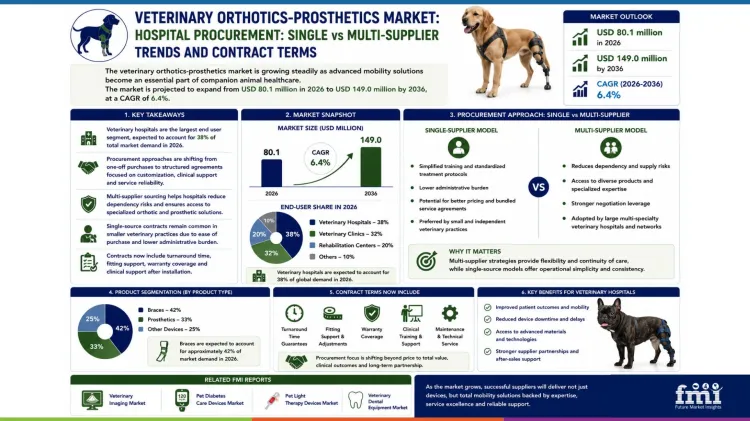
- The veterinary orthotics-prosthetics market is estimated to expand from USD 80.1 million in 2026 to USD 149.0 million by 2036, at a CAGR of 6.4% over the forecast period.
- The largest end user segment for orthotic and prosthetic solutions is expected to be the veterinary hospitals, which is expected to account for about 38% of the total market demand in 2026.
- Procurement approaches are shifting from the purchase of individual products to structured agreements with suppliers that focus on the ability to customize, clinical support and ongoing service reliability.
- Large multi-specialty veterinary hospitals are increasingly moving toward multi-supplier sourcing models to reduce dependency risks and ensure access to specialized orthotic and prosthetic solutions.
- Single-source contracts are still common in smaller veterinary practices, due to the ease of purchase, standardized products and less administrative burden.
- Contract negotiations are moving away from pricing alone and include more focus on turnaround time for custom devices, fitting support, warranty coverage and clinical support after installation.
The veterinary orthotics-prosthetics market is entering a period of steady growth as advanced mobility solutions become an increasingly important part of companion animal health care. Drivers for braces, prosthetics and custom mobility devices demand include increased pet humanization, increasing costs of specialized veterinary care and increased acceptance of orthopedic rehabilitation.
The market is expected to expand from an estimated USD 80.1 Million in 2026 to USD 149.0 Million by 2036 providing ample opportunities to the manufacturers and providers of veterinary care.
As the market matures, buying patterns in veterinary hospitals are becoming sophisticated.
Traditionally, orthotic and prosthetic devices are purchased from individual suppliers on a case-by-case basis. The choice of product was generally driven by clinician familiarity, availability locally and immediate needs of the patient.
Larger veterinary organizations today are adopting procurement frameworks that are more like those used across broader healthcare settings.
With orthopedics becoming more complex, veterinary hospitals want to formalize supplier relationships and establish purchasing standards. This trend is especially observed in multi-specialty hospitals which offer advanced orthopedic surgeries, rehabilitation therapies and long-term mobility management.
One of the most important strategic decisions for procurement teams is whether to rely on a single supplier or continue relationships with multiple vendors.
The single supplier models have some operational advantages.
Hospitals can often achieve lower prices, standardized training, and simplified service support by partnering with a single supplier. Consistent product specifications facilitate clinician education and lead to less variation in treatment routes for patients.
These benefits continue to appeal to smaller veterinary hospitals and independent specialty centers.
Administrative simplicity is often an important consideration. Procurement departments are often small, and managing multiple vendor relationships can add to the workload without much benefit to the bottom line.
Multi-supplier procurement strategies are gradually seeing increased adoption in the market.
Risk management is its main driver.
Custom orthotic and prosthetic devices often need custom design changes, specialized manufacturing and fast turnaround times. Hospitals that rely on a single supplier may be at risk of production delays, inventory shortages or service interruptions that impact patient care.
Multi-supplier models can help to mitigate these risks.
Hospitals have a wider choice of products, expertise in different orthopedic conditions and more agility in difficult clinical cases. It also enables procurement teams to compare vendor pricing and service quality, giving them more negotiating power when agreements are up for renewal.
These dynamics are especially related to the braces segment, which is expected to account for approximately 42% of the market demand in 2026. Braces are also commonly utilized for cruciate ligament injury, hip dysplasia management, post-surgical support and mobility assistance. Given the wide variation in patient demands, hospitals may benefit from access to a diverse set of suppliers with different product capabilities.
The contract terms are also changing.
Veterinary procurement agreements in the past were about price and delivery times. Increasingly, modern contracts are including performance-related clauses to ensure clinical continuity and customer support.
Turnaround time guarantees are especially important.
Custom prosthetic and orthotic devices require precise measurements, fabrication modifications, and fitting services. Delays can prolong the rehabilitation process and lead to adverse patient outcomes. Thus service level commitments are becoming more important to procurement teams.
Warranty provisions are also being subject to increased scrutiny.
Increasingly, veterinary practices are looking for coverage for manufacturing defects, fit adjustments, component replacement and technical support. These requirements become more and more important as advanced materials and digital fabrication technologies emerge.
Clinical support services are another procurement issue that is emerging.
Manufacturers often gain competitive advantage by offering consultancy, fitting support, rehabilitation advice and continuous training. Procurement evaluations are increasingly shifting beyond the physical product into the wider support ecosystem.
Geographic growth trends also further reinforce the need for procurement flexibility.
China is expected to grow at a CAGR of 6.2% and India at a CAGR of 5.6% till 2036. The expansion of veterinary infrastructure in these markets is providing opportunities for both regional and international suppliers. In fast developing areas, veterinary hospitals may be more inclined to adopt diversified sourcing models to address changing clinical needs and supplier availability.
These procurement changes are strategically important for manufacturers.
To win contracts, you need to be able to prove that you can customize, have reliable production capacity, a strong service network and consistent clinical outcomes. The quality of the product is still important, but buying decisions are becoming more holistic.
The misconception to avoid is that purchasing veterinary orthotics-prosthetics is still about relationships.
As the market matures, procurement processes are becoming more structured, data-driven and operationally focused. Veterinary hospitals are assessing vendors not just for their product offerings, but for their ability to support long-term clinical and economic goals.
Bottom Line
Procurement Strategies in Veterinary Orthotics-Prosthetics Market Become More Sophisticated. Single-supplier agreements are still simple and standardized, but multi-supplier models are becoming more popular as hospitals want more flexibility, supply security and access to specialized solutions. Instead of price negotiations, we’re negotiating contracts that cover all aspects of the quality of services, support for customization, and the value of long-term relationships.

