


- The veterinary procedure lights market is expected to reach USD 344.7 million in 2026 and USD 525.2 million by 2036, growing at a CAGR of 4.3% during the forecast period.
- Veterinary hospitals are increasingly consolidating procurement functions, affecting how lighting systems are bought, standardized and maintained across facilities.
- Still pursuing multi-supplier purchasing strategies, independent vet clinics aim for greater flexibility in pricing and choice of products.
- Large veterinary hospital networks are moving to single-supplier agreements to simplify servicing, staff training and equipment standardization.
- Contract negotiations are increasingly going beyond acquisition costs to cover preventive maintenance, warranty coverage, installation support, and replacement guarantees.
- The shift from halogen to LED lighting technologies is a good trend for long-term vendor partnerships as providers are more concerned about lifecycle value and operational reliability.
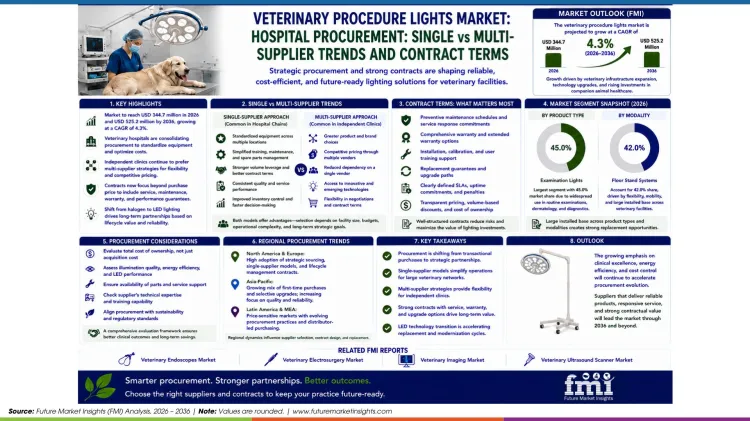
The veterinary procedure lights market is also witnessing evolution in line with broader trends in models for delivery of veterinary healthcare. The market is projected to reach USD 525.2 million by 2036 from USD 344.7 million in 2026, at a CAGR of 4.3% during the forecast period. Rising veterinary infrastructure, escalating investments in companion animal healthcare, and ongoing technology upgradation are boosting the demand for advanced procedure lighting systems.
Purchasing behavior in the market has been largely determined by procurement strategies.
Veterinary practices have traditionally purchased in a decentralized manner. Lighting systems were often selected by individual practices based on quick budget requirements, physician preference or distributor relationships. This environment naturally resulted in multi-supplier procurement structures.
Today the scene is getting more and more sophisticated.
Procurement frameworks similar to those in human healthcare settings are being used by major veterinary hospitals and commercial veterinary chains. Centralized decision making enables organizations to negotiate better terms and conditions while attaining consistency across various locations.
In such settings, single-supplier arrangements have gained momentum.
Veterinary organizations may want to consider pooling purchases from a single manufacturer to simplify maintenance procedures, lessen the level of difficulty of training, and create standard procedures for the examination and surgical suites. Also, standardized equipment platforms assist in inventory management by reducing the quantity of spare parts and consumables that need to be held on hand.
Such benefits become increasingly important as veterinary hospitals develop more advanced surgical capabilities.
Advanced orthopedic, soft tissue and emergency procedure facilities are increasingly looking for reliable lighting systems backed by responsive service networks. Procurement teams are therefore not only testing products on specs, but their ability to provide ongoing technical assistance.
Contract structures have evolved in tandem.
Modern procurement agreements typically include schedules of preventative maintenance, extended warranties, installation support and prearranged service response times. Some suppliers also offer equipment upgrade paths that allow facilities to migrate to newer technologies with minimal disruption to operations.
Nevertheless, the multi-supplier procurement remains relevant.
Independent veterinary practices often prefer a diversified supplier relationship to maintain flexibility in purchasing. Having various suppliers allows practices to compare pricing models, consider alternative technologies and negotiate better within tight capital budgets. This approach might also decrease reliance on one service provider.
But having multiple supplier environments can be a pain to operate. Over time, variations in equipment interfaces, servicing requirements and staff training needs may add to administrative complexity.
The ongoing transition to LED technology from halogen also impacts procurement.
LED procedure lights last longer, illuminate better and require less maintenance. As they are a long-term investment, veterinary organizations are increasingly looking for procurement contracts that are able to support the equipment throughout its lifecycle.
Segmentation trends also provide the context.
In 2026, the demand for examination lights was 45.0% of the total product demand, which indicates the extensive use of examination lights in general practice settings. The use of veterinary facilities during their development and modernization provides for the possibility of repeated procurement.
On the other hand, floor stand configurations represent 42.0% of the modality usage in 2026 due to their flexibility and versatility in various treatment settings.
Procurement behaviors are also different by region.
North America and European mature veterinary markets are increasingly preferring strategic sourcing practices based on supplier partnership and lifecycle management. Emerging markets, by contrast, tend to retain more fragmented buying patterns, with distributor-led purchasing and a heightened emphasis on price sensitivity.
Yet, common themes still emerge despite these differences. Veterinary providers are increasingly aware that acquisition cost is only one part of total value. Purchasing decisions today are equally as important in terms of reliability, technical assistance, equipment longevity and operational efficiency.
Manufacturers that can offer a complete procurement service are thus well positioned in the changing competitive environment.
Bottom line: Purchasing approaches in the veterinary procedure lights market are moving away from purely transactional buying and towards partnership based models that are more focused on creating long-term value. Independent clinics still have the flexibility of multiple suppliers, but larger veterinary organizations are increasingly choosing one-source services that allow for consistency, service continuity and operational efficiency.

