


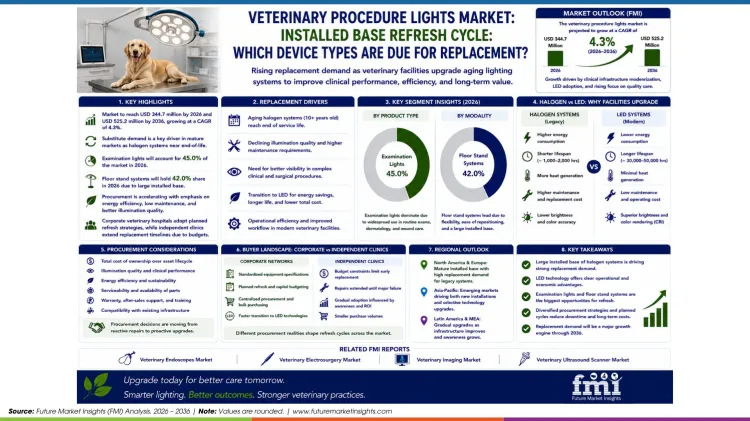
- The veterinary procedure lights market is projected to reach USD 344.7 million by 2026 and USD 525.2 million by 2036 at a CAGR of 4.3% as veterinary facilities continue to modernize their clinical infrastructure.
- Substitute demand is emerging as a key market driver, especially in mature veterinary markets where halogen-based systems are aging and nearing end-of-service life.
- Examination lights, the largest segment, are projected to capture 45.0% of the market in 2026 and are prone to systematic replacement cycles.
- Floor stand systems will account for 42.0% of the market in 2026 due to the large installed base and potential as a key driver of future upgrade demand.
- As veterinary providers transition from halogen to LED technology, procurement activity is picking up with a focus on energy efficiency, reduced maintenance and improved illumination quality.
- Corporate veterinary hospitals are more and more utilizing planned equipment refresh strategies while independent clinics still are using extended substitute timelines due to budget constraints.
The veterinary procedure lights market is entering an era where the demand for replacements is becoming as important as the demand for new installations. Ongoing growth of veterinary infrastructure enables first-time equipment purchases in developing areas, while mature markets are increasingly characterized by installed base renewal.
More than a decade ago, many veterinary hospitals and clinics converted to halogen lighting systems. These systems are still in service but increasing demands for quality of illumination, operational efficiency and total cost of ownership are forcing providers to look at their existing equipment portfolios.
As veterinary procedures become more complex, the importance of lighting performance becomes even more critical. Enhanced visibility increases diagnostic confidence, accuracy of procedures and workflow efficiencies. As such, clinical facilities are assessing whether legacy systems are appropriate for today’s clinical needs. The market is expected to grow from USD 344.7 million in 2026 to USD 525.2 million by 2036, driven by modernization efforts and increased expenditure on companion animal healthcare.
Examination lights among product categories accounts for the largest share of 45.0% in 2026. These systems are commonly used in routine consultation, dermatology, wound assessment and general examination. Their widespread use means that a large installed base will have to be replaced increasingly often during the forecast period.
Examination lights are especially vulnerable to refresh cycles because of their high usage. Frequent daily use leads to gradual reductions of the consistency of illumination and increased maintenance needs. In the quest for operational reliability, replacement decisions are moving away from reactive maintenance to proactive upgrade approaches.
Another major replacement opportunity lies in surgical lighting systems.
Veterinary hospitals performing orthopedic, emergency and specialty surgeries often find older technologies do not have the advanced illumination capabilities they need. In such environments, LED surgical systems with shadow reduction, improved colour rendering and adjustable intensity controls are becoming more attractive.
Replacement demand is another indication of the importance of the modality environment.
The dominant modality segment is the floor stand systems which hold the majority of market share of 42.0% in 2026. Their flexibility and ease of repositioning have made them a popular choice for clinics with multipurpose treatment areas. But their broad installed base also makes them a focal point for future refresh cycles.
The pace of technological change is speeding up the process.
LED systems are becoming a more common replacement for traditional halogen lights, for a few operational advantages. Stronger value propositions such as lower energy consumption, longer service life, less heat generation and improved illumination quality offset higher upfront costs.
More purchasing decisions by veterinary organizations are being driven by total costs.
Traditionally lighting purchases have often been driven only by acquisition price. Today, providers are more focused on maintenance costs, how often equipment needs to be replaced, workflow efficiency and equipment longevity. These factors favour technologies that can deliver sustained performance improvements over the asset lifecycle. Corporate veterinary networks are particularly affecting replacement patterns.
As consolidation sweeps the veterinary industry, larger organizations are rolling out standardized equipment specs for acquired facilities. This trend helps in building structured procurement cycles and systematic replacements of aging lighting inventories.
Independent practices exist in different realities.
There is a limitation on capital budgets and a tendency to maximize the usage of equipment. In these cases, the decision to replace equipment is usually made after a major breakdown or when the cost of continued maintenance becomes prohibitive. But ever-increasing awareness of the operational benefits of LED technology is sure to take a while to influence purchasing priorities, even among the smaller providers. Regional variations also exist.
North America and Europe have mature installed bases with higher densities of legacy halogen systems. As a result, these areas are expected to generate a significant amount of demand driven by replacement. Meanwhile, Asian emerging markets are likely to see both first-time installations and selective technology upgrades.
Responding to these trends, manufacturers may find opportunities beyond product innovation.
Trade-in programs, preventive maintenance agreements and lifecycle support services can help accelerate refresh decisions while forging stronger customer relationships. ‘Vendors who can show they have a proven ability to reduce operating expenses in a measurable way will probably be at a competitive advantage as buyers increasingly adopt more advanced procurement frameworks’.
Don’t fall into the trap of thinking that the veterinary lighting market is only driven by facility expansion.
In reality, replacement activity represents an increasingly important component of market growth. As veterinary providers pursue operational efficiency and clinical excellence simultaneously, aging equipment portfolios naturally become candidates for modernization.
Bottom line
The installed base refresh cycles are expected to be a key feature of the veterinary procedure lights market over the next decade. The move to LED technology, together with changing expectations of performance and cost effectiveness will continue to drive replacement strategies in veterinary hospitals and clinics around the world.

