


The Common Narrative
The common narrative around the Packaging and Packaging Waste Regulation is that recycled-content requirements will create a predictable transition away from virgin plastic. Once minimum thresholds are established, brands will increase demand for post-consumer recycled material, recyclers will expand capacity, converters will adapt their formulations, and the market will move towards a more circular supply base.
In many corporate plans, recycled-content compliance is treated as a procurement target. Packaging teams identify the required percentage, procurement teams source the resin, and converters validate the resulting structure. The expected commercial effect is a temporary material premium that declines as recycling capacity grows and supply becomes more standardized.
This narrative assumes that recycled plastic behaves like a normal commodity market. Higher demand is expected to attract investment, increase supply, improve quality, and gradually reduce price differences against virgin resin.
That is directionally reasonable, but commercially incomplete.
PPWR will not simply increase demand for recycled plastic. It will increase demand for specific grades, traceable sources, validated processing routes, and application-compatible material. Those requirements will not expand at the same speed across polymer types, packaging formats, or European countries. The transition is therefore more likely to create periods of procurement instability, qualification bottlenecks, and margin pressure before it creates a balanced circular-material market.
Why That Narrative Is Incomplete
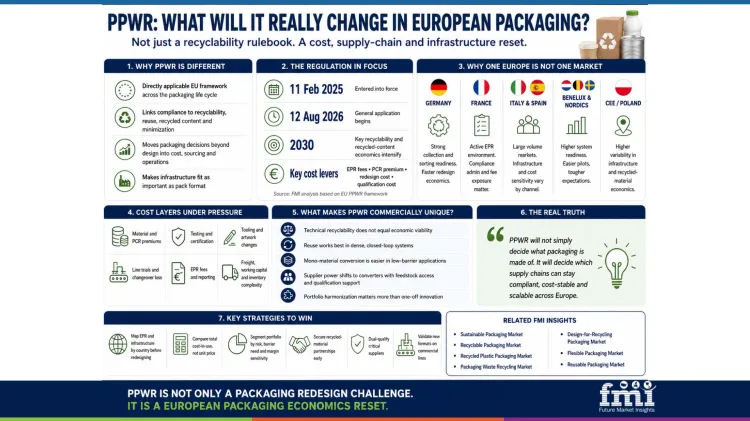
The phrase recycled content hides several different markets.
A high-quality recycled PET grade suitable for beverage packaging is not commercially interchangeable with recycled polyethylene used in transport film. Material required for food-contact packaging cannot be treated in the same way as material used in secondary packaging. Colour, odour, contamination, melt-flow consistency, mechanical performance, migration risk, and traceability all affect whether a recycled resin can be used in a particular application.
PPWR changes the value of these differences. When recycled content becomes a compliance requirement rather than a voluntary sustainability feature, demand shifts towards qualified material that can support both regulatory documentation and packaging performance. The constraint is no longer the total volume of recycled plastic available. The constraint is the volume that meets the technical and documentary requirements of a defined application.
This creates a mismatch between headline supply and usable supply.
A converter may be able to purchase recycled resin, but still be unable to use it across the customer's full portfolio. A brand may secure material for one high-volume bottle but struggle to replicate the solution across closures, films, trays, sachets, and specialist structures. A supplier may offer acceptable laboratory performance while failing to maintain consistency across commercial production batches.
Price volatility therefore emerges not only from the cost of waste feedstock or energy. It also emerges from qualification scarcity, limited approved suppliers, variable yields, rejected batches, blending requirements, and competition for application-grade material.
How the Market Actually Behaves
The market will not move towards recycled content evenly.
PET beverage packaging is likely to remain one of the more structured segments because collection systems, bottle-to-bottle recycling routes, and existing regulatory experience are more developed. Even here, access to suitable material depends on collection quality, sorting efficiency, flake contamination, decontamination capability, and competition from other uses.
Recycled polyethylene and polypropylene face a more fragmented path. Flexible films, closures, tubs, trays, and household-product packaging often require different mechanical, optical, sealing, or food-contact characteristics. Material streams are more mixed, and converting performance can vary more widely between batches.
Adoption will concentrate first in applications where appearance, odour, barrier performance, and migration requirements are less restrictive. Transport packaging, non-food rigid packaging, selected household-care formats, secondary films, and darker-coloured products can offer more manageable entry points.
Movement will be slower in transparent packaging, sensitive food applications, pharmaceutical formats, high-speed flexible lines, and products where a small performance loss can increase leakage, shelf-life failure, or consumer rejection.
Large brand owners will respond by securing volume through longer contracts, preferred-supplier agreements, and direct relationships with recyclers or resin producers. Some will reduce the number of packaging structures they use so that larger volumes can be concentrated into fewer qualified material systems.
Smaller brands and independent converters will be more exposed to spot availability and distributor pricing. They may technically comply with a recycled-content threshold but face greater cost variability because they lack scale, storage flexibility, or access to long-term feedstock agreements.
Supplier power will shift towards companies that control collection, sorting, washing, decontamination, compounding, conversion, or traceability across several stages of the chain. The strongest position will not necessarily belong to the supplier with the lowest quoted resin price. It will belong to the supplier that can deliver consistent, documented, application-ready material when customers need it.
Structural Constraints or Breakpoints
Material consistency is a central breakpoint.
Virgin resin is produced against tightly controlled specifications. Recycled resin depends on the quality of collected waste, sorting accuracy, contamination levels, processing technology, and blending. Variation affects colour, odour, mechanical strength, sealing, print performance, and machine stability.
Converters often compensate through additional testing, blending with virgin resin, slower production settings, higher scrap allowances, or narrower operating windows. These responses protect quality but increase conversion cost and weaken the apparent savings associated with recycled content.
Food-contact availability creates another breakpoint.
The amount of recycled plastic that is technically present in the market is larger than the amount qualified for sensitive contact applications. Decontamination requirements, traceability, regulatory authorization, and strict quality controls narrow the supplier base. Competition for this material can therefore become intense even when broader recycled-plastic supply appears adequate.
Qualification time also matters.
A new PCR source may require migration testing, shelf-life trials, line validation, colour approval, odour assessment, sealing tests, and customer sign-off. When the source changes, parts of the process may need to be repeated. This makes supplier substitution slower than normal commodity procurement.
Regional infrastructure adds another layer of volatility.
Countries with stronger collection and deposit-return systems can generate cleaner and more consistent feedstock. Markets with fragmented collection, lower sorting efficiency, or weaker recycling capacity may depend more heavily on imported recyclate or cross-border processing. Freight, energy, certification, and administrative costs then influence material pricing.
These differences mean that a European compliance target can produce several regional procurement realities.
Where Decisions Commonly Break
A frequent mistake is using an average PCR premium as the main budgeting assumption.
The premium for a broad polymer category does not reflect the actual cost of the grade required by a specific package. A low-cost recycled resin may not meet colour, odour, food-contact, barrier, or line-performance requirements. The relevant benchmark is the qualified material delivered to the production site, not the average recycled-resin price.
Another failure occurs when teams assume that a supplier approval solves the supply problem. Approval confirms technical suitability at a point in time. It does not guarantee future capacity, feedstock quality, batch consistency, or allocation during periods of tight demand.
Packaging teams may also set recycled-content targets without modelling yield loss. If recycled resin increases scrap, slows line speed, raises rejection rates, or requires more frequent cleaning, the effective cost per saleable unit can rise materially beyond the resin premium.
Single-source qualification creates a further risk. Companies often limit suppliers because qualification is expensive and time-consuming. That decision can improve short-term control but create bargaining weakness and production vulnerability when the approved supplier faces shortages or quality issues.
Another misjudgment is treating every polymer and application as though the same procurement strategy will work. PET bottles, flexible polyethylene films, polypropylene closures, rigid trays, and multilayer structures have different collection routes, recycling technologies, and performance constraints. A single company-wide recycled-content policy can therefore produce very different economic outcomes across the portfolio.
What Decision-Makers Should Do Differently
Companies should manage recycled content as a portfolio of material risks rather than a single sustainability target.
Each packaging structure should be classified by polymer, application sensitivity, required contact status, aesthetic requirement, line compatibility, annual volume, supplier count, and regional infrastructure. This identifies where recycled content can be adopted with limited disruption and where supply security requires greater intervention.
Procurement decisions should be based on application-grade cost. The calculation should include resin premium, freight, testing, compounding, blending, scrap, line-speed impact, quality rejection, inventory buffers, and supplier-qualification expense.
Longer contracts can improve supply visibility, but they should not replace resilience. Critical formats should have more than one technically qualified source where feasible. Dual qualification may increase development cost, but it reduces dependence on one recycler, compounder, or converter.
Companies should also distinguish between compliance volume and strategic volume. Material needed to meet minimum requirements must be secured with high confidence. Additional voluntary recycled content can be managed more flexibly where economics and supply conditions allow.
Converter selection should include the ability to handle variable recycled feedstock. Relevant capabilities include incoming-material testing, blending, process-control systems, colour and odour management, scrap control, traceability, and technical support.
Regional sourcing strategies should reflect feedstock reality. A centralized European contract may improve commercial leverage, but local collection quality, transport economics, certification, and plant qualification can still affect delivered cost. Central negotiation and regional execution may therefore be more practical than a single uniform sourcing model.
Management should define trigger points for material switching, price renegotiation, inventory increases, and alternative sourcing before disruption occurs. The goal is not to eliminate recycled-content premiums. It is to prevent compliance from becoming an uncontrolled source of margin volatility.
The Misconception to Avoid
The misconception is that recycled-content regulation will automatically create a stable commodity market for PCR.
Regulation creates demand. It does not guarantee uniform feedstock quality, application-grade availability, converter performance, or regional supply balance. Stability depends on the entire chain from collection and sorting to decontamination, compounding, conversion, qualification, and documentation.
Bottom Line
PPWR will make access to qualified recycled material a source of competitive advantage. The companies that protect margins will be those that manage PCR as a constrained, application-specific supply system rather than a simple substitute for virgin resin.
Related Future Market Insights Reports
- Recycled Plastic Packaging Market: Supports analysis of recycled-resin adoption, supplier activity, material availability and application demand.
- Post-Consumer Recycled Plastic Packaging Market: Provides context on PCR sourcing, quality variability, packaging applications and competitive positioning.
- PCR Plastic Packaging Market: Relevant for polymer-specific PCR demand, converter strategies and compliance-led material substitution.
- Recycled PET Packaging Market: Useful for bottle-to-bottle recycling, food-grade rPET availability and beverage packaging economics.
- Design-for-Recycling Packaging Market: Supports analysis of packaging redesign, recyclability requirements and converter capability.
- Sustainable Packaging Market: Provides broader context on material transition, end-use adoption and regional packaging strategies.
Sources
- European Commission, Packaging and Packaging Waste Regulation: https://environment.ec.europa.eu/topics/waste-and-recycling/packaging-waste/packaging-packaging-waste-regulation_en
- EUR-Lex, Regulation (EU) 2025/40: https://eur-lex.europa.eu/eli/reg/2025/40/oj/eng
- Future Market Insights, Recycled Plastic Packaging Market: https://www.futuremarketinsights.com/reports/recycled-plastic-packaging-market
- Future Market Insights, Post-Consumer Recycled Plastic Packaging Market: https://www.futuremarketinsights.com/reports/post-consumer-recycled-plastic-packaging-market
- Future Market Insights, PCR Plastic Packaging Market: https://www.futuremarketinsights.com/reports/pcr-plastic-packaging-market
- Future Market Insights, Recycled PET Packaging Market: https://www.futuremarketinsights.com/reports/recycled-pet-market
- Future Market Insights, Design-for-Recycling Packaging Market: https://www.futuremarketinsights.com/reports/design-for-recycling-packaging-market

