


The Common Narrative
The prevailing view of the Packaging and Packaging Waste Regulation is that Europe is moving towards a single packaging rulebook. Once common requirements for recyclability, recycled content, minimization, labelling, and reuse apply across the European Union, companies are expected to simplify packaging portfolios, reduce country-specific redesign, and operate against one compliance standard.
This interpretation is attractive to multinational brands and packaging suppliers. It suggests that a package qualified for the European market can be deployed across Germany, France, Italy, Spain, the Benelux countries, the Nordic region, and Central and Eastern Europe with limited variation. Procurement teams can consolidate volume, converters can standardize structures, and brands can reduce the cost of maintaining multiple national specifications.
The legal logic supports part of that expectation. PPWR replaces a directive-led framework with a directly applicable regulation and aims to reduce fragmentation in the internal market. The regulation entered into force on 11 February 2025 and generally applies from 12 August 2026.
The commercial conclusion, however, is often taken too far. A common legal framework does not create a common packaging economy.
Why That Narrative Is Incomplete
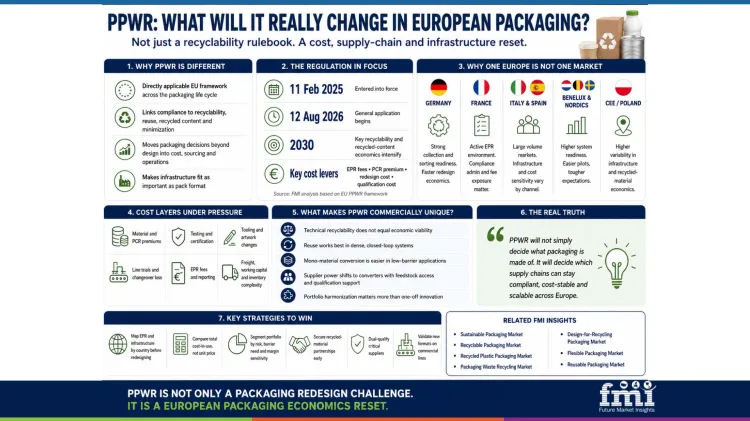
Packaging performance under PPWR will depend on systems that remain national, regional, and local. Collection coverage, sorting technology, recycling capacity, EPR fee structures, deposit-return systems, municipal contracting, recycled-material availability, and consumer participation differ materially across Europe.
These differences affect whether a packaging format is collected in practice, whether it is correctly identified at a sorting facility, whether sufficient recycling capacity exists, and whether the recovered material has commercial value. They also influence the recurring cost paid by the producer placing the package on the market.
EPR obligations already illustrate the gap. France uses a producer responsibility organization model in which household packaging contributions depend on declarations that include units and material characteristics. Germany requires registration in the LUCID Packaging Register and system participation for packaging that typically reaches private final consumers. Italy applies environmental contributions through the CONAI system and differentiates parts of its fee structure according to material and recyclability characteristics. These systems may move closer under PPWR, but they will not become identical operating environments overnight.
Regional material economics also remain uneven. Prices for recycled polymers, recovered paper, glass cullet, aluminium, coatings, and compliant barrier materials depend on local collection quality, processing capacity, energy cost, logistics, and competition for feedstock. A harmonized recycled-content obligation can therefore produce different procurement costs in different countries.
How the Market Actually Behaves
Companies will pursue European harmonization where the technical and economic conditions support it, but they will retain regional exceptions where infrastructure or product performance makes a single structure impractical.
Markets with mature collection and recycling systems can absorb some PPWR requirements more efficiently because packaging already moves through established recovery channels. Eurostat reported that seven EU countries had already reached the 2030 target of recycling 70% of total packaging waste in 2023. Belgium, the Netherlands, Italy, Czechia, Slovenia, Slovakia, and Spain were above that threshold. The EU average was 67.5%, yet the country spread remained wide.
Plastic packaging shows an even sharper divide. The EU recycled 42.1% of generated plastic packaging waste in 2023. Belgium and Latvia were close to 60%, while Hungary, France, and Austria reported rates below 27%. These figures do not measure every aspect of infrastructure quality, but they demonstrate why a single technical design can encounter very different end-of-life conditions.
Brand owners will respond by creating a European core specification with controlled regional variations. The core may standardize resin families, labels, closures, inks, or format geometry. Regional versions may still differ in recycled-content level, decoration, barrier system, deposit marking, EPR reporting data, or approved converter.
Supplier selection will also become more regional. Large converters with multi-country plants, local regulatory knowledge, and access to qualified recycled material will be better positioned for European contracts. Local converters may remain competitive where they understand domestic EPR rules, serve regional filling plants, or have stronger access to local recycling streams.
This means PPWR may reduce legal fragmentation while increasing the commercial value of regional execution capability.
Structural Constraints or Breakpoints
EPR cost is a recurring breakpoint because the fee basis and administrative route differ across countries. Packaging weight, material, unit count, recyclability, recycled content, and format characteristics can affect contributions in different ways. A design change that improves the fee position in one system may produce a smaller saving elsewhere. Companies that use one European average for EPR cost risk misallocating redesign budgets and mispricing country portfolios.
Collection and sorting performance create another breakpoint. A package may meet a European design criterion but still move through local infrastructure with different capture rates, sorting yields, contamination levels, and bale quality. The commercial value of recyclability depends on whether the package reaches the correct stream and whether the resulting output has a dependable buyer.
Recycling capacity is also material-specific. Paper, glass, metals, PET, polyethylene, polypropylene, and complex flexible packaging do not share the same processing network. Capacity can be concentrated in certain countries and dependent on cross-border movement of waste or secondary material. Local shortages may increase transport distance, handling cost, and feedstock premiums even when the legal requirement is common.
Regional material pricing is the final breakpoint. Recycled-content mandates increase demand for qualified feedstock, but local supply quality and processing cost remain uneven. Food-contact recycled polymers are especially sensitive to source-stream quality, decontamination capability, traceability, and regulatory approval. Buyers without local or long-term supply arrangements may face a different cost curve from competitors selling the same type of product in another European market.
Where Decisions Commonly Break
A common failure is to treat Europe as one line item in a packaging business case. Teams calculate a regional average for EPR, recycled-material premium, collection performance, and conversion cost. The average may look acceptable while concealing countries where the format is operationally weak or commercially uneconomic.
Another failure occurs when a successful launch in Germany, the Netherlands, or Belgium is treated as proof of European scalability. These markets can offer strong collection or sorting conditions for selected materials, but that does not guarantee equivalent economics in France, Hungary, Romania, Greece, or other markets with different infrastructure, fee systems, and procurement conditions.
Companies also misjudge supplier capability when they equate European sales coverage with European production and compliance support. A converter may ship across the region but lack local recycled-material sourcing, domestic EPR expertise, or technical-service capacity near the customer filling plant. The weakness appears during line trials, claim substantiation, documentation, or supply disruption rather than at the quotation stage.
Portfolio harmonization can also fail when it is pursued too aggressively. A single structure may be technically acceptable across Europe but unnecessarily expensive in markets where lower-cost compliant alternatives exist. Conversely, excessive localization can destroy purchasing scale, multiply qualification work, and increase inventory complexity. The decision challenge is not choosing between full standardization and full localization. It is defining where variation creates measurable value.
What Decision-Makers Should Do Differently
Packaging decisions should be built from country clusters rather than a single European average. Markets can be grouped by EPR structure, packaging recycling performance, material-specific collection, deposit-return coverage, recycled-feedstock availability, converter base, and logistics density.
Companies should maintain a country-level compliance and economics ledger for major packaging formats. The ledger should track EPR contribution logic, collection route, sorting compatibility, recycling outlet, recycled-material premium, local converter options, transport distance, and qualification status. This allows the same design to be evaluated against different operating environments.
European core specifications should be used where they protect purchasing scale and simplify manufacturing. Regional deviations should be allowed only when they improve compliance economics, infrastructure fit, product performance, or supply continuity. Every deviation should have a defined business reason rather than being inherited from historical local practice.
Supplier qualification should test regional execution, not only technical capability. Buyers should examine where the supplier produces, where it sources recycled material, which EPR systems it understands, how quickly it can support plant trials, and whether it has contingency capacity within the region.
Material sourcing should be connected to infrastructure mapping. A country with strong collection performance can still have limited availability of a specific food-grade recycled polymer. A country with lower domestic recycling may import secondary feedstock or finished packaging competitively. The relevant question is not whether a country performs well in general, but whether the required material and format have a viable local or cross-border system.
Management should also separate legal harmonization from economic harmonization. PPWR creates a common direction and common product requirements, but commercial decisions must still reflect national fee structures, infrastructure readiness, supplier capability, and material availability.
The Misconception to Avoid
The misconception is that one EU regulation will create one European packaging market.
PPWR will reduce parts of the regulatory fragmentation, but packaging cost and feasibility will still be shaped by national EPR systems, local collection, sorting and recycling performance, regional material supply, and converter capability. A package can be legally aligned across Europe while remaining economically uneven.
Bottom Line
PPWR will standardize the rules faster than Europe can standardize the systems behind them. The companies that perform best will design for a common legal framework while managing packaging economics country by country.
Key Metrics to Research
| Metric | What to Track | Decision Use |
|---|---|---|
| EPR cost by country | Producer contribution by material, unit, weight, recyclability class and packaging type | Shows recurring compliance cost and redesign payback by market |
| Packaging collection rate | Share of packaging captured through relevant collection systems | Tests whether technically recyclable packaging is likely to enter recovery streams |
| Sorting capacity and yield | Installed sorting capacity, throughput, capture efficiency and contamination | Indicates whether packaging can be separated into a commercially usable stream |
| Recycling infrastructure | Material-specific processing capacity, utilization, technology and geographic coverage | Shows whether collected packaging can be recycled at scale |
| Regional material price | Virgin and recycled material price, premium, freight and contract terms | Measures country-level packaging cost and procurement risk |
| Converter availability | Qualified suppliers, available capacity, lead time and regional plant coverage | Assesses supplier competition and continuity |
Related Future Market Insights Reports
- Sustainable Packaging Market: Broad context on sustainable materials, regional adoption and supplier strategies.
- Packaging Waste Recycling Market: Collection, sorting, processing capacity and recovered feedstock economics.
- Design-for-Recycling Packaging Market: Packaging redesign, recyclability criteria and PPWR-linked product decisions.
- Europe Flexible Plastic Packaging Market Share Analysis: Regional converter positioning and flexible packaging transition in Europe.
- EU Food-Grade rPP from Household Rigid Packaging Market: Country and supplier implications for qualified recycled polypropylene feedstock.
- Barrier Packaging Industry Analysis in Europe: Application-level constraints in food, healthcare and pharmaceutical packaging.
- Paper Packaging Market: Regional paperisation, fibre supply and format substitution.
- Recyclable Packaging Market: Commercial adoption of recyclable formats across materials and applications.
Sources
- Regulation (EU) 2025/40, official text
- European Commission, Packaging Waste overview
- Eurostat, Packaging waste statistics
- Eurostat, Plastic packaging waste in the EU, 2023 data
- Citeo, household packaging and paper contribution rates
- Germany ZSVR, Packaging Register and system participation
- CONAI, 2026 contribution guide notice

