


The Common Narrative
Recyclable packaging is often compared by material. Paper is evaluated against plastic, aluminium against steel, glass against rigid polymers, and mono-material flexible formats against multilayer structures. The discussion usually centres on material price, recyclability, recycled content, carbon performance, and consumer acceptance.
This creates the impression that the economics of a package travel with the material. A fibre-based pack should carry broadly similar recycling advantages across Europe. An aluminium container should benefit from high residual value in every market. A mono-PE pouch should become economically attractive wherever the same design is sold.
The PPWR reinforces the search for common packaging solutions by establishing harmonised sustainability, labelling, recyclability, recycled-content, minimisation, and reuse requirements across the European Union. Brands naturally want a limited number of packaging specifications that can serve several countries.
The assumption is that material choice will be the dominant driver of cost and compliance.
In practice, country-level systems often matter more.
Why That Narrative Is Incomplete
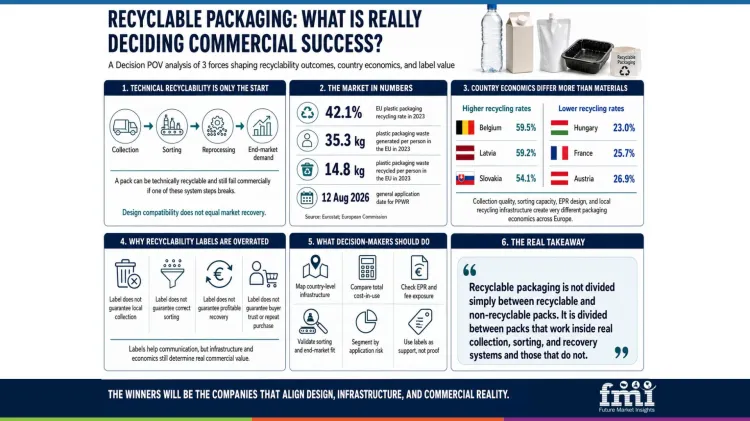
Packaging material is only one part of the economic equation. The same pack can face different EPR fees, collection routes, sorting performance, deposit obligations, recycling capacity, transport distances, administrative costs, and secondary-material demand depending on where it is placed on the market.
A recyclable design can therefore generate a low total burden in one country and a much higher burden in another. The package has not changed. The surrounding system has.
National and local infrastructure affects both cost and recovery. Dense collection networks and advanced sorting systems can improve capture and reduce the amount of material lost. Limited domestic processing may force material to travel farther or depend on cross-border capacity. Higher contamination can reduce yield and raise washing and sorting costs.
EPR structures also influence portfolio economics. Producer fees, reporting categories, modulation rules, registration requirements, and compliance schemes can differ even within a harmonised regulatory framework. PPWR reduces regulatory fragmentation at product-rule level, but it does not instantly create identical waste-management economics.
Regional material prices add another layer. Virgin resin, recycled resin, recovered fibre, aluminium, glass cullet, energy, labour, and freight differ by country and contract structure. The economically preferred design can change when these variables move.
How the Market Actually Behaves
Recyclable packaging adoption advances most smoothly in markets where regulation, infrastructure, and material demand reinforce one another.
Countries with mature deposit-return systems can generate relatively clean beverage-container streams and support high-value recycling. Markets with established paper collection can make fibre packaging commercially attractive, provided coatings, food contamination, and fibre quality do not reduce yield. Strong metal-recycling economics can support aluminium and steel formats because the recovered material retains commercial value.
Flexible packaging remains more uneven. CEFLEX states that mechanical recycling of flexible PE and PP is proven at commercial scale in Europe, but also notes that substantially more infrastructure is required as more countries begin collecting household flexible packaging. This means a mono-material pouch can have a credible route in one market and a weak route in another.
Brand strategies reflect this divergence. Some companies harmonise the base packaging structure but vary labels, disposal instructions, fees, or rollout timing by country. Others delay conversion in markets where the recycling system cannot yet support the intended claim or economics.
Converters and recyclers also respond regionally. Investment follows dependable feedstock, policy clarity, customer commitments, and end-market demand. A country with strong theoretical need but uncertain collection volumes may struggle to attract capacity.
The commercial market is therefore shaped by the interaction of material and place. The question is not only whether a package can be recycled, but whether that country can recycle it consistently and economically.
Structural Constraints or Breakpoints
EPR fee structure is a major breakpoint. Fee levels and modulation can alter the recurring cost of a packaging format. A redesign that appears economical under one national scheme may deliver a weaker return elsewhere.
Collection rate and coverage determine how much material enters the system. High design compatibility has limited value when consumer access to the correct collection route is weak or disposal instructions are inconsistent.
Sorting capacity affects capture and bale quality. Optical sorting, manual quality control, facility configuration, and packaging form influence whether the material reaches the appropriate recycler.
Domestic recycling capacity determines processing resilience. Countries that lack appropriate assets may rely on exports or distant facilities, increasing freight, working capital, and exposure to cross-border policy changes.
Regional material pricing influences both the initial package and the recovered output. Recycled-content premiums, virgin-material discounts, recovered-fibre quality, energy prices, and end-market demand can change the relative economics of plastic, fibre, metal, and glass.
These factors explain why a material-level strategy can produce different country-level returns.
Where Decisions Commonly Break
A common error is selecting one European packaging design and applying one economic assumption across every market.
The company may compare the material cost of the old and new package but omit EPR, reporting, logistics, and recycling-system differences. The result is a technically harmonised pack with uneven profitability.
Another failure is treating national recycling-rate rankings as a complete guide. A country can perform strongly overall while remaining weak in a specific stream such as flexible plastics, composite cartons, coated fibre, or small-format packaging.
Brands can also overestimate the benefit of local material sourcing. A domestic substrate may reduce inbound freight but still face high compliance cost or weak recovery infrastructure after use.
Investment cases often assume that recycling capacity will appear automatically once regulation creates demand. Recyclers require dependable feedstock volume, long-term contracts, energy access, and buyers for the output. Policy pressure without these conditions may increase cost before it improves capacity.
A further mistake is changing the material without changing the market strategy. A paper, plastic, metal, or glass solution may need different country sequencing, supplier networks, and consumer communication to succeed commercially.
What Decision-Makers Should Do Differently
Packaging economics should be modelled country by country before the final structure is selected.
The comparison should include packaging purchase cost, EPR fees, packaging taxes where applicable, recycled-content premiums, reporting costs, deposit requirements, freight, collection coverage, sorting capture, recycler access, and expected value of recovered material.
Countries should be grouped by system readiness rather than geography alone. Useful clusters may include strong deposit-return markets, advanced mixed-material systems, high-cost EPR markets, infrastructure-development markets, and import-dependent recycling markets.
A common European design can still be valuable, but the commercial rollout should be staged. Markets with established infrastructure and clear economics can move earlier. Markets with limited capacity may require cautious claims, alternative formats, or delayed implementation.
Supplier strategy should also account for regional feedstock and processing realities. Central procurement may improve scale, while local or regional execution can reduce freight and qualification risk.
Management should monitor EPR fee changes, collection expansion, sorting upgrades, recycling-capacity additions, and secondary-material prices as operating variables rather than static regulatory background.
The best packaging decision is not the material with the strongest general reputation. It is the material and format that fit the economics of the country in which the package will be sold and recovered.
The Misconception to Avoid
The misconception is that recyclable packaging has one European cost profile determined mainly by material.
The same material can face different collection, fee, sorting, processing, and end-market conditions. Country systems convert technical recyclability into very different commercial outcomes.
Bottom Line
Recyclable packaging economics are local even when packaging regulation is European. Material choice sets the technical potential, but country-level EPR, infrastructure, capacity, and secondary-material markets determine the real cost and value.
Related Future Market Insights Reports
- Recyclable Packaging Market: Primary FMI report covering recyclable materials, packaging formats, end-use adoption, and supplier competition.
- Design-for-Recycling Packaging Market: Supports analysis of packaging redesign, recycling compatibility, and compliance-led innovation.
- Packaging Waste Recycling Market: Relevant for collection, sorting, reprocessing capacity, and the economics of actual recycling.
- Sustainable Packaging Market: Provides wider context on material transition, regulation, and brand packaging strategies.
- Recycled Materials Packaging Market: Supports analysis of secondary-material demand, feedstock quality, and circular supply chains.
- Flexible Plastic Packaging Market: Relevant for films, pouches, mono-material conversion, and flexible-packaging recycling constraints.
Sources
- Regulation (EU) 2025/40, EUR-Lex: https://eur-lex.europa.eu/eli/reg/2025/40/oj/eng
- EUR-Lex summary, Packaging and Packaging Waste from 2026: https://eur-lex.europa.eu/EN/legal-content/summary/packaging-and-packaging-waste-from-2026.html
- RecyClass Design for Recycling Guidelines: https://recyclass.eu/protocols-guidelines/design-for-recycling-guidelines/
- RecyClass Packaging Design Guidelines: https://recyclass.eu/protocols-guidelines/design-for-recycling-guidelines/packaging/
- CEFLEX Designing for a Circular Economy Guidelines: https://guidelines.ceflex.eu/
- CEFLEX Recyclability Guidance: https://guidelines.ceflex.eu/guidelines/recyclability/
- Future Market Insights, Recyclable Packaging Market: https://www.futuremarketinsights.com/reports/recyclable-packaging-market
- Future Market Insights, Design-for-Recycling Packaging Market: https://www.futuremarketinsights.com/reports/design-for-recycling-packaging-market
- Future Market Insights, Packaging Waste Recycling Market: https://www.futuremarketinsights.com/reports/packaging-waste-recycling-market

