


The Common Narrative
Sustainable packaging has traditionally been framed as a reputation and compliance issue. Brands commit to recyclable, reusable, lower-carbon, fibre-based, compostable, or recycled-content formats because investors, retailers, regulators, and consumers expect visible progress. The central assumption is that sustainability performance creates brand value, protects market access, and strengthens long-term trust.
In many boardroom discussions, the financial question is treated as secondary. Packaging teams identify a preferred material or format, sustainability teams validate the environmental claim, and procurement negotiates the incremental cost. The premium is often considered an acceptable investment in ESG performance, especially when the new pack can be communicated through labels, annual reports, or product positioning.
This framing implies that sustainable packaging is mainly a question of ambition. Companies that move faster appear more progressive, while companies that delay appear reluctant to invest.
That interpretation is no longer sufficient. As packaging regulation, recycled-content requirements, EPR fees, retailer specifications, and material constraints become more commercially important, sustainable packaging is moving directly into product margin, supplier power, and portfolio economics.
Why That Narrative Is Incomplete
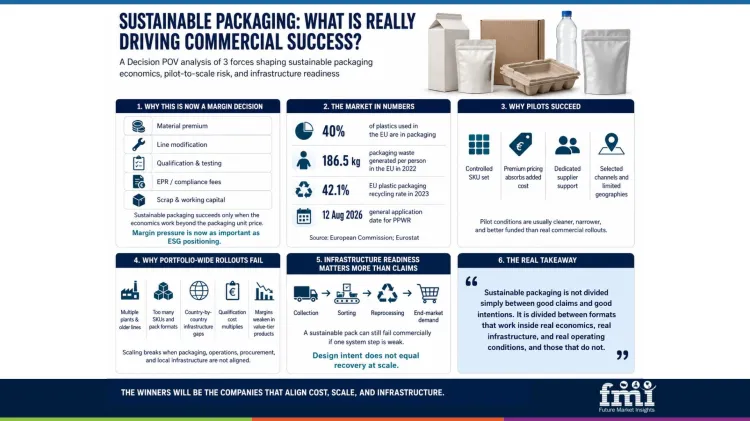
A packaging change rarely affects only the purchased pack. It can alter filling speed, scrap, shelf life, product damage, freight, warehousing, quality assurance, supplier qualification, and working capital. A format that looks more sustainable on a material scorecard can therefore reduce margin if the wider operating system is not aligned.
The cost also behaves differently by product tier. Premium products may absorb a higher packaging cost because packaging supports differentiation and the retail price provides more room. Value-tier products operate with narrower margins and greater price sensitivity. The same sustainable format can therefore be viable in one part of the portfolio and destructive in another.
Material substitution can introduce hidden concentration risk. Food-grade PCR, barrier-coated paper, compostable polymers, specialty adhesives, and advanced mono-material films may come from a smaller pool of qualified suppliers than conventional materials. A sustainability transition can reduce one type of risk while increasing exposure to allocation, price volatility, or supplier dependence.
Regulatory economics add another layer. PPWR is designed to make packaging recyclable in an economically viable way and to increase recycled plastic use, while EPR systems and country-level implementation will influence recurring cost. Sustainability is therefore becoming a continuous operating expense and margin-management issue rather than a one-time design decision.
How the Market Actually Behaves
Adoption concentrates where sustainability improvements can be achieved without disrupting product protection or production economics. Secondary packaging, transport formats, standard bottles, selected rigid containers, lower-barrier films, and high-volume paper-based applications often provide clearer conversion pathways.
Progress is slower where the package performs several critical functions. High-barrier foods, pharmaceuticals, medical products, liquids, retort applications, and long-shelf-life products require sealing, migration, barrier, sterilisation, and mechanical performance that cannot be traded away for a stronger sustainability claim.
Large brands tend to rationalise structures and consolidate suppliers. They can use scale to secure recycled materials, fund trials, and spread qualification cost across larger volumes. Smaller brands face higher cost per unit, weaker material access, and less leverage over minimum order quantities or technical support.
Converters also behave selectively. Suppliers with coating, orientation, recycled-content processing, testing, and multi-country support can charge for capability or use it to win strategic accounts. Commodity converters may carry development cost without sufficient pricing power. The market therefore rewards sustainable solutions that improve compliance and protect economics, not those that only improve the external claim.
Structural Constraints or Breakpoints
Total cost-in-use is the main breakpoint. Material cost is visible, while line losses, scrap, quality failures, damaged goods, and inventory complexity can remain hidden across departments. A lower-plastic or higher-recycled-content structure can still create a higher cost per saleable unit.
Performance is another constraint. Lightweighting can reduce material but weaken compression strength. Paper substitution can require coatings that add cost or complicate recycling. Recycled resin can affect colour, odour, consistency, or sealing. Reuse can increase durability requirements, washing cost, and reverse-logistics exposure.
Qualification time limits speed. Material changes can require shelf-life studies, migration testing, line trials, artwork changes, supplier audits, and customer approval. These costs multiply across large SKU portfolios.
Supply continuity is also decisive. Sustainable materials are not always available in the grade, volume, geography, and certification required. Companies that rely on a narrow supplier base can face cost spikes or delayed launches when demand tightens.
Where Decisions Commonly Break
A common failure is approving a sustainable pack on unit price and environmental benefit without calculating total margin impact. Operations may later discover slower speeds, higher scrap, or more frequent stoppages.
Another failure occurs when a premium-market pilot is used to justify a mass-market rollout. The premium SKU may absorb the cost and receive dedicated technical support. The value-tier portfolio may not.
Companies also overestimate the value of consumer willingness to pay. Consumers may support sustainability in surveys but still choose on price, convenience, freshness, or familiarity at the shelf.
A further mistake is treating compliance as a packaging-team responsibility. Procurement, manufacturing, logistics, quality, finance, marketing, and regulatory teams all carry part of the cost. When these functions are not aligned, savings in one area become losses in another.
Supplier selection can also fail when buyers prioritize a strong sustainability story over proven commercial capacity. A supplier may have an innovative format but lack stable feedstock, backup assets, multi-plant support, or the working capital needed to scale.
What Decision-Makers Should Do Differently
Companies should evaluate sustainable packaging through a margin bridge. The comparison should include material, conversion, tooling, qualification, line speed, scrap, freight, storage, product waste, EPR exposure, and working capital.
Portfolio segmentation should come before broad commitments. Products should be grouped by margin sensitivity, technical risk, annual volume, country exposure, and supplier availability. High-volume, low-risk formats can move earlier. Safety-critical and low-margin products require more controlled pathways.
Procurement should assess supplier resilience as closely as price. Relevant criteria include qualified material access, available capacity, technical-service capability, data quality, certification, alternate sites, and the ability to maintain performance across commercial production.
Companies should also separate compliance spending from differentiation spending. Some investments are necessary for market access. Others are justified only when they improve brand value, efficiency, or customer preference.
The strongest decisions will protect sustainability progress and product economics at the same time. A packaging change that cannot survive normal production, procurement, and margin pressure is not yet a scalable sustainability solution.
The Misconception to Avoid
The misconception is that sustainable packaging is an ESG premium that can be evaluated outside normal product economics.
Sustainable packaging now affects recurring fees, material access, operating efficiency, supplier leverage, and price realization. It belongs inside the margin model, not beside it.
Bottom Line
Sustainable packaging is becoming a commercial discipline. The winners will be companies that improve environmental performance while controlling total cost-in-use, qualification risk, supplier exposure, and portfolio margin.
Related Future Market Insights Reports
- Sustainable Packaging Market: Primary FMI report covering materials, formats, end uses, regional adoption and supplier strategies.
- Sustainable Packaging Market Share Analysis: Supports competitive benchmarking, supplier positioning and capability comparison.
- Recyclable Packaging Market: Relevant to design-for-recycling, material compatibility and market recovery pathways.
- Packaging Waste Recycling Market: Provides context on collection, sorting, processing capacity and end-market development.
- Recycled Plastic Packaging Market: Supports analysis of PCR availability, qualification, premiums and supplier risk.
- Reusable Packing Market: Relevant to closed-loop systems, return rates, asset circulation and reverse logistics.
- Paper Packaging Market: Supports analysis of fibre substitution, paperisation and cost-performance trade-offs.
Sources
- European Commission, Packaging waste and PPWR: https://environment.ec.europa.eu/topics/waste-and-recycling/packaging-waste_en
- EUR-Lex, Regulation (EU) 2025/40: https://eur-lex.europa.eu/eli/reg/2025/40/oj/eng
- Future Market Insights, Sustainable Packaging Market: https://www.futuremarketinsights.com/reports/sustainable-packaging-market
- Future Market Insights, Sustainable Packaging Market Share Analysis: https://www.futuremarketinsights.com/reports/sustainable-packaging-market-share-analysis
- Future Market Insights, Packaging Waste Recycling Market: https://www.futuremarketinsights.com/reports/packaging-waste-recycling-market
- Future Market Insights, Recyclable Packaging Market: https://www.futuremarketinsights.com/reports/recyclable-packaging-market
- Future Market Insights, Recycled Plastic Packaging Market: https://www.futuremarketinsights.com/reports/recycled-plastic-packaging-market
- Future Market Insights, Reusable Packing Market: https://www.futuremarketinsights.com/reports/reusable-packing-market

