


The Common Narrative
Sustainable packaging pilots are often treated as proof that a new format is ready for scale. A recyclable pouch runs successfully on one line, a paper-based container performs in one product family, a refill system achieves encouraging return rates in one city, or a reusable pack delivers a lower environmental footprint under controlled conditions.
The usual interpretation is that the main uncertainty has been removed. Once technical feasibility is demonstrated, commercial rollout appears to be a matter of procurement, capacity, and timing. Teams begin planning wider deployment across brands, plants, countries, and channels.
Pilot success also carries internal momentum. It supports sustainability commitments, creates a visible innovation story, and allows executives to show progress. The organization can become committed to scaling before the operating model has been fully tested.
The problem is that a pilot proves possibility under selected conditions. It does not prove repeatability across a portfolio.
Why That Narrative Is Incomplete
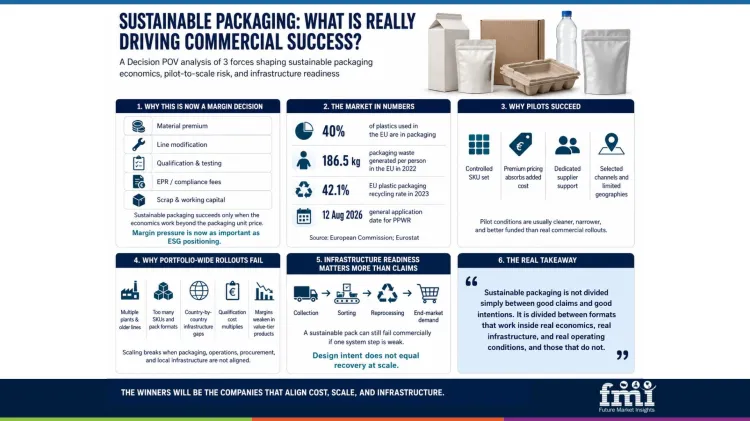
Pilots are designed to reduce risk. They use a limited number of SKUs, carefully selected equipment, dedicated technical support, controlled materials, and a manageable customer group. Commercial rollout removes many of those protections.
A portfolio introduces different product viscosities, barrier needs, pack sizes, artwork, line speeds, plants, operators, climates, warehouses, retailers, and regulatory conditions. Small deviations that are invisible in a pilot can become material when repeated across millions of units.
Pilot economics are also distorted. Development teams may absorb testing cost, suppliers may subsidize materials, production runs may be slower, and logistics may be manually managed. These conditions do not reflect the cost structure of routine production.
Reuse and refill pilots are particularly vulnerable. Return rates, washing, loss, contamination, and reverse logistics often look manageable in a dense or incentivized test area. Wider rollout introduces fragmented retail, lower participation, longer transport distances, and asset leakage.
How the Market Actually Behaves
Sustainable packaging scales where the new system can be standardized. High-volume products, a limited number of pack formats, concentrated production, strong retailer control, and a stable supplier base create better conditions.
Rollout becomes harder as SKU complexity increases. Each variation can require new tooling, artwork, testing, line settings, and inventory. A portfolio with hundreds of low-volume formats can consume more qualification effort than a few high-volume products, even when total sales are similar.
Scale also exposes plant differences. A format validated on a modern line may not perform on older assets. Sealing windows, web tension, stiffness, forming behaviour, closure torque, and coating sensitivity can create different outcomes across factories.
Country expansion adds further variation. Collection systems, EPR fees, recycled-material availability, labelling, and retailer expectations differ. A pack that is commercially attractive in one market may have weak recovery economics or higher administrative cost elsewhere.
Supplier behaviour changes at scale as well. The pilot may use a specialist supplier with close technical support. Wider rollout requires larger capacity, backup sites, consistent quality, and stable raw-material access. Not every innovative supplier can make that transition.
Structural Constraints or Breakpoints
Qualification capacity is a major breakpoint. Packaging, quality, regulatory, and operations teams can validate only a limited number of changes at one time. A portfolio-wide program can create an internal bottleneck even when suppliers are ready.
Asset compatibility is another constraint. New materials may need different temperatures, pressures, speeds, changeover practices, or inspection standards. The cost of modifying several plants can exceed the cost demonstrated in the pilot.
Material consistency becomes more difficult at volume. Recycled, fibre-based, coated, or bio-based materials can vary by supplier and batch. Commercial production requires a wider specification window and stronger incoming-quality control.
Transition inventory also matters. Old and new packaging frequently coexist. Companies must manage existing stock, write-offs, artwork changes, supplier contracts, and parallel production. This creates working-capital pressure and planning complexity.
Organizational ownership is another breakpoint. A pilot can be driven by one innovation team. Scale requires procurement, operations, finance, logistics, quality, regulatory, marketing, and sales to make coordinated decisions.
Where Decisions Commonly Break
A common failure is scaling directly from a successful pilot without an intermediate industrialization phase. The pack has been proven technically, but the production system, supplier network, and cost model have not.
Another failure is using average portfolio economics. A format may be profitable in large SKUs and uneconomic in small ones. Applying one business case across the entire portfolio hides these differences.
Teams also underestimate the value of supplier support during the pilot. Engineers may be present at every run, materials may be selected manually, and issues may be resolved immediately. Routine production cannot depend on that level of intervention.
Country rollout can fail when one market is used as the template for all others. Infrastructure, EPR, retail channels, and consumer behaviour change the result.
A further mistake is setting a public deadline before commercial thresholds are defined. Teams then optimize to meet the date rather than to deliver a stable, profitable system.
What Decision-Makers Should Do Differently
Companies should introduce an industrialization gate between pilot and rollout. This phase should test repeatability, multiple batches, normal operators, full line speed, different plants, and realistic logistics.
Rollout should be segmented by SKU economics and technical difficulty. High-volume, low-risk formats should move before low-volume, high-complexity formats. Exception pathways should be documented rather than hidden.
The cost model should include development, tooling, testing, scrap, line speed, training, inventory conversion, supplier qualification, and country-level compliance. Pilot subsidies and one-time support should be removed from the commercial case.
Suppliers should be evaluated for scale capability, not only innovation capability. Capacity, quality systems, alternate sites, feedstock access, technical support, and financial resilience matter.
Management should define minimum performance thresholds before rollout. These may include line efficiency, defect rate, shelf life, return rate, loss rate, recycled-content consistency, and total cost-in-use.
The objective is not to slow sustainability progress. It is to prevent a visible pilot success from becoming an expensive portfolio failure.
The Misconception to Avoid
The misconception is that a successful sustainable packaging pilot is evidence of portfolio readiness.
A pilot proves that a solution can work. Scale requires proof that it can work repeatedly, economically, and with less intervention across real operating conditions.
Bottom Line
Sustainable packaging scales only when the operating system is ready. The decisive step is not the pilot launch, but the disciplined transition from technical possibility to repeatable commercial performance.
Related Future Market Insights Reports
- Sustainable Packaging Market: Primary FMI report covering materials, formats, end uses, regional adoption and supplier strategies.
- Sustainable Packaging Market Share Analysis: Supports competitive benchmarking, supplier positioning and capability comparison.
- Recyclable Packaging Market: Relevant to design-for-recycling, material compatibility and market recovery pathways.
- Packaging Waste Recycling Market: Provides context on collection, sorting, processing capacity and end-market development.
- Recycled Plastic Packaging Market: Supports analysis of PCR availability, qualification, premiums and supplier risk.
- Reusable Packing Market: Relevant to closed-loop systems, return rates, asset circulation and reverse logistics.
- Paper Packaging Market: Supports analysis of fibre substitution, paperisation and cost-performance trade-offs.
Sources
- European Commission, Packaging waste and PPWR: https://environment.ec.europa.eu/topics/waste-and-recycling/packaging-waste_en
- EUR-Lex, Regulation (EU) 2025/40: https://eur-lex.europa.eu/eli/reg/2025/40/oj/eng
- Future Market Insights, Sustainable Packaging Market: https://www.futuremarketinsights.com/reports/sustainable-packaging-market
- Future Market Insights, Sustainable Packaging Market Share Analysis: https://www.futuremarketinsights.com/reports/sustainable-packaging-market-share-analysis
- Future Market Insights, Packaging Waste Recycling Market: https://www.futuremarketinsights.com/reports/packaging-waste-recycling-market
- Future Market Insights, Recyclable Packaging Market: https://www.futuremarketinsights.com/reports/recyclable-packaging-market
- Future Market Insights, Recycled Plastic Packaging Market: https://www.futuremarketinsights.com/reports/recycled-plastic-packaging-market
- Future Market Insights, Reusable Packing Market: https://www.futuremarketinsights.com/reports/reusable-packing-market

