

- Market Size (2026)
- USD 41.1 Mn
- Forecast (2036)
- USD 122.0 Mn
- CAGR (2026 to 2036)
- 11.5%
How big is 3D-Printed PEEK Cranial Implant Market in 2026?
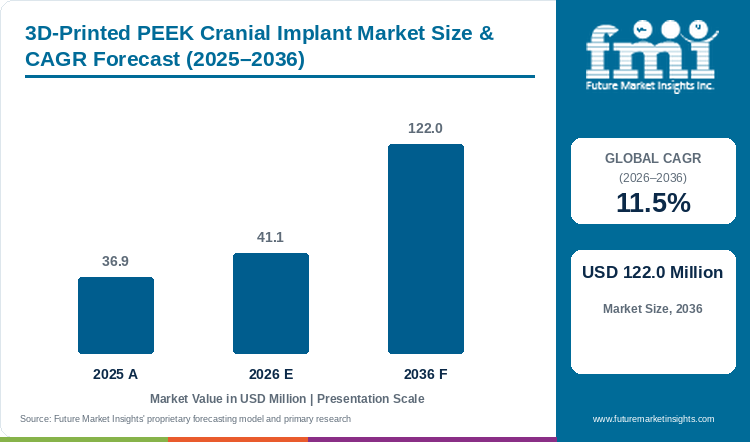
Demand for 3D-printed PEEK cranial implants is projected to expand at 11.5% CAGR between 2026 and 2036. Industry value grows from USD 36.9 million in 2025 to USD 41.1 million in 2026 and is projected to reach USD 122.0 million by 2036.
3D-printed PEEK cranial implants are patient-specific surgical implants gaining traction for replacing missing skull portions after trauma, tumor removal and revision surgery. As per FMI, market value increases from USD 36.9 million in 2025 to USD 41.1 million in 2026 and is projected to reach USD 122.0 million by 2036, expanding at 11.5% CAGR. Patient-specific cranioplasty implants hold 71.8% share in 2026, owing to use of CT-based design for irregular defects. In January 2025, 3D Systems reported more than 60 completed cranioplasties through its printed PEEK workflow.[1] A 2025 clinical evaluation across 27 skull-defect reconstructions reported that all customized 3D-printed PEEK implants achieved precise anatomical fit without major modification.[2] A 50-patient study reported 96.0% shaping satisfaction in 2026.[3] These procedure figures are expected to support wider acceptance of printed PEEK implants during the forecast period.
Key Market Trends & Insights
- By product type, patient-specific cranioplasty implants led with 71.8% share in 2026, owing to requirement for defect-matched cranial reconstruction.
- Fused filament fabrication accounted for 59.6% by printing technology in 2026, supported by medical-grade filament and controlled polymer deposition.
- Post-traumatic cranial defects represented 39.8% by indication in 2026, as reconstruction is commonly planned after stabilization and decompressive treatment.
- Hospitals held 63.0% of end-user demand in 2026, due to presence of imaging, neurosurgery and postoperative care facilities.
Regional Highlights
- The USA records the highest profiled growth at 14.7% CAGR from 2026 to 2036.
- Germany at 13.7% and Japan at 12.6% follow, whereas Netherlands expands at 8.3% during the forecast period.
- Product clearance, hospital manufacturing and medical-device quality systems are expected to create different adoption conditions across these countries.
Market Size & Forecast
Table 1: Market Size and Forecast for the 3D-Printed PEEK Cranial Implant Market (USD million and percentage), 2025 to 2036
| Metric | Value |
|---|---|
| 2025 Market Size | USD 36.9 million |
| Estimated Market Size in 2026 | USD 41.1 million |
| Projected Market Size by 2036 | USD 122.0 million |
| CAGR, 2026 to 2036 | 11.5% |
| Added Revenue, 2026 to 2036 | USD 80.9 million |
| Market Expansion Multiple | 2.97 times |
The addressable market remains smaller than the complete cranioplasty population, as every patient requires 3D imaging surgical solutions, surgeon approval and a finished implant. ISO 5092:2025 covers custom-made and patient-matched non-active implants and identifies factors affecting additive implant safety and performance.[4] The VSP PEEK workflow used up to 85% less material than comparable machined implants and supported nearly 40 European cranioplasties before its U.S. clearance.[5] By January 2025, completed procedures had increased beyond 60, which indicates movement from early clinical use towards repeat cases. Wider adoption will depend on hospitals receiving an implant with approved design, controlled printing, sterilization and delivery within the planned surgery period.
Patient-Specific Procedure and Qualification Indicators
Patient-specific PEEK demand develops when a cranial defect, an eligible patient and a controlled implant route are available together. Published procedure evidence shows that custom implants can be used for complex defects, whereas standards and product clearance decide whether hospitals can place regular orders.
Table 2: Patient-Specific Procedure and Qualification Indicators for the 3D-Printed PEEK Cranial Implant Market (procedures, patients, percentages, and standards), mixed reporting years from 2024 to 2026
| Indicator | Data Point | Market Meaning | Source |
|---|---|---|---|
| Completed printed PEEK cranioplasties | More than 60 procedures by January 2025 | Shows repeat use of one cleared printing workflow | [1] |
| European cranioplasties before FDA clearance | Nearly 40 procedures reported in April 2024 | Provides an earlier clinical-use baseline | [5] |
| European practice survey | 110 complete responses in 2025 | Supports preference for alloplastic reconstruction among participating centers | [6] |
| Patient-specific PEEK clinical series | 50 patients treated from January 2023 to January 2025 | Adds a procedure-level evidence base for custom implants | [3] |
| Shaping satisfaction | 96.0% in the 50-patient series | Supports the defect-matched use case | [3] |
| Additive-manufacturing standard | ISO 5092:2025, 11 pages | Identifies factors affecting safety and performance of patient-matched implants | [4] |
| Market expansion | USD 41.1 million to USD 122.0 million | Adds USD 80.9 million and expands 2.97 times by 2036 | FMI estimate |
Analyst Perspective
“Printed PEEK demand will rise where hospitals can approve designs and receive implants within the planned surgery period. Wider adoption will depend on repeatable implant quality, not only availability of medical-grade printing systems.”
- Anurag Sharma, Principal Consultant, Future Market Insights.
How is the 3D-printed PEEK cranial implant market segmented?
3D-printed PEEK cranial implant market is segmented by product type, printing technology, indication, end user, and region. In 2026, patient-specific cranioplasty implants are projected at 71.8%, fused filament fabrication at 59.6%, post-traumatic cranial defects at 39.8%, and hospitals at 63.0%.
As per the analysis from FMI, product type is divided into patient-specific cranioplasty implants, craniofacial and maxillofacial implants, and cranial fixation and accessories.
Printing technology is segmented into fused filament fabrication, selective laser sintering and other additive processes used for medical PEEK production.
By indication, the report covers post-traumatic cranial defects, tumor resection defects, congenital and developmental deformities, and infection and revision cases.
End-user demand is tracked across hospitals, specialty craniofacial clinics and ambulatory surgical centers performing cranial reconstruction procedures.
Regional analysis covers North America, Latin America, Western Europe, Eastern Europe, East Asia, South Asia and Pacific, and Middle East and Africa.
Why do patient-specific implants retain a notable product type share?
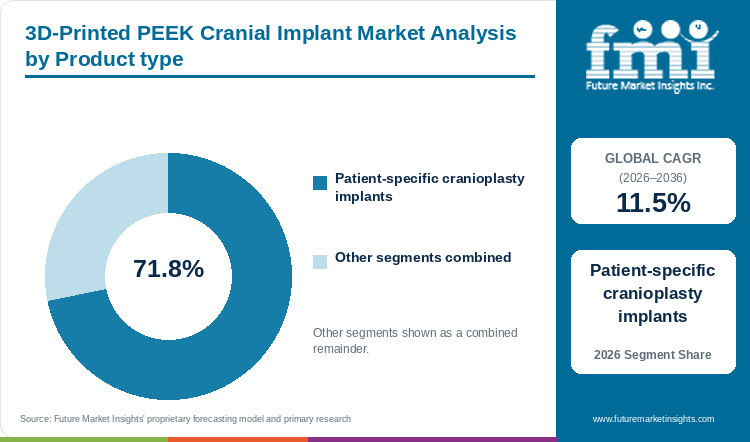
Based on product type, patient-specific cranioplasty implants are projected to account for 71.8% in 2026, driven by defect-matched purchasing.
Table 3: Product Type Share for the 3D-Printed PEEK Cranial Implant Market (percentage share), 2026
| Product Type | Share (2026) |
|---|---|
| Patient-Specific Cranioplasty Implants | 71.8% |
| Other Segments Combined | 28.2%* |
| Total | 100.0% |
*Calculated as the balance remaining after deducting the leading segment's reported share from 100.0%.
Table 4: Product Type Leadership and Market Growth for the 3D-Printed PEEK Cranial Implant Market (segment and CAGR percentage), 2026 to 2036
| Metric | Value |
|---|---|
| Global CAGR (2026 to 2036) | 11.5% |
| Leading Segment | Patient-Specific Cranioplasty Implants |
Patient-specific cranioplasty implants are manufactured according to the size and shape of an individual skull defect. FMI data suggests that the segment will hold 71.8% of product type revenue in 2026, owing to increasing use of CT-based design and custom implant production. A 2025 European survey received 110 complete responses and reported higher preference for alloplastic materials among participating centers.[6] Acceptance of custom alloplastic reconstruction is expected to support AI-designed surgical implants demand during the forecast period.
- Patient-specific cranioplasty implants account for 71.8% share in 2026, due to requirement for products matching individual defect geometry.
- CT-based design and growing preference for alloplastic reconstruction are anticipated to support the segment revenue growth.
What supports fused filament fabrication within printing technology demand?
By printing technology, fused filament fabrication is estimated to hold 59.6% in 2026, supported by controlled medical-polymer deposition.
Fused filament fabrication deposits medical-grade PEEK layer by layer for making patient-specific implants. In the FMI report, the technology accounts for 59.6% share in 2026 owing to availability of implant-grade filament and controlled extrusion systems. A 2026 mapping review in Materials Advances documented that fused filament fabrication of medical PEEK achieves tensile properties matching native cortical bone.[7] Documented printing parameters and controlled post-processing are expected to support additive manufacturing adoption across surgical centers.
- Fused filament fabrication represents 59.6% share in 2026, supported by medical-grade PEEK filament and controlled deposition conditions.
- Availability of medical extrusion systems is expected to increase use of fused filament fabrication for patient-specific implants.
How do post-traumatic defects shape indication demand through 2036?
In 2026, post-traumatic cranial defects are expected to lead indication revenue with 39.8% share, owing to staged reconstruction.
Post-traumatic cranial defects arise after skull injury or decompressive craniectomy and may require reconstruction after patient stabilization. FMI research indicates that this indication accounts for 39.8% share in 2026, owing to requirement for restoring protection and cranial contour. A 2025 systematic review covered cranioplasty approaches and outcomes in low-middle income countries.[8] Planned reconstruction after emergency treatment is anticipated to sustain demand from post-traumatic cranial defects alongside other bone grafts and substitutes.
- Post-traumatic cranial defects account for 39.8% share in 2026, owing to reconstruction after injury and decompressive treatment.
- Staged cranioplasty after patient stabilization is expected to support the indication demand through 2036.
Why are hospitals central to the end user category?
Hospitals are set to lead the end user category with 63.0% share in 2026, underpinned by operative and postoperative care.
Hospitals perform imaging, implant selection, surgery and postoperative monitoring required for cranial reconstruction. According to FMI, hospitals are projected to account for 63.0% of end-user demand in 2026 owing to availability of minimally invasive neurosurgery devices, skilled specialists and specialized operating facilities. In April 2025, University Hospital Basel used an MDR-compliant printed PEEK facial implant manufactured at the point of care.[9] Expansion of controlled hospital manufacturing is anticipated to support the hospitals segment growth.
- Hospitals account for 63.0% share in 2026, attributed to presence of neurosurgery, imaging and postoperative care facilities.
- Hospital-based planning and implant acceptance is expected to keep this end-user segment ahead during the forecast period.
What are the drivers, restraints, and opportunities in the market?
In the 3D-printed PEEK cranial implant market, patient-matched reconstruction is the key driver, process validation is the key restraint, and point-of-care production is the key opportunity.
- Driver: Patient-matched implants are gaining demand for irregular cranial defects where standard plates require additional shaping during surgery.
- Restraint: Printing, finishing and sterilization needs separate validation, due to which movement between printers and production facilities remains limited.
- Opportunity: Controlled point-of-care manufacturing can shorten implant delivery time and create new opportunities for hospitals and implant suppliers.
Patient-Matched Reconstruction Supports Demand
Patient-matched reconstruction replaces a missing cranial portion with an implant developed from patient imaging, advancing the integration of 3D printed surgical models across reconstructive surgery. In October 2025, the U.S. FDA cleared the TECHFIT Patient-Specific Cranial System under K250297.[10] The clearance adds another regulated cranial reconstruction option for hospitals evaluating defect-matched products. Availability of approved patient-specific systems is expected to drive the market growth.
Process Validation Restricts Supplier Switching
Process validation is one of the primary factors restricting movement of printed biocompatible polymers between production facilities. A 2025 quantitative regulatory survey in Therapeutic Innovation & Regulatory Science reported that 52.5% of medical device professionals found process validation and clearance for additive-manufactured implants difficult under premarket frameworks.[11] Manufacturers require extensive verification data for the finished product after printing, finishing and sterilization. High cost and time involved in qualifying each production route may restrain market growth.
Point-of-Care Workflows Open Capacity
Additive manufacturing materials enable hospitals to prepare patient-specific implants closer to the treatment site under a controlled production system. In July 2026, 3D Systems reported the first FDA clearance granted to a point-of-care institution for an implant.[12] The cleared implant uses titanium and remains outside printed PEEK revenue, but it shows movement of hospital manufacturing towards regulated products. Similar qualified facilities can create new avenues for printed PEEK implants.
Which country CAGRs are profiled in the market?
Table 5: Country CAGR Comparison for the 3D-Printed PEEK Cranial Implant Market (CAGR percentage), 2026 to 2036
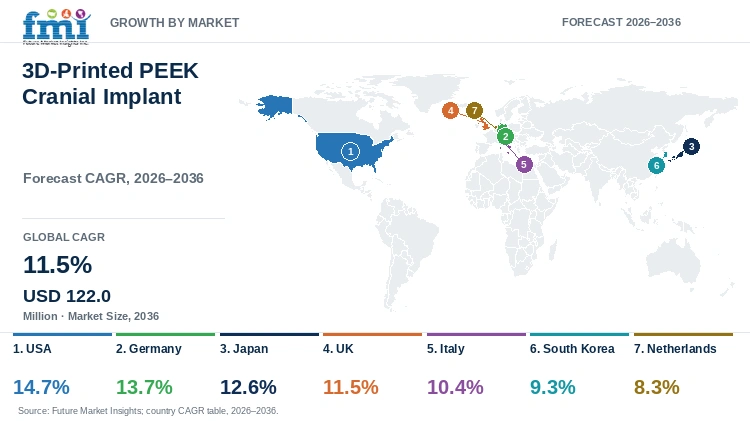
| Country | CAGR, 2026 to 2036 |
|---|---|
| USA | 14.7% |
| Germany | 13.7% |
| Japan | 12.6% |
| UK | 11.5% |
| Italy | 10.4% |
| South Korea | 9.3% |
| Netherlands | 8.3% |
How do country-level CAGRs compare in the market?
Growth conditions vary between the profiled countries as product clearance, medical additive manufacturing and hospital capability develop unevenly. The USA and Germany record comparatively higher expansion owing to regulated product access and polymer research facilities.
As noted by FMI, Japan, UK, Italy, South Korea and Netherlands maintain positive growth as quality systems and patient-specific manufacturing develops during the forecast period.
- Availability of patient-specific cranial clearances across the USA is expected to support hospital adoption of defect-matched implants.
- Germany relies on polymer research and additive manufacturing capability to support medical implant development.
- Japan emphasizes medical-device quality cooperation to support manufacturers preparing patient-specific implant records.
- The UK applies custom-made device guidance, keeping registration and post-market obligations with the manufacturer.
- Italy uses national medical-device records to support identification and traceability of patient-specific implants.
- South Korea provides updated GMP information to assist manufacturers during registration and export procedures.
- The Netherlands draws on hospital and company collaboration to support personalized implant manufacturing.
Full report country CAGRs cover North America, Latin America, Western Europe, Eastern Europe, East Asia, South Asia and Pacific, and Middle East and Africa.
Country-wise Analysis
- The USA 3D-printed PEEK cranial implant market is projected to grow at 14.7% CAGR through 2036. In November 2025, the U.S. FDA cleared KLS Martin Cranial Implants under K252573, expanding patient-specific reconstructive plate and PEEK solutions across domestic surgical centers.[13] Availability of regulated cranial products, specialized medical device contract manufacturing partnerships, and established neurosurgery centers is expected to support USA market revenue growth.
- Germany 3D-printed PEEK cranial implant market is anticipated to expand at 13.7% CAGR during the assessment period. In April 2026, Fraunhofer IAP presented a three-layer 3D-printed biomimetic tissue substitute for medical technology.[14] The development shows continued work on printable polymers and biological functionality. Presence of polymer research and medical additive manufacturing facilities is likely to propel implant development in Germany.
- Demand for 3D-printed PEEK cranial implants in Japan is forecast to rise at 12.6% CAGR over the forecast period. Japan hosted the Asia-Pacific region’s first MDSAP Forum in July 2026, with about 130 in-person and 90 online participants.[15] The program covered quality-management audits used by medical-device regulators and manufacturers. Wider regulatory cooperation is expected to support manufacturers preparing patient-specific implant records.
- Adoption of printed PEEK cranial implants in the UK is estimated to expand at 11.5% CAGR through 2036. MHRA guidance updated in July 2026 states that custom-made devices must follow a written prescription and remain subject to manufacturer requirements.[16] Registration and post-market obligations can support implant traceability but may increase documentation work. Growing hospital interest in local production is anticipated to support the UK market growth.
- The Italy 3D-printed PEEK cranial implant market is projected to record 10.4% CAGR during the assessment period. Italy’s Ministry of Health reported more than one million records in its national medical-device database during September 2026.[17] The database includes manufacturer, device type and classification information. Structured device records are expected to support identification and traceability of patient-specific implants.
- In South Korea, demand for 3D-printed PEEK cranial implants is predicted to advance at 9.3% CAGR through 2036. In February 2026, the Ministry of Food and Drug Safety issued an English compilation covering medical-device GMP regulations.[18] Better quality documentation can support manufacturers during registration and overseas approval procedures. Expansion of medical-device production capability is anticipated to support the South Korea market growth.
- The outlook for printed PEEK cranial implants in Netherlands remains positive, with sales projected to increase at 8.3% CAGR through 2036. The iMPACT Implants program connects UMCG, the University of Groningen and four regional companies for personalized implant development.[19] Work on imaging, design, materials and faster production is expected to support customized implants. These activities are likely to create new opportunities in Netherlands.
Who are the notable companies in the market?
3D Systems Corporation, Evonik Industries AG, Victrex plc, Stryker Corporation, Johnson & Johnson, Zimmer Biomet Holdings, Xilloc Medical, Anatomics, Curiteva, and Apium are notable companies profiled in this market.
3D-printed PEEK cranial implant market is moderately fragmented with material suppliers, medical printing companies and cranial reconstruction manufacturers. An FMI analyst notes that 3D Systems holds the clearest printed PEEK workflow position, whereas Evonik and Victrex supply implant-grade PEEK materials and adjacent polyether ether ketone interbody devices. Stryker, Johnson & Johnson, Zimmer Biomet, Xilloc Medical and Anatomics participate through cranial reconstruction products. Some of the prominent players are expanding medical printing and patient-specific implant capability in order to increase its customer base.
- Printed PEEK workflow and device route: 3D Systems Corporation.
- Implant-grade PEEK materials: Evonik Industries AG and Victrex plc.
- Cranial reconstruction channels: Stryker, Johnson & Johnson, Zimmer Biomet, Xilloc Medical, and Anatomics.
- Development and additive platforms: Curiteva and Apium.
Competitive Benchmarking: 3D-Printed PEEK Cranial Implant Market
Table 6: Competitive Benchmarking for the 3D-Printed PEEK Cranial Implant Market (qualitative capability ratings), 2026
| Company | PEEK capability | Cranial delivery | Current activity | Geographic reach |
|---|---|---|---|---|
| 3D Systems | High | High | High | High |
| Evonik | High | High | Medium | High |
| Victrex | High | High | Medium | High |
| Stryker | Medium | Medium | Medium | High |
| Johnson & Johnson | Low | Medium | Medium | High |
| Zimmer Biomet | Medium | Medium | Medium | High |
| Xilloc Medical | Medium | Medium | Medium | Medium |
| Anatomics | Low | Medium | Medium | Medium |
| Curiteva | Medium | Medium | Medium | Medium |
| Apium | Medium | Medium | Low | Medium |
High indicates wider public evidence, Medium indicates limited or adjacent evidence, and Low indicates less direct evidence. Ratings do not indicate product quality, company rank or market share.
Key Developments in the 3D-Printed PEEK Cranial Implant Market
- In September 2026, the U.S. FDA granted 510(k) clearance for the CraniUS Plate under K262874, providing a patient-specific PEEK skull implant.[20]
- In July 2026, T&R Biofab received U.S. clearance for the TnR Cranial Implant under K251959.[21] The product uses methyl methacrylate and remains outside printed PEEK revenue.
- In February 2026, KLS Martin Group announced plans to raise its 2026 investment volume to a three-digit million-euro level for infrastructure and production following record 2025 sales of EUR 518 million.[22]
- In July 2025, the U.S. FDA cleared the Kelyniam Fusion Skull Implant under K250334, introducing biphasic calcium phosphate PEEK formulation for custom cranial reconstruction.[23]
Key Players in the 3D-Printed PEEK Cranial Implant Market
Printed PEEK Device and Workflow
- 3D Systems Corporation
Implant-Grade PEEK Materials
- Evonik Industries AG
- Victrex plc
Cranial Reconstruction and Adjacent Platforms
- Stryker Corporation
- Johnson & Johnson
- Zimmer Biomet Holdings, Inc.
- Xilloc Medical B.V.
- Anatomics Pty Ltd
- Curiteva, Inc.
- Apium Additive Technologies GmbH
3D-Printed PEEK Cranial Implant Market - Report Scope
Table 7: Report Scope for the 3D-Printed PEEK Cranial Implant Market (coverage fields and definitions), 2026 to 2036
| Coverage field | Report scope |
|---|---|
| Market breakdown | Product type; printing technology; indication; end user; region |
| Quantitative units | USD million |
| Market definition | First-sale revenue from finished additively manufactured PEEK cranial and craniofacial implants, including inseparable design and finishing. Standalone printers, feedstock, separately billed services, milled-only PEEK, and substitute-material implants are excluded. |
| Regions covered | North America; Latin America; Western Europe; Eastern Europe; East Asia; South Asia and Pacific; Middle East and Africa |
| Countries covered | USA; Germany; Japan; UK; Italy; South Korea; Netherlands |
| Forecast period | 2026 to 2036 |
| Proprietary data | Segment shares and forecast estimates are proprietary analytical estimates. |
3D-Printed PEEK Cranial Implant Market - Research Methodology
Table 8: Research Methodology for the 3D-Printed PEEK Cranial Implant Market (research methods and approach), 2026 edition
| Method | Approach |
|---|---|
| Primary Research | Analysts gathered input from manufacturers, technology developers, distributors, hospitals, procurement teams and industry experts. Interviews covers product selection, adoption barrier, pricing, approval requirement and technical support. |
| Desk Research | Desk research covers government publications, regulatory records, standards, company announcements, technical literature and product information. |
| Market Sizing and Forecasting | Market sizing combines historical value, segment share, product pricing, adoption, company participation and country demand condition. |
| Data Validation | Market estimates are checked with public data, company activity, regulatory records and primary research findings. Overlapping revenue and excluded products are removed. |
3D-Printed PEEK Cranial Implant Market by Segments
Product type
- Patient-specific cranioplasty implants
- Craniofacial and maxillofacial implants
- Cranial fixation and accessories
Printing technology
- Fused filament fabrication
- Selective laser sintering
- Other additive processes
Indication
- Post-traumatic cranial defects
- Tumor resection defects
- Congenital and developmental deformities
- Infection and revision cases
End user
- Hospitals
- Specialty craniofacial clinics
- Ambulatory surgical centers
3D-Printed PEEK Cranial Implant Market by Region
- North America
- United States
- Canada
- Latin America
- Brazil
- Mexico
- Argentina
- Chile
- Western Europe
- Germany
- France
- United Kingdom
- Italy
- Spain
- Benelux
- Nordics
- Eastern Europe
- Poland
- Czech Republic
- Romania
- Hungary
- East Asia
- Japan
- South Korea
- Taiwan
- South Asia and Pacific
- ASEAN
- Australia and New Zealand
- Middle East and Africa
- GCC Countries
- South Africa
- Türkiye
- Israel
Research Sources and Bibliography
- [1] 3D Systems. (2025, January 16). Elevating patient care: PEEK 3D printing’s leap in 2024.
- [2] Humain, B. V., et al. (2025, March 17). Customized 3D-printed Poly ether ether ketone cranial implant for cranioplasty of skull defects. Neurosurgical Review, 48(1), 301.
- [3] Zhu, B., & Gao, S. (2026, June 29). 3D-printed patient-specific polyetheretherketone implants for cranioplasty: A retrospective analysis of 50 cases with focus on subcutaneous fluid collection management. Journal of Craniofacial Surgery.
- [4] International Organization for Standardization. (2025, September). ISO 5092:2025: Additive manufacturing for medical: General principles: Additive manufacturing of non-active implants. https://www.iso.org/standard/80762.html
- [5] 3D Systems. (2024, April 15). 3D Systems announces FDA clearance for world’s first 3D-printed PEEK cranial implants.
- [6] Naser, P. V., et al. (2025, February 17). The current state of cranioplasty in Europe. Brain & Spine, 5, 104214.
- [7] Materials Advances. (2026, March 9). PEEK implants for cranioplasty: a mapping review of 3D printing techniques and clinical outcomes. Materials Advances, 7(8), 3935-3950.
- [8] Solomon, S. S., et al. (2025, May 1). Cranioplasty approaches and outcomes in low-middle income countries.
- [9] 3D Systems. (2025, April 8). 3D Systems solution enables facial implant manufacturing at point-of-care.
- [10] U.S. Food and Drug Administration. (2025, October 27). TECHFIT Patient-Specific Cranial System: K250297. https://www.accessdata.fda.gov/cdrh_docs/pdf25/K250297.pdf
- [11] McDermott, O., et al. (2025, September). The challenges in the regulatory approval of additive-manufactured medical devices: A quantitative survey. Therapeutic Innovation & Regulatory Science, 59(5), 1160-1170.
- [12] 3D Systems. (2026, July 28). First FDA clearance for implant from a point-of-care institution.
- [13] U.S. Food and Drug Administration. (2025, November 10). KLS Martin Cranial Implants: K252573.
- [14] Fraunhofer Institute for Applied Polymer Research IAP. (2026, April 20). 3D-printed tissue substitute.
- [15] Ministry of Health, Labour and Welfare, Japan. (2026, July 9). 2026 MDSAP Forum held in Kyoto.
- [16] Medicines and Healthcare products Regulatory Agency. (2026, July 20). Custom-made devices in Great Britain. https://www.gov.uk/government/publications/custom-made-medical-devices/custom-made-devices-in-great-britain
- [17] Ministry of Health, Italy. (2026, September 21). Open data: Medical devices.
- [18] Ministry of Food and Drug Safety. (2026, February 11). Medical Device Good Manufacturing Practice Regulations. https://www.mfds.go.kr/eng/brd/m_40/view.do?seq=72638
- [19] iMPACT Implants. (2026). The program: A new generation of personalised implants.
- [20] U.S. Food and Drug Administration. (2026, September 11). CraniUS Plate: K262874. https://www.accessdata.fda.gov/cdrh_docs/pdf26/K262874.pdf
- [21] U.S. Food and Drug Administration. (2026, July 30). TnR Cranial Implant: K251959.
- [22] KLS Martin Group. (2026, February). Annual investment and production expansion announcement.
- [23] U.S. Food and Drug Administration. (2025, July 25). Kelyniam Fusion Skull Implant: K250334.
This bibliography is provided for reader reference. The full report contains the complete reference list and detailed citations.
This Report Answers
- How large is the 3D-printed PEEK cranial implant market during 2026?
- What value is projected for the market by the end of 2036?
- Which product type holds a notable share of 2026 revenue?
- Which printing technology accounts for a notable market share in 2026?
- Which profiled countries show notable market expansion through the forecast period?
- Which companies are notable in the 3D-printed PEEK cranial implant market?
Frequently Asked Questions
How large is the 3D-Printed PEEK Cranial Implant Market expected to be in 2026?
Future Market Insights estimates that the 3D-printed PEEK cranial implant market will reach USD 41.1 million in 2026. The market is projected to reach USD 122.0 million by 2036, expanding at 11.5% CAGR. Patient-specific reconstruction and controlled medical PEEK printing are expected to support growth through 2036.
What CAGR is projected for the 3D-Printed PEEK Cranial Implant Market through 2036?
The 3D-printed PEEK cranial implant market is projected to grow at 11.5% CAGR from 2026 to 2036. Demand is supported by custom implant use after trauma, tumor removal and revision surgery.
Which product type holds a notable 3D-printed PEEK cranial implant demand share in 2026?
Patient-specific cranioplasty implants are projected to account for 71.8% of product type revenue in 2026. The segment benefits from implants prepared according to individual cranial defects.
Which printing technology holds a notable 3D-printed PEEK cranial implant share in 2026?
Fused filament fabrication is estimated to hold 59.6% of printing technology revenue in 2026. Medical-grade filament and controlled extrusion systems are expected to increase its adoption.
Which country has a notable 3D-printed PEEK cranial implant expansion outlook through 2036?
FMI finds that the USA market is projected to register 14.7% CAGR through 2036. Patient-specific cranial clearances and hospital reconstruction capability are expected to support the country growth.
Which companies are active in the 3D-Printed PEEK Cranial Implant Market during 2026?
Notable companies include 3D Systems Corporation, Evonik Industries AG, Victrex plc, Stryker Corporation, Johnson & Johnson, Zimmer Biomet Holdings, Xilloc Medical, Anatomics, Curiteva, and Apium. These companies participate through implant materials, medical printing and cranial reconstruction products.
Preview the report firsthand - request a free sample
Get SampleGet the brochure for pricing and purchase details.
Get PDFTable of Content
- Key Takeaways
- Market Size and CAGR
- Top Growth Driver
- Fastest Growing Segment
- Leading Region
- Key Companies
- Emerging Opportunities
- Executive Summary
- Global Market Outlook
- Demand-side Trends
- Supply-side Trends
- Technology Roadmap Analysis
- Analysis and Recommendations
- Analyst Perspective (What is happening? Why now? What should investors know?)
- Key Questions Answered
- How large is the market?
- What is the CAGR?
- What are key trends?
- Which region dominates?
- Who are the leaders?
- Market Overview
- Market Coverage / Taxonomy
- Market Definition / Scope / Limitations
- Research Methodology
- Chapter Orientation
- Analytical Lens and Working Hypotheses
- Market Structure, Signals, and Trend Drivers
- Benchmarking and Cross-market Comparability
- Market Sizing, Forecasting, and Opportunity Mapping
- Research Design and Evidence Framework
- Desk Research Programme (Secondary Evidence)
- Expert Input and Fieldwork (Primary Evidence)
- Tooling, Models, and Reference Databases
- Data Engineering and Model Build
- Quality Assurance and Audit Trail
- Market Background
- Market Dynamics (Drivers, Restraints, Opportunity, Trends)
- Scenario Forecast (Optimistic, Likely, Conservative)
- Impact Analysis
- AI Impact
- Sustainability Impact
- Regulatory Impact
- Technology Impact
- Consumer / Buyer Analysis
- Purchase Drivers
- Adoption Barriers
- Buyer Journey
- Opportunity Map Analysis
- Product Life Cycle Analysis
- Supply Chain Analysis
- Investment Feasibility Matrix
- Value Chain Analysis
- PESTLE and Porter's Analysis
- Regulatory Landscape
- Regional Parent Market Outlook
- Production and Consumption Statistics
- Import and Export Statistics
- Global Market Analysis and Forecast, 2021 to 2036
- Historical Market Size Value (USD Million) Analysis, 2021 to 2025
- Current and Future Market Size Value (USD Million) Projections, 2026 to 2036
- Y-o-Y Growth Trend Analysis
- Absolute $ Opportunity Analysis
- Global Market Pricing Analysis, 2021 to 2036
- Global Market Analysis and Forecast, By Product type, 2021 to 2036
- Introduction / Key Findings
- Historical Market Size Value (USD Million) Analysis By Product type, 2021 to 2025
- Current and Future Market Size Value (USD Million) Analysis and Forecast By Product type, 2026 to 2036
- Patient-specific cranioplasty implants
- Craniofacial and maxillofacial implants
- Cranial fixation and accessories
- Y-o-Y Growth Trend Analysis By Product type, 2021 to 2025
- Absolute $ Opportunity Analysis By Product type, 2026 to 2036
- Global Market Analysis and Forecast, By Printing technology, 2021 to 2036
- Introduction / Key Findings
- Historical Market Size Value (USD Million) Analysis By Printing technology, 2021 to 2025
- Current and Future Market Size Value (USD Million) Analysis and Forecast By Printing technology, 2026 to 2036
- Fused filament fabrication
- Selective laser sintering
- Other additive processes
- Y-o-Y Growth Trend Analysis By Printing technology, 2021 to 2025
- Absolute $ Opportunity Analysis By Printing technology, 2026 to 2036
- Global Market Analysis and Forecast, By Indication, 2021 to 2036
- Introduction / Key Findings
- Historical Market Size Value (USD Million) Analysis By Indication, 2021 to 2025
- Current and Future Market Size Value (USD Million) Analysis and Forecast By Indication, 2026 to 2036
- Post-traumatic cranial defects
- Tumor resection defects
- Congenital and developmental deformities
- Infection and revision cases
- Y-o-Y Growth Trend Analysis By Indication, 2021 to 2025
- Absolute $ Opportunity Analysis By Indication, 2026 to 2036
- Global Market Analysis and Forecast, By End user, 2021 to 2036
- Introduction / Key Findings
- Historical Market Size Value (USD Million) Analysis By End user, 2021 to 2025
- Current and Future Market Size Value (USD Million) Analysis and Forecast By End user, 2026 to 2036
- Hospitals
- Specialty craniofacial clinics
- Ambulatory surgical centers
- Y-o-Y Growth Trend Analysis By End user, 2021 to 2025
- Absolute $ Opportunity Analysis By End user, 2026 to 2036
- Global Market Analysis and Forecast, By Region, 2021 to 2036
- Introduction
- Historical Market Size Value (USD Million) Analysis By Region, 2021 to 2025
- Current Market Size Value (USD Million) Analysis and Forecast By Region, 2026 to 2036
- North America
- Latin America
- Western Europe
- Eastern Europe
- East Asia
- South Asia and Pacific
- Middle East and Africa
- Market Attractiveness Analysis By Region
- North America Market Analysis and Forecast, By Country, 2021 to 2036
- Historical Market Size Value (USD Million) Trend Analysis By Market Taxonomy, 2021 to 2025
- Market Size Value (USD Million) Forecast By Market Taxonomy, 2026 to 2036
- By Country
- United States
- Canada
- By Product type
- By Printing technology
- By Indication
- By End user
- By Country
- Market Attractiveness Analysis
- By Country
- By Product type
- By Printing technology
- By Indication
- By End user
- Key Takeaways
- Latin America Market Analysis and Forecast, By Country
- Historical Market Size Value (USD Million) Trend Analysis By Market Taxonomy, 2021 to 2025
- Market Size Value (USD Million) Forecast By Market Taxonomy, 2026 to 2036
- By Country
- Brazil
- Mexico
- Argentina
- Chile
- By Product type
- By Printing technology
- By Indication
- By End user
- By Country
- Market Attractiveness Analysis
- By Country
- By Product type
- By Printing technology
- By Indication
- By End user
- Key Takeaways
- Western Europe Market Analysis and Forecast, By Country
- Historical Market Size Value (USD Million) Trend Analysis By Market Taxonomy, 2021 to 2025
- Market Size Value (USD Million) Forecast By Market Taxonomy, 2026 to 2036
- By Country
- Germany
- France
- United Kingdom
- Italy
- Spain
- Benelux
- Nordics
- By Product type
- By Printing technology
- By Indication
- By End user
- By Country
- Market Attractiveness Analysis
- By Country
- By Product type
- By Printing technology
- By Indication
- By End user
- Key Takeaways
- Eastern Europe Market Analysis and Forecast, By Country
- Historical Market Size Value (USD Million) Trend Analysis By Market Taxonomy, 2021 to 2025
- Market Size Value (USD Million) Forecast By Market Taxonomy, 2026 to 2036
- By Country
- Poland
- Czech Republic
- Romania
- Hungary
- By Product type
- By Printing technology
- By Indication
- By End user
- By Country
- Market Attractiveness Analysis
- By Country
- By Product type
- By Printing technology
- By Indication
- By End user
- Key Takeaways
- East Asia Market Analysis and Forecast, By Country
- Historical Market Size Value (USD Million) Trend Analysis By Market Taxonomy, 2021 to 2025
- Market Size Value (USD Million) Forecast By Market Taxonomy, 2026 to 2036
- By Country
- Japan
- South Korea
- Taiwan
- By Product type
- By Printing technology
- By Indication
- By End user
- By Country
- Market Attractiveness Analysis
- By Country
- By Product type
- By Printing technology
- By Indication
- By End user
- Key Takeaways
- South Asia and Pacific Market Analysis and Forecast, By Country
- Historical Market Size Value (USD Million) Trend Analysis By Market Taxonomy, 2021 to 2025
- Market Size Value (USD Million) Forecast By Market Taxonomy, 2026 to 2036
- By Country
- ASEAN
- Australia and New Zealand
- By Product type
- By Printing technology
- By Indication
- By End user
- By Country
- Market Attractiveness Analysis
- By Country
- By Product type
- By Printing technology
- By Indication
- By End user
- Key Takeaways
- Middle East and Africa Market Analysis and Forecast, By Country
- Historical Market Size Value (USD Million) Trend Analysis By Market Taxonomy, 2021 to 2025
- Market Size Value (USD Million) Forecast By Market Taxonomy, 2026 to 2036
- By Country
- GCC Countries
- South Africa
- Türkiye
- Israel
- By Product type
- By Printing technology
- By Indication
- By End user
- By Country
- Market Attractiveness Analysis
- By Country
- By Product type
- By Printing technology
- By Indication
- By End user
- Key Takeaways
- Key Countries Market Analysis
- United States
- Pricing Analysis
- Market Share Analysis, 2025
- By Product type
- By Printing technology
- By Indication
- By End user
- Canada
- Pricing Analysis
- Market Share Analysis, 2025
- By Product type
- By Printing technology
- By Indication
- By End user
- Mexico
- Pricing Analysis
- Market Share Analysis, 2025
- By Product type
- By Printing technology
- By Indication
- By End user
- Brazil
- Pricing Analysis
- Market Share Analysis, 2025
- By Product type
- By Printing technology
- By Indication
- By End user
- Chile
- Pricing Analysis
- Market Share Analysis, 2025
- By Product type
- By Printing technology
- By Indication
- By End user
- Germany
- Pricing Analysis
- Market Share Analysis, 2025
- By Product type
- By Printing technology
- By Indication
- By End user
- United Kingdom
- Pricing Analysis
- Market Share Analysis, 2025
- By Product type
- By Printing technology
- By Indication
- By End user
- Italy
- Pricing Analysis
- Market Share Analysis, 2025
- By Product type
- By Printing technology
- By Indication
- By End user
- Spain
- Pricing Analysis
- Market Share Analysis, 2025
- By Product type
- By Printing technology
- By Indication
- By End user
- France
- Pricing Analysis
- Market Share Analysis, 2025
- By Product type
- By Printing technology
- By Indication
- By End user
- ASEAN
- Pricing Analysis
- Market Share Analysis, 2025
- By Product type
- By Printing technology
- By Indication
- By End user
- Australia and New Zealand
- Pricing Analysis
- Market Share Analysis, 2025
- By Product type
- By Printing technology
- By Indication
- By End user
- Japan
- Pricing Analysis
- Market Share Analysis, 2025
- By Product type
- By Printing technology
- By Indication
- By End user
- South Korea
- Pricing Analysis
- Market Share Analysis, 2025
- By Product type
- By Printing technology
- By Indication
- By End user
- Poland
- Pricing Analysis
- Market Share Analysis, 2025
- By Product type
- By Printing technology
- By Indication
- By End user
- Hungary
- Pricing Analysis
- Market Share Analysis, 2025
- By Product type
- By Printing technology
- By Indication
- By End user
- Türkiye
- Pricing Analysis
- Market Share Analysis, 2025
- By Product type
- By Printing technology
- By Indication
- By End user
- South Africa
- Pricing Analysis
- Market Share Analysis, 2025
- By Product type
- By Printing technology
- By Indication
- By End user
- Netherlands
- Pricing Analysis
- Market Share Analysis, 2025
- By Product type
- By Printing technology
- By Indication
- By End user
- United States
- Market Structure Analysis
- Competition Dashboard
- Competition Benchmarking
- Market Share Analysis of Top Players
- By Regional
- By Product type
- By Printing technology
- By Indication
- By End user
- Emerging Startups
- Innovation Benchmarking
- Competition Analysis
- Competition Deep Dive
- 3D Systems
- Overview
- Product Portfolio
- Profitability by Market Segments
- Sales Footprint
- Strategy Overview
- Marketing Strategy
- Product Strategy
- Channel Strategy
- Evonik
- Victrex
- Stryker
- Johnson & Johnson
- Zimmer Biomet
- Xilloc Medical
- Anatomics
- Curiteva
- Apium
- 3D Systems Corporation
- Evonik Industries AG
- Victrex plc
- Stryker Corporation
- Zimmer Biomet Holdings, Inc.
- Xilloc Medical B.V.
- Anatomics Pty Ltd
- Apium Additive Technologies GmbH
- 3D Systems
- Case Studies
- Success Stories
- Recent Developments
- Competition Deep Dive
- Assumptions & Acronyms Used


