

- Industry Size (2026)
- USD 536.07 Mn
- Forecast (2036)
- USD 1054.53 Mn
- CAGR (2026 to 2036)
- 7.0%
Absorbance Micro plate Reader Market Size, Market Forecast and Outlook By FMI
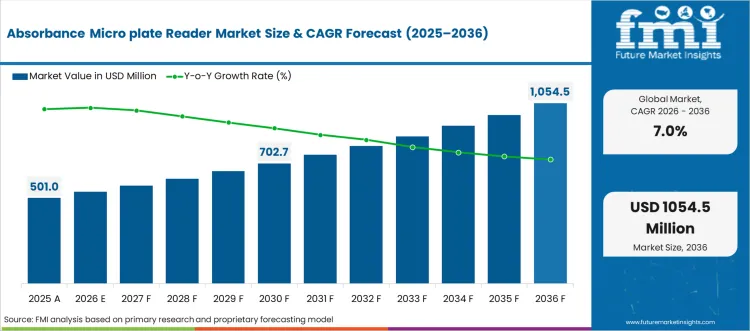
The absorbance micro plate reader market was valued at USD 501.00 million in 2025, projected to reach USD 536.07 million in 2026, and is forecast to expand to USD 1,054.53 million by 2036 at a 7.0% CAGR. As per FMI, the expansion is driven by accelerating drug discovery pipelines in biopharmaceutical companies, growing clinical diagnostics throughput requirements, and increasing adoption of automated high-throughput screening workflows in research institutions. Micro plate readers are transitioning from standalone laboratory instruments to integrated components within automated liquid handling and sample processing platforms.
Summary of Absorbance Micro plate Reader Market
- Market Snapshot
- The absorbance micro plate reader market is valued at USD 501.00 million in 2025 and is projected to reach USD 1,054.53 million by 2036.
- The industry is expected to grow at a 7.0% CAGR from 2026 to 2036, creating an incremental opportunity of USD 518.46 million.
- The market is a technology-driven, R&D-cycle-sensitive analytical instrument category where wavelength flexibility, throughput capacity, and automation integration define competitive positioning.
- Demand and Growth Drivers
- Demand is rising as biopharmaceutical drug discovery pipelines accelerate and clinical diagnostic laboratories require higher throughput absorbance measurement capacity.
- The transition from single-mode filter-based readers to monochromator-based systems offering wavelength flexibility is driving instrument upgrade cycles.
- Growth is further supported by the integration of micro plate readers into automated liquid handling and high-throughput screening platforms.
- Among key countries, India leads at 8.8% CAGR, followed by Germany at 8.1%, France at 7.4%, the UK at 6.7%, the USA at 6.0%, and Brazil at 5.3%.
- Product and Segment View
- The market includes monochromator and filter-based absorbance micro plate readers used across diagnostic centers, hospitals, biopharmaceutical companies, and research institutions for immunoassay, protein quantification, nucleic acid analysis, and high-throughput screening.
- Monochromator-based systems lead by modality with 60.0% share in 2026, driven by wavelength flexibility that eliminates dedicated filter set requirements.
- Diagnostic centers lead by end user with 30.0% share in 2026.
- Immunoassay leads by application with 25.0% share in 2026.
- The scope includes standalone and integrated absorbance micro plate readers, while excluding dedicated fluorescence-only, luminescence-only, and flow cytometry instruments.
- Geography and Competitive Outlook
- India and Germany are the fastest-growing markets due to biopharmaceutical manufacturing expansion and laboratory modernization, while the United States remains the largest market by installed instrument base.
- Competition is shaped by optical system precision, software automation capabilities, and multi-modal upgrade pathways, with key players including Thermo Fisher Scientific Inc., PerkinElmer Inc., Bio-Rad Laboratories Inc., Agilent Technologies Inc., and BMG LABTECH GmbH.
- FMI analysts note that the market is consolidating around platform providers offering upgrade pathways from absorbance-only to multi-modal detection within the same instrument chassis.
- Analyst Opinion at FMI
- Sabyasachi Ghosh, Principal Consultant for Life Sciences Instrumentation, opines: 'In my analysis, I have observed that the purchasing decision for micro plate readers is shifting from individual principal investigator budgets to centralized core facility procurement committees. Laboratories that continue purchasing single-mode filter-based readers for individual research groups face fleet fragmentation, inconsistent assay standardization, and higher per-read costs compared to facilities that deploy shared monochromator-based platforms with centralized scheduling and maintenance. Core facility directors who delay the transition to multi-modal platforms risk losing grant-funded researchers to competing institutions with more capable shared instrumentation.'
- Strategic Implications / Executive Takeaways
- Instrument manufacturers must develop modular upgrade pathways that allow customers to transition from absorbance-only to multi-modal detection without replacing the base instrument platform.
- Core facility directors should centralize micro plate reader procurement under shared instrument platforms to reduce per-assay costs and improve assay standardization across research groups.
- Clinical laboratory managers must evaluate monochromator-based systems for their diagnostic workflows to reduce filter inventory costs and enable faster assay protocol transitions.
The market is adding an incremental opportunity of approximately USD 518.46 million between 2026 and 2036. This growth reflects the structural shift toward multi-modal detection platforms that combine absorbance measurement with fluorescence, luminescence, and time-resolved capabilities in a single instrument footprint. FMI analysts observe that clinical laboratories are upgrading from single-mode filter-based readers to monochromator-based systems that offer wavelength flexibility without the need for dedicated filter sets, reducing per-assay consumable costs and enabling faster assay protocol transitions.
Regional growth trajectories reflect the geographic distribution of pharmaceutical R&D investment, clinical laboratory infrastructure, and academic research funding. India sets the pace with an 8.8% CAGR, driven by biopharmaceutical manufacturing expansion and growing clinical diagnostics demand across diagnostic chain laboratories. Germany follows at 8.1%, supported by its pharmaceutical R&D concentration and university hospital clinical laboratory modernization. France registers a 7.4% pace, anchored by its academic research funding through the Agence Nationale de la Recherche. The United Kingdom advances at 6.7%, driven by NHS diagnostic laboratory capacity expansion. The United States grows at 6.0%, reflecting instrument fleet modernization across academic medical centers and pharmaceutical companies. Brazil registers a 5.3% trajectory.
Absorbance Micro plate Reader Market Key Takeaways
| Metric | Details |
|---|---|
| Industry Size (2026) | USD 536.07 million |
| Industry Value (2036) | USD 1,054.53 million |
| CAGR (2026-2036) | 7.0% |
Source: Future Market Insights, 2026
Absorbance Micro plate Reader Market Definition
Absorbance micro plate readers are analytical instruments that measure the optical density of samples contained in multi-well micro plates by passing light through the sample and quantifying the transmitted intensity. These instruments are used across diagnostic centers, hospitals, biopharmaceutical industries, and research institutions for immunoassays, protein quantification, nucleic acid quantification, and high-throughput screening applications.
Absorbance Micro plate Reader Market Inclusions
Market scope includes standalone and integrated absorbance micro plate readers across monochromator and filter-based modalities. Instruments capable of 96-well, 384-well, and 1536-well plate formats are fully incorporated. Global and regional market sizes, forecast period metrics, and segment-level analysis across end users, applications, modality, and geography are covered.
Absorbance Micro plate Reader Market Exclusions
Dedicated fluorescence-only readers, luminescence-only readers, flow cytometry instruments, and spectrophotometers designed for cuvette-based measurement rather than micro plate format are excluded. Micro plate washer and liquid handling equipment sold separately from readers falls outside the analytical scope.
Absorbance Micro plate Reader Market Research Methodology
- Primary Research: Analysts engaged with core facility directors, clinical laboratory managers, biopharmaceutical R&D procurement leads, and instrument service engineers to map instrument replacement cycles and upgrade decision criteria.
- Desk Research: Data collection phases aggregated pharmaceutical R&D expenditure databases, clinical laboratory accreditation registries, and published instrument procurement surveys from academic research funding agencies.
- Market-Sizing and Forecasting: Baseline values derive from a bottom-up aggregation of instrument placements by end user type, applying average selling prices and service contract revenue to project future market value.
- Data Validation and Update Cycle: Projections are tested against publicly reported analytical instrument revenue from leading life sciences companies and cross-referenced with pharmaceutical R&D expenditure growth forecasts.
Why is the Absorbance Micro plate Reader Market Growing?
The Absorbance Microplate Reader market is experiencing steady growth, driven by the increasing adoption of automated laboratory instruments in research and clinical diagnostics. The market is currently shaped by rising demand for high-throughput screening, enhanced assay accuracy, and the need for reproducible results in diagnostic and research laboratories. Growing investment in biotechnology and pharmaceutical research, alongside increasing government initiatives supporting advanced diagnostic technologies, is creating favorable conditions for market expansion.
The ability to perform multiple assays simultaneously and to integrate data collection with laboratory information management systems has strengthened the appeal of microplate readers. Advancements in software-enabled analytics, improved optical systems, and modular platforms have further increased operational efficiency.
As laboratories focus on reducing manual errors and improving turnaround times, absorbance-based microplate readers are becoming integral to workflows The market outlook is positive, with emerging opportunities in personalized medicine, clinical diagnostics, and drug discovery expected to sustain demand, ensuring continuous growth in both established and emerging markets.
Segmental Analysis
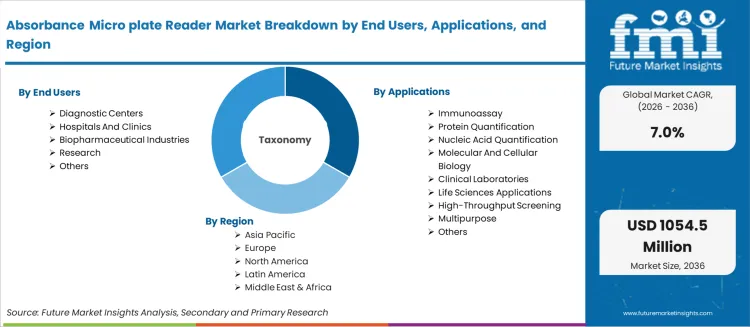
The absorbance micro plate reader market is segmented by end users, applications, modality, and geographic regions. By end users, absorbance micro plate reader market is divided into Diagnostic Centers, Hospitals And Clinics, Biopharmaceutical Industries, Research, and Others. In terms of applications, absorbance micro plate reader market is classified into Immunoassay, Protein Quantification, Nucleic Acid Quantification, Molecular And Cellular Biology, Clinical Laboratories, Life Sciences Applications, High-Throughput Screening, Multipurpose, and Others. Based on modality, absorbance micro plate reader market is segmented into Monochromator and Filter-Based. Regionally, the absorbance micro plate reader industry is classified into North America, Latin America, Western Europe, Eastern Europe, Balkan & Baltic Countries, Russia & Belarus, Central Asia, East Asia, South Asia & Pacific, and the Middle East & Africa.
Insights into the Diagnostic Centers Segment
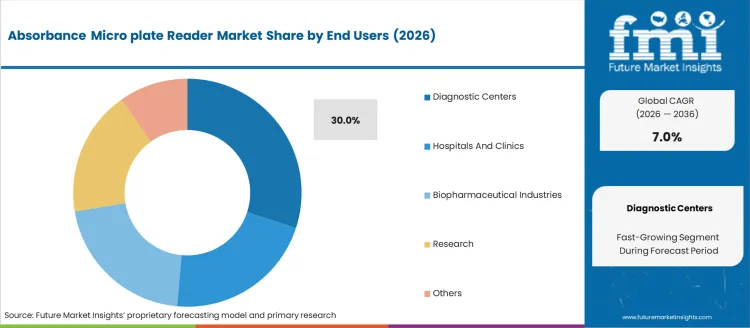
The Diagnostic Centers end-use segment is projected to hold 30.00% of the Absorbance Microplate Reader market revenue in 2026, making it the leading end-use category. This dominance is attributed to the widespread deployment of absorbance microplate readers in clinical diagnostic laboratories for routine testing and disease monitoring. The preference for diagnostic centers is driven by the need for rapid, high-throughput analysis with reproducible results that can support a wide variety of tests.
Automation has reduced manual intervention, improving efficiency and accuracy, which is critical in patient care environments. Investments in upgrading laboratory equipment, along with the increasing prevalence of chronic diseases requiring frequent testing, have further accelerated adoption.
Additionally, the scalability of microplate readers allows diagnostic centers to expand their testing capabilities without significant infrastructure changes The ability to integrate with laboratory software systems and perform multiplexed assays has reinforced the segment’s growth, making diagnostic centers a key driver of the market in 2026.
Insights into the Immunoassay Segment
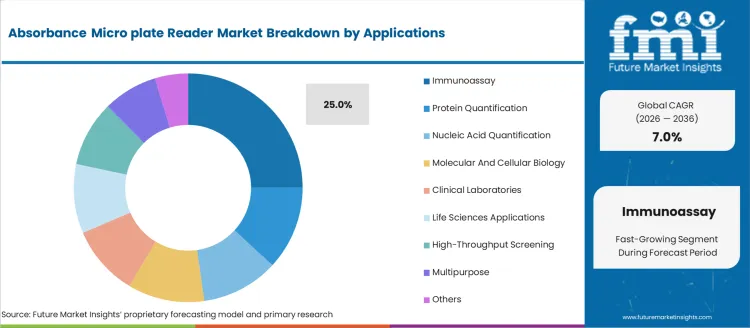
The Immunoassay application segment is expected to account for 25.00% of the Absorbance Microplate Reader market revenue in 2026, positioning it as a leading application. This prominence is being driven by the critical role of immunoassays in detecting biomarkers, monitoring disease progression, and supporting drug development. High sensitivity, accuracy, and reproducibility of absorbance-based measurements have made immunoassays particularly suited to research and clinical diagnostics.
Growth in this segment has been supported by increasing demand for ELISA testing and other protein quantification assays, which require reliable microplate readers. Automation has facilitated rapid processing of multiple samples while minimizing errors, further enhancing adoption. Laboratories are increasingly prioritizing high-throughput immunoassay capabilities to support large-scale screening and clinical studies.
The versatility of absorbance microplate readers to accommodate different assay formats without hardware changes has contributed to their widespread adoption in this segment Continued emphasis on efficient diagnostic workflows and rapid assay turnaround times is expected to maintain the segment’s leading position in 2026.
Insights into the Monochromator Segment
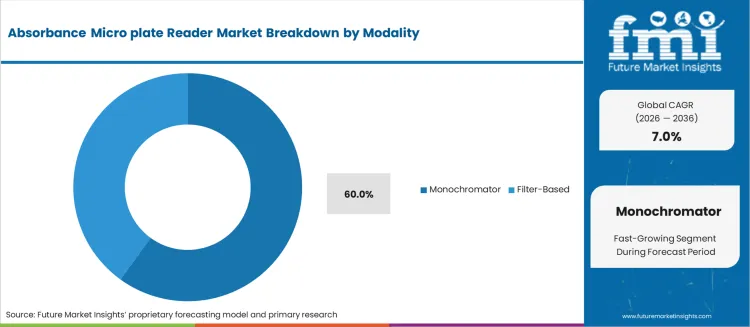
The Monochromator modality segment is projected to capture 60.00% of the Absorbance Microplate Reader market revenue in 2026, making it the largest modality category. This leadership is being attributed to the flexibility offered by monochromator-based readers, which allow users to select specific wavelengths for a wide range of assays without the need for fixed filters. The ability to customize measurements and perform multi-wavelength analysis enhances precision, particularly in complex and multiplexed assays.
Adoption has been driven by increasing demand from research and clinical laboratories for versatile instruments that can accommodate evolving assay protocols. Monochromator systems are preferred due to their ability to support new assay developments without requiring additional hardware investments.
Furthermore, the precision and accuracy of absorbance readings provided by monochromator systems improve reproducibility, which is critical for regulatory compliance and high-quality research outputs As laboratories focus on operational efficiency and flexibility, the monochromator modality continues to dominate the market, ensuring it remains the preferred choice in 2026.
Market Overview
Absorbance Micro plate Reader Market Overview
Microplate readers also called as microplate photometers, are devices used to detect physical, biological, or chemical changes in samples in microtiter plates. Absorbance micro plate reader is a type of Microplate readers which uses the principle of absorbance to detect changes in the sample.
When light of specific wavelength illuminates a sample, it gets selectively absorbed which is a characteristic of the sample composition. The spectrum of light absorbed is detected and recorded by the detector in the Microplate readers device.
Analysis of Absorbance Micro plate Reader Market By Key Countries
.webp "Top Country Growth Comparison — Absorbance Micro Plate Reader Market CAGR (2026–2036)")
| Country | CAGR |
|---|---|
| China | 9.5% |
| India | 8.8% |
| Germany | 8.1% |
| France | 7.4% |
| UK | 6.7% |
| USA | 6.0% |
| Brazil | 5.3% |
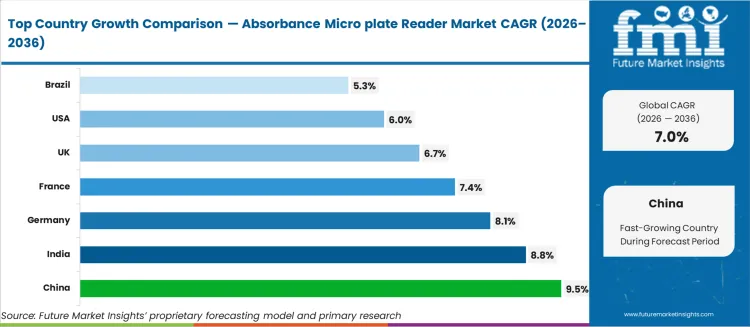
The Absorbance Micro plate Reader Market is expected to register a CAGR of 7.0% during the forecast period, exhibiting varied country level momentum. China leads with the highest CAGR of 9.5%, followed by India at 8.8%. Developed markets such as Germany, France, and the UK continue to expand steadily, while the USA is likely to grow at consistent rates. Brazil posts the lowest CAGR at 5.3%, yet still underscores a broadly positive trajectory for the global Absorbance Micro plate Reader Market. In 2024, Germany held a dominant revenue in the Western Europe market and is expected to grow with a CAGR of 8.1%. The USA Absorbance Micro plate Reader Market is estimated to be valued at USD 187.6 million in 2026 and is anticipated to reach a valuation of USD 334.4 million by 2036. Sales are projected to rise at a CAGR of 6.0% over the forecast period between 2026 and 2036. While Japan and South Korea markets are estimated to be valued at USD 25.0 million and USD 16.2 million respectively in 2026.
Key Players in the Absorbance Micro plate Reader Market
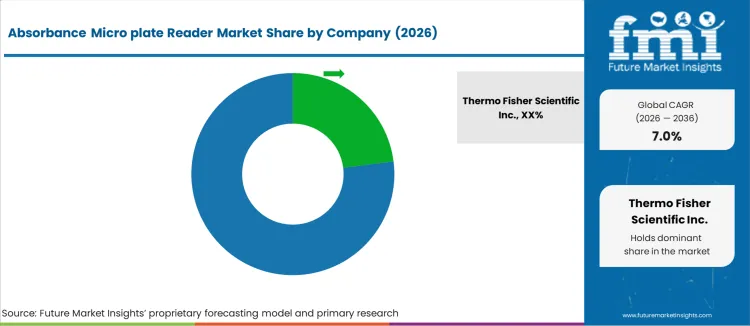
- Thermo Fisher Scientific Inc.
- PerkinElmer Inc.
- Bio-Rad Laboratories Inc.
- Agilent Technologies Inc.
- BMG LABTECH GmbH
- Berthold Technologies GmbH & Co. KG
- Revvity Inc.
- Molecular Devices LLC
Scope of the Report
| Metric | Value |
|---|---|
| Quantitative Units | USD 536.07 million to USD 1,054.53 million, at a CAGR of 7.0% |
| Market Definition | Absorbance micro plate readers measure optical density of samples in multi-well plates for diagnostic, pharmaceutical, and research applications. |
| End Users Segmentation | Diagnostic Centers, Hospitals and Clinics, Biopharmaceutical Industries, Research, Others |
| Applications Segmentation | Immunoassay, Protein Quantification, Nucleic Acid Quantification, Molecular and Cellular Biology, Clinical Laboratories, Life Sciences Applications, High-Throughput Screening, Multipurpose, Others |
| Modality Segmentation | Monochromator, Filter-Based |
| Regions Covered | North America, Latin America, Europe, East Asia, South Asia, Oceania, Middle East & Africa |
| Countries Covered | India, Germany, France, UK, USA, Brazil, and 40 plus countries |
| Key Companies Profiled | Thermo Fisher Scientific Inc., PerkinElmer Inc., Bio-Rad Laboratories Inc., Agilent Technologies Inc., BMG LABTECH GmbH, Berthold Technologies GmbH & Co. KG, Revvity Inc., Molecular Devices LLC |
| Forecast Period | 2026 to 2036 |
| Approach | Bottom-up methodology starting with instrument placements by end user type, applying average selling prices and service contract revenue projections. |
Absorbance Micro plate Reader Market by Segments
End Users:
- Diagnostic Centers
- Hospitals And Clinics
- Biopharmaceutical Industries
- Research
- Others
Applications:
- Immunoassay
- Protein Quantification
- Nucleic Acid Quantification
- Molecular And Cellular Biology
- Clinical Laboratories
- Life Sciences Applications
- High-Throughput Screening
- Multipurpose
- Others
Modality:
- Monochromator
- Filter-Based
Region:
- North America
- USA
- Canada
- Mexico
- Latin America
- Brazil
- Chile
- Rest of Latin America
- Western Europe
- Germany
- UK
- Italy
- Spain
- France
- Nordic
- BENELUX
- Rest of Western Europe
- Eastern Europe
- Russia
- Poland
- Hungary
- Balkan & Baltic
- Rest of Eastern Europe
- East Asia
- China
- Japan
- South Korea
- South Asia and Pacific
- India
- ASEAN
- Australia & New Zealand
- Rest of South Asia and Pacific
- Middle East & Africa
- Kingdom of Saudi Arabia
- Other GCC Countries
- Turkiye
- South Africa
- Other African Union
- Rest of Middle East & Africa
Bibliography
- National Institutes of Health. (2024). NIH budget and spending: Research infrastructure investment report. NIH.
- USA Food and Drug Administration. (2024). Clinical laboratory improvement amendments (CLIA): Instrument performance specifications. FDA.
- European Medicines Agency. (2024). Guideline on bioanalytical method validation. EMA.
- Agence Nationale de la Recherche, France. (2024). Annual report: Research infrastructure funding allocations. ANR.
- World Health Organization. (2024). Laboratory quality management system handbook, second edition. WHO.
- Organisation for Economic Co-operation and Development. (2024). Main science and technology indicators: R&D expenditure by sector. OECD.
This bibliography is provided for reader reference. The full Future Market Insights report contains the complete reference list with primary research documentation.
Frequently Asked Questions
How large is the demand for absorbance micro plate readers in the global market in 2026?
Demand for absorbance micro plate readers in the global market is estimated to be valued at USD 536.07 million in 2026.
What will be the market size of absorbance micro plate readers by 2036?
Market size for absorbance micro plate readers is projected to reach USD 1,054.53 million by 2036.
What is the expected demand growth between 2026 and 2036?
Demand is expected to grow at a CAGR of 7.0% between 2026 and 2036.
Which Modality is poised to lead global sales by 2026?
Monochromator-based systems account for 60.0% share in 2026 as wavelength flexibility eliminates the need for dedicated filter sets and enables faster assay protocol transitions.
How significant are diagnostic centers in driving demand in 2026?
Diagnostic centers hold 30.0% of end user share as growing clinical testing volumes require higher throughput absorbance measurement instruments.
What is driving demand in India?
Biopharmaceutical manufacturing expansion and growing clinical diagnostics demand across diagnostic chain laboratories are driving demand at an 8.8% CAGR.
What is Germany's growth outlook in this report?
Germany is projected to expand at a CAGR of 8.1% during 2026 to 2036, supported by pharmaceutical R&D concentration and university hospital laboratory modernization.
What is included in the scope of this report?
The market covers standalone and integrated absorbance micro plate readers across monochromator and filter-based modalities for diagnostic, pharmaceutical, and research applications.
Preview the report firsthand - request a free sample
Get SampleGet the brochure for pricing and purchase details.
Get PDFTable of Content
- Executive Summary
- Global Market Outlook
- Demand-side Trends
- Supply-side Trends
- Technology Roadmap Analysis
- Analysis and Recommendations
- Market Overview
- Market Coverage / Taxonomy
- Market Definition / Scope / Limitations
- Research Methodology
- Chapter Orientation
- Analytical Lens and Working Hypotheses
- Market Structure, Signals, and Trend Drivers
- Benchmarking and Cross-market Comparability
- Market Sizing, Forecasting, and Opportunity Mapping
- Research Design and Evidence Framework
- Desk Research Programme (Secondary Evidence)
- Company Annual and Sustainability Reports
- Peer-reviewed Journals and Academic Literature
- Corporate Websites, Product Literature, and Technical Notes
- Earnings Decks and Investor Briefings
- Statutory Filings and Regulatory Disclosures
- Technical White Papers and Standards Notes
- Trade Journals, Industry Magazines, and Analyst Briefs
- Conference Proceedings, Webinars, and Seminar Materials
- Government Statistics Portals and Public Data Releases
- Press Releases and Reputable Media Coverage
- Specialist Newsletters and Curated Briefings
- Sector Databases and Reference Repositories
- FMI Internal Proprietary Databases and Historical Market Datasets
- Subscription Datasets and Paid Sources
- Social Channels, Communities, and Digital Listening Inputs
- Additional Desk Sources
- Expert Input and Fieldwork (Primary Evidence)
- Primary Modes
- Qualitative Interviews and Expert Elicitation
- Quantitative Surveys and Structured Data Capture
- Blended Approach
- Why Primary Evidence is Used
- R&D and Innovation Heads
- Technical Specialists
- Domain Subject-matter Experts
- Scientists
- Physicians and Other Healthcare Professionals
- Primary Modes
- Governance, Ethics, and Data Stewardship
- Research Ethics
- Data Integrity and Handling
- Desk Research Programme (Secondary Evidence)
- Tooling, Models, and Reference Databases
- Data Engineering and Model Build
- Data Acquisition and Ingestion
- Cleaning, Normalisation, and Verification
- Synthesis, Triangulation, and Analysis
- Quality Assurance and Audit Trail
- Market Background
- Market Dynamics
- Drivers
- Restraints
- Opportunity
- Trends
- Scenario Forecast
- Demand in Optimistic Scenario
- Demand in Likely Scenario
- Demand in Conservative Scenario
- Opportunity Map Analysis
- Product Life Cycle Analysis
- Supply Chain Analysis
- Investment Feasibility Matrix
- Value Chain Analysis
- PESTLE and Porter’s Analysis
- Regulatory Landscape
- Regional Parent Market Outlook
- Production and Consumption Statistics
- Import and Export Statistics
- Market Dynamics
- Global Market Analysis 2021 to 2025 and Forecast, 2026 to 2036
- Historical Market Size Value (USD Million) Analysis, 2021 to 2025
- Current and Future Market Size Value (USD Million) Projections, 2026 to 2036
- Y-o-Y Growth Trend Analysis
- Absolute $ Opportunity Analysis
- Global Market Pricing Analysis 2021 to 2025 and Forecast 2026 to 2036
- Global Market Analysis 2021 to 2025 and Forecast 2026 to 2036, By End Users
- Introduction / Key Findings
- Historical Market Size Value (USD Million) Analysis By End Users , 2021 to 2025
- Current and Future Market Size Value (USD Million) Analysis and Forecast By End Users , 2026 to 2036
- Diagnostic Centers
- Hospitals And Clinics
- Biopharmaceutical Industries
- Research
- Others
- Diagnostic Centers
- Y-o-Y Growth Trend Analysis By End Users , 2021 to 2025
- Absolute $ Opportunity Analysis By End Users , 2026 to 2036
- Global Market Analysis 2021 to 2025 and Forecast 2026 to 2036, By Applications
- Introduction / Key Findings
- Historical Market Size Value (USD Million) Analysis By Applications, 2021 to 2025
- Current and Future Market Size Value (USD Million) Analysis and Forecast By Applications, 2026 to 2036
- Immunoassay
- Protein Quantification
- Nucleic Acid Quantification
- Molecular And Cellular Biology
- Clinical Laboratories
- Life Sciences Applications
- High-Throughput Screening
- Multipurpose
- Others
- Immunoassay
- Y-o-Y Growth Trend Analysis By Applications, 2021 to 2025
- Absolute $ Opportunity Analysis By Applications, 2026 to 2036
- Global Market Analysis 2021 to 2025 and Forecast 2026 to 2036, By Modality
- Introduction / Key Findings
- Historical Market Size Value (USD Million) Analysis By Modality, 2021 to 2025
- Current and Future Market Size Value (USD Million) Analysis and Forecast By Modality, 2026 to 2036
- Monochromator
- Filter-Based
- Monochromator
- Y-o-Y Growth Trend Analysis By Modality, 2021 to 2025
- Absolute $ Opportunity Analysis By Modality, 2026 to 2036
- Global Market Analysis 2021 to 2025 and Forecast 2026 to 2036, By Region
- Introduction
- Historical Market Size Value (USD Million) Analysis By Region, 2021 to 2025
- Current Market Size Value (USD Million) Analysis and Forecast By Region, 2026 to 2036
- North America
- Latin America
- Western Europe
- Eastern Europe
- East Asia
- South Asia and Pacific
- Middle East & Africa
- Market Attractiveness Analysis By Region
- North America Market Analysis 2021 to 2025 and Forecast 2026 to 2036, By Country
- Historical Market Size Value (USD Million) Trend Analysis By Market Taxonomy, 2021 to 2025
- Market Size Value (USD Million) Forecast By Market Taxonomy, 2026 to 2036
- By Country
- USA
- Canada
- Mexico
- By End Users
- By Applications
- By Modality
- By Country
- Market Attractiveness Analysis
- By Country
- By End Users
- By Applications
- By Modality
- Key Takeaways
- Latin America Market Analysis 2021 to 2025 and Forecast 2026 to 2036, By Country
- Historical Market Size Value (USD Million) Trend Analysis By Market Taxonomy, 2021 to 2025
- Market Size Value (USD Million) Forecast By Market Taxonomy, 2026 to 2036
- By Country
- Brazil
- Chile
- Rest of Latin America
- By End Users
- By Applications
- By Modality
- By Country
- Market Attractiveness Analysis
- By Country
- By End Users
- By Applications
- By Modality
- Key Takeaways
- Western Europe Market Analysis 2021 to 2025 and Forecast 2026 to 2036, By Country
- Historical Market Size Value (USD Million) Trend Analysis By Market Taxonomy, 2021 to 2025
- Market Size Value (USD Million) Forecast By Market Taxonomy, 2026 to 2036
- By Country
- Germany
- UK
- Italy
- Spain
- France
- Nordic
- BENELUX
- Rest of Western Europe
- By End Users
- By Applications
- By Modality
- By Country
- Market Attractiveness Analysis
- By Country
- By End Users
- By Applications
- By Modality
- Key Takeaways
- Eastern Europe Market Analysis 2021 to 2025 and Forecast 2026 to 2036, By Country
- Historical Market Size Value (USD Million) Trend Analysis By Market Taxonomy, 2021 to 2025
- Market Size Value (USD Million) Forecast By Market Taxonomy, 2026 to 2036
- By Country
- Russia
- Poland
- Hungary
- Balkan & Baltic
- Rest of Eastern Europe
- By End Users
- By Applications
- By Modality
- By Country
- Market Attractiveness Analysis
- By Country
- By End Users
- By Applications
- By Modality
- Key Takeaways
- East Asia Market Analysis 2021 to 2025 and Forecast 2026 to 2036, By Country
- Historical Market Size Value (USD Million) Trend Analysis By Market Taxonomy, 2021 to 2025
- Market Size Value (USD Million) Forecast By Market Taxonomy, 2026 to 2036
- By Country
- China
- Japan
- South Korea
- By End Users
- By Applications
- By Modality
- By Country
- Market Attractiveness Analysis
- By Country
- By End Users
- By Applications
- By Modality
- Key Takeaways
- South Asia and Pacific Market Analysis 2021 to 2025 and Forecast 2026 to 2036, By Country
- Historical Market Size Value (USD Million) Trend Analysis By Market Taxonomy, 2021 to 2025
- Market Size Value (USD Million) Forecast By Market Taxonomy, 2026 to 2036
- By Country
- India
- ASEAN
- Australia & New Zealand
- Rest of South Asia and Pacific
- By End Users
- By Applications
- By Modality
- By Country
- Market Attractiveness Analysis
- By Country
- By End Users
- By Applications
- By Modality
- Key Takeaways
- Middle East & Africa Market Analysis 2021 to 2025 and Forecast 2026 to 2036, By Country
- Historical Market Size Value (USD Million) Trend Analysis By Market Taxonomy, 2021 to 2025
- Market Size Value (USD Million) Forecast By Market Taxonomy, 2026 to 2036
- By Country
- Kingdom of Saudi Arabia
- Other GCC Countries
- Turkiye
- South Africa
- Other African Union
- Rest of Middle East & Africa
- By End Users
- By Applications
- By Modality
- By Country
- Market Attractiveness Analysis
- By Country
- By End Users
- By Applications
- By Modality
- Key Takeaways
- Key Countries Market Analysis
- USA
- Pricing Analysis
- Market Share Analysis, 2025
- By End Users
- By Applications
- By Modality
- Canada
- Pricing Analysis
- Market Share Analysis, 2025
- By End Users
- By Applications
- By Modality
- Mexico
- Pricing Analysis
- Market Share Analysis, 2025
- By End Users
- By Applications
- By Modality
- Brazil
- Pricing Analysis
- Market Share Analysis, 2025
- By End Users
- By Applications
- By Modality
- Chile
- Pricing Analysis
- Market Share Analysis, 2025
- By End Users
- By Applications
- By Modality
- Germany
- Pricing Analysis
- Market Share Analysis, 2025
- By End Users
- By Applications
- By Modality
- UK
- Pricing Analysis
- Market Share Analysis, 2025
- By End Users
- By Applications
- By Modality
- Italy
- Pricing Analysis
- Market Share Analysis, 2025
- By End Users
- By Applications
- By Modality
- Spain
- Pricing Analysis
- Market Share Analysis, 2025
- By End Users
- By Applications
- By Modality
- France
- Pricing Analysis
- Market Share Analysis, 2025
- By End Users
- By Applications
- By Modality
- India
- Pricing Analysis
- Market Share Analysis, 2025
- By End Users
- By Applications
- By Modality
- ASEAN
- Pricing Analysis
- Market Share Analysis, 2025
- By End Users
- By Applications
- By Modality
- Australia & New Zealand
- Pricing Analysis
- Market Share Analysis, 2025
- By End Users
- By Applications
- By Modality
- China
- Pricing Analysis
- Market Share Analysis, 2025
- By End Users
- By Applications
- By Modality
- Japan
- Pricing Analysis
- Market Share Analysis, 2025
- By End Users
- By Applications
- By Modality
- South Korea
- Pricing Analysis
- Market Share Analysis, 2025
- By End Users
- By Applications
- By Modality
- Russia
- Pricing Analysis
- Market Share Analysis, 2025
- By End Users
- By Applications
- By Modality
- Poland
- Pricing Analysis
- Market Share Analysis, 2025
- By End Users
- By Applications
- By Modality
- Hungary
- Pricing Analysis
- Market Share Analysis, 2025
- By End Users
- By Applications
- By Modality
- Kingdom of Saudi Arabia
- Pricing Analysis
- Market Share Analysis, 2025
- By End Users
- By Applications
- By Modality
- Turkiye
- Pricing Analysis
- Market Share Analysis, 2025
- By End Users
- By Applications
- By Modality
- South Africa
- Pricing Analysis
- Market Share Analysis, 2025
- By End Users
- By Applications
- By Modality
- USA
- Market Structure Analysis
- Competition Dashboard
- Competition Benchmarking
- Market Share Analysis of Top Players
- By Regional
- By End Users
- By Applications
- By Modality
- Competition Analysis
- Competition Deep Dive
- Thermo Fisher Scientific Inc.
- Overview
- Product Portfolio
- Profitability by Market Segments (Product/Age /Sales Channel/Region)
- Sales Footprint
- Strategy Overview
- Marketing Strategy
- Product Strategy
- Channel Strategy
- PerkinElmer Inc.
- Bio-Rad Laboratories Inc.
- Agilent Technologies Inc.
- BMG LABTECH GmbH
- Berthold Technologies GmbH & Co. KG
- Revvity Inc.
- Molecular Devices LLC
- Thermo Fisher Scientific Inc.
- Competition Deep Dive
- Assumptions & Acronyms Used


