

- Market Size (2026)
- USD 68.4 Bn
- Forecast (2036)
- USD 175.8 Bn
- CAGR (2026 to 2036)
- 9.9%
How big is Green Hospitals Market in 2026?
USD 68.4 billion in 2026 and USD 175.8 billion by 2036 at a 9.9% CAGR.
Demand in green hospitals market is projected to expand from USD 68.4 billion in 2026 to USD 175.8 billion by 2036 at 9.9% CAGR. Hospital owners must reduce energy and water intensity without weakening ventilation, sterile processing or emergency power across continuously occupied facilities. WHO and UNICEF stated in June 2024 that safe water, waste services and reliable electricity form one operational framework for quality care. That connection broadens project scope beyond efficient equipment toward integrated green building materials, utilities and environmental services.
National reporting rules and aging hospital estates produce different investment schedules across major healthcare markets worldwide. France provides a measurable example because OPERAT recorded more than 1.145 million validated declarations covering nearly 340,000 buildings by January 2026. A reporting base of that scale makes metering and verified baselines necessary before owners can compare retrofit packages across hospital portfolios. New facilities can integrate controls during design, while older hospitals require phased work supported by facility management services that preserve clinical capacity throughout commissioning.
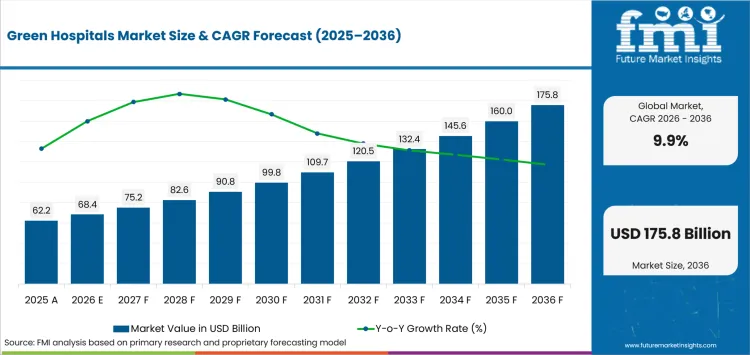
Key Takeaways of Green Hospitals Market
- Hospital estate programs support demand by linking measured resource reductions with clinical continuity and accountable performance across occupied facilities.
- Green building infrastructure is projected to account for 47.0% in 2026 because envelope and plant decisions determine lifetime utility performance.
- General hospitals are estimated to capture 41.0% in 2026 as mixed clinical departments require coordinated ventilation, water and waste systems.
- Energy-efficient systems are anticipated to represent 38.0% in 2026 owing to efficient HVAC and controls that protect required room conditions.
- Legacy infrastructure and continuous care requirements extend shutdown planning, commissioning and capital approval across occupied hospital retrofit programs.
- Siemens Healthineers AG, Johnson Controls International plc, Schneider Electric SE, Koninklijke Philips N.V., GE HealthCare Technologies Inc., Veolia Environnement S.A., Trane Technologies plc and Ecolab Inc. form the competitive set across hospital controls, medical technology and environmental services.
Analyst Perspective
"Green hospital investment earns approval when engineering teams prove that lower resource use does not weaken room conditions, equipment availability or emergency response. Commercial value is therefore earned through dependable baselines, staged commissioning and service accountability that keeps savings measurable after clinical handover."
- Anurag Sharma, Principal Consultant, Future Market Insights
How is the Green Hospitals Market segmented?
The Green Hospitals Market is segmented by component, application, technology, end user, certification and region.
Component categories include green building infrastructure, energy management systems, waste and water management solutions and green healthcare services. Applications cover general hospitals, specialty hospitals, ambulatory healthcare facilities and academic and research hospitals. Technology includes energy-efficient systems, renewable energy integration, water conservation technologies and waste management technologies. End users comprise public hospitals, private hospitals and healthcare networks. Certification covers LEED-certified hospitals, BREEAM-certified hospitals and other green certifications.
Why does Green Building Infrastructure lead the component category?
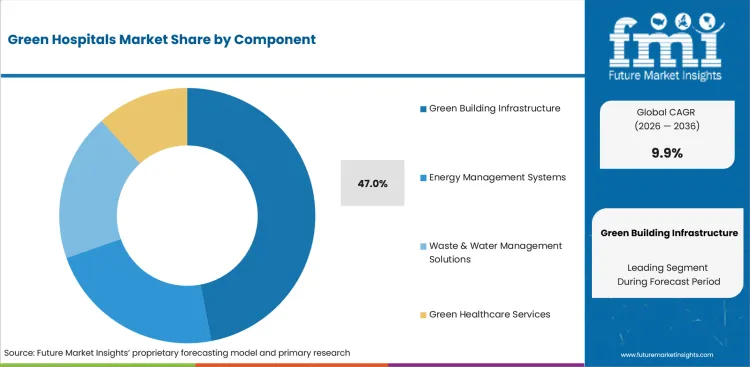
Green building infrastructure establishes the physical load that later controls and utility systems must manage across a hospital estate. Envelope performance, plant-room design and material selection shape energy demand throughout construction and future refurbishment.
- By component, green building infrastructure is estimated to hold 47.0% in 2026 owing to owners resolving envelope performance and certification requirements during design.
- Projects combine HVAC control systems with metering and high-performance materials so commissioning teams can test the building as one operating system. Integrated specifications also reduce redesign risk and create a consistent evidence record for certification, maintenance and later retrofit planning.
Why do General Hospitals lead the application category?
General hospitals combine emergency departments and surgical theaters with diagnostic units and inpatient wards inside one continuously occupied estate. Their mixed clinical loads require coordinated ventilation, hot water, sterile processing and waste handling across different operating schedules.
- In 2026, general hospitals are expected to lead the application category with 41.0% share because multi-specialty estates require coordinated utility programs.
- Facility engineers test air conditioning systems against sterile-room conditions and maintenance access before accepting equipment for routine use. Shared controls can then support several departments while local schedules protect operating rooms, diagnostics and inpatient wards from avoidable disruption.
Why do Energy-efficient Systems lead the technology category?
Hospitals cannot reduce essential care activity merely to lower utility consumption across critical departments and occupied clinical spaces. The practical route improves equipment efficiency and matches environmental conditions with verified clinical room use.
- The technology category is forecast to be led by energy-efficient systems at 38.0% share in 2026 due to high-efficiency HVAC and responsive controls.
- Engineers assess air source heat pumps and onsite renewable systems against electrical capacity, peak loads and emergency resilience before project approval. Sequenced upgrades are commercially stronger because hospitals can verify savings without relying on unsupported assumptions about future power availability.
Why do Public Hospitals lead the end user category?
Public hospitals manage large patient volumes and long-lived estates under formal capital controls across regional healthcare systems. Their scale favors programs that standardize metering, controls and reporting across municipal networks while preserving local engineering responsibility.
- The end user category is forecast to be led by public hospitals at 44.0% share in 2026 due to portfolio scale and formal performance reporting.
- Government hospitals can group similar upgrades across several sites to reduce design repetition and compare operating results under common specifications.
Why do LEED-certified Hospitals lead the certification category?
Certification converts environmental goals into documented criteria for energy, water, materials and indoor environmental performance. Hospital owners use comparable evidence during design review and repeat approved measures across several network projects with shared governance.
- LEED-certified hospitals are set to lead the certification category with 49.0% share in 2026 due to established Silver, Gold and Platinum pathways.
- Certification teams review medical waste management systems and meter records against defined project boundaries during formal assessment. Missing operating data can delay final documentation even after equipment installation, which makes early measurement plans necessary for project closeout and future reporting.
What are the drivers, restraints and opportunities in the Green Hospitals Market?
Measured estate targets support investment, but clinical disruption and weak baselines delay occupied retrofits. Integrated controls and performance contracts improve sequencing across hospital networks.
- Driver: Health systems are linking capital approval to measured energy, water and resilience outcomes across buildings and clinical equipment.
- Restraint: Retrofit programs must protect infection control and critical services during shutdown planning, commissioning and validation.
- Opportunity: Connected controls and performance contracts can verify savings before hospital networks authorize wider portfolio deployment.
Measured Estate Targets Convert Policy into Projects
Hospital owners convert environmental commitments into funded projects by assigning baselines and named responsibility to each facility. NHS England’s September 2025 progress report treats estate upgrades as part of a health-system program instead of isolated engineering work. That governance makes measured outcomes central to capital comparison, supplier selection and annual board reporting.
Clinical Continuity Raises Retrofit Cost
Occupied hospitals must maintain operating rooms and sterile services during construction or control-system replacement work. Older estates often lack reliable submetering that separates clinical loads accurately from general building use. Temporary plant, staged commissioning and clinical sign-off raise costs and delay authorization for projects with uncertain baselines.
Integrated Programs Improve Investment Sequencing
Performance contracts can combine facility management software with plant upgrades under one measured delivery plan. Hospital networks can add smart waste management once operating data confirms safe staff workflows and service responsibilities. Each completed phase supplies evidence for the next investment decision, which reduces the risk of disrupting several clinical departments together.
Which country CAGRs are profiled in the Green Hospitals Market?
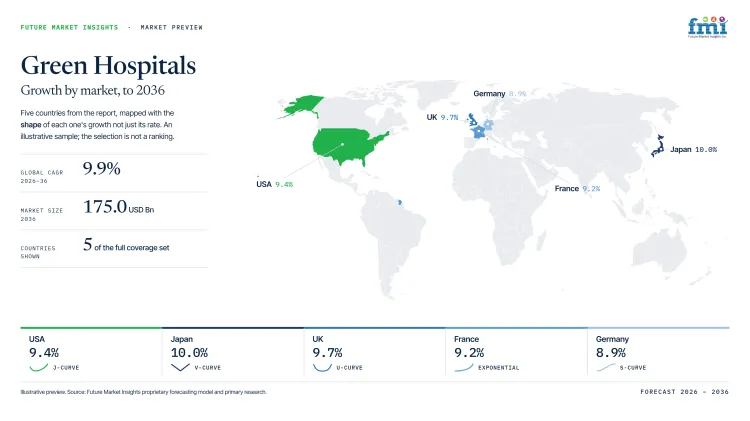
| Country | CAGR |
|---|---|
| Japan | 10.0% |
| United Kingdom | 9.7% |
| United States | 9.4% |
| France | 9.2% |
| Germany | 8.9% |
How do country-level CAGRs compare in the Green Hospitals Market?
The country forecasts span 1.1 percentage points between Japan and Germany over the assessment period. That narrow forecast range does not imply identical market size, project access or installed capacity. Growth conditions differ through building standards and public procurement rules across each national health system. Performance finance and service coverage create further differences in project conversion across public and private estates.
- Japan combines building energy labels with retrofit programs that must align efficiency upgrades with emergency power resilience and local engineering support.
- The United Kingdom relies on national building standards and portfolio planning across a publicly managed estate with common capital-review requirements.
- United States projects often use performance contracts across large hospital portfolios with decentralized ownership and different utility conditions.
- France links mandatory energy reporting with staged reduction targets that make metering and verified baselines central to retrofit approval.
- Germany uses trained climate managers to translate resource goals into site-level measures, funding requests and operating responsibility.
Comparable CAGRs can therefore produce different qualification evidence, service obligations and purchase schedules across each country. Full report coverage spans North America, Latin America, Western Europe, Eastern Europe, East Asia, South Asia and Pacific and Middle East and Africa.
Country-wise Analysis
- Japan’s building energy label gives hospital owners a common method for comparing nonresidential performance during construction and major renovation. Green hospital demand in Japan is forecast to rise at 10.0% CAGR over the forecast period, supported by clearer ZEB qualification and resilience planning. The Ministry of Land, Infrastructure, Transport and Tourism states that the label has operated since April 2024 and uses four qualitative ZEB tiers from ZEB Oriented to full ZEB to track hospital performance, although retrofit contractors must coordinate hot-water systems and controls with emergency power requirements plus regional maintenance capacity across occupied older facilities with limited shutdown access.
- The NHS Net Zero Building Standard gives hospital estates a common technical basis for qualifying new buildings and major upgrades. The United Kingdom’s green hospitals market is anticipated to advance at 9.7% CAGR over the assessment period, reinforced by national specifications and public portfolio planning. NHS England announced in March 2025 that 132 solar projects were allocated across 78 trusts covering about 200 sites, yet contractors must schedule electrical work around clinical compliance and limited shutdown windows while proving battery safety plus long-term service capacity.
- United States hospital networks use portfolio benchmarking and performance contracts across estates with different ownership structures and utility tariffs. Adoption of green hospital systems in the United States is estimated to expand at 9.4% CAGR through 2036, supported by measurable savings and flexible project finance. The Department of Energy reported in September 2024 that the Carl T. Hayden VA Medical Center achieved more than 25% energy savings and an ENERGY STAR score of 99, although contractors must align hospital capacity management with incentives plus resilience requirements and local maintenance coverage across sites using different financing rules.
- France requires covered tertiary buildings to report annual energy use through OPERAT and compare progress against national reduction targets. Green hospital sales in France are forecast to expand at 9.2% CAGR by 2036, influenced by mandatory reporting and demand for meters with active controls. The environment ministry states that covered facilities must reduce final energy use by 40% in 2030 relative to 2010, but older hospitals need staged construction and reliable baselines before reported savings support continued capital approval and long-term monitoring contracts.
- Germany’s KLIK green program trained hospital climate managers to coordinate energy and purchasing measures across hospitals and rehabilitation clinics. The German green hospitals market is projected to record 8.9% CAGR during the assessment period, shaped by site-level expertise and practical implementation support. KLIK green engaged 250 institutions and generated more than 1,600 measures, although project suppliers still need local engineering coverage plus defensible payback evidence for public tenders and ongoing maintenance across technically varied regional estates.
Who are the notable companies in the Green Hospitals Market?
Siemens Healthineers AG, Johnson Controls International plc, Schneider Electric SE, Koninklijke Philips N.V., GE HealthCare Technologies Inc., Veolia Environnement S.A., Trane Technologies plc and Ecolab Inc. are the notable companies serving this market.
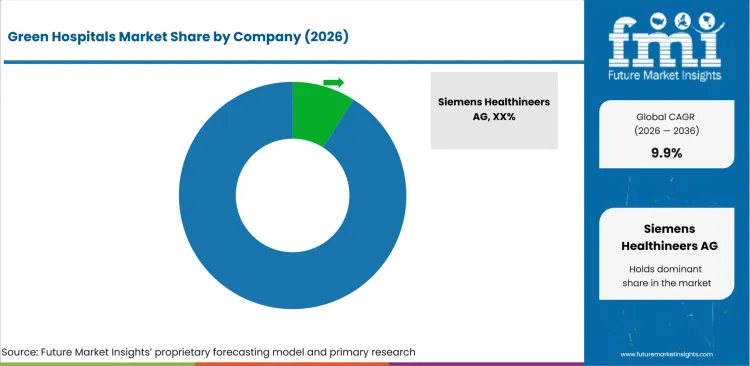
The competitive field is fragmented across building automation, medical technology and environmental services because no provider covers every hospital requirement. Entry depends on clinical compatibility and documented performance alongside engineering support that remains available throughout commissioning and maintenance. Hospital owners therefore compare specialist depth before considering portfolio breadth or global scale across digital healthcare programs.
- Johnson Controls International plc, Schneider Electric SE and Trane Technologies plc compete through hospital controls, HVAC services, financing support and long-term performance programs.
- Siemens Healthineers AG, Koninklijke Philips N.V. and GE HealthCare Technologies Inc. address imaging energy use, equipment life extension and clinical performance requirements.
- Veolia Environnement S.A. provides hospital water, waste and energy services while Ecolab Inc. addresses hygiene, infection prevention and water safety across care environments.
Competitive Benchmarking: Green Hospitals Market
| Company | Building Energy and Controls | Sustainable Medical Systems | Water, Waste and Circularity | Geographic Reach |
|---|---|---|---|---|
| Siemens Healthineers AG | Medium | High | Medium | Global |
| Johnson Controls International plc | High | Low | Low | Global |
| Schneider Electric SE | High | Low | Low | Global |
| Koninklijke Philips N.V. | Low | High | High | Global |
| GE HealthCare Technologies Inc. | Low | High | Medium | Global |
| Veolia Environnement S.A. | Medium | Low | High | Global |
| Trane Technologies plc | High | Low | Medium | Global |
| Ecolab Inc. | Low | Low | Medium | Global |
Key Developments in the Green Hospitals Market
- In July 2026, Siemens Healthineers AG reported that a Luz Saúde pilot across ten MRI systems and chillers cut idle-period energy use by 46% and identified 200 MWh in savings. Smart sensors and digital dashboards established an operating baseline for testing equipment settings without reducing diagnostic capacity.
- In May 2026, Johnson Controls International plc reported annual energy-cost savings above USD 5,000 per operating room at one healthcare organization using OpenBlue Operating Room Optimization. The platform adjusts temperature and airflow during idle periods while preserving readiness for scheduled procedures and emergencies.
- In March 2026, Schneider Electric SE published a hospital retrofit study covering nine strategies across seven global climates. Optimized digital combinations reached approximately 18% energy savings under the modeled conditions, while results varied with climate and existing plant design.
Key Players in the Green Hospitals Market
Hospital Building and Energy Platforms
- Johnson Controls International plc
- Schneider Electric SE
- Trane Technologies plc
Sustainable Medical Technology Platforms
- Siemens Healthineers AG
- Koninklijke Philips N.V.
- GE HealthCare Technologies Inc.
Water, Waste and Environmental Services
- Veolia Environnement S.A.
- Ecolab Inc.
Green Hospitals Market - Report Scope
| Coverage field | Report scope |
|---|---|
| Market breakdown | By component, application, technology, end user, certification and region. |
| Quantitative Units | Revenue in USD billion and CAGR in %. |
| Market Definition | Products, systems and services that reduce hospital energy, water, waste and material intensity while protecting clinical operations, resilience and recognized building-performance outcomes. |
| Regions Covered | North America, Latin America, Western Europe, Eastern Europe, East Asia, South Asia and Pacific, and Middle East and Africa. |
| Countries Covered | United States, Germany, United Kingdom, France, Japan, and 20+ countries included in the full report. |
| Key Companies Profiled | Siemens Healthineers AG, Johnson Controls International plc, Schneider Electric SE, Koninklijke Philips N.V., GE HealthCare Technologies Inc., Veolia Environnement S.A., Trane Technologies plc and Ecolab Inc. |
| Forecast Period | 2026 to 2036. |
| Approach | Primary and secondary research with market triangulation. |
Green Hospitals Market - Research Methodology
| Method | Approach |
|---|---|
| Primary Research | FMI analysts gathered input from manufacturers, service providers, technology developers, distributors, end users, procurement teams, and subject-matter experts. Interviews examined purchasing decisions, product or service evaluation, adoption barriers, approval requirements, pricing considerations, and expectations for technical or commercial support. Respondents were also asked what evidence is required before a trial, pilot, or initial order develops into regular purchasing. |
| Desk Research | Desk research covered government statistics, regulatory publications, trade data, industry associations, technical literature, standards, company filings, product information, and official corporate announcements. Sources were reviewed for relevance, publication date, geographic coverage, and consistency with the defined market scope. Claims relating to performance, applications, approvals, capacity, investment, and commercial activity were retained only when supported by credible public evidence. |
| Market Sizing and Forecasting | The market model combined the baseline value with historical performance, segment structure, pricing and volume indicators, adoption levels, company participation, and country-level demand conditions. Forecast assumptions considered economic activity, investment trends, regulatory developments, technology adoption, purchasing cycles, supply availability, and barriers to wider market use. Segment and regional estimates were reconciled before the final market total was calculated. |
| Data Validation | Estimates were checked against multiple independent indicators, including public data, company activity, trade patterns, industry developments, and findings from primary interviews. Validation also tested whether products, services, applications, and company revenues fell within the defined market boundaries. Adjacent categories, unsupported claims, overlapping revenues, and activities without direct market relevance were excluded to reduce double counting and maintain consistency across segments and countries. |
Green Hospitals Market by Segments
Green Hospitals Market segmented by Component:
- Green Building Infrastructure
- Energy-efficient Building Design
- Sustainable Construction Materials
- LEED-certified Hospital Buildings
- Energy Management Systems
- Smart HVAC Systems
- Lighting Control Systems
- Building Energy Monitoring
- Waste & Water Management Solutions
- Medical Waste Recycling
- Water Recycling Systems
- Rainwater Harvesting Systems
- Green Healthcare Services
- Energy Auditing
- Sustainability Consulting
- Carbon Management Services
Green Hospitals Market segmented by Application:
- General Hospitals
- Multi-specialty Hospitals
- Community Hospitals
- Teaching Hospitals
- Specialty Hospitals
- Cancer Hospitals
- Cardiac Hospitals
- Orthopedic Hospitals
- Ambulatory Healthcare Facilities
- Day Surgery Centers
- Outpatient Clinics
- Diagnostic Centers
- Academic & Research Hospitals
- Medical Universities
- Research Hospitals
- Government Medical Centers
Green Hospitals Market segmented by Technology:
- Energy-efficient Systems
- High-efficiency HVAC
- LED Lighting Systems
- Smart Building Controls
- Renewable Energy Integration
- Solar Power Systems
- Geothermal Energy Systems
- Wind Energy Systems
- Water Conservation Technologies
- Greywater Recycling
- Low-flow Fixtures
- Smart Water Monitoring
- Waste Management Technologies
- Automated Waste Segregation
- Medical Waste Treatment
- Recycling Systems
Green Hospitals Market segmented by End User:
- Public Hospitals
- Government Hospitals
- Municipal Hospitals
- Public Health Systems
- Private Hospitals
- Private Hospital Chains
- Independent Hospitals
- Specialty Care Hospitals
- Healthcare Networks
- Integrated Delivery Networks
- Academic Health Systems
- Non-profit Healthcare Organizations
Green Hospitals Market segmented by Certification:
- LEED-certified Hospitals
- LEED Silver
- LEED Gold
- LEED Platinum
- BREEAM-certified Hospitals
- New Construction Certification
- In-use Certification
- Healthcare-specific Certification
- Other Green Certifications
- GREEN STAR
- IGBC Green Healthcare
- Local Green Building Standards
Green Hospitals Market by Region
- North America
- United States
- Canada
- Mexico
- Latin America
- Brazil
- Chile
- Rest of Latin America
- Western Europe
- Germany
- United Kingdom
- Italy
- Spain
- France
- Nordics
- Benelux
- Rest of Western Europe
- Eastern Europe
- Russia
- Poland
- Hungary
- Balkan and Baltic States
- Rest of Eastern Europe
- East Asia
- China
- Japan
- South Korea
- South Asia and Pacific
- India
- ASEAN
- Australia and New Zealand
- Rest of South Asia and Pacific
- Middle East and Africa
- Kingdom of Saudi Arabia
- Other GCC Countries
- Türkiye
- South Africa
- Other African Union Countries
- Rest of Middle East and Africa
Research Sources and Bibliography
- World Health Organization & United Nations Children’s Fund. (2024, June 22). Universal water, sanitation, hygiene, waste and electricity services in all health care facilities to achieve quality care.
- Ministère de la Transition écologique. (2026, May 19). Communiqué de presse - Économies d’énergie : une baisse de 26 % dans le secteur tertiaire.
- NHS England. (2025, September 24). Five years of a greener NHS: progress and forward look.
- Ministry of Land, Infrastructure, Transport and Tourism. (2024, April).
- NHS England. (2025, March 21). £100 million funding from Great British Energy for NHS trusts to install solar panels and battery storage systems.
- NHS England. (2023, February 22). NHS Net Zero Building Standard.
- USA Department of Energy. (2024, September 20). Carl T. Hayden Veterans Affairs Medical Center: Smart Buildings Case Study.
- Ministère de la Transition écologique. (2025, September 9). Éco Énergie Tertiaire (EET).
- KLIK green. (2022). Projektbeschreibung.
- Siemens Healthineers. (2026, July 10). A smart move for energy efficiency.
- Johnson Controls. (2026, May 26). Smarter Hospitals & ORs With OpenBlue.
- Schneider Electric. (2026, May 29). The hospital retrofit imperative.
- Philips. (2025, March 13). Philips transforming healthcare with responsible and sustainable innovations, delivering better care for more people.
- GE HealthCare. (2024, December 4). GE HealthCare showcases commitment to sustainable innovation at RSNA 2024.
- Veolia Environnement. (2026). Universal registration document 2025.
- Trane. (2025, March 12). Revolutionizing Healthcare Facilities with Connected Mechanical Service.
- Ecolab. (2024, July 2). Ecolab launches Disinfectant 1 Wipe, the first EPA-registered 100% plastic-free degradable disinfectant wipe complete with 1-minute hospital disinfection.
- Siemens Healthcare K.K. (2026, May 11).
- Schneider Electric. (2025, December 3). The NHS National Rehabilitation Centre selects Schneider Electric to deliver innovative solutions to improve patient care and efficiencies.
- Trane. (2025, October 17). Greenwood County Hospital Boosts Energy Efficiency.
- Siemens Healthineers. (2025, June 10). Siemens Healthineers achieves Science Based Targets initiative validation for Net Zero targets.
- Philips. (2025, November 4). 5 lessons from our journey toward net-zero healthcare delivery.
This bibliography is provided for reader reference and is not exhaustive. The full report contains the complete reference list and detailed citations
This Report Answers
- How do hospital owners protect clinical continuity while reducing resource use?
- Which component, application and technology segments lead demand in 2026?
- How do certification requirements change design and operating evidence?
- Which conditions delay retrofits across occupied hospital estates?
- How do integrated controls and performance contracts improve investment sequencing?
- How do market-entry conditions differ across the five profiled countries?
- Which provider groups compete across building systems, medical technology and environmental services?
- Which verified developments are changing hospital energy management?
Frequently Asked Questions
How big is the Green Hospitals Market in 2026?
The green hospitals market is valued at USD 68.4 billion in 2026 and is projected to reach USD 175.8 billion by 2036. Hospital owners are investing in efficient buildings, clinical equipment and environmental services that reduce resource use without weakening critical care conditions or emergency resilience.
What is the CAGR of the Green Hospitals Market from 2026 to 2036?
The green hospitals market is projected to expand at 9.9% CAGR from 2026 to 2036. Growth reflects measured estate targets and verified operating savings, although legacy infrastructure and clinical continuity requirements extend retrofit planning and capital approval across occupied hospitals.
Which component segment is projected to account for 47.0% of the Green Hospitals Market?
Green building infrastructure is projected to account for 47.0% of the green hospitals market component category in 2026. Its position reflects the need to resolve envelope performance, plant capacity and certification requirements during design or major refurbishment across planned and occupied hospital estates.
Which certification segment is projected to account for 49.0% of the Green Hospitals Market?
LEED-certified hospitals are projected to account for 49.0% of the green hospitals market certification category in 2026. Their position reflects documented criteria for energy, water, materials and indoor environmental performance that support design review and consistent project verification across hospital portfolios.
Which companies are active in the Green Hospitals Market?
Key companies are profiled in the green hospitals market: Siemens Healthineers AG, Johnson Controls International plc, Schneider Electric SE, Koninklijke Philips N.V., GE HealthCare Technologies Inc., Veolia Environnement S.A., Trane Technologies plc and Ecolab Inc. Their roles cover hospital controls, medical technology, water management and environmental services across occupied healthcare facilities.
Preview the report firsthand - request a free sample
Get SampleGet the brochure for pricing and purchase details.
Get PDFTable of Content
- Key Takeaways
- Market Size and CAGR
- Top Growth Driver
- Fastest Growing Segment
- Leading Region
- Key Companies
- Emerging Opportunities
- Executive Summary
- Global Market Outlook
- Demand-side Trends
- Supply-side Trends
- Technology Roadmap Analysis
- Analysis and Recommendations
- Analyst Perspective (What is happening? Why now? What should investors know?)
- Key Questions Answered
- How large is the market?
- What is the CAGR?
- What are key trends?
- Which region dominates?
- Who are the leaders?
- Market Overview
- Market Coverage / Taxonomy
- Market Definition / Scope / Limitations
- Research Methodology
- Chapter Orientation
- Analytical Lens and Working Hypotheses
- Market Structure, Signals, and Trend Drivers
- Benchmarking and Cross-market Comparability
- Market Sizing, Forecasting, and Opportunity Mapping
- Research Design and Evidence Framework
- Desk Research Programme (Secondary Evidence)
- Expert Input and Fieldwork (Primary Evidence)
- Tooling, Models, and Reference Databases
- Data Engineering and Model Build
- Quality Assurance and Audit Trail
- Market Background
- Market Dynamics (Drivers, Restraints, Opportunity, Trends)
- Scenario Forecast (Optimistic, Likely, Conservative)
- Impact Analysis
- AI Impact
- Sustainability Impact
- Regulatory Impact
- Technology Impact
- Consumer / Buyer Analysis
- Purchase Drivers
- Adoption Barriers
- Buyer Journey
- Opportunity Map Analysis
- Product Life Cycle Analysis
- Supply Chain Analysis
- Investment Feasibility Matrix
- Value Chain Analysis
- PESTLE and Porter's Analysis
- Regulatory Landscape
- Regional Parent Market Outlook
- Production and Consumption Statistics
- Import and Export Statistics
- Global Market Analysis and Forecast, 2021 to 2036
- Historical Market Size Value (USD Billion) Analysis, 2021 to 2025
- Current and Future Market Size Value (USD Billion) Projections, 2026 to 2036
- Y-o-Y Growth Trend Analysis
- Absolute $ Opportunity Analysis
- Global Market Pricing Analysis, 2021 to 2036
- Global Market Analysis and Forecast, By Component, 2021 to 2036
- Introduction / Key Findings
- Historical Market Size Value (USD Billion) Analysis By Component, 2021 to 2025
- Current and Future Market Size Value (USD Billion) Analysis and Forecast By Component, 2026 to 2036
- Green Building Infrastructure
- Energy-efficient Building Design
- Sustainable Construction Materials
- LEED-certified Hospital Buildings
- Energy Management Systems
- Smart HVAC Systems
- Lighting Control Systems
- Building Energy Monitoring
- Waste & Water Management Solutions
- Medical Waste Recycling
- Water Recycling Systems
- Rainwater Harvesting Systems
- Green Healthcare Services
- Energy Auditing
- Sustainability Consulting
- Carbon Management Services
- Green Building Infrastructure
- Y-o-Y Growth Trend Analysis By Component, 2021 to 2025
- Absolute $ Opportunity Analysis By Component, 2026 to 2036
- Global Market Analysis and Forecast, By Application, 2021 to 2036
- Introduction / Key Findings
- Historical Market Size Value (USD Billion) Analysis By Application, 2021 to 2025
- Current and Future Market Size Value (USD Billion) Analysis and Forecast By Application, 2026 to 2036
- General Hospitals
- Multi-specialty Hospitals
- Community Hospitals
- Teaching Hospitals
- Specialty Hospitals
- Cancer Hospitals
- Cardiac Hospitals
- Orthopedic Hospitals
- Ambulatory Healthcare Facilities
- Day Surgery Centers
- Outpatient Clinics
- Diagnostic Centers
- Academic & Research Hospitals
- Medical Universities
- Research Hospitals
- Government Medical Centers
- General Hospitals
- Y-o-Y Growth Trend Analysis By Application, 2021 to 2025
- Absolute $ Opportunity Analysis By Application, 2026 to 2036
- Global Market Analysis and Forecast, By Technology, 2021 to 2036
- Introduction / Key Findings
- Historical Market Size Value (USD Billion) Analysis By Technology, 2021 to 2025
- Current and Future Market Size Value (USD Billion) Analysis and Forecast By Technology, 2026 to 2036
- Energy-efficient Systems
- High-efficiency HVAC
- LED Lighting Systems
- Smart Building Controls
- Renewable Energy Integration
- Solar Power Systems
- Geothermal Energy Systems
- Wind Energy Systems
- Water Conservation Technologies
- Greywater Recycling
- Low-flow Fixtures
- Smart Water Monitoring
- Waste Management Technologies
- Automated Waste Segregation
- Medical Waste Treatment
- Recycling Systems
- Energy-efficient Systems
- Y-o-Y Growth Trend Analysis By Technology, 2021 to 2025
- Absolute $ Opportunity Analysis By Technology, 2026 to 2036
- Global Market Analysis and Forecast, By End User, 2021 to 2036
- Introduction / Key Findings
- Historical Market Size Value (USD Billion) Analysis By End User, 2021 to 2025
- Current and Future Market Size Value (USD Billion) Analysis and Forecast By End User, 2026 to 2036
- Public Hospitals
- Government Hospitals
- Municipal Hospitals
- Public Health Systems
- Private Hospitals
- Private Hospital Chains
- Independent Hospitals
- Specialty Care Hospitals
- Healthcare Networks
- Integrated Delivery Networks
- Academic Health Systems
- Non-profit Healthcare Organizations
- Public Hospitals
- Y-o-Y Growth Trend Analysis By End User, 2021 to 2025
- Absolute $ Opportunity Analysis By End User, 2026 to 2036
- Global Market Analysis and Forecast, By Certification, 2021 to 2036
- Introduction / Key Findings
- Historical Market Size Value (USD Billion) Analysis By Certification, 2021 to 2025
- Current and Future Market Size Value (USD Billion) Analysis and Forecast By Certification, 2026 to 2036
- LEED-certified Hospitals
- LEED Silver
- LEED Gold
- LEED Platinum
- BREEAM-certified Hospitals
- New Construction Certification
- In-use Certification
- Healthcare-specific Certification
- Other Green Certifications
- GREEN STAR
- IGBC Green Healthcare
- Local Green Building Standards
- LEED-certified Hospitals
- Y-o-Y Growth Trend Analysis By Certification, 2021 to 2025
- Absolute $ Opportunity Analysis By Certification, 2026 to 2036
- Global Market Analysis and Forecast, By Region, 2021 to 2036
- Introduction
- Historical Market Size Value (USD Billion) Analysis By Region, 2021 to 2025
- Current Market Size Value (USD Billion) Analysis and Forecast By Region, 2026 to 2036
- North America
- Latin America
- Western Europe
- Eastern Europe
- East Asia
- South Asia and Pacific
- Middle East & Africa
- Market Attractiveness Analysis By Region
- North America Market Analysis and Forecast, By Country, 2021 to 2036
- Historical Market Size Value (USD Billion) Trend Analysis By Market Taxonomy, 2021 to 2025
- Market Size Value (USD Billion) Forecast By Market Taxonomy, 2026 to 2036
- By Country
- USA
- Canada
- By Component
- By Application
- By Technology
- By End User
- By Certification
- By Country
- Market Attractiveness Analysis
- By Country
- By Component
- By Application
- By Technology
- By End User
- By Certification
- Key Takeaways
- Latin America Market Analysis and Forecast, By Country
- Historical Market Size Value (USD Billion) Trend Analysis By Market Taxonomy, 2021 to 2025
- Market Size Value (USD Billion) Forecast By Market Taxonomy, 2026 to 2036
- By Country
- Brazil
- Mexico
- Chile
- Rest of Latin America
- By Component
- By Application
- By Technology
- By End User
- By Certification
- By Country
- Market Attractiveness Analysis
- By Country
- By Component
- By Application
- By Technology
- By End User
- By Certification
- Key Takeaways
- Western Europe Market Analysis and Forecast, By Country
- Historical Market Size Value (USD Billion) Trend Analysis By Market Taxonomy, 2021 to 2025
- Market Size Value (USD Billion) Forecast By Market Taxonomy, 2026 to 2036
- By Country
- Germany
- UK
- Italy
- Spain
- France
- Nordic
- BENELUX
- Rest of Western Europe
- By Component
- By Application
- By Technology
- By End User
- By Certification
- By Country
- Market Attractiveness Analysis
- By Country
- By Component
- By Application
- By Technology
- By End User
- By Certification
- Key Takeaways
- Eastern Europe Market Analysis and Forecast, By Country
- Historical Market Size Value (USD Billion) Trend Analysis By Market Taxonomy, 2021 to 2025
- Market Size Value (USD Billion) Forecast By Market Taxonomy, 2026 to 2036
- By Country
- Russia
- Poland
- Hungary
- Balkan & Baltic
- Rest of Eastern Europe
- By Component
- By Application
- By Technology
- By End User
- By Certification
- By Country
- Market Attractiveness Analysis
- By Country
- By Component
- By Application
- By Technology
- By End User
- By Certification
- Key Takeaways
- East Asia Market Analysis and Forecast, By Country
- Historical Market Size Value (USD Billion) Trend Analysis By Market Taxonomy, 2021 to 2025
- Market Size Value (USD Billion) Forecast By Market Taxonomy, 2026 to 2036
- By Country
- China
- Japan
- South Korea
- By Component
- By Application
- By Technology
- By End User
- By Certification
- By Country
- Market Attractiveness Analysis
- By Country
- By Component
- By Application
- By Technology
- By End User
- By Certification
- Key Takeaways
- South Asia and Pacific Market Analysis and Forecast, By Country
- Historical Market Size Value (USD Billion) Trend Analysis By Market Taxonomy, 2021 to 2025
- Market Size Value (USD Billion) Forecast By Market Taxonomy, 2026 to 2036
- By Country
- India
- ASEAN
- Australia & New Zealand
- Rest of South Asia and Pacific
- By Component
- By Application
- By Technology
- By End User
- By Certification
- By Country
- Market Attractiveness Analysis
- By Country
- By Component
- By Application
- By Technology
- By End User
- By Certification
- Key Takeaways
- Middle East & Africa Market Analysis and Forecast, By Country
- Historical Market Size Value (USD Billion) Trend Analysis By Market Taxonomy, 2021 to 2025
- Market Size Value (USD Billion) Forecast By Market Taxonomy, 2026 to 2036
- By Country
- Kingdom of Saudi Arabia
- Other GCC Countries
- Türkiye
- South Africa
- Other African Union
- Rest of Middle East & Africa
- By Component
- By Application
- By Technology
- By End User
- By Certification
- By Country
- Market Attractiveness Analysis
- By Country
- By Component
- By Application
- By Technology
- By End User
- By Certification
- Key Takeaways
- Key Countries Market Analysis
- USA
- Pricing Analysis
- Market Share Analysis, 2025
- By Component
- By Application
- By Technology
- By End User
- By Certification
- Canada
- Pricing Analysis
- Market Share Analysis, 2025
- By Component
- By Application
- By Technology
- By End User
- By Certification
- Mexico
- Pricing Analysis
- Market Share Analysis, 2025
- By Component
- By Application
- By Technology
- By End User
- By Certification
- Brazil
- Pricing Analysis
- Market Share Analysis, 2025
- By Component
- By Application
- By Technology
- By End User
- By Certification
- Chile
- Pricing Analysis
- Market Share Analysis, 2025
- By Component
- By Application
- By Technology
- By End User
- By Certification
- Germany
- Pricing Analysis
- Market Share Analysis, 2025
- By Component
- By Application
- By Technology
- By End User
- By Certification
- UK
- Pricing Analysis
- Market Share Analysis, 2025
- By Component
- By Application
- By Technology
- By End User
- By Certification
- Italy
- Pricing Analysis
- Market Share Analysis, 2025
- By Component
- By Application
- By Technology
- By End User
- By Certification
- Spain
- Pricing Analysis
- Market Share Analysis, 2025
- By Component
- By Application
- By Technology
- By End User
- By Certification
- France
- Pricing Analysis
- Market Share Analysis, 2025
- By Component
- By Application
- By Technology
- By End User
- By Certification
- India
- Pricing Analysis
- Market Share Analysis, 2025
- By Component
- By Application
- By Technology
- By End User
- By Certification
- ASEAN
- Pricing Analysis
- Market Share Analysis, 2025
- By Component
- By Application
- By Technology
- By End User
- By Certification
- Australia & New Zealand
- Pricing Analysis
- Market Share Analysis, 2025
- By Component
- By Application
- By Technology
- By End User
- By Certification
- China
- Pricing Analysis
- Market Share Analysis, 2025
- By Component
- By Application
- By Technology
- By End User
- By Certification
- Japan
- Pricing Analysis
- Market Share Analysis, 2025
- By Component
- By Application
- By Technology
- By End User
- By Certification
- South Korea
- Pricing Analysis
- Market Share Analysis, 2025
- By Component
- By Application
- By Technology
- By End User
- By Certification
- Russia
- Pricing Analysis
- Market Share Analysis, 2025
- By Component
- By Application
- By Technology
- By End User
- By Certification
- Poland
- Pricing Analysis
- Market Share Analysis, 2025
- By Component
- By Application
- By Technology
- By End User
- By Certification
- Hungary
- Pricing Analysis
- Market Share Analysis, 2025
- By Component
- By Application
- By Technology
- By End User
- By Certification
- Kingdom of Saudi Arabia
- Pricing Analysis
- Market Share Analysis, 2025
- By Component
- By Application
- By Technology
- By End User
- By Certification
- Türkiye
- Pricing Analysis
- Market Share Analysis, 2025
- By Component
- By Application
- By Technology
- By End User
- By Certification
- South Africa
- Pricing Analysis
- Market Share Analysis, 2025
- By Component
- By Application
- By Technology
- By End User
- By Certification
- USA
- Market Structure Analysis
- Competition Dashboard
- Competition Benchmarking
- Market Share Analysis of Top Players
- By Regional
- By Component
- By Application
- By Technology
- By End User
- By Certification
- Emerging Startups
- Innovation Benchmarking
- Competition Analysis
- Competition Deep Dive
- Siemens Healthineers AG
- Overview
- Product Portfolio
- Profitability by Market Segments
- Sales Footprint
- Strategy Overview
- Marketing Strategy
- Product Strategy
- Channel Strategy
- Johnson Controls International plc
- Honeywell International Inc.
- Schneider Electric SE
- Philips Healthcare
- GE HealthCare Technologies Inc.
- Veolia Environment S.A.
- Trane Technologies plc
- Johnson Matthey plc
- Ecolab Inc.
- Siemens Healthineers AG
- Case Studies
- Success Stories
- Recent Developments
- Competition Deep Dive
- Assumptions & Acronyms Used


