

- Market Size (2026)
- USD 620.6 Mn
- Forecast (2036)
- USD 1524.0 Mn
- CAGR (2026 to 2036)
- 9.4%
How big is the acetylene black market in 2026?
USD 620.6 million in 2026 and USD 1,524.0 million by 2036 at a 9.4% CAGR.
The acetylene black industry value is forecast to grow from USD 567.3 million in 2025 to USD 1,524.0 million by 2036 as battery electrodes, cable compounds, and conductive polymers require high-purity carbon networks. Powder is forecast to represent 68.0% share in 2026 because slurry processors need flexible dosage control and faster wetting. Direct sales are expected to secure 61.0% share in 2026, led by supplier-backed qualification contracts and technical data exchange.
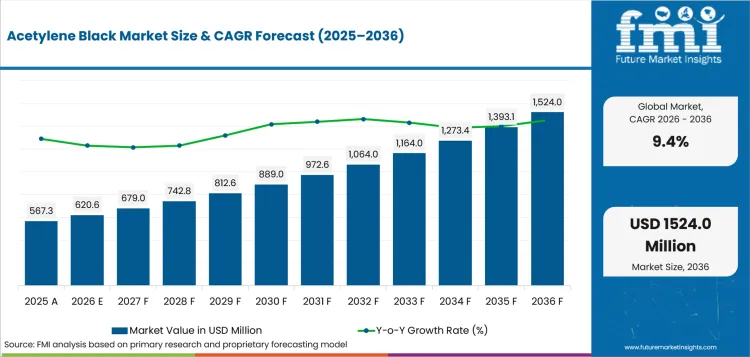
Acetylene Black Market Overview: Size and Forecast
- 2026 Market Size: USD 620.6 million
- 2036 Market Size: USD 1,524.0 million
- Forecast CAGR: 9.4% from 2026 to 2036
- Leading Form: Powder
- Powder Share in 2026: 68.0%
- Leading Sales Channel: Direct
- Direct Share in 2026: 61.0%
- Fastest-growing Country: China
- China CAGR: 10.8% by 2036
Summary of the Acetylene Black Market
- Demand and Growth Drivers
- Battery makers are raising conductive additive specifications as coating lines require low impurity material with consistent dispersion behavior.
- Cable compounders are using acetylene black where shielding layers need controlled electrical resistance and stable processing.
- Conductive polymer buyers are adding specialty carbon materials when antistatic and dissipative parts need repeatable performance.
- Product and Segment View
- Powder is forecast to represent 68.0% share in 2026, supported by flexible dosage control and faster wetting in slurry preparation.
- Direct sales are projected to hold 61.0% share in 2026, influenced by supplier-backed qualification records and long-term contracts.
- Lithium-ion Batteries are expected to account for 54.0% share in 2026, led by cathode and anode coating lines requiring stable conductive pathways.
- Geography and Competitive Outlook
- China is projected to record 10.8% CAGR by 2036, backed by cell manufacturing scale and domestic conductive additive supply.
- India is expected to expand at 10.2% CAGR by 2036 as battery localization and cable applications broaden the buyer base.
- Denka, Orion S.A., Cabot Corporation, Birla Carbon, and Hexing Chemical Industry compete through specialty carbon know-how and regional technical support.
- Suppliers with cleaner grades, reliable packaging, and application support should gain stronger positions in battery and cable accounts.
- Analyst Opinion
- Nikhil Kaitwade, Associate Vice President at FMI, observes, “Acetylene black has become a qualification-led material rather than a simple specialty carbon purchase. Battery buyers need conductivity, but they are paying for impurity control, lot consistency, and process stability on coating lines. Cable and polymer buyers view the same material through shielding, static control, and dispersion reliability. Suppliers able to prove clean production, stable packaging, and regional technical support should defend value more effectively than producers competing only on price.”
Quality control is becoming the main purchase filter as battery and storage scale moves conductive additives into stricter qualification programs. The International Energy Agency reported global EV battery deployment at 1.2 TWh in 2025, with China holding 60% of deployment, Europe nearly 15%, and the United States 10%. The agency also stated global electric car sales topped 20 million units in 2025, equal to more than one-quarter of total car sales. Cabot Corporation stated in July 2025 that its LITX 95F conductive carbon was engineered for energy storage systems and demonstrated strong capacity retention in pouch cell testing. Suppliers with cleaner grades and documented process performance can gain stronger access to battery and cable accounts.
Which factors support expansion in the acetylene black market?
Battery electrode revenue, conductive polymer specifications, and cable shielding requirements support market value across high-purity conductive carbon applications.
- Market value is supported by battery-grade additive revenue before cable and polymer accounts add incremental demand.
- Supplier pricing reflects purity, packaging control, and technical support before commodity carbon black benchmarks affect negotiations.
- Revenue improves as cell makers qualify acetylene black for low-loading conductive networks in cathode and anode formulations.
- Buyer trust rises as suppliers document ash limits, moisture control, dispersion behavior, and lot-to-lot performance.
Why is the acetylene black market growing?
Battery manufacturers and compounders are moving toward conductive carbon grades that can deliver stable performance at low loading levels.
Growth outlook is tied to manufacturing scale, qualification discipline, and conductivity requirements across the electric vehicle battery market and stationary storage systems. The International Energy Agency reported that lithium demand rose nearly 30% in 2024, while demand for nickel, cobalt, graphite, and rare earths increased by 6% to 8%. That context reinforces why cell makers scrutinize conductive additives such as acetylene black. The material can support electron pathways without excessive loading, but only when purity, wetting, and particle consistency remain stable across production batches.
How is the acetylene black market segmented?
The acetylene black industry is segmented by grade, application, end use, form, and sales channel.
- Battery Grade is projected to account for 46.0% share in 2026, led by electrode makers requiring low ash content and cleaner conductive carbon networks in battery formulations.
- Lithium-ion Batteries are expected to hold 54.0% share in 2026, since cell producers need conductive additives that support stable electrode performance without excess inactive material.
- Automotive is anticipated to capture 42.0% share in 2026 due to traction battery production, supplier qualification, and electric powertrain material demand.
- Powder is forecast to represent 68.0% share in 2026, guided by slurry mixing needs, laboratory trial flexibility, and easier dosage control.
- Direct sales are estimated to secure 61.0% share in 2026, reflected by large battery and cable buyers preferring supplier-supported technical contracts.
Why does Battery Grade dominate the acetylene black market?
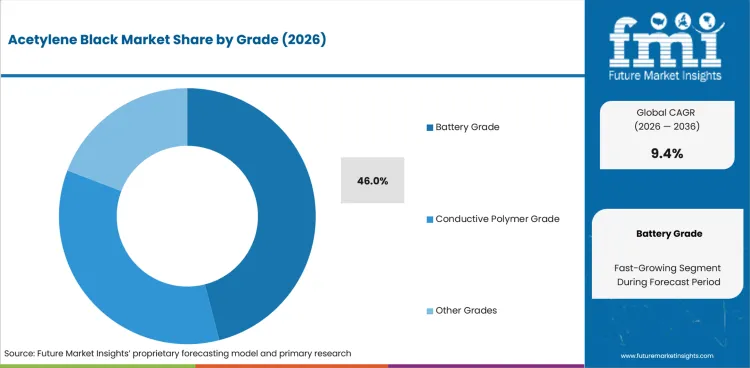
- Battery Grade is projected to account for 46.0% share in 2026, influenced by lower impurity expectations and the need for stable electronic pathways inside coated electrodes.
- Conductive polymer and rubber grades remain important where buyers need static dissipation, cable shielding, and processing stability without full battery-grade purity requirements.
Which application leads the acetylene black market?
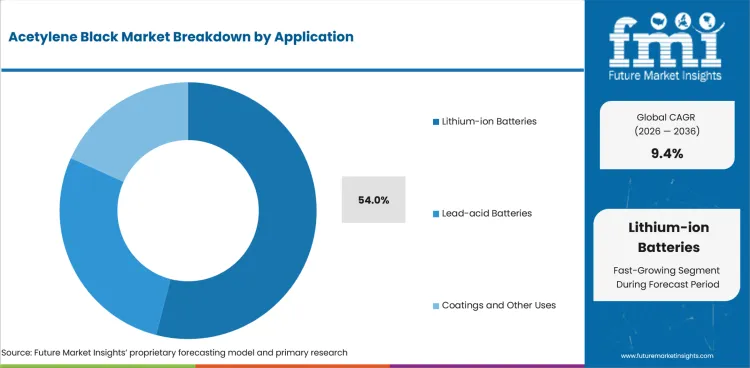
- Lithium-ion Batteries are expected to hold 54.0% share in 2026, shaped by high-volume electrode coating lines that need repeatable conductive networks.
- Lead-acid batteries and conductive plastics sustain additional demand when formulators require charge acceptance support or controlled surface resistance.
Which end use leads the acetylene black market?
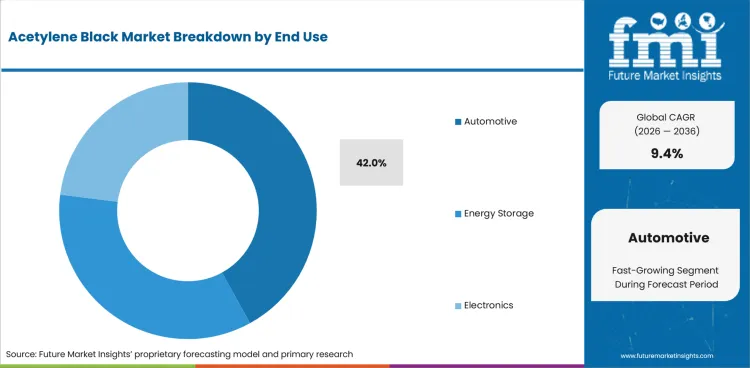
- Automotive is anticipated to capture 42.0% share in 2026, attributable to traction battery programs and electric powertrain material qualification.
- Energy storage and electronics uses widen the addressable base as pack makers and packaging suppliers seek high-purity conductive additives.
Which form leads the acetylene black market?
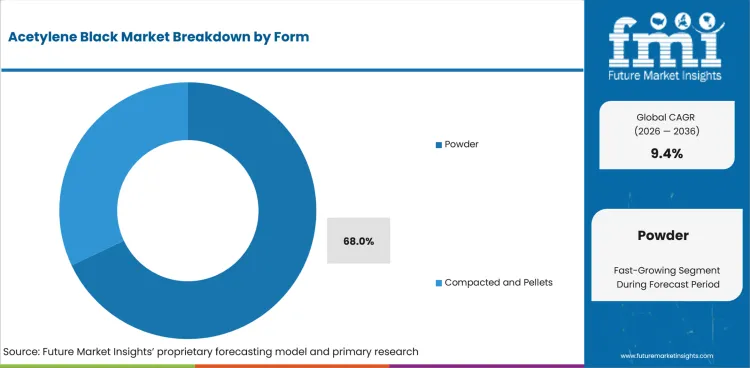
- Powder is forecast to represent 68.0% share in 2026, owing to its compatibility with slurry mixing, trial batches, and flexible dosage windows.
- Compacted forms and pellets gain attention where safer handling, lower dust exposure, and cleaner warehouse operations are procurement priorities.
Which sales channel leads the acetylene black market?
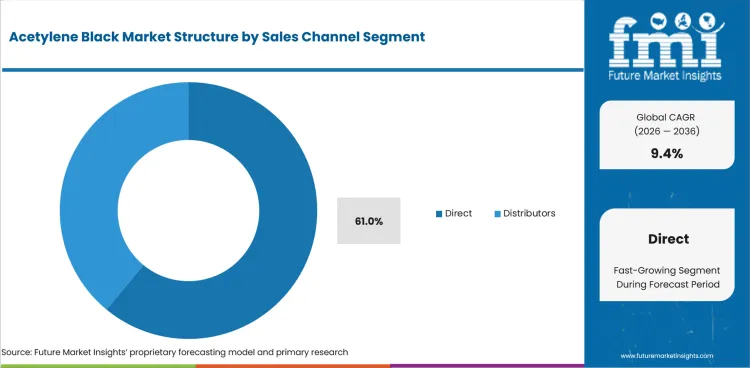
- Direct sales are estimated to secure 61.0% share in 2026, supported by qualification records, technical data exchange, and multi-year supply discussions.
- Distributors remain useful for sample programs, smaller compounding accounts, and regional buyers testing acetylene black before direct supply commitments.
What are the drivers, restraints, and opportunities in the acetylene black market?
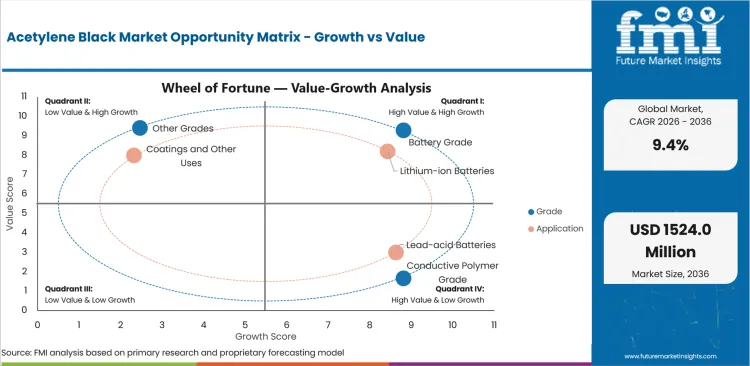
Battery qualification and conductive compound requirements support expansion while feedstock exposure and substitution risk limit unchecked adoption.
- Driver: Battery electrode producers are demanding cleaner conductive carbon that supports coating uniformity and low inactive material loading.
- Restraint: Acetylene route production and feedstock exposure can create cost pressure in price-sensitive polymer and rubber applications.
- Opportunity: Cable shielding and storage systems can create wider use for acetylene black beyond electric vehicle batteries.
Battery Electrode Conductivity Qualification Demand Outlook
Battery electrode qualification is becoming the main driver for acetylene black demand because cell makers need clean conductive pathways before coating lines move into large-volume operation. The International Energy Agency said global battery manufacturing capacity grew almost 30% in 2024 and reached more than 3 TWh, which gives conductive additive suppliers a larger approval pipeline. Battery-grade acetylene black suppliers can gain when they prove ash control, moisture stability, and repeatable dispersion during cathode and anode formulation trials.
Acetylene Route Cost and Substitution Restraint Analysis
Acetylene black can face restraint when customers compare its premium against other conductive carbons and lower-cost filler options. The International Energy Agency reported lithium prices fell by over 80% since 2023, while graphite, cobalt, and nickel prices dropped by 10% to 20% in 2024. This pricing reset can make battery and polymer buyers push harder for evidence that acetylene-route material improves conductivity, processing stability, and reject reduction enough to justify a premium.
Grid Storage and Cable Shielding Opportunity Analysis
Grid storage and cable shielding create an opportunity for acetylene black suppliers beyond electric vehicle battery demand. The International Energy Agency stated battery storage is expected to deliver 90% of storage growth and rise 14-fold to 1,200 GW by 2030. This supports wider technical demand for conductive additives used in storage cells, high-voltage cable layers, and dissipative polymer systems where stable electrical performance matters more than simple pigmentation.
Which countries are growing fastest in the acetylene black market?
China 10.8% CAGR, India 10.2% CAGR, South Korea 9.8% CAGR, United States 9.5% CAGR, Germany 9.0% CAGR, Japan 8.7% CAGR, France 8.6% CAGR, and United Kingdom 8.1% CAGR through 2036.
.webp "Top Country Growth Comparison Acetylene Black Market Cagr (2026 2036)")
| Country | CAGR |
|---|---|
| China | 10.8% |
| India | 10.2% |
| South Korea | 9.8% |
| United States | 9.5% |
| Germany | 9.0% |
| Japan | 8.7% |
| France | 8.6% |
| United Kingdom | 8.1% |
Source: Future Market Insights, 2026.
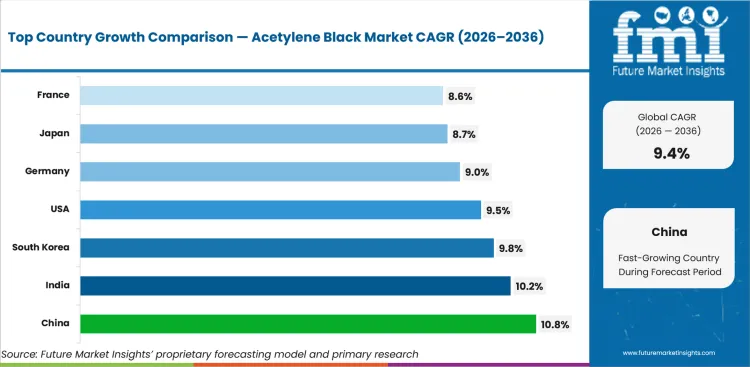
How do country-level CAGRs compare in the acetylene black market?
China leads country expansion while the United Kingdom records the most measured expansion outlook among profiled markets.
- China is forecast to record 10.8% CAGR by 2036 as battery, cable, and conductive compound demand shape local adoption.
- India is forecast to record 10.2% CAGR by 2036 as battery, cable, and conductive compound demand shape local adoption.
- South Korea is forecast to record 9.8% CAGR by 2036 as battery, cable, and conductive compound demand shape local adoption.
- United States is forecast to record 9.5% CAGR by 2036 as battery, cable, and conductive compound demand shape local adoption.
- Germany is forecast to record 9.0% CAGR by 2036 as battery, cable, and conductive compound demand shape local adoption.
- Japan is forecast to record 8.7% CAGR by 2036 as battery, cable, and conductive compound demand shape local adoption.
- France is forecast to record 8.6% CAGR by 2036 as battery, cable, and conductive compound demand shape local adoption.
- United Kingdom is forecast to record 8.1% CAGR by 2036 as battery, cable, and conductive compound demand shape local adoption.
Why does China lead acetylene black market growth?
A 10.8% CAGR through 2036 is supported by large battery output, domestic supply, and export-oriented quality demands.
Country Market Snapshot Table
| Parameter | Value |
|---|---|
| Market Size in 2025 (Value) | USD 171.5 million |
| Market Size in 2026 (Value) | USD 190.0 million |
| Market Forecast in 2036 (Value) | USD 529.7 million |
| CAGR (2026 to 2036) | 10.8% |
| Years Considered | 2021 to 2036 |
| Base Year | 2025 |
| Forecast Period | 2026 to 2036 |
| Units Considered | Value (USD million) |
| Leading Sub-Region | Yangtze River Delta, Pearl River Delta, and battery manufacturing provinces |
China Acetylene Black Market Outlook
China acetylene black demand is supported by large-scale cell manufacturing, conductive polymer production, and domestic carbon black supply. Buyers compare local grades with global materials when purity, dispersion, and export documentation are critical.
The market is expected to stay competitive because local producers can shorten lead times for standard grades. Premium demand will depend on proof of impurity control and repeatable performance on high-throughput coating lines.
Key Growth Drivers
- Battery additive demand is reinforced by the International Energy Agency reporting more than 13 million electric cars sold in China in 2025.
- Consumer policy supports battery material planning as The State Council of the People’s Republic of China renewed the auto trade-in program with subsidies up to CNY 20,000 for eligible vehicle replacement in 2026.
- Domestic acetylene black producers support shorter lead times for local battery, cable, and conductive plastic buyers.
- Export-oriented battery makers require material documentation that supports overseas customer audits.
Key Restraints
- Supply concentration creates scrutiny since the International Energy Agency reported the top three refining nations reached 86% share across selected critical mineral refining in 2024.
- Local price competition can compress margins for standard conductive carbon grades.
- Small producers may struggle to meet documentation requirements demanded by export-focused cell manufacturers.
What makes China unique
China is unique because it combines the largest battery demand pool with a growing domestic supply base for acetylene black and conductive additives.
Key Companies
- Denka Company Limited
- Orion S.A.
- Hexing Chemical Industry
- Xiahuayuan Xuguang Chemical
- Cabot Corporation
Sales & Marketing Channels
- Direct sales to cell manufacturers
- Domestic chemical distributors
- Conductive polymer compounder channels
- Cable material producers
- Export trading houses
Country Segment Breakdown Table
| Segment | Sub-Segments |
|---|---|
| By Grade | Battery Grade · Conductive Polymer Grade · Rubber Grade · Other Grades |
| By Application | Lithium-ion Batteries · Lead-acid Batteries · Conductive Plastics · Coatings and Other Uses |
| By End Use | Automotive · Energy Storage · Industrial · Electronics |
| By Form | Powder · Compacted and Pellets |
| By Sales Channel | Direct · Distributors |
| Key Sub-Regions Covered, Battery and Industrial Material Corridors | Yangtze River Delta · Pearl River Delta · Sichuan-Chongqing · Shandong · Hubei · Fujian |
Frequently Asked Questions
How fast is China acetylene black market growing?
Sales in China are forecast to rise at 10.8% CAGR from 2026 to 2036 through battery, cable, and conductive compound applications.
Who leads China acetylene black market?
Denka Company Limited, Orion S.A., Hexing Chemical Industry compete through conductive carbon supply, technical support, and qualification-linked customer relationships.
What is driving adoption in China acetylene black market?
Battery material qualification and conductive compound demand are moving buyers toward cleaner acetylene black grades in China.
What is driving acetylene black market growth in India?
A 10.2% CAGR through 2036 is driven by battery localization, EV adoption support, and conductive polymer demand.
Country Market Snapshot Table
| Parameter | Value |
|---|---|
| Market Size in 2025 (Value) | USD 38.1 million |
| Market Size in 2026 (Value) | USD 42.0 million |
| Market Forecast in 2036 (Value) | USD 111.1 million |
| CAGR (2026 to 2036) | 10.2% |
| Years Considered | 2021 to 2036 |
| Base Year | 2025 |
| Forecast Period | 2026 to 2036 |
| Units Considered | Value (USD million) |
| Leading Sub-Region | Gujarat, Maharashtra, Tamil Nadu, and emerging battery corridors |
India Acetylene Black Market Outlook
India acetylene black demand is developing from battery materials planning, electrical cable applications, and conductive compound use. Buyers are expected to evaluate imported grades while domestic battery supply chains mature.
Technical distribution remains important because many users need samples, documentation, and formulation support before adopting higher-purity conductive carbon. Direct sales should grow as battery accounts move toward larger annual contracts.
Key Growth Drivers
- Battery and EV localization is supported by the Press Information Bureau reporting on the PM E-DRIVE scheme with an approved outlay of INR 10,900 crore for the 2024 to 2026 period.
- Electric vehicle material demand is supported by the International Energy Agency reporting Indian electric car sales rose 75% in 2025.
- Cable and industrial compounders provide a practical demand base for conductive carbon before local cell output reaches larger scale.
- Battery materials localization encourages buyers to qualify cleaner conductive additives for long-term supply programs.
Key Restraints
- A large conventional vehicle base slows battery-grade pull since Press Information Bureau reported India’s auto industry produced approximately 28 million vehicles in 2023 to 2024.
- Imported high-purity acetylene black can face freight, lead-time, and currency pressure for smaller buyers.
- Local formulation capabilities need stronger testing infrastructure before premium grades gain wider adoption.
What makes India unique
India is unique because distributors and battery project buyers are creating new qualification pathways before local cell output reaches global scale.
Key Companies
- Birla Carbon
- PCBL Limited
- Denka Company Limited
- Cabot Corporation
- Orion S.A.
Sales & Marketing Channels
- Battery materials qualification programs
- Specialty chemical distributors
- Cable compounder procurement
- Direct sales to large battery accounts
- Technical sample channels
Country Segment Breakdown Table
| Segment | Sub-Segments |
|---|---|
| By Grade | Battery Grade · Conductive Polymer Grade · Rubber Grade · Other Grades |
| By Application | Lithium-ion Batteries · Lead-acid Batteries · Conductive Plastics · Coatings and Other Uses |
| By End Use | Automotive · Energy Storage · Industrial · Electronics |
| By Form | Powder · Compacted and Pellets |
| By Sales Channel | Direct · Distributors |
| Key Sub-Regions Covered, Battery and Industrial Material Corridors | Gujarat · Maharashtra · Tamil Nadu · Karnataka · Telangana · National Capital Region |
Frequently Asked Questions
How fast is India acetylene black market growing?
Sales in India are forecast to rise at 10.2% CAGR from 2026 to 2036 through battery, cable, and conductive compound applications.
Who leads India acetylene black market?
Birla Carbon, PCBL Limited, Denka Company Limited compete through conductive carbon supply, technical support, and qualification-linked customer relationships.
What is driving adoption in India acetylene black market?
Battery material qualification and conductive compound demand are moving buyers toward cleaner acetylene black grades in India.
What is the acetylene black market outlook in South Korea?
A 9.8% CAGR through 2036 reflects battery maker requirements and export-linked material validation.
Country Market Snapshot Table
| Parameter | Value |
|---|---|
| Market Size in 2025 (Value) | USD 52.8 million |
| Market Size in 2026 (Value) | USD 58.0 million |
| Market Forecast in 2036 (Value) | USD 147.5 million |
| CAGR (2026 to 2036) | 9.8% |
| Years Considered | 2021 to 2036 |
| Base Year | 2025 |
| Forecast Period | 2026 to 2036 |
| Units Considered | Value (USD million) |
| Leading Sub-Region | Seoul-Incheon, Ulsan, and battery export corridors |
South Korea Acetylene Black Market Outlook
South Korea acetylene black demand is linked to battery cell makers and high-spec conductive additive validation. Suppliers must support purity data, cycle testing, and export customer documentation.
The country’s battery value chain creates a strong technical buying culture. Direct selling is expected to dominate battery-grade material, while distributors support smaller polymer and cable accounts.
Key Growth Drivers
- Battery-grade conductive additive planning is supported by the International Trade Administration showing Korea produced 407,009 electric vehicles in 2025.
- Industrial policy supports secondary batteries as Korea’s Ministry of Economy and Finance announced a KRW 50 trillion high-tech strategic industry fund in 2025.
- Global cell makers in Korea require lot-to-lot consistency before approving conductive carbon for export supply programs.
- Electronics and cable uses provide added demand for clean conductive carbon beyond vehicle battery applications.
Key Restraints
- Global competition can pressure domestic battery suppliers as the International Energy Agency noted Korean-owned EU battery capacity share may fall from about 85% in 2024 to nearly 30% by 2030.
- Battery export exposure can create order swings when overseas EV programs change production schedules.
- Qualification timelines stay long when cell makers require extended cycle and safety validation.
What makes South Korea unique
South Korea is unique because export customer standards shape battery-grade conductive additive selection and documentation discipline.
Key Companies
- LG Energy Solution material suppliers
- Samsung SDI material suppliers
- SK On material suppliers
- Birla Carbon
- Orion S.A.
Sales & Marketing Channels
- Direct technical sales to battery makers
- Cell supplier qualification programs
- Specialty chemical distributors
- Cable compounder channels
- Electronics materials distributors
Country Segment Breakdown Table
| Segment | Sub-Segments |
|---|---|
| By Grade | Battery Grade · Conductive Polymer Grade · Rubber Grade · Other Grades |
| By Application | Lithium-ion Batteries · Lead-acid Batteries · Conductive Plastics · Coatings and Other Uses |
| By End Use | Automotive · Energy Storage · Industrial · Electronics |
| By Form | Powder · Compacted and Pellets |
| By Sales Channel | Direct · Distributors |
| Key Sub-Regions Covered, Battery and Industrial Material Corridors | Seoul-Incheon · Ulsan · Chungcheong · Gyeonggi · Busan · Daegu |
Frequently Asked Questions
How fast is South Korea acetylene black market growing?
Sales in South Korea are forecast to rise at 9.8% CAGR from 2026 to 2036 through battery, cable, and conductive compound applications.
Who leads South Korea acetylene black market?
LG Energy Solution material suppliers, Samsung SDI material suppliers, SK On material suppliers compete through conductive carbon supply, technical support, and qualification-linked customer relationships.
What is driving adoption in South Korea acetylene black market?
Battery material qualification and conductive compound demand are moving buyers toward cleaner acetylene black grades in South Korea.
What is the acetylene black market outlook in the United States?
A 9.5% CAGR through 2036 is supported by battery plants, grid storage additions, and technical qualification routes.
Country Market Snapshot Table
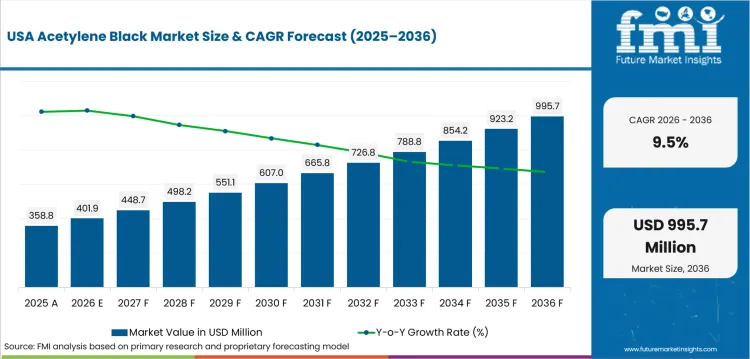
| Parameter | Value |
|---|---|
| Market Size in 2025 (Value) | USD 100.5 million |
| Market Size in 2026 (Value) | USD 110.0 million |
| Market Forecast in 2036 (Value) | USD 272.8 million |
| CAGR (2026 to 2036) | 9.5% |
| Years Considered | 2021 to 2036 |
| Base Year | 2025 |
| Forecast Period | 2026 to 2036 |
| Units Considered | Value (USD million) |
| Leading Sub-Region | Texas, Southeast, and Midwest battery corridors |
United States Acetylene Black Market Outlook
United States acetylene black demand is shaped by battery material localization and grid storage buildout. Cell producers and polymer compounders are placing greater emphasis on impurity control, safety documentation, and direct technical support.
Large buyers are expected to favor suppliers that can provide local sampling, repeatable lots, and process guidance. Specialty distributors will continue serving smaller cable, rubber, and conductive plastic users that need lower-volume supply access.
Key Growth Drivers
- U.S. electric vehicle activity supports electrode additive planning as Argonne National Laboratory reported more than 1.5 million plug-in electric vehicles sold in 2024.
- Grid storage adds a second demand channel since the U.S. Energy Information Administration reported utility-scale battery storage capacity exceeded 26 GW in 2024.
- Battery material localization encourages buyers to evaluate domestic supply contracts before expanding qualified conductive additive purchases.
- Cable and polymer accounts support demand when grid, electronics, and industrial users require antistatic and shielding compounds.
Key Restraints
- EV demand volatility can slow spot restocking because the International Energy Agency reported U.S. electric car sales near 1.5 million units in 2025 with a weaker final quarter.
- Long cell qualification cycles can delay switching even when local conductive additive availability improves.
- Lower-value polymer users can resist acetylene black premiums when furnace black alternatives meet basic conductivity targets.
What makes United States unique
The United States is unique because it combines cell manufacturing, storage deployment, and chemical distribution depth in a qualification-heavy buying environment.
Key Companies
- Orion S.A.
- Cabot Corporation
- Denka Company Limited
- Birla Carbon
- RDAbbott
Sales & Marketing Channels
- Direct supply to battery cell manufacturers
- Specialty chemical distribution
- Cable compounder purchasing teams
- Technical sampling programs
- Long-term supplier qualification contracts
Country Segment Breakdown Table
| Segment | Sub-Segments |
|---|---|
| By Grade | Battery Grade · Conductive Polymer Grade · Rubber Grade · Other Grades |
| By Application | Lithium-ion Batteries · Lead-acid Batteries · Conductive Plastics · Coatings and Other Uses |
| By End Use | Automotive · Energy Storage · Industrial · Electronics |
| By Form | Powder · Compacted and Pellets |
| By Sales Channel | Direct · Distributors |
| Key Sub-Regions Covered, Battery and Industrial Material Corridors | Texas · Southeast · Midwest · California · Northeast · Gulf Coast |
Frequently Asked Questions
How fast is United States acetylene black market growing?
Sales in United States are forecast to rise at 9.5% CAGR from 2026 to 2036 through battery, cable, and conductive compound applications.
Who leads United States acetylene black market?
Orion S.A., Cabot Corporation, Denka Company Limited compete through conductive carbon supply, technical support, and qualification-linked customer relationships.
What is driving adoption in United States acetylene black market?
Battery material qualification and conductive compound demand are moving buyers toward cleaner acetylene black grades in United States.
What is driving acetylene black market demand in Germany?
A 9.0% CAGR through 2036 is shaped by automotive materials, high-voltage cable compounds, and battery qualification discipline.
Country Market Snapshot Table
| Parameter | Value |
|---|---|
| Market Size in 2025 (Value) | USD 46.8 million |
| Market Size in 2026 (Value) | USD 51.0 million |
| Market Forecast in 2036 (Value) | USD 120.8 million |
| CAGR (2026 to 2036) | 9.0% |
| Years Considered | 2021 to 2036 |
| Base Year | 2025 |
| Forecast Period | 2026 to 2036 |
| Units Considered | Value (USD million) |
| Leading Sub-Region | Bavaria, Baden-Wuerttemberg, and Rhine-Ruhr industrial clusters |
Germany Acetylene Black Market Outlook
Germany acetylene black demand is guided by automotive suppliers, engineering plastics producers, and cable compounders. Buyers tend to require audit-ready documentation before approving conductive carbon grades for scaled production.
Supplier selection is expected to favor European technical service and stable lot information. The market has stronger value in specification-led applications than in basic black pigmentation or commodity filler use.
Key Growth Drivers
- Battery material planning is supported by electric vehicle registrations as the European Alternative Fuels Observatory reported 45,535 new battery electric registrations in April 2025.
- Automotive material demand is reinforced by Verband der Automobilindustrie reporting 864,000 electric cars produced in Germany during the first half of 2025.
- Cable and compound producers require documented dispersion behavior for conductive layers used in demanding industrial environments.
- Local technical service supports faster sample feedback for battery, rubber, and engineering plastic accounts.
Key Restraints
- Domestic electric car uptake can stay uneven since the Federal Statistical Office reported electric cars at 13.5% of new passenger car registrations in 2024.
- High energy and compounding costs can pressure specialty carbon premiums in non-battery applications.
- Automotive inventory swings can delay restocking decisions for conductive additive users.
What makes Germany unique
Germany is unique because plant audit readiness and supplier consistency carry strong commercial weight in automotive material qualification.
Key Companies
- Cabot Corporation
- Orion S.A.
- Denka Company Limited
- Birla Carbon
- Imerys Graphite & Carbon
Sales & Marketing Channels
- Direct OEM material qualification
- Battery cell supplier purchasing
- Cable compounder procurement
- European specialty chemical distributors
- Technical service centers
Country Segment Breakdown Table
| Segment | Sub-Segments |
|---|---|
| By Grade | Battery Grade · Conductive Polymer Grade · Rubber Grade · Other Grades |
| By Application | Lithium-ion Batteries · Lead-acid Batteries · Conductive Plastics · Coatings and Other Uses |
| By End Use | Automotive · Energy Storage · Industrial · Electronics |
| By Form | Powder · Compacted and Pellets |
| By Sales Channel | Direct · Distributors |
| Key Sub-Regions Covered, Battery and Industrial Material Corridors | Bavaria · Baden-Wuerttemberg · North Rhine-Westphalia · Saxony · Lower Saxony · Hesse |
Frequently Asked Questions
How fast is Germany acetylene black market growing?
Sales in Germany are forecast to rise at 9.0% CAGR from 2026 to 2036 through battery, cable, and conductive compound applications.
Who leads Germany acetylene black market?
Cabot Corporation, Orion S.A., Denka Company Limited compete through conductive carbon supply, technical support, and qualification-linked customer relationships.
What is driving adoption in Germany acetylene black market?
Battery material qualification and conductive compound demand are moving buyers toward cleaner acetylene black grades in Germany.
How fast is Japan acetylene black market growing?
An 8.7% CAGR through 2036 reflects premium battery, electronics, and cable material demand.
Country Market Snapshot Table
| Parameter | Value |
|---|---|
| Market Size in 2025 (Value) | USD 45.1 million |
| Market Size in 2026 (Value) | USD 49.0 million |
| Market Forecast in 2036 (Value) | USD 112.7 million |
| CAGR (2026 to 2036) | 8.7% |
| Years Considered | 2021 to 2036 |
| Base Year | 2025 |
| Forecast Period | 2026 to 2036 |
| Units Considered | Value (USD million) |
| Leading Sub-Region | Kanto, Kansai, and Japanese electronics material corridors |
Japan Acetylene Black Market Outlook
Japan acetylene black demand is specification-led rather than purely volume-led. Battery materials, electronics packaging, and cable compounds sustain demand for clean conductive carbon with strong lot consistency.
Domestic technical know-how supports buyer confidence in high-purity grades. Long qualification cycles can protect incumbents but also slow adoption for new suppliers.
Key Growth Drivers
- Battery industry planning supports conductive additive demand as the Ministry of Economy, Trade and Industry set a domestic battery manufacturing base target of 150 GWh from around the start of the next decade.
- Electrified vehicle know-how supports materials demand as the International Energy Agency reported hybrid electric vehicles represented around one-third of Japanese car sales in 2025.
- Electronics packaging creates high-purity demand where surface resistance and clean processing carry more value than bulk filler price.
- Japanese buyers favor suppliers with stable documentation and long technical histories in specialty carbon materials.
Key Restraints
- Domestic EV pull remains limited since the International Trade Administration reported electric vehicles at only 1.35% of Japan’s new vehicle registrations in 2024.
- Conservative qualification practices can slow supplier switching for battery and electronics accounts.
- Premium acetylene black adoption can be delayed when buyers use established graphite or furnace black blends.
What makes Japan unique
Japan is unique because it acts as both a premium specification market and a technology reference point for high-purity acetylene black.
Key Companies
- Denka Company Limited
- Tokai Carbon Co. Ltd.
- Mitsubishi Chemical Group
- Cabot Corporation
- Orion S.A.
Sales & Marketing Channels
- Direct sales to battery material formulators
- Electronics materials qualification channels
- Cable compounder purchasing
- Trading house distribution
- Long-term technical supply agreements
Country Segment Breakdown Table
| Segment | Sub-Segments |
|---|---|
| By Grade | Battery Grade · Conductive Polymer Grade · Rubber Grade · Other Grades |
| By Application | Lithium-ion Batteries · Lead-acid Batteries · Conductive Plastics · Coatings and Other Uses |
| By End Use | Automotive · Energy Storage · Industrial · Electronics |
| By Form | Powder · Compacted and Pellets |
| By Sales Channel | Direct · Distributors |
| Key Sub-Regions Covered, Battery and Industrial Material Corridors | Kanto · Kansai · Chubu · Kyushu · Tohoku · Shikoku |
Frequently Asked Questions
How fast is Japan acetylene black market growing?
Sales in Japan are forecast to rise at 8.7% CAGR from 2026 to 2036 through battery, cable, and conductive compound applications.
Who leads Japan acetylene black market?
Denka Company Limited, Tokai Carbon Co. Ltd., Mitsubishi Chemical Group compete through conductive carbon supply, technical support, and qualification-linked customer relationships.
What is driving adoption in Japan acetylene black market?
Battery material qualification and conductive compound demand are moving buyers toward cleaner acetylene black grades in Japan.
What is the acetylene black market forecast for France?
An 8.6% CAGR through 2036 is supported by selective battery projects and conductive compound demand.
Country Market Snapshot Table
| Parameter | Value |
|---|---|
| Market Size in 2025 (Value) | USD 35.0 million |
| Market Size in 2026 (Value) | USD 38.0 million |
| Market Forecast in 2036 (Value) | USD 86.7 million |
| CAGR (2026 to 2036) | 8.6% |
| Years Considered | 2021 to 2036 |
| Base Year | 2025 |
| Forecast Period | 2026 to 2036 |
| Units Considered | Value (USD million) |
| Leading Sub-Region | Northern battery corridor and national industrial compounder networks |
France Acetylene Black Market Outlook
France acetylene black demand is shaped by battery projects, automotive electrification, and industrial compounders. Buyers value European documentation and supplier reliability before committing to repeat purchases.
Conductive plastics and cable materials help reduce dependence on battery project timing. This gives suppliers a broader route to commercial adoption when cell capacity ramps gradually.
Key Growth Drivers
- Battery-grade additive demand is supported by the International Energy Agency reporting French battery electric car sales up 15% in 2025.
- Near-term electric vehicle activity improved as the European Alternative Fuels Observatory reported 35,683 battery electric registrations in France in February 2026.
- Cable and industrial compounders create non-vehicle demand for conductive carbon with repeatable dispersion performance.
- Battery supply-chain localization encourages buyers to compare global acetylene black grades with European technical support.
Key Restraints
- Broader vehicle softness can delay material orders as the European Automobile Manufacturers’ Association reported EU petrol registrations fell 18.7% in 2025, with France among the steepest declines.
- Imported specialty carbon can face lead-time pressure for smaller users without annual supply contracts.
- Battery project phasing can create uneven demand for battery-grade powder in early production years.
What makes France unique
France is unique because battery policy support is balanced by a cautious specification culture that rewards compliance-backed suppliers.
Key Companies
- Cabot Corporation
- Orion S.A.
- Denka Company Limited
- Birla Carbon
- Arkema distribution partners
Sales & Marketing Channels
- Battery material qualification channels
- Specialty chemical distributors
- Cable compounder direct purchasing
- Coatings additive distributors
- Technical sample programs
Country Segment Breakdown Table
| Segment | Sub-Segments |
|---|---|
| By Grade | Battery Grade · Conductive Polymer Grade · Rubber Grade · Other Grades |
| By Application | Lithium-ion Batteries · Lead-acid Batteries · Conductive Plastics · Coatings and Other Uses |
| By End Use | Automotive · Energy Storage · Industrial · Electronics |
| By Form | Powder · Compacted and Pellets |
| By Sales Channel | Direct · Distributors |
| Key Sub-Regions Covered, Battery and Industrial Material Corridors | Hauts-de-France · Grand Est · Ile-de-France · Auvergne-Rhone-Alpes · Normandy · Occitanie |
Frequently Asked Questions
How fast is France acetylene black market growing?
Sales in France are forecast to rise at 8.6% CAGR from 2026 to 2036 through battery, cable, and conductive compound applications.
Who leads France acetylene black market?
Cabot Corporation, Orion S.A., Denka Company Limited compete through conductive carbon supply, technical support, and qualification-linked customer relationships.
What is driving adoption in France acetylene black market?
Battery material qualification and conductive compound demand are moving buyers toward cleaner acetylene black grades in France.
How is the acetylene black market performing in the United Kingdom?
An 8.1% CAGR through 2036 reflects controlled import channels and battery-linked conductive compound planning.
Country Market Snapshot Table
| Parameter | Value |
|---|---|
| Market Size in 2025 (Value) | USD 25.0 million |
| Market Size in 2026 (Value) | USD 27.0 million |
| Market Forecast in 2036 (Value) | USD 58.8 million |
| CAGR (2026 to 2036) | 8.1% |
| Years Considered | 2021 to 2036 |
| Base Year | 2025 |
| Forecast Period | 2026 to 2036 |
| Units Considered | Value (USD million) |
| Leading Sub-Region | Midlands, North East, and national distributor corridors |
United Kingdom Acetylene Black Market Outlook
United Kingdom demand is influenced by imported specialty carbon supply and a buyer base focused on compliance documentation. Conductive plastics, cable compounds, and pilot battery projects provide a measured route for acetylene black adoption.
Distributors are expected to hold a visible role because smaller buyers need safety data, sample access, and flexible lot sizes. Direct supply is more common where battery or cable customers complete a formal material qualification process.
Key Growth Drivers
- Battery and cable material demand is supported by vehicle electrification as the International Energy Agency reported nearly 0.5 million battery electric cars sold in the United Kingdom in 2025.
- EV policy support helps material planning as Government Digital Service guidance set eligible model pricing at GBP 37,000 or below under the Electric Car Grant.
- Specialty compounders use distributor-backed technical support when they compare acetylene black against other conductive carbons.
- Grid and cable projects create a steady route for conductive carbon use beyond local cell manufacturing.
Key Restraints
- Grant design can limit model eligibility because Government Digital Service eligibility guidance sets the highest Electric Car Grant support at GBP 3,750 per approved vehicle.
- Import dependence creates lead-time risk for smaller conductive polymer and cable material buyers.
- Limited domestic acetylene black production keeps qualification focused on overseas producer documentation.
What makes United Kingdom unique
The United Kingdom is unique because distributor-led specification work and compliance evidence influence adoption more than domestic production scale.
Key Companies
- Cabot Corporation
- Orion S.A.
- Denka Company Limited
- Birla Carbon
- RDAbbott
Sales & Marketing Channels
- Specialty chemical distributors
- Battery project qualification channels
- Cable compounder procurement
- Technical sales agencies
- Importer-managed sample programs
Country Segment Breakdown Table
| Segment | Sub-Segments |
|---|---|
| By Grade | Battery Grade · Conductive Polymer Grade · Rubber Grade · Other Grades |
| By Application | Lithium-ion Batteries · Lead-acid Batteries · Conductive Plastics · Coatings and Other Uses |
| By End Use | Automotive · Energy Storage · Industrial · Electronics |
| By Form | Powder · Compacted and Pellets |
| By Sales Channel | Direct · Distributors |
| Key Sub-Regions Covered, Battery and Industrial Material Corridors | Midlands · North East · London · Scotland · Wales · National distributor networks |
Frequently Asked Questions
How fast is United Kingdom acetylene black market growing?
Sales in United Kingdom are forecast to rise at 8.1% CAGR from 2026 to 2036 through battery, cable, and conductive compound applications.
Who leads United Kingdom acetylene black market?
Cabot Corporation, Orion S.A., Denka Company Limited compete through conductive carbon supply, technical support, and qualification-linked customer relationships.
What is driving adoption in United Kingdom acetylene black market?
Battery material qualification and conductive compound demand are moving buyers toward cleaner acetylene black grades in United Kingdom.
Who are the leading companies in the acetylene black market?
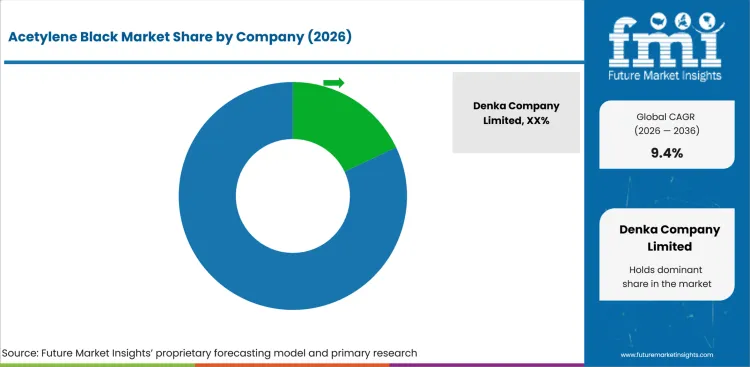
Denka, Orion S.A., Cabot Corporation, Birla Carbon, and Hexing Chemical Industry are the leading companies in the acetylene black market.
- Established acetylene-route producers hold an advantage when buyers need validated impurity control and stable conductive additive performance.
- Battery materials suppliers gain relevance by offering conductive carbons and dispersions that help electrode formulators meet process targets.
- Regional producers and distributors support sampling, small-lot access, and documentation for cable and conductive polymer accounts.
- Portfolio breadth supports customer retention when buyers compare powder, compacted, battery-grade, and conductive polymer grades.
Acetylene black suppliers compete by combining route evidence with battery qualification support. Denka’s DENKA BLACK portfolio provides a direct acetylene black reference, while Orion documents acetylene-based conductive additives for battery energy storage systems and high-voltage cable compounds. Cabot competes through conductive carbon products and dispersions used in lithium-ion battery electrodes. Buyers assess purity, packaging control, and performance documentation before approving repeat purchases.
Manufacturing scale has become a competitive separator as battery and storage buyers move beyond trial lots. Cabot’s multi-year agreement with PowerCo shows how conductive carbon suppliers can move into long-term battery material contracts. Orion’s conductive additive activity in grid modernization highlights the role of battery energy storage systems and high-voltage cable compounds. Producers with regional technical support can convert application testing into annual supply agreements more easily.
Smaller and regional producers can win by serving localized demand and cost-sensitive conductive compound accounts. Hexing Chemical Industry and Xiahuayuan Xuguang Chemical are relevant in China because domestic supply can reduce lead-time pressure. PCBL Limited is important in India through its acetylene black technology transfer plan. Companies relying only on low price are expected to face weaker acceptance in battery-grade accounts because qualification evidence and consistent lots are becoming more important.
How do top acetylene black companies compare?
Denka and Orion score strongest on acetylene-route evidence while Cabot and Birla Carbon have strong adjacent conductive carbon depth.
| Company | Relevance to Market Title | Acetylene-route Evidence | Battery Conductive Grade Depth | Regional Technical Access | Geographic Footprint |
|---|---|---|---|---|---|
| Denka Company Limited | Very High | Very Strong | Strong | Strong | Japan, Asia, North America |
| Orion S.A. | Very High | Very Strong | Strong | Very Strong | Global |
| Hexing Chemical Industry | High | Strong | Moderate | Moderate | China and export markets |
| Xiahuayuan Xuguang Chemical | High | Strong | Moderate | Moderate | China and export markets |
| Cabot Corporation | High | Moderate | Very Strong | Very Strong | Global |
| Birla Carbon | Moderate to High | Low to Moderate | Strong | Strong | Global |
| PCBL Limited | Moderate to High | Developing | Moderate | Strong | India |
| RDAbbott | Moderate | Distributor | Moderate | Strong | North Americ |
Source: Future Market Insights competitive analysis, 2026.
Who are the key players in the acetylene black market?
Denka Company Limited, Orion S.A., Cabot Corporation, Hexing Chemical Industry, and Birla Carbon are listed with other suppliers.
Key global companies leading the acetylene black market include:
- Denka Company Limited
- Orion S.A.
- Cabot Corporation
- Birla Carbon
- Hexing Chemical Industry
- Xiahuayuan Xuguang Chemical
- PCBL Limited
- RDAbbott
- Tokai Carbon Co. Ltd.
- Mitsubishi Chemical Group
Key Developments in Acetylene Black Market
- In January 2026, Cabot Corporation signed a multi-year supply agreement with PowerCo SE covering conductive carbons and dispersions for lithium-ion battery applications.
- In July 2025, Cabot Corporation launched LITX 95F, a conductive carbon product engineered for energy storage systems and thick-electrode pouch cell performance.
- In November 2025, Orion S.A. reported commercial traction for conductive additives used in grid modernization, including battery energy storage systems and high-voltage cable compounds.
Key Players in the Acetylene Black Market
Direct Acetylene Black Producers
- Denka Company Limited
- Orion S.A.
- Hexing Chemical Industry
- Xiahuayuan Xuguang Chemical
- SCGC-Denka
Conductive Carbon Specialists
- Cabot Corporation
- Birla Carbon
- Tokai Carbon Co. Ltd.
- Mitsubishi Chemical Group
Regional and Channel Access Companies
- PCBL Limited
- RDAbbott
- Imerys Graphite & Carbon
Acetylene Black Market - Report Scope
| Parameter | Details |
|---|---|
| Forecast period | 2026 to 2036 |
| Historical period | 2021 to 2025 |
| Quantitative unit | Revenue in USD million |
| By grade | Battery grade, conductive polymer grade, rubber grade, other grades |
| By application | Lithium-ion batteries, lead-acid batteries, conductive plastics, coatings and other uses |
| By end use | Automotive, energy storage, industrial, electronics |
| By form | Powder, compacted and pellets |
| By sales channel | Direct, distributors |
| Regions covered | North America, Latin America, Europe, East Asia, South Asia and Pacific, Middle East and Africa |
| Countries covered | China, India, South Korea, United States, Germany, Japan, France, United Kingdom |
| Key companies profiled | Denka, Orion S.A., Cabot Corporation, Birla Carbon, Hexing Chemical Industry, Xiahuayuan Xuguang Chemical, PCBL Limited, RDAbbott |
| Approach | Bottom-up product-boundary approach using grade demand, application mix, channel presence, supplier evidence, and country-level battery and conductive compound signals |
Source: Future Market Insights, 2026.
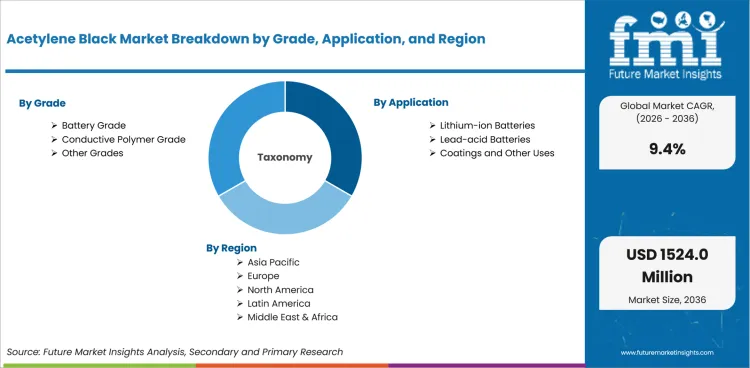
Acetylene Black Market Breakdown by Grade, Application, End Use, Form, Sales Channel, and Region
Acetylene Black Market Segmented by Grade:
- Battery Grade
- Conductive Polymer Grade
- Rubber Grade
- Other Grades
Acetylene Black Market Segmented by Application:
- Lithium-ion Batteries
- Lead-acid Batteries
- Conductive Plastics
- Coatings and Other Uses
Acetylene Black Market Segmented by End Use:
- Automotive
- Energy Storage
- Industrial
- Electronics
Acetylene Black Market Segmented by Form:
- Powder
- Compacted and Pellets
Acetylene Black Market Segmented by Sales Channel:
- Direct
- Distributors
Acetylene Black Market by Region:
- North America
- Latin America
- Europe
- East Asia
- South Asia and Pacific
- Middle East and Africa
Research Sources and Bibliography
- Argonne National Laboratory. (2025, January). EV model availability and sales. Argonne National Laboratory.
- Cabot Corporation. (2025, July 29). Cabot Corporation launches new LITX 95F conductive carbon engineered for energy storage systems. Cabot Corporation.
- Cabot Corporation. (2026, January 7). Cabot Corporation signs multi-year supply agreement with PowerCo SE, a battery manufacturing subsidiary of Volkswagen Group. Cabot Corporation.
- European Alternative Fuels Observatory. (2025, May 9). Germany: BEV registrations surge by 54% in April 2025. European Commission.
- European Alternative Fuels Observatory. (2026, March 20). France EV market accelerates in February 2026. European Commission.
- European Automobile Manufacturers’ Association. (2026, January 27). New car registrations: +1.8% in 2025; battery-electric 17.4% market share. ACEA.
- Federal Statistical Office. (2025, September 8). Electric cars: Low number of new registrations. Destatis.
- Government Digital Service. (2025, July 15). Electric Car Grant. Find a Grant Service.
- Government Digital Service. (2026, April 1). How to apply for vehicle eligibility for the Electric Car Grant. Department for Transport.
- International Energy Agency. (2024, April 25). Batteries and secure energy transitions. International Energy Agency.
- International Energy Agency. (2025, March 5). The battery industry has entered a new phase. International Energy Agency.
- International Energy Agency. (2025, May 14). Global EV Outlook 2025: Electric vehicle batteries. International Energy Agency.
- International Energy Agency. (2025, February 20). Share of manufacturing capacity by battery producer's domicile, 2024-2030. International Energy Agency.
- International Energy Agency. (2025, May 21). Global Critical Minerals Outlook 2025: Executive summary. International Energy Agency.
- International Energy Agency. (2026, May 20). Global EV Outlook 2026: Electric vehicle batteries. International Energy Agency.
- International Energy Agency. (2026, May 20). Global EV Outlook 2026: Trends in electric cars. International Energy Agency.
- International Trade Administration. (2025, July 21). South Korea electric vehicles EV market. U.S. Department of Commerce.
- International Trade Administration. (2025, September 19). Japan electric vehicles. U.S. Department of Commerce.
- Ministry of Economy, Trade and Industry. (2026, June 2). Battery Industry Strategy revised as the Battery and Power Industry Strategy. Government of Japan.
- Ministry of Economy and Finance. (2025, March 5). A 50 trillion KRW high-tech strategic industry fund to be established. Government of the Republic of Korea.
- Orion S.A. (2025, November 19). Orion S.A. gains commercial traction with conductive additives vital for grid modernization. Orion S.A.
- Press Information Bureau. (2025, February 11). PM E-DRIVE scheme for electric vehicle adoption. Government of India.
- Press Information Bureau. (2025, March 25). Revolutionizing mobility: The Make in India auto story. Government of India.
- The State Council of the People’s Republic of China. (2025, December 31). China renews auto trade-in subsidy program for 2026. The State Council of the People’s Republic of China.
- U.S. Energy Information Administration. (2025, March 12). U.S. battery capacity increased 66% in 2024. U.S. Energy Information Administration.
- Verband der Automobilindustrie. (2025, August 4). Electric car production at record levels in first half of the year. VDA.
This bibliography is provided for reader reference and is not exhaustive. The full report contains the complete reference list and detailed citations.
Acetylene Black Market - Scope & Definition
| Attribute | Detail |
|---|---|
| Market Definition | High-purity acetylene-route carbon black sold for conductive performance in batteries, polymers, cables, rubber, coatings, and electronics materials |
| Functions Covered | Conductivity enhancement, static dissipation, electrode network formation, cable shielding, dispersion support |
| Applications Covered | Lithium-ion batteries, lead-acid batteries, conductive plastics, coatings, rubber compounds, electronics packaging, cable materials |
| End-Use Industries | Automotive, energy storage, industrial manufacturing, electronics, cable and wire, specialty polymers |
| Grades Covered | Battery grade, conductive polymer grade, rubber grade, other specialty conductive grades |
| Inclusions | Commercial acetylene black products sold in powder, compacted, or pellet form across direct and distributor channels for conductive applications |
| Exclusions | Standard furnace black used only for tire reinforcement, pigment-only carbon black, recovered carbon black, graphite, CNTs, graphene, and non-acetylene conductive additives unless blended with acetylene black |
Acetylene Black Market - Research Methodology
| Method | Description |
|---|---|
| Primary Research | FMI analyst interviews with battery material formulators, conductive polymer compounders, cable material suppliers, specialty chemical distributors, and conductive additive users across key markets |
| Desk Research | Review of official energy data, EV and battery statistics, company releases, product literature, technical data, trade evidence, and country-level policy information related to conductive carbon demand |
| Market Sizing & Forecasting | Bottom-up product-boundary approach using 2025 value anchors, application mix, grade shares, sales-channel behavior, country-level signals, and supplier portfolio evidence |
| Data Validation | Cross-verification using battery deployment, EV production signals, supplier developments, conductive carbon portfolios, distributor evidence, and country-specific adoption indicators |
This Report Answers
- Market size estimates for 2026 and forecasts through 2036 for the acetylene black market.
- Insights across regional and country-level markets where battery, cable, and conductive polymer applications are expanding.
- Analysis of demand drivers, material qualification patterns, conductive additive use, and purchase behavior.
- Evaluation of leading grades and applications, including battery grade and lithium-ion battery use.
- Assessment of regional demand conditions across China, India, South Korea, the United States, Germany, Japan, France, and the United Kingdom.
- Identification of opportunities across powder, compacted forms, direct sales, distributors, and specialty conductive compounds.
- Evaluation of supply chain dynamics, acetylene-route evidence, product innovation, and technical support needs.
- Country-level growth analysis covering leading battery, automotive, cable, and electronics material corridors.
- Assessment of the competitive landscape, including acetylene black producers and adjacent conductive carbon suppliers.
- Analysis of market scope, exclusions, methodology, and data validation approach.
- Regional outlooks across North America, Europe, East Asia, South Asia and Pacific, and other regions.
- Delivery of market data, forecasts, and supporting analysis in report-ready formats.
Frequently Asked Questions
What is the growth prospect for acetylene black?
Demand for acetylene black is expected to rise at a considerable pace as battery and cable buyers need cleaner conductive carbon materials.
Which companies are expected to shape the acetylene black market?
Denka, Orion S.A., Cabot Corporation, Birla Carbon, Hexing Chemical Industry, Xiahuayuan Xuguang Chemical, PCBL Limited, and RDAbbott are expected to shape competition.
Why are battery makers using acetylene black?
Battery makers use acetylene black because it can form stable conductive networks inside electrodes while supporting lower additive loading.
Why is powder important in the acetylene black market?
Powder is important because slurry processors need flexible dosage control, easier wetting, and faster testing during battery formulation work.
Which application is gaining attention in acetylene black?
Lithium-ion batteries are gaining attention because cathode and anode coating lines need repeatable conductive additive performance.
How do direct sales support acetylene black suppliers?
Direct sales support suppliers by allowing technical data exchange, qualification support, and repeat supply discussions with large battery and cable buyers.
Why are cable compounds relevant for acetylene black demand?
Cable compounds are relevant because shielding layers require controlled conductivity and clean dispersion in high-voltage applications.
How do regulations and policies influence acetylene black demand?
Policies influence demand by supporting electric mobility, battery manufacturing, and energy storage investments that require conductive materials.
What is excluded from the acetylene black market?
The market excludes pigment-only furnace black, recovered carbon black, graphite, CNTs, graphene, and non-acetylene conductive additives unless blended with acetylene black.
Preview the report firsthand - request a free sample
Get SampleGet the brochure for pricing and purchase details.
Get PDFTable of Content
- Executive Summary
- Global Market Outlook
- Demand to side Trends
- Supply to side Trends
- Technology Roadmap Analysis
- Analysis and Recommendations
- Market Overview
- Market Coverage / Taxonomy
- Market Definition / Scope / Limitations
- Research Methodology
- Chapter Orientation
- Analytical Lens and Working Hypotheses
- Market Structure, Signals, and Trend Drivers
- Benchmarking and Cross-market Comparability
- Market Sizing, Forecasting, and Opportunity Mapping
- Research Design and Evidence Framework
- Desk Research Programme (Secondary Evidence)
- Company Annual and Sustainability Reports
- Peer-reviewed Journals and Academic Literature
- Corporate Websites, Product Literature, and Technical Notes
- Earnings Decks and Investor Briefings
- Statutory Filings and Regulatory Disclosures
- Technical White Papers and Standards Notes
- Trade Journals, Industry Magazines, and Analyst Briefs
- Conference Proceedings, Webinars, and Seminar Materials
- Government Statistics Portals and Public Data Releases
- Press Releases and Reputable Media Coverage
- Specialist Newsletters and Curated Briefings
- Sector Databases and Reference Repositories
- FMI Internal Proprietary Databases and Historical Market Datasets
- Subscription Datasets and Paid Sources
- Social Channels, Communities, and Digital Listening Inputs
- Additional Desk Sources
- Expert Input and Fieldwork (Primary Evidence)
- Primary Modes
- Qualitative Interviews and Expert Elicitation
- Quantitative Surveys and Structured Data Capture
- Blended Approach
- Why Primary Evidence is Used
- Field Techniques
- Interviews
- Surveys
- Focus Groups
- Observational and In-context Research
- Social and Community Interactions
- Stakeholder Universe Engaged
- C-suite Leaders
- Board Members
- Presidents and Vice Presidents
- R&D and Innovation Heads
- Technical Specialists
- Domain Subject-matter Experts
- Scientists
- Physicians and Other Healthcare Professionals
- Governance, Ethics, and Data Stewardship
- Research Ethics
- Data Integrity and Handling
- Primary Modes
- Tooling, Models, and Reference Databases
- Desk Research Programme (Secondary Evidence)
- Data Engineering and Model Build
- Data Acquisition and Ingestion
- Cleaning, Normalisation, and Verification
- Synthesis, Triangulation, and Analysis
- Quality Assurance and Audit Trail
- Market Background
- Market Dynamics
- Drivers
- Restraints
- Opportunity
- Trends
- Scenario Forecast
- Demand in Optimistic Scenario
- Demand in Likely Scenario
- Demand in Conservative Scenario
- Opportunity Map Analysis
- Product Life Cycle Analysis
- Supply Chain Analysis
- Investment Feasibility Matrix
- Value Chain Analysis
- PESTLE and Porter’s Analysis
- Regulatory Landscape
- Regional Parent Market Outlook
- Production and Consumption Statistics
- Import and Export Statistics
- Market Dynamics
- Global Market Analysis 2021 to 2025 and Forecast, 2026 to 2036
- Historical Market Size Value (USD Million) Analysis, 2021 to 2025
- Current and Future Market Size Value (USD Million) Projections, 2026 to 2036
- Y to o to Y Growth Trend Analysis
- Absolute $ Opportunity Analysis
- Global Market Pricing Analysis 2021 to 2025 and Forecast 2026 to 2036
- Global Market Analysis 2021 to 2025 and Forecast 2026 to 2036, By Grade
- Introduction / Key Findings
- Historical Market Size Value (USD Million) Analysis By Grade , 2021 to 2025
- Current and Future Market Size Value (USD Million) Analysis and Forecast By Grade , 2026 to 2036
- Battery Grade
- Conductive Polymer Grade
- Other Grades
- Battery Grade
- Y to o to Y Growth Trend Analysis By Grade , 2021 to 2025
- Absolute $ Opportunity Analysis By Grade , 2026 to 2036
- Global Market Analysis 2021 to 2025 and Forecast 2026 to 2036, By Application
- Introduction / Key Findings
- Historical Market Size Value (USD Million) Analysis By Application, 2021 to 2025
- Current and Future Market Size Value (USD Million) Analysis and Forecast By Application, 2026 to 2036
- Lithium-ion Batteries
- Lead-acid Batteries
- Coatings and Other Uses
- Lithium-ion Batteries
- Y to o to Y Growth Trend Analysis By Application, 2021 to 2025
- Absolute $ Opportunity Analysis By Application, 2026 to 2036
- Global Market Analysis 2021 to 2025 and Forecast 2026 to 2036, By End Use
- Introduction / Key Findings
- Historical Market Size Value (USD Million) Analysis By End Use, 2021 to 2025
- Current and Future Market Size Value (USD Million) Analysis and Forecast By End Use, 2026 to 2036
- Automotive
- Energy Storage
- Electronics
- Automotive
- Y to o to Y Growth Trend Analysis By End Use, 2021 to 2025
- Absolute $ Opportunity Analysis By End Use, 2026 to 2036
- Global Market Analysis 2021 to 2025 and Forecast 2026 to 2036, By Form
- Introduction / Key Findings
- Historical Market Size Value (USD Million) Analysis By Form, 2021 to 2025
- Current and Future Market Size Value (USD Million) Analysis and Forecast By Form, 2026 to 2036
- Powder
- Compacted and Pellets
- Powder
- Y to o to Y Growth Trend Analysis By Form, 2021 to 2025
- Absolute $ Opportunity Analysis By Form, 2026 to 2036
- Global Market Analysis 2021 to 2025 and Forecast 2026 to 2036, By Sales Channel
- Introduction / Key Findings
- Historical Market Size Value (USD Million) Analysis By Sales Channel, 2021 to 2025
- Current and Future Market Size Value (USD Million) Analysis and Forecast By Sales Channel, 2026 to 2036
- Direct
- Distributors
- Direct
- Y to o to Y Growth Trend Analysis By Sales Channel, 2021 to 2025
- Absolute $ Opportunity Analysis By Sales Channel, 2026 to 2036
- Global Market Analysis 2021 to 2025 and Forecast 2026 to 2036, By Region
- Introduction
- Historical Market Size Value (USD Million) Analysis By Region, 2021 to 2025
- Current Market Size Value (USD Million) Analysis and Forecast By Region, 2026 to 2036
- North America
- Latin America
- Western Europe
- Eastern Europe
- East Asia
- South Asia and Pacific
- Middle East & Africa
- Market Attractiveness Analysis By Region
- North America Market Analysis 2021 to 2025 and Forecast 2026 to 2036, By Country
- Historical Market Size Value (USD Million) Trend Analysis By Market Taxonomy, 2021 to 2025
- Market Size Value (USD Million) Forecast By Market Taxonomy, 2026 to 2036
- By Country
- USA
- Canada
- Mexico
- By Grade
- By Application
- By End Use
- By Form
- By Sales Channel
- By Country
- Market Attractiveness Analysis
- By Country
- By Grade
- By Application
- By End Use
- By Form
- By Sales Channel
- Key Takeaways
- Latin America Market Analysis 2021 to 2025 and Forecast 2026 to 2036, By Country
- Historical Market Size Value (USD Million) Trend Analysis By Market Taxonomy, 2021 to 2025
- Market Size Value (USD Million) Forecast By Market Taxonomy, 2026 to 2036
- By Country
- Brazil
- Chile
- Rest of Latin America
- By Grade
- By Application
- By End Use
- By Form
- By Sales Channel
- By Country
- Market Attractiveness Analysis
- By Country
- By Grade
- By Application
- By End Use
- By Form
- By Sales Channel
- Key Takeaways
- Western Europe Market Analysis 2021 to 2025 and Forecast 2026 to 2036, By Country
- Historical Market Size Value (USD Million) Trend Analysis By Market Taxonomy, 2021 to 2025
- Market Size Value (USD Million) Forecast By Market Taxonomy, 2026 to 2036
- By Country
- Germany
- UK
- Italy
- Spain
- France
- Nordic
- BENELUX
- Rest of Western Europe
- By Grade
- By Application
- By End Use
- By Form
- By Sales Channel
- By Country
- Market Attractiveness Analysis
- By Country
- By Grade
- By Application
- By End Use
- By Form
- By Sales Channel
- Key Takeaways
- Eastern Europe Market Analysis 2021 to 2025 and Forecast 2026 to 2036, By Country
- Historical Market Size Value (USD Million) Trend Analysis By Market Taxonomy, 2021 to 2025
- Market Size Value (USD Million) Forecast By Market Taxonomy, 2026 to 2036
- By Country
- Russia
- Poland
- Hungary
- Balkan & Baltic
- Rest of Eastern Europe
- By Grade
- By Application
- By End Use
- By Form
- By Sales Channel
- By Country
- Market Attractiveness Analysis
- By Country
- By Grade
- By Application
- By End Use
- By Form
- By Sales Channel
- Key Takeaways
- East Asia Market Analysis 2021 to 2025 and Forecast 2026 to 2036, By Country
- Historical Market Size Value (USD Million) Trend Analysis By Market Taxonomy, 2021 to 2025
- Market Size Value (USD Million) Forecast By Market Taxonomy, 2026 to 2036
- By Country
- China
- Japan
- South Korea
- By Grade
- By Application
- By End Use
- By Form
- By Sales Channel
- By Country
- Market Attractiveness Analysis
- By Country
- By Grade
- By Application
- By End Use
- By Form
- By Sales Channel
- Key Takeaways
- South Asia and Pacific Market Analysis 2021 to 2025 and Forecast 2026 to 2036, By Country
- Historical Market Size Value (USD Million) Trend Analysis By Market Taxonomy, 2021 to 2025
- Market Size Value (USD Million) Forecast By Market Taxonomy, 2026 to 2036
- By Country
- India
- ASEAN
- Australia & New Zealand
- Rest of South Asia and Pacific
- By Grade
- By Application
- By End Use
- By Form
- By Sales Channel
- By Country
- Market Attractiveness Analysis
- By Country
- By Grade
- By Application
- By End Use
- By Form
- By Sales Channel
- Key Takeaways
- Middle East & Africa Market Analysis 2021 to 2025 and Forecast 2026 to 2036, By Country
- Historical Market Size Value (USD Million) Trend Analysis By Market Taxonomy, 2021 to 2025
- Market Size Value (USD Million) Forecast By Market Taxonomy, 2026 to 2036
- By Country
- Kingdom of Saudi Arabia
- Other GCC Countries
- Turkiye
- South Africa
- Other African Union
- Rest of Middle East & Africa
- By Grade
- By Application
- By End Use
- By Form
- By Sales Channel
- By Country
- Market Attractiveness Analysis
- By Country
- By Grade
- By Application
- By End Use
- By Form
- By Sales Channel
- Key Takeaways
- Key Countries Market Analysis
- USA
- Pricing Analysis
- Market Share Analysis, 2025
- By Grade
- By Application
- By End Use
- By Form
- By Sales Channel
- Canada
- Pricing Analysis
- Market Share Analysis, 2025
- By Grade
- By Application
- By End Use
- By Form
- By Sales Channel
- Mexico
- Pricing Analysis
- Market Share Analysis, 2025
- By Grade
- By Application
- By End Use
- By Form
- By Sales Channel
- Brazil
- Pricing Analysis
- Market Share Analysis, 2025
- By Grade
- By Application
- By End Use
- By Form
- By Sales Channel
- Chile
- Pricing Analysis
- Market Share Analysis, 2025
- By Grade
- By Application
- By End Use
- By Form
- By Sales Channel
- Germany
- Pricing Analysis
- Market Share Analysis, 2025
- By Grade
- By Application
- By End Use
- By Form
- By Sales Channel
- UK
- Pricing Analysis
- Market Share Analysis, 2025
- By Grade
- By Application
- By End Use
- By Form
- By Sales Channel
- Italy
- Pricing Analysis
- Market Share Analysis, 2025
- By Grade
- By Application
- By End Use
- By Form
- By Sales Channel
- Spain
- Pricing Analysis
- Market Share Analysis, 2025
- By Grade
- By Application
- By End Use
- By Form
- By Sales Channel
- France
- Pricing Analysis
- Market Share Analysis, 2025
- By Grade
- By Application
- By End Use
- By Form
- By Sales Channel
- India
- Pricing Analysis
- Market Share Analysis, 2025
- By Grade
- By Application
- By End Use
- By Form
- By Sales Channel
- ASEAN
- Pricing Analysis
- Market Share Analysis, 2025
- By Grade
- By Application
- By End Use
- By Form
- By Sales Channel
- Australia & New Zealand
- Pricing Analysis
- Market Share Analysis, 2025
- By Grade
- By Application
- By End Use
- By Form
- By Sales Channel
- China
- Pricing Analysis
- Market Share Analysis, 2025
- By Grade
- By Application
- By End Use
- By Form
- By Sales Channel
- Japan
- Pricing Analysis
- Market Share Analysis, 2025
- By Grade
- By Application
- By End Use
- By Form
- By Sales Channel
- South Korea
- Pricing Analysis
- Market Share Analysis, 2025
- By Grade
- By Application
- By End Use
- By Form
- By Sales Channel
- Russia
- Pricing Analysis
- Market Share Analysis, 2025
- By Grade
- By Application
- By End Use
- By Form
- By Sales Channel
- Poland
- Pricing Analysis
- Market Share Analysis, 2025
- By Grade
- By Application
- By End Use
- By Form
- By Sales Channel
- Hungary
- Pricing Analysis
- Market Share Analysis, 2025
- By Grade
- By Application
- By End Use
- By Form
- By Sales Channel
- Kingdom of Saudi Arabia
- Pricing Analysis
- Market Share Analysis, 2025
- By Grade
- By Application
- By End Use
- By Form
- By Sales Channel
- Turkiye
- Pricing Analysis
- Market Share Analysis, 2025
- By Grade
- By Application
- By End Use
- By Form
- By Sales Channel
- South Africa
- Pricing Analysis
- Market Share Analysis, 2025
- By Grade
- By Application
- By End Use
- By Form
- By Sales Channel
- USA
- Market Structure Analysis
- Competition Dashboard
- Competition Benchmarking
- Market Share Analysis of Top Players
- By Regional
- By Grade
- By Application
- By End Use
- By Form
- By Sales Channel
- Competition Analysis
- Competition Deep Dive
- Denka Company Limited
- Overview
- Product Portfolio
- Profitability by Market Segments (Product/Age /Sales Channel/Region)
- Sales Footprint
- Strategy Overview
- Marketing Strategy
- Product Strategy
- Channel Strategy
- Orion S.A.
- Cabot Corporation
- Birla Carbon
- Hexing Chemical Industry
- Xiahuayuan Xuguang Chemical
- Denka Company Limited
- Competition Deep Dive
- Assumptions & Acronyms Used


