- Market Size (2026)
- USD 384.0 Mn
- Forecast (2036)
- USD 3872.9 Mn
- CAGR (2026 to 2036)
- 26.0%
How Big Is the Agentic Commerce Market in 2026?
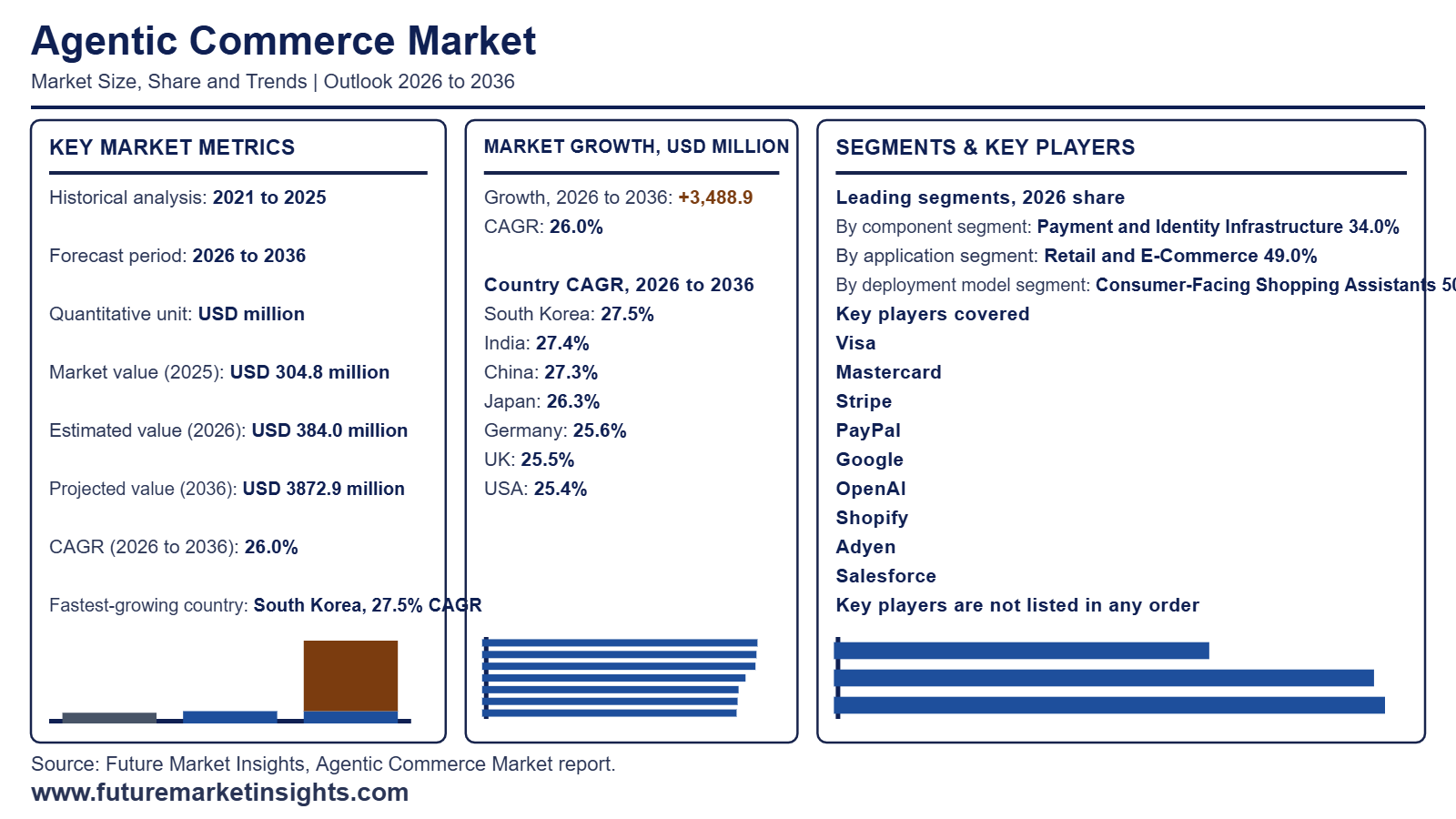
Following an initial baseline valuation of USD 304.8 million in 2025, global agentic commerce market valuation advanced to USD 384.0 million in 2026, with Future Market Insights projections pointing toward USD 3,872.9 million by 2036 at a 26.0% CAGR, generating USD 3,488.9 million in incremental opportunity as merchants deploy authorized agent checkout infrastructure.
| Market Metric | Valuation / Share / Forecast Benchmark |
|---|---|
| 2025 Market Size (Historical) | USD 304.8 million |
| 2026 Market Size (Estimated) | USD 384.0 million |
| 2036 Market Size (Projected) | USD 3,872.9 million |
| Compound Annual Growth Rate (2026 to 2036) | 26.0% CAGR |
| Incremental Dollar Opportunity (2026 to 2036) | USD 3,488.9 million |
| Dominant Component Segment (2026 Share) | Payment and Identity Infrastructure (34.0% share in 2026) | Other Segment Combined (66.0%) |
| Leading Application Segment (2026 Share) | Retail and E-Commerce (49.0% share in 2026) | Other Segment Combined (51.0%) |
| Leading Deployment Model Segment (2026 Share) | Consumer-Facing Shopping Assistants (50.0% share in 2026) | Other Segment Combined (50.0%) |
| Leading Payment Method Segment (2026 Share) | Cards and Tokenised Card Credentials (62.0% share in 2026) | Other Segment Combined (38.0%) |
| Fastest-Growing Country Markets (2026 to 2036) | South Korea (27.5% CAGR), India (27.4% CAGR), China (27.3% CAGR) |
| Leading Tier-1 Companies | Visa, Mastercard, Stripe, PayPal, Google, OpenAI, Shopify, Adyen, Salesforce, Amazon |
Source: Future Market Insights analysis of the agentic commerce market, 2026.
Executive Market Overview
Commercial interest in agentic commerce is rising as digital retailers and fintech providers construct software infrastructure allowing autonomous AI purchasing agents to research products and execute programmatic transactions. Consumer transaction tracking from the National Retail Federation (2025) shows that personalized automated re-ordering protocols lift repeat checkout frequency while reducing shopper abandonment during complex multi-vendor searches. The United States leads total commercial platform volume, while high mobile-commerce integration across South Korea and China produces higher forecast CAGRs as regional digital payment networks standardize automated tokenized checkout across e-commerce software and fintech.
Software developers protect recurring platform margins by creating secure multi-modal agent workflows, automated cart reconciliation APIs, and proprietary merchant negotiation algorithms rather than simple customer support bots. Merchant security concerns regarding rogue bot checkout volume and payment authentication liability under financial fraud regulations act as adoption restraints. FMI projects autonomous purchasing agents to advance at an exceptional pace through 2036, supported by smart device integration. Market sizing tracks software licenses, API consumption fees, and platform take-rates for autonomous AI commerce agents, while excluding conventional static e-commerce website hosting and manual digital payment processor fees.
Analyst Perspective
"Suppliers will capture durable recurring revenue by proving that an autonomous checkout creates an auditable consent trail and clean dispute evidence, rather than simply demonstrating a capable chat interface. The primary commercial risk is unclear liability allocation between issuers and merchants during unauthorized or disputed agent orders, which can stall enterprise pilots."
- Sudip Saha, Co-founder, FMI
Major Market Trends and Insights
- Open Agentic Checkout Protocols Replace Custom Point Integrations: maintaining separate checkout connectors for every shopping assistant is too expensive for mid-sized and large retailers, which is why shared standards are gaining traction right now. Google (January 2026) and Shopify (January 2026) introducing the Universal Commerce Protocol in January 2026 proves that point, allowing merchants to expose one verified product feed across multiple AI surfaces. From these announcements, analysts project faster agentic automation adoption across retail catalogs, while custom enterprise integrations persist in complex B2B procurement; however, that does not mean protocol adoption removes merchant testing cycles.
- Cryptographic Agent Verification Separates Legitimate Buyers From Bot Abuse: Rising automated traffic is forcing payment networks and merchants to demand verifiable proof of buyer consent before approving an order. When Visa (October 2025) launched its Trusted Agent Protocol in October 2025 and Google Cloud (September 2025) unveiled its Agent Payments Protocol in September 2025, it meant retailers gained cryptographic signatures to distinguish real shopping agents from malicious scrapers. The likelihood of wider fraud detection and prevention spending is rising as risk teams require auditable transaction logs before permitting unattended payments.
- Bundled Payment and Catalog Suites Accelerate Merchant Onboarding: Payment acquirers are packaging catalog sync and tokenized acceptance together so merchants can test AI sales channels without rebuilding existing checkout stacks. Stripe (December 2025) releasing its Agentic Commerce Suite in December 2025 and Adyen (June 2026) launching Adyen Agentic in June 2026 confirm this commercial shift. While bundled APIs lower onboarding friction for epayment systems, it does not mean every local payment method works out of the box, keeping regional verification critical for growth.
What Are the Main Drivers, Restraints, and Opportunities?
Conversational purchase intent drives spending on executable checkout infrastructure, while consent verification and dispute liability restrain enterprise rollouts, and interoperable catalog protocols create an opening for repeatable multi-agent services.
Driver: Converting Conversational Product Discovery Into Verified Merchant Orders
Shoppers increasingly ask AI assistants to compare prices and build baskets directly, which is pushing retailers to fund order-ready checkout connections at present. To put it simply, merchants cannot earn revenue from AI product discovery unless external agents read live stock and submit clean orders into existing ERP systems. Stripe (December 2025) launching its Agentic Commerce Suite in December 2025 and Amazon (May 2026) rolling out Alexa for Shopping across 13 countries by November 2026 prove that commercial shift. On account of these launches, the likelihood of sustained artificial intelligence in retail investment is rising, though adoption still hinges on accurate fulfillment handoffs.
Restraint: Delegated Authority Ambiguity, Bot Abuse, and Dispute Liability
Even with strong merchant interest, unclear rules around who pays for unauthorized or mistaken agent orders slow enterprise approval. Stated in practical terms, when the Competition and Markets Authority (November 2025) updated its unfair commercial practices guidance in November 2025, it meant automated shopping carts must still display full pricing and disclosures without hiding fees. Meanwhile, the Reserve Bank of India (2026) reported over 200 billion UPI transactions in fiscal 2025-26 with 30.0% annual growth, showing why delegated-payment tokens must match strict domestic bank controls. Consequently, buyers delay unattended checkout rollouts until refund and escalation paths are proven.
Opportunity: Interoperable Multi-Agent Catalogs and Tokenized Rail Routing
Vendors have a clear expansion opportunity when they let a retailer publish one accurate catalog that routes orders across competing AI assistants and local payment methods. PayPal (October 2025) introducing Agent Ready and Store Sync in October 2025 and updating PayPal Developer (June 2026) specifications in June 2026 proves suppliers are packaging catalog sync with payment acceptance. From these rollouts, analysts expect higher demand for mobile payment transactions routing, while single-channel integrations lose ground; however, suppliers still need live conversion proof to win multi-year contracts.
How Is the Agentic Commerce Market Segmented?
Agentic Commerce Market is segmented by Component, Application, Deployment Model, Payment Method, and Region. Forecast period from 2026 to 2036.
| Segmentation Axis | Sub-Segments Covered | 2026 Leading Segment & Share | Other Segment Combined & Total |
|---|---|---|---|
| Component | Payment and Identity Infrastructure, Agent Platforms and Orchestration, Managed and Professional Services, Product Data and Catalogue Integration | Payment and Identity Infrastructure (34.0% share in 2026) | Other Segment Combined (66.0%) | Total (100.0%) |
| Application | Retail and E-Commerce, Travel and Hospitality, Grocery and Food Delivery, Financial Services, Digital Goods and Subscriptions | Retail and E-Commerce (49.0% share in 2026) | Other Segment Combined (51.0%) | Total (100.0%) |
| Deployment Model | Consumer-Facing Shopping Assistants, Merchant-Side Agents, Marketplace-Embedded Agents, Business Procurement Agents | Consumer-Facing Shopping Assistants (50.0% share in 2026) | Other Segment Combined (50.0%) | Total (100.0%) |
| Payment Method | Cards and Tokenised Card Credentials, Digital Wallets, Bank Transfers and Account-To-Account, Stablecoins and Other Digital Assets | Cards and Tokenised Card Credentials (62.0% share in 2026) | Other Segment Combined (38.0%) | Total (100.0%) |
| Region | North America, Latin America, Western Europe, Eastern Europe, East Asia, South Asia and Pacific, Middle East and Africa | North America (led by USA at 25.4% CAGR) | Global Coverage Across 7 Core Countries (100.0%) |
Source: Future Market Insights analysis of the agentic commerce market, 2026.
Why Does Payment and Identity Infrastructure Lead the Component Category?
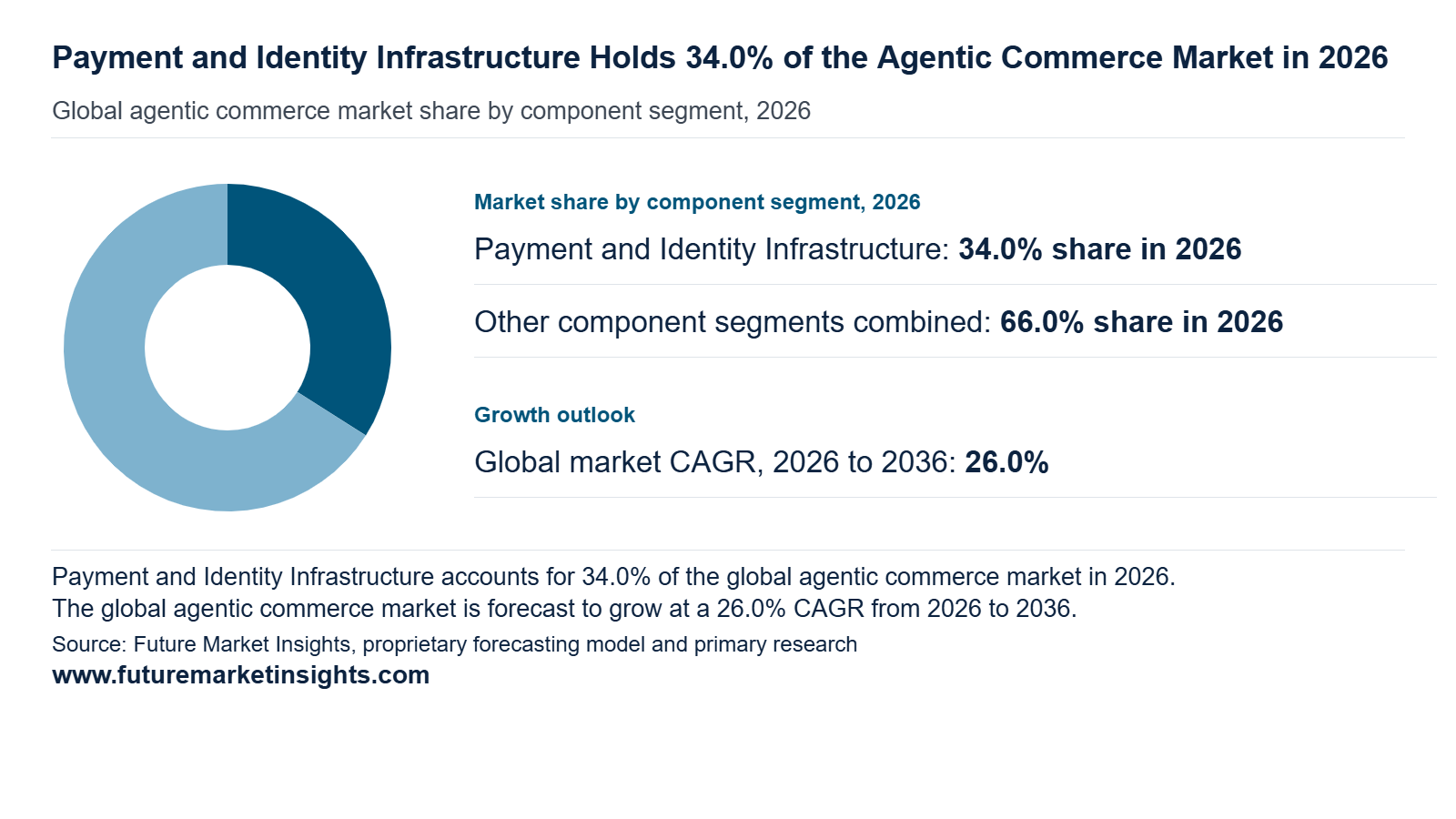
Payment and identity infrastructure accounts for 34.0% of component revenue in 2026 because merchants will not let an external AI assistant charge a customer without scoped credentials and fraud checks. While orchestration platforms and catalog adapters support product discovery, authorization controls sit on the transaction-critical path. Visa (April 2025) unveiling Visa Intelligent Commerce in April 2025 and Mastercard (April 2025) launching Agent Pay in April 2025 prove card networks are prioritizing delegated token controls. As buyer preference shifts toward faster biometric and face swiping payment approvals, spending on payment and identity infrastructure is expected to anchor component growth through 2036.
What Sustains Retail and E-Commerce Within the Application Category?
Retail and e-commerce captures 49.0% of application revenue in 2026, and current merchant onboarding proves why structured merchandise catalogs convert faster than travel or grocery bookings. Travel requires live fare holds, and grocery adds delivery-slot substitutions, whereas retail merchants keep existing order systems intact while exposing SKU feeds. To put that in plain terms, when Shopify (March 2026) expanded Agentic Storefronts in March 2026, millions of retail brands gained a direct path into AI chats. The National Bureau of Statistics of China (January 2026) reporting 2025 online retail sales at 15,972.2 billion yuan confirms the massive retail base driving industry expansion through 2036.
How Do Consumer-Facing Shopping Assistants Shape Deployment Model Revenue?
Consumer-facing shopping assistants hold 50.0% of deployment model revenue in 2026 because shopper interfaces originate purchase intent and trigger checkout approval. From what current launches show, consumer assistants will outpace business procurement agents in near-term adoption, while merchant-side agents remain focused on owned storefronts; however, that does not mean enterprise procurement agents lack long-term potential once spending-policy gates are automated. Amazon (April 2025) introducing Buy for Me in April 2025 and expanding Alexa for Shopping across 13 countries by November 2026 proves consumer assistant scale. Increased reliance on generative AI interfaces will influence deployment growth through 2036.
Why Do Cards and Tokenised Card Credentials Lead Payment Method?
Cards and tokenised card credentials represent 62.0% of payment method revenue in 2026, driven by existing merchant acceptance and chargeback rules that adapt cleanly to delegated agent tokens. Scoped credentials cap purchase amounts and merchant categories without exposing raw card numbers, whereas bank transfers still require new mandate flows for autonomous orders. Google Cloud (September 2025) embedding cryptographic authorization concepts for card rails into its Agent Payments Protocol in September 2025 proves that point. Increased demand for contactless and self-checkout systems compatibility keeps cards and tokenised card credentials ahead through 2036.
Agentic Commerce Market by Region and Country (2026 to 2036)
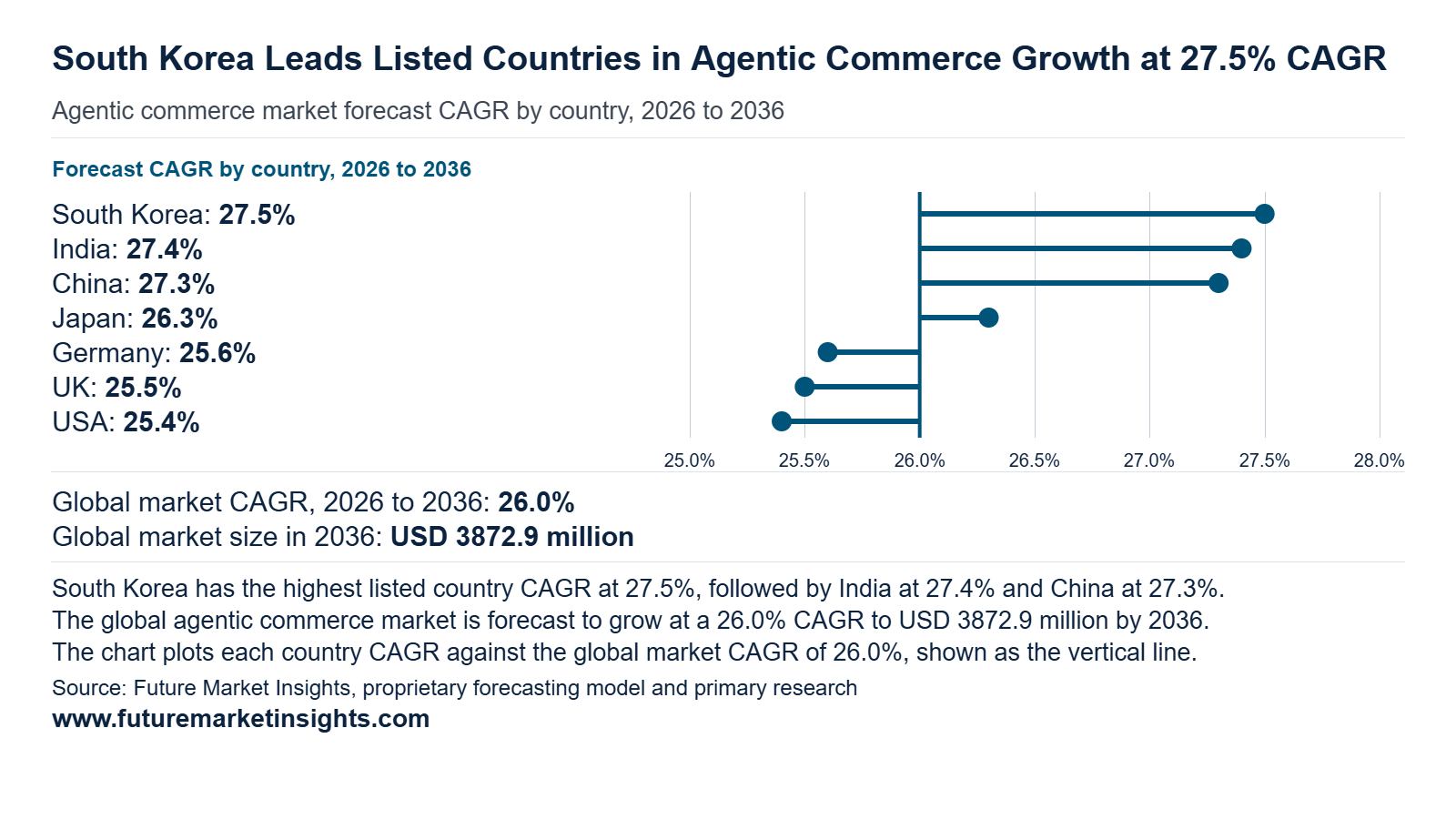
North America leads current agentic commerce spending due to early in-chat checkout rollouts, while East Asia and South Asia record the fastest growth rates as mobile shopping and instant bank rails integrate AI workflows. FMI projects South Korea to lead national growth at a 27.5% CAGR from 2026 to 2036, followed closely by India at 27.4% and China at 27.3%. Japan advances at 26.3%, Germany at 25.6%, the UK at 25.5%, and the USA at 25.4%. That 2.1 percentage point spread does not mean identical buying conditions, as each country's payment mix and consumer rules shape vendor adoption.
| Country | 2026 Revenue | 2036 Revenue | 10-Year Addition | 2026 to 2036 CAGR | Global Share (2026 -> 2036) |
|---|---|---|---|---|---|
| USA | USD 134.4 million | USD 1,291.3 million | +USD 1,156.9 million | 25.4% | 35.0% -> 33.3% |
| China | USD 69.1 million | USD 771.9 million | +USD 702.8 million | 27.3% | 18.0% -> 19.9% |
| UK | USD 34.6 million | USD 335.1 million | +USD 300.5 million | 25.5% | 9.0% -> 8.7% |
| Germany | USD 30.7 million | USD 299.7 million | +USD 269.0 million | 25.6% | 8.0% -> 7.7% |
| Japan | USD 26.9 million | USD 277.5 million | +USD 250.6 million | 26.3% | 7.0% -> 7.2% |
| India | USD 23.0 million | USD 259.0 million | +USD 236.0 million | 27.4% | 6.0% -> 6.7% |
| South Korea | USD 19.2 million | USD 217.9 million | +USD 198.7 million | 27.5% | 5.0% -> 5.6% |
Source: Future Market Insights analysis of the agentic commerce market, 2026.
USA
USA agentic commerce demand is projected to advance at a 25.4% CAGR through 2036, spurred by steady retail demand and growing consumer preference for certified products. In FMI's assessment, the USA acts as the primary launchpad because payment processors and AI labs run U.S.-first pilots before international expansion; however, that does not mean merchants approve unattended checkout without strict refund and attribution governance. Quarterly retail data from the U.S. Census Bureau (August 2026) estimating second-quarter 2026 retail e-commerce sales at proves the scale of online retail ready for Stripe and OpenAI integrations. Continued enterprise spending on tokenized card rails and catalog APIs will keep the USA as the largest market through 2036.
South Korea
South Korea agentic commerce demand is projected to advance at a 27.5% CAGR through 2036, anchored by expanding end-user adoption and recurring replenishment demand. FMI finds that heavy mobile shopping behavior pushes demand toward app-native assistants with concise consent steps, while financial regulators enforce strict security reviews. To put that simply, the Ministry of Data and Statistics, Republic of Korea (February 2026) reporting mobile shopping at 77.4% of December 2025 online value, paired with Financial Services Commission, Republic of Korea (June 2026) AI guidelines issued in June 2026, means suppliers must prove auditability before scaling. Compliance with local authentication rules will drive rapid South Korean adoption through 2036.
India
India agentic commerce demand is projected to advance at a 27.4% CAGR through 2036, supported by expanding procurement agreements across specialized commercial distribution channels. FMI observes that India's adoption path diverges from card-centric markets because consumers rely on instant account-to-account transfers rather than credit cards. Annual disclosures from the Reserve Bank of India (2026) showing UPI exceeded 200 billion transactions in fiscal 2025-26 with 30.0% annual growth prove that point, meaning vendors must attach explicit user mandates and local-language catalogs to bank rails. Reliable payment reconciliation and scheme-compliant delegation will propel Indian merchant adoption through 2036.
China
China agentic commerce demand is projected to advance at a 27.3% CAGR through 2036, driven by continuous technical modernization and shifting institutional buyer preferences. In FMI's view, domestic super-app ecosystems control product discovery and wallet settlement tightly, so foreign interoperability claims mean little without local SKU and promotion handling. Data from the National Bureau of Statistics of China (January 2026) showing 2025 online retail sales reached 15,972.2 billion yuan, with physical goods at 26.1% of total retail, confirms the massive commercial environment. Suppliers supporting localized identifiers and domestic wallet APIs will capture sustained Chinese enterprise growth through 2036.
Japan
Japan agentic commerce demand is projected to advance at a 26.3% CAGR through 2036, reflecting sustained industrial usage and growing awareness of operational advantages. FMI notes that Japanese buyers demand minimal exception rates across consumer shopping and corporate purchasing, which slows hasty pilots while rewarding accurate catalog integrations. Survey results from the Ministry of Economy, Trade and Industry, Japan (August 2025) measuring domestic B2C e-commerce at 26.1 trillion yen and B2B e-commerce at 514.4 trillion yen highlight substantial enterprise ordering potential. Integration of verified product data to purchase-order approvals will support steady Japanese market growth through 2036.
Germany
Germany agentic commerce demand is projected to advance at a 25.6% CAGR through 2036, sustained by long-term corporate supply contracts and resilient customer adoption. FMI finds that Germany's mix of debit cards and e-payments prevents a single card-token workflow from fitting every merchant. Research from the Deutsche Bundesbank (June 2026) confirming cashless methods made up 55.0% of 2025 daily purchases, while the European Commission (August 2025) began enforcing general-purpose AI transparency rules in August 2025, means suppliers must handle multi-method routing and compliance logs. Assistance with buyer payment choice will expand German retail deployments through 2036.
UK
UK agentic commerce demand is projected to advance at a 25.5% CAGR through 2036, strengthened by expanding regional network capabilities and favorable regulatory guidelines. FMI observes that high online retail adoption drives merchant interest, yet strict consumer-protection enforcement forces vendors to prove transparent offer presentation. Figures from the Office for National Statistics (January 2026) showing Great Britain online spending rose 8.4% year over year in late 2025, paired with Competition and Markets Authority (November 2025) unfair commercial practices guidance, prove that point. Platforms preserving full price disclosures inside conversational carts will gain durable UK adoption through 2036.
Competitive Environment and Notable Companies
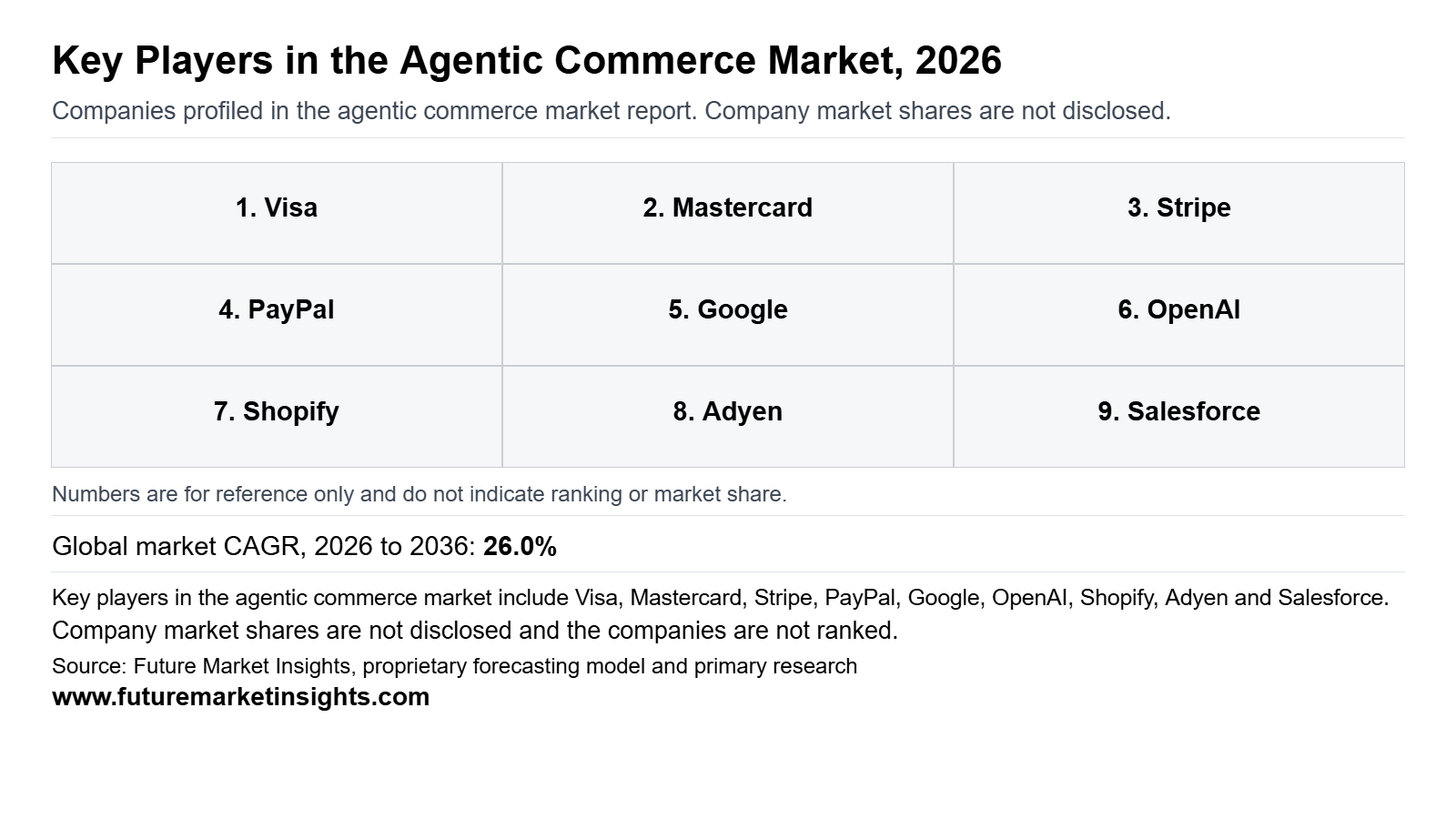
Competition in the global agentic commerce market spans card networks setting trust rules, payment platforms delivering merchant acceptance, and AI or commerce ecosystems operating buyer interfaces and catalog orchestration. Visa, Mastercard, Stripe, PayPal, Adyen, Google, OpenAI, Amazon, Shopify, and Salesforce compete and partner across these layers. Because public launches signal capability direction rather than market share, enterprise buyers test live inventory sync and dispute evidence before signing contracts.
How Are Companies Positioned in the Agentic Commerce Market?
Visa and Mastercard anchor network-level agent identification and delegated card tokenization across global issuers. Stripe and Adyen combine payment acceptance with modular APIs that connect merchant checkouts to external AI assistants. Google and Amazon control consumer discovery surfaces and shopping assistants, while Shopify and Salesforce connect retailer product catalogs and order records to conversational buying channels.
What Matters When a Buyer Selects an Agentic Commerce Supplier?
Retail technology and payment risk teams evaluate vendors on scoped payment credentials, real-time inventory accuracy, clear dispute liability, and preservation of the merchant of record. Buyers test whether a provider like Stripe or Adyen can authenticate an agent, block malicious bots, and reconcile refunds across existing accounting stacks without requiring separate integrations for every consumer AI interface.
Which Capabilities Distinguish Product Offers?
Differentiation centers on open-protocol interoperability, multi-channel catalog syndication, and native consumer assistant reach. Google and Shopify distinguish their offers through the Universal Commerce Protocol for unified product discovery and checkout, Salesforce delivers native Shopper Agent and Merchant Agent modules inside Agentforce Commerce, and Amazon operates cross-merchant purchasing trials through Buy for Me as well as Alexa for Shopping.
How Does Geographic Reach Affect Competition?
Geographic availability varies significantly between global network specifications and live merchant checkout rollouts. OpenAI launched Instant Checkout initially for eligible U.S. Etsy merchants, and Adyen introduced Adyen Agentic in limited U.S. enterprise availability before broader international expansion, whereas Amazon scaled Alexa for Shopping across 13 countries by November 2026 and Visa published its Trusted Agent Protocol globally.
| Verified Company Evidence (2025 to 2026) | Commercial Effect | Buyer Action |
|---|---|---|
| September 2025: Stripe and OpenAI launched Instant Checkout in ChatGPT and the Agentic Commerce Protocol for U.S. Etsy sellers (Stripe, September 2025; OpenAI, September 2025). | Proved live conversational discovery can convert into merchant-of-record orders inside chat. | Test catalog feed accuracy and tax calculation before enabling external chat checkout. |
| October 2025: Visa released its Trusted Agent Protocol with cryptographic merchant-verification mechanisms (Visa, October 2025). | Helps retail sites distinguish authorized shopping agents from abusive scraper traffic. | Require cryptographic agent credentials during payment-risk qualification. |
| January 2026: Google and Shopify announced the Universal Commerce Protocol for discovery, checkout, and post-purchase sync (Google, January 2026; Shopify, January 2026). | Reduces duplicated engineering work when connecting one catalog to multiple AI surfaces. | Prioritize open-protocol catalog adapters that preserve existing fulfillment workflows. |
| June 2026: Adyen launched Adyen Agentic in limited U.S. enterprise availability and Salesforce released Agentforce Commerce agents (Adyen, June 2026; Salesforce, June 2026). | Unifies catalog feeds, cart orchestration, and payment risk behind modular enterprise APIs. | Pilot single-API orchestration across selected SKUs before full catalog rollout. |
Source: Verified corporate disclosures and Future Market Insights analysis, 2026.
| Company | Core Positioning | Verified Activity & Source Attribution |
|---|---|---|
| Visa | Global card network; agent tokenization and trust protocols | Launched Visa Intelligent Commerce in April 2025 and Trusted Agent Protocol in October 2025 (Visa, October 2025). |
| Mastercard | Global card network; Agentic Tokens and AI partner program | Unveiled Mastercard Agent Pay in April 2025 to support delegated AI payment credentials (Mastercard, April 2025). |
| Stripe | Global payment processor and agentic checkout infrastructure | Codeveloped Agentic Commerce Protocol in September 2025 and launched Agentic Commerce Suite in December 2025 (Stripe, December 2025). |
| PayPal | Multi-market digital wallet and merchant commerce services | Introduced Agentic Commerce Services in October 2025 and updated Agent Ready docs in June 2026 (PayPal Developer, June 2026). |
| Consumer AI discovery, payment protocols, and retail standards | Launched Agent Payments Protocol in September 2025 and Universal Commerce Protocol in January 2026 (Google, January 2026). | |
| OpenAI | Consumer AI assistant and in-chat checkout interface | Launched Instant Checkout in ChatGPT and Agentic Commerce Protocol in September 2025 (OpenAI, September 2025). |
| Shopify | Merchant commerce platform and multi-channel catalog hub | Co-launched Universal Commerce Protocol in January 2026 and expanded Agentic Storefronts in March 2026 (Shopify, March 2026). |
| Adyen | Enterprise payment acquirer and modular commerce APIs | Announced Adyen Agentic in June 2026 to unify catalog feeds, orchestration, and payments (Adyen, June 2026). |
| Salesforce | Enterprise CRM and merchant-side commerce agent suite | Released Shopper Agent, Buyer Agent, and Merchant Agent in June 2026 (Salesforce, June 2026). |
| Amazon | Consumer shopping assistant and cross-site purchasing beta | Introduced Buy for Me in April 2025 and expanded Alexa for Shopping across 13 countries by November 2026 (Amazon, November 2026). |
Source: Verified corporate disclosures and Future Market Insights analysis, 2026.
Agentic Commerce Market Report Scope and Research Methodology
FMI analysts size the global agentic commerce market through primary interviews with payment network architects, merchant commerce directors and AI platform product leads, combined with desk research across central bank payment reports, national e-commerce surveys, AI regulatory filings, and corporate technical specifications. Core 2025 and 2026 valuations reconcile identifiable software subscriptions, delegated-payment and identity fees, catalog connector licensing, and integration services across all seven profiled countries and regional clusters. Segment shares across component, application, deployment model, and payment method are validated against live commercial rollouts while strictly excluding underlying merchandise gross transaction value, ordinary e-commerce sales, and general-purpose AI subscriptions to prevent double counting.
| Coverage Field | Report Scope |
|---|---|
| Market Definition | Revenue from identifiable agentic-commerce software, delegated-payment and identity services, catalog connectors, and integration services for agent-executed purchasing. |
| Component Segments | Payment and Identity Infrastructure, Agent Platforms and Orchestration, Managed and Professional Services, and Product Data and Catalogue Integration. |
| Application Segments | Retail and E-Commerce, Travel and Hospitality, Grocery and Food Delivery, Financial Services, and Digital Goods and Subscriptions. |
| Deployment Model Segments | Consumer-Facing Shopping Assistants, Merchant-Side Agents, Marketplace-Embedded Agents, and Business Procurement Agents. |
| Payment Method Segments | Cards and Tokenised Card Credentials, Digital Wallets, Bank Transfers and Account-To-Account, and Stablecoins and Other Digital Assets. |
| Exclusions | Merchandise gross transaction value, ordinary e-commerce revenue, general-purpose AI subscriptions, and non-agentic payment processing. |
| Quantitative Units | USD Million across global and country-level market sizing. |
| Historical & Base Years | 2025 (Historical) and 2026 (Estimated Base Year). |
| Forecast Period | 2026 to 2036 (10-Year Projection Window). |
| Regions Covered | North America, Latin America, Western Europe, Eastern Europe, East Asia, South Asia and Pacific, and Middle East and Africa. |
| Countries Profiled | USA, China, UK, Germany, Japan, India, and South Korea. |
| Companies Covered | Visa, Mastercard, Stripe, PayPal, Google, OpenAI, Shopify, Adyen, Salesforce, and Amazon. |
| Research Approach | Primary buyer and supplier interviews combined with secondary regulatory, payment-rail, and corporate disclosure triangulation. |
Source: Future Market Insights analysis of the agentic commerce market, 2026.
Research Sources and Bibliography
- Adyen. (2026, June 16). Adyen Announces Adyen Agentic As the Universal Translator for the Next Era of Commerce.
- Amazon. (2025, April 3). Amazon's new Buy for Me feature helps customers find and buy products from other brands' sites.
- Amazon. (2026, November 13). Meet Alexa for Shopping, your personalized, agentic AI assistant on Amazon.
- Competition and Markets Authority. (2025, November 18). Unfair commercial practices.
- Deutsche Bundesbank. (2026, June 17). Payment behaviour in Germany in 2025. https://www.bundesbank.de/en/press/press-releases/payment-behaviour-in-germany-in-2025-964738
- European Commission. (2025, August 1). EU rules on general-purpose AI models start to apply, bringing more transparency, safety and accountability. https://digital-strategy.ec.europa.eu/en/news/eu-rules-general-purpose-ai-models-start-apply-bringing-more-transparency-safety-and-accountability
- Financial Services Commission, Republic of Korea. (2026, June 18). FSC Holds Meeting on AX with Financial Companies and Introduces Updates to AI Guidelines in Financial Sector. https://www.fsc.go.kr/eng/pr010101/87140?curPage=1&srchCtgry=3
- Google. (2026, January 11). New tech and tools for retailers to succeed in an agentic shopping era. https://blog.google/products/ads-commerce/agentic-commerce-ai-tools-protocol-retailers-platforms/
- Google Cloud. (2025, September 16). Powering AI commerce with the new Agent Payments Protocol (AP2). https://cloud.google.com/blog/products/ai-machine-learning/announcing-agents-to-payments-ap2-protocol
- Mastercard. (2025, April 29). Mastercard unveils Agent Pay, pioneering agentic payments technology to power commerce in the age of AI. https://www.mastercard.com/in/en/news-and-trends/press/2025/april/mastercard-unveils-agent-pay-pioneering-agentic-payments-technology-to-power-commerce-in-the-age-of-ai.html
- Ministry of Data and Statistics, Republic of Korea. (2026, February 2). Online Shopping in December 2025. https://mods.go.kr/board.es?act=view&bid=11722&list_no=443346&mid=a20101000000&ref_bid=&tag=
- Ministry of Economy, Trade and Industry, Japan. (2025, August 26). Results of FY2024 E-Commerce Market Survey Compiled. https://www.meti.go.jp/english/press/2025/0826_003.html
- National Bureau of Statistics of China. (2026, January 20). Total Retail Sales of Consumer Goods in December 2025. https://www.stats.gov.cn/english/PressRelease/202601/t20260120_1962354.html
- Office for National Statistics. (2026, January 23). Retail sales, Great Britain: December 2025. https://www.ons.gov.uk/businessindustryandtrade/retailindustry/bulletins/retailsales/december2025
- OpenAI. (2025, September 29). Buy it in ChatGPT: Instant Checkout and the Agentic Commerce Protocol. https://openai.com/index/buy-it-in-chatgpt/
- PayPal. (2025, October 28). PayPal Launches Agentic Commerce Services to Power AI-Driven Shopping. https://newsroom.paypal-corp.com/2025-10-28-PayPal-Launches-Agentic-Commerce-Services-to-Power-AI-Driven-Shopping
- PayPal Developer. (2026, June 10). Agent Ready overview. https://developer.paypal.com/agent-ready/overview/
- Reserve Bank of India. (2026, May 29). Annual Report 2025-26. https://www.rbi.org.in/scripts/AnnualReportPublications.aspx?Id=1461
- Salesforce. (2026, June 24). As AI Agents Transform Commerce, Salesforce Unleashes Its Biggest Agentforce Commerce Release Yet. https://www.salesforce.com/news/stories/agentforce-commerce-announcement/
- Shopify. (2026, January 11). The agentic commerce platform: Shopify connects any merchant to every AI conversation. https://www.shopify.com/news/ai-commerce-at-scale
- Shopify. (2026, March 24). Millions of merchants can sell in AI chats. https://www.shopify.com/news/agentic-commerce-momentum
- Stripe. (2025, September 29). Stripe powers Instant Checkout in ChatGPT and releases Agentic Commerce Protocol codeveloped with OpenAI. https://stripe.com/newsroom/news/stripe-openai-instant-checkout
- Stripe. (2025, December 11). Stripe launches the Agentic Commerce Suite to help every business thrive in the AI-enabled commerce era. https://stripe.com/newsroom/news/agentic-commerce-suite
- U.S. Census Bureau. (2026, August 18). Quarterly Retail E-Commerce Sales: Second Quarter 2026. https://www.census.gov/retail/ecommerce.html
- Visa. (2025, April 30). Find and Buy with AI: Visa Unveils New Era of Commerce. https://investor.visa.com/news/news-details/2025/Find-and-Buy-with-AI-Visa-Unveils-New-Era-of-Commerce/
- Visa. (2025, October 17). Visa Introduces Trusted Agent Protocol: An Ecosystem-Led Framework for AI Commerce. https://www.visa.com/en-ua/newsroom/visa-trusted-agent-protocol
Table of Content
- Key Takeaways
- Market Size and CAGR
- Top Growth Driver
- Fastest Growing Segment
- Leading Region
- Key Companies
- Emerging Opportunities
- Executive Summary
- Global Market Outlook
- Demand-side Trends
- Supply-side Trends
- Technology Roadmap Analysis
- Analysis and Recommendations
- Analyst Perspective (What is happening? Why now? What should investors know?)
- Key Questions Answered
- How large is the market?
- What is the CAGR?
- What are key trends?
- Which region dominates?
- Who are the leaders?
Read More...
- Market Overview
- Market Coverage / Taxonomy
- Market Definition / Scope / Limitations
- Research Methodology
- Chapter Orientation
- Analytical Lens and Working Hypotheses
- Market Structure, Signals, and Trend Drivers
- Benchmarking and Cross-market Comparability
- Market Sizing, Forecasting, and Opportunity Mapping
- Research Design and Evidence Framework
- Desk Research Programme (Secondary Evidence)
- Expert Input and Fieldwork (Primary Evidence)
- Tooling, Models, and Reference Databases
- Data Engineering and Model Build
- Quality Assurance and Audit Trail
- Market Background
- Market Dynamics (Drivers, Restraints, Opportunity, Trends)
- Scenario Forecast (Optimistic, Likely, Conservative)
- Impact Analysis
- AI Impact
- Sustainability Impact
- Regulatory Impact
- Technology Impact
- Consumer / Buyer Analysis
- Purchase Drivers
- Adoption Barriers
- Buyer Journey
- Opportunity Map Analysis
- Product Life Cycle Analysis
- Supply Chain Analysis
- Investment Feasibility Matrix
- Value Chain Analysis
- PESTLE and Porter's Analysis
- Regulatory Landscape
- Regional Parent Market Outlook
- Production and Consumption Statistics
- Import and Export Statistics
- Global Market Analysis and Forecast, 2021 to 2036
- Historical Market Size Value (USD Million) Analysis, 2021 to 2025
- Current and Future Market Size Value (USD Million) Projections, 2026 to 2036
- Y-o-Y Growth Trend Analysis
- Absolute $ Opportunity Analysis
- Global Market Pricing Analysis, 2021 to 2036
- Global Market Analysis and Forecast, By Component, 2021 to 2036
- Introduction / Key Findings
- Historical Market Size Value (USD Million) Analysis By Component, 2021 to 2025
- Current and Future Market Size Value (USD Million) Analysis and Forecast By Component, 2026 to 2036
- Payment and Identity Infrastructure
- Agent Platforms and Orchestration
- Managed and Professional Services
- Product Data and Catalogue Integration
- Y-o-Y Growth Trend Analysis By Component, 2021 to 2025
- Absolute $ Opportunity Analysis By Component, 2026 to 2036
- Global Market Analysis and Forecast, By Application, 2021 to 2036
- Introduction / Key Findings
- Historical Market Size Value (USD Million) Analysis By Application, 2021 to 2025
- Current and Future Market Size Value (USD Million) Analysis and Forecast By Application, 2026 to 2036
- Retail and E-Commerce
- Travel and Hospitality
- Grocery and Food Delivery
- Financial Services
- Digital Goods and Subscriptions
- Y-o-Y Growth Trend Analysis By Application, 2021 to 2025
- Absolute $ Opportunity Analysis By Application, 2026 to 2036
- Global Market Analysis and Forecast, By Deployment Model, 2021 to 2036
- Introduction / Key Findings
- Historical Market Size Value (USD Million) Analysis By Deployment Model, 2021 to 2025
- Current and Future Market Size Value (USD Million) Analysis and Forecast By Deployment Model, 2026 to 2036
- Consumer-Facing Shopping Assistants
- Merchant-Side Agents
- Marketplace-Embedded Agents
- Business Procurement Agents
- Y-o-Y Growth Trend Analysis By Deployment Model, 2021 to 2025
- Absolute $ Opportunity Analysis By Deployment Model, 2026 to 2036
- Global Market Analysis and Forecast, By Payment Method, 2021 to 2036
- Introduction / Key Findings
- Historical Market Size Value (USD Million) Analysis By Payment Method, 2021 to 2025
- Current and Future Market Size Value (USD Million) Analysis and Forecast By Payment Method, 2026 to 2036
- Cards and Tokenised Card Credentials
- Digital Wallets
- Bank Transfers and Account-To-Account
- Stablecoins and Other Digital Assets
- Y-o-Y Growth Trend Analysis By Payment Method, 2021 to 2025
- Absolute $ Opportunity Analysis By Payment Method, 2026 to 2036
- Global Market Analysis and Forecast, By Region, 2021 to 2036
- Introduction
- Historical Market Size Value (USD Million) Analysis By Region, 2021 to 2025
- Current Market Size Value (USD Million) Analysis and Forecast By Region, 2026 to 2036
- North America
- Western Europe
- East Asia
- South Asia and Pacific
- Market Attractiveness Analysis By Region
- North America Market Analysis and Forecast, By Country, 2021 to 2036
- Historical Market Size Value (USD Million) Trend Analysis By Market Taxonomy, 2021 to 2025
- Market Size Value (USD Million) Forecast By Market Taxonomy, 2026 to 2036
- By Country
- United States
- Canada
- By Component
- By Application
- By Deployment Model
- By Payment Method
- By Country
- Market Attractiveness Analysis
- By Country
- By Component
- By Application
- By Deployment Model
- By Payment Method
- Key Takeaways
- Western Europe Market Analysis and Forecast, By Country
- Historical Market Size Value (USD Million) Trend Analysis By Market Taxonomy, 2021 to 2025
- Market Size Value (USD Million) Forecast By Market Taxonomy, 2026 to 2036
- By Country
- United Kingdom
- Germany
- France
- By Component
- By Application
- By Deployment Model
- By Payment Method
- By Country
- Market Attractiveness Analysis
- By Country
- By Component
- By Application
- By Deployment Model
- By Payment Method
- Key Takeaways
- East Asia Market Analysis and Forecast, By Country
- Historical Market Size Value (USD Million) Trend Analysis By Market Taxonomy, 2021 to 2025
- Market Size Value (USD Million) Forecast By Market Taxonomy, 2026 to 2036
- By Country
- China
- Japan
- South Korea
- By Component
- By Application
- By Deployment Model
- By Payment Method
- By Country
- Market Attractiveness Analysis
- By Country
- By Component
- By Application
- By Deployment Model
- By Payment Method
- Key Takeaways
- South Asia and Pacific Market Analysis and Forecast, By Country
- Historical Market Size Value (USD Million) Trend Analysis By Market Taxonomy, 2021 to 2025
- Market Size Value (USD Million) Forecast By Market Taxonomy, 2026 to 2036
- By Country
- India
- Australia
- Rest of world aggregate
- By Component
- By Application
- By Deployment Model
- By Payment Method
- By Country
- Market Attractiveness Analysis
- By Country
- By Component
- By Application
- By Deployment Model
- By Payment Method
- Key Takeaways
- Key Countries Market Analysis
- United States
- Pricing Analysis
- Market Share Analysis, 2025
- By Component
- By Application
- By Deployment Model
- By Payment Method
- Canada
- Pricing Analysis
- Market Share Analysis, 2025
- By Component
- By Application
- By Deployment Model
- By Payment Method
- Germany
- Pricing Analysis
- Market Share Analysis, 2025
- By Component
- By Application
- By Deployment Model
- By Payment Method
- United Kingdom
- Pricing Analysis
- Market Share Analysis, 2025
- By Component
- By Application
- By Deployment Model
- By Payment Method
- France
- Pricing Analysis
- Market Share Analysis, 2025
- By Component
- By Application
- By Deployment Model
- By Payment Method
- India
- Pricing Analysis
- Market Share Analysis, 2025
- By Component
- By Application
- By Deployment Model
- By Payment Method
- China
- Pricing Analysis
- Market Share Analysis, 2025
- By Component
- By Application
- By Deployment Model
- By Payment Method
- Japan
- Pricing Analysis
- Market Share Analysis, 2025
- By Component
- By Application
- By Deployment Model
- By Payment Method
- South Korea
- Pricing Analysis
- Market Share Analysis, 2025
- By Component
- By Application
- By Deployment Model
- By Payment Method
- Australia
- Pricing Analysis
- Market Share Analysis, 2025
- By Component
- By Application
- By Deployment Model
- By Payment Method
- United States
- Market Structure Analysis
- Competition Dashboard
- Competition Benchmarking
- Market Share Analysis of Top Players
- By Regional
- By Component
- By Application
- By Deployment Model
- By Payment Method
- Emerging Startups
- Innovation Benchmarking
- Competition Analysis
- Competition Deep Dive
- Visa
- Overview
- Product Portfolio
- Profitability by Market Segments
- Sales Footprint
- Strategy Overview
- Marketing Strategy
- Product Strategy
- Channel Strategy
- Mastercard
- Stripe
- PayPal
- OpenAI
- Shopify
- Adyen
- Salesforce
- Amazon
- Visa
- Case Studies
- Success Stories
- Recent Developments
- Competition Deep Dive
- Assumptions & Acronyms Used
List of Tables
- Table 1: Global Market Value (USD Million) Forecast by Region, 2021 to 2036
- Table 2: Global Market Value (USD Million) Forecast by Component, 2021 to 2036
- Table 3: Global Market Value (USD Million) Forecast by Application, 2021 to 2036
- Table 4: Global Market Value (USD Million) Forecast by Deployment Model, 2021 to 2036
- Table 5: Global Market Value (USD Million) Forecast by Payment Method, 2021 to 2036
- Table 6: North America Market Value (USD Million) Forecast by Country, 2021 to 2036
- Table 7: North America Market Value (USD Million) Forecast by Component, 2021 to 2036
- Table 8: North America Market Value (USD Million) Forecast by Application, 2021 to 2036
- Table 9: North America Market Value (USD Million) Forecast by Deployment Model, 2021 to 2036
- Table 10: North America Market Value (USD Million) Forecast by Payment Method, 2021 to 2036
- Table 11: Western Europe Market Value (USD Million) Forecast by Country, 2021 to 2036
- Table 12: Western Europe Market Value (USD Million) Forecast by Component, 2021 to 2036
- Table 13: Western Europe Market Value (USD Million) Forecast by Application, 2021 to 2036
- Table 14: Western Europe Market Value (USD Million) Forecast by Deployment Model, 2021 to 2036
- Table 15: Western Europe Market Value (USD Million) Forecast by Payment Method, 2021 to 2036
- Table 16: East Asia Market Value (USD Million) Forecast by Country, 2021 to 2036
- Table 17: East Asia Market Value (USD Million) Forecast by Component, 2021 to 2036
- Table 18: East Asia Market Value (USD Million) Forecast by Application, 2021 to 2036
- Table 19: East Asia Market Value (USD Million) Forecast by Deployment Model, 2021 to 2036
- Table 20: East Asia Market Value (USD Million) Forecast by Payment Method, 2021 to 2036
- Table 21: South Asia and Pacific Market Value (USD Million) Forecast by Country, 2021 to 2036
- Table 22: South Asia and Pacific Market Value (USD Million) Forecast by Component, 2021 to 2036
- Table 23: South Asia and Pacific Market Value (USD Million) Forecast by Application, 2021 to 2036
- Table 24: South Asia and Pacific Market Value (USD Million) Forecast by Deployment Model, 2021 to 2036
- Table 25: South Asia and Pacific Market Value (USD Million) Forecast by Payment Method, 2021 to 2036
List of Figures
- Figure 1: Global Market Pricing Analysis
- Figure 2: Global Market Value (USD Million) Forecast 2021-2036
- Figure 3: Global Market Value Share and BPS Analysis by Component, 2026 and 2036
- Figure 4: Global Market Y-o-Y Growth Comparison by Component, 2026-2036
- Figure 5: Global Market Attractiveness Analysis by Component
- Figure 6: Global Market Value Share and BPS Analysis by Application, 2026 and 2036
- Figure 7: Global Market Y-o-Y Growth Comparison by Application, 2026-2036
- Figure 8: Global Market Attractiveness Analysis by Application
- Figure 9: Global Market Value Share and BPS Analysis by Deployment Model, 2026 and 2036
- Figure 10: Global Market Y-o-Y Growth Comparison by Deployment Model, 2026-2036
- Figure 11: Global Market Attractiveness Analysis by Deployment Model
- Figure 12: Global Market Value Share and BPS Analysis by Payment Method, 2026 and 2036
- Figure 13: Global Market Y-o-Y Growth Comparison by Payment Method, 2026-2036
- Figure 14: Global Market Attractiveness Analysis by Payment Method
- Figure 15: Global Market Value (USD Million) Share and BPS Analysis by Region, 2026 and 2036
- Figure 16: Global Market Y-o-Y Growth Comparison by Region, 2026-2036
- Figure 17: Global Market Attractiveness Analysis by Region
- Figure 18: North America Market Incremental Dollar Opportunity, 2026-2036
- Figure 19: Western Europe Market Incremental Dollar Opportunity, 2026-2036
- Figure 20: East Asia Market Incremental Dollar Opportunity, 2026-2036
- Figure 21: South Asia and Pacific Market Incremental Dollar Opportunity, 2026-2036
- Figure 22: North America Market Value Share and BPS Analysis by Country, 2026 and 2036
- Figure 23: North America Market Value Share and BPS Analysis by Component, 2026 and 2036
- Figure 24: North America Market Y-o-Y Growth Comparison by Component, 2026-2036
- Figure 25: North America Market Attractiveness Analysis by Component
- Figure 26: North America Market Value Share and BPS Analysis by Application, 2026 and 2036
- Figure 27: North America Market Y-o-Y Growth Comparison by Application, 2026-2036
- Figure 28: North America Market Attractiveness Analysis by Application
- Figure 29: North America Market Value Share and BPS Analysis by Deployment Model, 2026 and 2036
- Figure 30: North America Market Y-o-Y Growth Comparison by Deployment Model, 2026-2036
- Figure 31: North America Market Attractiveness Analysis by Deployment Model
- Figure 32: North America Market Value Share and BPS Analysis by Payment Method, 2026 and 2036
- Figure 33: North America Market Y-o-Y Growth Comparison by Payment Method, 2026-2036
- Figure 34: North America Market Attractiveness Analysis by Payment Method
- Figure 35: Western Europe Market Value Share and BPS Analysis by Country, 2026 and 2036
- Figure 36: Western Europe Market Value Share and BPS Analysis by Component, 2026 and 2036
- Figure 37: Western Europe Market Y-o-Y Growth Comparison by Component, 2026-2036
- Figure 38: Western Europe Market Attractiveness Analysis by Component
- Figure 39: Western Europe Market Value Share and BPS Analysis by Application, 2026 and 2036
- Figure 40: Western Europe Market Y-o-Y Growth Comparison by Application, 2026-2036
- Figure 41: Western Europe Market Attractiveness Analysis by Application
- Figure 42: Western Europe Market Value Share and BPS Analysis by Deployment Model, 2026 and 2036
- Figure 43: Western Europe Market Y-o-Y Growth Comparison by Deployment Model, 2026-2036
- Figure 44: Western Europe Market Attractiveness Analysis by Deployment Model
- Figure 45: Western Europe Market Value Share and BPS Analysis by Payment Method, 2026 and 2036
- Figure 46: Western Europe Market Y-o-Y Growth Comparison by Payment Method, 2026-2036
- Figure 47: Western Europe Market Attractiveness Analysis by Payment Method
- Figure 48: East Asia Market Value Share and BPS Analysis by Country, 2026 and 2036
- Figure 49: East Asia Market Value Share and BPS Analysis by Component, 2026 and 2036
- Figure 50: East Asia Market Y-o-Y Growth Comparison by Component, 2026-2036
- Figure 51: East Asia Market Attractiveness Analysis by Component
- Figure 52: East Asia Market Value Share and BPS Analysis by Application, 2026 and 2036
- Figure 53: East Asia Market Y-o-Y Growth Comparison by Application, 2026-2036
- Figure 54: East Asia Market Attractiveness Analysis by Application
- Figure 55: East Asia Market Value Share and BPS Analysis by Deployment Model, 2026 and 2036
- Figure 56: East Asia Market Y-o-Y Growth Comparison by Deployment Model, 2026-2036
- Figure 57: East Asia Market Attractiveness Analysis by Deployment Model
- Figure 58: East Asia Market Value Share and BPS Analysis by Payment Method, 2026 and 2036
- Figure 59: East Asia Market Y-o-Y Growth Comparison by Payment Method, 2026-2036
- Figure 60: East Asia Market Attractiveness Analysis by Payment Method
- Figure 61: South Asia and Pacific Market Value Share and BPS Analysis by Country, 2026 and 2036
- Figure 62: South Asia and Pacific Market Value Share and BPS Analysis by Component, 2026 and 2036
- Figure 63: South Asia and Pacific Market Y-o-Y Growth Comparison by Component, 2026-2036
- Figure 64: South Asia and Pacific Market Attractiveness Analysis by Component
- Figure 65: South Asia and Pacific Market Value Share and BPS Analysis by Application, 2026 and 2036
- Figure 66: South Asia and Pacific Market Y-o-Y Growth Comparison by Application, 2026-2036
- Figure 67: South Asia and Pacific Market Attractiveness Analysis by Application
- Figure 68: South Asia and Pacific Market Value Share and BPS Analysis by Deployment Model, 2026 and 2036
- Figure 69: South Asia and Pacific Market Y-o-Y Growth Comparison by Deployment Model, 2026-2036
- Figure 70: South Asia and Pacific Market Attractiveness Analysis by Deployment Model
- Figure 71: South Asia and Pacific Market Value Share and BPS Analysis by Payment Method, 2026 and 2036
- Figure 72: South Asia and Pacific Market Y-o-Y Growth Comparison by Payment Method, 2026-2036
- Figure 73: South Asia and Pacific Market Attractiveness Analysis by Payment Method
- Figure 74: Global Market - Tier Structure Analysis
- Figure 75: Global Market - Company Share Analysis
Frequently Asked Questions
What is the projected size and CAGR of the agentic commerce market through 2036?
Global agentic commerce revenue is projected to reach USD 3,872.9 million by 2036, expanding at a 26.0% CAGR from 2026 to 2036 and adding USD 3,488.9 million in new value.
Which Component segment leads the agentic commerce market in 2026?
Payment and identity infrastructure leads the component axis with a 34.0% share in 2026 because AI agents require scoped credentials and authorization controls before executing a payment.
Which Application segment captures the largest share of agentic commerce revenue?
Retail and e-commerce accounts for 49.0% of application revenue in 2026 as structured product catalogs connect directly to automated cart assembly and merchant-of-record checkout.
How much share do Consumer-Facing Shopping Assistants hold in 2026?
Consumer-facing shopping assistants represent 50.0% of deployment model revenue in 2026 because shopper interfaces originate purchase intent and trigger payment authorization.
Why do Cards and Tokenised Card Credentials lead payment methods?
Cards and tokenised card credentials capture 62.0% of 2026 payment method revenue due to established merchant acceptance, scoped token controls, and existing dispute arbitration frameworks.
Which countries are projected to grow fastest in the agentic commerce market?
South Korea leads profiled growth at a 27.5% CAGR from 2026 to 2036, followed closely by India at 27.4% and China at 27.3% as mobile commerce and digital rails expand.
Which companies are profiled as key players in the agentic commerce market?
Key profiled companies include Visa, Mastercard, Stripe, PayPal, Google, OpenAI, Shopify, Adyen, Salesforce, and Amazon across payment networks and assistant interfaces.
Preview the report firsthand - request a free sample
Get SampleGet the brochure for pricing and purchase details.
Get PDF