

- Market Size (2026)
- USD 389.2 Mn
- Forecast (2036)
- USD 896.3 Mn
- CAGR (2026 to 2036)
- 8.7%
How big is AI Rack Power Event Recorder Systems Market in 2026?
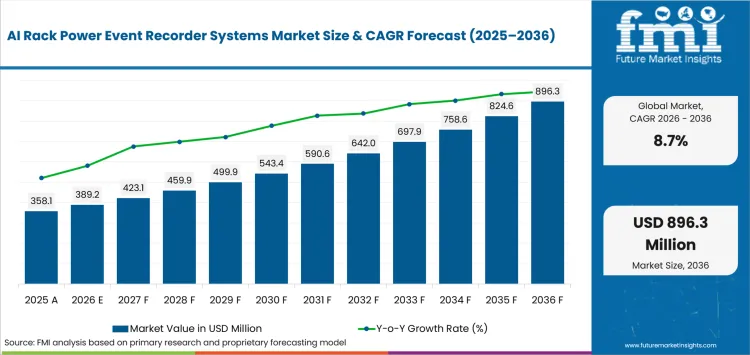
USD 389.2 million in 2026 and USD 896.3 million by 2036 at an 8.7% CAGR.
Sales in the ai rack power event recorder systems market are projected to grow at 8.7% CAGR through 2036, reaching USD 896.3 million from USD 389.2 million. Fast AI load swings make recorder placement part of the power architecture since operators need fault evidence near conversion and protection equipment. EPRI documented in November 2025 that AI training power can fluctuate by 40% or more within milliseconds to seconds. That volatility raises the need for synchronized waveform capture during commissioning and post-event analysis at high-density AI facilities.
Grid access changes the disturbance evidence operators need during energization and later capacity expansion planning. Ireland carries greater connection pressure than retrofit-heavy markets because data centers already represent a concentrated share of national electricity use. In June 2025, the Central Statistics Office recorded data centres at 22% of Irish metered electricity consumption during 2024. Concentrated load makes disturbance records useful during connection studies without turning the recorder into a separate integration project.
Key Takeaways
- AI power density increases demand for synchronized event evidence that separates utility disturbances from conversion, protection and rack-side electrical behavior.
- In 2026, power conversion equipment is expected to lead solution type with 27.0% share, owing to its direct role in conditioning and transfer events.
- By electrical layer, medium-voltage distribution is estimated to hold 31.0% in 2026, driven by larger campus blocks placing protection farther upstream.
- By power capacity, 51-150 MW is forecast to represent 31.0% in 2026, supported by phased campus designs that repeat common electrical blocks.
- Qualification slows where recorder timing, protocol support or waveform exports cannot align with existing protection logic and EPMS configurations.
- Some of the key players in this market include Eaton, ABB, Siemens, Schneider Electric, Vertiv, Delta Electronics, Janitza, and Socomec.
Analyst Perspective
"AI data-center operators gain more diagnostic value from recorder systems that shorten fault reconstruction and fit commissioning workflows than from higher meter counts. The strongest commercial fit uses one time base for protection events and power-quality records during rapid load changes."
- Sudip saha, Principal Consultant, Future Market Insights
How is the ai rack power event recorder systems market segmented?
The ai rack power event recorder systems market is segmented by solution type, electrical layer, power capacity, facility type, route to market and region.
Solution type includes power conversion equipment, power distribution equipment, event recording and monitoring platforms, and integrated rack power systems. Electrical layer covers utility interface or substation, medium-voltage distribution, low-voltage distribution, and rack or row distribution. Power capacity spans below 10 MW, 10-50 MW, 51-150 MW, and above 150 MW. Facility type covers hyperscale AI, colocation, enterprise or private cloud, and HPC or research. Route to market includes OEM direct, electrical EPC or contractor, system integrator, and distributor or service partner.
What makes power conversion equipment central to the solution type category?
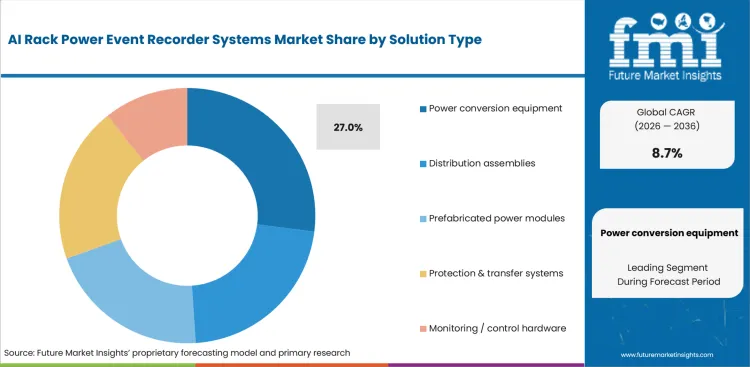
Power conversion equipment records disturbances at the same electrical stage that governs ride-through and transfer behavior for high-density AI loads during initial site acceptance testing.
Schneider Electric's September 2025 AI reference design added integrated power management plus rack peak-power guidance, giving operators a documented path for validating conversion events before deployment.
- By solution type, power conversion equipment is estimated to hold 27.0% in 2026, owing to direct visibility into conditioning and transfer behavior.
- Data-center engineers compare data center UPS records with upstream protection because synchronized evidence shortens fault isolation during commissioning and subsequent service incidents.
How does medium-voltage distribution influence selection within the electrical layer category?
Medium-voltage distribution becomes a common reference point as large AI campuses concentrate more load behind fewer upstream protection zones serving several buildings and shared substations.
ABB documented this arrangement in November 2025 at Applied Digital's 300 MW Polaris Forge 2 campus, where HiPerGuard supports medium-voltage distribution in 25 MW blocks.
- In 2026, medium-voltage distribution is expected to lead electrical layer with 31.0% share, attributable to protection coordination at larger campus power blocks.
- Electrical designers use LV/MV power distribution records to compare one disturbance against several buildings before changing protection settings or replacing downstream equipment during commissioning.
What supports demand for 51-150 MW within the power capacity category?
The 51-150 MW range supports repeatable campus blocks without forcing every project into a bespoke data-center switchgear architecture during the first major construction phase.
Siemens and nVent published a 100 MW hyperscale AI reference architecture in December 2025, placing this capacity directly inside standardized high-density design work.
- Based on power capacity, 51-150 MW is projected to account for 31.0% in 2026, shaped by phased construction and repeatable electrical packages.
- Project teams standardizing modular data centers gain more from event records after one block establishes approved triggers, protocol mappings and protection references for later capacity phases.
How do hyperscale operators evaluate hyperscale AI within the facility type category?
Hyperscale AI facilities need disturbance records that reproduce fast GPU load behavior before the same electrical design is repeated among several buildings and capacity phases.
Vertiv introduced an AI Load Simulator in December 2025 that reproduces GPU electrical behavior for testing UPS systems and complete power trains under realistic conditions.
- Hyperscale AI is projected to hold 44.0% share in 2026, influenced by concentrated accelerator fleets and repeated fleet-level electrical designs.
- Fleet operators compare power quality equipment against protection timing and common data formats because one unresolved disturbance can affect several identical capacity blocks during fleet expansion.
What are the drivers, restraints and opportunities in the AI Rack Power Event Recorder Systems Market?
AI load volatility increases the value of synchronized event evidence. Compressed commissioning limits qualification. Factory-built power blocks provide a route to repeatable recorder integration.
- Driver: AI training loads produce electrical oscillations that require higher-resolution records near protection and conversion equipment.
- Restraint: compressed schedules leave less time to align recorder locations, communication protocols and protection settings before energization.
- Opportunity: factory-built electrical blocks allow recorder triggers and data interfaces to be validated before equipment reaches the site.
AI load oscillations make high-resolution event evidence a reliability requirement
AI training centers synchronize thousands of processors, producing load oscillations that conventional measurements may not capture at every relevant frequency. The USA Department of Energy documented this measurement gap in May 2026 and identified hybrid PMU plus point-on-wave monitoring as the most reliable pathway. Power monitoring raises recorder specification value by preserving high-frequency evidence protection engineers can use without replacing the existing monitoring hierarchy.
Compressed delivery schedules narrow the systems that can pass qualification
Recorder qualification stalls as commissioning teams reconcile time sources, protection settings and EPMS mappings ahead of site acceptance. Janitza documented this pressure in April 2026 as compressed data-center project cycles strained existing planning and standardization practices. Systems requiring custom engineering lose ground because power quality meters and event recorders must provide repeatable exports before energization dates become fixed.
Factory-built power blocks give event recording a repeatable integration route
Preconfigured electrical blocks let manufacturers test recorder timing and interfaces at the factory. Site teams then face less integration work during phased AI-campus commissioning. Delta Electronics reported in June 2026 that its prefabricated AI modular data center can reduce deployment time by up to 60%. The same factory workflow favors embedded event capture because trigger settings and protocol mappings can be validated alongside modular UPS systems before installation.
Which country CAGRs are profiled in the AI Rack Power Event Recorder Systems Market?
| Country | CAGR |
|---|---|
| Saudi Arabia | 10.2% |
| Ireland | 9.9% |
| UAE | 9.6% |
| South Korea | 9.3% |
| USA | 8.9% |
| Germany | 8.6% |
How do country-level CAGRs compare in the AI Rack Power Event Recorder Systems Market?
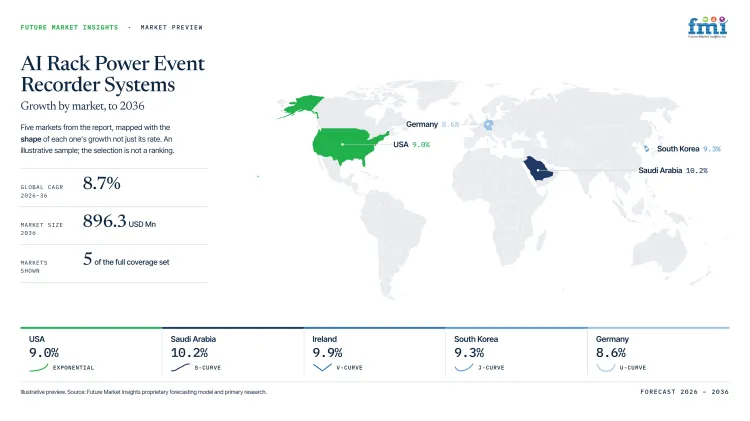
The profiled markets span 1.6 percentage points from Saudi Arabia at 10.2% to Germany at 8.6%. Ireland and the UAE form the upper group beneath Saudi Arabia, with South Korea holding the middle position. Mature-grid conditions place the USA and Germany lower as retrofit work and connection timing influence recorder orders differently.
- Saudi Arabia advances through greenfield projects that specify recorder functions early.
- Ireland's dense installed load favors fleet-compatible disturbance records.
- UAE campuses reward high-capacity power distribution units with multi-source coordination.
- South Korea concentrates retrofit demand inside active commercial cloud facilities.
- USA projects reward rapid-load capture without separate monitoring layers.
- Germany gives service continuity more weight during recorder replacements.
Comparable CAGRs therefore mask different commissioning calendars and integration costs. The full report provides country-level CAGR analysis across North America, Latin America, Europe, East Asia, South Asia, Oceania and the Middle East and Africa.
Country-wise Analysis
- USA data-center developers lock medium-voltage architecture during early utility negotiations since connection capacity determines which AI campus phases receive an energization path first. Demand for ai rack power event recorder systems in the USA is anticipated to advance at 8.9% CAGR over the assessment period, tied to larger loads and stricter fault-reconstruction needs. In January 2026, the USA Energy Information Administration forecast the strongest four-year electricity-demand growth since 2000 and named large computing centers as the main cause. Constrained grid schedules favor interoperable timestamps and field support during each campus phase. Vendors still must fit existing utility protection studies without extending commissioning schedules at each site.
- Irish data-center operators work inside a connection regime that leaves little tolerance for undocumented electrical behavior during expansion planning and security-of-supply review. In July 2026, the Central Statistics Office measured data centres at 23% of national metered electricity use during 2025. Adoption of ai rack power event recorder systems in Ireland is estimated to expand at 9.9% CAGR through 2036, aided by a mature installed base and concentrated electrical demand. Connection capacity plus generation or storage requirements can extend qualification for each proposed load block. Recorder vendors therefore need disturbance evidence that fits the connection plan without delaying approved expansion work.
- German operators must reconcile fault investigation with energy-efficiency duties as existing monitoring architecture becomes part of every recorder qualification decision at brownfield sites. In June 2026, the federal government approved Energy Efficiency Act revisions that shift full renewable-electricity accounting for data centers to 2030. Duplicate EPMS layers raise commissioning effort and complicate consistent operating records during scheduled reviews and post-event analysis at each facility. Germany's ai rack power event recorder systems sector is projected to record 8.6% CAGR during the assessment period, shaped by demand for auditable electrical evidence inside existing facilities. Retrofit vendors therefore compete on integration discipline since operators cannot justify a second monitoring layer solely for event capture.
- South Korean cloud operators are upgrading live facilities as public AI programs place advanced GPU capacity inside existing commercial data-center environments. The Ministry of Science and ICT announced 10,000 advanced GPUs in May 2025 and required selected cloud providers to prepare existing power systems for deployment. In South Korea, ai rack power event recorder systems demand is predicted to advance at 9.3% CAGR through 2036 given the need for additional electrical visibility without long outages. Compact recorders and retrofit-friendly communications therefore hold an advantage in live sites that cannot accept long service interruptions. Software fit sets the commercial limit since monitoring changes must preserve active customer workloads during deployment.
- Saudi AI infrastructure is developing through greenfield programs that let sponsors set campus power architecture before major electrical packages are released. Project sponsors can also specify local service expectations while recorder functions are still being defined for initial campus phases. The Public Investment Fund launched HUMAIN in May 2025 with a mandate covering new data centers plus AI infrastructure and cloud capabilities. Saudi Arabia is estimated to post 10.2% CAGR over the forecast period, propelled by planned capacity and the ability to specify recorder functions early. Local qualification and service depth decide whether imported electrical packages retain usable event evidence after construction teams hand systems to domestic operators.
- UAE AI-campus development favors staged electrical blocks as large projects coordinate international compute platforms with local energy systems during successive commissioning packages. Recorder vendors face a practical constraint: protection logic and event records must stay consistent as new power blocks join an operating campus. Abu Dhabi Media Office announced Stargate UAE in May 2025 as a 1 GW cluster within a planned 5 GW campus with the first 200 MW expected in 2026. AI rack power event recorder systems sales in the UAE are forecast to expand at 9.6% CAGR by 2036, reflecting demand for one scalable data model throughout phased energization.
Who are the notable companies in the AI Rack Power Event Recorder Systems Market?
Eaton, ABB, Siemens, Schneider Electric, Vertiv, Delta Electronics, Janitza and Socomec are the notable companies serving this market.
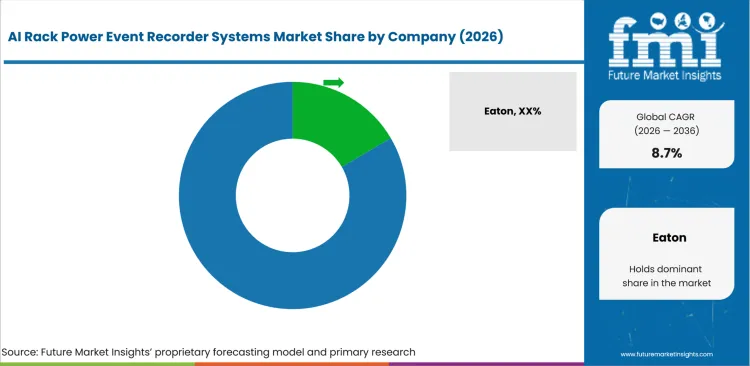
Competition turns on how much electrical context each company preserves during a disturbance without requiring a separate integration project. Eaton, ABB, Siemens and Schneider Electric span broad power platforms that cover several electrical layers inside large data-center projects. Vertiv and Delta Electronics emphasize modular AI infrastructure while Janitza and Socomec concentrate on specialist measurement or critical-power depth.
- Eaton, ABB, Siemens and Schneider Electric provide broad power conversion, protection, distribution and monitoring portfolios for large data-center electrical systems.
- Vertiv and Delta Electronics focus on integrated AI infrastructure where modular power blocks and lifecycle services reduce interface work during deployment.
- Janitza and Socomec provide specialist measurement or critical-power functions that fit operators needing deeper power-quality evidence inside existing facilities.
Competitive Benchmarking: AI Rack Power Event Recorder Systems Market
| Company | Power Train Breadth | Event / Power Quality Visibility | AI Deployment Integration | Geographic Reach |
|---|---|---|---|---|
| Eaton | High | High | High | Global |
| ABB | High | High | High | Global |
| Siemens | High | High | High | Global |
| Schneider Electric | High | High | High | Global |
| Vertiv | High | High | High | Global |
| Delta Electronics | High | Medium | High | Global |
| Janitza | Low | High | Medium | Europe and international markets |
| Socomec | High | Medium | Medium | Europe, Asia, Middle East and Americas |
Scoring basis: High power-train breadth requires documented conversion, distribution and protection coverage within current data-center electrical platforms. Medium covers two documented layers and Low identifies a specialist platform with one verified electrical layer. High event visibility requires dedicated disturbance or power-quality recording with usable exports for engineering review after an event. Medium indicates narrower monitoring depth and Low identifies limited recorder functions within the verified data-center offering. High AI integration requires current AI reference architectures or modular programs tied to high-density data-center deployment. Medium indicates standard data-center integration and Low identifies one documented deployment route without broader AI-specific architecture.
Key Developments in the AI Rack Power Event Recorder Systems Market
- In September 2025, Eaton released firmware for its Power Xpert Quality event analysis system that detects AI power bursts and potential subsynchronous oscillations in data centers.
- In October 2025, ABB launched an AI-ready MNS low-voltage distribution system with SACE Emax 3 sensing and integrated power-quality analysis for data centers.
- In August 2026, Siemens and Reinhausen announced a solid-state transformer for AI data centers that accepts up to 36 kV and provides 800 VDC output.
Key Players in the AI Rack Power Event Recorder Systems Market
Integrated Power and Protection Platforms
- Eaton
- ABB
- Siemens
- Schneider Electric
AI Infrastructure and Modular Power Platforms
- Vertiv
- Delta Electronics
Power-Quality and Critical-Power Specialists
- Janitza
- Socomec
AI Rack Power Event Recorder Systems Market - Report Scope
| Coverage field | Report scope |
|---|---|
| Market breakdown | By solution type, electrical layer, power capacity, facility type, route to market and region. |
| Quantitative Units | USD million. |
| Market Definition | Revenue includes AI data-center electrical equipment supplied with event-recording, power-quality logging or disturbance-capture capability inside the stated segmentation. Generic electrical equipment without the named recording function is excluded. |
| Regions Covered | North America, Latin America, Western Europe, Eastern Europe, East Asia, South Asia and Pacific and Middle East and Africa. |
| Countries Covered | Saudi Arabia, Ireland, UAE, South Korea, USA, Germany and 25+ additional countries included in the full report. |
| Key Companies Profiled | Eaton, ABB, Siemens, Schneider Electric, Vertiv, Delta Electronics, Janitza, Socomec. |
| Forecast Period | 2026 to 2036. |
| Approach | Hybrid bottom-up and top-down sizing that reconciles electrical equipment revenue with AI facility power architecture, deployment patterns and stated scope exclusions. |
AI Rack Power Event Recorder Systems Market - Research Methodology
| Method | Approach |
|---|---|
| Primary Research | FMI analysts gathered input from manufacturers, service providers, technology developers, distributors, end users, procurement teams, and subject-matter experts. Interviews examined purchasing decisions, product or service evaluation, adoption barriers, approval requirements, pricing considerations, and expectations for technical or commercial support. Respondents were also asked what evidence is required before a trial, pilot, or initial order develops into regular purchasing. |
| Desk Research | Desk research covered government statistics, regulatory publications, trade data, industry associations, technical literature, standards, company filings, product information, and official corporate announcements. Sources were reviewed for relevance, publication date, geographic coverage, and consistency with the defined market scope. Claims relating to performance, applications, approvals, capacity, investment, and commercial activity were retained only when supported by credible public evidence. |
| Market Sizing and Forecasting | The market model combined the baseline value with historical performance, segment structure, pricing and volume indicators, adoption levels, company participation, and country-level demand conditions. Forecast assumptions considered economic activity, investment trends, regulatory developments, technology adoption, purchasing cycles, supply availability, and barriers to wider market use. Segment and regional estimates were reconciled before the final market total was calculated. |
| Data Validation | Estimates were checked against multiple independent indicators, including public data, company activity, trade patterns, industry developments, and findings from primary interviews. Validation also tested whether products, services, applications, and company revenues fell within the defined market boundaries. Adjacent categories, unsupported claims, overlapping revenues, and activities without direct market relevance were excluded to reduce double counting and maintain consistency across segments and countries. |
AI Rack Power Event Recorder Systems Market by Segments
AI Rack Power Event Recorder Systems Market segmented by Solution Type:
- Power conversion equipment
- Power distribution equipment
- Event recording / monitoring platforms
- Integrated rack power systems
AI Rack Power Event Recorder Systems Market segmented by Electrical Layer:
- Utility interface / substation
- Medium-voltage distribution
- Low-voltage distribution
- Rack / row distribution
AI Rack Power Event Recorder Systems Market segmented by Power Capacity:
- Below 10 MW
- 10-50 MW
- 51-150 MW
- Above 150 MW
AI Rack Power Event Recorder Systems Market segmented by Facility Type:
- Hyperscale AI
- Colocation
- Enterprise / private cloud
- HPC / research
AI Rack Power Event Recorder Systems Market segmented by Route to Market:
- OEM direct
- Electrical EPC / contractor
- System integrator
- Distributor / service partner
AI Rack Power Event Recorder Systems Market by Region:
- North America
- United States
- Canada
- Latin America
- Brazil
- Mexico
- Argentina
- Chile
- Western Europe
- Germany
- France
- United Kingdom
- Italy
- Spain
- Benelux
- Nordics
- Ireland
- Eastern Europe
- Poland
- Czech Republic
- Romania
- Hungary
- East Asia
- China
- Japan
- South Korea
- South Asia and Pacific
- India
- ASEAN
- Australia and New Zealand
- Middle East and Africa
- GCC Countries
- Saudi Arabia
- UAE
- South Africa
- Türkiye
- Israel
Research Sources and Bibliography
- Electric Power Research Institute. (2025, November 24). Key characteristics of data center power demand.
- Central Statistics Office. (2025, June 10). Data Centres Metered Electricity Consumption 2024.
- Schneider Electric. (2025, September 18). Schneider Electric announces new reference designs featuring integrated power management and liquid cooling controls.
- ABB. (2025, November 13). ABB expands power technology partnership with Applied Digital for AI-ready data centers.
- Siemens. (2025, December 9). Siemens and nVent collaborate on reference architecture for 100 MW hyperscale AI data centers.
- Vertiv. (2025, December 3). Vertiv AI Load Simulator: innovation for precise power validation.
- USA Department of Energy. (2026, May 28). Monitoring oscillations from large data centers.
- Janitza. (2026, April 30). Accelerated data centers delivery: is time pressure undermining established standards?
- Delta Electronics. (2026, June 5). Delta debuts prefabricated AI modular data center solution at COMPUTEX 2026 to reduce deployment time by up to 60%.
- USA Energy Information Administration. (2026, January 13). EIA forecasts strongest four-year growth in USA electricity demand since 2000, fueled by data centers.
- Central Statistics Office. (2026, July 7). Data Centres Metered Electricity Consumption 2025.
- Federal Government of Germany. (2026, June 24). Weniger Bürokratie - mehr Energieeffizienz.
- Ministry of Science and ICT, Republic of Korea. (2025, May 14). Government unveils plan to secure 10,000 advanced GPUs and launch CSP recruitment.
- Public Investment Fund. (2025, May 12). HRH Crown Prince launches HUMAIN as global AI powerhouse.
- Abu Dhabi Media Office. (2025, May 22). Global tech alliance launches Stargate UAE.
- Eaton. (2025, September 9). Eaton delivers edge-based innovation to help mitigate the impact of AI power bursting on data centers and the grid.
- ABB. (2025, October 8). ABB launches next-generation power solution for AI-ready data centers.
- Siemens. (2026, August 14). Siemens and Reinhausen develop direct current power solutions for AI data centers.
- Eaton. (2025, October 13). Eaton unveils next-generation architecture to advance 800 VDC power infrastructure for AI factories.
- Vertiv. (2025, May 19). Vertiv accelerates AI infrastructure evolution in alignment with NVIDIA 800 VDC power architecture announcement.
- Delta Electronics. (2025, May 21). Delta presents comprehensive solutions for AI data center with containerized data center and HVDC power solution at COMPUTEX 2025.
- Janitza. (2025, July 24). Janitza acquires majority stake in Digimondo.
- Socomec. (2026, May 12). Digital Realty and Socomec: a trusted partnership for the development of reliable and responsible data centres.
- Socomec. (2025, September 8). Demanding, power hungry & coming to a data centre near you.
- Siemens. (2026, March 17). Siemens and Rittal partner to design data center infrastructure of the future.
- Schneider Electric. (2026, June 15). Schneider Electric and Hon Hai Technology Group announce collaboration to accelerate next-generation AI data centers.
- ABB. (2025, October 13). ABB to develop next-generation AI data centers with NVIDIA.
- Delta Electronics. (2026, March 17). Delta exhibits energy-saving solutions for 800 VDC in next-gen AI factories at NVIDIA GTC 2026.
- Eaton. (2025, December 10). Eaton invests $50M+ in new Virginia facility to advance grid-to-chip AI data center solutions.
- ABB. (2026, June 1). ABB expands collaboration with NVIDIA through integration of DSX Blueprint for AI infrastructure.
- Siemens. (2026, June 1). Siemens and partners develop reference architecture purpose-built for NVIDIA AI data centers.
- Schneider Electric. (2025, March 18). ETAP and Schneider Electric unveil digital twin to simulate AI factory power requirements from grid to chip.
- Huawei Digital Power. (2026, June 2). Huawei Unveils Its Grid-Interactive AIDC Strategy and Solutions at DataCloud Global Congress 2026.
- Mitsubishi Electric. (2025, November 6). Mitsubishi Electric Signs MoU with Hon Hai Precision Industry for Global Alliance in AI Data Center Solutions.
This bibliography is provided for reader reference and is not exhaustive. The full report contains the complete reference list and detailed citations.
This Report Answers
- How large is the ai rack power event recorder systems market in 2026 and 2036?
- Which AI electrical-load conditions increase demand for synchronized disturbance records?
- Why does power conversion equipment account for 27.0% of solution type demand in 2026?
- How does medium-voltage distribution shape event visibility in large AI campuses?
- Why does the 51-150 MW capacity range account for 31.0% of demand in 2026?
- How do the six profiled country CAGRs differ from 2026 to 2036?
- Which companies provide broad power-chain coverage and specialist power-quality depth?
- Which commissioning constraints limit adoption of recorder systems in brownfield and greenfield projects?
- What should operators evaluate before standardizing event-recording architecture over several AI capacity blocks?
Frequently Asked Questions
How big is the AI rack power event recorder systems market in 2026?
The ai rack power event recorder systems market is valued at USD 389.2 million in 2026 and is projected to reach USD 896.3 million by 2036. Growth follows rising AI power density and demand for synchronized disturbance evidence during commissioning and fault diagnosis.
What is the CAGR of the AI rack power event recorder systems market from 2026 to 2036?
The ai rack power event recorder systems market is projected to grow at a CAGR of 8.7% between 2026 and 2036. Expansion is supported by larger electrical blocks plus faster AI load changes that increase fault-diagnosis requirements.
Which solution type leads the AI rack power event recorder systems market?
The power conversion equipment segment is expected to hold 27.0% of the ai rack power event recorder systems market in 2026, driven by access to conditioning and transfer events. Recorder data at this stage gives engineers fault context during commissioning and later service investigations.
Which electrical layer leads the AI rack power event recorder systems market?
The medium-voltage distribution segment is estimated to hold 31.0% of the ai rack power event recorder systems market in 2026, attributable to larger campus power blocks. Upstream records give operating teams one reference for disturbances affecting several downstream buildings during fault investigation.
Which companies are active in the AI rack power event recorder systems market?
Key companies in the ai rack power event recorder systems market include Eaton, ABB, Siemens, Schneider Electric, Vertiv, Delta Electronics, Janitza, and Socomec. Their positions differ by power-chain breadth and recorder depth with modular integration plus field-service coverage separating broader platform providers.
Preview the report firsthand - request a free sample
Get SampleGet the brochure for pricing and purchase details.
Get PDFTable of Content
- Key Takeaways
- Market Size and CAGR
- Top Growth Driver
- Fastest Growing Segment
- Leading Region
- Key Companies
- Emerging Opportunities
- Executive Summary
- Global Market Outlook
- Demand-side Trends
- Supply-side Trends
- Technology Roadmap Analysis
- Analysis and Recommendations
- Analyst Perspective (What is happening? Why now? What should investors know?)
- Key Questions Answered
- How large is the market?
- What is the CAGR?
- What are key trends?
- Which region dominates?
- Who are the leaders?
- Market Overview
- Market Coverage / Taxonomy
- Market Definition / Scope / Limitations
- Research Methodology
- Chapter Orientation
- Analytical Lens and Working Hypotheses
- Market Structure, Signals, and Trend Drivers
- Benchmarking and Cross-market Comparability
- Market Sizing, Forecasting, and Opportunity Mapping
- Research Design and Evidence Framework
- Desk Research Programme (Secondary Evidence)
- Expert Input and Fieldwork (Primary Evidence)
- Tooling, Models, and Reference Databases
- Data Engineering and Model Build
- Quality Assurance and Audit Trail
- Market Background
- Market Dynamics (Drivers, Restraints, Opportunity, Trends)
- Scenario Forecast (Optimistic, Likely, Conservative)
- Impact Analysis
- AI Impact
- Sustainability Impact
- Regulatory Impact
- Technology Impact
- Consumer / Buyer Analysis
- Purchase Drivers
- Adoption Barriers
- Buyer Journey
- Opportunity Map Analysis
- Product Life Cycle Analysis
- Supply Chain Analysis
- Investment Feasibility Matrix
- Value Chain Analysis
- PESTLE and Porter's Analysis
- Regulatory Landscape
- Regional Parent Market Outlook
- Production and Consumption Statistics
- Import and Export Statistics
- Global Market Analysis and Forecast, 2021 to 2036
- Historical Market Size Value (USD Million) Analysis, 2021 to 2025
- Current and Future Market Size Value (USD Million) Projections, 2026 to 2036
- Y-o-Y Growth Trend Analysis
- Absolute $ Opportunity Analysis
- Global Market Pricing Analysis, 2021 to 2036
- Global Market Analysis and Forecast, By Solution Type, 2021 to 2036
- Introduction / Key Findings
- Historical Market Size Value (USD Million) Analysis By Solution Type, 2021 to 2025
- Current and Future Market Size Value (USD Million) Analysis and Forecast By Solution Type, 2026 to 2036
- Power conversion equipment
- Distribution assemblies
- Prefabricated power modules
- Protection & transfer systems
- Monitoring / control hardware
- Power conversion equipment
- Y-o-Y Growth Trend Analysis By Solution Type, 2021 to 2025
- Absolute $ Opportunity Analysis By Solution Type, 2026 to 2036
- Global Market Analysis and Forecast, By Electrical Layer, 2021 to 2036
- Introduction / Key Findings
- Historical Market Size Value (USD Million) Analysis By Electrical Layer, 2021 to 2025
- Current and Future Market Size Value (USD Million) Analysis and Forecast By Electrical Layer, 2026 to 2036
- Medium-voltage distribution
- Low-voltage distribution
- Rack / row-level
- Substation / grid interface
- Medium-voltage distribution
- Y-o-Y Growth Trend Analysis By Electrical Layer, 2021 to 2025
- Absolute $ Opportunity Analysis By Electrical Layer, 2026 to 2036
- Global Market Analysis and Forecast, By Power Capacity, 2021 to 2036
- Introduction / Key Findings
- Historical Market Size Value (USD Million) Analysis By Power Capacity, 2021 to 2025
- Current and Future Market Size Value (USD Million) Analysis and Forecast By Power Capacity, 2026 to 2036
- 51-150 MW
- 10-50 MW
- Below 10 MW
- Above 150 MW
- 51-150 MW
- Y-o-Y Growth Trend Analysis By Power Capacity, 2021 to 2025
- Absolute $ Opportunity Analysis By Power Capacity, 2026 to 2036
- Global Market Analysis and Forecast, By Facility Type, 2021 to 2036
- Introduction / Key Findings
- Historical Market Size Value (USD Million) Analysis By Facility Type, 2021 to 2025
- Current and Future Market Size Value (USD Million) Analysis and Forecast By Facility Type, 2026 to 2036
- Hyperscale AI
- Colocation
- Enterprise / private cloud
- HPC / research
- Hyperscale AI
- Y-o-Y Growth Trend Analysis By Facility Type, 2021 to 2025
- Absolute $ Opportunity Analysis By Facility Type, 2026 to 2036
- Global Market Analysis and Forecast, By Route to Market, 2021 to 2036
- Introduction / Key Findings
- Historical Market Size Value (USD Million) Analysis By Route to Market, 2021 to 2025
- Current and Future Market Size Value (USD Million) Analysis and Forecast By Route to Market, 2026 to 2036
- OEM direct
- Electrical EPC / contractor
- System integrator
- Distributor / service partner
- OEM direct
- Y-o-Y Growth Trend Analysis By Route to Market, 2021 to 2025
- Absolute $ Opportunity Analysis By Route to Market, 2026 to 2036
- Global Market Analysis and Forecast, By Region, 2021 to 2036
- Introduction
- Historical Market Size Value (USD Million) Analysis By Region, 2021 to 2025
- Current Market Size Value (USD Million) Analysis and Forecast By Region, 2026 to 2036
- North America
- Latin America
- Western Europe
- Eastern Europe
- East Asia
- South Asia and Pacific
- Middle East & Africa
- Market Attractiveness Analysis By Region
- North America Market Analysis and Forecast, By Country, 2021 to 2036
- Historical Market Size Value (USD Million) Trend Analysis By Market Taxonomy, 2021 to 2025
- Market Size Value (USD Million) Forecast By Market Taxonomy, 2026 to 2036
- By Country
- USA
- Canada
- By Solution Type
- By Electrical Layer
- By Power Capacity
- By Facility Type
- By Route to Market
- By Country
- Market Attractiveness Analysis
- By Country
- By Solution Type
- By Electrical Layer
- By Power Capacity
- By Facility Type
- By Route to Market
- Key Takeaways
- Latin America Market Analysis and Forecast, By Country
- Historical Market Size Value (USD Million) Trend Analysis By Market Taxonomy, 2021 to 2025
- Market Size Value (USD Million) Forecast By Market Taxonomy, 2026 to 2036
- By Country
- Brazil
- Mexico
- Chile
- Rest of Latin America
- By Solution Type
- By Electrical Layer
- By Power Capacity
- By Facility Type
- By Route to Market
- By Country
- Market Attractiveness Analysis
- By Country
- By Solution Type
- By Electrical Layer
- By Power Capacity
- By Facility Type
- By Route to Market
- Key Takeaways
- Western Europe Market Analysis and Forecast, By Country
- Historical Market Size Value (USD Million) Trend Analysis By Market Taxonomy, 2021 to 2025
- Market Size Value (USD Million) Forecast By Market Taxonomy, 2026 to 2036
- By Country
- Germany
- UK
- Italy
- Spain
- France
- Nordic
- BENELUX
- Rest of Western Europe
- By Solution Type
- By Electrical Layer
- By Power Capacity
- By Facility Type
- By Route to Market
- By Country
- Market Attractiveness Analysis
- By Country
- By Solution Type
- By Electrical Layer
- By Power Capacity
- By Facility Type
- By Route to Market
- Key Takeaways
- Eastern Europe Market Analysis and Forecast, By Country
- Historical Market Size Value (USD Million) Trend Analysis By Market Taxonomy, 2021 to 2025
- Market Size Value (USD Million) Forecast By Market Taxonomy, 2026 to 2036
- By Country
- Russia
- Poland
- Hungary
- Balkan & Baltic
- Rest of Eastern Europe
- By Solution Type
- By Electrical Layer
- By Power Capacity
- By Facility Type
- By Route to Market
- By Country
- Market Attractiveness Analysis
- By Country
- By Solution Type
- By Electrical Layer
- By Power Capacity
- By Facility Type
- By Route to Market
- Key Takeaways
- East Asia Market Analysis and Forecast, By Country
- Historical Market Size Value (USD Million) Trend Analysis By Market Taxonomy, 2021 to 2025
- Market Size Value (USD Million) Forecast By Market Taxonomy, 2026 to 2036
- By Country
- China
- Japan
- South Korea
- By Solution Type
- By Electrical Layer
- By Power Capacity
- By Facility Type
- By Route to Market
- By Country
- Market Attractiveness Analysis
- By Country
- By Solution Type
- By Electrical Layer
- By Power Capacity
- By Facility Type
- By Route to Market
- Key Takeaways
- South Asia and Pacific Market Analysis and Forecast, By Country
- Historical Market Size Value (USD Million) Trend Analysis By Market Taxonomy, 2021 to 2025
- Market Size Value (USD Million) Forecast By Market Taxonomy, 2026 to 2036
- By Country
- India
- ASEAN
- Australia & New Zealand
- Rest of South Asia and Pacific
- By Solution Type
- By Electrical Layer
- By Power Capacity
- By Facility Type
- By Route to Market
- By Country
- Market Attractiveness Analysis
- By Country
- By Solution Type
- By Electrical Layer
- By Power Capacity
- By Facility Type
- By Route to Market
- Key Takeaways
- Middle East & Africa Market Analysis and Forecast, By Country
- Historical Market Size Value (USD Million) Trend Analysis By Market Taxonomy, 2021 to 2025
- Market Size Value (USD Million) Forecast By Market Taxonomy, 2026 to 2036
- By Country
- Kingdom of Saudi Arabia
- Other GCC Countries
- Türkiye
- South Africa
- Other African Union
- Rest of Middle East & Africa
- By Solution Type
- By Electrical Layer
- By Power Capacity
- By Facility Type
- By Route to Market
- By Country
- Market Attractiveness Analysis
- By Country
- By Solution Type
- By Electrical Layer
- By Power Capacity
- By Facility Type
- By Route to Market
- Key Takeaways
- Key Countries Market Analysis
- USA
- Pricing Analysis
- Market Share Analysis, 2025
- By Solution Type
- By Electrical Layer
- By Power Capacity
- By Facility Type
- By Route to Market
- Canada
- Pricing Analysis
- Market Share Analysis, 2025
- By Solution Type
- By Electrical Layer
- By Power Capacity
- By Facility Type
- By Route to Market
- Mexico
- Pricing Analysis
- Market Share Analysis, 2025
- By Solution Type
- By Electrical Layer
- By Power Capacity
- By Facility Type
- By Route to Market
- Brazil
- Pricing Analysis
- Market Share Analysis, 2025
- By Solution Type
- By Electrical Layer
- By Power Capacity
- By Facility Type
- By Route to Market
- Chile
- Pricing Analysis
- Market Share Analysis, 2025
- By Solution Type
- By Electrical Layer
- By Power Capacity
- By Facility Type
- By Route to Market
- Germany
- Pricing Analysis
- Market Share Analysis, 2025
- By Solution Type
- By Electrical Layer
- By Power Capacity
- By Facility Type
- By Route to Market
- UK
- Pricing Analysis
- Market Share Analysis, 2025
- By Solution Type
- By Electrical Layer
- By Power Capacity
- By Facility Type
- By Route to Market
- Italy
- Pricing Analysis
- Market Share Analysis, 2025
- By Solution Type
- By Electrical Layer
- By Power Capacity
- By Facility Type
- By Route to Market
- Spain
- Pricing Analysis
- Market Share Analysis, 2025
- By Solution Type
- By Electrical Layer
- By Power Capacity
- By Facility Type
- By Route to Market
- France
- Pricing Analysis
- Market Share Analysis, 2025
- By Solution Type
- By Electrical Layer
- By Power Capacity
- By Facility Type
- By Route to Market
- India
- Pricing Analysis
- Market Share Analysis, 2025
- By Solution Type
- By Electrical Layer
- By Power Capacity
- By Facility Type
- By Route to Market
- ASEAN
- Pricing Analysis
- Market Share Analysis, 2025
- By Solution Type
- By Electrical Layer
- By Power Capacity
- By Facility Type
- By Route to Market
- Australia & New Zealand
- Pricing Analysis
- Market Share Analysis, 2025
- By Solution Type
- By Electrical Layer
- By Power Capacity
- By Facility Type
- By Route to Market
- China
- Pricing Analysis
- Market Share Analysis, 2025
- By Solution Type
- By Electrical Layer
- By Power Capacity
- By Facility Type
- By Route to Market
- Japan
- Pricing Analysis
- Market Share Analysis, 2025
- By Solution Type
- By Electrical Layer
- By Power Capacity
- By Facility Type
- By Route to Market
- South Korea
- Pricing Analysis
- Market Share Analysis, 2025
- By Solution Type
- By Electrical Layer
- By Power Capacity
- By Facility Type
- By Route to Market
- Russia
- Pricing Analysis
- Market Share Analysis, 2025
- By Solution Type
- By Electrical Layer
- By Power Capacity
- By Facility Type
- By Route to Market
- Poland
- Pricing Analysis
- Market Share Analysis, 2025
- By Solution Type
- By Electrical Layer
- By Power Capacity
- By Facility Type
- By Route to Market
- Hungary
- Pricing Analysis
- Market Share Analysis, 2025
- By Solution Type
- By Electrical Layer
- By Power Capacity
- By Facility Type
- By Route to Market
- Kingdom of Saudi Arabia
- Pricing Analysis
- Market Share Analysis, 2025
- By Solution Type
- By Electrical Layer
- By Power Capacity
- By Facility Type
- By Route to Market
- Türkiye
- Pricing Analysis
- Market Share Analysis, 2025
- By Solution Type
- By Electrical Layer
- By Power Capacity
- By Facility Type
- By Route to Market
- South Africa
- Pricing Analysis
- Market Share Analysis, 2025
- By Solution Type
- By Electrical Layer
- By Power Capacity
- By Facility Type
- By Route to Market
- USA
- Market Structure Analysis
- Competition Dashboard
- Competition Benchmarking
- Market Share Analysis of Top Players
- By Regional
- By Solution Type
- By Electrical Layer
- By Power Capacity
- By Facility Type
- By Route to Market
- Emerging Startups
- Innovation Benchmarking
- Competition Analysis
- Competition Deep Dive
- Eaton
- Overview
- Product Portfolio
- Profitability by Market Segments
- Sales Footprint
- Strategy Overview
- Marketing Strategy
- Product Strategy
- Channel Strategy
- ABB
- Siemens
- Janitza
- Eaton
- Case Studies
- Success Stories
- Recent Developments
- Competition Deep Dive
- Assumptions & Acronyms Used


