

- Market Size (2026)
- USD 527.1 Mn
- Forecast (2036)
- USD 917.6 Mn
- CAGR (2026 to 2036)
- 5.7%
How big is Air Flow Probes Market in 2026?
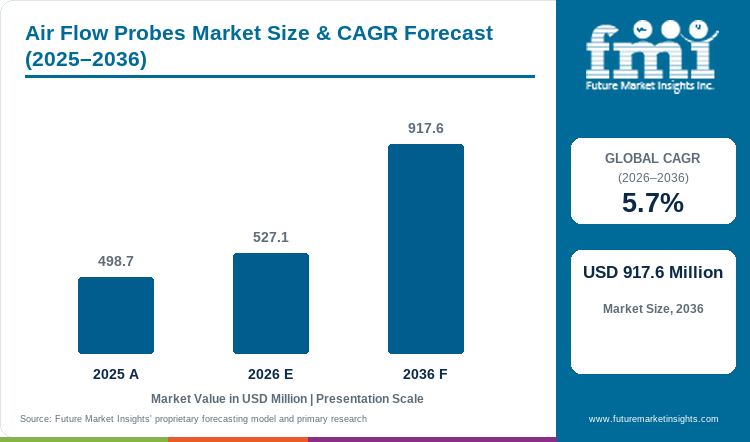
The air flow probes market is valued at USD 527.1 million in 2026 and is projected to reach USD 917.6 million by 2036, growing at a 5.7% CAGR.
Sales of air flow probes are estimated to rise at 5.7% CAGR through 2036, increasing valuation from USD 498.7 million in 2025 to USD 527.1 million in 2026, and reaching USD 917.6 million by 2036. Airflow checks continue after a building opens. ASHRAE Addendum h to Standard 62.1-2022 calls for repeat air-balance checks on covered systems. Service crews return when controls change or comfort problems appear. They need probes that cover the right speed range and work with meters already on site. Clear calibration records help crews trust the reading and avoid another visit.
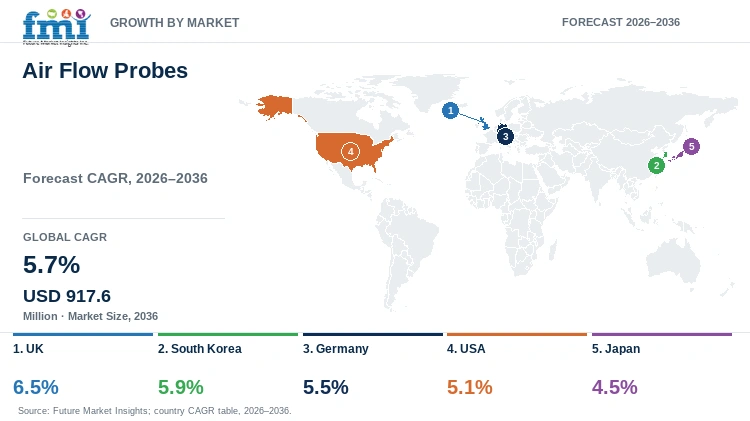
Country growth differs because building rules place airflow checks at different project stages. South Korea is projected to grow at 5.9% CAGR through 2036. Japan is projected at 4.5%. South Korea now requires at least 0.5 air changes each hour for covered new or rebuilt housing. Japan uses current public-building work standards and replaces tools at a slower pace. Distributors plan stock around local test methods. Calibration and repair service can also affect how long crews keep a probe in use.
Key Takeaways of Air Flow Probes Market
- Airflow checks bring crews back after setup and later system changes.
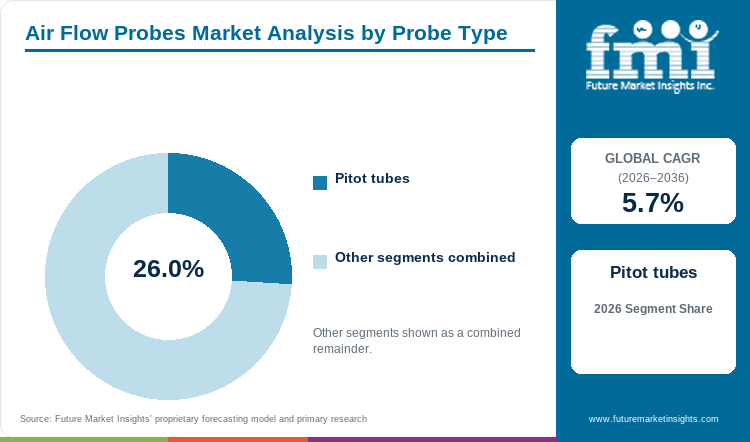
- By probe type, pitot tubes are estimated to hold 26.0% in 2026. Familiar pressure meters support their position. Crews can reuse tools they already know.
- In 2026, velocity is expected to lead the measurement category with 24.0% share. Direct use in duct checks supports this position. Crews use the reading to calculate total flow.
- By application, HVAC testing is projected to represent 29.0% in 2026. Repeat checks during balancing and handover drive this position. Crews may test the same system more than once.
- Calibration costs and uneven duct flow can add field time. Crews may need more checks before they accept a reading.
- The article profiles eight main companies. TSI Incorporated and Testo are part of this group. KIMO Instruments and Kanomax also serve field testing. DwyerOmega and Sierra Instruments add wider sensing and flow coverage. E+E Elektronik and Degree Controls complete the group. Together these firms cover field tests and fixed sensing. They also cover calibration service and plant flow measurement.
Analyst Perspective
“Crews first choose a probe that covers the speed range they need. It must also work with the test method on site. Suppliers can win repeat work when probes fit current meters. Local calibration service also helps crews avoid extra visits.”
- Nikhil Kaitwade, Principal Consultant, Future Market Insights.
How is the Air Flow Probes Market segmented?
The air flow probes market is segmented by Probe Type, Measurement, Application, Output, Sales Channel, and Region.
The air flow probes market uses five segment axes with region as the geographic split.
Probe type covers pitot tubes, averaging pitot probes, hot-wire probes, thermal mass probes, and insertion flow probes.
Measurement covers velocity, volumetric flow, mass flow, differential pressure, and air balancing.
Application covers HVAC testing, industrial duct monitoring, aerospace wind tunnels, cleanrooms, and combustion air systems.
Output covers analog, digital, wireless datalogger, and transmitter integrated formats.
Sales channel covers instrumentation distributors, direct OEM, calibration service providers, and HVAC suppliers.
What makes pitot tubes central to the probe type category?
Pitot tubes use air pressure to measure flow in a duct. Crews pair them with pressure meters they already know. Portable anemometer tools help when crews need a quick air-speed check. Pitot tubes remain useful on fixed duct paths and repeat test routes.
- By probe type, pitot tubes are estimated to hold 26.0% in 2026, supported by familiar pressure meters. Crews can reuse meters they already know during duct tests.
- ASHRAE Standard 41.2-2026 gives current methods for air-speed and airflow tests. These methods keep duct traverse checks part of system acceptance and later service work.
Why does velocity lead the measurement category?
Velocity gives crews a direct reading before they calculate total flow. It can also reveal uneven air movement across several test points. Engineers may use flow meter devices for plant checks that run all day. Handheld probes remain useful for spot tests and balancing.
- In 2026, velocity is expected to lead the measurement category with 24.0% share, supported by direct use in duct checks. Crews use the reading to calculate total flow.
- NIST found uneven and twisting air movement in large exhaust ducts during 2026 calibration work. In selected tests, local flow ranged from 70% to 125% of the monitored speed. The wide range can make crews use several test points.
How does HVAC testing shape demand within the application category?
Crews test HVAC systems during handover and again when systems change. HVAC control systems can flag a zone that needs attention. Airflow probes then help crews check the air speed or flow at the duct or outlet.
- By application, HVAC testing is projected to represent 29.0% in 2026, driven by repeat checks during balancing and handover. Crews may test the same system more than once.
- EPA guidance lists an airflow hood as a tool for checking building ventilation. It also calls for another HVAC check once people occupy a school building.
What supports analog output within the output category?
Many installed controllers still accept current or voltage signals. A probe change can keep the existing control cabinet in service. Building automation systems may add digital data elsewhere, but an analog probe can still use the current input card.
- By output, analog is forecast to represent 31.0% in 2026, supported by controllers that still accept current or voltage signals. Crews can change the probe and keep the same control panel.
- E+E Elektronik introduced the AVS701 in March 2026 for air and gas speed tests. Its alignment tool helps crews place the sensor in the right position. Better placement can reduce setup errors during plant work.
Why do instrumentation distributors lead the sales channel category?
A field order can include a probe, meter, cable, fitting, and calibration service. A distributor can match these parts to the test method and keep replacements nearby. Specialist channels carry Test and measurement sensors because buyers need help choosing the right range and signal.
- By sales channel, instrumentation distributors are projected to lead with 39.0% in 2026, supported by local stock and product help. Crews can order matching probes and parts from one source.
- DwyerOmega participated in AHR Expo 2026, showcasing measurement solutions across temperature, pressure, flow, and indoor air quality categories. The company's team was available on-site to discuss applications and provide live demonstrations of HVACR tools relevant to field measurement.
What are the drivers, restraints and opportunities in the Air Flow Probes Market?
In the air flow probes market, the key driver is the recurring need for repeat airflow verification after building handover and during later system changes, since ventilation rules require crews to retest airflow whenever controls are adjusted or comfort problems appear, making probes a routine field tool rather than a one-time purchase, the key restraint is uneven airflow inside ducts that can force crews to take multiple readings at several test points before a reading is accepted, adding field time and labor cost even when the probe itself meets its stated accuracy, and the key opportunity is the development of guided digital measurement workflows that save test records automatically and connect with analog inputs already in place on installed control systems, reducing setup effort and helping crews complete repeat checks with fewer manual steps and record gaps.
- Driver: Building handover and regular air checks bring crews back for repeat flow tests.
- Restraint: Uneven airflow and calibration needs add field work. Crews may need more checks before they accept a reading.
- Opportunity: Guided digital tools can make field records easier to save and review. They can also work with many control links already on site.
Airflow checks create repeat work after a building opens. Facility teams test flow again when controls change or comfort problems appear. Current HVAC rules keep outdoor-air readings part of normal service checks. Some sites use air flow monitoring systems for live data. Technicians still carry handheld probes for spot checks. Each visit can reveal a worn probe or a missing test range. Calibration dates tell crews if they can use a reading in a handover record. Contractors need common probes and service close to the job site. Vendors that keep both available can win repeat orders. The service cycle keeps field tools in use between major building projects. It also gives crews a clear way to replace a failed probe without changing the full test kit.
Uneven airflow becomes a restraint when air moves in different directions inside a duct. NIST reported in April 2026 that swirl and skew can make probe location a major source of error. In selected tests, local flow ranged from 70% to 125% of the speed seen by averaging pitot probes. A good probe can still give a poor system result. Crews may need more test points or a new mounting spot. Permanent flow meters can face the same problem when duct shape disturbs the air stream. Extra checks add labor and can delay approval. Buyers compare probe fit with duct shape before they trust one test point. This work can raise service cost even when the probe itself meets its stated accuracy.
The sales opportunity is to make repeat airflow checks easier without replacing the full control system. ASHRAE Standard 41.2-2026 gives crews a current method for air-speed and airflow tests. Vendors can add guided menus and saved readings so crews write fewer notes by hand. Existing analog inputs can stay in place when a transmitter already works with the controller. Digital logs can keep clearer records at the meter or gateway. Service teams gain more value when calibration history stays with the tool. This approach cuts setup work and keeps the test method already accepted at the site. Distributors can bundle matching probes with service and support for faster replacement. These steps help crews finish repeat checks with less setup and fewer record gaps.
Which country CAGRs are profiled in the Air Flow Probes Market?
| Country | CAGR |
|---|---|
| UK | 6.5% |
| South Korea | 5.9% |
| Germany | 5.5% |
| USA | 5.1% |
| Japan | 4.5% |
How do country-level CAGRs compare in the Air Flow Probes Market?
The five profiled countries span 2.0 percentage points from the UK at 6.5% to Japan at 4.5%. South Korea follows at 5.9% and Germany at 5.5%. The USA is projected at 5.1%. Similar growth rates can still create different service needs. Each country uses its own building rules and work methods.
- UK service teams need clear test records because new ventilation rules are changing how teams plan building work.
- South Korean housing rules set a clear air-change level. Crews keep airflow checks close to building handover work.
- German building teams use clear test records, while local calibration service helps them keep routine checks on schedule.
- US crews work in many older buildings, so portable probes stay useful across different meters and duct systems.
- Japanese teams plan building service with care, so clear test records matter before they replace a working probe.
Similar CAGRs do not give every country the same market size or buying pattern. Each country turns growth into orders through its own test rules and service needs. The full report covers country growth across North America and Latin America. It also covers Western Europe and Eastern Europe. The report covers East Asia and South Asia and Pacific too. The Middle East and Africa complete the regional coverage.
Country-wise Analysis
- Air flow probe sales in the UK are forecast to expand at 6.5% CAGR by 2036, supported by repair work and ventilation checks. Building teams need clear records when they test air systems during service or handover. ONS reported that repair and maintenance output in Great Britain rose 0.8% in July 2026. England published Approved Document F 2026 in March. Most of that guidance takes effect from March 24, 2027. Project teams are preparing for new test and record rules. Air quality monitoring equipment can track indoor conditions. Airflow tools verify the ventilation system itself. Suppliers with local calibration and replacement stock can help crews avoid delays. That support matters when a failed probe could hold up a test or handover record.
- Adoption of air flow probes in South Korea is estimated to expand at 5.9% CAGR through 2036, supported by national ventilation rules. The national building rule has been in force since August 24, 2026. Covered new or remodeled housing must support at least 0.5 air changes each hour. Contractors need test tools that can check installed airflow before handover. Some buildings use Air flow sensors for live checks. Portable probes remain useful during setup and balancing. Local test methods also shape the probe range and parts that crews need. Distributors can support projects by keeping common probes in stock. They can also help technicians plan calibration. This local support can reduce delays when crews need a fast replacement before a building test.
- Germany's air flow probes outlook is anticipated to advance at 5.5% CAGR over the assessment period, influenced by ventilation work and service checks. Germany's Federal Environment Agency published a national review in May 2026. It covered the types of ventilation used in German buildings and the main barriers to wider use. Service teams need clear records when they test or change a system. Industrial sensors can track other plant conditions. Airflow probes check air movement during service work. Calibration records help crews compare new readings with earlier work. Local service can also reduce delays when a probe needs a check or replacement. Suppliers can gain repeat orders when their service matches the test process already used on site.
- The USA is estimated to post 5.1% CAGR over the forecast period, supported by routine checks in schools and other occupied buildings. EPA guidance lists an airflow hood as a tool for checking school ventilation. It also calls for an HVAC check once people occupy the building. Service crews need portable tools that can move between sites and keep clear calibration records. Older buildings may use different meters and probe fittings. Control systems can also differ from site to site. A missing match can slow a probe replacement. Dealers that support several common meter systems can cut downtime. Clear records also help crews reuse a trusted tool during later inspections.
- The Japan air flow probes sector is projected to record 4.5% CAGR during the assessment period, shaped by planned service and public-building methods. Japan's transport ministry keeps the 2025 standard drawings for public mechanical building work. The ministry revised the current edition on May 12, 2025. Building teams use these documents to keep system work consistent. They also compare digital records when they want fewer handwritten notes. Teams may keep an older tool when it still works well. Suppliers can support adoption with local calibration and clear records. These services help the probe match the service process already used on site.
Who are the notable companies in the Air Flow Probes Market?
TSI Incorporated, Testo, KIMO Instruments, Kanomax, DwyerOmega, Sierra Instruments, E+E Elektronik, and Degree Controls serve the defined air flow probes market.
The companies in this market follow three main product paths. TSI Incorporated and Testo sell handheld tools for HVAC and field tests. KIMO Instruments and Kanomax also serve this work. DwyerOmega and E+E Elektronik focus more on fixed airflow sensing. Degree Controls also serves fixed sensing and control links. Sierra Instruments serves plant air and gas work with thermal mass flow products. These groups compete on more than measurement range. Field teams compare probe fit and calibration service. They also compare saved data and local support. A new supplier needs a clear product range and a service route technicians can use. Meter and controller fit matters because many crews keep the rest of the test system when they replace a probe.
- Four firms focus on handheld HVAC work. TSI Incorporated and Testo are part of this group. KIMO Instruments and Kanomax complete the group. Their tools support building handover and air balancing. They also support routine service work.
- Three firms focus more on fixed airflow sensing. DwyerOmega and E+E Elektronik are in this group. Degree Controls completes the group. Their sensors can send airflow data to building or plant control systems.
- Sierra Instruments focuses on thermal mass flow for plant air and gas. Its products suit sites that need live readings instead of occasional handheld tests.
Competitive Benchmarking: Air Flow Probes Market
| Company | Probe Coverage | Workflow Integration | Calibration & Support | Geographic Reach |
|---|---|---|---|---|
| TSI Incorporated | High | High | High | North America, Europe and Asia |
| Testo | High | High | High | Global |
| KIMO Instruments | High | Medium | Medium | Europe and international distributors |
| Kanomax | High | Medium | High | North America, Asia and international distributors |
| DwyerOmega | Medium | High | High | North America and international channels |
| Sierra Instruments | Medium | High | High | North America, Europe and Asia |
| E+E Elektronik | High | High | High | Europe, North America and Asia |
| Degree Controls | High | High | Medium | North America and international distributors |
Scoring basis: High probe coverage means a company offers several verified airflow or air-speed probe choices. Medium means the verified range is smaller. High workflow fit means tools can guide tests and save data. It can also mean they connect with another system. Support ratings use proof of service and calibration. Geographic reach uses current sales or service coverage.
Key Developments in the Air Flow Probes Market
- In August 2026, Degree Controls introduced the Rooster family. The line covers airflow and pressure checks. The company said product availability and launch details would come later. The products target labs and cleanrooms. They also target healthcare sites and other controlled spaces.
- In June 2026, TSI Incorporated expanded its VelociCalc 9600 Series and Airflow TA500 meters. The update added support for more probes. It also gave crews more guided steps for HVAC tests. These changes help crews set up common field checks.
- In March 2026, E+E Elektronik introduced the AVS701 air and gas velocity sensor. An alignment aid helps crews place the sensor in the right position. Better placement can cut setup errors during plant work.
Key Players in the Air Flow Probes Market
Portable HVAC and Field Measurement Platforms
- TSI Incorporated
- Testo
- KIMO Instruments
- Kanomax
Building and Industrial Airflow Sensing
- DwyerOmega
- E+E Elektronik
- Degree Controls
Industrial Thermal Flow Measurement
- Sierra Instruments
Air Flow Probes Market - Report Scope
| Coverage field | Report scope |
|---|---|
| Market breakdown | By probe type, measurement, application, output, sales channel and region. |
| Quantitative Units | Revenue in USD million and CAGR in %. |
| Market Definition | Air velocity and airflow probes used for portable testing, installed monitoring and measurement integration across HVAC and industrial applications. |
| Regions Covered | North America, Latin America, Western Europe, Eastern Europe, East Asia, South Asia and Pacific, and Middle East and Africa. |
| Countries Covered | UK, South Korea, Germany, USA, Japan, and 20+ countries included in the full report. |
| Key Companies Profiled | TSI Incorporated, Testo, KIMO Instruments, Kanomax, DwyerOmega, Sierra Instruments, E+E Elektronik, and Degree Controls. |
| Forecast Period | 2026 to 2036. |
| Approach | Primary and secondary research with market triangulation. |
Air Flow Probes Market - Research Methodology
| Method | Approach |
|---|---|
| Primary Research | FMI analysts gathered input from manufacturers, service providers, technology developers, distributors, end users, procurement teams, and subject-matter experts. Interviews examined purchasing decisions, product or service evaluation, adoption barriers, approval requirements, pricing considerations, and expectations for technical or commercial support. Respondents were also asked what evidence is required before a trial, pilot, or initial order develops into regular purchasing. |
| Desk Research | Desk research covered government statistics, regulatory publications, trade data, industry associations, technical literature, standards, company filings, product information, and official corporate announcements. Sources were reviewed for relevance, publication date, geographic coverage, and consistency with the defined market scope. Claims relating to performance, applications, approvals, capacity, investment, and commercial activity were retained only when supported by credible public evidence. |
| Market Sizing and Forecasting | The market model combined the baseline value with historical performance, segment structure, pricing and volume indicators, adoption levels, company participation, and country-level demand conditions. Forecast assumptions considered economic activity, investment trends, regulatory developments, technology adoption, purchasing cycles, supply availability, and barriers to wider market use. Segment and regional estimates were reconciled before the final market total was calculated. |
| Data Validation | Estimates were checked against multiple independent indicators, including public data, company activity, trade patterns, industry developments, and findings from primary interviews. Validation also tested whether products, services, applications, and company revenues fell within the defined market boundaries. Adjacent categories, unsupported claims, overlapping revenues, and activities without direct market relevance were excluded to reduce double counting and maintain consistency across segments and countries. |
Air Flow Probes Market by Segments
Air Flow Probes Market segmented by Probe Type:
- Pitot tubes
- Averaging pitot probes
- Hot-wire probes
- Thermal mass probes
- Insertion flow probes
Air Flow Probes Market segmented by Measurement:
- Velocity
- Volumetric flow
- Mass flow
- Differential pressure
- Air balancing
Air Flow Probes Market segmented by Application:
- HVAC testing
- Industrial duct monitoring
- Aerospace wind tunnels
- Cleanrooms
- Combustion air systems
Air Flow Probes Market segmented by Output:
- Analog
- Digital
- Wireless - datalogger
- Transmitter integrated
Air Flow Probes Market segmented by Sales Channel:
- Instrumentation distributors
- Direct OEM
- Calibration service providers
- HVAC suppliers
Air Flow Probes Market by Region:
- North America
- United States
- Canada
- Latin America
- Brazil
- Mexico
- Chile
- Rest of Latin America
- Western Europe
- Germany
- United Kingdom
- Italy
- Spain
- France
- Nordics
- Benelux
- Rest of Western Europe
- Eastern Europe
- Russia
- Poland
- Hungary
- Balkan and Baltic States
- Rest of Eastern Europe
- East Asia
- China
- Japan
- South Korea
- South Asia and Pacific
- India
- ASEAN
- Australia and New Zealand
- Rest of South Asia and Pacific
- Middle East and Africa
- Kingdom of Saudi Arabia
- Other GCC Countries
- Türkiye
- South Africa
- Other African Union Countries
- Rest of Middle East and Africa
Research Sources and Bibliography
- ASHRAE. (2025, September 30). ANSI/ASHRAE Addendum h to ANSI/ASHRAE Standard 62.1-2022.
- ASHRAE. (2026). ANSI/ASHRAE Standard 41.2-2026: Standard Methods for Air Velocity and Airflow Measurement.
- U.S. Environmental Protection Agency. (2026, January 13). Building Commissioning, Part of Indoor Air Quality Design Tools for Schools.
- National Institute of Standards and Technology. (2026, April 14). Exhaust Flow Calibration - S-probe Traverse.
- Umweltbundesamt. (2026, May). Bestandsaufnahme von raumlufttechnischen Anlagen und Lüftungsmaßnahmen in Gebäuden.
- Ministry of Housing, Communities and Local Government. (2026, March 24). Approved Document F (2026).
- Korea National Law Information Center. (2026, August 24). Rules on Facility Standards for Buildings, Article 11 ventilation equipment standards.
- Ministry of Land, Infrastructure, Transport and Tourism, Japan. (2025, May 12). Public Building Equipment Standard Drawings, Mechanical Equipment Works, 2025 edition.
- TSI Incorporated. (2026, June 17). TSI Expands Capabilities of VelociCalc 9600 Series and Airflow TA500 Multi-Function Ventilation Meters.
- Kanomax USA. (2026, April 28). Kanomax USA Achieves ISO/IEC 17025 Accreditation for Calibration Laboratory.
- E+E Elektronik. (2026, March 9). AVS701: Faster, Error-Free Installation.
- E+E Elektronik. (2026, April 23). Long-Term Stable and H₂O₂-Resistant: The EE680 for Reliable Laminar Flow Monitoring in Cleanrooms.
- Degree Controls Inc. (2026, August 24). Introducing the New Rooster Family.
- Degree Controls Inc. (2026, August 12). Board-Mount Air Velocity Sensors for Dense Electronics.
- DwyerOmega. (2026, February 10). DwyerOmega Expands Digital Engineering Tools with 3D CAD Models for Flow, Pressure, and Temperature Products on TraceParts.
- Testo. (2026, July). testo Smart Connect service launch announcement.
- TSI Incorporated. (2026, August 24). TSI Delivers Total Visibility and Control with Facility Management System with Web Client 2.0.
- DwyerOmega. (2026). Getting Ready for AHR 2026.
This bibliography gives readers the main sources used in the article. It is not the full source list. The full report keeps the detailed references used for the wider analysis.
This Report Answers
- How large is the air flow probes market in 2026 and what value is projected for 2036?
- Which rules and work steps turn ventilation checks into repeat demand for air flow probes?
- Why do pitot tubes hold the largest share of probe type demand?
- How do velocity readings help crews balance and test air systems?
- Why does HVAC testing hold the largest application share in 2026?
- Which field problems can stop a probe from giving an accepted reading?
- How do country growth rates change local service and stock needs?
- Which product and service features separate the main probe suppliers?
Frequently Asked Questions
How big is the air flow probes market in 2026?
The air flow probes market is estimated at USD 527.1 million in 2026. It is projected to reach USD 917.6 million by 2036. Repeat HVAC checks support purchases because crews need new airflow readings when systems change.
What is the CAGR of the air flow probes market from 2026 to 2036?
The air flow probes market is projected to grow at 5.7% CAGR between 2026 and 2036. Ventilation checks and plant monitoring support the forecast. Installed systems need repeat flow readings during balancing and service work.
Which probe type leads the air flow probes market?
Pitot tubes are expected to hold 26.0% of probe type demand in 2026. Crews can use them for routine duct checks with pressure meters they already know.
Which output segment holds the largest current share in the air flow probes market?
Analog is forecast to represent 31.0% of output demand in 2026. Many controllers still accept current or voltage signals. Crews can replace a probe without rebuilding the whole control panel.
How much value will the air flow probes market add between 2026 and 2036?
The air flow probes market is expected to add USD 390.5 million in value between 2026 and 2036. Repeat ventilation checks and plant monitoring keep airflow tools in use on installed systems.
Which countries are projected to record the highest growth in the air flow probes market?
The UK is projected to grow at 6.5% CAGR through 2036. South Korea follows at 5.9% and Germany at 5.5%. Local rules and service needs shape how growth turns into probe orders. Local replacement habits also affect demand.
Which companies are active in the air flow probes market?
The article profiles eight main companies. TSI Incorporated and Testo are part of this group. KIMO Instruments and Kanomax also serve field testing. DwyerOmega and Sierra Instruments add wider sensing and flow coverage. E+E Elektronik and Degree Controls complete the group. These firms serve field HVAC work and fixed airflow sensing. They also cover calibration service and plant flow measurement.
What should buyers check before choosing an air flow probe?
Buyers should match the measurement range to the airflow they need to check. They should also review the calibration record. Probe shape and signal fit matter too. Local service can affect downtime. These checks help the probe work with the meter or controller already in use.
Preview the report firsthand - request a free sample
Get SampleGet the brochure for pricing and purchase details.
Get PDFTable of Content
- Key Takeaways
- Market Size and CAGR
- Top Growth Driver
- Fastest Growing Segment
- Leading Region
- Key Companies
- Emerging Opportunities
- Executive Summary
- Global Market Outlook
- Demand-side Trends
- Supply-side Trends
- Technology Roadmap Analysis
- Analysis and Recommendations
- Analyst Perspective (What is happening? Why now? What should investors know?)
- Key Questions Answered
- How large is the market?
- What is the CAGR?
- What are key trends?
- Which region dominates?
- Who are the leaders?
- Market Overview
- Market Coverage / Taxonomy
- Market Definition / Scope / Limitations
- Research Methodology
- Chapter Orientation
- Analytical Lens and Working Hypotheses
- Market Structure, Signals, and Trend Drivers
- Benchmarking and Cross-market Comparability
- Market Sizing, Forecasting, and Opportunity Mapping
- Research Design and Evidence Framework
- Desk Research Programme (Secondary Evidence)
- Expert Input and Fieldwork (Primary Evidence)
- Tooling, Models, and Reference Databases
- Data Engineering and Model Build
- Quality Assurance and Audit Trail
- Market Background
- Market Dynamics (Drivers, Restraints, Opportunity, Trends)
- Scenario Forecast (Optimistic, Likely, Conservative)
- Impact Analysis
- AI Impact
- Sustainability Impact
- Regulatory Impact
- Technology Impact
- Consumer / Buyer Analysis
- Purchase Drivers
- Adoption Barriers
- Buyer Journey
- Opportunity Map Analysis
- Product Life Cycle Analysis
- Supply Chain Analysis
- Investment Feasibility Matrix
- Value Chain Analysis
- PESTLE and Porter's Analysis
- Regulatory Landscape
- Regional Parent Market Outlook
- Production and Consumption Statistics
- Import and Export Statistics
- Global Market Analysis and Forecast, 2021 to 2036
- Historical Market Size Value (USD Million) Analysis, 2021 to 2025
- Current and Future Market Size Value (USD Million) Projections, 2026 to 2036
- Y-o-Y Growth Trend Analysis
- Absolute $ Opportunity Analysis
- Global Market Pricing Analysis, 2021 to 2036
- Global Market Analysis and Forecast, By Probe Type, 2021 to 2036
- Introduction / Key Findings
- Historical Market Size Value (USD Million) Analysis By Probe Type, 2021 to 2025
- Current and Future Market Size Value (USD Million) Analysis and Forecast By Probe Type, 2026 to 2036
- Pitot tubes
- Averaging pitot probes
- Hot-wire probes
- Thermal mass probes
- Insertion flow probes
- Y-o-Y Growth Trend Analysis By Probe Type, 2021 to 2025
- Absolute $ Opportunity Analysis By Probe Type, 2026 to 2036
- Global Market Analysis and Forecast, By Measurement, 2021 to 2036
- Introduction / Key Findings
- Historical Market Size Value (USD Million) Analysis By Measurement, 2021 to 2025
- Current and Future Market Size Value (USD Million) Analysis and Forecast By Measurement, 2026 to 2036
- Velocity
- Volumetric flow
- Mass flow
- Differential pressure
- Air balancing
- Y-o-Y Growth Trend Analysis By Measurement, 2021 to 2025
- Absolute $ Opportunity Analysis By Measurement, 2026 to 2036
- Global Market Analysis and Forecast, By Application, 2021 to 2036
- Introduction / Key Findings
- Historical Market Size Value (USD Million) Analysis By Application, 2021 to 2025
- Current and Future Market Size Value (USD Million) Analysis and Forecast By Application, 2026 to 2036
- HVAC testing
- Industrial duct monitoring
- Aerospace wind tunnels
- Cleanrooms
- Combustion air systems
- Y-o-Y Growth Trend Analysis By Application, 2021 to 2025
- Absolute $ Opportunity Analysis By Application, 2026 to 2036
- Global Market Analysis and Forecast, By Output, 2021 to 2036
- Introduction / Key Findings
- Historical Market Size Value (USD Million) Analysis By Output, 2021 to 2025
- Current and Future Market Size Value (USD Million) Analysis and Forecast By Output, 2026 to 2036
- Analog
- Digital
- Wireless - datalogger
- Transmitter integrated
- Y-o-Y Growth Trend Analysis By Output, 2021 to 2025
- Absolute $ Opportunity Analysis By Output, 2026 to 2036
- Global Market Analysis and Forecast, By Sales Channel, 2021 to 2036
- Introduction / Key Findings
- Historical Market Size Value (USD Million) Analysis By Sales Channel, 2021 to 2025
- Current and Future Market Size Value (USD Million) Analysis and Forecast By Sales Channel, 2026 to 2036
- Instrumentation distributors
- Direct OEM
- Calibration service providers
- HVAC suppliers
- Y-o-Y Growth Trend Analysis By Sales Channel, 2021 to 2025
- Absolute $ Opportunity Analysis By Sales Channel, 2026 to 2036
- Global Market Analysis and Forecast, By Region, 2021 to 2036
- Introduction
- Historical Market Size Value (USD Million) Analysis By Region, 2021 to 2025
- Current Market Size Value (USD Million) Analysis and Forecast By Region, 2026 to 2036
- North America
- Latin America
- Western Europe
- Eastern Europe
- East Asia
- South Asia and Pacific
- Middle East and Africa
- Market Attractiveness Analysis By Region
- North America Market Analysis and Forecast, By Country, 2021 to 2036
- Historical Market Size Value (USD Million) Trend Analysis By Market Taxonomy, 2021 to 2025
- Market Size Value (USD Million) Forecast By Market Taxonomy, 2026 to 2036
- By Country
- United States
- Canada
- By Probe Type
- By Measurement
- By Application
- By Output
- By Sales Channel
- By Country
- Market Attractiveness Analysis
- By Country
- By Probe Type
- By Measurement
- By Application
- By Output
- By Sales Channel
- Key Takeaways
- Latin America Market Analysis and Forecast, By Country
- Historical Market Size Value (USD Million) Trend Analysis By Market Taxonomy, 2021 to 2025
- Market Size Value (USD Million) Forecast By Market Taxonomy, 2026 to 2036
- By Country
- Brazil
- Mexico
- Chile
- Rest of Latin America
- By Probe Type
- By Measurement
- By Application
- By Output
- By Sales Channel
- By Country
- Market Attractiveness Analysis
- By Country
- By Probe Type
- By Measurement
- By Application
- By Output
- By Sales Channel
- Key Takeaways
- Western Europe Market Analysis and Forecast, By Country
- Historical Market Size Value (USD Million) Trend Analysis By Market Taxonomy, 2021 to 2025
- Market Size Value (USD Million) Forecast By Market Taxonomy, 2026 to 2036
- By Country
- Germany
- United Kingdom
- Italy
- Spain
- France
- Nordics
- Benelux
- Rest of Western Europe
- By Probe Type
- By Measurement
- By Application
- By Output
- By Sales Channel
- By Country
- Market Attractiveness Analysis
- By Country
- By Probe Type
- By Measurement
- By Application
- By Output
- By Sales Channel
- Key Takeaways
- Eastern Europe Market Analysis and Forecast, By Country
- Historical Market Size Value (USD Million) Trend Analysis By Market Taxonomy, 2021 to 2025
- Market Size Value (USD Million) Forecast By Market Taxonomy, 2026 to 2036
- By Country
- Russia
- Poland
- Hungary
- Balkan and Baltic States
- Rest of Eastern Europe
- By Probe Type
- By Measurement
- By Application
- By Output
- By Sales Channel
- By Country
- Market Attractiveness Analysis
- By Country
- By Probe Type
- By Measurement
- By Application
- By Output
- By Sales Channel
- Key Takeaways
- East Asia Market Analysis and Forecast, By Country
- Historical Market Size Value (USD Million) Trend Analysis By Market Taxonomy, 2021 to 2025
- Market Size Value (USD Million) Forecast By Market Taxonomy, 2026 to 2036
- By Country
- China
- Japan
- South Korea
- By Probe Type
- By Measurement
- By Application
- By Output
- By Sales Channel
- By Country
- Market Attractiveness Analysis
- By Country
- By Probe Type
- By Measurement
- By Application
- By Output
- By Sales Channel
- Key Takeaways
- South Asia and Pacific Market Analysis and Forecast, By Country
- Historical Market Size Value (USD Million) Trend Analysis By Market Taxonomy, 2021 to 2025
- Market Size Value (USD Million) Forecast By Market Taxonomy, 2026 to 2036
- By Country
- India
- ASEAN
- Australia and New Zealand
- Rest of South Asia and Pacific
- By Probe Type
- By Measurement
- By Application
- By Output
- By Sales Channel
- By Country
- Market Attractiveness Analysis
- By Country
- By Probe Type
- By Measurement
- By Application
- By Output
- By Sales Channel
- Key Takeaways
- Middle East and Africa Market Analysis and Forecast, By Country
- Historical Market Size Value (USD Million) Trend Analysis By Market Taxonomy, 2021 to 2025
- Market Size Value (USD Million) Forecast By Market Taxonomy, 2026 to 2036
- By Country
- Kingdom of Saudi Arabia
- Other GCC Countries
- Türkiye
- South Africa
- Other African Union Countries
- Rest of Middle East and Africa
- By Probe Type
- By Measurement
- By Application
- By Output
- By Sales Channel
- By Country
- Market Attractiveness Analysis
- By Country
- By Probe Type
- By Measurement
- By Application
- By Output
- By Sales Channel
- Key Takeaways
- Key Countries Market Analysis
- United States
- Pricing Analysis
- Market Share Analysis, 2025
- By Probe Type
- By Measurement
- By Application
- By Output
- By Sales Channel
- Canada
- Pricing Analysis
- Market Share Analysis, 2025
- By Probe Type
- By Measurement
- By Application
- By Output
- By Sales Channel
- Mexico
- Pricing Analysis
- Market Share Analysis, 2025
- By Probe Type
- By Measurement
- By Application
- By Output
- By Sales Channel
- Brazil
- Pricing Analysis
- Market Share Analysis, 2025
- By Probe Type
- By Measurement
- By Application
- By Output
- By Sales Channel
- Chile
- Pricing Analysis
- Market Share Analysis, 2025
- By Probe Type
- By Measurement
- By Application
- By Output
- By Sales Channel
- Germany
- Pricing Analysis
- Market Share Analysis, 2025
- By Probe Type
- By Measurement
- By Application
- By Output
- By Sales Channel
- United Kingdom
- Pricing Analysis
- Market Share Analysis, 2025
- By Probe Type
- By Measurement
- By Application
- By Output
- By Sales Channel
- Italy
- Pricing Analysis
- Market Share Analysis, 2025
- By Probe Type
- By Measurement
- By Application
- By Output
- By Sales Channel
- Spain
- Pricing Analysis
- Market Share Analysis, 2025
- By Probe Type
- By Measurement
- By Application
- By Output
- By Sales Channel
- France
- Pricing Analysis
- Market Share Analysis, 2025
- By Probe Type
- By Measurement
- By Application
- By Output
- By Sales Channel
- India
- Pricing Analysis
- Market Share Analysis, 2025
- By Probe Type
- By Measurement
- By Application
- By Output
- By Sales Channel
- ASEAN
- Pricing Analysis
- Market Share Analysis, 2025
- By Probe Type
- By Measurement
- By Application
- By Output
- By Sales Channel
- Australia and New Zealand
- Pricing Analysis
- Market Share Analysis, 2025
- By Probe Type
- By Measurement
- By Application
- By Output
- By Sales Channel
- China
- Pricing Analysis
- Market Share Analysis, 2025
- By Probe Type
- By Measurement
- By Application
- By Output
- By Sales Channel
- Japan
- Pricing Analysis
- Market Share Analysis, 2025
- By Probe Type
- By Measurement
- By Application
- By Output
- By Sales Channel
- South Korea
- Pricing Analysis
- Market Share Analysis, 2025
- By Probe Type
- By Measurement
- By Application
- By Output
- By Sales Channel
- Russia
- Pricing Analysis
- Market Share Analysis, 2025
- By Probe Type
- By Measurement
- By Application
- By Output
- By Sales Channel
- Poland
- Pricing Analysis
- Market Share Analysis, 2025
- By Probe Type
- By Measurement
- By Application
- By Output
- By Sales Channel
- Hungary
- Pricing Analysis
- Market Share Analysis, 2025
- By Probe Type
- By Measurement
- By Application
- By Output
- By Sales Channel
- Kingdom of Saudi Arabia
- Pricing Analysis
- Market Share Analysis, 2025
- By Probe Type
- By Measurement
- By Application
- By Output
- By Sales Channel
- Türkiye
- Pricing Analysis
- Market Share Analysis, 2025
- By Probe Type
- By Measurement
- By Application
- By Output
- By Sales Channel
- South Africa
- Pricing Analysis
- Market Share Analysis, 2025
- By Probe Type
- By Measurement
- By Application
- By Output
- By Sales Channel
- United States
- Market Structure Analysis
- Competition Dashboard
- Competition Benchmarking
- Market Share Analysis of Top Players
- By Regional
- By Probe Type
- By Measurement
- By Application
- By Output
- By Sales Channel
- Emerging Startups
- Innovation Benchmarking
- Competition Analysis
- Competition Deep Dive
- TSI Incorporated
- Overview
- Product Portfolio
- Profitability by Market Segments
- Sales Footprint
- Strategy Overview
- Marketing Strategy
- Product Strategy
- Channel Strategy
- Testo
- KIMO Instruments
- Kanomax
- DwyerOmega
- Sierra Instruments
- E+E Elektronik
- Degree Controls
- TSI Incorporated
- Case Studies
- Success Stories
- Recent Developments
- Competition Deep Dive
- Assumptions & Acronyms Used


