

- Market Size (2026)
- USD 1.7 Bn
- Forecast (2036)
- USD 2.8 Bn
- CAGR (2026 to 2036)
- 5.3%
How big is Air Suspension Seat Market in 2026?
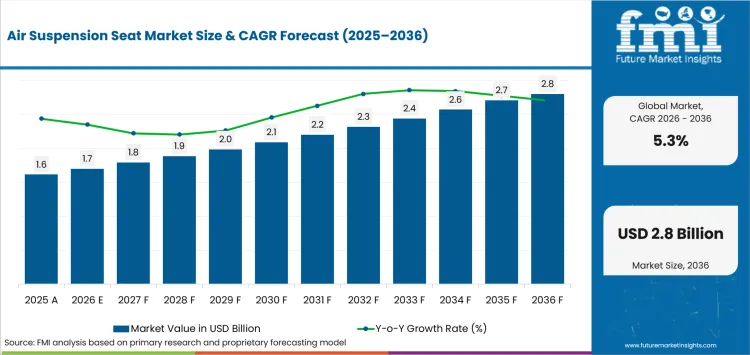
USD 1.7 billion in 2026 and USD 2.8 billion by 2036 at a 5.3% CAGR.
Demand for air suspension seats is projected to rise at 5.3% CAGR between 2026 and 2036, taking market value from USD 1.7 billion to USD 2.8 billion. Long commercial-vehicle shifts make damping performance a specification issue because seat wear directly affects operator comfort and replacement timing. In November 2025 GRAMMER introduced the Maximo XT2 retrofit series for agricultural machinery with an actively controlled suspension system. The retrofit route lets dealers upgrade worn seating during machine service without waiting for a new equipment purchase. Higher-end packages can justify additional electrical content once service teams can maintain those functions.
National fleet structure changes how quickly replacement need becomes a commercial seat order in each country. Türkiye carries a large aftermarket base with many vehicle generations still in service. In February 2025 TURKSTAT counted 31.46 million registered road vehicles at the end of January. Mexico follows a different route because heavy-vehicle factories give seat manufacturers earlier access to OEM engineering programs. The divergence separates retrofit-led demand from factory-program demand despite comparable forecast growth.
Key Takeaways of Air Suspension Seat Market
- Long-duration truck and off-highway duty sustains demand because suspension travel and damping influence operator exposure during extended shifts.
- By seat type, air suspension seats are estimated to hold 41.0% in 2026 owing to adjustable ride control for varied duty cycles.
- In 2026, heavy trucks are expected to lead vehicle type with 35.0% share because long shifts expose seat performance and replacement downtime.
- Manual adjustment is projected to hold 31.0% share in 2026 owing to direct controls that simplify maintenance in mixed-age fleets.
- Cab-specific mounting and restraint integration can delay replacement decisions if fleet workshops cannot validate fitment before vehicles return to service.
- Some of the key players in this market include GRAMMER AG, ISRINGHAUSEN GmbH & Co. KG, Commercial Vehicle Group, Inc., Sears Seating, UnitedSeats, Be-Ge Seating AB, Seats Incorporated, and H.O. Bostrom Company.
Analyst Perspective
"Air suspension seats justify a premium once vehicle engineers prove the suspension curve and mounting geometry plus service-parts coverage for each platform. Fleet standardization should follow that evidence since impressive hardware still becomes expensive if fitment extends workshop downtime."
- Nikhil Kaitwade, Principal Consultant, Future Market Insights
How is the Air Suspension Seat Market segmented?
The air suspension seat market is segmented by seat type, vehicle type, adjustment, sales channel, end use and region.
Seat type includes air suspension seats, mechanical suspension seats, low-profile air seats and heated or ventilated air seats. Vehicle type covers heavy trucks, agricultural tractors, construction equipment, buses or coaches and mining vehicles. Adjustment spans manual, pneumatic height, automatic weight and integrated lumbar or armrest systems. Sales channels include OEM direct supply, aftermarket distributors, fleet maintenance and dealer networks. End use covers long-haul transport, off-highway equipment, agriculture, public transport and specialty fleets.
Why does OEM direct supply lead the Sales channel category?
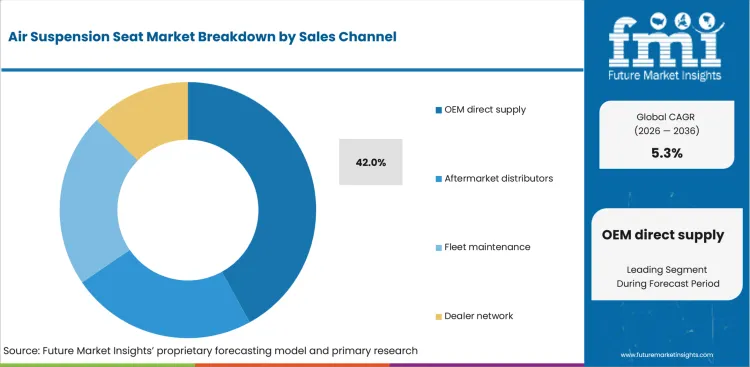
OEM direct supply lets vehicle engineers validate seat geometry with restraint interfaces and cab electrical systems before serial production begins. Commercial Vehicle Group stated in its March 2026 Form 10-K that Global Seating supplies fully assembled seats for truck and off-highway applications. Agricultural equipment programs benefit from the same early fitment discipline before a vehicle enters field service.
- OEM direct supply is expected to hold 42.0% of sales channel demand in 2026 because vehicle-level engineering reduces fitment uncertainty during production.
- Ready-to-install assemblies let manufacturers coordinate mounting and electrical requirements before vehicle launch. Aftermarket channels can then address aging vehicles and specialized retrofits through service networks.
Why do Air suspension seats lead the Seat type category?
Air suspension architecture gives the driver controlled vertical travel without changing the complete cab structure. The same base can support ventilated air seats for specific cab layouts. UnitedSeats announced the LGV150 in October 2025 with 150 millimeters of suspension travel and adjustable damping for construction and mining equipment.
- By seat type, air suspension seats are estimated to hold 41.0% in 2026 owing to ride-height control that handles changing operator weight and terrain.
- Contractors using compact construction equipment can specify different seat tops on a common suspension base, so comfort options do not require a complete mounting redesign.
Why do Heavy trucks lead the Vehicle type category?
Heavy trucks turn seat exposure into a daily operating cost during long driver shifts. The USA Bureau of Labor Statistics documented 2.24 million heavy and tractor-trailer driver jobs in its August 2025 occupational update. Standardized tractor populations also give fleet engineers repeatable platforms for planned seat replacement.
- In 2026, heavy trucks are expected to lead vehicle type with 35.0% share because long shifts expose fatigue complaints and replacement downtime.
- Fleet engineering teams can standardize one suspension specification over similar tractor platforms during scheduled maintenance. One specification reduces spare-part variation without treating every cab as a custom installation.
How does Manual adjustment retain the lead in the Adjustment category?
Manual adjustment stays practical in mixed-age fleets since drivers can set weight and position without additional diagnostic hardware. Premium automotive seat motors widen adjustment options, but electrical complexity increases the components technicians must validate. In March 2025 Be-Ge Seating began customer production of its 37E00 E-powered Memory Seat after establishing a new production line.
- By adjustment, manual adjustment is forecast to represent 31.0% in 2026 driven by direct controls that technicians can service with familiar procedures.
- The Be-Ge production move clarifies the premium path: automated memory functions expand above manual controls without making basic adjustment obsolete.
What are the drivers, restraints and opportunities in the Air Suspension Seat Market?
Long-duration driving increases the value of vibration control. Cab-specific installation limits easy substitution. Retrofit-ready premium suspensions offer the clearest revenue expansion route.
- Driver: Long driving periods make damping and operator support measurable requirements for heavy-truck and off-highway fleet programs.
- Restraint: Mounting geometry and electrical or pneumatic interfaces raise installed cost if older cabs lack standardized seat provisions.
- Opportunity: Modular retrofit seats can raise replacement value by packaging automatic weight response with serviceable mounting and familiar controls.
Long-haul work concentrates seat exposure because truck drivers spend most of the shift inside one cab. June 2025 Census Bureau data placed trucks at 68.1% of domestic shipment tonnage in the 2022 Commodity Flow Survey. Fleet operators therefore evaluate seat accessories against repeated driver exposure and scheduled maintenance cost in a very large road-freight base.
Mounting centers and seat tops vary between vehicle generations, so retrofit friction begins at the workshop. UnitedSeats stated in March 2026 that the first LGV150 batch used 260 millimeter mounting centers and accepted several seat uppers. Mixed fleets therefore need vehicle-specific validation before ordering one configuration for a wider replacement program.
Planned replacement gives premium suspension a route into service without requiring a new vehicle purchase. GRAMMER presented the MSG 297/2900 at bauma in April 2025 with a newly developed suspension system for construction machinery. Dealers can raise replacement revenue if advanced damping fits existing controls and maintenance windows for construction equipment attachments.
Which country CAGRs are profiled in the Air Suspension Seat Market?
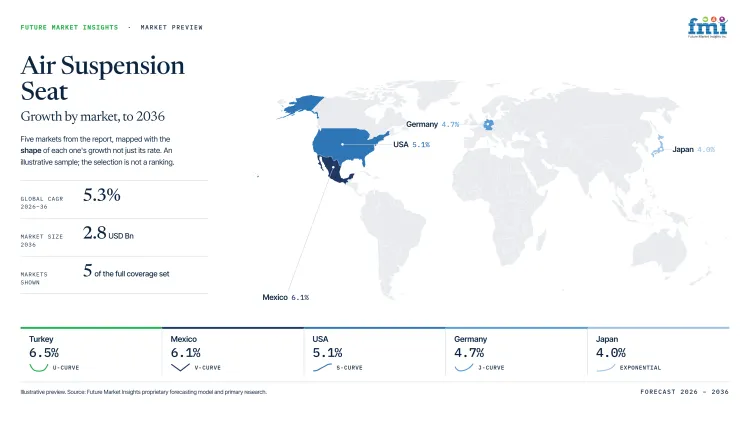
| Türkiye | 6.5% |
| Mexico | 6.1% |
| USA | 5.1% |
| Germany | 4.7% |
| Japan | 4.0% |
How do country-level CAGRs compare in the Air Suspension Seat Market?
Five country forecasts occupy a 2.5 percentage-point band, with Türkiye and Mexico above 6.0%. USA and Germany form the middle pair before Japan at 4.0%. The wider spread still hides materially different order routes for seat manufacturers. Mexico depends more on serial OEM programs, whereas Türkiye and Germany carry heavier retrofit exposure.
- Türkiye's older mixed fleets reward bracket families that cover several cab generations.
- Mexico's export-oriented factories make engineering change control central to seat program economics.
- Germany's mature commercial fleets make regional parts access decisive during premium seat replacement.
- Japan's specialized duty mix raises the value of field-serviceable suspension components substantially.
- USA fleet standardization favors seats compatible with common parts and scheduled service.
Comparable CAGRs hide different qualification costs and channel requirements between national markets. The full report provides country-level CAGR analysis across North America, Latin America, Europe, East Asia, South Asia, Oceania and the Middle East and Africa.
Country-wise Analysis
- Türkiye's replacement market is unusually exposed to older commercial vehicles, so seat fitment must cover cab generations with different mounting layouts. TURKSTAT documented in January 2026 that registered trucks averaged 18.4 years old and tractors averaged 24.9 years at year-end 2025. Türkiye is projected to grow at 6.5% CAGR through 2036 tied to replacement volume and dealer access for aging work vehicles. Dealer inventory can turn that installed base into orders by stocking common brackets and service parts near major freight corridors. Model-age variation limits standardization, which gives manufacturers with disciplined fitment catalogs an advantage over brands relying on one universal mounting package.
- Mexico gives seat manufacturers direct access to serial heavy-vehicle programs through large domestic factories building cargo trucks for local and export fleets. Production volume changes sharply between model years and can strand platform-specific seat inventory. INEGI reported in January 2026 that Mexico produced 138,954 heavy vehicles during 2025 with cargo vehicles at 97.6% of output. Air suspension seat demand in Mexico is forecast to rise at 6.1% CAGR over the forecast period attributable to OEM program activity and local engineering access. Qualification can move quickly, but program wins still require disciplined change control before manufacturers commit platform-specific inventory to one cab family at scale.
- United States fleets evaluate seats inside standardized maintenance programs that compare replacement time and parts availability over repeated tractor platforms. The Bureau of Transportation Statistics reported in its 2025 annual report that trucks moved 64.0 million tons between the USA and Canada during 2024. The USA air suspension seat outlook is anticipated to advance at 5.1% CAGR over the assessment period reflecting mature replacement cycles. Large road-freight volumes give national dealer networks a broad service base, but platform-wide upgrades require predictable belt and electrical interfaces. Compared with Türkiye or Brazil, USA programs place more weight on lifecycle records before one suspension specification is approved fleet-wide.
- Germany's extensive freight and commercial vehicle base makes seating durability and ergonomic performance important considerations during replacement decisions. Germany's mature road-freight operations support steady demand for replacement air suspension seats as vehicles undergo scheduled maintenance and fleet renewal. The Germany air suspension seat market is forecast to expand at 4.7% CAGR through 2036, reflecting established commercial vehicle fleets and gradual replacement activity. Fleet operators increasingly prioritize standardized seat dimensions, dependable suspension systems, and readily available replacement components. Compared with higher-growth markets, Germany's mature fleet structure places greater emphasis on product longevity, regulatory compliance, and compatibility with established vehicle platforms.
- Japan's dense logistics network and specialized commercial vehicle fleets support continued demand for comfortable and durable suspension seating. Long operating hours encourage operators to consider ergonomic support, vibration reduction, and reliable suspension performance when replacing seats. The Japan air suspension seat market is forecast to expand at 4.0% CAGR through 2036, reflecting mature vehicle fleets and measured replacement cycles. Compact vehicle configurations make dimensional compatibility and mounting flexibility important purchasing factors. Compared with Germany and higher-growth markets, Japan's replacement programs place greater emphasis on precision fitment, long-term reliability, and compatibility with established vehicle platforms.
Who are the notable companies in the Air Suspension Seat Market?
GRAMMER AG, ISRINGHAUSEN GmbH & Co. KG, Commercial Vehicle Group, Inc., Sears Seating, UnitedSeats, Be-Ge Seating AB, Seats Incorporated, and H.O. Bostrom Company are the notable companies serving this market.
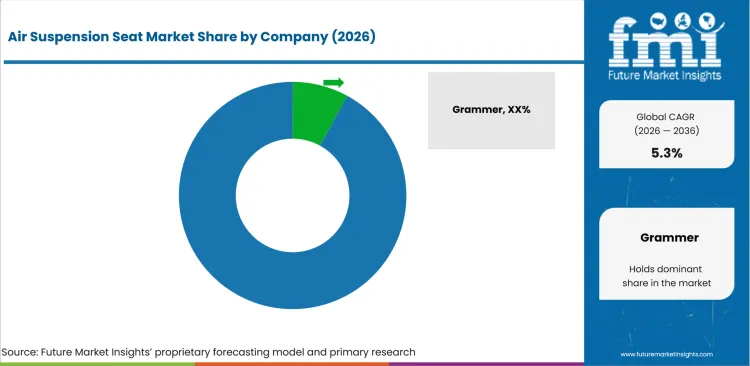
Competition is split between global commercial-vehicle seating groups and specialists focused on work-vehicle suspensions. Vehicle-level engineering and restraint interfaces limit easy entry because a replacement seat must fit the cab before channel breadth matters. Off-highway electrification raises the value of manufacturers that can integrate powered seat functions without complicating routine service.
- GRAMMER AG and ISRINGHAUSEN GmbH & Co. KG serve commercial vehicle programs with documented engineering operations. Commercial Vehicle Group, Inc. also covers truck and off-highway applications through documented manufacturing operations.
- Sears Seating and UnitedSeats focus heavily on suspension-led work-vehicle seating, and Be-Ge Seating AB serves difficult duty cycles with replacement configurations.
- Seats Incorporated and H.O. Bostrom Company serve specialized North American fleets, where configurable fitment and local service support carry greater weight.
Competitive Benchmarking: Air Suspension Seat Market
| Company | Suspension Portfolio Breadth | OEM / Vehicle Integration | Application Coverage | Geographic Reach |
|---|---|---|---|---|
| GRAMMER AG | High | High | High | Global |
| ISRINGHAUSEN GmbH & Co. KG | High | High | High | Global |
| Commercial Vehicle Group, Inc. | High | High | High | North America, Europe and Asia-Pacific |
| Sears Seating | High | High | High | Global |
| UnitedSeats | High | Medium | High | Europe and international dealer network |
| Be-Ge Seating AB | High | High | High | Europe and international sales |
| Seats Incorporated | Medium | Medium | High | North America and Mexico |
| H.O. Bostrom Company | Medium | High | High | North America and selected international channels |
Scoring basis: High suspension breadth requires at least three documented configurations, while Medium requires two and Low identifies one focused route. High integration requires documented vehicle-program engineering or validated OEM fitment, with Medium reflecting configurable supply and Low indicating basic application support. High application coverage requires at least three commercial or off-highway vehicle groups, with Medium requiring two and Low identifying one group.
Key Developments in the Air Suspension Seat Market
- In July 2026, Sears Seating opened a manufacturing facility near Madrid to increase European manufacturing capacity and shorten support routes for regional commercial-vehicle customers.
- In April 2026, UnitedSeats documented Haladjian installing the LGV150/C8 Pro air seat in a Volvo L180 wheel loader with integrated control brackets.
- In March 2025, GRAMMER launched a spare-parts service with genuine replacement components for driver seats to extend service life and reduce unnecessary whole-seat replacement.
Key Players in the Air Suspension Seat Market
Global Commercial-Vehicle Seating Groups
- GRAMMER AG
- ISRINGHAUSEN GmbH & Co. KG
- Commercial Vehicle Group, Inc.
Work-Vehicle Suspension Specialists
- Sears Seating
- UnitedSeats
- Be-Ge Seating AB
Specialized North American Seating Manufacturers
- Seats Incorporated
- H.O. Bostrom Company
Air Suspension Seat Market - Report Scope
| Coverage field | Report scope |
|---|---|
| Market breakdown | By seat type, vehicle type, adjustment, sales channel, end use and region. |
| Quantitative Units | USD Billion. |
| Market Definition | Commercial air suspension driver seats and related suspension seating systems supplied for heavy trucks, agriculture, construction, mining, public transport and specialty work vehicles. |
| Regions Covered | North America, Latin America, Western Europe, Eastern Europe, East Asia, South Asia and Pacific, and Middle East and Africa. |
| Countries Covered | Türkiye, Mexico, Brazil, Australia, USA, and 20+ countries included in the full report. |
| Key Companies Profiled | GRAMMER AG, ISRINGHAUSEN GmbH & Co. KG, Commercial Vehicle Group, Inc., Sears Seating, UnitedSeats, Be-Ge Seating AB, Seats Incorporated, and H.O. Bostrom Company. |
| Forecast Period | 2026 to 2036. |
| Approach | Primary and secondary research with market triangulation. |
Air Suspension Seat Market - Research Methodology
| Method | Approach |
|---|---|
| Primary Research | FMI analysts gathered input from manufacturers, service providers, technology developers, distributors, end users, procurement teams, and subject-matter experts. Interviews examined purchasing decisions, product or service evaluation, adoption barriers, approval requirements, pricing considerations, and expectations for technical or commercial support. Respondents were also asked what evidence is required before a trial, pilot, or initial order develops into regular purchasing. |
| Desk Research | Desk research covered government statistics, regulatory publications, trade data, industry associations, technical literature, standards, company filings, product information, and official corporate announcements. Sources were reviewed for relevance, publication date, geographic coverage, and consistency with the defined market scope. Claims relating to performance, applications, approvals, capacity, investment, and commercial activity were retained only when supported by credible public evidence. |
| Market Sizing and Forecasting | The market model combined the baseline value with historical performance, segment structure, pricing and volume indicators, adoption levels, company participation, and country-level demand conditions. Forecast assumptions considered economic activity, investment trends, regulatory developments, technology adoption, purchasing cycles, supply availability, and barriers to wider market use. Segment and regional estimates were reconciled before the final market total was calculated. |
| Data Validation | Estimates were checked against multiple independent indicators, including public data, company activity, trade patterns, industry developments, and findings from primary interviews. Validation also tested whether products, services, applications, and company revenues fell within the defined market boundaries. Adjacent categories, unsupported claims, overlapping revenues, and activities without direct market relevance were excluded to reduce double counting and maintain consistency across segments and countries. |
Air Suspension Seat Market by Segments
Air Suspension Seat Market segmented by Seat Type:
- Air suspension seats
- Heavy-duty air seats
- Mechanical suspension seats
- Low-profile air seats
- Heated/ventilated air seats
Air Suspension Seat Market segmented by Vehicle Type:
- Heavy trucks
- Agricultural tractors
- Construction equipment
- Buses/coaches
- Mining vehicles
Air Suspension Seat Market segmented by Adjustment:
- Manual adjustment
- Pneumatic height adjustment
- Automatic weight adjustment
- Integrated lumbar/armrest
Air Suspension Seat Market segmented by Sales Channel:
- OEM direct supply
- Aftermarket distributors
- Fleet maintenance
- Dealer network
Air Suspension Seat Market segmented by End Use:
- Long-haul transport
- Off-highway equipment
- Agriculture
- Public transport
- Specialty fleets
Air Suspension Seat Market by Region:
- North America
- United States
- Canada
- Latin America
- Brazil
- Mexico
- Argentina
- Chile
- Western Europe
- Germany
- France
- United Kingdom
- Italy
- Spain
- Benelux
- Nordics
- Eastern Europe
- Poland
- Czech Republic
- Romania
- Hungary
- East Asia
- China
- Japan
- South Korea
- South Asia and Pacific
- India
- ASEAN
- Australia and New Zealand
- Middle East and Africa
- GCC Countries
- South Africa
- Türkiye
- Israel
Research Sources and Bibliography
- GRAMMER AG. (2025, November 10). World premiere at Agritechnica: New Grammer Maximo XT2: Newly developed driver seat series with massage function for retrofitting.
- Turkish Statistical Institute. (2026, January 16). Road Motor Vehicles, December 2025.
- Turkish Statistical Institute. (2025, February 18). Road Motor Vehicles, January 2025.
- UnitedSeats. (2025, October 24). UnitedSeats all new air suspension LGV150 incoming.
- USA Bureau of Labor Statistics. (2025, August 28). Heavy and Tractor-trailer Truck Drivers.
- GRAMMER AG. (2025, March 25). GRAMMER Spare Parts Service - A sustainable and cost-effective alternative to buying a new seat.
- Commercial Vehicle Group, Inc.. (2026, March 10). Annual Report on Form 10-K for the year ended December 31, 2025.
- UnitedSeats. (2026, March 17). LGV150 heavy duty air suspension options.
- GRAMMER AG. (2025, April 9). World premiere Grammer MSG 297/2900: Newly developed driver seat brings Ultimate Comfort to construction machinery.
- Instituto Nacional de Estadística y Geografía. (2026, January 12). Registro Administrativo de la Industria Automotriz de Vehículos Pesados, diciembre de 2025.
- Agência Nacional de Transportes Terrestres. (2026, January 23). Transporte de cargas: ANTT amplia diálogo com o setor e avança na modernização do transporte de cargas no Brasil.
- Bureau of Infrastructure and Transport Research Economics. (2025, December 12). Australian Infrastructure and Transport Statistics-Yearbook 2025.
- USA Census Bureau. (2025, June 26). Census Bureau Reports Shipment of USA Goods Reached 12.2 Billion Tons and $18.0 Trillion.
- Sears Seating. (2026, July 1). Sears Seating Expands European Footprint with New Manufacturing Facility near Madrid, Spain.
- UnitedSeats. (2026, April 9). LGV150/C8 air seat fitted to Volvo wheel loader.
- Be-Ge Seating Division. (2025, March 14). Be-Ge E-powered Memory Seat in production.
- TÜV Rheinland Cert GmbH. (2025, July 22). IATF 16949:2016 Certificate: ISRINGHAUSEN GmbH & Co. KG.
- United States Department of Transportation, Bureau of Transportation Statistics. (2025, December). Transportation Statistics Annual Report 2025.
- ABS Quality Evaluations, Inc. (2025, June 17). Certificate of Conformance: Seats Incorporated ISO 9001:2015.
- H.O. Bostrom Company. (2025, April 14). H.O. Bostrom launches SecureAll+ and SecureAll RapidRelease SCBA brackets at FDIC 2025.
- Sears Seating. (2026, March 23). Sears Seating Showcases Next-Generation Innovation at CONEXPO-CON/AGG 2026.
- GRAMMER USA. (2026, March 10). The new Grammer MSG 297/2900: Newly developed driver seat brings Ultimate Comfort to construction machinery.
- Be-Ge Seating Division. (2025, October 23). Be-Ge Memory Seat, part of a hardworking forest machine.
- Commercial Vehicle Group, Inc. (2025, January 7). CVG Announces New Structure to Support Market-Focused Strategy.
- UnitedSeats. (2026, March 26). Asfir successfully installs LGV84/C1 AR in John Deere tractor.
This bibliography is provided for reader reference and is not exhaustive. The full report contains the complete reference list and detailed citations
This Report Answers
- How large is the air suspension seat market in 2026 and what valuation is projected for 2036?
- Which operating conditions make vibration management commercially relevant for truck and off-highway seating programs?
- Why do air suspension seats account for 41.0% of seat type demand during 2026?
- Why do heavy trucks represent 35.0% of vehicle type demand during 2026?
- How does manual adjustment retain 31.0% of adjustment demand despite wider premium automation?
- Why does OEM direct supply hold 42.0% of sales channel demand during 2026?
- How do Türkiye, Mexico, Brazil, Australia and the USA compare by forecast CAGR?
- Which companies compete through OEM integration, suspension specialization and aftermarket service coverage?
- Which installation constraints can slow conversion from seat replacement need into fleet orders?
Frequently Asked Questions
How big is the air suspension seat market in 2026?
The air suspension seat market is valued at USD 1.7 billion in 2026 and is projected to reach USD 2.8 billion by 2036. Growth is supported by replacement demand and higher specification of vibration-control seating in commercial vehicles.
What is the CAGR of the air suspension seat market from 2026 to 2036?
The air suspension seat market is projected to grow at a CAGR of 5.3% between 2026 and 2036. Expansion is supported by long driving periods and replacement programs that make suspension performance economically visible to fleets.
Which seat type leads the air suspension seat market?
The air suspension seats segment is expected to hold 41.0% of the air suspension seat market in 2026, driven by adjustable ride control for varied duty cycles. Vehicle-specific tuning and installation quality determine the vibration isolation delivered during actual service.
Which adjustment segment holds an additional dominant position in the air suspension seat market?
The manual adjustment segment is expected to hold 31.0% of the air suspension seat market in 2026, attributable to direct controls that simplify field service. Premium automatic functions broaden configuration choices, but they require additional electrical or pneumatic integration.
How much value will the air suspension seat market add between 2026 and 2036?
The air suspension seat market is expected to add USD 1.1 billion in value between 2026 and 2036. Replacement demand and vehicle-level specification raise revenue where suspension upgrades fit existing cab structures without extensive modification.
Which countries are projected to record the highest growth in the air suspension seat market?
Türkiye is projected to grow at 6.5% CAGR in the air suspension seat market through 2036, ahead of Mexico at 6.1% and Brazil at 5.7%. Aging fleets and heavy-vehicle production create different order routes in those three countries.
Which companies are active in the air suspension seat market?
Key companies operating in the air suspension seat market include GRAMMER AG, ISRINGHAUSEN GmbH & Co. KG, Commercial Vehicle Group, Inc., Sears Seating, UnitedSeats, Be-Ge Seating AB, Seats Incorporated, and H.O. Bostrom Company. These companies compete on suspension engineering and vehicle integration for work-vehicle applications.
Preview the report firsthand - request a free sample
Get SampleGet the brochure for pricing and purchase details.
Get PDFTable of Content
- Key Takeaways
- Market Size and CAGR
- Top Growth Driver
- Fastest Growing Segment
- Leading Region
- Key Companies
- Emerging Opportunities
- Executive Summary
- Global Market Outlook
- Demand-side Trends
- Supply-side Trends
- Technology Roadmap Analysis
- Analysis and Recommendations
- Analyst Perspective (What is happening? Why now? What should investors know?)
- Key Questions Answered
- How large is the market?
- What is the CAGR?
- What are key trends?
- Which region dominates?
- Who are the leaders?
- Market Overview
- Market Coverage / Taxonomy
- Market Definition / Scope / Limitations
- Research Methodology
- Chapter Orientation
- Analytical Lens and Working Hypotheses
- Market Structure, Signals, and Trend Drivers
- Benchmarking and Cross-market Comparability
- Market Sizing, Forecasting, and Opportunity Mapping
- Research Design and Evidence Framework
- Desk Research Programme (Secondary Evidence)
- Expert Input and Fieldwork (Primary Evidence)
- Tooling, Models, and Reference Databases
- Data Engineering and Model Build
- Quality Assurance and Audit Trail
- Market Background
- Market Dynamics (Drivers, Restraints, Opportunity, Trends)
- Scenario Forecast (Optimistic, Likely, Conservative)
- Impact Analysis
- AI Impact
- Sustainability Impact
- Regulatory Impact
- Technology Impact
- Consumer / Buyer Analysis
- Purchase Drivers
- Adoption Barriers
- Buyer Journey
- Opportunity Map Analysis
- Product Life Cycle Analysis
- Supply Chain Analysis
- Investment Feasibility Matrix
- Value Chain Analysis
- PESTLE and Porter's Analysis
- Regulatory Landscape
- Regional Parent Market Outlook
- Production and Consumption Statistics
- Import and Export Statistics
- Global Market Analysis and Forecast, 2021 to 2036
- Historical Market Size Value (USD Billion) Analysis, 2021 to 2025
- Current and Future Market Size Value (USD Billion) Projections, 2026 to 2036
- Y-o-Y Growth Trend Analysis
- Absolute $ Opportunity Analysis
- Global Market Pricing Analysis, 2021 to 2036
- Global Market Analysis and Forecast, By Seat Type, 2021 to 2036
- Introduction / Key Findings
- Historical Market Size Value (USD Billion) Analysis By Seat Type, 2021 to 2025
- Current and Future Market Size Value (USD Billion) Analysis and Forecast By Seat Type, 2026 to 2036
- Air suspension seats
- Heavy-duty air seats
- Mechanical suspension seats
- Low-profile air seats
- Heated/ventilated air seats
- Air suspension seats
- Y-o-Y Growth Trend Analysis By Seat Type, 2021 to 2025
- Absolute $ Opportunity Analysis By Seat Type, 2026 to 2036
- Global Market Analysis and Forecast, By Vehicle Type, 2021 to 2036
- Introduction / Key Findings
- Historical Market Size Value (USD Billion) Analysis By Vehicle Type, 2021 to 2025
- Current and Future Market Size Value (USD Billion) Analysis and Forecast By Vehicle Type, 2026 to 2036
- Heavy trucks
- Agricultural tractors
- Construction equipment
- Buses/coaches
- Mining vehicles
- Heavy trucks
- Y-o-Y Growth Trend Analysis By Vehicle Type, 2021 to 2025
- Absolute $ Opportunity Analysis By Vehicle Type, 2026 to 2036
- Global Market Analysis and Forecast, By Adjustment, 2021 to 2036
- Introduction / Key Findings
- Historical Market Size Value (USD Billion) Analysis By Adjustment, 2021 to 2025
- Current and Future Market Size Value (USD Billion) Analysis and Forecast By Adjustment, 2026 to 2036
- Manual adjustment
- Pneumatic height adjustment
- Automatic weight adjustment
- Integrated lumbar/armrest
- Manual adjustment
- Y-o-Y Growth Trend Analysis By Adjustment, 2021 to 2025
- Absolute $ Opportunity Analysis By Adjustment, 2026 to 2036
- Global Market Analysis and Forecast, By Sales Channel, 2021 to 2036
- Introduction / Key Findings
- Historical Market Size Value (USD Billion) Analysis By Sales Channel, 2021 to 2025
- Current and Future Market Size Value (USD Billion) Analysis and Forecast By Sales Channel, 2026 to 2036
- OEM direct supply
- Aftermarket distributors
- Fleet maintenance
- Dealer network
- OEM direct supply
- Y-o-Y Growth Trend Analysis By Sales Channel, 2021 to 2025
- Absolute $ Opportunity Analysis By Sales Channel, 2026 to 2036
- Global Market Analysis and Forecast, By End Use, 2021 to 2036
- Introduction / Key Findings
- Historical Market Size Value (USD Billion) Analysis By End Use, 2021 to 2025
- Current and Future Market Size Value (USD Billion) Analysis and Forecast By End Use, 2026 to 2036
- Long-haul transport
- Off-highway equipment
- Agriculture
- Public transport
- Specialty fleets
- Long-haul transport
- Y-o-Y Growth Trend Analysis By End Use, 2021 to 2025
- Absolute $ Opportunity Analysis By End Use, 2026 to 2036
- Global Market Analysis and Forecast, By Region, 2021 to 2036
- Introduction
- Historical Market Size Value (USD Billion) Analysis By Region, 2021 to 2025
- Current Market Size Value (USD Billion) Analysis and Forecast By Region, 2026 to 2036
- North America
- Latin America
- Western Europe
- Eastern Europe
- East Asia
- South Asia and Pacific
- Middle East & Africa
- Market Attractiveness Analysis By Region
- North America Market Analysis and Forecast, By Country, 2021 to 2036
- Historical Market Size Value (USD Billion) Trend Analysis By Market Taxonomy, 2021 to 2025
- Market Size Value (USD Billion) Forecast By Market Taxonomy, 2026 to 2036
- By Country
- USA
- Canada
- By Seat Type
- By Vehicle Type
- By Adjustment
- By Sales Channel
- By End Use
- By Country
- Market Attractiveness Analysis
- By Country
- By Seat Type
- By Vehicle Type
- By Adjustment
- By Sales Channel
- By End Use
- Key Takeaways
- Latin America Market Analysis and Forecast, By Country
- Historical Market Size Value (USD Billion) Trend Analysis By Market Taxonomy, 2021 to 2025
- Market Size Value (USD Billion) Forecast By Market Taxonomy, 2026 to 2036
- By Country
- Brazil
- Mexico
- Chile
- Rest of Latin America
- By Seat Type
- By Vehicle Type
- By Adjustment
- By Sales Channel
- By End Use
- By Country
- Market Attractiveness Analysis
- By Country
- By Seat Type
- By Vehicle Type
- By Adjustment
- By Sales Channel
- By End Use
- Key Takeaways
- Western Europe Market Analysis and Forecast, By Country
- Historical Market Size Value (USD Billion) Trend Analysis By Market Taxonomy, 2021 to 2025
- Market Size Value (USD Billion) Forecast By Market Taxonomy, 2026 to 2036
- By Country
- Germany
- UK
- Italy
- Spain
- France
- Nordic
- BENELUX
- Rest of Western Europe
- By Seat Type
- By Vehicle Type
- By Adjustment
- By Sales Channel
- By End Use
- By Country
- Market Attractiveness Analysis
- By Country
- By Seat Type
- By Vehicle Type
- By Adjustment
- By Sales Channel
- By End Use
- Key Takeaways
- Eastern Europe Market Analysis and Forecast, By Country
- Historical Market Size Value (USD Billion) Trend Analysis By Market Taxonomy, 2021 to 2025
- Market Size Value (USD Billion) Forecast By Market Taxonomy, 2026 to 2036
- By Country
- Russia
- Poland
- Hungary
- Balkan & Baltic
- Rest of Eastern Europe
- By Seat Type
- By Vehicle Type
- By Adjustment
- By Sales Channel
- By End Use
- By Country
- Market Attractiveness Analysis
- By Country
- By Seat Type
- By Vehicle Type
- By Adjustment
- By Sales Channel
- By End Use
- Key Takeaways
- East Asia Market Analysis and Forecast, By Country
- Historical Market Size Value (USD Billion) Trend Analysis By Market Taxonomy, 2021 to 2025
- Market Size Value (USD Billion) Forecast By Market Taxonomy, 2026 to 2036
- By Country
- China
- Japan
- South Korea
- By Seat Type
- By Vehicle Type
- By Adjustment
- By Sales Channel
- By End Use
- By Country
- Market Attractiveness Analysis
- By Country
- By Seat Type
- By Vehicle Type
- By Adjustment
- By Sales Channel
- By End Use
- Key Takeaways
- South Asia and Pacific Market Analysis and Forecast, By Country
- Historical Market Size Value (USD Billion) Trend Analysis By Market Taxonomy, 2021 to 2025
- Market Size Value (USD Billion) Forecast By Market Taxonomy, 2026 to 2036
- By Country
- India
- ASEAN
- Australia & New Zealand
- Rest of South Asia and Pacific
- By Seat Type
- By Vehicle Type
- By Adjustment
- By Sales Channel
- By End Use
- By Country
- Market Attractiveness Analysis
- By Country
- By Seat Type
- By Vehicle Type
- By Adjustment
- By Sales Channel
- By End Use
- Key Takeaways
- Middle East & Africa Market Analysis and Forecast, By Country
- Historical Market Size Value (USD Billion) Trend Analysis By Market Taxonomy, 2021 to 2025
- Market Size Value (USD Billion) Forecast By Market Taxonomy, 2026 to 2036
- By Country
- Kingdom of Saudi Arabia
- Other GCC Countries
- Türkiye
- South Africa
- Other African Union
- Rest of Middle East & Africa
- By Seat Type
- By Vehicle Type
- By Adjustment
- By Sales Channel
- By End Use
- By Country
- Market Attractiveness Analysis
- By Country
- By Seat Type
- By Vehicle Type
- By Adjustment
- By Sales Channel
- By End Use
- Key Takeaways
- Key Countries Market Analysis
- USA
- Pricing Analysis
- Market Share Analysis, 2025
- By Seat Type
- By Vehicle Type
- By Adjustment
- By Sales Channel
- By End Use
- Canada
- Pricing Analysis
- Market Share Analysis, 2025
- By Seat Type
- By Vehicle Type
- By Adjustment
- By Sales Channel
- By End Use
- Mexico
- Pricing Analysis
- Market Share Analysis, 2025
- By Seat Type
- By Vehicle Type
- By Adjustment
- By Sales Channel
- By End Use
- Brazil
- Pricing Analysis
- Market Share Analysis, 2025
- By Seat Type
- By Vehicle Type
- By Adjustment
- By Sales Channel
- By End Use
- Chile
- Pricing Analysis
- Market Share Analysis, 2025
- By Seat Type
- By Vehicle Type
- By Adjustment
- By Sales Channel
- By End Use
- Germany
- Pricing Analysis
- Market Share Analysis, 2025
- By Seat Type
- By Vehicle Type
- By Adjustment
- By Sales Channel
- By End Use
- UK
- Pricing Analysis
- Market Share Analysis, 2025
- By Seat Type
- By Vehicle Type
- By Adjustment
- By Sales Channel
- By End Use
- Italy
- Pricing Analysis
- Market Share Analysis, 2025
- By Seat Type
- By Vehicle Type
- By Adjustment
- By Sales Channel
- By End Use
- Spain
- Pricing Analysis
- Market Share Analysis, 2025
- By Seat Type
- By Vehicle Type
- By Adjustment
- By Sales Channel
- By End Use
- France
- Pricing Analysis
- Market Share Analysis, 2025
- By Seat Type
- By Vehicle Type
- By Adjustment
- By Sales Channel
- By End Use
- India
- Pricing Analysis
- Market Share Analysis, 2025
- By Seat Type
- By Vehicle Type
- By Adjustment
- By Sales Channel
- By End Use
- ASEAN
- Pricing Analysis
- Market Share Analysis, 2025
- By Seat Type
- By Vehicle Type
- By Adjustment
- By Sales Channel
- By End Use
- Australia & New Zealand
- Pricing Analysis
- Market Share Analysis, 2025
- By Seat Type
- By Vehicle Type
- By Adjustment
- By Sales Channel
- By End Use
- China
- Pricing Analysis
- Market Share Analysis, 2025
- By Seat Type
- By Vehicle Type
- By Adjustment
- By Sales Channel
- By End Use
- Japan
- Pricing Analysis
- Market Share Analysis, 2025
- By Seat Type
- By Vehicle Type
- By Adjustment
- By Sales Channel
- By End Use
- South Korea
- Pricing Analysis
- Market Share Analysis, 2025
- By Seat Type
- By Vehicle Type
- By Adjustment
- By Sales Channel
- By End Use
- Russia
- Pricing Analysis
- Market Share Analysis, 2025
- By Seat Type
- By Vehicle Type
- By Adjustment
- By Sales Channel
- By End Use
- Poland
- Pricing Analysis
- Market Share Analysis, 2025
- By Seat Type
- By Vehicle Type
- By Adjustment
- By Sales Channel
- By End Use
- Hungary
- Pricing Analysis
- Market Share Analysis, 2025
- By Seat Type
- By Vehicle Type
- By Adjustment
- By Sales Channel
- By End Use
- Kingdom of Saudi Arabia
- Pricing Analysis
- Market Share Analysis, 2025
- By Seat Type
- By Vehicle Type
- By Adjustment
- By Sales Channel
- By End Use
- Türkiye
- Pricing Analysis
- Market Share Analysis, 2025
- By Seat Type
- By Vehicle Type
- By Adjustment
- By Sales Channel
- By End Use
- South Africa
- Pricing Analysis
- Market Share Analysis, 2025
- By Seat Type
- By Vehicle Type
- By Adjustment
- By Sales Channel
- By End Use
- USA
- Market Structure Analysis
- Competition Dashboard
- Competition Benchmarking
- Market Share Analysis of Top Players
- By Regional
- By Seat Type
- By Vehicle Type
- By Adjustment
- By Sales Channel
- By End Use
- Emerging Startups
- Innovation Benchmarking
- Competition Analysis
- Competition Deep Dive
- Grammer
- Overview
- Product Portfolio
- Profitability by Market Segments
- Sales Footprint
- Strategy Overview
- Marketing Strategy
- Product Strategy
- Channel Strategy
- Isringhausen
- Adient
- Sears Seating
- United Seats
- KAB Seating
- Seats Inc.
- Bostrom Seating
- Freedman Seating
- Milsco
- Grammer
- Case Studies
- Success Stories
- Recent Developments
- Competition Deep Dive
- Assumptions & Acronyms Used


