

- Industry Size (2026):
- USD 2.5 Bn
- Forecast (2036):
- USD 4.6 Bn
- CAGR (2026 to 2036)
- 6.2%
Aircraft Gearbox Market Forecast and Outlook 2026 to 2036
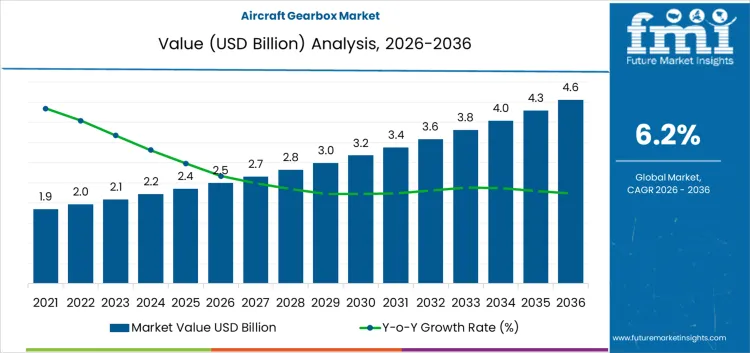
The aircraft gearbox market is projected to reach USD 4.6 billion by 2036, growing at a CAGR of 6.2% from its 2026 value of USD 2.5 billion. Commercial performance will be shaped by several factors, including the need for stringent pricing discipline in a market where cost pressures from buyers are likely to increase. Large aerospace manufacturers and maintenance providers wield significant leverage, pushing for better pricing, quality, and delivery timelines. Volume predictability remains a challenge, as demand fluctuates with cyclical changes in the aviation industry, influenced by factors such as airline fleet expansion or economic downturns. Companies will need to adapt to these uncertainties by managing costs efficiently and maintaining strong relationships with key stakeholders. Furthermore, the growing trend toward technological advancements in gear systems will demand consistent investment in R&D, which can impact short-term profitability but is essential for long-term competitiveness.
Quick Stats for the Aircraft Gearbox Market
- Aircraft Gearbox Market Value (2026): USD 2.5 billion
- Aircraft Gearbox Market Forecast Value (2036): USD 4.6 billion
- Aircraft Gearbox Market Global Forecast CAGR 2026 to 2036: 6.2%
- Aircraft Gearbox Market Leading Segment: Commercial Aircraft (52%)
- Key Growth Regions in Aircraft Gearbox Market: USA
- Top Players in Aircraft Gearbox Market: Safran Transmission Systems, GE Aviation (CFM International), Honeywell Aerospace, Rolls-Royce plc, Pratt & Whitney (RTX), MTU Aero Engines, Leonardo S.p.A., ABB Turbo Systems, Shanghai Aerospace Gear Co., Ltd., Kobe Steel, Ltd.
What is the Growth Contribution Index for the Aircraft Gearbox Market through 2036?
The growth contribution index for the aircraft gearbox market reflects a combination of factors, including the increasing demand for commercial and military aircraft, technological innovations in gearbox design, and the need for more efficient and reliable components. Initially, from 2026 to 2028, volume growth will play a significant role in driving the market, as aircraft production increases globally. The demand for aircraft gearboxes will rise in tandem with the expanding aviation industry, contributing to steady growth, with the market growing from USD 2.5 billion in 2026 to USD 2.9 billion in 2028.
Between 2028 and 2032, technological advancements and the ongoing focus on fuel efficiency and performance will start to contribute more significantly to the market's growth. As aerospace manufacturers develop lighter, more durable gearboxes, the market will accelerate, with values rising from USD 3 billion in 2029 to USD 3.6 billion by 2032. This phase reflects the growing adoption of advanced gearbox technologies in both commercial and military aircraft.
From 2032 to 2036, the market will continue its upward trajectory, reaching USD 4.6 billion by 2036. The contribution of volume growth will remain strong, driven by global aircraft production, while technological innovations will continue to shape the demand for next-generation gearboxes. The overall growth contribution index highlights the importance of both volume expansion in the aviation sector and technological advancements in driving the aircraft gearbox market forward.
Aircraft Gearbox Market Key Takeaways
| Metric | Value |
|---|---|
| Industry Sales Value (2026) | USD 2.5 billion |
| Industry Forecast Value (2036) | USD 4.6 billion |
| Industry Forecast CAGR 2026 to 2036 | 6.2% |
What Is Driving the Aircraft Gearbox Market?
Historically, the aircraft gearbox market developed as aerospace propulsion and drive systems became more complex and performance demanding. Early aircraft gearboxes were simple reduction units linking piston engines to propellers, designed to manage torque and optimize rotational speed for efficient thrust. As turbine engines replaced piston powerplants, gearboxes evolved to accommodate higher input speeds, multiple accessory drives, and tighter weight constraints. Conventional gear systems in helicopters and turboprops enabled rotor speed control and power split to drive mechanical systems. Early adoption was driven by needs for reliability, precise power transmission, and tolerance to vibration and thermal cycles in flight. Manufacturers refined metallurgy, gear geometries, and lubrication systems to meet military and commercial standards that prioritized long service life and predictable maintenance intervals. This formative period shaped expectations for durability under extreme loads, integration with aircraft structures, and compliance with stringent safety and certification regimes, establishing a baseline for future innovation.
Future demand for the aircraft gearbox market will be shaped by expanding commercial air travel, increasing helicopter usage, and emerging propulsion architectures that drive complexity in power transmission. Growth factors include adoption of geared turbofan engines in next generation airliners, which improve fuel efficiency by optimizing fan and turbine speeds, and rising interest in hybrid electric and distributed propulsion systems that require specialized gearboxes to manage multiple power paths. Urban air mobility and electric vertical take off and landing vehicles will further stimulate demand for compact, lightweight gear systems capable of withstanding high rotational speeds with minimal maintenance. Advances in additive manufacturing, advanced materials, and precision machining will help reduce gearbox weight, enhance fatigue resistance, and enable greater integration with sensors for real time health monitoring. Barriers include high certification costs, long qualification cycles, and the need to ensure compatibility across diverse aircraft platforms. Long term market expansion will depend on demonstrable improvements in efficiency, service intervals, and integration with newer propulsion technologies that align with industry goals for reduced operating cost and emissions.
What are the Key Segments in the Aircraft Gearbox Market?
The Aircraft Gearbox market is segmented by propulsion type and application. Propulsion types include turbofan aircraft, turboprop aircraft, helicopters, and unmanned aerial vehicles (UAVs), with turbofan aircraft leading the market at 47%. Application segments include commercial aircraft, military & defense aircraft, business & general aviation, and UAVs, with commercial aircraft accounting for the largest share at 52%. The market is driven by the increasing demand for efficient, high-performance aircraft gearboxes that support a wide range of aviation applications, from commercial travel to military operations. The growing fleet of aircraft, along with advancements in aerospace technology, is further fueling the demand for reliable and durable gearboxes.
What is Driving Growth in the Turbofan Aircraft Propulsion Type Segment?
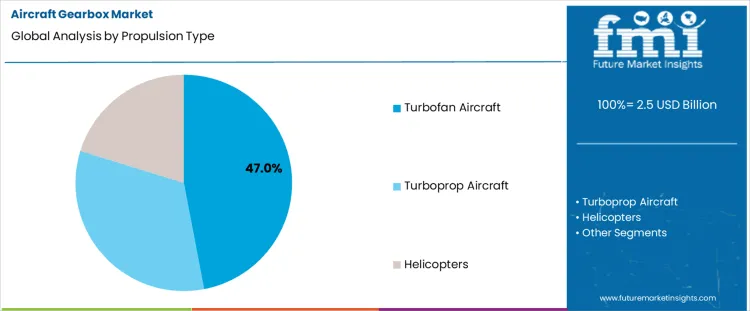
Turbofan aircraft are the dominant propulsion type in the Aircraft Gearbox market, holding 47% of the market share. This growth is primarily driven by the widespread use of turbofan engines in commercial aviation, which are known for their fuel efficiency, high thrust, and quieter operation compared to other engine types. Turbofan engines are the most common propulsion system in large commercial aircraft, such as those used by major airlines for long-haul travel. As global air travel continues to expand, particularly in emerging markets, the demand for turbofan-powered commercial aircraft increases, which in turn drives the need for aircraft gearboxes. These gearboxes are crucial for transmitting power from the engine to the aircraft’s various systems, ensuring safe and efficient operation. Additionally, advancements in engine design and performance improvements in turbofan engines further drive the demand for more sophisticated and durable gearboxes. As the aviation industry focuses on enhancing fuel efficiency and reducing emissions, the use of turbofan engines and the associated aircraft gearboxes is expected to remain strong.
What is Driving the Demand for Commercial Aircraft in the Application Segment?
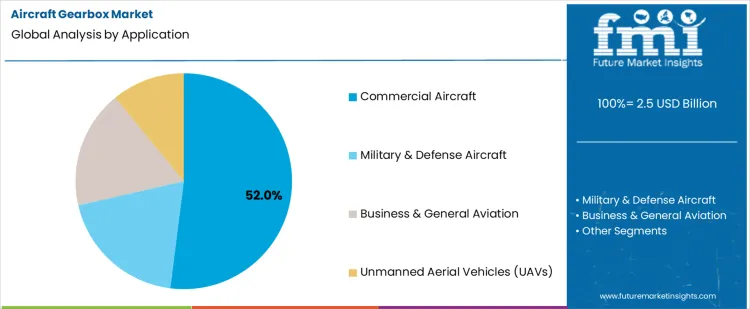
Commercial aircraft are the largest application segment in the Aircraft Gearbox market, accounting for 52% of the market share. This growth is driven by the ongoing expansion of global air travel, which continues to rise as economies grow and more people travel internationally. Commercial aircraft are crucial for transporting passengers and goods, and the increasing demand for air travel services directly correlates with the need for new aircraft and the maintenance of existing fleets. Aircraft gearboxes play a critical role in ensuring that commercial aircraft operate smoothly by enabling the transfer of power from the engine to the aircraft’s auxiliary systems. With the global fleet of commercial aircraft steadily increasing, the demand for reliable and efficient gearboxes is expected to remain strong. Additionally, the shift towards more fuel-efficient and environmentally friendly aircraft further drives the need for advanced, lightweight, and durable gearboxes. The continued expansion of low-cost carriers and the modernization of fleets in both developed and emerging markets contribute to the growth of this segment.
What are the Key Dynamics in the Aircraft Gearbox Market?
The aircraft gearbox market is growing due to the increasing demand for more efficient and reliable transmission systems in the aerospace industry. Aircraft gearboxes are integral components that transfer power from the engine to other mechanical systems, such as the propeller, hydraulic pumps, and generators. The market is driven by the expansion of the commercial aviation sector, the rise in air travel demand, and the need for improved fuel efficiency and performance in aircraft. Additionally, the growing adoption of advanced technologies in aerospace, such as electric and hybrid aircraft, is further propelling the demand for specialized gearboxes that can handle varying power requirements. The focus on reducing the weight and enhancing the reliability of these components is driving continuous innovation in the market.
What are the Key Drivers of Growth in the Aircraft Gearbox Market?
Several factors are driving the growth of the aircraft gearbox market. The increasing number of air passengers and the expansion of the commercial aviation industry are key contributors, as they lead to higher demand for aircraft and, consequently, the components used in their engines and power systems. Moreover, the rise in fuel costs and the industry's focus on fuel efficiency are pushing the need for more advanced gearbox systems that reduce weight while maximizing power transmission efficiency. The shift toward more electric and hybrid propulsion systems in the aerospace sector also drives the demand for specialized gearboxes capable of handling these advanced technologies. Additionally, military applications, including the need for advanced gearboxes in military aircraft and helicopters, are contributing to market growth. Research and development efforts focused on improving the durability, reliability, and performance of aircraft gearboxes also drive the market, as aviation manufacturers seek components that meet stringent safety and regulatory standards.
What are the Key Restraints in the Aircraft Gearbox Market?
Despite its growth prospects, the aircraft gearbox market faces several challenges. One major restraint is the high cost associated with developing and manufacturing advanced aircraft gearboxes. These components require precise engineering, high-quality materials, and adherence to stringent safety standards, which can significantly increase production costs. Additionally, the complexity of designing gearboxes for newer propulsion systems, such as electric and hybrid engines, presents challenges for manufacturers in terms of integration, power distribution, and reliability. The long lifecycle of aircraft can also result in slower demand for replacements, as airlines and operators tend to maintain their gearboxes for extended periods before requiring upgrades. Another challenge is the reliance on a limited number of suppliers, which can create supply chain vulnerabilities and affect the market's ability to meet increasing demand in a timely manner. Furthermore, the need for constant innovation to meet evolving aerospace standards and emerging technologies requires ongoing investments in research and development, which could strain smaller manufacturers.
What are the Key Trends in the Aircraft Gearbox Market?
Several trends are influencing the aircraft gearbox market. One key trend is the development of lightweight and high-efficiency gearboxes, as the aerospace industry increasingly prioritizes fuel efficiency and performance optimization. Manufacturers are focusing on advanced materials, such as composites and lightweight alloys, to reduce the weight of gearboxes while maintaining strength and durability. Another significant trend is the integration of smart technologies and digital monitoring systems in aircraft gearboxes. These systems can provide real-time data on the gearbox's performance, enabling predictive maintenance and reducing downtime. The shift towards hybrid and electric propulsion systems in aircraft is also a growing trend, driving demand for gearboxes that can manage variable power outputs and integrate seamlessly with new technologies. Additionally, the focus on sustainability and eco-friendly solutions in aviation is pushing the market for gearboxes that minimize energy consumption and reduce emissions. As the industry seeks to meet stringent environmental standards, the demand for more efficient, environmentally friendly gearbox solutions is expected to rise, driving innovation and market growth.
What is the Country-Wise Analysis of the Aircraft Gearbox Market?
The aircraft gearbox market is growing as the aviation industry continues to expand, driven by increasing air traffic, the rise in aircraft production, and the need for efficient and reliable power transmission systems in aircraft. Aircraft gearboxes are essential for converting and transmitting power from the engine to the various systems on the aircraft, including the propellers and turbines. The market is driven by technological advancements, the growing demand for fuel-efficient aircraft, and the need for enhanced performance and safety in the aviation sector. Countries like the USA, China, Germany, France, and Japan are witnessing growth in this market, fueled by strong aerospace industries, rising aircraft production, and continuous innovation in gearbox technologies.
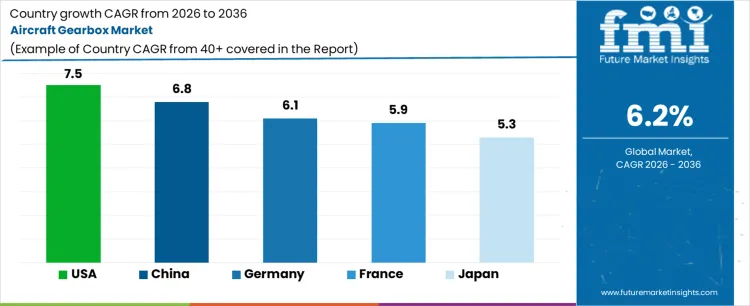
| Country | CAGR (%) |
|---|---|
| USA | 7.5 |
| China | 6.8 |
| Germany | 6.1 |
| France | 5.9 |
| Japan | 5.3 |
What is Driving the Growth of the Aircraft Gearbox Market in the USA?
The aircraft gearbox market in the USA is growing at a CAGR of 7.5%, the highest among the countries analyzed. The USA is home to some of the largest aerospace manufacturers and is a global leader in aircraft production. The increasing demand for both commercial and military aircraft, along with advancements in aircraft technology, is driving the need for more efficient and durable gearboxes. Additionally, the USA’s strong investment in the development of next-generation aircraft, such as electric and hybrid-electric planes, is further contributing to market growth. The ongoing focus on improving fuel efficiency and reducing operating costs in the aviation sector is expected to continue driving demand for advanced aircraft gearboxes.
How is the Aircraft Gearbox Market Performing in China?
The aircraft gearbox market in China is growing at a CAGR of 6.8%. China’s rapidly expanding aerospace sector, fueled by both domestic and international demand for aircraft, is driving the adoption of advanced gearbox systems. The Chinese government’s support for the aerospace industry, including investments in aircraft manufacturing and military aviation, is contributing to market growth. The demand for fuel-efficient aircraft and the increasing focus on improving aircraft performance and reliability are further fueling the need for high-performance gearboxes. As China continues to invest in its aerospace capabilities and expand its commercial and military aircraft production, the market for aircraft gearboxes is expected to grow steadily.
What Factors are Shaping the Aircraft Gearbox Market in Germany?
Germany’s aircraft gearbox market is growing at a CAGR of 6.1%. Germany’s aerospace industry, which is a key player in both civil and military aviation, is contributing to the rising demand for aircraft gearboxes. The country’s strong focus on engineering, manufacturing excellence, and innovation in aerospace technologies is driving the adoption of high-performance gearboxes. As demand for fuel-efficient and low-emission aircraft increases, the need for advanced gearbox systems that offer enhanced performance and reliability is rising. Germany’s commitment to sustainable aviation and the growth of its aircraft manufacturing industry are expected to continue driving the demand for aircraft gearboxes in the coming years.
How is the Aircraft Gearbox Market Evolving in France?
France’s aircraft gearbox market is growing at a CAGR of 5.9%. France is a significant player in the global aerospace industry, particularly in aircraft manufacturing and aerospace technology development. The country’s strong aerospace industry, led by major players such as Airbus, is driving the demand for advanced gearbox systems that are essential for efficient power transmission in aircraft. France’s focus on developing environmentally sustainable aviation technologies, including fuel-efficient aircraft and next-generation propulsion systems, is contributing to the demand for high-performance gearboxes. As the country continues to innovate in the aerospace sector and expand its aircraft production capacity, the market for aircraft gearboxes is expected to grow steadily.
What is Contributing to the Growth of the Aircraft Gearbox Market in Japan?
The aircraft gearbox market in Japan is growing at a CAGR of 5.3%. Japan’s aerospace industry, particularly its strong presence in aircraft manufacturing and military aviation, is contributing to the demand for advanced aircraft gearboxes. The increasing focus on improving the performance and efficiency of aircraft, coupled with Japan’s investments in new technologies such as hybrid-electric propulsion systems, is driving the need for high-quality gearboxes. Japan’s emphasis on developing lightweight and energy-efficient aircraft is also contributing to the demand for improved gearbox solutions. As Japan continues to invest in aerospace innovation and expand its aircraft production capabilities, the demand for aircraft gearboxes is expected to increase gradually.
What is the Competitive Landscape for the Aircraft Gearbox Market?
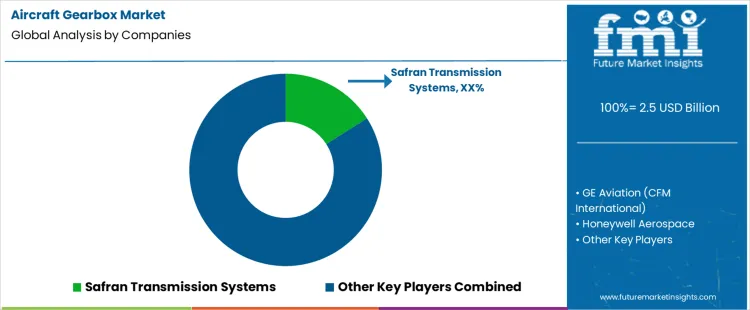
The aircraft gearbox market is expanding steadily as aircraft manufacturers and airlines demand high-performance, lightweight, and highly reliable gear systems to support improved fuel efficiency and operational performance. Safran Transmission Systems leads the competitive landscape with advanced gearbox technologies widely used across civil and military aviation, supported by strong partnerships with major aerospace OEMs and a proven track record in durability and system integration. GE Aviation (CFM International) is a key competitor, supplying efficient gearbox solutions that play a critical role in reducing fuel consumption and enhancing engine performance in modern commercial aircraft.
Pratt & Whitney (RTX) remains central to the market through its geared turbofan engine architecture, where high-efficiency gearbox systems enable lower fuel burn, reduced emissions, and quieter operation. Rolls-Royce plc and Honeywell Aerospace contribute high-performance gearbox solutions designed for demanding operating environments, focusing on reliability, extended maintenance intervals, and lifecycle cost reduction. MTU Aero Engines specializes in precision-engineered gear systems that support both commercial and military applications, emphasizing lightweight construction and performance optimization.
Additional participants such as Leonardo S.p.A., ABB Turbo Systems, Shanghai Aerospace Gear Co., Ltd., and Kobe Steel, Ltd. strengthen the market by offering specialized, cost-effective, and high-precision gearbox solutions. Overall, competition is driven by innovation in materials, weight reduction, efficiency gains, and long-term reliability, as manufacturers align gearbox design with next-generation aircraft and engine architectures.
Key Players of the Aircraft Gearbox Market
- Safran Transmission Systems
- GE Aviation (CFM International)
- Honeywell Aerospace
- Rolls-Royce plc
- Pratt & Whitney (RTX)
- MTU Aero Engines
- Leonardo S.p.A.
- ABB Turbo Systems
- Shanghai Aerospace Gear Co., Ltd.
- Kobe Steel, Ltd.
Scope of the Report
| Items | Values |
|---|---|
| Quantitative Units (2026) | USD Billion |
| Propulsion Type | Turbofan Aircraft, Turboprop Aircraft, Helicopters, Unmanned Aerial Vehicles (UAVs) |
| Application | Commercial Aircraft, Military & Defense Aircraft, Business & General Aviation, Unmanned Aerial Vehicles (UAVs) |
| Component Type | Gear Train Assemblies, Lubrication & Sealing Systems, Bearings & Supports, Sensors & Monitoring Modules |
| Companies | Safran Transmission Systems, GE Aviation (CFM International), Honeywell Aerospace, Rolls-Royce plc, Pratt & Whitney (RTX), MTU Aero Engines, Leonardo S.p.A., ABB Turbo Systems, Shanghai Aerospace Gear Co., Ltd., Kobe Steel, Ltd. |
| Regions Covered | North America, Latin America, Western Europe, Eastern Europe, South Asia and Pacific, East Asia, Middle East & Africa |
| Countries Covered | United States, Canada, Mexico, Brazil, Argentina, Germany, France, United Kingdom, Italy, Spain, Netherlands, China, India, Japan, South Korea, ANZ, GCC Countries, South Africa |
| Additional Attributes | Dollar sales by propulsion type, application, component type, and region. Includes market trends towards efficiency, cost-effectiveness, regulatory compliance, and the role of aircraft gearboxes in improving performance and reliability in aviation systems. |
Aircraft Gearbox Market Segmentation
Propulsion Type
- Turbofan Aircraft
- Turboprop Aircraft
- Helicopters
- Unmanned Aerial Vehicles (UAVs)
Application
- Commercial Aircraft
- Military & Defense Aircraft
- Business & General Aviation
- Other
Component Type
- Gear Train Assemblies
- Lubrication & Sealing Systems
- Bearings & Supports
- Sensors & Monitoring Modules
- Other
Region
- Asia Pacific
- China
- Japan
- India
- Australia & New Zealand
- ASEAN
- Rest of Asia Pacific
- Europe
- Germany
- United Kingdom
- France
- Italy
- Spain
- Nordic
- BENELUX
- Rest of Europe
- North America
- United States
- Canada
- Mexico
- Latin America
- Brazil
- Argentina
- Rest of Latin America
- Middle East & Africa
- Kingdom of Saudi Arabia
- Other GCC Countries
- South Africa
- Rest of Middle East & Africa
Bibliography
- Federal Aviation Administration. (2025). FAA aerospace forecast fiscal years 2025–2045. U.S. Department of Transportation.
- International Civil Aviation Organization. (2025). Global aviation safety plan (GASP): 2026–2028 edition (Doc 10004). Author.
- European Union Aviation Safety Agency. (2023). Certification specifications and acceptable means of compliance for engines (CS-E) (Amendment 7). European Union Aviation Safety Agency.
Frequently Asked Questions
How big is the aircraft gearbox market in 2026?
The global aircraft gearbox market is estimated to be valued at USD 2.5 billion in 2026.
What will be the size of aircraft gearbox market in 2036?
The market size for the aircraft gearbox market is projected to reach USD 4.6 billion by 2036.
How much will be the aircraft gearbox market growth between 2026 and 2036?
The aircraft gearbox market is expected to grow at a 6.2% CAGR between 2026 and 2036.
What are the key product types in the aircraft gearbox market?
The key product types in aircraft gearbox market are turbofan aircraft, turboprop aircraft and helicopters.
Which application segment to contribute significant share in the aircraft gearbox market in 2026?
In terms of application, commercial aircraft segment to command 52.0% share in the aircraft gearbox market in 2026.
Preview the report firsthand - request a free sample
Get SampleGet the brochure for pricing and purchase details.
Get PDFTable of Content
- Executive Summary
- Global Market Outlook
- Demand-side Trends
- Supply-side Trends
- Technology Roadmap Analysis
- Analysis and Recommendations
- Market Overview
- Market Coverage / Taxonomy
- Market Definition / Scope / Limitations
- Market Background
- Market Dynamics
- Drivers
- Restraints
- Opportunity
- Trends
- Scenario Forecast
- Demand in Optimistic Scenario
- Demand in Likely Scenario
- Demand in Conservative Scenario
- Opportunity Map Analysis
- Product Life Cycle Analysis
- Supply Chain Analysis
- Investment Feasibility Matrix
- Value Chain Analysis
- PESTLE and Porter’s Analysis
- Regulatory Landscape
- Regional Parent Market Outlook
- Production and Consumption Statistics
- Import and Export Statistics
- Market Dynamics
- Global Market Analysis 2021 to 2025 and Forecast, 2026 to 2036
- Historical Market Size Value (USD Million) Analysis, 2021 to 2025
- Current and Future Market Size Value (USD Million) Projections, 2026 to 2036
- Y-o-Y Growth Trend Analysis
- Absolute $ Opportunity Analysis
- Global Market Pricing Analysis 2021 to 2025 and Forecast 2026 to 2036
- Global Market Analysis 2021 to 2025 and Forecast 2026 to 2036, By Propulsion Type
- Introduction / Key Findings
- Historical Market Size Value (USD Million) Analysis By Propulsion Type, 2021 to 2025
- Current and Future Market Size Value (USD Million) Analysis and Forecast By Propulsion Type, 2026 to 2036
- Turbofan Aircraft
- Turboprop Aircraft
- Helicopters
- Turbofan Aircraft
- Y-o-Y Growth Trend Analysis By Propulsion Type, 2021 to 2025
- Absolute $ Opportunity Analysis By Propulsion Type, 2026 to 2036
- Global Market Analysis 2021 to 2025 and Forecast 2026 to 2036, By Application
- Introduction / Key Findings
- Historical Market Size Value (USD Million) Analysis By Application, 2021 to 2025
- Current and Future Market Size Value (USD Million) Analysis and Forecast By Application, 2026 to 2036
- Commercial Aircraft
- Military & Defense Aircraft
- Business & General Aviation
- Unmanned Aerial Vehicles (UAVs)
- Commercial Aircraft
- Y-o-Y Growth Trend Analysis By Application, 2021 to 2025
- Absolute $ Opportunity Analysis By Application, 2026 to 2036
- Global Market Analysis 2021 to 2025 and Forecast 2026 to 2036, By Component Type
- Introduction / Key Findings
- Historical Market Size Value (USD Million) Analysis By Component Type, 2021 to 2025
- Current and Future Market Size Value (USD Million) Analysis and Forecast By Component Type, 2026 to 2036
- Gear Train Assemblies
- Lubrication & Sealing Systems
- Bearings & Supports
- Sensors & Monitoring Modules
- Gear Train Assemblies
- Y-o-Y Growth Trend Analysis By Component Type, 2021 to 2025
- Absolute $ Opportunity Analysis By Component Type, 2026 to 2036
- Global Market Analysis 2021 to 2025 and Forecast 2026 to 2036, By Region
- Introduction
- Historical Market Size Value (USD Million) Analysis By Region, 2021 to 2025
- Current Market Size Value (USD Million) Analysis and Forecast By Region, 2026 to 2036
- North America
- Latin America
- Western Europe
- Eastern Europe
- East Asia
- South Asia and Pacific
- Middle East & Africa
- Market Attractiveness Analysis By Region
- North America Market Analysis 2021 to 2025 and Forecast 2026 to 2036, By Country
- Historical Market Size Value (USD Million) Trend Analysis By Market Taxonomy, 2021 to 2025
- Market Size Value (USD Million) Forecast By Market Taxonomy, 2026 to 2036
- By Country
- USA
- Canada
- Mexico
- By Propulsion Type
- By Application
- By Component Type
- By Country
- Market Attractiveness Analysis
- By Country
- By Propulsion Type
- By Application
- By Component Type
- Key Takeaways
- Latin America Market Analysis 2021 to 2025 and Forecast 2026 to 2036, By Country
- Historical Market Size Value (USD Million) Trend Analysis By Market Taxonomy, 2021 to 2025
- Market Size Value (USD Million) Forecast By Market Taxonomy, 2026 to 2036
- By Country
- Brazil
- Chile
- Rest of Latin America
- By Propulsion Type
- By Application
- By Component Type
- By Country
- Market Attractiveness Analysis
- By Country
- By Propulsion Type
- By Application
- By Component Type
- Key Takeaways
- Western Europe Market Analysis 2021 to 2025 and Forecast 2026 to 2036, By Country
- Historical Market Size Value (USD Million) Trend Analysis By Market Taxonomy, 2021 to 2025
- Market Size Value (USD Million) Forecast By Market Taxonomy, 2026 to 2036
- By Country
- Germany
- UK
- Italy
- Spain
- France
- Nordic
- BENELUX
- Rest of Western Europe
- By Propulsion Type
- By Application
- By Component Type
- By Country
- Market Attractiveness Analysis
- By Country
- By Propulsion Type
- By Application
- By Component Type
- Key Takeaways
- Eastern Europe Market Analysis 2021 to 2025 and Forecast 2026 to 2036, By Country
- Historical Market Size Value (USD Million) Trend Analysis By Market Taxonomy, 2021 to 2025
- Market Size Value (USD Million) Forecast By Market Taxonomy, 2026 to 2036
- By Country
- Russia
- Poland
- Hungary
- Balkan & Baltic
- Rest of Eastern Europe
- By Propulsion Type
- By Application
- By Component Type
- By Country
- Market Attractiveness Analysis
- By Country
- By Propulsion Type
- By Application
- By Component Type
- Key Takeaways
- East Asia Market Analysis 2021 to 2025 and Forecast 2026 to 2036, By Country
- Historical Market Size Value (USD Million) Trend Analysis By Market Taxonomy, 2021 to 2025
- Market Size Value (USD Million) Forecast By Market Taxonomy, 2026 to 2036
- By Country
- China
- Japan
- South Korea
- By Propulsion Type
- By Application
- By Component Type
- By Country
- Market Attractiveness Analysis
- By Country
- By Propulsion Type
- By Application
- By Component Type
- Key Takeaways
- South Asia and Pacific Market Analysis 2021 to 2025 and Forecast 2026 to 2036, By Country
- Historical Market Size Value (USD Million) Trend Analysis By Market Taxonomy, 2021 to 2025
- Market Size Value (USD Million) Forecast By Market Taxonomy, 2026 to 2036
- By Country
- India
- ASEAN
- Australia & New Zealand
- Rest of South Asia and Pacific
- By Propulsion Type
- By Application
- By Component Type
- By Country
- Market Attractiveness Analysis
- By Country
- By Propulsion Type
- By Application
- By Component Type
- Key Takeaways
- Middle East & Africa Market Analysis 2021 to 2025 and Forecast 2026 to 2036, By Country
- Historical Market Size Value (USD Million) Trend Analysis By Market Taxonomy, 2021 to 2025
- Market Size Value (USD Million) Forecast By Market Taxonomy, 2026 to 2036
- By Country
- Kingdom of Saudi Arabia
- Other GCC Countries
- Turkiye
- South Africa
- Other African Union
- Rest of Middle East & Africa
- By Propulsion Type
- By Application
- By Component Type
- By Country
- Market Attractiveness Analysis
- By Country
- By Propulsion Type
- By Application
- By Component Type
- Key Takeaways
- Key Countries Market Analysis
- USA
- Pricing Analysis
- Market Share Analysis, 2025
- By Propulsion Type
- By Application
- By Component Type
- Canada
- Pricing Analysis
- Market Share Analysis, 2025
- By Propulsion Type
- By Application
- By Component Type
- Mexico
- Pricing Analysis
- Market Share Analysis, 2025
- By Propulsion Type
- By Application
- By Component Type
- Brazil
- Pricing Analysis
- Market Share Analysis, 2025
- By Propulsion Type
- By Application
- By Component Type
- Chile
- Pricing Analysis
- Market Share Analysis, 2025
- By Propulsion Type
- By Application
- By Component Type
- Germany
- Pricing Analysis
- Market Share Analysis, 2025
- By Propulsion Type
- By Application
- By Component Type
- UK
- Pricing Analysis
- Market Share Analysis, 2025
- By Propulsion Type
- By Application
- By Component Type
- Italy
- Pricing Analysis
- Market Share Analysis, 2025
- By Propulsion Type
- By Application
- By Component Type
- Spain
- Pricing Analysis
- Market Share Analysis, 2025
- By Propulsion Type
- By Application
- By Component Type
- France
- Pricing Analysis
- Market Share Analysis, 2025
- By Propulsion Type
- By Application
- By Component Type
- India
- Pricing Analysis
- Market Share Analysis, 2025
- By Propulsion Type
- By Application
- By Component Type
- ASEAN
- Pricing Analysis
- Market Share Analysis, 2025
- By Propulsion Type
- By Application
- By Component Type
- Australia & New Zealand
- Pricing Analysis
- Market Share Analysis, 2025
- By Propulsion Type
- By Application
- By Component Type
- China
- Pricing Analysis
- Market Share Analysis, 2025
- By Propulsion Type
- By Application
- By Component Type
- Japan
- Pricing Analysis
- Market Share Analysis, 2025
- By Propulsion Type
- By Application
- By Component Type
- South Korea
- Pricing Analysis
- Market Share Analysis, 2025
- By Propulsion Type
- By Application
- By Component Type
- Russia
- Pricing Analysis
- Market Share Analysis, 2025
- By Propulsion Type
- By Application
- By Component Type
- Poland
- Pricing Analysis
- Market Share Analysis, 2025
- By Propulsion Type
- By Application
- By Component Type
- Hungary
- Pricing Analysis
- Market Share Analysis, 2025
- By Propulsion Type
- By Application
- By Component Type
- Kingdom of Saudi Arabia
- Pricing Analysis
- Market Share Analysis, 2025
- By Propulsion Type
- By Application
- By Component Type
- Turkiye
- Pricing Analysis
- Market Share Analysis, 2025
- By Propulsion Type
- By Application
- By Component Type
- South Africa
- Pricing Analysis
- Market Share Analysis, 2025
- By Propulsion Type
- By Application
- By Component Type
- USA
- Market Structure Analysis
- Competition Dashboard
- Competition Benchmarking
- Market Share Analysis of Top Players
- By Regional
- By Propulsion Type
- By Application
- By Component Type
- Competition Analysis
- Competition Deep Dive
- Safran Transmission Systems
- Overview
- Product Portfolio
- Profitability by Market Segments (Product/Age /Sales Channel/Region)
- Sales Footprint
- Strategy Overview
- Marketing Strategy
- Product Strategy
- Channel Strategy
- GE Aviation (CFM International)
- Honeywell Aerospace
- Rolls-Royce plc
- Pratt & Whitney (RTX)
- MTU Aero Engines
- Leonardo S.p.A.
- ABB Turbo Systems
- Shanghai Aerospace Gear Co., Ltd.
- Kobe Steel, Ltd.
- Safran Transmission Systems
- Competition Deep Dive
- Assumptions & Acronyms Used
- Research Methodology


