

- Industry Size (2026)
- USD 733.5 Mn
- Forecast (2036)
- USD 1350.5 Mn
- CAGR (2026 to 2036)
- 6.3%
Alkali-Silica Reaction Mitigation Functional Agents Market Size, Market Forecast and Outlook By FMI
Summary of the Alkali-Silica Reaction Mitigation Functional Agents Market
- Demand and Growth Drivers
- Reactive aggregate risk supports demand for ASR mitigation agents as infrastructure owners focus on extended concrete life.
- Ready mix concrete demand remains central as batch plants need controlled dosage records for project approval.
- Bridge renewal and pavement durability needs can increase ASR mitigation agent use through 2036.
- Product and Segment View
- Lithium salts lead agent type demand because they directly limit ASR expansion in reactive aggregate mixes. Mineral admixtures gain use as concrete producers balance durability needs with lower-clinker binder systems.
- Ready-mix concrete accounts for a major application share since batch plants can control dosage and maintain mix records. Infrastructure repair grows as bridge and dam owners address extended concrete deterioration risk.
- Direct supply leads sales as ASR mitigation often needs technical guidance and project-specific dosage support before approval.
- Geography and Competitive Outlook
- India record strong demand as highway and water infrastructure projects increase the need for durable concrete mixes. China is expected to stay a major demand center due to large bridge and public works activity.
- The United States and Germany support demand through DOT specifications and stronger concrete durability standards. Saudi Arabia gains attention through coastal construction and large infrastructure projects requiring performance-tested concrete.
- Suppliers with proven ASR test support, lithium-based formulation depth and ready-mix technical service are expected to gain better access to infrastructure contracts during the forecast period.
- Analyst Opinion
- Nikhil Kaitwade, Associate Vice President at FMI says, “I view alkali-silica reaction mitigation as a risk-control decision for concrete owners. Buyers begin with aggregate reactivity, cement alkali level, and the cost of future repair. Lithium-based admixtures gain when project owners need direct ASR control. Mineral admixtures gain when owners want lower permeability and lower clinker use in one mix.”
- Alkali-Silica Reaction Mitigation Functional Agents Market Value Analysis
- Alkali-silica reaction mitigation agents are moving beyond specialized repair work and gaining use in new infrastructure concrete mixes.
- Project owners are paying closer attention to reactive aggregate risk as early concrete expansion can raise long-term repair costs.
- Ready-mix producers need clearer dosage control and test records when ASR mitigation is written into project specifications.
- Low-carbon binder use, bridge renewal and pavement durability requirements are creating a stronger revenue path for ASR control suppliers.
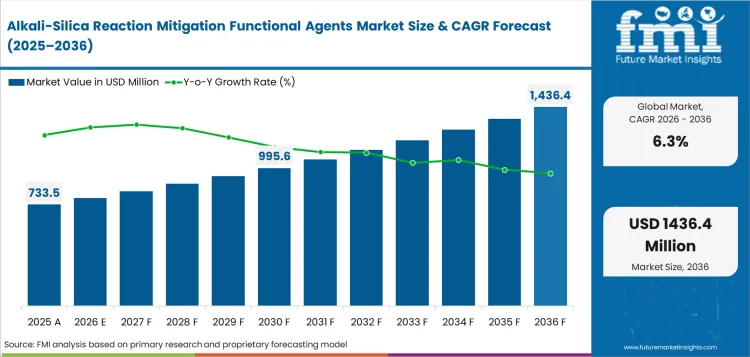
Key Takeaways
- Market value is estimated at USD 690.0 million in 2025, based on ASR-risk concrete applications and specialty admixture use.
- By 2036, global sales are forecast to reach USD 1,350.5 million as public infrastructure owners specify longer concrete life.
- During 2026 to 2036, demand is expected to advance at 6.3% CAGR across new concrete and repair applications.
- Incremental opportunity is expected to reach USD 617.0 million between 2026 and 2036.
- Lithium Salts are projected to account for 36.0% share in 2026 as they directly reduce ASR expansion risk.
- Ready Mix is estimated to hold 42.0% application share in 2026 since batch plants can control dosage records.
- India records the fastest outlook (8.1% CAGR), followed by China (7.4% CAGR), supported by highway and public infrastructure concrete use.
Strategic Pointers: Alkali-Silica Reaction Mitigation Functional Agents Market
Post-2024 evidence points to a sharper product shift in the Alkali-Silica Reaction Mitigation Functional Agents Market as Nyacol Nano Technologies’ US Patent 12,398,076 issued on August 26 2025 covers lithium-stabilized colloidal silica or powder obtained from it for ASR control in concrete mixes. Purdue C3 2025 research by Rui Xiao and co-authors shows calcium nitrate suppressing ASR through a passivation layer on reactive aggregates, with calcium nitrate priced near USD 250 to USD 600 per tonne against lithium-based alternatives above USD 12,000 per tonne. Virginia Transportation Research Council’s 2026 report supports modified AASHTO T380 for more realistic SCM dosing in high-alkali concrete, while ASTM C1567-25 published on April 1 2025 keeps 16-day mortar-bar testing central for mix-specific ASR screening. WIPO publication WO2025016996 dated January 23 2025 adds another direction through Al³⁺ release control in alkali-activated GGBS binder systems, which makes the market less dependent on one lithium chemistry and more focused on validated mix-specific mitigation packages.
Alkali-Silica Reaction Mitigation Functional Agents Market Definition
The market covers functional agents used to reduce alkali-silica reaction in new concrete and repair mixes. Included products are lithium-based admixtures, pozzolanic mineral additions, low-alkali binder packages, and surface treatments used with reactive aggregates.
Alkali-Silica Reaction Mitigation Functional Agents Market Inclusions
Scope includes lithium salts, mineral admixtures, pozzolanic blends, silane treatments, low-alkali binders, ready-mix supply, precast use, infrastructure repair, transport infrastructure, water infrastructure, buildings, energy projects, and marine works across major regions. Key stakeholders include ASR mitigation agent producers, concrete admixture suppliers, cement and SCM producers, ready-mix companies, precast manufacturers, infrastructure contractors, bridge and pavement authorities, testing laboratories, durability consultants, distributors, and regulatory bodies.
Alkali-Silica Reaction Mitigation Functional Agents Market Exclusions
Scope excludes standard water reducers, decorative concrete additives, corrosion inhibitors without ASR claims, generic sealers, aggregate mining services, and concrete placement contracts sold without a functional agent component.
Alkali-Silica Reaction Mitigation Functional Agents Market Research Methodology
- Primary Research: FMI analysts reviewed inputs from ready-mix producers, admixture formulators, bridge contractors, and durability consultants. Discussions focused on ASR test thresholds, dosage practice, approval cycles, and substitution between lithium and mineral systems.
- Desk Research: Desk research reviewed public cement statistics, ASR mitigation guidance, ASTM test references, and supplier product literature. Product scope was checked against ASTM C1567, ASTM C1293, and active ASR control claims from concrete chemical suppliers.
- Market Sizing and Forecasting: The model combined specialty admixture demand, ASR-risk project share, agent dosage, and country-level infrastructure intensity. Forecasts were adjusted for reactive aggregate exposure, low-carbon binder use, and repair timing across public assets.
- Data Validation: Forecast outputs were checked against cement shipment patterns, ready-mix use, supplier portfolios, and public infrastructure demand. Segment shares were cross-checked with dosing economics and project approval needs in transport and water assets.
Why is the Alkali-Silica Reaction Mitigation Functional Agents Market Growing?
- Reactive aggregates create repair risk in bridges and pavements with long design lives.
- Ready-mix producers need agents capable of passing ASTM expansion tests before mix approval.
- Low-carbon concrete raises binder blending, which increases early durability testing needs.
- Repair owners choose mitigation packages when replacement cost exceeds the upfront agent premium.
Public infrastructure owners treat ASR as a service-life risk able to turn concrete assets into early repair liabilities. FHWA guidance identifies lithium compounds and supplementary cementitious materials as recognized mitigation routes for reactive aggregates. The guidance provides specifiers a practical product toolkit before final mix selection. Suppliers improve access when they can show test history and clear dosing guidance.
Ready-mix concrete provides the main dosing route since mitigation agents must enter the mix before placement. USGS reported that 70% to 75% of U.S. cement sales in 2025 went to ready-mixed concrete producers. Batch plants can document dosage and connect each mix to project specifications. Agents with liquid handling and limited effect on slump control gain easier acceptance. Highway slabs and utility structures create steady use because replacement costs are high.
Market Segmentation Analysis
- During 2026 to 2036, lithium salts are projected to account for 36.0% of the agent type mix.
- Ready-mix concrete is estimated to cover 42.0% of applications by 2036 with steady use across infrastructure concrete projects.
- Transport infrastructure is forecast to represent 39.0% of end use in 2026, as bridge and pavement durability needs guide material choice.
- Direct supply is expected to hold 47.0% of sales during 2026, mainly due to project-level testing and dosage support.
- Across the 2026 to 2036 forecast period, ASTM C1567 is projected to lead testing methods with 44.0% share.
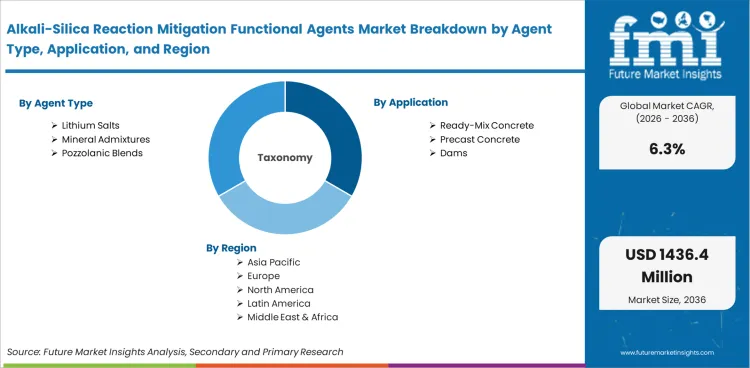
The alkali-silica reaction mitigation functional agents market is classified by agent type, application, end use, sales channel, and testing method. By agent type, the market includes lithium salts, mineral admixtures, pozzolanic blends, silane treatments, and low-alkali binders. By application, it covers ready-mix concrete, precast concrete, infrastructure repair, dams, and pavements. End use includes transport infrastructure, water infrastructure, buildings, energy projects, and marine works. Sales channel covers direct supply, admixture distributors, ready-mix partners, specialist contractors, and online technical sales. Testing method includes ASTM C1567, ASTM C1293, petrographic review, field core testing, and alkali loading.
Insights into the Lithium Salts Agent Type Segment
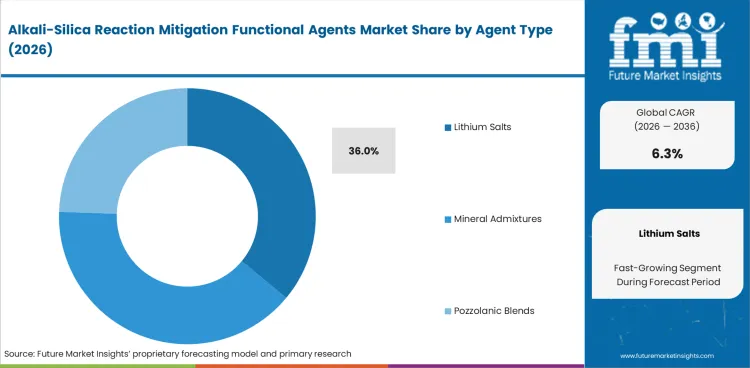
- Lithium salts are projected to account for 36.0% of the agent type mix in 2026. Their use is preferred when concrete mixes need direct control against ASR-related expansion.
- Mineral admixtures follow as concrete producers use fly ash and other pozzolanic materials to lower permeability and improve durability in reactive aggregate mixes.
Insights into the Ready-Mix Concrete Application Segment
- By 2026, ready-mix concrete is estimated to cover 42.0% of applications. Batch plants can manage dosage more consistently and maintain project-level mix records.
- Infrastructure repair is gaining attention as bridge decks and dam structures need longer service life with controlled cracking risk.
Insights into the Transport Infrastructure End Use Segment
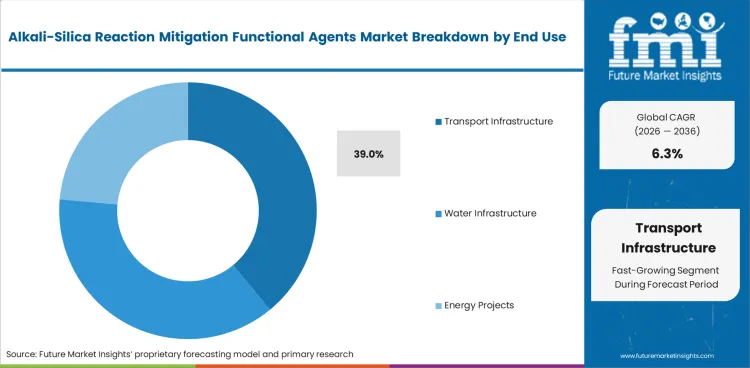
- Transport infrastructure is forecast to represent 39.0% of end-use share in 2026. Bridges and pavements face moisture exposure and high repair costs.
- Water infrastructure follows as dams and treatment structures need durable concrete mixes that can limit expansion over long operating periods.
Insights into the Direct Supply Sales Channel Segment
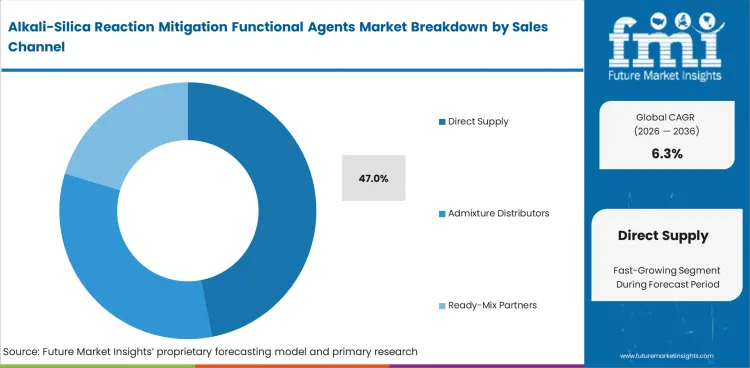
- Direct supply is expected to hold 47.0% of sales in 2026. ASR mitigation often needs dosage guidance and supplier input before project approval.
- Admixture distributors serve smaller contractors and repair jobs. Direct supplier involvement is stronger in public infrastructure projects with strict durability specifications.
Insights into the ASTM C1567 Testing Method Segment
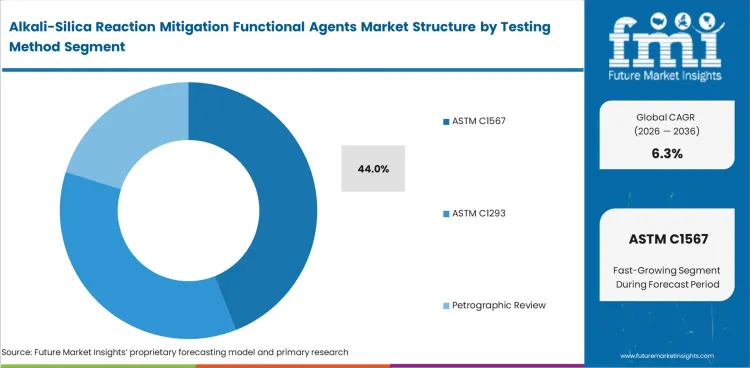
- ASTM C1567 is projected to lead testing methods with 44.0% share in 2026. Faster mortar-bar screening helps project owners assess reactive aggregate risk earlier.
- ASTM C1293 remains important for longer confirmation work. It is used when agencies need stronger evidence before approving concrete for critical structures.
Alkali-Silica Reaction Mitigation Functional Agents Market Drivers, Restraints, and Opportunities
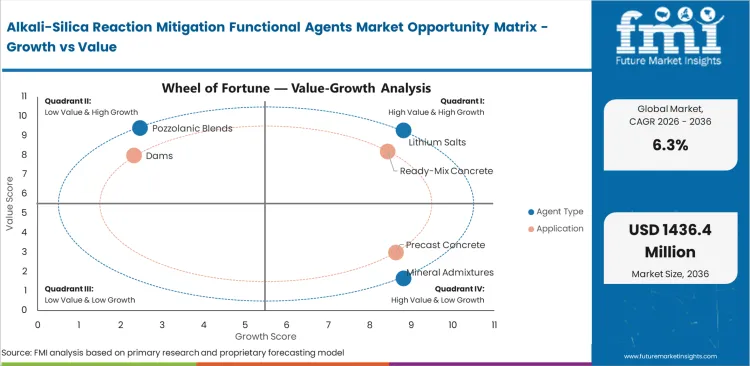
- Reactive aggregate exposure drives agent use when long-life concrete assets need documented expansion control.
- Low-carbon binder use raises demand for durability checks as mix chemistry changes across cement systems.
- Public repair budgets favor mitigation when early cracking could trigger costly replacement.
- Price sensitivity limits lithium use in general building concrete with lower ASR exposure.
- Opportunity exists in repair mortar systems where ASR control can be tied to structural strengthening.
Reactive Aggregate Approval
Concrete owners now require aggregate screening before approving public infrastructure mixes. ASR mitigation agents gain value when test results show expansion risk. FHWA guidance makes lithium compounds and supplementary cementitious materials visible options in the approval path. Specification writers then compare dosage cost against repair risk over the asset life. Suppliers with ASTM data and mix design support gain access before final material selection. Concrete specifiers need proof that the agent reduces expansion without harming strength gain. This creates a practical advantage for suppliers with test labs and clear project records.
Low-Carbon Binder Checks
Low-carbon concrete changes binder chemistry and can alter how ASR risk is evaluated. Many project owners use fly ash or other mineral additions to reduce clinker use. Green cement demand adds a durability link because alternative binders need performance checks before wide use. ASR agents fit into this shift when mineral blends reduce permeability and direct inhibitors control high-risk aggregates. Suppliers need to explain compatibility in plain test terms. The winning offer will combine dosage guidance with evidence that strength and workability stay within project limits.
Analysis of Alkali-Silica Reaction Mitigation Functional Agents Market By Key Countries
.webp "Top Country Growth Comparison Alkali Silica Reaction Mitigation Functional Agents Market Cagr (2026 2036)")
| Country | CAGR |
|---|---|
| India | 8.1% |
| China | 7.4% |
| Saudi Arabia | 6.8% |
| Brazil | 6.1% |
| United States | 5.7% |
| Germany | 4.8% |
| Japan | 4.5% |
Source: FMI analysis based on primary research and proprietary forecasting model.
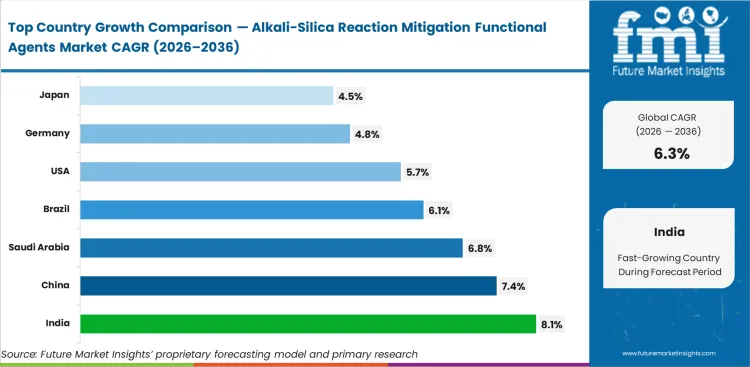
Alkali-Silica Reaction Mitigation Functional Agents Market CAGR Analysis By Country
- India leads with 8.1% CAGR as highway and metro projects raise ASR control needs.
- China follows at 7.4% CAGR with large bridge, rail and public works activity.
- Saudi Arabia records 6.8% CAGR due to coastal construction and large infrastructure projects.
- Brazil reaches 6.1% CAGR as hydropower and highway repair work support demand.
- United States advances at 5.7% CAGR with DOT specifications guiding ASR testing.
- Germany grows at 4.8% CAGR through bridge renewal and strict concrete quality rules.
- Japan records 4.5% CAGR as older transport assets require repair-focused durability agents.
- Global demand is expected to grow at 6.3% CAGR from 2026 to 2036, supported by ASR testing needs in infrastructure concrete.
Demand Outlook for Alkali-Silica Reaction Mitigation Functional Agents Market in India
India has the strongest country outlook because expressways, metro corridors, and water projects use large concrete volumes. The country growth is predicted at 8.1% CAGR from 2026 to 2036. Specialty suppliers can enter through India construction chemicals channels when project owners ask for tested durability packages. Public works create more value for early aggregate screening and admixture guidance. Local technical service will matter most when contractors need mix approval before placement.
- National Highways Authority of India road projects create concrete pavement needs across high-traffic corridors.
- Delhi Metro and regional metro projects use controlled ready-mix supply near dense urban construction zones.
- Gujarat and Tamil Nadu coastal projects increase the need for low-permeability concrete packages.
Sales Analysis of Alkali-Silica Reaction Mitigation Functional Agents Market in China
China is expected to expand at 7.4% CAGR in 2026 because bridge and rail projects use high-volume concrete. China has the largest concrete volume base, which keeps ASR mitigation linked to major project qualification. Provincial aggregate variation makes testing important before mix approval. Local producers can use pozzolanic blends for many mixes. High-risk structures still create demand for direct ASR control agents with laboratory support.
- Yangtze River bridge projects create strict durability expectations for concrete exposed to traffic and moisture.
- Guangdong and Zhejiang construction clusters create ready-mix dosing routes for specialty admixtures.
- Water transfer assets require long service lives, which raises attention to reactive aggregate control.
Demand Analysis of Alkali-Silica Reaction Mitigation Functional Agents Market in the United States
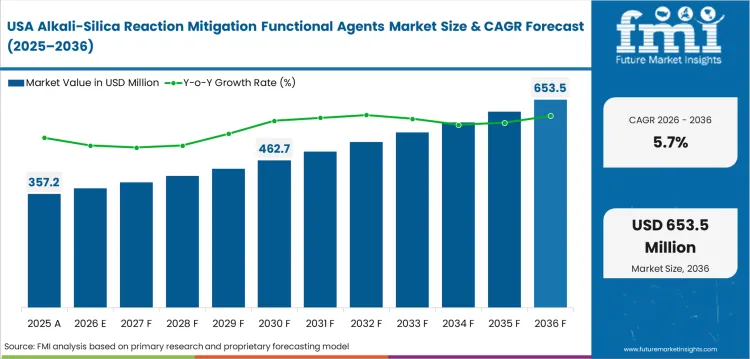
State DOT specification culture gives the United States a stable demand base for ASR mitigation agents. The country is anticipated to grow at 5.7% CAGR by 2036. Specialty demand often moves through United States concrete admixture channels, where documentation and field records affect approval. A large construction base gives admixture suppliers steady access to highway and bridge repair work.
- Texas and Florida road programs use large ready-mix volumes in heavy traffic environments.
- FHWA durability guidance keeps lithium compounds and SCMs visible in ASR mitigation decisions.
- State DOT laboratories often use ASTM screening before reactive aggregate combinations reach project use.
Alkali-Silica Reaction Mitigation Functional Agents Market Country Value Analysis
Demand for alkali-silica reaction mitigation functional agents in Germany is projected to grow at a CAGR of 4.8%. Bridge renewal and industrial concrete work create demand for specialty agents. Producers often evaluate durability through binder selection and performance testing before broad additive use. Suppliers need clear data on compatibility with European cement systems and strict project documentation.
- Autobahn bridge renewal creates repeat demand for durability products in transport assets.
- German ready-mix producers use quality records that favor agents with clear dosage guidance.
- Rhine industrial corridors create concrete exposure needs across logistics and utility assets.
Future Outlook for Alkali-Silica Reaction Mitigation Functional Agents Market in Japan
Japan has a repair-oriented concrete market with high attention to service life. By 2036, demand is projected to rise at 4.5% CAGR. Ports and older road assets need measured repair choices. Dense coastal infrastructure increases moisture exposure and chloride risk. Technical documentation shapes adoption through Japan concrete admixture channels. Suppliers gain when products fit conservative approval practices and existing concrete standards.
- Tokyo and Osaka infrastructure renewal favors predictable placement and long service records.
- Port facilities in Yokohama and Kobe create moisture exposure conditions for durability-focused mixes.
- Public owners in coastal prefectures often require clear records before accepting new admixture packages.
Demand Outlook for the Alkali-Silica Reaction Mitigation Functional Agents Market in Brazil
Brazil demand is tied to hydropower assets, highways, and coastal concrete exposure. The country is forecast at 6.1% CAGR during the forecast period with civil works and repair spending maintaining ASR control needs. Aggregate variability across regions increases project-level testing. Mineral admixtures can be favored when they improve durability and cost performance together. Dedicated lithium products keep value in structures where repair access is difficult.
- Hydropower structures in Paraná and Minas Gerais create long-life mass concrete control needs.
- São Paulo highway concessions increase pavement and bridge repair demand with documented durability requirements.
- Coastal projects near Rio de Janeiro add moisture exposure that can raise ASR risk in vulnerable mixes.
In-depth Analysis of Alkali-Silica Reaction Mitigation Functional Agents Market in Saudi Arabia
Saudi Arabia combines large project spending with harsh coastal and desert exposure. The country is expected to post 6.8% CAGR during 2026 to 2036 because giga-projects and utility assets increase demand for controlled concrete performance. High temperatures and saline exposure make mix consistency important. ASR mitigation agents gain when bundled with durability packages for marine works and infrastructure. Local approvals and technical service near project sites will decide supplier access.
- NEOM construction activity increases concrete specification depth in desert and coastal conditions.
- Red Sea coastal work favors low-permeability mixes with ASR-aware design.
- Riyadh metro expansion increases ready-mix demand with higher quality control expectations.
Competitive Landscape and Strategic Positioning
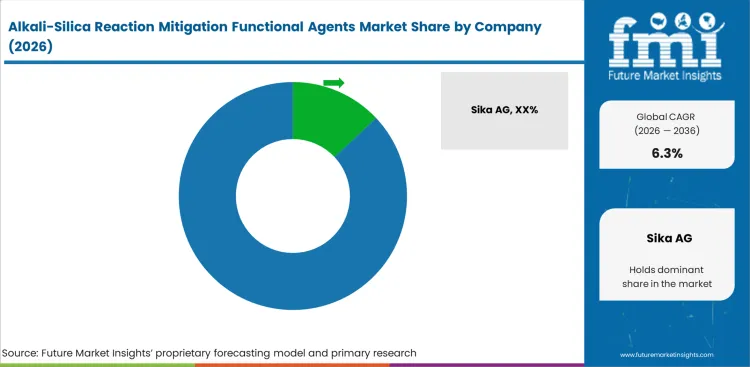
- Market concentration is moderate, with global admixture suppliers serving high-specification projects and regional suppliers serving repair jobs.
- Established companies gain from laboratory support, ASTM familiarity, and ready-mix relationships.
- Specialist suppliers compete in reactive aggregate regions through local testing support and faster delivery.
- Entry barriers include approval records, mix compatibility proof and trust from public infrastructure owners.
Competition centers on proof that an agent can reduce expansion without harming strength or workability. Master Builders Solutions sells MasterLife ASR 30 as a lithium-based liquid admixture for high-alkali concrete with reactive aggregates. The product places the company directly inside ASR mitigation beyond broad durability chemistry. Sika competes through wider concrete repair and protection systems, including moisture-control routes relevant to ASR risk. Buyers compare products through test reports and local service before concrete placement.
Product breadth gives large suppliers an advantage because ASR mitigation often fits inside a wider durability package. Saint-Gobain Construction Chemicals offers CHRYSO RASIR as a 30% lithium nitrate solution for ASR control. MAPEI, Euclid Chemical, and Fosroc compete when projects need repair materials and mix guidance together. The link between ASR control and concrete surface treatment chemicals becomes stronger in repair work, where moisture movement and surface protection affect service life.
Key Companies in the Alkali-Silica Reaction Mitigation Functional Agents Market
Supplier competition is based on ASR test proof, ready-mix dosing support, and repair-system compatibility.
- Global Leaders: Sika AG, Master Builders Solutions, Saint-Gobain Construction Chemicals, MAPEI, and GCP Applied Technologies.
- Regional and Specialist Suppliers: Euclid Chemical and Fosroc serve ASR control needs through concrete repair systems and admixture channels.
- Technical Service Providers: Testing laboratories and specialist concrete consultants influence product choice by interpreting ASTM C1567 and ASTM C1293 results.
Competitive Benchmarking: Alkali-Silica Reaction Mitigation Functional Agents Market
| Company | ASR Inhibition Portfolio | Mix Design Support | Repair Compatibility | Geographic Footprint |
|---|---|---|---|---|
| Sika AG | High | High | High | Global |
| Master Builders Solutions | High | High | Strong | Global |
| Saint-Gobain Construction Chemicals | High | Strong | Strong | Global |
| MAPEI | Medium | High | High | Global |
| Euclid Chemical | Medium | Strong | High | North America |
| GCP Applied Technologies | High | Strong | Medium | Global |
| Fosroc | Medium | Strong | High | Middle East and Asia |
| CHRYSO | High | Strong | Strong | Europe and Global |
Source: Future Market Insights competitive analysis, 2026. Ratings reflect relative positioning based on ASR inhibition portfolio, mix design support, and repair compatibility.
Key Developments in Alkali-Silica Reaction Mitigation Functional Agents Market
- In January 2025, MAPEI launched an EPD service for concrete mixtures. The service helps concrete producers prepare verified environmental declarations for project-specific mixes.
- In January 2025, Saint-Gobain completed the acquisition of Cemix. Cemix is a construction chemicals player in Mexico and Central America.
Key Players in the Alkali-Silica Reaction Mitigation Functional Agents Market
Global Leaders
- Sika AG
- Master Builders Solutions
- Saint-Gobain Construction Chemicals
- MAPEI
- GCP Applied Technologies
Regional and Specialist Suppliers
- Euclid Chemical
- Fosroc
- CHRYSO
Technical Service Providers
- Concrete durability laboratories
- ASTM testing service providers
- Specialist concrete consultants
Report Scope and Coverage
| Parameter | Details |
|---|---|
| Quantitative Units | USD 733.5 million in 2026 to USD 1,350.5 million by 2036, at 6.3% CAGR |
| Market Definition | Functional agents used to reduce alkali-silica reaction in new concrete and repair mixes |
| Regions Covered | North America, Latin America, Europe, East Asia, South Asia and Pacific, Middle East and Africa |
| Countries Covered | India, China, United States, Germany, Japan, Brazil, Saudi Arabia, and 30+ countries |
| Key Companies Profiled | Sika AG, Master Builders Solutions, Saint-Gobain Construction Chemicals, MAPEI, Euclid Chemical, GCP Applied Technologies, Fosroc |
| Forecast Period | 2026 to 2036 |
| Approach | Hybrid bottom-up and top-down methodology using project exposure, agent dosage, channel use, and country infrastructure intensity |
Alkali-Silica Reaction Mitigation Functional Agents Market by Segments
Alkali-Silica Reaction Mitigation Functional Agents Market Segmented by Agent Type
- Lithium Salts
- Mineral Admixtures
- Pozzolanic Blends
- Silane Treatments
- Low-Alkali Binders
Alkali-Silica Reaction Mitigation Functional Agents Market Segmented by Application
- Ready Mix
- Precast Concrete
- Infrastructure Repair
- Dams
- Pavements
Alkali-Silica Reaction Mitigation Functional Agents Market Segmented by End Use
- Transport Infrastructure
- Water Infrastructure
- Buildings
- Energy Projects
- Marine Works
Alkali-Silica Reaction Mitigation Functional Agents Market Segmented by Sales Channel
- Direct Supply
- Admixture Distributors
- Ready-Mix Partners
- Specialist Contractors
- Online Technical Sales
Alkali-Silica Reaction Mitigation Functional Agents Market Segmented by Testing Method
- ASTM C1567
- ASTM C1293
- Petrographic Review
- Field Core Testing
- Alkali Loading
Alkali-Silica Reaction Mitigation Functional Agents Market by Region
- North America
- United States
- Canada
- Mexico
- Latin America
- Brazil
- Chile
- Rest of Latin America
- Western Europe
- Germany
- UK
- Italy
- Spain
- France
- Nordic
- BENELUX
- Rest of Western Europe
- Eastern Europe
- Russia
- Poland
- Hungary
- Balkan and Baltic
- Rest of Eastern Europe
- East Asia
- China
- Japan
- South Korea
- South Asia and Pacific
- India
- ASEAN
- Australia and New Zealand
- Rest of South Asia and Pacific
- Middle East and Africa
- Kingdom of Saudi Arabia
- Other GCC Countries
- Turkiye
- South Africa
- Other African Union
- Rest of Middle East and Africa
Research Sources and Bibliography
- MAPEI. (2025, January 7). MAPEI is the first company in the world to provide an EPD service for concrete mixtures.
- Saint-Gobain. (2025, January 15). Saint-Gobain completes the acquisition of Cemix.
- Global Cement and Concrete Association. (2024). Concrete future: Supplementary cementitious materials policy recommendations. GCCA.
- Sika AG. (2025). Sika annual performance and construction solutions update.
This Report Answers
- What is the current and future size of the alkali-silica reaction mitigation functional agents market?
- How fast is demand expected to grow during 2026 to 2036?
- Which agent type is forecast to lead demand by 2026?
- Which application is estimated to account for the highest use by 2026?
- Why do ready-mix producers need ASR mitigation agents before project approval?
- How do low-carbon binders affect ASR control requirements?
- Which countries are forecast to grow fastest during the assessment period?
- Which companies are active in lithium-based and mineral ASR mitigation?
- What products and applications are included in market scope?
- How does FMI estimate market size and segment share?
Frequently Asked Questions
What is the global demand for alkali-silica reaction mitigation functional agents in 2026?
In 2026, global demand is expected to be worth USD 733.5 million, driven by concrete durability requirements in infrastructure work.
What will the market value reach by 2036?
By 2036, global demand is forecast to reach USD 1,350.5 million as owners specify longer concrete service life.
What CAGR is forecast for 2026 to 2036?
Demand is forecast to grow at 6.3% CAGR during 2026 to 2036 across new concrete and repair uses.
Which agent type is expected to lead in 2026?
Lithium Salts are projected to account for 36.0% share in 2026 due to direct ASR expansion control.
Which application is expected to hold the largest share in 2026?
Ready Mix is estimated to hold 42.0% share in 2026 as batch plants can control dosage and records.
Which country records the fastest growth outlook?
India records the fastest outlook at 8.1% CAGR during 2026 to 2036, supported by highway and metro concrete.
What is included in this market?
Scope includes lithium salts, mineral admixtures, pozzolanic blends, low-alkali binders, and ASR-focused surface treatments.
How are the market forecasts prepared?
Forecasts combine project exposure, agent dosage, country infrastructure intensity and supplier portfolio checks.
Preview the report firsthand - request a free sample
Get SampleGet the brochure for pricing and purchase details.
Get PDFTable of Content
- Executive Summary
- Global Market Outlook
- Demand-side Trends
- Supply-side Trends
- Technology Roadmap Analysis
- Analysis and Recommendations
- Market Overview
- Market Coverage / Taxonomy
- Market Definition / Scope / Limitations
- Research Methodology
- Chapter Orientation
- Analytical Lens and Working Hypotheses
- Market Structure, Signals, and Trend Drivers
- Benchmarking and Cross-market Comparability
- Market Sizing, Forecasting, and Opportunity Mapping
- Research Design and Evidence Framework
- Desk Research Programme (Secondary Evidence)
- Company Annual and Sustainability Reports
- Peer-reviewed Journals and Academic Literature
- Corporate Websites, Product Literature, and Technical Notes
- Earnings Decks and Investor Briefings
- Statutory Filings and Regulatory Disclosures
- Technical White Papers and Standards Notes
- Trade Journals, Industry Magazines, and Analyst Briefs
- Conference Proceedings, Webinars, and Seminar Materials
- Government Statistics Portals and Public Data Releases
- Press Releases and Reputable Media Coverage
- Specialist Newsletters and Curated Briefings
- Sector Databases and Reference Repositories
- FMI Internal Proprietary Databases and Historical Market Datasets
- Subscription Datasets and Paid Sources
- Social Channels, Communities, and Digital Listening Inputs
- Additional Desk Sources
- Expert Input and Fieldwork (Primary Evidence)
- Primary Modes
- Qualitative Interviews and Expert Elicitation
- Quantitative Surveys and Structured Data Capture
- Blended Approach
- Why Primary Evidence is Used
- Field Techniques
- Interviews
- Surveys
- Focus Groups
- Observational and In-context Research
- Social and Community Interactions
- Stakeholder Universe Engaged
- C-suite Leaders
- Board Members
- Presidents and Vice Presidents
- R&D and Innovation Heads
- Technical Specialists
- Domain Subject-matter Experts
- Scientists
- Physicians and Other Healthcare Professionals
- Governance, Ethics, and Data Stewardship
- Research Ethics
- Data Integrity and Handling
- Primary Modes
- Tooling, Models, and Reference Databases
- Desk Research Programme (Secondary Evidence)
- Data Engineering and Model Build
- Data Acquisition and Ingestion
- Cleaning, Normalisation, and Verification
- Synthesis, Triangulation, and Analysis
- Quality Assurance and Audit Trail
- Market Background
- Market Dynamics
- Drivers
- Restraints
- Opportunity
- Trends
- Scenario Forecast
- Demand in Optimistic Scenario
- Demand in Likely Scenario
- Demand in Conservative Scenario
- Opportunity Map Analysis
- Product Life Cycle Analysis
- Supply Chain Analysis
- Investment Feasibility Matrix
- Value Chain Analysis
- PESTLE and Porter’s Analysis
- Regulatory Landscape
- Regional Parent Market Outlook
- Production and Consumption Statistics
- Import and Export Statistics
- Market Dynamics
- Global Market Analysis 2021 to 2025 and Forecast, 2026 to 2036
- Historical Market Size Value (USD Million) Analysis, 2021 to 2025
- Current and Future Market Size Value (USD Million) Projections, 2026 to 2036
- Y-o-Y Growth Trend Analysis
- Absolute $ Opportunity Analysis
- Global Market Pricing Analysis 2021 to 2025 and Forecast 2026 to 2036
- Global Market Analysis 2021 to 2025 and Forecast 2026 to 2036, By Agent Type
- Introduction / Key Findings
- Historical Market Size Value (USD Million) Analysis By Agent Type , 2021 to 2025
- Current and Future Market Size Value (USD Million) Analysis and Forecast By Agent Type , 2026 to 2036
- Lithium Salts
- Mineral Admixtures
- Pozzolanic Blends
- Lithium Salts
- Y-o-Y Growth Trend Analysis By Agent Type , 2021 to 2025
- Absolute $ Opportunity Analysis By Agent Type , 2026 to 2036
- Global Market Analysis 2021 to 2025 and Forecast 2026 to 2036, By Application
- Introduction / Key Findings
- Historical Market Size Value (USD Million) Analysis By Application, 2021 to 2025
- Current and Future Market Size Value (USD Million) Analysis and Forecast By Application, 2026 to 2036
- Ready-Mix Concrete
- Precast Concrete
- Dams
- Ready-Mix Concrete
- Y-o-Y Growth Trend Analysis By Application, 2021 to 2025
- Absolute $ Opportunity Analysis By Application, 2026 to 2036
- Global Market Analysis 2021 to 2025 and Forecast 2026 to 2036, By End Use
- Introduction / Key Findings
- Historical Market Size Value (USD Million) Analysis By End Use, 2021 to 2025
- Current and Future Market Size Value (USD Million) Analysis and Forecast By End Use, 2026 to 2036
- Transport Infrastructure
- Water Infrastructure
- Energy Projects
- Transport Infrastructure
- Y-o-Y Growth Trend Analysis By End Use, 2021 to 2025
- Absolute $ Opportunity Analysis By End Use, 2026 to 2036
- Global Market Analysis 2021 to 2025 and Forecast 2026 to 2036, By Sales Channel
- Introduction / Key Findings
- Historical Market Size Value (USD Million) Analysis By Sales Channel, 2021 to 2025
- Current and Future Market Size Value (USD Million) Analysis and Forecast By Sales Channel, 2026 to 2036
- Direct Supply
- Admixture Distributors
- Ready-Mix Partners
- Direct Supply
- Y-o-Y Growth Trend Analysis By Sales Channel, 2021 to 2025
- Absolute $ Opportunity Analysis By Sales Channel, 2026 to 2036
- Global Market Analysis 2021 to 2025 and Forecast 2026 to 2036, By Testing Method
- Introduction / Key Findings
- Historical Market Size Value (USD Million) Analysis By Testing Method, 2021 to 2025
- Current and Future Market Size Value (USD Million) Analysis and Forecast By Testing Method, 2026 to 2036
- ASTM C1567
- ASTM C1293
- Petrographic Review
- ASTM C1567
- Y-o-Y Growth Trend Analysis By Testing Method, 2021 to 2025
- Absolute $ Opportunity Analysis By Testing Method, 2026 to 2036
- Global Market Analysis 2021 to 2025 and Forecast 2026 to 2036, By Region
- Introduction
- Historical Market Size Value (USD Million) Analysis By Region, 2021 to 2025
- Current Market Size Value (USD Million) Analysis and Forecast By Region, 2026 to 2036
- North America
- Latin America
- Western Europe
- Eastern Europe
- East Asia
- South Asia and Pacific
- Middle East & Africa
- Market Attractiveness Analysis By Region
- North America Market Analysis 2021 to 2025 and Forecast 2026 to 2036, By Country
- Historical Market Size Value (USD Million) Trend Analysis By Market Taxonomy, 2021 to 2025
- Market Size Value (USD Million) Forecast By Market Taxonomy, 2026 to 2036
- By Country
- USA
- Canada
- Mexico
- By Agent Type
- By Application
- By End Use
- By Sales Channel
- By Testing Method
- By Country
- Market Attractiveness Analysis
- By Country
- By Agent Type
- By Application
- By End Use
- By Sales Channel
- By Testing Method
- Key Takeaways
- Latin America Market Analysis 2021 to 2025 and Forecast 2026 to 2036, By Country
- Historical Market Size Value (USD Million) Trend Analysis By Market Taxonomy, 2021 to 2025
- Market Size Value (USD Million) Forecast By Market Taxonomy, 2026 to 2036
- By Country
- Brazil
- Chile
- Rest of Latin America
- By Agent Type
- By Application
- By End Use
- By Sales Channel
- By Testing Method
- By Country
- Market Attractiveness Analysis
- By Country
- By Agent Type
- By Application
- By End Use
- By Sales Channel
- By Testing Method
- Key Takeaways
- Western Europe Market Analysis 2021 to 2025 and Forecast 2026 to 2036, By Country
- Historical Market Size Value (USD Million) Trend Analysis By Market Taxonomy, 2021 to 2025
- Market Size Value (USD Million) Forecast By Market Taxonomy, 2026 to 2036
- By Country
- Germany
- UK
- Italy
- Spain
- France
- Nordic
- BENELUX
- Rest of Western Europe
- By Agent Type
- By Application
- By End Use
- By Sales Channel
- By Testing Method
- By Country
- Market Attractiveness Analysis
- By Country
- By Agent Type
- By Application
- By End Use
- By Sales Channel
- By Testing Method
- Key Takeaways
- Eastern Europe Market Analysis 2021 to 2025 and Forecast 2026 to 2036, By Country
- Historical Market Size Value (USD Million) Trend Analysis By Market Taxonomy, 2021 to 2025
- Market Size Value (USD Million) Forecast By Market Taxonomy, 2026 to 2036
- By Country
- Russia
- Poland
- Hungary
- Balkan & Baltic
- Rest of Eastern Europe
- By Agent Type
- By Application
- By End Use
- By Sales Channel
- By Testing Method
- By Country
- Market Attractiveness Analysis
- By Country
- By Agent Type
- By Application
- By End Use
- By Sales Channel
- By Testing Method
- Key Takeaways
- East Asia Market Analysis 2021 to 2025 and Forecast 2026 to 2036, By Country
- Historical Market Size Value (USD Million) Trend Analysis By Market Taxonomy, 2021 to 2025
- Market Size Value (USD Million) Forecast By Market Taxonomy, 2026 to 2036
- By Country
- China
- Japan
- South Korea
- By Agent Type
- By Application
- By End Use
- By Sales Channel
- By Testing Method
- By Country
- Market Attractiveness Analysis
- By Country
- By Agent Type
- By Application
- By End Use
- By Sales Channel
- By Testing Method
- Key Takeaways
- South Asia and Pacific Market Analysis 2021 to 2025 and Forecast 2026 to 2036, By Country
- Historical Market Size Value (USD Million) Trend Analysis By Market Taxonomy, 2021 to 2025
- Market Size Value (USD Million) Forecast By Market Taxonomy, 2026 to 2036
- By Country
- India
- ASEAN
- Australia & New Zealand
- Rest of South Asia and Pacific
- By Agent Type
- By Application
- By End Use
- By Sales Channel
- By Testing Method
- By Country
- Market Attractiveness Analysis
- By Country
- By Agent Type
- By Application
- By End Use
- By Sales Channel
- By Testing Method
- Key Takeaways
- Middle East & Africa Market Analysis 2021 to 2025 and Forecast 2026 to 2036, By Country
- Historical Market Size Value (USD Million) Trend Analysis By Market Taxonomy, 2021 to 2025
- Market Size Value (USD Million) Forecast By Market Taxonomy, 2026 to 2036
- By Country
- Kingdom of Saudi Arabia
- Other GCC Countries
- Turkiye
- South Africa
- Other African Union
- Rest of Middle East & Africa
- By Agent Type
- By Application
- By End Use
- By Sales Channel
- By Testing Method
- By Country
- Market Attractiveness Analysis
- By Country
- By Agent Type
- By Application
- By End Use
- By Sales Channel
- By Testing Method
- Key Takeaways
- Key Countries Market Analysis
- USA
- Pricing Analysis
- Market Share Analysis, 2025
- By Agent Type
- By Application
- By End Use
- By Sales Channel
- By Testing Method
- Canada
- Pricing Analysis
- Market Share Analysis, 2025
- By Agent Type
- By Application
- By End Use
- By Sales Channel
- By Testing Method
- Mexico
- Pricing Analysis
- Market Share Analysis, 2025
- By Agent Type
- By Application
- By End Use
- By Sales Channel
- By Testing Method
- Brazil
- Pricing Analysis
- Market Share Analysis, 2025
- By Agent Type
- By Application
- By End Use
- By Sales Channel
- By Testing Method
- Chile
- Pricing Analysis
- Market Share Analysis, 2025
- By Agent Type
- By Application
- By End Use
- By Sales Channel
- By Testing Method
- Germany
- Pricing Analysis
- Market Share Analysis, 2025
- By Agent Type
- By Application
- By End Use
- By Sales Channel
- By Testing Method
- UK
- Pricing Analysis
- Market Share Analysis, 2025
- By Agent Type
- By Application
- By End Use
- By Sales Channel
- By Testing Method
- Italy
- Pricing Analysis
- Market Share Analysis, 2025
- By Agent Type
- By Application
- By End Use
- By Sales Channel
- By Testing Method
- Spain
- Pricing Analysis
- Market Share Analysis, 2025
- By Agent Type
- By Application
- By End Use
- By Sales Channel
- By Testing Method
- France
- Pricing Analysis
- Market Share Analysis, 2025
- By Agent Type
- By Application
- By End Use
- By Sales Channel
- By Testing Method
- India
- Pricing Analysis
- Market Share Analysis, 2025
- By Agent Type
- By Application
- By End Use
- By Sales Channel
- By Testing Method
- ASEAN
- Pricing Analysis
- Market Share Analysis, 2025
- By Agent Type
- By Application
- By End Use
- By Sales Channel
- By Testing Method
- Australia & New Zealand
- Pricing Analysis
- Market Share Analysis, 2025
- By Agent Type
- By Application
- By End Use
- By Sales Channel
- By Testing Method
- China
- Pricing Analysis
- Market Share Analysis, 2025
- By Agent Type
- By Application
- By End Use
- By Sales Channel
- By Testing Method
- Japan
- Pricing Analysis
- Market Share Analysis, 2025
- By Agent Type
- By Application
- By End Use
- By Sales Channel
- By Testing Method
- South Korea
- Pricing Analysis
- Market Share Analysis, 2025
- By Agent Type
- By Application
- By End Use
- By Sales Channel
- By Testing Method
- Russia
- Pricing Analysis
- Market Share Analysis, 2025
- By Agent Type
- By Application
- By End Use
- By Sales Channel
- By Testing Method
- Poland
- Pricing Analysis
- Market Share Analysis, 2025
- By Agent Type
- By Application
- By End Use
- By Sales Channel
- By Testing Method
- Hungary
- Pricing Analysis
- Market Share Analysis, 2025
- By Agent Type
- By Application
- By End Use
- By Sales Channel
- By Testing Method
- Kingdom of Saudi Arabia
- Pricing Analysis
- Market Share Analysis, 2025
- By Agent Type
- By Application
- By End Use
- By Sales Channel
- By Testing Method
- Turkiye
- Pricing Analysis
- Market Share Analysis, 2025
- By Agent Type
- By Application
- By End Use
- By Sales Channel
- By Testing Method
- South Africa
- Pricing Analysis
- Market Share Analysis, 2025
- By Agent Type
- By Application
- By End Use
- By Sales Channel
- By Testing Method
- USA
- Market Structure Analysis
- Competition Dashboard
- Competition Benchmarking
- Market Share Analysis of Top Players
- By Regional
- By Agent Type
- By Application
- By End Use
- By Sales Channel
- By Testing Method
- Competition Analysis
- Competition Deep Dive
- Sika AG
- Overview
- Product Portfolio
- Profitability by Market Segments (Product/Age /Sales Channel/Region)
- Sales Footprint
- Strategy Overview
- Marketing Strategy
- Product Strategy
- Channel Strategy
- Master Builders Solutions
- Saint-Gobain Construction Chemicals
- MAPEI
- GCP Applied Technologies
- Sika AG
- Competition Deep Dive
- Assumptions & Acronyms Used


