

- Market Size (2026)
- USD 540.0 Mn
- Forecast (2036)
- USD 913.7 Mn
- CAGR (2026 to 2036)
- 5.4%
How big is the Alkaline Compound Feed Market in 2026?
USD 540.0 million in 2026 and USD 913.7 million by 2036 at a 5.4% CAGR.
The alkaline compound feed market was valued at USD 512.3 million in 2025, supported by feed-mill demand for ration pH control and handling discipline. It is expected to expand from USD 540.0 million in 2026 to USD 913.7 million by 2036 at 5.4% CAGR. Feed-cost exposure is pulling alkaline compound feed additives into routine ration review at commercial mills. Corn concentration makes ration cost movement visible inside mill margins and daily additive-screening work for feed teams. Nutrition teams using compound feed formulations are likely to examine alkaline inputs for buffering value and mineral delivery. The spending case is expected to rest on documented diet stability and line handling rather than broad additive claims.
Feed mills and premix suppliers are expected to adopt alkaline feed inputs only after a practical handling case is clear. EFSA reported in May 2026 that feed additive applications require submission and completeness checks before risk assessment. Feed additive review enters additive screening before mill teams approve routine use for species programs. Sourcing teams comparing animal feed additives are likely to ask for storage evidence and species guidance. The product earns consideration by reducing mill rework and supporting repeatable ration control after commercial scale-up.
From formulation to flock performance, the category is expected to gain value across the feed purchase chain. IFIF reported in September 2025 that world compound feed production would likely reach 1.4 billion tonnes annually. The feed scale makes service support more valuable around additive dosing and follow-up during account expansion. Established markets are likely to weigh dossiers and audits before alkaline additives move into approved premixes. High-growth Asian markets are set to weigh feed enzymes adoption and technical access during account expansion.
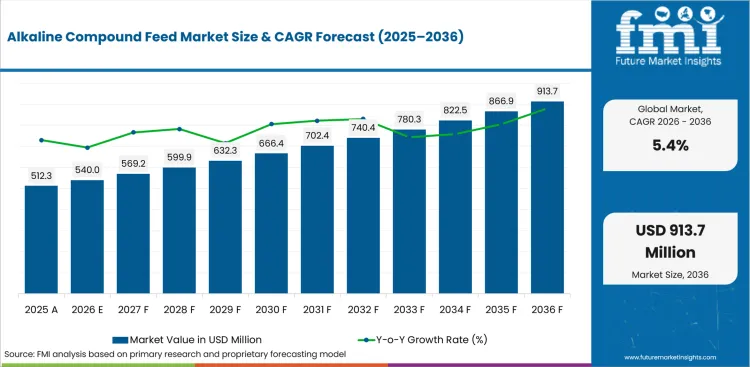
| Metric | Value |
|---|---|
| 2025 Market Size | USD 512.3 million |
| 2026 Market Size | USD 540.0 million |
| 2036 Market Size | USD 913.7 million |
| Forecast CAGR (2026-2036) | 5.4% |
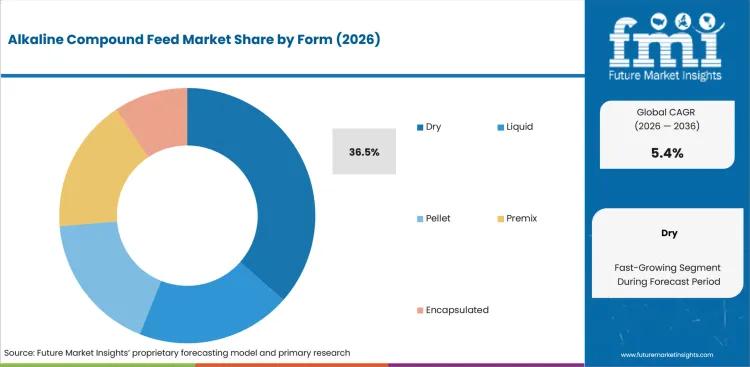
| Form Focus | Dry |
| Dry Share (2026) | 36.5% |
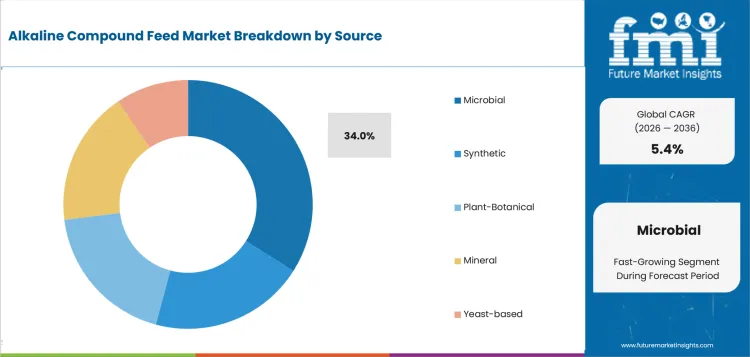
| Source Focus | Microbial |
| Microbial Share (2026) | 34.0% |
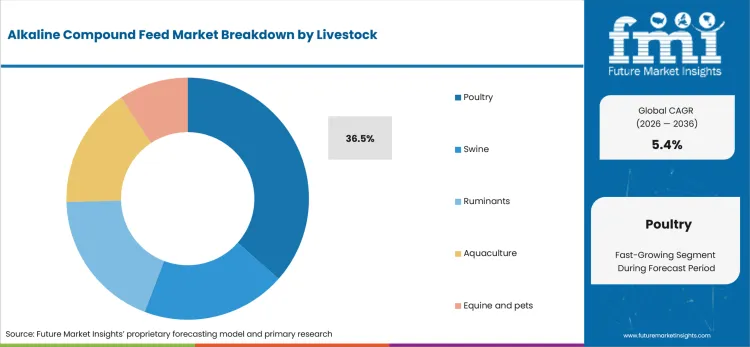
| Livestock Focus | Poultry |
| Poultry Share (2026) | 36.5% |
| Key Countries | USA, Germany, France, UK |
Summary of the Alkaline Compound Feed Market
| Market Signal | Commercial Impact |
|---|---|
| Demand and Growth Drivers | Feed-cost pressure and species-specific performance checks are expected to push spending toward alkaline compound feed inputs. Documentation needs are likely to create urgency before feed mills approve wider mill use across poultry and ruminant accounts.
|
| Product and Segment View | Dry and microbial are expected to guide 2026 purchasing screens. Poultry and gut health shape segment review alongside North America’s regional documentation pressure.
|
| Geography and Growth Outlook | India and China are expected to occupy the higher-growth tier due to livestock scale and feed modernization. Established markets are likely to move slower due to audit discipline and supplier qualification cycles.
|
| Competitive Landscape | Competition is expected to remain moderately concentrated around animal nutrition groups and specialist additive companies. Sourcing evaluation is likely to center on portfolio fit and service continuity before documentation depth shapes final account selection across integrated livestock accounts.
|
| Analyst Perspective | The central adoption screen is expected to be proof of repeatable ration behavior under commercial mill conditions. Account retention is likely to depend on service ownership after trial approval.
|
How is the Alkaline Compound Feed Market segmented?
The alkaline compound feed market is segmented by form, source, livestock, function, and region.
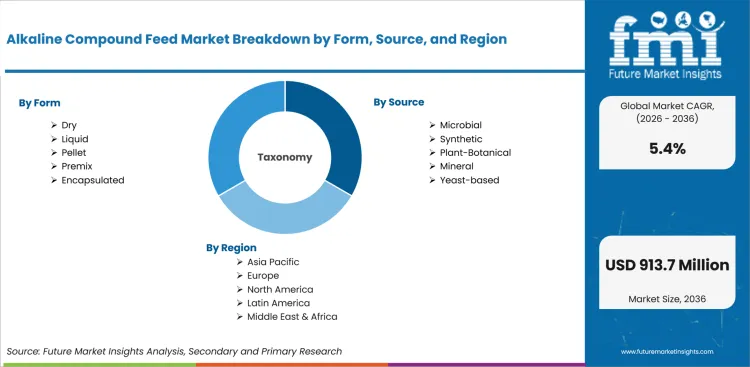
The alkaline compound feed market is segmented by form, source, livestock, function, and region. By form, the market covers dry, liquid, pellet, premix, and encapsulated. By source, it covers synthetic, microbial, plant/botanical, mineral, and yeast-based inputs. By livestock, it covers poultry, swine, ruminants, aquaculture, and equine and pets. By function, it covers gut health, growth performance, immunity, nutrient utilization, and stress management. Regional coverage includes North America, Europe, East Asia, South Asia, and Latin America, supported by adjacent movement in feed premix demand.
How does dry format shape demand within the form category?
Dry additive selection is shaped by dosing behavior in mills that run high-volume premix schedules. EFSA reported in May 2026 that feed additive applications move from pre-submission into completeness review before risk assessment. Stable dry handling becomes more valuable in high-volume feed programs that cannot absorb frequent line stoppages. Feed mills review alkaline products for caking risk and line compatibility before approving routine use.
- Based on form, dry is projected to account for 36.5% of demand in 2026 due to storage stability and dosing familiarity. Theapplicants use separate documents and tools during the application process. The process structure makes dry-format documentation easier for sourcingteams to compare before mill teams approve storage and batching routines.
- Dry formats are witnessing demand from feed mills owing to lower handling variation during batching. Mills using poultry feed programs are expected to value products that keep flow behavior clear after warehouse storage. The format also reduces training friction for operators who already manage dry premix inputs during daily line checks.
What supports microbial demand within source choices?
Microbial source decisions are shaped by traceability requirements and the need to link source claims to commercial batch behavior. EFSA held an online update on feed additive efficacy guidance in December 2024 for dossier reviewers. The update reinforces the need for evidence around source claims and technical files before authorization review. Premix suppliers therefore ask microbial-source vendors for strain documentation and use-case limits before mill approval. Source proof becomes central during account qualification due to mill evidence needs before routine approval.
- By source, microbial is estimated to hold 34.0% share in 2026 owing to traceability and biological positioning in feed programs.The event points to tighter review around strain evidence and use-case support before microbial products enter routine feed programs.
- Demand for microbial sources is expected to grow among premix suppliers attributable to source governance and batch records. Formulators comparing microbial feed additives are likely to favor clear origin files and compatibility data
How do integrators evaluate poultry within the livestock category?
Poultry programs place pressure on nutrition teams due to broiler feed conversion sensitivity around gut stress and raw-material shifts. USDA NASS reported in April 2026 that 9.40 billion broilers were produced in the United States during 2025. The production base explains why species-specific additive screening remains active across integrated poultry accounts and mill routines. Integrators assess alkaline inputs by cost per bird and ration consistency during flock placement cycles. Farm records push suppliers toward clearer proof of repeat response across starter and grower diets.
- In 2026, poultry is expected to lead livestock demand with 36.5% share due to rapid ration turnover and flock performance tracking. Poultry nutrition programs therefore remain close to mill-planning decisions and supplier trial calendars during flock placement cycles.
- Integrated poultry teams are increasingly purchasing poultry-fit alkaline inputs led by feed conversion pressure and flock uniformity targets. Species managers using natural feed additives are expected to require performance notes before commercial rollouts. The same teams also compare supplier support during starter and grower feed changes across contract farms and mill routines.
How is gut health positioned within function decisions?
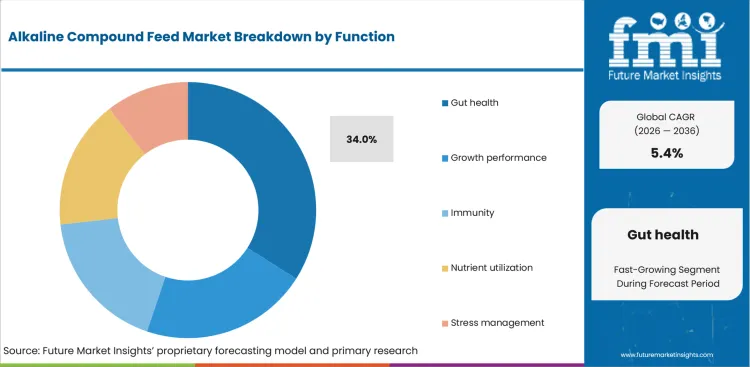
Gut health positioning is shaped by the need to connect alkaline inputs to practical animal performance rather than broad nutrition claims. EFSA’s December 2024 efficacy guidance links additive assessment to target animal feed use and documented claim support. The guidance raises the evidence threshold around gut-stability language before routine product approval and supplier evidence review. Nutrition teams therefore ask whether alkaline inputs improve ration consistency before approving wider programs. Alkaline products need performance notes that fit gut-stability reviews before technical teams approve routine ration use.
- By function, gut health is forecast to represent 34.0% of demand in 2026 driven by the need to manage digestive stress in commercial rations. Function claims therefore need a clearer link to animal resilience and repeatable ration response.
- Gut health adoption is gaining momentum in poultry and swine programs supported by measurable ration outcomes. Nutrition teams reviewing feed carbohydrase use are likely to ask whether alkaline additives help keep feed response consistent. Trial records are expected to decide whether the function moves beyond limited farm programs into routine diets.
What are the drivers, restraints, and opportunities in the Alkaline Compound Feed Market?
Near-term purchases are being shaped by feed-cost control and trial evidence gaps alongside species-specific service routes outlined below.
- Driver: Feed-cost pressure is expected to push feed mills toward alkaline inputs that help stabilize commercial ration behavior.
- Restraint: Adoption is likely to slow where trial results do not translate into routine mill specifications.
- Opportunity: Species-specific premix bundles are projected to open account access for suppliers that support formulation teams.
Feed mills are expected to expand alkaline additive trials in accounts exposed to repeated diet adjustments from grain variability. Alltech released its 2025 Agri-Food Outlook in April 2025 based on survey data from 28,230 feed mills. The survey scope shows why mill-level evidence carries weight during additive review and supplier qualification. Mill teams therefore look for alkaline products that are easy to dose and explain during nutrition reviews. Stronger trial records shorten internal review cycles for premix accounts that need repeatable field evidence.
Qualification risk is likely to slow adoption where supply teams lack a common success measure for feed trials. EFSA’s 2025 feed additive application procedure points to a formal authorisation process for additives used in animal nutrition. The review burden makes undocumented performance claims difficult to move into approved product lists. Feed additive suppliers need clear species evidence before they receive repeat orders from technical accounts.
Service packages are expected to convert restraint into a selling route for suppliers that assist mills beyond product delivery. The forum highlights broad regulator and industry attention around safe feed and practical account support. Suppliers using starter feed programs are likely to win consideration where young-animal nutrition requires tighter trial follow-up. Service teams improve account retention by translating test results into workable mill instructions before repeat purchase review
Which country CAGRs are profiled in the Alkaline Compound Feed Market?
.webp "Top Country Growth Comparison Alkaline Compound Feed Market Cagr (2026 2036)")
| Country | CAGR |
|---|---|
| United States | 3.2% |
| China | 4.1% |
| India | 4.9% |
| Germany | 2.8% |
| United Kingdom | 3.0% |
| Japan | 2.3% |
| South Korea | 3.1% |
Source: FMI's proprietary forecasting model and primary research
How do country-level CAGRs compare in the Alkaline Compound Feed Market?
The United States is projected to grow at 3.2% CAGR through 2036 and China is forecast to expand at 4.1% CAGR. India is anticipated to advance at 4.9% CAGR by 2036 and Germany is estimated to record 2.8% CAGR. The United Kingdom is likely to post 3.0% CAGR and Japan is projected to rise at 2.3% CAGR. South Korea is forecast to grow at 3.1% CAGR over the assessment period in feed-mill accounts. Variation reflects feed-mill scale in Asia and audit-led additive selection in established livestock systems. Country differences also reflect local evidence thresholds and technical service access across feed-mill networks and premix channels.
- By 2036, the United States is projected to grow at 3.2% CAGR due to poultry scale and feed-cost discipline. USDA NASS reported live-weight broiler output of 62.2 billion pounds in 2025. The broiler volume keeps alkaline additive screening close to feed conversion and gut-stability reviews. Integrated poultry accounts require careful qualification across mills and nutrition programs before vendors enter approved supplier lists. Local supply chain also screens vendors for storage evidence and response support after trial completion. Technical managers need records that show dosing behavior under commercial feed-line conditions and seasonal ration changes. Suppliers with field trial packs are expected to receive stronger consideration in accounts that require documented ration behavior.
- China’s alkaline compound feed market outlook is anticipated to advance at 4.1% CAGR over the assessment period due to large meat-output systems. The National Bureau of Statistics of China reported meat and poultry output of 100.72 million tonnes in 2025. The production scale raises the value of additives that support mill consistency during poultry and swine ration changes. Regional feed plants still require proof that products fit local raw-material conditions before routine line inclusion. Technical service coverage is expected to influence repeat awards in dense poultry and swine provinces. Cargill and Novonesis are positioned to gain traction where biological nutrition and mill service are both required.
- Alkaline compound feed demand in India is forecast to rise at 4.9% CAGR over the forecast period driven by poultry and dairy output expansion. PIB reported in November 2025 that egg production reached 149.11 billion numbers during 2024-25. The large commercial poultry base raises pressure on feed mills to stabilize young-bird diets and mineral delivery. Channel fragmentation keeps technical training and dealer education central to adoption across small and mid-sized poultry farms. Regional dealers also need simple dosage explanations before alkaline inputs move into smaller farms.
- Demand for alkaline compound feed in Germany is estimated to expand at 2.8% CAGR through 2036 owing to cost discipline and EU feed controls. Destatis reported that poultry and egg import prices rose 15.9% in December 2025 versus December 2024. Price pressure makes feed efficiency language more visible during additive review and supplier file comparison. The local opening is limited to vendors able to meet audit records and species dossiers. German accounts also require technical files that align with additive authorization expectations and customer audit routines. Suppliers with EU-ready documentation are expected to receive stronger consideration in accounts that require formal additive review.
- The United Kingdom alkaline compound feed sector is projected to record 3.0% CAGR during the assessment period attributable to compound feed value and changing feed costs. GOV.UK reported compound animal feed at GBP 4.4 billion in 2025 intermediate consumption. The spending level keeps additive value tied to ration cost and formulation service inside UK feed accounts. Feed production expansion creates openings for suppliers that reduce mill friction and sampling burden. UK feed mills also need specification files that support faster account review and sampling dispute resolution.
- The alkaline compound feed industry in Japan is predicted to advance at 2.3% CAGR through 2036 reinforced by feed security concerns and careful approval cycles. MAFF’s 2025 Basic Plan placed the calorie-supply food self-sufficiency ratio at 38% for FY2023. Import dependence makes feed inputs sensitive to price and availability shocks across poultry and livestock supply chains. Japanese integrators are likely to move slowly unless products match domestic documentation expectations and local trial routines. Local supply also favors technical explanations that reduce uncertainty around ration changes and annual contract review.
- South Korea is estimated to post 3.1% CAGR over the forecast period led by livestock modernization and animal-health export linkages. The export figure shows commercial attention around feed-linked amino acid and veterinary nutrition products. Domestic farm modernization keeps service support and biosecurity language in the purchase conversation for integrator accounts. Distributor accounts need Korean-language files that shorten technical review and reduce handoff risk during account onboarding. Integrators also screen suppliers for biosecurity language that fits farm-level service expectations and documentation routines.
Who are the notable companies in the Alkaline Compound Feed Market?
Cargill, ADM, Kemin Industries, Alltech, Novonesis, Adisseo, Trouw Nutrition, dsm-firmenich, and BASF are the notable companies shaping this market.
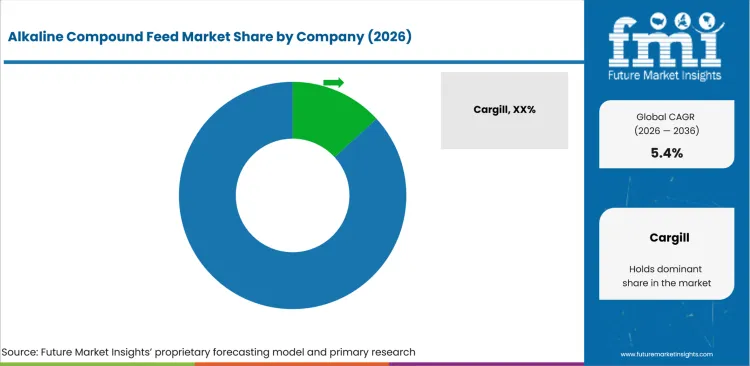
The market is moderately concentrated around multinational animal nutrition groups and specialist additive companies. Concentration is controlled by feed-mill access and documentation depth rather than product availability alone. Large companies hold scale in premixes and technical service that supports national account coverage. Regional specialists compete in narrow species programs and local distributor routes that require faster field response. Competition centers on formulation evidence and service continuity across mill trials that decide repeat orders. Feed additive suppliers connected to animal feed ingredients are expected to gain consideration in accounts requiring documentation and quick troubleshooting.
- Portfolio breadth shapes large-account screening before feed mills approve routine alkaline additive use across species programs. Cargill and ADM serve broad livestock accounts that need premixes and technical support under one commercial program. Their practical advantage is account reach across feed mills and integrators that want fewer vendor handoffs.
- Species-focused service creates a separate competitive route for performance-oriented accounts that need poultry and swine guidance. Kemin Industries and Alltech compete around gut-health programs and bird performance reviews for integrator teams. Their value comes from translating product claims into ration advice used by nutrition teams during commercial trials.
- Biological nutrition depth is expected to influence microbial-source decisions before premix suppliers approve recurring use. Novonesis and dsm-firmenich bring enzyme and microbial knowledge into discussions around nutrient availability and gut stability. Their fit improves in accounts that need source records and application support before commercial scale-up.
- Integrator service and regional technical coverage are expected to shape repeat purchasing during species-specific rollout programs. Adisseo and Trouw Nutrition serve accounts that need species guidance and documentation discipline in multiple regions. BASF adds documentation depth for accounts that need formulation support after product approval and during renewals.
Competitive Benchmarking: Alkaline Compound Feed Market
| Company | Feed Additive Fit | Species Service Fit | Documentation Depth | Regional Reach |
|---|---|---|---|---|
| Cargill | High | Strong | High | Global |
| ADM | High | Strong | Strong | Global |
| Kemin Industries | Strong | High | Strong | Global |
| Alltech | Strong | High | Strong | Global |
| Novonesis | High | Strong | High | Global |
| Adisseo | Strong | High | Strong | Global |
| Trouw Nutrition | High | Strong | High | Global |
| dsm-firmenich | High | Strong | High | Global |
| BASF | Medium | Medium | Strong | Global |
Source: Future Market Insights competitive analysis, 2026. Ratings reflect relative portfolio relevance and workflow fit. Service capability and geographic reach shape the remaining comparison.
Key Developments in the Alkaline Compound Feed Market
- In March 2025, Cargill Animal Nutrition & Health presented new mycotoxin and poultry gut-health research at the World Mycotoxin Forum and launched the NOTOX brand, including Notox AMA, for mycotoxin risk management across feed accounts. This development is expected to elevate feed-safety documentation requirements in poultry nutrition programs during additive qualification.
- In June 2025, dsm-firmenich launched GutServ Biotics to support piglet resilience and performance in early-life nutrition programs. The postbiotic solution was positioned to strengthen gut health and developmental outcomes in swine production systems. This development highlights growing supplier investment in species-specific gut-health validation for young-animal feed applications.
- In June 2025, Novonesis completed the acquisition of dsm-firmenich’s share in the Feed Enzyme Alliance, bringing sales, distribution, and customer-service activities for the alliance portfolio under Novonesis control. This development signals a broader focus on integrated service ownership within biological feed-input markets.
Key Players in the Alkaline Compound Feed Market
Integrated animal nutrition and premix companies
- Cargill
- ADM
- Trouw Nutrition
Specialty feed additive and gut-health companies
- Kemin Industries
- Alltech
- Adisseo
Biological nutrition and enzyme specialists
- Novonesis
- dsm-firmenich
- BASF
Alkaline Compound Feed Market - Report Scope
| Coverage field | Report scope |
|---|---|
| Market breakdown | Alkaline Compound Feed Market Breakdown By Form, Source, Livestock, Function, and Region |
| Market Definition | Alkaline compound feed products are feed additive and premix inputs used by feed mills to support ration buffering and gut stability and help nutrition teams manage nutrient-use control. |
| Regions Covered | North America, Latin America, Europe, East Asia, South Asia, and Middle East and Africa |
| Countries Covered | United States, China, India, Germany, United Kingdom, Japan, South Korea, and 30+ countries |
| Key Companies Profiled | Cargill, ADM, Kemin Industries, Alltech, Novonesis, Adisseo, Trouw Nutrition, dsm-firmenich, BASF |
| Forecast Period | 2026 to 2036 |
| Approach | Hybrid bottom-up and top-down methodology using form adoption rates and species use cases alongside country-level livestock indicators and supplier portfolio depth |
Source: Future Market Insights - analysis driven by proprietary forecasting models and primary research
Alkaline Compound Feed Market - Research Methodology
| Method | Approach |
|---|---|
| Primary Research | FMI analysts gathered input from manufacturers, service providers, technology developers, distributors, end users, sourcing teams, and subject-matter experts. Interviews examined purchasing decisions, product or service evaluation, adoption barriers, approval requirements, pricing considerations, and expectations for technical or commercial support. Respondents were also asked what evidence is required before a trial, pilot, or initial order develops into regular purchasing. |
| Desk Research | Desk research covered government statistics, regulatory publications, trade data, industry associations, technical literature, standards, company filings, product information, and official corporate announcements. Sources were reviewed for relevance, publication date, geographic coverage, and consistency with the defined market scope. Claims relating to performance, applications, approvals, capacity, investment, and commercial activity were retained only when supported by credible public evidence. |
| Market Sizing and Forecasting | The market model combined the baseline value with historical performance, segment structure, pricing and volume indicators, adoption levels, company participation, and country-level demand conditions. Forecast assumptions considered economic activity, investment trends, regulatory developments, technology adoption, purchasing cycles, supply availability, and barriers to wider market use. Segment and regional estimates were reconciled before the final market total was calculated. |
| Data Validation | Estimates were checked against multiple independent indicators, including public data, company activity, trade patterns, industry developments, and findings from primary interviews. Validation also tested whether products, services, applications, and company revenues fell within the defined market boundaries. Adjacent categories, unsupported claims, overlapping revenues, and activities without direct market relevance were excluded to reduce double counting and maintain consistency across segments and countries. |
Alkaline Compound Feed Market by Segments
Alkaline Compound Feed Market segmented by Form:
- Dry
- Liquid
- Pellet
- Premix
- Encapsulated
Alkaline Compound Feed Market segmented by Source:
- Synthetic
- Microbial
- Plant/Botanical
- Mineral
- Yeast-based
Alkaline Compound Feed Market segmented by Livestock:
- Poultry
- Swine
- Ruminants
- Aquaculture
- Equine and pets
Alkaline Compound Feed Market segmented by Function:
- Gut health
- Growth performance
- Immunity
- Nutrient utilization
- Stress management
Alkaline Compound Feed Market by Region:
- North America
- United States
- Canada
- Latin America
- Brazil
- Mexico
- Argentina
- Europe
- Germany
- United Kingdom
- France
- Italy
- Spain
- East Asia
- China
- Japan
- South Korea
- South Asia
- India
- Indonesia
- Thailand
- Middle East and Africa
- GCC countries
- South Africa
- Turkey
Research Sources and Bibliography
- USA Department of Agriculture, Economic Research Service. (2026, May). Corn and other feed grains - feed grains sector at a glance. USDA ERS.
- USA Department of Agriculture, National Agricultural Statistics Service. (2026, April). Poultry - Production and Value 2025 Summary. USDA NASS.
- International Feed Industry Federation. (2025, September). IFIF launches its Annual Report 2024/2025. IFIF.
- International Feed Industry Federation. (2025, October). Successful IFIF FAO Global Forum for Animal Feed and Feed Regulators & 18th IFRM. IFIF.
- European Food Safety Authority. (2026, May). Feed additives application procedure. EFSA.
- European Food Safety Authority. (2024, December). Online event: Update on FEEDAP guidance on the assessment of the efficacy of feed additives: what’s new. EFSA.
- National Bureau of Statistics of China. (2026, February). Statistical Communiqué of the People's Republic of China on the 2025 National Economic and Social Development. National Bureau of Statistics of China.
- Press Information Bureau. (2025, November). Release of Basic Animal Husbandry Statistics 2025 on the Occasion of National Milk Day 2025. Government of India.
- Federal Statistical Office. (2026, January). Import prices in December 2025: -2.3% on December 2024. Destatis.
- Department for Environment, Food & Rural Affairs. (2026, June). Total income from farming in the UK in 2025. GOV.UK.
- Ministry of Agriculture, Forestry and Fisheries. (2025, March). First Basic Plan for Food, Agriculture, and Rural Areas. MAFF.
- Ministry of Agriculture, Food and Rural Affairs. (2025, April). Exports of K-Food Plus in Q1 of 2025. MAFRA.
- European Food Safety Authority. (2026, June). Ready for EFSA’s new Guidance? Build a fit for purpose feed additive dossier—from microorganism to submission. EFSA.
- Alltech. (2025, April). 2025 Alltech Agri-Food Outlook shares global feed production survey data. Alltech.
- Cargill. (2025, March). Cargill Animal Nutrition & Health Presents New Insights on Mycotoxins and Poultry Gut Health. Cargill.
- ADM. (2025, June). ADM Opens Pioneering R&D Center Dedicated to Animal Health and Wellness. ADM.
- Novonesis. (2025, June). Deal to acquire dsm-firmenich’s share of the Feed Enzyme Alliance is completed, supporting Novonesis’ growth strategy. Novonesis.
- ADM Investor Relations. (2025, September). ADM, Alltech to Bring Together Unparalleled Expertise and Experience in New North American Animal Feed Joint Venture. ADM.
- dsm-firmenich. (2025, June). dsm-firmenich Launches GutServ® Biotics Postbiotic Solution for Stronger, Healthier Piglets. dsm-firmenich.
This bibliography is provided for reader reference and uses primary government, standards-body, official trade body, and company sources.
This Report Answers
- What is the estimated value of the Alkaline Compound Feed Market in 2026 and by 2036?
- What CAGR is forecast for the Alkaline Compound Feed Market from 2026 to 2036?
- Which segments shape demand across form and source categories and livestock and function categories?
- Which feed-cost and formulation pressures are expected to support purchase activity?
- How do country CAGRs differ across the profiled feed additive markets?
- Which companies compete on feed additive fit and species service during documentation-heavy account review?
- What should feed mills and procurement teams address before broader account expansion?
- How does additive documentation and feed regulation affect vendor selection?
Frequently Asked Questions
Why should executives track the Alkaline Compound Feed Market?
Executives should track this market because alkaline compounds influence feed cost control and ration consistency in poultry and swine programs. Performance repeatability also affects ruminant and aquaculture systems that rely on predictable feed responses.
What business problem does the Alkaline Compound Feed Market address?
The market addresses diet instability and processing variability that undermine confidence in repeat feed additive inclusion. Alkaline compounds help standardize feed behavior during formulation and milling.
What should procurement leaders evaluate before selecting suppliers?
Procurement leaders should assess formulation evidence and dry format stability prior to supplier approval. Species specific documentation and access to technical service should then guide sourcing decisions.
What limits return on investment for feed mills?
Return on investment is constrained by weak trial design and poor compatibility with existing mill processes. Unclear ownership between nutrition and procurement teams further slows payback during qualification and scale up.
How should suppliers build long term account confidence?
Suppliers should strengthen confidence by providing structured trial protocols and detailed specification packs. Documentation should clearly demonstrate expected mill handling behavior and formulation reliability before wider adoption.
Preview the report firsthand - request a free sample
Get SampleGet the brochure for pricing and purchase details.
Get PDFTable of Content
- Key Takeaways
- Market Size and CAGR
- Top Growth Driver
- Fastest Growing Segment
- Leading Region
- Key Companies
- Emerging Opportunities
- Executive Summary
- Global Market Outlook
- Demand-side Trends
- Supply-side Trends
- Technology Roadmap Analysis
- Analysis and Recommendations
- Analyst Perspective (What is happening? Why now? What should investors know?)
- Key Questions Answered
- How large is the market?
- What is the CAGR?
- What are key trends?
- Which region dominates?
- Who are the leaders?
- Market Overview
- Market Coverage / Taxonomy
- Market Definition / Scope / Limitations
- Research Methodology
- Chapter Orientation
- Analytical Lens and Working Hypotheses
- Market Structure, Signals, and Trend Drivers
- Benchmarking and Cross-market Comparability
- Market Sizing, Forecasting, and Opportunity Mapping
- Research Design and Evidence Framework
- Desk Research Programme (Secondary Evidence)
- Expert Input and Fieldwork (Primary Evidence)
- Tooling, Models, and Reference Databases
- Data Engineering and Model Build
- Quality Assurance and Audit Trail
- Market Background
- Market Dynamics (Drivers, Restraints, Opportunity, Trends)
- Scenario Forecast (Optimistic, Likely, Conservative)
- Impact Analysis
- AI Impact
- Sustainability Impact
- Regulatory Impact
- Technology Impact
- Consumer / Buyer Analysis
- Purchase Drivers
- Adoption Barriers
- Buyer Journey
- Opportunity Map Analysis
- Product Life Cycle Analysis
- Supply Chain Analysis
- Investment Feasibility Matrix
- Value Chain Analysis
- PESTLE and Porter's Analysis
- Regulatory Landscape
- Regional Parent Market Outlook
- Production and Consumption Statistics
- Import and Export Statistics
- Global Market Analysis and Forecast, 2021 to 2036
- Historical Market Size Value (USD Million) & Volume (Unit) Analysis, 2021 to 2025
- Current and Future Market Size Value (USD Million) & Volume (Unit) Projections, 2026 to 2036
- Y-o-Y Growth Trend Analysis
- Absolute $ Opportunity Analysis
- Global Market Pricing Analysis, 2021 to 2036
- Global Market Analysis and Forecast, By Form, 2021 to 2036
- Introduction / Key Findings
- Historical Market Size Value (USD Million) & Volume (Unit) Analysis By Form, 2021 to 2025
- Current and Future Market Size Value (USD Million) & Volume (Unit) Analysis and Forecast By Form, 2026 to 2036
- Dry
- Liquid
- Pellet
- Premix
- Encapsulated
- Dry
- Y-o-Y Growth Trend Analysis By Form, 2021 to 2025
- Absolute $ Opportunity Analysis By Form, 2026 to 2036
- Global Market Analysis and Forecast, By Source, 2021 to 2036
- Introduction / Key Findings
- Historical Market Size Value (USD Million) & Volume (Unit) Analysis By Source, 2021 to 2025
- Current and Future Market Size Value (USD Million) & Volume (Unit) Analysis and Forecast By Source, 2026 to 2036
- Microbial
- Synthetic
- Plant-Botanical
- Mineral
- Yeast-based
- Microbial
- Y-o-Y Growth Trend Analysis By Source, 2021 to 2025
- Absolute $ Opportunity Analysis By Source, 2026 to 2036
- Global Market Analysis and Forecast, By Livestock, 2021 to 2036
- Introduction / Key Findings
- Historical Market Size Value (USD Million) & Volume (Unit) Analysis By Livestock, 2021 to 2025
- Current and Future Market Size Value (USD Million) & Volume (Unit) Analysis and Forecast By Livestock, 2026 to 2036
- Poultry
- Swine
- Ruminants
- Aquaculture
- Equine and pets
- Poultry
- Y-o-Y Growth Trend Analysis By Livestock, 2021 to 2025
- Absolute $ Opportunity Analysis By Livestock, 2026 to 2036
- Global Market Analysis and Forecast, By Function, 2021 to 2036
- Introduction / Key Findings
- Historical Market Size Value (USD Million) & Volume (Unit) Analysis By Function, 2021 to 2025
- Current and Future Market Size Value (USD Million) & Volume (Unit) Analysis and Forecast By Function, 2026 to 2036
- Gut health
- Growth performance
- Immunity
- Nutrient utilization
- Stress management
- Gut health
- Y-o-Y Growth Trend Analysis By Function, 2021 to 2025
- Absolute $ Opportunity Analysis By Function, 2026 to 2036
- Global Market Analysis and Forecast, By Region, 2021 to 2036
- Introduction
- Historical Market Size Value (USD Million) & Volume (Unit) Analysis By Region, 2021 to 2025
- Current Market Size Value (USD Million) & Volume (Unit) Analysis and Forecast By Region, 2026 to 2036
- North America
- Latin America
- Western Europe
- Eastern Europe
- East Asia
- South Asia and Pacific
- Middle East & Africa
- Market Attractiveness Analysis By Region
- North America Market Analysis and Forecast, By Country, 2021 to 2036
- Historical Market Size Value (USD Million) & Volume (Unit) Trend Analysis By Market Taxonomy, 2021 to 2025
- Market Size Value (USD Million) & Volume (Unit) Forecast By Market Taxonomy, 2026 to 2036
- By Country
- USA
- Canada
- Mexico
- By Form
- By Source
- By Livestock
- By Function
- By Country
- Market Attractiveness Analysis
- By Country
- By Form
- By Source
- By Livestock
- By Function
- Key Takeaways
- Latin America Market Analysis and Forecast, By Country
- Historical Market Size Value (USD Million) & Volume (Unit) Trend Analysis By Market Taxonomy, 2021 to 2025
- Market Size Value (USD Million) & Volume (Unit) Forecast By Market Taxonomy, 2026 to 2036
- By Country
- Brazil
- Chile
- Rest of Latin America
- By Form
- By Source
- By Livestock
- By Function
- By Country
- Market Attractiveness Analysis
- By Country
- By Form
- By Source
- By Livestock
- By Function
- Key Takeaways
- Western Europe Market Analysis and Forecast, By Country
- Historical Market Size Value (USD Million) & Volume (Unit) Trend Analysis By Market Taxonomy, 2021 to 2025
- Market Size Value (USD Million) & Volume (Unit) Forecast By Market Taxonomy, 2026 to 2036
- By Country
- Germany
- UK
- Italy
- Spain
- France
- Nordic
- BENELUX
- Rest of Western Europe
- By Form
- By Source
- By Livestock
- By Function
- By Country
- Market Attractiveness Analysis
- By Country
- By Form
- By Source
- By Livestock
- By Function
- Key Takeaways
- Eastern Europe Market Analysis and Forecast, By Country
- Historical Market Size Value (USD Million) & Volume (Unit) Trend Analysis By Market Taxonomy, 2021 to 2025
- Market Size Value (USD Million) & Volume (Unit) Forecast By Market Taxonomy, 2026 to 2036
- By Country
- Russia
- Poland
- Hungary
- Balkan & Baltic
- Rest of Eastern Europe
- By Form
- By Source
- By Livestock
- By Function
- By Country
- Market Attractiveness Analysis
- By Country
- By Form
- By Source
- By Livestock
- By Function
- Key Takeaways
- East Asia Market Analysis and Forecast, By Country
- Historical Market Size Value (USD Million) & Volume (Unit) Trend Analysis By Market Taxonomy, 2021 to 2025
- Market Size Value (USD Million) & Volume (Unit) Forecast By Market Taxonomy, 2026 to 2036
- By Country
- China
- Japan
- South Korea
- By Form
- By Source
- By Livestock
- By Function
- By Country
- Market Attractiveness Analysis
- By Country
- By Form
- By Source
- By Livestock
- By Function
- Key Takeaways
- South Asia and Pacific Market Analysis and Forecast, By Country
- Historical Market Size Value (USD Million) & Volume (Unit) Trend Analysis By Market Taxonomy, 2021 to 2025
- Market Size Value (USD Million) & Volume (Unit) Forecast By Market Taxonomy, 2026 to 2036
- By Country
- India
- ASEAN
- Australia & New Zealand
- Rest of South Asia and Pacific
- By Form
- By Source
- By Livestock
- By Function
- By Country
- Market Attractiveness Analysis
- By Country
- By Form
- By Source
- By Livestock
- By Function
- Key Takeaways
- Middle East & Africa Market Analysis and Forecast, By Country
- Historical Market Size Value (USD Million) & Volume (Unit) Trend Analysis By Market Taxonomy, 2021 to 2025
- Market Size Value (USD Million) & Volume (Unit) Forecast By Market Taxonomy, 2026 to 2036
- By Country
- Kingdom of Saudi Arabia
- Other GCC Countries
- Türkiye
- South Africa
- Other African Union
- Rest of Middle East & Africa
- By Form
- By Source
- By Livestock
- By Function
- By Country
- Market Attractiveness Analysis
- By Country
- By Form
- By Source
- By Livestock
- By Function
- Key Takeaways
- Key Countries Market Analysis
- USA
- Pricing Analysis
- Market Share Analysis, 2025
- By Form
- By Source
- By Livestock
- By Function
- Canada
- Pricing Analysis
- Market Share Analysis, 2025
- By Form
- By Source
- By Livestock
- By Function
- Mexico
- Pricing Analysis
- Market Share Analysis, 2025
- By Form
- By Source
- By Livestock
- By Function
- Brazil
- Pricing Analysis
- Market Share Analysis, 2025
- By Form
- By Source
- By Livestock
- By Function
- Chile
- Pricing Analysis
- Market Share Analysis, 2025
- By Form
- By Source
- By Livestock
- By Function
- Germany
- Pricing Analysis
- Market Share Analysis, 2025
- By Form
- By Source
- By Livestock
- By Function
- UK
- Pricing Analysis
- Market Share Analysis, 2025
- By Form
- By Source
- By Livestock
- By Function
- Italy
- Pricing Analysis
- Market Share Analysis, 2025
- By Form
- By Source
- By Livestock
- By Function
- Spain
- Pricing Analysis
- Market Share Analysis, 2025
- By Form
- By Source
- By Livestock
- By Function
- France
- Pricing Analysis
- Market Share Analysis, 2025
- By Form
- By Source
- By Livestock
- By Function
- India
- Pricing Analysis
- Market Share Analysis, 2025
- By Form
- By Source
- By Livestock
- By Function
- ASEAN
- Pricing Analysis
- Market Share Analysis, 2025
- By Form
- By Source
- By Livestock
- By Function
- Australia & New Zealand
- Pricing Analysis
- Market Share Analysis, 2025
- By Form
- By Source
- By Livestock
- By Function
- China
- Pricing Analysis
- Market Share Analysis, 2025
- By Form
- By Source
- By Livestock
- By Function
- Japan
- Pricing Analysis
- Market Share Analysis, 2025
- By Form
- By Source
- By Livestock
- By Function
- South Korea
- Pricing Analysis
- Market Share Analysis, 2025
- By Form
- By Source
- By Livestock
- By Function
- Russia
- Pricing Analysis
- Market Share Analysis, 2025
- By Form
- By Source
- By Livestock
- By Function
- Poland
- Pricing Analysis
- Market Share Analysis, 2025
- By Form
- By Source
- By Livestock
- By Function
- Hungary
- Pricing Analysis
- Market Share Analysis, 2025
- By Form
- By Source
- By Livestock
- By Function
- Kingdom of Saudi Arabia
- Pricing Analysis
- Market Share Analysis, 2025
- By Form
- By Source
- By Livestock
- By Function
- Türkiye
- Pricing Analysis
- Market Share Analysis, 2025
- By Form
- By Source
- By Livestock
- By Function
- South Africa
- Pricing Analysis
- Market Share Analysis, 2025
- By Form
- By Source
- By Livestock
- By Function
- USA
- Market Structure Analysis
- Competition Dashboard
- Competition Benchmarking
- Market Share Analysis of Top Players
- By Regional
- By Form
- By Source
- By Livestock
- By Function
- Emerging Startups
- Innovation Benchmarking
- Competition Analysis
- Competition Deep Dive
- Cargill
- Overview
- Product Portfolio
- Profitability by Market Segments (Product/Region/Sales Channel)
- Sales Footprint
- Strategy Overview
- Marketing Strategy
- Product Strategy
- Channel Strategy
- ADM
- Kemin Industries
- Alltech
- Novonesis
- Adisseo
- Trouw Nutrition
- dsm-firmenich
- BASF
- Cargill
- Case Studies
- Success Stories
- Recent Developments
- Competition Deep Dive
- Assumptions & Acronyms Used


