

- Market Size (2026)
- USD 1.3 Bn
- Forecast (2036)
- USD 3.7 Bn
- CAGR (2026 to 2036)
- 11.0%
How big is Alpha Gal Syndrome Allergy Market in 2026?
USD 1.3 billion in 2026 and USD 3.7 billion by 2036 at an 11.0% CAGR.
Demand in the alpha-gal syndrome allergy market is projected to grow at 11.0% CAGR through 2036, lifting valuation to USD 3.7 billion from USD 1.3 billion in 2026. Increasing identification of alpha-gal syndrome cases is strengthening the need for accurate diagnostic testing and clinical evaluation pathways. CDC reported in January 2026 that more than 110,000 suspected United States cases were identified between 2010 and 2022. The agency estimated that as many as 450,000 Americans could be affected by the condition during that period. The difference supports stronger case recognition but does not establish automatic conversion into laboratory orders across all care settings. Laboratory networks need in vitro diagnostics that connect exposure history with interpreted specific IgE results and specialist referral decisions.
Delayed reactions often appear several hours after exposure and may involve food or medical products, which creates a complex care pathway. CDC guidance published in January 2026 identifies mammalian meat and dairy products alongside medicines and vaccines as possible exposure routes. Clinicians therefore need a detailed diet and medication history during diagnosis and continuing management for each suspected patient. Laboratories create recurring value through clinical diagnostics that preserve exposure history beside component results and referral decisions. Allergy practices must add emergency planning and practical avoidance guidance for patients with confirmed clinical reactions. Commercial retention depends on coordinated interpretation and follow-up rather than isolated sensitization reports without a clear management plan.
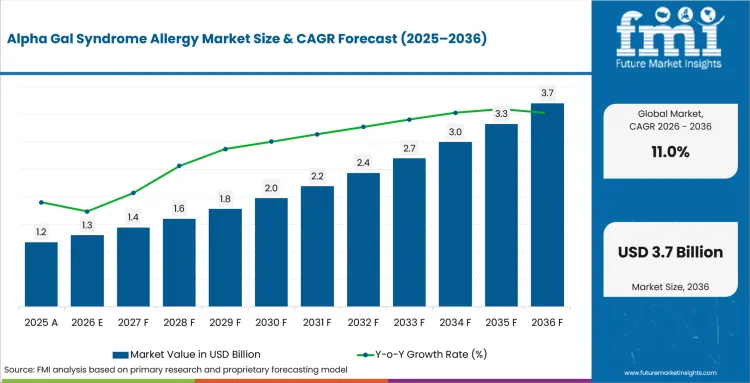
Key Takeaways of Alpha Gal Syndrome Allergy Market
- Commercial growth depends on converting delayed mammalian-product reactions into targeted testing and coordinated specialist management across recognized referral pathways.
- Diagnostic tests are estimated to account for 42.0% of product in 2026 due to their role in confirming clinically suspected sensitization.
- Disease diagnosis is projected to represent 46.0% by application in 2026 owing to the need for history-led laboratory interpretation.
- Hospitals and specialty clinics are forecast to capture 44.0% share in 2026, driven by specialist evaluation and emergency-care access.
- Delayed symptoms and asymptomatic sensitization constrain diagnostic conversion because positive IgE results require compatible clinical reactions and documented exposure history.
- Competition spans assay platforms and national laboratories alongside specialist immunology providers with verified alpha-gal testing or care capabilities.
Analyst Perspective
"Alpha-gal syndrome rewards organizations that connect the correct patient history with specific IgE testing and practical follow-up. A positive antibody result has limited clinical value without compatible delayed reactions and clear specialist interpretation for each patient. Laboratories strengthen recurring demand through coordinated referrals and exposure review alongside emergency planning and patient guidance across one documented care pathway."
- Anurag Sharma, Principal Analyst, Future Market Insights
How is the Alpha Gal Syndrome Allergy Market segmented?
The Alpha Gal Syndrome Allergy market is assessed by Product, Application, End User, Distribution Channel, Diagnosis Method, and Region.
The alpha-gal syndrome allergy market is assessed by product, application, end user, distribution channel, diagnosis method, and region. Product analysis separates diagnostic tests from emergency support and continuing-management products used across confirmed patient care pathways. Application categories distinguish disease diagnosis, disease management, emergency treatment, clinical research, and patient education across separate clinical objectives. End-user analysis reflects ordering authority across hospitals, diagnostic laboratories, research institutes, home healthcare, and life-science companies. Distribution channels cover direct laboratory relationships, medical distributors, retail pharmacies, online pharmacies, and specialty healthcare suppliers. Diagnosis methods separate blood-based specific IgE testing, skin testing, clinical evaluation, food challenge testing, and molecular diagnostics. The combined structure shows how testing responsibility and management access create different commercial routes across one patient pathway.
What keeps diagnostic tests ahead within product?
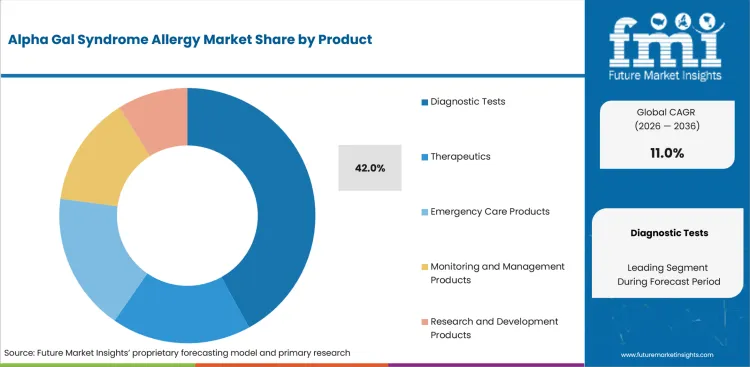
Alpha-gal diagnosis requires compatible delayed reactions and targeted laboratory evidence rather than broad allergy screening across unselected populations. Thermo Fisher Scientific published clinician guidance in May 2025 that places specific IgE blood testing beside exposure history and clinical response. The guidance explains that sensitization without symptoms cannot establish alpha-gal syndrome as a clinical diagnosis. The distinction supports immunoassay platforms with clear component reporting and specialist interpretation rather than indiscriminate screening.
- By product, diagnostic tests are forecast to represent 42.0% in 2026 driven by their central role in confirming clinically suspected alpha-gal sensitization. Recurring use across initial evaluation and unresolved anaphylaxis workups supports the approved product position across specialist pathways. Laboratories protect demand through consistent methodology and interpretation that separates symptomatic disease from incidental sensitization.
- Reference laboratories widen adoption by accepting specimens from care settings that lack local component-testing infrastructure. Outsourced testing services reduce analyzer investment and give smaller clinics access to validated specialist methods through established networks. Dependable transport and clear reporting support repeat use across regional referral networks and reduce incomplete diagnostic episodes. An antibody concentration cannot replace specialist management for patients with confirmed reactions and continuing exposure risks.
Which buying mechanism supports disease diagnosis in the application category?
Disease diagnosis converts delayed symptoms into a care decision through exposure review and a defined component-testing route. Clinicians assess mammalian-product exposure and reaction timing during the evaluation of patients who require targeted specific IgE testing. The pathway connects food allergy expertise with medication review and emergency-risk assessment across complex presentations. Specialist interpretation converts the laboratory result into practical avoidance advice and a defensible follow-up plan for each confirmed patient. Commercial activity rises through completed diagnostic episodes rather than screening among people without compatible clinical reactions.
- Disease diagnosis is likely to capture 46.0% share in 2026 attributable to its role in connecting symptoms with laboratory evidence. Labcorp explained in May 2026 that detectable specific IgE reflects sensitization and requires interpretation beside clinical history. Careful ordering reduces unnecessary dietary restrictions and directs patients with complex presentations toward appropriate specialist review and follow-up.
- Referral pathways widen adoption by transferring uncertain cases from primary care into specialist evaluation with complete exposure records. Oral food challenge services provide a comparison for supervised confirmation decisions across other food-allergy pathways. Alpha-gal pathways need different protocols since reactions may appear several hours later and create extended observation requirements. Shared records preserve the clinical reasoning that connects laboratory testing with continuing management decisions across several care settings.
What supports the position of hospitals and specialty clinics within the end user category?
Hospitals and specialty clinics coordinate allergy consultation with emergency assessment and dietary management for patients presenting with delayed systemic reactions. Specialist involvement becomes commercially relevant for unexplained anaphylaxis or gastrointestinal symptoms that cross several departments. Clinical teams connect medication exposure and mammalian-product history with laboratory interpretation inside one documented pathway. Smaller settings refer complex cases because emergency resources and specialist counseling remain concentrated within larger care networks.
- By end user, hospitals and specialty clinics are estimated to hold 44.0% in 2026 owing to integrated specialist and emergency-care access. Multidisciplinary review across allergy and gastroenterology services supports the approved end-user position during complex patient presentations and referrals. Referral capacity and coordinated follow-up sustain demand by managing clinical risk beyond the initial test result.
- Institutional adoption strengthens through clinician education that improves recognition across emergency departments and specialist hospital services. AAAAI released a dedicated alpha-gal review for clinicians in December 2025 covering current diagnosis and management practices. Hospitals can connect that education with epinephrine auto-injectors pathways that support severe reaction planning for confirmed patients. The mechanism differs from testing share by improving referral quality and emergency preparedness across the complete hospital network.
Why does direct sales lead the distribution channel category?
Direct sales connect laboratories with care networks through specialized component testing without a retail intermediary. Labcorp OnDemand published a direct-access alpha-gal testing pathway in November 2025 that measures reactive IgE and directs severe cases toward clinical care. The article states that laboratory results cannot establish alpha-gal syndrome without professional interpretation and documented clinical history. Digital ordering therefore needs laboratory information systems that preserve instructions beside result delivery and escalation guidance.
- The distribution channel category is forecast to be led by direct sales at 48.0% share in 2026 due to specialist ordering and controlled specimen logistics. Direct relationships help laboratories manage collection instructions and result delivery consistently across physician networks and regional specimen routes. Commercial advantage depends on responsive support and transparent limitations that protect trust across convenient testing pathways.
- Adoption grows through channels that combine convenient ordering with dependable clinical escalation for patients outside specialist centers. National specimen networks shorten the route to testing across underserved referral areas and support broader physician access. Clear eligibility language and accessible interpretation reduce inappropriate dietary changes among patients with positive sensitization results. Commercial credibility improves when testing convenience remains separate from diagnostic certainty throughout every patient communication and follow-up step.
How does blood-based IgE testing shape demand in the diagnosis method category?
Blood-based IgE testing addresses delayed reactions that routine skin testing cannot reproduce reliably across clinical settings. The method provides a measurable alpha-gal antibody concentration and can add selected mammalian components for interpretation. Clinical usefulness depends on reaction history and documented product tolerance across each suspected patient evaluation and referral pathway. The workflow supports allergy point-of-care referral decisions even though the definitive assay remains laboratory based. Specimen transport extends geographic coverage beyond specialist skin-testing services that require local expertise and supervised patient access.
- Based on diagnosis method, blood-based IgE testing is projected to account for 51.0% in 2026 due to its fit with delayed mammalian-product reactions. CDC guidance published in January 2026 identifies alpha-gal-specific IgE blood testing as the main diagnostic laboratory route. The same guidance requires clinical interpretation rather than treating a positive result as independent proof of disease.
- Panel adoption expands through combinations of alpha-gal IgE with selected mammalian-food components and total IgE interpretation. Laboratories can standardize specimen collection and electronic reporting across physician referral sites and regional networks. Specialist review remains necessary since antibody concentration does not predict reaction severity consistently across different patients. Clear limitations create more clinical value than unrelated allergens added to a broad screening panel without purpose.
What are the drivers, restraints, and opportunities in the Alpha Gal Syndrome Allergy Market?
Stronger clinician recognition supports targeted testing and specialist follow-up. Delayed symptoms and asymptomatic sensitization constrain diagnostic conversion. Integrated testing and management pathways create a credible commercial opening across laboratory and specialist care networks.
- Driver: Better clinical recognition converts delayed mammalian-product reactions into targeted testing and structured specialist follow-up.
- Restraint: Variable symptoms and asymptomatic sensitization reduce diagnostic certainty and can create unnecessary avoidance without specialist interpretation.
- Opportunity: Integrated testing and management pathways connect laboratory evidence with emergency planning and practical exposure guidance for confirmed patients.
Better clinical recognition supports market growth by directing compatible delayed reactions toward the correct laboratory test and specialist pathway. CDC published healthcare-provider communication resources in March 2026 with a dedicated fact sheet and practical education materials. Emergency departments and allergy practices can add the materials to intake questions and referral protocols across routine care settings. Commercial value appears through qualified testing orders and completed diagnostic episodes rather than awareness activity without clinical action or follow-up.
Diagnostic uncertainty materially slows market conversion since symptoms vary across patients and exposure events within the same care network. CDC reported in January 2026 that reactions usually begin two to six hours later and may involve several organ systems. The delayed presentation weakens patient recall and sends cases through unrelated gastrointestinal or emergency pathways during initial care. Laboratories lose repeat demand if results reach patients without specialist interpretation or documented management steps across continuing care.
Integrated care creates a credible opening by connecting laboratory testing with avoidance planning and emergency preparation across specialist services. CDC management guidance published in January 2026 recommends tick-bite prevention and individualized review of products that may contain alpha-gal. Laboratories and specialist clinics can translate that guidance into structured follow-up services for patients with confirmed clinical reactions. Commercial capture requires completed referrals and practical counseling rather than broad claims that additional testing automatically improves outcomes.
Which country CAGRs are profiled in the Alpha Gal Syndrome Allergy Market?
| Country | CAGR |
|---|---|
| UK | 14.3% |
| Canada | 13.6% |
| Japan | 12.7% |
| Brazil | 11.3% |
| USA | 9.9% |
| Germany | 9.6% |
| Australia | 7.9% |
How do country-level CAGRs compare in the Alpha Gal Syndrome Allergy Market?
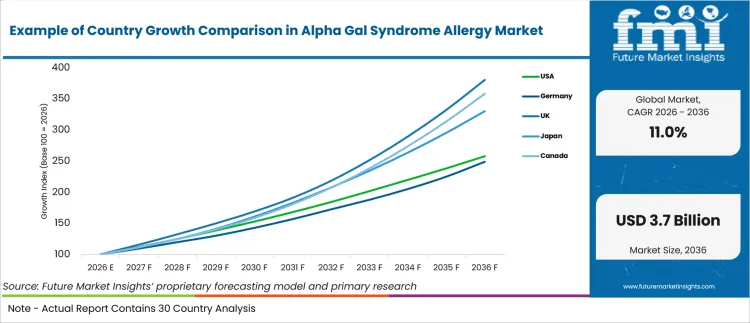
A 6.4-percentage-point spread separates the United Kingdom at 14.3% from Australia at 7.9% across the approved country outlook. The United Kingdom and Canada form a close upper group with a measured difference of 0.7 percentage points. Japan remains 0.9 points below Canada and 1.4 points above Brazil within the middle growth interval. The United States and Germany form the closest pair with a difference of 0.3 percentage points. Australia creates a wider 1.7-point lower gap relative to Germany across the approved country set. The spacing reflects different recognition and service conditions rather than one universal adoption sequence across national care systems. Commercial entry depends on local testing access and specialist capacity alongside each approved forecast for this market.
- The United Kingdom combines formal national guidance with accredited laboratory access but remains constrained by very low recorded case frequency.
- Canada has a defined provincial risk-planning signal although specialist access and coverage rules remain uneven across provincial care systems.
- Japan benefits from domestic specialist education and careful laboratory qualification while recognition outside allergy centers can delay referral completion.
- Brazil has concentrated urban diagnostic capacity but limited national protocols and uneven access weaken consistent patient identification across regions.
- The United States combines national laboratory routes with regional risk evidence while asymptomatic sensitization complicates conversion from testing into diagnosis.
- Germany supports component testing and specialist allergy research although access remains concentrated within established molecular diagnostic and referral networks.
- Australia has recognized tick-related allergy services in exposed coastal regions but long service distances constrain follow-up outside specialist hubs.
The full report provides country-level CAGR analysis across North America, Latin America, Europe, East Asia, South Asia, Oceania and the Middle East and Africa.
Country-wise Analysis
- United Kingdom care pathways require specialist referral and testing through an NHS-accredited laboratory for suspected alpha-gal cases. Alpha-gal syndrome allergy demand in the United Kingdom is estimated to post 14.3% CAGR over the forecast period, supported by national clinical guidance and recognized immunology laboratories. UKHSA published national guidance in August 2025 and updated the clinical information in January 2026. The guidance identifies specific IgE blood testing and states that skin testing is inappropriate for diagnosis. Accredited immunology access directly enables targeted testing across recognized referral pathways and supports consistent specialist interpretation nationwide. Very low reported frequency and limited recognition outside specialist services create material commercial friction across routine care settings. Commercial planning should prioritize clinician education and referral completion instead of broad screening across the general population.
- Canadian adoption develops through provincial health systems that review vector risk and organize specialist laboratory access. Sales of alpha-gal testing and care services in Canada are forecast to expand at 13.6% CAGR by 2036, shaped by province-level risk planning and specialist diagnostic capacity. Public Health Ontario published a ten-year hazard assessment in May 2026 that includes alpha-gal syndrome among emerging vector-related threats. The assessment gives provincial planners a formal basis for recognition and surveillance discussions across public-health programs. Specialist laboratory capacity enables testing within major centers and supports structured referrals from smaller and remote communities. Province-level coverage rules and long travel distances create material follow-up friction across dispersed patient communities. Market entry depends on provincial partnerships and remote interpretation support rather than one national purchasing route.
- Japanese diagnosis depends on specialist allergists who connect delayed reactions with component-specific laboratory evidence across hospital referral pathways. Alpha-gal syndrome allergy demand in Japan is forecast to rise at 12.7% CAGR over the forecast period, reinforced by current domestic clinical education and careful diagnostic qualification. The Japanese Society of Allergology published a dedicated alpha-gal syndrome review for domestic clinicians in August 2025. The review provides current terminology and a recognized educational route for physicians evaluating delayed reactions. Structured hospital referral and careful laboratory qualification directly enable appropriate testing decisions across established specialist services. Limited recognition outside specialist centers creates a material barrier for gastrointestinal or unexplained anaphylaxis presentations. Commercial providers need Japanese-language interpretation and reference-laboratory relationships that fit established regional hospital workflows and referral standards.
- Brazilian commercial activity concentrates in major urban laboratories and specialist allergy practices serving widely separated regions. Alpha-gal syndrome allergy demand in Brazil is projected to grow at 11.3% CAGR by 2036, influenced by emerging recognition and concentrated urban diagnostic capacity. A June 2025 review from Universidade Estadual Paulista described alpha-gal syndrome as an emerging diagnostic challenge linked with arthropod exposure. The review also identified limited national prevention and diagnostic policy for allergy conditions linked with arthropod exposure. Urban laboratory capacity directly enables targeted testing and specialist interpretation within major cities and established private networks. Uneven specialist access and limited protocols create material friction beyond larger cities and established private laboratory networks. Commercial expansion requires local clinical education and referral agreements rather than assumptions based on general allergy prevalence.
- United States laboratories provide national specimen routes and several component-based alpha-gal testing options across physician networks. Adoption of alpha-gal testing and care services in the United States is estimated to expand at 9.9% CAGR through 2036, underpinned by broad laboratory coverage and expanding public-health evidence. CDC published a July 2026 MMWR analysis of 3,000 blood-donor samples collected across ten states during 2024 and 2025. Seroprevalence was concentrated in states with more suspected cases and required clinical criteria beside testing. National laboratory coverage directly enables testing access across urban and rural referral sites within established physician networks. Clinical conversion remains constrained since positive sensitization must match delayed reactions and documented mammalian-product exposure history. Providers should separate screening inquiries from qualified orders and support specialist interpretation for uncertain patient presentations.
- German ordering pathways depend on specialist molecular diagnostics and referral networks with alpha-gal testing access. Germany's alpha-gal syndrome allergy outlook is anticipated to advance at 9.6% CAGR over the assessment period, supported by specialist allergy research and verified component-testing services. Helmholtz Munich currently lists alpha-gal allergy as a dedicated research field within its Institute of Allergy Research. IMD Berlin lists specific IgE code o215 for molecular alpha-gal assessment within its current testing service. The combination directly enables specialist interpretation and access to a defined laboratory route across established regional networks. Clinical recognition remains uneven outside established allergy centers and molecular diagnostic networks across several German regions. Commercial access requires local laboratory partnerships and German-language interpretation rather than generic food-allergy panels without alpha-gal context.
- Australian care pathways rely on regional allergy and emergency services in communities with recognized tick-related reactions. The Australian alpha-gal syndrome allergy sector is projected to record 7.9% CAGR during the assessment period, aided by coastal exposure awareness and established regional referral services. Northern NSW Local Health District reported three recent tick-related anaphylaxis presentations across its emergency services in November 2025. The same guidance stated that tick bites can lead to mammalian-meat allergy among exposed residents. Regional public guidance and specialist emergency pathways directly enable appropriate referrals across exposed coastal communities and hospitals. Long travel distances and concentrated expertise create material follow-up friction outside major coastal hubs and regional hospital networks. Commercial providers need specimen logistics and remote interpretation that preserve continuing care across dispersed communities and regional services.
Who are the notable companies in the Alpha Gal Syndrome Allergy Market?
Thermo Fisher Scientific, Labcorp, Quest Diagnostics, ARUP Laboratories, Eurofins Viracor, Mayo Clinic Laboratories, The Doctors Laboratory, IgGenix, UVA Health, and 60 Degrees Pharmaceuticals are the notable companies shaping this market.
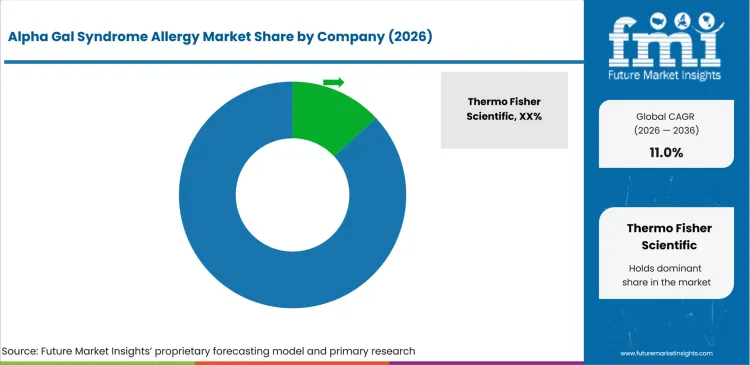
The competitive outlook combines assay technology with national laboratory networks and specialist clinical services across the complete care pathway. Platform companies compete through component standardization and compatibility with routine laboratory systems across several physician networks. Reference laboratories compete through specimen reach and panel breadth across national or regional physician ordering networks. Clinical programs create commercial value through referral completion and continuing management for patients with confirmed reactions. Emerging developers add discovery activity that could broaden future diagnostic or therapeutic options for the exact condition. Commercial advantage depends on coordinated performance across testing and care rather than corporate scale or general allergy activity alone.
- Thermo Fisher Scientific supplies the ImmunoCAP alpha-gal component used across established laboratory systems and physician referral networks. Labcorp provides a current panel containing alpha-gal and related mammalian-food components through its national specimen network. Quest Diagnostics lists alpha-gal panel code 10555 in its current 2026 tick-borne disease testing guide for clinicians. The three organizations compete through assay standardization and dependable result integration across physician ordering routes.
- ARUP Laboratories maintains a current alpha-gal food panel with disclosed methodology and detailed ordering requirements for referring clinicians. Eurofins Viracor offers a panel with beef and pork alongside lamb components and a stated turnaround time. Mayo Clinic Laboratories provides a current mammalian-meat allergy profile with alpha-gal and related food components. The group competes through specialist reporting and reference-laboratory reach rather than general corporate breadth across unrelated diagnostic categories.
- The Doctors Laboratory lists an Alpha Gal Components service under code ZZ37 with a two-day turnaround on its current test page. The offering gives United Kingdom clinicians a defined route beyond total-IgE testing for delayed reactions. IgGenix and UVA Health occupy narrower exact-market roles in antibody discovery and multidisciplinary patient care. Their commercial positions depend on documented progress rather than national diagnostic scale or general institutional reputation.
Competitive Benchmarking: Alpha Gal Syndrome Allergy Market
| Company | Alpha-gal Testing Breadth | Interpretation and Care Support | Exact-market Development Activity | Geographic Reach |
|---|---|---|---|---|
| Thermo Fisher Scientific | High | High | Medium | Global |
| Labcorp | High | High | Medium | United States |
| Quest Diagnostics | High | Medium | Low | United States |
| ARUP Laboratories | High | High | Low | United States referral network |
| Eurofins Viracor | High | Medium | Low | United States |
| Mayo Clinic Laboratories | High | High | Low | Multi-country referral network |
| IgGenix | Low | Low | High | United States development-stage |
| UVA Health | Low | High | High | Regional specialist care |
Key Developments in the Alpha Gal Syndrome Allergy Market
- In February 2025, IgGenix announced alpha-gal-specific monoclonal antibody discovery for presentation at the AAAAI and WAO Joint Congress. The company reported more than sixty antibodies derived from people with red-meat allergy and linked them with future candidate evaluation. The program broadens exact-market antibody discovery beyond routine laboratory testing and creates a defined candidate-evaluation route. Commercial relevance depends on subsequent validation and development rather than the conference presentation without further supporting evidence.
- In February 2026, Food Allergy Research & Education (FARE) and Alpha-gal Alliance announced a collaboration focused on public and clinical understanding. The organizations released a joint myths-and-facts guide and launched coordinated social media activity for alpha-gal syndrome. The collaboration provides a defined education route that can improve recognition and referral quality across public and clinical audiences. Commercial relevance depends on education producing qualified testing referrals and completed specialist care across participating networks.
- In July 2026, 60 Degrees Pharmaceuticals entered an exclusive option agreement with the Florida State University Research Foundation for castanospermine intellectual property. The agreement covers potential therapeutic development for alpha-gal syndrome alongside other tick-borne conditions (Powassan virus disease, tick-borne encephalitis, and post-treatment Lyme disease) within the stated option scope. The option gives the company a defined period to evaluate a United States licensing and commercialization strategy. Commercial relevance remains at the development stage pending regulatory planning and clinical validation across any future program.
Alpha Gal Syndrome Allergy Market - Report Scope
| Coverage field | Report scope |
|---|---|
| Market breakdown | Product, application, end user, distribution channel, diagnosis method, and region. |
| Quantitative Units | Revenue in USD billion and CAGR in %. |
| Market Definition | Diagnostic testing, clinical evaluation, emergency support products, and medically supervised management used for alpha-gal syndrome across defined care pathways. |
| Regions Covered | North America, Latin America, Europe, East Asia, South Asia, Oceania, and Middle East and Africa. |
| Countries Covered | UK, Canada, Japan, Brazil, USA, Germany, and Australia. |
| Key Companies Profiled | Thermo Fisher Scientific, Labcorp, Quest Diagnostics, ARUP Laboratories, Eurofins Viracor, Mayo Clinic Laboratories, The Doctors Laboratory, IgGenix, UVA Health, and 60 Degrees Pharmaceuticals |
| Forecast Period | 2026 to 2036. |
| Approach | Hybrid bottom-up and top-down market sizing supported by primary interviews and authoritative desk research. |
Alpha Gal Syndrome Allergy Market - Research Methodology
| Method | Approach |
|---|---|
| Primary Research | FMI analysts gathered input from manufacturers, service providers, technology developers, distributors, end users, procurement teams, and subject-matter experts. Interviews examined purchasing decisions, product or service evaluation, adoption barriers, approval requirements, pricing considerations, and expectations for technical or commercial support. Respondents were also asked what evidence is required before a trial, pilot, or initial order develops into regular purchasing. |
| Desk Research | Desk research covered government statistics, regulatory publications, trade data, industry associations, technical literature, standards, company filings, product information, and official corporate announcements. Sources were reviewed for relevance, publication date, geographic coverage, and consistency with the defined market scope. Claims relating to performance, applications, approvals, capacity, investment, and commercial activity were retained only when supported by credible public evidence. |
| Market Sizing and Forecasting | The market model combined the baseline value with historical performance, segment structure, pricing and volume indicators, adoption levels, company participation, and country-level demand conditions. Forecast assumptions considered economic activity, investment trends, regulatory developments, technology adoption, purchasing cycles, supply availability, and barriers to wider market use. Segment and regional estimates were reconciled before the final market total was calculated. |
| Data Validation | Estimates were checked against multiple independent indicators, including public data, company activity, trade patterns, industry developments, and findings from primary interviews. Validation also tested whether products, services, applications, and company revenues fell within the defined market boundaries. Adjacent categories, unsupported claims, overlapping revenues, and activities without direct market relevance were excluded to reduce double counting and maintain consistency across segments and countries. |
Alpha Gal Syndrome Allergy Market by Segments
Alpha Gal Syndrome Allergy Market segmented by Product:
- Diagnostic Tests
- Therapeutics
- Emergency Care Products
- Monitoring and Management Products
- Research and Development Products
Alpha Gal Syndrome Allergy Market segmented by Application:
- Disease Diagnosis
- Disease Management
- Emergency Treatment
- Clinical Research
- Patient Education
Alpha Gal Syndrome Allergy Market segmented by End User:
- Hospitals and Specialty Clinics
- Diagnostic Laboratories
- Academic and Research Institutes
- Home Healthcare
- Pharmaceutical and Biotechnology Companies
Alpha Gal Syndrome Allergy Market segmented by Distribution Channel:
- Direct Sales
- Medical Distributors
- Retail Pharmacies
- Online Pharmacies
- Specialty Healthcare Suppliers
Alpha Gal Syndrome Allergy Market segmented by Diagnosis Method:
- Blood-Based IgE Testing
- Skin Allergy Testing
- Clinical Evaluation
- Food Challenge Testing
- Molecular Diagnostics
Alpha Gal Syndrome Allergy Market by Region:
- North America
- United States
- Canada
- Latin America
- Brazil
- Mexico
- Argentina
- Chile
- Western Europe
- Germany
- France
- United Kingdom
- Italy
- Spain
- Benelux
- Nordics
- Eastern Europe
- Poland
- Czech Republic
- Romania
- Hungary
- East Asia
- China
- Japan
- South Korea
- South Asia and Pacific
- India
- ASEAN
- Australia and New Zealand
- Middle East and Africa
- GCC Countries
- South Africa
- Türkiye
- Israel
Research Sources and Bibliography
- Centers for Disease Control and Prevention. (2026, January 5). About Alpha-gal Syndrome.
- Centers for Disease Control and Prevention. (2026, January 5). Fast Facts: Products That May Contain Alpha-gal.
- Thermo Fisher Scientific. (2025, May). What healthcare providers should know about alpha-Gal syndrome.
- Thermo Fisher Scientific. (n.d.). ImmunoCAP Component nGal-alpha-1,3-Gal (alpha-Gal). Retrieved July 27, 2026.
- Labcorp. (2026, May 15). Ask the expert: Using food IgE and component testing to improve diagnostic accuracy.
- American Academy of Allergy, Asthma & Immunology. (2025, December 2). Beyond the Bite: Alpha-Gal Syndrome Review for Clinicians.
- Labcorp OnDemand. (2025, November 5). What is alpha-gal syndrome? What you need to know about the red meat allergy.
- UK Health Security Agency. (2025, August 7). Alpha-gal Syndrome.
- Centers for Disease Control and Prevention. (2026, March 27). Communication Resources.
- Centers for Disease Control and Prevention. (2026, January 5). Symptoms of Alpha-gal Syndrome.
- Centers for Disease Control and Prevention. (2026, January 5). Managing Alpha-gal Syndrome.
- Public Health Ontario. (2026, May 13). Hazard Identification and Risk Assessment (HIRA): Climate Change and Vector-borne Diseases.
- (2025, August 10).
- Almeida, G. A. de. (2025, June 5). O avanço de casos alérgicos desencadeados por artrópodes em humanos. Universidade Estadual Paulista.
- Helmholtz Munich. (n.d.). Caspar Ohnmacht. Retrieved July 27, 2026.
- IMD Berlin. (n.d.). Molecular allergy testing. Retrieved July 27, 2026.
- Northern NSW Local Health District. (2025, November 25). Northern NSW Local Health District urges residents to protect against tick bites.
- Labcorp. (n.d.). Alpha-Gal IgE Panel, Test 650003. Retrieved July 27, 2026.
- Quest Diagnostics. (2026). Tick-borne disease testing: Test list.
- ARUP Laboratories. (2025, July 21). Allergen, Food, Alpha-Gal (galactose-alpha-1,3-galactose) Panel.
- Eurofins Viracor. (n.d.). Alpha Gal Panel, Test Code 403196P. Retrieved July 27, 2026.
- Mayo Clinic Laboratories. (2026, July 1). Galactose-Alpha-1,3-Galactose (Alpha-Gal) Mammalian Meat Allergy Profile, Serum.
- The Doctors Laboratory. (2025, December 6). Alpha Gal Components (related to red meat).
- IgGenix. (2025, February 10). IgGenix to Present Alpha-gal Syndrome Monoclonal Antibody Discovery at 2025 AAAAI / WAO Joint Congress.
- UVA Health. (2025, December 9). Improving Quality of Life with Allergy Treatment.
- Food Allergy Research & Education. (2026, January 27). FARE and Alpha-gal Alliance Announce New Collaboration to Improve Understanding and Build Public Awareness of Alpha-gal Syndrome.
- 60 Degrees Pharmaceuticals, Inc. (2026, July 8). 60 Degrees Pharmaceuticals Announces Exclusive Option Agreement with Florida State University to Advance Castanospermine for Tick-Borne Diseases.
- Centers for Disease Control and Prevention. (2026, January 5). Clinical Diagnosis and Testing.
- Saunders, E. F., Taylor, M. L., Jones, E. S., et al. (2026, July 2). Alpha-gal immunoglobulin E seroprevalence among blood donors-10 states, 2024- 2025. Morbidity and Mortality Weekly Report, 75(25), 315- 321.
This bibliography is provided for reader reference and is not exhaustive. The full report contains the complete reference list and detailed citations
This Report Answers
- How large is the alpha gal syndrome allergy market in 2026 and 2036?
- Which clinical conditions convert suspected alpha-gal reactions into qualified diagnostic testing?
- Why do diagnostic tests hold the approved product share in 2026?
- How does disease diagnosis connect exposure history with specific IgE interpretation?
- Why do hospitals and specialty clinics retain a central end-user position?
- How do country growth conditions differ across the seven profiled markets?
- Which companies provide assays, laboratory services, clinical care, or discovery activity?
- What limits diagnostic conversion across patients with delayed or variable reactions?
- How can integrated testing and management pathways support recurring commercial demand?
Frequently Asked Questions
How big is the Alpha Gal Syndrome Allergy Market in 2026?
The alpha-gal syndrome allergy market is valued at USD 1.3 billion in 2026 and is forecast to reach USD 3.7 billion by 2036. Growth is supported by increasing identification of alpha-gal syndrome cases, which strengthens demand for accurate diagnostic testing and coordinated clinical evaluation pathways across recognized referral networks.
What is the CAGR of the Alpha Gal Syndrome Allergy Market from 2026 to 2036?
The alpha-gal syndrome allergy market grows at a CAGR of 11.0% between 2026 and 2036, supported by better clinical recognition that converts delayed mammalian-product reactions into targeted specific IgE testing and structured specialist follow-up across allergy and emergency care networks.
Which product type leads the Alpha Gal Syndrome Allergy Market?
Diagnostic tests account for 42.0% of the alpha-gal syndrome allergy market by product in 2026, driven by their central role in confirming clinically suspected sensitization through consistent methodology and specialist interpretation that separates symptomatic disease from incidental sensitization.
How much will the Alpha Gal Syndrome Allergy Market add between 2026 and 2036?
The alpha-gal syndrome allergy market is set to add USD 2.4 billion between 2026 and 2036, growing from USD 1.3 billion to USD 3.7 billion as integrated testing and management pathways connect laboratory evidence with emergency planning and practical exposure guidance for confirmed patients.
Who are the leading companies in the Alpha Gal Syndrome Allergy Market?
Ten companies lead the alpha-gal syndrome allergy market, including Thermo Fisher Scientific, Labcorp, Quest Diagnostics, ARUP Laboratories, Eurofins Viracor, Mayo Clinic Laboratories, The Doctors Laboratory, IgGenix, UVA Health, and 60 Degrees Pharmaceuticals, competing through assay standardization, national specimen networks, specialist clinical care, and emerging antibody and therapeutic development.
Preview the report firsthand - request a free sample
Get SampleGet the brochure for pricing and purchase details.
Get PDFTable of Content
- Key Takeaways
- Market Size and CAGR
- Top Growth Driver
- Fastest Growing Segment
- Leading Region
- Key Companies
- Emerging Opportunities
- Executive Summary
- Global Market Outlook
- Demand-side Trends
- Supply-side Trends
- Technology Roadmap Analysis
- Analysis and Recommendations
- Analyst Perspective (What is happening? Why now? What should investors know?)
- Key Questions Answered
- How large is the market?
- What is the CAGR?
- What are key trends?
- Which region dominates?
- Who are the leaders?
- Market Overview
- Market Coverage / Taxonomy
- Market Definition / Scope / Limitations
- Research Methodology
- Chapter Orientation
- Analytical Lens and Working Hypotheses
- Market Structure, Signals, and Trend Drivers
- Benchmarking and Cross-market Comparability
- Market Sizing, Forecasting, and Opportunity Mapping
- Research Design and Evidence Framework
- Desk Research Programme (Secondary Evidence)
- Expert Input and Fieldwork (Primary Evidence)
- Tooling, Models, and Reference Databases
- Data Engineering and Model Build
- Quality Assurance and Audit Trail
- Market Background
- Market Dynamics (Drivers, Restraints, Opportunity, Trends)
- Scenario Forecast (Optimistic, Likely, Conservative)
- Impact Analysis
- AI Impact
- Sustainability Impact
- Regulatory Impact
- Technology Impact
- Consumer / Buyer Analysis
- Purchase Drivers
- Adoption Barriers
- Buyer Journey
- Opportunity Map Analysis
- Product Life Cycle Analysis
- Supply Chain Analysis
- Investment Feasibility Matrix
- Value Chain Analysis
- PESTLE and Porter's Analysis
- Regulatory Landscape
- Regional Parent Market Outlook
- Production and Consumption Statistics
- Import and Export Statistics
- Global Market Analysis and Forecast, 2021 to 2036
- Historical Market Size Value (USD Billion) Analysis, 2021 to 2025
- Current and Future Market Size Value (USD Billion) Projections, 2026 to 2036
- Y-o-Y Growth Trend Analysis
- Absolute $ Opportunity Analysis
- Global Market Pricing Analysis, 2021 to 2036
- Global Market Analysis and Forecast, By Product, 2021 to 2036
- Introduction / Key Findings
- Historical Market Size Value (USD Billion) Analysis By Product, 2021 to 2025
- Current and Future Market Size Value (USD Billion) Analysis and Forecast By Product, 2026 to 2036
- Diagnostic Tests
- Serological Alpha-Gal IgE Tests
- Skin Prick Tests
- Therapeutics
- Antihistamines
- Epinephrine Auto Injectors
- Emergency Care Products
- Allergy Emergency Kits
- Emergency Injectable Epinephrine
- Monitoring and Management Products
- Dietary Management Solutions
- Patient Monitoring Tools
- Research and Development Products
- Diagnostic Reagents
- Research Assay Kits
- Diagnostic Tests
- Y-o-Y Growth Trend Analysis By Product, 2021 to 2025
- Absolute $ Opportunity Analysis By Product, 2026 to 2036
- Global Market Analysis and Forecast, By Application, 2021 to 2036
- Introduction / Key Findings
- Historical Market Size Value (USD Billion) Analysis By Application, 2021 to 2025
- Current and Future Market Size Value (USD Billion) Analysis and Forecast By Application, 2026 to 2036
- Disease Diagnosis
- Primary Diagnosis
- Confirmatory Testing
- Disease Management
- Dietary Counseling
- Allergy Monitoring
- Emergency Treatment
- Acute Allergy Management
- Anaphylaxis Treatment
- Clinical Research
- Biomarker Discovery
- Drug Development
- Patient Education
- Dietary Awareness Programs
- Allergy Prevention Programs
- Disease Diagnosis
- Y-o-Y Growth Trend Analysis By Application, 2021 to 2025
- Absolute $ Opportunity Analysis By Application, 2026 to 2036
- Global Market Analysis and Forecast, By End User, 2021 to 2036
- Introduction / Key Findings
- Historical Market Size Value (USD Billion) Analysis By End User, 2021 to 2025
- Current and Future Market Size Value (USD Billion) Analysis and Forecast By End User, 2026 to 2036
- Hospitals and Specialty Clinics
- Allergy Clinics
- Multispecialty Hospitals
- Diagnostic Laboratories
- Independent Diagnostic Laboratories
- Hospital Laboratories
- Academic and Research Institutes
- University Research Centers
- Government Research Institutes
- Home Healthcare
- Home Monitoring
- Telehealth Services
- Pharmaceutical and Biotechnology Companies
- Allergy Therapeutics Developers
- Diagnostic Kit Manufacturers
- Hospitals and Specialty Clinics
- Y-o-Y Growth Trend Analysis By End User, 2021 to 2025
- Absolute $ Opportunity Analysis By End User, 2026 to 2036
- Global Market Analysis and Forecast, By Distribution Channel, 2021 to 2036
- Introduction / Key Findings
- Historical Market Size Value (USD Billion) Analysis By Distribution Channel, 2021 to 2025
- Current and Future Market Size Value (USD Billion) Analysis and Forecast By Distribution Channel, 2026 to 2036
- Direct Sales
- Hospital Procurement
- Institutional Contracts
- Medical Distributors
- National Distributors
- Regional Distributors
- Retail Pharmacies
- Chain Pharmacies
- Independent Pharmacies
- Online Pharmacies
- E-Commerce Healthcare Platforms
- Digital Pharmacy Services
- Specialty Healthcare Suppliers
- Allergy Care Suppliers
- Diagnostic Product Suppliers
- Direct Sales
- Y-o-Y Growth Trend Analysis By Distribution Channel, 2021 to 2025
- Absolute $ Opportunity Analysis By Distribution Channel, 2026 to 2036
- Global Market Analysis and Forecast, By Diagnosis Method, 2021 to 2036
- Introduction / Key Findings
- Historical Market Size Value (USD Billion) Analysis By Diagnosis Method, 2021 to 2025
- Current and Future Market Size Value (USD Billion) Analysis and Forecast By Diagnosis Method, 2026 to 2036
- Blood-Based IgE Testing
- Alpha-Gal Specific IgE Assays
- ImmunoCAP Testing
- Skin Allergy Testing
- Skin Prick Testing
- Intradermal Testing
- Clinical Evaluation
- Patient History Assessment
- Symptom Evaluation
- Food Challenge Testing
- Oral Food Challenge
- Supervised Clinical Challenge
- Molecular Diagnostics
- Component Resolved Diagnostics
- Allergen Profiling
- Blood-Based IgE Testing
- Y-o-Y Growth Trend Analysis By Diagnosis Method, 2021 to 2025
- Absolute $ Opportunity Analysis By Diagnosis Method, 2026 to 2036
- Global Market Analysis and Forecast, By Region, 2021 to 2036
- Introduction
- Historical Market Size Value (USD Billion) Analysis By Region, 2021 to 2025
- Current Market Size Value (USD Billion) Analysis and Forecast By Region, 2026 to 2036
- North America
- Latin America
- Western Europe
- Eastern Europe
- East Asia
- South Asia and Pacific
- Middle East & Africa
- Market Attractiveness Analysis By Region
- North America Market Analysis and Forecast, By Country, 2021 to 2036
- Historical Market Size Value (USD Billion) Trend Analysis By Market Taxonomy, 2021 to 2025
- Market Size Value (USD Billion) Forecast By Market Taxonomy, 2026 to 2036
- By Country
- USA
- Canada
- By Product
- By Application
- By End User
- By Distribution Channel
- By Diagnosis Method
- By Country
- Market Attractiveness Analysis
- By Country
- By Product
- By Application
- By End User
- By Distribution Channel
- By Diagnosis Method
- Key Takeaways
- Latin America Market Analysis and Forecast, By Country
- Historical Market Size Value (USD Billion) Trend Analysis By Market Taxonomy, 2021 to 2025
- Market Size Value (USD Billion) Forecast By Market Taxonomy, 2026 to 2036
- By Country
- Brazil
- Mexico
- Chile
- Rest of Latin America
- By Product
- By Application
- By End User
- By Distribution Channel
- By Diagnosis Method
- By Country
- Market Attractiveness Analysis
- By Country
- By Product
- By Application
- By End User
- By Distribution Channel
- By Diagnosis Method
- Key Takeaways
- Western Europe Market Analysis and Forecast, By Country
- Historical Market Size Value (USD Billion) Trend Analysis By Market Taxonomy, 2021 to 2025
- Market Size Value (USD Billion) Forecast By Market Taxonomy, 2026 to 2036
- By Country
- Germany
- UK
- Italy
- Spain
- France
- Nordic
- BENELUX
- Rest of Western Europe
- By Product
- By Application
- By End User
- By Distribution Channel
- By Diagnosis Method
- By Country
- Market Attractiveness Analysis
- By Country
- By Product
- By Application
- By End User
- By Distribution Channel
- By Diagnosis Method
- Key Takeaways
- Eastern Europe Market Analysis and Forecast, By Country
- Historical Market Size Value (USD Billion) Trend Analysis By Market Taxonomy, 2021 to 2025
- Market Size Value (USD Billion) Forecast By Market Taxonomy, 2026 to 2036
- By Country
- Russia
- Poland
- Hungary
- Balkan & Baltic
- Rest of Eastern Europe
- By Product
- By Application
- By End User
- By Distribution Channel
- By Diagnosis Method
- By Country
- Market Attractiveness Analysis
- By Country
- By Product
- By Application
- By End User
- By Distribution Channel
- By Diagnosis Method
- Key Takeaways
- East Asia Market Analysis and Forecast, By Country
- Historical Market Size Value (USD Billion) Trend Analysis By Market Taxonomy, 2021 to 2025
- Market Size Value (USD Billion) Forecast By Market Taxonomy, 2026 to 2036
- By Country
- China
- Japan
- South Korea
- By Product
- By Application
- By End User
- By Distribution Channel
- By Diagnosis Method
- By Country
- Market Attractiveness Analysis
- By Country
- By Product
- By Application
- By End User
- By Distribution Channel
- By Diagnosis Method
- Key Takeaways
- South Asia and Pacific Market Analysis and Forecast, By Country
- Historical Market Size Value (USD Billion) Trend Analysis By Market Taxonomy, 2021 to 2025
- Market Size Value (USD Billion) Forecast By Market Taxonomy, 2026 to 2036
- By Country
- India
- ASEAN
- Australia & New Zealand
- Rest of South Asia and Pacific
- By Product
- By Application
- By End User
- By Distribution Channel
- By Diagnosis Method
- By Country
- Market Attractiveness Analysis
- By Country
- By Product
- By Application
- By End User
- By Distribution Channel
- By Diagnosis Method
- Key Takeaways
- Middle East & Africa Market Analysis and Forecast, By Country
- Historical Market Size Value (USD Billion) Trend Analysis By Market Taxonomy, 2021 to 2025
- Market Size Value (USD Billion) Forecast By Market Taxonomy, 2026 to 2036
- By Country
- Kingdom of Saudi Arabia
- Other GCC Countries
- Türkiye
- South Africa
- Other African Union
- Rest of Middle East & Africa
- By Product
- By Application
- By End User
- By Distribution Channel
- By Diagnosis Method
- By Country
- Market Attractiveness Analysis
- By Country
- By Product
- By Application
- By End User
- By Distribution Channel
- By Diagnosis Method
- Key Takeaways
- Key Countries Market Analysis
- USA
- Pricing Analysis
- Market Share Analysis, 2025
- By Product
- By Application
- By End User
- By Distribution Channel
- By Diagnosis Method
- Canada
- Pricing Analysis
- Market Share Analysis, 2025
- By Product
- By Application
- By End User
- By Distribution Channel
- By Diagnosis Method
- Mexico
- Pricing Analysis
- Market Share Analysis, 2025
- By Product
- By Application
- By End User
- By Distribution Channel
- By Diagnosis Method
- Brazil
- Pricing Analysis
- Market Share Analysis, 2025
- By Product
- By Application
- By End User
- By Distribution Channel
- By Diagnosis Method
- Chile
- Pricing Analysis
- Market Share Analysis, 2025
- By Product
- By Application
- By End User
- By Distribution Channel
- By Diagnosis Method
- Germany
- Pricing Analysis
- Market Share Analysis, 2025
- By Product
- By Application
- By End User
- By Distribution Channel
- By Diagnosis Method
- UK
- Pricing Analysis
- Market Share Analysis, 2025
- By Product
- By Application
- By End User
- By Distribution Channel
- By Diagnosis Method
- Italy
- Pricing Analysis
- Market Share Analysis, 2025
- By Product
- By Application
- By End User
- By Distribution Channel
- By Diagnosis Method
- Spain
- Pricing Analysis
- Market Share Analysis, 2025
- By Product
- By Application
- By End User
- By Distribution Channel
- By Diagnosis Method
- France
- Pricing Analysis
- Market Share Analysis, 2025
- By Product
- By Application
- By End User
- By Distribution Channel
- By Diagnosis Method
- India
- Pricing Analysis
- Market Share Analysis, 2025
- By Product
- By Application
- By End User
- By Distribution Channel
- By Diagnosis Method
- ASEAN
- Pricing Analysis
- Market Share Analysis, 2025
- By Product
- By Application
- By End User
- By Distribution Channel
- By Diagnosis Method
- Australia & New Zealand
- Pricing Analysis
- Market Share Analysis, 2025
- By Product
- By Application
- By End User
- By Distribution Channel
- By Diagnosis Method
- China
- Pricing Analysis
- Market Share Analysis, 2025
- By Product
- By Application
- By End User
- By Distribution Channel
- By Diagnosis Method
- Japan
- Pricing Analysis
- Market Share Analysis, 2025
- By Product
- By Application
- By End User
- By Distribution Channel
- By Diagnosis Method
- South Korea
- Pricing Analysis
- Market Share Analysis, 2025
- By Product
- By Application
- By End User
- By Distribution Channel
- By Diagnosis Method
- Russia
- Pricing Analysis
- Market Share Analysis, 2025
- By Product
- By Application
- By End User
- By Distribution Channel
- By Diagnosis Method
- Poland
- Pricing Analysis
- Market Share Analysis, 2025
- By Product
- By Application
- By End User
- By Distribution Channel
- By Diagnosis Method
- Hungary
- Pricing Analysis
- Market Share Analysis, 2025
- By Product
- By Application
- By End User
- By Distribution Channel
- By Diagnosis Method
- Kingdom of Saudi Arabia
- Pricing Analysis
- Market Share Analysis, 2025
- By Product
- By Application
- By End User
- By Distribution Channel
- By Diagnosis Method
- Türkiye
- Pricing Analysis
- Market Share Analysis, 2025
- By Product
- By Application
- By End User
- By Distribution Channel
- By Diagnosis Method
- South Africa
- Pricing Analysis
- Market Share Analysis, 2025
- By Product
- By Application
- By End User
- By Distribution Channel
- By Diagnosis Method
- USA
- Market Structure Analysis
- Competition Dashboard
- Competition Benchmarking
- Market Share Analysis of Top Players
- By Regional
- By Product
- By Application
- By End User
- By Distribution Channel
- By Diagnosis Method
- Emerging Startups
- Innovation Benchmarking
- Competition Analysis
- Competition Deep Dive
- Thermo Fisher Scientific
- Overview
- Product Portfolio
- Profitability by Market Segments
- Sales Footprint
- Strategy Overview
- Marketing Strategy
- Product Strategy
- Channel Strategy
- Eurofins Scientific
- Quest Diagnostics
- Labcorp
- Viracor Eurofins
- Siemens Healthineers
- Danaher Corporation
- Stallergenes Greer
- ALK-Abelló
- Omega Diagnostics
- Thermo Fisher Scientific
- Case Studies
- Success Stories
- Recent Developments
- Competition Deep Dive
- Assumptions & Acronyms Used


