

- Market Size (2026)
- USD 284.6 Mn
- Forecast (2036)
- USD 2593.9 Mn
- CAGR (2026 to 2036)
- 24.7%
How big is Alzheimer's Blood Test Market in 2026?
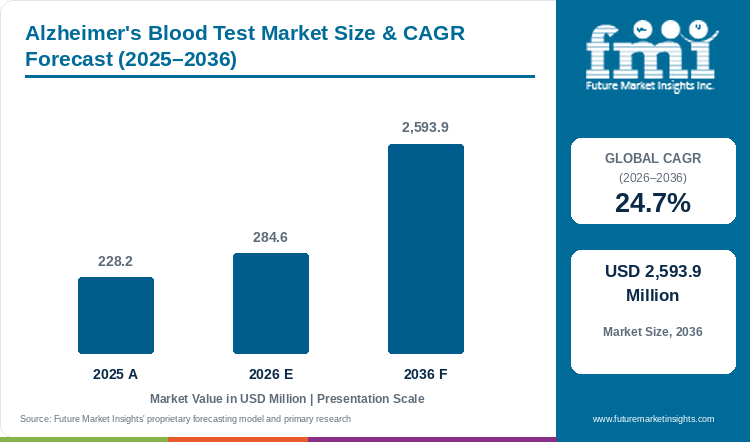
Valued at USD 228.2 Million during 2025, worldwide alzheimer's blood test sales reach an estimated USD 284.6 Million in 2026 and a projected USD 2,593.9 Million by 2036 on an expected 24.7% CAGR.
Memory assessment clinics face severe scheduling backlogs for positron emission tomography brain scans and invasive lumbar punctures when qualifying mild cognitive impairment patients for anti-amyloid infusions, prompting the Alzheimer's Association in July 2025 to release its first specialty care clinical practice guideline endorsing blood-based biomarkers with at least 90% sensitivity [1]. When compared with spinal fluid sampling or radiotracer imaging, quantifying phosphorylated tau isoforms in peripheral venous plasma helps neurologists assess the likelihood of Alzheimer's-associated amyloid pathology alongside clinical evaluation, which explains why p-tau217 is projected to capture 47.2% of biomarker demand in 2026 on automated immunochemistry analyzers. According to FMI, global alzheimer's blood test revenue stands at USD 228.2 Million for 2025 before reaching an estimated USD 284.6 Million in 2026 and hitting a projected USD 2,593.9 Million by 2036, which represents an expected 24.7% CAGR and USD 2,309.3 Million in added turnover. Across major healthcare systems, national expansion is anticipated between 19.0% annually in Germany and 30.2% in the UAE until 2036, although inter-laboratory cutoff variations and primary care reimbursement gaps still restrain wider outpatient ordering.
Key Market Trends & Insights
- By biomarker: Phosphorylated tau p-tau217 is projected to claim 47.2% of 2026 biomarker revenue because plasma p-tau217 fold-changes distinguish brain amyloid status with above 90% diagnostic concordance.
- By technology: Immunoassay platforms are estimated to generate 64.8% of 2026 technology sales since chemiluminescent reagent cartridges run directly on random-access hospital analyzers.
- By application: Diagnostic evaluation of symptomatic patients is slated to capture 56.4% of 2026 application volume as cognitive specialists verify amyloid eligibility prior to monoclonal antibody dosing.
- By end user: Commercial diagnostic laboratories are forecast to secure 51.8% of 2026 end user billings through centralized cold-chain courier logistics and standardized dual-threshold reporting.
Regional Highlights
- Top national expansion pace: Preventive geriatric screening mandates are projected to propel UAE testing demand at a 30.2% ten-year clip through 2036 across private tertiary hospitals.
- Subsequent country trajectories: South Korea is expected to post 27.9% and the USA is anticipated at 25.7% ahead of the UK at 24.2%, while Canada (22.3%) and Japan (21.4%) outpace Germany's predicted 19.0% rate.
Market Size & Forecast
Table 1: Market Size and Forecast for the Alzheimer's Blood Test Market (USD million and CAGR percentage), 2025 to 2036
| Metric | Value |
|---|---|
| 2025 Market Size | USD 228.2 Million |
| Estimated Market Size in 2026 | USD 284.6 Million |
| Projected Market Size by 2036 | USD 2,593.9 Million |
| CAGR, 2026 to 2036 | 24.7% |
| Added Revenue, 2026 to 2036 | USD 2,309.3 Million |
Commercial diagnostic networks are upgrading specimen handling and plasma aliquoting lines to meet strict pre-analytical stability thresholds across outpatient phlebotomy sites. In October 2025, the Global Biomarker Standardization Consortium published an evidence-based sample handling protocol in Alzheimer's & Dementia showing that beta-amyloid peptides decline by more than 10% under delayed room-temperature centrifugation whereas p-tau217 remains highly stable [2]. Consequently, regional reference hubs are pairing automated sample sorters with neurodegenerative disease care panels so community neurologists receive quantitative amyloid probability scores within 48 hours.
Clinical Memory Center Throughput and Blood Biomarker Triage Sizing
Table 2: Clinical Memory Center Throughput and Blood Biomarker Triage Indicators for the Alzheimer's Blood Test Market (USD Million and operational ranges), mixed historical and forecast years from 2025 to 2036
| Metric | 2025 | 2026 | 2036 |
|---|---|---|---|
| Market size (USD Million) | 228.2 | 284.6 | 2,593.9 |
| Active clinical memory assessment centers (thousand sites) | 3.1 to 4.5 | 3.6 to 5.2 | 12.8 to 18.5 |
| Average diagnostic wait time from referral to blood test (days) | 45 to 90 | 35 to 75 | 7 to 14 |
| Annualized PET scan avoidance cost savings per clinic (USD) | 120,000 to 240,000 | 145,000 to 290,000 | 480,000 to 920,000 |
Operational note: Memory center figures cover specialized cognitive neurology practices and academic geriatric units utilizing validated plasma biomarker triage prior to confirmatory amyloid imaging.
Integrating plasma triage gates into memory clinic intake pathways cuts multi-month diagnostic waitlists by assessing the likelihood of Alzheimer's-associated amyloid pathology in symptomatic patients before ordering expensive neuroimaging. Neurology departments combine phosphorylated tau ratios with neurological biomarkers such as neurofilament light chain to stratify mild cognitive impairment cohorts rapidly.
Laboratory Instrumentation & Clinical Chemistry Procurement Sizing
Reference laboratory directors judge blood biomarker platforms on within-run precision and reagent onboard stability across multi-shift operations. High-volume hospital laboratories favor automated immunoassays paired with digital neuro biomarkers that operate on existing chemiluminescent core analyzers without requiring manual solid-phase extraction.
Table 3: Laboratory Instrumentation Procurement Indicators for the Alzheimer's Blood Test Market (USD and volume metrics), mixed historical and forecast years from 2025 to 2036
| Metric | 2025 | 2026 | 2036 |
|---|---|---|---|
| Commercial blood test volume performed globally (thousand tests) | 680.0 | 895.0 | 9,850.0 |
| Average laboratory reimbursement fee per commercial blood test (USD) | 335.6 | 318.0 | 263.3 |
| Reagent kit acquisition cost per diagnostic test run (USD) | 78.0 to 125.0 | 72.0 to 118.0 | 42.0 to 68.0 |
| Automated high-throughput benchtop analyzer placement price (USD) | 95,000 to 185,000 | 92,000 to 178,000 | 65,000 to 125,000 |
Table 4: Biomarker Sector Procurement Indicators for the Alzheimer's Blood Test Market (USD Million and percentages), 2026
| Benchmark Indicator | 2026 Value | Institutional Reference Basis |
|---|---|---|
| Global market valuation, 2026 | USD 284.6 Million | 2026 commercial assay and laboratory testing baseline |
| Phosphorylated tau p-tau217 revenue, 2026 | USD 134.3 Million | 47.2% share of global biomarker demand |
| Immunoassay technology revenue, 2026 | USD 184.4 Million | 64.8% share of global technology installations |
| Symptomatic evaluation application revenue, 2026 | USD 160.5 Million | 56.4% share of clinical application orders |
Analyst Perspective
"Plasma phosphorylated tau assays give memory clinics a rapid frontline filter before scheduling expensive amyloid brain scans. Harmonizing dual-cutoff reference materials across analyzer vendors remains essential before primary care physicians order routine cognitive panels."
- Anurag Sharma, Principal Consultant, Future Market Insights.
How is the alzheimer's blood test market segmented?
The alzheimer's blood test market is segmented by biomarker, technology, application, end user, and region. In 2026, p-tau217 is projected to account for 47.2%, immunoassay for 64.8%, symptomatic evaluation for 56.4%, and diagnostic laboratories for 51.8%.
By biomarker: p-tau217, p-tau181, amyloid beta ratio (Abeta42/Abeta40), neurofilament light (NfL), and glial fibrillary acidic protein (GFAP).
By technology: immunoassay, mass spectrometry, and digital single-molecule array (Simoa).
By application: diagnostic evaluation of symptomatic patients, early cognitive impairment screening, and clinical trial patient stratification.
By end user: diagnostic laboratories, hospitals and memory clinics, and academic research institutes.
Why Does Phosphorylated Tau p-tau217 Command the Biomarker Category?
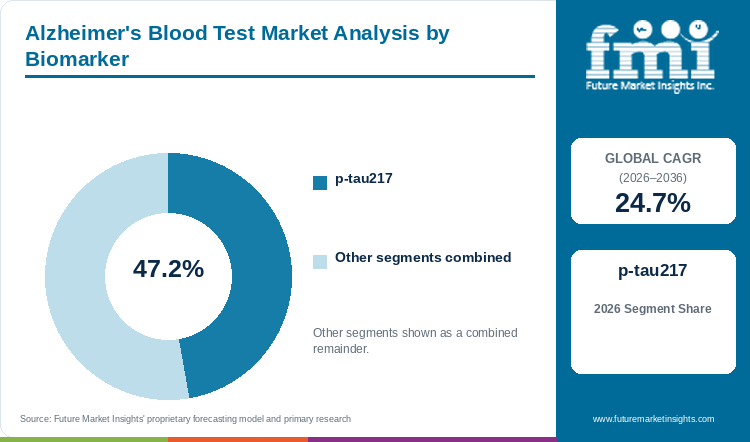
Within the biomarker category, p-tau217 is projected to capture 47.2% share in 2026, driven by high amyloid PET concordance.
Table 5: Biomarker Share for the Alzheimer's Blood Test Market (percentage share), 2026
| Biomarker | Share (2026) |
|---|---|
| p-tau217 | 47.2% |
| Other Segments Combined | 52.8%* |
| Total | 100.0% |
*Note: Combined share of remaining biomarker categories totaling 100.0% of 2026 market demand.
Table 6: Biomarker Leadership and Market Growth for the Alzheimer's Blood Test Market (segment and CAGR percentage), 2026 to 2036
| Metric | Value |
|---|---|
| Global CAGR (2026 to 2036) | 24.7% |
| Leading Segment | p-tau217 |
Circulating p-tau217 concentrations rise several-fold in patients carrying cortical amyloid plaques whereas p-tau181 and isolated amyloid-beta ratios show narrower dynamic ranges in peripheral blood. Clinical validation cohorts confirm that combining plasma p-tau217 with beta-amyloid 1-42 ratios matches cerebrospinal fluid lumbar puncture accuracy across specialty memory clinics. Reference laboratories integrate these assays into dementia management workflows so neurologists can assess the likelihood of Alzheimer's-associated amyloid pathology alongside clinical evaluation and investigate alternative causes when results are negative. Automated two-cutoff algorithms also reduce indeterminate grey-zone results that otherwise require confirmatory positron emission tomography.
- Superior fold-change separation over p-tau181 is expected to enable p-tau217 to secure 47.2% of 2026 biomarker turnover.
- During May 2025, the U.S. Food and Drug Administration cleared Fujirebio Diagnostics' Lumipulse G pTau217/ß-Amyloid 1-42 Plasma Ratio after a 499-sample study showed 91.7% positive and 97.3% negative concordance with amyloid PET or CSF [3].
How Do Automated Immunoassay Platforms Retain 64.8% of Technology Billings?
Across the technology segment, immunoassay is estimated to hold 64.8% revenue in 2026, owing to automated hospital chemiluminescence analyzers.
Chemiluminescent and electrochemiluminescent analyzers process hundreds of plasma tubes per hour without manual immunoprecipitation, keeping immunoassay platforms ahead of liquid chromatography mass spectrometry. While mass spectrometry offers high structural specificity for peptide isoforms, its high instrument capital cost and specialized operator requirements limit deployment to select national reference hubs. In contrast, hospital core laboratories run in vitro diagnostics cartridges on existing random-access chemistry lines that deliver patient results in under 30 minutes.
- Turnkey integration onto installed clinical chemistry lines is projected to give immunoassay 64.8% of 2026 technology revenue.
- F. Hoffmann-La Roche Ltd received U.S. FDA clearance for its Elecsys pTau217 plasma blood test in August 2026 to support rule-in and rule-out amyloid pathology detection across more than 4,500 installed U.S. cobas analyzers [4].
What Places Diagnostic Evaluation of Symptomatic Patients First Among Applications?
Diagnostic evaluation of symptomatic patients is expected to command 56.4% of 2026 application volume, supported by anti-amyloid therapy triage.
Regulatory prescribing labels for anti-amyloid monoclonal antibodies require documented cerebral amyloid pathology before patients begin biweekly or monthly intravenous infusions. Neurologists examining individuals with mild cognitive impairment or mild dementia order blood biomarker panels as a frontline diagnostic filter to accelerate qualification for alzheimers therapeutics. Whereas asymptomatic population screening faces payer reimbursement exclusions, symptomatic workups carry clear clinical utility and established procedural billing codes across outpatient neurology networks.
- Mandatory amyloid verification prior to disease-modifying therapy initiation is anticipated to place symptomatic patient evaluation at 56.4% of 2026 application sales.
- PREVENT-AD cohort investigators reported in Alzheimer's & Dementia in February 2025 that elevated plasma p-tau217 strongly predicts clinical progression to mild cognitive impairment across a 10-year window [5].
Why Do Commercial Diagnostic Laboratories Capture 51.8% of End User Volume?
Diagnostic laboratories are forecast to secure 51.8% of 2026 end user billings, enabled by centralized cold-chain specimen referral networks.
National commercial reference laboratories operate thousands of outpatient blood-draw stations connected by refrigerated air couriers to centralized high-throughput immunoassay lines. Community neurologists and geriatricians lack on-site ultra-low freezers or calibrated chemiluminescent analyzers, prompting clinics to route venous EDTA plasma tubes to accredited reference hubs. Centralized testing providers also maintain proficiency testing certifications and longitudinal quality controls that minimize inter-batch reagent drift.
- Nationwide phlebotomy collection sites and high-volume analyzer fleets are predicted to allow diagnostic laboratories to claim 51.8% of 2026 end user billings.
- Labcorp Holdings Inc. launched nationwide clinical availability of the FDA-cleared Lumipulse pTau-217/Beta Amyloid 42 Ratio test across more than 2,200 U.S. patient service centers in August 2025 [6].
What are the drivers, restraints, and opportunities in the alzheimer's blood test market?
Anti-amyloid monoclonal antibody qualification is expected to accelerate clinical blood biomarker orders through 2036, even as inter-platform cutoff discrepancies and primary care reimbursement exclusions temper community adoption.
- Driver: Expanding prescriptions for disease-modifying anti-amyloid therapies compel neurology clinics to adopt rapid blood biomarker triage before scheduling confirmatory brain scans.
- Restraint: Inter-assay cutoff variations across commercial analyzer platforms and restrictive insurer prior-authorization policies slow ordering in primary care offices.
- Opportunity: Validating multi-marker prognostic panels and capillary fingerstick collection kits is projected to open decentralized cognitive screening across community health networks through 2036.
Growth Analysis and Future Potential: Disease-Modifying Anti-Amyloid Therapy Catalysts
Commercial rollouts of amyloid-clearing immunotherapies require timely confirmation of brain amyloid plaques while patients remain in early mild cognitive impairment stages. Conventional amyloid positron emission tomography and lumbar punctures suffer from radiotracer scheduling bottlenecks and high procedural costs that delay treatment initiation. Health systems therefore deploy plasma p-tau217 testing to triage candidates for therapeutic monoclonal antibodies within days of initial cognitive assessment. In December 2025, multicenter investigators publishing in Neurology demonstrated across 716 participants that using plasma p-tau217 as a longitudinal trial endpoint reduces required recruitment costs by up to 54% [7]. Fast blood-based amyloid pathology assessment preserves scarce imaging slots for borderline cases and accelerates therapy onboarding.
Risk Assessment and Operational Hurdles: Reimbursement Gaps and Diagnostic Threshold Variance
Differing numerical cutoffs across commercial chemiluminescent and mass spectrometry platforms complicate clinical interpretation when patients move between health systems. Borderline plasma ratios in patients with chronic kidney disease or metabolic comorbidities require confirmatory cerebrospinal fluid or imaging tests before treatment decisions. Furthermore, commercial health insurers frequently restrict coverage within clinical diagnostics schedules to specialist neurologist orders, leaving general practitioners with out-of-pocket billing friction. In November 2025, neurochemistry researchers at University Medical Center Göttingen emphasized in Fortschritte der Neurologie · Psychiatrie that blood biomarkers in prodromal Alzheimer's stages still require careful clinical correlation alongside established cerebrospinal fluid criteria [8].
Commercial Opportunity Analysis: Decentralized Primary Care and Community Screening
Extending blood biomarker testing from tertiary academic memory centers into routine geriatric wellness checkups represents a major revenue avenue for assay manufacturers. Combining phosphorylated tau isoforms with neurofilament light and glial fibrillary acidic protein alongside point of care molecular diagnostics workflows helps clinicians estimate symptom onset windows before severe cognitive decline. National Institutes of Health investigators reported a plasma p-tau217 clock model in March 2026 across 603 older adults capable of predicting the onset age of Alzheimer's symptoms within a median error of three to four years [9]. Pairing dried-plasma capillary collection cards with automated core-lab immunoassays is expected to let rural clinics screen aging populations without cold-chain centrifugation.
Alzheimer's Blood Test Market by Country (2026 to 2036)
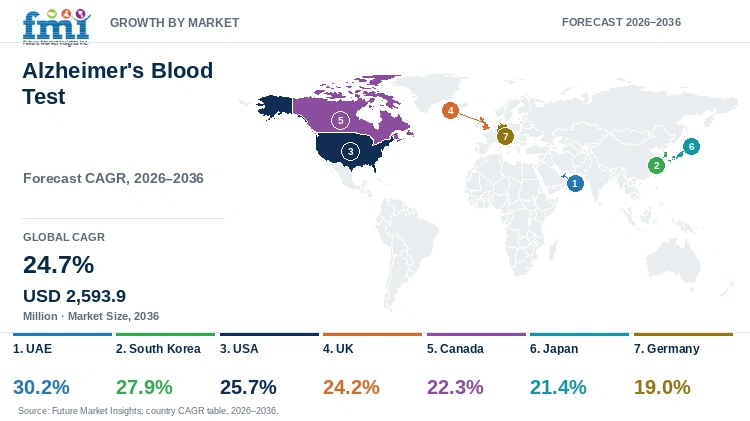
As per FMI, federal geriatric screening initiatives are projected to propel the UAE at a 30.2% ten-year pace through 2036 above South Korean clinics at 27.9% and U.S. laboratories at 25.7%, whereas German hospital demand is expected to grow at 19.0%. Reimbursement coverage for anti-amyloid therapy qualification and automated core-laboratory analyzer density govern country-level adoption speeds.
Table 7: Country CAGR and Primary Growth Levers for the Alzheimer's Blood Test Market (CAGR percentage and operational drivers), 2026 to 2036
| Country | CAGR (2026 to 2036) | Primary Growth Lever |
|---|---|---|
| UAE | 30.2% | National seven-step cognitive care pathways and rapid adoption across private tertiary medical centers |
| South Korea | 27.9% | Super-aged society dementia screening and automated biomarker rollouts across municipal memory centers |
| USA | 25.7% | FDA clearance of plasma p-tau217 assays and nationwide reference laboratory collection networks |
| UK | 24.2% | NHS Blood Biomarker Challenge ADAPT clinical trials and memory clinic waitlist modernization |
| Canada | 22.3% | Provincial memory clinic validation and remote reference laboratory specimen routing |
| Japan | 21.4% | Lecanemab diagnostic flow optimization and automated testing across geriatric hospitals |
| Germany | 19.0% | Longitudinal cohort validation and tertiary university hospital neurology coordination |
Source: Future Market Insights analysis
UAE Alzheimer's Blood Test Market Outlook (2026 to 2036)
Unlike Western healthcare systems where blood biomarker orders remain restricted to late-stage memory referrals, the UAE integrates fluid cognitive biomarkers into multidisciplinary longevity checkups and early amyloid-targeting therapy workups across Abu Dhabi and Dubai. In October 2025, an Emirates Neurology Society expert task force published a seven-step consensus framework in Neurology and Therapy endorsing fluid biomarker testing alongside lecanemab and donanemab onboarding across UAE hospitals [10]. Even so, a shortage of Arabic-validated cognitive screening tools and specialist neurologists across smaller emirates slows follow-up on borderline plasma ratios. Bundling automated chemiluminescent reagent kits with specialist neurology networks helps private hospitals close diagnostic gaps, and UAE alzheimer's blood test revenue is projected to scale 30.2% per year through 2036.
Key takeaway: In the UAE, seven-step clinical consensus pathways and private tertiary hospital automation are projected to drive rapid uptake of plasma p-tau217 assays.
South Korea Alzheimer's Blood Test Market Outlook (2026 to 2036)
In October 2025, the Korean Dementia Association published its IC-KDA/ASAD 2025 consensus report in Dementia and Neurocognitive Disorders highlighting Simoa plasma p-tau and GFAP biomarker validation across Korean subjective cognitive decline cohorts [11]. South Korea differs structurally from decentralized Western diagnostic markets because over 250 public district dementia relief centers screen elderly residents locally as the nation enters a super-aged society before referring patients to metropolitan university hospitals. Backed by this public intake network and domestic lecanemab clinical rollouts, South Korean alzheimer's blood test sales are expected to gain 27.9% per year until 2036. However, strict national health insurance fee ceilings compress per-test margins, prompting suppliers to partner with high-volume Seoul reference laboratories.
Key takeaway: In South Korea, public dementia center screening programs and dense metropolitan hospital laboratories are expected to sustain fast blood test volume expansion.
USA Alzheimer's Blood Test Market Outlook (2026 to 2036)
A dual-track regulatory framework where CLIA-certified laboratory-developed assays operate alongside FDA-cleared in vitro diagnostic kits across national commercial reference laboratories distinguishes the United States from single-payer health systems. Supported by high-volume venous plasma processing at Quest Diagnostics and Labcorp, U.S. alzheimer's blood test expenditure is anticipated to rise 25.7% each year through 2036. In August 2026, the U.S. Food and Drug Administration cleared C2N Diagnostics' PrecivityAD2 high-resolution mass spectrometry blood test for symptomatic adults aged 40 and older after a 1,142-subject study demonstrated 97.6% positive predictive value [12]. Nevertheless, commercial payer prior-authorization rules still restrict primary care ordering, prompting assay makers to publish multicenter clinical utility evidence.
Key takeaway: In the USA, FDA assay clearances and nationwide reference laboratory collection networks are anticipated to anchor high-volume clinical triage testing.
UK Alzheimer's Blood Test Market Outlook (2026 to 2036)
Whereas private insurance and commercial reference laboratories drive U.S. testing volumes, adoption in the United Kingdom depends on centralized National Health Service commissioning and multi-site public clinical utility trials that address year-long regional memory clinic waitlists. In September 2025, Alzheimer's Research UK and University College London neurologists launched the ADAPT clinical trial under the Blood Biomarker Challenge across 20 NHS specialist centers to evaluate plasma p-tau217 in routine memory services [13]. Aided by these public pathway reforms, British alzheimer's blood test turnover is predicted to compound at 24.2% annually through 2036. Yet constrained NHS trust capital budgets delay standalone analyzer purchases, so diagnostic suppliers offer reagent-rental contracts across regional NHS pathology networks.
Key takeaway: In the UK, NHS Blood Biomarker Challenge trials and memory clinic waitlist pressures are predicted to accelerate adoption of automated plasma triage tests.
Canada Alzheimer's Blood Test Market Outlook (2026 to 2036)
Vast geographic distances separating rural and northern primary care practices from urban positron emission tomography scanners make venous plasma triage far more critical in Canada than in dense European hospital networks. During July 2025, University of British Columbia neurologists reported in Clinical Biochemistry that rising Canadian dementia prevalence projected at 674,000 cases by 2031 makes validated plasma p-tau217 testing essential for triaging referrals across public memory clinics [14]. Reflecting provincial investments in remote geriatric triage, Canadian alzheimer's blood test demand is estimated to climb 22.3% per annum over the ten-year horizon. However, single-payer provincial laboratory formularies create uneven reimbursement timing between British Columbia and Ontario alongside Atlantic health authorities, prompting assay makers to establish reference hubs in Vancouver and Toronto.
Key takeaway: In Canada, provincial memory clinic modernization and remote rural triage needs are estimated to support steady adoption of centralized plasma biomarker assays.
Japan Alzheimer's Blood Test Market Outlook (2026 to 2036)
Japan stands apart from global diagnostic markets by combining the world's highest elderly dementia prevalence with domestic chemiluminescence analyzer manufacturing and strict Optimal Use Guidelines for anti-amyloid infusions. In October 2025, University of Tokyo and Oita University investigators published a dynamic simulation in Alzheimer's & Dementia showing that integrating blood biomarker triage cuts Japanese specialist diagnostic wait times from 6.4 months down to 4.7 months [15]. Anchored by domestic diagnostic pioneer Fujirebio and municipal hospital outpatient departments, Japanese alzheimer's blood test turnover is forecast to gain 21.4% annually until 2036. Even so, Japanese clinical guidelines still require careful specialist confirmation before antibody dosing, so suppliers market dual-cutoff plasma panels that streamline pre-PET triage.
Key takeaway: In Japan, lecanemab workflow optimization and geriatric hospital infrastructure are forecast to support disciplined integration of automated blood biomarker tests.
Germany Alzheimer's Blood Test Market Outlook (2026 to 2036)
Unlike North American clinics that rapidly substitute venous blood panels for spinal taps, German university memory centers maintain deeply entrenched cerebrospinal fluid lumbar-puncture workflows and strict statutory sickness-fund evidence thresholds. In July 2026, German Cancer Research Center and Ruhr-University Bochum investigators reported in EMBO Molecular Medicine across 779 older adults followed over 17 years that combining plasma p-tau217 with GFAP and NfL achieves an 0.86 area under the curve for Alzheimer's risk prediction [16]. Supported by specialized neurology departments in Heidelberg and Bochum alongside Göttingen academic clinics, German alzheimer's blood test revenue is slated to grow 19.0% annually through 2036, while diagnostic vendors fund prospective health-economic registries across statutory sickness funds.
Key takeaway: In Germany, multi-year prospective cohort validation and university memory clinic collaborations are expected to sustain methodical clinical blood test adoption.
Full report country CAGRs cover: North America; Latin America; Western Europe; Eastern Europe; East Asia; South Asia and Pacific; Middle East and Africa.
Who are the notable companies in the alzheimer's blood test market?
Fujirebio Holdings, Inc., F. Hoffmann-La Roche Ltd, C2N Diagnostics LLC, Quanterix Corporation, Labcorp Holdings Inc., Quest Diagnostics Incorporated, ALZpath Inc., Beckman Coulter, Inc., and Siemens Healthineers AG are the notable companies in the alzheimer's blood test market.
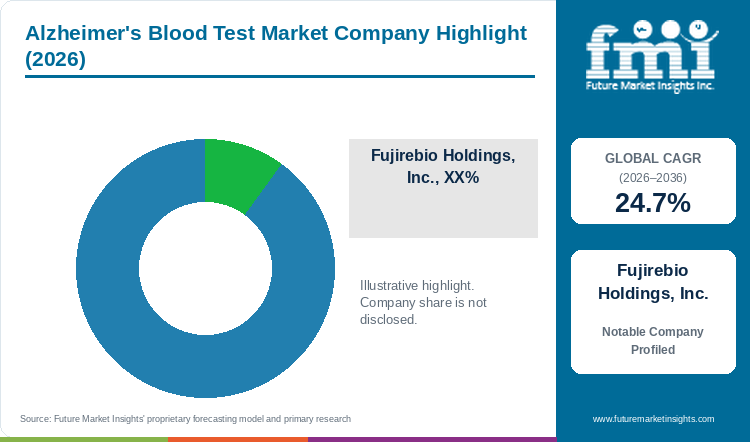
Future Market Insights observes that competition splits between multinational in vitro diagnostics instrument makers and specialized ultra-sensitive assay developers alongside national reference laboratories. Analyzer manufacturers compete on random-access hourly throughput and regulatory dual-cutoff clearances that minimize indeterminate results. Meanwhile, specialized neurology assay developers license proprietary p-tau217 antibodies and run high-specificity mass spectrometry panels. Clinical laboratory directors select suppliers based on lot-to-lot reagent consistency and verified concordance with amyloid positron emission tomography.
- Global In Vitro Diagnostics Leaders: F. Hoffmann-La Roche Ltd and Fujirebio Holdings alongside Beckman Coulter and Siemens Healthineers commercialize automated chemiluminescent plasma assays on core hospital analyzers.
- Specialized Assay Innovators: C2N Diagnostics LLC and Quanterix Corporation together with ALZpath Inc. develop high-sensitivity mass spectrometry and digital single-molecule p-tau217 platforms.
- Commercial Laboratory Networks: Labcorp Holdings Inc. and Quest Diagnostics Incorporated operate nationwide phlebotomy collection centers and high-throughput reference testing hubs.
Competitive Benchmarking: Alzheimer's Blood Test Market
Table 8: Competitive Benchmarking for the Alzheimer's Blood Test Market (qualitative capability ratings), 2026
| Company | Biomarker Menu Breadth | Automated Platform Integration | Clinical Validation Depth | Geographic Reach |
|---|---|---|---|---|
| Fujirebio Holdings, Inc. | High | High | High | High |
| F. Hoffmann-La Roche Ltd | High | High | High | High |
| C2N Diagnostics LLC | High | Medium | High | Medium |
| Quanterix Corporation | High | Medium | High | High |
| ALZpath Inc. | Medium | High | High | Medium |
| Beckman Coulter, Inc. | Medium | High | High | High |
| Siemens Healthineers AG | Medium | High | Medium | High |
| Labcorp Holdings Inc. | High | High | High | High |
| Quest Diagnostics Incorporated | High | High | High | High |
Scoring basis: Biomarker Menu Breadth is rated High when a supplier offers validated plasma p-tau217 and amyloid-beta ratio assays alongside neurofilament light panels. Automated Platform Integration is High when reagent kits run on random-access clinical chemistry instruments and Medium for specialized benchtop systems. Clinical Validation Depth reflects regulatory clearances and multicenter prospective diagnostic accuracy cohorts across international neurology centers.
Key Developments in the Alzheimer's Blood Test Market
- In July 2026, Beckman Coulter, Inc. received CE Mark certification under the European IVDR for its automated Access p-Tau217 blood test on DxI 9000 immunoassay analyzers [17].
- In August 2026, C2N Diagnostics LLC released its PrecivityAD2 blood test quantifying p-tau217 and amyloid-beta ratios across more than 700 U.S. patient service centers [18].
- In January 2026, Quanterix Corporation announced landmark JAMA Network Open study results demonstrating a 0.90 C-index prognostic accuracy for its multi-analyte Simoa blood biomarker panel [19].
Key Players in the Alzheimer's Blood Test Market
Global In Vitro Diagnostics Leaders
- Fujirebio Holdings, Inc.
- F. Hoffmann-La Roche Ltd
- Beckman Coulter, Inc.
- Siemens Healthineers AG
Specialized Assay Innovators
- C2N Diagnostics LLC
- Quanterix Corporation
- ALZpath Inc.
Commercial Laboratory Networks
- Labcorp Holdings Inc.
- Quest Diagnostics Incorporated
Alzheimer's Blood Test Market - Report Scope
Table 9: Report Scope for the Alzheimer's Blood Test Market (coverage fields and definitions), 2026 to 2036
| Coverage field | Report scope |
|---|---|
| Market breakdown | Biomarker; Technology; Application; End User; Region |
| Quantitative Units | USD Million |
| Market Definition | Includes manufacturer reagent kit sales and commercial diagnostic laboratory testing revenue from venous and capillary blood-based Alzheimer's disease biomarker assays. Category Scope Note: The valuation captures commercial plasma immunoassay, mass spectrometry, and digital single-molecule array tests measuring phosphorylated tau, beta-amyloid ratios, NfL, and GFAP, while excluding cerebrospinal fluid lumbar puncture assays, neuroimaging radiotracers, and therapeutic drug sales. |
| Regions Covered | North America; Latin America; Western Europe; Eastern Europe; East Asia; South Asia and Pacific; Middle East and Africa |
| Countries Covered | UAE, South Korea, USA, UK, Canada, Japan, Germany, and additional countries in the full report |
| Key Companies Covered | Fujirebio Holdings, Inc., F. Hoffmann-La Roche Ltd, C2N Diagnostics LLC, Quanterix Corporation, Labcorp Holdings Inc., Quest Diagnostics Incorporated, ALZpath Inc., Beckman Coulter, Inc., Siemens Healthineers AG |
| Forecast Period | 2026 to 2036 |
| Approach | Primary and secondary research with market triangulation. |
Alzheimer's Blood Test Market - Research Methodology
Table 10: Research Methodology for the Alzheimer's Blood Test Market (research methods and approach), 2026 edition
| Method | Approach |
|---|---|
| Primary Research | Primary interviews were conducted with cognitive neurologists and reference laboratory medical directors alongside in vitro diagnostics executives to validate plasma cutoff algorithms and payer coverage policies. |
| Secondary Research | Secondary research encompassed FDA 510(k) and De Novo decision summaries, European IVDR technical filings, Alzheimer's Association clinical practice guidelines, and corporate earnings disclosures. |
| Market Sizing and Forecasting | Market sizing and forecasting for the 2026 to 2036 period were constructed using symptomatic mild cognitive impairment prevalence cohorts calibrated against commercial laboratory test volumes and reagent pricing. |
| Data Triangulation and Validation | Estimates are cross-checked against national dementia registry inflows, installed chemiluminescent analyzer fleets, and Medicare laboratory fee schedules without double counting downstream imaging fees. |
| Country Forecasting Model | Country-level CAGRs are modeled against the 24.7% global baseline by weighting national elderly demographic growth, anti-amyloid drug reimbursement approvals, and automated core-laboratory analyzer density. |
| Operational Benchmark Traceability | Operational indicators in Tables 2, 3, and 4 are synthesized from Alzheimer's Association clinical guideline benchmarks, CMS clinical laboratory fee schedules, and NIHR Blood Biomarker Challenge clinic registries. |
Alzheimer's Blood Test Market by Segments
Alzheimer's Blood Test Market segmented by Biomarker:
- p-tau217
- p-tau181
- Amyloid Beta Ratio (Abeta42/Abeta40)
- Neurofilament Light (NfL)
- Glial Fibrillary Acidic Protein (GFAP)
Alzheimer's Blood Test Market segmented by Technology:
- Immunoassay
- Mass Spectrometry
- Digital Single-Molecule Array (Simoa)
Alzheimer's Blood Test Market segmented by Application:
- Diagnostic Evaluation of Symptomatic Patients
- Early Cognitive Impairment Screening
- Clinical Trial Patient Stratification
Alzheimer's Blood Test Market segmented by End User:
- Diagnostic Laboratories
- Hospitals and Memory Clinics
- Academic Research Institutes
Alzheimer's Blood Test Market by Region
- North America
- United States
- Canada
- Latin America
- Brazil
- Mexico
- Argentina
- Chile
- Western Europe
- Germany
- France
- United Kingdom
- Italy
- Spain
- Benelux
- Nordics
- Eastern Europe
- Poland
- Czech Republic
- Romania
- Hungary
- East Asia
- China
- Japan
- South Korea
- South Asia and Pacific
- India
- ASEAN
- Australia and New Zealand
- Middle East and Africa
- GCC Countries
- South Africa
- Türkiye
- Israel
Research Sources and Bibliography
- [1] Alzheimer's Association. (2025, July 29). Clinical Practice Guideline: Blood-Based Biomarkers in Specialty Care. Alzheimer's Association.
- [2] Verberk, I. M. W., Gouda, M., Antwi-Berko, D., & Teunissen, C. (2025, October 15). Evidence-based standardized sample handling protocol for accurate blood-based Alzheimer's disease biomarker measurement: Results and consensus of the Global Biomarker Standardization Consortium. Alzheimer's & Dementia.
- [3] U.S. Food and Drug Administration (FDA). (2025, May 16). FDA Clears First Blood Test Used in Diagnosing Alzheimer's Disease. U.S. Food and Drug Administration.
- [4] F. Hoffmann-La Roche Ltd. (2026, August 24). Roche receives FDA clearance for Elecsys pTau217, advancing Alzheimer's disease assessment across primary and specialty care. Roche Diagnostics.
- [5] Yakoub, Y., Gonzalez-Ortiz, F., Ashton, N. J., & Villeneuve, S. (2025, February 15). Plasma p-tau217 identifies cognitively normal older adults who will develop cognitive impairment in a 10-year window. Alzheimer's & Dementia.
- [6] Labcorp Holdings Inc. (2025, August 18). Labcorp Launches First FDA-Cleared Blood Test for Alzheimer's Disease. Labcorp Investor Relations.
- [7] Ferreira, P. C. L., Bellaver, B., Povala, G., & Pascoal, T. A. (2025, December 09). Evaluating Plasma p-tau217 as an Endpoint for Alzheimer Disease Clinical Trials. Neurology.
- [8] Hansen, N., & Wiltfang, J. (2025, November 06). News on blood biomarker-based early diagnosis of the preliminary stages of Alzheimer's dementia. Fortschritte der Neurologie Psychiatrie.
- [9] National Institutes of Health (NIH). (2026, March 17). Blood test predicts start of Alzheimer's disease symptoms. National Institutes of Health.
- [10] Alsaadi, T., Almadani, A., AlRukn, S., & Krieger, D. W. (2025, October 04). Expert Guidance on Cognitive Impairment in Alzheimer's Disease: A Practical Seven-Step Approach from the United Arab Emirates. Neurology and Therapy.
- [11] Kim, J., Kim, G. H., Kang, K., & Moon, S. Y. (2025, October 20). Executive Summary of 2025 International Conference of the Korean Dementia Association and International Congress of the Asian Society Against Dementia (IC-KDA/ASAD 2025): A Report From the Academic Committee of the Korean Dementia Association. Dementia and Neurocognitive Disorders.
- [12] C2N Diagnostics LLC. (2026, August 20). FDA Clears C2N Diagnostics' PrecivityAD2 - First Alzheimer's Blood Test for Adults with Cognitive Symptoms as Young as 40. C2N Diagnostics.
- [13] Alzheimer's Research UK. (2025, September 10). UK trial launches to transform Alzheimer's diagnosis with simple blood test. Alzheimer's Research UK.
- [14] Kumar, P., Mousavi, A., & Frykman, H. (2025, July 31). The biological diagnosis of Alzheimer's disease using blood-based biomarkers: A Canadian prospective. Clinical Biochemistry.
- [15] Igarashi, A., Kimura, N., Ataka, T., & Matsubara, E. (2025, October 07). Simulation of Alzheimer's diagnostic flows with blood biomarker test options in Japan. Alzheimer's & Dementia: Translational Research & Clinical Interventions.
- [16] Trares, K., Duman, D., Beyer, L., & Brenner, H. (2026, July 16). Predictive value of plasma p-tau217 for Alzheimer's dementia compared to other blood-based biomarkers. EMBO Molecular Medicine.
- [17] Beckman Coulter, Inc. (2026, July 07). Beckman Coulter Diagnostics Expands Alzheimer's Portfolio with CE-Marked p-Tau217 Blood Test and New High-Specificity Research Assay. Beckman Coulter Diagnostics.
- [18] C2N Diagnostics LLC. (2026, August 17). C2N Diagnostics Releases the PrecivityAD2 Blood Test for Clinical Care, A Robust Assay with High Concordance to Amyloid PET and CSF. C2N Diagnostics.
- [19] Quanterix Corporation. (2026, January 21). Quanterix Announces Landmark JAMA Study Highlighting Prognostic Value of Multi-Analyte Approach to Blood-Based Alzheimer's Risk Profiling. Quanterix Corporation.
- [20] ALZpath Inc. (2025, December 15). ALZpath and Siemens Healthineers Sign Licensing Agreement to Advance Global Access to Blood-Based Alzheimer's Disease Diagnostic Testing. ALZpath Inc.
- [21] Quest Diagnostics Incorporated. (2026, August 24). Quest Diagnostics to Offer FDA-Cleared Roche pTau217 Blood Test to Assess Alzheimer's Disease Pathology. Quest Diagnostics.
This bibliography is provided for reader reference and is not exhaustive. The full report contains the complete reference list and detailed citations.
This Report Answers
- How large is the alzheimer's blood test market in 2026 and what is forecast for 2036?
- Which clinical therapy rollouts accelerate blood biomarker test orders?
- Why does p-tau217 represent the leading biomarker segment in 2026?
- Why does immunoassay dominate the technology breakdown globally?
- How do growth rates compare across the UAE, South Korea, the USA, the UK, Canada, Japan, and Germany?
- Which leading diagnostic companies manufacture commercial Alzheimer's blood test kits?
- What reimbursement hurdles restrict routine screening in primary care clinics?
- What laboratory validation benchmarks should diagnostic directors verify before adding new testing platforms?
Frequently Asked Questions
How big is the alzheimer's blood test market in 2026, and what is forecast for 2036?
Worldwide alzheimer's blood test revenue is estimated at USD 284.6 Million in 2026 (up from USD 228.2 Million in 2025) and is projected to reach USD 2,593.9 Million by 2036 as neurology clinics screen symptomatic patients for anti-amyloid infusions.
What is the CAGR for the alzheimer's blood test market from 2026 to 2036?
According to FMI, global turnover is projected to compound at a 24.7% CAGR from 2026 to 2036, representing an estimated USD 2,309.3 Million increase in annual diagnostic kit and reference testing revenue between 2026 and 2036.
Which biomarker segment leads the alzheimer's blood test market?
Phosphorylated tau p-tau217 is projected to claim 47.2% of 2026 biomarker demand because dual-cutoff plasma assays match amyloid positron emission tomography concordance above 90%.
Which technology leads the alzheimer's blood test market?
Immunoassay platforms are estimated to account for 64.8% of 2026 technology revenue through automated chemiluminescent analyzers operating inside hospital and commercial reference laboratories.
Which country has a notable growth outlook during the assessment period?
Future Market Insights finds that the UAE leads national expansion with a projected 30.2% CAGR through 2036, supported by seven-step cognitive care pathways and private tertiary hospital automation.
Who are the key players in the market?
Major suppliers include Fujirebio Holdings, Inc., F. Hoffmann-La Roche Ltd, C2N Diagnostics LLC, Quanterix Corporation, Labcorp Holdings Inc., Quest Diagnostics Incorporated, ALZpath Inc., Beckman Coulter, Inc., and Siemens Healthineers AG.
Preview the report firsthand - request a free sample
Get SampleGet the brochure for pricing and purchase details.
Get PDFTable of Content
- Key Takeaways
- Market Size and CAGR
- Top Growth Driver
- Fastest Growing Segment
- Leading Region
- Key Companies
- Emerging Opportunities
- Executive Summary
- Global Market Outlook
- Demand-side Trends
- Supply-side Trends
- Technology Roadmap Analysis
- Analysis and Recommendations
- Analyst Perspective (What is happening? Why now? What should investors know?)
- Key Questions Answered
- How large is the market?
- What is the CAGR?
- What are key trends?
- Which region dominates?
- Who are the leaders?
- Market Overview
- Market Coverage / Taxonomy
- Market Definition / Scope / Limitations
- Research Methodology
- Chapter Orientation
- Analytical Lens and Working Hypotheses
- Market Structure, Signals, and Trend Drivers
- Benchmarking and Cross-market Comparability
- Market Sizing, Forecasting, and Opportunity Mapping
- Research Design and Evidence Framework
- Desk Research Programme (Secondary Evidence)
- Expert Input and Fieldwork (Primary Evidence)
- Tooling, Models, and Reference Databases
- Data Engineering and Model Build
- Quality Assurance and Audit Trail
- Market Background
- Market Dynamics (Drivers, Restraints, Opportunity, Trends)
- Scenario Forecast (Optimistic, Likely, Conservative)
- Impact Analysis
- AI Impact
- Sustainability Impact
- Regulatory Impact
- Technology Impact
- Consumer / Buyer Analysis
- Purchase Drivers
- Adoption Barriers
- Buyer Journey
- Opportunity Map Analysis
- Product Life Cycle Analysis
- Supply Chain Analysis
- Investment Feasibility Matrix
- Value Chain Analysis
- PESTLE and Porter's Analysis
- Regulatory Landscape
- Regional Parent Market Outlook
- Production and Consumption Statistics
- Import and Export Statistics
- Global Market Analysis and Forecast, 2021 to 2036
- Historical Market Size Value (USD Million) Analysis, 2021 to 2025
- Current and Future Market Size Value (USD Million) Projections, 2026 to 2036
- Y-o-Y Growth Trend Analysis
- Absolute $ Opportunity Analysis
- Global Market Pricing Analysis, 2021 to 2036
- Global Market Analysis and Forecast, By Biomarker, 2021 to 2036
- Introduction / Key Findings
- Historical Market Size Value (USD Million) Analysis By Biomarker, 2021 to 2025
- Current and Future Market Size Value (USD Million) Analysis and Forecast By Biomarker, 2026 to 2036
- p-tau217
- p-tau181
- Amyloid Beta Ratio (Abeta42/Abeta40)
- Neurofilament Light (NfL)
- Glial Fibrillary Acidic Protein (GFAP)
- Y-o-Y Growth Trend Analysis By Biomarker, 2021 to 2025
- Absolute $ Opportunity Analysis By Biomarker, 2026 to 2036
- Global Market Analysis and Forecast, By Technology, 2021 to 2036
- Introduction / Key Findings
- Historical Market Size Value (USD Million) Analysis By Technology, 2021 to 2025
- Current and Future Market Size Value (USD Million) Analysis and Forecast By Technology, 2026 to 2036
- Immunoassay
- Mass Spectrometry
- Digital Single-Molecule Array (Simoa)
- Y-o-Y Growth Trend Analysis By Technology, 2021 to 2025
- Absolute $ Opportunity Analysis By Technology, 2026 to 2036
- Global Market Analysis and Forecast, By Application, 2021 to 2036
- Introduction / Key Findings
- Historical Market Size Value (USD Million) Analysis By Application, 2021 to 2025
- Current and Future Market Size Value (USD Million) Analysis and Forecast By Application, 2026 to 2036
- Diagnostic Evaluation of Symptomatic Patients
- Early Cognitive Impairment Screening
- Clinical Trial Patient Stratification
- Y-o-Y Growth Trend Analysis By Application, 2021 to 2025
- Absolute $ Opportunity Analysis By Application, 2026 to 2036
- Global Market Analysis and Forecast, By End User, 2021 to 2036
- Introduction / Key Findings
- Historical Market Size Value (USD Million) Analysis By End User, 2021 to 2025
- Current and Future Market Size Value (USD Million) Analysis and Forecast By End User, 2026 to 2036
- Diagnostic Laboratories
- Hospitals and Memory Clinics
- Academic Research Institutes
- Y-o-Y Growth Trend Analysis By End User, 2021 to 2025
- Absolute $ Opportunity Analysis By End User, 2026 to 2036
- Global Market Analysis and Forecast, By Region, 2021 to 2036
- Introduction
- Historical Market Size Value (USD Million) Analysis By Region, 2021 to 2025
- Current Market Size Value (USD Million) Analysis and Forecast By Region, 2026 to 2036
- North America
- Latin America
- Western Europe
- Eastern Europe
- East Asia
- South Asia and Pacific
- Middle East and Africa
- Market Attractiveness Analysis By Region
- North America Market Analysis and Forecast, By Country, 2021 to 2036
- Historical Market Size Value (USD Million) Trend Analysis By Market Taxonomy, 2021 to 2025
- Market Size Value (USD Million) Forecast By Market Taxonomy, 2026 to 2036
- By Country
- United States
- Canada
- By Biomarker
- By Technology
- By Application
- By End User
- By Country
- Market Attractiveness Analysis
- By Country
- By Biomarker
- By Technology
- By Application
- By End User
- Key Takeaways
- Latin America Market Analysis and Forecast, By Country
- Historical Market Size Value (USD Million) Trend Analysis By Market Taxonomy, 2021 to 2025
- Market Size Value (USD Million) Forecast By Market Taxonomy, 2026 to 2036
- By Country
- Brazil
- Mexico
- Argentina
- Chile
- By Biomarker
- By Technology
- By Application
- By End User
- By Country
- Market Attractiveness Analysis
- By Country
- By Biomarker
- By Technology
- By Application
- By End User
- Key Takeaways
- Western Europe Market Analysis and Forecast, By Country
- Historical Market Size Value (USD Million) Trend Analysis By Market Taxonomy, 2021 to 2025
- Market Size Value (USD Million) Forecast By Market Taxonomy, 2026 to 2036
- By Country
- Germany
- France
- United Kingdom
- Italy
- Spain
- Benelux
- Nordics
- By Biomarker
- By Technology
- By Application
- By End User
- By Country
- Market Attractiveness Analysis
- By Country
- By Biomarker
- By Technology
- By Application
- By End User
- Key Takeaways
- Eastern Europe Market Analysis and Forecast, By Country
- Historical Market Size Value (USD Million) Trend Analysis By Market Taxonomy, 2021 to 2025
- Market Size Value (USD Million) Forecast By Market Taxonomy, 2026 to 2036
- By Country
- Poland
- Czech Republic
- Romania
- Hungary
- By Biomarker
- By Technology
- By Application
- By End User
- By Country
- Market Attractiveness Analysis
- By Country
- By Biomarker
- By Technology
- By Application
- By End User
- Key Takeaways
- East Asia Market Analysis and Forecast, By Country
- Historical Market Size Value (USD Million) Trend Analysis By Market Taxonomy, 2021 to 2025
- Market Size Value (USD Million) Forecast By Market Taxonomy, 2026 to 2036
- By Country
- China
- Japan
- South Korea
- By Biomarker
- By Technology
- By Application
- By End User
- By Country
- Market Attractiveness Analysis
- By Country
- By Biomarker
- By Technology
- By Application
- By End User
- Key Takeaways
- South Asia and Pacific Market Analysis and Forecast, By Country
- Historical Market Size Value (USD Million) Trend Analysis By Market Taxonomy, 2021 to 2025
- Market Size Value (USD Million) Forecast By Market Taxonomy, 2026 to 2036
- By Country
- India
- ASEAN
- Australia and New Zealand
- By Biomarker
- By Technology
- By Application
- By End User
- By Country
- Market Attractiveness Analysis
- By Country
- By Biomarker
- By Technology
- By Application
- By End User
- Key Takeaways
- Middle East and Africa Market Analysis and Forecast, By Country
- Historical Market Size Value (USD Million) Trend Analysis By Market Taxonomy, 2021 to 2025
- Market Size Value (USD Million) Forecast By Market Taxonomy, 2026 to 2036
- By Country
- GCC Countries
- South Africa
- Türkiye
- Israel
- By Biomarker
- By Technology
- By Application
- By End User
- By Country
- Market Attractiveness Analysis
- By Country
- By Biomarker
- By Technology
- By Application
- By End User
- Key Takeaways
- Key Countries Market Analysis
- United States
- Pricing Analysis
- Market Share Analysis, 2025
- By Biomarker
- By Technology
- By Application
- By End User
- Canada
- Pricing Analysis
- Market Share Analysis, 2025
- By Biomarker
- By Technology
- By Application
- By End User
- Mexico
- Pricing Analysis
- Market Share Analysis, 2025
- By Biomarker
- By Technology
- By Application
- By End User
- Brazil
- Pricing Analysis
- Market Share Analysis, 2025
- By Biomarker
- By Technology
- By Application
- By End User
- Chile
- Pricing Analysis
- Market Share Analysis, 2025
- By Biomarker
- By Technology
- By Application
- By End User
- Germany
- Pricing Analysis
- Market Share Analysis, 2025
- By Biomarker
- By Technology
- By Application
- By End User
- United Kingdom
- Pricing Analysis
- Market Share Analysis, 2025
- By Biomarker
- By Technology
- By Application
- By End User
- Italy
- Pricing Analysis
- Market Share Analysis, 2025
- By Biomarker
- By Technology
- By Application
- By End User
- Spain
- Pricing Analysis
- Market Share Analysis, 2025
- By Biomarker
- By Technology
- By Application
- By End User
- France
- Pricing Analysis
- Market Share Analysis, 2025
- By Biomarker
- By Technology
- By Application
- By End User
- India
- Pricing Analysis
- Market Share Analysis, 2025
- By Biomarker
- By Technology
- By Application
- By End User
- ASEAN
- Pricing Analysis
- Market Share Analysis, 2025
- By Biomarker
- By Technology
- By Application
- By End User
- Australia and New Zealand
- Pricing Analysis
- Market Share Analysis, 2025
- By Biomarker
- By Technology
- By Application
- By End User
- China
- Pricing Analysis
- Market Share Analysis, 2025
- By Biomarker
- By Technology
- By Application
- By End User
- Japan
- Pricing Analysis
- Market Share Analysis, 2025
- By Biomarker
- By Technology
- By Application
- By End User
- South Korea
- Pricing Analysis
- Market Share Analysis, 2025
- By Biomarker
- By Technology
- By Application
- By End User
- Poland
- Pricing Analysis
- Market Share Analysis, 2025
- By Biomarker
- By Technology
- By Application
- By End User
- Hungary
- Pricing Analysis
- Market Share Analysis, 2025
- By Biomarker
- By Technology
- By Application
- By End User
- Türkiye
- Pricing Analysis
- Market Share Analysis, 2025
- By Biomarker
- By Technology
- By Application
- By End User
- South Africa
- Pricing Analysis
- Market Share Analysis, 2025
- By Biomarker
- By Technology
- By Application
- By End User
- UAE
- Pricing Analysis
- Market Share Analysis, 2025
- By Biomarker
- By Technology
- By Application
- By End User
- United States
- Market Structure Analysis
- Competition Dashboard
- Competition Benchmarking
- Market Share Analysis of Top Players
- By Regional
- By Biomarker
- By Technology
- By Application
- By End User
- Emerging Startups
- Innovation Benchmarking
- Competition Analysis
- Competition Deep Dive
- Fujirebio Holdings, Inc.
- Overview
- Product Portfolio
- Profitability by Market Segments
- Sales Footprint
- Strategy Overview
- Marketing Strategy
- Product Strategy
- Channel Strategy
- F. Hoffmann-La Roche Ltd
- C2N Diagnostics LLC
- Quanterix Corporation
- ALZpath Inc.
- Beckman Coulter, Inc.
- Siemens Healthineers AG
- Labcorp Holdings Inc.
- Quest Diagnostics Incorporated
- Fujirebio Holdings, Inc.
- Case Studies
- Success Stories
- Recent Developments
- Competition Deep Dive
- Assumptions & Acronyms Used


