

- Market Size (2026)
- USD 4.9 Bn
- Forecast (2036)
- USD 9.9 Bn
- CAGR (2026 to 2036)
- 7.3%
How big is Amplifier Modules Market in 2026?
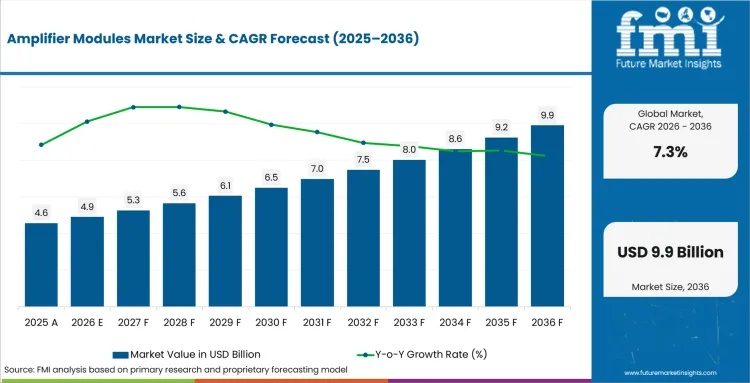
USD 4.9 billion in 2026 and USD 9.9 billion by 2036 at a 7.3% CAGR.
Demand for amplifier modules is projected to expand at 7.3% CAGR between 2026 and 2036, increasing valuation from USD 4.9 billion in 2026 to USD 9.9 billion by 2036. Radio-equipment designers use RF front-end modules to reduce matching work and keep gain predictable across repeated signal paths. Skyworks announced in March 2026 that a MediaTek reference design would use its FR3 LNA and power-amplifier module with integrated filters from 6.425 GHz to above 7 GHz.
Country demand converts at different points because spectrum policy changes the timing and scope of radio upgrades. Germany extended usage rights at 800 MHz, 1800 MHz and 2600 MHz for five years in March 2025 under stronger coverage obligations. That continuity favors incremental RF power amplifiers and radio upgrades instead of an immediate band reset. Taiwan and South Korea face earlier upper-mid-band validation work that places more weight on broadband characterization.
Key Takeaways ofAir Operated Hoists Market
- Radio redesigns increase amplifier content as wider bandwidth and higher antenna density place more gain stages inside each qualified platform.
- By module type, RF amplifier modules are estimated to hold 34.0% in 2026 owing to integrated gain stages that reduce external matching work.
- In 2026, microwave is expected to lead frequency with 28.0% share because telecom and defense programs require characterized high-frequency amplification.
- Medium power is set to lead the power rating category with 34.0% share in 2026 due to replicated radio paths requiring useful output without excessive thermal load.
- RF and thermal validation restrain supplier switching because replacement modules can force renewed board testing and reliability qualification.
- Qorvo, Skyworks Solutions, Analog Devices, Broadcom, Mini-Circuits, MACOM and Infineon Technologies are some notable players in the industry.
Analyst Perspective
"Module economics depend on how much matching and thermal work a vendor removes from the radio design. Long-term value comes from documented RF behavior and stable lifecycle support that remains credible throughout equipment qualification programs."
- Sudip saha, Principal Consultant, Future Market Insights
How is the Air Operated Hoists Market segmented?
The amplifier modules market is segmented by module type, frequency, power rating, end use and sales channel.
Module types include RF amplifier modules, power amplifier modules, audio amplifier modules, instrumentation amplifier modules and optical amplifier modules. Frequency covers microwave, IF / broadband, low frequency, mmWave and optical / photonic. Power ratings include medium power, low power, high power and high linearity specialty. End uses cover telecom infrastructure, defense / aerospace, consumer electronics, industrial test and medical equipment. Sales channels include electronics distributors, direct semiconductor OEM, module integrators and contract manufacturers.
What makes RF amplifier modules central to the module type category?
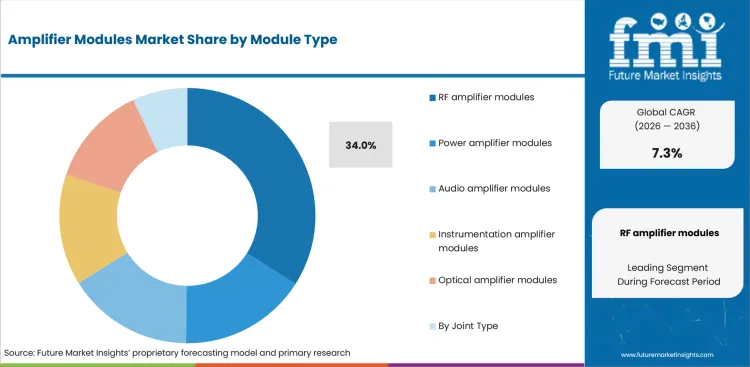
RF amplifier modules sit inside transmit and receive chains where designers need controlled gain without rebuilding every matching and bias network. RF module test systems matter during qualification because integrated gain stages must meet noise, linearity and thermal targets on the intended board.
- By module type, RF amplifier modules are estimated to hold 34.0% in 2026 owing to their use across repeated radio-frequency gain and power stages.
- Module integration reduces separate matching work if switching and filtering behavior remains compatible inside the intended transceiver chain. Broadcom's December 2025 Form 10-K identifies multi-chip RF front-end modules plus amplifier-design and module-integration capability for transceiver applications.
Why does microwave lead the frequency category?
Microwave modules serve satellite, defense and test systems where passive loss rises and layout tolerance tightens as operating frequency increases. Engineers use microwave integrated circuits to reduce board-level complexity by placing characterized high-frequency gain inside compact packages.
- In 2026, microwave is expected to lead the frequency category with 28.0% share because established infrastructure and mission systems require characterized high-frequency amplification.
- Radar and SATCOM engineers qualify packaged high-power gain against frequency range and system size before switching from legacy amplification. Qorvo introduced four wideband SSPAs in November 2025 for radar, SATCOM, electronic warfare and test applications, giving engineers current packaged options across demanding microwave systems.
What role does medium power play within the power rating category?
Medium-power modules balance usable radio output against heat, footprint and power limits across repeated antenna paths. The same trade-off shapes 5G gain blocks that must fit compact radio units without forcing larger cooling assemblies.
- Medium power is set to lead the power rating category with 34.0% share in 2026 due to replicated radio paths requiring useful output without excessive thermal load.
- Matched mid-power modules reduce external RF work if driver and final stages arrive as one characterized design. Ampleon introduced its G1M3438P70C in June 2026 for TDD and FDD massive-MIMO systems, integrating a GaN Doherty amplifier with a bias control IC across the 3.4 to 3.8 GHz range.
What supports telecom infrastructure within the end use category?
Telecom infrastructure repeats amplifier stages across radio units, antenna paths and frequency bands during each platform design. Equipment teams therefore evaluate 5G driver amplifiers against efficiency, linearity and thermal behavior before moving a radio design into production.
- The end use category is forecast to be led by telecom infrastructure at 31.0% share in 2026 due to repeated amplification stages and long platform support cycles.
- Deployed cellular networks sustain recurring radio qualification as operators maintain and upgrade active infrastructure. 5G Americas reported in September 2025 that 373 commercial 5G networks were deployed worldwide, keeping module lifecycle support relevant across operating networks.
What are the drivers, restraints and opportunities in the amplifier modules market?
Telecom radio redesigns raise module content, qualification limits switching and new upper-mid-band work creates a broader design window.
- Driver: Radio platforms require more qualified amplification paths as bandwidth and antenna density increase inside compact equipment.
- Restraint: RF emissions and thermal behavior must remain inside system limits before replacement modules receive production approval.
- Opportunity: Upper-mid-band and future 6G programs create new design positions for broadband modules with stronger integration support.
Radio Redesigns Increase Qualified Amplification Content
Radio redesigns raise qualified amplifier content as manufacturers repeat gain stages across more antenna paths and wider operating bandwidths. Qorvo introduced the QPA9862 pre-driver in June 2025 for 32T and 64T 5G mMIMO radios with 3.3 to 4.2 GHz coverage. That format reduces external RF work across replicated radio-frequency components while making efficiency and thermal behavior part of system-level qualification.
High-Frequency Validation Extends Supplier Qualification
RF and thermal validation can make a nominally compatible module expensive to substitute after design-in. NTIA reported in June 2026 that measured out-of-band emissions from a commercial n260 5G base station exceeded the referenced ITU limit in the adjacent 36 to 37 GHz band. RF evaluation boards therefore need to reproduce system conditions closely enough for engineers to identify emissions or thermal risks before approval.
Upper-Mid-Band Research Opens New Design Positions
Upper-mid-band research gives amplifier makers a design window before future 6G specifications settle into production hardware. South Korea's Ministry of Science and ICT reported in March 2025 that national 6G research would study wireless-network characteristics from 7 to 24 GHz. Module developers can use that period to validate broadband gain, filtering and thermal behavior beside millimeter-wave transceivers before equipment teams lock reference designs.
Which country CAGRs are profiled in the amplifier modules market?
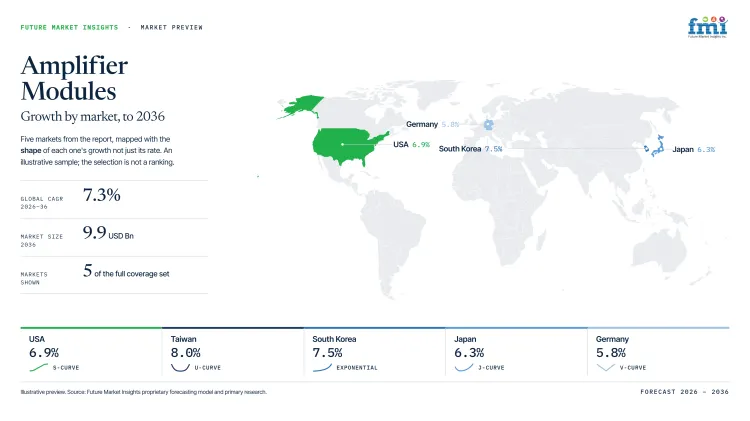
| Country | CAGR |
|---|---|
| Taiwan | 8.0% |
| South Korea | 7.5% |
| USA | 6.9% |
| Japan | 6.3% |
| Germany | 5.8% |
How do country-level CAGRs compare in the amplifier modules market?
The forecasts span 2.2 percentage points from Taiwan to Germany, with Taiwan and South Korea forming the upper band. USA occupies the middle position while Japan and Germany show a more measured pace. The spread reflects different standards timelines and radio-upgrade cycles rather than a ranking of revenue.
- Taiwan links RF chipset design with antenna integration inside compact electronics supply chains.
- South Korea aligns 6G standards work with domestic semiconductor and radio engineering programs.
- USA demand spans commercial wireless and defense programs with separate qualification routes.
- Japan emphasizes reliability evidence and long component support before platform release decisions.
- Germany's spectrum extensions favor measured optimization across established mobile radio bands.
CAGR therefore signals upgrade pace while local qualification determines how design activity converts into orders. The full report provides country-level CAGR analysis across North America, Latin America, Europe, East Asia, South Asia, Oceania and the Middle East and Africa.
Country-wise Analysis
- Taiwan combines RF semiconductor design with electronics manufacturing that lets antenna, chipset and module teams iterate within supply routes. Amplifier-module sales in Taiwan are forecast to expand at 8.0% CAGR by 2036, aided by local integration and test capacity. The Ministry of Economic Affairs presented Taiwan's first 6G base-station antenna system in December 2025 alongside self-developed base-station technologies for new 6G bands. Local co-design shortens prototype cycles, but globally accepted characterization must keep pace with emerging band and test requirements before a module can move from demonstration hardware into repeatable production. Fast sample logistics also matter during that conversion because prototype schedules leave little room for delayed component access.
- South Korean radio development follows national standards priorities because handset, infrastructure and semiconductor programs share overlapping engineering roadmaps. Adoption of amplifier modules in South Korea is estimated to expand at 7.5% CAGR through 2036, supported by early 5G-Advanced and 6G work. The Ministry of Science and ICT reported in March 2026 that ETRI software could reduce base-station equipment energy use by more than 20%. That efficiency focus rewards lower-loss RF stages, but changing pre-6G specifications require broadband prototypes and reference designs that remain adjustable before production qualification. Domestic application teams can also coordinate component testing with system-level power targets.
- USA amplifier-module demand spans commercial radio equipment, defense electronics and test systems that follow different qualification and purchasing routes. USA is estimated to post 6.9% CAGR over the forecast period, supported by a large deployed wireless base and broad authorized distribution. The Federal Communications Commission reported in May 2025 that 96% of homes and small businesses had access to 5G service at least 7/1 Mbps. Network scale supports recurring radio upgrades, but manufacturers must prove interoperability and lifecycle continuity across fragmented programs before samples convert into production orders. Authorized distribution helps engineers source qualified alternatives during that process without delaying bench testing across separate customer programs.
- Japanese equipment teams place weight on reliability records, controlled qualification and long component availability before committing an amplifier module to production. Demand for amplifier modules in Japan is forecast to rise at 6.3% CAGR over the forecast period, shaped by future-radio research and measured product transitions. NICT reported in February 2026 that an outdoor base-station experiment achieved simultaneous communication with 10 devices using hybrid signal processing. Local research creates evaluation work for new RF chains, but manufacturers must translate laboratory performance into manufacturable modules with predictable thermals and stable change control. Long support periods raise the cost of substitutions because replacement modules can reopen thermal and reliability qualification work.
- German amplifier-module demand combines mobile-network modernization with industrial and test applications that favor predictable performance over frequent platform changes. The German amplifier modules sector is projected to record 5.8% CAGR during the assessment period, supported by continued 5G optimization across established spectrum. Bundesnetzagentur's June 2026 annual report found that about 56% of valid mobile speed tests used 5G during its latest reporting period. That deployed base supports incremental radio upgrades, but long purchasing cycles and mixed legacy configurations reward multiband efficiency plus documented reliability. Distribution support also matters where industrial platforms remain in service for extended periods. That service model reduces requalification risk for long-lived radio and industrial designs.
Who are the notable companies in the amplifier modules market?
Qorvo, Skyworks Solutions, Analog Devices, Broadcom, Mini-Circuits, MACOM and Infineon Technologies are the notable companies serving this market.
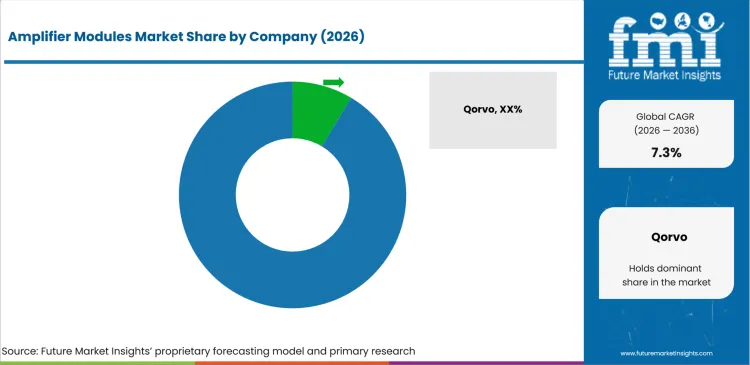
Competition is fragmented across RF specialists and broad semiconductor groups that solve different parts of the qualification problem. Some vendors combine solid-state power amplifiers with application support while others compete through integrated front ends or wide signal-chain portfolios. Entry barriers rise when customers require characterized thermal behavior and stable lifecycle support across several design revisions.
- Qorvo, and MACOM compete around radio infrastructure power stages and application-specific RF coverage.
- Skyworks Solutions and Broadcom emphasize integrated wireless front ends that reduce external component count in compact signal chains.
- Analog Devices, Mini-Circuits and Infineon Technologies address broader RF design needs through signal-chain breadth, microwave building blocks and semiconductor process depth.
Competitive Benchmarking: Amplifier Modules Market
| Company | RF / Microwave Coverage | Module Integration and Design Support | Power / Thermal Engineering Depth | Geographic Reach |
|---|---|---|---|---|
| Qorvo | High | High | High | Global |
| Skyworks Solutions | High | High | Medium | Global |
| Analog Devices | High | High | Medium | Global |
| Broadcom | Medium | High | Medium | Global |
| Mini-Circuits | High | Medium | Medium | North America, Europe and Asia |
| MACOM | High | High | High | North America, Europe and Asia |
| Infineon Technologies | Medium | Medium | High | Global |
Key Developments in the Amplifier Modules Market
- In May 2026, Qorvo introduced the QPA3312 1.8 GHz DOCSIS 4.0 power-doubler hybrid amplifier for higher downstream RF output within established 24 V platform limits.
- In November 2025, MACOM entered an agreement with HRL Laboratories to license and manufacture HRL's 40 nm T3L GaN-on-SiC process for high-frequency RF and microwave devices.
- In October 2025, Skyworks Solutions and Qorvo entered a definitive cash-and-stock agreement to combine their businesses with completion subject to required approvals.
Key Players in the Amplifier Modules Market
RF, Microwave and Radio-Power Specialists
- Qorvo
- Mini-Circuits
- MACOM
Integrated Wireless Front-End Platforms
- Skyworks Solutions
- Broadcom
Broad Analog and Semiconductor Platforms
- Analog Devices
- Infineon Technologies
Amplifier Modules Market - Report Scope
| Coverage field | Report scope |
|---|---|
| Market breakdown | By module type, frequency, power rating, end use, sales channel and region. |
| Quantitative Units | Revenue in USD billion and CAGR in %. |
| Market Definition | Integrated electronic amplifier modules supplied as qualified gain or power blocks for telecom, defense, consumer, industrial and medical systems. |
| Regions Covered | North America, Latin America, Europe, East Asia, South Asia and Pacific and Middle East and Africa. |
| Countries Covered | Taiwan, South Korea, USA, Japan, Germany, and 20+ countries included in the full report. |
| Key Companies Profiled | Qorvo, Skyworks Solutions, Analog Devices, Broadcom, Mini-Circuits, MACOM, Infineon Technologies. |
| Forecast Period | 2026 to 2036. |
| Approach | Primary and secondary research with market triangulation. |
Amplifier Modules Market - Research Methodology
| Method | Approach |
|---|---|
| Primary Research | FMI analysts gathered input from manufacturers, service providers, technology developers, distributors, end users, procurement teams, and subject-matter experts. Interviews examined purchasing decisions, product or service evaluation, adoption barriers, approval requirements, pricing considerations, and expectations for technical or commercial support. Respondents were also asked what evidence is required before a trial, pilot, or initial order develops into regular purchasing. |
| Desk Research | Desk research covered government statistics, regulatory publications, trade data, industry associations, technical literature, standards, company filings, product information, and official corporate announcements. Sources were reviewed for relevance, publication date, geographic coverage, and consistency with the defined market scope. Claims relating to performance, applications, approvals, capacity, investment, and commercial activity were retained only when supported by credible public evidence. |
| Market Sizing and Forecasting | The market model combined the baseline value with historical performance, segment structure, pricing and volume indicators, adoption levels, company participation, and country-level demand conditions. Forecast assumptions considered economic activity, investment trends, regulatory developments, technology adoption, purchasing cycles, supply availability, and barriers to wider market use. Segment and regional estimates were reconciled before the final market total was calculated. |
| Data Validation | Estimates were checked against multiple independent indicators, including public data, company activity, trade patterns, industry developments, and findings from primary interviews. Validation also tested whether products, services, applications, and company revenues fell within the defined market boundaries. Adjacent categories, unsupported claims, overlapping revenues, and activities without direct market relevance were excluded to reduce double counting and maintain consistency across segments and countries. |
Amplifier Modules Market by Segments
Amplifier Modules Market segmented by Module Type:
- RF amplifier modules
- Power amplifier modules
- Audio amplifier modules
- Instrumentation amplifier modules
- Optical amplifier modules
Amplifier Modules Market segmented by Frequency:
- Microwave
- IF / broadband
- Low frequency
- mmWave
- Optical / photonic
Amplifier Modules Market segmented by Power Rating:
- Medium power
- Low power
- High power
- High linearity specialty
Amplifier Modules Market segmented by End Use:
- Telecom infrastructure
- Defense / aerospace
- Consumer electronics
- Industrial test
- Medical equipment
Amplifier Modules Market segmented by Sales Channel:
- Electronics distributors
- Direct semiconductor OEM
- Module integrators
- Contract manufacturers
Amplifier Modules Market by Region:
- North America
- United States
- Canada
- Latin America
- Brazil
- Mexico
- Chile
- Rest of Latin America
- Western Europe
- Germany
- United Kingdom
- Italy
- Spain
- France
- Nordics
- Benelux
- Rest of Western Europe
- Eastern Europe
- Russia
- Poland
- Hungary
- Balkan and Baltic States
- Rest of Eastern Europe
- East Asia
- China
- Japan
- South Korea
- South Asia and Pacific
- India
- ASEAN
- Australia and New Zealand
- Rest of South Asia and Pacific
- Middle East and Africa
- Kingdom of Saudi Arabia
- Other GCC Countries
- Türkiye
- South Africa
- Other African Union Countries
- Rest of Middle East and Africa
Research Sources and Bibliography
- Skyworks Solutions, Inc. (2026, March 2). Skyworks and MediaTek Showcase Early 6G FR3 and PC1 RF Front-End Innovations at MWC 2026.
- Bundesnetzagentur. (2025, March 24). Bundesnetzagentur extends mobile spectrum subject to conditions.
- Broadcom Inc. (2025, December 18). Form 10-K for Broadcom INC filed 12/18/2025.
- Qorvo. (2025, November 11). Qorvo® Delivers Wideband SSPAs as Reliable TWTA Replacement with Up to 50 Percent Smaller System Footprint.
- Ampleon. (2026, June 11). Ampleon introduces fully integrated 5G massive MIMO GaN power amplifier module with intelligent bias control.
- 5G Americas. (2025, September 23). North America Sets Global Pace as 5G Growth Hits 2.6 Billion Connections Worldwide.
- Qorvo. (2025, June 16). Qorvo Simplifies 5G Infrastructure with New Compact Solutions that Reduce Radio Footprint and Improve Thermal Performance.
- Wepman, J. A., Thompson, S. T., McCullough, R. S., Drocella, E. F., Lundy, A., Saqueton, G. C., & Brewster, K. J. (2026, June). Measured Out-of-Band Emissions in the 36-37 GHz Band from an n260 (37-40 GHz) Millimeter-Wave 5G Base Station.
- Ministry of Science and ICT, Republic of Korea. (2025, March 18). The 3GPP 6G International Conference Concluded Successfully, Marked by Achievements Such As Korea’s Appointment to Chair Positions.
- Ministry of Economic Affairs, Taiwan. (2025, December 10). Taiwan Unveils Its First 6G Base Station Antenna System at IEEE GLOBECOM 2025.
- Ministry of Science and ICT, Republic of Korea. (2026, March 3). Korea Showcases Low-Power AI Network Technology to the World.
- Federal Communications Commission. (2025, May 20). Broadband Data Collection Shows Access to High-Speed Internet Services.
- National Institute of Information and Communications Technology. (2026, February 17). Demonstration of Massive Connectivity for the 6G Era.
- Bundesnetzagentur. (2026, June). Net Neutrality in Germany Annual Report 2025/2026. Report of the Bundesnetzagentur to the European Commission and BEREC pursuant to Article 5(1) Regulation (EU) 2015/2120 Reporting period: May 2025 to April 2026.
- Qorvo. (2026, May 13). Qorvo Increases 1.8 GHz DOCSIS® 4.0 Output at 24V without Exceeding Power Limits.
- MACOM Technology Solutions Inc. (2025, November 4). MACOM to Manufacture HRL’s 40nm GaN-on-SiC Process.
- Skyworks Solutions, Inc., & Qorvo, Inc. (2025, October 28). Skyworks and Qorvo to Combine to Create $22 Billion USA-Based Leader in High-Performance RF, Analog and Mixed-Signal Solutions.
This bibliography is provided for reader reference and is not exhaustive. The full report contains the complete reference list and detailed citations.
This Report Answers
- How large is the amplifier modules market in 2026 and what value is projected for 2036?
- Which radio-platform changes are increasing demand for qualified amplifier modules?
- Why do RF amplifier modules lead the module type category in 2026?
- Why does microwave remain the leading frequency category for amplifier modules?
- How does medium power balance output and thermal limits across repeated radio paths?
- Why do Taiwan and South Korea show faster forecast CAGRs than Germany and Japan?
- Which local qualification frictions affect order conversion across the five profiled countries?
- How do Qorvo, MACOM and other suppliers differ in amplifier-module positioning?
- What RF, thermal and lifecycle evidence should equipment teams review before approving a module?
Frequently Asked Questions
How big is the Amplifier Modules Market in 2026?
The amplifier modules market is expected to be valued at USD 4.9 billion in 2026 and reach USD 9.9 billion by 2036. Expansion reflects wider radio bandwidths and denser antenna paths that require more qualified amplification stages.
What is the CAGR of the Amplifier Modules Market from 2026 to 2036?
The amplifier modules market is projected to grow at a 7.3% CAGR between 2026 and 2036. Growth is supported by radio-platform redesigns that increase qualified gain-stage content while integration reduces board-level RF work.
Which module type leads the Amplifier Modules Market?
The RF amplifier modules are projected to account for 34.0% of module-type demand in 2026. Their leading position reflects use across transmit and receive chains that require controlled gain without excessive external matching.
How much value will the Amplifier Modules Market add between 2026 and 2036?
The amplifier modules market is expected to add USD 5.0 billion between 2026 and 2036 based on its rise from USD 4.9 billion to USD 9.9 billion. Value comes from radio redesigns that add qualified amplification paths across new and existing platforms.
Which companies are active in the Amplifier Modules Market?
The amplifier modules market includes Qorvo, Skyworks Solutions, Analog Devices, Broadcom, NXP Semiconductors, Mini-Circuits, MACOM and Infineon Technologies. These companies compete through different combinations of RF coverage, module integration, power engineering and qualification support.
Preview the report firsthand - request a free sample
Get SampleGet the brochure for pricing and purchase details.
Get PDFTable of Content
- Key Takeaways
- Market Size and CAGR
- Top Growth Driver
- Fastest Growing Segment
- Leading Region
- Key Companies
- Emerging Opportunities
- Executive Summary
- Global Market Outlook
- Demand-side Trends
- Supply-side Trends
- Technology Roadmap Analysis
- Analysis and Recommendations
- Analyst Perspective (What is happening? Why now? What should investors know?)
- Key Questions Answered
- How large is the market?
- What is the CAGR?
- What are key trends?
- Which region dominates?
- Who are the leaders?
- Market Overview
- Market Coverage / Taxonomy
- Market Definition / Scope / Limitations
- Research Methodology
- Chapter Orientation
- Analytical Lens and Working Hypotheses
- Market Structure, Signals, and Trend Drivers
- Benchmarking and Cross-market Comparability
- Market Sizing, Forecasting, and Opportunity Mapping
- Research Design and Evidence Framework
- Desk Research Programme (Secondary Evidence)
- Expert Input and Fieldwork (Primary Evidence)
- Tooling, Models, and Reference Databases
- Data Engineering and Model Build
- Quality Assurance and Audit Trail
- Market Background
- Market Dynamics (Drivers, Restraints, Opportunity, Trends)
- Scenario Forecast (Optimistic, Likely, Conservative)
- Impact Analysis
- AI Impact
- Sustainability Impact
- Regulatory Impact
- Technology Impact
- Consumer / Buyer Analysis
- Purchase Drivers
- Adoption Barriers
- Buyer Journey
- Opportunity Map Analysis
- Product Life Cycle Analysis
- Supply Chain Analysis
- Investment Feasibility Matrix
- Value Chain Analysis
- PESTLE and Porter's Analysis
- Regulatory Landscape
- Regional Parent Market Outlook
- Production and Consumption Statistics
- Import and Export Statistics
- Global Market Analysis and Forecast, 2021 to 2036
- Historical Market Size Value (USD Billion) Analysis, 2021 to 2025
- Current and Future Market Size Value (USD Billion) Projections, 2026 to 2036
- Y-o-Y Growth Trend Analysis
- Absolute $ Opportunity Analysis
- Global Market Pricing Analysis, 2021 to 2036
- Global Market Analysis and Forecast, By Module Type, 2021 to 2036
- Introduction / Key Findings
- Historical Market Size Value (USD Billion) Analysis By Module Type, 2021 to 2025
- Current and Future Market Size Value (USD Billion) Analysis and Forecast By Module Type, 2026 to 2036
- RF amplifier modules
- Power amplifier modules
- Audio amplifier modules
- Instrumentation amplifier modules
- Optical amplifier modules
- By Joint Type
- RF amplifier modules
- Y-o-Y Growth Trend Analysis By Module Type, 2021 to 2025
- Absolute $ Opportunity Analysis By Module Type, 2026 to 2036
- Global Market Analysis and Forecast, By Frequency, 2021 to 2036
- Introduction / Key Findings
- Historical Market Size Value (USD Billion) Analysis By Frequency, 2021 to 2025
- Current and Future Market Size Value (USD Billion) Analysis and Forecast By Frequency, 2026 to 2036
- Microwave
- IF / broadband
- Low frequency
- mmWave
- Optical / photonic
- By Material
- Microwave
- Y-o-Y Growth Trend Analysis By Frequency, 2021 to 2025
- Absolute $ Opportunity Analysis By Frequency, 2026 to 2036
- Global Market Analysis and Forecast, By Power Rating, 2021 to 2036
- Introduction / Key Findings
- Historical Market Size Value (USD Billion) Analysis By Power Rating, 2021 to 2025
- Current and Future Market Size Value (USD Billion) Analysis and Forecast By Power Rating, 2026 to 2036
- Medium power
- Low power
- High power
- High linearity specialty
- By Load Class
- Medium power
- Y-o-Y Growth Trend Analysis By Power Rating, 2021 to 2025
- Absolute $ Opportunity Analysis By Power Rating, 2026 to 2036
- Global Market Analysis and Forecast, By End Use, 2021 to 2036
- Introduction / Key Findings
- Historical Market Size Value (USD Billion) Analysis By End Use, 2021 to 2025
- Current and Future Market Size Value (USD Billion) Analysis and Forecast By End Use, 2026 to 2036
- Telecom infrastructure
- Defense / aerospace
- Consumer electronics
- Industrial test
- Medical equipment
- By Application
- Telecom infrastructure
- Y-o-Y Growth Trend Analysis By End Use, 2021 to 2025
- Absolute $ Opportunity Analysis By End Use, 2026 to 2036
- Global Market Analysis and Forecast, By Sales Channel, 2021 to 2036
- Introduction / Key Findings
- Historical Market Size Value (USD Billion) Analysis By Sales Channel, 2021 to 2025
- Current and Future Market Size Value (USD Billion) Analysis and Forecast By Sales Channel, 2026 to 2036
- Electronics distributors
- Direct semiconductor OEM
- Module integrators
- Contract manufacturers
- By Sales Channel
- Electronics distributors
- Y-o-Y Growth Trend Analysis By Sales Channel, 2021 to 2025
- Absolute $ Opportunity Analysis By Sales Channel, 2026 to 2036
- Global Market Analysis and Forecast, By Region, 2021 to 2036
- Introduction
- Historical Market Size Value (USD Billion) Analysis By Region, 2021 to 2025
- Current Market Size Value (USD Billion) Analysis and Forecast By Region, 2026 to 2036
- North America
- Latin America
- Western Europe
- Eastern Europe
- East Asia
- South Asia and Pacific
- Middle East & Africa
- Market Attractiveness Analysis By Region
- North America Market Analysis and Forecast, By Country, 2021 to 2036
- Historical Market Size Value (USD Billion) Trend Analysis By Market Taxonomy, 2021 to 2025
- Market Size Value (USD Billion) Forecast By Market Taxonomy, 2026 to 2036
- By Country
- USA
- Canada
- By Module Type
- By Frequency
- By Power Rating
- By End Use
- By Sales Channel
- By Country
- Market Attractiveness Analysis
- By Country
- By Module Type
- By Frequency
- By Power Rating
- By End Use
- By Sales Channel
- Key Takeaways
- Latin America Market Analysis and Forecast, By Country
- Historical Market Size Value (USD Billion) Trend Analysis By Market Taxonomy, 2021 to 2025
- Market Size Value (USD Billion) Forecast By Market Taxonomy, 2026 to 2036
- By Country
- Brazil
- Mexico
- Chile
- Rest of Latin America
- By Module Type
- By Frequency
- By Power Rating
- By End Use
- By Sales Channel
- By Country
- Market Attractiveness Analysis
- By Country
- By Module Type
- By Frequency
- By Power Rating
- By End Use
- By Sales Channel
- Key Takeaways
- Western Europe Market Analysis and Forecast, By Country
- Historical Market Size Value (USD Billion) Trend Analysis By Market Taxonomy, 2021 to 2025
- Market Size Value (USD Billion) Forecast By Market Taxonomy, 2026 to 2036
- By Country
- Germany
- UK
- Italy
- Spain
- France
- Nordic
- BENELUX
- Rest of Western Europe
- By Module Type
- By Frequency
- By Power Rating
- By End Use
- By Sales Channel
- By Country
- Market Attractiveness Analysis
- By Country
- By Module Type
- By Frequency
- By Power Rating
- By End Use
- By Sales Channel
- Key Takeaways
- Eastern Europe Market Analysis and Forecast, By Country
- Historical Market Size Value (USD Billion) Trend Analysis By Market Taxonomy, 2021 to 2025
- Market Size Value (USD Billion) Forecast By Market Taxonomy, 2026 to 2036
- By Country
- Russia
- Poland
- Hungary
- Balkan & Baltic
- Rest of Eastern Europe
- By Module Type
- By Frequency
- By Power Rating
- By End Use
- By Sales Channel
- By Country
- Market Attractiveness Analysis
- By Country
- By Module Type
- By Frequency
- By Power Rating
- By End Use
- By Sales Channel
- Key Takeaways
- East Asia Market Analysis and Forecast, By Country
- Historical Market Size Value (USD Billion) Trend Analysis By Market Taxonomy, 2021 to 2025
- Market Size Value (USD Billion) Forecast By Market Taxonomy, 2026 to 2036
- By Country
- China
- Japan
- South Korea
- By Module Type
- By Frequency
- By Power Rating
- By End Use
- By Sales Channel
- By Country
- Market Attractiveness Analysis
- By Country
- By Module Type
- By Frequency
- By Power Rating
- By End Use
- By Sales Channel
- Key Takeaways
- South Asia and Pacific Market Analysis and Forecast, By Country
- Historical Market Size Value (USD Billion) Trend Analysis By Market Taxonomy, 2021 to 2025
- Market Size Value (USD Billion) Forecast By Market Taxonomy, 2026 to 2036
- By Country
- India
- ASEAN
- Australia & New Zealand
- Rest of South Asia and Pacific
- By Module Type
- By Frequency
- By Power Rating
- By End Use
- By Sales Channel
- By Country
- Market Attractiveness Analysis
- By Country
- By Module Type
- By Frequency
- By Power Rating
- By End Use
- By Sales Channel
- Key Takeaways
- Middle East & Africa Market Analysis and Forecast, By Country
- Historical Market Size Value (USD Billion) Trend Analysis By Market Taxonomy, 2021 to 2025
- Market Size Value (USD Billion) Forecast By Market Taxonomy, 2026 to 2036
- By Country
- Kingdom of Saudi Arabia
- Other GCC Countries
- Türkiye
- South Africa
- Other African Union
- Rest of Middle East & Africa
- By Module Type
- By Frequency
- By Power Rating
- By End Use
- By Sales Channel
- By Country
- Market Attractiveness Analysis
- By Country
- By Module Type
- By Frequency
- By Power Rating
- By End Use
- By Sales Channel
- Key Takeaways
- Key Countries Market Analysis
- USA
- Pricing Analysis
- Market Share Analysis, 2025
- By Module Type
- By Frequency
- By Power Rating
- By End Use
- By Sales Channel
- Canada
- Pricing Analysis
- Market Share Analysis, 2025
- By Module Type
- By Frequency
- By Power Rating
- By End Use
- By Sales Channel
- Mexico
- Pricing Analysis
- Market Share Analysis, 2025
- By Module Type
- By Frequency
- By Power Rating
- By End Use
- By Sales Channel
- Brazil
- Pricing Analysis
- Market Share Analysis, 2025
- By Module Type
- By Frequency
- By Power Rating
- By End Use
- By Sales Channel
- Chile
- Pricing Analysis
- Market Share Analysis, 2025
- By Module Type
- By Frequency
- By Power Rating
- By End Use
- By Sales Channel
- Germany
- Pricing Analysis
- Market Share Analysis, 2025
- By Module Type
- By Frequency
- By Power Rating
- By End Use
- By Sales Channel
- UK
- Pricing Analysis
- Market Share Analysis, 2025
- By Module Type
- By Frequency
- By Power Rating
- By End Use
- By Sales Channel
- Italy
- Pricing Analysis
- Market Share Analysis, 2025
- By Module Type
- By Frequency
- By Power Rating
- By End Use
- By Sales Channel
- Spain
- Pricing Analysis
- Market Share Analysis, 2025
- By Module Type
- By Frequency
- By Power Rating
- By End Use
- By Sales Channel
- France
- Pricing Analysis
- Market Share Analysis, 2025
- By Module Type
- By Frequency
- By Power Rating
- By End Use
- By Sales Channel
- India
- Pricing Analysis
- Market Share Analysis, 2025
- By Module Type
- By Frequency
- By Power Rating
- By End Use
- By Sales Channel
- ASEAN
- Pricing Analysis
- Market Share Analysis, 2025
- By Module Type
- By Frequency
- By Power Rating
- By End Use
- By Sales Channel
- Australia & New Zealand
- Pricing Analysis
- Market Share Analysis, 2025
- By Module Type
- By Frequency
- By Power Rating
- By End Use
- By Sales Channel
- China
- Pricing Analysis
- Market Share Analysis, 2025
- By Module Type
- By Frequency
- By Power Rating
- By End Use
- By Sales Channel
- Japan
- Pricing Analysis
- Market Share Analysis, 2025
- By Module Type
- By Frequency
- By Power Rating
- By End Use
- By Sales Channel
- South Korea
- Pricing Analysis
- Market Share Analysis, 2025
- By Module Type
- By Frequency
- By Power Rating
- By End Use
- By Sales Channel
- Russia
- Pricing Analysis
- Market Share Analysis, 2025
- By Module Type
- By Frequency
- By Power Rating
- By End Use
- By Sales Channel
- Poland
- Pricing Analysis
- Market Share Analysis, 2025
- By Module Type
- By Frequency
- By Power Rating
- By End Use
- By Sales Channel
- Hungary
- Pricing Analysis
- Market Share Analysis, 2025
- By Module Type
- By Frequency
- By Power Rating
- By End Use
- By Sales Channel
- Kingdom of Saudi Arabia
- Pricing Analysis
- Market Share Analysis, 2025
- By Module Type
- By Frequency
- By Power Rating
- By End Use
- By Sales Channel
- Türkiye
- Pricing Analysis
- Market Share Analysis, 2025
- By Module Type
- By Frequency
- By Power Rating
- By End Use
- By Sales Channel
- South Africa
- Pricing Analysis
- Market Share Analysis, 2025
- By Module Type
- By Frequency
- By Power Rating
- By End Use
- By Sales Channel
- USA
- Market Structure Analysis
- Competition Dashboard
- Competition Benchmarking
- Market Share Analysis of Top Players
- By Regional
- By Module Type
- By Frequency
- By Power Rating
- By End Use
- By Sales Channel
- Emerging Startups
- Innovation Benchmarking
- Competition Analysis
- Competition Deep Dive
- Qorvo
- Overview
- Product Portfolio
- Profitability by Market Segments
- Sales Footprint
- Strategy Overview
- Marketing Strategy
- Product Strategy
- Channel Strategy
- Skyworks Solutions
- Analog Devices
- Broadcom
- Mini-Circuits
- MACOM
- Texas Instruments
- Infineon Technologies
- Murata
- Qorvo
- Case Studies
- Success Stories
- Recent Developments
- Competition Deep Dive
- Assumptions & Acronyms Used


