

- Market Size (2026)
- USD 620.7 Mn
- Forecast (2036)
- USD 1020.7 Mn
- CAGR (2026 to 2036)
- 5.1%
How big is Attachment Chains Market in 2026?
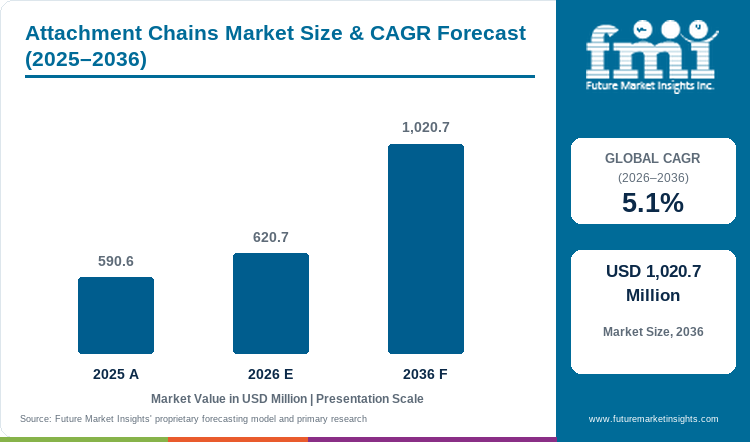
USD 620.7 million in 2026 and USD 1,020.7 million by 2036 at a 5.1% CAGR.
Sales of attachment chains are estimated to grow at a 5.1% CAGR from USD 620.7 million in 2026 to USD 1,020.7 million by 2036. The market was valued at USD 590.6 million in 2025. Demand is tied to machines in which the chain does more than transmit motion: tabs, pins, lugs, or welded features carry a product, fixture, slat, scraper, guide, or workpiece through a controlled path. This keeps attachment-chain purchasing close to machine design, but the installed base creates a separate replacement cycle once elongation, wear, corrosion, or attachment damage threatens line timing.
In packaging machinery, conveying and indexing mechanisms create recurring demand for precisely matched replacement chains. PMMI reported in September 2025 that US packaging machinery sales reached USD 11.3 billion in 2024. Once a chain is specified on a line, maintenance teams need the same pitch, attachment spacing, material and strand alignment when wear affects timing. Accurate drawings and available stock can determine how quickly the line returns to service.
Key Takeaways
- Attachment-chain revenue is supported by both new machine builds and recurring replacement demand from installed packaging, processing, assembly, and material-handling equipment.
- Roller attachment chains are projected to hold 32.0% of Chain Type revenue in 2026 because they add carrying or mounting features to familiar roller-chain geometry.
- K attachments are estimated at 26.0% of Attachment Style demand, while carbon steel is projected to account for 46.0% of Material revenue in 2026.
- Exact-fit requirements remain a restraint because nominal pitch does not guarantee that attachment spacing, mounting geometry, strand matching, or material will suit an installed machine.
- Italy is forecast to record the fastest CAGR among the profiled countries at 5.7%, followed by Mexico at 5.4% from 2026 to 2036.
- Key companies include Tsubaki, Rexnord / Regal Rexnord, Renold, iwis, Donghua Chain, KettenWulf, Senqcia, HKK Chain, PEER Chain, and Ramsey Products.
Analyst Perspective
The attachment pattern becomes part of a machine's geometry. A replacement chain must put each slat, pin or fixture in the original position and remain aligned with any parallel strand. Suppliers earn repeat orders by reproducing that geometry consistently and delivering it within the plant's shutdown window.
- Nikhil Kaitwade, Principal Consultant, Future Market Insights
How is the attachment chains market segmented?
Chain Type, Attachment Style, Material, End Use, Sales Channel, and Region
The attachment chains market is segmented by Chain Type, Attachment Style, Material, End Use, Sales Channel, and Region. Chain Type includes roller attachment chains, conveyor attachment chains, extended pin chains, hollow pin attachment chains, and special pitch attachment chains. Attachment Style includes K attachments, A attachments, SA attachments, SK attachments, and custom welded attachments. Material covers carbon steel, stainless steel, nickel plated steel, and plastic or engineering polymer. End Use includes packaging machinery, food processing, automotive assembly, material handling, and agricultural equipment. Sales Channel includes MRO distributors, direct chain manufacturers, conveyor OEMs, and custom fabrication shops.
Why do roller attachment chains lead demand within the Chain Type category?
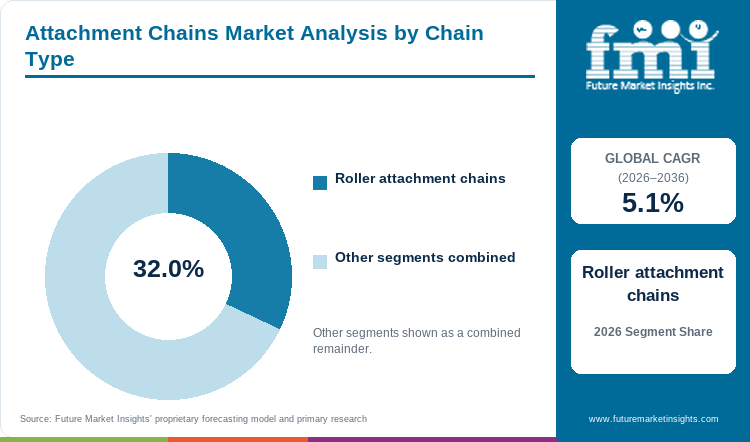
Roller attachment chains lead because they let machine designers add carrying or positioning features without abandoning a familiar roller-chain architecture. The base pitch, roller relationship, and sprocket interface remain recognizable, while attachments can be added for trays, slats, product supports, guides, or fixtures. This lowers redesign effort on standard industrial equipment and gives maintenance teams a clearer replacement path than a fully bespoke chain. The format also supports both single-pitch and double-pitch configurations, so suppliers can serve compact indexing duties as well as longer conveyor runs from the same design family.
- Roller attachment chains are estimated to account for 32.0% of Chain Type revenue in 2026.
- Their advantage is strongest where the machine builder wants a known sprocket relationship but still needs application-specific tabs, pins, or mounting surfaces.
Why do K attachments lead demand within the Attachment Style category?
K attachments lead because their two-sided geometry creates a stable mounting platform across both sides of the chain. That is useful when a slat, scraper, crossbar, or jig must sit square to the direction of travel and resist twisting under load. K formats also suit machine builders that want a standardized attachment code rather than a welded special for every project. A, SA, and SK attachments remain useful where access, orientation, or clearance requires a one-sided or vertical mounting surface, but K attachments fit a broad range of common conveying duties.
- K attachments are projected to hold 26.0% of Attachment Style revenue in 2026.
- Two-sided mounting helps distribute fixture loads more evenly where a conveyor needs a stable platform rather than a single projecting lug.
Why does carbon steel lead demand within the Material category?
Carbon steel leads because most attachment-chain applications first require tensile strength, fatigue resistance, wear life, and economical fabrication. Many industrial lines operate in dry or controlled environments where a stainless construction would add cost without solving the main failure mode. Carbon steel also accepts heat treatment and common attachment-fabrication methods, which matters when the chain must carry repeated loads over long service intervals. Stainless steel gains preference in washdown, corrosive, or hygienic environments, while plated steel provides a middle ground where surface protection is needed without moving to a full stainless specification.
- Carbon steel is estimated to account for 46.0% of Material revenue in 2026.
- Stainless steel, plated steel, and engineering polymers gain share when corrosion, sanitation, low noise, or weight becomes more important than the standard steel cost-performance balance.
Why does packaging machinery lead demand within the End Use category?
Packaging machinery leads because a packaging line contains many short, synchronized movement stages rather than one continuous transport function. Cartons, trays, bottles, pouches, slats, and product fixtures may be carried through filling, closing, coding, grouping, or transfer steps where positional repeatability matters. This produces many attachment-chain points per line and creates recurring replacement demand once chain elongation or attachment wear affects timing. The same installed-base logic appears across automated material handling systems, but packaging machinery is especially attachment-intensive because line layouts frequently require guided or indexed movement around multiple process stations.
- Packaging machinery is projected to account for 27.0% of End Use revenue in 2026.
- The segment combines OEM demand from new lines with MRO demand from format changes, rebuilds, and replacement of worn chains on installed equipment.
Why do MRO distributors lead demand within the Sales Channel category?
MRO distributors lead because the replacement problem usually begins after the machine is already in service. A plant may know the chain pitch but still need help identifying the attachment code, spacing, material, or equivalent brand before a shutdown can be cleared. Distributors create value by holding common configurations, cross-referencing legacy parts, and consolidating access to several chain brands. Direct manufacturers remain important for engineered OEM programs, while conveyor OEMs influence the initial specification. The distributor channel becomes strongest when the buyer is trying to restore a conveyor system quickly rather than redesign the machine.
- MRO distributors are projected to hold 36.0% of Sales Channel revenue in 2026.
- Local stock and application support can be more important than unit price when the cost of waiting exceeds the price difference between two compatible chains.
What are the drivers, restraints and opportunities in the Attachment Chains Market?
New machine investment expands the installed base, exact-fit requirements slow substitution, and faster standardized replacement supply creates aftermarket opportunity.
- Driver: Packaging, processing, factory automation, and material-handling investment adds new chain-based conveying and indexing points that later become replacement demand.
- Restraint: Pitch alone does not establish interchangeability because attachment geometry, spacing, material, strand matching, and machine alignment can still differ.
- Opportunity: Suppliers can monetize faster replacement by combining standardized attachment ranges with local stock, dimensional cross-reference support, and rapid custom finishing.
Automated production and logistics equipment adds chains at conveying, transfer and positioning points. Spending on factory automation and industrial controls increases the number of machines that move parts through defined stations, while packaging and handling equipment adds repeated transfer points. Each installed chain creates a future maintenance requirement because elongation, pin-bush wear, attachment fatigue, contamination, or a format change can eventually force replacement. The market therefore gains twice from capital investment: once when an OEM builds the machine and again when the user services it.
A chain with the correct pitch can still be unsuitable for an existing machine. Attachment-hole position, lug shape, pin extension and side-plate height affect the fit. Paired strands also need compatible length and alignment. Substitution can therefore require a drawing, sample or dimensional check, especially on older equipment whose original part number is no longer available.
Faster identification and manufacture of a compatible chain can shorten a production stoppage. Suppliers serving automated material handling equipment can build standardized K, A, and extended-pin ranges around common chain families, then add local machining, welding, or finishing for exceptions. The buyer pays for shorter downtime, fewer fit corrections, and less dependence on a single legacy source. This creates room for premium service even when the physical chain remains a relatively small part of the total machine value.
Which country CAGRs are profiled in the Attachment Chains Market?
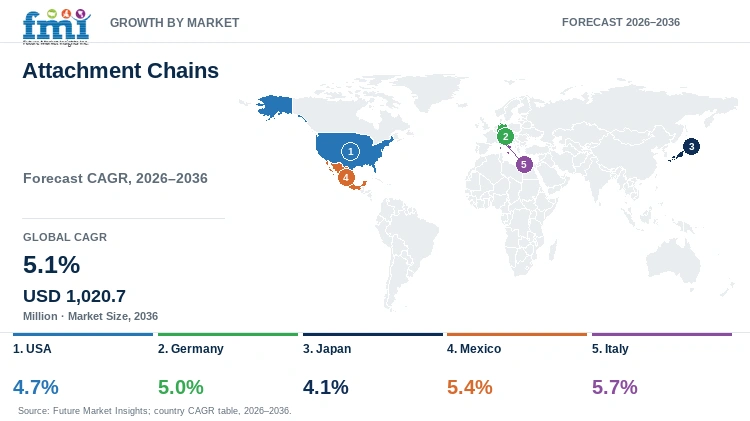
| Country | CAGR |
|---|---|
| USA | 4.7% |
| Germany | 5.0% |
| Japan | 4.1% |
| Mexico | 5.4% |
| Italy | 5.7% |
How do country-level CAGRs compare in the Attachment Chains Market?
Italy leads at 5.7% CAGR from 2026 to 2036, followed by Mexico at 5.4%, Germany at 5.0%, USA at 4.7% and Japan at 4.1%. Italian and German machinery builders generate demand for configured chains supplied to drawing. US replacement orders rely heavily on distributor stock, while Mexican plants may need both ANSI and metric configurations. Japan's established equipment base favors exact dimensional continuity.
- Italy leads Mexico by 0.3 percentage points, supported by a packaging-machinery industry that remains export intensive and closely connected to engineered component suppliers.
- Mexico leads Germany by 0.4 percentage points as automotive and industrial plants continue to create localized demand for replacement and machine-build components.
- Germany leads the USA by 0.3 percentage points, but the German opportunity is more engineering-led while U.S. demand benefits from a broad installed base and large MRO channel.
- The USA leads Japan by 0.6 percentage points; Japan remains a valuable market for high-precision chain even when mature equipment cycles produce slower headline growth.
Country-wise Analysis
- USA: Demand for attachment chains in the USA is forecast to expand at a 4.7% CAGR from 2026 to 2036. PMMI reported in September 2025 that U.S. packaging machinery sales reached USD 11.3 billion in 2024, giving chain suppliers a sizeable equipment base across food, beverage, pharmaceutical, and consumer-goods lines. The U.S. buying problem is often identification and availability rather than first-time design, so distributors that hold ANSI attachment formats and can cross-reference older machines are well placed to capture shutdown-driven orders.
- Germany: Demand in Germany is projected to grow at a 5.0% CAGR through 2036. Industrial production weakened in 2025, including a 2.6% decline in machinery and equipment output, which increases the importance of maintenance and productivity upgrades on existing assets rather than relying only on greenfield expansion. iwis nevertheless announced targeted investment in Munich during April 2026 for modern assembly machines, automated roller- and conveyor-chain processes, and on-site engineering. That combination favors suppliers able to support precise, configured chains during both OEM programs and retrofit work.
- Japan: Demand in Japan is forecast to rise at a 4.1% CAGR from 2026 to 2036. The Japan Packaging Institute reported that the production value of packaging machinery reached JPY 531 billion in 2025, up 4.8% from the prior year, while production units edged lower. That mix suggests a market where equipment value and specification depth can rise even without rapid unit expansion. Attachment-chain suppliers therefore compete on repeatability, low-maintenance options, and exact dimensional compatibility with established machinery platforms.
- Mexico: Demand in Mexico is projected to expand at a 5.4% CAGR through 2036. INEGI reported production of 3,953,494 light vehicles in 2025, keeping the country among the largest automotive manufacturing bases even though output was 0.9% lower than in 2024. Automotive plants and supplier parks contain conveyors, assembly fixtures, paint-shop handling, and component-transfer equipment sourced from several global OEM traditions. This rewards chain suppliers that can support both ANSI and metric standards and maintain local stock for replacement work.
- Italy: Demand in Italy is forecast to grow at a 5.7% CAGR from 2026 to 2036. UCIMA reported in July 2026 that Italian packaging-machinery revenue reached EUR 10.46 billion in 2025, up 4%, with exports above EUR 8.1 billion. The export orientation creates demand for attachment-chain suppliers that can meet machine-builder specifications consistently and support equipment after it is installed in other countries. Italian buyers also value responsive customization because chain geometry often becomes part of the machine design rather than a generic consumable choice.
Who are the notable companies in the Attachment Chains Market?
Tsubaki, Rexnord / Regal Rexnord, Renold, iwis, Donghua Chain, KettenWulf, Senqcia, HKK Chain, PEER Chain, and Ramsey Products are the notable companies profiled in this market.
Competition separates into broad chain platforms, replacement-oriented industrial chain suppliers, and engineered specialists. Tsubaki, Rexnord / Regal Rexnord, Renold, and iwis can serve programs that need broad pitch families, engineering support, and access across multiple regions. Donghua Chain, Senqcia, HKK Chain, and PEER Chain are relevant where standardized industrial chain access and replacement compatibility matter. KettenWulf and Ramsey Products are positioned more strongly around special chain designs and application-specific geometry. Renold now operates within the Webster-Renold platform following its 2025 acquisition, which broadened the combined group’s industrial chain and power-transmission footprint.
- Broad platform suppliers compete for OEM programs where the same machine family may be built across several countries and needs a repeatable chain specification.
- Replacement-oriented suppliers win when a plant requires a common K, A, or extended-pin format quickly and values cross-reference support.
- Engineered specialists gain leverage where load, environment, attachment geometry, or conveyor architecture makes a standard chain unsuitable.
Competitive Benchmarking: Attachment Chains Market
| Company | Standard Attachment Breadth | Engineered Customization | Environment-Specific Materials | Geographic Reach |
|---|---|---|---|---|
| Tsubaki | High | High | High | Global: Americas, Europe, and Asia-Pacific |
| Rexnord / Regal Rexnord | High | High | Medium | Global: North America, Europe, and Asia-Pacific |
| Renold | High | High | High | Global: Americas, Europe, and Asia-Pacific |
| iwis | High | High | High | Europe, North America, and Asia-Pacific |
| Donghua Chain | High | High | High | Europe-led distribution with international group reach |
| KettenWulf | Medium | High | Medium | Europe-based with international production and sales coverage |
| Senqcia | Unscored | Unscored | Unscored | Unscored |
| HKK Chain | Medium | Medium | Medium | Japan and North America with distributor-based international supply |
| PEER Chain | High | High | High | North America with international industrial distribution |
| Ramsey Products | Medium | High | Medium | North America with global specialty applications |
Scoring basis: Standard Attachment Breadth reflects coverage of common attachment forms and chain families. Engineered Customization reflects special geometry, made-to-order configurations, and application engineering. Environment-Specific Materials reflects stainless, plated, coated, lube-free, or other service-specific constructions. High indicates broad capability; Medium indicates narrower coverage; Low indicates a documented limitation.
Key Developments in the Attachment Chains Market
- In February 2025, Tsubaki Europe announced the establishment of a conveyor-chain manufacturing base in Germany through the integration of Karl Jungbluth Kettenfabrik. The company said the move was intended to shorten lead times, increase customization, and strengthen localized service for European chain customers.
- In late October 2025, Webster Industries and MPE completed the acquisition of Renold, combining two industrial chain and power-transmission businesses. Renold stated that the combined platform would continue operating its existing manufacturing facilities while expanding product and geographic coverage.
- In April 2026, iwis announced targeted investment at its Munich site in modern assembly machines, automated roller- and conveyor-chain processes, and on-site engineering. The investment supports precision, repeatability, and customized chain solutions for industrial customers.
Key Players in the Attachment Chains Market
Broad Standardized Attachment-Chain Platforms
- Tsubaki
- Rexnord / Regal Rexnord
- Renold
- iwis
Replacement-Oriented Industrial Chain Specialists
- Donghua Chain
- Senqcia
- HKK Chain
- PEER Chain
Engineered Custom Chain Specialists
- KettenWulf
- Ramsey Products
Attachment Chains Market - Report Scope
| Coverage field | Report scope |
|---|---|
| Market breakdown | Chain Type; Attachment Style; Material; End Use; Sales Channel |
| Quantitative Units | USD Million |
| Market Definition | Revenue includes complete attachment chains and customized attachment-chain assemblies sold for carrying, positioning, indexing, or conveying duties. Ordinary chain sold without attachment functionality, downstream finished machinery revenue, and substitute conveying products outside the defined chain categories are excluded. |
| Regions Covered | North America; Latin America; Western Europe; Eastern Europe; East Asia; South Asia and Pacific; Middle East and Africa |
| Countries Covered | USA, Germany, Japan, Mexico, Italy, and more than twenty-five additional countries in the full report |
| Key Companies Profiled | Tsubaki; Rexnord / Regal Rexnord; Renold; iwis; Donghua Chain; KettenWulf; Senqcia; HKK Chain; PEER Chain; Ramsey Products |
| Forecast Period | 2026 to 2036 |
| Approach | Hybrid bottom-up and top-down market sizing using supplier activity, channel structure, installed-equipment demand, replacement cycles, end-use machinery indicators, and country-level industrial conditions. |
Attachment Chains Market - Research Methodology
| Method | Approach |
|---|---|
| Primary Research | Interviews and channel discussions assess attachment specifications, replacement cycles, sourcing routes, service expectations, and purchase frictions among chain manufacturers, distributors, machinery OEMs, maintenance teams, and industrial users. |
| Desk Research | Public industrial statistics, association data, company filings, product documentation, current company announcements, and technical material are used to assess machinery activity, supplier capabilities, and application conditions. |
| Market Sizing and Forecasting | Supplier and channel revenue signals are combined with installed-equipment activity, end-use investment, replacement frequency, product mix, and the role of direct versus distributor sales across countries. |
| Data Validation | Findings are cross-checked across company, channel, industry, and country sources before forecast assumptions are applied to the defined attachment-chain revenue boundary. |
Attachment Chains Market by Segments
Attachment Chains Market segmented by Chain Type:
- Roller attachment chains
- Conveyor attachment chains
- Extended pin chains
- Hollow pin attachment chains
- Special pitch attachment chains
Attachment Chains Market segmented by Attachment Style:
- K attachments
- A attachments
- SA attachments
- SK attachments
- Custom welded attachments
Attachment Chains Market segmented by Material:
- Carbon steel
- Stainless steel
- Nickel plated steel
- Plastic / engineering polymer
Attachment Chains Market segmented by End Use:
- Packaging machinery
- Food processing
- Automotive assembly
- Material handling
- Agricultural equipment
Attachment Chains Market segmented by Sales Channel:
- MRO distributors
- Direct chain manufacturers
- Conveyor OEMs
- Custom fabrication shops
Attachment Chains Market by Region:
- North America
- United States
- Canada
- Latin America
- Brazil
- Mexico
- Argentina
- Chile
- Western Europe
- Germany
- France
- United Kingdom
- Italy
- Spain
- Benelux
- Nordics
- Eastern Europe
- Poland
- Czech Republic
- Romania
- Hungary
- East Asia
- China
- Japan
- South Korea
- South Asia and Pacific
- India
- ASEAN
- Australia and New Zealand
- Middle East and Africa
- GCC Countries
- South Africa
- Türkiye
- Israel
Research Sources and Bibliography
- PMMI, The Association for Packaging and Processing Technologies. (2025, September 11). 2025 Packaging State of the Industry: U.S. Expands, Canada Maintains Strong Base.
- German Federal Statistical Office. (2026, February 6). Production in December 2025: -1.9% on the previous month.
- Japan Packaging Institute. (2026). Statistics on the Scale of Japanese Packaging Industry in 2025.
- Instituto Nacional de Estadística y Geografía. (2026, January 9). Registro Administrativo de la Industria Automotriz de Vehículos Ligeros, December 2025.
- UCIMA. (2026, July 2). Italian packaging machinery manufacturers maintain growth: 2025 revenue up 4% to nearly EUR 10.5 billion.
- Tsubaki Europe. (2025, February 14). Tsubaki Europe Expands with a Manufacturing Base in Germany.
- Renold. (2025, November 4). Statement following the acquisition of Renold by MPE Partners and Webster Industries.
- iwis drive systems. (2026, April 16). Investments in production at the Munich site.
- Renold. (2026, July 30). Acquisition Announcement: Sircatene S.P.A. joins the Webster-Renold Group.
This bibliography is provided for reader reference and is not exhaustive. The full report contains the complete reference list and detailed citations.
This Report Answers
- How large is the Attachment Chains Market in 2026 and what value is forecast for 2036?
- Why do roller attachment chains lead the Chain Type category?
- Why do K attachments and carbon steel hold leading positions within their respective categories?
- How does packaging machinery create both OEM and recurring MRO demand for attachment chains?
- Why do MRO distributors hold the leading Sales Channel position in 2026?
- How do growth conditions differ across the USA, Germany, Japan, Mexico, and Italy?
- Which capabilities distinguish broad chain platforms from replacement specialists and engineered custom suppliers?
- What fit, material, alignment, and lead-time issues can delay approval of an alternative attachment chain?
Frequently Asked Questions
How big is the Attachment Chains Market in 2026?
The attachment chains market is valued at USD 620.7 million in 2026 and is forecast to reach USD 1,020.7 million by 2036. The market was valued at USD 590.6 million in 2025.
What is the CAGR of the Attachment Chains Market from 2026 to 2036?
The attachment chains market is projected to expand at a 5.1% CAGR from 2026 to 2036 as new automated equipment adds chain positions and the installed base continues to generate replacement demand.
Which Chain Type leads the Attachment Chains Market?
Roller attachment chains are projected to lead Chain Type revenue with a 32.0% share in 2026 because they combine familiar roller-chain geometry with application-specific tabs, pins, and mounting features.
Which countries record the higher stated growth rates in the Attachment Chains Market?
Italy is forecast at 5.7% CAGR and Mexico at 5.4% from 2026 to 2036, followed by Germany at 5.0%, the USA at 4.7%, and Japan at 4.1%.
Which companies are active in the Attachment Chains Market?
Key companies include Tsubaki, Rexnord / Regal Rexnord, Renold, iwis, Donghua Chain, KettenWulf, Senqcia, HKK Chain, PEER Chain, and Ramsey Products. Their positions span standardized attachment ranges, distributor-led replacement access, engineered conveyor chain, material variants, and custom configurations.
Preview the report firsthand - request a free sample
Get SampleGet the brochure for pricing and purchase details.
Get PDFTable of Content
- Key Takeaways
- Market Size and CAGR
- Top Growth Driver
- Fastest Growing Segment
- Leading Region
- Key Companies
- Emerging Opportunities
- Executive Summary
- Global Market Outlook
- Demand-side Trends
- Supply-side Trends
- Technology Roadmap Analysis
- Analysis and Recommendations
- Analyst Perspective (What is happening? Why now? What should investors know?)
- Key Questions Answered
- How large is the market?
- What is the CAGR?
- What are key trends?
- Which region dominates?
- Who are the leaders?
- Market Overview
- Market Coverage / Taxonomy
- Market Definition / Scope / Limitations
- Research Methodology
- Chapter Orientation
- Analytical Lens and Working Hypotheses
- Market Structure, Signals, and Trend Drivers
- Benchmarking and Cross-market Comparability
- Market Sizing, Forecasting, and Opportunity Mapping
- Research Design and Evidence Framework
- Desk Research Programme (Secondary Evidence)
- Expert Input and Fieldwork (Primary Evidence)
- Tooling, Models, and Reference Databases
- Data Engineering and Model Build
- Quality Assurance and Audit Trail
- Market Background
- Market Dynamics (Drivers, Restraints, Opportunity, Trends)
- Scenario Forecast (Optimistic, Likely, Conservative)
- Impact Analysis
- AI Impact
- Sustainability Impact
- Regulatory Impact
- Technology Impact
- Consumer / Buyer Analysis
- Purchase Drivers
- Adoption Barriers
- Buyer Journey
- Opportunity Map Analysis
- Product Life Cycle Analysis
- Supply Chain Analysis
- Investment Feasibility Matrix
- Value Chain Analysis
- PESTLE and Porter's Analysis
- Regulatory Landscape
- Regional Parent Market Outlook
- Production and Consumption Statistics
- Import and Export Statistics
- Global Market Analysis and Forecast, 2021 to 2036
- Historical Market Size Value (USD Million) Analysis, 2021 to 2025
- Current and Future Market Size Value (USD Million) Projections, 2026 to 2036
- Y-o-Y Growth Trend Analysis
- Absolute $ Opportunity Analysis
- Global Market Pricing Analysis, 2021 to 2036
- Global Market Analysis and Forecast, By Chain Type, 2021 to 2036
- Introduction / Key Findings
- Historical Market Size Value (USD Million) Analysis By Chain Type, 2021 to 2025
- Current and Future Market Size Value (USD Million) Analysis and Forecast By Chain Type, 2026 to 2036
- Roller attachment chains
- Conveyor attachment chains
- Extended pin chains
- Hollow pin attachment chains
- Special pitch attachment chains
- Y-o-Y Growth Trend Analysis By Chain Type, 2021 to 2025
- Absolute $ Opportunity Analysis By Chain Type, 2026 to 2036
- Global Market Analysis and Forecast, By Attachment Style, 2021 to 2036
- Introduction / Key Findings
- Historical Market Size Value (USD Million) Analysis By Attachment Style, 2021 to 2025
- Current and Future Market Size Value (USD Million) Analysis and Forecast By Attachment Style, 2026 to 2036
- K attachments
- A attachments
- SA attachments
- SK attachments
- Custom welded attachments
- Y-o-Y Growth Trend Analysis By Attachment Style, 2021 to 2025
- Absolute $ Opportunity Analysis By Attachment Style, 2026 to 2036
- Global Market Analysis and Forecast, By Material, 2021 to 2036
- Introduction / Key Findings
- Historical Market Size Value (USD Million) Analysis By Material, 2021 to 2025
- Current and Future Market Size Value (USD Million) Analysis and Forecast By Material, 2026 to 2036
- Carbon steel
- Stainless steel
- Nickel plated steel
- Plastic / engineering polymer
- Y-o-Y Growth Trend Analysis By Material, 2021 to 2025
- Absolute $ Opportunity Analysis By Material, 2026 to 2036
- Global Market Analysis and Forecast, By End Use, 2021 to 2036
- Introduction / Key Findings
- Historical Market Size Value (USD Million) Analysis By End Use, 2021 to 2025
- Current and Future Market Size Value (USD Million) Analysis and Forecast By End Use, 2026 to 2036
- Packaging machinery
- Food processing
- Automotive assembly
- Material handling
- Agricultural equipment
- Y-o-Y Growth Trend Analysis By End Use, 2021 to 2025
- Absolute $ Opportunity Analysis By End Use, 2026 to 2036
- Global Market Analysis and Forecast, By Sales Channel, 2021 to 2036
- Introduction / Key Findings
- Historical Market Size Value (USD Million) Analysis By Sales Channel, 2021 to 2025
- Current and Future Market Size Value (USD Million) Analysis and Forecast By Sales Channel, 2026 to 2036
- MRO distributors
- Direct chain manufacturers
- Conveyor OEMs
- Custom fabrication shops
- Y-o-Y Growth Trend Analysis By Sales Channel, 2021 to 2025
- Absolute $ Opportunity Analysis By Sales Channel, 2026 to 2036
- Global Market Analysis and Forecast, By Region, 2021 to 2036
- Introduction
- Historical Market Size Value (USD Million) Analysis By Region, 2021 to 2025
- Current Market Size Value (USD Million) Analysis and Forecast By Region, 2026 to 2036
- North America
- Latin America
- Western Europe
- Eastern Europe
- East Asia
- South Asia and Pacific
- Middle East and Africa
- Market Attractiveness Analysis By Region
- North America Market Analysis and Forecast, By Country, 2021 to 2036
- Historical Market Size Value (USD Million) Trend Analysis By Market Taxonomy, 2021 to 2025
- Market Size Value (USD Million) Forecast By Market Taxonomy, 2026 to 2036
- By Country
- United States
- Canada
- By Chain Type
- By Attachment Style
- By Material
- By End Use
- By Sales Channel
- By Country
- Market Attractiveness Analysis
- By Country
- By Chain Type
- By Attachment Style
- By Material
- By End Use
- By Sales Channel
- Key Takeaways
- Latin America Market Analysis and Forecast, By Country
- Historical Market Size Value (USD Million) Trend Analysis By Market Taxonomy, 2021 to 2025
- Market Size Value (USD Million) Forecast By Market Taxonomy, 2026 to 2036
- By Country
- Brazil
- Mexico
- Argentina
- Chile
- By Chain Type
- By Attachment Style
- By Material
- By End Use
- By Sales Channel
- By Country
- Market Attractiveness Analysis
- By Country
- By Chain Type
- By Attachment Style
- By Material
- By End Use
- By Sales Channel
- Key Takeaways
- Western Europe Market Analysis and Forecast, By Country
- Historical Market Size Value (USD Million) Trend Analysis By Market Taxonomy, 2021 to 2025
- Market Size Value (USD Million) Forecast By Market Taxonomy, 2026 to 2036
- By Country
- Germany
- France
- United Kingdom
- Italy
- Spain
- Benelux
- Nordics
- By Chain Type
- By Attachment Style
- By Material
- By End Use
- By Sales Channel
- By Country
- Market Attractiveness Analysis
- By Country
- By Chain Type
- By Attachment Style
- By Material
- By End Use
- By Sales Channel
- Key Takeaways
- Eastern Europe Market Analysis and Forecast, By Country
- Historical Market Size Value (USD Million) Trend Analysis By Market Taxonomy, 2021 to 2025
- Market Size Value (USD Million) Forecast By Market Taxonomy, 2026 to 2036
- By Country
- Poland
- Czech Republic
- Romania
- Hungary
- By Chain Type
- By Attachment Style
- By Material
- By End Use
- By Sales Channel
- By Country
- Market Attractiveness Analysis
- By Country
- By Chain Type
- By Attachment Style
- By Material
- By End Use
- By Sales Channel
- Key Takeaways
- East Asia Market Analysis and Forecast, By Country
- Historical Market Size Value (USD Million) Trend Analysis By Market Taxonomy, 2021 to 2025
- Market Size Value (USD Million) Forecast By Market Taxonomy, 2026 to 2036
- By Country
- China
- Japan
- South Korea
- By Chain Type
- By Attachment Style
- By Material
- By End Use
- By Sales Channel
- By Country
- Market Attractiveness Analysis
- By Country
- By Chain Type
- By Attachment Style
- By Material
- By End Use
- By Sales Channel
- Key Takeaways
- South Asia and Pacific Market Analysis and Forecast, By Country
- Historical Market Size Value (USD Million) Trend Analysis By Market Taxonomy, 2021 to 2025
- Market Size Value (USD Million) Forecast By Market Taxonomy, 2026 to 2036
- By Country
- India
- ASEAN
- Australia and New Zealand
- By Chain Type
- By Attachment Style
- By Material
- By End Use
- By Sales Channel
- By Country
- Market Attractiveness Analysis
- By Country
- By Chain Type
- By Attachment Style
- By Material
- By End Use
- By Sales Channel
- Key Takeaways
- Middle East and Africa Market Analysis and Forecast, By Country
- Historical Market Size Value (USD Million) Trend Analysis By Market Taxonomy, 2021 to 2025
- Market Size Value (USD Million) Forecast By Market Taxonomy, 2026 to 2036
- By Country
- GCC Countries
- South Africa
- Türkiye
- Israel
- By Chain Type
- By Attachment Style
- By Material
- By End Use
- By Sales Channel
- By Country
- Market Attractiveness Analysis
- By Country
- By Chain Type
- By Attachment Style
- By Material
- By End Use
- By Sales Channel
- Key Takeaways
- Key Countries Market Analysis
- United States
- Pricing Analysis
- Market Share Analysis, 2025
- By Chain Type
- By Attachment Style
- By Material
- By End Use
- By Sales Channel
- Canada
- Pricing Analysis
- Market Share Analysis, 2025
- By Chain Type
- By Attachment Style
- By Material
- By End Use
- By Sales Channel
- Mexico
- Pricing Analysis
- Market Share Analysis, 2025
- By Chain Type
- By Attachment Style
- By Material
- By End Use
- By Sales Channel
- Brazil
- Pricing Analysis
- Market Share Analysis, 2025
- By Chain Type
- By Attachment Style
- By Material
- By End Use
- By Sales Channel
- Chile
- Pricing Analysis
- Market Share Analysis, 2025
- By Chain Type
- By Attachment Style
- By Material
- By End Use
- By Sales Channel
- Germany
- Pricing Analysis
- Market Share Analysis, 2025
- By Chain Type
- By Attachment Style
- By Material
- By End Use
- By Sales Channel
- United Kingdom
- Pricing Analysis
- Market Share Analysis, 2025
- By Chain Type
- By Attachment Style
- By Material
- By End Use
- By Sales Channel
- Italy
- Pricing Analysis
- Market Share Analysis, 2025
- By Chain Type
- By Attachment Style
- By Material
- By End Use
- By Sales Channel
- Spain
- Pricing Analysis
- Market Share Analysis, 2025
- By Chain Type
- By Attachment Style
- By Material
- By End Use
- By Sales Channel
- France
- Pricing Analysis
- Market Share Analysis, 2025
- By Chain Type
- By Attachment Style
- By Material
- By End Use
- By Sales Channel
- India
- Pricing Analysis
- Market Share Analysis, 2025
- By Chain Type
- By Attachment Style
- By Material
- By End Use
- By Sales Channel
- ASEAN
- Pricing Analysis
- Market Share Analysis, 2025
- By Chain Type
- By Attachment Style
- By Material
- By End Use
- By Sales Channel
- Australia and New Zealand
- Pricing Analysis
- Market Share Analysis, 2025
- By Chain Type
- By Attachment Style
- By Material
- By End Use
- By Sales Channel
- China
- Pricing Analysis
- Market Share Analysis, 2025
- By Chain Type
- By Attachment Style
- By Material
- By End Use
- By Sales Channel
- Japan
- Pricing Analysis
- Market Share Analysis, 2025
- By Chain Type
- By Attachment Style
- By Material
- By End Use
- By Sales Channel
- South Korea
- Pricing Analysis
- Market Share Analysis, 2025
- By Chain Type
- By Attachment Style
- By Material
- By End Use
- By Sales Channel
- Poland
- Pricing Analysis
- Market Share Analysis, 2025
- By Chain Type
- By Attachment Style
- By Material
- By End Use
- By Sales Channel
- Hungary
- Pricing Analysis
- Market Share Analysis, 2025
- By Chain Type
- By Attachment Style
- By Material
- By End Use
- By Sales Channel
- Türkiye
- Pricing Analysis
- Market Share Analysis, 2025
- By Chain Type
- By Attachment Style
- By Material
- By End Use
- By Sales Channel
- South Africa
- Pricing Analysis
- Market Share Analysis, 2025
- By Chain Type
- By Attachment Style
- By Material
- By End Use
- By Sales Channel
- United States
- Market Structure Analysis
- Competition Dashboard
- Competition Benchmarking
- Market Share Analysis of Top Players
- By Regional
- By Chain Type
- By Attachment Style
- By Material
- By End Use
- By Sales Channel
- Emerging Startups
- Innovation Benchmarking
- Competition Analysis
- Competition Deep Dive
- Tsubaki
- Overview
- Product Portfolio
- Profitability by Market Segments
- Sales Footprint
- Strategy Overview
- Marketing Strategy
- Product Strategy
- Channel Strategy
- Rexnord / Regal Rexnord
- Renold
- iwis
- Donghua Chain
- KettenWulf
- Senqcia
- HKK Chain
- PEER Chain
- Ramsey Products
- Tsubaki
- Case Studies
- Success Stories
- Recent Developments
- Competition Deep Dive
- Assumptions & Acronyms Used


