

- Market Size (2026)
- USD 1.9 Bn
- Forecast (2036)
- USD 3.3 Bn
- CAGR (2026 to 2036)
- 5.8%
How big is Bucket Elevator Chains Market in 2026?
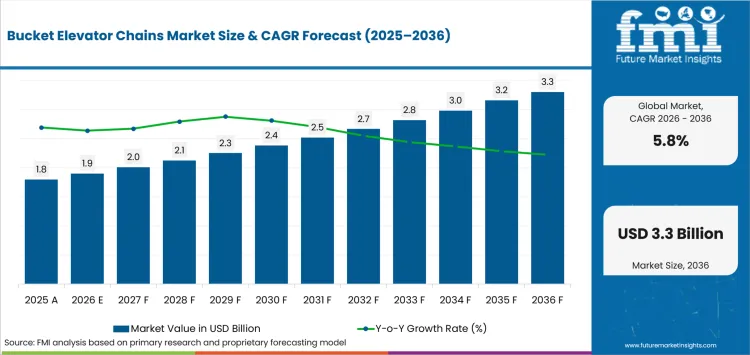
USD 1.9 billion in 2026 and USD 3.3 billion by 2036 at a 5.8% CAGR.
Sales of bucket elevator chains are estimated to rise at 5.8% CAGR through 2036, increasing valuation from USD 1.9 billion in 2026 to USD 3.3 billion by 2036. Cement-plant modernization adds new chain specifications alongside recurring replacement demand from abrasive vertical conveying systems operating under continuous duty. In June 2026, the Cement Association of Canada reported that Amrize broke ground on a modernization project at its Saint-Constant cement plant. Chain manufacturers gain access as upgraded material-handling routes require validated traction components that fit the new operating layout.
Country conditions separate expansion based chain demand from mature replacement work across major cement markets. Türkiye and Mexico are forecast at 5.5% and 5.4% CAGR respectively, while the USA reaches 4.9% and Germany reaches 4.5%. In January 2026, Alabama Governor Kay Ivey announced KettenWulf’s planned Auburn manufacturing operation for engineered conveyor chains and sprockets serving the Americas. If commissioned, the facility would give USA cement plants a nearer source of replacement chains and technical support.
Key Takeaways of Bucket Elevator Chains Market
- Recurring replacement demand is expected to remain central as abrasive cement duty gradually changes chain pitch and joint condition.
- By chain type, central chain is estimated to hold 28.0% in 2026 owing to single-center traction that avoids parallel-strand matching in suitable high-capacity elevators.
- By material, carbon steel is forecast to represent 31.0% in 2026 driven by economical heat treatment that covers broad abrasive-duty strength requirements.
- Centrifugal discharge is set to lead the elevator type category with 46.0% share in 2026 due to higher-speed transfer across free-flowing dry materials.
- Cement plants face switching constraints from pitch and attachment geometry as replacements must align with installed buckets and sprockets during planned shutdowns.
- RUD Ketten, Tsubaki, Renold, KettenWulf, FB Ketju, THIELE, John King Chains and Pewag are some notable players in this market.
Analyst Perspective
"Bucket elevator chain selection starts with installed geometry because pitch, bucket attachments and sprocket condition determine whether a replacement can restart on schedule. Cement-plant engineers should compare verified wear life with local fitting support, as extended qualification can erase a lower-priced strand’s cost advantage."
- Nikhil Kaitwade, Principal Consultant, Future Market Insights
How is the Bucket Elevator Chains Market segmented?
The market is segmented by chain type, material, elevator type, application, sales channel and region.
Taxonomy separates chain type into central, double strand, round link, roller and forged link chains alongside carbon, alloy, stainless and case-hardened steel materials. Elevator types cover centrifugal, continuous and positive discharge while applications include raw meal, clinker, cement and coal or additive handling. Sales channels include elevator OEMs, aftermarket replacement and industrial chain distributors, with region completing the market classification.
What role does raw meal handling play within the application category?
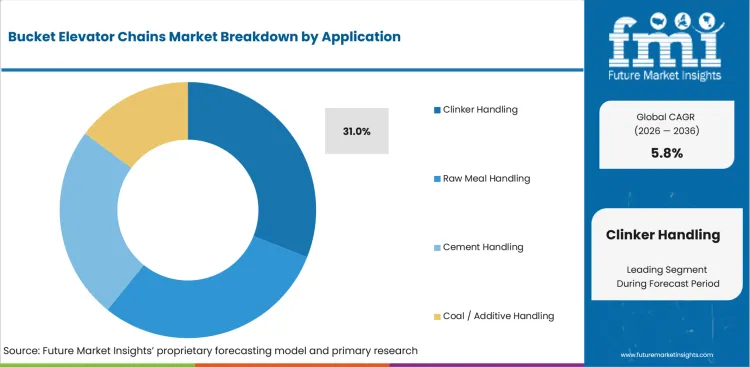
Raw meal handling sits ahead of kiln processing, so interruptions in vertical feed systems can restrict downstream utilization across continuously operated cement lines. Fine abrasive material and lift height shape chain selection, as uneven feed or accelerated joint wear can disrupt kiln supply.
- Based on application, raw meal handling is projected to account for 31.0% in 2026 due to continuous feed requirements before kiln processing and clinker formation.
- Chain-driven elevators must move abrasive bulk material continuously so raw-meal feed remains stable during kiln operation. AUMUND presented its Push Chain Bucket Elevator during a November 2025 cement-industry Open House for demanding bulk-material duty.
What makes central chain central to the chain type category?
Central chain concentrates traction on one centerline, reducing strand-matching requirements across high-capacity vertical conveying systems that carry repeated bucket loads. AUMUND reported in February 2026 that it converted an existing raw-meal belt elevator to a central-chain system after temperature and particle conditions increased belt wear and reduced availability.
- In 2026, central chain is expected to lead chain type with 28.0% share because single-center traction suits high-capacity equipment and compatible retrofit conversions.
- Conversion projects can retain surrounding steelwork and selected drive components, allowing plant engineers to change the traction system without rebuilding the complete elevator structure.
How does carbon steel influence selection within the material category?
Carbon steel gives bucket elevator chains a strength baseline for abrasive duties without forcing premium alloys into cement applications. Heat treatment can raise surface hardness while retaining a tougher core, helping maintenance teams balance wear life against replacement cost.
- Carbon steel is projected to hold 31.0% share in 2026 owing to economical heat treatment that covers broad abrasive-duty strength requirements across standard cement applications.
- Improving surface hardness without losing weldability gives chain manufacturers a practical route to extend wear performance within familiar fabrication methods. FB Ketju reported in March 2026 that upgraded FB1000 side-plate steel raised hardness about 10% while retaining weldability for conveyor-chain production.
What supports centrifugal discharge within the elevator type category?
Centrifugal discharge elevators use higher operating speed so bulk material leaves each bucket near the head by centrifugal action. Pewag introduced a bucket-elevator configurator in July 2026 that separates centrifugal and gravity discharge during chain selection, confirming that discharge method changes the required operating geometry.
- The elevator type category is forecast to be led by centrifugal discharge at 46.0% share in 2026 due to higher-speed transfer across free-flowing dry materials.
- Plant engineers must align chain pitch and bucket spacing with discharge speed, then validate complete head-end geometry during commissioning for both new systems and retrofits.
What are the drivers, restraints, and opportunities in the Bucket Elevator Chains Market?
Recurring wear and cement-plant modernization support demand, while dimensional qualification slows supplier switching and precision manufacturing improves retrofit economics.
- Driver: Abrasive high-throughput conveying wears pins and joints, sustaining recurring replacement demand while cement-plant modernization adds new chain sets.
- Restraint: Matching pitch, attachments, buckets and sprockets lengthens qualification as replacement chains must fit the installed elevator within a planned shutdown.
- Opportunity: Precision manufacturing and retrofit engineering reduce short-run replacement costs, allowing chain manufacturers to quote site-specific parts during planned maintenance windows.
Abrasive Throughput Sustains Replacement Demand
Abrasive cement duty turns steady material throughput into recurring joint and pin wear across installed bucket elevators during normal plant operation. The American Cement Association reported in June 2026 that USA consumption reached about 65 million metric tons of blended cement during 2025 versus 35 million tons of traditional cement. The reported volume keeps chain condition tied to plant uptime, so replacement demand persists without a new elevator installation.
Dimensional Qualification Slows Supplier Switching
Replacement qualification slows switching as every chain must match installed pitch plus buckets and sprockets for the elevator’s return to service. THIELE released DQA Guide 6.0 in July 2025 with current product data plus operating instructions and downloadable 3D files. Digital geometry shortens preliminary checks, yet plant engineers still need fit proof against installed sprockets to approve an alternative chain.
Short-Batch Precision Improves Retrofit Economics
Short replacement runs become more economical as precision welding reduces setup time for site-specific links and attachments. FB Ketju reported in June 2026 that a collaborative welding robot shortened cycle times and improved the economics of small connecting links batches. Lower small-batch cost gives chain manufacturers more room to quote engineered retrofit parts without forcing plants into oversized standard orders.
Which country CAGRs are profiled in the Bucket Elevator Chains Market?
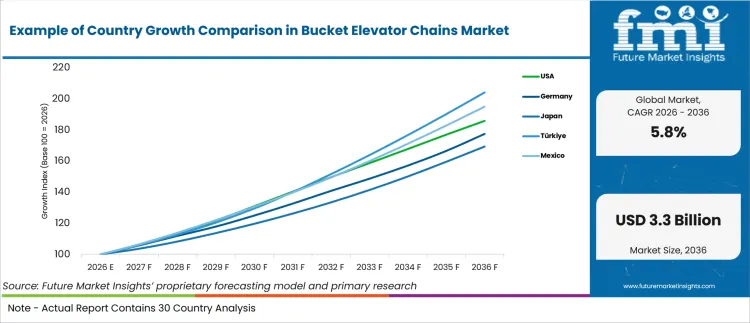
| Country | CAGR |
|---|---|
| Türkiye | 5.5% |
| Mexico | 5.4% |
| USA | 4.9% |
| Germany | 4.5% |
| Japan | 4.2% |
How do country-level CAGRs compare in the Bucket Elevator Chains Market?
The profiled countries span a 1.3 percentage-point range from Türkiye at 5.5% CAGR to Japan at 4.2%. Türkiye and Mexico form the upper pair as project activity supports chain demand across expansion markets. The USA occupies the middle while Germany and Japan depend more on service-led replacement across assets.
- Türkiye combines rising output and exports that increase elevator utilization at plants.
- Mexico pairs construction gains with project timing that rewards stocked replacement chains.
- The USA relies on installed-base replacement as softer consumption limits equipment spending.
- Germany balances mechanical modernization against carbon programs competing for the plant budgets.
- Japan rewards site-specific engineering as a concentrated cement network raises qualification costs.
Similar growth rates therefore require different inventory, service and qualification strategies across the five profiled countries.
The full report provides country-level CAGR analysis across North America, Latin America, Europe, East Asia, South Asia, Oceania and the Middle East and Africa.
Country-wise Analysis
- Integrated cement plants in Türkiye serve domestic construction and export terminals, so chain demand follows both local dispatch and export loading across long operating cycles with different regional utilization rates. Sales of bucket elevator chains in Türkiye are forecast to expand at 5.5% CAGR by 2036 owing to frequent elevator use, while TürkÇimento reported in March 2026 that 2025 cement production rose 9.4% and exports increased 15.0% across the national industry. Regional sales weakened in Marmara and the Aegean, so chain manufacturers need spare inventory and service coverage near heavily used plants instead of applying one national stocking plan to every production area.
- Mexico’s construction cycle can change cement-plant throughput quickly, making replacement readiness important across industrial corridors with uneven project timing and maintenance schedules at established production sites and changing regional construction demand patterns. Demand for bucket elevator chains in Mexico is forecast to rise at 5.4% CAGR over the forecast period, and INEGI reported in July 2026 that construction-company production value increased 7.5% year over year in May across the national industry. Regional construction swings can compress outage planning, so distributors need compatible chains with verified attachment data and technical support near major cement-production corridors as plants prepare scheduled maintenance work.
- A mature cement network keeps chain purchasing tied to maintenance windows across the USA, making nearby inventory and dimensional certainty valuable for elevator shutdowns at established production sites. The USA bucket elevator chains outlook is anticipated to advance at 4.9% CAGR over the assessment period owing to recurring replacement needs across established elevators and scheduled maintenance programs at major production sites. The American Cement Association forecast in April 2026 that cement consumption would decline 2.5% during 2026, making discretionary projects easier to defer and increasing the value of nearby spares with documented fit as maintenance teams prepare outage work plans.
- German cement plants balance mechanical modernization with carbon-related capital programs, and VDZ introduced its Cement Carbon Class in February 2025 for tenders that compare lower-carbon cement performance during purchasing decisions. Germany is estimated to post 4.5% CAGR over the forecast period shaped by regular maintenance needs across established bucket elevators and clinker-handling systems serving mature integrated production sites with fixed outage schedules. Existing elevators sustain recurring replacement work, but chain upgrades compete with carbon-reduction spending and require manufacturers to document dimensional compatibility plus credible service-life gains to secure approval for changes to installed specifications during planned modernization work and site reviews.
- Japan’s concentrated cement network makes each plant relationship commercially important, since a failed chain installation can consume a large part of a scheduled maintenance window at an established production site. The Japan Cement Association reported that, as of April 2024, 28 cement plants were owned by 16 companies, concentrating replacement work among sites with established maintenance routines and long supplier relationships across the country. Adoption of bucket elevator chains in Japan is estimated to expand at 4.2% CAGR through 2036 owing to recurring site-specific replacement demand, although plant engineers require documented dimensional fit and dependable local service to change established specifications.
Who are the notable companies in the Bucket Elevator Chains Market?
RUD Ketten, Tsubaki, Renold, KettenWulf, FB Ketju, THIELE, John King Chains and Pewag are companies profiled in this market.
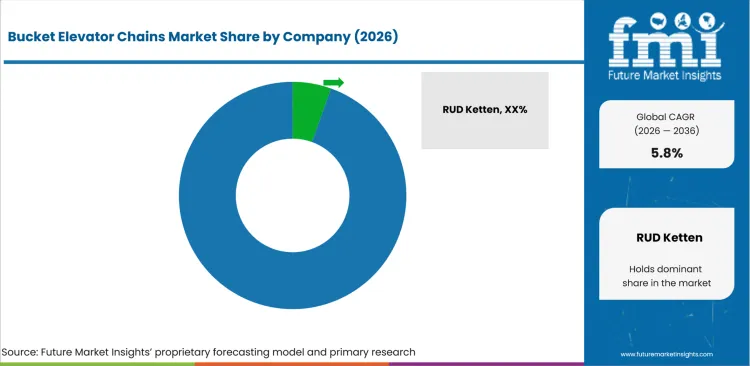
The competitive field is fragmented across global industrial-chain groups and specialized bucket-elevator manufacturers, with no single architecture fitting every installed system. Competition centers on dimensional fit and wear treatment alongside matched components and service response during short shutdowns. Entry barriers rise as an alternative chain must match installed pitch and attachments, then run correctly with existing sprockets under site-specific duty.
- RUD Ketten, KettenWulf and John King Chains combine elevator-chain engineering with matched components and field support for installed equipment.
- Tsubaki, Renold and Pewag serve multiple conveying applications with manufacturing or commercial reach across major industrial regions.
- FB Ketju and THIELE emphasize wear-resistant materials and bulk-material chain designs for abrasive service and custom replacement work.
Competitive Benchmarking: Bucket Elevator Chains Market
| Company | Elevator-System Integration | Wear Engineering Depth | Aftermarket Service Depth | Geographic Reach |
|---|---|---|---|---|
| RUD Ketten | High | High | High | Europe and international projects |
| Tsubaki | Medium | High | High | Europe, Asia and North America |
| Renold | Medium | Medium | Medium | Global |
| KettenWulf | High | High | Medium | Europe, Asia and North America |
| FB Ketju | Medium | High | Medium | Europe and export markets |
| THIELE | High | High | Medium | Europe and international sales |
| John King Chains | High | High | High | United Kingdom and export markets |
| Pewag | High | High | Medium | Global |
Key Developments in the Bucket Elevator Chains Market
- In March 2026, FB Ketju launched conveyor chains made with SSAB Zero steel after the material entered customer-order production. The launch adds a lower-fossil-emissions steel route while keeping the company’s stated mechanical property requirements unchanged.
- In November 2025, MPE Partners and Webster Industries completed the acquisition of Renold plc while existing manufacturing facilities remained operational. The transaction combines chain manufacturing networks across major industrial regions without implying current capacity changes.
- In February 2025, Tsubakimoto Europe B.V. acquired Karl Jungbluth Kettenfabrik GmbH & Co. KG and established a German conveyor-chain manufacturing base. The completed acquisition expands local European chain production and provides a nearer manufacturing route for customized industrial conveyor-chain requirements.
Key Players in the Bucket Elevator Chains Market
Integrated Bucket-Elevator Systems
- RUD Ketten
- KettenWulf
- John King Chains
Global Industrial-Chain Platforms
- Tsubaki
- Renold
- Pewag
Specialist Wear and Bulk-Material Chains
- FB Ketju
- THIELE
Bucket Elevator Chains Market - Report Scope
| Coverage field | Report scope |
|---|---|
| Market breakdown | By chain type, material, elevator type, application, sales channel and region. |
| Quantitative Units | Revenue in USD million and CAGR in %. |
| Market Definition | Commercial bucket elevator chains and chain-specific connecting or attachment components supplied for chain-driven vertical bulk-material elevators. |
| Regions Covered | North America, Latin America, Europe, East Asia, South Asia and Pacific and Middle East and Africa. |
| Countries Covered | Türkiye, Mexico, USA, Germany, Japan, and 20+ countries included in the full report. |
| Key Companies Profiled | RUD Ketten, Tsubaki, Renold, KettenWulf, FB Ketju, THIELE, John King Chains, Pewag. |
| Forecast Period | 2026 to 2036. |
| Approach | Primary and secondary research with market triangulation. |
Bucket Elevator Chains Market - Research Methodology
| Method | Approach |
|---|---|
| Primary Research | FMI analysts gathered input from manufacturers, service providers, technology developers, distributors, end users, procurement teams, and subject-matter experts. Interviews examined purchasing decisions, product or service evaluation, adoption barriers, approval requirements, pricing considerations, and expectations for technical or commercial support. Respondents were also asked what evidence is required before a trial, pilot, or initial order develops into regular purchasing. |
| Desk Research | Desk research covered government statistics, regulatory publications, trade data, industry associations, technical literature, standards, company filings, product information, and official corporate announcements. Sources were reviewed for relevance, publication date, geographic coverage, and consistency with the defined market scope. Claims relating to performance, applications, approvals, capacity, investment, and commercial activity were retained only when supported by credible public evidence. |
| Market Sizing and Forecasting | The market model combined the baseline value with historical performance, segment structure, pricing and volume indicators, adoption levels, company participation, and country-level demand conditions. Forecast assumptions considered economic activity, investment trends, regulatory developments, technology adoption, purchasing cycles, supply availability, and barriers to wider market use. Segment and regional estimates were reconciled before the final market total was calculated. |
| Data Validation | Estimates were checked against multiple independent indicators, including public data, company activity, trade patterns, industry developments, and findings from primary interviews. Validation also tested whether products, services, applications, and company revenues fell within the defined market boundaries. Adjacent categories, unsupported claims, overlapping revenues, and activities without direct market relevance were excluded to reduce double counting and maintain consistency across segments and countries. |
Bucket Elevator Chains Market by Segments
Bucket Elevator Chains Market segmented by Chain Type:
- Central Chain
- Double Strand Chain
- Round Link Chain
- Roller Chain
- Forged Link Chain
Bucket Elevator Chains Market segmented by Material:
- Carbon Steel
- Alloy Steel
- Stainless Steel
- Case-hardened Steel
Bucket Elevator Chains Market segmented by Elevator Type:
- Centrifugal Discharge
- Continuous Discharge
- Positive Discharge
Bucket Elevator Chains Market segmented by Application:
- Raw Meal Handling
- Clinker Handling
- Cement Handling
- Coal / Additive Handling
Bucket Elevator Chains Market segmented by Sales Channel:
- Elevator OEMs
- Aftermarket Replacement
- Industrial Chain Distributors
Bucket Elevator Chains Market by Region:
- North America
- United States
- Canada
- Latin America
- Brazil
- Mexico
- Chile
- Rest of Latin America
- Western Europe
- Germany
- United Kingdom
- Italy
- Spain
- France
- Nordics
- Benelux
- Rest of Western Europe
- Eastern Europe
- Russia
- Poland
- Hungary
- Balkan and Baltic States
- Rest of Eastern Europe
- East Asia
- China
- Japan
- South Korea
- South Asia and Pacific
- India
- ASEAN
- Australia and New Zealand
- Rest of South Asia and Pacific
- Middle East and Africa
- Kingdom of Saudi Arabia
- Other GCC Countries
- Türkiye
- South Africa
- Other African Union Countries
- Rest of Middle East and Africa
Research Sources and Bibliography
- Cement Association of Canada. (2026, June 24). Amrize to Modernize Montreal Area Cement Plant to be Most Advanced in Eastern Canada.
- Office of Governor of Alabama. (2026, January 26). Governor Ivey Announces Global Chain Manufacturer KettenWulf Coming to Auburn, $34 Million Manufacturing Operation Investment Bringing 70 New Jobs.
- AUMUND Fördertechnik. (2026, February 5). Conversion from a Belt Bucket Elevator to a Central Chain Bucket Elevator: An Engineering-Based Solution.
- FB Ketju. (2026, March 5). Durable FB1000 - FB Ketju’s Premium Steel Upgraded.
- Pewag. (2026, July 16). Built to Keep Your Operations Moving: Introducing Our New Conveyor Chains and Components Catalog.
- AUMUND Fördertechnik. (2025, November 21). Open House Rheinberg.
- American Cement Association. (2026, June 18). ACA Launches First-Ever Blended Cement Awards.
- THIELE GmbH & Co. KG. (2025, July 10). DQA Guide 6.0: digital, sustainable, and contemporary.
- FB Ketju. (2026, June 10). Latest Investment Ensures Consistent Quality and Boosts Productivity.
- TürkÇimento. (2026, March 2). Cement and Clinker Statistical Data.
- Instituto Nacional de Estadística y Geografía. (2026, July 24). National Survey of Construction Companies (ENEC) 2018. May, 2026.
- American Cement Association. (2026, April 30). USA Cement Industry’s Economic Forecast Reflects Uncertainty of War’s Future; Recession Still Unlikely.
- VDZ. (2025, February 4). VDZ introduces a new CO₂ label for cement.
- Japan Cement Association. (2025, July). CEMENT IN JAPAN 2025.
- RUD Ketten Rieger & Dietz GmbH u. Co. KG. (2025, December 10). From rural hero to global market leader: 150 years of RUD.
- John King Chains. (2025, August 15). Bucket Elevators: An Important Feature Across Various Industries.
- FB Ketju. (2026, March 11). Zero Steel chains launched - FB Ketju is the first chain manufacturer to use SSAB Zero™ steel.
- Renold. (2025, November 4). Statement.
- Tsubakimoto Europe B.V. (2025, February 14). Tsubaki Europe Expands with a Manufacturing Base in Germany.
This bibliography is provided for reader reference and is not exhaustive. The full report contains the complete reference list and detailed citations.
This Report Answers
- What revenue is projected for the bucket elevator chains market between 2026 and 2036?
- Which operating conditions make abrasive cement service a recurring replacement driver for bucket elevator chains?
- How does centrifugal discharge change the chain geometry required for higher-speed vertical conveying?
- Why does central chain retain the leading share within chain type for high-capacity bucket elevator applications?
- How do Türkiye, Mexico, the USA, Germany and Japan differ in chain-demand conversion conditions?
- Which service and engineering capabilities raise switching barriers during planned shutdowns?
- How do the eight profiled companies differ in system integration, wear engineering and aftermarket support?
- What recent manufacturing and ownership developments are changing chain availability across major industrial regions?
Frequently Asked Questions
How big is the Bucket Elevator Chains Market in 2026?
The bucket elevator chains market is expected to be valued at USD 1.9 billion in 2026. Recurring abrasive-duty replacement and new chain specifications from cement-plant modernization account for the main spending routes.
What is the CAGR of the Bucket Elevator Chains Market from 2026 to 2036?
The bucket elevator chains market is projected to grow at a CAGR of 5.8% between 2026 and 2036. Expansion reflects replacement demand from installed elevators alongside new equipment required during plant upgrades
Which elevator type is projected to account for 46.0% of the Bucket Elevator Chains Market?
The bucket elevator chains market is projected to record centrifugal discharge at 46.0% share in 2026. Higher operating speed suits many powder and granular cement-process materials as compatible head geometry allows centrifugal release
How much will the Bucket Elevator Chains Market add between 2026 and 2036?
The bucket elevator chains market is expected to add USD 1.4 billion between 2026 and 2036. The incremental value reflects combined spending on new elevator chain sets and recurring replacements across installed systems.
Which companies are active in the Bucket Elevator Chains Market?
The bucket elevator chains market includes RUD Ketten, Tsubaki, Renold, KettenWulf, FB Ketju, THIELE, John King Chains and Pewag as profiled companies. Their positions differ by system fit and wear engineering alongside service coverage during plant replacement work
Preview the report firsthand - request a free sample
Get SampleGet the brochure for pricing and purchase details.
Get PDFTable of Content
- Key Takeaways
- Market Size and CAGR
- Top Growth Driver
- Fastest Growing Segment
- Leading Region
- Key Companies
- Emerging Opportunities
- Executive Summary
- Global Market Outlook
- Demand-side Trends
- Supply-side Trends
- Technology Roadmap Analysis
- Analysis and Recommendations
- Analyst Perspective (What is happening? Why now? What should investors know?)
- Key Questions Answered
- How large is the market?
- What is the CAGR?
- What are key trends?
- Which region dominates?
- Who are the leaders?
- Market Overview
- Market Coverage / Taxonomy
- Market Definition / Scope / Limitations
- Research Methodology
- Chapter Orientation
- Analytical Lens and Working Hypotheses
- Market Structure, Signals, and Trend Drivers
- Benchmarking and Cross-market Comparability
- Market Sizing, Forecasting, and Opportunity Mapping
- Research Design and Evidence Framework
- Desk Research Programme (Secondary Evidence)
- Expert Input and Fieldwork (Primary Evidence)
- Tooling, Models, and Reference Databases
- Data Engineering and Model Build
- Quality Assurance and Audit Trail
- Market Background
- Market Dynamics (Drivers, Restraints, Opportunity, Trends)
- Scenario Forecast (Optimistic, Likely, Conservative)
- Impact Analysis
- AI Impact
- Sustainability Impact
- Regulatory Impact
- Technology Impact
- Consumer / Buyer Analysis
- Purchase Drivers
- Adoption Barriers
- Buyer Journey
- Opportunity Map Analysis
- Product Life Cycle Analysis
- Supply Chain Analysis
- Investment Feasibility Matrix
- Value Chain Analysis
- PESTLE and Porter's Analysis
- Regulatory Landscape
- Regional Parent Market Outlook
- Production and Consumption Statistics
- Import and Export Statistics
- Global Market Analysis and Forecast, 2021 to 2036
- Historical Market Size Value (USD Billion) Analysis, 2021 to 2025
- Current and Future Market Size Value (USD Billion) Projections, 2026 to 2036
- Y-o-Y Growth Trend Analysis
- Absolute $ Opportunity Analysis
- Global Market Pricing Analysis, 2021 to 2036
- Global Market Analysis and Forecast, By Chain Type, 2021 to 2036
- Introduction / Key Findings
- Historical Market Size Value (USD Billion) Analysis By Chain Type, 2021 to 2025
- Current and Future Market Size Value (USD Billion) Analysis and Forecast By Chain Type, 2026 to 2036
- Central Chain
- Double Strand Chain
- Round Link Chain
- Roller Chain
- Forged Link Chain
- Central Chain
- Y-o-Y Growth Trend Analysis By Chain Type, 2021 to 2025
- Absolute $ Opportunity Analysis By Chain Type, 2026 to 2036
- Global Market Analysis and Forecast, By Material, 2021 to 2036
- Introduction / Key Findings
- Historical Market Size Value (USD Billion) Analysis By Material, 2021 to 2025
- Current and Future Market Size Value (USD Billion) Analysis and Forecast By Material, 2026 to 2036
- Alloy Steel
- Carbon Steel
- Stainless Steel
- Case-hardened Steel
- Alloy Steel
- Y-o-Y Growth Trend Analysis By Material, 2021 to 2025
- Absolute $ Opportunity Analysis By Material, 2026 to 2036
- Global Market Analysis and Forecast, By Elevator Type, 2021 to 2036
- Introduction / Key Findings
- Historical Market Size Value (USD Billion) Analysis By Elevator Type, 2021 to 2025
- Current and Future Market Size Value (USD Billion) Analysis and Forecast By Elevator Type, 2026 to 2036
- Centrifugal Discharge
- Continuous Discharge
- Positive Discharge
- Centrifugal Discharge
- Y-o-Y Growth Trend Analysis By Elevator Type, 2021 to 2025
- Absolute $ Opportunity Analysis By Elevator Type, 2026 to 2036
- Global Market Analysis and Forecast, By Application, 2021 to 2036
- Introduction / Key Findings
- Historical Market Size Value (USD Billion) Analysis By Application, 2021 to 2025
- Current and Future Market Size Value (USD Billion) Analysis and Forecast By Application, 2026 to 2036
- Clinker Handling
- Raw Meal Handling
- Cement Handling
- Coal / Additive Handling
- Clinker Handling
- Y-o-Y Growth Trend Analysis By Application, 2021 to 2025
- Absolute $ Opportunity Analysis By Application, 2026 to 2036
- Global Market Analysis and Forecast, By Sales Channel, 2021 to 2036
- Introduction / Key Findings
- Historical Market Size Value (USD Billion) Analysis By Sales Channel, 2021 to 2025
- Current and Future Market Size Value (USD Billion) Analysis and Forecast By Sales Channel, 2026 to 2036
- Aftermarket Replacement
- Elevator OEMs
- Industrial Chain Distributors
- Aftermarket Replacement
- Y-o-Y Growth Trend Analysis By Sales Channel, 2021 to 2025
- Absolute $ Opportunity Analysis By Sales Channel, 2026 to 2036
- Global Market Analysis and Forecast, By Region, 2021 to 2036
- Introduction
- Historical Market Size Value (USD Billion) Analysis By Region, 2021 to 2025
- Current Market Size Value (USD Billion) Analysis and Forecast By Region, 2026 to 2036
- North America
- Latin America
- Western Europe
- Eastern Europe
- East Asia
- South Asia and Pacific
- Middle East & Africa
- Market Attractiveness Analysis By Region
- North America Market Analysis and Forecast, By Country, 2021 to 2036
- Historical Market Size Value (USD Billion) Trend Analysis By Market Taxonomy, 2021 to 2025
- Market Size Value (USD Billion) Forecast By Market Taxonomy, 2026 to 2036
- By Country
- USA
- Canada
- By Chain Type
- By Material
- By Elevator Type
- By Application
- By Sales Channel
- By Country
- Market Attractiveness Analysis
- By Country
- By Chain Type
- By Material
- By Elevator Type
- By Application
- By Sales Channel
- Key Takeaways
- Latin America Market Analysis and Forecast, By Country
- Historical Market Size Value (USD Billion) Trend Analysis By Market Taxonomy, 2021 to 2025
- Market Size Value (USD Billion) Forecast By Market Taxonomy, 2026 to 2036
- By Country
- Brazil
- Mexico
- Chile
- Rest of Latin America
- By Chain Type
- By Material
- By Elevator Type
- By Application
- By Sales Channel
- By Country
- Market Attractiveness Analysis
- By Country
- By Chain Type
- By Material
- By Elevator Type
- By Application
- By Sales Channel
- Key Takeaways
- Western Europe Market Analysis and Forecast, By Country
- Historical Market Size Value (USD Billion) Trend Analysis By Market Taxonomy, 2021 to 2025
- Market Size Value (USD Billion) Forecast By Market Taxonomy, 2026 to 2036
- By Country
- Germany
- UK
- Italy
- Spain
- France
- Nordic
- BENELUX
- Rest of Western Europe
- By Chain Type
- By Material
- By Elevator Type
- By Application
- By Sales Channel
- By Country
- Market Attractiveness Analysis
- By Country
- By Chain Type
- By Material
- By Elevator Type
- By Application
- By Sales Channel
- Key Takeaways
- Eastern Europe Market Analysis and Forecast, By Country
- Historical Market Size Value (USD Billion) Trend Analysis By Market Taxonomy, 2021 to 2025
- Market Size Value (USD Billion) Forecast By Market Taxonomy, 2026 to 2036
- By Country
- Russia
- Poland
- Hungary
- Balkan & Baltic
- Rest of Eastern Europe
- By Chain Type
- By Material
- By Elevator Type
- By Application
- By Sales Channel
- By Country
- Market Attractiveness Analysis
- By Country
- By Chain Type
- By Material
- By Elevator Type
- By Application
- By Sales Channel
- Key Takeaways
- East Asia Market Analysis and Forecast, By Country
- Historical Market Size Value (USD Billion) Trend Analysis By Market Taxonomy, 2021 to 2025
- Market Size Value (USD Billion) Forecast By Market Taxonomy, 2026 to 2036
- By Country
- China
- Japan
- South Korea
- By Chain Type
- By Material
- By Elevator Type
- By Application
- By Sales Channel
- By Country
- Market Attractiveness Analysis
- By Country
- By Chain Type
- By Material
- By Elevator Type
- By Application
- By Sales Channel
- Key Takeaways
- South Asia and Pacific Market Analysis and Forecast, By Country
- Historical Market Size Value (USD Billion) Trend Analysis By Market Taxonomy, 2021 to 2025
- Market Size Value (USD Billion) Forecast By Market Taxonomy, 2026 to 2036
- By Country
- India
- ASEAN
- Australia & New Zealand
- Rest of South Asia and Pacific
- By Chain Type
- By Material
- By Elevator Type
- By Application
- By Sales Channel
- By Country
- Market Attractiveness Analysis
- By Country
- By Chain Type
- By Material
- By Elevator Type
- By Application
- By Sales Channel
- Key Takeaways
- Middle East & Africa Market Analysis and Forecast, By Country
- Historical Market Size Value (USD Billion) Trend Analysis By Market Taxonomy, 2021 to 2025
- Market Size Value (USD Billion) Forecast By Market Taxonomy, 2026 to 2036
- By Country
- Kingdom of Saudi Arabia
- Other GCC Countries
- Türkiye
- South Africa
- Other African Union
- Rest of Middle East & Africa
- By Chain Type
- By Material
- By Elevator Type
- By Application
- By Sales Channel
- By Country
- Market Attractiveness Analysis
- By Country
- By Chain Type
- By Material
- By Elevator Type
- By Application
- By Sales Channel
- Key Takeaways
- Key Countries Market Analysis
- USA
- Pricing Analysis
- Market Share Analysis, 2025
- By Chain Type
- By Material
- By Elevator Type
- By Application
- By Sales Channel
- Canada
- Pricing Analysis
- Market Share Analysis, 2025
- By Chain Type
- By Material
- By Elevator Type
- By Application
- By Sales Channel
- Mexico
- Pricing Analysis
- Market Share Analysis, 2025
- By Chain Type
- By Material
- By Elevator Type
- By Application
- By Sales Channel
- Brazil
- Pricing Analysis
- Market Share Analysis, 2025
- By Chain Type
- By Material
- By Elevator Type
- By Application
- By Sales Channel
- Chile
- Pricing Analysis
- Market Share Analysis, 2025
- By Chain Type
- By Material
- By Elevator Type
- By Application
- By Sales Channel
- Germany
- Pricing Analysis
- Market Share Analysis, 2025
- By Chain Type
- By Material
- By Elevator Type
- By Application
- By Sales Channel
- UK
- Pricing Analysis
- Market Share Analysis, 2025
- By Chain Type
- By Material
- By Elevator Type
- By Application
- By Sales Channel
- Italy
- Pricing Analysis
- Market Share Analysis, 2025
- By Chain Type
- By Material
- By Elevator Type
- By Application
- By Sales Channel
- Spain
- Pricing Analysis
- Market Share Analysis, 2025
- By Chain Type
- By Material
- By Elevator Type
- By Application
- By Sales Channel
- France
- Pricing Analysis
- Market Share Analysis, 2025
- By Chain Type
- By Material
- By Elevator Type
- By Application
- By Sales Channel
- India
- Pricing Analysis
- Market Share Analysis, 2025
- By Chain Type
- By Material
- By Elevator Type
- By Application
- By Sales Channel
- ASEAN
- Pricing Analysis
- Market Share Analysis, 2025
- By Chain Type
- By Material
- By Elevator Type
- By Application
- By Sales Channel
- Australia & New Zealand
- Pricing Analysis
- Market Share Analysis, 2025
- By Chain Type
- By Material
- By Elevator Type
- By Application
- By Sales Channel
- China
- Pricing Analysis
- Market Share Analysis, 2025
- By Chain Type
- By Material
- By Elevator Type
- By Application
- By Sales Channel
- Japan
- Pricing Analysis
- Market Share Analysis, 2025
- By Chain Type
- By Material
- By Elevator Type
- By Application
- By Sales Channel
- South Korea
- Pricing Analysis
- Market Share Analysis, 2025
- By Chain Type
- By Material
- By Elevator Type
- By Application
- By Sales Channel
- Russia
- Pricing Analysis
- Market Share Analysis, 2025
- By Chain Type
- By Material
- By Elevator Type
- By Application
- By Sales Channel
- Poland
- Pricing Analysis
- Market Share Analysis, 2025
- By Chain Type
- By Material
- By Elevator Type
- By Application
- By Sales Channel
- Hungary
- Pricing Analysis
- Market Share Analysis, 2025
- By Chain Type
- By Material
- By Elevator Type
- By Application
- By Sales Channel
- Kingdom of Saudi Arabia
- Pricing Analysis
- Market Share Analysis, 2025
- By Chain Type
- By Material
- By Elevator Type
- By Application
- By Sales Channel
- Türkiye
- Pricing Analysis
- Market Share Analysis, 2025
- By Chain Type
- By Material
- By Elevator Type
- By Application
- By Sales Channel
- South Africa
- Pricing Analysis
- Market Share Analysis, 2025
- By Chain Type
- By Material
- By Elevator Type
- By Application
- By Sales Channel
- USA
- Market Structure Analysis
- Competition Dashboard
- Competition Benchmarking
- Market Share Analysis of Top Players
- By Regional
- By Chain Type
- By Material
- By Elevator Type
- By Application
- By Sales Channel
- Emerging Startups
- Innovation Benchmarking
- Competition Analysis
- Competition Deep Dive
- RUD Ketten
- Overview
- Product Portfolio
- Profitability by Market Segments
- Sales Footprint
- Strategy Overview
- Marketing Strategy
- Product Strategy
- Channel Strategy
- Renold
- Tsubaki
- KettenWulf
- Rexnord
- FB Ketju
- THIELE
- John King Chains
- 4B Group
- Pewag
- RUD Ketten
- Case Studies
- Success Stories
- Recent Developments
- Competition Deep Dive
- Assumptions & Acronyms Used


