

- Market Size (2026)
- USD 430.1 Mn
- Forecast (2036)
- USD 720.9 Mn
- CAGR (2026 to 2036)
- 5.3%
How big is Accumulator Chains Market in 2026?
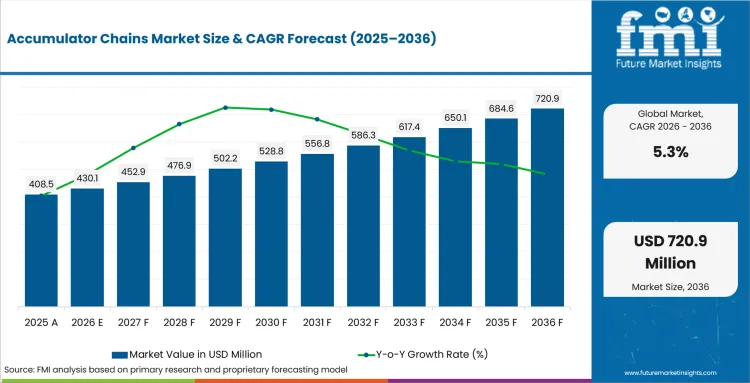
USD 430.1 million in 2026 and USD 720.9 million by 2036 at a 5.3% CAGR.
Demand for accumulator chains is projected to expand at 5.3% CAGR between 2026 and 2036, increasing valuation from USD 430.1 million in 2026 to USD 720.9 million by 2036. The 2026 base follows a USD 408.5 million market value recorded in 2025. Packaging machinery needs controlled buffers between machines running at different cycle rates. Wippermann reported in March 2026 that high cycle rates and system availability are central packaging-machine demands. Accumulator chains fit that duty by continuing to circulate while queued products remain stationary.
Country order conversion differs with factory investment cycles and the age of installed conveyor systems. The USA Bureau of Economic Analysis reported in June 2026 that greenfield investment expenditures reached USD 13.8 billion during 2025 for new establishments and expansions of foreign-owned businesses. Those projects create fresh conveyor design-in decisions, while mature German plants more often test replacements against installed sprockets and guides. Mexico and Italy convert chain demand around automotive and packaging-machine production schedules.
Key Takeaways of Accumulator Chains Market
- Automated production lines need controlled buffering between process steps that run at different cycle rates without stopping the complete conveyor loop.
- Based on chain type, roller accumulator chains are projected to account for 31.0% in 2026 due to rolling contact that limits product drag during queuing.
- By material, carbon steel is estimated to hold 34.0% in 2026 owing to its strength-to-cost balance in dry industrial service.
- By pitch, medium pitch is forecast to represent 49.0% in 2026 driven by the need to balance roller size with conveyor envelope and allowable load.
- Retrofit purchases slow as existing sprockets and guide rails can require engineering changes to qualify a replacement chain for the installed conveyor.
- Tsubaki, iwis, Wippermann, Renold, Donghua Chain, KettenWulf, Habasit and System Plast span dedicated accumulation chains, engineered conveyor chains and low-backpressure conveying platforms.
Analyst Perspective
"Accumulator-chain economics depend on queue length and chain tension because both determine wear during stopped-product accumulation. Chain manufacturers protect replacement revenue by matching those loads to installed sprockets while keeping compatible stock close to the plant."
- Nikhil Kaitwade, Principal Consultant, Future Market Insights
How is the Accumulator Chains Market segmented?
The accumulator chains market is assessed by chain type, material, pitch, application, sales channel and region.
Chain types cover roller accumulator chains, side bow accumulator chains, plastic-top chains, low-backpressure chains and stainless steel accumulator chains. Materials include carbon steel, stainless steel, engineering plastic and hybrid steel-plastic. Pitch covers medium, small and large formats. Applications include packaging, bottling, automotive assembly, warehouse handling and food processing. Sales channels include conveyor OEMs, MRO distributors, direct chain manufacturers and system integrators.
What makes roller accumulator chains central to the chain type category?
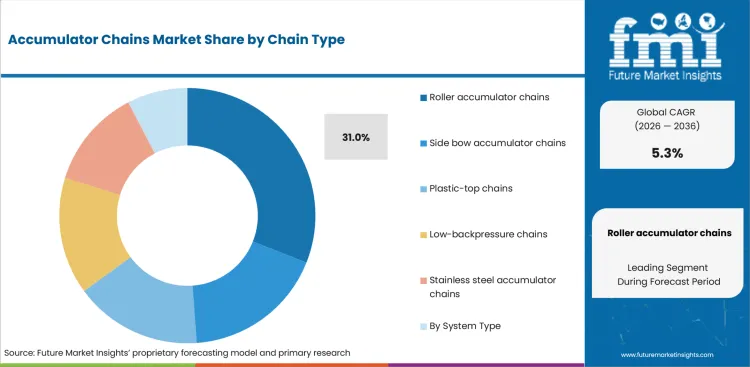
Roller accumulator chains separate chain travel from product travel inside automated material handling systems, allowing a queued pallet or tote to stop without stopping the chain. ANSI recorded final action for ASME B29.15M steel roller-type conveyor chains in July 2025, preserving dimensional controls for links and sprocket interfaces used across standard conveyor installations.
- Based on chain type, roller accumulator chains are projected to account for 31.0% in 2026 due to rolling support that limits sliding resistance during stopped-product accumulation.
- Plant engineers select the roller architecture by checking allowable chain tension and queue length against product weight across the intended accumulation zone.
Why does carbon steel lead the material category?
Carbon steel fits dry assembly lines that require high chain strength without the cost of corrosion-resistant alloys. Its familiar behavior reduces qualification work across installed steel sprockets and standard conveyor guides. Washdown or corrosive exposure shifts material selection toward stainless steel or polymer elements for longer service life.
- By material, carbon steel is estimated to hold 34.0% in 2026 owing to its strength-to-cost balance in dry industrial service. ANSI placed ASME B29.12M steel bushed rollerless chains under stabilized maintenance in July 2025, retaining a current steel-chain dimensional reference.
- Engineers change material once corrosion or hygiene risk outweighs carbon steel's lower acquisition cost in the line.
How does medium pitch influence selection within the pitch category?
Pitch sets roller spacing and sprocket engagement across each transfer point, so medium pitch leaves enough roller section for common pallet loads without the larger conveyor envelope of heavy-duty formats.
- By pitch, medium pitch is forecast to represent 49.0% in 2026 driven by its balance between load capacity and manageable conveyor geometry.
- ANSI listed ASME B29.100 double-pitch roller chains for stabilized maintenance in July 2025, keeping a current reference for chain geometry. Medium-pitch formats fit warehouse racking layouts in storage conveyors that need adequate roller support while preserving compact pallet transfers and practical sprocket sizes.
What supports packaging conveyors within the application category?
Packaging lines accumulate cartons between fillers and sealers so a short stoppage does not halt every upstream machine during routine production. UCIMA reported in December 2025 that Italian packaging machinery turnover reached EUR 10.2 billion in 2025, showing the scale of machinery platforms that repeatedly require conveyor integration.
- Packaging conveyors are set to lead the application category with 29.0% share in 2026 due to repeated buffering points between high-cycle process machines.
- Accumulator chains also serve beverage packaging lines because low product pressure and predictable restart behavior protect containers during short queues ahead of downstream packing equipment.
What are the drivers, restraints and opportunities in the Accumulator Chains Market?
Automation raises buffering demand, installed geometry slows retrofit switching and local engineering improves the replacement case for low-maintenance chain designs.
- Driver: Automated packaging, assembly and logistics lines need buffers that absorb cycle-time differences without stopping the complete conveyor system.
- Restraint: Retrofit chains must match installed pitch and sprocket geometry plus guide and lubrication conditions before a plant changes its chain specification.
- Opportunity: Low-maintenance chain designs paired with local application engineering can convert recurring lubrication or downtime problems into planned replacement projects.
Automation Spending Increases Buffering Requirements
Industrial automation connects more independent machines on a single production route, so short cycle mismatches need mechanical buffers between workstations. The International Federation of Robotics reported in September 2025 that factories installed 542,000 industrial robots during 2024 and exceeded 500,000 annual installations for a fourth year. Accumulator chains fit smart factory programs that need one process to pause without forcing the complete conveyor to stop.
Retrofit Geometry Extends Qualification Time
Retrofit work starts with fit because nominal pitch does not guarantee compatibility with installed sprockets and guide rails. Wippermann introduced a stainless steel chain-wear indicator in March 2026 for machine-side elongation checks, helping maintenance teams time replacement work without removing the need for geometry review and planned downtime.
Distribution Coverage Improves Replacement Conversion
Application advice beside local inventory shortens the path from a replacement request to compatible chain selection. Donghua and RUBIX began a premium DACH partnership in February 2025, giving industrial accounts direct access to chain support through an established distributor. Local engineering confirms pitch and guide compatibility ahead of releasing stocked replacement parts for scheduled maintenance.
Which country CAGRs are profiled in the Accumulator Chains Market?
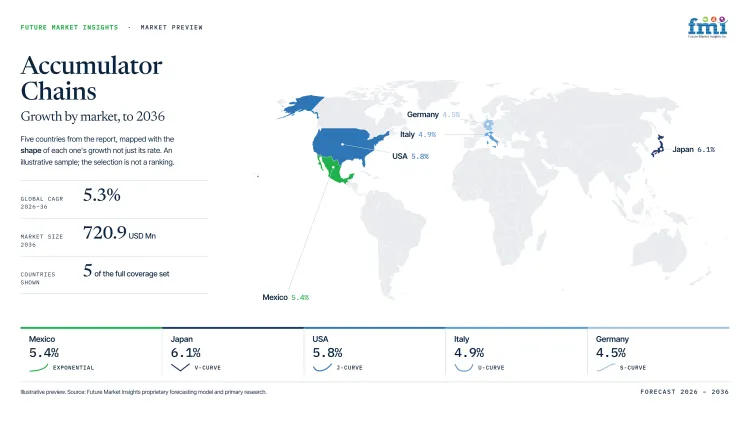
| Country | CAGR |
|---|---|
| Japan | 6.1% |
| USA | 5.8% |
| Mexico | 5.4% |
| Italy | 4.9% |
| Germany | 4.5% |
How do country-level CAGRs compare in the Accumulator Chains Market?
The 1.6-point profiled spread forms a Japan-USA upper pair and an Italy-Germany lower pair, with Mexico between them. The spacing reflects different automation investment cycles and installed conveyor ages rather than a ranking of current market size. Each country converts similar buffering needs into orders through a different equipment channel or replacement pattern.
- Japan links labor shortages with warehouse robotics adoption across automated production cells.
- USA factory investment broadens design-in decisions across plants and intralogistics automation projects.
- Mexico ties chain qualification to vehicle takt times across export-oriented transport packaging flows.
- Italian packaging-machine OEMs embed accumulation specifications inside repeat platforms serving export customers.
- German plants emphasize retrofit continuity across mature conveyor installations and maintenance routines.
Similar CAGRs produce different sales routes because installed-base maturity changes replacement economics. The full report provides country-level CAGR analysis across North America, Latin America, Europe, East Asia, South Asia, Oceania and the Middle East and Africa.
Country-wise Analysis
- Japanese factories are adding labor-saving automation around production cells that still need reliable transfer and accumulation between machines in automotive and electronics production networks and smaller component factories. Adoption of accumulator chains in Japan is estimated to expand at 6.1% CAGR through 2036, supported by conveyor integration around automated work cells. METI established the RING Project in June 2025 to accelerate regional robot adoption after identifying implementation gaps among smaller manufacturers facing labor shortages. Smaller plants still need outside integration expertise, so chain makers that simplify load selection and maintenance planning can reduce the engineering work required before routine operation.
- USA plants and distribution centers operate across a wide installed conveyor base, making local parts and application engineering valuable during scheduled maintenance. Goods-to-person systems add another accumulation need because tote and case flows must pause without stopping upstream conveyors. Accumulator-chain sales in the USA are forecast to expand at 5.8% CAGR by 2036, aided by recurring factory and warehouse automation projects. The USA Census Bureau reported in July 2026 that private manufacturing construction totaled USD 71.9 billion through May, down 22.4% from the same 2025 period. That slowdown shifts more near-term selling toward retrofits and replacement work, where spare availability and geometry checks control downtime.
- Mexico's automotive plants synchronize conveyors with assembly takt times and scheduled shutdowns across export-oriented vehicle programs and tier-supplier operations. INEGI reported in June 2026 that 342,926 light vehicles were produced in May and 306,288 were exported, tying conveyor uptime closely to high-volume line schedules. Mexico is estimated to post 5.4% CAGR over the forecast period, supported by accumulation needs between machining, subassembly and final-line stations. Maintenance windows leave little room for extended replacement lead times or trial-and-error changes to installed pitch and guide geometry. Local chain stock and application support therefore matter most where plant teams need a compatible replacement approved before the next planned shutdown.
- Italian packaging-machine builders often embed accumulation geometry inside equipment platforms sold to food, beverage and pharmaceutical plants across export markets. Istat reported in February 2026 that calendar-adjusted industrial production rose 3.2% year over year in December 2025 after a weaker monthly reading. That machinery route gives chain makers early design-in access but also ties orders to OEM build schedules and customer commissioning dates. Italy's accumulator chains outlook is anticipated to advance at 4.9% CAGR over the assessment period, supported by repeat packaging platforms and retrofit demand. Slower capital cycles raise scrutiny of component changes, so suppliers need configurations that preserve existing sprockets and guides without adding redesign work.
- German plants evaluate accumulator-chain changes against mature automated lines, established maintenance routines and existing sprocket geometry at large industrial sites across machinery, packaging and automotive applications. Lifecycle cost carries more weight than catalog breadth because a replacement that changes surrounding conveyor components can extend work during planned shutdowns. The German accumulator chains sector is projected to record 4.5% CAGR during the assessment period, supported by recurring service demand across the installed manufacturing base. Destatis reported in February 2026 that industrial production in the manufacturing sector contracted 1.3% across 2025, reinforcing stricter return tests for discretionary retrofit spending and greater emphasis on documented service-life evidence.
Who are the notable companies in the Accumulator Chains Market?
Tsubaki, iwis, Wippermann, Renold, Donghua Chain, KettenWulf, Habasit and System Plast are the notable companies profiled in this market.
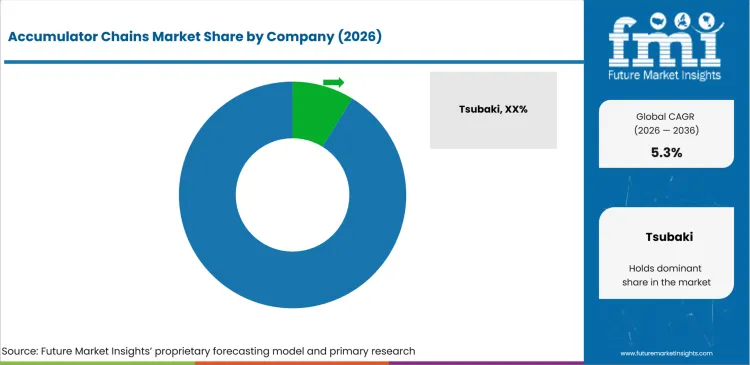
The competitive field spans dedicated accumulation-chain specialists, engineered steel-chain manufacturers and conveying-platform brands with low-backpressure products. Entry depends on fitting chain geometry to the surrounding conveyor because pitch, sprockets and guides are fixed early in the design. Replacement business then favors companies that combine application engineering with local stock for installed chain families.
- Tsubaki, iwis and Wippermann document dedicated accumulation-chain families with engineering support for pitch, load and maintenance selection.
- Renold, Donghua Chain and KettenWulf focus on engineered conveyor-chain manufacturing for industrial OEMs and replacement programs.
- Habasit and System Plast cover low-backpressure plastic conveying where accumulation rollers and surrounding conveyor components influence the selected layout.
Competitive Benchmarking: Accumulator Chains Market
| Company | Accumulation Architecture Depth | Material and Maintenance Range | OEM and Retrofit Engineering Support | Geographic Reach |
|---|---|---|---|---|
| Tsubaki | High | High | High | Global |
| iwis | High | High | High | Europe, North America and Asia |
| Wippermann | High | High | High | Europe with international distribution |
| Renold | Medium | Medium | High | Europe, North America and Asia-Pacific |
| Donghua Chain | Medium | Medium | High | China, Europe and international distribution |
| KettenWulf | Medium | Medium | High | Europe, China, India and North America |
| Habasit | High | High | High | Global |
| System Plast | High | High | High | Global through Regal Rexnord |
Key Developments in the Accumulator Chains Market
- In January 2026, KettenWulf announced plans for a USD 34 million Auburn manufacturing operation covering engineered conveyor chains, drive chains and sprockets for customers across the Americas.
- In January 2026, Tsubaki completed the simplified share exchange that made Daido Kogyo a wholly owned subsidiary and broadened its chain-business platform.
- In November 2025, MPE Partners completed its acquisition of Renold and the company ceased public listing under the new ownership structure.
Key Players in the Accumulator Chains Market
Dedicated Accumulation and Precision Chain Specialists
- Tsubaki
- iwis
- Wippermann
Engineered Industrial Conveyor Chain Suppliers
- Renold
- Donghua Chain
- KettenWulf
Low-Backpressure Conveying Platforms
- Habasit
- System Plast
Accumulator Chains Market - Report Scope
| Coverage field | Report scope |
|---|---|
| Market breakdown | By chain type, material, pitch, application, sales channel and region. |
| Quantitative Units | Revenue in USD million and CAGR in %. |
| Market Definition | Industrial chains designed to permit product accumulation while the driven chain or conveying surface continues operating under controlled load. |
| Regions Covered | North America, Latin America, Europe, East Asia, South Asia and Pacific, and Middle East and Africa. |
| Countries Covered | Japan, USA, Mexico, Italy, Germany, and 20+ countries included in the full report. |
| Key Companies Profiled | Tsubaki, iwis, Wippermann, Renold, Donghua Chain, KettenWulf, Habasit, System Plast. |
| Forecast Period | 2026 to 2036. |
| Approach | Primary and secondary research with market triangulation. |
Accumulator Chains Market - Research Methodology
| Method | Approach |
|---|---|
| Primary Research | FMI analysts gathered input from manufacturers, service providers, technology developers, distributors, end users, procurement teams, and subject-matter experts. Interviews examined purchasing decisions, product or service evaluation, adoption barriers, approval requirements, pricing considerations, and expectations for technical or commercial support. Respondents were also asked what evidence is required before a trial, pilot, or initial order develops into regular purchasing. |
| Desk Research | Desk research covered government statistics, regulatory publications, trade data, industry associations, technical literature, standards, company filings, product information, and official corporate announcements. Sources were reviewed for relevance, publication date, geographic coverage, and consistency with the defined market scope. Claims relating to performance, applications, approvals, capacity, investment, and commercial activity were retained only when supported by credible public evidence. |
| Market Sizing and Forecasting | The market model combined the baseline value with historical performance, segment structure, pricing and volume indicators, adoption levels, company participation, and country-level demand conditions. Forecast assumptions considered economic activity, investment trends, regulatory developments, technology adoption, purchasing cycles, supply availability, and barriers to wider market use. Segment and regional estimates were reconciled before the final market total was calculated. |
| Data Validation | Estimates were checked against multiple independent indicators, including public data, company activity, trade patterns, industry developments, and findings from primary interviews. Validation also tested whether products, services, applications, and company revenues fell within the defined market boundaries. Adjacent categories, unsupported claims, overlapping revenues, and activities without direct market relevance were excluded to reduce double counting and maintain consistency across segments and countries. |
Accumulator Chains Market by Segments
Accumulator Chains Market segmented by Chain Type:
- Roller Accumulator Chains
- Side Bow Accumulator Chains
- Plastic-Top Chains
- Low-Backpressure Chains
- Stainless Steel Accumulator Chains
Accumulator Chains Market segmented by Material:
- Carbon Steel
- Stainless Steel
- Engineering Plastic
- Hybrid Steel-Plastic
Accumulator Chains Market segmented by Pitch:
- Medium Pitch
- Small Pitch
- Large Pitch
Accumulator Chains Market segmented by Application:
- Packaging Conveyors
- Bottling Lines
- Automotive Assembly
- Warehouse Handling
- Food Processing
Accumulator Chains Market segmented by Sales Channel:
- Conveyor OEMs
- MRO Distributors
- Direct Chain Manufacturer
- System Integrators
Accumulator Chains Market by Region:
- North America
- United States
- Canada
- Latin America
- Brazil
- Mexico
- Chile
- Rest of Latin America
- Western Europe
- Germany
- United Kingdom
- Italy
- Spain
- France
- Nordics
- Benelux
- Rest of Western Europe
- Eastern Europe
- Russia
- Poland
- Hungary
- Balkan and Baltic States
- Rest of Eastern Europe
- East Asia
- China
- Japan
- South Korea
- South Asia and Pacific
- India
- ASEAN
- Australia and New Zealand
- Rest of South Asia and Pacific
- Middle East and Africa
- Kingdom of Saudi Arabia
- Other GCC Countries
- Türkiye
- South Africa
- Other African Union Countries
- Rest of Middle East and Africa
Research Sources and Bibliography
- Wippermann. (2026, March 13). Innovative chain solutions for the packaging industry - live at components 2026.
- USA Bureau of Economic Analysis. (2026, June 10). New Foreign Direct Investment in the United States, 2025.
- American National Standards Institute. (2025, July 11). ANSI Standards Action, Vol. 56, No. 28.
- UCIMA. (2025, December 11). Ucima presenta i preconsuntivi 2025: andamento stabile, ordini in rallentamento nel contesto globale complesso.
- International Federation of Robotics. (2025, September 25). Global Robot Demand in Factories Doubles Over 10 Years.
- Wippermann. (2026, March 13). New stainless steel chain wear indicator - detect chain elongation early in roller and leaf chains.
- Donghua Industries Europe GmbH. (2025, March 18). RUBIX und DONGHUA schließen Premium-Partnerschaft.
- Ministry of Economy, Trade and Industry. (2025, June 30). Robotics & Regional Initiative Networking Group (RING Project) Established to Solve Regional Labor Shortages.
- USA Census Bureau. (2026, July 1). Monthly Construction Spending, May 2026.
- Instituto Nacional de Estadística y Geografía. (2026, June 8). Administrative Record of the Light Vehicle Automotive Industry.
- Istituto Nazionale di Statistica. (2026, February 11). Industrial production - December 2025.
- Federal Statistical Office of Germany. (2026, February 6). Production in December 2025: -1.9% on the previous month.
- Office of the Governor of Alabama. (2026, January 26). Governor Ivey Announces Global Chain Manufacturer KettenWulf Coming to Auburn, $34 Million Manufacturing Operation Investment Bringing 70 New Jobs.
- Tsubakimoto Chain Co. (2026, January 1). Notice Regarding Completion of Making Daido Kogyo Co., Ltd. a Wholly Owned Subsidiary Through a Simplified Share Exchange.
- Renold. (2025, November 4). Statement.
This bibliography is provided for reader reference and is not exhaustive. The full report contains the complete reference list and detailed citations
This Report Answers
- How large is the accumulator chains market in 2026 and what valuation is projected for 2036?
- Which operating conditions make accumulation chains useful inside automated production and material-handling systems?
- Why do roller accumulator chains account for 31.0% of chain type demand in 2026?
- How do material and pitch choices change chain qualification across conveyor applications?
- Which technical and commercial conditions limit retrofit conversion from an installed chain specification?
- Why do Japan and the USA post faster profiled CAGRs than Italy and Germany?
- How do local service and qualification conditions differ across the five profiled countries?
- Which companies compete through dedicated accumulation chains, engineered steel chains and low-backpressure conveying platforms?
- What evidence thresholds distinguish benchmark ratings across accumulation depth, material range and engineering support?
Frequently Asked Questions
How big is the Accumulator Chains Market in 2026?
The accumulator chains market is expected to be valued at USD 430.1 million in 2026 and reach USD 720.9 million by 2036. Automated lines need controlled buffering between machines that run at different cycle rates.
What is the CAGR of the Accumulator Chains Market from 2026 to 2036?
The accumulator chains market is projected to grow at a CAGR of 5.3% between 2026 and 2036. Growth follows continued automation of packaging, assembly and logistics lines that require stop-and-release product buffering.
Which chain type leads the Accumulator Chains Market?
The roller accumulator chains segment is projected to account for 31.0% of chain type demand in 2026. Rolling support reduces product drag during accumulation and fits a wide range of industrial conveyor layouts.
Which application dominates the Accumulator Chains Market?
The packaging conveyors segment is projected to hold 29.0% of application demand in 2026. Packaging lines create repeated buffering points between fillers, inspection equipment and downstream cartoning or packing stations.
Which companies are active in the Accumulator Chains Market?
The accumulator chains market includes Tsubaki, iwis, Wippermann, Renold, Donghua Chain, KettenWulf, Habasit and System Plast. Their positions span dedicated accumulation chains, engineered conveyor chains and low-backpressure conveying platforms.
Preview the report firsthand - request a free sample
Get SampleGet the brochure for pricing and purchase details.
Get PDFTable of Content
- Key Takeaways
- Market Size and CAGR
- Top Growth Driver
- Fastest Growing Segment
- Leading Region
- Key Companies
- Emerging Opportunities
- Executive Summary
- Global Market Outlook
- Demand-side Trends
- Supply-side Trends
- Technology Roadmap Analysis
- Analysis and Recommendations
- Analyst Perspective (What is happening? Why now? What should investors know?)
- Key Questions Answered
- How large is the market?
- What is the CAGR?
- What are key trends?
- Which region dominates?
- Who are the leaders?
- Market Overview
- Market Coverage / Taxonomy
- Market Definition / Scope / Limitations
- Research Methodology
- Chapter Orientation
- Analytical Lens and Working Hypotheses
- Market Structure, Signals, and Trend Drivers
- Benchmarking and Cross-market Comparability
- Market Sizing, Forecasting, and Opportunity Mapping
- Research Design and Evidence Framework
- Desk Research Programme (Secondary Evidence)
- Expert Input and Fieldwork (Primary Evidence)
- Tooling, Models, and Reference Databases
- Data Engineering and Model Build
- Quality Assurance and Audit Trail
- Market Background
- Market Dynamics (Drivers, Restraints, Opportunity, Trends)
- Scenario Forecast (Optimistic, Likely, Conservative)
- Impact Analysis
- AI Impact
- Sustainability Impact
- Regulatory Impact
- Technology Impact
- Consumer / Buyer Analysis
- Purchase Drivers
- Adoption Barriers
- Buyer Journey
- Opportunity Map Analysis
- Product Life Cycle Analysis
- Supply Chain Analysis
- Investment Feasibility Matrix
- Value Chain Analysis
- PESTLE and Porter's Analysis
- Regulatory Landscape
- Regional Parent Market Outlook
- Production and Consumption Statistics
- Import and Export Statistics
- Global Market Analysis and Forecast, 2021 to 2036
- Historical Market Size Value (USD Million) Analysis, 2021 to 2025
- Current and Future Market Size Value (USD Million) Projections, 2026 to 2036
- Y-o-Y Growth Trend Analysis
- Absolute $ Opportunity Analysis
- Global Market Pricing Analysis, 2021 to 2036
- Global Market Analysis and Forecast, By Chain Type, 2021 to 2036
- Introduction / Key Findings
- Historical Market Size Value (USD Million) Analysis By Chain Type, 2021 to 2025
- Current and Future Market Size Value (USD Million) Analysis and Forecast By Chain Type, 2026 to 2036
- Roller accumulator chains
- Side bow accumulator chains
- Plastic-top chains
- Low-backpressure chains
- Stainless steel accumulator chains
- By System Type
- Roller accumulator chains
- Y-o-Y Growth Trend Analysis By Chain Type, 2021 to 2025
- Absolute $ Opportunity Analysis By Chain Type, 2026 to 2036
- Global Market Analysis and Forecast, By Material, 2021 to 2036
- Introduction / Key Findings
- Historical Market Size Value (USD Million) Analysis By Material, 2021 to 2025
- Current and Future Market Size Value (USD Million) Analysis and Forecast By Material, 2026 to 2036
- Carbon steel
- Stainless steel
- Engineering plastic
- Hybrid steel-plastic
- By Acid Type
- Carbon steel
- Y-o-Y Growth Trend Analysis By Material, 2021 to 2025
- Absolute $ Opportunity Analysis By Material, 2026 to 2036
- Global Market Analysis and Forecast, By Pitch, 2021 to 2036
- Introduction / Key Findings
- Historical Market Size Value (USD Million) Analysis By Pitch, 2021 to 2025
- Current and Future Market Size Value (USD Million) Analysis and Forecast By Pitch, 2026 to 2036
- Medium pitch
- Small pitch
- Large pitch
- By Measurement Method
- Medium pitch
- Y-o-Y Growth Trend Analysis By Pitch, 2021 to 2025
- Absolute $ Opportunity Analysis By Pitch, 2026 to 2036
- Global Market Analysis and Forecast, By Application, 2021 to 2036
- Introduction / Key Findings
- Historical Market Size Value (USD Million) Analysis By Application, 2021 to 2025
- Current and Future Market Size Value (USD Million) Analysis and Forecast By Application, 2026 to 2036
- Packaging conveyors
- Bottling lines
- Automotive assembly
- Warehouse handling
- Food processing
- By End Use
- Packaging conveyors
- Y-o-Y Growth Trend Analysis By Application, 2021 to 2025
- Absolute $ Opportunity Analysis By Application, 2026 to 2036
- Global Market Analysis and Forecast, By Sales Channel, 2021 to 2036
- Introduction / Key Findings
- Historical Market Size Value (USD Million) Analysis By Sales Channel, 2021 to 2025
- Current and Future Market Size Value (USD Million) Analysis and Forecast By Sales Channel, 2026 to 2036
- Conveyor OEMs
- MRO distributors
- Direct chain manufacturer
- System integrators
- By Sales Channel
- Conveyor OEMs
- Y-o-Y Growth Trend Analysis By Sales Channel, 2021 to 2025
- Absolute $ Opportunity Analysis By Sales Channel, 2026 to 2036
- Global Market Analysis and Forecast, By Region, 2021 to 2036
- Introduction
- Historical Market Size Value (USD Million) Analysis By Region, 2021 to 2025
- Current Market Size Value (USD Million) Analysis and Forecast By Region, 2026 to 2036
- North America
- Latin America
- Western Europe
- Eastern Europe
- East Asia
- South Asia and Pacific
- Middle East & Africa
- Market Attractiveness Analysis By Region
- North America Market Analysis and Forecast, By Country, 2021 to 2036
- Historical Market Size Value (USD Million) Trend Analysis By Market Taxonomy, 2021 to 2025
- Market Size Value (USD Million) Forecast By Market Taxonomy, 2026 to 2036
- By Country
- USA
- Canada
- By Chain Type
- By Material
- By Pitch
- By Application
- By Sales Channel
- By Country
- Market Attractiveness Analysis
- By Country
- By Chain Type
- By Material
- By Pitch
- By Application
- By Sales Channel
- Key Takeaways
- Latin America Market Analysis and Forecast, By Country
- Historical Market Size Value (USD Million) Trend Analysis By Market Taxonomy, 2021 to 2025
- Market Size Value (USD Million) Forecast By Market Taxonomy, 2026 to 2036
- By Country
- Brazil
- Mexico
- Chile
- Rest of Latin America
- By Chain Type
- By Material
- By Pitch
- By Application
- By Sales Channel
- By Country
- Market Attractiveness Analysis
- By Country
- By Chain Type
- By Material
- By Pitch
- By Application
- By Sales Channel
- Key Takeaways
- Western Europe Market Analysis and Forecast, By Country
- Historical Market Size Value (USD Million) Trend Analysis By Market Taxonomy, 2021 to 2025
- Market Size Value (USD Million) Forecast By Market Taxonomy, 2026 to 2036
- By Country
- Germany
- UK
- Italy
- Spain
- France
- Nordic
- BENELUX
- Rest of Western Europe
- By Chain Type
- By Material
- By Pitch
- By Application
- By Sales Channel
- By Country
- Market Attractiveness Analysis
- By Country
- By Chain Type
- By Material
- By Pitch
- By Application
- By Sales Channel
- Key Takeaways
- Eastern Europe Market Analysis and Forecast, By Country
- Historical Market Size Value (USD Million) Trend Analysis By Market Taxonomy, 2021 to 2025
- Market Size Value (USD Million) Forecast By Market Taxonomy, 2026 to 2036
- By Country
- Russia
- Poland
- Hungary
- Balkan & Baltic
- Rest of Eastern Europe
- By Chain Type
- By Material
- By Pitch
- By Application
- By Sales Channel
- By Country
- Market Attractiveness Analysis
- By Country
- By Chain Type
- By Material
- By Pitch
- By Application
- By Sales Channel
- Key Takeaways
- East Asia Market Analysis and Forecast, By Country
- Historical Market Size Value (USD Million) Trend Analysis By Market Taxonomy, 2021 to 2025
- Market Size Value (USD Million) Forecast By Market Taxonomy, 2026 to 2036
- By Country
- China
- Japan
- South Korea
- By Chain Type
- By Material
- By Pitch
- By Application
- By Sales Channel
- By Country
- Market Attractiveness Analysis
- By Country
- By Chain Type
- By Material
- By Pitch
- By Application
- By Sales Channel
- Key Takeaways
- South Asia and Pacific Market Analysis and Forecast, By Country
- Historical Market Size Value (USD Million) Trend Analysis By Market Taxonomy, 2021 to 2025
- Market Size Value (USD Million) Forecast By Market Taxonomy, 2026 to 2036
- By Country
- India
- ASEAN
- Australia & New Zealand
- Rest of South Asia and Pacific
- By Chain Type
- By Material
- By Pitch
- By Application
- By Sales Channel
- By Country
- Market Attractiveness Analysis
- By Country
- By Chain Type
- By Material
- By Pitch
- By Application
- By Sales Channel
- Key Takeaways
- Middle East & Africa Market Analysis and Forecast, By Country
- Historical Market Size Value (USD Million) Trend Analysis By Market Taxonomy, 2021 to 2025
- Market Size Value (USD Million) Forecast By Market Taxonomy, 2026 to 2036
- By Country
- Kingdom of Saudi Arabia
- Other GCC Countries
- Türkiye
- South Africa
- Other African Union
- Rest of Middle East & Africa
- By Chain Type
- By Material
- By Pitch
- By Application
- By Sales Channel
- By Country
- Market Attractiveness Analysis
- By Country
- By Chain Type
- By Material
- By Pitch
- By Application
- By Sales Channel
- Key Takeaways
- Key Countries Market Analysis
- USA
- Pricing Analysis
- Market Share Analysis, 2025
- By Chain Type
- By Material
- By Pitch
- By Application
- By Sales Channel
- Canada
- Pricing Analysis
- Market Share Analysis, 2025
- By Chain Type
- By Material
- By Pitch
- By Application
- By Sales Channel
- Mexico
- Pricing Analysis
- Market Share Analysis, 2025
- By Chain Type
- By Material
- By Pitch
- By Application
- By Sales Channel
- Brazil
- Pricing Analysis
- Market Share Analysis, 2025
- By Chain Type
- By Material
- By Pitch
- By Application
- By Sales Channel
- Chile
- Pricing Analysis
- Market Share Analysis, 2025
- By Chain Type
- By Material
- By Pitch
- By Application
- By Sales Channel
- Germany
- Pricing Analysis
- Market Share Analysis, 2025
- By Chain Type
- By Material
- By Pitch
- By Application
- By Sales Channel
- UK
- Pricing Analysis
- Market Share Analysis, 2025
- By Chain Type
- By Material
- By Pitch
- By Application
- By Sales Channel
- Italy
- Pricing Analysis
- Market Share Analysis, 2025
- By Chain Type
- By Material
- By Pitch
- By Application
- By Sales Channel
- Spain
- Pricing Analysis
- Market Share Analysis, 2025
- By Chain Type
- By Material
- By Pitch
- By Application
- By Sales Channel
- France
- Pricing Analysis
- Market Share Analysis, 2025
- By Chain Type
- By Material
- By Pitch
- By Application
- By Sales Channel
- India
- Pricing Analysis
- Market Share Analysis, 2025
- By Chain Type
- By Material
- By Pitch
- By Application
- By Sales Channel
- ASEAN
- Pricing Analysis
- Market Share Analysis, 2025
- By Chain Type
- By Material
- By Pitch
- By Application
- By Sales Channel
- Australia & New Zealand
- Pricing Analysis
- Market Share Analysis, 2025
- By Chain Type
- By Material
- By Pitch
- By Application
- By Sales Channel
- China
- Pricing Analysis
- Market Share Analysis, 2025
- By Chain Type
- By Material
- By Pitch
- By Application
- By Sales Channel
- Japan
- Pricing Analysis
- Market Share Analysis, 2025
- By Chain Type
- By Material
- By Pitch
- By Application
- By Sales Channel
- South Korea
- Pricing Analysis
- Market Share Analysis, 2025
- By Chain Type
- By Material
- By Pitch
- By Application
- By Sales Channel
- Russia
- Pricing Analysis
- Market Share Analysis, 2025
- By Chain Type
- By Material
- By Pitch
- By Application
- By Sales Channel
- Poland
- Pricing Analysis
- Market Share Analysis, 2025
- By Chain Type
- By Material
- By Pitch
- By Application
- By Sales Channel
- Hungary
- Pricing Analysis
- Market Share Analysis, 2025
- By Chain Type
- By Material
- By Pitch
- By Application
- By Sales Channel
- Kingdom of Saudi Arabia
- Pricing Analysis
- Market Share Analysis, 2025
- By Chain Type
- By Material
- By Pitch
- By Application
- By Sales Channel
- Türkiye
- Pricing Analysis
- Market Share Analysis, 2025
- By Chain Type
- By Material
- By Pitch
- By Application
- By Sales Channel
- South Africa
- Pricing Analysis
- Market Share Analysis, 2025
- By Chain Type
- By Material
- By Pitch
- By Application
- By Sales Channel
- USA
- Market Structure Analysis
- Competition Dashboard
- Competition Benchmarking
- Market Share Analysis of Top Players
- By Regional
- By Chain Type
- By Material
- By Pitch
- By Application
- By Sales Channel
- Emerging Startups
- Innovation Benchmarking
- Competition Analysis
- Competition Deep Dive
- Tsubaki
- Overview
- Product Portfolio
- Profitability by Market Segments
- Sales Footprint
- Strategy Overview
- Marketing Strategy
- Product Strategy
- Channel Strategy
- Rexnord / Regal Rexnord
- Renold
- iwis
- Donghua Chain
- KettenWulf
- Senqcia
- Habasit
- System Plast
- HKK Chain
- Tsubaki
- Case Studies
- Success Stories
- Recent Developments
- Competition Deep Dive
- Assumptions & Acronyms Used


