

- Market Size (2026)
- USD 754.1 Mn
- Forecast (2036)
- USD 1337.8 Mn
- CAGR (2026 to 2036)
- 5.9%
How big is Automated Plate Changers Market in 2026?
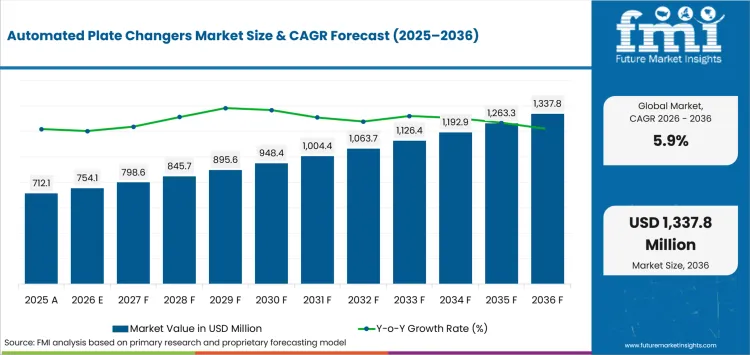
USD 754.1 million in 2026 and USD 1,337.8 million by 2036 at a 5.9% CAGR.
Sales of automated plate changers are estimated to rise at 5.9% CAGR through 2036, increasing valuation from USD 754.1 million in 2026 to USD 1,337.8 million by 2036. Demand is increasing as commercial printers seek to reduce non-printing time and improve press utilization during short production runs and frequent job changes. HEIDELBERG documented the first USA Plate to Unit installation in April 2025. Its Plate to Unit workflow reduced manual handling during plate exchange on a Speedmaster XL 106. Repeated job changes turn those saved minutes into usable press capacity during every productive shift.
Country economics diverge with plant scale and installed-base age, and Canada's 6.5% CAGR profile exceeds Germany's 5.1%. Smaller-site structures can lengthen the payback path for automation on older presses. Insee documented about 16,000 French printing companies in July 2026 and no large enterprise in the sector. France provides a documented example of a fragmented printer base in Europe with limited enterprise scale. Plate-handling savings accumulate fastest at sites with enough daily changeovers to repeat the time recovery.
Key Takeaways
- Frequent artwork and version changes raise the value of plate automation by increasing the production time recovered from each completed makeready.
- Based on system type, fully automatic plate changers are projected to account for 32.0% in 2026 due to lower operator dependence during complete plate exchange.
- The flexographic presses segment is likely to capture 35.0% share in 2026 attributable to repeated plate and sleeve preparation in packaging production.
- Narrow-web is projected to hold 28.0% share in 2026 owing to frequent label jobs and short production campaigns.
- Retrofit projects slow if controls integration, installation downtime, or low job-change frequency weakens the plant-specific payback case.
- Some of the key players in this market include Koenig & Bauer, Heidelberg, Bobst, Mark Andy, Nilpeter, Komori, Manroland Goss, and MPS Systems.
Analyst Perspective
"Automatic plate changing pays back on presses where repeated job changes turn makeready into measurable lost production time. The strongest purchase case measures plate exchange beside washing and presetting, then tests whether controls compatibility and local service can preserve those savings through the press's remaining life."
- Nandini Roy Choudhury, Principal Consultant, Future Market Insights
How is the automated plate changers market segmented?
The market is assessed by System Type, Press Type, Format, End Use, and Sales Channel.
The automated plate changers market is segmented by system type, press type, format, end use, and sales channel. System type covers fully automatic, semi-automatic, sleeve, robotic handling, and quick-lock systems. Press type includes flexographic, offset, digital-hybrid, corrugated, and gravure support for plated production lines. Format covers narrow-web, mid-web, wide-web, and sheet-fed equipment used on different press architectures. End use covers packaging printing, commercial printing, labels, and corrugated printing applications with distinct job frequencies. Sales channel covers press OEMs, retrofit automation suppliers, direct system integrators, and service contracts.
What makes fully automatic plate changers central to the system type category?
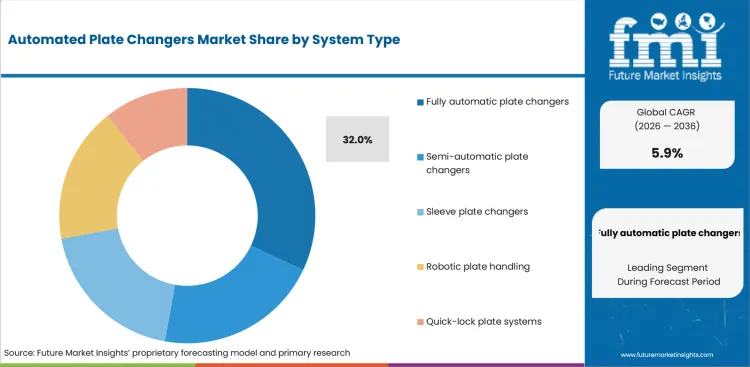
Fully automatic systems remove plate identification, routing, and loading from the operator's active changeover sequence. Short-run digital folding cartons make those repeated steps costly on every multicolor job. HEIDELBERG reported in July 2026 that Brodnax 21C had commissioned a Speedmaster XL 106 with AutoPlate XL in late 2025, placing plate exchange inside the press setup routine.
- By system type, fully automatic plate changers are estimated to hold 32.0% in 2026 owing to lower manual intervention during complete plate-transfer sequences.
- Production teams favor full automation on presses that must finish plate routing and loading in time for the next job to start without extending makeready.
Why do flexographic presses lead the press type category?
Flexographic converters prepare several plates or sleeves for each packaging job, so offline setup directly affects usable press time. The flexographic printing machines segment also serves high-change flexible plastic packaging work. BOBST documented in March 2025 that smartGPS generated registration and impression settings during offline plate mounting, then sent those values to the press ahead of production.
- In 2026, flexographic presses are expected to lead press type with 35.0% share because repeated plate and sleeve preparation is common in packaging workflows.
- Offline mounting data has commercial value by letting registration and impression settings be prepared during the previous production run.
How does narrow-web shape the format category?
Narrow-web plants process label portfolios with frequent artwork changes and many small orders. digital label printing and automated labelling machines put the same pressure on changeover time. Mark Andy announced in July 2025 that its Labelexpo Europe lineup would include flexo and hybrid presses configured for faster changeovers and lower waste in short-run production.
- By format, narrow-web is forecast to represent 28.0% in 2026 driven by high job frequency in labels and short-run packaging.
- Converters place more value on repeatable changeovers if several low-volume jobs must be completed before the same press returns to a longer run.
What supports packaging printing in the end use category?
Packaging printers need fast plate exchange without losing register control on multicolor board work. folding carton packaging and corrugated carton packaging make makeready performance visible in plant capacity planning. Koenig & Bauer reported in February 2025 that Emballages Mega Packaging entered production with a Rapida 106 using fully automatic plate changing and simultaneous roller washing during makeready.
- Packaging printing is set to lead the end use category with 37.0% share in 2026 due to frequent artwork changes and multicolor production.
- Automatic plate change gains value in folding-carton production as capacity additions must shorten makeready without weakening inline quality control.
What are the drivers, restraints and opportunities in the automated plate changers market?
Demand rises as printers compress makeready, retrofit economics limit conversion on older presses, and mid-web packaging investment extends plate automation beyond narrow-web lines.
- Driver: Printers place more value on repeatable plate exchange as short production runs increase the number of non-printing setup events per shift.
- Restraint: Capital approval weakens if installation cost, controls work, and planned downtime cannot be recovered from the press's actual changeover frequency.
- Opportunity: Wider mid-web flexo platforms extend automated setup into packaging jobs that were previously concentrated on narrower label-focused lines.
Short-run schedules expose the cost of plate-change time
Short-run packaging and commercial work make makeready capacity visible in daily scheduling. Komori stated in March 2025 that its China Print workflow coordinated A-APC with parallel blanket cleaning for high-speed job changes. Running plate exchange beside another setup task reduces idle press time during multicolor changeovers. Plants serving flexible packaging programs can recover sellable hours if job queues are dense enough to repeat the saving.
Capital timing can delay otherwise workable retrofits
Retrofit economics deteriorate if automation is approved during an uncertain equipment-spending cycle. PRINTING United Alliance and Alliance Research reported in August 2025 that many participating printers were postponing capital investments during tariff uncertainty. Plate-changing projects face the same budget discipline since controls work and planned downtime require spending ahead of productivity savings. Plants with fewer daily changeovers need a longer payback period or a narrower installation scope.
Mid-web packaging extends the addressable automation base
Mid-web flexible-packaging lines use more automated setup as formats widen and job mixes fragment. Nilpeter documented in August 2025 that FA-26 installations had expanded from the United States into several European plants, with updated configurations adding register and camera-inspection automation. The wider installed base gives plate-handling functions a larger role in flexible-packaging changeovers, though the economics still depend on enough job changes to justify a more automated press platform.
Which country CAGRs are profiled in the automated plate changers market?
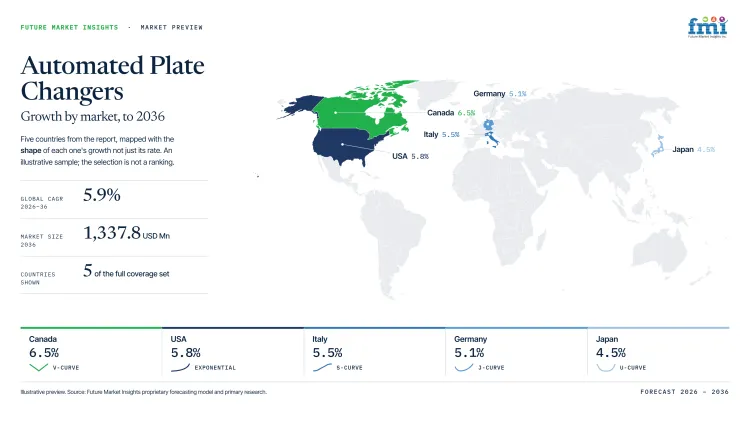
| Country | CAGR |
|---|---|
| Canada | 6.5% |
| Mexico | 6.1% |
| USA | 5.8% |
| Italy | 5.5% |
| Germany | 5.1% |
| France | 4.8% |
| Japan | 4.5% |
How do country-level CAGRs compare in the automated plate changers market?
The seven profiled countries span a 2.0 percentage-point range between Canada at 6.5% and Japan at 4.5% from 2026 to 2036. Canada and Mexico form the higher-growth band above 6%. USA, Italy, and Germany occupy a middle band between 5.1% and 5.8%. France and Japan sit below 5%. These rates indicate the pace at which spending is expected to expand, not the absolute size of each national market.
- Canada's carton and commercial job mix raises value from shorter makeready cycles.
- Mexico's export schedules prioritize repeatable changeovers over peak speed in packaging production.
- USA fleet diversity splits spending between replacement presses and retrofits on mixed-age assets.
- Italian plants assess plate automation within press-renewal programs that upgrade color control.
- German fleet maturity makes controls compatibility central as older presses approach modernization.
- Japanese printers operate within a mature manufacturing and printing base that places a premium on reliability and controlled equipment renewal.
- France suppliers face a fragmented buyer base in which investment capacity varies widely by company size.
Similar CAGRs can produce different orders as plants weigh press age and support access. The full report provides country-level CAGR analysis across North America, Latin America, Europe, East Asia, South Asia, Oceania and the Middle East and Africa.
Country-wise Analysis
- Canadian sheet-fed printers often run mixed carton and commercial schedules in which a few makeready minutes become visible over a full shift. Statistics Canada placed printing and related support activities at 75.7% capacity utilization in May 2026, a level that raises the cost of long commissioning windows for busy plants although smaller shops face a harder payback test on low-frequency job changes. By 2036, Canada is projected to grow at 6.5% CAGR because dense packaging schedules give automatic plate exchange more chances to recover press time and make responsive local service coverage important during installation and early production during multiple shifts.
- At export-oriented Mexican plants, fixed cross-border delivery windows make unscheduled downtime a risk to production and shipment commitments at the same time. Automated plate changer demand in Mexico is forecast to rise at 6.1% CAGR through 2036, aided by packaging investment and regional technical coverage that reduces service delays during commissioning and post-installation ramp-up. INEGI counted 74 printing and related industries establishments in the IMMEX program in February 2025, confirming an export-oriented base in which rapid changeover has practical value while smaller plants may delay capital approval until job frequency and service access can support the installation cost over a full equipment cycle.
- A mixed press fleet defines USA plate-automation economics from high-volume web offset and folding cartons to labels and smaller commercial work, so payback changes sharply by press type and job frequency. BLS recorded 27,525 private establishments in printing and related support activities in the fourth quarter of 2025, which makes regional service coverage necessary for a fragmented installed base with many generations of press controls. The USA is expected to maintain 5.8% CAGR through 2036, tied to replacement demand in plants whose makeready minutes affect capacity although older controls and planned shutdown windows keep compatibility proof central to retrofit approval.
- For Italian packaging specialists, automatic plate changing usually enters a broader press-renewal decision that covers color control, waste reduction, maintenance access, and the remaining life of existing equipment. Italy is positioned to record 5.5% CAGR during the forecast period, attributable to packaging specialization and repeated multicolor setup on carton and label jobs whose changeover time limits usable capacity. Istat's March 2026 sector sheet counted 12,688 printing and recorded-media enterprises in 2023, which means field service must cover a dispersed production base even as specialized plants can justify automation sooner if utilization keeps plate changes frequent ahead of the next full press replacement.
- Long press service lives shape German commercial and packaging investment, so automated plate-changing proposals must fit existing controls instead of assuming a complete press replacement. Destatis recorded 1,110 companies with production for sale in printing and recorded-media products during 2025, which leaves service organizations with a technically varied installed base that can accept integrated upgrades if spare parts and controls expertise stay local. Germany could advance at 5.1% CAGR by 2036, given mature equipment fleets and strong engineering coverage that reduce integration risk despite long replacement cycles that delay automation until a planned modernization cycle or major controls replacement.
- French suppliers face a fragmented buyer base in which investment capacity varies widely by company size. Demand for automated plate changers in France is forecast to expand at 4.8% CAGR from 2026 to 2036. Insee reported in July 2026 that about 16,000 printing companies employed 38,000 full-time-equivalent workers in 2023. The same study found no large enterprise in the sector. This structure can slow adoption of capital-intensive factory automation because many buyers are SMEs or microenterprises. Suppliers need modular retrofit packages, financing discipline, and service coverage that let printers automate the highest-frequency changeover step without replacing the entire press.
- Japanese printers operate within a mature manufacturing and printing base that places a premium on reliability and controlled equipment renewal. Demand for automated plate changers in Japan is forecast to expand at 4.5% CAGR from 2026 to 2036. The Statistics Bureau's September 2024 handbook reported 13,536 printing and allied establishments and 252,593 persons engaged in 2022. A broad installed base can support automation demand, but it also slows replacement where existing presses remain productive. Suppliers need to emphasize lifecycle compatibility, dependable service, and integration with connected production controls rather than relying on a greenfield equipment pitch.
Who are the notable companies in the automated plate changers market?
Koenig & Bauer, Heidelberg, Bobst, Mark Andy, Nilpeter, Komori, Manroland Goss, and MPS Systems are the notable companies serving this market.
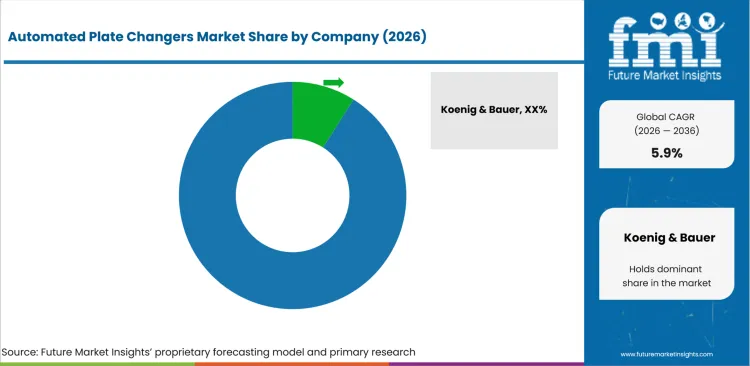
Competition separates offset OEMs with native plate logistics from flexo specialists that reduce mounting and setup time. Entry barriers come from controls integration, service depth, and the ability to prove makeready savings on installed equipment. The same investment logic appears in the USA folding carton market, in which packaging plants weigh throughput and print quality together.
- Offset and web automation: Koenig & Bauer, Heidelberg, Komori, and Manroland Goss integrate automatic plate loading with press controls and other makeready tasks.
- Flexographic packaging platforms: Bobst and MPS Systems reduce setup work with automated mounting, connected job settings, and press-level control functions.
- Narrow- and mid-web production: Mark Andy and Nilpeter compete on fast-change flexo platforms, repeatable register, and regional technical support.
Competitive Benchmarking: Automated Plate Changers Market
| Company | In-press plate / sleeve automation | Plate logistics / mounting integration | Parallel makeready orchestration | Geographic Reach |
|---|---|---|---|---|
| Koenig & Bauer | High | High | High | Global |
| Heidelberg | High | High | High | Global |
| Bobst | Medium | High | High | Global |
| Mark Andy | Medium | Medium | High | Global |
| Nilpeter | Medium | Medium | Medium | Global |
| Komori | High | Medium | High | Global |
| Manroland Goss | High | High | High | Global |
| MPS Systems | Medium | Low | High | Global |
Scoring basis: High in-press automation requires documented automatic plate or sleeve exchange at the printing unit, Medium covers platform-specific automated setup, and Low marks a narrower verified function. High plate-logistics integration requires automatic routing or mounting tied to press data. Medium covers partial integration and Low covers press-side setup without automated plate logistics. High parallel makeready requires coordinated setup tasks, Medium a limited parallel sequence, and Low a single documented setup function. Geographic reach records active commercial regions and is not scored against the three capability columns.
Key Developments in the Automated Plate Changers Market
- In December 2025, Nilpeter reported that Reflex Group invested in four new FA-22 flexo presses for installations in the United Kingdom and United States.
- In October 2025, Koenig & Bauer documented a Rapida 106 X workflow with simultaneous plate changes and fully automated plate logistics for shorter commercial-printing makeready.
- In March 2025, HEIDELBERG reported that All Color Printers installed a Speedmaster XL 106 with AutoPlate Pro for folding-carton production.
Key Players in the Automated Plate Changers Market
Sheet-fed Offset Plate Automation
- Koenig & Bauer
- Heidelberg
Flexographic Packaging Automation
- Bobst
- Mark Andy
- Nilpeter
Offset and Web Makeready Automation
- Komori
- Manroland Goss
Connected Flexographic Setup
- MPS Systems
Automated Plate Changers Market - Report Scope
| Coverage field | Report scope |
|---|---|
| Market breakdown | By system type, press type, format, end use, sales channel, and region. |
| Quantitative Units | USD million. |
| Market Definition | Revenue from automated plate-changing, plate-loading, sleeve-change, plate-mounting, and directly attributable handling subsystems used on plated printing presses. |
| Regions Covered | North America, Latin America, Europe, East Asia, South Asia and Pacific, and Middle East and Africa. |
| Countries Covered | Canada, Mexico, USA, Italy, Germany, and 20+ countries included in the full report. |
| Key Companies Profiled | Koenig & Bauer, Heidelberg, Bobst, Mark Andy, Nilpeter, Komori, Manroland Goss, and MPS Systems. |
| Forecast Period | 2026 to 2036. |
| Approach | Primary and secondary research with market triangulation. |
Automated Plate Changers Market - Research Methodology
| Method | Approach |
|---|---|
| Primary Research | FMI analysts gathered input from manufacturers, service providers, technology developers, distributors, end users, procurement teams, and subject-matter experts. Interviews examined purchasing decisions, product or service evaluation, adoption barriers, approval requirements, pricing considerations, and expectations for technical or commercial support. Respondents were also asked what evidence is required before a trial, pilot, or initial order develops into regular purchasing. |
| Desk Research | Desk research covered government statistics, regulatory publications, trade data, industry associations, technical literature, standards, company filings, product information, and official corporate announcements. Sources were reviewed for relevance, publication date, geographic coverage, and consistency with the defined market scope. Claims relating to performance, applications, approvals, capacity, investment, and commercial activity were retained only when supported by credible public evidence. |
| Market Sizing and Forecasting | The market model combined the baseline value with historical performance, segment structure, pricing and volume indicators, adoption levels, company participation, and country-level demand conditions. Forecast assumptions considered economic activity, investment trends, regulatory developments, technology adoption, purchasing cycles, supply availability, and barriers to wider market use. Segment and regional estimates were reconciled before the final market total was calculated. |
| Data Validation | Estimates were checked against multiple independent indicators, including public data, company activity, trade patterns, industry developments, and findings from primary interviews. Validation also tested whether products, services, applications, and company revenues fell within the defined market boundaries. Adjacent categories, unsupported claims, overlapping revenues, and activities without direct market relevance were excluded to reduce double counting and maintain consistency across segments and countries. |
Automated Plate Changers Market by Segments
Automated Plate Changers Market segmented by System Type:
- Fully automatic plate changers
- Semi-automatic plate changers
- Sleeve plate changers
- Robotic plate handling
- Quick-lock plate systems
Automated Plate Changers Market segmented by Press Type:
- Flexographic presses
- Offset presses
- Digital-hybrid presses
- Corrugated presses
- Gravure support
Automated Plate Changers Market segmented by Format:
- Narrow-web
- Mid-web
- Wide-web
- Sheet-fed
Automated Plate Changers Market segmented by End Use:
- Packaging printing
- Commercial printing
- Labels
- Corrugated printing
Automated Plate Changers Market segmented by Sales Channel:
- Press OEMs
- Retrofit automation suppliers
- Direct system integrators
- Service contracts
Automated Plate Changers Market by Region:
- North America
- United States
- Canada
- Latin America
- Brazil
- Mexico
- Chile
- Rest of Latin America
- Western Europe
- Germany
- United Kingdom
- Italy
- Spain
- France
- Nordics
- Benelux
- Rest of Western Europe
- Eastern Europe
- Russia
- Poland
- Hungary
- Balkan and Baltic States
- Rest of Eastern Europe
- East Asia
- China
- Japan
- South Korea
- South Asia and Pacific
- India
- ASEAN
- Australia and New Zealand
- Rest of South Asia and Pacific
- Middle East and Africa
- Kingdom of Saudi Arabia
- Other GCC Countries
- Türkiye
- South Africa
- Other African Union Countries
- Rest of Middle East and Africa
Research Sources and Bibliography
- Heidelberger Druckmaschinen AG. (2025, April 29). US customer Seaway turns to latest HEIDELBERG technology to improve efficiency.
- Institut national de la statistique et des études économiques. (2026, July 28). Les entreprises de l’imprimerie depuis 2010 : la production recule, les usages se modifient.
- Heidelberger Druckmaschinen AG. (2026, July 29). US printing company strengthens its packaging and commercial printing business with a Speedmaster XL 106 from HEIDELBERG.
- BOBST. (2025, March 11). BOBST CI Flexo: enhancing the customer experience through innovation.
- Mark Andy Inc. (2025, July 8). Mark Andy to Showcase Total Pressroom Solutions at Labelexpo Europe.
- Koenig & Bauer AG. (2025, February 4). Emballages Mega Packaging Moves into Full Scale Production with Its Newest Generation Koenig & Bauer Rapida 106 Six-Color Hybrid UV Press.
- Komori Corporation. (2025, March 12). China Print 2025 Exhibit Information.
- PRINTING United Alliance & Alliance Research. (2025, August). State of the Industry Report 2025: Executive Summary.
- Nilpeter A/S. (2025, August 28). FA-26: From American success to European breakthrough.
- Statistics Canada. (2026, July 15). Manufacturing capacity utilization rates by industry - Unadjusted.
- Instituto Nacional de Estadística y Geografía. (2025, April 22). Estadística del Programa de la Industria Manufacturera, Maquiladora y de Servicios de Exportación (IMMEX).
- USA Bureau of Labor Statistics. (2026, June 16). Printing and Related Support Activities: NAICS 323.
- Istituto Nazionale di Statistica. (2026, March). Settore 18 - Stampa e riproduzione di supporti registrati.
- Statistisches Bundesamt. (2026, July 22). Produktion im Verarbeitenden Gewerbe: Deutschland, Jahre, Güterverzeichnis (2-/4-Steller).
- Nilpeter A/S. (2025, December 2). Reflex Group invests in four new Nilpeter FA-Lines.
- Koenig & Bauer AG. (2025, October 23). Koenig & Bauer Sets Productivity Benchmarks in Commercial Printing with Rapida 106 X.
- Heidelberger Druckmaschinen AG. (2025, March 31). All Color Printers Drives Rapid Folding Carton Growth with HEIDELBERG Speedmaster XL 106s.
- Mark Andy Inc. (2026, June 1). Mark Andy Launches SmartPress Program, Delivering Application-Ready Press Configurations to Converters in Eight Weeks.
- Heidelberger Druckmaschinen AG. (2026, June 24). HEIDELBERG integrates the lifecycle business and global sales and service companies of the manroland sheetfed Group.
- BOBST. (2026, June 16). BOBST expands footprint in South-East Europe with new partnership.
- Nilpeter A/S. (2026, August 10). Nilpeter strengthens customer support in the Czech Republic and Slovakia.
- Mark Andy Inc. (2026, April 21). Arben Graphic Systems Becomes Mark Andy Distributor for the Western Balkans.
- Koenig & Bauer AG. (2026, April 21). CPCneutek Triples Production With New Koenig & Bauer Rapida 106 LED-UV Eight-Color Perfecting Press.
- Heidelberger Druckmaschinen AG. (2026, February 12). Media service provider Page Bros automates production and accelerates growth with solutions from HEIDELBERG.
- BOBST. (2026, May 8). Tecnopack continues growth with BOBST VISION CI flexo press.
- Mark Andy Inc. (2026, May 13). Seen Print Installs Mark Andy Performance Series.
- Nilpeter A/S. (2026, April 7). Reflex Group Expands Nilpeter Platform with Three Additional FA-Line Presses.
- Komori Corporation. (2026, February 4). Komori Installs the Lithrone GX29 advance at KGC to Enable Value-Added Printing for Diverse Market Needs.
- manroland Goss web systems GmbH. (2025, December 9). Lakeside Book Company Invests in State-of-the-Art Web Offset Technology from manroland Goss in Willard, Ohio.
- MPS Systems B.V. (2025, August 28). Where Performance Grows: MPS Unveils EF Packaging and Performance Ecosystem.
This bibliography is provided for reader reference and is not exhaustive. The full report contains the complete reference list and detailed citations.
This Report Answers
- What is the automated plate changers market size in 2026 and what value is forecast for 2036?
- What operating conditions make automatic plate handling economical on plated printing presses?
- Why do fully automatic plate changers lead the system type category?
- Why do flexographic presses account for the largest press type share?
- How do narrow-web production patterns affect plate-change investment?
- Why does packaging printing account for the largest profiled end use share?
- How do country growth rates differ among Canada, Mexico, USA, Italy, and Germany?
- Which companies provide integrated plate logistics, flexo setup automation, or robotic plate handling?
- What retrofit, service, and payback conditions can delay an automated plate changer purchase?
Frequently Asked Questions
How big is the automated plate changers market in 2026?
The automated plate changers market is valued at USD 754.1 million in 2026 and is projected to reach USD 1,337.8 million by 2036. Growth follows repeated job changes that make saved makeready time economically visible.
What is the CAGR of the automated plate changers market from 2026 to 2036?
The automated plate changers market is projected to grow at a CAGR of 5.9% between 2026 and 2036. Expansion is supported by shorter print campaigns and tighter coordination between plate exchange and other makeready tasks.
Which system type leads the automated plate changers market?
The fully automatic plate changers segment is expected to hold 32.0% of the automated plate changers market in 2026, driven by lower operator dependence during complete plate-transfer sequences. Integrated plate routing also reduces manual handling between consecutive multicolor jobs during short production campaigns.
Which press type leads the automated plate changers market?
The flexographic presses segment is expected to hold 35.0% of the automated plate changers market in 2026, driven by repeated plate and sleeve preparation in packaging production. Offline mounting keeps more plate preparation outside the print cycle and reduces setup pressure on the running press.
Which countries are projected to record the highest growth in the automated plate changers market?
Canada is projected to grow at 6.5% CAGR, followed by Mexico at 6.1% and the USA at 5.8% through 2036. Growth differs with packaging investment, installed press age, and local service coverage.
Which companies are active in the automated plate changers market?
Key companies operating in the market include Koenig & Bauer, Heidelberg, Bobst, Mark Andy, Nilpeter, Komori, Manroland Goss, and MPS Systems. They compete on press integration, setup automation, service coverage, and repeatable job-change performance.
Preview the report firsthand - request a free sample
Get SampleGet the brochure for pricing and purchase details.
Get PDFTable of Content
- Key Takeaways
- Market Size and CAGR
- Top Growth Driver
- Fastest Growing Segment
- Leading Region
- Key Companies
- Emerging Opportunities
- Executive Summary
- Global Market Outlook
- Demand-side Trends
- Supply-side Trends
- Technology Roadmap Analysis
- Analysis and Recommendations
- Analyst Perspective (What is happening? Why now? What should investors know?)
- Key Questions Answered
- How large is the market?
- What is the CAGR?
- What are key trends?
- Which region dominates?
- Who are the leaders?
- Market Overview
- Market Coverage / Taxonomy
- Market Definition / Scope / Limitations
- Research Methodology
- Chapter Orientation
- Analytical Lens and Working Hypotheses
- Market Structure, Signals, and Trend Drivers
- Benchmarking and Cross-market Comparability
- Market Sizing, Forecasting, and Opportunity Mapping
- Research Design and Evidence Framework
- Desk Research Programme (Secondary Evidence)
- Expert Input and Fieldwork (Primary Evidence)
- Tooling, Models, and Reference Databases
- Data Engineering and Model Build
- Quality Assurance and Audit Trail
- Market Background
- Market Dynamics (Drivers, Restraints, Opportunity, Trends)
- Scenario Forecast (Optimistic, Likely, Conservative)
- Impact Analysis
- AI Impact
- Sustainability Impact
- Regulatory Impact
- Technology Impact
- Consumer / Buyer Analysis
- Purchase Drivers
- Adoption Barriers
- Buyer Journey
- Opportunity Map Analysis
- Product Life Cycle Analysis
- Supply Chain Analysis
- Investment Feasibility Matrix
- Value Chain Analysis
- PESTLE and Porter's Analysis
- Regulatory Landscape
- Regional Parent Market Outlook
- Production and Consumption Statistics
- Import and Export Statistics
- Global Market Analysis and Forecast, 2021 to 2036
- Historical Market Size Value (USD Million) Analysis, 2021 to 2025
- Current and Future Market Size Value (USD Million) Projections, 2026 to 2036
- Y-o-Y Growth Trend Analysis
- Absolute $ Opportunity Analysis
- Global Market Pricing Analysis, 2021 to 2036
- Global Market Analysis and Forecast, By System Type, 2021 to 2036
- Introduction / Key Findings
- Historical Market Size Value (USD Million) Analysis By System Type, 2021 to 2025
- Current and Future Market Size Value (USD Million) Analysis and Forecast By System Type, 2026 to 2036
- Fully automatic plate changers
- Semi-automatic plate changers
- Sleeve plate changers
- Robotic plate handling
- Quick-lock plate systems
- Fully automatic plate changers
- Y-o-Y Growth Trend Analysis By System Type, 2021 to 2025
- Absolute $ Opportunity Analysis By System Type, 2026 to 2036
- Global Market Analysis and Forecast, By Press Type, 2021 to 2036
- Introduction / Key Findings
- Historical Market Size Value (USD Million) Analysis By Press Type, 2021 to 2025
- Current and Future Market Size Value (USD Million) Analysis and Forecast By Press Type, 2026 to 2036
- Flexographic presses
- Offset presses
- Digital-hybrid presses
- Corrugated presses
- Gravure support
- Flexographic presses
- Y-o-Y Growth Trend Analysis By Press Type, 2021 to 2025
- Absolute $ Opportunity Analysis By Press Type, 2026 to 2036
- Global Market Analysis and Forecast, By Format, 2021 to 2036
- Introduction / Key Findings
- Historical Market Size Value (USD Million) Analysis By Format, 2021 to 2025
- Current and Future Market Size Value (USD Million) Analysis and Forecast By Format, 2026 to 2036
- Narrow-web
- Mid-web
- Wide-web
- Sheet-fed
- Narrow-web
- Y-o-Y Growth Trend Analysis By Format, 2021 to 2025
- Absolute $ Opportunity Analysis By Format, 2026 to 2036
- Global Market Analysis and Forecast, By End Use, 2021 to 2036
- Introduction / Key Findings
- Historical Market Size Value (USD Million) Analysis By End Use, 2021 to 2025
- Current and Future Market Size Value (USD Million) Analysis and Forecast By End Use, 2026 to 2036
- Packaging printing
- Commercial printing
- Labels
- Corrugated printing
- Packaging printing
- Y-o-Y Growth Trend Analysis By End Use, 2021 to 2025
- Absolute $ Opportunity Analysis By End Use, 2026 to 2036
- Global Market Analysis and Forecast, By Sales Channel, 2021 to 2036
- Introduction / Key Findings
- Historical Market Size Value (USD Million) Analysis By Sales Channel, 2021 to 2025
- Current and Future Market Size Value (USD Million) Analysis and Forecast By Sales Channel, 2026 to 2036
- Press OEMs
- Retrofit automation suppliers
- Direct system integrators
- Service contracts
- Press OEMs
- Y-o-Y Growth Trend Analysis By Sales Channel, 2021 to 2025
- Absolute $ Opportunity Analysis By Sales Channel, 2026 to 2036
- Global Market Analysis and Forecast, By Region, 2021 to 2036
- Introduction
- Historical Market Size Value (USD Million) Analysis By Region, 2021 to 2025
- Current Market Size Value (USD Million) Analysis and Forecast By Region, 2026 to 2036
- North America
- Latin America
- Western Europe
- Eastern Europe
- East Asia
- South Asia and Pacific
- Middle East & Africa
- Market Attractiveness Analysis By Region
- North America Market Analysis and Forecast, By Country, 2021 to 2036
- Historical Market Size Value (USD Million) Trend Analysis By Market Taxonomy, 2021 to 2025
- Market Size Value (USD Million) Forecast By Market Taxonomy, 2026 to 2036
- By Country
- USA
- Canada
- By System Type
- By Press Type
- By Format
- By End Use
- By Sales Channel
- By Country
- Market Attractiveness Analysis
- By Country
- By System Type
- By Press Type
- By Format
- By End Use
- By Sales Channel
- Key Takeaways
- Latin America Market Analysis and Forecast, By Country
- Historical Market Size Value (USD Million) Trend Analysis By Market Taxonomy, 2021 to 2025
- Market Size Value (USD Million) Forecast By Market Taxonomy, 2026 to 2036
- By Country
- Brazil
- Mexico
- Chile
- Rest of Latin America
- By System Type
- By Press Type
- By Format
- By End Use
- By Sales Channel
- By Country
- Market Attractiveness Analysis
- By Country
- By System Type
- By Press Type
- By Format
- By End Use
- By Sales Channel
- Key Takeaways
- Western Europe Market Analysis and Forecast, By Country
- Historical Market Size Value (USD Million) Trend Analysis By Market Taxonomy, 2021 to 2025
- Market Size Value (USD Million) Forecast By Market Taxonomy, 2026 to 2036
- By Country
- Germany
- UK
- Italy
- Spain
- France
- Nordic
- BENELUX
- Rest of Western Europe
- By System Type
- By Press Type
- By Format
- By End Use
- By Sales Channel
- By Country
- Market Attractiveness Analysis
- By Country
- By System Type
- By Press Type
- By Format
- By End Use
- By Sales Channel
- Key Takeaways
- Eastern Europe Market Analysis and Forecast, By Country
- Historical Market Size Value (USD Million) Trend Analysis By Market Taxonomy, 2021 to 2025
- Market Size Value (USD Million) Forecast By Market Taxonomy, 2026 to 2036
- By Country
- Russia
- Poland
- Hungary
- Balkan & Baltic
- Rest of Eastern Europe
- By System Type
- By Press Type
- By Format
- By End Use
- By Sales Channel
- By Country
- Market Attractiveness Analysis
- By Country
- By System Type
- By Press Type
- By Format
- By End Use
- By Sales Channel
- Key Takeaways
- East Asia Market Analysis and Forecast, By Country
- Historical Market Size Value (USD Million) Trend Analysis By Market Taxonomy, 2021 to 2025
- Market Size Value (USD Million) Forecast By Market Taxonomy, 2026 to 2036
- By Country
- China
- Japan
- South Korea
- By System Type
- By Press Type
- By Format
- By End Use
- By Sales Channel
- By Country
- Market Attractiveness Analysis
- By Country
- By System Type
- By Press Type
- By Format
- By End Use
- By Sales Channel
- Key Takeaways
- South Asia and Pacific Market Analysis and Forecast, By Country
- Historical Market Size Value (USD Million) Trend Analysis By Market Taxonomy, 2021 to 2025
- Market Size Value (USD Million) Forecast By Market Taxonomy, 2026 to 2036
- By Country
- India
- ASEAN
- Australia & New Zealand
- Rest of South Asia and Pacific
- By System Type
- By Press Type
- By Format
- By End Use
- By Sales Channel
- By Country
- Market Attractiveness Analysis
- By Country
- By System Type
- By Press Type
- By Format
- By End Use
- By Sales Channel
- Key Takeaways
- Middle East & Africa Market Analysis and Forecast, By Country
- Historical Market Size Value (USD Million) Trend Analysis By Market Taxonomy, 2021 to 2025
- Market Size Value (USD Million) Forecast By Market Taxonomy, 2026 to 2036
- By Country
- Kingdom of Saudi Arabia
- Other GCC Countries
- Türkiye
- South Africa
- Other African Union
- Rest of Middle East & Africa
- By System Type
- By Press Type
- By Format
- By End Use
- By Sales Channel
- By Country
- Market Attractiveness Analysis
- By Country
- By System Type
- By Press Type
- By Format
- By End Use
- By Sales Channel
- Key Takeaways
- Key Countries Market Analysis
- USA
- Pricing Analysis
- Market Share Analysis, 2025
- By System Type
- By Press Type
- By Format
- By End Use
- By Sales Channel
- Canada
- Pricing Analysis
- Market Share Analysis, 2025
- By System Type
- By Press Type
- By Format
- By End Use
- By Sales Channel
- Mexico
- Pricing Analysis
- Market Share Analysis, 2025
- By System Type
- By Press Type
- By Format
- By End Use
- By Sales Channel
- Brazil
- Pricing Analysis
- Market Share Analysis, 2025
- By System Type
- By Press Type
- By Format
- By End Use
- By Sales Channel
- Chile
- Pricing Analysis
- Market Share Analysis, 2025
- By System Type
- By Press Type
- By Format
- By End Use
- By Sales Channel
- Germany
- Pricing Analysis
- Market Share Analysis, 2025
- By System Type
- By Press Type
- By Format
- By End Use
- By Sales Channel
- UK
- Pricing Analysis
- Market Share Analysis, 2025
- By System Type
- By Press Type
- By Format
- By End Use
- By Sales Channel
- Italy
- Pricing Analysis
- Market Share Analysis, 2025
- By System Type
- By Press Type
- By Format
- By End Use
- By Sales Channel
- Spain
- Pricing Analysis
- Market Share Analysis, 2025
- By System Type
- By Press Type
- By Format
- By End Use
- By Sales Channel
- France
- Pricing Analysis
- Market Share Analysis, 2025
- By System Type
- By Press Type
- By Format
- By End Use
- By Sales Channel
- India
- Pricing Analysis
- Market Share Analysis, 2025
- By System Type
- By Press Type
- By Format
- By End Use
- By Sales Channel
- ASEAN
- Pricing Analysis
- Market Share Analysis, 2025
- By System Type
- By Press Type
- By Format
- By End Use
- By Sales Channel
- Australia & New Zealand
- Pricing Analysis
- Market Share Analysis, 2025
- By System Type
- By Press Type
- By Format
- By End Use
- By Sales Channel
- China
- Pricing Analysis
- Market Share Analysis, 2025
- By System Type
- By Press Type
- By Format
- By End Use
- By Sales Channel
- Japan
- Pricing Analysis
- Market Share Analysis, 2025
- By System Type
- By Press Type
- By Format
- By End Use
- By Sales Channel
- South Korea
- Pricing Analysis
- Market Share Analysis, 2025
- By System Type
- By Press Type
- By Format
- By End Use
- By Sales Channel
- Russia
- Pricing Analysis
- Market Share Analysis, 2025
- By System Type
- By Press Type
- By Format
- By End Use
- By Sales Channel
- Poland
- Pricing Analysis
- Market Share Analysis, 2025
- By System Type
- By Press Type
- By Format
- By End Use
- By Sales Channel
- Hungary
- Pricing Analysis
- Market Share Analysis, 2025
- By System Type
- By Press Type
- By Format
- By End Use
- By Sales Channel
- Kingdom of Saudi Arabia
- Pricing Analysis
- Market Share Analysis, 2025
- By System Type
- By Press Type
- By Format
- By End Use
- By Sales Channel
- Türkiye
- Pricing Analysis
- Market Share Analysis, 2025
- By System Type
- By Press Type
- By Format
- By End Use
- By Sales Channel
- South Africa
- Pricing Analysis
- Market Share Analysis, 2025
- By System Type
- By Press Type
- By Format
- By End Use
- By Sales Channel
- USA
- Market Structure Analysis
- Competition Dashboard
- Competition Benchmarking
- Market Share Analysis of Top Players
- By Regional
- By System Type
- By Press Type
- By Format
- By End Use
- By Sales Channel
- Emerging Startups
- Innovation Benchmarking
- Competition Analysis
- Competition Deep Dive
- Koenig & Bauer
- Overview
- Product Portfolio
- Profitability by Market Segments
- Sales Footprint
- Strategy Overview
- Marketing Strategy
- Product Strategy
- Channel Strategy
- Heidelberg
- Bobst
- Windmöller & Hölscher
- Uteco
- Mark Andy
- Nilpeter
- MPS Systems
- Komori
- Manroland Goss
- Koenig & Bauer
- Case Studies
- Success Stories
- Recent Developments
- Competition Deep Dive
- Assumptions & Acronyms Used


