

- Market Size (2026)
- USD 150.0 Mn
- Forecast (2036)
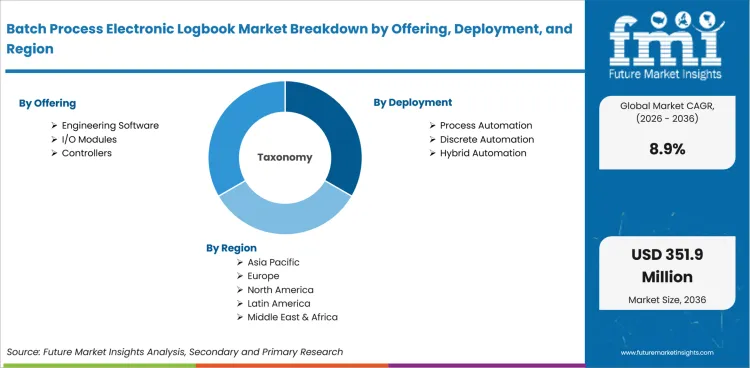
- USD 351.9 Mn
- CAGR (2026 to 2036)
- 8.9%
How big is the batch process electronic logbook market in 2026?
USD 150.0 million in 2026 and USD 351.9 million by 2036 at an 8.9% CAGR.
The batch process electronic logbook industry value is forecast to grow from USD 137.7 million in 2025 to USD 351.9 million by 2036 at 8.9% CAGR as process automation and instrumentation demand pushes regulated plants to replace paper shift books with batch-linked, audit-ready records. Process Automation is forecast to represent 52.0% share in 2026 because batch sequencing creates the highest volume of operator decisions and control events. Engineering Software is expected to secure 46.0% share in 2026, led by recipe-linked review screens, electronic signatures, and exception workflows.
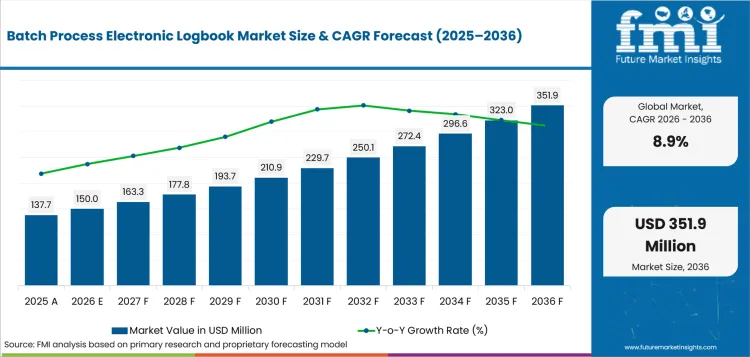
Batch Process Electronic Logbook Market Overview: Size and Forecast
- 2026 Market Size: USD 150.0 million
- 2036 Market Size: USD 351.9 million
- Forecast CAGR: 8.9% from 2026 to 2036
- Leading Deployment: Process Automation
- Process Automation Share in 2026: 52.0%
- Leading Offering: Engineering Software
- Engineering Software Share in 2026: 46.0%
- Fastest-growing Country: India
- India CAGR: 10.1% by 2036
Summary of the Batch Process Electronic Logbook Market
- Demand and Growth Drivers
- Batch release pressure is pushing buyers toward exception-based review that reduces manual reconciliation after production ends.
- Pharma and chemicals plants are expected to drive the largest use cases as regulated production requires stronger record integrity.
- Hybrid automation demand is increasing as plants connect legacy equipment with modern software and review workflows.
- Product and Segment View
- Process Automation is projected to hold 52.0% share in 2026, influenced by batch sequencing and exception capture needs.
- Engineering Software is forecast to represent 46.0% share in 2026, supported by recipe-linked records and controlled signatures.
- Electronic Batch Record Review is expected to secure 41.5% share in 2026, led by quality teams prioritizing exception-linked release control.
- Geography and Competitive Outlook
- India is projected to record 10.1% CAGR by 2036, backed by smart manufacturing support and pharma validation needs.
- China is expected to expand at 9.5% CAGR by 2036 through automation scale and multi-site production records.
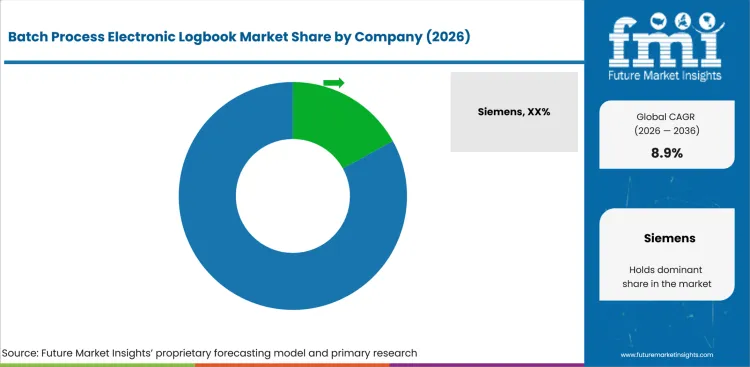
- Siemens, Rockwell Automation, Emerson, ABB, Schneider Electric, Honeywell, and Yokogawa compete through automation and software depth.
- Körber and MasterControl focus on life sciences workflows where validation depth can outweigh controller breadth.
- Analyst Opinion
- Nikhil Kaitwade, Principal Consultant at Future Market Insights for process automation domain, says, “Batch process electronic logbooks are changing from shift-note digitization into a batch accountability layer. Buyers now ask whether the record can match recipe steps, equipment status, alarms, deviation notes, and electronic signatures without slowing the plant. Pressure comes from batch release time, audit exposure, and the cost of reconciling data after production has ended. Suppliers gain an advantage when their systems connect control systems, MES, historians, and quality workflows with clear validation support.”
Adoption is shaped by production scale, digital plant investment, and automation readiness across regulated batch operations. The USA Census Bureau reported April 2026 durable goods new orders increased by USD 25.5 billion to USD 346.0 billion, showing the production base that needs controlled batch evidence. The UK Office for National Statistics reported manufacturing output increased by 0.6% in the three months to April 2026, supporting retrofit demand in established plants. China's National Bureau of Statistics reported industrial robot output increased by 27.9% year over year in May 2026, pointing to equipment-rich sites where operator logs must connect with machine events.
The batch process electronic logbook market is expected to witness steady growth through 2036, driven by regulated manufacturers replacing paper shift notes with controlled digital records. Market expansion is further supported by process manufacturing MES applications, validation service demand, and stronger links between operator decisions and control-system evidence.
Which factors support expansion in the batch process electronic logbook market?
Software-led batch records and validation services support market value as regulated plants link shift notes with batch execution evidence.
- Market value is supported by software license revenue before validation and integration services add incremental sales.
- Supplier pricing reflects recipe mapping and audit trail depth before hardware attachment affects total project value.
- Revenue improves as plants replace paper logbooks with controlled workflows that connect operators, alarms, and release review.
- Buyer trust rises when systems make signatures, exception records, and batch IDs easier to compare across sites.
Why is the batch process electronic logbook market growing?
Batch plants are digitizing operator handover as paper entries make deviation review slower during shift changes.
Growth outlook has become more structured as batch teams move from simple data entry to software-assisted review. The USA National Institute of Standards and Technology Manufacturing Extension Partnership reported in May 2026 that 46.0% of manufacturers were using artificial intelligence tools in manufacturing operations. That adoption signal supports the wider move toward digital thread for automation, automated review cues, and software-assisted decision layers. Electronic logbooks gain value when they connect operator notes with equipment state, recipe steps, alarms, and exception evidence. Buyers are therefore prioritizing systems that reduce review gaps while keeping each entry traceable for quality and audit teams.
How is the batch process electronic logbook market segmented?
The batch process electronic logbook industry is segmented by offering, deployment, application, end-use industry, and record function.
- Engineering Software is projected to secure 46.0% share in 2026, led by buyers needing configurable recipe links, audit trails, and exception review screens inside one controlled workflow.
- Process Automation is anticipated to hold 52.0% share in 2026 since batch sequencing creates frequent status changes that must be logged with operator decisions and review evidence.
- Line Integration is expected to capture 38.0% share in 2026 due to the need for one batch record across tanks, skids, packaging areas, and quality checkpoints.
- Pharmaceuticals is forecast to represent 34.0% share in 2026, reflected by release review, validation evidence, and controlled electronic signature requirements.
- Electronic Batch Record Review is projected to account for 41.5% share in 2026, led by quality teams moving from full-record checking toward exception-linked release control.
Why does Engineering Software dominate the batch process electronic logbook market?
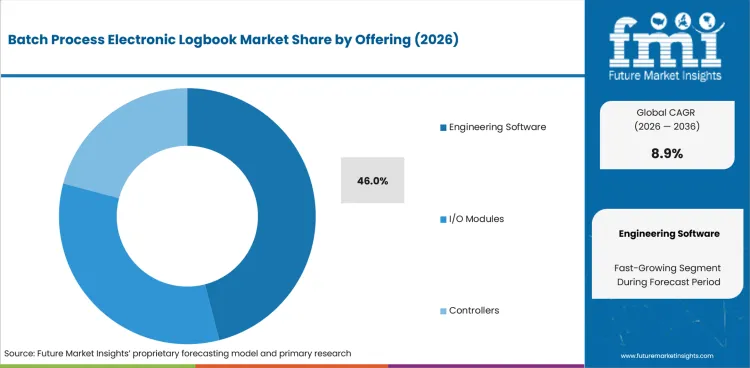
- Engineering Software is projected to account for 46.0% share in 2026, influenced by configurable recipe links and controlled review screens that reduce paper reconciliation.
- Services gain use as validation work, operator training, recipe mapping, and lifecycle support remain difficult to standardize across batch plants.
Which deployment leads the batch process electronic logbook market?
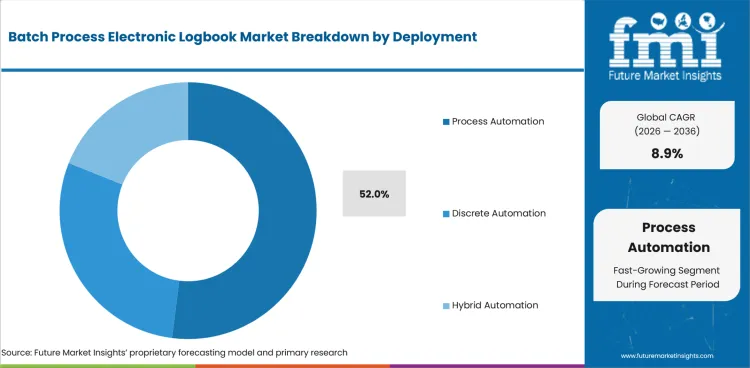
- Process Automation is anticipated to hold 52.0% share in 2026 through batch sequencing, phase records, and event capture that create constant logbook entries.
- Hybrid Automation gains importance as plants connect older equipment with modern MES and quality workflows without replacing every control asset.
Which application leads the batch process electronic logbook market?
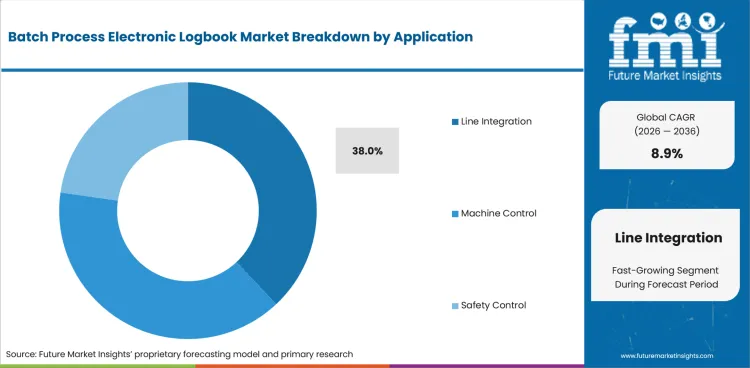
- Line Integration is forecast to secure 38.0% share in 2026, reflected by buyers needing one record across tanks, skids, filling lines, inspection points, and automated material handling systems that feed production evidence into batch review.
- Remote Operations gains value as supervisors review shift notes and production exceptions without waiting for paper handovers.
Which end-use industry leads the batch process electronic logbook market?
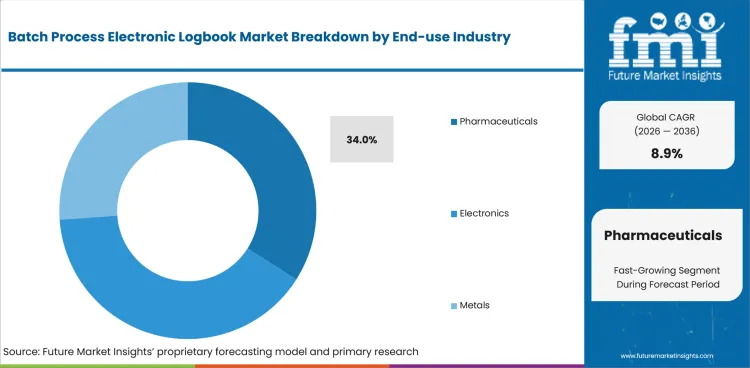
- Pharmaceuticals is expected to represent 34.0% share in 2026, shaped by validated batch release, deviation control, and electronic signature needs.
- Chemicals gain value as complex recipe handling and safety reviews require clearer links between operator actions and control events.
Which record function leads the batch process electronic logbook market?
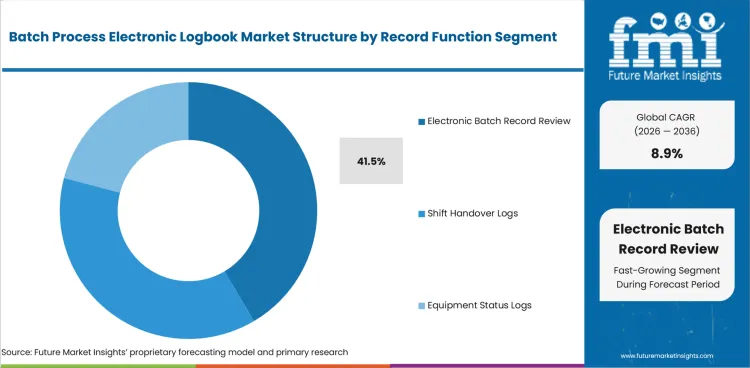
- Electronic Batch Record Review is projected to account for 41.5% share in 2026, led by quality teams using exceptions to shorten release review.
- Deviation and Exception Logs gain use when plants need faster root-cause review after alarms, holds, and manual interventions.
What are the driver, restraints, and opportunities in the batch process electronic logbook market?
Exception-based batch review and hybrid automation support growth while validation cost and legacy mapping limit faster rollout.
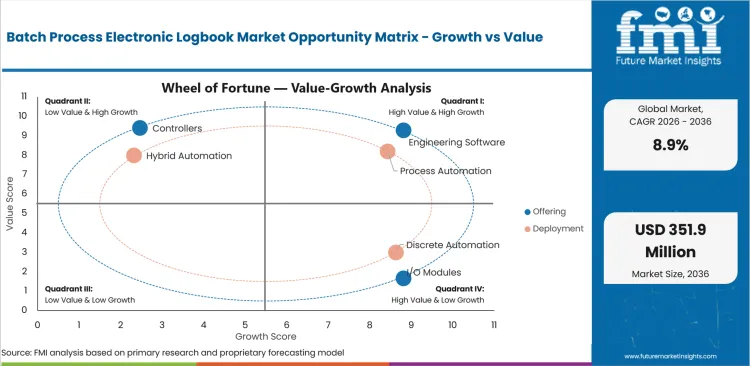
- Driver: Batch plants need time-stamped records that connect operator decisions with equipment events and release review.
- Restraint: Validation cost and legacy data mapping slow projects when recipe structures and user permissions are not clean.
- Opportunity: Cloud-managed workflows and MES-linked templates can support multi-site manufacturers with standard recipes.
Batch Process Electronic Logbook Market Demand Outlook
Demand outlook is moving toward electronic logbooks that shorten batch release while preserving the proof trail expected by auditors. The USA Federal Reserve reported manufacturing output increased by 0.6% in April 2026, showing continued production activity in plants that depend on controlled records. Batch teams increasingly need live links between operator entries, alarms, recipe stages, quality holds, and discrete manufacturing MES software. Suppliers that make review by exception simple can convert documentation pain into larger software and service scopes.
Legacy Equipment Mapping and Validation Pressure
Older batch assets create a major restraint because plants often operate mixed PLCs, skids, historians, and manual checks that were never designed around one batch ID. The Cybersecurity and Infrastructure Security Agency released 10 industrial control systems advisories on August 7, 2025, reinforcing the scrutiny facing connected production software. Buyers therefore test electronic logbooks for security, validation, and equipment context before wider rollout. Weak integration can keep a system trapped as a digital form instead of a trusted batch record layer.
Multi-Site Workflow Standardization
The opportunity is strongest when suppliers package templates, training, and lifecycle support without weakening audit control. The UK Advanced Manufacturing Sector Plan stated that a £129 million adoption programme had generated £202 million in private investment and more than 350 industrial digital technology projects. This supports a wider shift toward structured digital workflows in manufacturing. Cloud-managed or centrally governed logbook systems can help multi-site plants standardize recipes, signatures, and exception paths.
Which countries are growing fastest in the batch process electronic logbook market?
India 10.1% CAGR, China 9.5% CAGR, South Korea 9.2% CAGR, United States 8.8% CAGR, Japan 8.4% CAGR, United Kingdom 8.3% CAGR, Germany 8.1% CAGR, and France 8.0% CAGR through 2036.
.webp "Top Country Growth Comparison Batch Process Electronic Logbook Market Cagr (2026 2036)")
| Country | CAGR |
|---|---|
| United States | 8.8% |
| United Kingdom | 8.3% |
| Germany | 8.1% |
| France | 8.0% |
| Japan | 8.4% |
| China | 9.5% |
| South Korea | 9.2% |
| India | 10.1% |
Source: Future Market Insights, 2026.
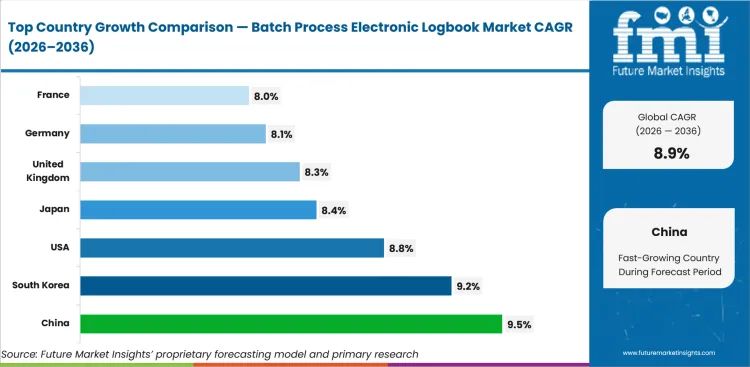
How do country-level CAGRs compare in the batch process electronic logbook market?
India leads country growth while France records the most cautious expansion outlook among profiled markets.
- India is projected to record 10.1% CAGR by 2036 as smart manufacturing support widens digital plant trials.
- China is expected to expand at 9.5% CAGR from 2026 to 2036 due to automation scale and multi-site production records.
- South Korea is forecast to grow at 9.2% CAGR through 2036 as smart factory support strengthens quality-led digitization.
- The United States is projected to rise at 8.8% CAGR by 2036 with regulated batch review and established MES buying routes.
- Japan is expected to advance at 8.4% CAGR over the forecast period as quality-focused plants digitize records carefully.
- The United Kingdom is forecast to grow at 8.3% CAGR through 2036 as retrofit modernization supports audit-ready logbooks.
- Germany is projected to post 8.1% CAGR by 2036 as engineered process plants require deeper integration proof.
- France is estimated to rise at 8.0% CAGR by 2036 with pharma, chemicals, and food plants modernizing records in stages.
What is the batch process electronic logbook market outlook in the United States?
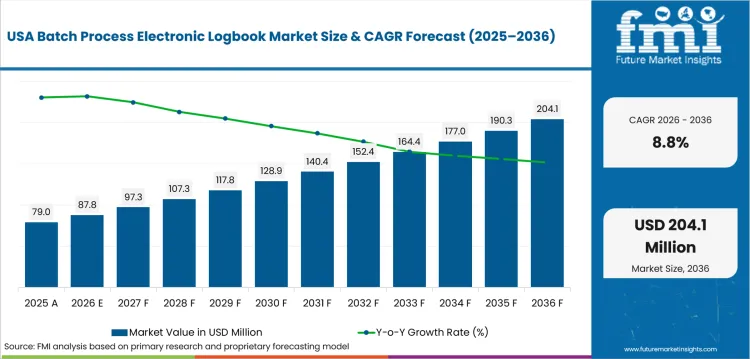
An 8.8% CAGR through 2036 is supported by regulated production scale, automation depth, and multi-site batch review programs.
Country Market Snapshot Table
| Parameter | Value |
|---|---|
| Market Size in 2025 (Value) | USD 41.4 million |
| Market Size in 2026 (Value) | USD 45.0 million |
| Market Forecast in 2036 (Value) | USD 104.4 million |
| CAGR (2026 to 2036) | 8.8% |
| Years Considered | 2021 to 2036 |
| Base Year | 2025 |
| Forecast Period | 2026 to 2036 |
| Units Considered | Value (USD million) |
| Leading Sub-Region | Great Lakes and Gulf Coast regulated manufacturing corridors |
United States Batch Process Electronic Logbook Market Outlook
- United States batch process electronic logbook demand is shaped by large pharma, food, specialty chemical, and advanced materials plants that already use automation systems but retain manual review gaps. Buyers want logbooks that connect operator entries with control events, electronic signatures, and quality records without creating extra shift work.
- The procurement route often starts with a delayed review issue before expanding into recipe, historian, and quality integration. Suppliers with validated workflows and strong integration partners should gain better access to multi-site standardization projects.
Key Growth Drivers
- Manufacturing output improvement supports digital record projects. The Federal Reserve reported manufacturing output increased 0.6% in April 2026, which reinforces demand for controlled production evidence across active plants.
- Productivity pressure supports software that reduces manual reconciliation. The USA Bureau of Labor Statistics reported manufacturing labor productivity increased 3.2% in the first quarter of 2026.
- Pharma and food plants are using logbooks to strengthen deviation evidence, batch release control, and shift handover accountability.
- Large automation suppliers and MES integrators give buyers a practical path to connect logbooks with existing control-system investments.
Key Restraints
- Cyber review can slow rollout in control rooms. CISA released 10 industrial control systems advisories on August 7, 2025, showing the scrutiny facing connected production software.
- Legacy PLC tags and historian naming differences make batch ID mapping expensive before plants can trust exception reports.
- Validation teams can extend buying cycles when each site uses different approval roles, recipe rules, and release workflows.
What makes United States unique
The United States is unique because regulated manufacturers can fund multi-site logbook standardization across mature automation environments.
Key Companies
- Rockwell Automation
- Emerson
- Siemens USA
- Honeywell
- ABB Inc.
- Schneider Electric USA
- MasterControl
Sales & Marketing Channels
- Direct enterprise sales
- MES system integrators
- Control-system upgrade projects
- Validation consulting partners
- Plant engineering framework contracts
- Quality-system implementation teams
Country Segment Breakdown Table
| Segment | Sub-Segments |
|---|---|
| By Offering | Controllers · I/O Modules · Engineering Software · Services |
| By Deployment | Discrete Automation · Process Automation · Hybrid Automation |
| By Application | Machine Control · Line Integration · Safety Control · Remote Operations |
| By End-use Industry | Automotive · Food & Beverage · Chemicals · Pharmaceuticals · Electronics · Metals |
| By Record Function | Electronic Batch Record Review · Shift Handover Logs · Equipment Status Logs · Deviation and Exception Logs · Remote Supervisor Notes |
| Key Sub-Regions Covered, Manufacturing Corridors | Great Lakes · Gulf Coast · Northeast Pharma Corridor · California · Texas · Carolinas |
Frequently Asked Questions
How fast is the United States batch process electronic logbook market growing?
Sales in the United States are expected to rise at 8.8% CAGR from 2026 to 2036, guided by regulated batch review demand.
Who leads the United States batch process electronic logbook market?
Rockwell Automation, Emerson, Siemens, Honeywell, ABB, Schneider Electric, and MasterControl compete through automation and quality-system depth.
What is driving adoption in the United States batch process electronic logbook market?
Batch release control, cyber review, and multi-site standardization are moving plants toward structured electronic logbooks.
How is the batch process electronic logbook market performing in the United Kingdom?
An 8.3% CAGR through 2036 reflects retrofit-led demand across pharma, food, and high-value manufacturing sites.
Country Market Snapshot Table
| Parameter | Value |
|---|---|
| Market Size in 2025 (Value) | USD 10.2 million |
| Market Size in 2026 (Value) | USD 11.0 million |
| Market Forecast in 2036 (Value) | USD 24.4 million |
| CAGR (2026 to 2036) | 8.3% |
| Years Considered | 2021 to 2036 |
| Base Year | 2025 |
| Forecast Period | 2026 to 2036 |
| Units Considered | Value (USD million) |
| Leading Sub-Region | Midlands and Cambridge-Oxford-London life sciences corridor |
United Kingdom Batch Process Electronic Logbook Market Outlook
- United Kingdom demand is led by existing batch plants that need cleaner records without major production disruption. Logbook projects are usually tied to quality review, shift notes, deviation capture, and controlled recipe documentation.
- Service partners play a large role because many facilities need integration with PLC, SCADA, MES, and quality systems already running on site. Suppliers that prove operator usability can move from single-area pilots into wider plant programs.
Key Growth Drivers
- Manufacturing stability supports software modernization. The Office for National Statistics reported manufacturing output grew 0.6% in the three months to April 2026.
- Life sciences investment creates stronger demand for validated records. The UK government announced more than £80 million in new life sciences manufacturing investment in April 2026.
- Food manufacturers are using batch logs to improve recipe discipline, allergen control, and product hold investigations.
- Retrofit-focused integrators help plants connect legacy control systems with modern logbook and MES workflows.
Key Restraints
- Digital adoption is broad but uneven among smaller manufacturers. The UK technology adoption review noted Made Smarter Adoption had reached over 4,000 manufacturing SMEs, leaving many firms still outside mature support programs.
- Mixed software environments can slow integration when quality teams and production teams use separate approval tools.
- Validation service cost can delay projects at smaller sites that need proof of payback before expanding scope.
What makes United Kingdom unique
The United Kingdom is unique because electronic logbook demand is mainly retrofit-led and tied to audit-ready modernization of established plants.
Key Companies
- Siemens UK
- Rockwell Automation UK
- ABB UK
- Schneider Electric UK
- Emerson UK
- AVEVA
- Honeywell UK
Sales & Marketing Channels
- Direct site sales
- Automation service partners
- MES integration projects
- Pharma validation consultants
- Food plant modernization programs
- Industrial digital service firms
Country Segment Breakdown Table
| Segment | Sub-Segments |
|---|---|
| By Offering | Controllers · I/O Modules · Engineering Software · Services |
| By Deployment | Discrete Automation · Process Automation · Hybrid Automation |
| By Application | Machine Control · Line Integration · Safety Control · Remote Operations |
| By End-use Industry | Automotive · Food & Beverage · Chemicals · Pharmaceuticals · Electronics · Metals |
| By Record Function | Electronic Batch Record Review · Shift Handover Logs · Equipment Status Logs · Deviation and Exception Logs · Remote Supervisor Notes |
| Key Sub-Regions Covered, Manufacturing Corridors | Midlands · North West · Scotland · Cambridge-Oxford-London · Wales · Yorkshire |
Frequently Asked Questions
How fast is the United Kingdom batch process electronic logbook market growing?
Demand in the United Kingdom is projected to grow at 8.3% CAGR from 2026 to 2036 through regulated plant modernization.
Who leads the United Kingdom batch process electronic logbook market?
Siemens, Rockwell Automation, ABB, Schneider Electric, Emerson, AVEVA, and Honeywell compete through controls and software coverage.
What is driving adoption in the United Kingdom batch process electronic logbook market?
Retrofit modernization, life sciences investment, and food safety record needs are moving plants toward structured electronic logbooks.
What is driving batch process electronic logbook growth in Germany?
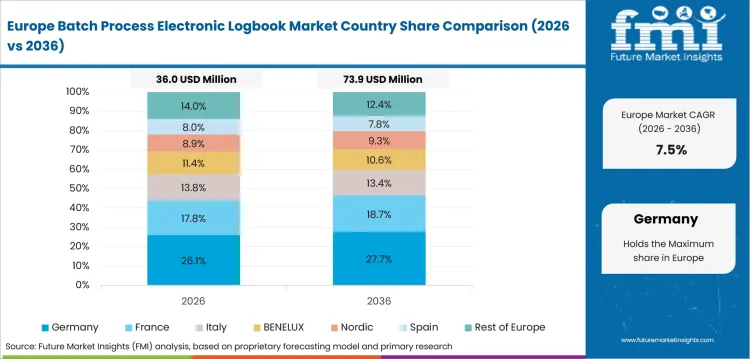
An 8.1% CAGR through 2036 reflects engineering-led adoption across chemicals, pharma, food, and specialty materials plants.
Country Market Snapshot Table
| Parameter | Value |
|---|---|
| Market Size in 2025 (Value) | USD 11.1 million |
| Market Size in 2026 (Value) | USD 12.0 million |
| Market Forecast in 2036 (Value) | USD 26.2 million |
| CAGR (2026 to 2036) | 8.1% |
| Years Considered | 2021 to 2036 |
| Base Year | 2025 |
| Forecast Period | 2026 to 2036 |
| Units Considered | Value (USD million) |
| Leading Sub-Region | Rhine-Ruhr and Bavaria process manufacturing corridors |
Germany Batch Process Electronic Logbook Market Outlook
- Germany demand is shaped by engineering discipline and a preference for tightly specified automation systems. Plants value logbooks that can map equipment context, recipe changes, alarms, and approvals into one controlled batch record.
- Projects can move slowly because engineering teams test each link between recipes, equipment, and review permissions. Suppliers with batch-control knowledge and strong service coverage should hold an advantage in complex plants.
Key Growth Drivers
- Automation intensity supports deeper links between machines and records. The International Federation of Robotics reported Germany had 449 robots per 10,000 manufacturing employees in 2024.
- Order backlogs support modernization planning. Destatis reported Germany's manufacturing order stock was 8.4% higher year over year in April 2026.
- Chemical and pharma sites need batch records that fit complex recipe structures and strict equipment change control.
- Engineering-led procurement favors suppliers with proven MES, batch control, historian, and validation service portfolios.
Key Restraints
- Supply-chain pressure can affect project timing. The ifo Institute reported 15.9% of German manufacturing companies faced material bottlenecks in May 2026.
- Long validation cycles slow supplier replacement at plants with strict engineering change procedures.
- Site-specific IT rules can limit cloud-first deployment models until data governance is clarified.
What makes Germany unique
Germany is unique because buyers expect engineered evidence that connects logbooks with batch control, equipment data, and validation rules.
Key Companies
- Siemens
- ABB Germany
- Schneider Electric Germany
- Bosch Rexroth
- Körber Pharma
- Endress+Hauser
- Yokogawa Germany
Sales & Marketing Channels
- Automation system houses
- Direct enterprise account teams
- Plant engineering tenders
- Pharma validation partners
- Chemical industry integrator networks
- Industrial software service firms
Country Segment Breakdown Table
| Segment | Sub-Segments |
|---|---|
| By Offering | Controllers · I/O Modules · Engineering Software · Services |
| By Deployment | Discrete Automation · Process Automation · Hybrid Automation |
| By Application | Machine Control · Line Integration · Safety Control · Remote Operations |
| By End-use Industry | Automotive · Food & Beverage · Chemicals · Pharmaceuticals · Electronics · Metals |
| By Record Function | Electronic Batch Record Review · Shift Handover Logs · Equipment Status Logs · Deviation and Exception Logs · Remote Supervisor Notes |
| Key Sub-Regions Covered, Manufacturing Corridors | North Rhine-Westphalia · Bavaria · Baden-Württemberg · Hesse · Hamburg · Lower Saxony |
Frequently Asked Questions
How fast is Germany batch process electronic logbook market growing?
Germany demand is forecast to expand at 8.1% CAGR from 2026 to 2036, led by engineered batch automation needs.
Who leads Germany batch process electronic logbook market?
Siemens, ABB, Schneider Electric, Bosch Rexroth, Körber, Endress+Hauser, and Yokogawa compete through automation and validation depth.
What is driving adoption in Germany batch process electronic logbook market?
Chemical and pharma complexity is moving German plants toward controlled batch records linked with recipe and equipment evidence.
What is the batch process electronic logbook market forecast for France?
An 8.0% CAGR through 2036 is supported by industrial modernization, pharma production, and traceability-led software adoption.
Country Market Snapshot Table
| Parameter | Value |
|---|---|
| Market Size in 2025 (Value) | USD 7.4 million |
| Market Size in 2026 (Value) | USD 8.0 million |
| Market Forecast in 2036 (Value) | USD 17.3 million |
| CAGR (2026 to 2036) | 8.0% |
| Years Considered | 2021 to 2036 |
| Base Year | 2025 |
| Forecast Period | 2026 to 2036 |
| Units Considered | Value (USD million) |
| Leading Sub-Region | Ile-de-France, Auvergne-Rhone-Alpes and Normandy industrial corridors |
France Batch Process Electronic Logbook Market Outlook
- France demand is centered on making batch plants more traceable while keeping established operating routines stable. Electronic logbook projects often support deviation notes, quality checks, and operator handover in pharma, chemicals, and food processing.
- Buyers usually require simple screens, bilingual documentation support, and clear audit trails before site expansion. Adoption improves when the system lowers review time without adding unnecessary work for operators.
Key Growth Drivers
- Manufacturing momentum supports documentation upgrades. INSEE reported manufacturing output increased 0.4% in April 2026 after a stronger March reading.
- Digital investment capacity is improving. The French Treasury raised the Tibi Initiative target to €15 billion in September 2025 to support late-stage technology financing.
- Pharma and chemical producers need stronger deviation record control across batch campaigns and quality investigations.
- Food processors value electronic logbooks when recipe checks and product hold decisions must be visible across shifts.
Key Restraints
- Capacity pressure can make project scheduling cautious. Banque de France reported industry capacity utilization at 77.0% at the start of May 2026.
- Operator change management can slow conversion from paper logs when sites do not simplify screens for shift teams.
- Multi-site groups may delay rollout when plant templates differ sharply across recipe families and approval paths.
What makes France unique
France is unique because demand links industrial modernization with operator usability in regulated and quality-sensitive plants.
Key Companies
- Schneider Electric
- Siemens France
- ABB France
- Emerson France
- AVEVA France
- Rockwell Automation France
- Dassault Systemes
Sales & Marketing Channels
- Industrial digital service firms
- Direct automation vendor sales
- MES implementation partners
- Quality system consultants
- Plant modernization tenders
- Food and pharma engineering partners
Country Segment Breakdown Table
| Segment | Sub-Segments |
|---|---|
| By Offering | Controllers · I/O Modules · Engineering Software · Services |
| By Deployment | Discrete Automation · Process Automation · Hybrid Automation |
| By Application | Machine Control · Line Integration · Safety Control · Remote Operations |
| By End-use Industry | Automotive · Food & Beverage · Chemicals · Pharmaceuticals · Electronics · Metals |
| By Record Function | Electronic Batch Record Review · Shift Handover Logs · Equipment Status Logs · Deviation and Exception Logs · Remote Supervisor Notes |
| Key Sub-Regions Covered, Manufacturing Corridors | Ile-de-France · Auvergne-Rhone-Alpes · Normandy · Hauts-de-France · Grand Est · Nouvelle-Aquitaine |
Frequently Asked Questions
How fast is France batch process electronic logbook market growing?
France demand is expected to increase at 8.0% CAGR from 2026 to 2036 through regulated production modernization.
Who leads France batch process electronic logbook market?
Schneider Electric, Siemens, ABB, Emerson, AVEVA, Rockwell Automation, and Dassault Systemes compete through industrial software coverage.
What is driving adoption in France batch process electronic logbook market?
Traceability needs in pharma, chemicals, and food processing are moving plants toward controlled electronic logbook workflows.
How fast is the batch process electronic logbook market growing in Japan?
An 8.4% CAGR through 2036 reflects quality-first adoption across pharma, food, chemicals, and electronics plants.
Country Market Snapshot Table
| Parameter | Value |
|---|---|
| Market Size in 2025 (Value) | USD 8.3 million |
| Market Size in 2026 (Value) | USD 9.0 million |
| Market Forecast in 2036 (Value) | USD 20.2 million |
| CAGR (2026 to 2036) | 8.4% |
| Years Considered | 2021 to 2036 |
| Base Year | 2025 |
| Forecast Period | 2026 to 2036 |
| Units Considered | Value (USD million) |
| Leading Sub-Region | Kanto and Kansai precision manufacturing corridors |
Japan Batch Process Electronic Logbook Market Outlook
- Japan demand is driven by quality discipline and the need to reduce paper work inside precise manufacturing routines. Plants prefer electronic logbooks that support detailed approval steps while operating alongside stable control assets, robotics layers, and robot controller integrator and software connected to production records.
- Supplier trust is critical because plant teams expect long support cycles and low-disruption integration. The strongest opportunities sit in validated workflows that lower manual review without changing proven production methods.
Key Growth Drivers
- Production recovery supports gradual software upgrades. METI reported Japan's revised April 2026 production index at 102.5 with 0.5% monthly growth.
- Automation maturity supports machine-event capture. The International Federation of Robotics reported Japan had 446 robots per 10,000 manufacturing employees in 2024.
- Quality-focused plants need consistent operator entries that can be reviewed across shifts and batch campaigns.
- Pharma and electronics sites require clear evidence chains when process exceptions affect release, rework decisions, and laboratory automation workflows linked to quality checks.
Key Restraints
- Capital priorities can compete with logbook software. Japan's Cabinet Office reported private-sector machinery orders excluding volatile items increased 8.7% month over month in April 2026.
- Long qualification cycles can delay supplier switching when plants require extensive proof before production use.
- Custom plant practices make standard templates harder to reuse across factories with different approval routines.
What makes Japan unique
Japan is unique because adoption depends on low-disruption integration that protects established quality routines.
Key Companies
- Yokogawa Electric
- Mitsubishi Electric
- Omron
- Hitachi
- Azbil
- Siemens Japan
- Rockwell Automation Japan
Sales & Marketing Channels
- Direct automation vendor relationships
- Long-term service agreements
- MES and controls integrators
- Quality system consultants
- Plant-by-plant pilot projects
- Electronics manufacturing partners
Country Segment Breakdown Table
| Segment | Sub-Segments |
|---|---|
| By Offering | Controllers · I/O Modules · Engineering Software · Services |
| By Deployment | Discrete Automation · Process Automation · Hybrid Automation |
| By Application | Machine Control · Line Integration · Safety Control · Remote Operations |
| By End-use Industry | Automotive · Food & Beverage · Chemicals · Pharmaceuticals · Electronics · Metals |
| By Record Function | Electronic Batch Record Review · Shift Handover Logs · Equipment Status Logs · Deviation and Exception Logs · Remote Supervisor Notes |
| Key Sub-Regions Covered, Manufacturing Corridors | Kanto · Kansai · Chubu · Kyushu · Tohoku · Hiroshima Corridor |
Frequently Asked Questions
How fast is Japan batch process electronic logbook market growing?
Japan demand is projected to rise at 8.4% CAGR from 2026 to 2036 as quality-driven plants digitize batch records.
Who leads Japan batch process electronic logbook market?
Yokogawa, Mitsubishi Electric, Omron, Hitachi, Azbil, Siemens Japan, and Rockwell Automation Japan compete through local automation strength.
What is driving adoption in Japan batch process electronic logbook market?
Quality discipline and low-disruption plant integration are moving Japanese buyers toward validated electronic logbook systems.
What is the batch process electronic logbook market outlook in China?
A 9.5% CAGR through 2036 is supported by manufacturing scale, automation expansion, and multi-site batch standardization.
Country Market Snapshot Table
| Parameter | Value |
|---|---|
| Market Size in 2025 (Value) | USD 25.6 million |
| Market Size in 2026 (Value) | USD 28.0 million |
| Market Forecast in 2036 (Value) | USD 69.3 million |
| CAGR (2026 to 2036) | 9.5% |
| Years Considered | 2021 to 2036 |
| Base Year | 2025 |
| Forecast Period | 2026 to 2036 |
| Units Considered | Value (USD million) |
| Leading Sub-Region | Yangtze River Delta and Greater Bay industrial corridors |
China Batch Process Electronic Logbook Market Outlook
- China demand is shaped by manufacturing scale and faster automation penetration across process and hybrid industries. Plants need electronic logbooks that can scale across multiple lines, sites, and equipment brands.
- Buyers often compare global supplier platforms with local integration capacity and implementation speed. Demand is strongest where production expansion creates too many paper records for manual review.
Key Growth Drivers
- Advanced production expansion supports digital record demand. The National Bureau of Statistics reported industrial robot output increased 27.9% year over year in May 2026.
- Broad industrial output supports plant-level digitization. China's State Council reported value-added industrial output grew 5.6% year over year in the first four months of 2026.
- Chemical, battery, and electronics plants need better event traceability across multi-line batch and hybrid operations.
- Local integrators make adoption easier for manufacturers running mixed equipment brands across industrial parks.
Key Restraints
- Manufacturing sentiment can keep approvals cautious. The China Federation of Logistics and Purchasing reported the manufacturing PMI was 50.0 in May 2026.
- Cybersecurity and data localization review can slow supplier approval when cloud-hosted workflows are proposed.
- Price pressure is high when local alternatives meet basic logbook capture needs without full validation depth.
What makes China unique
China is unique because multi-site rollout ability can matter more than single-plant feature depth during automation expansion.
Key Companies
- Siemens China
- Rockwell Automation China
- ABB China
- Schneider Electric China
- SUPCON
- Hollysys
- Yokogawa China
Sales & Marketing Channels
- Local automation integrators
- OEM partnerships
- Direct enterprise sales
- Industrial park supplier networks
- Plant expansion projects
- MES service partners
Country Segment Breakdown Table
| Segment | Sub-Segments |
|---|---|
| By Offering | Controllers · I/O Modules · Engineering Software · Services |
| By Deployment | Discrete Automation · Process Automation · Hybrid Automation |
| By Application | Machine Control · Line Integration · Safety Control · Remote Operations |
| By End-use Industry | Automotive · Food & Beverage · Chemicals · Pharmaceuticals · Electronics · Metals |
| By Record Function | Electronic Batch Record Review · Shift Handover Logs · Equipment Status Logs · Deviation and Exception Logs · Remote Supervisor Notes |
| Key Sub-Regions Covered, Manufacturing Corridors | Yangtze River Delta · Greater Bay Area · Bohai Rim · Sichuan-Chongqing · Hubei · Fujian |
Frequently Asked Questions
How fast is China batch process electronic logbook market growing?
China demand is forecast to expand at 9.5% CAGR from 2026 to 2036 through automation-led plant expansion.
Who leads China batch process electronic logbook market?
Siemens China, Rockwell Automation China, ABB China, Schneider Electric China, SUPCON, Hollysys, and Yokogawa China compete through platform and integration reach.
What is driving adoption in China batch process electronic logbook market?
Automation expansion and multi-line batch accountability are moving plants toward electronic logbooks that scale across sites.
How is the batch process electronic logbook market growing in South Korea?
A 9.2% CAGR through 2036 reflects smart factory support, electronics strength, and quality-controlled batch production.
Country Market Snapshot Table
| Parameter | Value |
|---|---|
| Market Size in 2025 (Value) | USD 6.9 million |
| Market Size in 2026 (Value) | USD 7.5 million |
| Market Forecast in 2036 (Value) | USD 18.1 million |
| CAGR (2026 to 2036) | 9.2% |
| Years Considered | 2021 to 2036 |
| Base Year | 2025 |
| Forecast Period | 2026 to 2036 |
| Units Considered | Value (USD million) |
| Leading Sub-Region | Gyeonggi, Ulsan and Busan manufacturing corridors |
South Korea Batch Process Electronic Logbook Market Outlook
- South Korea demand is supported by electronics, batteries, chemicals, food, and pharma plants that need quality evidence across dense production networks. Electronic logbooks help teams connect equipment events with human decisions during shifts.
- Supplier selection is influenced by integration capability and support for local plant practices. Buyers value templates that shorten deployment while preserving approval discipline.
Key Growth Drivers
- Public support helps widen the smart manufacturing buyer base. The OECD noted Korea's smart manufacturing initiative budget reached KRW 247.9 billion by 2025.
- Automation culture supports digital records. The International Federation of Robotics reported Korea had 1,220 robots per 10,000 manufacturing employees in 2024.
- Electronics and battery supply chains need disciplined batch records when traceability affects yield and customer audits.
- Local automation and IT service firms help plants adapt logbook workflows to established production rules.
Key Restraints
- Short-term production softness can delay project approvals. Statistics Korea reported the manufacturing production index decreased 0.8% month over month in April 2026.
- Budget caps can slow smaller plants that need integration support before they can use electronic logbooks effectively.
- Skills shortages can raise dependence on integrators for validation, template design, and user training.
What makes South Korea unique
South Korea is unique because smart factory support and electronics quality pressure align with batch record digitization.
Key Companies
- Siemens Korea
- Rockwell Automation Korea
- ABB Korea
- LS Electric
- POSCO DX
- Samsung SDS
- Yokogawa Korea
Sales & Marketing Channels
- Smart factory program partners
- Automation integrators
- Direct enterprise sales
- Electronics manufacturing service networks
- Validation consultants
- Industrial IT service firms
Country Segment Breakdown Table
| Segment | Sub-Segments |
|---|---|
| By Offering | Controllers · I/O Modules · Engineering Software · Services |
| By Deployment | Discrete Automation · Process Automation · Hybrid Automation |
| By Application | Machine Control · Line Integration · Safety Control · Remote Operations |
| By End-use Industry | Automotive · Food & Beverage · Chemicals · Pharmaceuticals · Electronics · Metals |
| By Record Function | Electronic Batch Record Review · Shift Handover Logs · Equipment Status Logs · Deviation and Exception Logs · Remote Supervisor Notes |
| Key Sub-Regions Covered, Manufacturing Corridors | Gyeonggi · Ulsan · Busan · Incheon · Chungcheong · Daegu-Gyeongbuk |
Frequently Asked Questions
How fast is South Korea batch process electronic logbook market growing?
South Korea demand is expected to grow at 9.2% CAGR from 2026 to 2036 as smart factory programs support digital records.
Who leads South Korea batch process electronic logbook market?
Siemens Korea, Rockwell Automation Korea, ABB Korea, LS Electric, POSCO DX, Samsung SDS, and Yokogawa Korea compete through automation and IT service coverage.
What is driving adoption in South Korea batch process electronic logbook market?
Smart manufacturing support and electronics quality pressure are moving plants toward structured batch and shift records.
What makes India the fastest-growing batch process electronic logbook market?
A 10.1% CAGR through 2036 is supported by manufacturing expansion, pharma validation needs, and Industry 4.0 adoption support.
Country Market Snapshot Table
| Parameter | Value |
|---|---|
| Market Size in 2025 (Value) | USD 5.4 million |
| Market Size in 2026 (Value) | USD 6.0 million |
| Market Forecast in 2036 (Value) | USD 15.7 million |
| CAGR (2026 to 2036) | 10.1% |
| Years Considered | 2021 to 2036 |
| Base Year | 2025 |
| Forecast Period | 2026 to 2036 |
| Units Considered | Value (USD million) |
| Leading Sub-Region | Western and southern pharma-industrial corridors |
India Batch Process Electronic Logbook Market Outlook
- India demand is expanding as batch-heavy pharma, chemicals, food, automotive, and electronics plants formalize digital production records. Electronic logbooks are becoming useful for shift handover, exception notes, line integration, and audit preparation.
- The local buying route is often integrator-led because many plants need support to connect older equipment with software workflows. Suppliers that offer simple validation templates and practical training should improve adoption among mid-sized manufacturers.
Key Growth Drivers
- Manufacturing expansion supports digital batch record spending. India's Press Information Bureau reported manufacturing output grew 6.2% year over year in April 2026.
- Industry 4.0 support is widening the adoption base. The Ministry of Heavy Industries entrusted C4i4 Pune with 10 additional Industry 4.0 centers.
- Pharma exporters need stronger electronic evidence chains for batch release, deviation review, and customer audits.
- Integrator-led pilots make adoption practical for plants that must connect legacy PLCs, manual checks, and quality records.
Key Restraints
- Automation depth must still broaden across factories. The International Federation of Robotics reported India installed 9,100 industrial robots in 2024, leaving many plants at early adoption stages.
- Price sensitivity can delay full MES-linked logbook projects when buyers start with basic digitized forms.
- Legacy equipment variation increases mapping effort before plants can trust exception-led batch review.
What makes India unique
India is unique because manufacturing expansion and pharma compliance needs are creating a fast-moving buyer pool for affordable validated logbooks.
Key Companies
- Siemens India
- Rockwell Automation India
- Emerson India
- ABB India
- Schneider Electric India
- Honeywell Automation India
- Yokogawa India
Sales & Marketing Channels
- Automation integrators
- Direct vendor sales
- Pharma validation partners
- Smart manufacturing centers
- Plant engineering consultants
- MES implementation firms
Country Segment Breakdown Table
| Segment | Sub-Segments |
|---|---|
| By Offering | Controllers · I/O Modules · Engineering Software · Services |
| By Deployment | Discrete Automation · Process Automation · Hybrid Automation |
| By Application | Machine Control · Line Integration · Safety Control · Remote Operations |
| By End-use Industry | Automotive · Food & Beverage · Chemicals · Pharmaceuticals · Electronics · Metals |
| By Record Function | Electronic Batch Record Review · Shift Handover Logs · Equipment Status Logs · Deviation and Exception Logs · Remote Supervisor Note |
| Key Sub-Regions Covered, Manufacturing Corridors | Maharashtra · Gujarat · Telangana · Karnataka · Tamil Nadu · Andhra Pradesh |
Frequently Asked Questions
How fast is India batch process electronic logbook market growing?
India demand is projected to grow at 10.1% CAGR from 2026 to 2036, making it the fastest market among profiled countries.
Who leads India batch process electronic logbook market?
Siemens India, Rockwell Automation India, Emerson India, ABB India, Schneider Electric India, Honeywell Automation India, and Yokogawa India compete through automation and service networks.
What is driving adoption in India batch process electronic logbook market?
Pharma validation needs, smart manufacturing support, and legacy equipment integration are moving Indian plants toward electronic logbooks.
Who are the leading companies in the batch process electronic logbook market?
Siemens, Rockwell Automation, Emerson, ABB, Schneider Electric, Honeywell, Yokogawa, Körber, MasterControl, and AVEVA lead the market.
- Automation companies hold an advantage through control-system access and existing relationships with regulated manufacturing sites.
- MES and quality software specialists gain share when batch record review and validation depth outweigh controller breadth.
- Service partners remain important because recipe mapping, role setup, and audit-trail validation must match each plant.
- Cloud-ready workflow tools support wider rollout when multi-site manufacturers want standard templates and lower support load.
Suppliers compete by connecting operator entries with batch control, historians, quality systems, and manufacturing execution systems. Large automation vendors are strongest when buyers need one implementation path across controllers, MES, validation, and plant support. Specialist vendors can still win in life sciences accounts where review-by-exception depth is more important than controller attachment.
The competitive base also depends on how well suppliers fit inside factory automation and industrial controls upgrade programs. Buyers prefer platforms that can read events from PLCs, batch engines, historians, and operator terminals without forcing a full equipment replacement. That favors vendors with deep integration libraries and proven services.
Smaller software providers can compete when they solve narrow review problems faster than large platforms. Demand linked to smart factory market outlook supports more pilots in mid-sized plants. Durable advantage will come from validated templates, practical operator screens, and evidence links that auditors can follow without extra manual reconciliation.
How do top batch process electronic logbook companies compare?
Siemens and Rockwell Automation score strongest on OT-MES depth while Körber and MasterControl score strongest in life sciences validation.
| Company | Relevance to Market Title | Batch Record Integration Depth | Audit Trail and E-Signature Control | OT-MES Connectivity | Geographic Footprint |
|---|---|---|---|---|---|
| Siemens | Very High | Very Strong | Very Strong | Very Strong | Global |
| Rockwell Automation | Very High | Very Strong | Strong | Very Strong | Global |
| Emerson | Very High | Strong | Strong | Strong | Global |
| ABB | High | Strong | Moderate to Strong | Very Strong | Global |
| Schneider Electric and AVEVA | Very High | Strong | Strong | Strong | Global |
| Honeywell | High | Strong | Strong | Strong | Global |
| Yokogawa Electric | High | Strong | Moderate to Strong | Strong | Global |
| Körber | Very High | Very Strong | Very Strong | Moderate to Strong | Global life sciences |
| MasterControl | High | Strong | Very Strong | Moderate | Life sciences focused |
| SUPCON | Moderate to High | Moderate to Strong | Moderate | Strong | China and export markets |
Source: Future Market Insights competitive analysis, 2026.
Who are the key players in the batch process electronic logbook market?
Siemens, Rockwell Automation and Emerson are listed with ABB, Schneider Electric, Honeywell, Yokogawa, Körber and MasterControl among other suppliers.
Key global companies leading the batch process electronic logbook market include:
- Siemens
- Rockwell Automation
- Emerson
- ABB
- Schneider Electric
- Honeywell
- Yokogawa Electric
- Körber
- MasterControl
- AVEVA
Key Developments in Batch Process Electronic Logbook Market
- In April 2024, Emerson introduced DeltaV Workflow Management as a cloud-based software-as-a-service tool for recipe authoring, execution, and electronic data capture in life sciences manufacturing.
- In July 2025, Siemens released Opcenter Execution Pharma 2505 with genealogy, audit trail tools, and batch record review by exception for regulated production environments.
- In October 2024, Yokogawa released OpreX Batch MES globally to support batch chemical process management with low-code configuration and digital recording workflows.
Key Players in the Batch Process Electronic Logbook Market
Global Automation and Control Vendors
- Siemens
- Rockwell Automation
- Emerson
- ABB
- Schneider Electric
- Honeywell
- Yokogawa Electric
Life Sciences and MES Specialists
- Körber
- MasterControl
- AVEVA
- Werum PAS-X ecosystem partners
Regional Automation and Integration Companies
- Mitsubishi Electric
- Omron
- LS Electric
- SUPCON
- Hollysys
- POSCO DX
Batch Process Electronic Logbook Market - Scope & Definition
| Attribute | Detail |
|---|---|
| Market Definition | Digital systems that capture batch events, operator notes, equipment status, alarms, exceptions, and signatures during production in batch and hybrid plants. |
| Functions Covered | Batch record capture, shift handover, equipment status logging, deviation capture, exception review, remote supervisor notes, electronic signatures. |
| Applications Covered | Machine control, line integration, safety control, remote operations, recipe-linked review, and batch release support. |
| End-Use Industries | Automotive, food and beverage, chemicals, pharmaceuticals, electronics, metals, and other regulated batch manufacturing operations. |
| Product Scope Covered | Controllers, I/O modules, engineering software, services, deployment support, and record-function workflows used for batch documentation. |
| Inclusions | MES-linked logbooks, batch-control records, digital work instruction logs, quality review records, historian-linked operator notes, and validated electronic signatures. |
| Exclusions | Generic office forms, unstructured note-taking apps, maintenance-only CMMS logs, laboratory-only notebooks, paper batch records, and pure historians without logbook review capability. |
Batch Process Electronic Logbook Market - Research Methodology
| Method | Description |
|---|---|
| Primary Research | FMI analyst interviews with automation vendors, MES suppliers, system integrators, plant engineering teams, quality leaders, and validation consultants across key markets. |
| Desk Research | Review of official manufacturing statistics, government technology adoption evidence, industrial automation sources, supplier documentation, and company product releases. |
| Market Sizing & Forecasting | Bottom-up model using software license revenue, validation service intensity, controller attachment, record-function scope, and country-level automation readiness. |
| Data Validation | Cross-verification using supplier portfolios, country manufacturing signals, smart manufacturing programs, and known use cases in pharma, chemicals, food, electronics, and metals. |
Batch Process Electronic Logbook Market - Report Scope
| Parameter | Details |
|---|---|
| Forecast period | 2026 to 2036 |
| Historical period | 2021 to 2025 |
| Quantitative unit | Revenue in USD million |
| By offering | Controllers, I/O Modules, Engineering Software, Services |
| By deployment | Discrete Automation, Process Automation, Hybrid Automation |
| By application | Machine Control, Line Integration, Safety Control, Remote Operations |
| By end-use industry | Automotive, Food & Beverage, Chemicals, Pharmaceuticals, Electronics, Metals |
| By record function | Electronic Batch Record Review, Shift Handover Logs, Equipment Status Logs, Deviation and Exception Logs, Remote Supervisor Notes |
| Regions covered | North America, Latin America, Europe, East Asia, South Asia and Pacific, Middle East and Africa |
| Countries covered | United States, United Kingdom, Germany, France, Japan, China, South Korea, India |
| Key companies profiled | Siemens, Rockwell Automation, Emerson, ABB, Schneider Electric, Honeywell, Yokogawa, Körber, MasterControl, AVEVA |
| Approach | Bottom-up product-boundary approach using software license revenue, validation service intensity, controller attachment, record-function depth, and country-level automation readiness |
Source: Future Market Insights competitive analysis, 2026.
Batch Process Electronic Logbook Market Breakdown by Offering, Deployment, Application, End-use Industry, Record Function, and Region
Batch Process Electronic Logbook Market Segmented by Offering
- Controllers
- I/O Modules
- Engineering Software
- Services
Batch Process Electronic Logbook Market Segmented by Deployment
- Discrete Automation
- Process Automation
- Hybrid Automation
Batch Process Electronic Logbook Market Segmented by Application
- Machine Control
- Line Integration
- Safety Control
- Remote Operations
Batch Process Electronic Logbook Market Segmented by End-use Industry
- Automotive
- Food & Beverage
- Chemicals
- Pharmaceuticals
- Electronics
- Metals
Batch Process Electronic Logbook Market Segmented by Record Function
- Electronic Batch Record Review
- Shift Handover Logs
- Equipment Status Logs
- Deviation and Exception Logs
- Remote Supervisor Notes
Batch Process Electronic Logbook Market by Region
- North America
- Latin America
- Europe
- East Asia
- South Asia and Pacific
- Middle East and Africa
Research Sources and Bibliography
- ABB. (2025, February 18). ABB launches new advanced automation solution to increase productivity and collaboration in process industries.
- Banque de France. (2026, May). Monthly business survey: Start of May 2026.
- Bureau of Labor Statistics. (2026, June 4). Productivity and costs: First quarter 2026, revised.
- Cabinet Office of Japan. (2026, June 18). Machinery orders in April 2026.
- Census Bureau. (2026, June 3). Manufacturers' shipments, inventories, and orders: April 2026.
- Cybersecurity and Infrastructure Security Agency. (2025, August 7). CISA releases ten industrial control systems advisories.
- Department for Business and Trade. (2025, June 23). Advanced manufacturing sector plan.
- Department of Health and Social Care, & Department for Science, Innovation and Technology. (2026, April 14). Vital medicines and new jobs in over £80 million boost for UK life sciences.
- Destatis. (2026, June 12). Real stock of orders in manufacturing in April 2026: +0.4% on the previous month.
- Emerson. (2024, April 16). Emerson's next-generation software streamlines pharmaceutical development and accelerates speed to market.
- Federal Reserve Board. (2026, May 15). Industrial production and capacity utilization: April 2026.
- French Treasury. (2025, September 16). Tibi Initiative: A target raised to €15 billion.
- ifo Institute. (2026, May 27). Material shortage in German manufacturing intensifies.
- Institut national de la statistique et des études économiques. (2026, June 5). In April 2026, manufacturing output increased by 0.4%.
- International Federation of Robotics. (2026, April 8). Robot density surges in Europe, Asia, and Americas.
- International Federation of Robotics. (2025, September 25). World Robotics 2025 report.
- Ministry of Economy, Trade and Industry. (2026, June 12). Indices of industrial production: Revised report for April 2026.
- Ministry of Heavy Industries. (2025, April 1). SAMARTH Udyog Bharat 4.0.
- National Bureau of Statistics of China. (2026, June 16). National economy showed steady momentum with continued high-quality development.
- Office for National Statistics. (2026, June 12). GDP monthly estimate, UK: April 2026.
- Organisation for Economic Co-operation and Development. (2025). The Korea smart manufacturing innovation initiative.
- Press Information Bureau. (2026, May 28). Index of industrial production, April 2026.
- Siemens Digital Industries Software. (2025, July 16). What's new in Opcenter Execution Pharma 2505.
- Statistics Korea. (2026, May 29). Monthly industrial statistics, April 2026.
- USA National Institute of Standards and Technology Manufacturing Extension Partnership. (2026, May 13). AI for manufacturers: Moving from hype to how.
- Yokogawa Electric Corporation. (2024, October 28). Yokogawa releases OpreX Batch MES.
This bibliography is provided for reader reference and is not exhaustive. The full report contains the complete reference list and detailed citations.
This Report Answers
- Market size estimates for 2026 and forecasts through 2036 for the batch process electronic logbook market.
- Insights across regional and country-level markets with country CAGR comparison.
- Analysis of demand drivers, validation pressure, legacy integration needs, and purchasing behavior.
- Evaluation of key deployment, offering, application, end-use industry, and record-function segments.
- Assessment of workflow standardization, review-by-exception, and electronic signature requirements.
- Identification of growth opportunities across process automation, engineering software, and batch record review.
- Evaluation of supply-side competition among automation vendors, MES suppliers, and life sciences software specialists.
- Country-level growth analysis covering the United States, United Kingdom, Germany, France, Japan, China, South Korea, and India.
- Assessment of the competitive landscape, including leading electronic logbook and batch record technology suppliers.
- Delivery of market data, forecasts, and supporting analysis in PDF and Excel formats.
Frequently Asked Questions
What is the growth prospect for batch process electronic logbooks?
Demand for batch process electronic logbooks is expected to rise at a considerable pace as plants replace paper shift records with audit-ready digital workflows.
Which companies are expected to shape the batch process electronic logbook market?
Siemens, Rockwell Automation, Emerson, ABB, Schneider Electric, Honeywell, Yokogawa, Körber, MasterControl, and AVEVA are expected to shape market competition.
Why are regulated manufacturers investing in batch process electronic logbooks?
Regulated manufacturers are investing in electronic logbooks to improve release review, deviation tracking, electronic signatures, and shift accountability.
Why are MES and automation links important in batch process electronic logbooks?
MES and automation links are important because batch records gain value when operator decisions can be compared with equipment events and recipe steps.
Which deployment is gaining attention in batch process electronic logbooks?
Process automation is gaining attention because batch sequencing creates frequent events that must be captured with operator decisions.
How do validation requirements influence electronic logbook launches?
Validation requirements influence launches by requiring suppliers to prove role controls, audit trails, signatures, and recipe-linked review paths.
Why is integration important for batch process electronic logbooks?
Integration is important because logbooks must connect old equipment, historians, MES, and quality workflows without adding manual review burden.
How do services support batch process electronic logbook adoption?
Services support adoption by helping plants map recipes, configure roles, train operators, validate workflows, and maintain audit readiness.
What role does review by exception play in the market?
Review by exception helps quality teams focus on deviations and linked evidence instead of manually checking every production entry.
Preview the report firsthand - request a free sample
Get SampleGet the brochure for pricing and purchase details.
Get PDFTable of Content
- Key Takeaways
- Market Size and CAGR
- Top Growth Driver
- Fastest Growing Segment
- Leading Region
- Key Companies
- Emerging Opportunities
- Executive Summary
- Global Market Outlook
- Demand-side Trends
- Supply-side Trends
- Technology Roadmap Analysis
- Analysis and Recommendations
- Analyst Perspective (What is happening? Why now? What should investors know?)
- Key Questions Answered
- How large is the market?
- What is the CAGR?
- What are key trends?
- Which region dominates?
- Who are the leaders?
- Market Overview
- Market Coverage / Taxonomy
- Market Definition / Scope / Limitations
- Research Methodology
- Chapter Orientation
- Analytical Lens and Working Hypotheses
- Market Structure, Signals, and Trend Drivers
- Benchmarking and Cross-market Comparability
- Market Sizing, Forecasting, and Opportunity Mapping
- Research Design and Evidence Framework
- Desk Research Programme (Secondary Evidence)
- Expert Input and Fieldwork (Primary Evidence)
- Tooling, Models, and Reference Databases
- Data Engineering and Model Build
- Quality Assurance and Audit Trail
- Market Background
- Market Dynamics (Drivers, Restraints, Opportunity, Trends)
- Scenario Forecast (Optimistic, Likely, Conservative)
- Impact Analysis
- AI Impact
- Sustainability Impact
- Regulatory Impact
- Technology Impact
- Consumer / Buyer Analysis
- Purchase Drivers
- Adoption Barriers
- Buyer Journey
- Opportunity Map Analysis
- Product Life Cycle Analysis
- Supply Chain Analysis
- Investment Feasibility Matrix
- Value Chain Analysis
- PESTLE and Porter's Analysis
- Regulatory Landscape
- Regional Parent Market Outlook
- Production and Consumption Statistics
- Import and Export Statistics
- Global Market Analysis and Forecast, 2021 to 2036
- Historical Market Size Value (USD Million) Analysis, 2021 to 2025
- Current and Future Market Size Value (USD Million) Projections, 2026 to 2036
- Y-o-Y Growth Trend Analysis
- Absolute $ Opportunity Analysis
- Global Market Pricing Analysis, 2021 to 2036
- Global Market Analysis and Forecast, By Offering, 2021 to 2036
- Introduction / Key Findings
- Historical Market Size Value (USD Million) Analysis By Offering, 2021 to 2025
- Current and Future Market Size Value (USD Million) Analysis and Forecast By Offering, 2026 to 2036
- Engineering Software
- I/O Modules
- Controllers
- Engineering Software
- Y-o-Y Growth Trend Analysis By Offering, 2021 to 2025
- Absolute $ Opportunity Analysis By Offering, 2026 to 2036
- Global Market Analysis and Forecast, By Deployment, 2021 to 2036
- Introduction / Key Findings
- Historical Market Size Value (USD Million) Analysis By Deployment, 2021 to 2025
- Current and Future Market Size Value (USD Million) Analysis and Forecast By Deployment, 2026 to 2036
- Process Automation
- Discrete Automation
- Hybrid Automation
- Process Automation
- Y-o-Y Growth Trend Analysis By Deployment, 2021 to 2025
- Absolute $ Opportunity Analysis By Deployment, 2026 to 2036
- Global Market Analysis and Forecast, By Application, 2021 to 2036
- Introduction / Key Findings
- Historical Market Size Value (USD Million) Analysis By Application, 2021 to 2025
- Current and Future Market Size Value (USD Million) Analysis and Forecast By Application, 2026 to 2036
- Line Integration
- Machine Control
- Safety Control
- Line Integration
- Y-o-Y Growth Trend Analysis By Application, 2021 to 2025
- Absolute $ Opportunity Analysis By Application, 2026 to 2036
- Global Market Analysis and Forecast, By End-use Industry, 2021 to 2036
- Introduction / Key Findings
- Historical Market Size Value (USD Million) Analysis By End-use Industry, 2021 to 2025
- Current and Future Market Size Value (USD Million) Analysis and Forecast By End-use Industry, 2026 to 2036
- Pharmaceuticals
- Electronics
- Metals
- Pharmaceuticals
- Y-o-Y Growth Trend Analysis By End-use Industry, 2021 to 2025
- Absolute $ Opportunity Analysis By End-use Industry, 2026 to 2036
- Global Market Analysis and Forecast, By Record Function, 2021 to 2036
- Introduction / Key Findings
- Historical Market Size Value (USD Million) Analysis By Record Function, 2021 to 2025
- Current and Future Market Size Value (USD Million) Analysis and Forecast By Record Function, 2026 to 2036
- Electronic Batch Record Review
- Shift Handover Logs
- Equipment Status Logs
- Electronic Batch Record Review
- Y-o-Y Growth Trend Analysis By Record Function, 2021 to 2025
- Absolute $ Opportunity Analysis By Record Function, 2026 to 2036
- Global Market Analysis and Forecast, By Region, 2021 to 2036
- Introduction
- Historical Market Size Value (USD Million) Analysis By Region, 2021 to 2025
- Current Market Size Value (USD Million) Analysis and Forecast By Region, 2026 to 2036
- North America
- Latin America
- Western Europe
- Eastern Europe
- East Asia
- South Asia and Pacific
- Middle East & Africa
- Market Attractiveness Analysis By Region
- North America Market Analysis and Forecast, By Country, 2021 to 2036
- Historical Market Size Value (USD Million) Trend Analysis By Market Taxonomy, 2021 to 2025
- Market Size Value (USD Million) Forecast By Market Taxonomy, 2026 to 2036
- By Country
- USA
- Canada
- Mexico
- By Offering
- By Deployment
- By Application
- By End-use Industry
- By Record Function
- By Country
- Market Attractiveness Analysis
- By Country
- By Offering
- By Deployment
- By Application
- By End-use Industry
- By Record Function
- Key Takeaways
- Latin America Market Analysis and Forecast, By Country
- Historical Market Size Value (USD Million) Trend Analysis By Market Taxonomy, 2021 to 2025
- Market Size Value (USD Million) Forecast By Market Taxonomy, 2026 to 2036
- By Country
- Brazil
- Chile
- Rest of Latin America
- By Offering
- By Deployment
- By Application
- By End-use Industry
- By Record Function
- By Country
- Market Attractiveness Analysis
- By Country
- By Offering
- By Deployment
- By Application
- By End-use Industry
- By Record Function
- Key Takeaways
- Western Europe Market Analysis and Forecast, By Country
- Historical Market Size Value (USD Million) Trend Analysis By Market Taxonomy, 2021 to 2025
- Market Size Value (USD Million) Forecast By Market Taxonomy, 2026 to 2036
- By Country
- Germany
- UK
- Italy
- Spain
- France
- Nordic
- BENELUX
- Rest of Western Europe
- By Offering
- By Deployment
- By Application
- By End-use Industry
- By Record Function
- By Country
- Market Attractiveness Analysis
- By Country
- By Offering
- By Deployment
- By Application
- By End-use Industry
- By Record Function
- Key Takeaways
- Eastern Europe Market Analysis and Forecast, By Country
- Historical Market Size Value (USD Million) Trend Analysis By Market Taxonomy, 2021 to 2025
- Market Size Value (USD Million) Forecast By Market Taxonomy, 2026 to 2036
- By Country
- Russia
- Poland
- Hungary
- Balkan & Baltic
- Rest of Eastern Europe
- By Offering
- By Deployment
- By Application
- By End-use Industry
- By Record Function
- By Country
- Market Attractiveness Analysis
- By Country
- By Offering
- By Deployment
- By Application
- By End-use Industry
- By Record Function
- Key Takeaways
- East Asia Market Analysis and Forecast, By Country
- Historical Market Size Value (USD Million) Trend Analysis By Market Taxonomy, 2021 to 2025
- Market Size Value (USD Million) Forecast By Market Taxonomy, 2026 to 2036
- By Country
- China
- Japan
- South Korea
- By Offering
- By Deployment
- By Application
- By End-use Industry
- By Record Function
- By Country
- Market Attractiveness Analysis
- By Country
- By Offering
- By Deployment
- By Application
- By End-use Industry
- By Record Function
- Key Takeaways
- South Asia and Pacific Market Analysis and Forecast, By Country
- Historical Market Size Value (USD Million) Trend Analysis By Market Taxonomy, 2021 to 2025
- Market Size Value (USD Million) Forecast By Market Taxonomy, 2026 to 2036
- By Country
- India
- ASEAN
- Australia & New Zealand
- Rest of South Asia and Pacific
- By Offering
- By Deployment
- By Application
- By End-use Industry
- By Record Function
- By Country
- Market Attractiveness Analysis
- By Country
- By Offering
- By Deployment
- By Application
- By End-use Industry
- By Record Function
- Key Takeaways
- Middle East & Africa Market Analysis and Forecast, By Country
- Historical Market Size Value (USD Million) Trend Analysis By Market Taxonomy, 2021 to 2025
- Market Size Value (USD Million) Forecast By Market Taxonomy, 2026 to 2036
- By Country
- Kingdom of Saudi Arabia
- Other GCC Countries
- Türkiye
- South Africa
- Other African Union
- Rest of Middle East & Africa
- By Offering
- By Deployment
- By Application
- By End-use Industry
- By Record Function
- By Country
- Market Attractiveness Analysis
- By Country
- By Offering
- By Deployment
- By Application
- By End-use Industry
- By Record Function
- Key Takeaways
- Key Countries Market Analysis
- USA
- Pricing Analysis
- Market Share Analysis, 2025
- By Offering
- By Deployment
- By Application
- By End-use Industry
- By Record Function
- Canada
- Pricing Analysis
- Market Share Analysis, 2025
- By Offering
- By Deployment
- By Application
- By End-use Industry
- By Record Function
- Mexico
- Pricing Analysis
- Market Share Analysis, 2025
- By Offering
- By Deployment
- By Application
- By End-use Industry
- By Record Function
- Brazil
- Pricing Analysis
- Market Share Analysis, 2025
- By Offering
- By Deployment
- By Application
- By End-use Industry
- By Record Function
- Chile
- Pricing Analysis
- Market Share Analysis, 2025
- By Offering
- By Deployment
- By Application
- By End-use Industry
- By Record Function
- Germany
- Pricing Analysis
- Market Share Analysis, 2025
- By Offering
- By Deployment
- By Application
- By End-use Industry
- By Record Function
- UK
- Pricing Analysis
- Market Share Analysis, 2025
- By Offering
- By Deployment
- By Application
- By End-use Industry
- By Record Function
- Italy
- Pricing Analysis
- Market Share Analysis, 2025
- By Offering
- By Deployment
- By Application
- By End-use Industry
- By Record Function
- Spain
- Pricing Analysis
- Market Share Analysis, 2025
- By Offering
- By Deployment
- By Application
- By End-use Industry
- By Record Function
- France
- Pricing Analysis
- Market Share Analysis, 2025
- By Offering
- By Deployment
- By Application
- By End-use Industry
- By Record Function
- India
- Pricing Analysis
- Market Share Analysis, 2025
- By Offering
- By Deployment
- By Application
- By End-use Industry
- By Record Function
- ASEAN
- Pricing Analysis
- Market Share Analysis, 2025
- By Offering
- By Deployment
- By Application
- By End-use Industry
- By Record Function
- Australia & New Zealand
- Pricing Analysis
- Market Share Analysis, 2025
- By Offering
- By Deployment
- By Application
- By End-use Industry
- By Record Function
- China
- Pricing Analysis
- Market Share Analysis, 2025
- By Offering
- By Deployment
- By Application
- By End-use Industry
- By Record Function
- Japan
- Pricing Analysis
- Market Share Analysis, 2025
- By Offering
- By Deployment
- By Application
- By End-use Industry
- By Record Function
- South Korea
- Pricing Analysis
- Market Share Analysis, 2025
- By Offering
- By Deployment
- By Application
- By End-use Industry
- By Record Function
- Russia
- Pricing Analysis
- Market Share Analysis, 2025
- By Offering
- By Deployment
- By Application
- By End-use Industry
- By Record Function
- Poland
- Pricing Analysis
- Market Share Analysis, 2025
- By Offering
- By Deployment
- By Application
- By End-use Industry
- By Record Function
- Hungary
- Pricing Analysis
- Market Share Analysis, 2025
- By Offering
- By Deployment
- By Application
- By End-use Industry
- By Record Function
- Kingdom of Saudi Arabia
- Pricing Analysis
- Market Share Analysis, 2025
- By Offering
- By Deployment
- By Application
- By End-use Industry
- By Record Function
- Türkiye
- Pricing Analysis
- Market Share Analysis, 2025
- By Offering
- By Deployment
- By Application
- By End-use Industry
- By Record Function
- South Africa
- Pricing Analysis
- Market Share Analysis, 2025
- By Offering
- By Deployment
- By Application
- By End-use Industry
- By Record Function
- USA
- Market Structure Analysis
- Competition Dashboard
- Competition Benchmarking
- Market Share Analysis of Top Players
- By Regional
- By Offering
- By Deployment
- By Application
- By End-use Industry
- By Record Function
- Emerging Startups
- Innovation Benchmarking
- Competition Analysis
- Competition Deep Dive
- Siemens
- Overview
- Product Portfolio
- Profitability by Market Segments (Product/Region/Sales Channel)
- Sales Footprint
- Strategy Overview
- Marketing Strategy
- Product Strategy
- Channel Strategy
- Rockwell Automation
- Emerson
- ABB
- Schneider Electric
- Honeywell
- Siemens
- Case Studies
- Success Stories
- Recent Developments
- Competition Deep Dive
- Assumptions & Acronyms Used


