

- Market Size (2026)
- USD 1124.1 Mn
- Forecast (2036)
- USD 2113.0 Mn
- CAGR (2026 to 2036)
- 6.5%
How big is Battery Thermal Interface Gels Market in 2026?
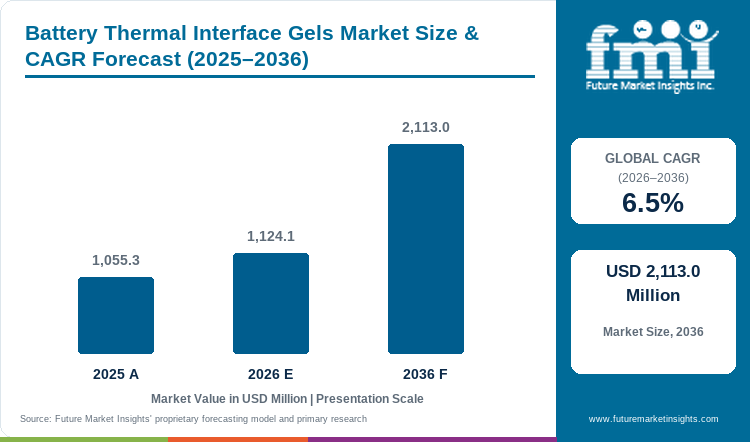
USD 1,124.1 million in 2026 and USD 2,113.0 million by 2036, expanding at 6.5% CAGR.
Sales of battery thermal interface gels are estimated to rise at 6.5% CAGR through 2036. Valuation rises from USD 1,055.3 million in 2025 to USD 1,124.1 million in 2026 and reaches USD 2,113.0 million by 2036. Engineers working on electric vehicle batteries must manage more heat at module and power-electronics contact points. In May 2026, the International Energy Agency reported 1.2 TWh of EV battery deployment in 2025. This was almost 30% above 2024. Before serial production, teams test thermal resistance and dispense rate at each approved interface. They also check cure behavior and cell pressure.
Germany is projected to expand at 4.5% CAGR through 2036. Japan is projected at 3.8% over the same period. Destatis reported in January 2026 that electrically driven cars made up 30.0% of German new-car registrations in 2025. Japan has a larger hybrid share. It also uses longer approval cycles for automotive materials. These differences change how fast a new gel moves from testing into regular production use.
Key Takeaways
- More batteries mean more approved heat-control layers. These layers go between cells and modules. They also connect power electronics with cooling parts.
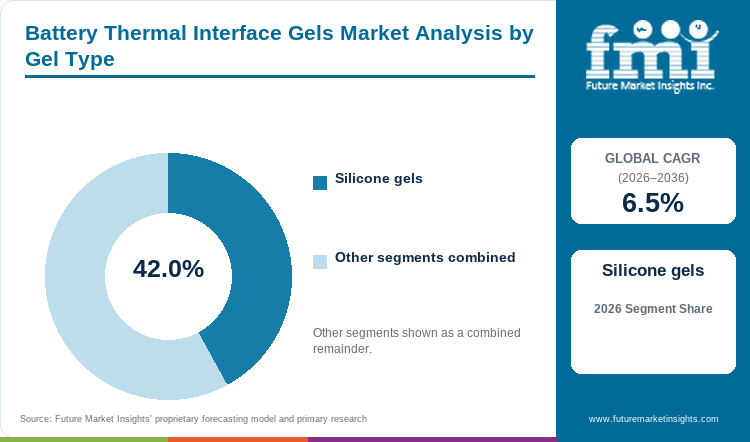
- By gel type, silicone gels are estimated to hold 42.0% of revenue in 2026. Their soft contact puts less stress on parts during assembly.
- Battery modules are projected to account for 42.0% of application revenue in 2026. Their cooling interfaces must fill small height differences between parts.
- In 2026, 1-3 W/mK grades are expected to hold 39.0% of thermal conductivity revenue. They provide useful heat transfer and practical dispensing.
- Automotive tests and line checks slow material changes. A new gel can change cure time and pump pressure. It can also affect long-term reliability.
- Some of the key players in this market include Dow, Henkel, Parker LORD, 3M, Wacker Chemie, Momentive, Shin-Etsu Chemical, DuPont, T-Global Technology, and Laird Technologies.
Analyst Perspective
“Thermal conductivity matters, but EV programs also test dispensing and the bond layer between parts. Suppliers can keep repeat orders by showing low assembly stress and steady line performance as pack designs change.”
- Nikhil Kaitwade, Principal Consultant, Future Market Insights
How is the battery thermal interface gels market segmented?
The battery thermal interface gels market is segmented by Gel Type, Application, Thermal Conductivity, End Use, Sales Channel, and Region.
The market uses six product groups. They are gel type, application, thermal conductivity, end use, sales channel, and region. Gel type covers silicone, non-silicone, and special cure options. Application covers battery modules, packs, power electronics, busbars/connectors, and charging systems. Thermal conductivity groups products by heat-transfer level. End use shows where products are used. Sales channel shows how they are bought. Region shows where demand comes from.
What makes silicone gels central to the gel type category?
Silicone gels cure into soft layers. The layers follow uneven battery surfaces. They need less force during assembly. Formulators can change how the gel flows and cures. This helps machines apply the gel. Silicone elastomers also help move heat. They provide electrical insulation. Soft contact helps during vibration and temperature change. Non-silicone grades are useful when silicone contamination is restricted.
- By gel type, silicone gels are projected to account for 42.0% in 2026. Their soft contact and familiar processing methods support this position.
- Momentive lists silicone thermal gap fillers for high-voltage battery systems. These fillers use silicone chemistry to help control battery heat.
Why do battery modules shape demand within the application category?
Battery modules create wide contact areas between grouped cells and cooling plates. Small height differences can leave air gaps that block heat flow. Engineers compare EV battery adhesives with gap fillers. Each option changes line steps, cure time, and repair needs. The same module interface appears on every approved production platform.
- By application, battery modules are estimated to hold 42.0% in 2026. Their cooling-plate contact areas need gels that fill small gaps between parts.
- DuPont’s 2025 materials guide lists BETATECH gap fillers for battery modules. The guide places the fillers at the battery cooling interface.
What supports the 1-3 W/mK band within thermal conductivity?
The 1-3 W/mK band serves many module interfaces that need useful heat transfer. It does this without heavy use of conductive filler. Lower viscosity can make pumping easier and reduce force as cells are fitted. Engineers compare the full heat path with other thermal interface materials. They do not choose only the highest conductivity number. Higher bands remain important for power electronics with very high heat loads.
- In 2026, 1-3 W/mK is expected to lead thermal conductivity with 39.0% share. The band provides useful heat transfer with easier processing and softer contact.
- DuPont’s 2025 guide lists gap-filler grades with thermal conductivity from 2.0 to 3.5 W/mK. The listed grades are made for battery module applications.
Why are EVs central to the end use category?
EVs have large battery surfaces and power electronics. Both face vibration and repeated heat changes. Once a gel is approved, vehicle makers use it again for that platform. Similar heat-control work is needed in lithium-ion batteries used for stationary storage. EVs are built in large series. This creates more approved gel use. Commercial vehicles and two-wheelers use different gel amounts.
- EVs are set to lead the end use category with 54.0% share in 2026. Large traction batteries and repeat vehicle production support this position.
- In May 2026, the International Energy Agency reported on global battery use. EVs made up more than 70% of battery deployment in 2025.
How do EV OEMs shape the sales channel category?
EV OEM engineers set heat-transfer targets before serial production. They also set electrical insulation and life targets. Factory teams test mixing and gel-application tools at the needed line speed. Battery pack suppliers shape programs when they control module design. Work on thermal management technologies does not enter regular buying at once. Platform approval comes first. Line trials must also show steady results.
- By sales channel, EV OEMs are forecast to represent 40.0% in 2026. Platform approval gives them strong control over repeat material purchasing.
- In May 2026, Laird Technologies reported a BorgWarner award. It covered heat-control materials used in electric-vehicle motor-drive programs.
What are the drivers, restraints and opportunities in the Battery Thermal Interface Gels Market?
Higher battery output expands interface demand, qualification work slows substitution, and changing pack layouts create openings for gels with validated process behavior.
- Driver: More battery output creates more places that need heat-control materials. Higher power density makes each interface move more heat into cooling hardware.
- Restraint: Automotive testing and dispensing-line setup can delay a material change. The delay can remain even after a new gel passes laboratory tests.
- Opportunity: New cell and pack layouts create new needs for gap size, pressure, and processing. Suppliers can meet these needs with tested gels.
More battery factories mean more programs need approved gap-filling materials. In May 2026, the International Energy Agency said battery-cell output rose in 2025. The output was still concentrated in a small group of countries. Engineers using battery materials need good heat contact. They must also avoid too much pressure on cells. Each approved platform sets gel amount, dispensing speed, and final bondline thickness. Teams test the gel and equipment before regular production. After approval, the gel moves from lab tests to repeat use. Demand rises as more battery programs reach serial production. Heat removal needs also shape how much gel each design uses.
Changing a gel takes time because it can affect heat control and factory output. Engineers test heat transfer at the bondline. They test pressure on parts. They also test electrical insulation and aging. Mixing and dispensing must stay stable through the planned thermal cycle. In September 2025, Momentive’s Ohta plant received IATF 16949 certification. The certificate covered silicone electronic-material design and manufacturing. It does not approve one gel. It confirms a controlled quality system for automotive work. A replacement gel can change pump pressure, cure time, or line speed. This can happen even when conductivity is similar. Automotive adhesives and thermal materials need design and process tests before replacement.
New pack designs create a clear sales route for focused gels. In May 2026, the International Energy Agency reported on prismatic cells. They made up more than 60% of EV batteries and most stationary-storage batteries in 2025. Cell-to-pack and cell-to-chassis designs can move the cooling surface. They can also remove an intermediate module. Either change can alter the gap that the gel must fill. Suppliers can offer different cure systems, gap ranges, and repair options. Similar design changes affect separator coatings and other battery protection materials. Long-term performance is required for sales. The gel must also dispense steadily on customer equipment at full production speed.
Which country CAGRs are profiled in the Battery Thermal Interface Gels Market?
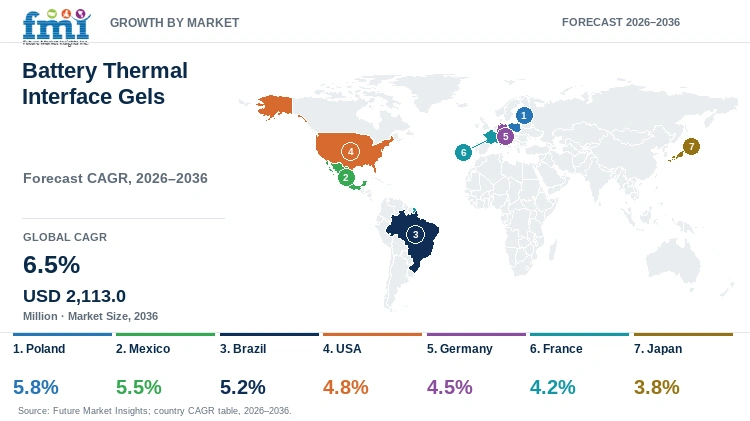
| Country | CAGR |
|---|---|
| Poland | 5.8% |
| Mexico | 5.5% |
| Brazil | 5.2% |
| USA | 4.8% |
| Germany | 4.5% |
| France | 4.2% |
| Japan | 3.8% |
How do country-level CAGRs compare in the Battery Thermal Interface Gels Market?
The seven growth rates differ by 2.0 points. Poland is at 5.8%. Japan is at 3.8%. Poland, Mexico, and Brazil grow faster. EV use starts from smaller bases there. Large car industries can take longer to change. Material tests take more time. Car models also change on different schedules.
- Poland has more EVs. Its battery programs also feed factories across Europe.
- Mexico uses export orders to support local factory programs. The programs must meet customer specs in North America.
- Brazil has more local EV output. Specialist distributors handle imported heat-control materials. They also give local technical help.
- The USA supports many battery programs. Policy changes can shift factory plans. Project timing can do the same.
- Germany values machine dispensing and clear quality records. Vehicle programs also need the same approval steps each time.
- France combines material approval with tight vehicle costs. Those costs can slow changes to factory materials.
- Japan uses long life tests before changing a heat-control material. Vehicle programs also require full approval work.
Similar CAGRs can still create different entry conditions for suppliers. The full report provides country-level CAGR analysis across North America, Latin America, Western Europe, Eastern Europe, East Asia, South Asia and Pacific, and the Middle East and Africa.
Country-wise Analysis
- Polish vehicle programs are adding more battery-electric models to Europe’s battery supply chain. Gel demand in Poland is projected to expand at 5.8% CAGR through 2036. In April 2026, the Ministry of Climate and Environment reported more than 43,000 battery-electric registrations in 2025. That total was more than twice the 2024 level. More electric models mean more local cooling tests. Teams must also check gel flow and electrical insulation. Higher gel prices can still limit use. Suppliers need local help that shows less rework or faster line handling. Clear factory savings can help the added material cost fit normal production budgets.
- Mexican vehicle plants build for export programs. They need fast local technical help during launches. Gel demand in Mexico is forecast to rise at 5.5% CAGR through 2036. In January 2026, AMDA reported 146,724 hybrid and electric vehicle sales in Mexico during 2025. Sales were up 18.0% from 2024. Export programs must meet quality and document rules in destination markets. A new gel can add tests during a busy launch. Suppliers can reduce delays with North American stock and bilingual process help. Clear dispensing guidance also helps. These steps let a material enter serial production without slowing the launch.
- Brazilian EV programs use direct OEM buying and specialist distributors for imported heat-control materials. Gel demand in Brazil is estimated to expand at 5.2% CAGR through 2036. ABVE reported in January 2026 that Brazil sold 223,912 electrified light vehicles during 2025. Sales were 26% higher than in 2024. More local production means more programs need gel tests near vehicle plants. Import costs and uneven local help can slow problem solving. Suppliers can protect repeat orders by holding local stock and supporting gel trials. They also need to show how the selected gel works during the customer’s real assembly cycle.
- US battery and vehicle plants bring materials engineers into projects before serial production. Line integrators join early too. The USA is projected to record 4.8% CAGR through 2036. In March 2026, the US Department of Energy made up to USD 500 million available for critical-material processing. The program also covers related battery manufacturing or recycling. This funding can add domestic battery supply capacity. Each pack program must pass material and line tests before it creates demand for thermal-interface gels. Policy changes can shift project timing. Suppliers need domestic technical service and stable bulk supply. They also need dispensing support from lab tests through equipment trials and repeat production.
- German OEM and Tier programs put strong weight on automated gel dispensing. They also expect steady material quality during platform approval. Germany is anticipated to post 4.5% CAGR through 2036. Destatis reported in January 2026 that Germany registered more than 545,100 battery-electric passenger cars during 2025. These cars made up 19.1% of new passenger-car registrations. The vehicle base gives gel suppliers many programs to serve. Cost pressure can still delay changes that add tests or rework. Suppliers need faster line cycles and steady gel flow. They also need reliable local service. These gains help a new gel replace an approved grade in production.
- French battery and vehicle programs combine technical approval with tight production costs. Gel demand in France is predicted to advance at 4.2% CAGR through 2036. France’s SDES reported in February 2026 that battery-electric cars made up 19.9% of new passenger-car registrations during 2025. That share keeps EV heat control important even as the new-car market shrinks. Start-up risk and price pressure can delay a material change that needs new line settings. Suppliers need steady curing and clear long-term data. They also need local engineering help. These features can cut rework during platform updates without adding approval time or assembly stress.
- Japanese vehicle programs use long test cycles before changing automotive materials. They also require detailed durability data. Gel demand in Japan is forecast to expand at 3.8% CAGR through 2036. The Japan Automobile Manufacturers Association published a buyer survey in April 2026. It found that 46% of surveyed buyers preferred an electrified powertrain for their next vehicle. Hybrid vehicles still make up much of that interest. EV charging infrastructure and the cost of full battery-electric vehicles can slow the shift. Suppliers need local engineering help and long-term reliability data. They also need steady dispensing guidance. A new gel must pass these checks before repeat vehicle production begins.
Who are the notable companies in the Battery Thermal Interface Gels Market?
Dow, Henkel, Parker LORD, 3M, Wacker Chemie, Momentive, Shin-Etsu Chemical, DuPont, T-Global Technology, and Laird Technologies are active within the defined battery thermal interface gels supply boundary.
Three supplier groups compete here. Silicone makers form one group. Battery assembly makers form another. A third group focuses on heat control. Vehicle programs compare gel flow and cure behavior. They also check electrical insulation and heat transfer. Local support matters too. Some specialists serve unusual gap sizes. Others serve uses that cannot accept silicone. Regional engineers matter because each line may need different gel settings.
- Dow, Henkel, and Wacker Chemie supply silicone products. Momentive and Shin-Etsu Chemical do too. The group also supplies other heat-control materials for demanding electronics uses.
- Parker LORD and 3M sell thermal materials for battery assembly. DuPont does too. Their products also support electrical insulation and protection.
- T-Global Technology and Laird Technologies focus on thermal-interface products. Both also give technical help for specific customer uses.
Competitive Benchmarking: Battery Thermal Interface Gels Market
| Company | Direct Gel / Gap-Filler Evidence | Thermal Portfolio Breadth | Automotive Application Support | Geographic Reach |
|---|---|---|---|---|
| Dow | High | High | High | Global |
| Henkel | High | High | High | Global |
| Parker LORD | High | Medium | High | Global |
| 3M | Low | Medium | High | Global |
| Wacker Chemie | High | High | High | Global |
| Momentive | High | Medium | High | Global |
| Shin-Etsu Chemical | High | High | High | Global |
| DuPont | High | Medium | High | Global |
| T-Global Technology | High | High | Medium | Asia, Europe, North America |
| Laird Technologies | High | High | High | Global |
Scoring basis: High means public records directly name an automotive or battery gel or gap filler. Medium means the records cover a narrower liquid product that moves heat. Low means the company works in heat control, but gel evidence is less clear. Geographic reach shows where the company works.
Key Developments in the Battery Thermal Interface Gels Market
- In May 2026, Henkel launched Bergquist TGF 2030APS. The product is for EV battery assemblies. The silicone-free two-part gap filler supports fast dispensing and low compression force.
- In June 2025, Wacker Chemie introduced SEMICOSIL 9649 TC. The product is for power electronics in electric and hybrid vehicles. The silicone gap filler is designed for automotive processing needs.
- In March 2025, T-Global Technology launched TG-ASD35AB. The product is a thermal gel for vehicle electronics. Its listed uses include ECUs and battery-management systems. Power electronics are also listed.
Key Players in the Battery Thermal Interface Gels Market
Broad formulation and silicone platforms
- Dow
- Henkel
- Wacker Chemie
- Momentive
- Shin-Etsu Chemical
Integrated battery assembly material providers
- Parker LORD
- 3M
- DuPont
Specialized thermal interface portfolios
- T-Global Technology
- Laird Technologies
Battery Thermal Interface Gels Market - Report Scope
| Coverage field | Report scope |
|---|---|
| Market breakdown | By gel type, application, thermal conductivity, end use, sales channel, and region. |
| Quantitative Units | USD million. |
| Market Definition | Dispensable or gel-like thermal interface materials used to fill heat-transfer gaps in batteries, battery packs, power electronics, busbars/connectors, and charging assemblies are included. Structural adhesives without a thermal-interface function and unrelated potting compounds are excluded. |
| Regions Covered | North America, Latin America, Western Europe, Eastern Europe, East Asia, South Asia and Pacific, and Middle East and Africa. |
| Countries Covered | Poland, Mexico, Brazil, USA, Germany, France, Japan, and 20+ countries included in the full report. |
| Key Companies Profiled | Dow, Henkel, Parker LORD, 3M, Wacker Chemie, Momentive, Shin-Etsu Chemical, DuPont, T-Global Technology, and Laird Technologies. |
| Forecast Period | 2026 to 2036. |
| Approach | Primary and secondary research with market triangulation. |
Battery Thermal Interface Gels Market - Research Methodology
| Method | Approach |
|---|---|
| Primary Research | FMI analysts gathered input from manufacturers, service providers, technology developers, distributors, end users, procurement teams, and subject-matter experts. Interviews examined purchasing decisions, product or service evaluation, adoption barriers, approval requirements, pricing considerations, and expectations for technical or commercial support. Respondents were also asked what evidence is required before a trial, pilot, or initial order develops into regular purchasing. |
| Desk Research | Desk research covered government statistics, regulatory publications, trade data, industry associations, technical literature, standards, company filings, product information, and official corporate announcements. Sources were reviewed for relevance, publication date, geographic coverage, and consistency with the defined market scope. Claims relating to performance, applications, approvals, capacity, investment, and commercial activity were retained only when supported by credible public evidence. |
| Market Sizing and Forecasting | The market model combined the baseline value with historical performance, segment structure, pricing and volume indicators, adoption levels, company participation, and country-level demand conditions. Forecast assumptions considered economic activity, investment trends, regulatory developments, technology adoption, purchasing cycles, supply availability, and barriers to wider market use. Segment and regional estimates were reconciled before the final market total was calculated. |
| Data Validation | Estimates were checked against multiple independent indicators, including public data, company activity, trade patterns, industry developments, and findings from primary interviews. Validation also tested whether products, services, applications, and company revenues fell within the defined market boundaries. Adjacent categories, unsupported claims, overlapping revenues, and activities without direct market relevance were excluded to reduce double counting and maintain consistency across segments and countries. |
Battery Thermal Interface Gels Market by Segments
Battery Thermal Interface Gels Market segmented by Gel Type:
- Silicone gels
- Non-silicone gels
- Two-part gap gels
- Phase-change gels
- Electrically insulating gels
Battery Thermal Interface Gels Market segmented by Application:
- Battery modules
- Battery packs
- Power electronics
- Busbars/connectors
- Charging systems
Battery Thermal Interface Gels Market segmented by Thermal Conductivity:
- 1-3 W/mK
- Below 1 W/mK
- 3-6 W/mK
- Above 6 W/mK
Battery Thermal Interface Gels Market segmented by End Use:
- EVs
- Energy storage systems
- Consumer batteries
- Commercial vehicles
- Two-wheelers
Battery Thermal Interface Gels Market segmented by Sales Channel:
- EV OEMs
- Battery pack suppliers
- Thermal material distributors
- Direct specialty suppliers
Battery Thermal Interface Gels Market by Region:
- North America
- United States
- Canada
- Latin America
- Brazil
- Mexico
- Chile
- Rest of Latin America
- Western Europe
- Germany
- United Kingdom
- Italy
- Spain
- France
- Nordics
- Benelux
- Rest of Western Europe
- Eastern Europe
- Russia
- Poland
- Hungary
- Balkan and Baltic States
- Rest of Eastern Europe
- East Asia
- China
- Japan
- South Korea
- South Asia and Pacific
- India
- ASEAN
- Australia and New Zealand
- Rest of South Asia and Pacific
- Middle East and Africa
- Kingdom of Saudi Arabia
- Other GCC Countries
- Türkiye
- South Africa
- Other African Union Countries
- Rest of Middle East and Africa
Research Sources and Bibliography
- International Energy Agency. (2026, May 20). Electric vehicle batteries: Global EV Outlook 2026.
- Federal Statistical Office of Germany (Destatis). (2026, January 22). Electric cars and plug-in hybrids: Household ownership varies strongly by income.
- Momentive Performance Materials Japan LLC. (2025, September 2). IATF 16949:2016 certificate, Ohta Plant.
- DuPont. (2025). Battery pack manufacturing: Material solutions for EV battery assembly.
- Japan Automobile Manufacturers Association. (2026, April 14). 2025 Passenger Car Market Trends Survey.
- Ministry of Climate and Environment, Republic of Poland. (2026, April 29). Over two years of action for the climate, the environment and security.
- Mexican Association of Automotive Distributors (AMDA). (2026, January 12). Light Vehicle Internal Market Report: December 2025.
- Brazilian Electric Vehicle Association (ABVE). (2026, January 6). Electrified vehicle sales reach 224,000 units in 2025.
- USA Department of Energy. (2026, March 13). Energy Department announces $500 million to strengthen domestic critical materials processing and manufacturing.
- Ministry for Ecological Transition, France, Data and Statistical Studies Service. (2026, February 11). Car registrations in 2025: New-car market declines while the used market holds.
- Laird Technologies. (2026, May 15). Laird Technologies recognized with Innovation Award for automotive thermal management applications.
- Henkel. (2026, May 12). Henkel launches thermal gap filler and thermally conductive adhesive to improve EV battery thermal management.
- Wacker Chemie AG. (2025, June 2). Battery Show Europe 2025: WACKER presents new gap filler for electromobility.
- T-Global Technology. (2025, March 18). TG-ASD35AB Thermal Gel Launched.
- Shin-Etsu Chemical Co., Ltd. (2025, November). Exhibition report: 14th PLASTIC JAPAN.
- 3M. (2026). The Next Gear: Automotive materials and thermal-management platform.
- Dow. (2025, September 4). DOWSIL EG-4175 Silicone Gel for high-temperature electric-vehicle power electronics.
- DuPont. (2025, November 1). DuPont completes separation of Qnity Electronics.
- Parker Hannifin Corporation, Chomerics Division. (2025, February). THERM-A-GAP CIP 60.
This bibliography is provided for reader reference and is not exhaustive. The full report contains the complete reference list and detailed citations.
This Report Answers
- How large is the battery thermal interface gels market in 2026 and 2036?
- What supports battery thermal interface gel demand?
- Which gel type holds 42.0% share in 2026?
- Why do battery modules hold 42.0% application share?
- Why does 1-3 W/mK hold 39.0% thermal-conductivity share?
- How does qualification delay material substitution?
- How do country growth conditions differ?
- Which companies are active in battery thermal interface gels?
- How do pack designs change gel requirements?
Frequently Asked Questions
How big is the battery thermal interface gels market in 2026?
The battery thermal interface gels market is valued at USD 1,124.1 million in 2026 and is projected to reach USD 2,113.0 million by 2036. More battery production increases the number of interfaces that need approved gels for heat transfer.
What is the CAGR of the battery thermal interface gels market from 2026 to 2036?
The battery thermal interface gels market is projected to grow at 6.5% CAGR from 2026 to 2036. Larger battery use raises heat-control needs in modules and power electronics.
Which gel type leads the battery thermal interface gels market in 2026?
The silicone gels segment is expected to hold 42.0% of gel type revenue in 2026. Soft cured gels fill small surface gaps and put less pressure on battery parts as temperatures change.
Which different application segment leads the battery thermal interface gels market in 2026?
The battery modules segment is projected to hold 42.0% of application revenue in 2026. Wide cooling-plate contact areas need even gap filling when module parts have small height differences.
Which companies are active in the battery thermal interface gels market?
Key companies include Dow, Henkel, Parker LORD, 3M, Wacker Chemie, Momentive, Shin-Etsu Chemical, DuPont, T-Global Technology, and Laird Technologies. They compete on gel chemistry, testing help, and technical support for each use.
Preview the report firsthand - request a free sample
Get SampleGet the brochure for pricing and purchase details.
Get PDFTable of Content
- Key Takeaways
- Market Size and CAGR
- Top Growth Driver
- Fastest Growing Segment
- Leading Region
- Key Companies
- Emerging Opportunities
- Executive Summary
- Global Market Outlook
- Demand-side Trends
- Supply-side Trends
- Technology Roadmap Analysis
- Analysis and Recommendations
- Analyst Perspective (What is happening? Why now? What should investors know?)
- Key Questions Answered
- How large is the market?
- What is the CAGR?
- What are key trends?
- Which region dominates?
- Who are the leaders?
- Market Overview
- Market Coverage / Taxonomy
- Market Definition / Scope / Limitations
- Research Methodology
- Chapter Orientation
- Analytical Lens and Working Hypotheses
- Market Structure, Signals, and Trend Drivers
- Benchmarking and Cross-market Comparability
- Market Sizing, Forecasting, and Opportunity Mapping
- Research Design and Evidence Framework
- Desk Research Programme (Secondary Evidence)
- Expert Input and Fieldwork (Primary Evidence)
- Tooling, Models, and Reference Databases
- Data Engineering and Model Build
- Quality Assurance and Audit Trail
- Market Background
- Market Dynamics (Drivers, Restraints, Opportunity, Trends)
- Scenario Forecast (Optimistic, Likely, Conservative)
- Impact Analysis
- AI Impact
- Sustainability Impact
- Regulatory Impact
- Technology Impact
- Consumer / Buyer Analysis
- Purchase Drivers
- Adoption Barriers
- Buyer Journey
- Opportunity Map Analysis
- Product Life Cycle Analysis
- Supply Chain Analysis
- Investment Feasibility Matrix
- Value Chain Analysis
- PESTLE and Porter's Analysis
- Regulatory Landscape
- Regional Parent Market Outlook
- Production and Consumption Statistics
- Import and Export Statistics
- Global Market Analysis and Forecast, 2021 to 2036
- Historical Market Size Value (USD Million) Analysis, 2021 to 2025
- Current and Future Market Size Value (USD Million) Projections, 2026 to 2036
- Y-o-Y Growth Trend Analysis
- Absolute $ Opportunity Analysis
- Global Market Pricing Analysis, 2021 to 2036
- Global Market Analysis and Forecast, By Gel Type, 2021 to 2036
- Introduction / Key Findings
- Historical Market Size Value (USD Million) Analysis By Gel Type, 2021 to 2025
- Current and Future Market Size Value (USD Million) Analysis and Forecast By Gel Type, 2026 to 2036
- Silicone gels
- Non-silicone gels
- Two-part gap gels
- Phase-change gels
- Electrically insulating gels
- Y-o-Y Growth Trend Analysis By Gel Type, 2021 to 2025
- Absolute $ Opportunity Analysis By Gel Type, 2026 to 2036
- Global Market Analysis and Forecast, By Application, 2021 to 2036
- Introduction / Key Findings
- Historical Market Size Value (USD Million) Analysis By Application, 2021 to 2025
- Current and Future Market Size Value (USD Million) Analysis and Forecast By Application, 2026 to 2036
- Battery modules
- Battery packs
- Power electronics
- Busbars/connectors
- Charging systems
- Y-o-Y Growth Trend Analysis By Application, 2021 to 2025
- Absolute $ Opportunity Analysis By Application, 2026 to 2036
- Global Market Analysis and Forecast, By Thermal Conductivity, 2021 to 2036
- Introduction / Key Findings
- Historical Market Size Value (USD Million) Analysis By Thermal Conductivity, 2021 to 2025
- Current and Future Market Size Value (USD Million) Analysis and Forecast By Thermal Conductivity, 2026 to 2036
- 1-3 W/mK
- Below 1 W/mK
- 3-6 W/mK
- Above 6 W/mK
- Y-o-Y Growth Trend Analysis By Thermal Conductivity, 2021 to 2025
- Absolute $ Opportunity Analysis By Thermal Conductivity, 2026 to 2036
- Global Market Analysis and Forecast, By End Use, 2021 to 2036
- Introduction / Key Findings
- Historical Market Size Value (USD Million) Analysis By End Use, 2021 to 2025
- Current and Future Market Size Value (USD Million) Analysis and Forecast By End Use, 2026 to 2036
- EVs
- Energy storage systems
- Consumer batteries
- Commercial vehicles
- Two-wheelers
- Y-o-Y Growth Trend Analysis By End Use, 2021 to 2025
- Absolute $ Opportunity Analysis By End Use, 2026 to 2036
- Global Market Analysis and Forecast, By Sales Channel, 2021 to 2036
- Introduction / Key Findings
- Historical Market Size Value (USD Million) Analysis By Sales Channel, 2021 to 2025
- Current and Future Market Size Value (USD Million) Analysis and Forecast By Sales Channel, 2026 to 2036
- EV OEMs
- Battery pack suppliers
- Thermal material distributors
- Direct specialty suppliers
- Y-o-Y Growth Trend Analysis By Sales Channel, 2021 to 2025
- Absolute $ Opportunity Analysis By Sales Channel, 2026 to 2036
- Global Market Analysis and Forecast, By Region, 2021 to 2036
- Introduction
- Historical Market Size Value (USD Million) Analysis By Region, 2021 to 2025
- Current Market Size Value (USD Million) Analysis and Forecast By Region, 2026 to 2036
- North America
- Latin America
- Western Europe
- Eastern Europe
- East Asia
- South Asia and Pacific
- Middle East and Africa
- Market Attractiveness Analysis By Region
- North America Market Analysis and Forecast, By Country, 2021 to 2036
- Historical Market Size Value (USD Million) Trend Analysis By Market Taxonomy, 2021 to 2025
- Market Size Value (USD Million) Forecast By Market Taxonomy, 2026 to 2036
- By Country
- United States
- Canada
- By Gel Type
- By Application
- By Thermal Conductivity
- By End Use
- By Sales Channel
- By Country
- Market Attractiveness Analysis
- By Country
- By Gel Type
- By Application
- By Thermal Conductivity
- By End Use
- By Sales Channel
- Key Takeaways
- Latin America Market Analysis and Forecast, By Country
- Historical Market Size Value (USD Million) Trend Analysis By Market Taxonomy, 2021 to 2025
- Market Size Value (USD Million) Forecast By Market Taxonomy, 2026 to 2036
- By Country
- Brazil
- Mexico
- Chile
- Rest of Latin America
- By Gel Type
- By Application
- By Thermal Conductivity
- By End Use
- By Sales Channel
- By Country
- Market Attractiveness Analysis
- By Country
- By Gel Type
- By Application
- By Thermal Conductivity
- By End Use
- By Sales Channel
- Key Takeaways
- Western Europe Market Analysis and Forecast, By Country
- Historical Market Size Value (USD Million) Trend Analysis By Market Taxonomy, 2021 to 2025
- Market Size Value (USD Million) Forecast By Market Taxonomy, 2026 to 2036
- By Country
- Germany
- United Kingdom
- Italy
- Spain
- France
- Nordics
- Benelux
- Rest of Western Europe
- By Gel Type
- By Application
- By Thermal Conductivity
- By End Use
- By Sales Channel
- By Country
- Market Attractiveness Analysis
- By Country
- By Gel Type
- By Application
- By Thermal Conductivity
- By End Use
- By Sales Channel
- Key Takeaways
- Eastern Europe Market Analysis and Forecast, By Country
- Historical Market Size Value (USD Million) Trend Analysis By Market Taxonomy, 2021 to 2025
- Market Size Value (USD Million) Forecast By Market Taxonomy, 2026 to 2036
- By Country
- Russia
- Poland
- Hungary
- Balkan and Baltic States
- Rest of Eastern Europe
- By Gel Type
- By Application
- By Thermal Conductivity
- By End Use
- By Sales Channel
- By Country
- Market Attractiveness Analysis
- By Country
- By Gel Type
- By Application
- By Thermal Conductivity
- By End Use
- By Sales Channel
- Key Takeaways
- East Asia Market Analysis and Forecast, By Country
- Historical Market Size Value (USD Million) Trend Analysis By Market Taxonomy, 2021 to 2025
- Market Size Value (USD Million) Forecast By Market Taxonomy, 2026 to 2036
- By Country
- China
- Japan
- South Korea
- By Gel Type
- By Application
- By Thermal Conductivity
- By End Use
- By Sales Channel
- By Country
- Market Attractiveness Analysis
- By Country
- By Gel Type
- By Application
- By Thermal Conductivity
- By End Use
- By Sales Channel
- Key Takeaways
- South Asia and Pacific Market Analysis and Forecast, By Country
- Historical Market Size Value (USD Million) Trend Analysis By Market Taxonomy, 2021 to 2025
- Market Size Value (USD Million) Forecast By Market Taxonomy, 2026 to 2036
- By Country
- India
- ASEAN
- Australia and New Zealand
- Rest of South Asia and Pacific
- By Gel Type
- By Application
- By Thermal Conductivity
- By End Use
- By Sales Channel
- By Country
- Market Attractiveness Analysis
- By Country
- By Gel Type
- By Application
- By Thermal Conductivity
- By End Use
- By Sales Channel
- Key Takeaways
- Middle East and Africa Market Analysis and Forecast, By Country
- Historical Market Size Value (USD Million) Trend Analysis By Market Taxonomy, 2021 to 2025
- Market Size Value (USD Million) Forecast By Market Taxonomy, 2026 to 2036
- By Country
- Kingdom of Saudi Arabia
- Other GCC Countries
- Türkiye
- South Africa
- Other African Union Countries
- Rest of Middle East and Africa
- By Gel Type
- By Application
- By Thermal Conductivity
- By End Use
- By Sales Channel
- By Country
- Market Attractiveness Analysis
- By Country
- By Gel Type
- By Application
- By Thermal Conductivity
- By End Use
- By Sales Channel
- Key Takeaways
- Key Countries Market Analysis
- United States
- Pricing Analysis
- Market Share Analysis, 2025
- By Gel Type
- By Application
- By Thermal Conductivity
- By End Use
- By Sales Channel
- Canada
- Pricing Analysis
- Market Share Analysis, 2025
- By Gel Type
- By Application
- By Thermal Conductivity
- By End Use
- By Sales Channel
- Mexico
- Pricing Analysis
- Market Share Analysis, 2025
- By Gel Type
- By Application
- By Thermal Conductivity
- By End Use
- By Sales Channel
- Brazil
- Pricing Analysis
- Market Share Analysis, 2025
- By Gel Type
- By Application
- By Thermal Conductivity
- By End Use
- By Sales Channel
- Chile
- Pricing Analysis
- Market Share Analysis, 2025
- By Gel Type
- By Application
- By Thermal Conductivity
- By End Use
- By Sales Channel
- Germany
- Pricing Analysis
- Market Share Analysis, 2025
- By Gel Type
- By Application
- By Thermal Conductivity
- By End Use
- By Sales Channel
- United Kingdom
- Pricing Analysis
- Market Share Analysis, 2025
- By Gel Type
- By Application
- By Thermal Conductivity
- By End Use
- By Sales Channel
- Italy
- Pricing Analysis
- Market Share Analysis, 2025
- By Gel Type
- By Application
- By Thermal Conductivity
- By End Use
- By Sales Channel
- Spain
- Pricing Analysis
- Market Share Analysis, 2025
- By Gel Type
- By Application
- By Thermal Conductivity
- By End Use
- By Sales Channel
- France
- Pricing Analysis
- Market Share Analysis, 2025
- By Gel Type
- By Application
- By Thermal Conductivity
- By End Use
- By Sales Channel
- India
- Pricing Analysis
- Market Share Analysis, 2025
- By Gel Type
- By Application
- By Thermal Conductivity
- By End Use
- By Sales Channel
- ASEAN
- Pricing Analysis
- Market Share Analysis, 2025
- By Gel Type
- By Application
- By Thermal Conductivity
- By End Use
- By Sales Channel
- Australia and New Zealand
- Pricing Analysis
- Market Share Analysis, 2025
- By Gel Type
- By Application
- By Thermal Conductivity
- By End Use
- By Sales Channel
- China
- Pricing Analysis
- Market Share Analysis, 2025
- By Gel Type
- By Application
- By Thermal Conductivity
- By End Use
- By Sales Channel
- Japan
- Pricing Analysis
- Market Share Analysis, 2025
- By Gel Type
- By Application
- By Thermal Conductivity
- By End Use
- By Sales Channel
- South Korea
- Pricing Analysis
- Market Share Analysis, 2025
- By Gel Type
- By Application
- By Thermal Conductivity
- By End Use
- By Sales Channel
- Russia
- Pricing Analysis
- Market Share Analysis, 2025
- By Gel Type
- By Application
- By Thermal Conductivity
- By End Use
- By Sales Channel
- Poland
- Pricing Analysis
- Market Share Analysis, 2025
- By Gel Type
- By Application
- By Thermal Conductivity
- By End Use
- By Sales Channel
- Hungary
- Pricing Analysis
- Market Share Analysis, 2025
- By Gel Type
- By Application
- By Thermal Conductivity
- By End Use
- By Sales Channel
- Kingdom of Saudi Arabia
- Pricing Analysis
- Market Share Analysis, 2025
- By Gel Type
- By Application
- By Thermal Conductivity
- By End Use
- By Sales Channel
- Türkiye
- Pricing Analysis
- Market Share Analysis, 2025
- By Gel Type
- By Application
- By Thermal Conductivity
- By End Use
- By Sales Channel
- South Africa
- Pricing Analysis
- Market Share Analysis, 2025
- By Gel Type
- By Application
- By Thermal Conductivity
- By End Use
- By Sales Channel
- United States
- Market Structure Analysis
- Competition Dashboard
- Competition Benchmarking
- Market Share Analysis of Top Players
- By Regional
- By Gel Type
- By Application
- By Thermal Conductivity
- By End Use
- By Sales Channel
- Emerging Startups
- Innovation Benchmarking
- Competition Analysis
- Competition Deep Dive
- Dow
- Overview
- Product Portfolio
- Profitability by Market Segments
- Sales Footprint
- Strategy Overview
- Marketing Strategy
- Product Strategy
- Channel Strategy
- Henkel
- Parker LORD
- 3M
- Wacker Chemie
- Momentive
- Shin-Etsu Chemical
- DuPont
- T-Global Technology
- Laird Technologies
- Dow
- Case Studies
- Success Stories
- Recent Developments
- Competition Deep Dive
- Assumptions & Acronyms Used


