

- Market Size (2026)
- USD 582.1 Mn
- Forecast (2036)
- USD 1072.3 Mn
- CAGR (2026 to 2036)
- 6.3%
How big is Beauty Refill Pouches Market in 2026?
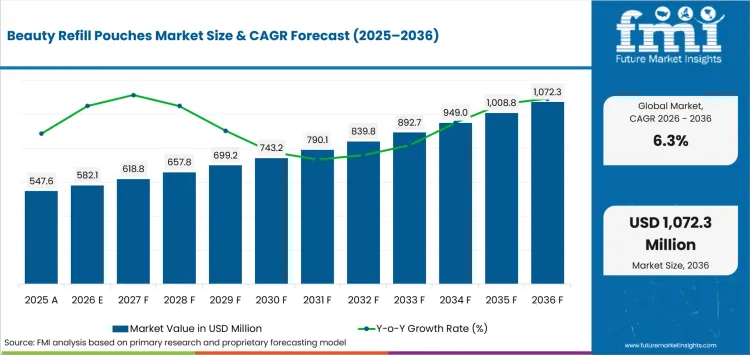
USD 582.1 million in 2026 and USD 1,072.3 million by 2036 at a 6.3% CAGR.
Demand for beauty refill pouches is projected to rise at 6.3% CAGR between 2026 and 2036. Market value is expected to rise from USD 582.1 million in 2026 to USD 1,072.3 million by 2036. Repeat purchasing remains essential because refill formats generate value only when consumers return to buy replacement product packs after the initial container purchase. Amcor found in June 2026 that 66% of 2,749 surveyed European personal-care consumers bought a refill pouch during the previous 12 months. The purchase record gives beauty brands an existing consumer habit against which repeat replenishment can be tested.
Producer-responsibility rules change pouch packaging economics once beauty brands commit to lower material use for repeat purchases. California approved permanent SB 54 rules in May 2026 requiring a 25% reduction in single-use plastic by 2032. CalRecycle states nearly half of that target can come from elimination or shifts to reusable and refill systems. Auditable pack reduction therefore becomes part of the commercial case for qualifying a lighter refill format.
Key Takeaways of Beauty Refill Pouches Market
- Beauty brands see stronger demand for refill pouches that reduce material use without weakening formula protection or the consumer refill gesture.
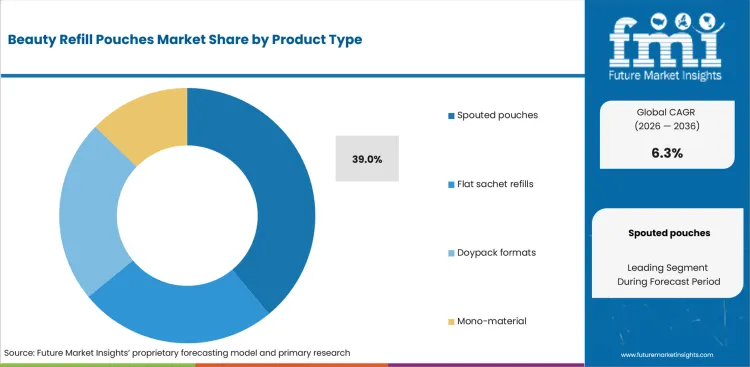
- Based on product type, spouted pouches are projected to account for 39.0% in 2026 due to cleaner transfer into retained beauty packs.
- By material, plastics & PCR resins are forecast to represent 39.0% in 2026 driven by low pack weight and adjustable barrier structures.
- The 15-50 ml segment is projected to hold 32.0% share in 2026 owing to controlled dosing in concentrated skincare and targeted beauty routines.
- Adoption weakens if refill pricing does not undercut the original pack or the pouch introduces spills, difficult handling or uncertain material recovery.
- Some of the key players in this market include Amcor, ProAmpac, Glenroy, Huhtamaki, Coveris, Mondi, SIG, and Arcade Beauty.
Analyst Perspective
"Beauty refill pouches should be qualified as a package system because film, spout geometry and retained-container neck design determine whether refilling stays clean. The strongest commercial programs prove formula compatibility on the filling line first, then preserve enough price separation for the refill to earn repeat purchase."
- Nandini Roy Choudhury, Principal Consultant, Future Market Insights
How is the Beauty Refill Pouches Market segmented?
The market is segmented by product type, material, capacity, decoration, end use and region.
Product type covers spouted pouches, flat sachet refills, Doypack formats and mono-material formats, and material covers plastics & PCR resins, glass, paper & board and aluminium & specialty structures. Capacity ranges from below 15 ml to above 150 ml, decoration includes standard, printed & decorated, premium finishes and smart / connected options, and end use covers skincare brands, color cosmetics, hair & body and fragrance.
What makes Spouted pouches central to the Product type category?
Beauty brands use spout pouch formats to establish a controlled transfer path from lightweight refill packs into bottles or jars retained for repeated use. The fitment must pour cleanly and protect seal integrity without weakening the intended recycling route.
- By product type, spouted pouches are estimated to hold 39.0% in 2026 owing to controlled dispensing during transfer into reusable primary packs.
- Amcor and Mediacor launched a 2-liter spouted refill pouch in July 2025 for the Nana home and personal-care range. The program also required filling-line changes, showing that fitment performance must be qualified with production equipment before repeated pouch orders can scale.
Why do Plastics & PCR resins lead the Material category?
Flexible plastic packaging lets converters tune seal layers and barriers without giving the refill pouch the weight of its retained pack. PCR resin can reduce virgin-plastic use, but contact-sensitive formulas require consistent material quality before a structure reaches beauty filling lines.
- The plastics & PCR resins segment is likely to capture 39.0% share in 2026 attributable to low pack weight and adjustable barrier performance.
- Huhtamaki disclosed in its 2025 annual report that it launched mono-material recyclable flexible packaging for sensitive formats including hair color. The launch provides operating evidence that simpler structures can meet demanding beauty-related barrier requirements without depending on multi-material laminates.
How does 15-50 ml anchor the Capacity category?
Compact liquid pouch packaging suits high-value formulas that make controlled dosing more important than bulk replenishment. The 15-50 ml range also limits residual product if consumers stop a refill midway or use the format during travel.
- 15-50 ml is set to lead the capacity category with 32.0% share in 2026 due to controlled dosing and manageable refill volumes.
- Shiseido announced in January 2025 that its renewed ULTIMUNE serum would include 50 ml and 75 ml refills for a March launch. The 50 ml option supports the commercial logic behind compact beauty refill capacities that depend on dosing control and low leftover product.
What supports Standard decoration in the Decoration category?
Flexible packaging lets beauty brands preserve recognition without adding finishes that raise converting cost or complicate material sorting. The retained bottle or jar can carry premium visual treatment, leaving the refill to prioritize legible artwork and efficient conversion.
- In 2026, standard decoration is expected to lead decoration with 36.0% share because simpler print specifications control conversion cost and material complexity.
- Arcade Beauty launched its 80% Paper Packette with Origins in January 2025 for current beauty sampling applications. The launch shows that beauty-specific flexible formats preserve branded artwork and reduce plastic content in small packs.
What are the drivers, restraints and opportunities in the Beauty Refill Pouches Market?
Producer-responsibility economics favor lower-material refill packs. Price and handling friction limit repeat purchase, and recyclable pouch-plus-spout engineering provides a clearer qualification route.
- Driver: Producer-responsibility fees tie packaging costs to documented recyclability and material reduction, strengthening the business case for qualified refill structures.
- Restraint: Consumers expect a visible price advantage from refills, so weak price separation can reduce repeat purchase despite lower packaging use.
- Opportunity: Converters can win beauty refill programs by qualifying simpler films and clean-pour fitments with the retained container before commercial launch.
Producer fees put a price on weak recyclability evidence
Producer-responsibility fees make material evidence commercially relevant during planning before a beauty refill reaches full-scale supply. PackUK stated in June 2025 that a Red RAM rating can raise producer disposal fees by a factor of 1.2 during the 2026-2027 assessment year. The uplift makes recyclability evidence a packaging-cost risk, so brands have reason to qualify simpler structures before launch.
Refill pricing determines whether replenishment earns a repeat order
Refill programs lose repeat-purchase appeal if the consumer saving is too small to justify another pack format. L’Oréal’s June 2026 #JoinTheRefillMovement campaign expanded refill visibility through 18 brands and 28 products and made the price advantage explicit. The campaign links adoption to access and consumer economics, leaving brands to preserve a visible saving after conversion and retail costs are included.
Finished-pouch qualification turns material reduction into a sales argument
Finished beauty pouches earn higher-value refill business after recyclability and material reduction are validated together. In August 2026, Amcor said its 150 ml AmPrima refill pouch won an AmeriStar award in the Health and Beauty Aids category after APR Critical Guidance testing. The pouch uses 94% less plastic than three standard 50 ml PET jars with lidding, giving converters a concrete benchmark for high-value beauty refills.
Which country CAGRs are profiled in the Beauty Refill Pouches Market?
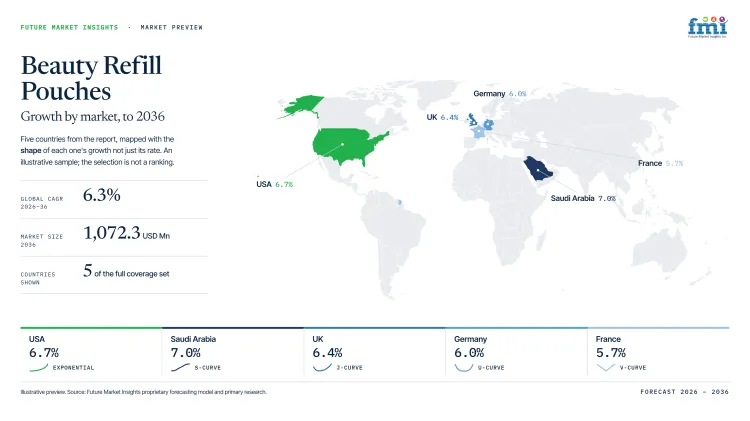
| Country | CAGR |
|---|---|
| Saudi Arabia | 7.0% |
| USA | 6.7% |
| UK | 6.4% |
| Germany | 6.0% |
| France | 5.7% |
How do country-level CAGRs compare in the Beauty Refill Pouches Market?
The five profiled CAGRs span 1.3 percentage points from Saudi Arabia at 7.0% to France at 5.7%. Saudi Arabia and USA form the upper band above 6.5%, with UK between them and the Germany-France pair. Different beauty packaging economics can require distinct qualification plans for converters serving each national market.
- Saudi refill launches benefit from concentrated premium retail and packaging refresh cycles.
- USA packaging evaluation favors material records before artwork reaches final approval.
- UK import programs require bilingual artwork control and reliable beauty-warehouse distribution routes.
- Germany packaging rules make material reduction visible during portfolio reviews nationwide.
- France refill launches compete directly with bottle formats for repeat beauty purchases.
Similar rates conceal different costs to qualify the same refill pouch locally. The full report provides country-level CAGR analysis across North America, Latin America, Europe, East Asia, South Asia, Oceania and the Middle East and Africa.
Country-wise Analysis
- Saudi beauty retail combines specialist stores, department outlets, and online channels that can introduce refill pouches across major markets. Adoption of beauty refill pouches in Saudi Arabia is estimated to expand at 7.0% CAGR through 2036, supported by expanding premium beauty consumption and demand for convenient repeat-purchase formats. The Saudi Food and Drug Authority documented 831 licensed cosmetics warehouses for 2025 in its January 2026 facility update. This distribution depth gives brands replenishment routes, but artwork revisions and importer records can delay pack changes after approval. Converters therefore need stable pouch structures, documentation, and Arabic-English claim control before rollout.
- USA beauty brands increasingly combine department stores, specialty retailers, and direct-to-consumer channels, creating multiple routes for refill pouches to reach repeat customers. Adoption of beauty refill pouches in USA is estimated to expand at 6.7% CAGR through 2036, supported by refill convenience, packaging-reduction initiatives, and established online purchasing behavior. Individual parcels raise leakage costs because a failed seal can damage shipments and weaken consumer confidence in the refill format. The Census Bureau reported in August 2026 that e-commerce accounted for 17.1% of total second-quarter retail sales. Converters therefore need parcel-tested seals and consistent barrier performance before national online replenishment programs scale.
- UK beauty brands sell through pharmacies, department stores, specialty retailers, and online channels that can scale successful refill formats after launch. Adoption of beauty refill pouches in UK is estimated to expand at 6.4% CAGR through 2036, supported by mature beauty retail coverage and increasing interest in packaging efficiency. Producer-responsibility reporting makes incomplete material records visible once one pouch structure enters nationwide commercial distribution. The Office for National Statistics recorded a 20.6% year-over-year increase in cosmetic and toilet-article retail volume during June 2026. Converters therefore benefit from well-controlled recyclability records, stable pouch specifications documentation, and artwork processes supporting launches.
- German beauty manufacturers and retailers emphasize structured packaging qualification, sustainability documentation and controls, and reliable supply for established brands. Adoption of beauty refill pouches in Germany is estimated to expand at 6.0% CAGR through 2036, supported by sustainability priorities and demand for material-efficient beauty packaging. Refill formats must balance barrier performance, sealing reliability, recyclability evidence, and shelf presentation before wider commercial market adoption. Packaging changes introduced late can create additional approval and documentation work across multiple SKUs and channels. Converters can support growth by locking pouch structures early, maintaining traceable material records, and aligning artwork with verified packaging specifications.
- French beauty brands operate across department stores, pharmacies, specialty retailers, and digital channels where premium presentation remains important for new packaging formats. Adoption of beauty refill pouches in France is estimated to expand at 5.7% CAGR through 2036, reflecting demand for convenient replenishment and packaging formats that reduce material use. Refill pouches must preserve product protection while maintaining presentation consistent with established positioning across retail and online channels. Material substitutions made late can require artwork updates, renewed technical checks, and supplier coordination. Converters therefore benefit from documented pouch specifications, controlled artwork revisions, and validated seals before broader beauty rollout.
Who are the notable companies in the Beauty Refill Pouches Market?
Amcor, ProAmpac, Glenroy, Huhtamaki, Coveris, Mondi, SIG and Arcade Beauty are the notable companies serving this market.
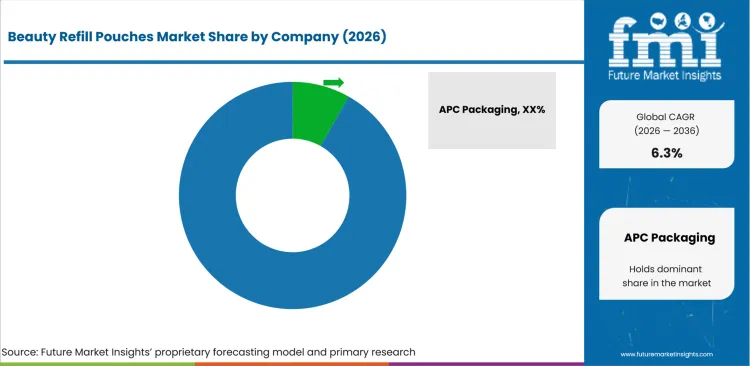
Competition in flexible plastic pouches depends less on corporate scale than on documented refill engineering and beauty-product qualification. Amcor, ProAmpac and Glenroy have the clearest direct evidence for personal-care or beauty refill pouches. Huhtamaki, Coveris and Mondi contribute broader film and circular-material routes for beauty packaging programs. SIG enters spout-pouch competition with third-party recyclability evidence but has less direct beauty-pouch evidence in the current public record. Arcade Beauty brings beauty-specific flexible-format manufacturing for short branded programs that need rapid artwork changes and smaller production runs.
- Amcor, ProAmpac and Glenroy compete in the refill application because each documents flexible pouch capability for personal-care or beauty products.
- Huhtamaki, Coveris and Mondi contribute film-converting and circular-material routes that can serve beauty programs after formula and contact requirements pass qualification.
- SIG contributes third-party spouted-pouch recyclability evidence, and Arcade Beauty supplies beauty-specific flexible formats with short-run manufacturing experience for brand programs.
Competitive Benchmarking: Beauty Refill Pouches Market
| Company | Refill Pouch Breadth | Circular Material Evidence | Beauty / Personal-Care Fit | Geographic Reach |
|---|---|---|---|---|
| Amcor | High | High | High | Global |
| ProAmpac | High | High | High | Global |
| Glenroy | High | High | High | North America and international sales |
| Huhtamaki | Medium | High | Medium | Europe, Asia and international markets |
| Coveris | Medium | High | Medium | Europe and selected international markets |
| Mondi | High | High | Low | Europe and international markets |
| SIG | Low | High | Low | Global |
| Arcade Beauty | Medium | Medium | High | North America, Europe and Brazil |
Scoring basis: High refill pouch breadth requires at least three documented pouch or refill configurations, Medium requires two and Low identifies one. High circular-material evidence requires at least three verified recyclable, PCR or third-party validated routes, with Medium requiring two and Low one. High beauty / personal-care fit requires at least three current applications, Medium requires two and Low identifies one directly relevant route.
Key Developments in the Beauty Refill Pouches Market
- In March 2026, ProAmpac completed its acquisition of TC Transcontinental Packaging and expanded its global flexible-packaging footprint for pouch and film conversion.
- In March 2026, SIG received APR Design for Recyclability Recognition for a spouted pouch whose flexible film and rigid spout were validated together.
- In April 2025, Amcor completed its combination with Berry Global and broadened flexible-film, closures and dispensing capabilities relevant to integrated refill-pack development.
Key Players in the Beauty Refill Pouches Market
Beauty and personal-care pouch platforms
- Amcor
- ProAmpac
- Glenroy
Flexible-material and converting platforms
- Huhtamaki
- Coveris
- Mondi
Spouted-pouch and beauty specialists
- SIG
- Arcade Beauty
Beauty Refill Pouches Market - Report Scope
| Coverage field | Report scope |
|---|---|
| Market breakdown | By product type, material, capacity, decoration, end use and region. |
| Quantitative Units | USD Million. |
| Market Definition | In-scope revenue covers beauty refill pouch packaging sold within the product type, material, capacity, decoration and end use universe in this report. It includes the refill pack and any pouch-integrated fitment or decoration sold as part of that pack. It excludes downstream finished beauty product revenue, retained rigid packs sold separately, rigid refill cartridges, dispensing hardware sold independently and adjacent non-pouch reuse systems. |
| Regions Covered | North America, Latin America, Western Europe, Eastern Europe, East Asia, South Asia and Pacific, Middle East and Africa. |
| Countries Covered | UAE, South Korea, Saudi Arabia, USA, UK, and 20+ countries included in the full report. |
| Key Companies Profiled | Amcor, ProAmpac, Glenroy, Huhtamaki, Coveris, Mondi, SIG, Arcade Beauty. |
| Forecast Period | 2026 to 2036. |
| Approach | Primary and secondary research with market triangulation. |
Beauty Refill Pouches Market - Research Methodology
| Method | Approach |
|---|---|
| Primary Research | FMI analysts gathered input from manufacturers, service providers, technology developers, distributors, end users, procurement teams, and subject-matter experts. Interviews examined purchasing decisions, product or service evaluation, adoption barriers, approval requirements, pricing considerations, and expectations for technical or commercial support. Respondents were also asked what evidence is required before a trial, pilot, or initial order develops into regular purchasing. |
| Desk Research | Desk research covered government statistics, regulatory publications, trade data, industry associations, technical literature, standards, company filings, product information, and official corporate announcements. Sources were reviewed for relevance, publication date, geographic coverage, and consistency with the defined market scope. Claims relating to performance, applications, approvals, capacity, investment, and commercial activity were retained only when supported by credible public evidence. |
| Market Sizing and Forecasting | The market model combined the baseline value with historical performance, segment structure, pricing and volume indicators, adoption levels, company participation, and country-level demand conditions. Forecast assumptions considered economic activity, investment trends, regulatory developments, technology adoption, purchasing cycles, supply availability, and barriers to wider market use. Segment and regional estimates were reconciled before the final market total was calculated. |
| Data Validation | Estimates were checked against multiple independent indicators, including public data, company activity, trade patterns, industry developments, and findings from primary interviews. Validation also tested whether products, services, applications, and company revenues fell within the defined market boundaries. Adjacent categories, unsupported claims, overlapping revenues, and activities without direct market relevance were excluded to reduce double counting and maintain consistency across segments and countries. |
Beauty Refill Pouches Market by Segments
By Product Type
- Spouted pouches
- Flat sachet refills
- Doypack formats
- Mono-material
By Material
- Plastics & PCR resins
- Glass
- Paper & board
- Aluminium & specialty
By Capacity
- Below 15 ml
- 15-50 ml
- 50-150 ml
- Above 150 ml
By Decoration
- Standard
- Printed & decorated
- Premium finishes
- Smart / connected
By End Use
- Skincare brands
- Color cosmetics
- Hair & body
- Fragrance
Beauty Refill Pouches Market by Region:
- North America
- United States
- Canada
- Latin America
- Brazil
- Mexico
- Argentina
- Chile
- Western Europe
- Germany
- France
- United Kingdom
- Italy
- Spain
- Benelux
- Nordics
- Eastern Europe
- Poland
- Czech Republic
- Romania
- Hungary
- East Asia
- China
- Japan
- South Korea
- South Asia and Pacific
- India
- ASEAN
- Australia and New Zealand
- Middle East and Africa
- GCC Countries
- South Africa
- Türkiye
- Israel
Research Sources and Bibliography
- Amcor. (2026, June 16). Consumers embrace convenient refill solutions in beauty and personal care, new Amcor research shows.
- California Department of Resources Recycling and Recovery (CalRecycle). (2026, May 1). California approves new plastic and packaging rules that put consumers first.
- SIG. (2026, March 24). SIG announces APR Design® for Recyclability Recognition for spouted pouch featuring SIG Terra RecShield BD laminate.
- Huhtamaki. (2026, March 3). Huhtamaki Annual Report 2025.
- Arcade Beauty. (2026, April 29). Arcade Beauty Expands Beyond Sampling to Lead Turnkey Fragrance and Cosmetic Manufacturing.
- ProAmpac. (2025, June 24). Less Waste, More Impact: ScottsMiracle-Gro and ProAmpac Advance Insecticide Packaging.
- PackUK. (2025, June 28). PackUK extended producer responsibility (EPR) for packaging: producer disposal fees modulation statement.
- Shiseido Company, Limited. (2025, January 22). Backed by world-leading skin research, SHISEIDO’s iconic ULTIMUNE is a serum reborn - to slow the skin aging cycle.
- Dubai Municipality. (2025, October 27). Product safety at Beautyworld Middle East 2025.
- Ministry of Food and Drug Safety. (2026, July 2).
- Saudi Food and Drug Authority. (2026, January 26). SFDA Reports 18% Growth in Licensed Factories and Warehouses During 2025.
- USA Census Bureau. (2026, August 18). Quarterly Retail E-Commerce Sales, Second Quarter 2026.
- Office for National Statistics. (2026, July 24). RSI: Retail of cosmetic and toilet articles (vol sa): All Business Index.
- Amcor. (2025, July 11). Amcor & Mediacor launch a refill pouch for Nana products.
- Coveris. (2026, July 7). Coveris Strengthens Recycled Plastics Transparency with RecyClass Certifications.
- ProAmpac. (2026, March 6). ProAmpac Completes Acquisition of TC Transcontinental Packaging.
- HP. (2026, February 11). A Decade of Digital Momentum: How HP Indigo and ePac Are Scaling the Future of Flexible Packaging.
- Arcade Beauty. (2025, January 28). Arcade Beauty Unveils Recycle-Ready Sampling Innovation with New 80% Paper Packette.
- Aptar Beauty. (2025, October 6). Aptar Beauty and Clarins Launch the New Reloadable Total Eye Lift.
- Quadpack. (2025, April 29). Dropify Pen: precise, targeted application, drop by drop.
- Mondi. (2026, June 2). Mondi introduces re/loop FlowWrap with 35% post-consumer recycled content for wet wipes packaging.
- Coveris. (2025, March 31). Coveris Launches Circular Solution for Stretch Sleeves with ReCover.
- Amcor. (2026, March 12). New products at Cosmoprof demonstrate Amcor’s versatility in beauty packaging.
- Amcor. (2026, August 14). Amcor Garners Two AmeriStar Awards.
- L’Oréal Groupe. (2026, June 15). L’Oréal calls on consumers around the world to #JoinTheRefillMovement in its biggest ever campaign for refillable beauty.
- Amcor. (2025, April 30). Amcor completes combination with Berry Global; positioned to significantly enhance value for customers and shareholders.
This bibliography is provided for reader reference and is not exhaustive. The full report contains the complete reference list and detailed citations.
This Report Answers
- What is the beauty refill pouches market size in 2026 and forecast value for 2036?
- Which packaging economics and consumer behaviors support beauty refill pouch demand?
- Why do spouted pouches lead the product type category?
- Why do plastics & PCR resins lead the material category?
- Why does 15-50 ml lead the capacity category?
- How do country growth rates differ among UAE, South Korea, Saudi Arabia, USA and UK?
- How do profiled companies differ by refill breadth, circular-material evidence and beauty fit?
- Which price and handling conditions can slow beauty refill pouch adoption?
- What should beauty teams verify before approving a refill pouch program?
Frequently Asked Questions
How big is the beauty refill pouches market in 2026?
The beauty refill pouches market is valued at USD 582.1 million in 2026 and is projected to reach USD 1,072.3 million by 2036. Refill packs gain traction provided brands protect formulas and offer a consumer benefit.
What is the CAGR of the beauty refill pouches market from 2026 to 2036?
The beauty refill pouches market is projected to grow at a CAGR of 6.3% between 2026 and 2036. Expansion is supported by refill purchasing habits and packaging economics that reward documented material reduction.
Which product type leads the beauty refill pouches market?
The spouted pouches segment is expected to hold 39.0% of the beauty refill pouches market in 2026, driven by controlled pouring into retained bottles and jars. The fitment reduces product loss during liquid or semi-viscous transfer into the retained primary package.
Which material leads the beauty refill pouches market?
The plastics & PCR resins segment is projected to represent 39.0% of the beauty refill pouches market in 2026, attributable to low pack weight and tunable barriers. Recycled content can reduce virgin-plastic use after the chosen resin meets formula-contact and appearance requirements.
Which companies are active in the beauty refill pouches market?
Key companies operating in the market include Amcor, ProAmpac, Glenroy, Huhtamaki, Coveris, Mondi, SIG, and Arcade Beauty. Their competitive positions depend on pouch conversion, material engineering, fitment qualification, beauty-format experience and regional manufacturing coverage.
Preview the report firsthand - request a free sample
Get SampleGet the brochure for pricing and purchase details.
Get PDFTable of Content
- Key Takeaways
- Market Size and CAGR
- Top Growth Driver
- Fastest Growing Segment
- Leading Region
- Key Companies
- Emerging Opportunities
- Executive Summary
- Global Market Outlook
- Demand-side Trends
- Supply-side Trends
- Technology Roadmap Analysis
- Analysis and Recommendations
- Analyst Perspective (What is happening? Why now? What should investors know?)
- Key Questions Answered
- How large is the market?
- What is the CAGR?
- What are key trends?
- Which region dominates?
- Who are the leaders?
- Market Overview
- Market Coverage / Taxonomy
- Market Definition / Scope / Limitations
- Research Methodology
- Chapter Orientation
- Analytical Lens and Working Hypotheses
- Market Structure, Signals, and Trend Drivers
- Benchmarking and Cross-market Comparability
- Market Sizing, Forecasting, and Opportunity Mapping
- Research Design and Evidence Framework
- Desk Research Programme (Secondary Evidence)
- Expert Input and Fieldwork (Primary Evidence)
- Tooling, Models, and Reference Databases
- Data Engineering and Model Build
- Quality Assurance and Audit Trail
- Market Background
- Market Dynamics (Drivers, Restraints, Opportunity, Trends)
- Scenario Forecast (Optimistic, Likely, Conservative)
- Impact Analysis
- AI Impact
- Sustainability Impact
- Regulatory Impact
- Technology Impact
- Consumer / Buyer Analysis
- Purchase Drivers
- Adoption Barriers
- Buyer Journey
- Opportunity Map Analysis
- Product Life Cycle Analysis
- Supply Chain Analysis
- Investment Feasibility Matrix
- Value Chain Analysis
- PESTLE and Porter's Analysis
- Regulatory Landscape
- Regional Parent Market Outlook
- Production and Consumption Statistics
- Import and Export Statistics
- Global Market Analysis and Forecast, 2021 to 2036
- Historical Market Size Value (USD Million) Analysis, 2021 to 2025
- Current and Future Market Size Value (USD Million) Projections, 2026 to 2036
- Y-o-Y Growth Trend Analysis
- Absolute $ Opportunity Analysis
- Global Market Pricing Analysis, 2021 to 2036
- Global Market Analysis and Forecast, By Product Type, 2021 to 2036
- Introduction / Key Findings
- Historical Market Size Value (USD Million) Analysis By Product Type, 2021 to 2025
- Current and Future Market Size Value (USD Million) Analysis and Forecast By Product Type, 2026 to 2036
- Spouted pouches
- Flat sachet refills
- Doypack formats
- Mono-material
- Spouted pouches
- Y-o-Y Growth Trend Analysis By Product Type, 2021 to 2025
- Absolute $ Opportunity Analysis By Product Type, 2026 to 2036
- Global Market Analysis and Forecast, By Material, 2021 to 2036
- Introduction / Key Findings
- Historical Market Size Value (USD Million) Analysis By Material, 2021 to 2025
- Current and Future Market Size Value (USD Million) Analysis and Forecast By Material, 2026 to 2036
- Plastics & PCR resins
- Glass
- Paper & board
- Aluminium & specialty
- Plastics & PCR resins
- Y-o-Y Growth Trend Analysis By Material, 2021 to 2025
- Absolute $ Opportunity Analysis By Material, 2026 to 2036
- Global Market Analysis and Forecast, By Capacity, 2021 to 2036
- Introduction / Key Findings
- Historical Market Size Value (USD Million) Analysis By Capacity, 2021 to 2025
- Current and Future Market Size Value (USD Million) Analysis and Forecast By Capacity, 2026 to 2036
- 15-50 ml
- Below 15 ml
- 50-150 ml
- Above 150 ml
- 15-50 ml
- Y-o-Y Growth Trend Analysis By Capacity, 2021 to 2025
- Absolute $ Opportunity Analysis By Capacity, 2026 to 2036
- Global Market Analysis and Forecast, By Decoration, 2021 to 2036
- Introduction / Key Findings
- Historical Market Size Value (USD Million) Analysis By Decoration, 2021 to 2025
- Current and Future Market Size Value (USD Million) Analysis and Forecast By Decoration, 2026 to 2036
- Standard
- Printed & decorated
- Premium finishes
- Smart / connected
- Standard
- Y-o-Y Growth Trend Analysis By Decoration, 2021 to 2025
- Absolute $ Opportunity Analysis By Decoration, 2026 to 2036
- Global Market Analysis and Forecast, By End Use, 2021 to 2036
- Introduction / Key Findings
- Historical Market Size Value (USD Million) Analysis By End Use, 2021 to 2025
- Current and Future Market Size Value (USD Million) Analysis and Forecast By End Use, 2026 to 2036
- Skincare brands
- Color cosmetics
- Hair & body
- Fragrance
- Skincare brands
- Y-o-Y Growth Trend Analysis By End Use, 2021 to 2025
- Absolute $ Opportunity Analysis By End Use, 2026 to 2036
- Global Market Analysis and Forecast, By Region, 2021 to 2036
- Introduction
- Historical Market Size Value (USD Million) Analysis By Region, 2021 to 2025
- Current Market Size Value (USD Million) Analysis and Forecast By Region, 2026 to 2036
- North America
- Latin America
- Western Europe
- Eastern Europe
- East Asia
- South Asia and Pacific
- Middle East & Africa
- Market Attractiveness Analysis By Region
- North America Market Analysis and Forecast, By Country, 2021 to 2036
- Historical Market Size Value (USD Million) Trend Analysis By Market Taxonomy, 2021 to 2025
- Market Size Value (USD Million) Forecast By Market Taxonomy, 2026 to 2036
- By Country
- USA
- Canada
- By Product Type
- By Material
- By Capacity
- By Decoration
- By End Use
- By Country
- Market Attractiveness Analysis
- By Country
- By Product Type
- By Material
- By Capacity
- By Decoration
- By End Use
- Key Takeaways
- Latin America Market Analysis and Forecast, By Country
- Historical Market Size Value (USD Million) Trend Analysis By Market Taxonomy, 2021 to 2025
- Market Size Value (USD Million) Forecast By Market Taxonomy, 2026 to 2036
- By Country
- Brazil
- Mexico
- Chile
- Rest of Latin America
- By Product Type
- By Material
- By Capacity
- By Decoration
- By End Use
- By Country
- Market Attractiveness Analysis
- By Country
- By Product Type
- By Material
- By Capacity
- By Decoration
- By End Use
- Key Takeaways
- Western Europe Market Analysis and Forecast, By Country
- Historical Market Size Value (USD Million) Trend Analysis By Market Taxonomy, 2021 to 2025
- Market Size Value (USD Million) Forecast By Market Taxonomy, 2026 to 2036
- By Country
- Germany
- UK
- Italy
- Spain
- France
- Nordic
- BENELUX
- Rest of Western Europe
- By Product Type
- By Material
- By Capacity
- By Decoration
- By End Use
- By Country
- Market Attractiveness Analysis
- By Country
- By Product Type
- By Material
- By Capacity
- By Decoration
- By End Use
- Key Takeaways
- Eastern Europe Market Analysis and Forecast, By Country
- Historical Market Size Value (USD Million) Trend Analysis By Market Taxonomy, 2021 to 2025
- Market Size Value (USD Million) Forecast By Market Taxonomy, 2026 to 2036
- By Country
- Russia
- Poland
- Hungary
- Balkan & Baltic
- Rest of Eastern Europe
- By Product Type
- By Material
- By Capacity
- By Decoration
- By End Use
- By Country
- Market Attractiveness Analysis
- By Country
- By Product Type
- By Material
- By Capacity
- By Decoration
- By End Use
- Key Takeaways
- East Asia Market Analysis and Forecast, By Country
- Historical Market Size Value (USD Million) Trend Analysis By Market Taxonomy, 2021 to 2025
- Market Size Value (USD Million) Forecast By Market Taxonomy, 2026 to 2036
- By Country
- China
- Japan
- South Korea
- By Product Type
- By Material
- By Capacity
- By Decoration
- By End Use
- By Country
- Market Attractiveness Analysis
- By Country
- By Product Type
- By Material
- By Capacity
- By Decoration
- By End Use
- Key Takeaways
- South Asia and Pacific Market Analysis and Forecast, By Country
- Historical Market Size Value (USD Million) Trend Analysis By Market Taxonomy, 2021 to 2025
- Market Size Value (USD Million) Forecast By Market Taxonomy, 2026 to 2036
- By Country
- India
- ASEAN
- Australia & New Zealand
- Rest of South Asia and Pacific
- By Product Type
- By Material
- By Capacity
- By Decoration
- By End Use
- By Country
- Market Attractiveness Analysis
- By Country
- By Product Type
- By Material
- By Capacity
- By Decoration
- By End Use
- Key Takeaways
- Middle East & Africa Market Analysis and Forecast, By Country
- Historical Market Size Value (USD Million) Trend Analysis By Market Taxonomy, 2021 to 2025
- Market Size Value (USD Million) Forecast By Market Taxonomy, 2026 to 2036
- By Country
- Kingdom of Saudi Arabia
- Other GCC Countries
- Türkiye
- South Africa
- Other African Union
- Rest of Middle East & Africa
- By Product Type
- By Material
- By Capacity
- By Decoration
- By End Use
- By Country
- Market Attractiveness Analysis
- By Country
- By Product Type
- By Material
- By Capacity
- By Decoration
- By End Use
- Key Takeaways
- Key Countries Market Analysis
- USA
- Pricing Analysis
- Market Share Analysis, 2025
- By Product Type
- By Material
- By Capacity
- By Decoration
- By End Use
- Canada
- Pricing Analysis
- Market Share Analysis, 2025
- By Product Type
- By Material
- By Capacity
- By Decoration
- By End Use
- Mexico
- Pricing Analysis
- Market Share Analysis, 2025
- By Product Type
- By Material
- By Capacity
- By Decoration
- By End Use
- Brazil
- Pricing Analysis
- Market Share Analysis, 2025
- By Product Type
- By Material
- By Capacity
- By Decoration
- By End Use
- Chile
- Pricing Analysis
- Market Share Analysis, 2025
- By Product Type
- By Material
- By Capacity
- By Decoration
- By End Use
- Germany
- Pricing Analysis
- Market Share Analysis, 2025
- By Product Type
- By Material
- By Capacity
- By Decoration
- By End Use
- UK
- Pricing Analysis
- Market Share Analysis, 2025
- By Product Type
- By Material
- By Capacity
- By Decoration
- By End Use
- Italy
- Pricing Analysis
- Market Share Analysis, 2025
- By Product Type
- By Material
- By Capacity
- By Decoration
- By End Use
- Spain
- Pricing Analysis
- Market Share Analysis, 2025
- By Product Type
- By Material
- By Capacity
- By Decoration
- By End Use
- France
- Pricing Analysis
- Market Share Analysis, 2025
- By Product Type
- By Material
- By Capacity
- By Decoration
- By End Use
- India
- Pricing Analysis
- Market Share Analysis, 2025
- By Product Type
- By Material
- By Capacity
- By Decoration
- By End Use
- ASEAN
- Pricing Analysis
- Market Share Analysis, 2025
- By Product Type
- By Material
- By Capacity
- By Decoration
- By End Use
- Australia & New Zealand
- Pricing Analysis
- Market Share Analysis, 2025
- By Product Type
- By Material
- By Capacity
- By Decoration
- By End Use
- China
- Pricing Analysis
- Market Share Analysis, 2025
- By Product Type
- By Material
- By Capacity
- By Decoration
- By End Use
- Japan
- Pricing Analysis
- Market Share Analysis, 2025
- By Product Type
- By Material
- By Capacity
- By Decoration
- By End Use
- South Korea
- Pricing Analysis
- Market Share Analysis, 2025
- By Product Type
- By Material
- By Capacity
- By Decoration
- By End Use
- Russia
- Pricing Analysis
- Market Share Analysis, 2025
- By Product Type
- By Material
- By Capacity
- By Decoration
- By End Use
- Poland
- Pricing Analysis
- Market Share Analysis, 2025
- By Product Type
- By Material
- By Capacity
- By Decoration
- By End Use
- Hungary
- Pricing Analysis
- Market Share Analysis, 2025
- By Product Type
- By Material
- By Capacity
- By Decoration
- By End Use
- Kingdom of Saudi Arabia
- Pricing Analysis
- Market Share Analysis, 2025
- By Product Type
- By Material
- By Capacity
- By Decoration
- By End Use
- Türkiye
- Pricing Analysis
- Market Share Analysis, 2025
- By Product Type
- By Material
- By Capacity
- By Decoration
- By End Use
- South Africa
- Pricing Analysis
- Market Share Analysis, 2025
- By Product Type
- By Material
- By Capacity
- By Decoration
- By End Use
- USA
- Market Structure Analysis
- Competition Dashboard
- Competition Benchmarking
- Market Share Analysis of Top Players
- By Regional
- By Product Type
- By Material
- By Capacity
- By Decoration
- By End Use
- Emerging Startups
- Innovation Benchmarking
- Competition Analysis
- Competition Deep Dive
- APC Packaging
- Overview
- Product Portfolio
- Profitability by Market Segments
- Sales Footprint
- Strategy Overview
- Marketing Strategy
- Product Strategy
- Channel Strategy
- Albea
- Berry Global
- HCP Packaging
- Silgan Holdings
- Baralan
- Amcor
- Aptar
- Quadpack
- Gerresheimer
- APC Packaging
- Case Studies
- Success Stories
- Recent Developments
- Competition Deep Dive
- Assumptions & Acronyms Used


