

- Market Size (2026)
- USD 87.5 Mn
- Forecast (2036)
- USD 209.0 Mn
- CAGR (2026 to 2036)
- 9.1%
How big is Berry Freshness Protectants Market in 2026?
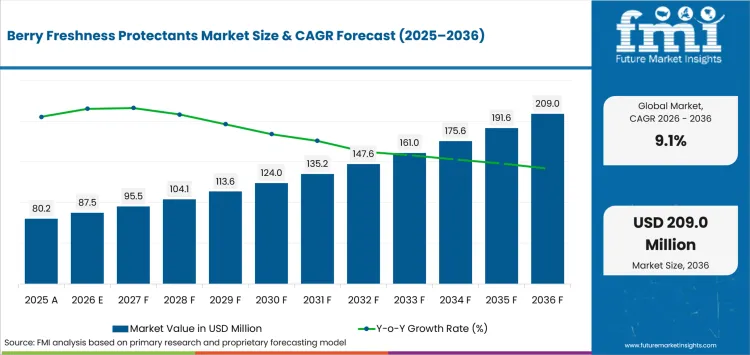
USD 87.5 million in 2026 and USD 209.0 million by 2036 at a 9.1% CAGR.
Demand for berry freshness protectants is projected to expand at 9.1% CAGR between 2026 and 2036, increasing valuation from USD 87.5 million to USD 209.0 million. USDA ARS began a September 2025 berry project testing smart packaging, natural edible coatings, 1-MCP and biological control after storage. Those trials address the same commercial test behind edible films and coatings purchases: preserving firmness and reducing decay without lowering consumer acceptance after cold storage or shipment.
Country economics diverge because route length and domestic supply change the value of each additional saleable day. Defra documented in June 2026 that home production supplied 14% of UK fruit during 2025, which leaves importers more exposed to long inbound routes and variable arrival quality. Germany relies more heavily on domestic orchard output than the import-dependent UK market. Japan and South Korea use quality-sensitive export programs serving longer overseas routes. Freshness and ripening control earns budget where the treatment protects accepted loads under those different distribution conditions.
Key Takeaways of Berry Freshness Protectants Market
- Packers increase spending on freshness protectants if longer storage or transport windows would otherwise reduce saleable berry quality and accepted load volume.
- By product type, edible coatings are estimated to hold 47.8% in 2026 because direct surface treatment can limit moisture exchange before distribution losses accumulate.
- In 2026, pome & stone fruit is expected to lead commodity with 44.9% share because centralized storage supports repeatable treatment protocols and quality checks.
- Packhouse is projected to hold 50.2% of application point revenue in 2026 because washing, grading and treatment occur within one controlled operating sequence.
- Crop-specific dose response and visible surface changes can delay qualification even after a treatment reduces decay or weight loss under controlled storage conditions.
- Some of the key players in this market include AgroFresh Solutions, Inc., Apeel Sciences, Hazel Technologies, Inc., DECCO (UPL), Citrosol, Biotalys, Fresh Inset S.A., and Verdant Technologies.
Analyst Perspective
"Berry freshness programs earn repeat orders after packers show better saleable yield without dulling natural bloom or slowing throughput. The most defensible programs pair crop-specific decay control with arrival-quality records that remain credible after the full storage or export route."
- Nandini Roy Choudhury, Principal Consultant, Future Market Insights
How is the Berry Freshness Protectants Market segmented?
The market is segmented by product type, commodity, application point, technology base and sales channel.
The berry freshness protectants market covers five product types: edible coatings, active sachets & liners, wash & drench treatments, storage-room treatments and others. Commodity includes pome & stone fruit, citrus, berries & grapes, tropical fruit, vegetables and others, and application point covers packhouse, storage facility, transit & retail and others. Technology base separates biological - microbial, plant-extract-based, mineral & wax-based and others, and sales channel includes packhouse suppliers, post-harvest service providers, direct sales and others.
How does Packhouse shape demand within the Application point category?
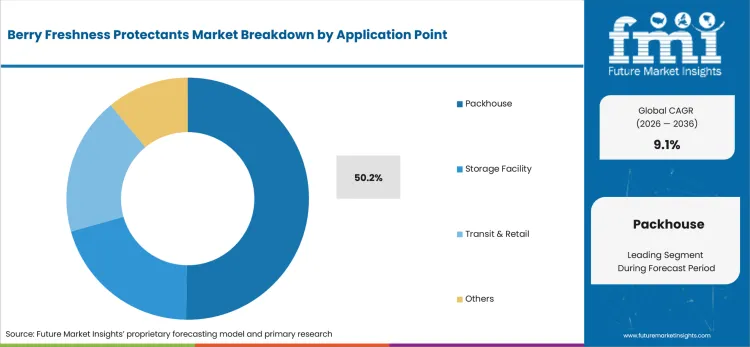
Packhouses concentrate washing, grading and packing at one point where operators can control dose and line speed. AgroFresh announced in February 2025 that it would launch a non-destructive fruit-quality scanner for FreshCloud Inspection at Fruit Attraction São Paulo. The scanner extends packhouse measurement beyond visual checks inside produce packaging operations.
- In 2026, packhouse is expected to lead application point with 50.2% share, because treatment fits existing handling equipment before storage or shipment without requiring another treatment chamber.
- Pairing treatment data with quality inspection gives packhouse operators stronger evidence because lot-level records reduce dependence on subjective visual assessment during seasonal requalification.
What makes Edible coatings central to the Product type category?
Edible coatings work directly on the fruit surface, so packers can test moisture loss and appearance without changing the primary container. USDA ARS reported in its 2025 annual project review that chitosan inhibited blueberry decay, while tested coatings partially or fully removed natural bloom and changed fruit appearance.
- Based on product type, edible coatings are projected to account for 47.8% in 2026, attributable to direct application before storage and distribution losses become visible.
- Berry packers evaluate coating programs against decay control and natural bloom retention because a technically effective barrier can still lose acceptance if fruit appearance changes materially.
Why does Pome & stone fruit lead the Commodity category?
Pome and stone fruit move through centralized storage and staged release programs common in packaged fresh fruits operations. Destatis documented 1.138 million tonnes of apples harvested in 2025, giving packhouses enough volume for commercial storage comparisons. The harvest figure describes operating scale and does not prove the modelled segment share.
- By commodity, pome & stone fruit is estimated to hold 44.9% in 2026, owing to centralized storage that supports repeated treatment and quality measurement.
- Apple and stone-fruit programs can retain a defined protocol for several storage lots, so technical teams gain more observations before changing dose or application conditions.
What supports Biological - microbial demand within the Technology base category?
Biological control addresses postharvest fungal loss without requiring the preservation program to depend entirely on conventional fungicides. Biotalys and AgroFresh formed a May 2025 collaboration to develop and commercialize biological fungicides specifically for postharvest fresh produce. The agreement gives this route a direct commercialization path beside fresh food packaging programs.
- By technology base, biological - microbial is forecast to represent 41.1% in 2026, attributable to programs seeking direct decay control with less dependence on conventional postharvest chemistry.
- Fresh produce companies qualify biological routes after efficacy and formulation stability are demonstrated under storage conditions that expose crop-specific handling and decay risks.
What are the drivers, restraints and opportunities in the Berry Freshness Protectants Market?
Longer distribution windows increase loss-prevention spending, crop-specific quality effects slow qualification and low-touch formats expand the routes available for commercial deployment.
- Driver: Longer storage and shipping windows raise the value of protection that preserves firmness and suppresses decay before retail inspection.
- Restraint: Berry appearance and cultivar response can slow qualification because a treatment that controls decay may alter bloom or other visible quality cues.
- Opportunity: Low-touch barriers and packaging treatments give packers a route to extend freshness without rebuilding washing or packing infrastructure.
Berry losses accumulate quickly once decay or water loss begins during refrigerated storage. USDA ARS started a May 2025 project devoted to integrated postharvest disease control and quality retention for blueberries and table grapes. The commercial link is direct: stronger control after harvest protects more sellable fruit on routes where active and intelligent packaging already carries part of the quality burden.
Berry qualification slows if a protective treatment changes surface bloom or other appearance cues that influence acceptance. USDA ARS accepted January 2025 research confirming that blueberry surface bloom affects consumer preference. Packhouses therefore need decay results beside appearance data before intelligent packaging or coatings move from a controlled trial into routine commercial use.
Low-touch protection fits existing packs or packhouse routines without requiring a separate application chamber. AgroFresh and Nabaco signed an exclusive distribution agreement in June 2025 for NatuWrap, a food-grade protective barrier supplied to produce packers worldwide. The distribution model broadens food packaging use cases where packers want added protection without new treatment-room equipment.
Which country CAGRs are profiled in the Berry Freshness Protectants Market?
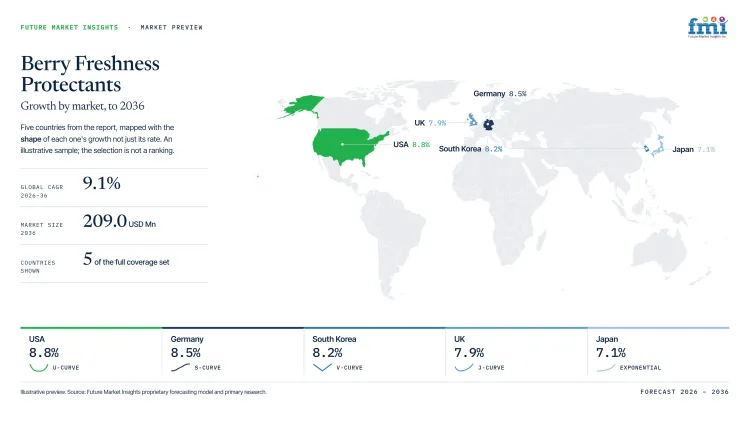
| Country | CAGR |
|---|---|
| USA | 8.8% |
| Germany | 8.5% |
| South Korea | 8.2% |
| UK | 7.9% |
| Japan | 7.1% |
How do country-level CAGRs compare in the Berry Freshness Protectants Market?
The five forecasts span 1.7 percentage points with USA leading at 8.8% within a narrow commercial band. Germany and South Korea remain within 0.6 points of the leader, and UK follows close behind. Japan forms the lower step at 7.1%, so the ranking describes conversion pace more clearly than current revenue scale.
- USA interstate routes make arrival quality central to repeat national treatment orders.
- Germany offers concentrated fruit-storage volumes for repeated commercial treatment trials each season.
- South Korean export programs tie freshness control to premium cultivar positioning abroad.
- UK import hubs enforce tight retailer arrival windows and appearance specifications closely.
- Japan premium-fruit channels place exceptional commercial weight on visible finish during qualification.
Similar CAGRs produce different entry conditions because qualification standards change conversion speed. The full report provides country-level CAGR analysis across North America, Latin America, Europe, East Asia, South Asia, Oceania and the Middle East and Africa.
Country-wise Analysis
- Pacific Northwest berry operations use refrigerated shipping and clamshell packs that expose firmness, shrivel and decay after transit. By 2036, USA is projected to grow at 8.8% CAGR, because long domestic and export routes make arrival quality measurable before wider account rollout. USDA ARS began a September 2025 project covering commercially relevant blueberries, blackberries and raspberries, with trials on smart packaging, coatings and biological control after shipping and cold storage. Large US packers can repeat those trials at commercial scale before widening a program. Cultivar response and retailer appearance standards still require route-specific validation before one protocol moves into additional regions.
- German fruit packhouses manage storage programs beside a large orchard base, so treatment performance can be compared over repeated commercial lots. Destatis estimated in August 2026 that the apple harvest would reach 934,000 tonnes after heat and drought affected fruit development. Germany is estimated to post 8.5% CAGR over the forecast period, aided by centralized packing and storage expertise that gives postharvest programs a practical trial base. Weather-driven variation in fruit size and condition can change treatment response during storage. New entrants therefore need protocols that tolerate seasonal variability without sacrificing throughput or visible finish during seasonal commercial programs.
- South Korean export programs pair premium cultivars with training and commercialization support, giving freshness technologies a direct route into overseas shipment preparation. MAFRA documented 590 tonnes of new Korean grape, strawberry, pear and paprika varieties exported during 2025, then set a higher target for 2026. The South Korea berry freshness protectants sector is projected to record 8.2% CAGR during the assessment period, tied to longer export windows for high-value fresh produce. Export consortia can coordinate pack specifications, but variety-specific handling and destination rules keep wider distribution dependent on proving repeatable performance on the exact crop and export route during commercial deployment.
- UK berry programs depend heavily on imported fruit and concentrated retail specifications, so arrival condition is assessed before produce reaches the shelf. Berry freshness protectant sales in UK are forecast to expand at 7.9% CAGR by 2036, given the commercial value of protecting fruit through variable route lengths. Defra documented in June 2026 that UK soft-fruit production fell 2.7% to 134,000 tonnes during 2025 after weather affected major crops. Dense distribution infrastructure supports controlled commercial trials during seasonal peak import periods. Retailer-specific acceptance criteria can prolong conversion because one treatment program may need to accommodate fruit from several origins and different packing systems.
- Japanese premium-fruit channels scrutinize visible finish and arrival condition, especially for berries sold through export and gift-oriented routes. Adoption of berry freshness protectants in Japan is estimated to expand at 7.1% CAGR through 2036, reflecting the value of protecting quality during longer market journeys. MAFF recorded January 2026 strawberry exports 7.4% above the same month a year earlier, which gives treatment companies a defined export-quality case without relying on a foreign-currency figure. Strict visual grading and destination rules limit products that change surface appearance, so commercial entry favors programs that preserve quality without disrupting established packing procedures or premium presentation standards.
Who are the notable companies in the Berry Freshness Protectants Market?
AgroFresh Solutions, Inc., Apeel Sciences, Hazel Technologies, Inc., DECCO (UPL), Citrosol, Biotalys, Fresh Inset S.A., and Verdant Technologies are the notable companies serving this market.
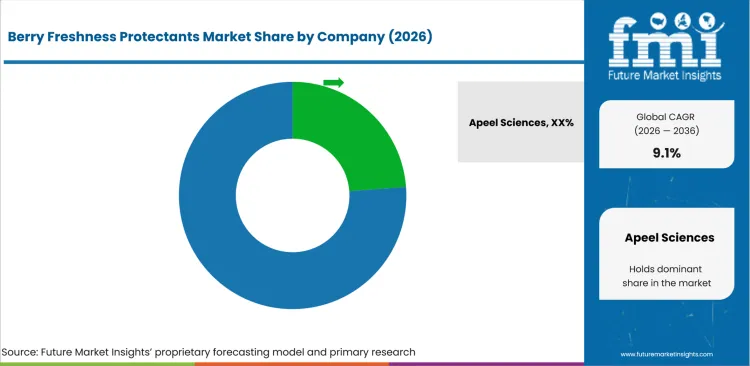
Competition separates by how much of the postharvest workflow each company controls, from packhouse chemistry and digital inspection to coatings and active packaging. Entry becomes harder once crop response, regulatory evidence and line throughput must be proven in the same commercial program. Low-touch specialists also overlap with freshness-indicating packaging where the package carries preservation or quality-monitoring functions.
- AgroFresh Solutions, Inc., DECCO (UPL) and Citrosol cover broad postharvest programs with packhouse treatment knowledge, application support and multi-crop operating experience.
- Apeel Sciences, Hazel Technologies, Inc., Fresh Inset S.A. and Verdant Technologies concentrate on coatings or low-touch packaging formats that fit existing produce handling routes.
- Biotalys enters the field through postharvest biological fungicide development, with its current commercial route tied to the May 2025 collaboration with AgroFresh Solutions, Inc.
Competitive Benchmarking: Berry Freshness Protectants Market
| Company | Freshness Treatment Breadth | Packhouse Integration Depth | Qualification Evidence | Geographic Reach |
|---|---|---|---|---|
| AgroFresh Solutions, Inc. | High | High | High | Global |
| Apeel Sciences | Medium | Medium | High | North America and Europe |
| Hazel Technologies, Inc. | Medium | Medium | Medium | North America and selected export programs |
| DECCO (UPL) | High | High | High | 40+ countries |
| Citrosol | High | High | High | Europe, Africa, Latin America and Asia |
| Biotalys | Low | Low | Medium | Europe and North America through development programs |
| Fresh Inset S.A. | Medium | Low | High | United States, Europe and Latin America |
| Verdant Technologies | Medium | Medium | High | North America |
Scoring basis: High freshness-treatment breadth requires at least three verified postharvest routes. Medium breadth requires two routes, and Low identifies one documented route under the same evidence test. High packhouse integration requires treatment evidence plus equipment and digital or field-service support. Medium requires documented operating integration and Low identifies a single application route. High qualification evidence requires multiple regulatory or certification records from current commercial programs. Medium qualification requires two evidence paths, and Low identifies one documented path. Geographic reach uses active commercial or development regions instead of corporate office locations.
Key Developments in the Berry Freshness Protectants Market
- In December 2025, Fresh Inset S.A. received unconditional US EPA registration for Vidre+ Low Concentration as a postharvest freshness treatment for packaged produce.
- In September 2025, DECCO (UPL) announced a new Beniparrell plant in Valencia that would expand its global postharvest production network to nine facilities.
- In March 2025, Hazel Technologies, Inc. announced a BreatheWay pallet-bag format designed to maintain broccoli quality without traditional ice during shipment and sought commercial trial partners.
Key Players in the Berry Freshness Protectants Market
Integrated Postharvest Platforms
- AgroFresh Solutions, Inc.
- DECCO (UPL)
- Citrosol
Low-Touch Coating and Packaging Specialists
- Apeel Sciences
- Hazel Technologies, Inc.
- Fresh Inset S.A.
- Verdant Technologies
Biological Protection Developers
- Biotalys
Berry Freshness Protectants Market - Report Scope
| Coverage field | Report scope |
|---|---|
| Market breakdown | By product type, commodity, application point, technology base, sales channel and region. |
| Quantitative Units | USD Million. |
| Market Definition | Revenue from postharvest freshness-protection products sold for application to fresh produce within the defined product types and treatment points. The scope excludes fresh-produce sales, processed-food revenue, inactive packaging, preharvest crop-protection inputs and standalone cold-storage equipment. |
| Regions Covered | North America, Latin America, Europe, East Asia, South Asia and Pacific, and Middle East and Africa. |
| Countries Covered | USA, Germany, South Korea, UK, Japan, and 20+ countries included in the full report. |
| Key Companies Profiled | AgroFresh Solutions, Inc., Apeel Sciences, Hazel Technologies, Inc., DECCO (UPL), Citrosol, Biotalys, Fresh Inset S.A., and Verdant Technologies. |
| Forecast Period | 2026 to 2036. |
| Approach | Primary and secondary research with market triangulation. |
Berry Freshness Protectants Market - Research Methodology
| Method | Approach |
|---|---|
| Primary Research | FMI analysts gathered input from manufacturers, service providers, technology developers, distributors, end users, procurement teams, and subject-matter experts. Interviews examined purchasing decisions, product or service evaluation, adoption barriers, approval requirements, pricing considerations, and expectations for technical or commercial support. Respondents were also asked what evidence is required before a trial, pilot, or initial order develops into regular purchasing. |
| Desk Research | Desk research covered government statistics, regulatory publications, trade data, industry associations, technical literature, standards, company filings, product information, and official corporate announcements. Sources were reviewed for relevance, publication date, geographic coverage, and consistency with the defined market scope. Claims relating to performance, applications, approvals, capacity, investment, and commercial activity were retained only when supported by credible public evidence. |
| Market Sizing and Forecasting | The market model combined the baseline value with historical performance, segment structure, pricing and volume indicators, adoption levels, company participation, and country-level demand conditions. Forecast assumptions considered economic activity, investment trends, regulatory developments, technology adoption, purchasing cycles, supply availability, and barriers to wider market use. Segment and regional estimates were reconciled before the final market total was calculated. |
| Data Validation | Estimates were checked against multiple independent indicators, including public data, company activity, trade patterns, industry developments, and findings from primary interviews. Validation also tested whether products, services, applications, and company revenues fell within the defined market boundaries. Adjacent categories, unsupported claims, overlapping revenues, and activities without direct market relevance were excluded to reduce double counting and maintain consistency across segments and countries. |
Berry Freshness Protectants Market by Segments
Product Type
- Edible Coatings
- Active Sachets & Liners
- Wash & Drench Treatments
- Storage-Room Treatments
- Others
Commodity
- Pome & Stone Fruit
- Citrus
- Berries & Grapes
- Tropical Fruit
- Vegetables
- Others
Application Point
- Packhouse
- Storage Facility
- Transit & Retail
- Others
Technology Base
- Biological - microbial
- Plant-Extract-Based
- Mineral & Wax-Based
- Others
Sales Channel
- Packhouse Suppliers
- Post-Harvest Service Providers
- Direct Sales
- Others
Berry Freshness Protectants Market by Region:
- North America
- USA
- Canada
- Latin America
- Brazil
- Mexico
- Argentina
- Rest of Latin America
- Europe
- Germany
- UK
- France
- Italy
- Spain
- Rest of Europe
- East Asia
- Japan
- South Korea
- South Asia and Pacific
- Australia
- New Zealand
- ASEAN
- Rest of South Asia and Pacific
- Middle East and Africa
- GCC Countries
- South Africa
- Turkey
- Rest of Middle East and Africa
Research Sources and Bibliography
- USA Department of Agriculture, Agricultural Research Service. (2025, September 1). Pre- and Postharvest Management Practices for Sustainable Production and Marketing of Blueberries, Blackberries, and Raspberries
- Department for Environment, Food & Rural Affairs. (2026, June 25). Horticulture statistics 2025
- USA Department of Agriculture, Agricultural Research Service. (2025, January 23). The role of fruit surface bloom in consumer preference for blueberries: Sensory evaluation and multisensory interactions
- Statistisches Bundesamt. (2025, December 19). Apfelernte 2025: Mit 1 138 000 Tonnen zweithöchste Ernte der vergangenen zehn Jahre
- AgroFresh Solutions, Inc.. (2025, February). AgroFresh Presents New Digital Post-Harvest Technology at Fruit Attraction 2025 in São Paulo
- AgroFresh Solutions, Inc.. (2025, May 20). Biotalys and AgroFresh Partner to Protect Fresh Produce
- USA Department of Agriculture, Agricultural Research Service. (2025). New Approaches to Enhance Fresh Fruit Quality and Control Postharvest Diseases: 2025 annual report
- USA Department of Agriculture, Agricultural Research Service. (2025, May 18). Innovative Approaches to Control Postharvest Diseases and Expand Market Opportunities of Fresh Fruits
- Apeel Sciences. (2025, June 3). Apeel Sciences Recognized by Food & Wine as a 2025 Game Changer for Food Innovation
- AgroFresh Solutions, Inc.. (2025, June 18). AgroFresh Expands Global Post-Harvest Solutions Portfolio with NatuWrap in Exclusive Distribution Agreement with Nabaco
- USA Department of Agriculture, Agricultural Research Service. (2025, September 1). Foliar Application of Biostimulants and Growth Regulators on Production and Quality of Blueberries and Blackberries
- Statistisches Bundesamt. (2026, August 18). Apfelernte 2026 voraussichtlich 5,4 % unter Zehnjahresschnitt
- Ministry of Agriculture, Food and Rural Affairs, Republic of Korea. (2026, April). Project to diversify export markets for new Korean varieties of fresh agricultural produce
- Ministry of Agriculture, Forestry and Fisheries, Japan. (2026, March). 2026 agricultural, forestry and fishery product exports: January results by item
- USA Environmental Protection Agency. (2025, December 1). Vidre+ Low Concentration registration, EPA Reg. No. 102518-4
- DECCO. (2025, September 23). DECCO Expands Global Footprint with New Plant in Valencia, Spain
- Hazel Technologies, Inc.. (2025, March 17). New packaging technology eliminates the need for ice when shipping broccoli
- AgroFresh Solutions, Inc.. (2025, November 5). AgroFresh Announces New AI-Powered Imaging and Orchard Analytics Partnerships with Aerobotics and Neolithics
- DECCO. (2025, January 21). DECCO Ibérica receives the registration for DECCO Zox: First Product formulated with Azoxystrobin in Europe in Postharvest Citrus Protection
- Citrosol. (2025, September 25). Citrosol expands its global footprint
- Fresh Inset S.A.. (2025, April 30). Fresh Inset and Interoc sign LOI to bring Vidre+ to Peru
- Hazel Technologies, Inc.. (2025, February 3). Modified Atmosphere Packaging solution helps improve melon quality
- USA Environmental Protection Agency. (2025, April 2). CR206 / HarvestHold Fresh EPA label, Registration No. 93197-2
- Biotalys. (2026, January 23). Biotalys and 21st.BIO enter strategic partnership to advance biocontrol manufacturing
- JBT Marel Corporation. (2026, March 2). JBT Marel Corporation Annual Report on Form 10-K for 2025
This bibliography is provided for reader reference and is not exhaustive. The full report contains the complete reference list and detailed citations
This Report Answers
- How large is the berry freshness protectants market in 2026 and what value is expected by 2036?
- Which operating conditions make freshness protection economically attractive for packers and fresh-fruit distributors?
- Why do edible coatings, pome & stone fruit and packhouse applications hold the largest approved 2026 shares?
- Which technical and commercial factors limit wider qualification of berry freshness protectants?
- How do the five profiled country CAGRs differ and what local conditions shape order conversion?
- Which companies are active in postharvest coatings, packaging, biological protection and integrated treatment programs?
- How do leading companies compare on freshness-treatment breadth, packhouse integration and qualification evidence?
Frequently Asked Questions
How big is the berry freshness protectants market in 2026?
The berry freshness protectants market is valued at USD 87.5 million in 2026 and is projected to reach USD 209.0 million by 2036. Longer shipment windows increase spending where protectants preserve saleable fruit quality through storage and refrigerated distribution.
What is the CAGR of the berry freshness protectants market from 2026 to 2036?
The berry freshness protectants market is projected to grow at a CAGR of 9.1% between 2026 and 2036. Expansion is tied to packhouse loss prevention, longer distribution routes and more consistent postharvest quality measurement.
Which product type leads the berry freshness protectants market?
The edible coatings segment is expected to hold 47.8% of the berry freshness protectants market in 2026, attributable to direct surface application before storage. Packers still qualify coatings against natural bloom, visible finish and cultivar-specific response before routine use.
Which application point leads the berry freshness protectants market?
The packhouse segment is expected to hold 50.2% of the berry freshness protectants market in 2026, driven by controlled application before storage and transit. Centralized lines also let packhouse teams compare treated and untreated outcomes under the same operating conditions.
Which commodity leads the berry freshness protectants market?
The pome & stone fruit segment is expected to hold 44.9% of the berry freshness protectants market in 2026, supported by centralized storage and staged release programs. Those programs provide repeated storage lots for evaluating decay control, weight retention and saleable appearance.
How much value will the berry freshness protectants market add between 2026 and 2036?
The berry freshness protectants market is expected to add USD 121.5 million in value between 2026 and 2036. The increase follows greater commercial use of protection that reduces decay, moisture loss and rejected fruit loads.
Which countries are projected to record the highest growth in the berry freshness protectants market?
USA is projected to grow at 8.8% CAGR, followed by Germany at 8.5% and South Korea at 8.2% through 2036. Their expansion follows distinct packhouse, export and route-length conditions that produce different qualification and sales cycles.
Which companies are active in the berry freshness protectants market?
Key companies operating in the market include AgroFresh Solutions, Inc., Apeel Sciences, Hazel Technologies, Inc., DECCO (UPL), Citrosol, Biotalys, Fresh Inset S.A., and Verdant Technologies. These companies compete through treatment breadth, packaging formats, biological development and application support.
Preview the report firsthand - request a free sample
Get SampleGet the brochure for pricing and purchase details.
Get PDFTable of Content
- Key Takeaways
- Market Size and CAGR
- Top Growth Driver
- Fastest Growing Segment
- Leading Region
- Key Companies
- Emerging Opportunities
- Executive Summary
- Global Market Outlook
- Demand-side Trends
- Supply-side Trends
- Technology Roadmap Analysis
- Analysis and Recommendations
- Analyst Perspective (What is happening? Why now? What should investors know?)
- Key Questions Answered
- How large is the market?
- What is the CAGR?
- What are key trends?
- Which region dominates?
- Who are the leaders?
- Market Overview
- Market Coverage / Taxonomy
- Market Definition / Scope / Limitations
- Research Methodology
- Chapter Orientation
- Analytical Lens and Working Hypotheses
- Market Structure, Signals, and Trend Drivers
- Benchmarking and Cross-market Comparability
- Market Sizing, Forecasting, and Opportunity Mapping
- Research Design and Evidence Framework
- Desk Research Programme (Secondary Evidence)
- Expert Input and Fieldwork (Primary Evidence)
- Tooling, Models, and Reference Databases
- Data Engineering and Model Build
- Quality Assurance and Audit Trail
- Market Background
- Market Dynamics (Drivers, Restraints, Opportunity, Trends)
- Scenario Forecast (Optimistic, Likely, Conservative)
- Impact Analysis
- AI Impact
- Sustainability Impact
- Regulatory Impact
- Technology Impact
- Consumer / Buyer Analysis
- Purchase Drivers
- Adoption Barriers
- Buyer Journey
- Opportunity Map Analysis
- Product Life Cycle Analysis
- Supply Chain Analysis
- Investment Feasibility Matrix
- Value Chain Analysis
- PESTLE and Porter's Analysis
- Regulatory Landscape
- Regional Parent Market Outlook
- Production and Consumption Statistics
- Import and Export Statistics
- Global Market Analysis and Forecast, 2021 to 2036
- Historical Market Size Value (USD Million) Analysis, 2021 to 2025
- Current and Future Market Size Value (USD Million) Projections, 2026 to 2036
- Y-o-Y Growth Trend Analysis
- Absolute $ Opportunity Analysis
- Global Market Pricing Analysis, 2021 to 2036
- Global Market Analysis and Forecast, By Product Type, 2021 to 2036
- Introduction / Key Findings
- Historical Market Size Value (USD Million) Analysis By Product Type, 2021 to 2025
- Current and Future Market Size Value (USD Million) Analysis and Forecast By Product Type, 2026 to 2036
- Edible Coatings
- Active Sachets & Liners
- Wash & Drench Treatments
- Storage-Room Treatments
- Others
- Edible Coatings
- Y-o-Y Growth Trend Analysis By Product Type, 2021 to 2025
- Absolute $ Opportunity Analysis By Product Type, 2026 to 2036
- Global Market Analysis and Forecast, By Commodity, 2021 to 2036
- Introduction / Key Findings
- Historical Market Size Value (USD Million) Analysis By Commodity, 2021 to 2025
- Current and Future Market Size Value (USD Million) Analysis and Forecast By Commodity, 2026 to 2036
- Pome & Stone Fruit
- Citrus
- Berries & Grapes
- Tropical Fruit
- Vegetables
- Others
- Pome & Stone Fruit
- Y-o-Y Growth Trend Analysis By Commodity, 2021 to 2025
- Absolute $ Opportunity Analysis By Commodity, 2026 to 2036
- Global Market Analysis and Forecast, By Application Point, 2021 to 2036
- Introduction / Key Findings
- Historical Market Size Value (USD Million) Analysis By Application Point, 2021 to 2025
- Current and Future Market Size Value (USD Million) Analysis and Forecast By Application Point, 2026 to 2036
- Packhouse
- Storage Facility
- Transit & Retail
- Others
- Packhouse
- Y-o-Y Growth Trend Analysis By Application Point, 2021 to 2025
- Absolute $ Opportunity Analysis By Application Point, 2026 to 2036
- Global Market Analysis and Forecast, By Technology Base, 2021 to 2036
- Introduction / Key Findings
- Historical Market Size Value (USD Million) Analysis By Technology Base, 2021 to 2025
- Current and Future Market Size Value (USD Million) Analysis and Forecast By Technology Base, 2026 to 2036
- Biological / Microbial
- Plant-Extract-Based
- Mineral & Wax-Based
- Others
- Biological / Microbial
- Y-o-Y Growth Trend Analysis By Technology Base, 2021 to 2025
- Absolute $ Opportunity Analysis By Technology Base, 2026 to 2036
- Global Market Analysis and Forecast, By Sales Channel, 2021 to 2036
- Introduction / Key Findings
- Historical Market Size Value (USD Million) Analysis By Sales Channel, 2021 to 2025
- Current and Future Market Size Value (USD Million) Analysis and Forecast By Sales Channel, 2026 to 2036
- Packhouse Suppliers
- Post-Harvest Service Providers
- Direct Sales
- Others
- Packhouse Suppliers
- Y-o-Y Growth Trend Analysis By Sales Channel, 2021 to 2025
- Absolute $ Opportunity Analysis By Sales Channel, 2026 to 2036
- Global Market Analysis and Forecast, By Region, 2021 to 2036
- Introduction
- Historical Market Size Value (USD Million) Analysis By Region, 2021 to 2025
- Current Market Size Value (USD Million) Analysis and Forecast By Region, 2026 to 2036
- North America
- Latin America
- Western Europe
- Eastern Europe
- East Asia
- South Asia and Pacific
- Middle East & Africa
- Market Attractiveness Analysis By Region
- North America Market Analysis and Forecast, By Country, 2021 to 2036
- Historical Market Size Value (USD Million) Trend Analysis By Market Taxonomy, 2021 to 2025
- Market Size Value (USD Million) Forecast By Market Taxonomy, 2026 to 2036
- By Country
- USA
- Canada
- By Product Type
- By Commodity
- By Application Point
- By Technology Base
- By Sales Channel
- By Country
- Market Attractiveness Analysis
- By Country
- By Product Type
- By Commodity
- By Application Point
- By Technology Base
- By Sales Channel
- Key Takeaways
- Latin America Market Analysis and Forecast, By Country
- Historical Market Size Value (USD Million) Trend Analysis By Market Taxonomy, 2021 to 2025
- Market Size Value (USD Million) Forecast By Market Taxonomy, 2026 to 2036
- By Country
- Brazil
- Mexico
- Chile
- Rest of Latin America
- By Product Type
- By Commodity
- By Application Point
- By Technology Base
- By Sales Channel
- By Country
- Market Attractiveness Analysis
- By Country
- By Product Type
- By Commodity
- By Application Point
- By Technology Base
- By Sales Channel
- Key Takeaways
- Western Europe Market Analysis and Forecast, By Country
- Historical Market Size Value (USD Million) Trend Analysis By Market Taxonomy, 2021 to 2025
- Market Size Value (USD Million) Forecast By Market Taxonomy, 2026 to 2036
- By Country
- Germany
- UK
- Italy
- Spain
- France
- Nordic
- BENELUX
- Rest of Western Europe
- By Product Type
- By Commodity
- By Application Point
- By Technology Base
- By Sales Channel
- By Country
- Market Attractiveness Analysis
- By Country
- By Product Type
- By Commodity
- By Application Point
- By Technology Base
- By Sales Channel
- Key Takeaways
- Eastern Europe Market Analysis and Forecast, By Country
- Historical Market Size Value (USD Million) Trend Analysis By Market Taxonomy, 2021 to 2025
- Market Size Value (USD Million) Forecast By Market Taxonomy, 2026 to 2036
- By Country
- Russia
- Poland
- Hungary
- Balkan & Baltic
- Rest of Eastern Europe
- By Product Type
- By Commodity
- By Application Point
- By Technology Base
- By Sales Channel
- By Country
- Market Attractiveness Analysis
- By Country
- By Product Type
- By Commodity
- By Application Point
- By Technology Base
- By Sales Channel
- Key Takeaways
- East Asia Market Analysis and Forecast, By Country
- Historical Market Size Value (USD Million) Trend Analysis By Market Taxonomy, 2021 to 2025
- Market Size Value (USD Million) Forecast By Market Taxonomy, 2026 to 2036
- By Country
- China
- Japan
- South Korea
- By Product Type
- By Commodity
- By Application Point
- By Technology Base
- By Sales Channel
- By Country
- Market Attractiveness Analysis
- By Country
- By Product Type
- By Commodity
- By Application Point
- By Technology Base
- By Sales Channel
- Key Takeaways
- South Asia and Pacific Market Analysis and Forecast, By Country
- Historical Market Size Value (USD Million) Trend Analysis By Market Taxonomy, 2021 to 2025
- Market Size Value (USD Million) Forecast By Market Taxonomy, 2026 to 2036
- By Country
- India
- ASEAN
- Australia & New Zealand
- Rest of South Asia and Pacific
- By Product Type
- By Commodity
- By Application Point
- By Technology Base
- By Sales Channel
- By Country
- Market Attractiveness Analysis
- By Country
- By Product Type
- By Commodity
- By Application Point
- By Technology Base
- By Sales Channel
- Key Takeaways
- Middle East & Africa Market Analysis and Forecast, By Country
- Historical Market Size Value (USD Million) Trend Analysis By Market Taxonomy, 2021 to 2025
- Market Size Value (USD Million) Forecast By Market Taxonomy, 2026 to 2036
- By Country
- Kingdom of Saudi Arabia
- Other GCC Countries
- Türkiye
- South Africa
- Other African Union
- Rest of Middle East & Africa
- By Product Type
- By Commodity
- By Application Point
- By Technology Base
- By Sales Channel
- By Country
- Market Attractiveness Analysis
- By Country
- By Product Type
- By Commodity
- By Application Point
- By Technology Base
- By Sales Channel
- Key Takeaways
- Key Countries Market Analysis
- USA
- Pricing Analysis
- Market Share Analysis, 2025
- By Product Type
- By Commodity
- By Application Point
- By Technology Base
- By Sales Channel
- Canada
- Pricing Analysis
- Market Share Analysis, 2025
- By Product Type
- By Commodity
- By Application Point
- By Technology Base
- By Sales Channel
- Mexico
- Pricing Analysis
- Market Share Analysis, 2025
- By Product Type
- By Commodity
- By Application Point
- By Technology Base
- By Sales Channel
- Brazil
- Pricing Analysis
- Market Share Analysis, 2025
- By Product Type
- By Commodity
- By Application Point
- By Technology Base
- By Sales Channel
- Chile
- Pricing Analysis
- Market Share Analysis, 2025
- By Product Type
- By Commodity
- By Application Point
- By Technology Base
- By Sales Channel
- Germany
- Pricing Analysis
- Market Share Analysis, 2025
- By Product Type
- By Commodity
- By Application Point
- By Technology Base
- By Sales Channel
- UK
- Pricing Analysis
- Market Share Analysis, 2025
- By Product Type
- By Commodity
- By Application Point
- By Technology Base
- By Sales Channel
- Italy
- Pricing Analysis
- Market Share Analysis, 2025
- By Product Type
- By Commodity
- By Application Point
- By Technology Base
- By Sales Channel
- Spain
- Pricing Analysis
- Market Share Analysis, 2025
- By Product Type
- By Commodity
- By Application Point
- By Technology Base
- By Sales Channel
- France
- Pricing Analysis
- Market Share Analysis, 2025
- By Product Type
- By Commodity
- By Application Point
- By Technology Base
- By Sales Channel
- India
- Pricing Analysis
- Market Share Analysis, 2025
- By Product Type
- By Commodity
- By Application Point
- By Technology Base
- By Sales Channel
- ASEAN
- Pricing Analysis
- Market Share Analysis, 2025
- By Product Type
- By Commodity
- By Application Point
- By Technology Base
- By Sales Channel
- Australia & New Zealand
- Pricing Analysis
- Market Share Analysis, 2025
- By Product Type
- By Commodity
- By Application Point
- By Technology Base
- By Sales Channel
- China
- Pricing Analysis
- Market Share Analysis, 2025
- By Product Type
- By Commodity
- By Application Point
- By Technology Base
- By Sales Channel
- Japan
- Pricing Analysis
- Market Share Analysis, 2025
- By Product Type
- By Commodity
- By Application Point
- By Technology Base
- By Sales Channel
- South Korea
- Pricing Analysis
- Market Share Analysis, 2025
- By Product Type
- By Commodity
- By Application Point
- By Technology Base
- By Sales Channel
- Russia
- Pricing Analysis
- Market Share Analysis, 2025
- By Product Type
- By Commodity
- By Application Point
- By Technology Base
- By Sales Channel
- Poland
- Pricing Analysis
- Market Share Analysis, 2025
- By Product Type
- By Commodity
- By Application Point
- By Technology Base
- By Sales Channel
- Hungary
- Pricing Analysis
- Market Share Analysis, 2025
- By Product Type
- By Commodity
- By Application Point
- By Technology Base
- By Sales Channel
- Kingdom of Saudi Arabia
- Pricing Analysis
- Market Share Analysis, 2025
- By Product Type
- By Commodity
- By Application Point
- By Technology Base
- By Sales Channel
- Türkiye
- Pricing Analysis
- Market Share Analysis, 2025
- By Product Type
- By Commodity
- By Application Point
- By Technology Base
- By Sales Channel
- South Africa
- Pricing Analysis
- Market Share Analysis, 2025
- By Product Type
- By Commodity
- By Application Point
- By Technology Base
- By Sales Channel
- USA
- Market Structure Analysis
- Competition Dashboard
- Competition Benchmarking
- Market Share Analysis of Top Players
- By Regional
- By Product Type
- By Commodity
- By Application Point
- By Technology Base
- By Sales Channel
- Emerging Startups
- Innovation Benchmarking
- Competition Analysis
- Competition Deep Dive
- Apeel Sciences
- Overview
- Product Portfolio
- Profitability by Market Segments
- Sales Footprint
- Strategy Overview
- Marketing Strategy
- Product Strategy
- Channel Strategy
- Hazel Technologies
- DECCO (UPL)
- Pace International
- Xeda International
- Citrosol
- Fomesa Fruitech
- JBT Corporation
- Apeel Sciences
- Case Studies
- Success Stories
- Recent Developments
- Competition Deep Dive
- Assumptions & Acronyms Used


