

- Market Size (2026)
- USD 22.3 Bn
- Forecast (2036)
- USD 53.8 Bn
- CAGR (2026 to 2036)
- 9.2%
How big is Smart & Freshness-Indicating Food Packaging Market in 2026?
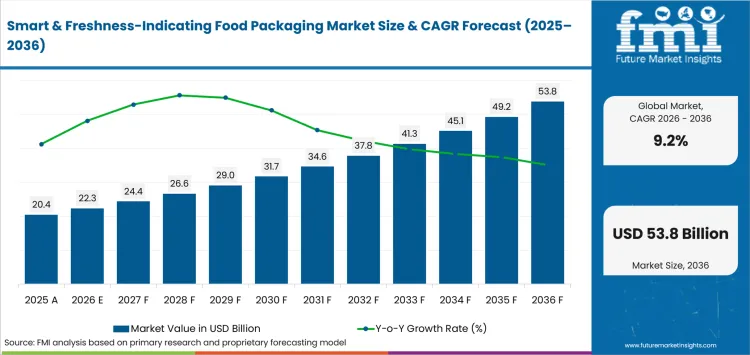
USD 22.3 billion in 2026 and USD 53.8 billion by 2036 at a 9.2% CAGR.
Demand for smart & freshness-indicating food packaging is projected to expand at a 9.2% CAGR between 2026 and 2036, taking market value from USD 22.3 billion to USD 53.8 billion. Active and intelligent packaging is witnessing demand as package data improves lot handling or condition decisions on perishable foods. FDA stated in July 2026 that the Food Traceability Rule requires covered firms to maintain key data for defined critical tracking events. Congress prevents enforcement before July 20 2028, extending implementation time without removing the record workflow that gives digital package identities operational value.
The UK sales case leans more heavily on household cold-chain uncertainty than Germany’s retailer waste route or USA traceability programs. The Food Standards Agency reported in March 2026 that 34 of 65 observed household fridges averaged above the recommended 5°C maximum. Those measured temperatures give fresh food packaging developers a concrete use case for simple condition cues after retail handoff. Country qualification depends on the operating problem the cue solves instead of one universal freshness message.
Key Takeaways of Smart & Freshness-Indicating Food Packaging Market
- Demand is driven as package-level condition or identity data helps food processors reduce waste exposure and make lot-specific handling decisions.
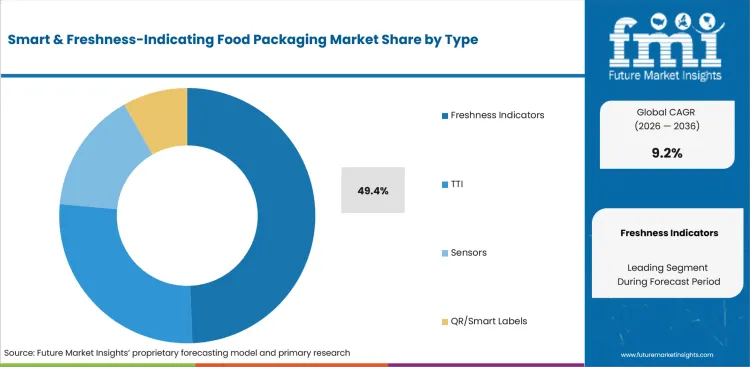
- Freshness indicators are set to lead the type category with 49.4% share in 2026 due to visible condition cues that work without separate readers.
- By material, paper & paperboard is estimated to hold 51.9% in 2026 owing to printable surfaces that fit recycling-focused fiber programs.
- In 2026, dairy is expected to lead the application category with 39.0% share because refrigerated handling creates frequent expiry and rotation decisions.
- Calibration and food-contact qualification can delay adoption if smart elements disrupt filling, sealing or recovery despite accurate sensing.
- The profiled company register includes Tetra Pak, Amcor, Mondi, Avery Dennison, SATO, Timestrip, SpotSee and Mimica.
Analyst Perspective
"Smart freshness packaging earns repeat orders when the signal survives the food’s cold-chain profile and the package still runs at normal line speed. Commercial value depends on waste or handling savings exceeding the added label cost plus SKU-specific calibration and quality approval."
- Nandini Roy Choudhury, Principal Consultant, Future Market Insights
How is the Smart & Freshness-Indicating Food Packaging Market segmented?
The smart & freshness-indicating food packaging market is segmented by type, material, application and region.
Type includes freshness indicators, TTI, sensors and QR/smart labels. Material includes paper & paperboard, plastic, bio-based polymers and metal. Application covers dairy, meat, produce and bakery. Region follows the standard FMI country and regional taxonomy used throughout the report.
What makes freshness indicators central to the type category?
Freshness indicators translate cumulative temperature exposure into a visible or tactile decision at the pack, unlike time-temperature indicator labels that mainly report exposure history. In May 2025 Mimica reported results from a household steak trial using Bump Tag alongside an extended use-by date as part of its collaboration with ABP Food Group.
- Based on type, freshness indicators are projected to account for 49.4% in 2026 due to visible condition cues that require no separate reader at the decision point.
- Commercial adoption depends on whether the cue changes handling decisions enough to justify recurring label cost across high-volume chilled-food portfolios and repeated retail replenishment cycles.
Why does paper & paperboard lead the material category?
Paper and paperboard give food brands a broad print surface for codes and visual indicators and fit fiber-based sustainable packaging programs on established converting lines. The substrate also keeps printed package identities close to standard corrugated conversion workflows at commercial line speed.
- By material, paper & paperboard is estimated to hold 51.9% in 2026 owing to printable surfaces that accommodate package identities without adding a separate structural layer.
- In September 2025 Mondi added white digital corrugated printing with sequential barcodes and QR codes directly on food packaging. Direct printing can remove separate label steps as qualified inks preserve line speed and intended recycling performance.
What supports dairy in the application category?
Dairy combines rapid replenishment with refrigeration, so smart packaging systems must survive aseptic production speed and remain clear after retail handoff. In April 2026 Tetra Pak and Sterilgarda Alimenti launched a one-litre paper-barrier dairy carton on a commercially qualified aseptic line.
- The application category is forecast to be led by dairy at 39.0% share in 2026 due to repeated refrigeration and frequent remaining-life decisions across retail cycles.
- Commercial line qualification sets the threshold for added freshness sensors because dairy brands cannot trade shelf life or filling reliability for extra condition data on commercial aseptic lines.
What are the drivers, restraints and opportunities in the smart & freshness-indicating food packaging market?
Food-waste and traceability pressures support adoption while validation costs constrain conversion, leaving recyclable smart formats as the clearest scalable opportunity.
- Driver: Perishable-food operators need package data that improves stock rotation and lot-level handling across recurring commercial use.
- Restraint: Sensor calibration and digital read performance can slow rollout under moisture, cold storage or existing line constraints.
- Opportunity: Packaging manufacturers can combine condition cues or serialized identities with recyclable packs that already run on high-volume food packaging lines.
Food-Waste Costs Reward Better Condition Signals
Food processors justify smart features that directly improve stock decisions or prevent unnecessary product disposal. Australia’s DCCEEW reported in December 2025 that landfill food waste fell from 127 kilograms per person in 2016-17 to 102 kilograms in 2022-23. Package-level freshness data can earn recurring food packaging demand by helping retailers time markdowns and avoid discarding usable stock across chilled categories.
Cold Conditions Raise Qualification Costs
Commercial rollout slows as cold moisture weakens label reads or added components disrupt existing labeling equipment. Avery Dennison launched AD IdentiFresh in February 2026 for densely stacked fresh foods in high-moisture cold environments and standard label formats. RFID-integrated smart packaging competes on repeatable read performance plus line fit because laboratory accuracy alone cannot protect inventory workflows across large store networks.
Recyclable Structures Improve Scaling Options
Smart features scale more easily on food packaging already being redesigned for material recovery. In May 2025 Amcor and Metsä Group announced a molded-fiber food-packaging collaboration whose full solution targets paper-stream recyclability with a CEPI score above 80%. Active packaging components can enter existing high-volume commercial programs if condition indicators or codes preserve sealing performance and the intended recycling path.
Which country CAGRs are profiled in the Smart & Freshness-Indicating Food Packaging Market?
| Country | CAGR |
|---|---|
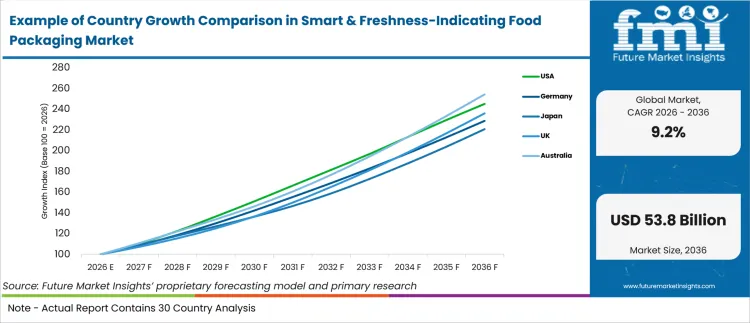
| Australia | 9.8% |
| USA | 9.4% |
| UK | 9.0% |
| Germany | 8.6% |
| Japan | 8.2% |
How do country-level CAGRs compare in the Smart & Freshness-Indicating Food Packaging Market?
A 1.6-percentage-point range keeps all CAGRs inside one narrow but distinct growth band. Australia and the USA form the upper pair while the UK occupies the middle position. Germany and Japan remain lower, so local qualification routes matter more than differences in forecast pace for next generation packaging programs.
- Australia ties smart-label qualification to packaging-recovery rules that raise material-compatibility requirements.
- Walmart is deploying RFID with use-by dates across USA bakery, meat and deli.
- UK household refrigeration variability increases demand for clear condition cues after retail handoff.
- German retailers pair food-waste pacts with EU recycling rules that increase smart-packaging material checks.
- Japan rewards indicators that fit delivery deadlines and familiar shelf-life management routines.
Similar CAGRs can mask different commercial integration costs and operating routes. The full report provides country-level CAGR analysis across North America, Latin America, Europe, East Asia, South Asia, Oceania and the Middle East and Africa.
Country-wise Analysis
- Australian food brands increasingly test smart labels against recovery rules as packaging functions become harder to separate from material choices across national retail portfolios. Adoption of smart & freshness-indicating food packaging in Australia is estimated to expand at 9.8% CAGR through 2036, aided by retailer waste programs and a large chilled-food base. DCCEEW reported in February 2026 that 6.84 million tonnes of packaging entered the market in 2023-24 and 41% went to landfill, giving brands a clear reason to pair condition data with recoverable pack designs although long distribution routes and recycling compatibility remain practical barriers to broad national SKU rollout.
- USA grocers manage large fresh departments where item identities must survive moisture and rapid replenishment without adding manual handling at receiving or shelf rotation across national store networks. EPA reported in April 2025 that food waste costs each USA consumer about USD 728 annually, giving retailers a direct economic reason to connect condition or date information with inventory decisions. The USA smart & freshness-indicating food packaging market is projected to reach a 9.4% CAGR by 2036, underpinned by item-level traceability mandates and RFID programs, though deployment depends on reliable reader coverage plus consistent label performance across bakery, meat and deli operations.
- UK food retailers need freshness cues that remain understandable after chilled products leave controlled stores and enter household refrigerators with uneven temperature management. The UK smart & freshness-indicating food packaging outlook is anticipated to advance at 9.0% CAGR over the assessment period, supported by retailer waste programs and consumer-facing date guidance. WRAP’s March 2026 survey of 5,509 people found self-reported waste across four tracked food products fell from 21% in 2024 to 18.8% in 2025 and gave brands a measurable waste benchmark yet any indicator must remain consistent with use-by safety rules and familiar date language in ordinary household use.
- German grocery chains already measure unsaleable food inside a formal retailer pact, and Thünen Institute reported in December 2025 that participating companies implemented 138 elective food-waste measures during 2024. Those programs give packaging teams practical routes to test condition information against markdown and donation routines, but EU packaging rules require any code or sensor to preserve recycling performance across retailer-approved material systems. The German smart & freshness-indicating food packaging sector is projected to record 8.6% CAGR during the assessment period, driven by documented retailer waste-reduction pacts, though successful commercial rollout depends on integration with existing food-pack qualification procedures and store operations across national retail networks.
- Japanese food manufacturers work within established delivery deadlines and date-management routines, so a freshness indicator must complement familiar shelf-life decisions instead of replacing them. MAFF reported in June 2026 that business food loss reached 2.37 million tonnes in fiscal 2024 and stood 57% below the fiscal 2000 level, keeping waste reduction tied to measurable operating practices across commercial channels. Japan is estimated to post 8.2% CAGR over the forecast period, reflecting disciplined retail handling and a strong packaged-food distribution infrastructure, despite ongoing requirements for product-specific calibration and clear local retailer instructions that prevent a condition cue from conflicting with printed dates.
Who are the notable companies in the Smart & Freshness-Indicating Food Packaging Market?
Tetra Pak, Amcor, Mondi, Avery Dennison, SATO, Timestrip, SpotSee and Mimica are the notable companies serving this market.
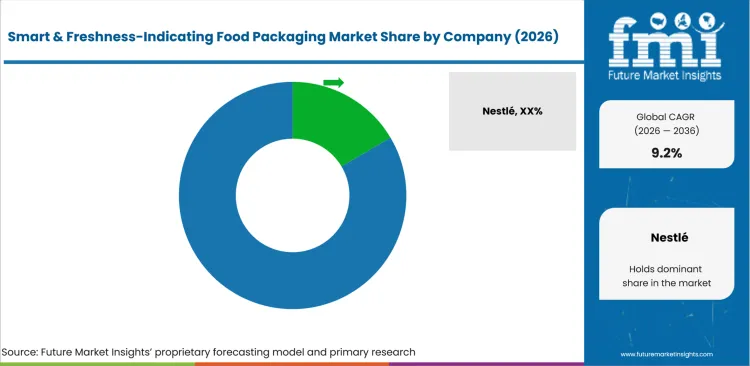
Competition is fragmented across food-pack conversion, unit-level identification and direct condition sensing because no company covers every use case with one platform. Entry barriers rise when smart labels or sensors must pass food-contact review without reducing print, filling or recovery performance on existing lines. Food manufacturers therefore compare signal reliability with integration cost and service coverage before moving a trial into recurring production.
- Tetra Pak, Amcor, Mondi, Avery Dennison and SATO compete where commercial programs need packaging or labeling scale plus digital identity or material integration.
- Timestrip, SpotSee and Mimica compete on package-level temperature or freshness signals that require limited reader infrastructure at receiving or retail decision points.
Competitive Benchmarking: Smart & Freshness-Indicating Food Packaging Market
| Company | Freshness or Condition Sensing | Package-Level Digital Identity | High-Volume Food-Pack Integration | Geographic Reach |
|---|---|---|---|---|
| Tetra Pak | Low | High | High | Global food and beverage packaging network |
| Amcor | Low | Low | High | Global consumer-packaging network |
| Mondi | Low | Medium | High | Europe-led network with international reach |
| Avery Dennison | Medium | High | High | Global identification and label network |
| SATO | Low | High | High | Asia-led auto-ID network with global operations |
| Timestrip | High | Low | Medium | UK base with international distribution |
| SpotSee | High | High | Medium | North America base with global distribution |
| Mimica | High | Low | Medium | UK specialist with partner-led food trials |
Key Developments in the Smart & Freshness-Indicating Food Packaging Market
- In June 2026, SATO announced it had completed a share transfer agreement to acquire Hiranoya Bussan as a wholly-owned subsidiary, adding a food flexible-packaging operation it plans to combine with 2D barcode and RFID capabilities.
- In October 2025, Avery Dennison and Walmart announced fresh-category RFID deployment across bakery plus meat and deli departments with digital use-by dates for rotation and markdown decisions.
- In January 2025, SpotSee launched WarmMark QR as a battery-free time-temperature indicator that pairs a visual excursion signal with cloud records from smartphone scans.
Key Players in the Smart & Freshness-Indicating Food Packaging Market
Packaging and Digital Identification Platforms
- Tetra Pak
- Amcor
- Mondi
- Avery Dennison
- SATO
Time-Temperature Monitoring Specialists
- Timestrip
- SpotSee
Dynamic Freshness Indicators
- Mimica
Smart & Freshness-Indicating Food Packaging Market - Report Scope
| Coverage field | Report scope |
|---|---|
| Market breakdown | By type, material, application and region. |
| Quantitative Units | Revenue in USD billion and CAGR in %. |
| Market Definition | Commercial food-packaging formats that display, record or digitally communicate product freshness, temperature exposure or traceability information at package level. Ordinary packaging without a smart information function and stand-alone logistics monitors outside the package are excluded. |
| Regions Covered | North America, Latin America, Europe, East Asia, South Asia and Pacific and Middle East and Africa. |
| Countries Covered | Australia, USA, UK, Germany, Japan, and 20+ countries included in the full report. |
| Key Companies Profiled | Tetra Pak, Amcor, Mondi, Avery Dennison, SATO, Timestrip, SpotSee, Mimica. |
| Forecast Period | 2026 to 2036. |
| Approach | Primary and secondary research with market triangulation. |
Smart & Freshness-Indicating Food Packaging Market - Research Methodology
| Method | Approach |
|---|---|
| Primary Research | FMI analysts gathered input from manufacturers, service providers, technology developers, distributors, end users, procurement teams, and subject-matter experts. Interviews examined purchasing decisions, product or service evaluation, adoption barriers, approval requirements, pricing considerations, and expectations for technical or commercial support. Respondents were also asked what evidence is required before a trial, pilot, or initial order develops into regular purchasing. |
| Desk Research | Desk research covered government statistics, regulatory publications, trade data, industry associations, technical literature, standards, company filings, product information, and official corporate announcements. Sources were reviewed for relevance, publication date, geographic coverage, and consistency with the defined market scope. Claims relating to performance, applications, approvals, capacity, investment, and commercial activity were retained only when supported by credible public evidence. |
| Market Sizing and Forecasting | The market model combined the baseline value with historical performance, segment structure, pricing and volume indicators, adoption levels, company participation, and country-level demand conditions. Forecast assumptions considered economic activity, investment trends, regulatory developments, technology adoption, purchasing cycles, supply availability, and barriers to wider market use. Segment and regional estimates were reconciled before the final market total was calculated. |
| Data Validation | Estimates were checked against multiple independent indicators, including public data, company activity, trade patterns, industry developments, and findings from primary interviews. Validation also tested whether products, services, applications, and company revenues fell within the defined market boundaries. Adjacent categories, unsupported claims, overlapping revenues, and activities without direct market relevance were excluded to reduce double counting and maintain consistency across segments and countries. |
Smart & Freshness-Indicating Food Packaging Market by Segments
Smart & Freshness-Indicating Food Packaging Market segmented by Type:
- Freshness Indicators
- TTI
- Sensors
- QR/Smart Labels
Smart & Freshness-Indicating Food Packaging Market segmented by Material:
- Paper & Paperboard
- Plastic
- Bio-Based Polymers
- Metal
Smart & Freshness-Indicating Food Packaging Market segmented by Application:
- Dairy
- Meat
- Produce
- Bakery
Smart & Freshness-Indicating Food Packaging Market by Region:
- North America
- United States
- Canada
- Latin America
- Brazil
- Mexico
- Chile
- Rest of Latin America
- Western Europe
- Germany
- United Kingdom
- Italy
- Spain
- France
- Nordics
- Benelux
- Rest of Western Europe
- Eastern Europe
- Russia
- Poland
- Hungary
- Balkan and Baltic States
- Rest of Eastern Europe
- East Asia
- China
- Japan
- South Korea
- South Asia and Pacific
- India
- ASEAN
- Australia and New Zealand
- Rest of South Asia and Pacific
- Middle East and Africa
- Kingdom of Saudi Arabia
- Other GCC Countries
- Türkiye
- South Africa
- Other African Union Countries
- Rest of Middle East and Africa
Research Sources and Bibliography
- USA Food and Drug Administration. (2026, July 2). FSMA Final Rule on Requirements for Additional Traceability Records for Certain Foods.
- Food Standards Agency. (2026, March 27). Consumers’ Food Safety Practices in the Home: Trends and Insights From 2020 to 2025.
- Mimica. (2025, May 28). Household steak trial results: Bump Tag boosts trust in freshness.
- Mondi. (2025, September 17). Mondi introduces white digital printing for corrugated packaging, unlocking new branding possibilities.
- Tetra Pak. (2026, April 22). Tetra Pak and Sterilgarda Alimenti Launch Industry-First 1-Litre Aseptic Carton with Paper-Based Barrier.
- Australian Department of Climate Change, Energy, the Environment and Water. (2025, December 19). Reducing Australia’s food waste.
- Avery Dennison. (2026, February 25). Avery Dennison launches AD IdentiFresh™ to unlock efficiency, freshness and waste reduction in food retail.
- Amcor. (2025, May 12). Amcor and Metsä Group partner to develop molded fiber-based food packaging solutions.
- Australian Department of Climate Change, Energy, the Environment and Water. (2026, February 3). A circular economy for packaging in Australia.
- USA Environmental Protection Agency. (2025, April 4). Estimating the Cost of Food Waste to American Consumers.
- WRAP. (2026, March 9). Understanding household food waste in the UK: the Household Food Management Survey 2025.
- Kuntscher, M., & Schmidt, T. G. (2025, December). Pakt gegen Lebensmittelverschwendung im Groß- und Einzelhandel - Ergebnisbericht zum Monitoring 2024.
- Ministry of Agriculture, Forestry and Fisheries, Japan. (2026, June 30).
- Timestrip. (2026, May 13). Advancing Food Monitoring: From Cold Chain Control to Food on the Move.
- SATO. (2026, June 23). SATO acquires Hiranoya Bussan as a wholly-owned subsidiary to strengthen its smart packaging business.
- Avery Dennison Corporation. (2025, October 22). Walmart and Avery Dennison Collaborate to Enhance Freshness and Increase Operational Efficiency Using RFID.
- SpotSee. (2025, January 8). SpotSee Launches WarmMark QR; Revolutionizing Cold Chain Monitoring with Smart, Low-cost, Sustainable Technology.
This bibliography is provided for reader reference and is not exhaustive. The full report contains the complete reference list and detailed citations.
This Report Answers
- What values define the 2026 to 2036 outlook for the smart & freshness-indicating food packaging market?
- Which package-level information mechanisms can convert food-waste pressure into recurring commercial demand for food processors and retailers?
- Why do freshness indicators hold the leading position within the type category for package-level condition decisions?
- How does paper & paperboard affect smart-feature integration within the material category across commercial food-packaging programs?
- Why does dairy provide a repeatable operating case for freshness and traceability functions across high-volume packaging lines?
- Which qualification conditions can prevent a technically accurate smart feature from reaching full commercial rollout across food categories?
- How do the five profiled country CAGRs differ once local qualification conditions and operating routes are considered?
- Which supplier capabilities distinguish the eight companies profiled across sensing, digital identity and high-volume pack integration?
- Which 2025 and 2026 company developments changed current supply options for smart identification and condition monitoring?
Frequently Asked Questions
How big is the smart & freshness-indicating food packaging market in 2026?
The smart & freshness-indicating food packaging market is valued at USD 22.3 billion in 2026 and is projected to reach USD 53.8 billion by 2036. Growth is driven by increasing demand for packaging solutions that improve freshness monitoring, traceability, and food quality management across supply chains.
What is the CAGR of the smart & freshness-indicating food packaging market from 2026 to 2036?
The smart & freshness-indicating food packaging market is projected to grow at a CAGR of 9.2% between 2026 and 2036. Expansion is supported by rising adoption of intelligent packaging technologies that provide real-time product condition information.
Which type leads the smart & freshness-indicating food packaging market?
Freshness indicators are projected to account for 49.4% of the market in 2026. Their leading share is supported by their ability to provide clear and easily interpretable product-condition information for retailers and consumers.
Which material leads the smart & freshness-indicating food packaging market?
Paper & paperboard are projected to account for 51.9% of the market in 2026. Their dominance is driven by strong compatibility with printed indicators, digital tracking features, and sustainability-focused packaging initiatives.
Which companies are active in the smart & freshness-indicating food packaging market?
Key companies operating in the market include Tetra Pak, Amcor, Mondi, Avery Dennison, SATO, Timestrip, SpotSee, and Mimica. These companies compete through intelligent packaging technologies, freshness-monitoring solutions, and product traceability capabilities.
Preview the report firsthand - request a free sample
Get SampleGet the brochure for pricing and purchase details.
Get PDFTable of Content
- Key Takeaways
- Market Size and CAGR
- Top Growth Driver
- Fastest Growing Segment
- Leading Region
- Key Companies
- Emerging Opportunities
- Executive Summary
- Global Market Outlook
- Demand-side Trends
- Supply-side Trends
- Technology Roadmap Analysis
- Analysis and Recommendations
- Analyst Perspective (What is happening? Why now? What should investors know?)
- Key Questions Answered
- How large is the market?
- What is the CAGR?
- What are key trends?
- Which region dominates?
- Who are the leaders?
- Market Overview
- Market Coverage / Taxonomy
- Market Definition / Scope / Limitations
- Research Methodology
- Chapter Orientation
- Analytical Lens and Working Hypotheses
- Market Structure, Signals, and Trend Drivers
- Benchmarking and Cross-market Comparability
- Market Sizing, Forecasting, and Opportunity Mapping
- Research Design and Evidence Framework
- Desk Research Programme (Secondary Evidence)
- Expert Input and Fieldwork (Primary Evidence)
- Tooling, Models, and Reference Databases
- Data Engineering and Model Build
- Quality Assurance and Audit Trail
- Market Background
- Market Dynamics (Drivers, Restraints, Opportunity, Trends)
- Scenario Forecast (Optimistic, Likely, Conservative)
- Impact Analysis
- AI Impact
- Sustainability Impact
- Regulatory Impact
- Technology Impact
- Consumer / Buyer Analysis
- Purchase Drivers
- Adoption Barriers
- Buyer Journey
- Opportunity Map Analysis
- Product Life Cycle Analysis
- Supply Chain Analysis
- Investment Feasibility Matrix
- Value Chain Analysis
- PESTLE and Porter's Analysis
- Regulatory Landscape
- Regional Parent Market Outlook
- Production and Consumption Statistics
- Import and Export Statistics
- Global Market Analysis and Forecast, 2021 to 2036
- Historical Market Size Value (USD Billion) Analysis, 2021 to 2025
- Current and Future Market Size Value (USD Billion) Projections, 2026 to 2036
- Y-o-Y Growth Trend Analysis
- Absolute $ Opportunity Analysis
- Global Market Pricing Analysis, 2021 to 2036
- Global Market Analysis and Forecast, By Type, 2021 to 2036
- Introduction / Key Findings
- Historical Market Size Value (USD Billion) Analysis By Type, 2021 to 2025
- Current and Future Market Size Value (USD Billion) Analysis and Forecast By Type, 2026 to 2036
- Freshness Indicators
- TTI
- Sensors
- QR/Smart Labels
- Freshness Indicators
- Y-o-Y Growth Trend Analysis By Type, 2021 to 2025
- Absolute $ Opportunity Analysis By Type, 2026 to 2036
- Global Market Analysis and Forecast, By Material, 2021 to 2036
- Introduction / Key Findings
- Historical Market Size Value (USD Billion) Analysis By Material, 2021 to 2025
- Current and Future Market Size Value (USD Billion) Analysis and Forecast By Material, 2026 to 2036
- Paper & Paperboard
- Plastic
- Bio-Based Polymers
- Metal
- Paper & Paperboard
- Y-o-Y Growth Trend Analysis By Material, 2021 to 2025
- Absolute $ Opportunity Analysis By Material, 2026 to 2036
- Global Market Analysis and Forecast, By Application, 2021 to 2036
- Introduction / Key Findings
- Historical Market Size Value (USD Billion) Analysis By Application, 2021 to 2025
- Current and Future Market Size Value (USD Billion) Analysis and Forecast By Application, 2026 to 2036
- Dairy
- Meat
- Produce
- Bakery
- Dairy
- Y-o-Y Growth Trend Analysis By Application, 2021 to 2025
- Absolute $ Opportunity Analysis By Application, 2026 to 2036
- Global Market Analysis and Forecast, By Region, 2021 to 2036
- Introduction
- Historical Market Size Value (USD Billion) Analysis By Region, 2021 to 2025
- Current Market Size Value (USD Billion) Analysis and Forecast By Region, 2026 to 2036
- North America
- Latin America
- Western Europe
- Eastern Europe
- East Asia
- South Asia and Pacific
- Middle East & Africa
- Market Attractiveness Analysis By Region
- North America Market Analysis and Forecast, By Country, 2021 to 2036
- Historical Market Size Value (USD Billion) Trend Analysis By Market Taxonomy, 2021 to 2025
- Market Size Value (USD Billion) Forecast By Market Taxonomy, 2026 to 2036
- By Country
- USA
- Canada
- By Type
- By Material
- By Application
- By Country
- Market Attractiveness Analysis
- By Country
- By Type
- By Material
- By Application
- Key Takeaways
- Latin America Market Analysis and Forecast, By Country
- Historical Market Size Value (USD Billion) Trend Analysis By Market Taxonomy, 2021 to 2025
- Market Size Value (USD Billion) Forecast By Market Taxonomy, 2026 to 2036
- By Country
- Brazil
- Mexico
- Chile
- Rest of Latin America
- By Type
- By Material
- By Application
- By Country
- Market Attractiveness Analysis
- By Country
- By Type
- By Material
- By Application
- Key Takeaways
- Western Europe Market Analysis and Forecast, By Country
- Historical Market Size Value (USD Billion) Trend Analysis By Market Taxonomy, 2021 to 2025
- Market Size Value (USD Billion) Forecast By Market Taxonomy, 2026 to 2036
- By Country
- Germany
- UK
- Italy
- Spain
- France
- Nordic
- BENELUX
- Rest of Western Europe
- By Type
- By Material
- By Application
- By Country
- Market Attractiveness Analysis
- By Country
- By Type
- By Material
- By Application
- Key Takeaways
- Eastern Europe Market Analysis and Forecast, By Country
- Historical Market Size Value (USD Billion) Trend Analysis By Market Taxonomy, 2021 to 2025
- Market Size Value (USD Billion) Forecast By Market Taxonomy, 2026 to 2036
- By Country
- Russia
- Poland
- Hungary
- Balkan & Baltic
- Rest of Eastern Europe
- By Type
- By Material
- By Application
- By Country
- Market Attractiveness Analysis
- By Country
- By Type
- By Material
- By Application
- Key Takeaways
- East Asia Market Analysis and Forecast, By Country
- Historical Market Size Value (USD Billion) Trend Analysis By Market Taxonomy, 2021 to 2025
- Market Size Value (USD Billion) Forecast By Market Taxonomy, 2026 to 2036
- By Country
- China
- Japan
- South Korea
- By Type
- By Material
- By Application
- By Country
- Market Attractiveness Analysis
- By Country
- By Type
- By Material
- By Application
- Key Takeaways
- South Asia and Pacific Market Analysis and Forecast, By Country
- Historical Market Size Value (USD Billion) Trend Analysis By Market Taxonomy, 2021 to 2025
- Market Size Value (USD Billion) Forecast By Market Taxonomy, 2026 to 2036
- By Country
- India
- ASEAN
- Australia & New Zealand
- Rest of South Asia and Pacific
- By Type
- By Material
- By Application
- By Country
- Market Attractiveness Analysis
- By Country
- By Type
- By Material
- By Application
- Key Takeaways
- Middle East & Africa Market Analysis and Forecast, By Country
- Historical Market Size Value (USD Billion) Trend Analysis By Market Taxonomy, 2021 to 2025
- Market Size Value (USD Billion) Forecast By Market Taxonomy, 2026 to 2036
- By Country
- Kingdom of Saudi Arabia
- Other GCC Countries
- Türkiye
- South Africa
- Other African Union
- Rest of Middle East & Africa
- By Type
- By Material
- By Application
- By Country
- Market Attractiveness Analysis
- By Country
- By Type
- By Material
- By Application
- Key Takeaways
- Key Countries Market Analysis
- USA
- Pricing Analysis
- Market Share Analysis, 2025
- By Type
- By Material
- By Application
- Canada
- Pricing Analysis
- Market Share Analysis, 2025
- By Type
- By Material
- By Application
- Mexico
- Pricing Analysis
- Market Share Analysis, 2025
- By Type
- By Material
- By Application
- Brazil
- Pricing Analysis
- Market Share Analysis, 2025
- By Type
- By Material
- By Application
- Chile
- Pricing Analysis
- Market Share Analysis, 2025
- By Type
- By Material
- By Application
- Germany
- Pricing Analysis
- Market Share Analysis, 2025
- By Type
- By Material
- By Application
- UK
- Pricing Analysis
- Market Share Analysis, 2025
- By Type
- By Material
- By Application
- Italy
- Pricing Analysis
- Market Share Analysis, 2025
- By Type
- By Material
- By Application
- Spain
- Pricing Analysis
- Market Share Analysis, 2025
- By Type
- By Material
- By Application
- France
- Pricing Analysis
- Market Share Analysis, 2025
- By Type
- By Material
- By Application
- India
- Pricing Analysis
- Market Share Analysis, 2025
- By Type
- By Material
- By Application
- ASEAN
- Pricing Analysis
- Market Share Analysis, 2025
- By Type
- By Material
- By Application
- Australia & New Zealand
- Pricing Analysis
- Market Share Analysis, 2025
- By Type
- By Material
- By Application
- China
- Pricing Analysis
- Market Share Analysis, 2025
- By Type
- By Material
- By Application
- Japan
- Pricing Analysis
- Market Share Analysis, 2025
- By Type
- By Material
- By Application
- South Korea
- Pricing Analysis
- Market Share Analysis, 2025
- By Type
- By Material
- By Application
- Russia
- Pricing Analysis
- Market Share Analysis, 2025
- By Type
- By Material
- By Application
- Poland
- Pricing Analysis
- Market Share Analysis, 2025
- By Type
- By Material
- By Application
- Hungary
- Pricing Analysis
- Market Share Analysis, 2025
- By Type
- By Material
- By Application
- Kingdom of Saudi Arabia
- Pricing Analysis
- Market Share Analysis, 2025
- By Type
- By Material
- By Application
- Türkiye
- Pricing Analysis
- Market Share Analysis, 2025
- By Type
- By Material
- By Application
- South Africa
- Pricing Analysis
- Market Share Analysis, 2025
- By Type
- By Material
- By Application
- USA
- Market Structure Analysis
- Competition Dashboard
- Competition Benchmarking
- Market Share Analysis of Top Players
- By Regional
- By Type
- By Material
- By Application
- Emerging Startups
- Innovation Benchmarking
- Competition Analysis
- Competition Deep Dive
- Nestlé
- Overview
- Product Portfolio
- Profitability by Market Segments
- Sales Footprint
- Strategy Overview
- Marketing Strategy
- Product Strategy
- Channel Strategy
- Tetra Pak
- Amcor
- Mondi
- Insignia Technologies
- Mimica
- Innoscentia
- Nestlé
- Case Studies
- Success Stories
- Recent Developments
- Competition Deep Dive
- Assumptions & Acronyms Used


