

- Market Size (2026)
- USD 5.4 Bn
- Forecast (2036)
- USD 10.5 Bn
- CAGR (2026 to 2036)
- 7.0%
Bio-based Adhesives Market Size, Market Forecast and Outlook By FMI
USD 5.4 billion in 2026 and USD 10.5 billion by 2036 at a 7.0% CAGR.
The bio-based adhesives market was valued at USD 5.0 billion in 2025.
It is expected to grow from USD 5.4 billion in 2026 to USD 10.5 billion by 2036 at a 7.0% CAGR. Starch adhesives are projected to account for 36.0% of product demand in 2026. Water-based systems are projected to represent 48.0% of technology demand in 2026.
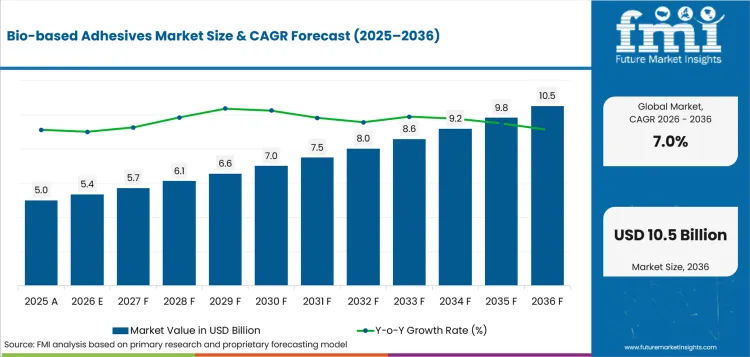
Bio-based Adhesives Market Overview: Size and Forecast
- 2026 Market Size: USD 5.4 billion
- 2036 Market Size: USD 10.5 billion
- Forecast CAGR: 7.0% from 2026 to 2036
- Leading Product Type: Starch Adhesives
- Starch Adhesives Share in 2026: 36.0%
- Leading Technology: Water-Based Systems
- Water-Based Systems Share in 2026: 48.0%
- Fastest-growing Country: India
- India CAGR: 8.4% by 2036
Summary of bio-based adhesives market
- Demand and Growth Drivers
- Packaging conversion is the largest demand driver, with packaging projected to hold 42.0% of application demand in 2026.
- Wood assembly is expected to hold 23.0% of application demand, as panel makers test soy and lignin binders for lower formaldehyde exposure.
- India is forecast at 8.4% CAGR, with paper packaging growth creating room for starch and water-based adhesive suppliers.
- China is expected to expand at 7.8% CAGR, as parcel packaging and courier packaging rules shape adhesive specifications.
- Germany is projected at 7.1% CAGR, with certification-backed purchasing giving mass-balance and bio-content claims more weight.
- Product and Segment View
- Starch adhesives are projected to lead the Product Type segment with 36.0% share as corrugated board and bag sealing use proven low-cost binders.
- Water-based systems are expected to lead the Technology segment with 48.0% share since paper packaging lines already use aqueous application equipment.
- Packaging is projected to lead the Application segment with 42.0% share, with carton sealing and labeling forming early repeat-purchase channels.
- Paper packaging is estimated to lead End Use with 34.0% share, given its fit with renewable adhesives and recycling checks.
- Direct supply is projected to lead Sales Channel with 46.0% share, where large converters need technical validation before plant-wide use.
- Geography and Competitive Outlook
- The United States is expected to grow at 6.9% CAGR, with BioPreferred purchasing and paper packaging demand supporting verified products.
- China and India are forecast to grow above the global pace, with China at 7.8% CAGR and India at 8.4% CAGR.
- Germany and France are shaped by EU packaging rules, with recyclability and reuse reporting affecting adhesive selection.
- Henkel, H.B. Fuller, Arkema, Avery Dennison, Jowat, Tex Year, and Sika form the verified competitive set.
- Specialist suppliers compete with bio-content depth and converter support, while larger suppliers win on certification and global supply security.
- Analyst Opinion
- Nikhil Kaitwade, Principal Consultant at Future Market Insights, says, "I see bio-based adhesives moving from renewable-content trials into purchasing rules for packaging and engineered wood. The strongest demand comes from buyers who cannot change the whole substrate stack but can change the bonding layer. Cost pressure is real, so suppliers need to prove run speed and open time before buyers accept a premium. Certification now carries more weight than a generic green claim. I would watch three signals closely. The first is mass-balance certification at adhesive plants. The second is formaldehyde-free binder use in wood panels. The third is whether paper packaging converters can use bio-based systems without slowing lines. Suppliers with application labs and verified carbon data will have the clearest advantage."
- What supports value in the bio-based adhesives market?
- Packaging demand, certified bio-content and line performance support value across regulated adhesive channels.
- The market is projected to rise from USD 5.4 billion in 2026 to USD 10.5 billion by 2036, with packaging redesign carrying the largest value gain.
- Starch and soy systems keep cost pressure manageable, as buyers can test renewable binders without redesigning every bonding process.
- Water-based systems are expected to hold 48.0% technology share in 2026, with paper converters using familiar pumps and applicators.
- Wood assembly demand is supported by formaldehyde-reduction goals, with soy and lignin systems competing against long-established urea-formaldehyde binders.
- Certification costs and feedstock variability will slow conversion in price-sensitive use cases, especially when fossil-based adhesives remain cheaper.
Supplier qualification is moving from a simple renewable-content claim toward proof of feedstock origin and line performance. Henkel’s September 2024 launch of Technomelt Supra 079 Eco Cool combined at least 49% direct bio-based content with application temperatures up to 40°C lower than conventional use conditions. This points to a buying shift in which converters value energy savings and paper recycling fit alongside renewable chemistry. Bostik’s September 2024 Kizen LIME launch used at least 80% renewable ingredients, which shows that carton sealing and wrap-around packaging are becoming the first large-volume proving grounds for bio-based adhesives. Buyers are expected to favor suppliers that can document bio-content and run at existing line speeds without bond failure.
Bio-based adhesives are bonding materials made partly or fully from renewable feedstocks such as starch, soy protein, lignin, rosin, casein, and plant oils. The scope includes adhesives used in packaging, labeling, wood panels, furniture, construction fixing, hygiene goods, and selected medical or consumer products. It excludes fossil-only synthetic adhesives, asphalt binders, dental adhesives, surgical sealants, and purely mechanical fixing systems. Mass-balance products are included only when suppliers provide verified renewable attribution.
Market scope covers commercially sold bio-based adhesive products by product type, technology, application, end use, sales channel, and geography across North America, Europe, East Asia, South Asia and Pacific, Latin America, and the Middle East and Africa.
Market scope excludes fossil-only adhesives, sealants without bonding function, asphalt emulsions, dental bonding agents, surgical glues, tape backings without adhesive revenue, and mechanical fasteners used without adhesive chemistry.
Why is the bio-based adhesives market growing?
Packaging converters and wood panel producers need bonding systems with renewable-content proof and dependable line performance.
- Paper packaging converters need adhesives that support fiber recovery, which favors starch and water-based bio systems.
- Wood panel makers are testing soy and lignin binders as formaldehyde scrutiny affects furniture and building product buyers.
- Large brand owners are asking suppliers for bio-content proof, which gives certified adhesive makers a clearer sales opening.
- Lower application-temperature hot melts reduce energy use on packaging lines, so converters can link chemistry shifts to plant costs.
- Public purchasing rules support verified bio-based product categories, with adhesives included in federal procurement lists.
Packaging is the first scaled use case because adhesive cost is small compared with the value of a failed pack. In September 2024, Henkel said Technomelt Supra 079 Eco Cool bonds folding cartons, trays, and wrap-around packaging at up to 40°C lower processing temperature. That means converters can test carbon savings without buying a new packaging line. The practical result is a faster route from trial batches to repeat orders. Suppliers that support trials on carton and label lines are expected to win earlier than firms selling only renewable-content claims. Public purchasing and product labeling create a second growth channel in the United States. The USA Department of Agriculture’s 2024 BioPreferred update listed adhesives as a category eligible for federal purchasing and product labeling. The same report noted about 10,000 products in the BioPreferred database and over 7,800 certified products. This gives buyers a known way to compare products that use renewable feedstocks. Adhesive suppliers gain from that structure when they can prove carbon content and meet application needs.
How is the bio-based adhesives market segmented?
The industry is segmented by product type, technology, application, end use and sales channel.
- With an estimated 36.0% share in 2026, Starch Adhesives are expected to lead Product Type through corrugated and paper bag bonding.
- Water-Based systems are projected to account for 48.0% of Technology demand in 2026 as paper converters use existing wet-glue equipment.
- Packaging buyers are expected to push Packaging to 42.0% of Application demand in 2026, given carton sealing and labeling use.
- Paper Packaging is anticipated to represent 34.0% of End Use demand in 2026 with fiber-based formats needing compatible bond lines.
- Direct Supply is projected to hold 46.0% of Sales Channel demand in 2026 since large converters need lab support and plant trials.
Segmentation reflects how buyers qualify adhesives inside running lines. Starch systems dominate where low cost and paper compatibility matter most. Bio-based hot melts are gaining attention where energy use and fast set times affect packaging economics. The compostable adhesives category overlaps with food-service packaging, but not every bio-based adhesive is compostable. This distinction affects supplier claims and buyer risk. The market will reward firms that match bio-content, bond strength, and end-of-life behavior to each application.
Bio-based Adhesives Market Analysis By Product Type
Starch adhesives hold 36.0% share in 2026 due to corrugated board and paper bag bonding.
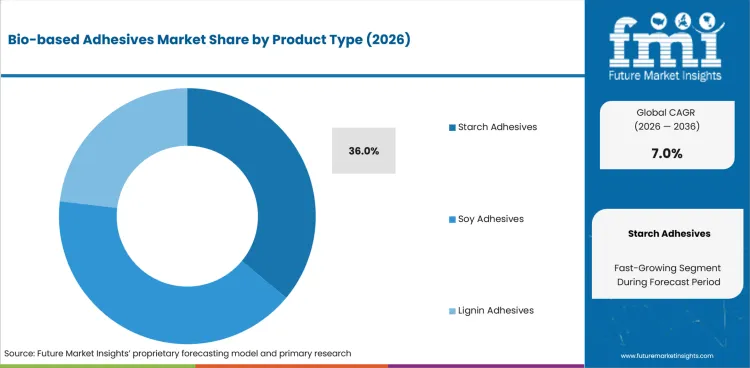
- Starch Adhesives are projected to account for 36.0% of product demand in 2026 as corrugated board and paper bag makers need low-cost wet glues with reliable tack.
- Buyers compare starch systems on viscosity stability and drying speed. Starch performs best in high-volume fiber packaging but loses ground where moisture resistance defines bond life.
Bio-based Adhesives Market Analysis By Technology
Water-based systems hold 48.0% share in 2026 as paper converters use established wet-glue equipment.
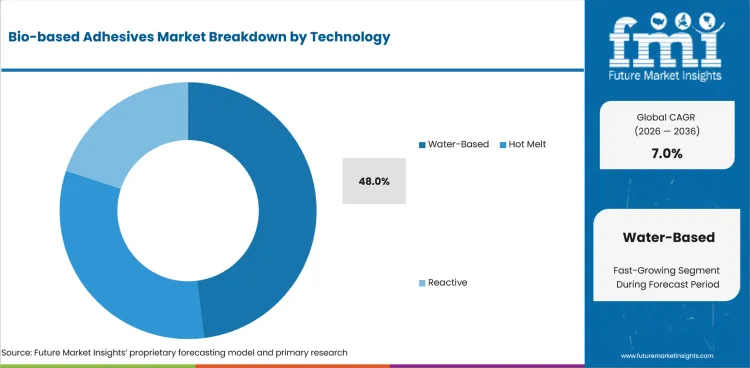
- Water-Based systems are expected to represent 48.0% of technology demand in 2026 as converters can use established pumps, tanks, and rollers for renewable formulations.
- Line managers often test water-based bio adhesives through small SKU runs first. Full conversion usually follows only after bond strength passes storage and transport stress.
Bio-based Adhesives Market Analysis By Application
Packaging holds 42.0% share in 2026 as cartons, labels and paper mailers create repeat orders.
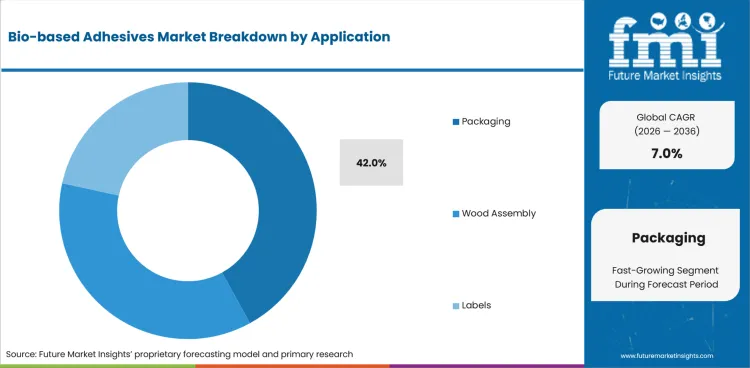
- Packaging is anticipated to hold 42.0% of application demand in 2026 since cartons, trays, labels, and paper mailers create repeat orders at high line speed.
- Brand owners push packaging converters for renewable content data. Adhesive suppliers then need test records showing recyclability fit for paper streams and low odor in food-contact settings.
Bio-based Adhesives Market Analysis By End Use
Paper packaging accounts for 34.0% share in 2026 as fiber formats need recycling-compatible bond lines.
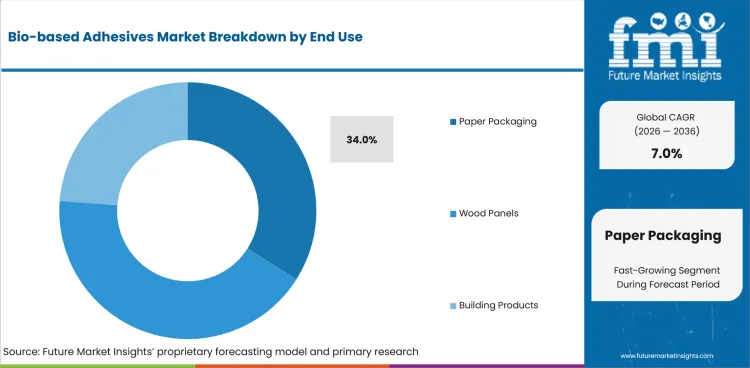
- Paper Packaging is projected to account for 34.0% of end-use demand in 2026 as fiber substitution increases interest in adhesives that do not disrupt recycling.
- The practical issue is repulping behavior. A bio-based adhesive with poor fiber-release performance can create more buyer resistance than a fossil adhesive with proven recycling compatibility.
Bio-based Adhesives Market Analysis By Sales Channel
Direct supply holds 46.0% share in 2026 because large converters need lab support and plant trials.
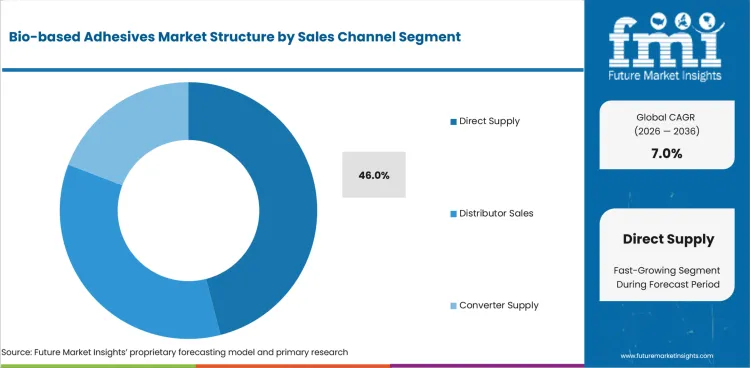
- Direct Supply is estimated to hold 46.0% of sales-channel demand in 2026 as large converters need supplier labs to tune viscosity and application temperature.
- Distributors serve smaller users well but rarely carry the full testing burden. Direct suppliers win bigger orders when they help customers qualify adhesives on existing equipment.
What are the drivers, restraints, and opportunities in the bio-based adhesives market?
Packaging qualification and wood bonding support demand while feedstock variability limits faster conversion.
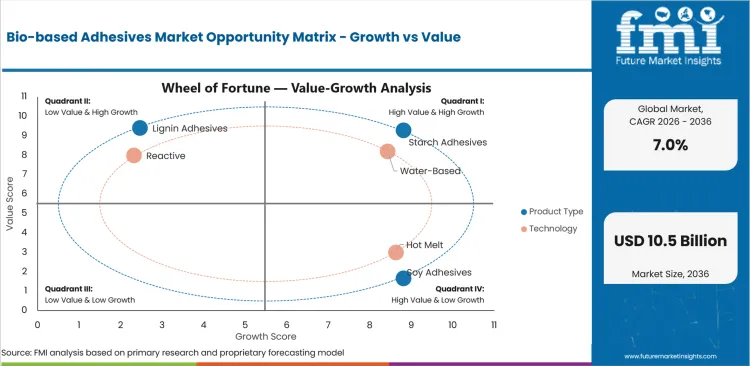
- Packaging recyclability checks favor adhesives with paper-stream compatibility, not only high renewable content.
- Formaldehyde pressure in wood panels opens room for soy and lignin binders, especially in furniture and interior building products.
- Mass-balance certification creates a route for large suppliers to scale renewable raw material use without separate plants.
- Feedstock variability restrains growth since starch, rosin, and plant oil prices can shift with food and forestry cycles.
- The main opportunity is certified low-temperature hot melt, where energy savings and bio-content strengthen the same buyer case.
Packaging Line Qualification
Packaging buyers adopt bio-based adhesives only when the adhesive survives real line speed and storage stress. Henkel’s September 2024 launch combined 49% direct bio-based raw materials with 30% ISCC-certified mass-balanced material. It also cut application temperature by up to 40°C and lowered cradle-to-gate carbon emissions by up to 25% versus conventional EVA hot melt. That makes the value case operational rather than only environmental. The hot melt adhesives segment therefore becomes a key crossover point between plant cost and renewable chemistry. Suppliers that prove set speed and clean running will gain repeat volume.
Formaldehyde-Free Wood Bonding
Wood panels form a harder but important adoption path. Bio-based binders must compete with urea-formaldehyde systems that are cheap and deeply established. Recent wood adhesive research highlights soy, lignin, tannin, and protein routes for composite panels, with performance and water resistance as recurring barriers. This means buyers will not switch on sustainability grounds alone. The wood adhesives and binders space will favor suppliers that can balance emissions reduction with press-cycle economics. Adoption is expected to be strongest in interior panels, furniture, and certified building products.
Certified Feedstock Control
Certification is becoming a purchase filter because buyers need audit-ready proof for packaging and product claims. H.B. Fuller said in January 2024 that its Lüneburg and Nienburg sites in Germany received ISCC PLUS certification. The company linked the certification to tracked bio-based and recycled raw materials across the supply chain. This matters for global converters that need common documentation across multiple plants. The industrial adhesives buyer now evaluates paperwork and plant reliability together. Smaller suppliers can compete if they bring local service and transparent batch data.
Who are the leading companies in the bio-based adhesives market?
Henkel, H.B. Fuller, Arkema Bostik, Avery Dennison and Jowat lead the verified supplier set.
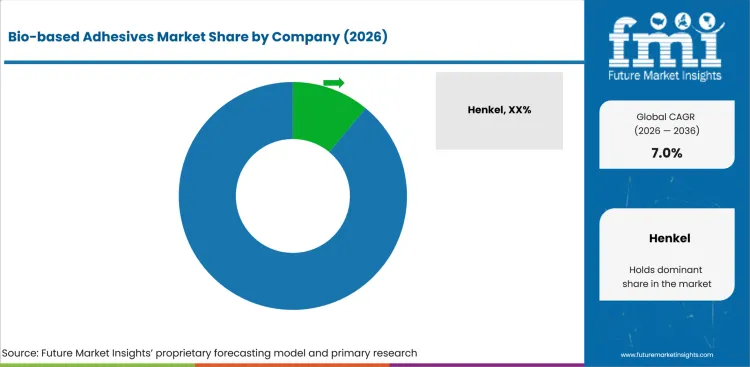
- The market is moderately concentrated, with global adhesive leaders holding the clearest certification and application-support positions.
- Specialist suppliers win where bio-content depth, compostability, or local converter support matter more than global scale.
- Entry barriers are highest in hot melt and reactive systems, since buyers require line trials and shelf-life proof.
- Starch and dextrin entry barriers are lower, but margin pressure is sharper in paper packaging accounts.
Established suppliers compete on formulation breadth and proof systems. Henkel’s September 2024 Technomelt launch shows how a leading firm ties bio-content to plant efficiency. The product combines renewable inputs with lower application temperature, which gives packaging buyers a measurable reason to trial it. This matters because the bio-based adhesive and fixing accessory solutions segment cannot scale on renewable-content claims alone. Buyers need a bond that works at speed and documentation that satisfies customers. Mass-balance supply is another competitive dividing line. H.B. Fuller’s January 2024 ISCC PLUS certification in Germany supports tracked renewable and recycled feedstock use across adhesive manufacturing. This gives global packaging accounts a way to standardize claims across markets. Smaller firms can compete in starch and casein adhesives, but they often lose large contracts when documentation and multi-site supply are required.
The water-based adhesive applicators value chain gains from this trend as converters tune equipment for lower-impact adhesive systems. Arkema’s Bostik business strengthened its packaging position through its December 2024 acquisition of Dow’s flexible packaging laminating adhesives business. Arkema said the acquired business had about USD 250 million in annual sales and five production sites. That kind of portfolio move changes the competitive field because flexible packaging needs food-contact knowledge and film-bonding performance. The reactive hot melt adhesive area remains more specialized since moisture curing and heat resistance raise the technical bar.
Entry is hardest where adhesives carry a warranty burden. Construction, medical, and specialty packaging buyers require clearer proof than simple paper carton users. Sika’s bio-based epoxy hardener work and H.B. Fuller’s sustainable roofing adhesive launch show how adjacent construction chemistries are moving toward renewable inputs. Suppliers entering these applications need testing depth, field support, and credible safety documents. The construction adhesives opportunity is therefore higher-value but slower than paper packaging.
Key Companies in the Bio-based Adhesives Market
The competitive structure is best viewed by role, since scale and application depth both shape buyer selection.
- Global Formulators: Henkel, H.B. Fuller, Arkema Bostik, 3M, and Sika hold the clearest positions in certified supply, global account access, and technical service. Henkel brings packaging hot melt depth. H.B. Fuller brings ISCC-certified production and packaging systems. Arkema Bostik combines flexible packaging adhesives with specialty materials. 3M and Sika participate through adhesive platforms and adjacent bio-based material systems.
- Label and Packaging Specialists: Avery Dennison and Jowat compete through labelstock, packaging, and converter-facing adhesive systems. Avery Dennison’s label materials include adhesives with bio-based components in selected product lines. Jowat’s Jowatherm GROW range targets bio-based hot melts for packaging and wood-related applications. These suppliers gain buyers where performance proof and converter support matter.
- Regional Bio-based Adhesive Specialists: Tex Year and selected European formulators compete by focusing on compostable, bio-based, and hot melt products. Tex Year’s 2025 biodegradable hot melt production line gives it a distinct Asia-Pacific position. Smaller firms can win if they serve local converters quickly and provide credible documentation on renewable content.
Competitive Benchmarking: Bio-based Adhesives Market
| Company | Bio-Content Verification Depth | Packaging Line Qualification | Wood and Construction Bonding Breadth | Geographic Footprint |
|---|---|---|---|---|
| Henkel | High | High | Strong | Global |
| H.B. Fuller | High | High | Strong | Global |
| Arkema Bostik | High | Strong | Strong | Global |
| 3M | Medium | Strong | Moderate | Global |
| Sika | Medium | Moderate | Strong | Global |
| Avery Dennison | Medium | Strong | Limited | Global |
| Jowat | Medium | Strong | Moderate | Europe-led |
| Tex Year | Medium | Moderate | Limited | Asia-Pacific-led |
Key Developments in Bio-based Adhesives Market
- In September 2024, Henkel launched Technomelt Supra 079 Eco Cool with at least 49% direct bio-based content. The launch matters for carton and tray bonding because it reduces application temperature.
- In September 2024, Arkema Bostik launched Kizen LIME packaging adhesives with at least 80% renewable ingredients. The launch strengthens bio-based options for packaging converters.
- In January 2024, H.B. Fuller received ISCC PLUS certification for its Lüneburg and Nienburg sites. The certification supports tracked bio-based and recycled feedstock use.
- In March 2025, H.B. Fuller launched Millennium PG-1 EF ECO2 roofing adhesive using naturally occurring environmental gases. The development shows renewable-material work moving into construction adhesives.
- In July 2025, Tex Year announced Asia’s first biodegradable hot melt adhesive dedicated production line. This supports higher-volume supply for bio-based hot melt applications.
Key Players in the Bio-based Adhesives Market
Global Formulators
- Henkel
- H.B. Fuller
- Arkema Bostik
- 3M
- Sika
Label and Packaging Specialists
- Avery Dennison
- Jowat
Regional Bio-based Adhesive Specialists
- Tex Year
- Paramelt
Which countries are growing fastest in the bio-based adhesives market?
India leads at 8.4% CAGR followed by China at 7.8% through 2036.
.webp "Top Country Growth Comparison Bio Based Adhesives Market Cagr (2026 2036)")
| Country | CAGR |
|---|---|
| United States | 6.9% |
| China | 7.8% |
| Germany | 7.1% |
| United Kingdom | 6.6% |
| India | 8.4% |
| Japan | 5.8% |
| France | 6.8% |
Source: Future Market Insights, 2026.
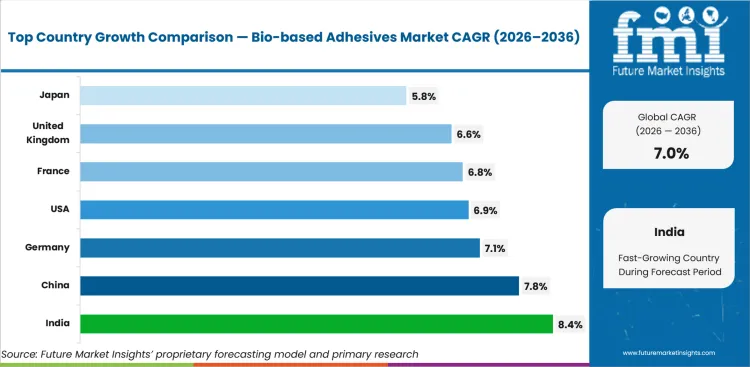
How do country-level CAGRs compare in the bio-based adhesives market?
India leads country growth while Japan records the most cautious expansion outlook among profiled markets.
- United States is projected to record 6.9% CAGR by 2036 based on its packaging scale and adhesive qualification environment.
- China is projected to record 7.8% CAGR by 2036 based on its packaging scale and adhesive qualification environment.
- Germany is projected to record 7.1% CAGR by 2036 based on its packaging scale and adhesive qualification environment.
- United Kingdom is projected to record 6.6% CAGR by 2036 based on its packaging scale and adhesive qualification environment.
- India is projected to record 8.4% CAGR by 2036 based on its packaging scale and adhesive qualification environment.
- Japan is projected to record 5.8% CAGR by 2036 based on its packaging scale and adhesive qualification environment.
- France is projected to record 6.8% CAGR by 2036 based on its packaging scale and adhesive qualification environment.
What is the bio-based adhesives market outlook in the United States?
A 6.9% CAGR through 2036 reflects BioPreferred purchasing and paper packaging demand.
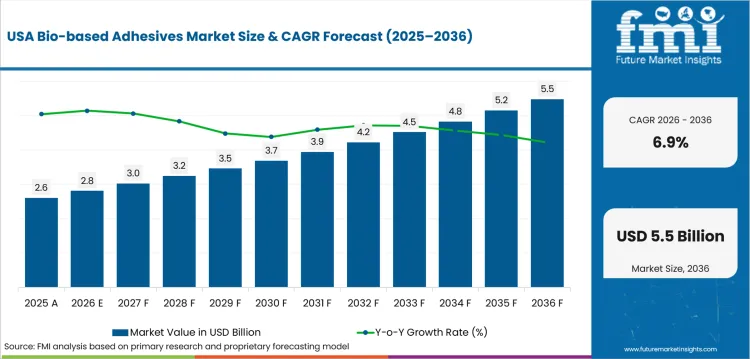
Country Market Snapshot Table
| Parameter | Value |
|---|---|
| Market Size in 2025 (Value) | USD 1,047.7 million |
| Market Size in 2026 (Value) | USD 1,120.0 million |
| Market Forecast in 2036 (Value) | USD 2,182.7 million |
| CAGR (2026 to 2036) | 6.9% |
| Years Considered | 2021 to 2036 |
| Base Year | 2025 |
| Forecast Period | 2026 to 2036 |
| Units Considered | Value (USD million) |
| Leading Sub-Region | Midwest and national packaging converter corridors |
United States Bio-based Adhesives Market Outlook
United States bio-based adhesive demand is shaped by verified public purchasing and high-volume packaging conversion.
Converters are expected to favor products that prove bio-content and line performance before plant-wide approval.
Key Growth Drivers
- Federal purchasing gives certified adhesive suppliers a clearer entry route. USDA’s BioPreferred program lists adhesives as a designated product category for federal purchasing preference.
- Packaging and e-commerce lines create steady trial demand. USA Census Bureau reported first-quarter 2026 retail e-commerce sales of USD 302.3 billion on a not adjusted basis.
- Large converters can test starch and water-based systems on carton and label lines before wider procurement approval.
- Domestic adhesive suppliers can support qualification through application labs and direct technical service.
Key Restraints
- Paper-stream compatibility remains difficult outside corrugated formats. EPA reported paper containers and packaging excluding corrugated boxes had a 20.8% recycling rate in 2018.
- Bio-based products can lose buyer support when renewable content is not linked to bond strength and open-time data.
- Feedstock price swings can narrow the cost gap against fossil-based hot melts and acrylic adhesives.
What makes United States unique
The United States has the clearest public purchasing reference for certified bio-based adhesive qualification.
Key Companies
- Henkel Corporation
- H.B. Fuller Company
- 3M Company
- Avery Dennison Corporation
- Arkema Inc.
- Sika Corporation
- Franklin International
Sales & Marketing Channels
- Direct converter supply
- Distributor sales
- Packaging line trials
- OEM contracts
- E-commerce supplier portals
- Specialty adhesive distributors
Country Segment Breakdown Table
| Segment | Sub-Segments |
|---|---|
| By Product Type | Starch Adhesives · Soy Adhesives · Lignin Adhesives · Rosin Adhesives · Protein Adhesives · Plant Oil Adhesives |
| By Technology | Water-Based · Hot Melt · Reactive · Solvent-Free |
| By Application | Packaging · Wood Assembly · Construction · Labels · Hygiene |
| By End Use | Paper Packaging · Wood Panels · Building Products · Consumer Goods · Medical Goods |
| By Sales Channel | Direct Supply · Distributor Sales · Converter Supply · OEM Contracts · Online Sales |
| Key Sub-Regions Covered, Packaging and Industrial Corridors | Midwest · Southeast · California · Texas · Northeast · Pacific Northwest |
Frequently Asked Questions
How fast is United States bio-based adhesives market growing?
The United States is expected to grow at 6.9% CAGR from 2026 to 2036 through certified purchasing and converter-led packaging trials.
Who leads United States bio-based adhesives market?
Henkel, H.B. Fuller, 3M, Avery Dennison, Arkema, and Sika compete through converter service and verified bio-content portfolios.
What is driving adoption in United States bio-based adhesives market?
BioPreferred purchasing rules and e-commerce packaging demand are moving suppliers toward certified and line-tested adhesive systems.
What is driving bio-based adhesives growth in China?
A 7.8% CAGR through 2036 is supported by parcel scale and large paper packaging demand.
Country Market Snapshot Table
| Parameter | Value |
|---|---|
| Market Size in 2025 (Value) | USD 797.8 million |
| Market Size in 2026 (Value) | USD 860.0 million |
| Market Forecast in 2036 (Value) | USD 1,822.6 million |
| CAGR (2026 to 2036) | 7.8% |
| Years Considered | 2021 to 2036 |
| Base Year | 2025 |
| Forecast Period | 2026 to 2036 |
| Units Considered | Value (USD million) |
| Leading Sub-Region | Yangtze River Delta and Pearl River Delta converter clusters |
China Bio-based Adhesives Market Outlook
China bio-based adhesive demand is shaped by express delivery scale and packaging-waste controls. Price discipline remains high, so suppliers need low-cost starch systems and local technical support.
Key Growth Drivers
- Parcel packaging gives adhesive suppliers a large test base. State Council Information Office reported China handled over 175 billion parcels in 2024.
- Online retail supports carton and label consumption. National Bureau of Statistics reported China’s 2024 online retail sales at 15,522.5 billion yuan.
- Large export manufacturers can test water-based adhesives where buyer specifications require cleaner packaging documentation.
- Local converters can scale starch and dextrin adhesives through established paper packaging and footwear supply chains.
Key Restraints
- Courier packaging waste keeps material selection under review. State Post Bureau data cited 9.92 billion packaging boxes and 16.98 billion meters of tape consumed in 2022.
- Low-cost synthetic adhesives can delay conversion when buyers prioritize price over renewable feedstock content.
- Regional quality differences can slow adoption when small converters lack testing records and consistent application control.
What makes China unique
China offers the largest volume pathway for carton and label adhesives among profiled countries.
Key Companies
- Henkel China
- H.B. Fuller China
- Arkema Bostik China
- Avery Dennison China
- Sika China
- Tex Year China
- Shanghai Kangda New Materials
Sales & Marketing Channels
- Direct supply to converters
- Local technical agents
- Industrial distributors
- Packaging parks
- Export manufacturing accounts
- Online B2B procurement
Country Segment Breakdown Table
| Segment | Sub-Segments |
|---|---|
| By Product Type | Starch Adhesives · Soy Adhesives · Lignin Adhesives · Rosin Adhesives · Protein Adhesives · Plant Oil Adhesives |
| By Technology | Water-Based · Hot Melt · Reactive · Solvent-Free |
| By Application | Packaging · Wood Assembly · Construction · Labels · Hygiene |
| By End Use | Paper Packaging · Wood Panels · Building Products · Consumer Goods · Medical Goods |
| By Sales Channel | Direct Supply · Distributor Sales · Converter Supply · OEM Contracts · Online Sales |
| Key Sub-Regions Covered, Packaging and Industrial Corridors | Shanghai · Guangdong · Zhejiang · Jiangsu · Shandong · Fujian |
Frequently Asked Questions
How fast is China bio-based adhesives market growing?
China is forecast to expand at 7.8% CAGR from 2026 to 2036 through parcel packaging and export converter demand.
Who leads China bio-based adhesives market?
Henkel China, H.B. Fuller China, Arkema Bostik China, Avery Dennison China, and Tex Year China compete through local adhesive access.
What is driving adoption in China bio-based adhesives market?
Parcel volume and online retail scale are moving Chinese converters toward cost-controlled bio-based carton and label adhesives.
How is the bio-based adhesives market performing in Germany?
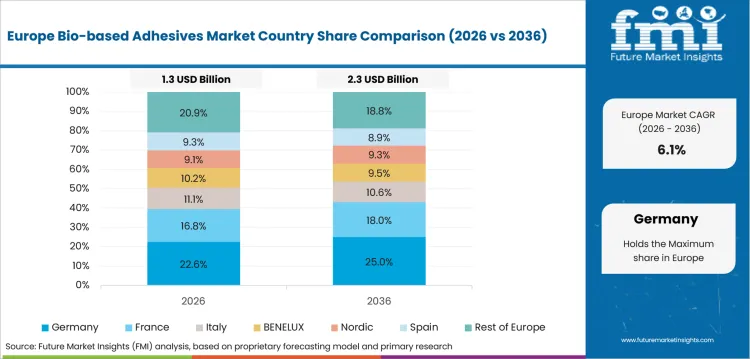
A 7.1% CAGR through 2036 reflects certification-led purchasing and packaging design rules.
Country Market Snapshot Table
| Parameter | Value |
|---|---|
| Market Size in 2025 (Value) | USD 485.5 million |
| Market Size in 2026 (Value) | USD 520.0 million |
| Market Forecast in 2036 (Value) | USD 1,032.5 million |
| CAGR (2026 to 2036) | 7.1% |
| Years Considered | 2021 to 2036 |
| Base Year | 2025 |
| Forecast Period | 2026 to 2036 |
| Units Considered | Value (USD million) |
| Leading Sub-Region | North Rhine-Westphalia and southern industrial packaging clusters |
Germany Bio-based Adhesives Market Outlook
Germany bio-based adhesive demand is guided by documentation-heavy packaging and industrial qualification. Suppliers with ISCC PLUS records and recycling-fit evidence are expected to gain stronger converter access.
Key Growth Drivers
- Packaging recycling systems support proof-based adhesive selection. Germany’s Environment Ministry reported a 69.4% total packaging recycling quota for 2023.
- Paper and carton applications provide a strong fit. Germany’s Environment Ministry reported an 86.6% paper and carton packaging recycling quota for 2023.
- Certification-backed supply supports mass-balance adhesive purchasing by large packaging and label converters.
- Industrial buyers can adopt bio-based systems when suppliers document viscosity stability and end-of-life performance.
Key Restraints
- Plastic packaging remains a tougher claim area. Germany’s Environment Ministry reported a 52.2% recycling quota for plastic packaging in 2023.
- Technical buyers reject renewable-content claims when suppliers cannot show EN, ISCC, or recycling evidence.
- High energy and labor costs can keep buyers focused on process efficiency rather than feedstock conversion alone.
What makes Germany unique
Germany is the strongest profiled market for certification-driven adhesive purchasing and technical qualification.
Key Companies
- Henkel AG & Co. KGaA
- Jowat SE
- H.B. Fuller Deutschland GmbH
- Sika Deutschland GmbH
- Bostik GmbH
- Wacker Chemie AG
- Uzin Utz SE
Sales & Marketing Channels
- Direct industrial supply
- Technical distributors
- Packaging converter contracts
- Wood-panel accounts
- Label material suppliers
- OEM procurement teams
Country Segment Breakdown Table
| Segment | Sub-Segments |
|---|---|
| By Product Type | Starch Adhesives · Soy Adhesives · Lignin Adhesives · Rosin Adhesives · Protein Adhesives · Plant Oil Adhesives |
| By Technology | Water-Based · Hot Melt · Reactive · Solvent-Free |
| By Application | Packaging · Wood Assembly · Construction · Labels · Hygiene |
| By End Use | Paper Packaging · Wood Panels · Building Products · Consumer Goods · Medical Goods |
| By Sales Channel | Direct Supply · Distributor Sales · Converter Supply · OEM Contracts · Online Sales |
| Key Sub-Regions Covered, Packaging and Industrial Corridors | North Rhine-Westphalia · Bavaria · Baden-Württemberg · Hesse · Lower Saxony · Hamburg |
Frequently Asked Questions
How fast is Germany bio-based adhesives market growing?
Germany is projected to grow at 7.1% CAGR from 2026 to 2036 through certification-backed adhesive purchasing.
Who leads Germany bio-based adhesives market?
Henkel, Jowat, H.B. Fuller Deutschland, Sika Deutschland, and Bostik GmbH compete through local formulation and converter support.
What is driving adoption in Germany bio-based adhesives market?
Packaging recycling rules and mass-balance certification are pushing German buyers toward verified bio-based adhesive systems.
What is the bio-based adhesives market outlook in the United Kingdom?
A 6.6% CAGR through 2036 reflects EPR reporting and paper packaging recycling pressure.
Country Market Snapshot Table
| Parameter | Value |
|---|---|
| Market Size in 2025 (Value) | USD 304.9 million |
| Market Size in 2026 (Value) | USD 325.0 million |
| Market Forecast in 2036 (Value) | USD 615.8 million |
| CAGR (2026 to 2036) | 6.6% |
| Years Considered | 2021 to 2036 |
| Base Year | 2025 |
| Forecast Period | 2026 to 2036 |
| Units Considered | Value (USD million) |
| Leading Sub-Region | England retail packaging and converter corridors |
United Kingdom Bio-based Adhesives Market Outlook
United Kingdom bio-based adhesive demand is influenced by EPR reporting and retailer packaging specifications.
Suppliers need documentation that helps converters report packaging performance across UK and EU channels.
Key Growth Drivers
- Packaging reporting rules improve adhesive visibility. GOV.UK guidance says affected organizations must collect packaging data for EPR reporting.
- Paper packaging gives a strong adoption route. GOV.UK reported an 86.4% recycling rate for paper and cardboard packaging in 2024.
- Retailer packaging specifications can pull bio-based adhesives into food, label, and e-commerce formats.
- Converters can use water-based and starch systems where they support fiber-based packaging and stable line performance.
Key Restraints
- Plastic packaging claims face closer checks. GOV.UK reported the UK’s 2024 plastic packaging recycling rate at 51.0% under methodology 2.
- Dual UK and EU compliance can add paperwork for adhesive suppliers selling into cross-border packaging accounts.
- Smaller converters can delay trial work when EPR reporting and testing costs compete with routine production needs.
What makes United Kingdom unique
The United Kingdom translates packaging compliance into adhesive documentation needs for retailers and converters.
Key Companies
- Henkel UK
- H.B. Fuller UK
- Bostik UK
- Sika UK
- 3M United Kingdom
- Avery Dennison UK
- Intertronics Ltd.
Sales & Marketing Channels
- Direct converter supply
- Packaging distributors
- Retailer specification routes
- Online B2B sales
- OEM contracts
- Specialty adhesive distributors
Country Segment Breakdown Table
| Segment | Sub-Segments |
|---|---|
| By Product Type | Starch Adhesives · Soy Adhesives · Lignin Adhesives · Rosin Adhesives · Protein Adhesives · Plant Oil Adhesives |
| By Technology | Water-Based · Hot Melt · Reactive · Solvent-Free |
| By Application | Packaging · Wood Assembly · Construction · Labels · Hygiene |
| By End Use | Paper Packaging · Wood Panels · Building Products · Consumer Goods · Medical Goods |
| By Sales Channel | Direct Supply · Distributor Sales · Converter Supply · OEM Contracts · Online Sales |
| Key Sub-Regions Covered, Packaging and Industrial Corridors | England · Scotland · Wales · Northern Ireland · Midlands · Greater London |
Frequently Asked Questions
How fast is United Kingdom bio-based adhesives market growing?
The United Kingdom is expected to advance at 6.6% CAGR from 2026 to 2036 through EPR-led packaging specification work.
Who leads United Kingdom bio-based adhesives market?
Henkel UK, H.B. Fuller UK, Bostik UK, Sika UK, and 3M United Kingdom compete through converter service and technical support.
What is driving adoption in United Kingdom bio-based adhesives market?
EPR data rules and retailer packaging requirements are moving UK buyers toward better documented bio-based adhesive systems.
What is driving bio-based adhesives growth in India?
An 8.4% CAGR through 2036 reflects paper packaging scale and cost-led starch adhesive demand.
Country Market Snapshot Table
| Parameter | Value |
|---|---|
| Market Size in 2025 (Value) | USD 359.8 million |
| Market Size in 2026 (Value) | USD 390.0 million |
| Market Forecast in 2036 (Value) | USD 873.7 million |
| CAGR (2026 to 2036) | 8.4% |
| Years Considered | 2021 to 2036 |
| Base Year | 2025 |
| Forecast Period | 2026 to 2036 |
| Units Considered | Value (USD million) |
| Leading Sub-Region | Western India and NCR packaging converter clusters |
India Bio-based Adhesives Market Outlook
India bio-based adhesive demand is led by paper packaging scale and price-sensitive converter purchasing.
Starch and dextrin systems are expected to gain earlier than high-premium certified systems.
Key Growth Drivers
- Converter scale gives suppliers a broad customer base. IBEF reported India has more than 22,000 packaging units and over 850 paper mills.
- Packaging value supports adhesive consumption. IBEF estimated India’s packaging industry at Rs. 7,36,092 crore in 2024.
- Regional converters can use starch and dextrin adhesives where low cost and paper compatibility matter most.
- Food, FMCG, and e-commerce packaging create repeat demand for carton sealing, paper bags, and labels.
Key Restraints
- Plastic packaging EPR remains a compliance burden. PIB reported around 3 million tonnes of plastic packaging EPR for 2022 to 2023.
- Informal low-cost adhesive supply can limit premiums for certified renewable systems in smaller converter accounts.
- Moisture resistance requirements can slow conversion when starch adhesives compete with synthetic systems in humid supply chains.
What makes India unique
India combines the fastest forecast growth with strict cost discipline across starch and dextrin adhesives.
Key Companies
- Pidilite Industries Limited
- Jesons Industries Limited
- Astral Adhesives
- Henkel Adhesives Technologies India
- H.B. Fuller India
- Bostik India
- Sika India
Sales & Marketing Channels
- Distributor sales
- Direct FMCG converter supply
- Packaging clusters
- Footwear and furniture channels
- Online B2B procurement
- OEM contracts
Country Segment Breakdown Table
| Segment | Sub-Segments |
|---|---|
| By Product Type | Starch Adhesives · Soy Adhesives · Lignin Adhesives · Rosin Adhesives · Protein Adhesives · Plant Oil Adhesives |
| By Technology | Water-Based · Hot Melt · Reactive · Solvent-Free |
| By Application | Packaging · Wood Assembly · Construction · Labels · Hygiene |
| By End Use | Paper Packaging · Wood Panels · Building Products · Consumer Goods · Medical Goods |
| By Sales Channel | Direct Supply · Distributor Sales · Converter Supply · OEM Contracts · Online Sales |
| Key Sub-Regions Covered, Packaging and Industrial Corridors | Maharashtra · Gujarat · Delhi NCR · Tamil Nadu · Karnataka · Telangana |
Frequently Asked Questions
How fast is India bio-based adhesives market growing?
India is forecast to grow at 8.4% CAGR from 2026 to 2036 through paper packaging and cost-led starch adhesive use.
Who leads India bio-based adhesives market?
Pidilite, Jesons, Astral Adhesives, Henkel India, H.B. Fuller India, Bostik India, and Sika India compete through local supply.
What is driving adoption in India bio-based adhesives market?
Packaging-unit scale and paper-mill depth are moving Indian buyers toward starch and water-based bio adhesive systems.
What is the bio-based adhesives market forecast for Japan?
A 5.8% CAGR through 2036 reflects careful technical validation and mature packaging demand.
Country Market Snapshot Table
| Parameter | Value |
|---|---|
| Market Size in 2025 (Value) | USD 311.9 million |
| Market Size in 2026 (Value) | USD 330.0 million |
| Market Forecast in 2036 (Value) | USD 579.9 million |
| CAGR (2026 to 2036) | 5.8% |
| Years Considered | 2021 to 2036 |
| Base Year | 2025 |
| Forecast Period | 2026 to 2036 |
| Units Considered | Value (USD million) |
| Leading Sub-Region | Kanto and Kansai packaging validation corridors |
Japan Bio-based Adhesives Market Outlook
Japan bio-based adhesive demand is shaped by high packaging quality standards and cautious substitution behavior.
Suppliers need clean-running products with stable viscosity and low defect risk before wider adoption.
Key Growth Drivers
- Packaging value gives adhesive suppliers a large quality-led base. Japan Packaging Institute estimated 2024 packaging material shipments at ¥6,382 billion.
- Packaging machinery supports line testing. Japan Packaging Institute placed 2024 packaging machinery production value at ¥522 billion.
- High-spec food and label packaging can support bio-based adhesives where clean application matters more than fast conversion.
- Domestic paper and packaging groups can trial water-based systems through controlled qualification programs.
Key Restraints
- Volume pressure limits faster adoption. Japan Packaging Institute said packaging material shipment volume fell to 17.79 million tons in 2024 from 18.08 million tons a year earlier.
- Long qualification cycles can slow supplier onboarding when buyers require defect data and storage stability evidence.
- Aging consumption patterns can limit volume-led growth compared with India and China.
What makes Japan unique
Japan is a high-spec validation market where clean application matters more than adoption speed.
Key Companies
- Konishi Co. Ltd.
- Cemedine Co. Ltd.
- Henkel Japan Ltd.
- 3M Japan Limited
- Sika Japan Ltd.
- Avery Dennison Japan
- Toyochem Co. Ltd.
Sales & Marketing Channels
- Direct technical supply
- Packaging machinery-linked trials
- Industrial distributors
- Food packaging converters
- Label material suppliers
- OEM procurement teams
Country Segment Breakdown Table
| Segment | Sub-Segments |
|---|---|
| By Product Type | Starch Adhesives · Soy Adhesives · Lignin Adhesives · Rosin Adhesives · Protein Adhesives · Plant Oil Adhesives |
| By Technology | Water-Based · Hot Melt · Reactive · Solvent-Free |
| By Application | Packaging · Wood Assembly · Construction · Labels · Hygiene |
| By End Use | Paper Packaging · Wood Panels · Building Products · Consumer Goods · Medical Goods |
| By Sales Channel | Direct Supply · Distributor Sales · Converter Supply · OEM Contracts · Online Sales |
| Key Sub-Regions Covered, Packaging and Industrial Corridors | Kanto · Kansai · Chubu · Kyushu · Hokkaido · Tohoku |
Frequently Asked Questions
How fast is Japan bio-based adhesives market growing?
Japan is expected to record 5.8% CAGR from 2026 to 2036 through technical validation and mature packaging demand.
Who leads Japan bio-based adhesives market?
Konishi, Cemedine, Henkel Japan, 3M Japan, Sika Japan, and Toyochem compete through local technical qualification.
What is driving adoption in Japan bio-based adhesives market?
Packaging shipment value and clean-line expectations are supporting careful adoption of bio-based adhesive systems in Japan.
What is the bio-based adhesives market outlook in France?
A 6.8% CAGR through 2036 reflects reuse policy and packaging recyclability pressure.
Country Market Snapshot Table
| Parameter | Value |
|---|---|
| Market Size in 2025 (Value) | USD 337.1 million |
| Market Size in 2026 (Value) | USD 360.0 million |
| Market Forecast in 2036 (Value) | USD 695.0 million |
| CAGR (2026 to 2036) | 6.8% |
| Years Considered | 2021 to 2036 |
| Base Year | 2025 |
| Forecast Period | 2026 to 2036 |
| Units Considered | Value (USD million) |
| Leading Sub-Region | Île-de-France and Auvergne-Rhône-Alpes packaging corridors |
France Bio-based Adhesives Market Outlook
France bio-based adhesive demand is linked to reuse policy and premium packaging specifications.
Suppliers must show whether adhesives support wash-off labels, fiber recovery, and controlled reuse systems.
Key Growth Drivers
- Reuse targets create adhesive redesign pressure. EEA reported France aims for 10% reused packaging placed on the market by 2027.
- Packaging recycling creates a proof route. EEA reported France’s overall packaging waste recycling rate at 67.2% in 2022.
- Food and cosmetics brands can use bio-based adhesives where label removal and premium carton performance are both needed.
- Arkema Bostik gives France a local technology anchor for packaging and industrial adhesive development.
Key Restraints
- Plastic packaging remains a weak point. Eurostat reported France recycled 25.7% of generated plastic packaging waste in 2023.
- Reuse formats can need wash-off or removable adhesives, which raises testing work before supplier approval.
- Premium packaging buyers can reject bio-based claims when suppliers cannot prove compatibility with sorting and reuse systems.
What makes France unique
France links bio-based adhesive demand to reuse policy and premium packaging rather than recycling claims alone.
Key Companies
- Arkema Bostik
- Avery Dennison France
- Henkel France
- Sika France
- H.B. Fuller France
- Paramelt France
- Aderis Specialty Adhesives
Sales & Marketing Channels
- Direct brand-owner specification
- Packaging converter supply
- Luxury carton channels
- Food packaging accounts
- Construction distributors
- Industrial adhesive agents
Country Segment Breakdown Table
| Segment | Sub-Segments |
|---|---|
| By Product Type | Starch Adhesives · Soy Adhesives · Lignin Adhesives · Rosin Adhesives · Protein Adhesives · Plant Oil Adhesives |
| By Technology | Water-Based · Hot Melt · Reactive · Solvent-Free |
| By Application | Packaging · Wood Assembly · Construction · Labels · Hygiene |
| By End Use | Paper Packaging · Wood Panels · Building Products · Consumer Goods · Medical Goods |
| By Sales Channel | Direct Supply · Distributor Sales · Converter Supply · OEM Contracts · Online Sales |
| Key Sub-Regions Covered, Packaging and Industrial Corridors | Île-de-France · Auvergne-Rhône-Alpes · Hauts-de-France · Grand Est · Nouvelle-Aquitaine · Provence-Alpes-Côte d’Azur |
Frequently Asked Questions
How fast is France bio-based adhesives market growing?
France is projected to post 6.8% CAGR from 2026 to 2036 through reuse policy and packaging recyclability work.
Who leads France bio-based adhesives market?
Arkema Bostik, Avery Dennison France, Henkel France, Sika France, and H.B. Fuller France compete through packaging and industrial channels.
What is driving adoption in France bio-based adhesives market?
Reuse targets and packaging recycling pressure are moving French buyers toward bio-based adhesives with stronger end-of-life evidence.
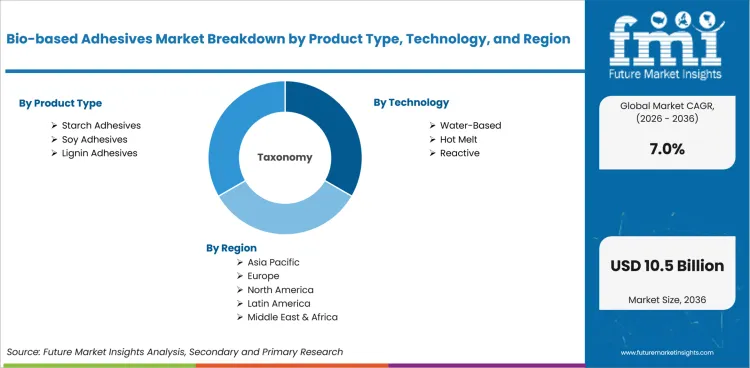
Bio-based Adhesives Market - Report Scope
| Item | Value |
|---|---|
| Market size by 2036 | USD 10.5 billion |
| Growth rate | 7.0% CAGR from 2026 to 2036 |
| Forecast period | 2026 to 2036 |
| Base year value (2025) | USD 5.0 billion |
| By product type | Starch adhesives, soy adhesives, lignin adhesives, rosin adhesives, protein adhesives, plant oil adhesives |
| By technology | Water-based, hot melt, reactive, solvent-free |
| By application | Packaging, wood assembly, construction, labels, hygiene |
| By end use | Paper packaging, wood panels, building products, consumer goods, medical goods |
| By sales channel | Direct supply, distributor sales, converter supply, OEM contracts, online sales |
| Regions covered | North America, Latin America, Europe, East Asia, South Asia and Pacific, Middle East and Africa |
| Countries covered | United States, China, Germany, United Kingdom, India, Japan, France |
| Key companies profiled | Henkel, H.B. Fuller, Arkema Bostik, 3M, Sika, Avery Dennison, Jowat, Tex Year |
| Approach | Bottom-up adhesive-boundary approach using eligible product revenue, application pricing, channel presence, and country-level adoption |
Source: Future Market Insights, 2026.
Bio-based Adhesives Market - Scope & Definition
| Attribute | Detail |
|---|---|
| Market Definition | Bonding materials made partly or fully from renewable feedstocks such as starch, soy protein, lignin, rosin, casein, and plant oils |
| Functions Covered | Bonding, laminating, carton sealing, label attachment, wood assembly, construction fixing, and hygiene product bonding |
| Applications Covered | Packaging, wood assembly, construction, labels, hygiene products, consumer goods, and selected medical goods |
| End-Use Industries | Paper packaging, wood panels, building products, consumer goods, medical goods, and industrial converting |
| Grades Covered | Starch, soy, lignin, rosin, protein, and plant-oil adhesive systems across water-based, hot melt, reactive, and solvent-free formats |
| Inclusions | Commercial bio-based adhesive revenue across product type, technology, application, end use, sales channel, and geography |
| Exclusions | Fossil-only adhesives, asphalt binders, dental adhesives, surgical sealants, tape backings without adhesive revenue, and mechanical fasteners |
Bio-based Adhesives Market - Research Methodology
| Method | Description |
|---|---|
| Primary Research | FMI analyst interviews with adhesive formulators, packaging converters, wood-panel producers, distributors, and sustainability managers across key markets |
| Desk Research | Review of procurement rules, packaging regulation, company product data, patent filings, technical datasheets, and public end-use statistics |
| Market Sizing & Forecasting | Bottom-up application model using adhesive consumption, formulation pricing, country packaging output, product availability, and adoption rates |
| Evidence Review | Review using supplier portfolios, regulatory signals, adhesive trade data, certification evidence, and regional packaging demand checks |
Bio-based Adhesives Market Segmented by Product Type
Bio-based Adhesives Market Segmented by Product Type:
- Starch Adhesives
- Soy Adhesives
- Lignin Adhesives
- Rosin Adhesives
- Protein Adhesives
- Plant Oil Adhesives
Bio-based Adhesives Market Segmented by Technology:
- Water-Based
- Hot Melt
- Reactive
- Solvent-Free
Bio-based Adhesives Market Segmented by Application:
- Packaging
- Wood Assembly
- Construction
- Labels
- Hygiene
Bio-based Adhesives Market Segmented by End Use:
- Paper Packaging
- Wood Panels
- Building Products
- Consumer Goods
- Medical Goods
Bio-based Adhesives Market Segmented by Sales Channel:
- Direct Supply
- Distributor Sales
- Converter Supply
- OEM Contracts
- Online Sales
Bio-based Adhesives Market by Region
- North America
- Latin America
- Western Europe
- Eastern Europe
- East Asia
- South Asia and Pacific
- Middle East & Africa
Research Sources and Bibliography
- USA Department of Agriculture Rural Development. (2024, March). An Economic Impact Analysis of the USA Biobased Products Industry: 2023 Update. USDA Rural Development.
- USA Census Bureau. (2026, June). Manufacturers' Value of Shipments: Paint, Coating, and Adhesive Manufacturing. Federal Reserve Bank of St. Louis.
- USA Environmental Protection Agency. (2024, November). National Strategy to Prevent Plastic Pollution. EPA.
- Department for Business and Trade. (2026, May). EU PPWR - Packaging and Packaging Waste Regulation. UK Government.
- Department for Environment, Food and Rural Affairs. (2025). Extended Producer Responsibility for Packaging: Who Is Affected and What to Do. GOV.UK.
- Environment Agency. (2026, May). National Packaging Waste Database: Public Reports. UK Government.
- ADEME. (2025, January). Declaration of Reuse of Industrial and Commercial Packaging and Food Services Packaging. ADEME.
- Japan Packaging Institute. (2025). Statistics on the Scale of Japanese Packaging Industry in 2024. Japan Packaging Institute.
- State Council Information Office of China. (2025, June). China Accelerates Express Delivery Green Packaging Amid Surging Parcel Volumes. SCIO.
- European Environment Agency. (2025, March). Germany Municipal Waste and Packaging Waste Management Country Profile. EEA.
- Henkel. (2024, September 24). Bio Just Got Cooler: Bio-Based Hot Melt Adhesive from Henkel Helps Save Energy in the Packaging Process. Henkel.
- Arkema. (2024, September 9). Bostik Takes a Key Step Towards Decarbonization with the Launch of Kizen LIME. Arkema.
- H.B. Fuller. (2024, January 10). H.B. Fuller Plants in Germany Receive ISCC PLUS Certification. H.B. Fuller.
- Arkema. (2024, December 2). Arkema Finalizes the Acquisition of Dow’s Flexible Packaging Laminating Adhesives Business. Arkema.
- H.B. Fuller. (2025, June 23). H.B. Fuller Announces 2024 Sustainability Report. H.B. Fuller.
- Tex Year. (2025, July 24). Tex Year Launches Asia's First Compostable Hot Melt Adhesive Dedicated Production Line. Tex Year.
- Avery Dennison. (2024, January). Product Services Guide SSA January 2024 Kenya. Avery Dennison.
- Jowat. (2024, October 14). Jowat Shows Innovative Adhesives for Sustainable Packaging at Scanpack. Jowat.
The bibliography is provided for reader reference and uses primary government, regulatory, academic, trade body, or official company publications.
This Report Answers
- What is the expected size of the Bio-based Adhesives Market in 2026 and 2036?
- What CAGR is forecast for bio-based adhesives between 2026 and 2036?
- Which bio-based adhesive product type is projected to lead demand in 2026?
- Which application creates the largest repeat-purchase channel for bio-based adhesive suppliers?
- Why are packaging converters shifting from fossil adhesives toward renewable-content bonding systems?
- How do packaging regulations and reuse targets change adhesive qualification requirements?
- Which profiled countries are expected to grow fastest in the Bio-based Adhesives Market?
- Which companies are best positioned in certified and application-tested bio-based adhesives?
- What products are included and excluded from the Bio-based Adhesives Market scope?
- How does FMI size and validate demand for bio-based adhesives across countries and segments?
Frequently Asked Questions
What is the global market demand for Bio-based Adhesives Market in 2026?
In 2026, the global Bio-based Adhesives Market is expected to be worth USD 5.4 billion, with packaging forming the largest application pool.
What will be the Bio-based Adhesives Market value by 2036?
By 2036, the Bio-based Adhesives Market is projected to reach USD 10.5 billion, supported by packaging and wood assembly conversion.
What CAGR is expected for the Bio-based Adhesives Market?
The Bio-based Adhesives Market is projected to grow at a 7.0% CAGR from 2026 to 2036 across global applications.
Which product type is expected to lead the Bio-based Adhesives Market?
Starch Adhesives are projected to lead product demand with 36.0% share in 2026 due to corrugated and paper packaging use.
Which application is expected to lead bio-based adhesive demand?
Packaging is projected to lead application demand with 42.0% share in 2026 as cartons, labels, and trays use renewable bonding systems.
Why is India the fastest-growing locked country for bio-based adhesives?
India is projected at 8.4% CAGR through 2036 as corrugated packaging and paper bag demand support starch-based adhesive use.
What is included in the Bio-based Adhesives Market?
The market includes starch, soy and lignin adhesives used in packaging and wood. It also covers rosin, protein and plant-oil adhesives used in construction, labels and hygiene goods.
How does FMI forecast the Bio-based Adhesives Market?
FMI combines adhesive consumption, application pricing and country-level packaging output. The model also checks wood-panel demand, certification evidence and supplier portfolios.
Which bio-based adhesive is best for paper packaging?
Starch and water-based bio adhesives are best for paper packaging when buyers need low cost, good wet tack, and compatibility with fiber recycling.
Are bio-based adhesives cheaper than synthetic adhesives?
Starch adhesives can be cost-competitive in paper applications. Certified hot melts and specialty bio adhesives often cost more but can lower energy use.
How do bio-based adhesives work?
Bio-based adhesives bond surfaces using renewable polymers or tackifiers from starch and soy. They can also use lignin, rosin, protein or plant oils instead of fossil-only feedstocks.
What is the main disadvantage of bio-based adhesives?
The main disadvantage is performance variability. Moisture resistance, shelf life, and heat stability can limit adoption unless suppliers tune the formulation.
Which countries use bio-based adhesives most?
The United States, China, Germany, India, Japan, and France show clear use through packaging, labels, wood products, and construction applications.
Preview the report firsthand - request a free sample
Get SampleGet the brochure for pricing and purchase details.
Get PDFTable of Content
- Key Takeaways
- Market Size and CAGR
- Top Growth Driver
- Fastest Growing Segment
- Leading Region
- Key Companies
- Emerging Opportunities
- Executive Summary
- Global Market Outlook
- Demand-side Trends
- Supply-side Trends
- Technology Roadmap Analysis
- Analysis and Recommendations
- Analyst Perspective (What is happening? Why now? What should investors know?)
- Key Questions Answered
- How large is the market?
- What is the CAGR?
- What are key trends?
- Which region dominates?
- Who are the leaders?
- Market Overview
- Market Coverage / Taxonomy
- Market Definition / Scope / Limitations
- Research Methodology
- Chapter Orientation
- Analytical Lens and Working Hypotheses
- Market Structure, Signals, and Trend Drivers
- Benchmarking and Cross-market Comparability
- Market Sizing, Forecasting, and Opportunity Mapping
- Research Design and Evidence Framework
- Desk Research Programme (Secondary Evidence)
- Expert Input and Fieldwork (Primary Evidence)
- Tooling, Models, and Reference Databases
- Data Engineering and Model Build
- Quality Assurance and Audit Trail
- Market Background
- Market Dynamics (Drivers, Restraints, Opportunity, Trends)
- Scenario Forecast (Optimistic, Likely, Conservative)
- Impact Analysis
- AI Impact
- Sustainability Impact
- Regulatory Impact
- Technology Impact
- Consumer / Buyer Analysis
- Purchase Drivers
- Adoption Barriers
- Buyer Journey
- Opportunity Map Analysis
- Product Life Cycle Analysis
- Supply Chain Analysis
- Investment Feasibility Matrix
- Value Chain Analysis
- PESTLE and Porter's Analysis
- Regulatory Landscape
- Regional Parent Market Outlook
- Production and Consumption Statistics
- Import and Export Statistics
- Global Market Analysis and Forecast, 2021 to 2036
- Historical Market Size Value (USD Billion) & Volume (Unit) Analysis, 2021 to 2025
- Current and Future Market Size Value (USD Billion) & Volume (Unit) Projections, 2026 to 2036
- Y-o-Y Growth Trend Analysis
- Absolute $ Opportunity Analysis
- Global Market Pricing Analysis, 2021 to 2036
- Global Market Analysis and Forecast, By Product Type, 2021 to 2036
- Introduction / Key Findings
- Historical Market Size Value (USD Billion) & Volume (Unit) Analysis By Product Type, 2021 to 2025
- Current and Future Market Size Value (USD Billion) & Volume (Unit) Analysis and Forecast By Product Type, 2026 to 2036
- Starch Adhesives
- Soy Adhesives
- Lignin Adhesives
- Rosin Adhesives
- Protein Adhesives
- Plant Oil Adhesives
- Starch Adhesives
- Y-o-Y Growth Trend Analysis By Product Type, 2021 to 2025
- Absolute $ Opportunity Analysis By Product Type, 2026 to 2036
- Global Market Analysis and Forecast, By Technology, 2021 to 2036
- Introduction / Key Findings
- Historical Market Size Value (USD Billion) & Volume (Unit) Analysis By Technology, 2021 to 2025
- Current and Future Market Size Value (USD Billion) & Volume (Unit) Analysis and Forecast By Technology, 2026 to 2036
- Water-Based
- Hot Melt
- Reactive
- Solvent-Free
- Water-Based
- Y-o-Y Growth Trend Analysis By Technology, 2021 to 2025
- Absolute $ Opportunity Analysis By Technology, 2026 to 2036
- Global Market Analysis and Forecast, By Application, 2021 to 2036
- Introduction / Key Findings
- Historical Market Size Value (USD Billion) & Volume (Unit) Analysis By Application, 2021 to 2025
- Current and Future Market Size Value (USD Billion) & Volume (Unit) Analysis and Forecast By Application, 2026 to 2036
- Packaging
- Wood Assembly
- Construction
- Labels
- Hygiene
- Packaging
- Y-o-Y Growth Trend Analysis By Application, 2021 to 2025
- Absolute $ Opportunity Analysis By Application, 2026 to 2036
- Global Market Analysis and Forecast, By End Use, 2021 to 2036
- Introduction / Key Findings
- Historical Market Size Value (USD Billion) & Volume (Unit) Analysis By End Use, 2021 to 2025
- Current and Future Market Size Value (USD Billion) & Volume (Unit) Analysis and Forecast By End Use, 2026 to 2036
- Paper Packaging
- Wood Panels
- Building Products
- Consumer Goods
- Medical Goods
- Paper Packaging
- Y-o-Y Growth Trend Analysis By End Use, 2021 to 2025
- Absolute $ Opportunity Analysis By End Use, 2026 to 2036
- Global Market Analysis and Forecast, By Sales Channel, 2021 to 2036
- Introduction / Key Findings
- Historical Market Size Value (USD Billion) & Volume (Unit) Analysis By Sales Channel, 2021 to 2025
- Current and Future Market Size Value (USD Billion) & Volume (Unit) Analysis and Forecast By Sales Channel, 2026 to 2036
- Direct Supply
- Distributor Sales
- Converter Supply
- OEM Contracts
- Online Sales
- Direct Supply
- Y-o-Y Growth Trend Analysis By Sales Channel, 2021 to 2025
- Absolute $ Opportunity Analysis By Sales Channel, 2026 to 2036
- Global Market Analysis and Forecast, By Region, 2021 to 2036
- Introduction
- Historical Market Size Value (USD Billion) & Volume (Unit) Analysis By Region, 2021 to 2025
- Current Market Size Value (USD Billion) & Volume (Unit) Analysis and Forecast By Region, 2026 to 2036
- North America
- Latin America
- Western Europe
- Eastern Europe
- East Asia
- South Asia and Pacific
- Middle East & Africa
- Market Attractiveness Analysis By Region
- North America Market Analysis and Forecast, By Country, 2021 to 2036
- Historical Market Size Value (USD Billion) & Volume (Unit) Trend Analysis By Market Taxonomy, 2021 to 2025
- Market Size Value (USD Billion) & Volume (Unit) Forecast By Market Taxonomy, 2026 to 2036
- By Country
- USA
- Canada
- Mexico
- By Product Type
- By Technology
- By Application
- By End Use
- By Sales Channel
- By Country
- Market Attractiveness Analysis
- By Country
- By Product Type
- By Technology
- By Application
- By End Use
- By Sales Channel
- Key Takeaways
- Latin America Market Analysis and Forecast, By Country
- Historical Market Size Value (USD Billion) & Volume (Unit) Trend Analysis By Market Taxonomy, 2021 to 2025
- Market Size Value (USD Billion) & Volume (Unit) Forecast By Market Taxonomy, 2026 to 2036
- By Country
- Brazil
- Chile
- Rest of Latin America
- By Product Type
- By Technology
- By Application
- By End Use
- By Sales Channel
- By Country
- Market Attractiveness Analysis
- By Country
- By Product Type
- By Technology
- By Application
- By End Use
- By Sales Channel
- Key Takeaways
- Western Europe Market Analysis and Forecast, By Country
- Historical Market Size Value (USD Billion) & Volume (Unit) Trend Analysis By Market Taxonomy, 2021 to 2025
- Market Size Value (USD Billion) & Volume (Unit) Forecast By Market Taxonomy, 2026 to 2036
- By Country
- Germany
- UK
- Italy
- Spain
- France
- Nordic
- BENELUX
- Rest of Western Europe
- By Product Type
- By Technology
- By Application
- By End Use
- By Sales Channel
- By Country
- Market Attractiveness Analysis
- By Country
- By Product Type
- By Technology
- By Application
- By End Use
- By Sales Channel
- Key Takeaways
- Eastern Europe Market Analysis and Forecast, By Country
- Historical Market Size Value (USD Billion) & Volume (Unit) Trend Analysis By Market Taxonomy, 2021 to 2025
- Market Size Value (USD Billion) & Volume (Unit) Forecast By Market Taxonomy, 2026 to 2036
- By Country
- Russia
- Poland
- Hungary
- Balkan & Baltic
- Rest of Eastern Europe
- By Product Type
- By Technology
- By Application
- By End Use
- By Sales Channel
- By Country
- Market Attractiveness Analysis
- By Country
- By Product Type
- By Technology
- By Application
- By End Use
- By Sales Channel
- Key Takeaways
- East Asia Market Analysis and Forecast, By Country
- Historical Market Size Value (USD Billion) & Volume (Unit) Trend Analysis By Market Taxonomy, 2021 to 2025
- Market Size Value (USD Billion) & Volume (Unit) Forecast By Market Taxonomy, 2026 to 2036
- By Country
- China
- Japan
- South Korea
- By Product Type
- By Technology
- By Application
- By End Use
- By Sales Channel
- By Country
- Market Attractiveness Analysis
- By Country
- By Product Type
- By Technology
- By Application
- By End Use
- By Sales Channel
- Key Takeaways
- South Asia and Pacific Market Analysis and Forecast, By Country
- Historical Market Size Value (USD Billion) & Volume (Unit) Trend Analysis By Market Taxonomy, 2021 to 2025
- Market Size Value (USD Billion) & Volume (Unit) Forecast By Market Taxonomy, 2026 to 2036
- By Country
- India
- ASEAN
- Australia & New Zealand
- Rest of South Asia and Pacific
- By Product Type
- By Technology
- By Application
- By End Use
- By Sales Channel
- By Country
- Market Attractiveness Analysis
- By Country
- By Product Type
- By Technology
- By Application
- By End Use
- By Sales Channel
- Key Takeaways
- Middle East & Africa Market Analysis and Forecast, By Country
- Historical Market Size Value (USD Billion) & Volume (Unit) Trend Analysis By Market Taxonomy, 2021 to 2025
- Market Size Value (USD Billion) & Volume (Unit) Forecast By Market Taxonomy, 2026 to 2036
- By Country
- Kingdom of Saudi Arabia
- Other GCC Countries
- Türkiye
- South Africa
- Other African Union
- Rest of Middle East & Africa
- By Product Type
- By Technology
- By Application
- By End Use
- By Sales Channel
- By Country
- Market Attractiveness Analysis
- By Country
- By Product Type
- By Technology
- By Application
- By End Use
- By Sales Channel
- Key Takeaways
- Key Countries Market Analysis
- USA
- Pricing Analysis
- Market Share Analysis, 2025
- By Product Type
- By Technology
- By Application
- By End Use
- By Sales Channel
- Canada
- Pricing Analysis
- Market Share Analysis, 2025
- By Product Type
- By Technology
- By Application
- By End Use
- By Sales Channel
- Mexico
- Pricing Analysis
- Market Share Analysis, 2025
- By Product Type
- By Technology
- By Application
- By End Use
- By Sales Channel
- Brazil
- Pricing Analysis
- Market Share Analysis, 2025
- By Product Type
- By Technology
- By Application
- By End Use
- By Sales Channel
- Chile
- Pricing Analysis
- Market Share Analysis, 2025
- By Product Type
- By Technology
- By Application
- By End Use
- By Sales Channel
- Germany
- Pricing Analysis
- Market Share Analysis, 2025
- By Product Type
- By Technology
- By Application
- By End Use
- By Sales Channel
- UK
- Pricing Analysis
- Market Share Analysis, 2025
- By Product Type
- By Technology
- By Application
- By End Use
- By Sales Channel
- Italy
- Pricing Analysis
- Market Share Analysis, 2025
- By Product Type
- By Technology
- By Application
- By End Use
- By Sales Channel
- Spain
- Pricing Analysis
- Market Share Analysis, 2025
- By Product Type
- By Technology
- By Application
- By End Use
- By Sales Channel
- France
- Pricing Analysis
- Market Share Analysis, 2025
- By Product Type
- By Technology
- By Application
- By End Use
- By Sales Channel
- India
- Pricing Analysis
- Market Share Analysis, 2025
- By Product Type
- By Technology
- By Application
- By End Use
- By Sales Channel
- ASEAN
- Pricing Analysis
- Market Share Analysis, 2025
- By Product Type
- By Technology
- By Application
- By End Use
- By Sales Channel
- Australia & New Zealand
- Pricing Analysis
- Market Share Analysis, 2025
- By Product Type
- By Technology
- By Application
- By End Use
- By Sales Channel
- China
- Pricing Analysis
- Market Share Analysis, 2025
- By Product Type
- By Technology
- By Application
- By End Use
- By Sales Channel
- Japan
- Pricing Analysis
- Market Share Analysis, 2025
- By Product Type
- By Technology
- By Application
- By End Use
- By Sales Channel
- South Korea
- Pricing Analysis
- Market Share Analysis, 2025
- By Product Type
- By Technology
- By Application
- By End Use
- By Sales Channel
- Russia
- Pricing Analysis
- Market Share Analysis, 2025
- By Product Type
- By Technology
- By Application
- By End Use
- By Sales Channel
- Poland
- Pricing Analysis
- Market Share Analysis, 2025
- By Product Type
- By Technology
- By Application
- By End Use
- By Sales Channel
- Hungary
- Pricing Analysis
- Market Share Analysis, 2025
- By Product Type
- By Technology
- By Application
- By End Use
- By Sales Channel
- Kingdom of Saudi Arabia
- Pricing Analysis
- Market Share Analysis, 2025
- By Product Type
- By Technology
- By Application
- By End Use
- By Sales Channel
- Türkiye
- Pricing Analysis
- Market Share Analysis, 2025
- By Product Type
- By Technology
- By Application
- By End Use
- By Sales Channel
- South Africa
- Pricing Analysis
- Market Share Analysis, 2025
- By Product Type
- By Technology
- By Application
- By End Use
- By Sales Channel
- USA
- Market Structure Analysis
- Competition Dashboard
- Competition Benchmarking
- Market Share Analysis of Top Players
- By Regional
- By Product Type
- By Technology
- By Application
- By End Use
- By Sales Channel
- Emerging Startups
- Innovation Benchmarking
- Competition Analysis
- Competition Deep Dive
- Henkel
- Overview
- Product Portfolio
- Profitability by Market Segments (Product/Region/Sales Channel)
- Sales Footprint
- Strategy Overview
- Marketing Strategy
- Product Strategy
- Channel Strategy
- H.B. Fuller
- Arkema Bostik
- 3M
- Sika
- Avery Dennison
- Jowat
- Tex Year
- Paramelt
- Henkel
- Case Studies
- Success Stories
- Recent Developments
- Competition Deep Dive
- Assumptions & Acronyms Used


