

- Market Size (2026)
- USD 1.5 Bn
- Forecast (2036)
- USD 2.4 Bn
- CAGR (2026 to 2036)
- 5.2%
How big is Blind Threaded Inserts Market in 2026?
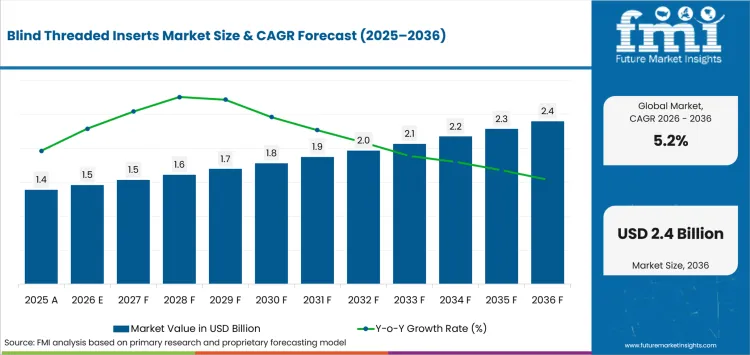
USD 1.5 billion in 2026 and USD 2.4 billion by 2036 at a 5.2% CAGR.
Demand for blind threaded inserts is projected to rise at a 5.2% CAGR, driving valuation from USD 1.5 billion in 2026 to USD 2.4 billion by 2036. Thin panels and enclosed structures expand the need for reusable threads installed from one accessible side. Böllhoff documented a current vehicle application in August 2026 through RIVKLE technology on EFORCE Prague Formula’s CTU.26 electric vehicle. One-sided assembly requirements also link insert demand with automotive fasteners used in mixed-material vehicle production lines.
Country operating conditions change how quickly qualified blind insert programs convert into recurring production orders. AutoSAP reported in January 2026 that electric vehicles represented 19.7% of Czech passenger-car production during 2025. Czech plants therefore present new fastening programs beside established export lines without removing supplier approval requirements. Other markets offer different entry conditions because service distance and incumbent relationships can outweigh headline growth rates for sheet metal components.
Key Takeaways of Blind Threaded Inserts Market
- One-sided assembly keeps demand tied to thin panels and enclosed structures that need a reusable thread without rear access.
- Based on insert type, open-end inserts are projected to account for 21.0% in 2026 due to broad use in unsealed blind-threaded joints.
- By material, steel is estimated to hold 42.0% in 2026 owing to familiar strength and workable economics for serial industrial programs.
- In 2026, below M5 is expected to lead thread size with 19.0% share because compact housings need reusable threads in limited space.
- Qualification slows conversion because grip range and hole geometry must remain stable through the actual production setting process.
- Some of the key players in this market include Stanley Engineered Fastening, Böllhoff, Sherex Fastening Solutions, PennEngineering, GESIPA, Avdel / Stanley, Bossard, and TR Fastenings.
Analyst Perspective
"Blind threaded inserts earn approval after the setting window survives the actual panel stack and production rate. Commercial value comes from pull-out evidence and controlled tooling plus nearby stock so an engineering change does not restart qualification."
- Nikhil Kaitwade, Principal Consultant, Future Market Insights
How is the blind threaded inserts market segmented?
The blind threaded inserts market is segmented by insert type, material, thread size, end use, sales channel and region.
Market taxonomy covers insert type, material, thread size, end use, sales channel and region. Insert types include open-end, closed-end, hex body, knurled body, rivet nuts and high-strength structural inserts. Materials cover steel, stainless steel, aluminum, brass and special alloys. Thread sizes include below M5, M5-M8, M8-M12 and above M12. End uses include automotive, aerospace, sheet metal fabrication, electronics enclosures and furniture/appliances. Sales channels include fastener distributors, direct OEM supply, industrial MRO and e-commerce/catalog routes.
What supports Automotive leadership in the End use category?
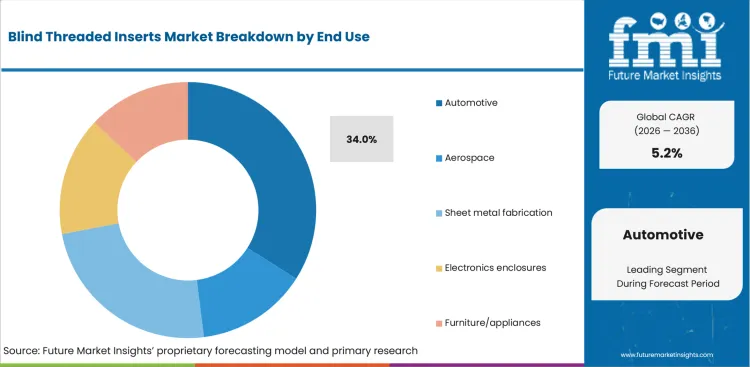
Vehicle assembly places threaded attachments inside thin sheet and enclosed modules that often cannot be reached from both sides. Alliance for Automotive Innovation reported in March 2026 that electric vehicles represented 9.6% of United States light-duty sales during 2025. Active powertrain redesign keeps brackets and enclosure interfaces under review, giving one-sided threaded fastening a continuing route into new vehicle programs.
- By end use, automotive is forecast to represent 34.0% in 2026 driven by repeatable one-sided threading in serial vehicle production.
- Programs using commercial vehicle fasteners also require local application support before a blind insert enters a released bill of materials.
What makes Open-end Inserts central to the Insert type category?
Open-end inserts fit assemblies that need a reusable thread without sealing the blind end. The open body accepts several screw lengths within the qualified grip range and suits fabricated brackets that do not require end sealing. VDA reported in March 2026 that Germany manufactured 664,300 passenger cars during the first two months of 2026.
- Open-end inserts are set to lead the insert type category with 21.0% share in 2026 due to broad use in unsealed blind joints.
- Engineers can keep the same basic fastening concept beside metal stampings and fabricated brackets before specifying special anti-rotation or sealed variants.
Why does Steel lead the Material category?
Steel suits serial assemblies that need predictable thread strength and controlled deformation during setting, with familiar coating routes for large-volume programs. VDA stated in February 2026 that electric powertrains represented 40% of German passenger-car production during 2025. The changing vehicle mix increases demand for insert grades that maintain thread strength without the cost premium of stainless steel or aluminum.
- Steel is projected to hold 42.0% share in 2026 owing to mechanical strength and workable economics in serial assembly.
- Stainless steel and aluminum address corrosion or weight limits in demanding applications, whereas standard steel fits familiar cold-heading wire supply and coating routes used in volume production.
What drives Fastener distributors to lead the Sales channel category?
Blind threaded insert demand fragments quickly by thread size and grip range before material or body style multiplies the available SKU count. Bossard completed its Ferdinand Gross acquisition in January 2025 and expanded fastening distribution coverage in Germany plus Eastern Europe. The enlarged regional network suits customers needing stocked standard parts beside technical support for less common joint configurations.
- The sales channel is forecast to be led by fastener distributors at 41.0% share in 2026 due to fragmented SKU demand and local stocking needs.
- Smaller fabricators can source blind inserts beside aerospace fasteners or other engineered hardware without committing to direct OEM volumes during qualification.
What are the drivers, restraints and opportunities in the Blind Threaded Inserts Market?
Thin-panel assembly expands one-sided threaded attachment, qualification sensitivity limits conversion, and process-controlled setting qualifies inserts for larger serial-production programs.
- Driver: Enclosed structures and mixed-material panels increase the number of joints that need reusable threads from one accessible side.
- Restraint: Grip range and setting parameters must match the actual panel for engineers to release a blind insert into serial use.
- Opportunity: Automated setting and application engineering give high-volume blind insert programs stronger traceability during qualification and serial production.
Thin-Panel Assembly Keeps One-Sided Threads Relevant
Vehicle plants add one-sided fastening points as body structures use thinner sheet and enclosed subassemblies that block rear access. INEGI reported in May 2026 that Mexican light-vehicle production rose 0.9% during the first four months compared with the same 2025 period. The production base leaves repeated thin-panel and enclosed-body applications available to insert makers that can prove pull-out and torque-out performance on the released panel stack.
Qualification Sensitivity Raises the Support Burden
Blind inserts can meet drawing dimensions and fail if the selected grip range forms an unstable closing head during production setting. TR Fastenings expanded German warehouse capacity in August 2025 to improve fastening availability and engineering support for automotive and industrial customers. Local response becomes commercially important during validation because part changes need checks against panel thickness and installation parameters at release.
Process-Controlled Setting Broadens Serial Programs
Automation shifts evaluation from a loose component toward a repeatable installed joint with recorded setting conditions. Böllhoff introduced RIVNUT Automation E in September 2025 for electric blind rivet nut setting with process control. High-volume plants can qualify the insert against a controlled installation window, extending component demand for repeat vehicle or qualified enclosure programs without placing setting-equipment revenue inside this market.
Which country CAGRs are profiled in the Blind Threaded Inserts Market?
| Country | CAGR |
|---|---|
| Czech Republic | 6.0% |
| Mexico | 5.4% |
| USA | 4.8% |
| Germany | 4.6% |
| Japan | 4.0% |
How do country-level CAGRs compare in the Blind Threaded Inserts Market?
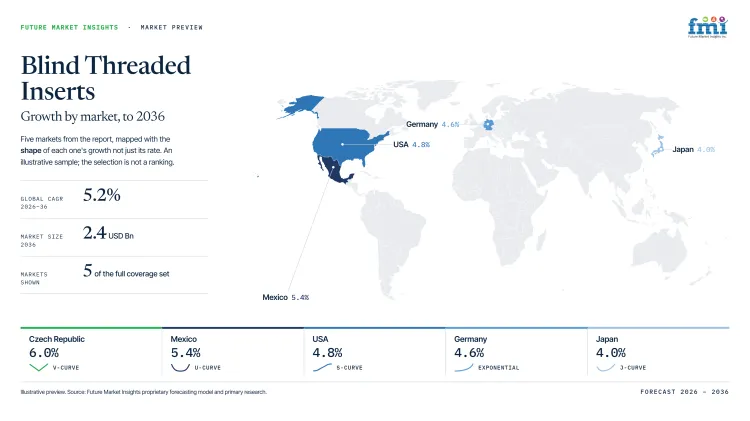
Five profiled countries span 2.0 percentage points from Czech Republic at 6.0% to Japan at 4.0%. Czech Republic and Mexico form the faster pair through export-oriented vehicle production. USA and Germany form a middle band under heavier qualification requirements. Japan records the slowest rate because mature source relationships lengthen approval cycles.
- Czech Republic uses dense component clusters to shorten travel between qualification sites.
- Mexico rewards inventory placed close to high-volume vehicle plants during model changes.
- USA plants require regional engineering coverage because manufacturing sites remain widely dispersed.
- Germany prioritizes documented setting control before changing sources on highly automated production lines.
- Japan favors proven quality records and long service histories during source approval.
Growth rates still hide distinct service burdens and entry conditions. The full report provides country-level CAGR analysis across North America, Latin America, Europe, East Asia, South Asia and Pacific, and the Middle East and Africa.
Country-wise Analysis
- Czech vehicle plants operate inside a dense Central European supplier network, so insert changes must fit export programs with short production handoffs. Czech Republic is estimated to post 6.0% CAGR over the forecast period, tied to mixed-powertrain assembly using more thin panels and enclosed modules. AutoSAP documented in January 2026 that more than 92.5% of Czech passenger cars produced during 2025 went to foreign markets. Local application engineers shorten qualification work by keeping joint trials close to vehicle and component plants. New sources still need repeatable joint evidence before an export program accepts regional production supply for multiple customer locations.
- Mexican light-vehicle plants run export-heavy schedules, and local fastener availability near assembly corridors directly affects line-release timing during model changes. INEGI reported in May 2026 that light-vehicle exports increased 4.7% during the first four months compared with the same 2025 period. Blind threaded insert sales in Mexico are forecast to expand at 5.4% CAGR by 2036, given the production base and local sourcing opportunity. Regional stock can win urgent replenishment business because engineering teams can resolve grip-range or setting problems before release. Plant scale does not remove qualification work, so distributors without local technical coverage remain exposed during specification changes.
- United States demand spans vehicle plants and enclosure fabricators in widely separated manufacturing corridors, which makes one national stocking model difficult to operate. Blind threaded insert demand in the USA is forecast to rise at 4.8% CAGR over the forecast period, aided by a broad mix of vehicle platforms. Alliance for Automotive Innovation reported in March 2026 that 164 electric models were available at the end of 2025 in the United States. Large account coverage can widen specification access because national manufacturers serve several vehicle and industrial programs. Regional engineering support is the structural constraint since plants use different panel stacks and validation rules.
- German vehicle and machinery plants release fastening changes through documented process windows, so a catalog match rarely substitutes for line-level validation records. VDA stated in February 2026 that Germany produced 1.67 million electric passenger cars during 2025. By 2036, Germany is projected to grow at 4.6% CAGR because automated manufacturing raises process-control requirements. Local process engineering gives qualified vendors a better route into trial builds ahead of serial production. Regional stock also reduces delay during line trials involving alternate grip ranges. Companies competing mainly on unit price face a harder conversion path because incumbent programs already carry mature validation records.
- Japanese manufacturers rely on mature vehicle and industrial supply relationships, and production continuity usually carries more weight than rapid source changes. Adoption of blind threaded inserts in Japan is estimated to expand at 4.0% CAGR through 2036, attributable to replacement programs that sustain demand inside mature production systems. JAMA's October 2025 industry fact book recorded an 8.5% decline in Japanese motor-vehicle production during 2024. Technical acceptance usually requires documented setting behavior and replenishment performance before engineering teams approve a new production source. Slower supplier turnover makes service consistency a stronger entry test here than headline availability of another technically suitable insert.
Who are the notable companies in the Blind Threaded Inserts Market?
Stanley Engineered Fastening, Böllhoff, Sherex Fastening Solutions, PennEngineering, GESIPA, Avdel / Stanley, Bossard and TR Fastenings are the notable companies serving this market.
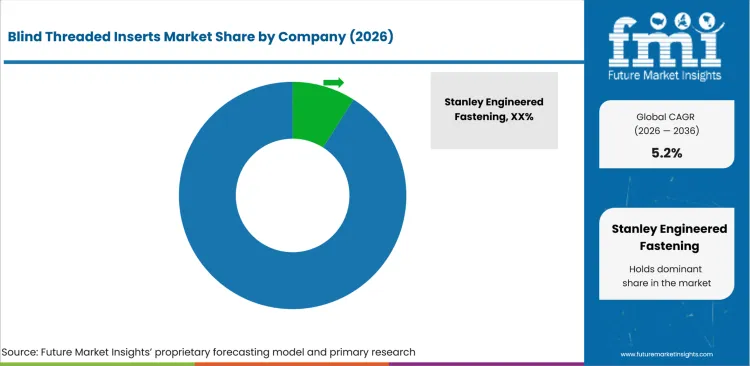
Competition separates by insert specialization and installation support because blind fasteners are qualified as installed joints instead of loose hardware. Integrated fastening groups pair blind inserts with tooling and dedicated setting-process engineering. Distributors compete on stock depth and local technical access during each qualification cycle. Once an OEM validates pull-out plus torque-out performance, a replacement source must reproduce the released part result and the setting window.
- Integrated fastening platforms: Stanley Engineered Fastening and Böllhoff pair blind insert portfolios with installation and process-control support.
- Blind rivet nut specialists include Sherex Fastening Solutions and PennEngineering with engineered ranges for production programs. GESIPA and Avdel / Stanley extend the group through installation expertise and broader blind-fastening support.
- Fastener distribution and application support: Bossard and TR Fastenings provide regional stock access with technical support for industrial and automotive programs.
Competitive Benchmarking: Blind Threaded Inserts Market
| Company | Blind Threaded Insert Breadth | Installation & Process Support | High-Strength / Automotive Fit | Geographic Reach |
|---|---|---|---|---|
| Stanley Engineered Fastening | High | High | High | Global |
| Böllhoff | High | High | High | Europe, North America and Asia |
| Sherex Fastening Solutions | High | High | High | North America, Europe and Asia |
| PennEngineering | High | High | High | Global |
| GESIPA | High | High | Medium | Europe, North America and Asia |
| Avdel / Stanley | High | High | High | Global through Stanley network |
| Bossard | Medium | High | Medium | Europe, Americas and Asia-Pacific |
| TR Fastenings | Medium | High | High | Europe, North America and Asia |
Scoring basis: Insert breadth is High for three or more verified families, Medium for two and Low for one. Process support is High with documented automation plus application engineering, Medium with one installation-support route and Low with distribution-only evidence. Automotive fit is High with automotive-specific or high-strength evidence, Medium with documented industrial high-load use and Low with documented application scope outside automotive programs.
Key Developments in the Blind Threaded Inserts Market
- In July 2026, PennEngineering launched the Sherex by PEM blind rivet nut portfolio across Europe with local stock and application engineering support.
- In October 2025, GESIPA introduced the FireBirdie blind rivet nut setting tool at Blechexpo with three operating modes for varied workstation requirements.
- In July 2025, STANLEY Engineered Fastening introduced ABF-N automated blind rivet nut installation technology for automotive production.
Key Players in the Blind Threaded Inserts Market
Integrated Fastening Platforms
- Stanley Engineered Fastening
- Böllhoff
Blind Rivet Nut and Installation Specialists
- Sherex Fastening Solutions
- PennEngineering
- GESIPA
- Avdel / Stanley
Fastener Distribution and Application Support
- Bossard
- TR Fastenings
Blind Threaded Inserts Market - Report Scope
| Coverage field | Report scope |
|---|---|
| Market breakdown | By insert type, material, thread size, end use, sales channel and region. |
| Quantitative Units | USD Billion. |
| Market Definition | Revenue from blind threaded inserts and blind rivet nuts installed from one accessible side in thin panels, enclosures and formed components. Installation tools, finished products and adjacent fastener categories are excluded. |
| Regions Covered | North America, Latin America, Western Europe, Eastern Europe, East Asia, South Asia and Pacific, and Middle East and Africa. |
| Countries Covered | Czech Republic, Mexico, USA, Germany, Japan, and 20+ countries included in the full report. |
| Key Companies Profiled | Stanley Engineered Fastening, Böllhoff, Sherex Fastening Solutions, PennEngineering, GESIPA, Avdel / Stanley, Bossard, TR Fastenings. |
| Forecast Period | 2026 to 2036. |
| Approach | Primary and secondary research with market triangulation. |
Blind Threaded Inserts Market - Research Methodology
| Method | Approach |
|---|---|
| Primary Research | FMI analysts gathered input from manufacturers, service providers, technology developers, distributors, end users, procurement teams, and subject-matter experts. Interviews examined purchasing decisions, product or service evaluation, adoption barriers, approval requirements, pricing considerations, and expectations for technical or commercial support. Respondents were also asked what evidence is required before a trial, pilot, or initial order develops into regular purchasing. |
| Desk Research | Desk research covered government statistics, regulatory publications, trade data, industry associations, technical literature, standards, company filings, product information, and official corporate announcements. Sources were reviewed for relevance, publication date, geographic coverage, and consistency with the defined market scope. Claims relating to performance, applications, approvals, capacity, investment, and commercial activity were retained only when supported by credible public evidence. |
| Market Sizing and Forecasting | The market model combined the baseline value with historical performance, segment structure, pricing and volume indicators, adoption levels, company participation, and country-level demand conditions. Forecast assumptions considered economic activity, investment trends, regulatory developments, technology adoption, purchasing cycles, supply availability, and barriers to wider market use. Segment and regional estimates were reconciled before the final market total was calculated. |
| Data Validation | Estimates were checked against multiple independent indicators, including public data, company activity, trade patterns, industry developments, and findings from primary interviews. Validation also tested whether products, services, applications, and company revenues fell within the defined market boundaries. Adjacent categories, unsupported claims, overlapping revenues, and activities without direct market relevance were excluded to reduce double counting and maintain consistency across segments and countries. |
Blind Threaded Inserts Market by Segments
Blind Threaded Inserts Market segmented by Insert Type:
- Open-end inserts
- Closed-end inserts
- Hex body inserts
- Knurled body inserts
- Rivet nuts
- High-strength structural inserts
Blind Threaded Inserts Market segmented by Material:
- Steel
- Stainless steel
- Aluminum
- Brass
- Special alloys
Blind Threaded Inserts Market segmented by Thread Size:
- Below M5
- M5-M8
- M8-M12
- Above M12
Blind Threaded Inserts Market segmented by End Use:
- Automotive
- Aerospace
- Sheet metal fabrication
- Electronics enclosures
- Furniture/appliances
Blind Threaded Inserts Market segmented by Sales Channel:
- Fastener distributors
- Direct OEM supply
- Industrial MRO
- E-commerce/catalog
Blind Threaded Inserts Market by Region:
- North America
- United States
- Canada
- Latin America
- Brazil
- Mexico
- Chile
- Rest of Latin America
- Western Europe
- Germany
- United Kingdom
- Italy
- Spain
- France
- Nordics
- Benelux
- Rest of Western Europe
- Eastern Europe
- Russia
- Poland
- Czech Republic
- Hungary
- Balkan and Baltic States
- Rest of Eastern Europe
- East Asia
- China
- Japan
- South Korea
- South Asia and Pacific
- India
- ASEAN
- Australia and New Zealand
- Rest of South Asia and Pacific
- Middle East and Africa
- Kingdom of Saudi Arabia
- Other GCC Countries
- Türkiye
- South Africa
- Other African Union Countries
- Rest of Middle East and Africa
Research Sources and Bibliography
- Böllhoff. (2026, August 4). Böllhoff is collaborating with EFORCE Prague Formula.
- Association of the Automotive Industry of the Czech Republic. (2026, January 27). 2025: Second strongest year in passenger car production, record year for bus production.
- German Association of the Automotive Industry. (2026, March 3). Production and Market in February 2026.
- German Association of the Automotive Industry. (2026, February 3). Production and market in January 2026.
- Alliance for Automotive Innovation. (2026, March 25). Alliance for Automotive Innovation reports new USA electric vehicle data.
- Bossard Group. (2025, January 7). Acquisition of the Ferdinand Gross Group.
- Instituto Nacional de Estadística y Geografía. (2026, May 11). Administrative record of the light vehicle automotive industry: April 2026.
- TR Fastenings. (2025, August 14). TR strengthens Central European operations as part of long-term global vision.
- Böllhoff. (2025, September 30). New RIVKLE Automation E.
- Japan Automobile Manufacturers Association. (2025, October 1). The motor industry of Japan 2025.
- PennEngineering. (2026, July 1). PennEngineering launches Sherex by PEM blind rivet nut portfolio across Europe.
- GESIPA. (2025, July 24). GESIPA at Blechexpo 2025.
- STANLEY Engineered Fastening. (2025, July 16). Man vs. Machine.
- SFS Group. (2026, March 6). Annual report 2025: segment report.
- Böllhoff. (2026, May 11). Böllhoff acquires business operations of Stöger Automation.
- TR Fastenings. (2026, May 5). Virtual Innovation Centre.
- STANLEY Engineered Fastening. (2025, June 25). Power in Partnership: How STANLEY led an auto OEM and tiers to a successful battery pack assembly launch.
- Böllhoff. (2025, October 16). New production facility inaugurated in Türkiye.
- Bossard Group. (2025, July 15). The Bossard Exploration Lab.
- Bulten. (2026, July 9). Bulten enters into binding agreement to divest European automotive contract manufacturing operations.
- Bufab. (2026, March 25). Annual report 2025.
- LISI Group. (2026, July 23). The LISI Group announces a significant improvement in its results for the 1st half of 2026, ahead of schedule.
The bibliography provides selected reader references and is not exhaustive because the full report contains the complete reference list and detailed citations.
This Report Answers
- How large is the blind threaded inserts market in 2026 and 2036?
- Which assembly conditions support blind threaded insert demand through 2036?
- Why do open-end inserts account for 21.0% of insert type demand?
- How does steel leadership shape material selection in serial fastening programs?
- Why does automotive represent 34.0% of end-use demand in 2026?
- How do country CAGRs differ between Czech Republic and Japan?
- Which companies compete through insert breadth, installation support and distribution?
- Which qualification conditions slow blind threaded insert supplier conversion?
Frequently Asked Questions
How big is the Blind Threaded Inserts Market in 2026?
The blind threaded inserts market is valued at USD 1.5 billion in 2026 and is projected to reach USD 2.4 billion by 2036. Growth follows thin-panel assemblies that require reusable threads from one accessible side during serial production.
What is the CAGR of the Blind Threaded Inserts Market from 2026 to 2036?
The blind threaded inserts market is projected to grow at a CAGR of 5.2% between 2026 and 2036. Expansion is supported by thin-sheet assembly and repeatable setting requirements in automotive plus industrial applications.
Which insert type leads the Blind Threaded Inserts Market?
The open-end inserts segment is expected to hold 21.0% of the blind threaded inserts market in 2026, driven by general-purpose suitability in unsealed blind joints. The geometry also accommodates several screw lengths within qualified grip ranges during component qualification and selection.
How much value will the Blind Threaded Inserts Market add between 2026 and 2036?
The blind threaded inserts market is expected to add USD 0.9 billion in value between 2026 and 2036. Growth follows wider one-sided fastening use in thin panels plus serial programs that require controlled installation.
Which companies are active in the Blind Threaded Inserts Market?
Key companies operating in the market include Stanley Engineered Fastening, Böllhoff, Sherex Fastening Solutions, PennEngineering, GESIPA, Avdel - Stanley, Bossard, and TR Fastenings. The listed companies compete through insert breadth, application engineering, installation support and local stock access for qualified programs.
Preview the report firsthand - request a free sample
Get SampleGet the brochure for pricing and purchase details.
Get PDFTable of Content
- Key Takeaways
- Market Size and CAGR
- Top Growth Driver
- Fastest Growing Segment
- Leading Region
- Key Companies
- Emerging Opportunities
- Executive Summary
- Global Market Outlook
- Demand-side Trends
- Supply-side Trends
- Technology Roadmap Analysis
- Analysis and Recommendations
- Analyst Perspective (What is happening? Why now? What should investors know?)
- Key Questions Answered
- How large is the market?
- What is the CAGR?
- What are key trends?
- Which region dominates?
- Who are the leaders?
- Market Overview
- Market Coverage / Taxonomy
- Market Definition / Scope / Limitations
- Research Methodology
- Chapter Orientation
- Analytical Lens and Working Hypotheses
- Market Structure, Signals, and Trend Drivers
- Benchmarking and Cross-market Comparability
- Market Sizing, Forecasting, and Opportunity Mapping
- Research Design and Evidence Framework
- Desk Research Programme (Secondary Evidence)
- Expert Input and Fieldwork (Primary Evidence)
- Tooling, Models, and Reference Databases
- Data Engineering and Model Build
- Quality Assurance and Audit Trail
- Market Background
- Market Dynamics (Drivers, Restraints, Opportunity, Trends)
- Scenario Forecast (Optimistic, Likely, Conservative)
- Impact Analysis
- AI Impact
- Sustainability Impact
- Regulatory Impact
- Technology Impact
- Consumer / Buyer Analysis
- Purchase Drivers
- Adoption Barriers
- Buyer Journey
- Opportunity Map Analysis
- Product Life Cycle Analysis
- Supply Chain Analysis
- Investment Feasibility Matrix
- Value Chain Analysis
- PESTLE and Porter's Analysis
- Regulatory Landscape
- Regional Parent Market Outlook
- Production and Consumption Statistics
- Import and Export Statistics
- Global Market Analysis and Forecast, 2021 to 2036
- Historical Market Size Value (USD Billion) Analysis, 2021 to 2025
- Current and Future Market Size Value (USD Billion) Projections, 2026 to 2036
- Y-o-Y Growth Trend Analysis
- Absolute $ Opportunity Analysis
- Global Market Pricing Analysis, 2021 to 2036
- Global Market Analysis and Forecast, By Insert Type, 2021 to 2036
- Introduction / Key Findings
- Historical Market Size Value (USD Billion) Analysis By Insert Type, 2021 to 2025
- Current and Future Market Size Value (USD Billion) Analysis and Forecast By Insert Type, 2026 to 2036
- Open-end inserts
- Closed-end inserts
- Hex body inserts
- Knurled body inserts
- Rivet nuts
- High-strength structural inserts
- Open-end inserts
- Y-o-Y Growth Trend Analysis By Insert Type, 2021 to 2025
- Absolute $ Opportunity Analysis By Insert Type, 2026 to 2036
- Global Market Analysis and Forecast, By Material, 2021 to 2036
- Introduction / Key Findings
- Historical Market Size Value (USD Billion) Analysis By Material, 2021 to 2025
- Current and Future Market Size Value (USD Billion) Analysis and Forecast By Material, 2026 to 2036
- Steel
- Stainless steel
- Aluminum
- Brass
- Special alloys
- Steel
- Y-o-Y Growth Trend Analysis By Material, 2021 to 2025
- Absolute $ Opportunity Analysis By Material, 2026 to 2036
- Global Market Analysis and Forecast, By Thread Size, 2021 to 2036
- Introduction / Key Findings
- Historical Market Size Value (USD Billion) Analysis By Thread Size, 2021 to 2025
- Current and Future Market Size Value (USD Billion) Analysis and Forecast By Thread Size, 2026 to 2036
- Below M5
- M5–M8
- M8–M12
- Above M12
- Below M5
- Y-o-Y Growth Trend Analysis By Thread Size, 2021 to 2025
- Absolute $ Opportunity Analysis By Thread Size, 2026 to 2036
- Global Market Analysis and Forecast, By End Use, 2021 to 2036
- Introduction / Key Findings
- Historical Market Size Value (USD Billion) Analysis By End Use, 2021 to 2025
- Current and Future Market Size Value (USD Billion) Analysis and Forecast By End Use, 2026 to 2036
- Automotive
- Aerospace
- Sheet metal fabrication
- Electronics enclosures
- Furniture/appliances
- Automotive
- Y-o-Y Growth Trend Analysis By End Use, 2021 to 2025
- Absolute $ Opportunity Analysis By End Use, 2026 to 2036
- Global Market Analysis and Forecast, By Sales Channel, 2021 to 2036
- Introduction / Key Findings
- Historical Market Size Value (USD Billion) Analysis By Sales Channel, 2021 to 2025
- Current and Future Market Size Value (USD Billion) Analysis and Forecast By Sales Channel, 2026 to 2036
- Fastener distributors
- Direct OEM supply
- Industrial MRO
- E-commerce/catalog
- Fastener distributors
- Y-o-Y Growth Trend Analysis By Sales Channel, 2021 to 2025
- Absolute $ Opportunity Analysis By Sales Channel, 2026 to 2036
- Global Market Analysis and Forecast, By Region, 2021 to 2036
- Introduction
- Historical Market Size Value (USD Billion) Analysis By Region, 2021 to 2025
- Current Market Size Value (USD Billion) Analysis and Forecast By Region, 2026 to 2036
- North America
- Latin America
- Western Europe
- Eastern Europe
- East Asia
- South Asia and Pacific
- Middle East & Africa
- Market Attractiveness Analysis By Region
- North America Market Analysis and Forecast, By Country, 2021 to 2036
- Historical Market Size Value (USD Billion) Trend Analysis By Market Taxonomy, 2021 to 2025
- Market Size Value (USD Billion) Forecast By Market Taxonomy, 2026 to 2036
- By Country
- USA
- Canada
- By Insert Type
- By Material
- By Thread Size
- By End Use
- By Sales Channel
- By Country
- Market Attractiveness Analysis
- By Country
- By Insert Type
- By Material
- By Thread Size
- By End Use
- By Sales Channel
- Key Takeaways
- Latin America Market Analysis and Forecast, By Country
- Historical Market Size Value (USD Billion) Trend Analysis By Market Taxonomy, 2021 to 2025
- Market Size Value (USD Billion) Forecast By Market Taxonomy, 2026 to 2036
- By Country
- Brazil
- Mexico
- Chile
- Rest of Latin America
- By Insert Type
- By Material
- By Thread Size
- By End Use
- By Sales Channel
- By Country
- Market Attractiveness Analysis
- By Country
- By Insert Type
- By Material
- By Thread Size
- By End Use
- By Sales Channel
- Key Takeaways
- Western Europe Market Analysis and Forecast, By Country
- Historical Market Size Value (USD Billion) Trend Analysis By Market Taxonomy, 2021 to 2025
- Market Size Value (USD Billion) Forecast By Market Taxonomy, 2026 to 2036
- By Country
- Germany
- UK
- Italy
- Spain
- France
- Nordic
- BENELUX
- Rest of Western Europe
- By Insert Type
- By Material
- By Thread Size
- By End Use
- By Sales Channel
- By Country
- Market Attractiveness Analysis
- By Country
- By Insert Type
- By Material
- By Thread Size
- By End Use
- By Sales Channel
- Key Takeaways
- Eastern Europe Market Analysis and Forecast, By Country
- Historical Market Size Value (USD Billion) Trend Analysis By Market Taxonomy, 2021 to 2025
- Market Size Value (USD Billion) Forecast By Market Taxonomy, 2026 to 2036
- By Country
- Russia
- Poland
- Hungary
- Balkan & Baltic
- Rest of Eastern Europe
- By Insert Type
- By Material
- By Thread Size
- By End Use
- By Sales Channel
- By Country
- Market Attractiveness Analysis
- By Country
- By Insert Type
- By Material
- By Thread Size
- By End Use
- By Sales Channel
- Key Takeaways
- East Asia Market Analysis and Forecast, By Country
- Historical Market Size Value (USD Billion) Trend Analysis By Market Taxonomy, 2021 to 2025
- Market Size Value (USD Billion) Forecast By Market Taxonomy, 2026 to 2036
- By Country
- China
- Japan
- South Korea
- By Insert Type
- By Material
- By Thread Size
- By End Use
- By Sales Channel
- By Country
- Market Attractiveness Analysis
- By Country
- By Insert Type
- By Material
- By Thread Size
- By End Use
- By Sales Channel
- Key Takeaways
- South Asia and Pacific Market Analysis and Forecast, By Country
- Historical Market Size Value (USD Billion) Trend Analysis By Market Taxonomy, 2021 to 2025
- Market Size Value (USD Billion) Forecast By Market Taxonomy, 2026 to 2036
- By Country
- India
- ASEAN
- Australia & New Zealand
- Rest of South Asia and Pacific
- By Insert Type
- By Material
- By Thread Size
- By End Use
- By Sales Channel
- By Country
- Market Attractiveness Analysis
- By Country
- By Insert Type
- By Material
- By Thread Size
- By End Use
- By Sales Channel
- Key Takeaways
- Middle East & Africa Market Analysis and Forecast, By Country
- Historical Market Size Value (USD Billion) Trend Analysis By Market Taxonomy, 2021 to 2025
- Market Size Value (USD Billion) Forecast By Market Taxonomy, 2026 to 2036
- By Country
- Kingdom of Saudi Arabia
- Other GCC Countries
- Türkiye
- South Africa
- Other African Union
- Rest of Middle East & Africa
- By Insert Type
- By Material
- By Thread Size
- By End Use
- By Sales Channel
- By Country
- Market Attractiveness Analysis
- By Country
- By Insert Type
- By Material
- By Thread Size
- By End Use
- By Sales Channel
- Key Takeaways
- Key Countries Market Analysis
- USA
- Pricing Analysis
- Market Share Analysis, 2025
- By Insert Type
- By Material
- By Thread Size
- By End Use
- By Sales Channel
- Canada
- Pricing Analysis
- Market Share Analysis, 2025
- By Insert Type
- By Material
- By Thread Size
- By End Use
- By Sales Channel
- Mexico
- Pricing Analysis
- Market Share Analysis, 2025
- By Insert Type
- By Material
- By Thread Size
- By End Use
- By Sales Channel
- Brazil
- Pricing Analysis
- Market Share Analysis, 2025
- By Insert Type
- By Material
- By Thread Size
- By End Use
- By Sales Channel
- Chile
- Pricing Analysis
- Market Share Analysis, 2025
- By Insert Type
- By Material
- By Thread Size
- By End Use
- By Sales Channel
- Germany
- Pricing Analysis
- Market Share Analysis, 2025
- By Insert Type
- By Material
- By Thread Size
- By End Use
- By Sales Channel
- UK
- Pricing Analysis
- Market Share Analysis, 2025
- By Insert Type
- By Material
- By Thread Size
- By End Use
- By Sales Channel
- Italy
- Pricing Analysis
- Market Share Analysis, 2025
- By Insert Type
- By Material
- By Thread Size
- By End Use
- By Sales Channel
- Spain
- Pricing Analysis
- Market Share Analysis, 2025
- By Insert Type
- By Material
- By Thread Size
- By End Use
- By Sales Channel
- France
- Pricing Analysis
- Market Share Analysis, 2025
- By Insert Type
- By Material
- By Thread Size
- By End Use
- By Sales Channel
- India
- Pricing Analysis
- Market Share Analysis, 2025
- By Insert Type
- By Material
- By Thread Size
- By End Use
- By Sales Channel
- ASEAN
- Pricing Analysis
- Market Share Analysis, 2025
- By Insert Type
- By Material
- By Thread Size
- By End Use
- By Sales Channel
- Australia & New Zealand
- Pricing Analysis
- Market Share Analysis, 2025
- By Insert Type
- By Material
- By Thread Size
- By End Use
- By Sales Channel
- China
- Pricing Analysis
- Market Share Analysis, 2025
- By Insert Type
- By Material
- By Thread Size
- By End Use
- By Sales Channel
- Japan
- Pricing Analysis
- Market Share Analysis, 2025
- By Insert Type
- By Material
- By Thread Size
- By End Use
- By Sales Channel
- South Korea
- Pricing Analysis
- Market Share Analysis, 2025
- By Insert Type
- By Material
- By Thread Size
- By End Use
- By Sales Channel
- Russia
- Pricing Analysis
- Market Share Analysis, 2025
- By Insert Type
- By Material
- By Thread Size
- By End Use
- By Sales Channel
- Poland
- Pricing Analysis
- Market Share Analysis, 2025
- By Insert Type
- By Material
- By Thread Size
- By End Use
- By Sales Channel
- Hungary
- Pricing Analysis
- Market Share Analysis, 2025
- By Insert Type
- By Material
- By Thread Size
- By End Use
- By Sales Channel
- Kingdom of Saudi Arabia
- Pricing Analysis
- Market Share Analysis, 2025
- By Insert Type
- By Material
- By Thread Size
- By End Use
- By Sales Channel
- Türkiye
- Pricing Analysis
- Market Share Analysis, 2025
- By Insert Type
- By Material
- By Thread Size
- By End Use
- By Sales Channel
- South Africa
- Pricing Analysis
- Market Share Analysis, 2025
- By Insert Type
- By Material
- By Thread Size
- By End Use
- By Sales Channel
- USA
- Market Structure Analysis
- Competition Dashboard
- Competition Benchmarking
- Market Share Analysis of Top Players
- By Regional
- By Insert Type
- By Material
- By Thread Size
- By End Use
- By Sales Channel
- Emerging Startups
- Innovation Benchmarking
- Competition Analysis
- Competition Deep Dive
- Stanley Engineered Fastening
- Overview
- Product Portfolio
- Profitability by Market Segments
- Sales Footprint
- Strategy Overview
- Marketing Strategy
- Product Strategy
- Channel Strategy
- Böllhoff
- Sherex Fastening Solutions
- PennEngineering
- GESIPA
- Avdel / Stanley
- Bossard
- TR Fastenings
- RivetKing
- LISI Automotive
- Stanley Engineered Fastening
- Case Studies
- Success Stories
- Recent Developments
- Competition Deep Dive
- Assumptions & Acronyms Used


