

- Industry Size (2025)
- USD 646.9 Mn
- Forecast (2035)
- USD 1074 Mn
- CAGR (2025 to 2035)
- 5.2%
Cordless Blind Rivet Gun Market Size, Market Forecast and Outlook By FMI
The cordless blind rivet gun market was valued at USD 646.90 million in 2025, projected to reach USD 680.54 million in 2026, and is forecast to expand to USD 1129.82 million by 2036 at a 5.20% CAGR. As per FMI, the incremental opportunity across the forecast period amounts to USD 449.28 million, reflecting a steady expansion trajectory shaped by evolving end-use requirements, tightening regulatory frameworks, and shifting procurement patterns across global supply chains.
Summary of Cordless Blind Rivet Gun Market
- The market is forecast to reach USD 1129.82 million by 2036.
- The market is expected to grow at a CAGR of 5.20% from 2026 to 2036.
- The market was estimated at USD 646.90 million in 2025.
- The forecast period represents an incremental opportunity of USD 449.28 million.
- Construction industrialization and high-volume assembly operations are the primary demand drivers.
- Battery voltage migration toward 18V and 24V platforms is enabling higher pull force capacity with improved operator ergonomics.
- 1/4-inch rivet capacity leads the product segment with a 45.0% share in 2026, while online sales channels dominate with a 73.0% share.
- China, India, and Germany are key growth markets, supported by prefabricated construction expansion and automotive assembly modernization.
- Metabo, GESIPA, Makita, Bosch, JRP, SRC STANLEY Engineered Fastening, HOWMET Fastening Systems, WÜRTH, MACSIM, and Pro Spot are among the key players in the market.
Cordless Blind Rivet Gun Market Key Takeaways
| Metric | Details |
|---|---|
| Industry Size (2026) | USD 680.54 Million |
| Industry Value (2036) | USD 1129.82 Million |
| CAGR (2026-2036) | 5.20% |
Source: Future Market Insights, 2026
As per FMI, the cordless blind rivet gun market is expected to create an incremental opportunity of USD 449.28 million between 2026 and 2036. FMI analysts project that end-use procurement patterns, regulatory compliance cycles, and regional supply chain dynamics will shape the distribution of this opportunity across segments and geographies.
Accelerating prefabrication and modular construction timelines are driving procurement of cordless blind rivet guns capable of delivering consistent pull force across high-volume assembly line operations. Aerospace MRO facility upgrades and automotive lightweighting programs using aluminum and composite panels are expanding the application envelope beyond traditional sheet metal joining. FMI is of the opinion that battery voltage platform migration toward 18V and 24V configurations is enabling heavier gauge fastening without sacrificing operator ergonomics.
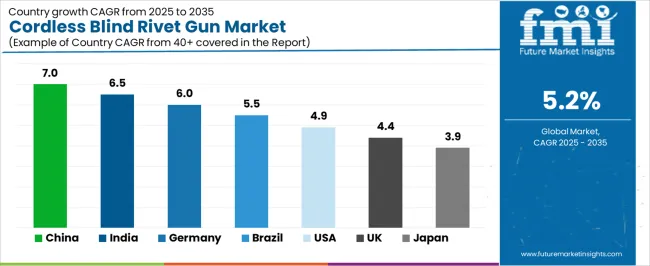
Regional deployment of cordless blind rivet guns reflects the pace of construction industrialization, aerospace MRO expansion, and automotive assembly automation. China at 7.0% CAGR, India at 6.5% CAGR, Germany at 6.0% CAGR, Brazil at 5.5% CAGR, USA at 4.9% CAGR, UK at 4.4% CAGR, Japan at 3.9% CAGR. China leads on the strength of massive prefabricated building programs and export-oriented tool manufacturing. India follows closely as automotive assembly line modernization and infrastructure construction volumes accelerate. Germany sustains growth through aerospace component assembly and precision manufacturing requirements. Brazil advances through expanding industrial construction and automotive production capacity. The United States maintains demand through aerospace MRO facility upgrades and modular construction adoption. The United Kingdom and Japan register steady growth linked to renovation, precision assembly, and marine fabrication sectors.
Cordless Blind Rivet Gun Market Definition
Cordless blind rivet guns are battery-operated fastening tools that install blind (pop) rivets for permanent sheet-to-sheet joining in applications where access is available from only one side of the workpiece. They use rechargeable lithium-ion battery platforms across 12V, 18V, and 24V voltage configurations. Primary applications include construction panel assembly, aerospace MRO rivet replacement, automotive body panel joining, HVAC ductwork fastening, and general manufacturing assembly.
Based on FMI's report, the market definition captures the complete addressable consumption base across all major producing and consuming regions, covering the forecast period from 2026 to 2036.
Cordless Blind Rivet Gun Market Inclusions
Market scope includes cordless blind rivet guns across rivet size capacities (1/4-inch, 3/16-inch), battery voltage platforms (12V, 18V, 24V and above), end-use industries, and distribution channels. The assessment covers global and regional market sizes, forecast period 2026 to 2036, and full segment breakdowns by type, application, battery voltage, end-use industry, distribution channel, and region.
Cordless Blind Rivet Gun Market Exclusions
The scope excludes manual hand rivet guns, pneumatic rivet tools, hydraulic structural rivet installation systems, and self-piercing rivet (SPR) equipment. Rivet fasteners sold as consumable supplies are not included in the tool market valuation.
Cordless Blind Rivet Gun Market Research Methodology
- Primary Research: Analysts engaged with procurement managers, production engineers, regulatory affairs specialists, and distribution channel executives to map the decision gates and compliance thresholds shaping product adoption.
- Desk Research: Data collection aggregated regulatory filings, trade body publications, standards body documentation, and company financial disclosures across all major producing and consuming regions.
- Market-Sizing and Forecasting: Baseline values derive from a bottom-up aggregation of producer shipment volumes and trade flow data, applying region-specific demand growth curves to project adoption velocity through 2036.
- Data Validation and Update Cycle: Projections are tested against publicly reported industry statistics, trade data, and company guidance. The model is updated quarterly to reflect regulatory and market structure changes.
Why is the Cordless Blind Rivet Gun Market Growing?
Market expansion is being supported by the increasing global demand for portable power tools and the corresponding need for fastening equipment that can provide reliable rivet installation without compressed air systems while enabling mobile operations and productivity enhancement across various construction, automotive, and manufacturing applications. Modern manufacturing facilities and service operations are increasingly focused on implementing cordless solutions that can reduce setup time, eliminate air compressor dependency, and provide consistent fastening performance throughout complex multi-location projects and field service operations.
The growing emphasis on operational efficiency and workplace mobility is driving demand for cordless rivet guns that can support high-volume fastening requirements, improve worker productivity, and enable flexible tool deployment. Manufacturers' preference for equipment that combines reliable performance with operational convenience and reduced infrastructure requirements is creating opportunities for innovative cordless rivet gun implementations. The rising influence of electric vehicle manufacturing and lightweight construction materials is also contributing to increased demand for cordless rivet guns that can provide precise fastening control, reduced weight, and reliable performance across extended operational periods.
Opportunity Pathways - Cordless Blind Rivet Gun Market
The cordless blind rivet gun market is poised for rapid growth and transformation. As industries across construction, automotive, aerospace, furniture manufacturing, and general fabrication seek fastening tools that deliver exceptional portability, consistent performance, and operational convenience, cordless rivet guns are gaining prominence not just as portable alternatives but as strategic enablers of productivity enhancement and operational flexibility.
Rising construction activity in Asia-Pacific and expanding manufacturing automation globally amplify demand, while manufacturers are leveraging innovations in battery technology, motor efficiency, and ergonomic design systems.
Pathways like professional-grade heavy-duty models, smart connectivity features, and application-specific customization promise strong margin uplift, especially in high-value segments. Geographic expansion and vertical integration will capture volume, particularly where local service capabilities and technical support proximity are critical. Regulatory pressures around workplace safety standards, noise reduction requirements, and emission-free operations give structural support.
- Pathway A - Heavy-Duty Industrial Cordless Models. Manufacturing and construction companies increasingly require cordless rivet guns with enhanced power output and extended battery life for continuous heavy-duty operations. Manufacturers who develop professional-grade models with superior torque capabilities can command premium pricing. Expected revenue pool: USD 180 million - USD 280 million.
- Pathway B - Smart Connected Rivet Guns with IoT Features. Growing demand for tool monitoring, usage tracking, and maintenance scheduling drives need for cordless rivet guns with wireless connectivity, digital displays, and integrated sensor systems. Opportunity: USD 95 million - USD 155 million.
- Pathway C - Multi-size Rivet Accommodation Systems. Advanced nose piece technology and quick-change mechanisms enable versatility improvements and reduced tool inventory requirements in multi-application environments. Revenue lift: USD 75 million - USD 125 million.
- Pathway D - Extended Battery Life & Fast Charging Solutions. Expanding reach into high-capacity battery systems with rapid charging capabilities and extended operational runtime. Professional contractors and manufacturing facilities will seek partners who supply long-lasting cordless tools with minimal downtime. Pool: USD 110 million - USD 175 million.
- Pathway E - Geographic Expansion & Regional Manufacturing. Strong growth in APAC, particularly India, Southeast Asia, and China. Local production lowers costs, reduces logistics complexity, and enables faster response to regional market requirements. Expected upside: USD 140 million - USD 220 million.
- Pathway F - Ergonomic Design & Lightweight Construction. Increasing demand for reduced-weight cordless rivet guns with improved grip design, vibration reduction, and operator comfort features for extended use applications. USD 85 million - USD 135 million.
- Pathway G - Specialized Automotive & Aerospace Applications. Developing cordless rivet guns with precision control systems, material-specific settings, and quality assurance features creates differentiation and addresses specialized fastening requirements in high-precision manufacturing environments. Pool: USD 70 million - USD 115 million.
Segmental Analysis
The cordless blind rivet gun market is segmented by type, application, battery voltage, end-use industry, distribution channel, and region. By type, the market is divided into 1/4″, 3/16″, and others. By application, it covers online sales and offline sales. By battery voltage, the cordless blind rivet gun market is segmented into 12V, 18V, and 24V & above. By end-use industry, it includes construction, automotive, aerospace, manufacturing, and others. By distribution channel, it is categorized into direct sales, retail stores, and online platforms. Regionally, the cordless blind rivet gun market is divided into North America, Europe, East Asia, South Asia & Pacific, Latin America, and the Middle East & Africa.
By Type, the 1/4″ Segment Accounts for 45% Market Share
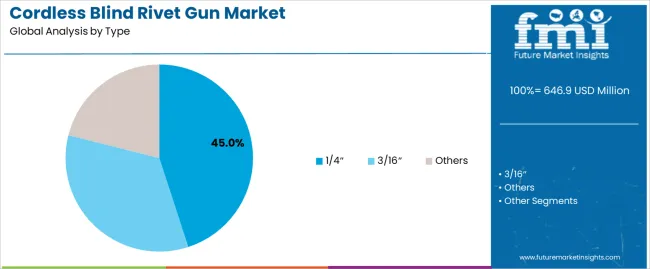
The 1/4″ segment is projected to account for 45% of the cordless blind rivet gun market in 2025, reaffirming its position as the leading size category. Construction contractors and manufacturing facilities increasingly utilize 1/4″ cordless rivet guns for their optimal balance between versatility and strength when handling standard fastening applications, excellent performance characteristics, and cost-effectiveness in applications ranging from sheet metal fabrication to general construction assembly. 1/4″ rivet gun technology's proven reliability and widespread rivet availability directly address the industrial requirements for dependable fastening performance in high-volume production environments.
This size segment forms the foundation of modern portable fastening operations, as it represents the rivet gun type with the greatest versatility and established market demand across multiple application categories and industry sectors. Manufacturer investments in enhanced motor technology and battery optimization continue to strengthen adoption among contractors and manufacturing operators. With companies prioritizing operational efficiency and tool versatility, 1/4″ cordless rivet guns align with both performance requirements and economic efficiency objectives, making them the central component of comprehensive fastening tool strategies.
By Application, the Online Sales Segment Accounts for 73% Market Share
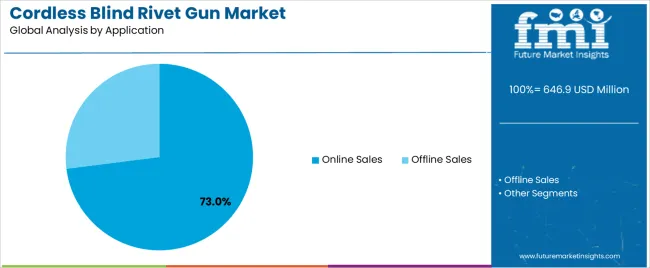
Online sales applications are projected to represent 73% of cordless rivet gun demand in 2025, underscoring their critical role as the primary distribution channel for portable power tools and cordless fastening equipment. Online platforms and e-commerce retailers prefer cordless rivet guns for their exceptional product visibility capabilities, detailed specification presentation, and ability to reach diverse customer segments while ensuring competitive pricing with comprehensive product information access. Positioned as essential sales channels for modern tool distribution, online platforms offer both convenience advantages and pricing transparency benefits.
The segment is supported by continuous innovation in digital marketing technologies and the growing availability of product demonstration videos that enable detailed feature comparison with enhanced customer education and rapid purchasing processes. Additionally, online retailers are investing in logistics optimization systems to support large-volume cordless tool distribution and customer service efficiency. As e-commerce penetration becomes more prevalent and professional tool purchasing moves online, online sales applications will continue to dominate the distribution market while supporting advanced customer engagement strategies and global market reach.
What are the Drivers, Restraints, and Key Trends of the Cordless Blind Rivet Gun Market?
The cordless blind rivet gun market is advancing rapidly due to increasing demand for portable fastening solutions and growing adoption of battery-powered tools that provide superior operational flexibility and enhanced productivity while enabling unrestricted movement across diverse construction, manufacturing, and maintenance applications. However, the cordless blind rivet gun market faces challenges, including battery technology limitations, higher initial investment costs compared to pneumatic alternatives, and the need for specialized charging infrastructure investments. Innovation in lithium-ion battery development and motor efficiency optimization continues to influence product development and market expansion patterns.
Expansion of Smart Tool Technologies and Digital Integration
The growing adoption of IoT-enabled cordless rivet guns, digital torque monitoring systems, and wireless connectivity features is enabling manufacturers to produce intelligent tools with superior operational tracking, enhanced maintenance scheduling, and data collection functionalities. Advanced smart systems provide improved productivity monitoring while allowing more efficient tool fleet management and consistent performance optimization across various operational conditions and applications. Manufacturers are increasingly recognizing the competitive advantages of digital integration capabilities for product differentiation and premium market positioning.
Integration of Advanced Battery Technology and Charging Systems
Modern cordless rivet gun producers are incorporating high-capacity lithium-ion battery systems, fast-charging capabilities, and interchangeable battery platforms to enhance operational runtime, enable rapid tool deployment, and deliver value-added solutions to professional contractors and manufacturing customers. These technologies improve field productivity while enabling new operational capabilities, including extended work sessions, reduced downtime, and enhanced tool utilization. Advanced battery integration also allows manufacturers to support large-scale operations and professional applications beyond traditional light-duty tool approaches.
Analysis of the Cordless Blind Rivet Gun Market by Key Countries
| Country | CAGR (2025-2035) |
|---|---|
| China | 7.0% |
| India | 6.5% |
| Germany | 6.0% |
| Brazil | 5.5% |
| USA | 4.9% |
| UK | 4.4% |
| Japan | 3.9% |
The cordless blind rivet gun market is experiencing strong growth globally, with China leading at a 7.0% CAGR through 2035, driven by the expanding manufacturing sector, growing construction activity, and significant investment in industrial automation development. India follows at 6.5%, supported by rapid infrastructure development, increasing automotive manufacturing, and growing adoption of modern fastening technologies. Germany shows growth at 6.0%, emphasizing precision engineering excellence and advanced manufacturing capabilities.
Brazil records 5.5%, focusing on construction market expansion and industrial development growth. The USA demonstrates 4.9% growth, prioritizing construction innovation and manufacturing automation development. The UK exhibits 4.4% growth, emphasizing professional tool adoption and construction sector modernization. Japan shows 3.9% growth, supported by precision manufacturing excellence and quality tool production standards.
The report covers an in-depth analysis of 40+ countries; seven top-performing countries are highlighted below.
China Leads Global Market Growth with Manufacturing Expansion Dominance
Revenue from cordless blind rivet guns in China is projected to exhibit exceptional growth with a CAGR of 7.0% through 2035, driven by expanding manufacturing capabilities and rapidly growing construction sector supported by government initiatives promoting industrial modernization and infrastructure development. The country's strong position in automotive manufacturing and increasing investment in advanced production technologies are creating substantial demand for professional cordless fastening solutions. Major manufacturers and construction companies are establishing comprehensive cordless tool procurement capabilities to serve both domestic production demand and export manufacturing markets.
- Government support for manufacturing upgrading initiatives and construction infrastructure development is driving demand for cordless rivet guns throughout major industrial centers and construction project sites.
- Strong manufacturing growth and an expanding network of automotive production facilities are supporting the rapid adoption of cordless fastening tools among manufacturers seeking enhanced productivity and operational flexibility.
India Demonstrates Strong Market Potential with Infrastructure Development
Revenue from cordless blind rivet guns in India is expanding at a CAGR of 6.5%, supported by the country's massive infrastructure development programs, expanding automotive sector, and increasing adoption of modern construction technologies. The country's government initiatives promoting manufacturing growth and growing middle-class purchasing power are driving requirements for professional-grade portable tool capabilities. International suppliers and domestic distributors are establishing extensive distribution and service capabilities to address the growing demand for cordless rivet gun products.
- Rising construction activity and expanding manufacturing capabilities are creating opportunities for cordless rivet gun adoption across construction contractors, automotive manufacturers, and general fabrication facilities in major industrial regions.
- Growing focus on productivity improvement and operational efficiency is driving adoption of battery-powered fastening tools among contractors and manufacturers seeking enhanced flexibility and reduced setup time.
Germany Demonstrates Engineering Excellence with Quality-Driven Growth
Revenue from cordless blind rivet guns in Germany is expanding at a CAGR of 6.0%, supported by the country's advanced manufacturing sector, strong emphasis on precision engineering, and robust demand for high-performance portable tools in automotive and industrial applications. The nation's mature manufacturing sector and quality-focused operations are driving sophisticated cordless rivet gun adoption throughout the supply chain. Leading manufacturers and technology providers are investing extensively in advanced motor technology and ergonomic design to serve both domestic and international markets.
- Rising demand for precision fastening solutions and automated production compatibility is creating requirements for high-quality cordless rivet guns with consistent performance characteristics among automotive manufacturers seeking enhanced assembly efficiency and quality control.
- Strong engineering tradition and growing investment in advanced manufacturing technologies are supporting adoption of professional-grade cordless tools with superior reliability and performance capabilities across precision manufacturing facilities.
Brazil Focuses on Construction Market Expansion and Industrial Growth
Revenue from cordless blind rivet guns in Brazil is growing at a CAGR of 5.5%, driven by the country's expanding construction sector, growing industrial development, and increasing investment in infrastructure projects. Brazil's large construction market and commitment to industrial expansion are supporting demand for portable fastening solutions across multiple application segments. Manufacturers are establishing comprehensive distribution capabilities to serve the growing domestic market and regional export opportunities.
- Strong construction activity and expanding infrastructure projects are driving adoption of cordless rivet guns with superior portability and operational flexibility among construction contractors and industrial fabricators.
- Growing manufacturing sector and increasing automotive production are supporting market expansion for professional cordless fastening tools with enhanced productivity characteristics throughout the country's industrial ecosystem.
USA Emphasizes Innovation Leadership and Professional Tool Adoption
Revenue from cordless blind rivet guns in the USA is expanding at a CAGR of 4.9%, supported by the country's advanced construction industry, strong emphasis on productivity enhancement, and strategic focus on professional-grade portable tools. The USA's innovation capabilities and efficiency-focused operations are driving demand for cordless rivet guns in construction, manufacturing, and maintenance applications. Manufacturers are investing in comprehensive technology development to serve both domestic professional markets and international specialty applications.
- Professional contractor adoption and construction productivity optimization are creating opportunities for cordless rivet gun utilization in commercial construction, residential building, and industrial maintenance operations among leading construction companies.
- Growing emphasis on tool efficiency and operational convenience is driving adoption of advanced cordless rivet guns with enhanced battery life and ergonomic features throughout the country's construction and manufacturing sectors.
UK Exhibits Professional Market Focus and Construction Modernization
Revenue from cordless blind rivet guns in the UK is growing at a CAGR of 4.4%, driven by the country's professional construction sector, emphasis on operational efficiency, and strong position in specialized manufacturing applications. The UK's established construction capabilities and commitment to productivity improvement are supporting investment in advanced portable tool technologies throughout major construction markets. Industry leaders are establishing comprehensive professional tool distribution systems to serve domestic contractors and specialized manufacturing operations.
- Innovations in battery technology and motor efficiency are creating demand for high-performance cordless rivet guns with exceptional operational reliability among professional contractors specializing in commercial and industrial construction projects.
- Growing construction sector modernization and increasing focus on productivity enhancement are driving adoption of advanced cordless fastening tools with superior convenience and performance characteristics across construction and manufacturing applications.
Japan Shows Precision Manufacturing and Quality Tool Production
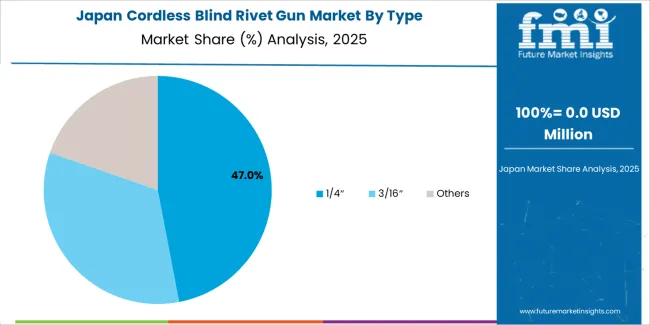
Revenue from cordless blind rivet guns in Japan is expanding at a CAGR of 3.9%, supported by the country's precision manufacturing excellence, emphasis on quality control, and strategic focus on advanced production technologies. Japan's established tool manufacturing capabilities and commitment to continuous improvement are supporting investment in high-quality cordless rivet gun production throughout major manufacturing centers. Industry leaders are establishing comprehensive quality assurance systems to serve domestic precision manufacturers and export markets.
- Precision manufacturing requirements and quality control standards are creating demand for ultra-high precision cordless rivet guns with exceptional consistency and reliability among manufacturers of automotive components, electronics assemblies, and precision equipment.
- Growing adoption of advanced manufacturing technologies and increasing focus on operational excellence are driving utilization of professional-grade cordless fastening tools with superior performance characteristics across the country's precision manufacturing sector.
Europe Market Split by Countries
The cordless blind rivet gun market in Europe is projected to grow from USD 185.3 million in 2025 to USD 298.7 million by 2035, registering a CAGR of 4.9% over the forecast period. Germany is expected to maintain its leadership position with a 32.5% market share in 2025, declining slightly to 31.8% by 2035, supported by its strong manufacturing industry, advanced automotive sector, and comprehensive professional tool distribution serving diverse cordless rivet gun applications across Europe.
France follows with a 18.5% share in 2025, projected to reach 19.2% by 2035, driven by robust demand for cordless tools in construction applications, aerospace manufacturing, and general fabrication, combined with established industrial infrastructure and professional contractor networks. The United Kingdom holds a 16.8% share in 2025, expected to reach 17.1% by 2035, supported by strong construction market and growing manufacturing activities. Italy commands a 12.2% share in 2025, projected to reach 12.6% by 2035, while Spain accounts for 8.7% in 2025, expected to reach 9.0% by 2035.
The Netherlands maintains a 4.1% share in 2025, growing to 4.3% by 2035. The Rest of Europe region, including Nordic countries, Eastern Europe, Belgium, Poland, and other nations, is anticipated to maintain momentum, with its collective share moving from 7.2% to 6.0% by 2035, attributed to increasing industrial development in Eastern Europe and growing construction activity in Nordic countries implementing advanced portable tool programs.
Competitive Landscape of the Cordless Blind Rivet Gun Market
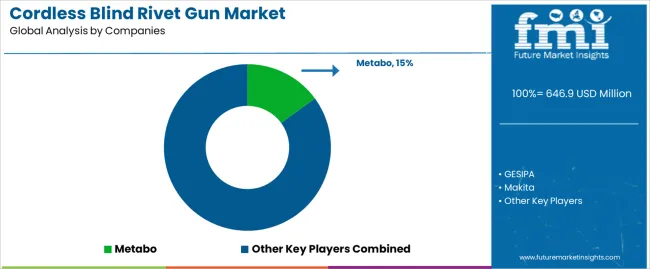
The cordless blind rivet gun market is characterized by competition among established power tool manufacturers, specialized fastening equipment producers, and integrated tool solutions providers. Companies are investing in battery technology research, motor efficiency optimization, ergonomic design development, and comprehensive product portfolios to deliver consistent, high-performance, and application-specific cordless rivet gun solutions. Innovation in smart connectivity features, advanced charging systems, and multi-size compatibility is central to strengthening market position and competitive advantage.
Metabo leads the cordless blind rivet gun market with a strong market share, offering comprehensive cordless rivet gun solutions with a focus on professional applications and industrial environments. GESIPA provides specialized fastening equipment capabilities with an emphasis on precision engineering and heavy-duty performance. Makita delivers innovative cordless tools with a focus on battery technology and user-friendly operation. Bosch specializes in professional power tools with advanced motor systems for enhanced efficiency. JRP focuses on specialized rivet gun applications and industrial fastening solutions. SRC STANLEY Engineered Fastening offers comprehensive fastening systems with emphasis on manufacturing and assembly applications.
Key Players in the Cordless Blind Rivet Gun Market
- Metabo
- GESIPA
- Makita
- Bosch
- JRP
- SRC STANLEY Engineered Fastening
- HOWMET Fastening Systems
- WÜRTH
- MACSIM
- Pro Spot
- GAGE
- Milwaukee
- GOEBEL
Scope of the Report
| Metric | Value |
|---|---|
| Quantitative Units | USD 680.54 Million to USD 1129.82 Million, at a CAGR of 5.20% |
| Market Definition | Cordless blind rivet guns are battery-operated fastening tools that install blind (pop) rivets for permanent sheet-to-sheet joining in applications where access is available from only one side of the workpiece. They use rechargeable lithium-ion battery platforms across 12V, 18V, and 24V voltage configurations. |
| Segmentation | Type: 1/4″, 3/16″, Others; Application: Online Sales, Offline Sales; Battery Voltage: 12V, 18V, 24V & Above; End-Use Industry: Construction, Automotive, Aerospace, Manufacturing, Others; Distribution Channel: Direct Sales, Retail Stores, Online Platforms |
| Regions Covered | North America, Latin America, Europe, East Asia, South Asia, Oceania, Middle East & Africa |
| Countries Covered | China, India, Germany, Brazil, USA, UK, Japan, and 40 plus countries |
| Key Companies Profiled | Metabo, GESIPA, Makita, Bosch, JRP, SRC STANLEY Engineered Fastening, HOWMET Fastening Systems, WÜRTH, MACSIM, Pro Spot |
| Forecast Period | 2026 to 2036 |
| Approach | Forecasting models apply a bottom-up methodology starting with regional production and trade metrics and projecting adoption rates against demand drivers and regulatory compliance timelines. |
Cordless Blind Rivet Gun Market by Segments
Type:
- 1/4″
- 3/16″
- Others
Application:
- Online Sales
- Offline Sales
Battery Voltage:
- 12V
- 18V
- 24V & Above
End-Use Industry:
- Construction
- Automotive
- Aerospace
- Manufacturing
- Others
Distribution Channel:
- Direct Sales
- Retail Stores
- Online Platforms
Region:
North America
- United States
- Canada
- Mexico
Europe
- Germany
- United Kingdom
- France
- Italy
- Spain
- Nordic
- BENELUX
- Rest of Europe
East Asia
- China
- Japan
- South Korea
- Taiwan
South Asia & Pacific
- India
- ASEAN
- Australia & New Zealand
- Rest of South Asia & Pacific
Latin America
- Brazil
- Chile
- Argentina
- Rest of Latin America
Middle East & Africa
- Kingdom of Saudi Arabia
- Other GCC Countries
- Turkiye
- South Africa
- Other African Union
- Rest of Middle East & Africa
Bibliography
- International Organization for Standardization. (2025). ISO 14588: Blind Rivets, Metallic. ISO.
- European Aviation Safety Agency. (2025). EASA Part-145: Approved Maintenance Organisation Requirements. EASA.
- USA Federal Aviation Administration. (2025). AC 43.13-1B: Acceptable Methods, Techniques, and Practices for Aircraft Inspection and Repair. FAA.
- European Commission. (2025). Construction Products Regulation (EU) 305/2011, Fastener Standards Update. European Commission.
- Stanley Engineered Fastening. (2025). Product Catalogue: Cordless Rivet Installation Systems. Stanley.
This bibliography is provided for reader reference. The full Future Market Insights report contains the complete reference list with primary research documentation.
This Report Addresses
- Market sizing and quantitative forecast metrics detailing procurement expenditure dedicated to cordless blind rivet gun across major industrial and geographic segments through 2036.
- Segmentation analysis mapping the adoption velocity of specific type categories and evaluating the structural drivers behind segment share shifts.
- Regional deployment intelligence comparing high-growth emerging market demand trajectories against mature market replacement and upgrade procurement patterns.
- Regulatory compliance assessment analyzing how evolving standards, certification mandates, and registration requirements shape procurement specifications and market access.
- Competitive posture evaluation tracking market structure concentration, integration advantages, and buyer leverage dynamics across major industry participants.
- Capital investment strategic guidance defining procurement specifications and qualification thresholds required by end-use industry decision-makers.
- Supply chain vulnerability analysis identifying sourcing concentration risks and logistics bottlenecks affecting delivery reliability and cost structures.
- Custom data delivery formats encompassing interactive dashboards, raw Excel datasets, and comprehensive PDF narrative reports.
Frequently Asked Questions
How large is the demand for Cordless Blind Rivet Gun in the global market in 2026?
Demand for Cordless Blind Rivet Gun in the global market is estimated to be valued at USD 680.54 million in 2026.
What will be the market size of Cordless Blind Rivet Gun in the global market by 2036?
Market size for Cordless Blind Rivet Gun is projected to reach USD 1129.82 million by 2036.
What is the expected demand growth for Cordless Blind Rivet Gun in the global market between 2026 and 2036?
Demand for Cordless Blind Rivet Gun is expected to grow at a CAGR of 5.20% between 2026 and 2036.
Which Type is poised to lead global sales by 2026?
1/4″ accounts for 45.0% share in 2026 based on structural demand factors and procurement concentration patterns.
What is driving demand in China?
China leads growth at 7.0% CAGR through 2036, driven by expanding domestic production capacity and end-use procurement volumes.
What is India's growth outlook in this report?
India is projected to grow at a CAGR of 6.5% during 2026 to 2036.
What is Cordless Blind Rivet Gun and what is it mainly used for?
Cordless blind rivet guns are battery-operated fastening tools that install blind (pop) rivets for permanent sheet-to-sheet joining in applications where access is available from only one side of the workpiece. They use rechargeable lithium-ion battery platforms across 12V, 18V, and 24V voltage configurations.
How does FMI build and validate the Cordless Blind Rivet Gun forecast?
Forecasting models apply a bottom-up methodology starting with regional production and trade metrics and cross-validate projections against industry statistics and company guidance.
Preview the report firsthand - request a free sample
Get SampleGet the brochure for pricing and purchase details.
Get PDFTable of Content
- Executive Summary
- Global Market Outlook
- Demand-side Trends
- Supply-side Trends
- Technology Roadmap Analysis
- Analysis and Recommendations
- Market Overview
- Market Coverage / Taxonomy
- Market Definition / Scope / Limitations
- Research Methodology
- Chapter Orientation
- Analytical Lens and Working Hypotheses
- Market Structure, Signals, and Trend Drivers
- Benchmarking and Cross-market Comparability
- Market Sizing, Forecasting, and Opportunity Mapping
- Research Design and Evidence Framework
- Desk Research Programme (Secondary Evidence)
- Company Annual and Sustainability Reports
- Peer-reviewed Journals and Academic Literature
- Corporate Websites, Product Literature, and Technical Notes
- Earnings Decks and Investor Briefings
- Statutory Filings and Regulatory Disclosures
- Technical White Papers and Standards Notes
- Trade Journals, Industry Magazines, and Analyst Briefs
- Conference Proceedings, Webinars, and Seminar Materials
- Government Statistics Portals and Public Data Releases
- Press Releases and Reputable Media Coverage
- Specialist Newsletters and Curated Briefings
- Sector Databases and Reference Repositories
- FMI Internal Proprietary Databases and Historical Market Datasets
- Subscription Datasets and Paid Sources
- Social Channels, Communities, and Digital Listening Inputs
- Additional Desk Sources
- Expert Input and Fieldwork (Primary Evidence)
- Primary Modes
- Qualitative Interviews and Expert Elicitation
- Quantitative Surveys and Structured Data Capture
- Blended Approach
- Why Primary Evidence is Used
- Field Techniques
- Interviews
- Surveys
- Focus Groups
- Observational and In-context Research
- Social and Community Interactions
- Stakeholder Universe Engaged
- C-suite Leaders
- Board Members
- Presidents and Vice Presidents
- R&D and Innovation Heads
- Technical Specialists
- Domain Subject-matter Experts
- Scientists
- Physicians and Other Healthcare Professionals
- Governance, Ethics, and Data Stewardship
- Research Ethics
- Data Integrity and Handling
- Primary Modes
- Tooling, Models, and Reference Databases
- Desk Research Programme (Secondary Evidence)
- Data Engineering and Model Build
- Data Acquisition and Ingestion
- Cleaning, Normalisation, and Verification
- Synthesis, Triangulation, and Analysis
- Quality Assurance and Audit Trail
- Market Background
- Market Dynamics
- Drivers
- Restraints
- Opportunity
- Trends
- Scenario Forecast
- Demand in Optimistic Scenario
- Demand in Likely Scenario
- Demand in Conservative Scenario
- Opportunity Map Analysis
- Product Life Cycle Analysis
- Supply Chain Analysis
- Investment Feasibility Matrix
- Value Chain Analysis
- PESTLE and Porter’s Analysis
- Regulatory Landscape
- Regional Parent Market Outlook
- Production and Consumption Statistics
- Import and Export Statistics
- Market Dynamics
- Global Market Analysis 2021 to 2025 and Forecast, 2026 to 2036
- Historical Market Size Value (USD Million) Analysis, 2021 to 2025
- Current and Future Market Size Value (USD Million) Projections, 2026 to 2036
- Y-o-Y Growth Trend Analysis
- Absolute $ Opportunity Analysis
- Global Market Pricing Analysis 2021 to 2025 and Forecast 2026 to 2036
- Global Market Analysis 2021 to 2025 and Forecast 2026 to 2036, By Type
- Introduction / Key Findings
- Historical Market Size Value (USD Million) Analysis By Type , 2021 to 2025
- Current and Future Market Size Value (USD Million) Analysis and Forecast By Type , 2026 to 2036
- 1/4″
- 3/16″
- Others
- 1/4″
- Y-o-Y Growth Trend Analysis By Type , 2021 to 2025
- Absolute $ Opportunity Analysis By Type , 2026 to 2036
- Global Market Analysis 2021 to 2025 and Forecast 2026 to 2036, By Application
- Introduction / Key Findings
- Historical Market Size Value (USD Million) Analysis By Application, 2021 to 2025
- Current and Future Market Size Value (USD Million) Analysis and Forecast By Application, 2026 to 2036
- Online Sales
- Offline Sales
- Online Sales
- Y-o-Y Growth Trend Analysis By Application, 2021 to 2025
- Absolute $ Opportunity Analysis By Application, 2026 to 2036
- Global Market Analysis 2021 to 2025 and Forecast 2026 to 2036, By Battery Voltage
- Introduction / Key Findings
- Historical Market Size Value (USD Million) Analysis By Battery Voltage, 2021 to 2025
- Current and Future Market Size Value (USD Million) Analysis and Forecast By Battery Voltage, 2026 to 2036
- 12V
- 18V
- 24V & Above
- 12V
- Y-o-Y Growth Trend Analysis By Battery Voltage, 2021 to 2025
- Absolute $ Opportunity Analysis By Battery Voltage, 2026 to 2036
- Global Market Analysis 2021 to 2025 and Forecast 2026 to 2036, By End-Use Industry
- Introduction / Key Findings
- Historical Market Size Value (USD Million) Analysis By End-Use Industry, 2021 to 2025
- Current and Future Market Size Value (USD Million) Analysis and Forecast By End-Use Industry, 2026 to 2036
- Construction
- Automotive
- Aerospace
- Manufacturing
- Others
- Construction
- Y-o-Y Growth Trend Analysis By End-Use Industry, 2021 to 2025
- Absolute $ Opportunity Analysis By End-Use Industry, 2026 to 2036
- Global Market Analysis 2021 to 2025 and Forecast 2026 to 2036, By Distribution Channel
- Introduction / Key Findings
- Historical Market Size Value (USD Million) Analysis By Distribution Channel, 2021 to 2025
- Current and Future Market Size Value (USD Million) Analysis and Forecast By Distribution Channel, 2026 to 2036
- Direct Sales
- Retail Stores
- Online Platforms
- Direct Sales
- Y-o-Y Growth Trend Analysis By Distribution Channel, 2021 to 2025
- Absolute $ Opportunity Analysis By Distribution Channel, 2026 to 2036
- Global Market Analysis 2021 to 2025 and Forecast 2026 to 2036, By Region
- Introduction
- Historical Market Size Value (USD Million) Analysis By Region, 2021 to 2025
- Current Market Size Value (USD Million) Analysis and Forecast By Region, 2026 to 2036
- North America
- Latin America
- Western Europe
- Eastern Europe
- East Asia
- South Asia and Pacific
- Middle East & Africa
- Market Attractiveness Analysis By Region
- North America Market Analysis 2021 to 2025 and Forecast 2026 to 2036, By Country
- Historical Market Size Value (USD Million) Trend Analysis By Market Taxonomy, 2021 to 2025
- Market Size Value (USD Million) Forecast By Market Taxonomy, 2026 to 2036
- By Country
- USA
- Canada
- Mexico
- By Type
- By Application
- By Battery Voltage
- By End-Use Industry
- By Distribution Channel
- By Country
- Market Attractiveness Analysis
- By Country
- By Type
- By Application
- By Battery Voltage
- By End-Use Industry
- By Distribution Channel
- Key Takeaways
- Latin America Market Analysis 2021 to 2025 and Forecast 2026 to 2036, By Country
- Historical Market Size Value (USD Million) Trend Analysis By Market Taxonomy, 2021 to 2025
- Market Size Value (USD Million) Forecast By Market Taxonomy, 2026 to 2036
- By Country
- Brazil
- Chile
- Rest of Latin America
- By Type
- By Application
- By Battery Voltage
- By End-Use Industry
- By Distribution Channel
- By Country
- Market Attractiveness Analysis
- By Country
- By Type
- By Application
- By Battery Voltage
- By End-Use Industry
- By Distribution Channel
- Key Takeaways
- Western Europe Market Analysis 2021 to 2025 and Forecast 2026 to 2036, By Country
- Historical Market Size Value (USD Million) Trend Analysis By Market Taxonomy, 2021 to 2025
- Market Size Value (USD Million) Forecast By Market Taxonomy, 2026 to 2036
- By Country
- Germany
- UK
- Italy
- Spain
- France
- Nordic
- BENELUX
- Rest of Western Europe
- By Type
- By Application
- By Battery Voltage
- By End-Use Industry
- By Distribution Channel
- By Country
- Market Attractiveness Analysis
- By Country
- By Type
- By Application
- By Battery Voltage
- By End-Use Industry
- By Distribution Channel
- Key Takeaways
- Eastern Europe Market Analysis 2021 to 2025 and Forecast 2026 to 2036, By Country
- Historical Market Size Value (USD Million) Trend Analysis By Market Taxonomy, 2021 to 2025
- Market Size Value (USD Million) Forecast By Market Taxonomy, 2026 to 2036
- By Country
- Russia
- Poland
- Hungary
- Balkan & Baltic
- Rest of Eastern Europe
- By Type
- By Application
- By Battery Voltage
- By End-Use Industry
- By Distribution Channel
- By Country
- Market Attractiveness Analysis
- By Country
- By Type
- By Application
- By Battery Voltage
- By End-Use Industry
- By Distribution Channel
- Key Takeaways
- East Asia Market Analysis 2021 to 2025 and Forecast 2026 to 2036, By Country
- Historical Market Size Value (USD Million) Trend Analysis By Market Taxonomy, 2021 to 2025
- Market Size Value (USD Million) Forecast By Market Taxonomy, 2026 to 2036
- By Country
- China
- Japan
- South Korea
- By Type
- By Application
- By Battery Voltage
- By End-Use Industry
- By Distribution Channel
- By Country
- Market Attractiveness Analysis
- By Country
- By Type
- By Application
- By Battery Voltage
- By End-Use Industry
- By Distribution Channel
- Key Takeaways
- South Asia and Pacific Market Analysis 2021 to 2025 and Forecast 2026 to 2036, By Country
- Historical Market Size Value (USD Million) Trend Analysis By Market Taxonomy, 2021 to 2025
- Market Size Value (USD Million) Forecast By Market Taxonomy, 2026 to 2036
- By Country
- India
- ASEAN
- Australia & New Zealand
- Rest of South Asia and Pacific
- By Type
- By Application
- By Battery Voltage
- By End-Use Industry
- By Distribution Channel
- By Country
- Market Attractiveness Analysis
- By Country
- By Type
- By Application
- By Battery Voltage
- By End-Use Industry
- By Distribution Channel
- Key Takeaways
- Middle East & Africa Market Analysis 2021 to 2025 and Forecast 2026 to 2036, By Country
- Historical Market Size Value (USD Million) Trend Analysis By Market Taxonomy, 2021 to 2025
- Market Size Value (USD Million) Forecast By Market Taxonomy, 2026 to 2036
- By Country
- Kingdom of Saudi Arabia
- Other GCC Countries
- Turkiye
- South Africa
- Other African Union
- Rest of Middle East & Africa
- By Type
- By Application
- By Battery Voltage
- By End-Use Industry
- By Distribution Channel
- By Country
- Market Attractiveness Analysis
- By Country
- By Type
- By Application
- By Battery Voltage
- By End-Use Industry
- By Distribution Channel
- Key Takeaways
- Key Countries Market Analysis
- USA
- Pricing Analysis
- Market Share Analysis, 2025
- By Type
- By Application
- By Battery Voltage
- By End-Use Industry
- By Distribution Channel
- Canada
- Pricing Analysis
- Market Share Analysis, 2025
- By Type
- By Application
- By Battery Voltage
- By End-Use Industry
- By Distribution Channel
- Mexico
- Pricing Analysis
- Market Share Analysis, 2025
- By Type
- By Application
- By Battery Voltage
- By End-Use Industry
- By Distribution Channel
- Brazil
- Pricing Analysis
- Market Share Analysis, 2025
- By Type
- By Application
- By Battery Voltage
- By End-Use Industry
- By Distribution Channel
- Chile
- Pricing Analysis
- Market Share Analysis, 2025
- By Type
- By Application
- By Battery Voltage
- By End-Use Industry
- By Distribution Channel
- Germany
- Pricing Analysis
- Market Share Analysis, 2025
- By Type
- By Application
- By Battery Voltage
- By End-Use Industry
- By Distribution Channel
- UK
- Pricing Analysis
- Market Share Analysis, 2025
- By Type
- By Application
- By Battery Voltage
- By End-Use Industry
- By Distribution Channel
- Italy
- Pricing Analysis
- Market Share Analysis, 2025
- By Type
- By Application
- By Battery Voltage
- By End-Use Industry
- By Distribution Channel
- Spain
- Pricing Analysis
- Market Share Analysis, 2025
- By Type
- By Application
- By Battery Voltage
- By End-Use Industry
- By Distribution Channel
- France
- Pricing Analysis
- Market Share Analysis, 2025
- By Type
- By Application
- By Battery Voltage
- By End-Use Industry
- By Distribution Channel
- India
- Pricing Analysis
- Market Share Analysis, 2025
- By Type
- By Application
- By Battery Voltage
- By End-Use Industry
- By Distribution Channel
- ASEAN
- Pricing Analysis
- Market Share Analysis, 2025
- By Type
- By Application
- By Battery Voltage
- By End-Use Industry
- By Distribution Channel
- Australia & New Zealand
- Pricing Analysis
- Market Share Analysis, 2025
- By Type
- By Application
- By Battery Voltage
- By End-Use Industry
- By Distribution Channel
- China
- Pricing Analysis
- Market Share Analysis, 2025
- By Type
- By Application
- By Battery Voltage
- By End-Use Industry
- By Distribution Channel
- Japan
- Pricing Analysis
- Market Share Analysis, 2025
- By Type
- By Application
- By Battery Voltage
- By End-Use Industry
- By Distribution Channel
- South Korea
- Pricing Analysis
- Market Share Analysis, 2025
- By Type
- By Application
- By Battery Voltage
- By End-Use Industry
- By Distribution Channel
- Russia
- Pricing Analysis
- Market Share Analysis, 2025
- By Type
- By Application
- By Battery Voltage
- By End-Use Industry
- By Distribution Channel
- Poland
- Pricing Analysis
- Market Share Analysis, 2025
- By Type
- By Application
- By Battery Voltage
- By End-Use Industry
- By Distribution Channel
- Hungary
- Pricing Analysis
- Market Share Analysis, 2025
- By Type
- By Application
- By Battery Voltage
- By End-Use Industry
- By Distribution Channel
- Kingdom of Saudi Arabia
- Pricing Analysis
- Market Share Analysis, 2025
- By Type
- By Application
- By Battery Voltage
- By End-Use Industry
- By Distribution Channel
- Turkiye
- Pricing Analysis
- Market Share Analysis, 2025
- By Type
- By Application
- By Battery Voltage
- By End-Use Industry
- By Distribution Channel
- South Africa
- Pricing Analysis
- Market Share Analysis, 2025
- By Type
- By Application
- By Battery Voltage
- By End-Use Industry
- By Distribution Channel
- USA
- Market Structure Analysis
- Competition Dashboard
- Competition Benchmarking
- Market Share Analysis of Top Players
- By Regional
- By Type
- By Application
- By Battery Voltage
- By End-Use Industry
- By Distribution Channel
- Competition Analysis
- Competition Deep Dive
- Metabo
- Overview
- Product Portfolio
- Profitability by Market Segments (Product/Age /Sales Channel/Region)
- Sales Footprint
- Strategy Overview
- Marketing Strategy
- Product Strategy
- Channel Strategy
- GESIPA
- Makita
- Bosch
- JRP
- SRC STANLEY Engineered Fastening
- HOWMET Fastening Systems
- WÜRTH
- MACSIM
- Pro Spot
- GAGE
- Milwaukee
- GOEBEL
- Metabo
- Competition Deep Dive
- Assumptions & Acronyms Used


