

- Industry Size (2026)
- USD 0.7 Bn
- Forecast (2036)
- USD 1.12 Bn
- CAGR (2026 to 2036)
- 5.2%
Cordless Pop Rivet Gun Market Size, Market Forecast and Outlook By FMI
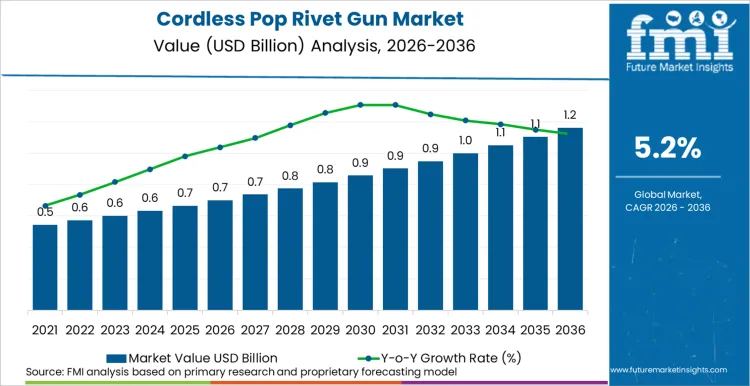
In 2025, the cordless pop rivet gun market was worth USD 0.6 billion. It is expected to reach USD 0.7 billion in 2026 and USD 1.12 billion by 2036, implying a CAGR of 5.2%. This trajectory reflects a structural pivot where industrial buyers are replacing pneumatic incumbents with high-torque battery-operated systems to eliminate air-hose tethering and reduce total cost of ownership in complex assembly environments.
According to FMI's estimates, procurement specifications are shifting from standalone tool performance to platform interoperability, where the decision to purchase a cordless pop rivet gun is increasingly dictated by existing battery fleet compatibility. Manufacturers are prioritizing "skin-only" tool acquisitions to leverage sunk costs in 18V/20V power packs, effectively raising the barrier to entry for non-platform competitors while accelerating the retirement of legacy pneumatic infrastructure in MRO and light manufacturing.
Summary of Cordless Pop Rivet Gun Market
- Cordless Pop Rivet Gun Market Definition
- Battery-powered tools for setting blind rivets without pneumatic tethers.
- Demand Drivers in the Market
- Migration to unified battery platforms reducing MRO complexity.
- Expansion of solar and renewable energy installation crews.
- Strict ergonomic mandates reducing repetitive strain injuries.
- Key Segments Analyzed in the FMI Report
- Rivet Size: 1/4" and 3/16" dominating structural applications.
- Sales Channel: Online sales capturing 68% of volume.
- Geography: High-growth Asia Pacific manufacturing hubs versus replacement-led Western markets.
- Analyst Opinion at FMI
- Nikhil Kaitwade, Principal Consultant for Oil and Gas, Automotive, Chemicals, Process Automation, opines, "In the updated Cordless Pop Rivet Gun Market Report, CXOs will find that the critical battleground has shifted from tool mechanics to digital ecosystem integration. My findings point at a consolidation where buyers prioritize tools that offer data-logging for quality assurance in automotive repair, effectively locking out tool competitors."
- Strategic Implications/Executive Takeaways
- Prioritize "skin-only" SKUs to lower entry barriers for existing platform users.
- Target the solar/renewables sector with high-durability, weather-resistant models.
- Invest in online direct-to-consumer logistics to capture the dominant 68% channel share.
- Methodology
- Validated through first-hand corporate production and capacity data.
- Zero reliance on speculative third-party market research reports.
- Based on verifiable industrial benchmarks and verified sources.
As per FMI's projection, this consolidation of power architecture is exemplified by industry leaders. “In 2025, we will continue our mission of cordless domination, bringing disruptive technology and innovative design to the market, while delivering outstanding financial results.” [7] - Horst Julius Pudwill, Chairman of Techtronic Industries
For buyers, this "cordless domination" signal implies a narrowing of vendor options toward large-cap OEMs capable of sustaining expansive power tools ecosystems, forcing smaller fabrication shops to align long-term capital expenditure with dominant battery standards (e.g., M18, LXT, 20V MAX) to ensure supply chain continuity.
Growth tracks a CAGR of 6.4% in India and 6.1% in China, reflecting aggressive industrialization, while mature markets like the USA (4.7%) and Germany (4.9%) focus on replacement cycles. Japan (4.1%) and South Korea (4.8%) show steady, albeit slower, expansion driven by precision manufacturing demands, whereas the UK (4.6%) aligns with construction sector recovery.
Cordless Pop Rivet Gun Market Definition
The Cordless Pop Rivet Gun market comprises the global trade and industrial application of battery-powered blind rivet setting tools designed to join materials where access is limited to one side. These tools utilize electro-mechanical mechanisms to pull the rivet mandrel, creating a permanent fastening without the need for compressed air hoses or external power cords. Definitions strictly cover pistol-grip and inline battery tools capable of setting standard, structural, and bulb-tite rivets across various alloy types.
Cordless Pop Rivet Gun Market Inclusions
The report includes a comprehensive analysis of tools compatible with lithium-ion battery platforms ranging from 12V compact series to 36V+ heavy-duty industrial lines. Coverage extends to smart-tools with integrated Bluetooth connectivity for torque tracking, cycle counting, and preventative maintenance alerts used in Industry 4.0 environments. It also encompasses the aftermarket for proprietary nose pieces, jaw sets, and replacement battery packs specifically marketed for riveting applications.
Cordless Pop Rivet Gun Market Exclusions
The scope excludes pneumatic (air-powered) rivet guns, manual hand riveters, and corded electric models that require continuous mains power. It also omits non-riveting fastening tools such as impact drivers, drill drivers, or thread locking adhesives unless sold as part of a specific riveting combo kit. Automated, stationary riveting cells and robotic end-effectors are also outside the purview of this handheld-focused analysis.
Cordless Pop Rivet Gun Market Research Methodology
- Primary Research: Interviews with product managers at major power tool OEMs, distributors, and procurement heads in automotive and aerospace maintenance.
- Desk Research: Analysis of corporate annual reports, investor presentations, government manufacturing output indices, and trade association safety standards.
- Market-Sizing and Forecasting: A bottom-up approach aggregating unit sales by channel and region, validated against battery platform install-base estimates.
- Data Validation and Update Cycle: Cross-referencing import/export codes for hand tools with battery pack shipment data to isolate cordless riveting volumes.
Segmental Analysis
Cordless Pop Rivet Gun Market Analysis by Rivet Size
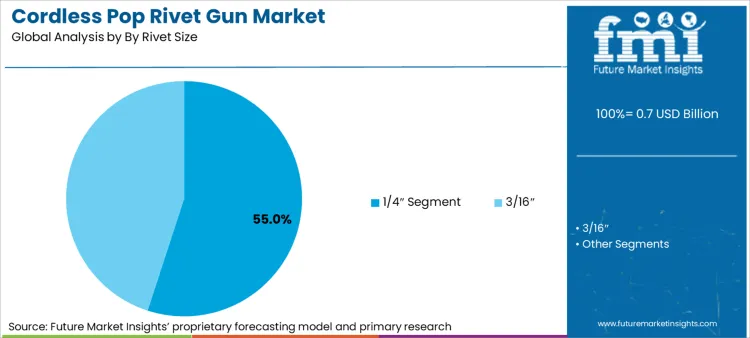
The dominance of specific rivet sizes is dictated by the structural requirements of the end-use application, with 1/4" capacity tools, holding around 55% share in 2026 seeing robust uptake in heavy fabrication. FMI analysts opine that demand is bifurcating between compact units for light assembly and high-torque monsters capable of setting structural fasteners. Techtronic Industries (TTI) reported record sales of USD 14.6 billion in 2024, partly driven by professional-grade tools like those in the Milwaukee line that cater to these heavy-duty specifications [1].
- Standardization trigger: Demand for 1/4" capacity tools is reinforced by the need for high-strength fastening in heavy truck and trailer assembly, where pneumatic lines are being phased out for mobile assembly fastening tools to improve workflow flexibility and reduce trip hazards in 2026. [1]
- Ergonomics shift: Procurement of 3/16" tools shifts because MRO technicians require lighter, compact form factors for overhead work in HVAC and electrical installations, reducing fatigue and aligning with safety mandates while maintaining sufficient pull force. [2]
- Specialty adaptation: Adoption accelerates where "Other" sizes (micro or mega rivets) are required for niche aerospace or electronics repair, compelling suppliers to offer modular nose-piece accessories that extend tool utility without requiring full unit replacement. [6]
Cordless Pop Rivet Gun Market Analysis by Sales Channel
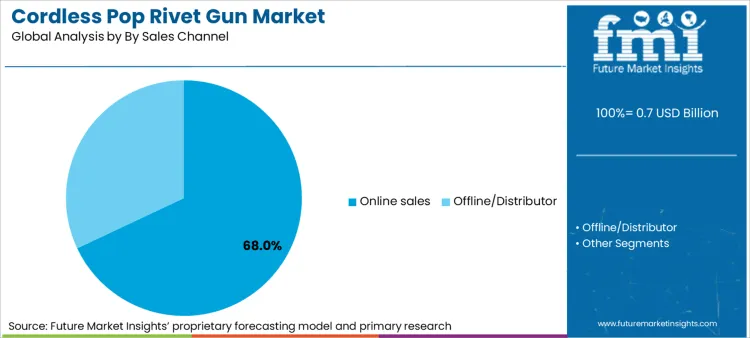
Online channels have emerged as the primary conduit for tool sales, capturing a massive 68.0% share as professional buyers increasingly rely on digital procurement. FMI estimates that this shift is structural, driven by the convenience of comparing specifications and the logistical efficiency of direct shipping. TTI's strategic emphasis on "cordless domination" and digital engagement supports this migration, ensuring their flagship brands remain visible and accessible to the modern digital-first tradesperson [7].
- Digital procurement: Growth is anchored in the 68.0% dominance of Online sales, where fleet managers utilize B2B e-commerce portals to bulk-order "bare tools" that integrate seamlessly with their existing battery inventories, bypassing physical retail bottlenecks. [1]
- Inventory logic: Distributors shift toward hybrid models because the vast SKU proliferation of voltage and amperage variations makes stocking every combination in Offline stores financially inefficient, pushing lower-turnover specialty rivet guns to virtual shelves. [9]
- Service integration: Offline/Distributor channels retain relevance by pivoting to after-sales service and immediate job-site fulfillment for urgent industrial fasteners needs, serving as critical emergency supply nodes rather than primary volume drivers. [3]
Cordless Pop Rivet Gun Market Analysis by End Use
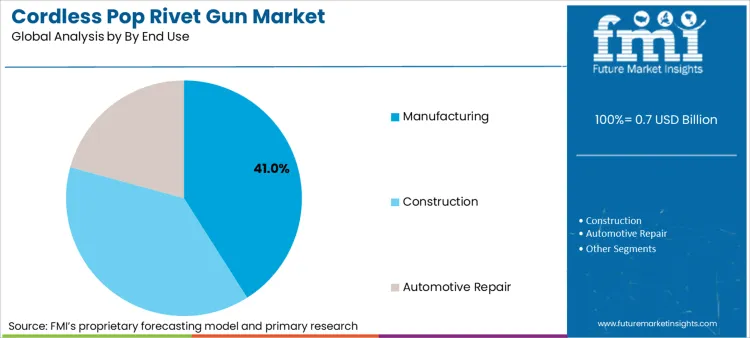
Manufacturing remains the bedrock of demand, accounting for 41% of the market, but construction and automotive repair are rapidly gaining ground. The need for mobility in large-scale assembly plants and remote construction sites drives the adoption of cordless solutions. In Germany, a 30.2% surge in fabricated metal product orders in late 2025 highlights the intense pressure on manufacturers to scale output, directly fueling the consumption of efficiency-enhancing power tools [3].
- Production mobility: Manufacturing demand (41% share) is driven by the reorganization of assembly lines into flexible cells, where cordless tools allow operators to move freely around large workpieces like appliances and cabinetry without air-hose limitations. [3]
- Field autonomy: Construction uptake accelerates as solar PV installers a workforce projected to add 12,000 jobs by 2034 require reliable, tether-free riveting solutions to mount racking systems in remote locations lacking consistent generator power. [2]
- Repair modernization: Automotive Repair adoption grows as technicians utilize compact cordless riveters for aluminum body panel fasteners, mirroring the 3.7% growth in private housing repair output in the UK which signals a broader trend of renovation and maintenance activity. [8]
Cordless Pop Rivet Gun Market Drivers, Restraints, and Opportunities
The rapid expansion of the renewable energy workforce and the associated need for mobile installation tools is a primary driver. As solar farms and wind installations move to more remote and expansive geographies, the logistical burden of pneumatic compressors becomes untenable. This shift forces installation contractors to adopt high-endurance cordless riveters that can operate autonomously for full shifts. This trend is substantiated by the U.S. Bureau of Labor Statistics, which projects the addition of 12,000 Solar PV Installer jobs through 2034, creating a sustained pipeline of new users who rely exclusively on battery-powered hand tools for racking assembly [2].
High upfront adoption costs for professional-grade cordless platforms compared to pneumatic equivalents remain a significant restraint for cost-sensitive workshops. While a pneumatic riveter is a simple mechanical device, a cordless unit involves complex motors, electronics, and expensive lithium-ion batteries, raising the initial capital expenditure (Capex) for small enterprises. Market players mitigate this by offering "bare tool" options that exclude batteries, yet the cost barrier persists. TTI's financial reports highlight this capital intensity, noting a robust Capex spend of USD 292 million in 2024 to support manufacturing and automation, costs that ultimately factor into the premium pricing of advanced cordless tools [9].
Opportunities
- Automotive Aftermarket: Service centers require specialized tools to handle mixed-material chassis repairs (aluminum/steel), creating a niche for smart-riveters; demand is reinforced by the broader automotive ecosystem, where USA auto repair technicians utilize diverse power tools to maintain the country's aging vehicle fleet [4].
- Emerging Market Industrialization: Rapid industrial value-added growth in developing economies opens a massive window for "leapfrog" adoption where factories skip pneumatics entirely; this is evidenced by China's 5.9% industrial growth in 2025, which drives demand for modern metal fabrication equipment and tools [5].
- Infrastructure Rehabilitation: Aging public infrastructure in Western nations necessitates extensive on-site repair work ideal for cordless riveting; this opportunity is highlighted by the 3.7% rise in UK private housing repair output in June 2025, signaling a robust renovation economy [8].
Regional Analysis
Based on the regional analysis, the Cordless Pop Rivet Gun market is segmented into North America, Latin America, Europe, East Asia, South Asia, Oceania and Middle East & Africa across 40+ countries. The full report also offers market attractiveness analysis based on regional trends.
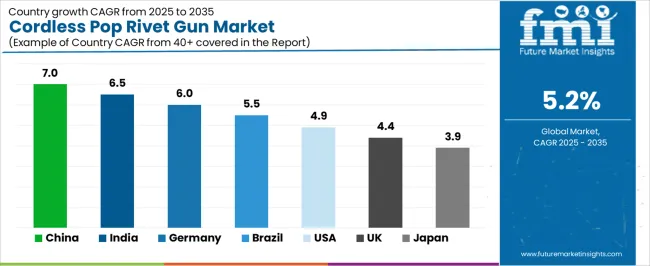
| Country | CAGR (2026 to 2036) |
|---|---|
| India | 6.4% |
| China | 6.1% |
| Germany | 4.9% |
| South Korea | 4.8% |
| United States | 4.7% |
| United Kingdom | 4.6% |
| Japan | 4.1% |
Source: Future Market Insights (FMI) analysis, based on proprietary forecasting model and primary research
Asia Pacific Cordless Pop Rivet Gun Analysis
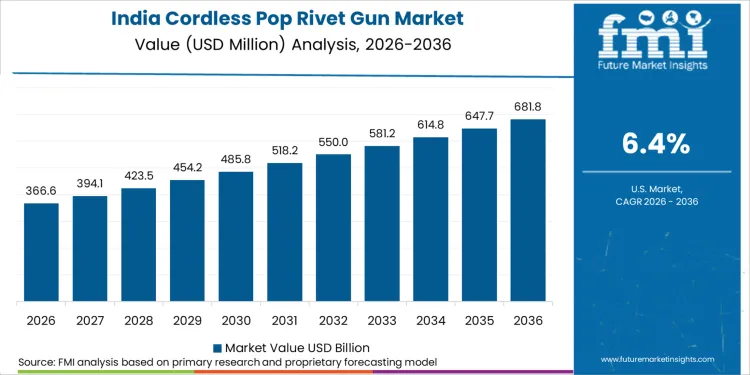
Asia Pacific is positioning itself as the global engine for volume growth, driven by the dual engines of Chinese manufacturing scale and Indian industrial modernization. The region is transitioning from low-cost manual assembly to semi-automated, power-assisted workflows to meet global quality standards. This shift is anchored by robust macroeconomic indicators, such as India's manufacturing sector recording an 8.0% growth in late 2025, specifically led by a 10.2% surge in basic metals production [4]. Additionally, TTI’s investment in manufacturing facilities in Vietnam and China underscores the region's role not just as a consumer, but as the central production hub for these tools [9].
- India: Growth in electric power tools across India is estimated at 6.4% CAGR through 2036, driven by the "Make in India" initiative that increased electrical equipment manufacturing output by 40.1% in late 2024, necessitating modern assembly tools [10].
- China: The Chinese cordless pop rivet gun sector is poised to expand at 6.1% CAGR during 2026 to 2036 because sustained industrial upgrades drove a 5.9% increase in industrial value-added in 2025, which lifts utilization rates for advanced assembly hardware [5].
- Japan: Demand for cordless pop rivet gun in Japan is set to grow at 4.1% CAGR through 2036, supported by a precision-focused manufacturing base where sales in the sector reached 463.4 trillion yen in 2023, emphasizing high-value tool procurement [11].
- South Korea: South Korea is expected to record 4.8% CAGR in cordless pop rivet gun demand over 2026 to 2036 as manufacturing capacity utilization stabilized at 70.9% in late 2025, tightening the link between operational constraints and adoption-led investment [10].
FMI’s report includes a deep-dive analysis of the Asia Pacific ecosystem. Beyond the major hubs, countries like Vietnam and Thailand are emerging as critical manufacturing satellites, attracting significant OEM investment to diversify supply chains away from single-source risks. Buyers in these markets are increasingly adopting hand tools and power equipment that meet export-quality standards. TTI's confirmed Capex spend of USD 292 million in 2024 specifically targets expansion in Vietnam, signaling a long-term commitment to these high-potential opportunistic markets [9].
Europe Cordless Pop Rivet Gun Analysis
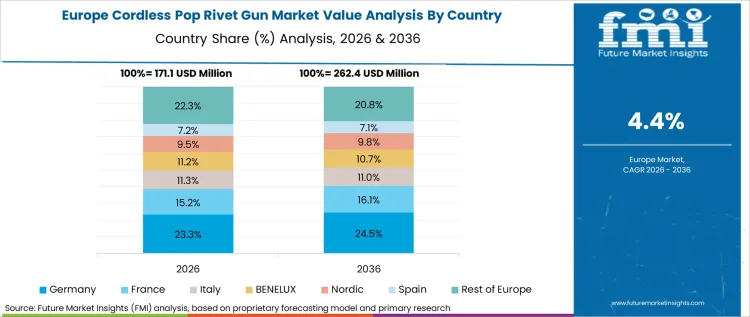
Europe represents a mature but technically sophisticated market where growth is driven by high-specification industrial manufacturing and strict environmental/ergonomic regulations. The region's industrial base is rebounding, with German data showing a sharp 30.2% increase in fabricated metal product orders in December 2025, which directly correlates with increased demand for fastening tools [3]. European buyers are particularly sensitive to tool efficiency and worker safety, favoring low-vibration, high-speed cordless units that align with EU directives on occupational health.
- Germany: The outlook for cordless pop rivet gun in Germany indicates a 4.9% CAGR from 2026 to 2036 as a 10.5% jump in capital goods orders in late 2025 fuels demand, strengthening procurement from both heavy machinery builders and automotive suppliers [3].
- United Kingdom: In the UK, the cordless pop rivet gun market is forecast to advance at 4.6% CAGR through 2036, with growth anchored in a 3.7% rise in private housing repair output that converts into measurable budget allocation for construction-grade tools [8].
FMI’s report includes an extensive assessment of the European landscape. Apart from the leaders, France and Italy remain vital markets due to their substantial aerospace and luxury automotive manufacturing sectors which demand precision fastening solutions. Suppliers in these opportunistic countries should watch for circular economy regulations that incentivize the repairability of industrial equipment, a trend that boosts the consumption of rivet gun market solutions for refurbishment projects. The region's focus on sustainable manufacturing practices is further evidenced by TTI's record sales performance, validated by their 2024 financial results [1].
North America Cordless Pop Rivet Gun Analysis
North America continues to lead in the adoption of high-voltage, professional-grade cordless platforms, driven by a construction and energy sector boom. The market is characterized by a strong preference for "system" tools where users buy into a single battery brand. This behavior is supported by the U.S. labor market's evolution, where the Bureau of Labor Statistics anticipates the addition of 12,000 Solar PV installers by 2034, a trade heavily dependent on cordless fastening efficiency [2].
- United States: Cordless pop rivet gun uptake in the United States is anticipated to climb at 4.7% CAGR over the forecast period as the solar installation workforce expands by 12,000 jobs through 2034, helping suppliers align positioning with local buying triggers in the renewables sector [2].
FMI’s report includes detailed insights into the North American market structure. Canada and Mexico serve as key complementary markets; Canada through its resource extraction and housing sectors, and Mexico as a rapidly expanding near-shoring manufacturing hub for US-based OEMs. Buyers in Mexico are increasingly upgrading to professional automatic riveting equipment market standards to match cross-border quality requirements. TTI's investment footprint in Mexico, part of their USD 292 million global Capex, highlights the strategic importance of this southern neighbor in the broader North American supply chain [9].
Competitive Aligners for Market Players
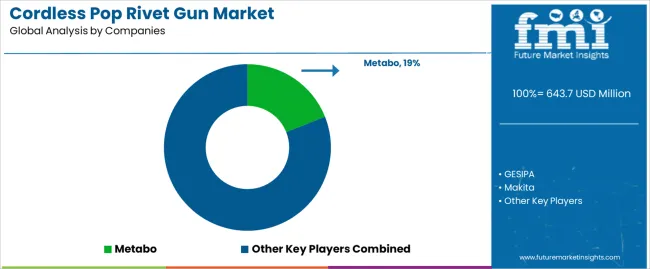
The competitive landscape is defined by a "platform wars" dynamic, where major players like Stanley Black & Decker and TTI leverage their massive battery ecosystems to lock in professional users. TTI’s achievement of USD 14.6 billion in 2024 sales demonstrates the efficacy of this strategy, as they aggressively expand their Milwaukee M12 and M18 lines to cover every possible niche, including riveting [1]. This forces competitors to either innovate with superior specialized features or compete on price, creating a high barrier for single-product entrants.
Differentiation is increasingly sought through digital integration and "smart" features that appeal to industrial quality control managers. DeWalt’s recognition for its DCF403D1 tool illustrates how established players use awards and third-party validation to signal reliability and performance supremacy in a crowded market [6]. Manufacturers are investing in R&D to produce tools that not only set rivets but also verify the setting force, a crucial capability for automotive and aerospace clients who require audit trails for every fastener.
Supply chain resilience has become a critical competitive differentiator, prompting leading firms to verticalize their manufacturing footprints. TTI’s strategic allocation of USD 292 million in Capex across Vietnam, Mexico, and the US is a direct response to global logistics volatility, ensuring they can meet regional demand surges without the lead-time shocks experienced in previous years [9]. This regionalization allows top-tier players to maintain inventory levels that smaller, import-dependent competitors cannot match during demand spikes.
Recent Developments
The report includes full coverage of key trends from competitive benchmarking. Some of the recent developments covered in the reports:
- In October 2024, Stanley Black & Decker [6] secured industry recognition when its DeWalt DCF403D1 20-volt Cordless Rivet Tool was named "Best Rivet Tool" by Popular Mechanics.
- In March 2025, Techtronic Industries [1] reported record annual sales of USD 14.6 billion, driven by an 11.6% growth in its flagship Milwaukee brand, reinforcing its dominance in the professional cordless segment.
Key Players in Cordless Pop Rivet Gun Market
- Stanley Black & Decker
- Hilti
- Makita
- Bosch Power Tools
- Milwaukee Tool (TTI)
- Ingersoll Rand
- Chicago Pneumatic
Scope of the Report
| Metric | Value |
|---|---|
| Quantitative Units | USD 0.7 billion (2026) to USD 1.12 billion (2036), at a CAGR of 5.2% |
| Market Definition | The Cordless Pop Rivet Gun market comprises the global trade and industrial application of battery-powered blind rivet setting tools designed to join materials where access is limited to one side. |
| Rivet Size Segmentation | 1/4", 3/16", Other |
| Sales Channel Segmentation | Online, Offline/Distributor |
| End Use Segmentation | Manufacturing, Construction, Automotive Repair, Others |
| Application Coverage | Standard Blind Rivets, Structural Rivets, Bulb-Tite Rivets |
| Regions Covered | North America, Latin America, Europe, East Asia, South Asia, Oceania, Middle East and Africa |
| Countries Covered | United States, Canada, Mexico, Brazil, Argentina, Chile, Germany, France, Italy, United Kingdom, Spain, China, India, Japan, South Korea, Indonesia, Australia, Thailand, Vietnam |
| Key Companies Profiled | Stanley Black & Decker, Hilti, Makita, Bosch Power Tools, Milwaukee Tool (TTI), Ingersoll Rand, Chicago Pneumatic |
| Forecast Period | 2026 to 2036 |
| Approach | Bottom-up market modeling validated through primary interviews with tool OEMs and distribution channel analysis, supported by trade data benchmarking and battery platform install-base verification |
Critical Power and Cooling Market Analysis by Segments
Rivet Size:
- 1/4"
- 3/16"
- Other
Sales Channel:
- Online
- Offline/Distributor
End Use:
- Manufacturing
- Construction
- Automotive Repair
- Others
Region:
- Asia Pacific
- India
- China
- Japan
- South Korea
- Indonesia
- Australia & New Zealand
- ASEAN
- Rest of Asia Pacific
- Europe
- Germany
- Italy
- France
- United Kingdom
- Spain
- Benelux
- Nordics
- Central & Eastern Europe
- Rest of Europe
- North America
- United States
- Canada
- Mexico
- Latin America
- Brazil
- Argentina
- Chile
- Rest of Latin America
- Middle East & Africa
- Kingdom of Saudi Arabia
- United Arab Emirates
- South Africa
- Turkey
- Rest of Middle East & Africa
Bibliography
- [1] Techtronic Industries. (2024). Annual Report 2024. Techtronic Industries.
- [2] Bureau of Labor Statistics. (2024). Solar Photovoltaic Installers Employment Projections. U.S. Department of Labor.
- [3] Federal Statistical Office (Destatis). (2026). Press Release: German Manufacturing Orders December 2025. Destatis.
- [4] Ministry of Statistics and Programme Implementation. (2025). IIP Press Release November 2025. Government of India.
- [5] National Bureau of Statistics of China. (2026). Industrial Value Added Growth 2025. NBS.
- [6] Stanley Black & Decker. (2024). DeWalt Award Announcement. Stanley Black & Decker.
- [7] Techtronic Industries. (2025). Annual Results Press Release. Techtronic Industries.
- [8] Office for National Statistics. (2025). Construction Output in Great Britain: June 2025. ONS.
- [9] Techtronic Industries. (2024). Annual Report 2024 - Capex and Strategy. Techtronic Industries.
- [10] Statistics Korea (KOSTAT). (2025). Manufacturing Capacity Utilization Rate November 2025. KOSTAT.
- [11] Statistics Bureau of Japan. (2024). Economic Census for Business Activity. Ministry of Internal Affairs and Communications.
This Report Addresses
- Market intelligence to enable structured strategic decision making across mature and emerging industrial tool economies.
- Market size estimation and 10 year revenue forecasts from 2026 to 2036, supported by validated battery platform install-base benchmarks.
- Growth opportunity mapping across rivet sizes and end-use sectors with emphasis on the transition from pneumatic to cordless technologies.
- Segment and regional revenue forecasts covering manufacturing, construction, and automotive repair applications.
- Competition strategy assessment including platform lock-in models, cost survivability positioning, and digital integration capability benchmarking.
- Product reformulation and ergonomic compliance tracking including vibration reduction and smart-tool connectivity trends.
- Regulatory impact analysis covering occupational health mandates, energy efficiency standards, and export driven specification upgrades.
- Market report delivery in PDF, Excel, PPT, and interactive dashboard formats for executive and operational use.
Frequently Asked Questions
How large is the demand for Cordless Pop Rivet Gun in the global market in 2026?
Demand for Cordless Pop Rivet Gun in the global market is estimated to be valued at USD 0.7 billion in 2026.
What will be the market size of Cordless Pop Rivet Gun in the global market by 2036?
Market size for Cordless Pop Rivet Gun is projected to reach USD 1.12 billion by 2036.
What is the expected demand growth for Cordless Pop Rivet Gun in the global market between 2026 and 2036?
Demand for Cordless Pop Rivet Gun in the global market is expected to grow at a CAGR of 5.2% between 2026 and 2036.
Which Rivet Size is poised to lead global sales by 2026?
1/4" rivet tools are expected to lead due to their critical role in heavy-duty structural fastening within the manufacturing sector.
How significant is the role of Manufacturing End Use in driving Cordless Pop Rivet Gun adoption in 2026?
Manufacturing represents a critical segment, holding 41% of the market share as factories transition to flexible, hose-free assembly cells.
What is driving demand in India?
Demand is driven by the "Make in India" initiative and an 8.0% surge in manufacturing output, necessitating modern assembly tools.
What compliance standards or regulations are referenced for India?
Industrial production data from the Ministry of Statistics and Programme Implementation is referenced as a key benchmark.
What is the India growth outlook in this report?
India is projected to grow at a CAGR of 6.4% during 2026 to 2036.
Why is Europe described as a priority region in this report?
Europe is prioritizing high-efficiency, ergonomic tools to meet strict occupational health standards and support a rebounding industrial sector.
What type of demand dominates in Europe?
Replacement demand for high-specification, low-vibration cordless tools dominates regional consumption.
What is China growth outlook in this report?
China is projected to expand at a CAGR of 6.1% during 2026 to 2036.
Does the report cover Japan in its regional analysis?
Yes, Japan is included within East Asia under the regional scope of analysis.
What are the sources referred to for analyzing Japan?
Official statistics from the Statistics Bureau of Japan covering manufacturing sales and economic census data are cited.
What is the main demand theme linked to Japan in its region coverage?
Demand is associated with precision manufacturing and high-value tool procurement for automotive and electronics sectors.
Does the report cover South Korea in its regional analysis?
Yes, South Korea is included within East Asia under the regional coverage framework.
What is the main South Korea related demand theme in its region coverage?
Adoption is linked to stabilized manufacturing capacity utilization and a push for operational efficiency in assembly lines.
Which product formats or configurations are strategically important for North America supply chains?
"Bare tool" or "skin-only" configurations are critical as professionals leverage existing battery platforms to reduce costs.
What is Cordless Pop Rivet Gun and what is it mainly used for?
It is a battery-powered tool used for setting blind rivets in manufacturing and construction without needing compressed air.
What does Cordless Pop Rivet Gun mean in this report?
The report covers the global trade and industrial use of battery-operated blind rivet setting tools.
What is included in the scope of this Cordless Pop Rivet Gun report?
Scope covers tools by rivet size, sales channel, end-use industries like manufacturing and construction, and key regions.
What is excluded from the scope of this report?
Pneumatic, manual, and corded electric rivet guns are excluded, along with non-riveting fastening tools.
What does market forecast mean on this page?
Market forecast represents a model-based projection built on defined assumptions for strategic planning purposes.
How does FMI build and validate the Cordless Pop Rivet Gun forecast?
Forecasts are developed using bottom-up modeling validated through primary OEM interviews and battery platform data.
What does zero reliance on speculative third party market research mean here?
It means the report uses primary corporate data and verified government statistics rather than unverified syndicated estimates.
Preview the report firsthand - request a free sample
Get SampleGet the brochure for pricing and purchase details.
Get PDFTable of Content
- Executive Summary
- Global Market Outlook
- Demand-side Trends
- Supply-side Trends
- Technology Roadmap Analysis
- Analysis and Recommendations
- Market Overview
- Market Coverage / Taxonomy
- Market Definition / Scope / Limitations
- Research Methodology
- Chapter Orientation
- Analytical Lens and Working Hypotheses
- Market Structure, Signals, and Trend Drivers
- Benchmarking and Cross-market Comparability
- Market Sizing, Forecasting, and Opportunity Mapping
- Research Design and Evidence Framework
- Desk Research Programme (Secondary Evidence)
- Company Annual and Sustainability Reports
- Peer-reviewed Journals and Academic Literature
- Corporate Websites, Product Literature, and Technical Notes
- Earnings Decks and Investor Briefings
- Statutory Filings and Regulatory Disclosures
- Technical White Papers and Standards Notes
- Trade Journals, Industry Magazines, and Analyst Briefs
- Conference Proceedings, Webinars, and Seminar Materials
- Government Statistics Portals and Public Data Releases
- Press Releases and Reputable Media Coverage
- Specialist Newsletters and Curated Briefings
- Sector Databases and Reference Repositories
- FMI Internal Proprietary Databases and Historical Market Datasets
- Subscription Datasets and Paid Sources
- Social Channels, Communities, and Digital Listening Inputs
- Additional Desk Sources
- Expert Input and Fieldwork (Primary Evidence)
- Primary Modes
- Qualitative Interviews and Expert Elicitation
- Quantitative Surveys and Structured Data Capture
- Blended Approach
- Why Primary Evidence is Used
- Field Techniques
- Interviews
- Surveys
- Focus Groups
- Observational and In-context Research
- Social and Community Interactions
- Stakeholder Universe Engaged
- C-suite Leaders
- Board Members
- Presidents and Vice Presidents
- R&D and Innovation Heads
- Technical Specialists
- Domain Subject-matter Experts
- Scientists
- Physicians and Other Healthcare Professionals
- Governance, Ethics, and Data Stewardship
- Research Ethics
- Data Integrity and Handling
- Primary Modes
- Tooling, Models, and Reference Databases
- Desk Research Programme (Secondary Evidence)
- Data Engineering and Model Build
- Data Acquisition and Ingestion
- Cleaning, Normalisation, and Verification
- Synthesis, Triangulation, and Analysis
- Quality Assurance and Audit Trail
- Market Background
- Market Dynamics
- Drivers
- Restraints
- Opportunity
- Trends
- Scenario Forecast
- Demand in Optimistic Scenario
- Demand in Likely Scenario
- Demand in Conservative Scenario
- Opportunity Map Analysis
- Product Life Cycle Analysis
- Supply Chain Analysis
- Investment Feasibility Matrix
- Value Chain Analysis
- PESTLE and Porter’s Analysis
- Regulatory Landscape
- Regional Parent Market Outlook
- Production and Consumption Statistics
- Import and Export Statistics
- Market Dynamics
- Global Market Analysis 2021 to 2025 and Forecast, 2026 to 2036
- Historical Market Size Value (USD Million) Analysis, 2021 to 2025
- Current and Future Market Size Value (USD Million) Projections, 2026 to 2036
- Y-o-Y Growth Trend Analysis
- Absolute $ Opportunity Analysis
- Global Market Pricing Analysis 2021 to 2025 and Forecast 2026 to 2036
- Global Market Analysis 2021 to 2025 and Forecast 2026 to 2036, By By Rivet Size
- Introduction / Key Findings
- Historical Market Size Value (USD Million) Analysis By By Rivet Size , 2021 to 2025
- Current and Future Market Size Value (USD Million) Analysis and Forecast By By Rivet Size , 2026 to 2036
- 1/4″ Segment
- 3/16″
- 1/4″ Segment
- Y-o-Y Growth Trend Analysis By By Rivet Size , 2021 to 2025
- Absolute $ Opportunity Analysis By By Rivet Size , 2026 to 2036
- Global Market Analysis 2021 to 2025 and Forecast 2026 to 2036, By By Sales Channel
- Introduction / Key Findings
- Historical Market Size Value (USD Million) Analysis By By Sales Channel, 2021 to 2025
- Current and Future Market Size Value (USD Million) Analysis and Forecast By By Sales Channel, 2026 to 2036
- Online sales
- Offline/Distributor
- Online sales
- Y-o-Y Growth Trend Analysis By By Sales Channel, 2021 to 2025
- Absolute $ Opportunity Analysis By By Sales Channel, 2026 to 2036
- Global Market Analysis 2021 to 2025 and Forecast 2026 to 2036, By By End Use
- Introduction / Key Findings
- Historical Market Size Value (USD Million) Analysis By By End Use, 2021 to 2025
- Current and Future Market Size Value (USD Million) Analysis and Forecast By By End Use, 2026 to 2036
- Manufacturing
- Construction
- Automotive Repair
- Manufacturing
- Y-o-Y Growth Trend Analysis By By End Use, 2021 to 2025
- Absolute $ Opportunity Analysis By By End Use, 2026 to 2036
- Global Market Analysis 2021 to 2025 and Forecast 2026 to 2036, By Region
- Introduction
- Historical Market Size Value (USD Million) Analysis By Region, 2021 to 2025
- Current Market Size Value (USD Million) Analysis and Forecast By Region, 2026 to 2036
- North America
- Latin America
- Western Europe
- Eastern Europe
- East Asia
- South Asia and Pacific
- Middle East & Africa
- Market Attractiveness Analysis By Region
- North America Market Analysis 2021 to 2025 and Forecast 2026 to 2036, By Country
- Historical Market Size Value (USD Million) Trend Analysis By Market Taxonomy, 2021 to 2025
- Market Size Value (USD Million) Forecast By Market Taxonomy, 2026 to 2036
- By Country
- USA
- Canada
- Mexico
- By By Rivet Size
- By By Sales Channel
- By By End Use
- By Country
- Market Attractiveness Analysis
- By Country
- By By Rivet Size
- By By Sales Channel
- By By End Use
- Key Takeaways
- Latin America Market Analysis 2021 to 2025 and Forecast 2026 to 2036, By Country
- Historical Market Size Value (USD Million) Trend Analysis By Market Taxonomy, 2021 to 2025
- Market Size Value (USD Million) Forecast By Market Taxonomy, 2026 to 2036
- By Country
- Brazil
- Chile
- Rest of Latin America
- By By Rivet Size
- By By Sales Channel
- By By End Use
- By Country
- Market Attractiveness Analysis
- By Country
- By By Rivet Size
- By By Sales Channel
- By By End Use
- Key Takeaways
- Western Europe Market Analysis 2021 to 2025 and Forecast 2026 to 2036, By Country
- Historical Market Size Value (USD Million) Trend Analysis By Market Taxonomy, 2021 to 2025
- Market Size Value (USD Million) Forecast By Market Taxonomy, 2026 to 2036
- By Country
- Germany
- UK
- Italy
- Spain
- France
- Nordic
- BENELUX
- Rest of Western Europe
- By By Rivet Size
- By By Sales Channel
- By By End Use
- By Country
- Market Attractiveness Analysis
- By Country
- By By Rivet Size
- By By Sales Channel
- By By End Use
- Key Takeaways
- Eastern Europe Market Analysis 2021 to 2025 and Forecast 2026 to 2036, By Country
- Historical Market Size Value (USD Million) Trend Analysis By Market Taxonomy, 2021 to 2025
- Market Size Value (USD Million) Forecast By Market Taxonomy, 2026 to 2036
- By Country
- Russia
- Poland
- Hungary
- Balkan & Baltic
- Rest of Eastern Europe
- By By Rivet Size
- By By Sales Channel
- By By End Use
- By Country
- Market Attractiveness Analysis
- By Country
- By By Rivet Size
- By By Sales Channel
- By By End Use
- Key Takeaways
- East Asia Market Analysis 2021 to 2025 and Forecast 2026 to 2036, By Country
- Historical Market Size Value (USD Million) Trend Analysis By Market Taxonomy, 2021 to 2025
- Market Size Value (USD Million) Forecast By Market Taxonomy, 2026 to 2036
- By Country
- China
- Japan
- South Korea
- By By Rivet Size
- By By Sales Channel
- By By End Use
- By Country
- Market Attractiveness Analysis
- By Country
- By By Rivet Size
- By By Sales Channel
- By By End Use
- Key Takeaways
- South Asia and Pacific Market Analysis 2021 to 2025 and Forecast 2026 to 2036, By Country
- Historical Market Size Value (USD Million) Trend Analysis By Market Taxonomy, 2021 to 2025
- Market Size Value (USD Million) Forecast By Market Taxonomy, 2026 to 2036
- By Country
- India
- ASEAN
- Australia & New Zealand
- Rest of South Asia and Pacific
- By By Rivet Size
- By By Sales Channel
- By By End Use
- By Country
- Market Attractiveness Analysis
- By Country
- By By Rivet Size
- By By Sales Channel
- By By End Use
- Key Takeaways
- Middle East & Africa Market Analysis 2021 to 2025 and Forecast 2026 to 2036, By Country
- Historical Market Size Value (USD Million) Trend Analysis By Market Taxonomy, 2021 to 2025
- Market Size Value (USD Million) Forecast By Market Taxonomy, 2026 to 2036
- By Country
- Kingdom of Saudi Arabia
- Other GCC Countries
- Turkiye
- South Africa
- Other African Union
- Rest of Middle East & Africa
- By By Rivet Size
- By By Sales Channel
- By By End Use
- By Country
- Market Attractiveness Analysis
- By Country
- By By Rivet Size
- By By Sales Channel
- By By End Use
- Key Takeaways
- Key Countries Market Analysis
- USA
- Pricing Analysis
- Market Share Analysis, 2025
- By By Rivet Size
- By By Sales Channel
- By By End Use
- Canada
- Pricing Analysis
- Market Share Analysis, 2025
- By By Rivet Size
- By By Sales Channel
- By By End Use
- Mexico
- Pricing Analysis
- Market Share Analysis, 2025
- By By Rivet Size
- By By Sales Channel
- By By End Use
- Brazil
- Pricing Analysis
- Market Share Analysis, 2025
- By By Rivet Size
- By By Sales Channel
- By By End Use
- Chile
- Pricing Analysis
- Market Share Analysis, 2025
- By By Rivet Size
- By By Sales Channel
- By By End Use
- Germany
- Pricing Analysis
- Market Share Analysis, 2025
- By By Rivet Size
- By By Sales Channel
- By By End Use
- UK
- Pricing Analysis
- Market Share Analysis, 2025
- By By Rivet Size
- By By Sales Channel
- By By End Use
- Italy
- Pricing Analysis
- Market Share Analysis, 2025
- By By Rivet Size
- By By Sales Channel
- By By End Use
- Spain
- Pricing Analysis
- Market Share Analysis, 2025
- By By Rivet Size
- By By Sales Channel
- By By End Use
- France
- Pricing Analysis
- Market Share Analysis, 2025
- By By Rivet Size
- By By Sales Channel
- By By End Use
- India
- Pricing Analysis
- Market Share Analysis, 2025
- By By Rivet Size
- By By Sales Channel
- By By End Use
- ASEAN
- Pricing Analysis
- Market Share Analysis, 2025
- By By Rivet Size
- By By Sales Channel
- By By End Use
- Australia & New Zealand
- Pricing Analysis
- Market Share Analysis, 2025
- By By Rivet Size
- By By Sales Channel
- By By End Use
- China
- Pricing Analysis
- Market Share Analysis, 2025
- By By Rivet Size
- By By Sales Channel
- By By End Use
- Japan
- Pricing Analysis
- Market Share Analysis, 2025
- By By Rivet Size
- By By Sales Channel
- By By End Use
- South Korea
- Pricing Analysis
- Market Share Analysis, 2025
- By By Rivet Size
- By By Sales Channel
- By By End Use
- Russia
- Pricing Analysis
- Market Share Analysis, 2025
- By By Rivet Size
- By By Sales Channel
- By By End Use
- Poland
- Pricing Analysis
- Market Share Analysis, 2025
- By By Rivet Size
- By By Sales Channel
- By By End Use
- Hungary
- Pricing Analysis
- Market Share Analysis, 2025
- By By Rivet Size
- By By Sales Channel
- By By End Use
- Kingdom of Saudi Arabia
- Pricing Analysis
- Market Share Analysis, 2025
- By By Rivet Size
- By By Sales Channel
- By By End Use
- Turkiye
- Pricing Analysis
- Market Share Analysis, 2025
- By By Rivet Size
- By By Sales Channel
- By By End Use
- South Africa
- Pricing Analysis
- Market Share Analysis, 2025
- By By Rivet Size
- By By Sales Channel
- By By End Use
- USA
- Market Structure Analysis
- Competition Dashboard
- Competition Benchmarking
- Market Share Analysis of Top Players
- By Regional
- By By Rivet Size
- By By Sales Channel
- By By End Use
- Competition Analysis
- Competition Deep Dive
- Stanley Black & Decker
- Overview
- Product Portfolio
- Profitability by Market Segments (Product/Age /Sales Channel/Region)
- Sales Footprint
- Strategy Overview
- Marketing Strategy
- Product Strategy
- Channel Strategy
- Hilti
- Makita
- Bosch Power Tools
- Milwaukee Tool (TTI)
- Ingersoll Rand
- Chicago Pneumatic
- Stanley Black & Decker
- Competition Deep Dive
- Assumptions & Acronyms Used


