

- Industry Size (2026)
- USD 480.0 Mn
- Forecast (2036)
- USD 781.9 Mn
- CAGR (2026 to 2036)
- 5.00%
Bottom Discharge Valve Market Forecast and Outlook 2026 to 2036
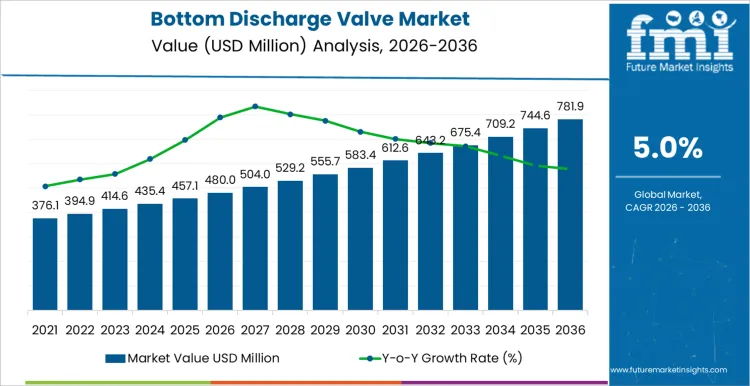
The bottom discharge valve market is expected to increase from USD 480.0 million in 2026 to USD 781.9 million by 2036, advancing at a CAGR of 5.00%. This category holds strategic importance because it sits at a critical control point between batch completion and downstream process continuity. Bottom discharge valves directly influence material recovery, contamination risk, and cycle time in reactors, crystallizers, and mixing vessels, making them operationally disproportionate to their unit cost. Control over valve specification often resides with process engineers and validation teams rather than procurement alone, creating strong dependency on approved designs and qualified suppliers.
Switching costs are elevated due to vessel integration, validation documentation, and shutdown requirements, which reinforces supplier stickiness once installed. Strategic trade-offs emerge between standardization and customization, as operators balance ease of maintenance against material-specific performance needs. Across pharmaceuticals, chemicals, and specialty manufacturing, bottom discharge valves function as risk-mitigation components that protect yield, safety, and compliance.
Quick Stats for Bottom Discharge Valve Market
- Bottom Discharge Valve Market Value (2026): USD 480.0 Million
- Bottom Discharge Valve Market Forecast Value (2036): USD 781.9 Million
- Bottom Discharge Valve Market Forecast CAGR 2026 to 2036: 5.00%
- Leading Valve Type in Bottom Discharge Valve Market: Flush Bottom Valves (56% share)
- Key Growth Regions in Bottom Discharge Valve Market: Asia Pacific, Europe, North America, Latin America, Middle East & Africa
- Top Key Players in Bottom Discharge Valve Market: De Dietrich Process Systems, GEMÜ, GEA, Spirax Sarco, Crane, IMI, Bürkert, Alfa Laval, Valmet, Flowserve
Bottom Discharge Valve Market Key Takeaways
| Metric | Value |
|---|---|
| Bottom Discharge Valve Market Value (2026) | USD 480.0 Million |
| Bottom Discharge Valve Market Forecast Value (2036) | USD 781.9 Million |
| Bottom Discharge Valve Market Forecast CAGR 2026 to 2036 | 5.00% |
How Are Process Containment and Batch Efficiency Requirements Driving the Bottom Discharge Valve Market?
The bottom discharge valve market is growing as batch-processing industries place greater emphasis on clean, controlled, and residue-free vessel emptying. Chemical, pharmaceutical, food, and specialty materials producers rely on bottom discharge valves to ensure complete discharge of slurries, powders, and viscous products while maintaining containment and minimizing product loss. For valve manufacturers and vessel OEMs, demand is closely linked to applications where hygiene, safety, and product recovery directly impact operating margins.
Procurement decisions are increasingly shaped by valve design integrity and cleanability. End users prioritize flush-bottom and zero-dead-leg configurations that eliminate product hold-up and reduce cross-contamination risk. Material selection, surface finish quality, and seal performance under repeated thermal and pressure cycling are critical evaluation criteria, particularly in pharmaceutical and fine chemical reactors. Suppliers offering validated designs, hygienic certifications, and compatibility with clean-in-place systems are gaining preference during equipment specification and qualification. Operators also scale clean-in-place capacity (including CIP tanks and recirculation volumes) to match faster batch turnaround targets enabled by improved bottom discharge. In regulated plants, qualification packages increasingly cross-reference clean-in-place systems performance to show residue-free discharge paths after every campaign.
Lifecycle performance and retrofit opportunities are further supporting market expansion. Aging reactors and process vessels are being upgraded with modern bottom discharge valves to improve batch turnaround time and meet updated safety and hygiene standards. Standardization across plants is also increasing as operators seek to simplify maintenance, spare parts management, and operator training. For manufacturers and suppliers, competitive advantage increasingly depends on application engineering expertise, customization capability, and reliable after-sales support positioning bottom discharge valves as a steady, process-critical component in batch manufacturing operations.
How Is the Bottom Discharge Valve Market Structured By End Use and Valve Type?
The bottom discharge valve market is segmented by end use and valve type, reflecting how material sensitivity, discharge efficiency, and contamination control requirements influence valve selection. By end use, pharmaceutical manufacturing represents the leading segment, driven by stringent hygiene, containment, and validation needs in reactor and vessel discharge operations. Other end uses include fine and specialty chemicals, food processing, petrochemicals, and battery materials manufacturing, each requiring different sealing, material, and cleanability standards. By valve type, flush bottom valves dominate market adoption, while tank bottom ball valves, tank bottom diaphragm valves, and other specialized designs serve application-specific discharge and flow-control requirements.
Why Does Pharmaceutical Manufacturing Lead End-Use Demand In the Bottom Discharge Valve Market?
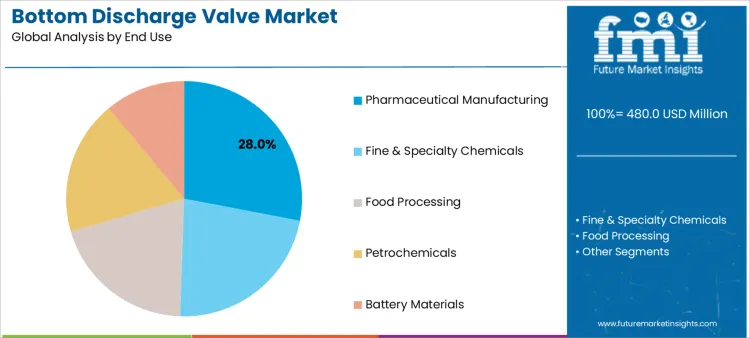
Pharmaceutical manufacturing accounts for 28% share of the bottom discharge valve market because precise, contamination-free discharge of active ingredients and intermediates is critical to product quality and regulatory compliance. Bottom discharge valves are widely used in reactors, crystallizers, and mixing vessels to ensure complete draining without product hold-up. Manufacturers prioritize designs that eliminate dead zones and support clean-in-place and sterilize-in-place procedures. Validation requirements drive preference for proven valve designs with documented material traceability and surface finishes. High-value batches and strict audit scrutiny increase focus on reliability and repeatable performance. These regulatory, operational, and quality-driven factors explain why pharmaceutical manufacturing remains the largest end-use segment.
Why Do Flush Bottom Valves Dominate Valve Type Adoption In The Bottom Discharge Valve Market?

Flush bottom valves hold 56% share of the bottom discharge valve market because they are designed to sit flush with the vessel bottom, enabling complete and efficient discharge of liquids, slurries, and viscous materials. This design minimizes residue buildup and reduces the risk of contamination or cross-batch carryover. Flush bottom valves are widely specified in pharmaceutical, chemical, and food processing applications where product recovery and hygiene are critical. Their ability to handle solids-bearing fluids and crystallizing media improves process efficiency. For equipment manufacturers and end users, flush bottom valves offer predictable performance and compatibility with automated vessel systems. These functional advantages explain their dominant market position.
What Are The Key Dynamics Of The Bottom Discharge Valve Market?
The bottom discharge valve market is driven by demand for reliable, high throughput isolation and discharge solutions in industries such as chemicals, pharmaceuticals, food and beverage, mining, cement, power generation, and bulk solids handling. Bottom discharge valves facilitate controlled release of powders, granules, slurries, and liquids from hoppers, silos, reactors, and process vessels, helping optimize material flow and reduce product loss. For manufacturers and suppliers, seal integrity, wear resistance, ease of maintenance, material compatibility, and integration with plant control systems are critical factors that influence customer selection and long term performance. Operational reliability and minimal downtime remain central to competitive differentiation.
How Are Design And Industry Trends Shaping Adoption In This Market?
Design and industry trends are shaping the bottom discharge valve market through increased emphasis on automation, modular designs, and performance monitoring. Manufacturers are offering valves with servo motor or pneumatic actuation, position feedback, and integration with process automation platforms that support precise control over discharge rates. Materials such as engineered alloys and abrasion resistant coatings extend service life in aggressive environments where powders and solids create high wear. For sectors like food processing and pharmaceuticals, sanitary finishes and cleanability are becoming standard expectations. Suppliers that provide customizable valve solutions and pre-engineered packages for specific applications strengthen their appeal to OEMs and end users.
Why Do Operational, Integration, And Cost Challenges Restrain Market Growth?
Operational, integration, and cost challenges restrain growth in the bottom discharge valve market by increasing implementation complexity and total project cost. Customizing valves for specific materials and process conditions requires detailed engineering and sometimes extended lead times, which can deter buyers with tight schedules. Integration with existing plant control systems may require additional field devices or control logic engineering, increasing project scope. Capital expenditure for high performance valve assemblies, actuation systems, and associated controls can be significant, especially for small and mid-sized operators. Inconsistent site expertise can further prolong commissioning and reduce early confidence in performance.
What is the Country-Wise Growth Outlook for the Bottom Discharge Valve Market?
The bottom discharge valve market is expanding steadily as process industries adopt safer and more efficient methods for complete vessel emptying and controlled material discharge. These valves are widely used in pharmaceuticals, chemicals, food processing, and specialty manufacturing to handle powders, slurries, and viscous materials while minimizing residue and contamination risks. Growth varies by country based on expansion of batch processing facilities, regulatory focus on process control, and investment in modern reactor and vessel systems. Higher-growth markets are driven by new plant installations and export-oriented manufacturing, while more mature regions show demand led by equipment replacement and process optimization.
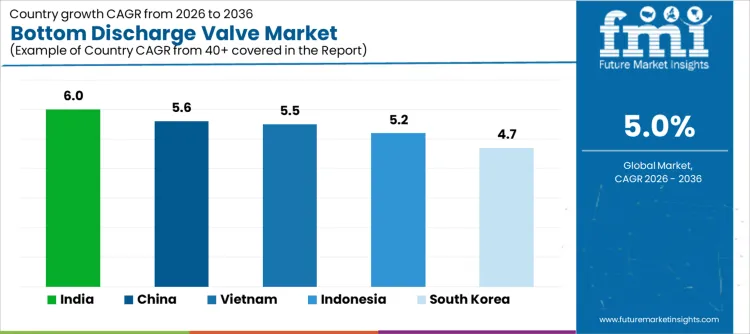
| Country | CAGR (%) |
|---|---|
| India | 6.0 |
| China | 5.6 |
| Vietnam | 5.5 |
| Indonesia | 5.2 |
| South Korea | 4.7 |
Why Is India Emerging As A High-Growth Market For Bottom Discharge Valves?
India’s bottom discharge valve market is growing at a CAGR of 6.0% during 2026-2036, driven by rapid expansion of batch-oriented industries such as pharmaceuticals, specialty chemicals, agrochemicals, and food ingredients. Increasing installation of reactors, pressure vessels, and mixing tanks is creating strong demand for reliable bottom discharge solutions that enable complete material evacuation and reduce batch losses. Buyers emphasize leak-tight sealing, smooth discharge performance, and compatibility with viscous or solid-laden materials. Adoption is particularly strong in greenfield plants and capacity expansions designed to meet export-quality manufacturing requirements. Cost sensitivity influences purchasing decisions, but process reliability and safety remain decisive due to the risk of contamination and downtime. Procurement cycles are relatively short, enabling faster supplier onboarding. Market value is supported by rising domestic production, contract manufacturing growth, and increasing automation of batch processes.
How Is China Sustaining Large-Scale Demand For Bottom Discharge Valves?
China’s bottom discharge valve market is expanding at a CAGR of 5.6% during 2026-2036, supported by extensive batch processing across chemicals, pharmaceuticals, and specialty materials manufacturing. Bottom discharge valves are widely deployed in reactors and storage vessels to ensure controlled discharge, prevent residue buildup, and support high-cycle batch operations. Buyers prioritize durability, precision sealing, and long service life under frequent actuation. Local manufacturing plays a major role, supporting cost efficiency and large-volume supply. Procurement decisions favor suppliers with standardized designs, automation compatibility, and compliance with national industrial standards. Replacement demand is significant as older valve assemblies are upgraded to improve safety and process efficiency. China represents a volume-driven market where competitiveness depends on manufacturing capacity, quality consistency, and the ability to support large installed bases across industrial zones.
Why Is Vietnam Becoming An Attractive Market For Bottom Discharge Valves?
Vietnam’s bottom discharge valve market is growing at a CAGR of 5.5% during 2026-2036, driven by industrialization and increasing investment in pharmaceuticals, chemicals, and food processing facilities. Demand is primarily project-led, with bottom discharge valves specified during design and construction of new batch-processing plants. Buyers focus on reliability, ease of cleaning, and compliance with international manufacturing standards. Imported valves dominate supply, often selected through EPC contractors responsible for plant execution. Supplier selection is influenced by delivery timelines, documentation quality, and availability of commissioning support. Replacement demand remains limited but is expected to increase as installed facilities mature. Vietnam represents an emerging market where success depends on strong EPC relationships, competitive pricing, and technical support during installation and startup.
What Is Driving Steady Growth Of Bottom Discharge Valves In Indonesia?
Indonesia’s bottom discharge valve market is expanding at a CAGR of 5.2% during 2026-2036, supported by growth in chemicals, food processing, palm oil derivatives, and industrial manufacturing. Bottom discharge valves are increasingly adopted to improve batch consistency, reduce manual intervention, and enhance safety in vessel emptying operations. Buyers prioritize corrosion resistance, robust construction, and ease of maintenance due to challenging operating conditions and variable raw materials. Demand is split between new installations and gradual replacement of aging valves in existing plants. Procurement decisions often favor suppliers with local service presence, spare parts availability, and experience in industrial process applications. Market value is driven by steady industrial expansion, compliance with operational safety standards, and incremental automation of batch processes. Indonesia represents a balanced growth market where supplier success depends on durability, service responsiveness, and adaptability to diverse processing environments.
How Is South Korea Maintaining Controlled Growth In The Bottom Discharge Valve Market?
South Korea’s bottom discharge valve market is growing at a CAGR of 4.7% during the forecast period, characterized by mature industrial infrastructure and high technical standards. Demand is concentrated in pharmaceuticals, specialty chemicals, and advanced materials manufacturing where precise process control is critical. Buyers emphasize engineering precision, hygienic design, and integration with automated control systems. Procurement decisions are highly structured, involving technical evaluations and long qualification cycles. Replacement demand dominates as facilities upgrade existing equipment to improve safety and operational efficiency. Market value is driven by technology upgrades and compliance with stringent process requirements rather than new plant construction. South Korea represents a mature market where growth is steady and supplier success depends on product quality, documentation strength, and long-term reliability rather than volume expansion.
How Are Manufacturers Competing in the Bottom Discharge Valve Market?
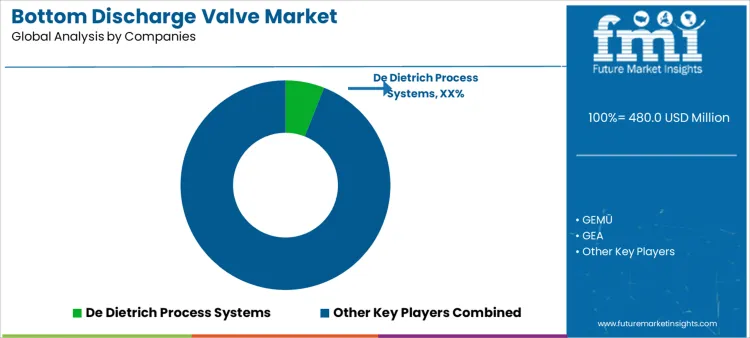
Competition in the bottom discharge valve market is driven by sealing integrity, discharge reliability, and compatibility with batch and continuous processing in chemicals, pharmaceuticals, food, and specialty materials. De Dietrich Process Systems anchors its positioning around glass-lined and alloy bottom outlet valves engineered for reactors and vessels handling corrosive or high-purity media. Product designs emphasize dead-zone-free discharge, tight shutoff, and cleanability suited to regulated batch operations. GEMÜ competes through diaphragm and seat valve architectures optimized for hygienic and sterile applications, highlighting modular actuation and precise control during product discharge.
Process integration and application breadth define another layer of competition. GEA positions bottom discharge valves as part of complete processing skids, focusing on sanitary design, CIP/SIP compatibility, and repeatable batch transfer. Spirax Sarco differentiates with control-oriented valve solutions that ensure stable discharge under varying pressures and temperatures. Crane and IMI emphasize rugged valve constructions and severe-service capability for demanding chemical and industrial environments.
Hygienic performance and global service networks strengthen competitive positioning. Bürkert and Alfa Laval focus on bottom discharge valves designed for high-purity and food applications, with attention to surface finish, drainability, and validation support. Valmet and Flowserve compete through engineered solutions integrated with automation and asset management platforms. Across the market, competitive advantage is defined by leak-free performance, ease of cleaning, and system-level integration rather than valve pricing alone.
Key Players in Bottom Discharge Valve Market
- De Dietrich Process Systems
- GEMÜ
- GEA
- Spirax Sarco
- Crane
- IMI
- Bürkert
- Alfa Laval
- Valmet
- Flowserve
Scope of Report
| Attribute | Details |
|---|---|
| Market Size Unit | USD Million |
| End Use Covered | Pharmaceutical Manufacturing, Fine & Specialty Chemicals, Food Processing, Petrochemicals, Battery Materials |
| Valve Type Covered | Flush Bottom Valves, Tank Bottom Ball Valves, Tank Bottom Diaphragm Valves, Other |
| Countries Covered | China, Japan, South Korea, India, Australia & New Zealand, ASEAN, Rest of Asia Pacific, Germany, United Kingdom, France, Italy, Spain, Nordic, BENELUX, Rest of Europe, United States, Canada, Mexico, Brazil, Chile, Rest of Latin America, Kingdom of Saudi Arabia, Other GCC Countries, Turkey, South Africa, Other African Union, Rest of Middle East & Africa |
| Regions Covered | Asia Pacific, Europe, North America, Latin America, Middle East & Africa |
| Key Companies Profiled | De Dietrich Process Systems, GEMÜ, GEA, Spirax Sarco, Crane, IMI, Bürkert, Alfa Laval, Valmet, Flowserve |
| Additional Attributes | Dollar sales by valve type and end use are assessed across b |
Bottom Discharge Valve Market by Key Segments
End Use
- Pharmaceutical Manufacturing
- Fine & Specialty Chemicals
- Food Processing
- Petrochemicals
- Battery Materials
Valve Type
- Flush Bottom Valves
- Tank Bottom Ball Valves
- Tank Bottom Diaphragm Valves
- Other
Region
- Asia Pacific
- China
- Japan
- South Korea
- India
- Australia & New Zealand
- ASEAN
- Rest of Asia Pacific
- Europe
- Germany
- United Kingdom
- France
- Italy
- Spain
- Nordic
- BENELUX
- Rest of Europe
- North America
- United States
- Canada
- Mexico
- Latin America
- Brazil
- Chile
- Rest of Latin America
- Middle East & Africa
- Kingdom of Saudi Arabia
- Other GCC Countries
- Turkey
- South Africa
- Other African Union
- Rest of Middle East & Africa
Bibliography
- American Society of Mechanical Engineers (ASME). (2024). ASME BPE‑2024: Bioprocessing Equipment. New York: ASME.
- European Hygienic Engineering & Design Group (EHEDG). (2025). EHEDG Guideline 20: Hygienic and aseptic valve systems (Revised 2025). EHEDG.
- International Society for Pharmaceutical Engineering (ISPE). (2024). ISPE Good Practice Guide: Process Equipment Cleaning & Containment (2024 Edition). ISPE.
Frequently Asked Questions
How big is the bottom discharge valve market in 2026?
The global bottom discharge valve market is estimated to be valued at USD 480.0 million in 2026.
What will be the size of bottom discharge valve market in 2036?
The market size for the bottom discharge valve market is projected to reach USD 781.9 million by 2036.
How much will be the bottom discharge valve market growth between 2026 and 2036?
The bottom discharge valve market is expected to grow at a 5.0% CAGR between 2026 and 2036.
What are the key product types in the bottom discharge valve market?
The key product types in bottom discharge valve market are pharmaceutical manufacturing, fine & specialty chemicals, food processing, petrochemicals and battery materials.
Which valve type segment to contribute significant share in the bottom discharge valve market in 2026?
In terms of valve type, flush bottom valves segment to command 56.0% share in the bottom discharge valve market in 2026.
Preview the report firsthand - request a free sample
Get SampleGet the brochure for pricing and purchase details.
Get PDFTable of Content
- Executive Summary
- Global Market Outlook
- Demand-side Trends
- Supply-side Trends
- Technology Roadmap Analysis
- Analysis and Recommendations
- Market Overview
- Market Coverage / Taxonomy
- Market Definition / Scope / Limitations
- Market Background
- Market Dynamics
- Drivers
- Restraints
- Opportunity
- Trends
- Scenario Forecast
- Demand in Optimistic Scenario
- Demand in Likely Scenario
- Demand in Conservative Scenario
- Opportunity Map Analysis
- Product Life Cycle Analysis
- Supply Chain Analysis
- Investment Feasibility Matrix
- Value Chain Analysis
- PESTLE and Porter’s Analysis
- Regulatory Landscape
- Regional Parent Market Outlook
- Production and Consumption Statistics
- Import and Export Statistics
- Market Dynamics
- Global Market Analysis 2021 to 2025 and Forecast, 2026 to 2036
- Historical Market Size Value (USD Million) Analysis, 2021 to 2025
- Current and Future Market Size Value (USD Million) Projections, 2026 to 2036
- Y-o-Y Growth Trend Analysis
- Absolute $ Opportunity Analysis
- Global Market Pricing Analysis 2021 to 2025 and Forecast 2026 to 2036
- Global Market Analysis 2021 to 2025 and Forecast 2026 to 2036, By End Use
- Introduction / Key Findings
- Historical Market Size Value (USD Million) Analysis By End Use , 2021 to 2025
- Current and Future Market Size Value (USD Million) Analysis and Forecast By End Use , 2026 to 2036
- Pharmaceutical Manufacturing
- Fine & Specialty Chemicals
- Food Processing
- Petrochemicals
- Battery Materials
- Pharmaceutical Manufacturing
- Y-o-Y Growth Trend Analysis By End Use , 2021 to 2025
- Absolute $ Opportunity Analysis By End Use , 2026 to 2036
- Global Market Analysis 2021 to 2025 and Forecast 2026 to 2036, By Valve Type
- Introduction / Key Findings
- Historical Market Size Value (USD Million) Analysis By Valve Type, 2021 to 2025
- Current and Future Market Size Value (USD Million) Analysis and Forecast By Valve Type, 2026 to 2036
- Flush Bottom Valves
- Tank Bottom Ball Valves
- Tank Bottom Diaphragm Valves
- Other
- Flush Bottom Valves
- Y-o-Y Growth Trend Analysis By Valve Type, 2021 to 2025
- Absolute $ Opportunity Analysis By Valve Type, 2026 to 2036
- Global Market Analysis 2021 to 2025 and Forecast 2026 to 2036, By Region
- Introduction
- Historical Market Size Value (USD Million) Analysis By Region, 2021 to 2025
- Current Market Size Value (USD Million) Analysis and Forecast By Region, 2026 to 2036
- North America
- Latin America
- Western Europe
- Eastern Europe
- East Asia
- South Asia and Pacific
- Middle East & Africa
- Market Attractiveness Analysis By Region
- North America Market Analysis 2021 to 2025 and Forecast 2026 to 2036, By Country
- Historical Market Size Value (USD Million) Trend Analysis By Market Taxonomy, 2021 to 2025
- Market Size Value (USD Million) Forecast By Market Taxonomy, 2026 to 2036
- By Country
- USA
- Canada
- Mexico
- By End Use
- By Valve Type
- By Country
- Market Attractiveness Analysis
- By Country
- By End Use
- By Valve Type
- Key Takeaways
- Latin America Market Analysis 2021 to 2025 and Forecast 2026 to 2036, By Country
- Historical Market Size Value (USD Million) Trend Analysis By Market Taxonomy, 2021 to 2025
- Market Size Value (USD Million) Forecast By Market Taxonomy, 2026 to 2036
- By Country
- Brazil
- Chile
- Rest of Latin America
- By End Use
- By Valve Type
- By Country
- Market Attractiveness Analysis
- By Country
- By End Use
- By Valve Type
- Key Takeaways
- Western Europe Market Analysis 2021 to 2025 and Forecast 2026 to 2036, By Country
- Historical Market Size Value (USD Million) Trend Analysis By Market Taxonomy, 2021 to 2025
- Market Size Value (USD Million) Forecast By Market Taxonomy, 2026 to 2036
- By Country
- Germany
- UK
- Italy
- Spain
- France
- Nordic
- BENELUX
- Rest of Western Europe
- By End Use
- By Valve Type
- By Country
- Market Attractiveness Analysis
- By Country
- By End Use
- By Valve Type
- Key Takeaways
- Eastern Europe Market Analysis 2021 to 2025 and Forecast 2026 to 2036, By Country
- Historical Market Size Value (USD Million) Trend Analysis By Market Taxonomy, 2021 to 2025
- Market Size Value (USD Million) Forecast By Market Taxonomy, 2026 to 2036
- By Country
- Russia
- Poland
- Hungary
- Balkan & Baltic
- Rest of Eastern Europe
- By End Use
- By Valve Type
- By Country
- Market Attractiveness Analysis
- By Country
- By End Use
- By Valve Type
- Key Takeaways
- East Asia Market Analysis 2021 to 2025 and Forecast 2026 to 2036, By Country
- Historical Market Size Value (USD Million) Trend Analysis By Market Taxonomy, 2021 to 2025
- Market Size Value (USD Million) Forecast By Market Taxonomy, 2026 to 2036
- By Country
- China
- Japan
- South Korea
- By End Use
- By Valve Type
- By Country
- Market Attractiveness Analysis
- By Country
- By End Use
- By Valve Type
- Key Takeaways
- South Asia and Pacific Market Analysis 2021 to 2025 and Forecast 2026 to 2036, By Country
- Historical Market Size Value (USD Million) Trend Analysis By Market Taxonomy, 2021 to 2025
- Market Size Value (USD Million) Forecast By Market Taxonomy, 2026 to 2036
- By Country
- India
- ASEAN
- Australia & New Zealand
- Rest of South Asia and Pacific
- By End Use
- By Valve Type
- By Country
- Market Attractiveness Analysis
- By Country
- By End Use
- By Valve Type
- Key Takeaways
- Middle East & Africa Market Analysis 2021 to 2025 and Forecast 2026 to 2036, By Country
- Historical Market Size Value (USD Million) Trend Analysis By Market Taxonomy, 2021 to 2025
- Market Size Value (USD Million) Forecast By Market Taxonomy, 2026 to 2036
- By Country
- Kingdom of Saudi Arabia
- Other GCC Countries
- Turkiye
- South Africa
- Other African Union
- Rest of Middle East & Africa
- By End Use
- By Valve Type
- By Country
- Market Attractiveness Analysis
- By Country
- By End Use
- By Valve Type
- Key Takeaways
- Key Countries Market Analysis
- USA
- Pricing Analysis
- Market Share Analysis, 2025
- By End Use
- By Valve Type
- Canada
- Pricing Analysis
- Market Share Analysis, 2025
- By End Use
- By Valve Type
- Mexico
- Pricing Analysis
- Market Share Analysis, 2025
- By End Use
- By Valve Type
- Brazil
- Pricing Analysis
- Market Share Analysis, 2025
- By End Use
- By Valve Type
- Chile
- Pricing Analysis
- Market Share Analysis, 2025
- By End Use
- By Valve Type
- Germany
- Pricing Analysis
- Market Share Analysis, 2025
- By End Use
- By Valve Type
- UK
- Pricing Analysis
- Market Share Analysis, 2025
- By End Use
- By Valve Type
- Italy
- Pricing Analysis
- Market Share Analysis, 2025
- By End Use
- By Valve Type
- Spain
- Pricing Analysis
- Market Share Analysis, 2025
- By End Use
- By Valve Type
- France
- Pricing Analysis
- Market Share Analysis, 2025
- By End Use
- By Valve Type
- India
- Pricing Analysis
- Market Share Analysis, 2025
- By End Use
- By Valve Type
- ASEAN
- Pricing Analysis
- Market Share Analysis, 2025
- By End Use
- By Valve Type
- Australia & New Zealand
- Pricing Analysis
- Market Share Analysis, 2025
- By End Use
- By Valve Type
- China
- Pricing Analysis
- Market Share Analysis, 2025
- By End Use
- By Valve Type
- Japan
- Pricing Analysis
- Market Share Analysis, 2025
- By End Use
- By Valve Type
- South Korea
- Pricing Analysis
- Market Share Analysis, 2025
- By End Use
- By Valve Type
- Russia
- Pricing Analysis
- Market Share Analysis, 2025
- By End Use
- By Valve Type
- Poland
- Pricing Analysis
- Market Share Analysis, 2025
- By End Use
- By Valve Type
- Hungary
- Pricing Analysis
- Market Share Analysis, 2025
- By End Use
- By Valve Type
- Kingdom of Saudi Arabia
- Pricing Analysis
- Market Share Analysis, 2025
- By End Use
- By Valve Type
- Turkiye
- Pricing Analysis
- Market Share Analysis, 2025
- By End Use
- By Valve Type
- South Africa
- Pricing Analysis
- Market Share Analysis, 2025
- By End Use
- By Valve Type
- USA
- Market Structure Analysis
- Competition Dashboard
- Competition Benchmarking
- Market Share Analysis of Top Players
- By Regional
- By End Use
- By Valve Type
- Competition Analysis
- Competition Deep Dive
- De Dietrich Process Systems
- Overview
- Product Portfolio
- Profitability by Market Segments (Product/Age /Sales Channel/Region)
- Sales Footprint
- Strategy Overview
- Marketing Strategy
- Product Strategy
- Channel Strategy
- GEMÜ
- GEA
- Spirax Sarco
- Crane
- IMI
- Bürkert
- Alfa Laval
- Valmet
- Flowserve
- De Dietrich Process Systems
- Competition Deep Dive
- Assumptions & Acronyms Used
- Research Methodology


