

- Market Size (2026)
- USD 60.13 Mn
- Forecast (2036)
- USD 121.46 Mn
- CAGR (2026 to 2036)
- 7.3%
Bupivacaine Market Size, Market Forecast and Outlook By FMI
USD 60.13 million in 2026 and USD 121.46 million by 2036 at a 7.3% CAGR.
Bupivacaine industry value is predicted to rise from USD 55.87 million in 2025 to USD 121.46 million by 2036 at 7.3% CAGR, reflected by sterile injectable buyers strengthening qualified API sourcing for regional anesthesia and pain-control formulations. Injectable is projected to secure 86.0% share in 2026, guided by hospital-administered local and regional anesthesia demand. Sterile-use API grade is expected to hold 72.0% share in 2026, supported by impurity control and injectable documentation requirements.
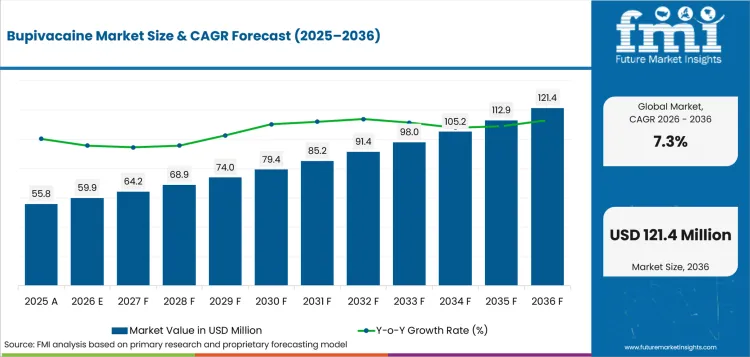
| Metric | Value |
|---|---|
| 2026 Market Size | USD 60.13 million |
| 2036 Market Size | USD 121.46 million |
| Forecast CAGR | 7.3% from 2026 to 2036 |
| Leading Formulation | Injectable |
| Injectable Share in 2026 | 86.0% |
| Leading Product Grade | Sterile-use API Grade |
| Sterile-use API Grade Share in 2026 | 72.0% |
| Leading CAGR Country | China |
| China CAGR | 8.4% by 2036 |
Summary of the Bupivacaine Market
| Market Signal | Commercial Impact |
|---|---|
| Demand and Growth Drivers | Demand for bupivacaine is increasing as healthcare providers seek reliable long-acting local anesthetics and manufacturers prioritize supply continuity.
|
| Product and Segment View | Injectable formulations, sterile-use API grades, and direct sales channels lead their respective segment categories.
|
| Geography and Growth Outlook | China and India are expected to remain key growth markets for bupivacaine production and injectable supply.
|
| Competitive Landscape | Competition is increasingly centered on manufacturing documentation, regulatory files, and reliable injectable supply capabilities.
|
| Analyst Perspective | Bupivacaine demand is increasingly influenced by supply assurance and regulatory readiness in addition to clinical anesthesia requirements.
- Anurag Sharma, Principal Consultant for Healthcare at FMI |
Hospital anesthesia use and API capacity investments are influencing supplier decisions across bupivacaine sourcing. DailyMed labeling updated in 2025 lists bupivacaine hydrochloride injection for local or regional anesthesia and analgesia across surgery and obstetrical procedures. FDA’s 2026 extended-use-date list included Hospira Bupivacaine Spinal Injection lots under NDC 0409-3613-01 that moved original 28 February 2026 expiries to 28 February 2027, showing shortage-management pressure in spinal anesthesia products. OECD’s 2025 country note reported that Korea spent USD 4,797 per capita on health and 8.4% of GDP on health, supporting hospital medicine demand in an advanced care system. Cambrex announced a USD 120 million API manufacturing investment in October 2025, adding supply-chain value for drug substance buyers.
Which factors support expansion in the Bupivacaine market?
Qualified API supply and sterile injectable continuity support market value across surgical anesthesia and pain-management formulations.
- Market value rises as injectable manufacturers need bupivacaine API with consistent impurity control and release behavior.
- Surgical anesthesia creates recurring demand as regional blocks and spinal anesthesia require predictable local anesthetic supply.
- Postoperative pain protocols support formulation demand as longer-acting local anesthetics reduce immediate systemic analgesic reliance.
- Dental anaesthetic and oral surgery applications maintain smaller volume channels for long-acting local anesthetic use.
Why is the Bupivacaine market growing?
Sterile injectable use is increasing API qualification intensity as anesthesia products need reliable drug substance supply.
Bupivacaine buyers spend more effort on source qualification as shortage exposure affects hospital injectable planning. FDA’s 2024 drug shortages report stated that FDA worked with manufacturers to prevent 283 shortages during 2024, showing how supply continuity has become a core issue for essential medicines. Bupivacaine spinal products appearing on extended-use-date lists further reinforce the need for alternate-source planning. Suppliers able to support quality documentation and release consistency gain stronger renewal positions with finished-dose manufacturers.
How is the Bupivacaine Market segmented?
Bupivacaine Market is segmented by formulation, therapeutic application, sales channel, buyer type, and product grade.
- Injectable is projected to account for 86.0% share in 2026, influenced by sterile hospital workflows and regional anesthesia dosing.
- Surgical Anesthesia is expected to hold 44.0% share in 2026, shaped by operating-room use and longer block duration requirements.
- Direct Sales are anticipated to account for 62.0% share in 2026, led by audit access and direct supplier documentation.
- Injectable Manufacturers are projected to hold 68.0% share in 2026, guided by finished-dose continuity and source filing needs.
- Sterile-use API Grade is expected to represent 72.0% share in 2026, supported by injectable-grade impurity and release controls.
Why does injectable formulation dominate the Bupivacaine market by formulation?
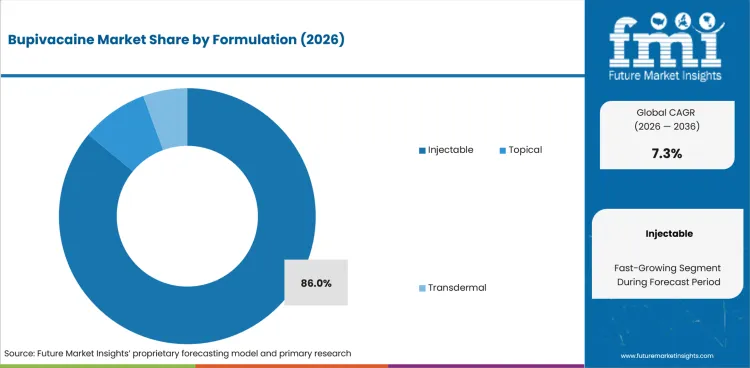
- Injectable is projected to account for 86.0% share in 2026, driven by sterile regional anesthesia and surgical pain-control workflows.
- Topical and transdermal formats remain smaller as hospital-administered use and finished injectable supply carry the main commercial demand.
Which therapeutic application leads the Bupivacaine market?
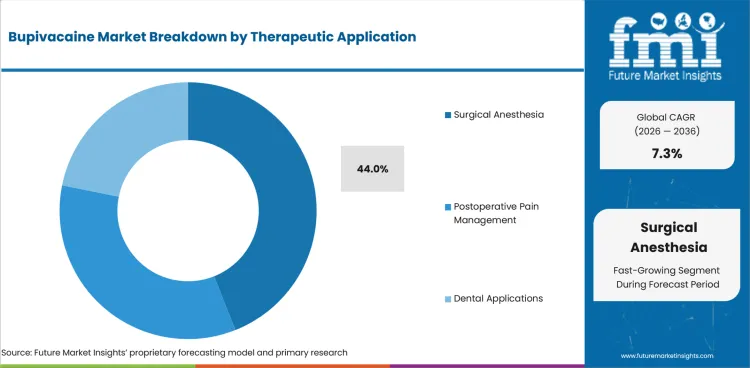
- Surgical anesthesia is expected to hold 44.0% share in 2026, shaped by operating-room use and predictable block-duration requirements.
- Postoperative pain management gains use as care teams seek extended-action local anaesthetic support during recovery pathways.
Which sales channel leads the Bupivacaine Market?
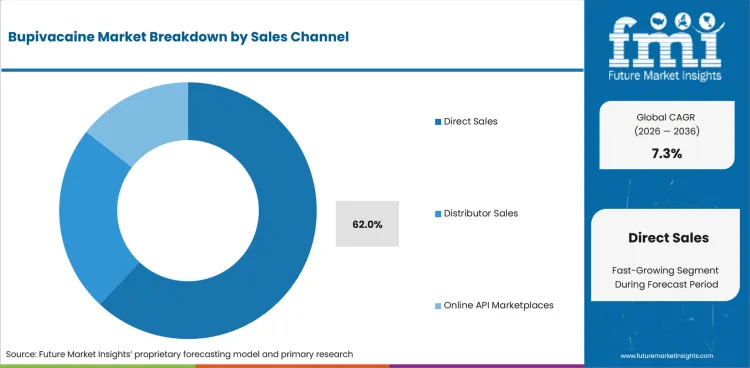
- Direct sales are anticipated to account for 62.0% share in 2026, led by audit requirements and supplier qualification access.
- Distributor sales remain active for smaller formulation buyers and replenishment channels with lower filing complexity.
Which buyer type leads the Bupivacaine Market?
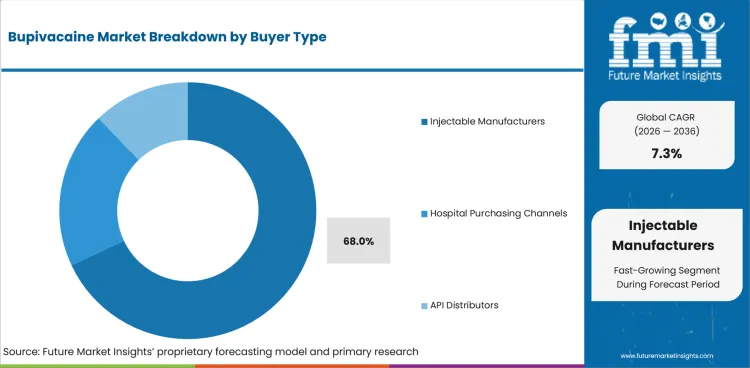
- Injectable manufacturers are projected to hold 68.0% share in 2026, reflected by sterile finished-dose production and regulated product filing requirements.
- Generic formulators continue to qualify API sources for backup supply and regional product launches.
Which product grade leads the Bupivacaine Market?
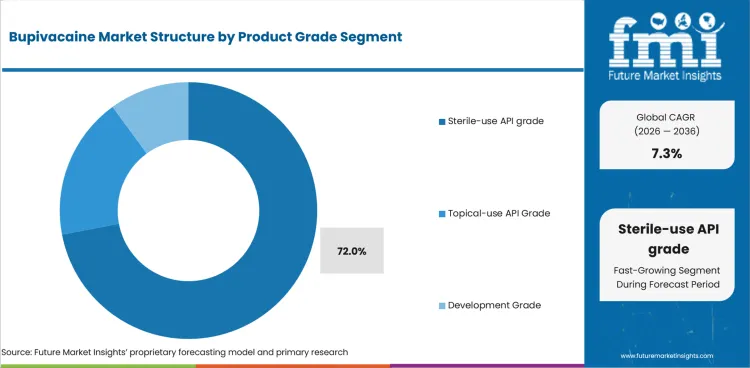
- Sterile-use API grade is expected to represent 72.0% share in 2026, guided by injectable manufacturing needs and tighter impurity controls.
- Topical-use API grade remains smaller as non-injectable formats create narrower bupivacaine consumption than hospital injectable products.
What are the drivers, restraints, and opportunities in the Bupivacaine Market?
Sterile injectable demand and supply assurance are shaping bupivacaine API purchasing decisions.
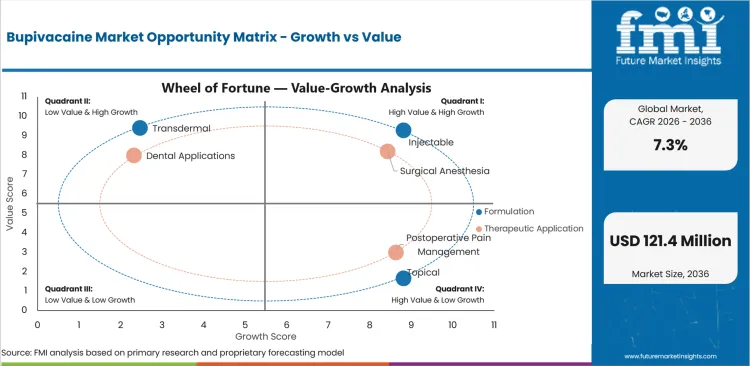
- Driver: Surgical anesthesia and regional nerve block use support recurring demand for qualified injectable-grade API.
- Restraint: Sterile injectable shortages and documentation gaps can slow finished-dose output and new-source approvals.
- Opportunity: Alternate-source qualification can improve supplier access as finished-dose sponsors reduce single-source exposure.
Sterile Anesthesia Workflows Strengthen API Demand
Hospital surgery capacity supports recurring bupivacaine consumption across injectable formulations. OECD’s 2025 health expenditure reporting estimated average health spending across OECD countries at nearly USD 6,000 per capita in 2024, showing continued healthcare spending depth across high-income surgical systems. Hospital-linked injectable manufacturers use that care base to plan API supply and validated source coverage. Bupivacaine API vendors gain demand as finished-dose manufacturers align inventory planning with anesthesia workflows.
Shortage Exposure Limits Finished-dose Stability
Sterile injectable supply remains sensitive to manufacturing interruptions and quality issues. USP’s 2026 drug shortages reporting stated that sterile injectables accounted for 71% of shortages, and product discontinuations increased 60% from 2024 to 2025. Shortage pressure can restrict finished-dose availability and lengthen qualification work for alternate suppliers. API sellers without strong audit records and release history can lose access to regulated injectable accounts.
Alternate-source Programs Create Qualification Opportunity
Shortage management creates an opening for bupivacaine API suppliers with complete files and responsive technical support. FDA’s extended-use-date list showed Hospira Bupivacaine Spinal Injection lots under NDC 0409-3613-01 moving from original 28 February 2026 expiry to 28 February 2027 for several lots. Finished-dose sponsors reviewing such supply signals are more likely to qualify additional API sources before availability tightens. Suppliers offering impurity profiles and change-control assistance can gain account entry through backup-source programs.
Which countries are growing in the Bupivacaine market?
China 8.4% CAGR, India 8.1% CAGR, South Korea 7.6% CAGR, United States 7.4% CAGR, Germany 7.1% CAGR, Japan 6.8% CAGR, United Kingdom 6.6% CAGR, and France 6.5% CAGR through 2036.
.webp "Top Country Growth Comparison Bupivacaine Market Cagr (2026 2036)")
| Country | CAGR |
|---|---|
| China | 8.4% |
| India | 8.1% |
| South Korea | 7.6% |
| United States | 7.4% |
| Germany | 7.1% |
| Japan | 6.8% |
| United Kingdom | 6.6% |
| France | 6.5% |
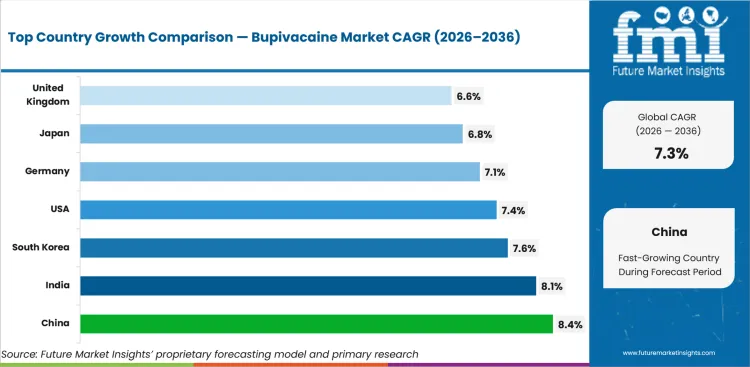
Source: Future Market Insights, 2026.
How do country-level CAGRs compare in the Bupivacaine Market?
China leads country expansion as France records the most cautious pace among profiled markets.
- China is forecast to record 8.4% CAGR by 2036, supported by API production scale and injectable manufacturing demand.
- India is expected to expand at 8.1% CAGR from 2026 to 2036, led by domestic hospital use and export-ready formulation activity.
- South Korea is projected to grow at 7.6% CAGR through 2036, influenced by hospital anesthesia demand and injectable product manufacturing.
- United States is estimated to rise at 7.4% CAGR by 2036, reflected by sterile injectable shortages and alternate-source qualification.
- Germany is expected to advance at 7.1% CAGR over the forecast period as high generic penetration supports regulated API sourcing.
- Japan is forecast to grow at 6.8% CAGR by 2036, backed by hospital capacity and established regional anesthesia use.
- United Kingdom is projected to post 6.6% CAGR by 2036, guided by NHS procedure volume and elective care recovery.
- France is expected to record 6.5% CAGR by 2036, driven by licensed hospital product use and conservative supplier changes.
What is the Bupivacaine market outlook in China?
An 8.4% CAGR through 2036 reflects API scale and injectable manufacturing demand.
Country Market Snapshot Table
| Parameter | Value |
|---|---|
| Market Size in 2025 (Value) | USD 5.4 million |
| Market Size in 2026 (Value) | USD 5.8 million |
| Market Forecast in 2036 (Value) | USD 13.0 million |
| CAGR (2026 to 2036) | 8.4% |
| Years Considered | 2021 to 2036 |
| Base Year | 2025 |
| Forecast Period | 2026 to 2036 |
| Units Considered | Value (USD million) |
| Leading Sub-Region | Yangtze River Delta and Guangdong pharmaceutical corridors |
China Bupivacaine Market Outlook
China bupivacaine demand draws strength from domestic injectable manufacturing and export-facing API capabilities. Finished-dose sponsors need qualified files supporting sterile-use formulations and international registrations.
Buyers are expected to favor suppliers with batch consistency and export documentation. Account wins will depend on molecule-specific files and inspection readiness.
Key Growth Drivers
- Hospital procedure volume supports bupivacaine injectable pull-through; National Health Commission reporting placed inpatient discharges above 1.09 billion in 2024.
- Drug approval depth supports formulation activity, shown through National Medical Products Administration records of 46 Class 1 or 1.1 innovative drugs approved in 2024.
- Export-facing finished-dose manufacturers need bupivacaine API sources able to support regulated filings and customer audits.
- Regional formulation clusters create demand for suppliers offering fast technical response and stability documentation.
Key Restraints
- Public bupivacaine-specific evidence can remain limited, making buyer due diligence heavily dependent on dossier review.
- GMP and export registration expectations can slow new vendor onboarding for sterile injectable accounts.
- Generic medicine price pressure can reduce room for premium API programs, against national planning that targeted centralized bulk-buying coverage of 500 drugs in 2024.
What makes China unique
China stands apart for API production depth and formulation manufacturing scale serving domestic and overseas buyers.
Key Companies
- Humanwell Healthcare
- Jiangsu Hengrui Pharmaceuticals
- Shanghai Harvest Pharmaceutical
- Sichuan Kelun Pharmaceutical
- Pfizer Hospira
- Fresenius Kabi
- Cambrex
Sales & Marketing Channels
- Direct API supply discussions with finished-dose manufacturers
- CDMO and formulation partner relationships
- Distributor support for smaller formulation buyers
- Technical file review and quality-audit meetings
- Export registration support
- Stability and impurity documentation packages
Country Segment Breakdown Table
| Segment | Sub-Segments |
|---|---|
| By Formulation | Injectable · Topical · Transdermal |
| By Therapeutic Application | Surgical Anesthesia · Postoperative Pain Management · Chronic Pain and Regional Nerve Blocks · Dental Applications |
| By Sales Channel | Direct Sales · Distributor Sales · Online API Marketplaces · Others |
| By Buyer Type | Injectable Manufacturers · Hospital Purchasing Channels · API Distributors · Generic Formulators · Contract Manufacturers |
| By Product Grade | Sterile-use API Grade · Topical-use API Grade · Development Grade |
| Key Sub-Regions Covered, Pharmaceutical Corridors | Yangtze River Delta · Guangdong · Shandong · Jiangsu · Zhejiang · Beijing-Tianjin-Hebei |
Frequently Asked Questions
How fast is China Bupivacaine market growing?
China demand is rising at 8.4% CAGR from 2026 to 2036 as domestic API scale and injectable manufacturing support supplier qualification.
Who leads China Bupivacaine market?
Humanwell Healthcare and Jiangsu Hengrui Pharmaceuticals lead local participation, supported by Pfizer Hospira and Fresenius Kabi in global injectable channels.
What is driving adoption in China Bupivacaine market?
Export-focused formulation activity and domestic API capacity are increasing preference for qualified bupivacaine suppliers.
How fast is the Bupivacaine market growing in India?
An 8.1% CAGR through 2036 reflects hospital use and export-ready sterile formulations.
Country Market Snapshot Table
| Parameter | Value |
|---|---|
| Market Size in 2025 (Value) | USD 3.9 million |
| Market Size in 2026 (Value) | USD 4.2 million |
| Market Forecast in 2036 (Value) | USD 9.2 million |
| CAGR (2026 to 2036) | 8.1% |
| Years Considered | 2021 to 2036 |
| Base Year | 2025 |
| Forecast Period | 2026 to 2036 |
| Units Considered | Value (USD million) |
| Leading Sub-Region | Gujarat, Maharashtra, and Telangana pharmaceutical corridors |
India Bupivacaine Market Outlook
India bupivacaine demand advances through hospital injectable use and pharmaceutical export readiness. API and finished-dose buyers need reliable documentation for regulated channels.
Local suppliers benefit from proximity to formulation customers and quality teams. Export-oriented accounts will prioritize DMF readiness and audit performance.
Key Growth Drivers
- Pharmaceutical export capacity supports API demand, measured by official commerce reporting that placed 2024-25 pharma exports at USD 30.47 billion after 9.4% annual expansion.
- Public health access adds volume depth, reflected in 1,80,906 Ayushman Arogya Mandirs operationalized across India as of 31 October 2025.
- District hospital and surgical programs create a steady base for long-acting local anesthetic formulations.
- Domestic finished-dose manufacturers need alternate API suppliers to manage regulated-market filing and batch continuity.
Key Restraints
- Tender-led pricing can compress supplier margins for standard local anesthetic injectables.
- Documentation gaps can slow export-linked source qualification for sterile-use API.
- Quality surveillance can raise compliance workload, according to 2026 CDSCO sampling guidelines requiring each drug inspector to collect at least 10 samples every month.
What makes India unique
India differs through export-ready formulation capacity and a large base of injectable manufacturers.
Key Companies
- Anthea Pharma
- Steriscience
- Neon Laboratories
- Themis Medicare
- Troikaa Pharmaceuticals
- Pfizer Hospira
- Fresenius Kabi
Sales & Marketing Channels
- Direct API selling to injectable manufacturers
- Export dossier support discussions
- Distributor sales for smaller formulation buyers
- Hospital-linked finished-dose supply channels
- Contract manufacturing relationships
- Quality-audit and stability-data review meetings
Country Segment Breakdown Table
| Segment | Sub-Segments |
|---|---|
| By Formulation | Injectable · Topical · Transdermal |
| By Therapeutic Application | Surgical Anesthesia · Postoperative Pain Management · Chronic Pain and Regional Nerve Blocks · Dental Applications |
| By Sales Channel | Direct Sales · Distributor Sales · Online API Marketplaces · Others |
| By Buyer Type | Injectable Manufacturers · Hospital Purchasing Channels · API Distributors · Generic Formulators · Contract Manufacturers |
| By Product Grade | Sterile-use API Grade · Topical-use API Grade · Development Grade |
| Key Sub-Regions Covered, Pharmaceutical Corridors | Gujarat · Maharashtra · Telangana · Himachal Pradesh · Karnataka · Andhra Pradesh |
Frequently Asked Questions
How fast is India Bupivacaine market growing?
India demand is advancing at 8.1% CAGR from 2026 to 2036 as injectable production and medicine exports support qualified API sourcing.
Who leads India Bupivacaine market?
Anthea Pharma and Steriscience lead local manufacturing relevance, joined by Neon Laboratories, Themis Medicare, and global suppliers serving injectable accounts.
What is driving adoption in India Bupivacaine market?
Local sterile injectable output and hospital procurement programs are raising demand for documented bupivacaine API supply.
What is the Bupivacaine market outlook in South Korea?
A 7.6% CAGR through 2036 reflects hospital anesthesia demand and injectable manufacturing links.
Country Market Snapshot Table
| Parameter | Value |
|---|---|
| Market Size in 2025 (Value) | USD 2.5 million |
| Market Size in 2026 (Value) | USD 2.7 million |
| Market Forecast in 2036 (Value) | USD 5.6 million |
| CAGR (2026 to 2036) | 7.6% |
| Years Considered | 2021 to 2036 |
| Base Year | 2025 |
| Forecast Period | 2026 to 2036 |
| Units Considered | Value (USD million) |
| Leading Sub-Region | Seoul-Incheon and Gyeonggi pharmaceutical corridors |
South Korea Bupivacaine Market Outlook
South Korea bupivacaine demand reflects hospital anesthesia use and export-linked injectable manufacturing. Finished-dose companies require qualified API partners able to meet regulated-market documentation expectations.
Supplier selection is expected to remain account-specific. Buyers will prioritize inspection history and communication with formulation teams.
Key Growth Drivers
- Healthcare spending supports high-control hospital product demand, supported by OECD’s 2025 country note placing Korea’s health spending at USD 4,797 per capita.
- Medicine review modernization supports regulated product access, reinforced by MFDS’s 2026 approval-review target of 240 days for medical products.
- Huons’ visibility in regulated product records supports South Korean participation in injectable channels.
- Regional manufacturers need bupivacaine API suppliers with impurity data and stability support.
Key Restraints
- High documentation expectations can lengthen approval cycles for API changes.
- Export-facing accounts may require repeated audit evidence before approving alternate sources.
- Shortage-management work can stretch regulatory resources, identified in a 2026 analysis of 1,054 regulatory-reported South Korean drug shortage cases from 2018 to 2024.
What makes South Korea unique
South Korea is distinguished by advanced injectable manufacturing and quality-led medicine review expectations.
Key Companies
- Huons
- Hana Pharm
- Daihan Pharm
- JW Pharmaceutical
- Pfizer Hospira
- Fresenius Kabi
- Hikma
Sales & Marketing Channels
- Direct technical selling to injectable manufacturers
- Qualified vendor programs
- Export dossier support
- Hospital-linked finished-dose supply channels
- Local distributor relationships
- Product file and batch documentation reviews
Country Segment Breakdown Table
| Segment | Sub-Segments |
|---|---|
| By Formulation | Injectable · Topical · Transdermal |
| By Therapeutic Application | Surgical Anesthesia · Postoperative Pain Management · Chronic Pain and Regional Nerve Blocks · Dental Applications |
| By Sales Channel | Direct Sales · Distributor Sales · Online API Marketplaces · Others |
| By Buyer Type | Injectable Manufacturers · Hospital Purchasing Channels · API Distributors · Generic Formulators · Contract Manufacturers |
| By Product Grade | Sterile-use API Grade · Topical-use API Grade · Development Grade |
| Key Sub-Regions Covered, Pharmaceutical Corridors | Seoul · Incheon · Gyeonggi · Chungcheong · Daejeon · Busan |
Frequently Asked Questions
How fast is South Korea Bupivacaine market growing?
South Korea demand is strengthening at 7.6% CAGR from 2026 to 2036 through high-control injectable sourcing and hospital medicine use.
Who leads South Korea Bupivacaine market?
Huons leads the local bupivacaine-related injectable channel, aided by Hana Pharm, Daihan Pharm, and global sterile injectable suppliers.
What is driving adoption in South Korea Bupivacaine market?
Regulated review discipline and export-linked injectable manufacturing are lifting demand for quality-led API sources.
How is the Bupivacaine market performing in the United States?
A 7.4% CAGR through 2036 reflects sterile injectable shortage planning and hospital anesthesia demand.
Country Market Snapshot Table
| Parameter | Value |
|---|---|
| Market Size in 2025 (Value) | USD 16.8 million |
| Market Size in 2026 (Value) | USD 18.0 million |
| Market Forecast in 2036 (Value) | USD 36.8 million |
| CAGR (2026 to 2036) | 7.4% |
| Years Considered | 2021 to 2036 |
| Base Year | 2025 |
| Forecast Period | 2026 to 2036 |
| Units Considered | Value (USD million) |
| Leading Sub-Region | Northeast, Midwest, and Sun Belt hospital corridors |
United States Bupivacaine Market Outlook
United States bupivacaine demand comes from sterile injectable availability and hospital anesthesia use. Finished-dose manufacturers need qualified API sources that can support filing updates and shortage risk management.
Suppliers are expected to compete through documentation depth and release reliability. Hospital scheduling pressure will favor finished-dose sponsors with more secure API supply.
Key Growth Drivers
- Hospital care spending supports injectable demand, reported by CMS at USD 1,634.7 billion in 2024.
- FDA quality surveillance strengthens supplier accountability, evidenced in 2026 annual sampling that tested bupivacaine hydrochloride injection across 6 quality attributes, including assay, impurities, pH, sterility, and bacterial endotoxins.
- Finished-dose sponsors are qualifying backup API sources after bupivacaine spinal shortage experience.
- Direct supplier communication helps buyers manage change control and regulatory filing updates.
Key Restraints
- Capital and validation work can delay source changes for regulated injectable products.
- Bupivacaine supply disruption can affect hospital purchasing plans, listed through ASHP shortage updates covering 30 mL and 50 mL presentations in 2026.
- Hospital buyers may prioritize immediate product availability over API source diversification during acute shortage periods.
What makes United States unique
United States stands out for large hospital spending and high sensitivity to sterile injectable shortages.
Key Companies
- Pfizer Hospira
- Fresenius Kabi USA
- Hikma
- Baxter Healthcare
- Xellia Pharmaceuticals
- Pacira BioSciences
- Cambrex
Sales & Marketing Channels
- Direct sales to finished-dose manufacturers
- Quality-audit and regulatory file reviews
- Hospital injectable supply partnerships
- Distributor support for smaller buyers
- Shortage-response account management
- Technical support for alternate-source qualification
Country Segment Breakdown Table
| Segment | Sub-Segments |
|---|---|
| By Formulation | Injectable · Topical · Transdermal |
| By Therapeutic Application | Surgical Anesthesia · Postoperative Pain Management · Chronic Pain and Regional Nerve Blocks · Dental Applications |
| By Sales Channel | Direct Sales · Distributor Sales · Online API Marketplaces · Others |
| By Buyer Type | Injectable Manufacturers · Hospital Purchasing Channels · API Distributors · Generic Formulators · Contract Manufacturers |
| By Product Grade | Sterile-use API Grade · Topical-use API Grade · Development Grade |
| Key Sub-Regions Covered, Pharmaceutical Corridors | Northeast · Midwest · California · Texas · Florida · North Carolina |
Frequently Asked Questions
How fast is United States Bupivacaine market growing?
United States demand is rising at 7.4% CAGR from 2026 to 2036 through shortage planning and hospital injectable use.
Who leads United States Bupivacaine market?
Pfizer Hospira leads through bupivacaine spinal and Marcaine visibility, followed by Fresenius Kabi USA, Hikma, Baxter Healthcare, and Xellia.
What is driving adoption in United States Bupivacaine market?
Sterile injectable shortage pressure and alternate-source qualification are making dependable bupivacaine API sources more valuable.
What is the Bupivacaine Market forecast for Germany?
A 7.1% CAGR through 2036 reflects regulated generic drug use and European filing requirements.
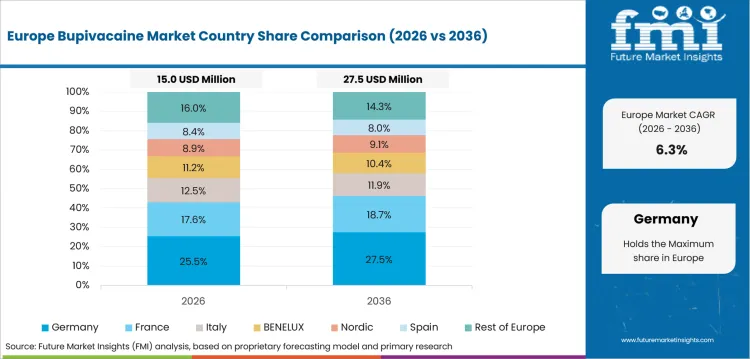
Country Market Snapshot Table
| Parameter | Value |
|---|---|
| Market Size in 2025 (Value) | USD 4.4 million |
| Market Size in 2026 (Value) | USD 4.7 million |
| Market Forecast in 2036 (Value) | USD 9.3 million |
| CAGR (2026 to 2036) | 7.1% |
| Years Considered | 2021 to 2036 |
| Base Year | 2025 |
| Forecast Period | 2026 to 2036 |
| Units Considered | Value (USD million) |
| Leading Sub-Region | North Rhine-Westphalia and Baden-Württemberg hospital corridors |
Germany Bupivacaine Market Outlook
Germany bupivacaine demand builds on regulated sterile injectable use and high generic medicine penetration. API suppliers need European documentation and quality files suited to finished-dose sponsors.
Buyers are expected to favor source stability over frequent supplier changes. Technical support and CEP alignment will remain central to account entry.
Key Growth Drivers
- Generic medicine use supports API sourcing depth, documented by OECD’s 2025 reporting of Germany’s generic share by volume at 84%.
- Health spending depth supports hospital product access, quantified at EUR 5,414 per capita in Germany’s 2025 OECD country profile.
- European filing support strengthens supplier selection for injectable-grade API.
- Local and regional manufacturing networks favor suppliers with rapid quality-response capability.
Key Restraints
- High technical approval requirements can slow new supplier entry into pharmaceutical plants.
- Hospital reform can reshape medicine access reviews, defined through Germany’s 2025 Hospital Care Improvement Act introducing 65 service groups for hospital reimbursement planning.
- Mid-sized formulation buyers can delay source changes if quality teams lack staff for validation and stability documentation.
What makes Germany unique
Germany holds a distinct position through generic penetration and regulated-market documentation expectations.
Key Companies
- Fresenius Kabi Germany
- B. Braun Melsungen
- Siegfried
- Cambrex
- Pfizer Hospira
- Hikma
- Moehs Group
Sales & Marketing Channels
- Direct API discussions with formulation manufacturers
- European dossier support
- CEP-led quality documentation reviews
- Hospital injectable supply networks
- Distributor relationships for smaller buyers
- Technical service and audit preparation
Country Segment Breakdown Table
| Segment | Sub-Segments |
|---|---|
| By Formulation | Injectable · Topical · Transdermal |
| By Therapeutic Application | Surgical Anesthesia · Postoperative Pain Management · Chronic Pain and Regional Nerve Blocks · Dental Applications |
| By Sales Channel | Direct Sales · Distributor Sales · Online API Marketplaces · Others |
| By Buyer Type | Injectable Manufacturers · Hospital Purchasing Channels · API Distributors · Generic Formulators · Contract Manufacturers |
| By Product Grade | Sterile-use API Grade · Topical-use API Grade · Development Grade |
| Key Sub-Regions Covered, Pharmaceutical Corridors | North Rhine-Westphalia · Baden-Württemberg · Bavaria · Hesse · Saxony · Hamburg |
Frequently Asked Questions
How fast is Germany Bupivacaine market growing?
Germany demand is growing at 7.1% CAGR from 2026 to 2036 through generic medicine volume and sterile-use documentation needs.
Who leads Germany Bupivacaine market?
Fresenius Kabi Germany and B. Braun Melsungen lead local sterile injectable relevance, with Siegfried and Cambrex strengthening API supply options.
What is driving adoption in Germany Bupivacaine market?
European filing standards and hospital product continuity are pushing buyers toward documented bupivacaine API sources.
What is the Bupivacaine market forecast for Japan?
A 6.8% CAGR through 2036 reflects hospital capacity and established regional anesthesia use.
Country Market Snapshot Table
| Parameter | Value |
|---|---|
| Market Size in 2025 (Value) | USD 3.2 million |
| Market Size in 2026 (Value) | USD 3.4 million |
| Market Forecast in 2036 (Value) | USD 6.6 million |
| CAGR (2026 to 2036) | 6.8% |
| Years Considered | 2021 to 2036 |
| Base Year | 2025 |
| Forecast Period | 2026 to 2036 |
| Units Considered | Value (USD million) |
| Leading Sub-Region | Kanto and Kansai hospital corridors |
Japan Bupivacaine Market Outlook
Japan bupivacaine demand tracks high hospital utilization and established regional anesthesia practice. Finished-dose sponsors require careful documentation before approving API changes.
Buyers are expected to prioritize low-risk source changes and product file continuity. Suppliers with Japanese documentation support can secure stronger acceptance.
Key Growth Drivers
- Health system spending supports hospital injectable access, indicated by World Bank data from WHO health accounts listing Japan’s 2024 current health expenditure per capita at USD 4,352.
- Aging-linked care demand sustains surgical anesthesia planning, framed by official 2025 population reporting that placed people aged 65 and older above 29% of Japan’s population.
- Mature hospital workflows support stable injectable demand across surgical anesthesia.
- Finished-dose sponsors need API suppliers able to support local documentation and release expectations.
Key Restraints
- Conservative qualification practices can slow new-source approval for sterile-use API.
- Local product sponsors may prefer existing API sources to avoid filing complexity and validation work.
- Generic API reliance can slow low-risk source changes, noted in Japan’s 2024 stable-supply roadmap materials reporting approximately 60% of generic-drug APIs as imported.
What makes Japan unique
Japan differs through cautious supplier qualification and hospital injectable discipline.
Key Companies
- Maruishi Pharmaceutical
- Pfizer Japan
- Sandoz Pharma K.K.
- Viatris Japan
- Fresenius Kabi Japan
- Siegfried
- Cambrex
Sales & Marketing Channels
- Direct selling to finished-dose sponsors
- Product file and stability-data review
- Local regulatory documentation support
- Distributor supply to smaller formulation accounts
- Hospital injectable channel relationships
- Quality-audit preparation meetings
Country Segment Breakdown Table
| Segment | Sub-Segments |
|---|---|
| By Formulation | Injectable · Topical · Transdermal |
| By Therapeutic Application | Surgical Anesthesia · Postoperative Pain Management · Chronic Pain and Regional Nerve Blocks · Dental Applications |
| By Sales Channel | Direct Sales · Distributor Sales · Online API Marketplaces · Others |
| By Buyer Type | Injectable Manufacturers · Hospital Purchasing Channels · API Distributors · Generic Formulators · Contract Manufacturers |
| By Product Grade | Sterile-use API Grade · Topical-use API Grade · Development Grade |
| Key Sub-Regions Covered, Pharmaceutical Corridors | Kanto · Kansai · Chubu · Kyushu · Tohoku · Hokkaido |
Frequently Asked Questions
How fast is Japan Bupivacaine market growing?
Japan demand is rising at 6.8% CAGR from 2026 to 2036 through hospital injectable use and aging-linked surgical care.
Who leads Japan Bupivacaine market?
Maruishi Pharmaceutical leads local anesthesia-product relevance, complemented by Pfizer Japan, Sandoz Pharma K.K., Viatris Japan, and global API suppliers.
What is driving adoption in Japan Bupivacaine market?
Aging care needs and careful product-file review are supporting qualified bupivacaine API demand.
How is the Bupivacaine Market performing in the United Kingdom?
A 6.6% CAGR through 2036 reflects elective procedure demand and licensed injectable supply.
Country Market Snapshot Table
| Parameter | Value |
|---|---|
| Market Size in 2025 (Value) | USD 2.8 million |
| Market Size in 2026 (Value) | USD 3.0 million |
| Market Forecast in 2036 (Value) | USD 5.7 million |
| CAGR (2026 to 2036) | 6.6% |
| Years Considered | 2021 to 2036 |
| Base Year | 2025 |
| Forecast Period | 2026 to 2036 |
| Units Considered | Value (USD million) |
| Leading Sub-Region | England hospital and specialty-care corridors |
United Kingdom Bupivacaine Market Outlook
United Kingdom bupivacaine demand rests on NHS hospital activity and licensed injectable product use. Finished-dose access depends on supplier continuity and regulatory product records.
API suppliers access the market mainly through finished-dose sponsors. Documentation and supply reliability will be more important than frequent supplier switching.
Key Growth Drivers
- NHS hospital activity supports anesthetic demand, validated by 22.6 million finished consultant episodes recorded in 2024-25.
- Elective care pressure sustains surgery-related product demand, sustained by 7.4 million referral-to-treatment pathways waiting at the end of April 2025.
- Licensed bupivacaine injection presentations support established hospital use in surgical anesthesia and acute pain management.
- Finished-dose manufacturers need supplier continuity to protect hospital product availability.
Key Restraints
- Tender pricing can limit premium API room for standard local anesthetic products.
- Product sponsor changes can require regulatory updates and validation work before supplier approval.
- Waiting-list pressure affects timing, seen in 190,068 pathways waiting more than 52 weeks in April 2025.
What makes United Kingdom unique
United Kingdom is set apart by NHS purchasing discipline and high visibility of elective-care pressure.
Key Companies
- Hikma Pharmaceuticals
- Baxter Healthcare UK
- Pfizer UK
- Fresenius Kabi UK
- Martindale Pharma
- Cambrex
- Siegfried
Sales & Marketing Channels
- Direct relationships with finished-dose sponsors
- NHS-linked injectable supply pathways
- Distributor support for licensed presentations
- Regulatory file and stability review
- Tender-aligned product support
- Quality documentation meetings
Country Segment Breakdown Table
| Segment | Sub-Segments |
|---|---|
| By Formulation | Injectable · Topical · Transdermal |
| By Therapeutic Application | Surgical Anesthesia · Postoperative Pain Management · Chronic Pain and Regional Nerve Blocks · Dental Applications |
| By Sales Channel | Direct Sales · Distributor Sales · Online API Marketplaces · Others |
| By Buyer Type | Injectable Manufacturers · Hospital Purchasing Channels · API Distributors · Generic Formulators · Contract Manufacturers |
| By Product Grade | Sterile-use API Grade · Topical-use API Grade · Development Grade |
| Key Sub-Regions Covered, Pharmaceutical Corridors | England · Scotland · Wales · Northern Ireland · Midlands · North West England |
Frequently Asked Questions
How fast is United Kingdom Bupivacaine market growing?
United Kingdom demand is advancing at 6.6% CAGR from 2026 to 2036, aided by NHS procedure volume and licensed injectable demand.
Who leads United Kingdom Bupivacaine market?
Hikma Pharmaceuticals and Baxter Healthcare UK lead local channel relevance, supported by Pfizer UK, Fresenius Kabi UK, and API-focused suppliers.
What is driving adoption in United Kingdom Bupivacaine market?
NHS elective-care activity and tender-linked continuity planning are supporting qualified API demand.
What is driving Bupivacaine Market growth in France?
A 6.5% CAGR through 2036 reflects licensed hospital injectable use and cautious source switching.
Country Market Snapshot Table
| Parameter | Value |
|---|---|
| Market Size in 2025 (Value) | USD 2.3 million |
| Market Size in 2026 (Value) | USD 2.5 million |
| Market Forecast in 2036 (Value) | USD 4.7 million |
| CAGR (2026 to 2036) | 6.5% |
| Years Considered | 2021 to 2036 |
| Base Year | 2025 |
| Forecast Period | 2026 to 2036 |
| Units Considered | Value (USD million) |
| Leading Sub-Region | Île-de-France and Auvergne-Rhône-Alpes hospital corridors |
France Bupivacaine Market Outlook
France bupivacaine demand follows hospital anesthesia use and licensed spinal anesthesia products. API suppliers gain access through finished-dose manufacturers rather than direct hospital purchasing.
Supplier changes are expected to remain cautious. Product sponsors will prioritize dossier continuity and quality documentation.
Key Growth Drivers
- Hospital care spending supports anesthesia product use, recorded by DREES at EUR 120.8 billion in 2024, equal to 47% of medical goods and care consumption.
- Specialist workforce depth supports surgery-linked anesthesia demand, tracked at 13,500 anesthetists and intensive care physicians active on 1 January 2025.
- Laboratoire Aguettant visibility in public product records supports a local finished-dose channel.
- API suppliers can gain through finished-dose sponsors needing alternate files and stable release history.
Key Restraints
- Hospital pricing discipline can limit premium positioning for standard local anesthetic products.
- Product sponsor qualification can slow new API source adoption through validation and filing needs.
- Medicine supply oversight can add administrative work for product sponsors, managed through ANSM’s 2024 activity reporting of 3,825 medicine shortage or shortage-risk notifications, with nearly half requiring at least one management measure.
What makes France unique
France is distinguished by hospital-care spending depth and local finished-dose product presence.
Key Companies
- Laboratoire Aguettant
- Delpharm
- Fresenius Kabi France
- Pfizer France
- Hikma
- Cambrex
- Siegfried
Sales & Marketing Channels
- Direct supplier discussions with finished-dose sponsors
- Hospital injectable supply routes
- Distributor support for smaller accounts
- Regulatory documentation support
- Quality and stability-data meetings
- Alternate-source qualification programs
Country Segment Breakdown Table
| Segment | Sub-Segments |
|---|---|
| By Formulation | Injectable · Topical · Transdermal |
| By Therapeutic Application | Surgical Anesthesia · Postoperative Pain Management · Chronic Pain and Regional Nerve Blocks · Dental Applications |
| By Sales Channel | Direct Sales · Distributor Sales · Online API Marketplaces · Others |
| By Buyer Type | Injectable Manufacturers · Hospital Purchasing Channels · API Distributors · Generic Formulators · Contract Manufacturers |
| By Product Grade | Sterile-use API Grade · Topical-use API Grade · Development Grade |
| Key Sub-Regions Covered, Pharmaceutical Corridors | Île-de-France · Auvergne-Rhône-Alpes · Normandy · Grand Est · Hauts-de-France · Occitanie |
Frequently Asked Questions
How fast is France Bupivacaine market growing?
France demand is supported at 6.5% CAGR from 2026 to 2036 by hospital-care spending and injectable product demand.
Who leads France Bupivacaine market?
Laboratoire Aguettant leads local finished-dose importance, joined by Delpharm, Fresenius Kabi France, Pfizer France, and global API suppliers.
What is driving adoption in France Bupivacaine market?
Hospital anesthesia activity and medicine-shortage controls are supporting demand for documented bupivacaine API sources.
Who are the leading companies in the Bupivacaine Market?
Siegfried, Cambrex, Moehs Group, Pfizer Hospira, and Fresenius Kabi.
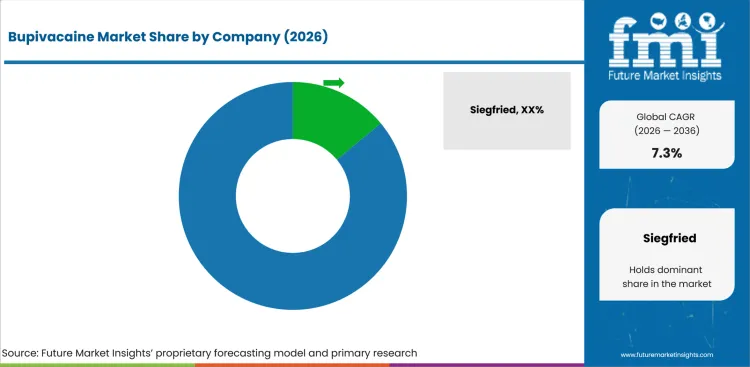
- API suppliers hold an advantage through bupivacaine product listings, USDMF support, and regulated-market documentation.
- Finished injectable companies influence API pull-through as hospital product availability depends on reliable drug substance sources.
- Regional finished-dose manufacturers gain access due to local registrations and export product records.
- Service-ready API suppliers improve renewal chances led by stability support and plant-level troubleshooting.
API-focused suppliers compete through documentation depth and batch reliability. Siegfried has a strong position through drug substance manufacturing and public bupivacaine API materials. Cambrex competes based on API manufacturing capabilities and regulated-market customer support. Moehs Group participates through generic API portfolio coverage and European documentation.
Manufacturing and technical service depth have become stronger competitive separators as sterile injectable buyers move beyond basic chemical supply. Pfizer Hospira and Fresenius Kabi compete through hospital injectable visibility and product access. Hikma, Xellia, Huons, Anthea Pharma, and Steriscience strengthen competition through regulated finished-dose channels. Buyers compare supplier performance through release consistency and quality records.
Smaller and regional suppliers can win through local filing knowledge and swift technical response. China, India, and South Korea create opportunities for suppliers with application laboratories and local service teams. United States and Europe create stronger demand for compliance documentation and technical validation. Companies that prove API consistency under sterile-use expectations should gain more durable qualified-source positions.
How do top Bupivacaine companies compare?
Siegfried and Cambrex score on API documentation as Pfizer Hospira and Fresenius Kabi lead finished injectable visibility.
| Company | Relevance to Market Title | Bupivacaine API File Depth | Sterile-use Supply Relevance | Regulated-Market Documentation | Channel Reach | Geographic Footprint |
|---|---|---|---|---|---|---|
| Siegfried | Very High | Very Strong | Strong | Very Strong | Strong | Global |
| Cambrex | Very High | Very Strong | Strong | Very Strong | Strong | North America and Europe |
| Moehs Group | High | Strong | Moderate | Strong | Moderate | Europe |
| Pfizer Hospira | Very High | Moderate | Very Strong | Very Strong | Very Strong | Global |
| Fresenius Kabi | High | Moderate | Very Strong | Strong | Very Strong | Global |
| Hikma | High | Moderate | Strong | Strong | Strong | United States and Global |
| Xellia | Moderate to High | Moderate | Strong | Strong | Moderate | United States and Europe |
| Huons | Moderate | Limited | Moderate | Moderate | Moderate | South Korea and Export Markets |
| Anthea Pharma | Moderate | Limited | Moderate | Moderate | Moderate | India and Export Markets |
| Steriscience | Moderate | Limited | Moderate | Moderate | Moderate | India and Export Markets |
Source: Future Market Insights competitive analysis, 2026.
Who are the key players in the Bupivacaine Market?
Siegfried, Cambrex, and Moehs Group are listed with Pfizer Hospira and Fresenius Kabi among other suppliers.
Key global companies leading the Bupivacaine Market include:
- Siegfried
- Cambrex
- Moehs Group
- Pfizer Hospira
- Fresenius Kabi
- Hikma
- Xellia
- Huons
- Anthea Pharma
- Steriscience
Key Developments in Bupivacaine Market
- In October 2025, Cambrex announced a USD 120 million investment to expand USA API manufacturing and strengthen domestic drug supply resilience.
- In March 2026, Pfizer Hospital issued an emergency date-extension notice for Bupivacaine Spinal and Marcaine Spinal to mitigate shortages of critical products.
- In June 2026, Siegfried announced a new large-scale drug substance facility in Minden adding 100 m³ of reactor capacity for complex manufacturing.
Key Players in the Bupivacaine Market
API and CDMO Suppliers
- Siegfried
- Cambrex
- Moehs Group
- Selected regional API manufacturers
Finished Injectable Channel Participants
- Pfizer Hospira
- Fresenius Kabi
- Hikma
- Xellia
Regional Finished-dose Manufacturers
- Huons
- Anthea Pharma
- Steriscience
- Local injectable suppliers
Documentation and Regulated-Market Specialists
- CEP-supported API suppliers
- USDMF-ready API suppliers
- Contract manufacturers serving sterile injectable sponsors
Bupivacaine Market - Report Scope
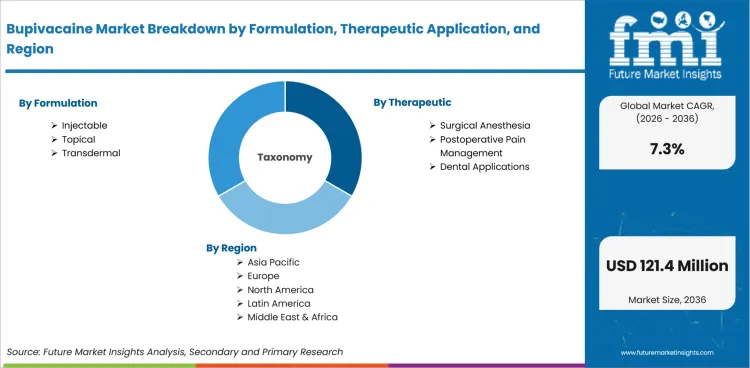
| Parameter | Details |
|---|---|
| Forecast period | 2026 to 2036 |
| Historical period | 2021 to 2025 |
| Quantitative unit | Revenue in USD million |
| By formulation | Injectable, topical, transdermal |
| By therapeutic application | Surgical anesthesia, postoperative pain management, chronic pain and regional nerve blocks, dental applications |
| By sales channel | Direct sales, distributor sales, online API marketplaces, others |
| By buyer type | Injectable manufacturers, hospital purchasing channels, API distributors, generic formulators, contract manufacturers |
| By product grade | Sterile-use API grade, topical-use API grade, development grade |
| Regions covered | North America, Latin America, Europe, East Asia, South Asia and Pacific, Middle East and Africa |
| Countries covered | China, India, South Korea, United States, Germany, Japan, United Kingdom, France |
| Key companies profiled | Siegfried, Cambrex, Moehs Group, Pfizer Hospira, Fresenius Kabi, Hikma, Xellia, Huons, Anthea Pharma, Steriscience |
| Approach | Bottom-up API consumption approach using formulation demand, hospital injectable use, qualified-source share, country-level surgical signals, and regulated API pricing |
Source: Future Market Insights competitive analysis, 2026.
Bupivacaine Market - Scope & Definition
| Attribute | Detail |
|---|---|
| Market Definition | Commercially supplied bupivacaine active pharmaceutical ingredient and related forms used in regulated medicinal products for local anesthesia and pain management |
| Functions Covered | Local anesthesia, regional anesthesia support, nerve block support, postoperative pain-control formulation input, and sterile injectable drug substance supply |
| Applications Covered | Surgical anesthesia, postoperative pain management, chronic pain and regional nerve blocks, and dental applications |
| End-Use Industries | Finished injectable manufacturers, generic formulators, contract manufacturers, hospital-linked pharmaceutical channels, and API distributors |
| Grades Covered | Sterile-use API grade, topical-use API grade, and development grade |
| Inclusions | All commercially supplied bupivacaine API and related forms used by regulated medicine manufacturers across selected formulations, applications, channels, buyer types, product grades, and regions |
| Exclusions | Finished hospital procedures, anesthesia service fees, injection devices, excipients, epinephrine as a separate ingredient, lidocaine API, ropivacaine API, levobupivacaine API, and unrelated pain therapy drugs |
Bupivacaine Market - Research Methodology
| Method | Description |
|---|---|
| Primary Research | FMI analyst interviews with API buyers, finished-dose formulation teams, sterile injectable manufacturers, distributors, sourcing managers, and quality-assurance stakeholders |
| Desk Research | Review of regulator labels, drug listings, pharmacopoeial references, company API catalogs, drug-shortage records, and public healthcare statistics |
| Market Sizing & Forecasting | Bottom-up API demand modeling using formulation demand, dose-form mix, country hospital use, qualified-source behavior, and estimated API pricing |
| Data Validation | Cross-checks against product listings, company disclosures, national health statistics, regulator supply records, and country-level injectable manufacturing signals |
Bupivacaine Market Breakdown by Formulation, Therapeutic Application, Sales Channel, Buyer Type, Product Grade, and Region
Bupivacaine Market Segmented by Formulation
- Injectable
- Topical
- Transdermal
Bupivacaine Market Segmented by Therapeutic Application
- Surgical Anesthesia
- Postoperative Pain Management
- Chronic Pain and Regional Nerve Blocks
- Dental Applications
Bupivacaine Market Segmented by Sales Channel
- Direct Sales
- Distributor Sales
- Online API Marketplaces
- Others
Bupivacaine Market Segmented by Buyer Type
- Injectable Manufacturers
- Hospital Purchasing Channels
- API Distributors
- Generic Formulators
- Contract Manufacturers
Bupivacaine Market Segmented by Product Grade
- Sterile-use API Grade
- Topical-use API Grade
- Development Grade
Bupivacaine Market by Region
- North America
- Latin America
- Europe
- East Asia
- South Asia and Pacific
- Middle East and Africa
Research Sources and Bibliography
- American Society of Health-System Pharmacists. (2026, May). Drug shortage detail: Bupivacaine injection.
- ANSM. (2025, September 4). Annual activity report 2024.
- Cambrex. (2025, October 22). Cambrex unveils USD 120 million investment to expand API manufacturing and strengthen USA drug supply resilience.
- Cambrex. (2026, March 23). Cambrex advances USA and European expansions.
- Central Drugs Standard Control Organisation. (2026, May 26). Revised regulatory guidelines for sampling of drugs, cosmetics and medical devices by drug inspectors of central and state drug authorities.
- Centers for Medicare & Medicaid Services. (2026, January 14). National health expenditure data: 2024 highlights.
- DailyMed. (2025, December 18). Bupivacaine hydrochloride injection prescribing information.
- DREES. (2025, October 27). Health expenditure in 2024: Results of the health accounts.
- DREES. (2025, July 28). Physician demographics in France as of 1 January 2025.
- FDA. (2025, October). Drug shortages report to Congress: Calendar year 2024.
- FDA. (2026). Search list of extended use dates to assist with drug shortages.
- FDA. (2026, March 25). Drug quality sampling and testing programs.
- Hikma Pharmaceuticals. (2025). Injectable medicines product catalog.
- Ministry of Food and Drug Safety. (2025, July 1). 2024 Drug Approval Report.
- Ministry of Food and Drug Safety. (2026, May 28). Medical product approval and review target: 240-day approval.
- Ministry of Health and Family Welfare. (2025, December 9). Update on Ayushman Arogya Mandirs.
- Ministry of Health, Labour and Welfare. (2024, September 30). Roadmap for the appropriate use of generic drugs based on securing stable supply.
- Ministry of Health, Labour and Welfare. (2025). Current population estimates and aging-related health policy materials.
- National Health Commission of the People’s Republic of China. (2025). Statistical bulletin on health development in 2024.
- National Medical Products Administration. (2025). Drug review and approval annual update for 2024.
- NHS England. (2025, September 25). Hospital admitted patient care activity, 2024-25.
- NHS England. (2025, June 12). Referral to treatment waiting times data: April 2025.
- OECD. (2025, November 13). Health at a Glance 2025: OECD indicators.
- OECD. (2025, November 13). Health at a Glance 2025: Korea country note.
- OECD. (2025, December). Germany country health profile 2025.
- Pfizer Hospital. (2026, April 2). Bupivacaine Spinal and Marcaine Spinal emergency date extension customer letter.
- Press Information Bureau. (2025, December). Ministry of Commerce update on pharmaceutical exports.
- Press Information Bureau. (2025, December). Ministry of Health and Family Welfare initiatives and achievements 2025.
- Roe, H. S., et al. (2026). Drug shortage in South Korea: Machine learning-based analysis of regulatory-reported cases.
- Siegfried. (2026, June 16). Siegfried strengthens manufacturing network with new large-scale drug substance facility in Minden.
- State Council of the People’s Republic of China. (2024, February 11). China expected to expand centralized bulk drug purchasing program.
- State Council of the People’s Republic of China. (2024, July 9). China to deepen medical and healthcare reform in 2024.
- USP. (2026, June 9). Annual drug shortages report finds rising discontinuations and supply-chain risk.
- World Bank. (2025, December 12). Current health expenditure per capita based on WHO Global Health Expenditure Database.
- Baxter Healthcare. (2025). Annual report and product portfolio updates.
- B. Braun. (2025). Company and product portfolio report.
- Fresenius Kabi. (2025). Injectable medicines portfolio update.
- Huons Global. (2025, May 7). Huons expands FDA-approved local anesthetic injection portfolio.
- Laboratoire Aguettant. (2025). Hospital injectable medicines portfolio.
- Maruishi Pharmaceutical. (2025). Anesthesia and critical-care product information.
- Pacira BioSciences. (2025). Annual report and bupivacaine product portfolio.
- Themis Medicare. (2025). Injectable medicines portfolio.
This bibliography is provided for reader reference and is not exhaustive. The full report contains the complete reference list and detailed citations.
This Report Answers
- Market size estimates for 2026 and forecasts through 2036 for the Bupivacaine Market.
- Insights across regional and country-level bupivacaine API and injectable formulation markets.
- Analysis of demand drivers and purchasing behavior.
- Evaluation of formulation, therapeutic application, sales channel, buyer type, and product grade segments.
- Assessment of sterile injectable shortages and API qualification impacts.
- Identification of opportunities across sterile-use API grade and alternate-source qualification.
- Evaluation of direct sales models and technical documentation channels.
- Country-level analysis covering China, India, South Korea, United States, Germany, Japan, United Kingdom, and France.
- Assessment of competition, including leading API suppliers and finished injectable companies.
- Analysis of buyer decision drivers and renewal criteria.
- Regional outlooks across North America, Europe, East Asia, South Asia and Pacific, Latin America, and Middle East and Africa.
- Delivery of market data, forecasts, and supporting analysis in report-ready format.
Frequently Asked Questions
What is the growth prospect for Bupivacaine?
Demand for bupivacaine is expected to rise at a steady pace as surgical anesthesia and sterile injectable supply assurance support qualified API sourcing.
Which companies are expected to shape the Bupivacaine market?
Siegfried, Cambrex, Moehs Group, Pfizer Hospira, Fresenius Kabi, Hikma, Xellia, Huons, Anthea Pharma, and Steriscience are expected to shape market competition through API documentation and injectable product channels.
Why are API suppliers investing in Bupivacaine-related capabilities?
API suppliers are investing in documentation and technical support to serve regulated injectable customers needing reliable drug substance supply.
Why are direct sales channels important in the Bupivacaine market?
Direct sales channels support audit access and source-change discussions for injectable manufacturers.
Which formulations are gaining attention in Bupivacaine?
Injectable formulations holds a notable share, and topical and transdermal formats maintain narrower demand across non-hospital applications.
How do shortages influence Bupivacaine API demand?
Shortages influence demand by pushing finished-dose sponsors to qualify alternate API sources and strengthen supply continuity planning.
Why is sterile-use API grade important for Bupivacaine?
Sterile-use API grade is important since injectable products require tighter impurity control, release documentation, and pharmacopoeial alignment.
What role does surgical anesthesia play in Bupivacaine adoption?
Surgical anesthesia supports adoption by creating recurring demand for longer-acting local anesthetic formulations used in controlled care settings.
Preview the report firsthand - request a free sample
Get SampleGet the brochure for pricing and purchase details.
Get PDFTable of Content
- Key Takeaways
- Market Size and CAGR
- Top Growth Driver
- Fastest Growing Segment
- Leading Region
- Key Companies
- Emerging Opportunities
- Executive Summary
- Global Market Outlook
- Demand-side Trends
- Supply-side Trends
- Technology Roadmap Analysis
- Analysis and Recommendations
- Analyst Perspective (What is happening? Why now? What should investors know?)
- Key Questions Answered
- How large is the market?
- What is the CAGR?
- What are key trends?
- Which region dominates?
- Who are the leaders?
- Market Overview
- Market Coverage / Taxonomy
- Market Definition / Scope / Limitations
- Research Methodology
- Chapter Orientation
- Analytical Lens and Working Hypotheses
- Market Structure, Signals, and Trend Drivers
- Benchmarking and Cross-market Comparability
- Market Sizing, Forecasting, and Opportunity Mapping
- Research Design and Evidence Framework
- Desk Research Programme (Secondary Evidence)
- Expert Input and Fieldwork (Primary Evidence)
- Tooling, Models, and Reference Databases
- Data Engineering and Model Build
- Quality Assurance and Audit Trail
- Market Background
- Market Dynamics (Drivers, Restraints, Opportunity, Trends)
- Scenario Forecast (Optimistic, Likely, Conservative)
- Impact Analysis
- AI Impact
- Sustainability Impact
- Regulatory Impact
- Technology Impact
- Consumer / Buyer Analysis
- Purchase Drivers
- Adoption Barriers
- Buyer Journey
- Opportunity Map Analysis
- Product Life Cycle Analysis
- Supply Chain Analysis
- Investment Feasibility Matrix
- Value Chain Analysis
- PESTLE and Porter's Analysis
- Regulatory Landscape
- Regional Parent Market Outlook
- Production and Consumption Statistics
- Import and Export Statistics
- Global Market Analysis and Forecast, 2021 to 2036
- Historical Market Size Value (USD Million) Analysis, 2021 to 2025
- Current and Future Market Size Value (USD Million) Projections, 2026 to 2036
- Y-o-Y Growth Trend Analysis
- Absolute $ Opportunity Analysis
- Global Market Pricing Analysis, 2021 to 2036
- Global Market Analysis and Forecast, By Formulation, 2021 to 2036
- Introduction / Key Findings
- Historical Market Size Value (USD Million) Analysis By Formulation, 2021 to 2025
- Current and Future Market Size Value (USD Million) Analysis and Forecast By Formulation, 2026 to 2036
- Injectable
- Topical
- Transdermal
- Injectable
- Y-o-Y Growth Trend Analysis By Formulation, 2021 to 2025
- Absolute $ Opportunity Analysis By Formulation, 2026 to 2036
- Global Market Analysis and Forecast, By Therapeutic Application, 2021 to 2036
- Introduction / Key Findings
- Historical Market Size Value (USD Million) Analysis By Therapeutic Application, 2021 to 2025
- Current and Future Market Size Value (USD Million) Analysis and Forecast By Therapeutic Application, 2026 to 2036
- Surgical Anesthesia
- Postoperative Pain Management
- Dental Applications
- Surgical Anesthesia
- Y-o-Y Growth Trend Analysis By Therapeutic Application, 2021 to 2025
- Absolute $ Opportunity Analysis By Therapeutic Application, 2026 to 2036
- Global Market Analysis and Forecast, By Sales Channel, 2021 to 2036
- Introduction / Key Findings
- Historical Market Size Value (USD Million) Analysis By Sales Channel, 2021 to 2025
- Current and Future Market Size Value (USD Million) Analysis and Forecast By Sales Channel, 2026 to 2036
- Direct Sales
- Distributor Sales
- Online API Marketplaces
- Direct Sales
- Y-o-Y Growth Trend Analysis By Sales Channel, 2021 to 2025
- Absolute $ Opportunity Analysis By Sales Channel, 2026 to 2036
- Global Market Analysis and Forecast, By Buyer Type, 2021 to 2036
- Introduction / Key Findings
- Historical Market Size Value (USD Million) Analysis By Buyer Type, 2021 to 2025
- Current and Future Market Size Value (USD Million) Analysis and Forecast By Buyer Type, 2026 to 2036
- Injectable Manufacturers
- Hospital Purchasing Channels
- API Distributors
- Injectable Manufacturers
- Y-o-Y Growth Trend Analysis By Buyer Type, 2021 to 2025
- Absolute $ Opportunity Analysis By Buyer Type, 2026 to 2036
- Global Market Analysis and Forecast, By Product Grade, 2021 to 2036
- Introduction / Key Findings
- Historical Market Size Value (USD Million) Analysis By Product Grade, 2021 to 2025
- Current and Future Market Size Value (USD Million) Analysis and Forecast By Product Grade, 2026 to 2036
- Sterile-use API grade
- Topical-use API Grade
- Development Grade
- Sterile-use API grade
- Y-o-Y Growth Trend Analysis By Product Grade, 2021 to 2025
- Absolute $ Opportunity Analysis By Product Grade, 2026 to 2036
- Global Market Analysis and Forecast, By Region, 2021 to 2036
- Introduction
- Historical Market Size Value (USD Million) Analysis By Region, 2021 to 2025
- Current Market Size Value (USD Million) Analysis and Forecast By Region, 2026 to 2036
- North America
- Latin America
- Western Europe
- Eastern Europe
- East Asia
- South Asia and Pacific
- Middle East & Africa
- Market Attractiveness Analysis By Region
- North America Market Analysis and Forecast, By Country, 2021 to 2036
- Historical Market Size Value (USD Million) Trend Analysis By Market Taxonomy, 2021 to 2025
- Market Size Value (USD Million) Forecast By Market Taxonomy, 2026 to 2036
- By Country
- USA
- Canada
- Mexico
- By Formulation
- By Therapeutic Application
- By Sales Channel
- By Buyer Type
- By Product Grade
- By Country
- Market Attractiveness Analysis
- By Country
- By Formulation
- By Therapeutic Application
- By Sales Channel
- By Buyer Type
- By Product Grade
- Key Takeaways
- Latin America Market Analysis and Forecast, By Country
- Historical Market Size Value (USD Million) Trend Analysis By Market Taxonomy, 2021 to 2025
- Market Size Value (USD Million) Forecast By Market Taxonomy, 2026 to 2036
- By Country
- Brazil
- Chile
- Rest of Latin America
- By Formulation
- By Therapeutic Application
- By Sales Channel
- By Buyer Type
- By Product Grade
- By Country
- Market Attractiveness Analysis
- By Country
- By Formulation
- By Therapeutic Application
- By Sales Channel
- By Buyer Type
- By Product Grade
- Key Takeaways
- Western Europe Market Analysis and Forecast, By Country
- Historical Market Size Value (USD Million) Trend Analysis By Market Taxonomy, 2021 to 2025
- Market Size Value (USD Million) Forecast By Market Taxonomy, 2026 to 2036
- By Country
- Germany
- UK
- Italy
- Spain
- France
- Nordic
- BENELUX
- Rest of Western Europe
- By Formulation
- By Therapeutic Application
- By Sales Channel
- By Buyer Type
- By Product Grade
- By Country
- Market Attractiveness Analysis
- By Country
- By Formulation
- By Therapeutic Application
- By Sales Channel
- By Buyer Type
- By Product Grade
- Key Takeaways
- Eastern Europe Market Analysis and Forecast, By Country
- Historical Market Size Value (USD Million) Trend Analysis By Market Taxonomy, 2021 to 2025
- Market Size Value (USD Million) Forecast By Market Taxonomy, 2026 to 2036
- By Country
- Russia
- Poland
- Hungary
- Balkan & Baltic
- Rest of Eastern Europe
- By Formulation
- By Therapeutic Application
- By Sales Channel
- By Buyer Type
- By Product Grade
- By Country
- Market Attractiveness Analysis
- By Country
- By Formulation
- By Therapeutic Application
- By Sales Channel
- By Buyer Type
- By Product Grade
- Key Takeaways
- East Asia Market Analysis and Forecast, By Country
- Historical Market Size Value (USD Million) Trend Analysis By Market Taxonomy, 2021 to 2025
- Market Size Value (USD Million) Forecast By Market Taxonomy, 2026 to 2036
- By Country
- China
- Japan
- South Korea
- By Formulation
- By Therapeutic Application
- By Sales Channel
- By Buyer Type
- By Product Grade
- By Country
- Market Attractiveness Analysis
- By Country
- By Formulation
- By Therapeutic Application
- By Sales Channel
- By Buyer Type
- By Product Grade
- Key Takeaways
- South Asia and Pacific Market Analysis and Forecast, By Country
- Historical Market Size Value (USD Million) Trend Analysis By Market Taxonomy, 2021 to 2025
- Market Size Value (USD Million) Forecast By Market Taxonomy, 2026 to 2036
- By Country
- India
- ASEAN
- Australia & New Zealand
- Rest of South Asia and Pacific
- By Formulation
- By Therapeutic Application
- By Sales Channel
- By Buyer Type
- By Product Grade
- By Country
- Market Attractiveness Analysis
- By Country
- By Formulation
- By Therapeutic Application
- By Sales Channel
- By Buyer Type
- By Product Grade
- Key Takeaways
- Middle East & Africa Market Analysis and Forecast, By Country
- Historical Market Size Value (USD Million) Trend Analysis By Market Taxonomy, 2021 to 2025
- Market Size Value (USD Million) Forecast By Market Taxonomy, 2026 to 2036
- By Country
- Kingdom of Saudi Arabia
- Other GCC Countries
- Türkiye
- South Africa
- Other African Union
- Rest of Middle East & Africa
- By Formulation
- By Therapeutic Application
- By Sales Channel
- By Buyer Type
- By Product Grade
- By Country
- Market Attractiveness Analysis
- By Country
- By Formulation
- By Therapeutic Application
- By Sales Channel
- By Buyer Type
- By Product Grade
- Key Takeaways
- Key Countries Market Analysis
- USA
- Pricing Analysis
- Market Share Analysis, 2025
- By Formulation
- By Therapeutic Application
- By Sales Channel
- By Buyer Type
- By Product Grade
- Canada
- Pricing Analysis
- Market Share Analysis, 2025
- By Formulation
- By Therapeutic Application
- By Sales Channel
- By Buyer Type
- By Product Grade
- Mexico
- Pricing Analysis
- Market Share Analysis, 2025
- By Formulation
- By Therapeutic Application
- By Sales Channel
- By Buyer Type
- By Product Grade
- Brazil
- Pricing Analysis
- Market Share Analysis, 2025
- By Formulation
- By Therapeutic Application
- By Sales Channel
- By Buyer Type
- By Product Grade
- Chile
- Pricing Analysis
- Market Share Analysis, 2025
- By Formulation
- By Therapeutic Application
- By Sales Channel
- By Buyer Type
- By Product Grade
- Germany
- Pricing Analysis
- Market Share Analysis, 2025
- By Formulation
- By Therapeutic Application
- By Sales Channel
- By Buyer Type
- By Product Grade
- UK
- Pricing Analysis
- Market Share Analysis, 2025
- By Formulation
- By Therapeutic Application
- By Sales Channel
- By Buyer Type
- By Product Grade
- Italy
- Pricing Analysis
- Market Share Analysis, 2025
- By Formulation
- By Therapeutic Application
- By Sales Channel
- By Buyer Type
- By Product Grade
- Spain
- Pricing Analysis
- Market Share Analysis, 2025
- By Formulation
- By Therapeutic Application
- By Sales Channel
- By Buyer Type
- By Product Grade
- France
- Pricing Analysis
- Market Share Analysis, 2025
- By Formulation
- By Therapeutic Application
- By Sales Channel
- By Buyer Type
- By Product Grade
- India
- Pricing Analysis
- Market Share Analysis, 2025
- By Formulation
- By Therapeutic Application
- By Sales Channel
- By Buyer Type
- By Product Grade
- ASEAN
- Pricing Analysis
- Market Share Analysis, 2025
- By Formulation
- By Therapeutic Application
- By Sales Channel
- By Buyer Type
- By Product Grade
- Australia & New Zealand
- Pricing Analysis
- Market Share Analysis, 2025
- By Formulation
- By Therapeutic Application
- By Sales Channel
- By Buyer Type
- By Product Grade
- China
- Pricing Analysis
- Market Share Analysis, 2025
- By Formulation
- By Therapeutic Application
- By Sales Channel
- By Buyer Type
- By Product Grade
- Japan
- Pricing Analysis
- Market Share Analysis, 2025
- By Formulation
- By Therapeutic Application
- By Sales Channel
- By Buyer Type
- By Product Grade
- South Korea
- Pricing Analysis
- Market Share Analysis, 2025
- By Formulation
- By Therapeutic Application
- By Sales Channel
- By Buyer Type
- By Product Grade
- Russia
- Pricing Analysis
- Market Share Analysis, 2025
- By Formulation
- By Therapeutic Application
- By Sales Channel
- By Buyer Type
- By Product Grade
- Poland
- Pricing Analysis
- Market Share Analysis, 2025
- By Formulation
- By Therapeutic Application
- By Sales Channel
- By Buyer Type
- By Product Grade
- Hungary
- Pricing Analysis
- Market Share Analysis, 2025
- By Formulation
- By Therapeutic Application
- By Sales Channel
- By Buyer Type
- By Product Grade
- Kingdom of Saudi Arabia
- Pricing Analysis
- Market Share Analysis, 2025
- By Formulation
- By Therapeutic Application
- By Sales Channel
- By Buyer Type
- By Product Grade
- Türkiye
- Pricing Analysis
- Market Share Analysis, 2025
- By Formulation
- By Therapeutic Application
- By Sales Channel
- By Buyer Type
- By Product Grade
- South Africa
- Pricing Analysis
- Market Share Analysis, 2025
- By Formulation
- By Therapeutic Application
- By Sales Channel
- By Buyer Type
- By Product Grade
- USA
- Market Structure Analysis
- Competition Dashboard
- Competition Benchmarking
- Market Share Analysis of Top Players
- By Regional
- By Formulation
- By Therapeutic Application
- By Sales Channel
- By Buyer Type
- By Product Grade
- Emerging Startups
- Innovation Benchmarking
- Competition Analysis
- Competition Deep Dive
- Siegfried
- Overview
- Product Portfolio
- Profitability by Market Segments (Product/Region/Sales Channel)
- Sales Footprint
- Strategy Overview
- Marketing Strategy
- Product Strategy
- Channel Strategy
- Cambrex
- Moehs Group
- Pfizer Hospira
- Fresenius Kabi
- Hikma
- Xellia
- Siegfried
- Case Studies
- Success Stories
- Recent Developments
- Competition Deep Dive
- Assumptions & Acronyms Used


