

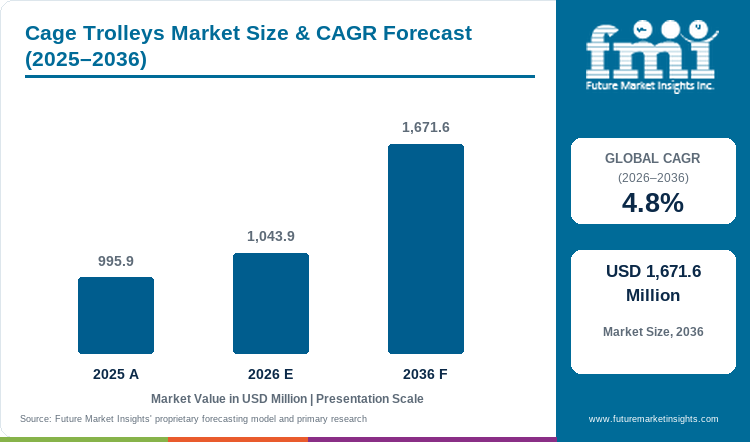
- Market Size (2026)
- USD 1043.9 Mn
- Forecast (2036)
- USD 1671.6 Mn
- CAGR (2026 to 2036)
- 4.8%
How big is Cage Trolleys Market in 2026?
USD 1,043.9 million in 2026 and USD 1,671.6 million by 2036 at a 4.8% CAGR.
Demand for cage trolleys is projected to expand at 4.8% CAGR between 2026 and 2036. Valuation rises from USD 995.9 million in 2025 to USD 1,043.9 million in 2026 and reaches USD 1,671.6 million by 2036. Warehouse teams are selecting reusable cages to keep one carrier moving from picking into shipping without repeated product transfers. National Cart documented in May 2026 that integrated material handling equipment reduces handoffs between picking and staging.
National handling conditions are changing the economics of reusable cage fleets during routine distribution operations. Poland is projected to grow at 6.1% CAGR through 2036. Japan is expected to post 4.0% CAGR over the same period. Statistics Poland's June 2026 release measures national exposure to strenuous work and mechanical risk factors by industry. Polish operators are placing greater weight on pushing force and steering control during trolley specification. Dense Japanese facilities make compact dimensions more important during replacement decisions.
Key Takeaways
- Repeated replenishment increases demand for cage trolleys that keep goods contained through warehouse and store handling stages.
- Based on trolley type, roll cage trolleys are projected to account for 31.0% in 2026. Their position is driven by enclosed formats that support reusable distribution loops.
- By material, steel is estimated to hold 47.0% in 2026. Its position is attributable to repairable frames that tolerate repeated warehouse impacts.
- In 2026, retail logistics is expected to lead end use with 31.0% share. Its position is supported by direct mobile transfers during store replenishment.
- Poor caster behavior or route compatibility can raise pushing effort and delay fleet standardization despite suitable nominal capacity.
- Some of the key players in this market include Wanzl GmbH & Co. KGaA, K.Hartwall Oy Ab, MiniTec GmbH, Breg Products Ltd, Loadhog Ltd, fetra Fechtel Transportgeräte GmbH, LKE Group, FlexQube AB, Anteck Industries, and National Cart Company.
Analyst Perspective
"Cage trolley economics improve because one carrier can survive repeated handling without product transfers between warehouse and store workflows. Buyers should test maneuverability under load before fleet standardization because poor wheel behavior can erase expected labor savings."
- Nikhil Kaitwade, Principal Consultant, Future Market Insights
How is the cage trolleys market segmented?
The cage trolleys market is segmented by trolley type, material, end use, load capacity, sales channel, and region.
The cage trolleys market is segmented by trolley type, material, end use, load capacity, sales channel, and region. Trolley type covers roll cage, nestable, security, shelf, and laundry designs. Materials include steel, stainless steel, aluminum, plastic - composite, and hybrid structures. End uses include retail logistics, warehousing, healthcare - laundry, e-commerce fulfillment, and foodservice distribution. Load capacity runs from below 250 kg to above 750 kg. Sales channels include distributors, direct manufacturer sales, e-commerce - catalog, and rental - fleet service.
How do roll cage trolleys reduce handling steps in repeat distribution loops?
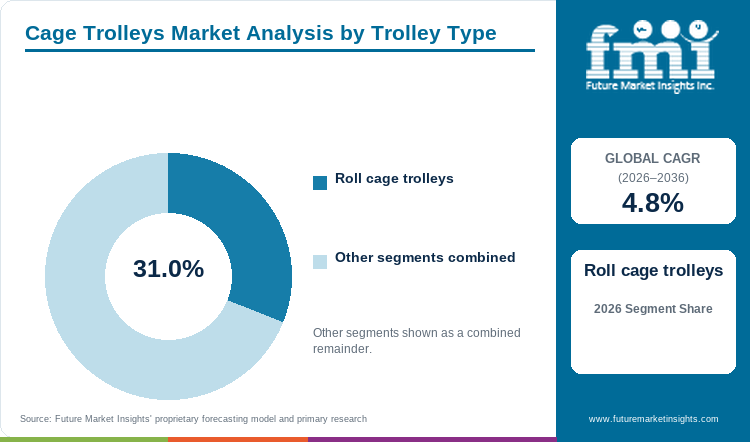
Roll cage trolleys keep goods contained from picking to receiving during repeated retail replenishment. K.Hartwall described roll container systems in May 2025 as reusable pallet alternatives that reduce handling transfers and improve material flow.
- By trolley type, roll cage trolleys are forecast to represent 31.0% in 2026. Reusable enclosed mobility reinforces their position by reducing product transfers during repeated distribution loops.
- Operators compare nesting and door access because empty returns and unloading time shape handling cost over repeated cycles.
Why does steel remain the practical material choice for high-cycle cage fleets?
Steel frames suit industrial cart fleets that need repairable doors and caster mounts under repeated warehouse impacts. Breg Products described steel-frame Euro trolleys in January 2026 with powder coating for chip and corrosion resistance.
- Steel is set to lead the material category with 47.0% share in 2026. Its position is supported by rigid frames that tolerate repeated impacts and remain repairable.
- Heavier frames can raise pushing effort so buyers test caster quality and loaded maneuverability before fleet standardization.
How does retail logistics shape cage trolley demand within the end-use category?
Retail logistics places cage trolleys between warehouse picking and store replenishment so one carrier avoids repeated repacking. National Cart reported in June 2026 that warehouse picking carts keep orders organized before dispatch.
- By end use, retail logistics is forecast to represent 31.0% in 2026. Its position is linked to direct mobile transfers during store replenishment.
- Store networks favor visible containment because replenishment crews need fast unloading without losing control of mixed merchandise.
Why do manual cage routes favor the 250-500 kg load-capacity band?
The 250-500 kg band balances payload with manual steering during repeated warehouse and retail movement. Wanzl's September 2025 Retail Box release rated two formats at 400 kg and 500 kg. Warehouse robotics are handling standardized carriers on automated routes. Receiving areas retain manual cage control during final handling.
- Based on load capacity, the 250-500 kg segment is projected to account for 42.0% in 2026. Selection is influenced by mid-range payloads that preserve manual maneuverability.
- Route tests remain necessary on ramps and tight turns because nominal load ratings may not predict loaded controllability.
How do material handling distributors reduce specification risk for cage trolley fleets?
Material handling distributors are matching trolley footprint and load rating to operating routes during fleet specification. fetra's March 2026 partner recognition cited specialty-trade cooperation and delivery capability for dealer-supported equipment programs. Local distributors are reducing route-specification risk in distribution logistics by supplying compatible fleet additions under existing specifications.
- By sales channel, material handling distributors are estimated to hold 38.0% in 2026. Their position is aided by specification support that reduces route-compatibility errors.
- Direct manufacturer programs support customized fleets. Distributor stock can shorten replacement cycles following routine equipment damage.
What are the drivers, restraints and opportunities in the Cage Trolleys Market?
Frequent fulfillment movements support demand, ergonomic limits slow standardization, and closed-loop distribution expands the case for reusable cage fleets.
- Driver: Higher fulfillment and store-replenishment frequency raises the value of wheeled containment that remains with goods through several handling stages.
- Restraint: Manual pushing effort and poor route compatibility can transfer handling cost into worker strain or slower loaded movement.
- Opportunity: Closed-loop delivery routes can reward nestable and repairable cage fleets that reduce empty-return volume and repeated repacking.
High-volume fulfillment operations are losing time as goods move between separate picking and staging equipment before dispatch. National Cart's March 2026 guidance described forklift-compatible carts that consolidate items and reduce repeated handling during picking and staging. Enclosed cage trolleys address the same operating need by keeping mixed goods together from pick location to shipping. Route trials need to confirm that fewer handoffs preserve load stability and steering control. Facilities with variable order volume can standardize cage fleets around repeatable handling routes instead of adding labor to every transfer. Compatible casters and fork access keep the same fleet useful as warehouse routes change.
Ergonomic limits become material if loaded trolleys require excessive force or unstable steering on the routes employees actually use. OSHA's July 2026 national emphasis program covers warehousing and distribution centers with inspections focused on material handling plus ergonomic risks. The program places caster geometry and braking performance inside equipment qualification before a fleet purchase is standardized. Route trials should test ramps and thresholds with representative loads before larger orders are approved. Failed loaded trials can postpone fleet purchasing until wheel size or braking configuration changes are approved. Suppliers providing test units and replacement caster options can shorten that correction cycle without changing the overall cage design.
Closed-loop delivery routes are supporting recurring fleet service because cage trolleys circulate repeatedly between distribution centers and receiving points. Loadhog described its Rolling Container System in March 2026 as reducing wrapping and repositioning during retail delivery between distribution centers and stores. Return density and repairability determine returnable transport packaging economics for repeated cage movement. Suppliers can earn service revenue beyond the initial trolley purchase as the same carriers cycle through frequent replenishment routes. Repair support limits fleet downtime as casters or doors wear during high-frequency handling cycles. Nestable frames reduce empty-return volume and preserve truck capacity for revenue-generating loads on the next outbound movement.
Which country CAGRs are profiled in the Cage Trolleys Market?
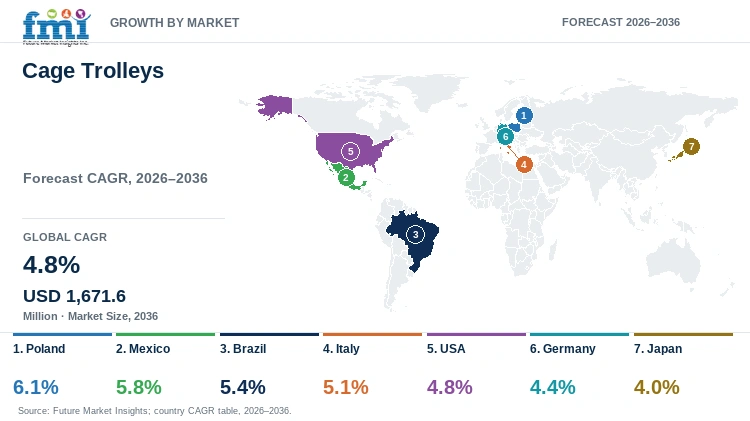
| Country | CAGR |
|---|---|
| Poland | 6.1% |
| Mexico | 5.8% |
| Brazil | 5.4% |
| Italy | 5.1% |
| USA | 4.8% |
| Germany | 4.4% |
| Japan | 4.0% |
How do country-level CAGRs compare in the Cage Trolleys Market?
The country rates form distinct upper and lower groups over the complete ten-year forecast period. Poland and Mexico occupy the upper band. Germany and Japan are projected to expand more slowly without implying smaller installed fleets.
- Polish cross-border handling increases caster and door wear, so suppliers prioritize repairable cages and readily available wear parts.
- Mexican logistics places a premium on local parts availability because imported equipment can remain idle following routine fleet damage.
- Long Brazilian distribution routes can extend equipment downtime, increasing the value of repairable steel frames and common replacement parts.
- Constrained turning space in Italian facilities makes nestable cage geometry more practical for daily movement and empty-equipment storage.
- Large installed fleets make USA fulfillment sites scrutinize loaded maneuverability and handling consistency during phased cage replacement.
- German warehouses emphasize lifecycle repair cost because pushing requirements influence trolley risk assessments and replacement planning.
- Narrow aisles in Japanese distribution sites limit reusable-cage footprints and increase demand for compact trolley dimensions.
Similar projected CAGRs can produce different entry conditions because service coverage and route geometry alter maintenance cost and replacement timing. The full report provides country-level CAGR analysis across North America, Latin America, Western Europe, Eastern Europe, East Asia, South Asia and Pacific, and the Middle East and Africa.
Country-wise Analysis
- Polish warehouse and distribution operations combine repeated pushing work with high-cycle fleet durability during retail and cross-border handling. Poland's cage trolleys outlook is anticipated to advance at 6.1% CAGR over the assessment period, supported by reusable carriers that move reliably between storage and dispatch. Poland's labor inspectorate reported in May 2026 that transport and warehousing remained among sectors with elevated serious-accident exposure during 2025. Warehouse operators are prioritizing steering force and caster control for cages used in frequent internal transfers. Nestable footprints and stocked wear parts keep damaged units from interrupting outbound logistics during repeated warehouse-to-vehicle cycles.
- Mexican distribution networks are combining manual and powered movement in warehouses serving retail and parcel flows. Cage trolley demand in Mexico is forecast to rise at 5.8% CAGR over the forecast period, shaped by efforts to reduce handling risk in mixed warehouse workflows. IMSS reported in April 2026 that 2,522 ELSSA workplaces reduced work accidents during 2025. Those workplaces logged 10,184 fewer accidents than one year earlier following prevention measures covering machinery and workplace conditions. Stable frames and predictable steering reduce unnecessary manual handling without disrupting established warehouse routes or surrounding equipment. Landed equipment costs can delay replacement outside dense logistics corridors, so local parts availability protects fleet uptime following routine damage.
- Brazilian retail and distribution operations require cage fleets that remain repairable over long routes and uneven service coverage. Adoption of cage trolleys in Brazil is estimated to expand at 5.4% CAGR through 2036, influenced by repeated replacement needs in transport and storage operations. Brazil's Ministry of Social Security recorded 52,486 workplace accidents in transportation and storage plus postal activities during 2024. National accident data keep load stability and controllable movement visible during reusable-cage fleet specification. Repairable steel frames and stocked common casters limit downtime because long replenishment distances can make specialist parts slow to source.
- Italian distribution sites combine modern retail processes with older buildings that restrict turning space and empty-equipment storage. The Italian cage trolleys sector is projected to record 5.1% CAGR during the assessment period, tied to demand for equipment that reduces physical load during repetitive movement. INAIL stated in July 2025 that musculoskeletal disorders accounted for about 77% of recognized occupational diseases. Push force and stable steering carry more weight on routes with tight corners or repeated load transfers. Nestable cages and locally stocked wheels keep standardized fleets usable in facilities that also run cold-chain warehouse automation.
- USA fulfillment networks are operating large installed fleets of mobile handling equipment within high-volume warehouse routes. USA is estimated to post 4.8% CAGR over the forecast period, reinforced by replacement demand and closer scrutiny of warehouse handling safety. Bureau of Labor Statistics data show a 4.8 recordable injury and illness rate per 100 full-time workers for warehousing and storage during 2024. National safety exposure makes loaded maneuverability and braking performance material during warehouse fleet standardization decisions. Cage fleets that work with forklifts or tugger carts preserve existing workflows during phased renewal and reduce extra product transfers.
- German warehouse operators assess cage and platform trolley fleets against manual pushing forces and lifecycle repair costs. Cage trolley sales in Germany are forecast to expand at 4.4% CAGR by 2036, linked to replacement demand in established intralogistics operations. BAuA's May 2026 guidance defines manual pushing and pulling as load movement with carts or trolleys and ties physical load to distance plus weight. BAuA guidance makes wheel selection and braking material during route-specific trolley risk assessments in warehouses. Common casters and repairable frames keep established warehouse routes productive during phased equipment renewal and routine component replacement.
- Japanese retail and distribution sites operate within dense facilities that limit acceptable trolley dimensions. By 2036, Japan is projected to grow at 4.0% CAGR, enabled by mature logistics infrastructure and strict attention to handling safety. Japan's health ministry reported in May 2026 that 15,632 injuries required at least four days away from work in land freight transport during 2025. Compact cage fleets need low-disruption casters and stable steering on narrow routes inside mature facilities. Common service parts protect repeated movement between receiving and storage without requiring wider aisles or major facility changes.
Who are the notable companies in the Cage Trolleys Market?
Wanzl GmbH & Co. KGaA, K.Hartwall Oy Ab, MiniTec GmbH, Breg Products Ltd, Loadhog Ltd, fetra Fechtel Transportgeräte GmbH, LKE Group, FlexQube AB, Anteck Industries, and National Cart Company are notable companies serving the cage trolleys market.
Dedicated roll-cage specialists compete with intralogistics suppliers on nesting performance and route compatibility. Large fleets raise entry barriers because buyers require verified caster performance and standardized replacement parts.
- Wanzl GmbH & Co. KGaA, K.Hartwall Oy Ab, Breg Products Ltd, and National Cart Company are supplying cage formats for retail distribution workflows.
- MiniTec GmbH, fetra Fechtel Transportgeräte GmbH, LKE Group, and FlexQube AB are connecting mobile carriers with tugger trains or automated intralogistics systems.
- Return efficiency is influencing buying decisions in reusable-load-carrier and laundry routes served by Loadhog Ltd and Anteck Industries.
Competitive Benchmarking: Cage Trolleys Market
| Company | Cage Format Breadth | Return/Security Options | Intralogistics Integration | Geographic Reach |
|---|---|---|---|---|
| Wanzl GmbH & Co. KGaA | High | High | High | Global |
| K.Hartwall Oy Ab | High | High | High | Global |
| MiniTec GmbH | Medium | Medium | High | Europe and project exports |
| Breg Products Ltd | High | High | Medium | United Kingdom and Europe |
| Loadhog Ltd | Medium | High | High | Europe and international sales |
| fetra Fechtel Transportgeräte GmbH | Medium | Medium | High | Europe |
| LKE Group | High | High | High | Europe and international sales |
| FlexQube AB | Low | Medium | High | North America and Europe |
| Anteck Industries | High | High | Medium | Australia |
| National Cart Company | High | High | High | North America |
Scoring basis: High requires broad verified cage-format or integration evidence and Medium requires two relevant configurations or system routes. Low requires one documented exact-market or immediate-family route. Geographic Reach records verified operating regions without a score.
Key Developments in the Cage Trolleys Market
- In June 2026, FlexQube AB received a USA aviation order for mechanical material-handling carts used in aircraft-engine maintenance and service operations.
- In April 2026, LKE Group documented LogiMAT demonstrations of electrically assisted transport trolleys and load carriers for internal material movement.
- In April 2025, K.Hartwall Oy Ab documented SPAR Albania implementing Foldia roll containers within a retail network of about eighty stores.
Key Players in the Cage Trolleys Market
Retail and Distribution Cage Specialists
- Wanzl GmbH & Co. KGaA
- K.Hartwall Oy Ab
- Breg Products Ltd
- Anteck Industries
- National Cart Company
Industrial Trolley and Intralogistics Platforms
- MiniTec GmbH
- fetra Fechtel Transportgeräte GmbH
- LKE Group
- FlexQube AB
Reusable Load-Carrier Systems
- Loadhog Ltd
Cage Trolleys Market - Report Scope
| Coverage field | Report scope |
|---|---|
| Market breakdown | By trolley type, material, end use, load capacity, sales channel and region. |
| Quantitative Units | USD million. |
| Market Definition | Commercial wheeled cage trolleys used to contain and move goods within retail, warehouse, parcel, laundry and distribution operations. |
| Regions Covered | North America, Latin America, Western Europe, Eastern Europe, East Asia, South Asia and Pacific, and Middle East and Africa. |
| Countries Covered | Poland, Mexico, Brazil, Italy, USA, Germany, Japan, and 20+ countries included in the full report. |
| Key Companies Profiled | Wanzl GmbH & Co. KGaA, K.Hartwall Oy Ab, MiniTec GmbH, Breg Products Ltd, Loadhog Ltd, fetra Fechtel Transportgeräte GmbH, LKE Group, FlexQube AB, Anteck Industries, and National Cart Company. |
| Forecast Period | 2026 to 2036. |
| Approach | Primary and secondary research with market triangulation. |
Cage Trolleys Market - Research Methodology
| Method | Approach |
|---|---|
| Primary Research | FMI analysts gathered input from manufacturers, service providers, technology developers, distributors, end users, procurement teams, and subject-matter experts. Interviews examined purchasing decisions, product or service evaluation, adoption barriers, approval requirements, pricing considerations, and expectations for technical or commercial support. Respondents were also asked what evidence is required before a trial, pilot, or initial order develops into regular purchasing. |
| Desk Research | Desk research covered government statistics, regulatory publications, trade data, industry associations, technical literature, standards, company filings, product information, and official corporate announcements. Sources were reviewed for relevance, publication date, geographic coverage, and consistency with the defined market scope. Claims relating to performance, applications, approvals, capacity, investment, and commercial activity were retained only when supported by credible public evidence. |
| Market Sizing and Forecasting | The market model combined the baseline value with historical performance, segment structure, pricing and volume indicators, adoption levels, company participation, and country-level demand conditions. Forecast assumptions considered economic activity, investment trends, regulatory developments, technology adoption, purchasing cycles, supply availability, and barriers to wider market use. Segment and regional estimates were reconciled before the final market total was calculated. |
| Data Validation | Estimates were checked against multiple independent indicators, including public data, company activity, trade patterns, industry developments, and findings from primary interviews. Validation also tested whether products, services, applications, and company revenues fell within the defined market boundaries. Adjacent categories, unsupported claims, overlapping revenues, and activities without direct market relevance were excluded to reduce double counting and maintain consistency across segments and countries. |
Cage Trolleys Market by Segments
Cage Trolleys Market segmented by Trolley Type:
- Roll cage trolleys
- Nestable cage trolleys
- Security cage trolleys
- Shelf cage trolleys
- Laundry cage trolleys
Cage Trolleys Market segmented by Material:
- Steel
- Stainless steel
- Aluminum
- Plastic - composite
- Hybrid metal - plastic
Cage Trolleys Market segmented by End Use:
- Retail logistics
- Warehousing
- Healthcare - laundry
- E-commerce fulfillment
- Foodservice distribution
Cage Trolleys Market segmented by Load Capacity:
- Below 250 kg
- 250-500 kg
- 500-750 kg
- Above 750 kg
Cage Trolleys Market segmented by Sales Channel:
- Material handling distributors
- Direct manufacturer sales
- E-commerce - catalog
- Rental - fleet service
Cage Trolleys Market by Region:
- North America
- United States
- Canada
- Latin America
- Brazil
- Mexico
- Argentina
- Chile
- Western Europe
- Germany
- France
- United Kingdom
- Italy
- Spain
- Benelux
- Nordics
- Eastern Europe
- Poland
- Czech Republic
- Romania
- Hungary
- East Asia
- China
- Japan
- South Korea
- South Asia and Pacific
- India
- ASEAN
- Australia and New Zealand
- Middle East and Africa
- GCC Countries
- South Africa
- Türkiye
- Israel
Research Sources and Bibliography
- National Cart Company. (2026, May 11). Integrating Carts with Forklifts for Streamlined Operations.
- Statistics Poland. (2026, June 29). Working conditions in 2025.
- K.Hartwall Oy Ab. (2025, May 28). K.Hartwall Roll Containers - The Intelligent Solution for Efficient Material Handling.
- Breg Products Ltd. (2026, January 20). EURO CONTAINERS & BOX TROLLEYS.
- National Cart Company. (2026, June 15). How Warehouse Picking Carts Support Last Mile Delivery Operations.
- Wanzl GmbH & Co. KGaA. (2025, September 25). Gold for Wanzl and DACHSER: Retail Box wins German Packaging Award 2025.
- fetra Fechtel Transportgeräte GmbH. (2026, March 18). fetra - Honored as Top Partner 2025.
- National Cart Company. (2026, March 15). Using Carts with Powered Industrial Trucks (PIT) for Smarter Warehouse Operations.
- Occupational Safety and Health Administration. (2026, July 31). National Emphasis Program on Warehousing and Distribution Center Operations.
- Loadhog Ltd. (2026, March 26). Lower costs, higher retail efficiency with the Rolling Container System.
- Państwowa Inspekcja Pracy. (2026, May 14). Mniej wypadków to wspólny sukces.
- Instituto Mexicano del Seguro Social. (2026, April 28).Empresas adheridas a la estrategia ELSSA del IMSS reducen accidentes y enfermedades de trabajo.
- Ministério da Previdência Social. (2025, October 22). 31.7 - Quantidade de acidentes do trabalho, por situação de registro e motivo, segundo o Setor de Atividade Econômica - 2022/2024.
- Istituto Nazionale per l'Assicurazione contro gli Infortuni sul Lavoro. (2025, July 7). Movimentazione manuale dei carichi durante l'attività lavorativa. Quanto ti riguarda?
- USA Bureau of Labor Statistics. (2026). Table 1. Incidence rates of nonfatal occupational injuries and illnesses by industry and case types, 2024.
- Bundesanstalt für Arbeitsschutz und Arbeitsmedizin. (2026, May 6). Manuelles Ziehen und Schieben von Lasten.
- Ministry of Health, Labour and Welfare. (2026, May 27). 令和7年の労働災害発生状況を公表.
- FlexQube AB. (2026, June 11). FlexQube receives order of approximately USD 0.9 million.
- LKE Group. (2026, April 13). That was LogiMat 2026!
- K.Hartwall Oy Ab. (2025, April 2). SPAR Albania transforms warehouse and distribution efficiency with K.Hartwall Foldia Roll Container.
- K.Hartwall Oy Ab. (2025, February 28). Topping-out ceremony for K.Hartwall's German facility.
- fetra Fechtel Transportgeräte GmbH. (2025, December 2). The new fetra catalogue 2026.
- fetra Fechtel Transportgeräte GmbH. (2026, January 19). LogiMAT 2026 - Press Release.
- K.Hartwall Oy Ab. (2025, June 30). New Partnership between K.Hartwall and Bosch Rexroth.
- FlexQube AB. (2026, March 23). FlexQube Secures Orders Worth Approximately USD 13 Million.
- Breg Products Ltd. (2026, May 5). BREG PRODUCTS ISO CERTIFICATES.
- Wanzl GmbH & Co. KGaA. (2025, January 15). Wanzl at LogiMAT 2025.
- K.Hartwall Oy Ab. (2025, March 11). We are proud to launch the A-MATE Lite.
- MiniTec GmbH. (2025, May 14). The offroad roll container from MiniTec.
- Breg Products Ltd. (2025, July 25). Custom Parcel Cages Supplied to Delivery Company.
- LKE Group. (2025, April 8). That was Logimat 2025!
- FlexQube AB. (2025, August 7). FlexQube Wins Order Worth 0.3M USD in Tennessee, USA
- Loadhog Ltd. (2025, September 1). Loadhog Announces Grand Opening of New Factory in Obernai, France.
- Anteck Industries. (2025, January 14). Anteck Industries Partners with Laundry Association Australia to Elevate Industry Standards.
- National Cart Company. (2026, April 21).Custom vs Standard Picking Carts for Warehouses: Which Should You Choose?
This bibliography is provided for reader reference and is not exhaustive. The full report contains the complete reference list and detailed citations
This Report Answers
- How large is the cage trolleys market in 2026 and 2036?
- What operating conditions sustain reusable cage trolley demand?
- Why do roll cage trolleys hold 31.0% of trolley type demand?
- Why does steel hold 47.0% of material demand?
- How does retail logistics shape cage trolley replacement?
- Which route constraints can delay cage trolley fleet standardization?
- Which companies supply cage trolleys and reusable load carriers?
Frequently Asked Questions
How big is the Cage Trolleys Market in 2026?
The cage trolleys market is estimated at USD 1,043.9 million in 2026. Valuation is projected to reach USD 1,671.6 million by 2036 as repeated handling strengthens the case for reusable mobile containment.
What is the CAGR of the Cage Trolleys Market from 2026 to 2036?
The cage trolleys market is projected to grow at 4.8% CAGR between 2026 and 2036. Higher handling frequency and recurring fleet replacement support demand because reusable cages reduce product transfers during warehouse and store replenishment.
Which trolley type leads the cage trolleys market?
The roll cage trolleys segment is expected to hold 31.0% of trolley type demand in 2026. Enclosed formats support repeat distribution loops and compact empty returns between warehouse staging and receiving points.
Which material segment leads the cage trolleys market?
The steel segment is projected to account for 47.0% of material demand in 2026. Repairable frames suit high-cycle warehouse and retail fleets that require repeated reuse and economical replacement following routine damage.
Which companies are active in the Cage Trolleys Market?
Key companies in the cage trolleys market include Wanzl GmbH & Co. KGaA, K.Hartwall Oy Ab, MiniTec GmbH, Breg Products Ltd, Loadhog Ltd, fetra Fechtel Transportgeräte GmbH, LKE Group, FlexQube AB, Anteck Industries, and National Cart Company. Their roles span dedicated cage supply and wider intralogistics integration for warehouse and retail distribution operations.
Preview the report firsthand - request a free sample
Get SampleGet the brochure for pricing and purchase details.
Get PDFTable of Content
- Key Takeaways
- Market Size and CAGR
- Top Growth Driver
- Fastest Growing Segment
- Leading Region
- Key Companies
- Emerging Opportunities
- Executive Summary
- Global Market Outlook
- Demand-side Trends
- Supply-side Trends
- Technology Roadmap Analysis
- Analysis and Recommendations
- Analyst Perspective (What is happening? Why now? What should investors know?)
- Key Questions Answered
- How large is the market?
- What is the CAGR?
- What are key trends?
- Which region dominates?
- Who are the leaders?
- Market Overview
- Market Coverage / Taxonomy
- Market Definition / Scope / Limitations
- Research Methodology
- Chapter Orientation
- Analytical Lens and Working Hypotheses
- Market Structure, Signals, and Trend Drivers
- Benchmarking and Cross-market Comparability
- Market Sizing, Forecasting, and Opportunity Mapping
- Research Design and Evidence Framework
- Desk Research Programme (Secondary Evidence)
- Expert Input and Fieldwork (Primary Evidence)
- Tooling, Models, and Reference Databases
- Data Engineering and Model Build
- Quality Assurance and Audit Trail
- Market Background
- Market Dynamics (Drivers, Restraints, Opportunity, Trends)
- Scenario Forecast (Optimistic, Likely, Conservative)
- Impact Analysis
- AI Impact
- Sustainability Impact
- Regulatory Impact
- Technology Impact
- Consumer / Buyer Analysis
- Purchase Drivers
- Adoption Barriers
- Buyer Journey
- Opportunity Map Analysis
- Product Life Cycle Analysis
- Supply Chain Analysis
- Investment Feasibility Matrix
- Value Chain Analysis
- PESTLE and Porter's Analysis
- Regulatory Landscape
- Regional Parent Market Outlook
- Production and Consumption Statistics
- Import and Export Statistics
- Global Market Analysis and Forecast, 2021 to 2036
- Historical Market Size Value (USD Million) Analysis, 2021 to 2025
- Current and Future Market Size Value (USD Million) Projections, 2026 to 2036
- Y-o-Y Growth Trend Analysis
- Absolute $ Opportunity Analysis
- Global Market Pricing Analysis, 2021 to 2036
- Global Market Analysis and Forecast, By Trolley Type, 2021 to 2036
- Introduction / Key Findings
- Historical Market Size Value (USD Million) Analysis By Trolley Type, 2021 to 2025
- Current and Future Market Size Value (USD Million) Analysis and Forecast By Trolley Type, 2026 to 2036
- Roll cage trolleys
- Nestable cage trolleys
- Security cage trolleys
- Shelf cage trolleys
- Laundry cage trolleys
- Y-o-Y Growth Trend Analysis By Trolley Type, 2021 to 2025
- Absolute $ Opportunity Analysis By Trolley Type, 2026 to 2036
- Global Market Analysis and Forecast, By Material, 2021 to 2036
- Introduction / Key Findings
- Historical Market Size Value (USD Million) Analysis By Material, 2021 to 2025
- Current and Future Market Size Value (USD Million) Analysis and Forecast By Material, 2026 to 2036
- Steel
- Stainless steel
- Aluminum
- Plastic - composite
- Hybrid metal - plastic
- Y-o-Y Growth Trend Analysis By Material, 2021 to 2025
- Absolute $ Opportunity Analysis By Material, 2026 to 2036
- Global Market Analysis and Forecast, By End Use, 2021 to 2036
- Introduction / Key Findings
- Historical Market Size Value (USD Million) Analysis By End Use, 2021 to 2025
- Current and Future Market Size Value (USD Million) Analysis and Forecast By End Use, 2026 to 2036
- Retail logistics
- Warehousing
- Healthcare - laundry
- E-commerce fulfillment
- Foodservice distribution
- Y-o-Y Growth Trend Analysis By End Use, 2021 to 2025
- Absolute $ Opportunity Analysis By End Use, 2026 to 2036
- Global Market Analysis and Forecast, By Load Capacity, 2021 to 2036
- Introduction / Key Findings
- Historical Market Size Value (USD Million) Analysis By Load Capacity, 2021 to 2025
- Current and Future Market Size Value (USD Million) Analysis and Forecast By Load Capacity, 2026 to 2036
- Below 250 kg
- 250-500 kg
- 500-750 kg
- Above 750 kg
- Y-o-Y Growth Trend Analysis By Load Capacity, 2021 to 2025
- Absolute $ Opportunity Analysis By Load Capacity, 2026 to 2036
- Global Market Analysis and Forecast, By Sales Channel, 2021 to 2036
- Introduction / Key Findings
- Historical Market Size Value (USD Million) Analysis By Sales Channel, 2021 to 2025
- Current and Future Market Size Value (USD Million) Analysis and Forecast By Sales Channel, 2026 to 2036
- Material handling distributors
- Direct manufacturer sales
- E-commerce - catalog
- Rental - fleet service
- Y-o-Y Growth Trend Analysis By Sales Channel, 2021 to 2025
- Absolute $ Opportunity Analysis By Sales Channel, 2026 to 2036
- Global Market Analysis and Forecast, By Region, 2021 to 2036
- Introduction
- Historical Market Size Value (USD Million) Analysis By Region, 2021 to 2025
- Current Market Size Value (USD Million) Analysis and Forecast By Region, 2026 to 2036
- North America
- Latin America
- Western Europe
- Eastern Europe
- East Asia
- South Asia and Pacific
- Middle East and Africa
- Market Attractiveness Analysis By Region
- North America Market Analysis and Forecast, By Country, 2021 to 2036
- Historical Market Size Value (USD Million) Trend Analysis By Market Taxonomy, 2021 to 2025
- Market Size Value (USD Million) Forecast By Market Taxonomy, 2026 to 2036
- By Country
- United States
- Canada
- By Trolley Type
- By Material
- By End Use
- By Load Capacity
- By Sales Channel
- By Country
- Market Attractiveness Analysis
- By Country
- By Trolley Type
- By Material
- By End Use
- By Load Capacity
- By Sales Channel
- Key Takeaways
- Latin America Market Analysis and Forecast, By Country
- Historical Market Size Value (USD Million) Trend Analysis By Market Taxonomy, 2021 to 2025
- Market Size Value (USD Million) Forecast By Market Taxonomy, 2026 to 2036
- By Country
- Brazil
- Mexico
- Argentina
- Chile
- By Trolley Type
- By Material
- By End Use
- By Load Capacity
- By Sales Channel
- By Country
- Market Attractiveness Analysis
- By Country
- By Trolley Type
- By Material
- By End Use
- By Load Capacity
- By Sales Channel
- Key Takeaways
- Western Europe Market Analysis and Forecast, By Country
- Historical Market Size Value (USD Million) Trend Analysis By Market Taxonomy, 2021 to 2025
- Market Size Value (USD Million) Forecast By Market Taxonomy, 2026 to 2036
- By Country
- Germany
- France
- United Kingdom
- Italy
- Spain
- Benelux
- Nordics
- By Trolley Type
- By Material
- By End Use
- By Load Capacity
- By Sales Channel
- By Country
- Market Attractiveness Analysis
- By Country
- By Trolley Type
- By Material
- By End Use
- By Load Capacity
- By Sales Channel
- Key Takeaways
- Eastern Europe Market Analysis and Forecast, By Country
- Historical Market Size Value (USD Million) Trend Analysis By Market Taxonomy, 2021 to 2025
- Market Size Value (USD Million) Forecast By Market Taxonomy, 2026 to 2036
- By Country
- Poland
- Czech Republic
- Romania
- Hungary
- By Trolley Type
- By Material
- By End Use
- By Load Capacity
- By Sales Channel
- By Country
- Market Attractiveness Analysis
- By Country
- By Trolley Type
- By Material
- By End Use
- By Load Capacity
- By Sales Channel
- Key Takeaways
- East Asia Market Analysis and Forecast, By Country
- Historical Market Size Value (USD Million) Trend Analysis By Market Taxonomy, 2021 to 2025
- Market Size Value (USD Million) Forecast By Market Taxonomy, 2026 to 2036
- By Country
- China
- Japan
- South Korea
- By Trolley Type
- By Material
- By End Use
- By Load Capacity
- By Sales Channel
- By Country
- Market Attractiveness Analysis
- By Country
- By Trolley Type
- By Material
- By End Use
- By Load Capacity
- By Sales Channel
- Key Takeaways
- South Asia and Pacific Market Analysis and Forecast, By Country
- Historical Market Size Value (USD Million) Trend Analysis By Market Taxonomy, 2021 to 2025
- Market Size Value (USD Million) Forecast By Market Taxonomy, 2026 to 2036
- By Country
- India
- ASEAN
- Australia and New Zealand
- By Trolley Type
- By Material
- By End Use
- By Load Capacity
- By Sales Channel
- By Country
- Market Attractiveness Analysis
- By Country
- By Trolley Type
- By Material
- By End Use
- By Load Capacity
- By Sales Channel
- Key Takeaways
- Middle East and Africa Market Analysis and Forecast, By Country
- Historical Market Size Value (USD Million) Trend Analysis By Market Taxonomy, 2021 to 2025
- Market Size Value (USD Million) Forecast By Market Taxonomy, 2026 to 2036
- By Country
- GCC Countries
- South Africa
- Türkiye
- Israel
- By Trolley Type
- By Material
- By End Use
- By Load Capacity
- By Sales Channel
- By Country
- Market Attractiveness Analysis
- By Country
- By Trolley Type
- By Material
- By End Use
- By Load Capacity
- By Sales Channel
- Key Takeaways
- Key Countries Market Analysis
- United States
- Pricing Analysis
- Market Share Analysis, 2025
- By Trolley Type
- By Material
- By End Use
- By Load Capacity
- By Sales Channel
- Canada
- Pricing Analysis
- Market Share Analysis, 2025
- By Trolley Type
- By Material
- By End Use
- By Load Capacity
- By Sales Channel
- Mexico
- Pricing Analysis
- Market Share Analysis, 2025
- By Trolley Type
- By Material
- By End Use
- By Load Capacity
- By Sales Channel
- Brazil
- Pricing Analysis
- Market Share Analysis, 2025
- By Trolley Type
- By Material
- By End Use
- By Load Capacity
- By Sales Channel
- Chile
- Pricing Analysis
- Market Share Analysis, 2025
- By Trolley Type
- By Material
- By End Use
- By Load Capacity
- By Sales Channel
- Germany
- Pricing Analysis
- Market Share Analysis, 2025
- By Trolley Type
- By Material
- By End Use
- By Load Capacity
- By Sales Channel
- United Kingdom
- Pricing Analysis
- Market Share Analysis, 2025
- By Trolley Type
- By Material
- By End Use
- By Load Capacity
- By Sales Channel
- Italy
- Pricing Analysis
- Market Share Analysis, 2025
- By Trolley Type
- By Material
- By End Use
- By Load Capacity
- By Sales Channel
- Spain
- Pricing Analysis
- Market Share Analysis, 2025
- By Trolley Type
- By Material
- By End Use
- By Load Capacity
- By Sales Channel
- France
- Pricing Analysis
- Market Share Analysis, 2025
- By Trolley Type
- By Material
- By End Use
- By Load Capacity
- By Sales Channel
- India
- Pricing Analysis
- Market Share Analysis, 2025
- By Trolley Type
- By Material
- By End Use
- By Load Capacity
- By Sales Channel
- ASEAN
- Pricing Analysis
- Market Share Analysis, 2025
- By Trolley Type
- By Material
- By End Use
- By Load Capacity
- By Sales Channel
- Australia and New Zealand
- Pricing Analysis
- Market Share Analysis, 2025
- By Trolley Type
- By Material
- By End Use
- By Load Capacity
- By Sales Channel
- China
- Pricing Analysis
- Market Share Analysis, 2025
- By Trolley Type
- By Material
- By End Use
- By Load Capacity
- By Sales Channel
- Japan
- Pricing Analysis
- Market Share Analysis, 2025
- By Trolley Type
- By Material
- By End Use
- By Load Capacity
- By Sales Channel
- South Korea
- Pricing Analysis
- Market Share Analysis, 2025
- By Trolley Type
- By Material
- By End Use
- By Load Capacity
- By Sales Channel
- Poland
- Pricing Analysis
- Market Share Analysis, 2025
- By Trolley Type
- By Material
- By End Use
- By Load Capacity
- By Sales Channel
- Hungary
- Pricing Analysis
- Market Share Analysis, 2025
- By Trolley Type
- By Material
- By End Use
- By Load Capacity
- By Sales Channel
- Türkiye
- Pricing Analysis
- Market Share Analysis, 2025
- By Trolley Type
- By Material
- By End Use
- By Load Capacity
- By Sales Channel
- South Africa
- Pricing Analysis
- Market Share Analysis, 2025
- By Trolley Type
- By Material
- By End Use
- By Load Capacity
- By Sales Channel
- United States
- Market Structure Analysis
- Competition Dashboard
- Competition Benchmarking
- Market Share Analysis of Top Players
- By Regional
- By Trolley Type
- By Material
- By End Use
- By Load Capacity
- By Sales Channel
- Emerging Startups
- Innovation Benchmarking
- Competition Analysis
- Competition Deep Dive
- Wanzl GmbH & Co. KGaA
- Overview
- Product Portfolio
- Profitability by Market Segments
- Sales Footprint
- Strategy Overview
- Marketing Strategy
- Product Strategy
- Channel Strategy
- K.Hartwall Oy Ab
- MiniTec GmbH
- Breg Products Ltd
- Loadhog Ltd
- fetra Fechtel Transportgeräte GmbH
- LKE Group
- FlexQube AB
- Anteck Industries
- National Cart Company
- Wanzl GmbH & Co. KGaA
- Case Studies
- Success Stories
- Recent Developments
- Competition Deep Dive
- Assumptions & Acronyms Used


