

- Market Size (2026)
- USD 0.6 Bn
- Forecast (2036)
- USD 1.0 Bn
- CAGR (2026 to 2036)
- 5.2%
How big is the platform trolley market in 2026?
USD 0.6 billion in 2026, reaching USD 1.0 billion by 2036 at a 5.2% CAGR
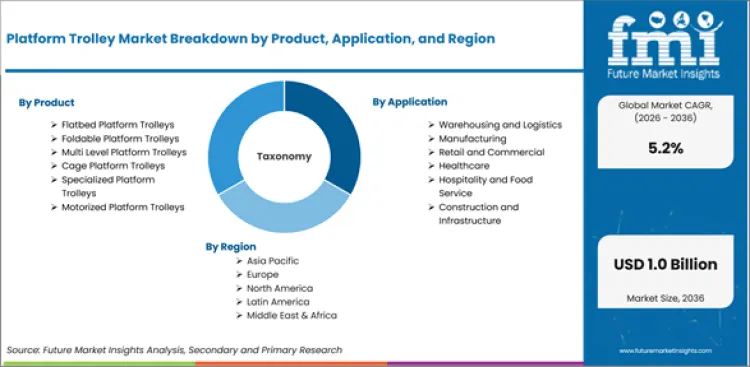
The platform trolley market was valued at USD 0.6 billion in 2025. The market is set to reach USD 0.6 billion by 2026-end and grow at a CAGR of 5.2% between 2026-2036 to reach USD 1.0 billion by 2036. Flatbed Platform Trolleys will dominate with a 38.0% share, while Warehousing and Logistics will lead with a 35.0% share.
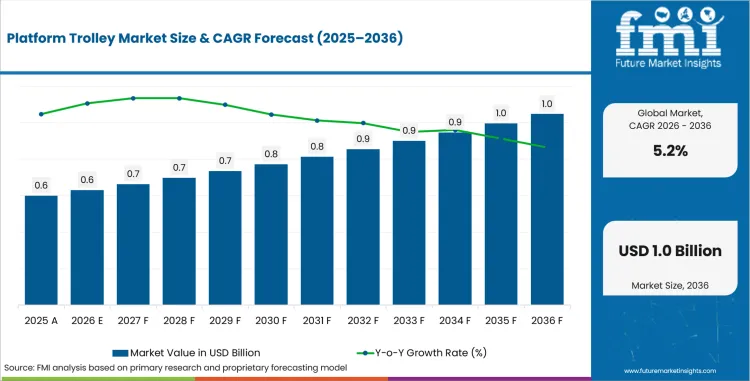
Key Takeaways, Market Size, and Forecast
- Platform Trolley Market Value (2026): USD 0.6 Bn
- Platform Trolley Market Forecast Value (2036): USD 1.0 Bn
- Platform Trolley Market CAGR (2026 TO 2036): 5.2%
- Platform Trolley Market Leading Product Segment: Flatbed Platform Trolleys (38.0%)
- Platform Trolley Market Key Growth Regions: South Korea, Japan, USA, EU, UK
- Platform Trolley Market Key Players: Still GmbH, Toyota Industries, Mecalux, Jungheinrich AG, Caddy Systems, Other Companies (combined)
| Parameter | Details |
|---|---|
| Market Size in 2026 (Value) | USD 0.6 Billion |
| Market Forecast in 2036 (Value) | USD 1.0 Billion |
| CAGR (2026 to 2036) | 5.2% |
| Years Considered | 2021 to 2036 |
| Base Year | 2025 |
| Forecast Period | 2026 to 2036 |
| Units Considered | Value (USD Billion) |
| Leading Sub-Region | USA |
Summary of the Platform Trolley Market
- Demand and Growth Drivers
- Sustained warehousing, retail, and commercial operations create baseline demand for platform trolleys used in everyday material transport across diverse facility environments.
- Growth in organized retail and wholesale operations is driving procurement of platform trolleys for stock movement, display setup, and backroom logistics.
- Foldable and compact trolley designs are expanding market appeal among smaller commercial users and residential consumers who value space-efficient storage.
- Product and Segment View
- Flatbed platform trolleys account for 38.0% of product share, providing the simplest and most versatile trolley design for transporting boxes, crates, and general cargo across flat surfaces.
- Warehousing and logistics hold 35.0% of application share, as distribution centers and storage facilities require platform trolleys for case picking, staging, and internal material movement.
- Industrial sector accounts for 50.0% of end use share, as manufacturing and logistics operations represent the largest procurement segment for platform trolley equipment.
- Geography and Competitive Outlook
- South Korea leads at 5.5% CAGR, reflecting logistics infrastructure development and manufacturing sector demand for material handling equipment.
- Japan follows at 5.4% CAGR, supported by precision manufacturing operations and established industrial equipment procurement standards.
- Companies with broad trolley ranges covering light to heavy duty capacities are positioned to serve growing demand across industrial, commercial, and retail settings.
- Analyst Opinion
- Nikhil Kaitwade, Principal Consultant at FMI says, 'Trolley manufacturers that can deliver durable, ergonomic designs with competitive pricing across load capacity ranges are likely to maintain procurement preference from commercial and industrial buyers over the forecast period.'
- The platform trolley market is sustained by the fundamental operational need for wheeled material transport equipment across warehouse, manufacturing, and commercial environments.
- Adoption is increasing due to retail and commercial expansion that creates new facility outfitting requirements for basic material handling equipment.
- Demand is supported by foldable and compact trolley designs that appeal to smaller businesses, residential users, and space-constrained commercial operations.
- Growth is attributable to logistics infrastructure expansion in emerging markets where new warehouse and distribution facilities create first-time equipment procurement.
What is a platform trolley and what does the market cover?
Wheeled flat-deck equipment for moving materials, boxes and supplies across warehouse, manufacturing and retail facilities
The platform trolley market encompasses wheeled flat-deck transport equipment used for moving materials, boxes, and supplies across warehouse, manufacturing, retail, and commercial facility surfaces. Products include flatbed, foldable, and multi-level platform trolleys in steel, aluminum, and plastic construction across light, medium, and heavy duty load capacities with rubber, caster, and polyurethane wheel options.
What is included in the platform trolley market scope?
Flatbed, foldable and multi-level platform trolleys across light, medium and heavy duty capacities, 2026 to 2036.
Market scope covers all commercially traded platform trolleys categorized by product (flatbed platform trolleys, foldable platform trolleys, multi level platform trolleys), application (warehousing anabhd logistics, manufacturing, retail and commercial), end use (industrial sector, commercial sector, healthcare sector), load capacity (light duty, medium duty, heavy duty platform trolleys), material (steel, aluminum, plastic platform trolleys), wheel type (rubber wheels, caster wheels, polyurethane wheels), and mobility (manual, powered platform trolleys). Revenue is tracked from 2026 to 2036.
What is excluded from the platform trolley market scope?
Hand trucks, shopping carts, and powered pallet jacks
The scope does not include hand trucks (vertical two-wheel dollies), shopping carts, or powered pallet jacks.
How was the platform trolley market research conducted?
Primary interviews, desk research, bottom-up sizing, and quarterly validation
- Primary Research: FMI analysts conducted interviews with trolley manufacturers, industrial supply distributors, warehouse operations managers, and retail procurement specialists across key markets.
- Desk Research: Combined data from material handling equipment databases, warehouse construction statistics, and manufacturer revenue disclosures.
- Market Sizing and Forecasting: Bottom-up aggregation of trolley sales across product types, load capacities, and geographic markets with facility expansion projections.
- Data Validation: Cross-validated quarterly against industrial distributor sales data, retail equipment procurement tracking, and manufacturer shipment records.
Why is the platform trolley market growing?
Rising warehouse, retail-logistics and material-transport demand for foldable designs
- Platform trolleys are expected to witness stable demand as a critical material handling equipment with warehouse operations, retail logistics and material transport in commercial facilities.
- Designs that are foldable and space-efficient are expanding the market from traditional industrial applications into commercial, retail and residential consumer segments.
- South Korea ranks first with a CAGR of 5.5% driven by logistics infrastructure development and manufacturing demand for material handling equipment.
Platform trolleys are in demand due to the universal need for wheeled material handling in various commercial and industrial settings. Flatbed platform trolleys account for 38.0% of product share, featuring simple flat-deck designs that can handle different load types without the restrictions of fixed shelving or side panels. Foldable models are for users who need to be able to fold their equipment when not in use for space-saving reasons.
35.0% of the application share is in warehousing and logistics applications. Platform trolleys are used in distribution centers for case picking, order staging and movement of material from dock to storage. Work-in-process transport and tool delivery are among the manufacturing applications. Platform trolleys are used in retail and commercial operations to restock shelves, set up displays and organize the backroom.
Additional demand is generated from commercial and healthcare sectors. The industrial sector holds 50.0% share of end use. Steel construction dominates the industrial sector, while aluminium and plastic trolleys are used in lighter-duty commercial environments. The segments with the highest volume are light and medium duty load capacities as the vast majority of facility material transport is from loads below 300 kg.
How is the platform trolley market segmented?
By product, application, end use, load capacity, material, wheel type and mobility
- Flatbed platform trolleys are the market leaders with a 38.0% product share, offering versatile flat-deck transport for a variety of loads in warehouse and commercial environments.
- Warehousing and logistics account for 35.0% of application share, with case picking, order staging, and internal material movements driving trolley procurement.
- Manufacturing and logistics operations need durable trolley equipment to handle materials on a day-to-day basis, which contributes to the 50.0% end use share of the industrial sector.
Why do flatbed platform trolleys lead the platform trolley market?
They hold 38.0% share, led by open flat-deck designs for varied loads
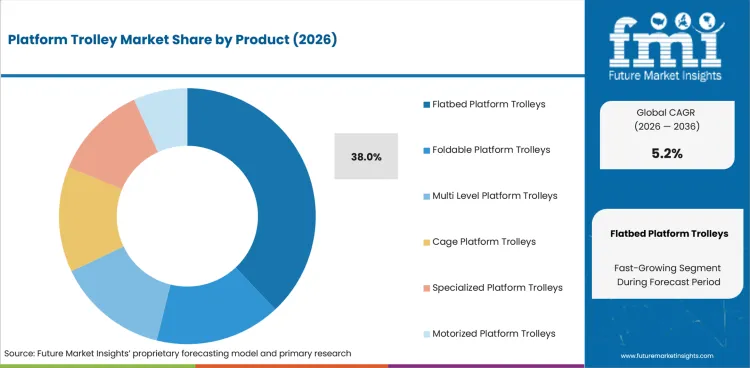
The market share of flatbed platform trolleys is 38.0% in 2026. The flat open-deck design provides maximum flexibility for loading boxes, crates, equipment and oddly-shaped items. Decks range from small 600 x 400 mm for office and retail applications to large 1500 x 750 mm industrial versions capable of handling loads in excess of 500 kg.
Steel flatbed trolleys are used in heavy-duty industrial applications where the cost of higher-grade materials is offset by the load capacity, structural rigidity and longevity. Aluminum and plastic construction is for lighter commercial and healthcare applications where corrosion-resistance and lighter-weight are appreciated.
How big is the warehousing and logistics segment in the platform trolley market?
About 35.0% share, led by distribution-center receiving and order handling
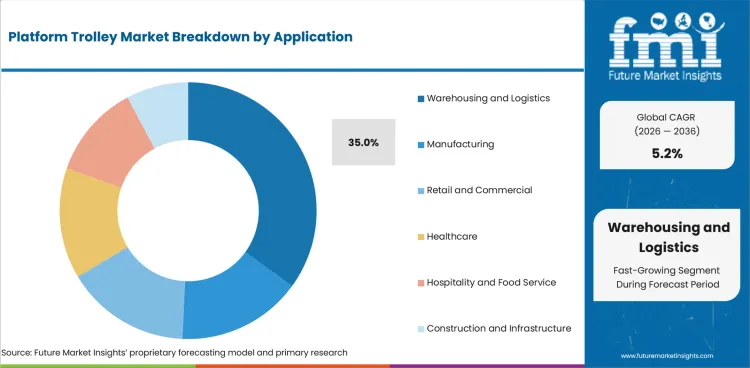
Warehousing and logistics have 35.0% of application in 2026. Platform trolleys are used in distribution centers and storage facilities for a number of operational functions, including receiving (dock to storage transport), storage management (stock relocation), order fulfillment (picking trolley), and shipping (staging area to dock transport).
The expansion of e-commerce distribution and third-party logistics operations generates incremental trolley demand as new facilities are equipped with basic material handling equipment for operations. Platform trolleys support manual transportation tasks not covered by automated systems in automated material handling systems.
What drives and restrains the platform trolley market?
Driven by universal material-transport needs; restrained by low-cost imports limiting differentiation
- Consistent platform trolley procurement demand is driven by universal material transport needs across warehouse, retail and commercial operations.
- Domestic manufacturers’ margins are squeezed by commodity pricing from low cost imported trolleys, and differentiation of premium products is limited.
- Opportunities for value-added product development include ergonomic design advancement and specialized application configurations.
The platform trolley market is experiencing moderate growth owing to facility expansion, logistics development and demand from commercial operations. Margins are under pressure on import pricing, but ergonomic design and special configurations provide differentiation opportunities.
What drives demand?
Warehouse and distribution-center construction generating new-facility demand
Demand is driven by warehouse and distribution center construction, which spurs new-facility equipment procurement, such as platform trolleys for material handling operations. Each new logistics hub will need a number of trolleys for use in operational areas.
What opportunity does retail growth create?
Rising retail and commercial activity buying trolleys for stock movement
Growth is a sign of increasing retail and commercial activity that buys platform trolleys for stock management, backroom logistics and facility maintenance work. Equipment is procured for the first time with new store openings and commercial facility development.
What opportunity does foldable design offer?
Demand for space-efficient foldable and compact trolleys
Both commercial users and residential consumers appreciate space-efficient equipment, hence the rise in the adoption of foldable platform trolleys. Foldable designs extend the addressable market beyond traditional permanent-deployment industrial applications.
How do ergonomics shape demand?
Demand for ergonomic handles, braking and load-retention features
Demand for trolleys with ergonomic handles, braking systems, and load retention features is growing as workplace safety standards influence procurement specifications.
Analysis of Platform Trolley Market By Key Countries
Which countries are growing fastest in the platform trolley market?
South Korea 5.5%, Japan 5.4%, USA 5.3%, EU 5.2%, UK 5.1% through 2036
.webp "Top Country Growth Comparison Platform Trolley Market Cagr (2026 2036)")
| Country | CAGR |
|---|---|
| USA | 5.3% |
| UK | 5.1% |
| EU | 5.2% |
| Japan | 5.4% |
| South Korea | 5.5% |
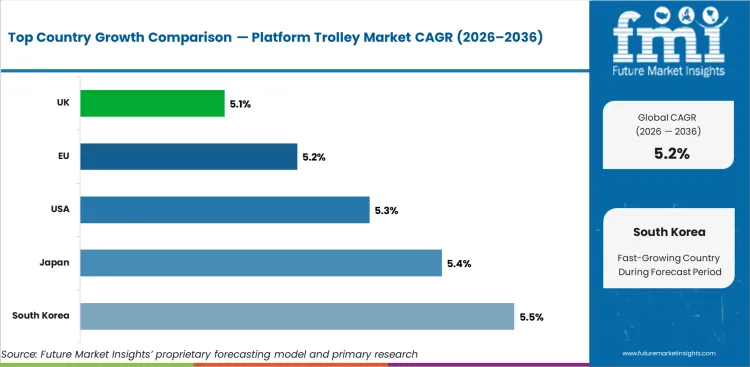
- South Korea leads at 5.5% CAGR, reflecting strong demand drivers.
- Japan follows at 5.4%, supported by expanding market activity.
- USA (5.3%) and EU (5.2%) sustain growth.
The global platform trolley market is estimated to grow at 5.2% CAGR from 2026 to 2036. The study covers more than 30 countries, and the key markets are listed below.
How fast is the platform trolley market growing in South Korea?
5.5% CAGR through 2036, the fastest country-level market in the study
South Korea leads the way, with a CAGR of 5.5% through 2036. Logistics infrastructure, demand from manufacturing affects the procurement of trolleys.
- With the development of logistics centers, the equipment procurement is required, for example, platform trolleys for warehouse operations.
- Manufacturing facilities invest in material handling equipment to optimize production efficiency.
- Effective channels of purchase are created by the distribution of domestic industrial equipment.
What is the platform trolley market outlook in Japan?
5.4% CAGR, driven by Precision material handling and quality equipment selection
Japan is forecast to expand at a CAGR of 5.4% by 2036. Precision material handling and quality equipment selection drive demand.
- Japanese facility operations require precision material handling equipment that satisfies the standards of workplace safety and organization.
- Platform trolleys are purchased by retail and commercial businesses for the maintenance of their premises and to control stock.
- Manufacturers of trolley products for Japanese commercial and industrial needs with quality control.
What is driving platform trolley growth in the United States?
5.3% CAGR, driven by Demand supported by warehouse expansion, commercial facilities operations
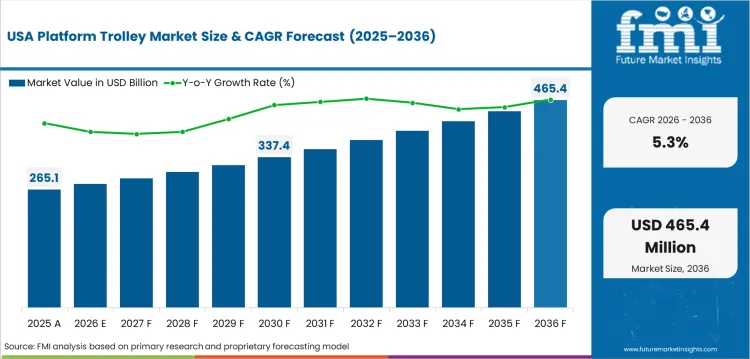
The country is expected to register 5.3% CAGR till 2036. Demand supported by warehouse expansion, commercial facilities operations.
- Logistics operations increase warehouses and fulfillment centers and demand for platform trolleys rises.
- Industrial distribution networks offer a wide variety of trolley products to commercial and industrial buyers.
- Retail operations buy platform trolleys to use in backroom logistics and for stock replenishment operations.
How is the platform trolley market performing in the European Union?
5.2% CAGR, driven by Standards on manufacturing, logistics and workplace safety
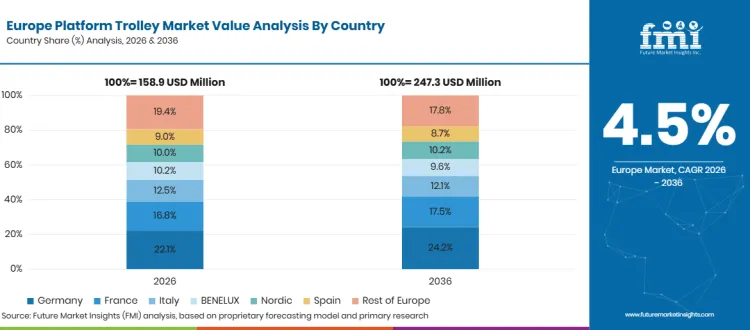
The European Union is expected to register a CAGR of 5.2% till 2036. Standards on manufacturing, logistics and workplace safety underpin demand.
- EU standards on health and safety at work impact trolley procurement specifications on ergonomics and safety features.
- New facility equipment procurement as platform trolleys is to be expanded in Central and Eastern Europe in logistics.
- European trolley manufacturers possess quality standings with compliance to EN standards and customer application support.
What is the platform trolley market forecast for the United Kingdom?
5.1% CAGR, driven by Demand for trolleys comes from commercial and logistics operations
The United Kingdom is expected to register 5.1% CAGR till 2036. Demand for trolleys comes from commercial and logistics operations.
- UK warehouse and distribution operations need platform trolleys to move materials through logistics workflows.
- Commercial trolley equipment for stock management and service operations is sourced from the retail and hospitality sectors.
- HSE manual handling regulations encourage investment in trolley equipment to reduce the need for manual carrying.
Who are the leading companies in the platform trolley market?
STILL GmbH (KION Group), Jungheinrich AG, Toyota Industries Corporation, KION Group AG, and Crown Equipment Corporation
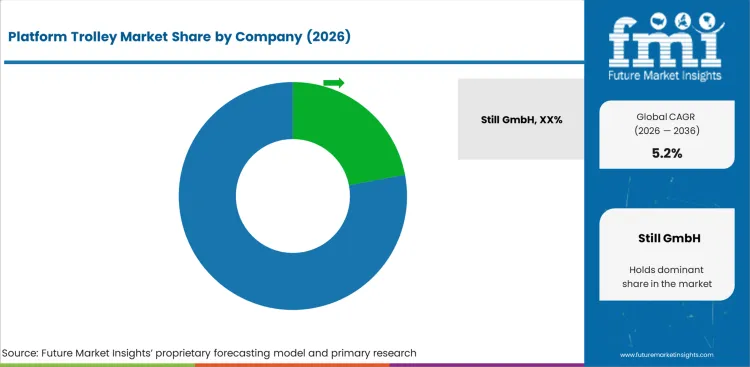
- Still GmbH and Jungheinrich AG lead through integrated material handling equipment portfolios that include platform trolley products alongside broader warehouse logistics systems.
- Toyota Industries serves the platform trolley market through its material handling division with global manufacturing and distribution capability.
- Mecalux and Caddy Systems provide trolley solutions targeting specific application segments including warehouse order picking and retail stock management.
Who are the key players in the platform trolley market?
STILL GmbH (KION Group), Jungheinrich AG, Toyota Industries Corporation, KION Group AG and Crown Equipment Corporation, plus regional players
Key global companies leading the platform trolley market include:
- Still GmbH (Germany), Toyota Industries (Japan), Mecalux (Spain), and Jungheinrich AG (Germany) lead global platform trolley markets through integrated material handling product portfolios, established warehouse customer relationships, and global distribution infrastructure.
- Caddy Systems (UK) holds a position through specialized trolley products targeting retail and commercial applications.
- Additional trolley manufacturers are expanding product offerings targeting cost-sensitive commercial and small warehouse applications.
How do top platform trolley companies compare?
STILL GmbH (KION Group) and Jungheinrich AG lead globally; Toyota Industries Corporation, KION Group AG and Crown Equipment Corporation are regional specialists
| Company | Product Range | Manufacturing Scale | Warehouse Customer Base | Geographic Footprint |
|---|---|---|---|---|
| Still GmbH | High | High | Strong | Europe, Global |
| Toyota Industries | High | High | Strong | Global |
| Mecalux | Medium | Medium | Moderate | Europe, Global |
| Jungheinrich | High | High | Strong | Europe, Global |
| Caddy Systems | Low | Medium | Low | UK |
Source: Future Market Insights competitive analysis, 2026.
Key Developments in Platform Trolley Market
- In 2025, Jungheinrich continued offering a broad range of industrial platform trolleys and material handling equipment featuring ergonomic handles, braking systems, and adjustable designs used across warehouse and logistics operations globally.
- In 2025, Mecalux continued focusing on warehouse automation, storage systems, and intralogistics solutions, while supporting material handling workflows where platform trolleys are used as auxiliary equipment in distribution and fulfillment centers rather than launching dedicated trolley products.
Key Players in the Platform Trolley Market
Major Global Players
- STILL GmbH (KION Group)
- Jungheinrich AG
- Toyota Industries Corporation
- KION Group AG
- Crown Equipment Corporation
- Hyster-Yale Materials Handling, Inc.
- The Raymond Corporation
Emerging Players/Startups
- Godrej & Boyce Manufacturing Co. Ltd.
- Nilkamal Limited
- Vestil Manufacturing Corporation
- The Hopper Company LLC
- Qingdao Huatian Hand Truck Co., Ltd.
- RuXXac Business
- Stanley Black & Decker
What does the platform trolley market report cover?
Platform Trolley Market - Research Methodology
| Method | Description |
|---|---|
| Primary Research | FMI analysts conducted interviews with manufacturers, distributors, procurement specialists, and end-use operators across USA, UK, and EU to validate demand patterns and pricing structures for Flatbed Platform Trolleys, and Foldable Platform Trolleys and related product categories. |
| Desk Research | Combined trade statistics, regulatory filings, industry association data, and manufacturer disclosures to establish baseline parameters for Platform Trolley across product, application, end use, load capacity, material, wheel, and mobility segments. |
| Market Sizing & Forecasting | Bottom-up aggregation across Flatbed Platform Trolleys, Foldable Platform Trolleys, and Multi Level Platform Trolleys product categories and Warehousing and Logistics, Manufacturing, and Retail and Commercial application segments, triangulated with top-down macro indicators and regional adoption curves. |
| Data Validation | Cross-checked quarterly against production statistics, trade flow data, and manufacturer revenue disclosures for Platform Trolley products. |
2016 to 2025 history and 2026 to 2036 forecasts across all segments and 30+ countries
| Parameter | Details |
|---|---|
| Market size by 2036 | USD 1.0 Bn |
| Growth rate | 5.2% CAGR (2026 to 2036) |
| Forecast period | 2026 to 2036 |
| Base year value (2025) | USD 0.6 Bn |
| Key Segment Covered | Product, Application, End Use, Load Capacity, Material, Wheel Type, Mobility |
| Regions covered | North America, Latin America, Eastern Europe, Western Europe, East Asia, South Asia and Pacific, Middle East and Africa |
| Countries covered | USA, UK, EU, Japan, South Korea, 30 plus countries |
| Key companies profiled | Still GmbH, Toyota Industries, Mecalux, Jungheinrich AG, Caddy Systems, Other Companies (combined) |
| Approach | Hybrid bottom-up and top-down methodology starting with verified transaction data, projecting adoption velocity across segments and regions. |
Market Segmentation Analysis
Platform Trolley Market Segmented by Product:
- Flatbed Platform Trolleys
- Standard Flatbed Trolleys
- Single Platform
- Anti Slip Surface
- Heavy Duty Flatbed Trolleys
- Reinforced Frame
- High Load Capacity
- Standard Flatbed Trolleys
- Foldable Platform Trolleys
- Compact Foldable Trolleys
- Collapsible Handle
- Space Saving Design
- Heavy Duty Foldable Trolleys
- Locking Mechanism
- Industrial Use
- Compact Foldable Trolleys
- Multi Level Platform Trolleys
- Two Tier Platform Trolleys
- Dual Deck Structure
- Order Picking Use
- Three Tier Platform Trolleys
- High Storage Capacity
- Inventory Handling
- Two Tier Platform Trolleys
- Cage Platform Trolleys
- Full Cage Trolleys
- Four Side Enclosure
- Secure Transport
- Partial Cage Trolleys
- Half Cage Design
- Removable Panels
- Full Cage Trolleys
- Specialized Platform Trolleys
- Hydraulic Platform Trolleys
- Lift Assist Systems
- Height Adjustment
- Tilt Platform Trolleys
- Dumping Mechanism
- Bulk Material Handling
- Hydraulic Platform Trolleys
- Motorized Platform Trolleys
- Electric Platform Trolleys
- Battery Powered Systems
- Heavy Load Movement
- Autonomous Platform Trolleys
- Automated Guided Systems
- Smart Navigation
- Electric Platform Trolleys
Platform Trolley Market Segmented by Application:
- Warehousing and Logistics
- Internal Transport
- Inventory Movement
- Order Picking
- Loading and Unloading
- Dock Operations
- Material Transfer
- Internal Transport
- Manufacturing
- Production Support
- Assembly Line Movement
- Work In Progress Handling
- Material Handling
- Raw Material Transport
- Finished Goods Movement
- Production Support
- Retail and Commercial
- Store Operations
- Stock Replenishment
- Inventory Handling
- Back End Logistics
- Storage Movement
- Delivery Support
- Store Operations
- Healthcare
- Hospital Logistics
- Medical Equipment Transport
- Supply Distribution
- Laboratory Use
- Sample Handling
- Equipment Movement
- Hospital Logistics
- Hospitality and Food Service
- Hotel Operations
- Linen Transport
- Room Service Logistics
- Food Service
- Kitchen Transport
- Catering Operations
- Hotel Operations
- Construction and Infrastructure
- Site Operations
- Material Transport
- Tool Movement
- Heavy Duty Handling
- Bulk Load Movement
- Rough Terrain Usage
- Site Operations
Platform Trolley Market Segmented by End Use:
- Industrial Sector
- Manufacturing Facilities
- Automotive Plants
- Machinery Production Units
- Logistics Centers
- Warehouses
- Distribution Hubs
- Manufacturing Facilities
- Commercial Sector
- Retail Chains
- Supermarkets
- Shopping Centers
- Hospitality Industry
- Hotels
- Restaurants
- Retail Chains
- Healthcare Sector
- Hospitals
- Public Hospitals
- Private Hospitals
- Clinics and Laboratories
- Diagnostic Centers
- Research Labs
- Hospitals
- Infrastructure Sector
- Construction Companies
- Building Projects
- Infrastructure Projects
- Public Utilities
- Municipal Services
- Maintenance Services
- Construction Companies
Platform Trolley Market Segmented by Load Capacity:
- Light Duty Platform Trolleys
- Below 150 Kg
- Retail Use
- Light Transport
- Below 150 Kg
- Medium Duty Platform Trolleys
- 150 Kg to 300 Kg
- Warehouse Use
- Commercial Use
- 150 Kg to 300 Kg
- Heavy Duty Platform Trolleys
- 300 Kg to 500 Kg
- Industrial Use
- Bulk Handling
- 300 Kg to 500 Kg
- Extra Heavy Duty Platform Trolleys
- Above 500 Kg
- Construction Use
- Heavy Industry
- Above 500 Kg
Platform Trolley Market Segmented by Material:
- Steel Platform Trolleys
- Mild Steel
- Powder Coated Finish
- Industrial Usage
- Stainless Steel
- Corrosion Resistant
- Food and Medical Use
- Mild Steel
- Aluminum Platform Trolleys
- Lightweight Aluminum
- Portable Design
- Rust Resistant
- Reinforced Aluminum
- High Strength
- Durable Structure
- Lightweight Aluminum
- Plastic Platform Trolleys
- HDPE Platform
- Lightweight Structure
- Chemical Resistant
- Polypropylene Platform
- Low Cost Design
- Low Maintenance
- HDPE Platform
- Composite Platform Trolleys
- Hybrid Materials
- Enhanced Durability
- Weight Optimization
- Recycled Materials
- Sustainable Design
- Eco Friendly Use
- Hybrid Materials
Platform Trolley Market Segmented by Wheel Type:
- Rubber Wheels
- Solid Rubber Wheels
- Shock Absorption
- Noise Reduction
- Pneumatic Wheels
- Outdoor Use
- Rough Terrain
- Solid Rubber Wheels
- Caster Wheels
- Swivel Casters
- High Maneuverability
- Flexible Movement
- Fixed Casters
- Directional Stability
- Load Support
- Swivel Casters
- Polyurethane Wheels
- Standard Polyurethane
- Wear Resistance
- Floor Protection
- Heavy Duty Polyurethane
- High Load Capacity
- Industrial Applications
- Standard Polyurethane
Platform Trolley Market Segmented by Mobility:
- Manual Platform Trolleys
- Push Trolleys
- Ergonomic Design
- Standard Use
- Pull Trolleys
- Towable Systems
- Multi Unit Handling
- Push Trolleys
- Powered Platform Trolleys
- Electric Trolleys
- Battery Powered
- Heavy Load Transport
- Autonomous Trolleys
- Automated Navigation
- Warehouse Integration
- Electric Trolleys
Platform Trolley Market by Region:
- North America
- USA
- Canada
- Mexico
- Latin America
- Brazil
- Chile
- Rest of Latin America
- Western Europe
- Germany
- UK
- Italy
- Spain
- France
- Nordic
- BENELUX
- Rest of Western Europe
- Eastern Europe
- Russia
- Poland
- Hungary
- Balkan & Baltic
- Rest of Eastern Europe
- East Asia
- China
- Japan
- South Korea
- South Asia and Pacific
- India
- ASEAN
- Australia & New Zealand
- Rest of South Asia and Pacific
- Middle East & Africa
- Kingdom of Saudi Arabia
- Other GCC Countries
- Türkiye
- South Africa
- Other African Union
- Rest of Middle East & Africa
Research Sources and Bibliography
- Material Handling Industry (MHI). (2025). Annual Industry Report. Material Handling Industry of America (MHI).
- European Committee for Standardization (CEN). (2025). Standards for Manual Handling Equipment and Industrial Trucks (EN Standards). CEN.
- Occupational Safety and Health Administration (OSHA). (2025). Guidelines for Safe Manual Material Handling and Ergonomics. USA Department of Labor.
- International Organization for Standardization (ISO). (2025). ISO Standards for Industrial Trucks and Material Handling Equipment. ISO.
- Health and Safety Executive (HSE). (2025). Manual Handling Operations Regulations Guidance. HSE (UK Government).
This bibliography is provided for reader reference.
This Report Answers
- Estimating the size of the platform trolley market and projected revenue from 2026 to 2036.
- Segmentation by product, application, end use, load capacity, material, wheel type, mobility.
- Insights about more than 30 regional markets.
- Analysis of key market dynamics including demand drivers, restraints, and emerging opportunities.
- Assessment of the competitive landscape and strategic positioning of leading companies.
- Identifying investment opportunities across key product segments and geographic markets.
- Supply chain and distribution channel analysis.
- Delivery of data in PDF and Excel formats.
Frequently Asked Questions
How big is the platform trolley market in 2026?
The global platform trolley market is estimated to be valued at USD 0.6 billion in 2026.
What will be the size of the platform trolley market in 2036?
The market size for the platform trolley market is projected to reach USD 1.0 billion by 2036.
How much will the platform trolley market growth be between 2026 and 2036?
The platform trolley market is expected to grow at a 5.2% CAGR between 2026 and 2036.
What are the key products in the platform trolley market?
The key products in the platform trolley market are Flatbed Platform Trolleys, Foldable Platform Trolleys, Multi Level Platform Trolleys, Cage Platform Trolleys, Specialized Platform Trolleys and Motorized Platform Trolleys.
Which application segment is expected to contribute a significant share in the platform trolley market in 2026?
In terms of application, the warehousing and logistics segment is expected to command 35.0% share in the platform trolley market in 2026.
Preview the report firsthand - request a free sample
Get SampleGet the brochure for pricing and purchase details.
Get PDFTable of Content
- Key Takeaways
- Market Size and CAGR
- Top Growth Driver
- Fastest Growing Segment
- Leading Region
- Key Companies
- Emerging Opportunities
- Executive Summary
- Global Market Outlook
- Demand-side Trends
- Supply-side Trends
- Technology Roadmap Analysis
- Analysis and Recommendations
- Analyst Perspective (What is happening? Why now? What should investors know?)
- Key Questions Answered
- How large is the market?
- What is the CAGR?
- What are key trends?
- Which region dominates?
- Who are the leaders?
- Market Overview
- Market Coverage / Taxonomy
- Market Definition / Scope / Limitations
- Research Methodology
- Chapter Orientation
- Analytical Lens and Working Hypotheses
- Market Structure, Signals, and Trend Drivers
- Benchmarking and Cross-market Comparability
- Market Sizing, Forecasting, and Opportunity Mapping
- Research Design and Evidence Framework
- Desk Research Programme (Secondary Evidence)
- Expert Input and Fieldwork (Primary Evidence)
- Tooling, Models, and Reference Databases
- Data Engineering and Model Build
- Quality Assurance and Audit Trail
- Market Background
- Market Dynamics (Drivers, Restraints, Opportunity, Trends)
- Scenario Forecast (Optimistic, Likely, Conservative)
- Impact Analysis
- AI Impact
- Sustainability Impact
- Regulatory Impact
- Technology Impact
- Consumer / Buyer Analysis
- Purchase Drivers
- Adoption Barriers
- Buyer Journey
- Opportunity Map Analysis
- Product Life Cycle Analysis
- Supply Chain Analysis
- Investment Feasibility Matrix
- Value Chain Analysis
- PESTLE and Porter's Analysis
- Regulatory Landscape
- Regional Parent Market Outlook
- Production and Consumption Statistics
- Import and Export Statistics
- Global Market Analysis and Forecast, 2021 to 2036
- Historical Market Size Value (USD Billion) Analysis, 2021 to 2025
- Current and Future Market Size Value (USD Billion) Projections, 2026 to 2036
- Y-o-Y Growth Trend Analysis
- Absolute $ Opportunity Analysis
- Global Market Pricing Analysis, 2021 to 2036
- Global Market Analysis and Forecast, By Product, 2021 to 2036
- Introduction / Key Findings
- Historical Market Size Value (USD Billion) Analysis By Product, 2021 to 2025
- Current and Future Market Size Value (USD Billion) Analysis and Forecast By Product, 2026 to 2036
- Flatbed Platform Trolleys
- Standard Flatbed Trolleys
- Heavy Duty Flatbed Trolleys
- Foldable Platform Trolleys
- Compact Foldable Trolleys
- Heavy Duty Foldable Trolleys
- Multi Level Platform Trolleys
- Two Tier Platform Trolleys
- Three Tier Platform Trolleys
- Cage Platform Trolleys
- Full Cage Trolleys
- Partial Cage Trolleys
- Specialized Platform Trolleys
- Hydraulic Platform Trolleys
- Tilt Platform Trolleys
- Motorized Platform Trolleys
- Electric Platform Trolleys
- Autonomous Platform Trolleys
- Flatbed Platform Trolleys
- Y-o-Y Growth Trend Analysis By Product, 2021 to 2025
- Absolute $ Opportunity Analysis By Product, 2026 to 2036
- Global Market Analysis and Forecast, By Application, 2021 to 2036
- Introduction / Key Findings
- Historical Market Size Value (USD Billion) Analysis By Application, 2021 to 2025
- Current and Future Market Size Value (USD Billion) Analysis and Forecast By Application, 2026 to 2036
- Warehousing and Logistics
- Internal Transport
- Loading and Unloading
- Manufacturing
- Production Support
- Material Handling
- Retail and Commercial
- Store Operations
- Back End Logistics
- Healthcare
- Hospital Logistics
- Laboratory Use
- Hospitality and Food Service
- Hotel Operations
- Food Service
- Construction and Infrastructure
- Site Operations
- Heavy Duty Handling
- Warehousing and Logistics
- Y-o-Y Growth Trend Analysis By Application, 2021 to 2025
- Absolute $ Opportunity Analysis By Application, 2026 to 2036
- Global Market Analysis and Forecast, By End Use, 2021 to 2036
- Introduction / Key Findings
- Historical Market Size Value (USD Billion) Analysis By End Use, 2021 to 2025
- Current and Future Market Size Value (USD Billion) Analysis and Forecast By End Use, 2026 to 2036
- Industrial Sector
- Manufacturing Facilities
- Logistics Centers
- Commercial Sector
- Retail Chains
- Hospitality Industry
- Healthcare Sector
- Hospitals
- Clinics and Laboratories
- Infrastructure Sector
- Construction Companies
- Public Utilities
- Industrial Sector
- Y-o-Y Growth Trend Analysis By End Use, 2021 to 2025
- Absolute $ Opportunity Analysis By End Use, 2026 to 2036
- Global Market Analysis and Forecast, By Load Capacity, 2021 to 2036
- Introduction / Key Findings
- Historical Market Size Value (USD Billion) Analysis By Load Capacity, 2021 to 2025
- Current and Future Market Size Value (USD Billion) Analysis and Forecast By Load Capacity, 2026 to 2036
- Light Duty Platform Trolleys
- Below 150 Kg
- Medium Duty Platform Trolleys
- 150 Kg to 300 Kg
- Heavy Duty Platform Trolleys
- 300 Kg to 500 Kg
- Extra Heavy Duty Platform Trolleys
- Above 500 Kg
- Light Duty Platform Trolleys
- Y-o-Y Growth Trend Analysis By Load Capacity, 2021 to 2025
- Absolute $ Opportunity Analysis By Load Capacity, 2026 to 2036
- Global Market Analysis and Forecast, By Material, 2021 to 2036
- Introduction / Key Findings
- Historical Market Size Value (USD Billion) Analysis By Material, 2021 to 2025
- Current and Future Market Size Value (USD Billion) Analysis and Forecast By Material, 2026 to 2036
- Steel Platform Trolleys
- Mild Steel
- Stainless Steel
- Aluminum Platform Trolleys
- Lightweight Aluminum
- Reinforced Aluminum
- Plastic Platform Trolleys
- HDPE Platform
- Polypropylene Platform
- Composite Platform Trolleys
- Hybrid Materials
- Recycled Materials
- Steel Platform Trolleys
- Y-o-Y Growth Trend Analysis By Material, 2021 to 2025
- Absolute $ Opportunity Analysis By Material, 2026 to 2036
- Global Market Analysis and Forecast, By Wheel Type
- Introduction / Key Findings
- Historical Market Size Value (USD Billion) Analysis By Wheel Type, 2021 to 2025
- Current and Future Market Size Value (USD Billion) Analysis and Forecast By Wheel Type, 2026 to 2036
- Rubber Wheels
- Solid Rubber Wheels
- Pneumatic Wheels
- Caster Wheels
- Swivel Casters
- Fixed Casters
- Polyurethane Wheels
- Standard Polyurethane
- Heavy Duty Polyurethane
- Rubber Wheels
- Y-o-Y Growth Trend Analysis By Wheel Type, 2021 to 2025
- Absolute $ Opportunity Analysis By Wheel Type, 2026 to 2036
- Global Market Analysis and Forecast, By Mobility
- Introduction / Key Findings
- Historical Market Size Value (USD Billion) Analysis By Mobility, 2021 to 2025
- Current and Future Market Size Value (USD Billion) Analysis and Forecast By Mobility, 2026 to 2036
- Manual Platform Trolleys
- Push Trolleys
- Pull Trolleys
- Powered Platform Trolleys
- Electric Trolleys
- Autonomous Trolleys
- Manual Platform Trolleys
- Y-o-Y Growth Trend Analysis By Mobility, 2021 to 2025
- Absolute $ Opportunity Analysis By Mobility, 2026 to 2036
- Global Market Analysis and Forecast, By Region, 2021 to 2036
- Introduction
- Historical Market Size Value (USD Billion) Analysis By Region, 2021 to 2025
- Current Market Size Value (USD Billion) Analysis and Forecast By Region, 2026 to 2036
- North America
- Latin America
- Western Europe
- Eastern Europe
- East Asia
- South Asia and Pacific
- Middle East & Africa
- Market Attractiveness Analysis By Region
- North America Market Analysis and Forecast, By Country, 2021 to 2036
- Historical Market Size Value (USD Billion) Trend Analysis By Market Taxonomy, 2021 to 2025
- Market Size Value (USD Billion) Forecast By Market Taxonomy, 2026 to 2036
- By Country
- USA
- Canada
- Mexico
- By Product
- By Application
- By End Use
- By Load Capacity
- By Material
- By Wheel Type
- By Mobility
- By Country
- Market Attractiveness Analysis
- By Country
- By Product
- By Application
- By End Use
- By Load Capacity
- By Material
- By Wheel Type
- By Mobility
- Key Takeaways
- Latin America Market Analysis and Forecast, By Country
- Historical Market Size Value (USD Billion) Trend Analysis By Market Taxonomy, 2021 to 2025
- Market Size Value (USD Billion) Forecast By Market Taxonomy, 2026 to 2036
- By Country
- Brazil
- Chile
- Rest of Latin America
- By Product
- By Application
- By End Use
- By Load Capacity
- By Material
- By Wheel Type
- By Mobility
- By Country
- Market Attractiveness Analysis
- By Country
- By Product
- By Application
- By End Use
- By Load Capacity
- By Material
- By Wheel Type
- By Mobility
- Key Takeaways
- Western Europe Market Analysis and Forecast, By Country
- Historical Market Size Value (USD Billion) Trend Analysis By Market Taxonomy, 2021 to 2025
- Market Size Value (USD Billion) Forecast By Market Taxonomy, 2026 to 2036
- By Country
- Germany
- UK
- Italy
- Spain
- France
- Nordic
- BENELUX
- Rest of Western Europe
- By Product
- By Application
- By End Use
- By Load Capacity
- By Material
- By Wheel Type
- By Mobility
- By Country
- Market Attractiveness Analysis
- By Country
- By Product
- By Application
- By End Use
- By Load Capacity
- By Material
- By Wheel Type
- By Mobility
- Key Takeaways
- Eastern Europe Market Analysis and Forecast, By Country
- Historical Market Size Value (USD Billion) Trend Analysis By Market Taxonomy, 2021 to 2025
- Market Size Value (USD Billion) Forecast By Market Taxonomy, 2026 to 2036
- By Country
- Russia
- Poland
- Hungary
- Balkan & Baltic
- Rest of Eastern Europe
- By Product
- By Application
- By End Use
- By Load Capacity
- By Material
- By Wheel Type
- By Mobility
- By Country
- Market Attractiveness Analysis
- By Country
- By Product
- By Application
- By End Use
- By Load Capacity
- By Material
- By Wheel Type
- By Mobility
- Key Takeaways
- East Asia Market Analysis and Forecast, By Country
- Historical Market Size Value (USD Billion) Trend Analysis By Market Taxonomy, 2021 to 2025
- Market Size Value (USD Billion) Forecast By Market Taxonomy, 2026 to 2036
- By Country
- China
- Japan
- South Korea
- By Product
- By Application
- By End Use
- By Load Capacity
- By Material
- By Wheel Type
- By Mobility
- By Country
- Market Attractiveness Analysis
- By Country
- By Product
- By Application
- By End Use
- By Load Capacity
- By Material
- By Wheel Type
- By Mobility
- Key Takeaways
- South Asia and Pacific Market Analysis and Forecast, By Country
- Historical Market Size Value (USD Billion) Trend Analysis By Market Taxonomy, 2021 to 2025
- Market Size Value (USD Billion) Forecast By Market Taxonomy, 2026 to 2036
- By Country
- India
- ASEAN
- Australia & New Zealand
- Rest of South Asia and Pacific
- By Product
- By Application
- By End Use
- By Load Capacity
- By Material
- By Wheel Type
- By Mobility
- By Country
- Market Attractiveness Analysis
- By Country
- By Product
- By Application
- By End Use
- By Load Capacity
- By Material
- By Wheel Type
- By Mobility
- Key Takeaways
- Middle East & Africa Market Analysis and Forecast, By Country
- Historical Market Size Value (USD Billion) Trend Analysis By Market Taxonomy, 2021 to 2025
- Market Size Value (USD Billion) Forecast By Market Taxonomy, 2026 to 2036
- By Country
- Kingdom of Saudi Arabia
- Other GCC Countries
- Türkiye
- South Africa
- Other African Union
- Rest of Middle East & Africa
- By Product
- By Application
- By End Use
- By Load Capacity
- By Material
- By Wheel Type
- By Mobility
- By Country
- Market Attractiveness Analysis
- By Country
- By Product
- By Application
- By End Use
- By Load Capacity
- By Material
- By Wheel Type
- By Mobility
- Key Takeaways
- Key Countries Market Analysis
- USA
- Pricing Analysis
- Market Share Analysis, 2025
- By Product
- By Application
- By End Use
- By Load Capacity
- By Material
- By Wheel Type
- By Mobility
- Canada
- Pricing Analysis
- Market Share Analysis, 2025
- By Product
- By Application
- By End Use
- By Load Capacity
- By Material
- By Wheel Type
- By Mobility
- Mexico
- Pricing Analysis
- Market Share Analysis, 2025
- By Product
- By Application
- By End Use
- By Load Capacity
- By Material
- By Wheel Type
- By Mobility
- Brazil
- Pricing Analysis
- Market Share Analysis, 2025
- By Product
- By Application
- By End Use
- By Load Capacity
- By Material
- By Wheel Type
- By Mobility
- Chile
- Pricing Analysis
- Market Share Analysis, 2025
- By Product
- By Application
- By End Use
- By Load Capacity
- By Material
- By Wheel Type
- By Mobility
- Germany
- Pricing Analysis
- Market Share Analysis, 2025
- By Product
- By Application
- By End Use
- By Load Capacity
- By Material
- By Wheel Type
- By Mobility
- UK
- Pricing Analysis
- Market Share Analysis, 2025
- By Product
- By Application
- By End Use
- By Load Capacity
- By Material
- By Wheel Type
- By Mobility
- Italy
- Pricing Analysis
- Market Share Analysis, 2025
- By Product
- By Application
- By End Use
- By Load Capacity
- By Material
- By Wheel Type
- By Mobility
- Spain
- Pricing Analysis
- Market Share Analysis, 2025
- By Product
- By Application
- By End Use
- By Load Capacity
- By Material
- By Wheel Type
- By Mobility
- France
- Pricing Analysis
- Market Share Analysis, 2025
- By Product
- By Application
- By End Use
- By Load Capacity
- By Material
- By Wheel Type
- By Mobility
- India
- Pricing Analysis
- Market Share Analysis, 2025
- By Product
- By Application
- By End Use
- By Load Capacity
- By Material
- By Wheel Type
- By Mobility
- ASEAN
- Pricing Analysis
- Market Share Analysis, 2025
- By Product
- By Application
- By End Use
- By Load Capacity
- By Material
- By Wheel Type
- By Mobility
- Australia & New Zealand
- Pricing Analysis
- Market Share Analysis, 2025
- By Product
- By Application
- By End Use
- By Load Capacity
- By Material
- By Wheel Type
- By Mobility
- China
- Pricing Analysis
- Market Share Analysis, 2025
- By Product
- By Application
- By End Use
- By Load Capacity
- By Material
- By Wheel Type
- By Mobility
- Japan
- Pricing Analysis
- Market Share Analysis, 2025
- By Product
- By Application
- By End Use
- By Load Capacity
- By Material
- By Wheel Type
- By Mobility
- South Korea
- Pricing Analysis
- Market Share Analysis, 2025
- By Product
- By Application
- By End Use
- By Load Capacity
- By Material
- By Wheel Type
- By Mobility
- Russia
- Pricing Analysis
- Market Share Analysis, 2025
- By Product
- By Application
- By End Use
- By Load Capacity
- By Material
- By Wheel Type
- By Mobility
- Poland
- Pricing Analysis
- Market Share Analysis, 2025
- By Product
- By Application
- By End Use
- By Load Capacity
- By Material
- By Wheel Type
- By Mobility
- Hungary
- Pricing Analysis
- Market Share Analysis, 2025
- By Product
- By Application
- By End Use
- By Load Capacity
- By Material
- By Wheel Type
- By Mobility
- Kingdom of Saudi Arabia
- Pricing Analysis
- Market Share Analysis, 2025
- By Product
- By Application
- By End Use
- By Load Capacity
- By Material
- By Wheel Type
- By Mobility
- Türkiye
- Pricing Analysis
- Market Share Analysis, 2025
- By Product
- By Application
- By End Use
- By Load Capacity
- By Material
- By Wheel Type
- By Mobility
- South Africa
- Pricing Analysis
- Market Share Analysis, 2025
- By Product
- By Application
- By End Use
- By Load Capacity
- By Material
- By Wheel Type
- By Mobility
- USA
- Market Structure Analysis
- Competition Dashboard
- Competition Benchmarking
- Market Share Analysis of Top Players
- By Regional
- By Product
- By Application
- By End Use
- By Load Capacity
- By Material
- By Wheel Type
- By Mobility
- Emerging Startups
- Innovation Benchmarking
- Competition Analysis
- Competition Deep Dive
- Still GmbH
- Overview
- Product Portfolio
- Profitability by Market Segments (Product/Region/Sales Channel)
- Sales Footprint
- Strategy Overview
- Marketing Strategy
- Product Strategy
- Channel Strategy
- Toyota Industries
- Mecalux
- Jungheinrich AG
- Caddy Systems
- Other Companies (combined)
- Still GmbH
- Case Studies
- Success Stories
- Recent Developments
- Competition Deep Dive
- Assumptions & Acronyms Used


