

- Industry Size (2026)
- USD 597.6 Mn
- Forecast (2036)
- USD 1060.1 Mn
- CAGR (2026 to 2036)
- 5.9%
Cajeput Oil Market Size, Market Forecast and Outlook By FMI
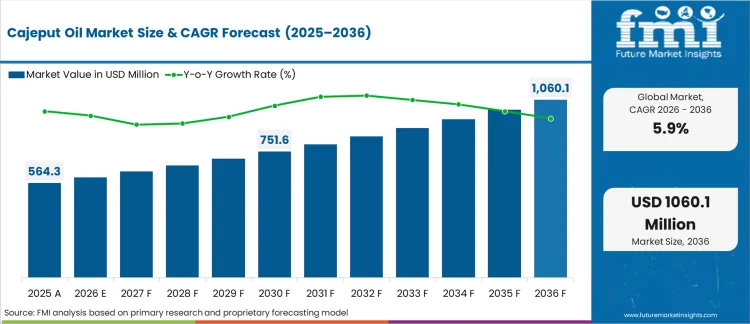
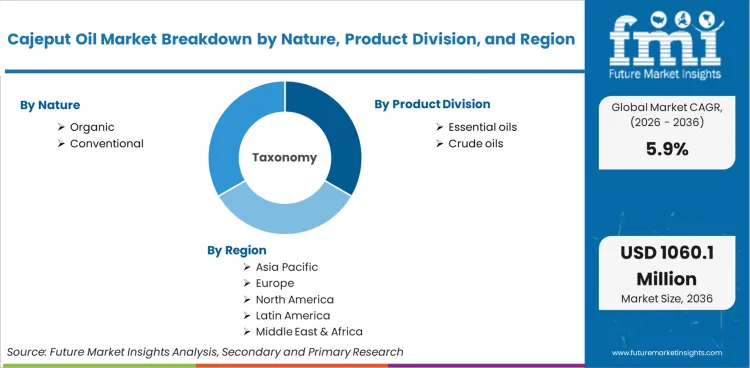
In 2025, the cajeput oil market was valued at USD 564.3 million. Based on Future Market Insights' analysis, demand for cajeput oil is estimated to grow to USD 597.6 million in 2026 and USD 1,060.1 million by 2036. FMI projects a CAGR of 5.9% during the forecast period.
Absolute dollar growth of USD 462.5 million over the decade reflects cajeput's broadening commercial credibility as scientific validation expands its addressable market beyond traditional aromatherapy into pharmaceutical and cosmeceutical applications. In February 2026, industry leaders reached a milestone with the adoption of agentic AI, where autonomous systems independently optimise steam distillation parameters using real-time sensory data and chemical marker monitoring of 1,8-cineole concentration to achieve maximum purity, enabling manufacturers to reduce energy consumption by an estimated 15 percent while ensuring consistent therapeutic-grade profiles for medical applications. [1] In March 2026, a study unveiled the high inhibitory potential of Melaleuca cajuputi essential oils against Methicillin-resistant Staphylococcus aureus, using in silico molecular docking to reveal that alloaromadendrene in the oil has strong binding to toxic shock proteins, driving 2026 research and development into cajeput-based next-generation plant-derived therapeutics for hospital-grade infections. [2] In late 2025, QuantoAgro successfully raised USD 650,000 to expand its sustainable essential oils business, specifically targeting increased cajeput production capacity through vertically integrated eco-friendly harvesting practices in Asia-Pacific. [3]
Summary of Cajeput Oil Market
- Cajeput Oil Market Definition
- The market covers steam-distilled Melaleuca cajuputi essential oil in organic and conventional grades for healthcare, cosmetics, aromatherapy, and food flavoring applications, differentiated by 1,8-cineole purity, botanical source certification, therapeutic-grade specification compliance, and sustainable harvesting provenance documentation from Indonesian and Malaysian production regions.
- Demand Drivers in the Market
- MRSA and antibiotic-resistant bacterial infection research validating cajeput oil's alloaromadendrene binding mechanism against toxic shock proteins is generating pharmaceutical and hospital-grade natural antimicrobial ingredient demand that elevates cajeput from traditional remedy status to scientifically credentialed plant-derived therapeutic, opening clinical procurement channels requiring higher-purity and standardised bioactive compound concentration specifications.
- Agentic AI optimisation of steam distillation parameters using real-time 1,8-cineole monitoring is enabling manufacturers to achieve consistent therapeutic-grade purity profiles with 15 percent lower energy consumption, creating a manufacturing efficiency and product quality differentiation that conventional fixed-parameter distillation operations cannot match and that justifies premium pricing for certified high-cineole cajeput grades.
- Organic certification and vertically integrated sustainable harvesting investment, as demonstrated by QuantoAgro's USD 650,000 capital raise for eco-friendly Asia-Pacific cajeput production expansion, is enabling cajeput suppliers to meet the provenance documentation and certification requirements of premium clean-label cosmetics and natural health product brands that specify verified sustainable botanical sourcing in their ingredient procurement standards.
- Key Segments Analyzed in the FMI Report
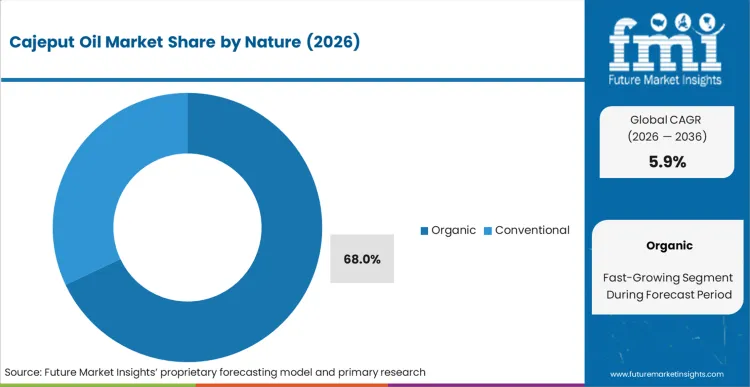
- Nature: Organic holds approximately 68% of nature segment share, reflecting the premium cosmetics, aromatherapy, and natural healthcare markets' strong preference for certified organic botanical ingredients that carry third-party verification of non-GMO cultivation, pesticide-free processing, and sustainable harvest provenance required by clean-label brand positioning.
- Product Division: Essential Oils accounts for approximately 74% of product division share as the commercially processed high-value form of cajeput output, with steam-distilled essential oil commanding substantially higher per-unit pricing than crude oil fractions and capturing the therapeutic, cosmetic, and aromatherapy application markets where precise chemical composition and purity specifications drive buyer procurement decisions.
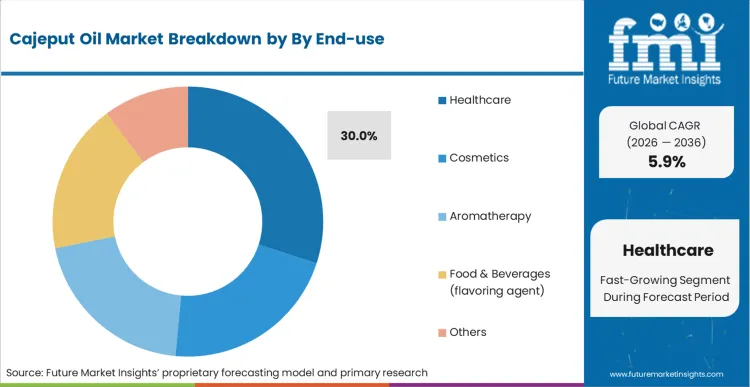
- End Use: Healthcare represents approximately 30% of end-use demand as the highest-specification application tier, encompassing pharmaceutical formulations, topical antiseptic preparations, respiratory health products, and the emerging antimicrobial research and development pipeline targeting cajeput oil bioactives against drug-resistant pathogens.
- Analyst Opinion at FMI
- Nandini Roy Choudhury, Principal Consultant for Food & Beverage Industry at Future Market Insights, opines, 'In the updated version of the Cajeput Oil Market Report for 2026 to 2036, CXOs will find that the MRSA bioactivity research published in March 2026 is a commercial inflection point rather than an academic footnote, because it provides the first molecular mechanism evidence that positions specific cajeput compounds as actionable drug-resistant infection candidates, which is exactly the scientific validation threshold that pharmaceutical procurement teams require before initiating ingredient qualification processes. My findings indicate that cajeput oil producers who invest in standardised alloaromadendrene and 1,8-cineole fraction documentation and partner with antimicrobial research programs will capture the highest-margin pharmaceutical application tier while competitors remain positioned in the commoditised aromatherapy and cosmetics segments.'
- Strategic Implications / Executive Takeaways
- Invest in standardised bioactive fraction documentation for alloaromadendrene and 1,8-cineole concentration ranges to qualify for pharmaceutical and clinical research ingredient procurement programs, establishing the analytical certificates of analysis and batch-to-batch consistency records required for antimicrobial research and development partnerships with hospital and pharmaceutical industry buyers.
- Deploy agentic AI steam distillation optimisation to achieve consistent therapeutic-grade 1,8-cineole purity profiles with quantified energy reduction credentials, enabling premium pricing justification for certified high-specification essential oil grades and providing the process efficiency documentation that ESG-focused cosmetics and healthcare procurement programs increasingly require from botanical ingredient suppliers.
- Pursue organic certification and sustainable harvesting program development, following QuantoAgro's vertically integrated Asia-Pacific model, to qualify for clean-label cosmetics and premium natural health product procurement where verified botanical provenance and sustainability credentials are purchasing specification requirements rather than optional brand attributes.
- Methodology
- Validated through primary interviews with cajeput essential oil distillers and exporters in Indonesia and Malaysia, organic certification program officers, and cosmetics ingredient buyers and aromatherapy product formulators across Asia-Pacific and North America.
- Zero reliance on speculative third-party market research reports; benchmarks sourced from Indonesian and Malaysian essential oil export statistics and verified company investment announcements and academic bioactivity research publications.
- Based on end-use application volume data across healthcare, cosmetics, aromatherapy, and food flavoring sectors, weighted by cajeput oil content ratios and cross-referenced against Southeast Asian essential oil export trade flows.
China (18.0% CAGR) leads country growth through expanding traditional medicine, cosmetics, and functional health product manufacturing. India (15.0% CAGR) follows through domestic Ayurvedic and herbal healthcare sector demand and growing cosmetic ingredient procurement. USA (14.0% CAGR) reflects expanding clean-label cosmetics, aromatherapy, and natural healthcare ingredient demand. Australia (10.0% CAGR) contributes through natural personal care and complementary medicine market growth in proximity to Indonesian supply. Japan (8.0% CAGR) is driven by high-specification cosmetic and aromatherapy ingredient procurement standards. Canada (6.0% CAGR) reflects natural health product and clean-label cosmetic ingredient market adoption. Organic Nature holds approximately 68%; Essential Oils Product Division accounts for approximately 74%; Healthcare End Use represents approximately 30% of demand.
Cajeput Oil Market Definition
The cajeput oil market comprises the global production, trade, and commercial application of essential oil steam-distilled from the leaves and twigs of Melaleuca cajuputi trees, indigenous to the tropical forests of Indonesia, Malaysia, and Australia. Cajeput oil is characterised by its high 1,8-cineole content ranging from 14 to 65 percent and its distinctive camphoraceous, medicinal aroma derived from terpene compounds including alpha-terpineol, limonene, and alloaromadendrene. The market covers certified organic and conventional cajeput essential oil grades and crude oil fractions sold to healthcare formulators, cosmetics manufacturers, aromatherapy product producers, and food and beverage flavoring specialists, differentiated by 1,8-cineole purity, botanical source certification, and therapeutic-grade specification compliance.
Cajeput Oil Market Inclusions
The report includes Global and Regional Market Sizes (Volume and Value) and a 10-year Forecast (2026 to 2036). Coverage spans segmental breakdowns by nature (Organic and Conventional), product division (Essential Oils and Crude Oils), end use (Healthcare, Cosmetics, Aromatherapy, Food and Beverages, and Others), and geography covering China, India, USA, Australia, Japan, Canada, and 40-plus countries.
Cajeput Oil Market Exclusions
The scope excludes tea tree oil, niaouli oil, and other Melaleuca species essential oils that share botanical origin genus but have distinct chemical profiles and separate market identities. Eucalyptus oil, which shares 1,8-cineole as a primary constituent but is derived from Eucalyptus species rather than Melaleuca cajuputi, is covered in a separate market scope and excluded here. Synthetic 1,8-cineole isolates produced through petrochemical synthesis rather than steam distillation of cajeput plant material are outside this natural essential oil market boundary. Cajeput wood and bark products without essential oil processing are not included within this scope.
Cajeput Oil Market Research Methodology
- Primary Research: Interviews were conducted with cajeput essential oil distillers and exporters in Indonesia and Malaysia, organic certification program officers, cosmetics ingredient buyers, aromatherapy product formulators, healthcare and pharmaceutical ingredient procurement specialists, and sustainable harvesting program developers across Asia-Pacific and North America.
- Desk Research: Trade statistics from Indonesian and Malaysian essential oil export databases, company investor disclosures and sustainability reports, academic research publications on Melaleuca cajuputi bioactivity, organic certification body registries, and natural product industry association reports supported volume and value benchmarking.
- Market-Sizing and Forecasting: A hybrid top-down and bottom-up model was developed. Demand was reconstructed from end-use application volume data across healthcare, cosmetics, aromatherapy, and food flavoring sectors weighted by cajeput oil content ratios, then validated against Indonesian and Malaysian essential oil export statistics.
- Data Validation and Update Cycle: Outputs undergo cross-validation against Southeast Asian essential oil export records, organic certification databases, pharmaceutical ingredient trade statistics, and structured peer review prior to release.
Industry Outlook
The demand for cajeput oil is anticipated to rise due to its expanding applications in aromatherapy, pharmaceuticals, cosmetics, and the food and beverage industries. By 2026, the market will witness increased consumer preference for natural and herbal remedies, driven by rising awareness of the therapeutic benefits of essential oils.
The growing demand for organic and plant-based ingredients in cosmetics and skincare will further propel market expansion. The oil extraction and processing technology in terms of the method used in obtaining oil will advance by 2036. The rising integration of cajeput oil into pharmaceutical formulas, expansion in the consumer market in emerging markets, and greater research and development in the health sector will dominate the long-run industry prospects.
Trend Analysis 2021 to 2025 vs 2026 to 2036
| 2021 to 2025 | 2026 to 2036 |
|---|---|
| Consumers increasingly adopted natural and plant-based ingredients in cosmetics, personal care, and aromatherapy. Rising awareness about the benefits of essential oils led to a gradual increase in demand, especially in the wellness sector. | The future will see an even stronger inclination toward organic, therapeutic, and sustainable products, particularly in skincare and pharmaceuticals. Consumers will prefer certified organic and ethically sourced cajeput oil, increasing premium product sales. |
| Regulations on essential oils were moderate, with increasing guidelines from organizations like the FDA and EU regulatory bodies ensuring safety and purity. | Stricter regulations and quality control standards are expected, requiring sustainable sourcing, purity certification, and compliance with international safety norms, impacting market entry for new players. |
| Cajeput oil was widely used for its antiseptic, carminative, and analgesic properties. Demand surged due to the COVID-19 pandemic as people sought natural decongestants and immunity-boosting remedies. However, large-scale adoption in pharmaceuticals was still in its early stages. | The pharmaceutical industry is expected to expand the usage of cajeput oil in new medicinal formulations for respiratory health, pain relief, and antimicrobial treatments. Research in clinical applications and therapeutic benefits will drive its acceptance in mainstream healthcare. |
| Cajeput oil gained popularity as a natural ingredient in skincare and haircare due to its anti-inflammatory and antibacterial properties. Major cosmetic brands integrated it into organic product lines. | The future will witness an increase in demand for clean-label, plant-derived skincare solutions. Companies will introduce innovative blends with cajeput oil, leveraging its potential in acne treatment, anti-aging products, and scalp health. |
| The use of cajeput oil as a natural flavoring agent in food and beverages was limited but growing, with some applications in herbal teas and digestive remedies. | The industry is expected to expand its applications in functional foods, dietary supplements, and beverages, especially in markets focused on herbal and wellness-based nutrition. |
| Steam distillation remained the primary extraction method, with limited innovations in enhancing oil purity and efficiency. Small-scale distillers dominated the market. | Advanced cold-pressed extraction techniques and biotechnology-driven enhancements will improve the quality and yield of cajeput oil. Automation in distillation will also increase large-scale production efficiency. |
| Asia Pacific, particularly Indonesia and Malaysia, dominated production due to the abundance of Myrtaceous trees. Demand in North America and Europe grew steadily, driven by wellness trends. | North America and Europe will see significant market expansion, driven by increasing consumer awareness and demand for aromatherapy, pharmaceuticals, and organic cosmetics. Emerging economies in Latin America and Africa will also contribute to demand growth. |
| Ethical sourcing and sustainability concerns emerged, with some brands emphasizing eco-friendly harvesting and fair-trade practices. However, mass awareness remained relatively low. | Sustainability will be a key differentiator in the market. Eco-conscious brands will dominate, with a focus on carbon-neutral production, fair trade practices, and deforestation-free sourcing to appeal to environmentally aware consumers. |
Consumer Trends
Increasing Trend of Functional and Wellness-Oriented Personal Care
Customers are moving toward more natural and plant-based wellness solutions. The demand for cajeput oil is increasing in aromatherapy, skincare, and healthcare. More and more aware customers are making themselves conscious of synthetic chemicals and, therefore, look for clean-label and organic products. The desire for essential oils with therapeutic properties has seen a huge rise. For pain relief, respiratory health, and holistic well-being, cajeput oil has gained immense popularity.
The increasing trend of functional and wellness-oriented personal care has dramatically influenced the cajeput oil market. Consumers are now looking for multi-functional skincare and haircare products infused with herbal extracts. Major cosmetic companies add cajeput oil to anti-inflammatory, anti-acne, and scalp-care products, which appeal to buyers who value natural healing and sustainable beauty. The increasing influence of social media and influencer marketing has further increased the popularity of cosmetics based on cajeput oil, especially among younger generations.
Segment-wise Analysis
By Nature
| Attributes | Details |
|---|---|
| Top Nature | Organic |
| Market Share in 2026 | 68.0% |
Based on nature, the market is divided into organic cajeput oil and conventional cajeput oil. The organic segment is set to observe a 68.0% share in 2026. Organic cajeput oil is not necessarily "widely used" in the sense that it is dominating the market, but it has been on the rise lately due to an increase in the organic and natural product demand by consumers. This is because it is free of synthetic pesticides and fertilizers.
Consumers opt for organic options for holistic and chemical-free solutions. Though conventional cajeput oil may still enjoy a larger market share due to its price advantage, the organic segment is expected to grow faster in the coming years as more people begin to appreciate the perceived health and environmental benefits of organic essential oils.
By Product Division
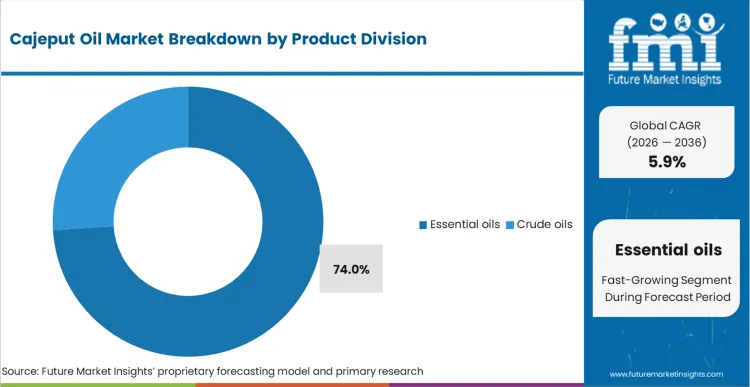
Based on product division, the market is divided into essential oils and crude oils. Essential oils, specifically cajeput oil extracted from the leaves and twigs of the Melaleuca species, are widely used, not crude oils. Cajeput oil is typically produced through steam distillation (also known as hydro distillation) of fresh leaves and twigs.
This process involves macerating the cajeput leaves in water and then steam distilling them after a period of fermentation. Distillation is a common and easy method of extracting essential oils, involving separating components based on boiling points. Methods like solvent-free microwave extraction are being explored to optimize the extraction process.
By End-use
| Attributes | Details |
|---|---|
| Top End-use | Cosmetics |
| Market Share in 2026 | 20.0% |
Based on end-use, the market is divided into healthcare, cosmetics, aromatherapy, food & beverages (flavoring agent), and others. Cajeput oil is widely used in healthcare, cosmetics, and aromatherapy due to its diverse therapeutic properties.
Cajeput oil is used in cosmetics because of its fragrance and several other beneficial properties. It can moisturize the skin and enhance its ability to retain moisture, which may reduce wrinkles and other signs of aging. This can be an alternative natural antiseptic and antibacterial oil against commercial cleansers.
This oil is a remedy for acne, boils, cuts, wounds, and burns. It could also eliminate toxins and control sebum production. It is used in many cosmetic products: face creams, lip glosses, moisteners, shampoos, and soaps.
Country-wise Analysis
.webp "Top Country Growth Comparison Cajeput Oil Market Cagr (2026 2036)")
USA: Rising Advanced Technology Adoption
The USA cajeput oil market is anticipated to hold a significant share in North America, driven by advanced technology adoption and the presence of major industry players. The market is expected to continue its upward trajectory, maintaining its leading position in the region.
Canada: Increasing Consumer Awareness of Natural Health Products
Canada's market is projected to grow steadily, supported by increasing consumer awareness of natural health products. It is projected to continue in a growth trend. It will contribute a stable share of the North American market.
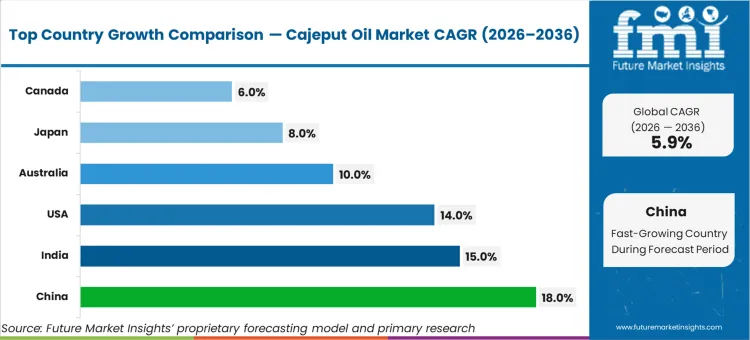
China: Increasing Propensity for Natural Remedies
The market in China will grow with rising disposable incomes and an increasing propensity for natural remedies. It would capture a significant share in the Asia Pacific region, as the demand will be sustained.
India: Rising Demand for Cajeput Oil
India is witnessing a rising demand for cajeput oil, primarily because of its application in traditional medicine and personal care products. The market is expected to grow at a fast pace due to a large consumer base and increased health awareness.
Japan: Growing Consumer Interest in Cajeput Oil
The growth of the market in Japan is driven by the integration of cajeput oil in aromatherapy and wellness practices. The market is expected to grow steadily, as consumers are showing consistent interest.
Australia: Growing Sustainability
Australia is the native region of cajeput, and therefore it has an already established market; growth in this market will be supported by domestic production as well as export activities. The market will sustain growth because of its position as a key supplier in the global market.
Market Concentration
As per FMI analysis, the market for cajeput oil remains moderately concentrated. Key players control production and distribution. Leading manufacturers maintain their edge through advanced extraction technologies and supply chains. Companies focus on differentiation, organic certifications, and new applications in various industries such as cosmetics, health care, and aromatherapy to strengthen market positions.
The North American market, led by the USA, benefits from advanced technology and major industry players, ensuring steady growth. Asia Pacific, with strong demand in China and India, is emerging as a dominant force. Increasing consumer awareness and disposable incomes in developing economies further drive market expansion, intensifying competition among key stakeholders.
The organic segment is gaining momentum, as consumers have started to seek more natural and chemical-free products. Companies are investing in sustainable sourcing and environmentally friendly production methods to capture larger market shares. This shift toward organic cajeput oil has influenced both product innovation and marketing strategies, cementing its place in premium health and wellness markets.
The cosmetics and healthcare sectors are a prime determinant of market trends. A growing demand for natural skincare solutions and therapeutic applications fuels the adoption of cajeput oil. Industry players are constantly exploring new formulations and partnerships to enhance the efficacy of the product, increase consumer reach, and secure long-term profitability in an evolving landscape.
Competitive Landscape
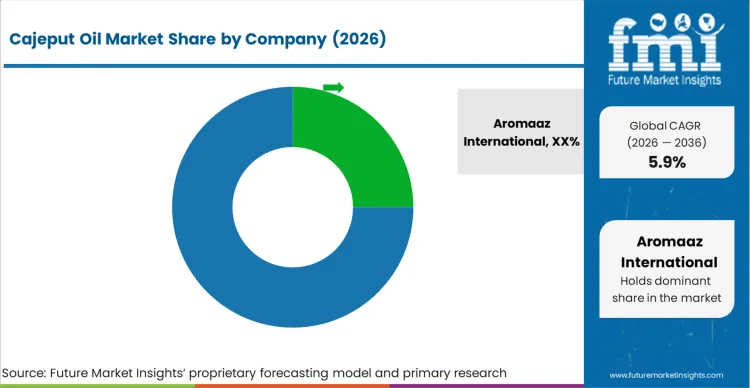
The market is relatively fragmented, with key players focusing on strategies such as mergers and acquisitions and expansion of their distribution networks to improve their market positions. These manufacturers use different competitive approaches, such as product launches, free-from claims, and organic and natural origin claims. As consumers are increasingly looking for products that support better health and fitness, there is a scope for expansion for players in the market.
Key players in the market are Aromaaz International, Ology Essentials, Plant Therapy Essential Oils, AOS Products, Kazima Perfumers, Edens Garden, DevinezIndia, Indiana Botanic Gardens, Inc., and Greenwood Essential. Other key players are Young Living Essential Oils, doTERRA International, Mountain Rose Herbs, Eden Botanicals, Aura Cacia, Aromatics International, Floracopeia & NHR Organic Oils. In this marketplace, producers had adopted several competitive strategies, such as new product developments.
Recent Developments
The report includes full coverage of key trends from competitive benchmarking. Some of the recent developments covered in the reports:
- In February 2026, industry leaders reached a milestone with the adoption of agentic AI where autonomous systems independently optimise steam distillation parameters using real-time sensory data and 1,8-cineole chemical marker monitoring, enabling manufacturers to reduce energy consumption by an estimated 15 percent while achieving consistent therapeutic-grade purity profiles for medical applications. [1]
- In March 2026, a study unveiled the high inhibitory potential of Melaleuca cajuputi essential oils against MRSA using in silico molecular docking to reveal that alloaromadendrene has strong binding to toxic shock proteins, driving research and development into cajeput-based next-generation plant-derived therapeutics for hospital-grade infection treatment. [2]
- In late 2025, QuantoAgro successfully raised USD 650,000 to expand its sustainable essential oils business, targeting increased cajeput production capacity through vertically integrated eco-friendly harvesting practices in Asia-Pacific to meet global demand for verified natural remedies. [3]
Key Market Players
- Aromaaz International
- Ology Essentials
- Plant Therapy Essential Oils
- AOS Products
- Kazima Perfumers
- Edens Garden
- DevinezIndia
- Indiana Botanic Gardens, Inc.
- Greenwood Essential
Scope of the Report
| Metric | Value |
|---|---|
| Quantitative Units | USD 597.6 million (2026) to USD 1,060.1 million (2036), at a CAGR of 5.9% |
| Market Definition | The cajeput oil market covers steam-distilled Melaleuca cajuputi essential oil in organic and conventional grades for healthcare, cosmetics, aromatherapy, and food flavoring applications, differentiated by 1,8-cineole purity, therapeutic-grade specification, and sustainable harvesting provenance. |
| Nature Segmentation | Organic, Conventional |
| Product Division | Essential Oils, Crude Oils |
| End Use Segmentation | Healthcare, Cosmetics, Aromatherapy, Food and Beverages, Others |
| Regions Covered | North America, Latin America, Europe, East Asia, South Asia, Oceania, Middle East and Africa |
| Countries Covered | China, India, United States, Australia, Japan, Canada and 40 plus countries |
| Key Companies Profiled | Aromaaz International, Ology Essentials, Plant Therapy Essential Oils, AOS Products, Kazima Perfumers, Edens Garden, DevinezIndia, Indiana Botanic Gardens Inc., Greenwood Essential |
| Forecast Period | 2026 to 2036 |
| Approach | Hybrid top-down and bottom-up market modeling validated through primary interviews with cajeput essential oil distillers and cosmetics ingredient buyers, supported by Indonesian and Malaysian essential oil export statistics and bioactivity research publications |
Cajeput Oil Market Segmentation
By Nature:
With respect to nature, the market is classified into organic cajeput oil and conventional cajeput oil.
By Product Division:
In terms of product division, the market is segmented into essential oils and crude oils.
By End-use:
In terms of end-use, the market is divided into healthcare, cosmetics, aromatherapy, food & beverages (flavoring agent), and others.
By Region:
In terms of region, the market is segmented into North America, Europe, Asia Pacific, Latin America, and the Middle East & Africa.
Bibliography
- [1] Future Market Insights Inc. (2026). Agentic AI adoption in cajeput essential oil steam distillation: autonomous systems optimising 1,8-cineole monitoring achieving 15% energy reduction and consistent therapeutic-grade purity. Market Update, February 2026.
- [2] Research Publication. (2026). High inhibitory potential of Melaleuca cajuputi essential oils against MRSA: in silico molecular docking reveals alloaromadendrene binding to toxic shock proteins driving antimicrobial therapeutic research. Published Study, March 2026.
- [3] QuantoAgro. (2025). QuantoAgro raises USD 650,000 for sustainable essential oils expansion targeting increased cajeput production capacity through vertically integrated eco-friendly Asia-Pacific harvesting. Investment Announcement, Late 2025.
- [4] Indonesian Ministry of Trade. (2025). Indonesia essential oil export statistics 2024-2025: cajeput oil production volumes, export values, and destination market analysis. Ministry Statistical Report.
- [5] European Medicines Agency. (2025). EMA herbal medicines committee assessment of Melaleuca cajuputi leaf oil: monograph review and therapeutic application criteria. Herbal Medicines Monograph.
- [6] Organic Trade Association. (2025). Organic essential oil market statistics 2024-2025: certified organic botanical ingredient production volumes and retail sales by category. Annual Industry Report.
This Report Addresses
- Market intelligence to enable structured sourcing, product development, and certification investment decisions for cajeput oil producers, natural cosmetics ingredient buyers, aromatherapy product formulators, healthcare and pharmaceutical ingredient procurement specialists, and sustainable essential oil investment programs
- Market size estimation and 10-year revenue forecasts from 2026 to 2036, supported by Southeast Asian essential oil export statistics, organic certification body data, and verified bioactivity research and company investment announcements
- Growth opportunity mapping across nature, product division, and end-use segments with emphasis on MRSA antimicrobial pharmaceutical application development, agentic AI distillation optimisation, and organic certified sustainable harvest expansion
- Segment and regional revenue forecasts covering healthcare, cosmetics, aromatherapy, and food flavoring channels across key cajeput oil consuming geographies in Asia-Pacific, North America, and Europe
- Competition strategy assessment including organic certification program status, therapeutic-grade bioactive fraction documentation, AI distillation optimisation adoption, and sustainable harvesting provenance verification program development
- Product and certification tracking including organic Melaleuca cajuputi certification requirements, 1,8-cineole purity specifications for healthcare applications, and pharmaceutical-grade antimicrobial ingredient qualification standards
- Regulatory impact analysis covering EMA herbal medicine monograph requirements for cajeput oil therapeutic applications, FDA botanical ingredient regulatory frameworks, and organic certification standards affecting premium cosmetics market access
- Market report delivery in PDF, Excel, PPT, and interactive dashboard formats for executive and operational use
Frequently Asked Questions
How large is the demand for cajeput oil in the global market in 2026?
Demand for cajeput oil in the global market is estimated to be valued at USD 597.6 million in 2026.
What will be the market size of cajeput oil by 2036?
Market size for cajeput oil is projected to reach USD 1,060.1 million by 2036.
What is the expected CAGR for the cajeput oil market between 2026 and 2036?
Demand for cajeput oil is expected to grow at a CAGR of 5.9% between 2026 and 2036.
Which nature segment leads cajeput oil demand?
Organic holds approximately 68% of nature segment share, reflecting premium cosmetics, aromatherapy, and natural healthcare markets' requirement for certified organic botanical ingredients with verified non-GMO cultivation, pesticide-free processing, and sustainable harvest provenance.
What is the significance of the 2026 MRSA research for cajeput oil?
The March 2026 in silico molecular docking study identifying alloaromadendrene's binding mechanism against MRSA toxic shock proteins provides the scientific validation threshold pharmaceutical procurement teams require to initiate ingredient qualification processes, positioning cajeput oil as a credentialed antimicrobial therapeutic candidate beyond traditional aromatherapy applications.
Which countries show the fastest growth in cajeput oil demand?
China leads at 18.0% CAGR through 2036, followed by India at 15.0% and USA at 14.0%, driven by expanding traditional medicine and cosmetics manufacturing, Ayurvedic healthcare sector demand growth, and clean-label natural healthcare and cosmetics ingredient adoption respectively.
How does agentic AI affect cajeput oil production quality?
Agentic AI autonomous optimisation of steam distillation parameters using real-time 1,8-cineole chemical marker monitoring enables consistent therapeutic-grade purity profiles with 15 percent lower energy consumption, creating both product quality differentiation and sustainability credentials that conventional fixed-parameter distillation cannot achieve.
Is Australia covered in this report's regional analysis?
Yes, Australia is covered at a projected 10.0% CAGR through 2036, reflecting natural personal care and complementary medicine market growth in geographic proximity to Indonesian cajeput supply and growing consumer demand for verified sustainable botanical ingredients.
How does FMI validate the cajeput oil market forecast?
The forecast uses a hybrid model validated through primary interviews with cajeput essential oil distillers and cosmetics ingredient buyers, cross-referenced against Indonesian and Malaysian essential oil export statistics, organic certification body registries, and verified bioactivity research publication and company investment announcements.
Preview the report firsthand - request a free sample
Get SampleGet the brochure for pricing and purchase details.
Get PDFTable of Content
- Executive Summary
- Global Market Outlook
- Demand-side Trends
- Supply-side Trends
- Technology Roadmap Analysis
- Analysis and Recommendations
- Market Overview
- Market Coverage / Taxonomy
- Market Definition / Scope / Limitations
- Research Methodology
- Chapter Orientation
- Analytical Lens and Working Hypotheses
- Market Structure, Signals, and Trend Drivers
- Benchmarking and Cross-market Comparability
- Market Sizing, Forecasting, and Opportunity Mapping
- Research Design and Evidence Framework
- Desk Research Programme (Secondary Evidence)
- Company Annual and Sustainability Reports
- Peer-reviewed Journals and Academic Literature
- Corporate Websites, Product Literature, and Technical Notes
- Earnings Decks and Investor Briefings
- Statutory Filings and Regulatory Disclosures
- Technical White Papers and Standards Notes
- Trade Journals, Industry Magazines, and Analyst Briefs
- Conference Proceedings, Webinars, and Seminar Materials
- Government Statistics Portals and Public Data Releases
- Press Releases and Reputable Media Coverage
- Specialist Newsletters and Curated Briefings
- Quantitative Surveys and Structured Data Capture
- Blended Approach
- Why Primary Evidence is Used
- Field Techniques
- Interviews
- Surveys
- Focus Groups
- Observational and In-context Research
- Social and Community Interactions
- Stakeholder Universe Engaged
- C-suite Leaders
- Board Members
- Presidents and Vice Presidents
- R&D and Innovation Heads
- Technical Specialists
- Domain Subject-matter Experts
- Scientists
- Physicians and Other Healthcare Professionals
- Governance, Ethics, and Data Stewardship
- Research Ethics
- Data Integrity and Handling
- Desk Research Programme (Secondary Evidence)
- Tooling, Models, and Reference Databases
- Data Engineering and Model Build
- Data Acquisition and Ingestion
- Cleaning, Normalisation, and Verification
- Synthesis, Triangulation, and Analysis
- Quality Assurance and Audit Trail
- Market Background
- Market Dynamics
- Drivers
- Restraints
- Opportunity
- Trends
- Scenario Forecast
- Demand in Optimistic Scenario
- Demand in Likely Scenario
- Demand in Conservative Scenario
- Opportunity Map Analysis
- Product Life Cycle Analysis
- Supply Chain Analysis
- Investment Feasibility Matrix
- Value Chain Analysis
- PESTLE and Porter’s Analysis
- Regulatory Landscape
- Regional Parent Market Outlook
- Production and Consumption Statistics
- Import and Export Statistics
- Market Dynamics
- Global Market Analysis 2021 to 2025 and Forecast, 2026 to 2036
- Historical Market Size Value (USD Million) Analysis, 2021 to 2025
- Current and Future Market Size Value (USD Million) Projections, 2026 to 2036
- Y-o-Y Growth Trend Analysis
- Absolute $ Opportunity Analysis
- Global Market Pricing Analysis 2021 to 2025 and Forecast 2026 to 2036
- Global Market Analysis 2021 to 2025 and Forecast 2026 to 2036, By Nature
- Introduction / Key Findings
- Historical Market Size Value (USD Million) Analysis By Nature , 2021 to 2025
- Current and Future Market Size Value (USD Million) Analysis and Forecast By Nature , 2026 to 2036
- Organic
- Conventional
- Organic
- Y-o-Y Growth Trend Analysis By Nature , 2021 to 2025
- Absolute $ Opportunity Analysis By Nature , 2026 to 2036
- Global Market Analysis 2021 to 2025 and Forecast 2026 to 2036, By Product Division
- Introduction / Key Findings
- Historical Market Size Value (USD Million) Analysis By Product Division, 2021 to 2025
- Current and Future Market Size Value (USD Million) Analysis and Forecast By Product Division, 2026 to 2036
- Essential oils
- Crude oils
- Essential oils
- Y-o-Y Growth Trend Analysis By Product Division, 2021 to 2025
- Absolute $ Opportunity Analysis By Product Division, 2026 to 2036
- Global Market Analysis 2021 to 2025 and Forecast 2026 to 2036, By By End-use
- Introduction / Key Findings
- Historical Market Size Value (USD Million) Analysis By By End-use, 2021 to 2025
- Current and Future Market Size Value (USD Million) Analysis and Forecast By By End-use, 2026 to 2036
- Healthcare
- Cosmetics
- Aromatherapy
- Food & Beverages (flavoring agent)
- Others
- Healthcare
- Y-o-Y Growth Trend Analysis By By End-use, 2021 to 2025
- Absolute $ Opportunity Analysis By By End-use, 2026 to 2036
- Global Market Analysis 2021 to 2025 and Forecast 2026 to 2036, By Region
- Introduction
- Historical Market Size Value (USD Million) Analysis By Region, 2021 to 2025
- Current Market Size Value (USD Million) Analysis and Forecast By Region, 2026 to 2036
- North America
- Latin America
- Western Europe
- Eastern Europe
- East Asia
- South Asia and Pacific
- Middle East & Africa
- Market Attractiveness Analysis By Region
- North America Market Analysis 2021 to 2025 and Forecast 2026 to 2036, By Country
- Historical Market Size Value (USD Million) Trend Analysis By Market Taxonomy, 2021 to 2025
- Market Size Value (USD Million) Forecast By Market Taxonomy, 2026 to 2036
- By Country
- USA
- Canada
- Mexico
- By Nature
- By Product Division
- By By End-use
- By Country
- Market Attractiveness Analysis
- By Country
- By Nature
- By Product Division
- By By End-use
- Key Takeaways
- Latin America Market Analysis 2021 to 2025 and Forecast 2026 to 2036, By Country
- Historical Market Size Value (USD Million) Trend Analysis By Market Taxonomy, 2021 to 2025
- Market Size Value (USD Million) Forecast By Market Taxonomy, 2026 to 2036
- By Country
- Brazil
- Chile
- Rest of Latin America
- By Nature
- By Product Division
- By By End-use
- By Country
- Market Attractiveness Analysis
- By Country
- By Nature
- By Product Division
- By By End-use
- Key Takeaways
- Western Europe Market Analysis 2021 to 2025 and Forecast 2026 to 2036, By Country
- Historical Market Size Value (USD Million) Trend Analysis By Market Taxonomy, 2021 to 2025
- Market Size Value (USD Million) Forecast By Market Taxonomy, 2026 to 2036
- By Country
- Germany
- UK
- Italy
- Spain
- France
- Nordic
- BENELUX
- Rest of Western Europe
- By Nature
- By Product Division
- By By End-use
- By Country
- Market Attractiveness Analysis
- By Country
- By Nature
- By Product Division
- By By End-use
- Key Takeaways
- Eastern Europe Market Analysis 2021 to 2025 and Forecast 2026 to 2036, By Country
- Historical Market Size Value (USD Million) Trend Analysis By Market Taxonomy, 2021 to 2025
- Market Size Value (USD Million) Forecast By Market Taxonomy, 2026 to 2036
- By Country
- Russia
- Poland
- Hungary
- Balkan & Baltic
- Rest of Eastern Europe
- By Nature
- By Product Division
- By By End-use
- By Country
- Market Attractiveness Analysis
- By Country
- By Nature
- By Product Division
- By By End-use
- Key Takeaways
- East Asia Market Analysis 2021 to 2025 and Forecast 2026 to 2036, By Country
- Historical Market Size Value (USD Million) Trend Analysis By Market Taxonomy, 2021 to 2025
- Market Size Value (USD Million) Forecast By Market Taxonomy, 2026 to 2036
- By Country
- China
- Japan
- South Korea
- By Nature
- By Product Division
- By By End-use
- By Country
- Market Attractiveness Analysis
- By Country
- By Nature
- By Product Division
- By By End-use
- Key Takeaways
- South Asia and Pacific Market Analysis 2021 to 2025 and Forecast 2026 to 2036, By Country
- Historical Market Size Value (USD Million) Trend Analysis By Market Taxonomy, 2021 to 2025
- Market Size Value (USD Million) Forecast By Market Taxonomy, 2026 to 2036
- By Country
- India
- ASEAN
- Australia & New Zealand
- Rest of South Asia and Pacific
- By Nature
- By Product Division
- By By End-use
- By Country
- Market Attractiveness Analysis
- By Country
- By Nature
- By Product Division
- By By End-use
- Key Takeaways
- Middle East & Africa Market Analysis 2021 to 2025 and Forecast 2026 to 2036, By Country
- Historical Market Size Value (USD Million) Trend Analysis By Market Taxonomy, 2021 to 2025
- Market Size Value (USD Million) Forecast By Market Taxonomy, 2026 to 2036
- By Country
- Kingdom of Saudi Arabia
- Other GCC Countries
- Turkiye
- South Africa
- Other African Union
- Rest of Middle East & Africa
- By Nature
- By Product Division
- By By End-use
- By Country
- Market Attractiveness Analysis
- By Country
- By Nature
- By Product Division
- By By End-use
- Key Takeaways
- Key Countries Market Analysis
- USA
- Pricing Analysis
- Market Share Analysis, 2025
- By Nature
- By Product Division
- By By End-use
- Canada
- Pricing Analysis
- Market Share Analysis, 2025
- By Nature
- By Product Division
- By By End-use
- Mexico
- Pricing Analysis
- Market Share Analysis, 2025
- By Nature
- By Product Division
- By By End-use
- Brazil
- Pricing Analysis
- Market Share Analysis, 2025
- By Nature
- By Product Division
- By By End-use
- Chile
- Pricing Analysis
- Market Share Analysis, 2025
- By Nature
- By Product Division
- By By End-use
- Germany
- Pricing Analysis
- Market Share Analysis, 2025
- By Nature
- By Product Division
- By By End-use
- UK
- Pricing Analysis
- Market Share Analysis, 2025
- By Nature
- By Product Division
- By By End-use
- Italy
- Pricing Analysis
- Market Share Analysis, 2025
- By Nature
- By Product Division
- By By End-use
- Spain
- Pricing Analysis
- Market Share Analysis, 2025
- By Nature
- By Product Division
- By By End-use
- France
- Pricing Analysis
- Market Share Analysis, 2025
- By Nature
- By Product Division
- By By End-use
- India
- Pricing Analysis
- Market Share Analysis, 2025
- By Nature
- By Product Division
- By By End-use
- ASEAN
- Pricing Analysis
- Market Share Analysis, 2025
- By Nature
- By Product Division
- By By End-use
- Australia & New Zealand
- Pricing Analysis
- Market Share Analysis, 2025
- By Nature
- By Product Division
- By By End-use
- China
- Pricing Analysis
- Market Share Analysis, 2025
- By Nature
- By Product Division
- By By End-use
- Japan
- Pricing Analysis
- Market Share Analysis, 2025
- By Nature
- By Product Division
- By By End-use
- South Korea
- Pricing Analysis
- Market Share Analysis, 2025
- By Nature
- By Product Division
- By By End-use
- Russia
- Pricing Analysis
- Market Share Analysis, 2025
- By Nature
- By Product Division
- By By End-use
- Poland
- Pricing Analysis
- Market Share Analysis, 2025
- By Nature
- By Product Division
- By By End-use
- Hungary
- Pricing Analysis
- Market Share Analysis, 2025
- By Nature
- By Product Division
- By By End-use
- Kingdom of Saudi Arabia
- Pricing Analysis
- Market Share Analysis, 2025
- By Nature
- By Product Division
- By By End-use
- Turkiye
- Pricing Analysis
- Market Share Analysis, 2025
- By Nature
- By Product Division
- By By End-use
- South Africa
- Pricing Analysis
- Market Share Analysis, 2025
- By Nature
- By Product Division
- By By End-use
- USA
- Market Structure Analysis
- Competition Dashboard
- Competition Benchmarking
- Market Share Analysis of Top Players
- By Regional
- By Nature
- By Product Division
- By By End-use
- Competition Analysis
- Competition Deep Dive
- Aromaaz International
- Overview
- Product Portfolio
- Profitability by Market Segments (Product/Age /Sales Channel/Region)
- Sales Footprint
- Strategy Overview
- Marketing Strategy
- Product Strategy
- Channel Strategy
- Ology Essentials
- Plant Therapy Essential Oils
- AOS Products
- Kazima Perfumers
- Edens Garden
- DevinezIndia
- Indiana Botanic Gardens, Inc.
- Greenwood Essential
- Aromaaz International
- Competition Deep Dive
- Assumptions & Acronyms Used


