

- Market Size (2026)
- USD 520.6 Mn
- Forecast (2036)
- USD 1050.6 Mn
- CAGR (2026 to 2036)
- 7.3%
How big is Catalyst Layer Binders Market in 2026?
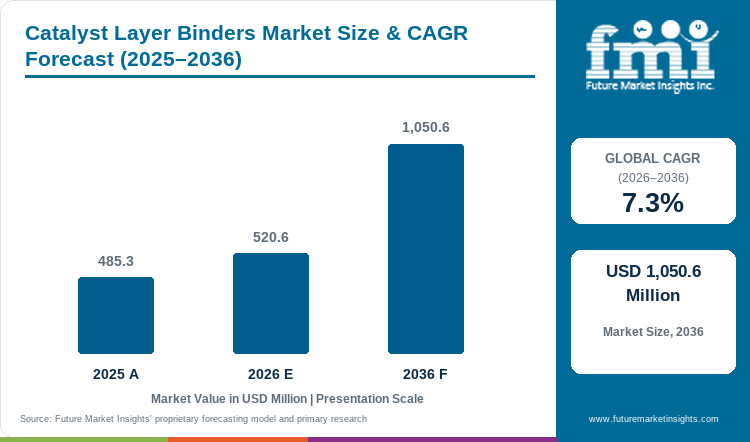
USD 520.6 million in 2026 and USD 1,050.6 million by 2036, expanding at 7.3% CAGR.
Sales of catalyst layer binders are estimated to rise at 7.3% CAGR through 2036. Valuation rises from USD 485.3 million in 2025 and USD 520.6 million in 2026 to USD 1,050.6 million by 2036. Production teams are moving binder inks from laboratory batches into wider coating runs that demand consistent flow and catalyst coverage. In June 2025, Ionomr Innovations signed with Jolt Solutions to pair AEM ionomer materials with nickel electrodes. That collaboration gives larger production trials a combined binder-and-electrode route for evaluating process stability. Consistent ink flow helps manufacturers keep one qualified recipe across scheduled coating runs.
Spain is projected to grow at 6.5% CAGR through 2036 compared with 4.5% for Japan. Spanish hydrogen projects are moving from funding awards into equipment design and site preparation. In January 2025, the government raised Spain's 2030 electrolyzer target to 12 GW. Japanese OEMs use longer qualification programs before approving new fuel-cell and electrolyzer materials. Different project cycles influence binder approval timing and the move from trials into recurring production. Local technical support and dependable stock help manufacturers keep validated recipes available across scheduled production runs.
Key Takeaways
- Wider electrode runs increase qualified binder demand by raising the cost of unstable ion flow and uneven catalyst coverage.
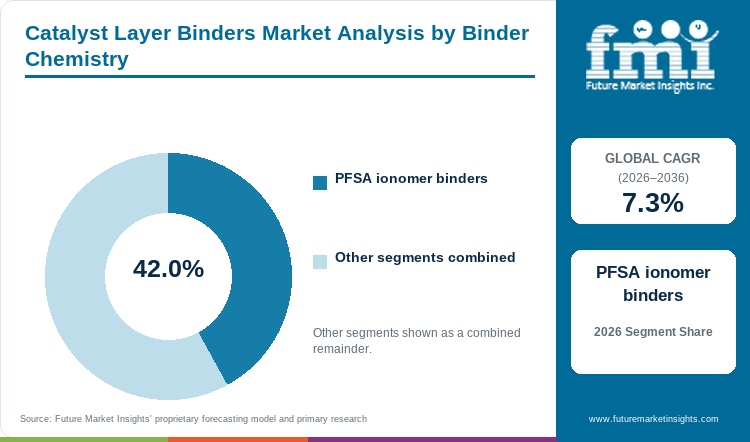
- PFSA ionomer binders are estimated to hold 42.0% in 2026, reinforced by long-established PEM qualification histories.
- Electrolyzer electrodes are projected to account for 34.0% in 2026, supported by larger coating runs that require stable binder formulations.
- Dispersion is forecast to represent 47.0% in 2026, supported by liquid delivery that helps maintain repeatable catalyst coating.
- Long qualification programs restrain binder changes when new chemistry alters coating flow, adhesion or cell life.
- Key suppliers include Chemours, Syensqo, AGC Chemicals, Ionomr Innovations, Versogen, Ecolectro, FUMATECH BWT, and ionysis across defined binder routes.
Analyst Perspective
“The commercial opportunity lies in carrying a qualified binder formulation from pilot coating into routine production without changing process behavior. Adoption depends on proving consistent coating quality and cell life across each customer's operating conditions.”
- Nikhil Kaitwade, Principal Consultant, Future Market Insights
How is the catalyst layer binders market segmented?
The catalyst layer binders market is segmented by Binder Chemistry, Application, Device Type, Form, Sales Channel, and Region.
The catalyst layer binders market is segmented by binder chemistry, application, device type, form, sales channel and region. Binder chemistry includes PFSA ionomer binders, hydrocarbon ionomers, PTFE binders, AEM ionomers and hybrid catalyst binders. Application includes electrolyzer electrodes, fuel cell electrodes, MEA fabrication, gas diffusion electrodes and R&D formulations. Device type includes PEM fuel cells, PEM electrolyzers, AEM electrolyzers, DMFC systems and pilot electrochemical cells. Form includes dispersion, solution, powder and custom ink blend options. Sales channel includes MEA manufacturers, catalyst suppliers, electrochemical OEMs and R&D/lab suppliers.
How do PFSA ionomer binders shape decisions within the binder chemistry category?
PFSA binders give PEM electrodes a familiar ion pathway that works with established catalyst formulations. PEM electrolyzers rely on these binders to move protons across catalyst surfaces under acidic operating conditions. Hydrocarbon and AEM binders reduce fluorine use while following different ion-transport routes. Qualification teams compare coating quality and cell life before approving a new binder formulation for production.
- PFSA ionomer binders are projected to hold 42.0% of binder chemistry revenue in 2026, supported by established PEM qualification histories.
- In May 2025, Berkeley Lab reported that PFSA ionomer uptake on Pt/C particles changes fuel-cell ink behavior.
Why do electrolyzer electrodes lead the application category?
Electrolyzer electrodes need binders that move ions without blocking gas or water transport through the catalyst layer. Hydrogen electrolyzers require an even binder layer across larger electrode areas during production scale-up. Lower catalyst loading raises the cost of uneven coating by reducing performance margin in each production run. Formulation teams control binder ratio, solvent choice and drying time during trials to protect coating consistency.
- Electrolyzer electrodes are estimated to hold 34.0% of application revenue in 2026, enabled by stable formulation control across larger coating runs.
- In May 2026, AGC said FORBLUE i-SERIES entered Toyota's 5 MW-class PEM water electrolysis test.
What keeps PEM fuel cells important within the device type category?
PEM fuel cells use ionomer inside the catalyst layer to move protons toward active reaction sites. Vehicle and stationary systems face start-stop operation and long service-life testing before platform approval. Established test histories favor binders with known cell results on qualified PEM platforms. AEM and DMFC systems use different chemistries that require separate formulation and validation programs.
- PEM fuel cells are expected to hold 34.0% of device-type revenue in 2026, linked to established platform qualification histories.
- In February 2026, Syensqo confirmed Aquivion ion-exchange polymer in the Climate Impulse fuel-cell membrane electrode assembly.
How does dispersion support the form category?
Catalyst layers usually begin as liquid inks that must wet particles and coat electrode surfaces evenly. A dispersion gives formulation teams a defined solids level and solvent system for repeatable processing. Electrolyzer equipment uses those inks in controlled coating steps that depend on steady material flow. Powder forms offer more formulation freedom but require additional mixing and dissolution before coating.
- Dispersion is forecast to represent 47.0% of form revenue in 2026, enabled by defined liquid delivery for repeatable catalyst coating.
- In September 2025, Syensqo published a guide placing Aquivion ionomer in catalyst layers for fuel-cell MEAs.
Why do MEA manufacturers lead the sales channel category?
MEA manufacturers decide which binder formulation can move from trials into regular plant production. Their process specifications define ink composition and coating steps before finished electrodes enter formal cell testing. A chemistry change can alter resistance or water flow across fuel cell systems during operation. Process changes can alter the approved electrode recipe, making direct technical support important during final validation.
- MEA manufacturers are set to lead the sales channel with 38.0% share in 2026, tied to formulation tests and release checks.
- In January 2025, Ionomr opened a Boston center for development and low-volume production to support customer work with ion-exchange materials.
What are the drivers, restraints and opportunities in the Catalyst Layer Binders Market?
Electrode scale-up raises qualified binder demand, long validation slows chemistry changes, and lower-fluorine ionomers open new formulation routes.
- Driver: Qualified binder demand is driven by wider electrode runs that make ion-flow stability and coating consistency more important during routine production.
- Restraint: Approval delays are attributable to extra testing required when new binder grades can change ink flow or cell life.
- Opportunity: Hydrocarbon and AEM ionomers can gain volume through lower-fluorine routes that meet both cell-performance and coating requirements.
At larger coating volumes, binder inconsistency wastes catalyst and interrupts scheduled electrode output. Production teams test solids content and catalyst contact before releasing each ink lot into routine use. In March 2025, the U.S. Department of Energy reported more than 15 new or expanded manufacturing plants. Those projects cover electrolyzers, fuel cells and related components that depend on repeatable electrode production. Larger plants increase the value of binder grades that maintain consistent output across wider coating runs. Detailed lot records help operators control line speed without weakening routine quality checks. Alternative recipes require fresh testing before approval, which makes qualified grades harder to replace.
Each new binder grade can alter ink flow and catalyst coverage, so every change requires fresh qualification. MEA manufacturers also test cell aging before approving a revised formulation for routine production. In September 2025, Ionomr reported fuel-cell tests of all-hydrocarbon MEAs using its Pemion ionomer. The reported system reached more than 1.4 W/cm² at 2.4 A/cm² and 0.6 V during testing. Those results give manufacturers a benchmark for comparing alternative binder routes with established plant requirements. Failed trials waste catalyst and can interrupt scheduled coating runs during qualification. Long validation cycles therefore keep proven recipes active until alternative grades pass both coating and cell tests.
Hydrocarbon and AEM ionomers create a lower-fluorine route for alkaline electrochemical cells. Each binder must move ions without blocking water transport inside the catalyst layer. In May 2025, Berkeley Lab reported pure-water AEM electrolyzer results at 2.0 A/cm² and 1.97 V with a non-PGM anode. Those results provide a practical benchmark for comparing new chemistry with operating requirements. Material developers pair ionomer design with catalyst selection and coating support during formulation work. Pilot teams compare cell output, service life and ink behavior before approving each recipe. Suppliers can extend beyond sample sales by helping customers tune these connected process steps and stabilize successful formulations.
Which country CAGRs are profiled in the Catalyst Layer Binders Market?
| Country | CAGR |
|---|---|
| Spain | 6.5% |
| South Korea | 6.2% |
| Mexico | 5.9% |
| USA | 5.5% |
| Germany | 5.2% |
| France | 4.8% |
| Japan | 4.5% |
How do country-level CAGRs compare in the Catalyst Layer Binders Market?
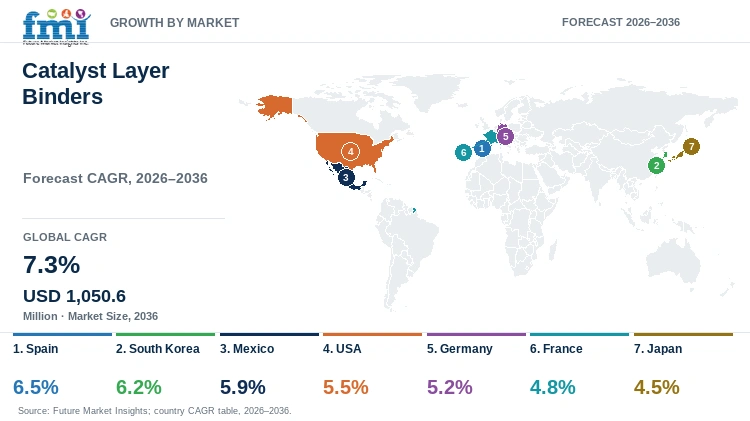
Spain and South Korea carry the fastest profiled rates at 6.5% and 6.2% CAGR. Mexico and the USA follow at 5.9% and 5.5% across the same forecast period. Germany, France and Japan post lower rates as project timing and qualification schedules delay binder orders. The 2.0-point spread compares forecast pace across all seven profiled countries. These rates describe expected growth rather than current revenue size in any country.
- Spain's 12 GW electrolyzer target gives equipment developers a larger planning base for catalyst-layer materials used in repeatable industrial coating programs.
- South Korea's fuel-cell manufacturing base favors binder materials that maintain stable MEA coating and durability results across repeated production runs.
- Mexico's reliance on imported binder samples makes dependable delivery and technical support important during early electrode trials and qualification work.
- Hydrogen fuel-cell vehicle programs in the USA keep lifetime testing and lot consistency important during qualification of new PEM binder recipes.
- German equipment qualification cycles favor dependable local binder stock and detailed test records during long validation programs for hydrogen projects.
- French electrolysis programs benefit from local binder stock and engineering support that keeps material trials moving through ink and drying adjustments.
- Japan's priority-region approach concentrates fuel-cell vehicle activity in named areas and rewards suppliers that place technical support near OEM programs.
Similar CAGRs can produce different sales conditions across countries with different device mixes and qualification schedules. Forecast pace does not measure the current revenue base within any profiled country.
The full report extends country-level CAGR analysis across all seven defined global regions. Coverage includes North America, Latin America, Western Europe, Eastern Europe, East Asia, South Asia and Pacific, and Middle East and Africa.
Country-wise Analysis
- Spanish hydrogen projects are moving from funding awards into equipment design and site preparation. Spain is estimated to post 6.5% CAGR through 2036, supported by projects entering equipment qualification. In February 2025, the government selected seven hydrogen valley projects covering 2,278 MW of planned electrolysis across 11 sites. That project base gives electrode makers more locations for testing binder recipes under site-specific operating requirements. Project teams use electrolyzer services for start-up checks and process work before regular production begins. Grid access and final permits can delay commissioning schedules and recurring material orders. Dependable stock and local engineering support help qualified recipes move from trials into regular purchasing without avoidable material gaps.
- South Korea links hydrogen development with fuel-cell manufacturing and designated industrial districts. Binder demand is estimated to expand at 6.2% CAGR through 2036, reinforced by district projects moving into implementation. In June 2025, the industry ministry reviewed two hydrogen special districts and their detailed project plans. The program connects plant development with hydrogen storage and fuel-cell use across defined local projects. Vehicle programs using fuel cell powertrains require stable MEA materials during repeated series-production testing. Local qualification teams pair new binders with each plant's catalyst system and coating process. Regional stock and clear lot records reduce test interruptions while giving approved materials a clearer route into recurring orders.
- Imported samples and pilot electrodes keep Mexican binder demand project-led during early programs. Through 2036, demand is forecast to rise at 5.9% CAGR, influenced by renewable power plans and hydrogen project economics. In December 2025, the national energy program assigned intermittent renewables 96% of planned private capacity additions through 2030. Variable generation can increase hydrogen interest in industrial projects that need flexible energy conversion. Industrial users also need hydrogen transport systems to move output from production sites toward demand centers. Pilot programs depend on timely materials and technical guidance during binder qualification. Smaller packs reduce trial waste, while reliable local support keeps testing active between planned deliveries and site work.
- US plants are scaling fuel-cell and electrolyzer output while protecting repeatable MEA performance. Binder use is projected to expand at 5.5% CAGR through 2036, tied to planned fuel-cell manufacturing scale-up. In May 2026, DOE set a 20,000-stack annual manufacturing case for 2030 against a current baseline below 2,000. The capacity gap raises pressure for faster MEA output without weaker coating or durability control. Hydrogen fuel cell vehicles keep lifetime testing important for PEM materials across vehicle qualification programs. Plant teams test each new binder recipe before releasing it into wider production. Stable lots and line support reduce qualification delays and shorten the path from samples into repeatable plant orders.
- German hydrogen projects combine network development with long equipment qualification cycles. Germany is projected to post 5.2% CAGR through 2036, tied to industrial projects connected with planned hydrogen infrastructure. In June 2026, Bundesnetzagentur said the second network plan draft covered 9,241 kilometers of hydrogen network by 2037. The planned network serves industrial projects that can require electrolyzers and related electrochemical components. Hydrogen energy storage also connects renewable output changes with equipment that depends on stable electrode performance. Network approval does not replace coating and cell validation for a new binder grade. Clear test records help manufacturers compare materials and move proven grades into routine production without disrupting qualified process settings.
- French hydrogen policy keeps electrolysis investment within a national planning framework. Binder demand is forecast to rise at 4.8% CAGR through 2036, shaped by national electrolysis targets. In April 2025, the government set 4.5 GW of electrolysis for 2030 and 8 GW for 2035. Those targets give equipment makers a defined basis for scheduling material and electrode tests. Permits and plant scale-up can delay commissioning even when project demand remains clearly defined. Stable local stock prevents material gaps during trials, while engineers adjust ink ratios and drying steps during qualification. Regular volume develops as electrode recipes pass both plant-process checks and cell validation.
- Japanese fuel-cell makers use long qualification programs to protect platform durability and material consistency. Japan is forecast to expand at 4.5% CAGR through 2036, constrained by extended OEM testing before material changes. In May 2025, METI selected five priority regions and six core local governments for fuel-cell commercial vehicles. The program concentrates deployment in named areas instead of spreading activity across a broad national rollout. Material firms keep ionomer lots consistent and place technical support near priority projects. New chemistry must pass OEM coating and cell tests before entering routine production. Long qualification histories slow supplier changes but help approved binders remain stable across repeated platform cycles.
Who are the notable companies in the Catalyst Layer Binders Market?
Chemours, Syensqo, AGC Chemicals, Ionomr Innovations, Versogen, Ecolectro, FUMATECH BWT, and ionysis are active within the defined catalyst layer binder and immediate ionomer supply boundary.
Competition centers on fluorinated ionomers, hydrocarbon AEM materials and technical support during electrode qualification. New entrants must prove that each binder works with the selected catalyst and industrial coating process. Syensqo continues Aquivion activities that came from the former Solvay specialty materials business.
- Chemours, Syensqo and AGC Chemicals supply fluorinated ionomers for PEM hydrogen systems.
- Ionomr Innovations, Versogen and Ecolectro make hydrocarbon or AEM materials for alkaline systems.
- FUMATECH BWT and ionysis support ion-exchange membranes and catalyst-coated membrane pilot work.
Competitive Benchmarking: Catalyst Layer Binders Market
| Company | Binder Fit | Device Validation | Supply Route Breadth | Geographic Reach |
|---|---|---|---|---|
| Chemours | High | High | High | Global |
| Syensqo | High | High | High | Global |
| AGC Chemicals | High | High | High | Global |
| Ionomr Innovations | High | High | Medium | North America, Europe |
| Versogen | High | High | Medium | North America, Europe, Asia |
| Ecolectro | High | High | Medium | United States |
| FUMATECH BWT | Medium | High | Medium | Global |
| ionysis | High | High | Medium | Europe |
Scoring basis: A High binder-fit score requires direct proof of catalyst-layer ionomer use. A Medium score requires membrane-electrode evidence that connects the binder with the device. A Low score covers a documented sales-channel role inside the defined market boundary. High device validation requires fuel-cell or electrolyzer use dated 2025 or later. Supply breadth covers production, integration and distribution across the same market boundary.
Key Developments in the Catalyst Layer Binders Market
- In May 2026, AGC Chemicals announced FORBLUE i-SERIES use in Toyota's 5 MW-class PEM water electrolysis test.
- In February 2026, Syensqo confirmed Aquivion ion-exchange polymer in the Climate Impulse fuel-cell MEA.
- In June 2025, Ionomr Innovations signed with Jolt Solutions to pair hydrocarbon ionomers with nickel AEM electrodes.
Key Players in the Catalyst Layer Binders Market
Fluorinated ionomer producers
- Chemours
- Syensqo
- AGC Chemicals
Hydrocarbon and AEM material developers
- Ionomr Innovations
- Versogen
- Ecolectro
Membrane and technical distribution routes
- FUMATECH BWT
- ionysis
Catalyst Layer Binders Market - Report Scope
| Coverage field | Report scope |
|---|---|
| Market breakdown | By binder chemistry, application, device type, form, sales channel and region. |
| Quantitative Units | USD million. |
| Market Definition | Revenue includes catalyst-layer binder products sold for listed electrochemical applications and devices. Catalysts, standalone membranes, finished electrodes, MEAs, stacks and complete systems are excluded. |
| Regions Covered | North America, Latin America, Western Europe, Eastern Europe, East Asia, South Asia and Pacific, and Middle East and Africa. |
| Countries Covered | Spain, South Korea, Mexico, USA, Germany, France, Japan, and 30+ countries included in the full report. |
| Key Companies Profiled | Chemours, Syensqo, AGC Chemicals, Ionomr Innovations, Versogen, Ecolectro, FUMATECH BWT, and ionysis. |
| Forecast Period | 2026 to 2036. |
| Approach | Primary and secondary research with market triangulation. |
Catalyst Layer Binders Market - Research Methodology
| Method | Approach |
|---|---|
| Primary Research | FMI analysts gathered input from manufacturers, service providers, technology developers, distributors, end users, procurement teams, and subject-matter experts. Interviews examined purchasing decisions, product or service evaluation, adoption barriers, approval requirements, pricing considerations, and expectations for technical or commercial support. Respondents were also asked what evidence is required before a trial, pilot, or initial order develops into regular purchasing. |
| Desk Research | Desk research covered government statistics, regulatory publications, trade data, industry associations, technical literature, standards, company filings, product information, and official corporate announcements. Sources were reviewed for relevance, publication date, geographic coverage, and consistency with the defined market scope. Claims relating to performance, applications, approvals, capacity, investment, and commercial activity were retained only when supported by credible public evidence. |
| Market Sizing and Forecasting | The market model combined the baseline value with historical performance, segment structure, pricing and volume indicators, adoption levels, company participation, and country-level demand conditions. Forecast assumptions considered economic activity, investment trends, regulatory developments, technology adoption, purchasing cycles, supply availability, and barriers to wider market use. Segment and regional estimates were reconciled before the final market total was calculated. |
| Data Validation | Estimates were checked against multiple independent indicators, including public data, company activity, trade patterns, industry developments, and findings from primary interviews. Validation also tested whether products, services, applications, and company revenues fell within the defined market boundaries. Adjacent categories, unsupported claims, overlapping revenues, and activities without direct market relevance were excluded to reduce double counting and maintain consistency across segments and countries. |
Catalyst Layer Binders Market by Segments
Catalyst Layer Binders Market segmented by Binder Chemistry:
- PFSA ionomer binders
- Hydrocarbon ionomers
- PTFE binders
- AEM ionomers
- Hybrid catalyst binders
Catalyst Layer Binders Market segmented by Application:
- Electrolyzer electrodes
- Fuel cell electrodes
- MEA fabrication
- Gas diffusion electrodes
- R&D formulations
Catalyst Layer Binders Market segmented by Device Type:
- PEM fuel cells
- PEM electrolyzers
- AEM electrolyzers
- DMFC systems
- Pilot electrochemical cells
Catalyst Layer Binders Market segmented by Form:
- Dispersion
- Solution
- Powder
- Custom ink blend
Catalyst Layer Binders Market segmented by Sales Channel:
- MEA manufacturers
- Catalyst suppliers
- Electrochemical OEMs
- R&D/lab suppliers
Catalyst Layer Binders Market by Region:
- North America
- United States
- Canada
- Latin America
- Brazil
- Mexico
- Argentina
- Chile
- Western Europe
- Germany
- France
- United Kingdom
- Italy
- Spain
- Benelux
- Nordics
- Eastern Europe
- Poland
- Czech Republic
- Romania
- Hungary
- East Asia
- China
- Japan
- South Korea
- South Asia and Pacific
- India
- ASEAN
- Australia and New Zealand
- Middle East and Africa
- GCC Countries
- South Africa
- Türkiye
- Israel
Research Sources and Bibliography
- Ionomr Innovations. (2025, June 3). Leading anion exchange membrane electrolyzer component suppliers collaborate to streamline adoption of technology.
- Government of Spain. (2025, January 29). Speech by the President of the Government of Spain at the inauguration of the 3rd Enagás Hydrogen Day.
- Lawrence Berkeley National Laboratory. (2025, May 7). PFSA-ionomer adsorption to C and Pt/C particles in fuel-cell inks.
- AGC Inc. (2026, May 19). FORBLUE i-SERIES fluorinated electrolyte polymer dispersion adopted as electrode material for PEM water electrolysis demonstration system.
- Syensqo. (2026, February 10). Syensqo marks two years of partnership with Climate Impulse, advancing hydrogen-powered aviation.
- Syensqo. (2025, September 10). Syensqo showcases its specialty polymers portfolio at K 2025.
- Ionomr Innovations. (2025, January 7). Ionomr Innovations opens Boston Development and Manufacturing Center.
- U.S. Department of Energy. (2025, March). Progress in hydrogen and fuel cells.
- Ionomr Innovations. (2025, September 3). Can hydrocarbon-based MEAs close the performance gap to state-of-the-art perfluorosulfonic acid-based MEAs for PEM fuel cells?
- Lawrence Berkeley National Laboratory. (2025, May 7). Perovskite catalysts for pure-water-fed anion-exchange-membrane electrolyzer anodes: Co-design of electrically conductive nanoparticle cores and active surfaces.
- Government of Spain. (2025, February 21). Ecological Transition selects seven future renewable hydrogen clusters.
- Ministry of Trade, Industry and Energy, Republic of Korea. (2025, June 26). Hydrogen specialized district development moves into implementation.
- Government of Mexico. (2025, December 22). Energy Sector Program 2025-2030.
- U.S. Department of Energy. (2026, May 14). DOE Alternative Fuels and Feedstocks Office Program Record 25001: 2030 fuel cell stack manufacturing capacities.
- Bundesnetzagentur. (2026, June 15). Bundesnetzagentur launches consultation for Gas and Hydrogen Network Development Plan 2025-2037/2045.
- Direction générale des Entreprises, France. (2025, April 16). National hydrogen strategy update.
- Ministry of Economy, Trade and Industry, Japan. (2025, May 19). First selection of priority regions for promoting deployment of fuel-cell commercial vehicles.
- AGC Inc. (2025, January 17). AGC leads the way in green hydrogen production with FORBLUE S-SERIES.
- The Chemours Company. (2026, February 20). Q4 2025 earnings call corrected transcript.
- Syensqo. (2026, March 4). Syensqo and Johnson Matthey demonstrate circular recovery of critical materials from hydrogen technologies.
- Ionomr Innovations. (2025, December 16). Ionomr Innovations celebrates ribbon cutting for Boston Development and Manufacturing Center.
- Versogen. (2026, March 12). Versogen accelerates global expansion with partnership in India following Delaware trade mission.
- Cornell University Center for Technology Licensing. (2025, August 5). Cornell-licensed Ecolectro partners with Re:Build Manufacturing to expand renewable hydrogen production.
- Office for the Protection of Competition, Czech Republic. (2025, July 3). MEGA a.s. and FUMATECH BWT GmbH may establish a joint venture.
- ionysis GmbH. (2026, July 30). ionysis achieves first successful full cell size stack validation of AEM electrolysis electrodes with H2i GreenHydrogen.
- ionysis GmbH. (2025, March 17). ionysis achieves key milestone with first electrolysis proof-of-concept projects on new coating line.
- BASF Environmental Catalyst and Metal Solutions. (2025, November 5). BASF Environmental Catalyst and Metal Solutions opens new green hydrogen and fuel cell component production facility in Budenheim, Germany.
- VSParticle. (2026, June 10). VSParticle reaches a critical milestone in scaling core technology.
- SCREEN Holdings Co., Ltd. (2025, December 9). Tokyo Gas and SCREEN ready to accept mass production orders for PEXEM, a cost-efficient water electrolysis catalyst coated membrane.
- HORIBA, Ltd. (2025, July 29). Introducing CCM/MEA catalyst coating monitor XV-100.
This bibliography is provided for reader reference and is not exhaustive. The full report contains the complete reference list and detailed citations.
This Report Answers
- How large is the catalyst layer binders market in 2026?
- What turns catalyst layer binder tests into regular commercial orders?
- Why do PFSA ionomers lead the binder chemistry category in 2026?
- Why do electrolyzer electrodes lead the application category in 2026?
- Why does dispersion lead the form category for catalyst layer binders?
- Why do binder changes require longer tests before routine production approval?
- How do the seven profiled countries differ in forecast demand conditions?
- Which companies supply catalyst-layer binder routes across fuel-cell and electrolyzer programs?
- What should MEA teams test before approving a new binder formulation?
Frequently Asked Questions
How large is the catalyst layer binders market in 2026?
The catalyst layer binders market is valued at USD 520.6 million in 2026. It is projected to reach USD 1,050.6 million by 2036 as qualified formulations move into wider coating runs. Binders connect catalyst particles with ion pathways that maintain stable electrode performance during production scale-up.
What CAGR is projected for catalyst layer binders from 2026 through 2036?
The catalyst layer binders market is projected to grow at 7.3% CAGR from 2026 through 2036. Fuel-cell and electrolyzer plants keep qualified binder formulations in use as production output expands across wider coating runs.
Which binder chemistry holds the leading revenue share in 2026?
PFSA ionomer binders are projected to hold 42.0% of binder chemistry revenue in 2026. Their proton pathway and long qualification history support established PEM electrode formulations and reduce the risk of changing proven mixes.
Which application segment holds the leading revenue share in 2026?
Electrolyzer electrodes are estimated to hold 34.0% of application revenue in 2026. Binder selection affects catalyst use and coating quality during the move from pilot layers into wider production runs.
Which form segment holds the leading revenue share in 2026?
Dispersion is forecast to represent 47.0% of form revenue in 2026. MEA teams test solids, solvent choice, coating quality and shelf life before releasing each liquid binder formulation.
Which profiled countries show the faster forecast growth rates through 2036?
Spain is projected at 6.5% CAGR, followed by South Korea at 6.2% through 2036. Mexico follows at 5.9% CAGR over the same forecast period. These rates compare expected growth pace and do not represent current country revenue size.
Which companies are active across catalyst layer binder supply routes?
Key companies include Chemours, Syensqo, AGC Chemicals, Ionomr Innovations, Versogen, Ecolectro, FUMATECH BWT and ionysis. Their work spans fluorinated and hydrocarbon ionomers together with membrane development and electrode pilot programs.
What limits expected returns when companies change catalyst layer binder suppliers?
Lower binder prices may improve purchase economics, but chemistry changes can alter ink flow and catalyst coverage. Rework, failed runs and long approval tests can erase nominal savings if a new formulation also reduces cell life.
Preview the report firsthand - request a free sample
Get SampleGet the brochure for pricing and purchase details.
Get PDFTable of Content
- Key Takeaways
- Market Size and CAGR
- Top Growth Driver
- Fastest Growing Segment
- Leading Region
- Key Companies
- Emerging Opportunities
- Executive Summary
- Global Market Outlook
- Demand-side Trends
- Supply-side Trends
- Technology Roadmap Analysis
- Analysis and Recommendations
- Analyst Perspective (What is happening? Why now? What should investors know?)
- Key Questions Answered
- How large is the market?
- What is the CAGR?
- What are key trends?
- Which region dominates?
- Who are the leaders?
- Market Overview
- Market Coverage / Taxonomy
- Market Definition / Scope / Limitations
- Research Methodology
- Chapter Orientation
- Analytical Lens and Working Hypotheses
- Market Structure, Signals, and Trend Drivers
- Benchmarking and Cross-market Comparability
- Market Sizing, Forecasting, and Opportunity Mapping
- Research Design and Evidence Framework
- Desk Research Programme (Secondary Evidence)
- Expert Input and Fieldwork (Primary Evidence)
- Tooling, Models, and Reference Databases
- Data Engineering and Model Build
- Quality Assurance and Audit Trail
- Market Background
- Market Dynamics (Drivers, Restraints, Opportunity, Trends)
- Scenario Forecast (Optimistic, Likely, Conservative)
- Impact Analysis
- AI Impact
- Sustainability Impact
- Regulatory Impact
- Technology Impact
- Consumer / Buyer Analysis
- Purchase Drivers
- Adoption Barriers
- Buyer Journey
- Opportunity Map Analysis
- Product Life Cycle Analysis
- Supply Chain Analysis
- Investment Feasibility Matrix
- Value Chain Analysis
- PESTLE and Porter's Analysis
- Regulatory Landscape
- Regional Parent Market Outlook
- Production and Consumption Statistics
- Import and Export Statistics
- Global Market Analysis and Forecast, 2021 to 2036
- Historical Market Size Value (USD Million) Analysis, 2021 to 2025
- Current and Future Market Size Value (USD Million) Projections, 2026 to 2036
- Y-o-Y Growth Trend Analysis
- Absolute $ Opportunity Analysis
- Global Market Pricing Analysis, 2021 to 2036
- Global Market Analysis and Forecast, By Binder Chemistry, 2021 to 2036
- Introduction / Key Findings
- Historical Market Size Value (USD Million) Analysis By Binder Chemistry, 2021 to 2025
- Current and Future Market Size Value (USD Million) Analysis and Forecast By Binder Chemistry, 2026 to 2036
- PFSA ionomer binders
- Hydrocarbon ionomers
- PTFE binders
- AEM ionomers
- Hybrid catalyst binders
- Y-o-Y Growth Trend Analysis By Binder Chemistry, 2021 to 2025
- Absolute $ Opportunity Analysis By Binder Chemistry, 2026 to 2036
- Global Market Analysis and Forecast, By Application, 2021 to 2036
- Introduction / Key Findings
- Historical Market Size Value (USD Million) Analysis By Application, 2021 to 2025
- Current and Future Market Size Value (USD Million) Analysis and Forecast By Application, 2026 to 2036
- Electrolyzer electrodes
- Fuel cell electrodes
- MEA fabrication
- Gas diffusion electrodes
- R&D formulations
- Y-o-Y Growth Trend Analysis By Application, 2021 to 2025
- Absolute $ Opportunity Analysis By Application, 2026 to 2036
- Global Market Analysis and Forecast, By Device Type, 2021 to 2036
- Introduction / Key Findings
- Historical Market Size Value (USD Million) Analysis By Device Type, 2021 to 2025
- Current and Future Market Size Value (USD Million) Analysis and Forecast By Device Type, 2026 to 2036
- PEM fuel cells
- PEM electrolyzers
- AEM electrolyzers
- DMFC systems
- Pilot electrochemical cells
- Y-o-Y Growth Trend Analysis By Device Type, 2021 to 2025
- Absolute $ Opportunity Analysis By Device Type, 2026 to 2036
- Global Market Analysis and Forecast, By Form, 2021 to 2036
- Introduction / Key Findings
- Historical Market Size Value (USD Million) Analysis By Form, 2021 to 2025
- Current and Future Market Size Value (USD Million) Analysis and Forecast By Form, 2026 to 2036
- Dispersion
- Solution
- Powder
- Custom ink blend
- Y-o-Y Growth Trend Analysis By Form, 2021 to 2025
- Absolute $ Opportunity Analysis By Form, 2026 to 2036
- Global Market Analysis and Forecast, By Sales Channel, 2021 to 2036
- Introduction / Key Findings
- Historical Market Size Value (USD Million) Analysis By Sales Channel, 2021 to 2025
- Current and Future Market Size Value (USD Million) Analysis and Forecast By Sales Channel, 2026 to 2036
- MEA manufacturers
- Catalyst suppliers
- Electrochemical OEMs
- R&D/lab suppliers
- Y-o-Y Growth Trend Analysis By Sales Channel, 2021 to 2025
- Absolute $ Opportunity Analysis By Sales Channel, 2026 to 2036
- Global Market Analysis and Forecast, By Region, 2021 to 2036
- Introduction
- Historical Market Size Value (USD Million) Analysis By Region, 2021 to 2025
- Current Market Size Value (USD Million) Analysis and Forecast By Region, 2026 to 2036
- North America
- Latin America
- Western Europe
- Eastern Europe
- East Asia
- South Asia and Pacific
- Middle East and Africa
- Market Attractiveness Analysis By Region
- North America Market Analysis and Forecast, By Country, 2021 to 2036
- Historical Market Size Value (USD Million) Trend Analysis By Market Taxonomy, 2021 to 2025
- Market Size Value (USD Million) Forecast By Market Taxonomy, 2026 to 2036
- By Country
- United States
- Canada
- By Binder Chemistry
- By Application
- By Device Type
- By Form
- By Sales Channel
- By Country
- Market Attractiveness Analysis
- By Country
- By Binder Chemistry
- By Application
- By Device Type
- By Form
- By Sales Channel
- Key Takeaways
- Latin America Market Analysis and Forecast, By Country
- Historical Market Size Value (USD Million) Trend Analysis By Market Taxonomy, 2021 to 2025
- Market Size Value (USD Million) Forecast By Market Taxonomy, 2026 to 2036
- By Country
- Brazil
- Mexico
- Argentina
- Chile
- By Binder Chemistry
- By Application
- By Device Type
- By Form
- By Sales Channel
- By Country
- Market Attractiveness Analysis
- By Country
- By Binder Chemistry
- By Application
- By Device Type
- By Form
- By Sales Channel
- Key Takeaways
- Western Europe Market Analysis and Forecast, By Country
- Historical Market Size Value (USD Million) Trend Analysis By Market Taxonomy, 2021 to 2025
- Market Size Value (USD Million) Forecast By Market Taxonomy, 2026 to 2036
- By Country
- Germany
- France
- United Kingdom
- Italy
- Spain
- Benelux
- Nordics
- By Binder Chemistry
- By Application
- By Device Type
- By Form
- By Sales Channel
- By Country
- Market Attractiveness Analysis
- By Country
- By Binder Chemistry
- By Application
- By Device Type
- By Form
- By Sales Channel
- Key Takeaways
- Eastern Europe Market Analysis and Forecast, By Country
- Historical Market Size Value (USD Million) Trend Analysis By Market Taxonomy, 2021 to 2025
- Market Size Value (USD Million) Forecast By Market Taxonomy, 2026 to 2036
- By Country
- Poland
- Czech Republic
- Romania
- Hungary
- By Binder Chemistry
- By Application
- By Device Type
- By Form
- By Sales Channel
- By Country
- Market Attractiveness Analysis
- By Country
- By Binder Chemistry
- By Application
- By Device Type
- By Form
- By Sales Channel
- Key Takeaways
- East Asia Market Analysis and Forecast, By Country
- Historical Market Size Value (USD Million) Trend Analysis By Market Taxonomy, 2021 to 2025
- Market Size Value (USD Million) Forecast By Market Taxonomy, 2026 to 2036
- By Country
- China
- Japan
- South Korea
- By Binder Chemistry
- By Application
- By Device Type
- By Form
- By Sales Channel
- By Country
- Market Attractiveness Analysis
- By Country
- By Binder Chemistry
- By Application
- By Device Type
- By Form
- By Sales Channel
- Key Takeaways
- South Asia and Pacific Market Analysis and Forecast, By Country
- Historical Market Size Value (USD Million) Trend Analysis By Market Taxonomy, 2021 to 2025
- Market Size Value (USD Million) Forecast By Market Taxonomy, 2026 to 2036
- By Country
- India
- ASEAN
- Australia and New Zealand
- By Binder Chemistry
- By Application
- By Device Type
- By Form
- By Sales Channel
- By Country
- Market Attractiveness Analysis
- By Country
- By Binder Chemistry
- By Application
- By Device Type
- By Form
- By Sales Channel
- Key Takeaways
- Middle East and Africa Market Analysis and Forecast, By Country
- Historical Market Size Value (USD Million) Trend Analysis By Market Taxonomy, 2021 to 2025
- Market Size Value (USD Million) Forecast By Market Taxonomy, 2026 to 2036
- By Country
- GCC Countries
- South Africa
- Türkiye
- Israel
- By Binder Chemistry
- By Application
- By Device Type
- By Form
- By Sales Channel
- By Country
- Market Attractiveness Analysis
- By Country
- By Binder Chemistry
- By Application
- By Device Type
- By Form
- By Sales Channel
- Key Takeaways
- Key Countries Market Analysis
- United States
- Pricing Analysis
- Market Share Analysis, 2025
- By Binder Chemistry
- By Application
- By Device Type
- By Form
- By Sales Channel
- Canada
- Pricing Analysis
- Market Share Analysis, 2025
- By Binder Chemistry
- By Application
- By Device Type
- By Form
- By Sales Channel
- Mexico
- Pricing Analysis
- Market Share Analysis, 2025
- By Binder Chemistry
- By Application
- By Device Type
- By Form
- By Sales Channel
- Brazil
- Pricing Analysis
- Market Share Analysis, 2025
- By Binder Chemistry
- By Application
- By Device Type
- By Form
- By Sales Channel
- Chile
- Pricing Analysis
- Market Share Analysis, 2025
- By Binder Chemistry
- By Application
- By Device Type
- By Form
- By Sales Channel
- Germany
- Pricing Analysis
- Market Share Analysis, 2025
- By Binder Chemistry
- By Application
- By Device Type
- By Form
- By Sales Channel
- United Kingdom
- Pricing Analysis
- Market Share Analysis, 2025
- By Binder Chemistry
- By Application
- By Device Type
- By Form
- By Sales Channel
- Italy
- Pricing Analysis
- Market Share Analysis, 2025
- By Binder Chemistry
- By Application
- By Device Type
- By Form
- By Sales Channel
- Spain
- Pricing Analysis
- Market Share Analysis, 2025
- By Binder Chemistry
- By Application
- By Device Type
- By Form
- By Sales Channel
- France
- Pricing Analysis
- Market Share Analysis, 2025
- By Binder Chemistry
- By Application
- By Device Type
- By Form
- By Sales Channel
- India
- Pricing Analysis
- Market Share Analysis, 2025
- By Binder Chemistry
- By Application
- By Device Type
- By Form
- By Sales Channel
- ASEAN
- Pricing Analysis
- Market Share Analysis, 2025
- By Binder Chemistry
- By Application
- By Device Type
- By Form
- By Sales Channel
- Australia and New Zealand
- Pricing Analysis
- Market Share Analysis, 2025
- By Binder Chemistry
- By Application
- By Device Type
- By Form
- By Sales Channel
- China
- Pricing Analysis
- Market Share Analysis, 2025
- By Binder Chemistry
- By Application
- By Device Type
- By Form
- By Sales Channel
- Japan
- Pricing Analysis
- Market Share Analysis, 2025
- By Binder Chemistry
- By Application
- By Device Type
- By Form
- By Sales Channel
- South Korea
- Pricing Analysis
- Market Share Analysis, 2025
- By Binder Chemistry
- By Application
- By Device Type
- By Form
- By Sales Channel
- Poland
- Pricing Analysis
- Market Share Analysis, 2025
- By Binder Chemistry
- By Application
- By Device Type
- By Form
- By Sales Channel
- Hungary
- Pricing Analysis
- Market Share Analysis, 2025
- By Binder Chemistry
- By Application
- By Device Type
- By Form
- By Sales Channel
- Türkiye
- Pricing Analysis
- Market Share Analysis, 2025
- By Binder Chemistry
- By Application
- By Device Type
- By Form
- By Sales Channel
- South Africa
- Pricing Analysis
- Market Share Analysis, 2025
- By Binder Chemistry
- By Application
- By Device Type
- By Form
- By Sales Channel
- United States
- Market Structure Analysis
- Competition Dashboard
- Competition Benchmarking
- Market Share Analysis of Top Players
- By Regional
- By Binder Chemistry
- By Application
- By Device Type
- By Form
- By Sales Channel
- Emerging Startups
- Innovation Benchmarking
- Competition Analysis
- Competition Deep Dive
- Chemours
- Overview
- Product Portfolio
- Profitability by Market Segments
- Sales Footprint
- Strategy Overview
- Marketing Strategy
- Product Strategy
- Channel Strategy
- Syensqo
- AGC Chemicals
- Ionomr Innovations
- Versogen
- Ecolectro
- FUMATECH BWT
- ionysis
- Chemours
- Case Studies
- Success Stories
- Recent Developments
- Competition Deep Dive
- Assumptions & Acronyms Used


