

- Industry Size (2026)
- USD 3.4 Bn
- Forecast (2036)
- USD 6.6 Bn
- CAGR (2026 to 2036)
- 6.9%
Cattle Reproductive Hormones Market Forecast and Outlook 2026 to 2036
The cattle reproductive hormones market is expected to be valued at USD 3.4 billion in 2026, reach USD 6.6 billion by 2036, and expand at a CAGR of 6.9%. Value behavior in this market is tied to reproductive control as an operational input rather than discretionary animal health spending. Hormone usage is embedded within breeding calendars, artificial insemination schedules, and calving interval targets that directly affect milk yield, calf crop uniformity, and genetic turnover. Demand concentrates where herd scale justifies protocol-driven reproduction, making utilization more predictable in organized dairy and commercial beef systems. Purchasing decisions are influenced by reliability of estrus response, consistency across batches, and alignment with veterinarian-managed programs rather than short-term price variation.
Adoption patterns reflect structural differences in herd management intensity, veterinary access, and regulatory oversight across regions. Larger operations favor standardized synchronization protocols to reduce labor dependence and improve timing accuracy, while smaller producers show selective use tied to fertility correction rather than full-cycle control. Regulatory requirements around residues, prescription status, and recordkeeping shape frequency and protocol design, limiting uncontrolled expansion. Supply continuity and cold-chain handling affect field-level confidence in outcomes. Capital allocation by manufacturers favors incremental formulation improvements and protocol compatibility over disruptive innovation. Expansion remains steady, anchored in productivity discipline, herd-scale economics, and long-term reproductive efficiency objectives.
Quick Stats for Cattle Reproductive Hormones Market
- Cattle Reproductive Hormones Market Value (2026): USD 3.4 billion
- Cattle Reproductive Hormones Market Forecast Value (2036): USD 6.6 billion
- Cattle Reproductive Hormones Market Forecast CAGR 2026 to 2036: 6.9%
- Leading Product Type by Utilization: Prostaglandins
- Fastest-Growing Countries: India, China, Brazil, USA, UK
- Top Players in Global Demand: Zoetis, MSD Animal Health, Elanco, Ceva, Boehringer Ingelheim
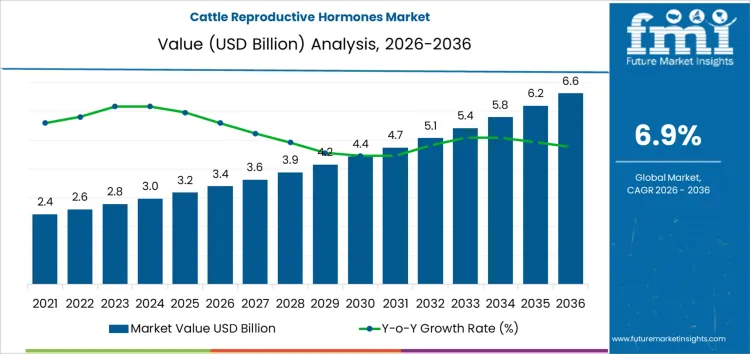
Cattle Reproductive Hormones Market Key Takeaways
| Metric | Value |
|---|---|
| Market Value (2026) | USD 3.4 billion |
| Market Forecast Value (2036) | USD 6.6 billion |
| Forecast CAGR 2026 to 2036 | 6.9% |
Why is the Demand for Cattle Reproductive Hormones Growing?
Demand for cattle reproductive hormones is increasing as livestock producers and breeding specialists seek to improve herd fertility performance and reproductive efficiency across commercial beef and dairy operations. Hormonal protocols such as estrous synchronization, ovulation induction, and pregnancy support enable precise timing of breeding activities, which optimizes conception rates and shortens inter-calving intervals. Reproductive endocrinologists and herd managers evaluate hormone product efficacy, dosing regimens, and route of administration to support predictable reproductive outcomes while minimizing stress on animals.
Procurement decisions in veterinary supply networks emphasize product stability, batch traceability, and compliance with regulatory standards because consistent performance directly affects breeding schedules and downstream production planning. Strong demand reflects producer priorities for maximizing reproductive throughput within limited breeding windows and reducing the need for repeated heat detection labor.
Growth in demand also stems from adoption of assisted reproductive technologies such as fixed-time artificial insemination (FTAI) and embryo transfer programs that integrate hormonal intervention to synchronize follicular development and ovulation. Dairy operations particularly benefit from structured breeding protocols that improve milk production cycles, and beef producers apply reproductive hormone strategies to achieve targeted calving distributions for market timing. Veterinary consultants and extension services train producers on hormone selection, protocol scheduling, and animal handling to support safe and effective implementation. Supply chain improvements in cold-chain logistics and access to veterinarian-approved formulations further support consistent availability in rural and emerging livestock regions. These industry-specific breeding and productivity drivers are contributing to sustained demand growth in the cattle reproductive hormones market.
How Do Key Demand Factors Shape the Cattle Reproductive Hormones Market?
Demand for cattle reproductive hormones is shaped by herd productivity targets, breeding cycle control, and efficiency pressures within commercial dairy and beef operations. Management strategies emphasize predictable conception timing, reduced calving intervals, and improved genetic utilization. Adoption reflects structured breeding programs, veterinary oversight, and integration with artificial insemination protocols. Product choice considers hormonal mechanism, dosing precision, and handling practicality under farm conditions. Segmentation clarifies how hormone class, reproductive objective, and delivery channel influence utilization patterns, purchasing concentration, and on-farm implementation across cattle reproduction management.
Which Product Type Leads Utilization in Cattle Reproductive Hormones?
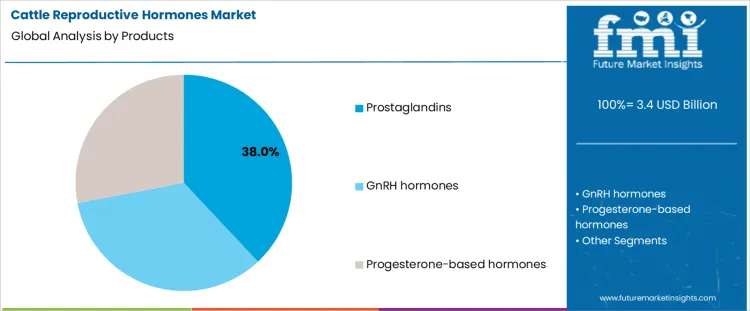
Use concentrates around prostaglandins at 38.0%, driven by their role in luteolysis and cycle control within synchronized breeding programs. These hormones enable timed estrus by resetting ovarian function, supporting planned insemination schedules. Practical dosing and compatibility with standard protocols encourage widespread veterinary use. GnRH hormones at 34.0% support ovulation control and follicular development, often paired with synchronization regimens. Progesterone-based hormones at 28.0% provide controlled release options for cycle regulation and luteal support. Product segmentation reflects preference for agents that integrate smoothly into repeatable, protocol-driven herd management systems.
Key Points:
- Prostaglandins enable predictable estrus timing through luteolysis.
- GnRH supports ovulation control within synchronized programs.
- Progesterone options provide sustained hormonal regulation.
How Do Reproductive Objectives Shape Application-Level Demand?
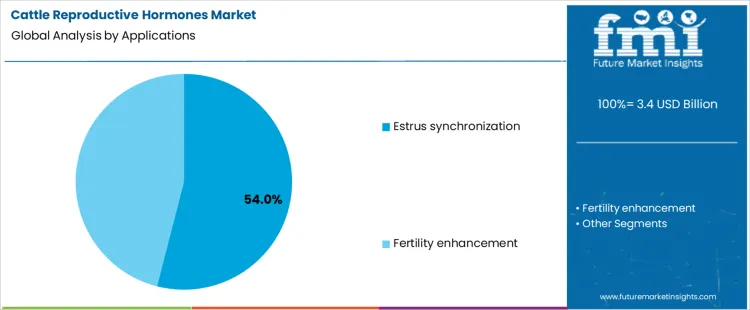
Application demand centers on estrus synchronization at 54.0%, reflecting emphasis on coordinated breeding and labor efficiency. Synchronization reduces detection variability and supports fixed-time insemination. Large herds benefit from standardized schedules that improve planning and resource allocation. Fertility enhancement at 46.0% addresses suboptimal conception rates, postpartum anestrus, and repeat breeders. These programs require tailored hormonal intervention based on herd performance metrics. Application segmentation highlights higher utilization where operational scale, timing precision, and reproductive efficiency directly affect productivity and economic outcomes.
Key Points
- Synchronization supports fixed-time insemination strategies.
- Labor efficiency improves with coordinated breeding windows.
- Fertility enhancement targets conception rate optimization.
Which End User Channels Drive Hormone Deployment in Cattle Breeding?
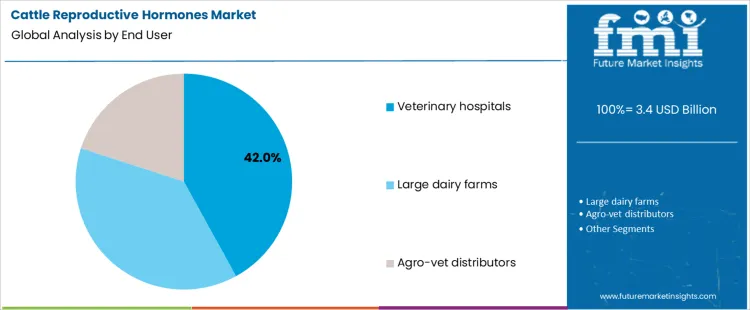
Veterinary hospitals account for 42.0% of hormone utilization, reflecting their role in protocol design, diagnosis, and supervised administration. Clinical oversight supports appropriate hormone selection and timing. Large dairy farms at 38.0% deploy hormones directly through trained personnel under veterinary guidance. Scale-driven adoption prioritizes consistency and cost control. Agro-vet distributors at 20.0% facilitate product access and supply continuity, particularly in rural regions. End-user segmentation reflects concentration where technical expertise, herd scale, and distribution reach jointly determine hormone deployment across cattle breeding systems.
Key Points:
- Veterinary hospitals guide protocol-driven hormone use.
- Large farms implement hormones at scale with trained staff.
- Distributors ensure access and supply continuity.
What are the Key Dynamics in the Cattle Reproductive Hormones Market?
Demand for cattle reproductive hormones reflects livestock productivity requirements linked to fertility control, herd synchronization, and calving interval optimization. Adoption concentrates in dairy and beef operations using managed breeding programs. Global scope aligns with commercial herd management practices and veterinary oversight. Usage centers on gonadotropins, prostaglandins, progesterone products, and gonadotropin-releasing hormone analogs administered to regulate estrus, ovulation timing, and conception outcomes.
How do herd productivity targets and breeding management practices shape adoption?
Livestock producers rely on predictable reproductive cycles to stabilize milk output, calf crop uniformity, and genetic selection outcomes. Demand increases where artificial insemination programs require synchronized estrus across large herds. Hormonal protocols reduce labor uncertainty by narrowing breeding windows and improving insemination timing accuracy. Dairy operations use hormones to shorten calving intervals and manage postpartum anestrus. Beef producers adopt synchronization to align calving seasons and optimize feed planning. Veterinary guidance influences protocol selection based on animal condition, parity, and production system intensity. Adoption reflects operational focus on reproductive efficiency as a controllable input affecting herd-level output consistency.
How do regulatory oversight, residue controls, and cost sensitivity influence market scalability?
Use of reproductive hormones is subject to veterinary prescription and residue compliance frameworks. Demand sensitivity rises where regulatory scrutiny affects protocol approval or public perception. Withdrawal periods and recordkeeping requirements increase management burden. Cost exposure influences adoption in extensive grazing systems with lower input tolerance. Improper administration affects fertility outcomes, reducing confidence among smaller producers. Supply depends on cold chain integrity and veterinary distribution networks. Export-oriented producers face additional compliance pressure tied to importing country standards. Scalability remains constrained by regulatory oversight intensity, producer cost tolerance, and dependence on trained veterinary supervision.
How Is Demand for Cattle Reproductive Hormones Evolving Globally?
Demand for cattle reproductive hormones is expanding globally as livestock producers emphasize fertility optimization, calving interval control, and herd productivity. Estrus synchronization, timed artificial insemination, and postpartum recovery protocols drive consistent use across dairy and beef operations. Veterinary oversight and herd health programs reinforce protocol adherence. Supply reliability and cold-chain distribution influence adoption. Growth rates in India at 8.6%, China at 8.4%, Brazil at 8.1%, USA at 7.5%, and the UK at 6.4% indicate steady expansion driven by productivity targets, herd scale, and management discipline rather than episodic disease management.
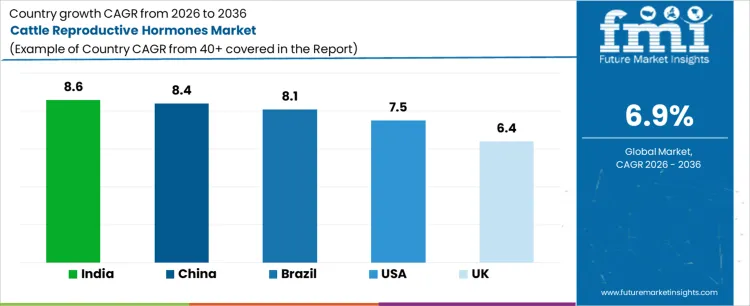
| Country | CAGR (%) |
|---|---|
| India | 8.6% |
| China | 8.4% |
| Brazil | 8.1% |
| USA | 7.5% |
| UK | 6.4% |
What Is Driving Momentum for Cattle Reproductive Hormone Use in India?
Demand for cattle reproductive hormones in India is growing at a CAGR of 8.6%, reflecting dairy intensification and organized herd management. Cooperative-led programs promote estrus synchronization to improve conception rates and milk yield stability. Veterinary extension services expand access to hormone protocols in peri-urban clusters. Postpartum anestrus management supports shorter calving intervals. Government-backed breeding initiatives reinforce protocol adoption. Growth aligns with productivity improvement and herd standardization rather than rapid expansion of beef operations.
- Cooperative-led estrus synchronization programs
- Veterinary extension improving protocol access
- Postpartum anestrus management focus
- Public breeding initiative alignment
Why Is China Sustaining Growth in Cattle Reproductive Hormone Adoption?
Cattle reproductive hormone demand in China is expanding at a CAGR of 8.4%, supported by herd consolidation and modernization. Large-scale dairy farms implement timed insemination protocols to reduce labor variability. Veterinary service integration improves compliance and monitoring. Domestic production enhances supply continuity. Performance benchmarking encourages consistent hormone use. Growth reflects farm-scale efficiency gains and protocolized breeding rather than smallholder expansion.
- Herd consolidation enabling standardized protocols
- Timed insemination reducing labor variability
- Integrated veterinary monitoring
- Reliable domestic supply availability
How Is Brazil Supporting Expansion of Cattle Reproductive Hormone Demand?
Demand for cattle reproductive hormones in Brazil is growing at a CAGR of 8.1%, driven by beef herd productivity and pasture-based management. Estrus synchronization improves breeding season control across extensive systems. Veterinary outreach supports protocol adoption in large ranches. Genetic improvement programs leverage hormone-assisted insemination. Climatic variability increases emphasis on predictable calving. Growth reflects operational efficiency and genetics management rather than increased headcount alone.
- Breeding season control in extensive systems
- Veterinary outreach for protocol adoption
- Genetics programs using assisted insemination
- Climate-driven need for predictable calving
What Factors Are Driving Cattle Reproductive Hormone Growth in United States?
Cattle reproductive hormone demand in the United States is expanding at a CAGR of 7.5%, supported by data-driven herd management and labor optimization. Dairy operations employ synchronization to improve conception timing and milk supply planning. Beef producers use protocols to tighten calving windows. Strong veterinary infrastructure supports compliance. Input cost management favors predictable reproductive outcomes. Growth reflects management precision and scale efficiencies rather than expansion of herd numbers.
- Data-driven synchronization protocols
- Tightened calving windows for beef herds
- Robust veterinary infrastructure
- Predictable outcomes supporting cost control
Why Is the UK Experiencing Measured Growth in Cattle Reproductive Hormones?
Demand for cattle reproductive hormones in United Kingdom is growing at a CAGR of 6.4%, shaped by efficiency targets and regulatory oversight. Dairy farms adopt selective synchronization to improve fertility without overuse. Veterinary guidance emphasizes evidence-based application. Grass-based systems require precise timing to align with grazing cycles. Cost sensitivity moderates adoption pace. Growth remains measured, reflecting disciplined use and productivity focus rather than aggressive intensification.
- Selective synchronization under veterinary guidance
- Alignment with grazing-based production cycles
- Evidence-based application standards
- Cost sensitivity moderating adoption pace
What is the competitive landscape of demand for the cattle reproductive hormones market globally?
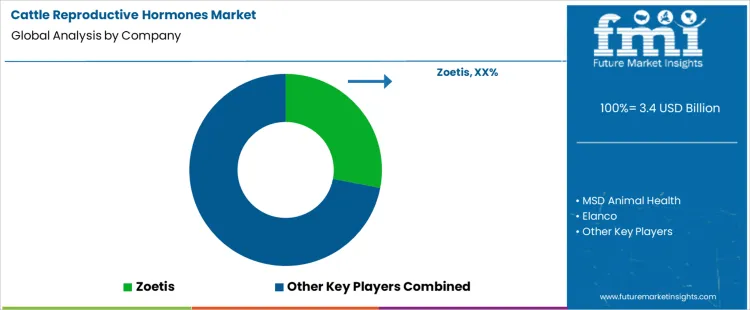
Demand for cattle reproductive hormones reflects herd fertility optimization, synchronization protocols, and productivity targets in commercial beef and dairy operations. Veterinary buyers assess estrus control efficacy, hormone stability, withdrawal compliance, dosing precision, and outcomes across different breeding systems. Evaluation also considers animal welfare impact, labor efficiency, seasonal breeding alignment, and compatibility with artificial insemination schedules. Procurement behavior centers on consistent supply, cold-chain robustness, regulatory labeling, and technical support for field veterinarians. Purchasing decisions emphasize predictable reproductive outcomes, herd-level return metrics, and integration with digital herd management tools. Trend in the cattle reproductive hormones market shows sustained protocol standardization and demand from large-scale, data-driven producers.
Zoetis leads competitive positioning through comprehensive hormone portfolios supporting synchronization, superovulation, and fertility programs across geographies. MSD Animal Health competes with established reproductive brands, strong veterinary relationships, and proven field performance in intensive operations. Elanco supports demand via reproductive management solutions aligned with herd health programs and global livestock production systems. Ceva maintains relevance by focusing on reproductive endocrinology, practical dosing formats, and accessibility for mixed-scale producers. Boehringer Ingelheim participates through integrated animal health portfolios supporting fertility outcomes within broader herd performance strategies. Competitive differentiation depends on protocol reliability, veterinary trust, supply continuity, and demonstrated economic impact at herd scale.
Key Players in the Cattle Reproductive Hormones Market
- Zoetis
- MSD Animal Health
- Elanco
- Ceva
- Boehringer Ingelheim
- Others
Scope of the Report
| Items | Values |
|---|---|
| Quantitative Units | USD billion |
| Products | Prostaglandins; GnRH hormones; Progesterone-based hormones |
| Applications | Estrus synchronization; Fertility enhancement |
| End User | Veterinary hospitals; Large dairy farms; Agro-vet distributors |
| Regions Covered | Asia Pacific, Europe, North America, Latin America, Middle East & Africa |
| Countries Covered | India, China, Brazil, USA, UK, and 40+ countries |
| Key Companies Profiled | Zoetis; MSD Animal Health; Elanco; Ceva; Boehringer Ingelheim; Others |
| Additional Attributes | Dollar sales by product type, application, end user, and sales channel; hormone efficacy and protocol design for estrus synchronization and fertility improvement; dosing schedules and compliance in large herd management systems; regulatory oversight and residue compliance in food-producing animals; adoption patterns across veterinary hospitals, commercial dairy operations, and distributor-led supply networks; procurement dynamics influenced by breeding calendars and herd productivity targets. |
Cattle Reproductive Hormones Market by Segment
Products:
- Prostaglandins
- GnRH hormones
- Progesterone-based hormones
Applications:
- Estrus synchronization
- Fertility enhancement
End User:
- Veterinary hospitals
- Large dairy farms
- Agro-vet distributors
Region:
- Asia Pacific
- China
- Japan
- South Korea
- India
- Australia & New Zealand
- ASEAN
- Rest of Asia Pacific
- Europe
- Germany
- United Kingdom
- France
- Italy
- Spain
- Nordic
- BENELUX
- Rest of Europe
- North America
- United States
- Canada
- Mexico
- Latin America
- Brazil
- Chile
- Rest of Latin America
- Middle East & Africa
- Kingdom of Saudi Arabia
- Other GCC Countries
- Turkey
- South Africa
- Other African Union
- Rest of Middle East & Africa
Bibliography
- Food and Agriculture Organization of the United Nations. (2024). Use of hormonal treatments in food-producing animals: Productivity, welfare, and regulatory considerations. FAO Animal Health Service.
- World Organisation for Animal Health. (2024). Guidelines on reproductive management practices in bovine herds. WOAH.
- European Food Safety Authority. (2024). Scientific opinion on hormonal substances used for reproductive management in food-producing animals. EFSA Panel on Biological Hazards.
Frequently Asked Questions
How big is the cattle reproductive hormones market in 2026?
The global cattle reproductive hormones market is estimated to be valued at USD 3.4 billion in 2026.
What will be the size of cattle reproductive hormones market in 2036?
The market size for the cattle reproductive hormones market is projected to reach USD 6.6 billion by 2036.
How much will be the cattle reproductive hormones market growth between 2026 and 2036?
The cattle reproductive hormones market is expected to grow at a 6.9% CAGR between 2026 and 2036.
What are the key product types in the cattle reproductive hormones market?
The key product types in cattle reproductive hormones market are prostaglandins, gnrh hormones and progesterone-based hormones.
Which applications segment to contribute significant share in the cattle reproductive hormones market in 2026?
In terms of applications, estrus synchronization segment to command 54.0% share in the cattle reproductive hormones market in 2026.
Preview the report firsthand - request a free sample
Get SampleGet the brochure for pricing and purchase details.
Get PDFTable of Content
- Executive Summary
- Global Market Outlook
- Demand-side Trends
- Supply-side Trends
- Technology Roadmap Analysis
- Analysis and Recommendations
- Market Overview
- Market Coverage / Taxonomy
- Market Definition / Scope / Limitations
- Market Background
- Market Dynamics
- Drivers
- Restraints
- Opportunity
- Trends
- Scenario Forecast
- Demand in Optimistic Scenario
- Demand in Likely Scenario
- Demand in Conservative Scenario
- Opportunity Map Analysis
- Product Life Cycle Analysis
- Supply Chain Analysis
- Investment Feasibility Matrix
- Value Chain Analysis
- PESTLE and Porter’s Analysis
- Regulatory Landscape
- Regional Parent Market Outlook
- Production and Consumption Statistics
- Import and Export Statistics
- Market Dynamics
- Global Market Analysis 2021 to 2025 and Forecast, 2026 to 2036
- Historical Market Size Value (USD Million) Analysis, 2021 to 2025
- Current and Future Market Size Value (USD Million) Projections, 2026 to 2036
- Y-o-Y Growth Trend Analysis
- Absolute $ Opportunity Analysis
- Global Market Pricing Analysis 2021 to 2025 and Forecast 2026 to 2036
- Global Market Analysis 2021 to 2025 and Forecast 2026 to 2036, By Products
- Introduction / Key Findings
- Historical Market Size Value (USD Million) Analysis By Products , 2021 to 2025
- Current and Future Market Size Value (USD Million) Analysis and Forecast By Products , 2026 to 2036
- Prostaglandins
- GnRH hormones
- Progesterone-based hormones
- Prostaglandins
- Y-o-Y Growth Trend Analysis By Products , 2021 to 2025
- Absolute $ Opportunity Analysis By Products , 2026 to 2036
- Global Market Analysis 2021 to 2025 and Forecast 2026 to 2036, By Applications
- Introduction / Key Findings
- Historical Market Size Value (USD Million) Analysis By Applications, 2021 to 2025
- Current and Future Market Size Value (USD Million) Analysis and Forecast By Applications, 2026 to 2036
- Estrus synchronization
- Fertility enhancement
- Estrus synchronization
- Y-o-Y Growth Trend Analysis By Applications, 2021 to 2025
- Absolute $ Opportunity Analysis By Applications, 2026 to 2036
- Global Market Analysis 2021 to 2025 and Forecast 2026 to 2036, By End User
- Introduction / Key Findings
- Historical Market Size Value (USD Million) Analysis By End User, 2021 to 2025
- Current and Future Market Size Value (USD Million) Analysis and Forecast By End User, 2026 to 2036
- Veterinary hospitals
- Large dairy farms
- Agro-vet distributors
- Veterinary hospitals
- Y-o-Y Growth Trend Analysis By End User, 2021 to 2025
- Absolute $ Opportunity Analysis By End User, 2026 to 2036
- Global Market Analysis 2021 to 2025 and Forecast 2026 to 2036, By Region
- Introduction
- Historical Market Size Value (USD Million) Analysis By Region, 2021 to 2025
- Current Market Size Value (USD Million) Analysis and Forecast By Region, 2026 to 2036
- North America
- Latin America
- Western Europe
- Eastern Europe
- East Asia
- South Asia and Pacific
- Middle East & Africa
- Market Attractiveness Analysis By Region
- North America Market Analysis 2021 to 2025 and Forecast 2026 to 2036, By Country
- Historical Market Size Value (USD Million) Trend Analysis By Market Taxonomy, 2021 to 2025
- Market Size Value (USD Million) Forecast By Market Taxonomy, 2026 to 2036
- By Country
- USA
- Canada
- Mexico
- By Products
- By Applications
- By End User
- By Country
- Market Attractiveness Analysis
- By Country
- By Products
- By Applications
- By End User
- Key Takeaways
- Latin America Market Analysis 2021 to 2025 and Forecast 2026 to 2036, By Country
- Historical Market Size Value (USD Million) Trend Analysis By Market Taxonomy, 2021 to 2025
- Market Size Value (USD Million) Forecast By Market Taxonomy, 2026 to 2036
- By Country
- Brazil
- Chile
- Rest of Latin America
- By Products
- By Applications
- By End User
- By Country
- Market Attractiveness Analysis
- By Country
- By Products
- By Applications
- By End User
- Key Takeaways
- Western Europe Market Analysis 2021 to 2025 and Forecast 2026 to 2036, By Country
- Historical Market Size Value (USD Million) Trend Analysis By Market Taxonomy, 2021 to 2025
- Market Size Value (USD Million) Forecast By Market Taxonomy, 2026 to 2036
- By Country
- Germany
- UK
- Italy
- Spain
- France
- Nordic
- BENELUX
- Rest of Western Europe
- By Products
- By Applications
- By End User
- By Country
- Market Attractiveness Analysis
- By Country
- By Products
- By Applications
- By End User
- Key Takeaways
- Eastern Europe Market Analysis 2021 to 2025 and Forecast 2026 to 2036, By Country
- Historical Market Size Value (USD Million) Trend Analysis By Market Taxonomy, 2021 to 2025
- Market Size Value (USD Million) Forecast By Market Taxonomy, 2026 to 2036
- By Country
- Russia
- Poland
- Hungary
- Balkan & Baltic
- Rest of Eastern Europe
- By Products
- By Applications
- By End User
- By Country
- Market Attractiveness Analysis
- By Country
- By Products
- By Applications
- By End User
- Key Takeaways
- East Asia Market Analysis 2021 to 2025 and Forecast 2026 to 2036, By Country
- Historical Market Size Value (USD Million) Trend Analysis By Market Taxonomy, 2021 to 2025
- Market Size Value (USD Million) Forecast By Market Taxonomy, 2026 to 2036
- By Country
- China
- Japan
- South Korea
- By Products
- By Applications
- By End User
- By Country
- Market Attractiveness Analysis
- By Country
- By Products
- By Applications
- By End User
- Key Takeaways
- South Asia and Pacific Market Analysis 2021 to 2025 and Forecast 2026 to 2036, By Country
- Historical Market Size Value (USD Million) Trend Analysis By Market Taxonomy, 2021 to 2025
- Market Size Value (USD Million) Forecast By Market Taxonomy, 2026 to 2036
- By Country
- India
- ASEAN
- Australia & New Zealand
- Rest of South Asia and Pacific
- By Products
- By Applications
- By End User
- By Country
- Market Attractiveness Analysis
- By Country
- By Products
- By Applications
- By End User
- Key Takeaways
- Middle East & Africa Market Analysis 2021 to 2025 and Forecast 2026 to 2036, By Country
- Historical Market Size Value (USD Million) Trend Analysis By Market Taxonomy, 2021 to 2025
- Market Size Value (USD Million) Forecast By Market Taxonomy, 2026 to 2036
- By Country
- Kingdom of Saudi Arabia
- Other GCC Countries
- Turkiye
- South Africa
- Other African Union
- Rest of Middle East & Africa
- By Products
- By Applications
- By End User
- By Country
- Market Attractiveness Analysis
- By Country
- By Products
- By Applications
- By End User
- Key Takeaways
- Key Countries Market Analysis
- USA
- Pricing Analysis
- Market Share Analysis, 2025
- By Products
- By Applications
- By End User
- Canada
- Pricing Analysis
- Market Share Analysis, 2025
- By Products
- By Applications
- By End User
- Mexico
- Pricing Analysis
- Market Share Analysis, 2025
- By Products
- By Applications
- By End User
- Brazil
- Pricing Analysis
- Market Share Analysis, 2025
- By Products
- By Applications
- By End User
- Chile
- Pricing Analysis
- Market Share Analysis, 2025
- By Products
- By Applications
- By End User
- Germany
- Pricing Analysis
- Market Share Analysis, 2025
- By Products
- By Applications
- By End User
- UK
- Pricing Analysis
- Market Share Analysis, 2025
- By Products
- By Applications
- By End User
- Italy
- Pricing Analysis
- Market Share Analysis, 2025
- By Products
- By Applications
- By End User
- Spain
- Pricing Analysis
- Market Share Analysis, 2025
- By Products
- By Applications
- By End User
- France
- Pricing Analysis
- Market Share Analysis, 2025
- By Products
- By Applications
- By End User
- India
- Pricing Analysis
- Market Share Analysis, 2025
- By Products
- By Applications
- By End User
- ASEAN
- Pricing Analysis
- Market Share Analysis, 2025
- By Products
- By Applications
- By End User
- Australia & New Zealand
- Pricing Analysis
- Market Share Analysis, 2025
- By Products
- By Applications
- By End User
- China
- Pricing Analysis
- Market Share Analysis, 2025
- By Products
- By Applications
- By End User
- Japan
- Pricing Analysis
- Market Share Analysis, 2025
- By Products
- By Applications
- By End User
- South Korea
- Pricing Analysis
- Market Share Analysis, 2025
- By Products
- By Applications
- By End User
- Russia
- Pricing Analysis
- Market Share Analysis, 2025
- By Products
- By Applications
- By End User
- Poland
- Pricing Analysis
- Market Share Analysis, 2025
- By Products
- By Applications
- By End User
- Hungary
- Pricing Analysis
- Market Share Analysis, 2025
- By Products
- By Applications
- By End User
- Kingdom of Saudi Arabia
- Pricing Analysis
- Market Share Analysis, 2025
- By Products
- By Applications
- By End User
- Turkiye
- Pricing Analysis
- Market Share Analysis, 2025
- By Products
- By Applications
- By End User
- South Africa
- Pricing Analysis
- Market Share Analysis, 2025
- By Products
- By Applications
- By End User
- USA
- Market Structure Analysis
- Competition Dashboard
- Competition Benchmarking
- Market Share Analysis of Top Players
- By Regional
- By Products
- By Applications
- By End User
- Competition Analysis
- Competition Deep Dive
- Zoetis
- Overview
- Product Portfolio
- Profitability by Market Segments (Product/Age /Sales Channel/Region)
- Sales Footprint
- Strategy Overview
- Marketing Strategy
- Product Strategy
- Channel Strategy
- MSD Animal Health
- Elanco
- Ceva
- Boehringer Ingelheim
- Others
- Zoetis
- Competition Deep Dive
- Assumptions & Acronyms Used
- Research Methodology


