

- Market Size (2026)
- USD 16.8 Bn
- Forecast (2036)
- USD 29.87 Bn
- CAGR (2026 to 2036)
- 5.9%
Cattle Nutrition Market Size, Market Forecast and Outlook By FMI
Summary of the Cattle Nutrition Market
- Demand and Growth Drivers
- The need for more efficient dairy production is likely to help growth, as large-scale dairy operations are using more premix, minerals, and specialty feed additives.
- Optimizing beef production is expected to continue to be a major driver of growth as producers use advanced nutrition solutions to improve feed conversion efficiency and weight gain.
- Sustainability positioning and efforts to cut down on methane are likely to help with adoption. Regulatory and corporate pressure is driving innovation in low-emission feed additives.
- Product and Segment View
- Feed additives are likely to stay the most popular type of product because people want formulas that improve performance and health.
- Milk production is likely to be the most important part of the application segment because of rising global dairy consumption and efforts to boost productivity.
- Dairy farms will probably stay the most important end-use segment because of large-scale structured procurement and steady feed demand cycles.
- Geography and Competitive Outlook
- India is likely to remain a key growth market owing to its large dairy herd, increasing milk production, and improving feed practices.
- China is expected to sustain demand on account of modernization of dairy farms and growing consumption of dairy products.
- Companies that can combine nutritional expertise with scalable supply and sustainability-focused innovation are likely to gain traction during the forecast period.
- Analyst Opinion
- Nandini Roy Choudhury, Principal Consultant at FMI says, “Companies that can deliver performance-driven nutrition solutions while aligning with sustainability and emission reduction goals are likely to strengthen their competitive position.”
- The cattle nutrition market is evolving from a traditional feed segment into a more science-driven input category.
- Adoption is being driven by increasing focus on productivity and efficiency in dairy and beef production.
- The market is also benefiting from innovation in feed additives targeting health and emission reduction.
- Demand is further supported by the need for consistent, high-quality nutrition solutions across commercial livestock operations.
Key Takeaways, Market Size, and Forecast
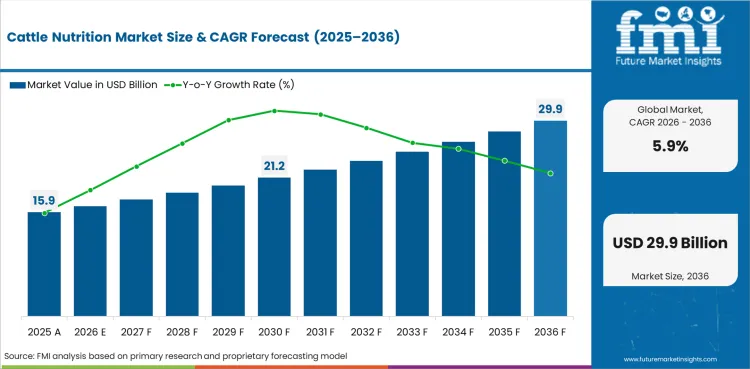
- The cattle nutrition market was valued at USD 15.90 billion in 2025.
- The market is projected to reach USD 16.8 billion in 2026 and USD 29.87 billion by 2036, growing at a CAGR of 5.9%.
- By 2036, the Cattle Nutrition Market is expected to be worth USD 29.87 billion.
- From 2026 to 2036, the market is projected to expand at a CAGR of 5.9%.
- The market is projected to create an incremental opportunity of USD 13.03 billion between 2026 and 2036.
- In 2026, feed additives are expected to account for 45.0% of the product segment, driven by demand for performance and health optimization in livestock.
- Milk production leads the application segment with a 50.0% share.
- India (6.50%) and China (6.10%) are among the fastest growing markets in the world.
Cattle Nutrition Market Definition
The cattle nutrition market encompasses feed additives, premixes, mineral supplements, vitamin supplements, and specialty nutrition products formulated for dairy cattle and beef cattle production. Product scope covers conventional and organic feed formulations, methane-reduction feed additives, ionophores, rumen modifiers, and specialty nutritional products sold to dairy farms, beef feedlots, and cattle production operations.
Cattle Nutrition Market Inclusions
Market scope includes all commercially traded cattle nutrition covering the product, application, end-use, and distribution-channel segments detailed in Section 4, spanning the 2026 to 2036 forecast period across North America, Latin America, Europe, East Asia, South Asia and Pacific, and Middle East and Africa regions.
Cattle Nutrition Market Exclusions
The scope excludes cattle feed grains and forages, veterinary pharmaceutical products (antibiotics, hormones), pet food and companion animal nutrition, aquaculture feed, and human nutrition products.
Cattle Nutrition Market Research Methodology
- Primary Research: FMI analysts talked to procurement leaders, technical experts, and commercial managers along the cattle nutrition value chain in North America, Europe, and Asia-Pacific.
- Desk Research: To set verifiable baseline parameters, data collection included statistics from industry associations, regulatory filings, company annual reports, and trade publications.
- Market Sizing and Forecasting: We get baseline values by adding up transaction volumes from the bottom up and using growth rates and substitution curves that are specific to each region to predict demand through 2036.
- Data validation and update cycle: Projections are checked against sales data from the industry, regulatory disclosures, and shipment statistics from manufacturers every three months.
Why is the Cattle Nutrition Market Growing?
- The need for more efficient dairy production leads to large-scale purchases of premix, mineral, and specialty feed additives at dairy farms in North America, Europe, and Latin America.
- Ionophore and rumen modifier demand is supported by beef production efficiency and feed conversion optimization, with Cargill, ADM, and Kemin already having a strong position in the market.
- Sustainability positioning and methane reduction regulation are pushing feed additive innovation. DSM's Bovaer and specialty methane-reducing formulations are at the top of the market.
The demand for premix, mineral, and specialty feed additives at scale is driven by the need for dairy production efficiency. Cargill, ADM, Kemin Industries, BASF, and Novus International use their relationships with dairy farms in North America, Europe, and Latin America to shape the category. As dairy production grows in India and Brazil, it adds to the demand for the category on a large scale in emerging markets.
Ionophores and rumen modifiers are in high demand because they help make beef production more efficient and improve feed conversion. Monensin (Elanco Rumensin), lasalocid, and specialty ionophores are all examples of beef production feed additives that set the standard for their category. Beef feedlot operators at JBS, Tyson Foods, and regional companies are the ones who buy in bulk across North America and Latin America.
The need for sustainability and rules to cut down on methane emissions are what drive innovation in feed additives. Bovaer (3-NOP) from DSM, specialty seaweed-derived methane-reducing formulations, and biochar feed additives all help cattle production that is good for the environment. The EU Common Agricultural Policy, California's methane regulations for dairy cows, and global ESG-aligned dairy and beef sourcing all help the specialty feed additive category to be seen as high-end.
Market Segmentation Analysis
- In 2026, feed additives will make up 45% of the market. The fastest-growing premium categories are specialty methane-reducing and rumen modifier sub-segments.
- Milk production applications are the most popular, making up 50% of all applications. Beef production efficiency and specialty nutritional applications are the next most popular.
- Direct sales channels account for 60% of distribution, which is in line with the size of the cattle operation procurement category structure.
The cattle nutrition market is divided into groups based on the type of product, how it is used, who it is for, how it is sold, how it is made, and how much it costs. Product segmentation includes things like mineral supplements, vitamin supplements, feed additives, premixes, and specialty nutrition products. Applications include making dairy milk, raising beef, and taking care of special cattle health.
Insights into the Feed Additives Segment
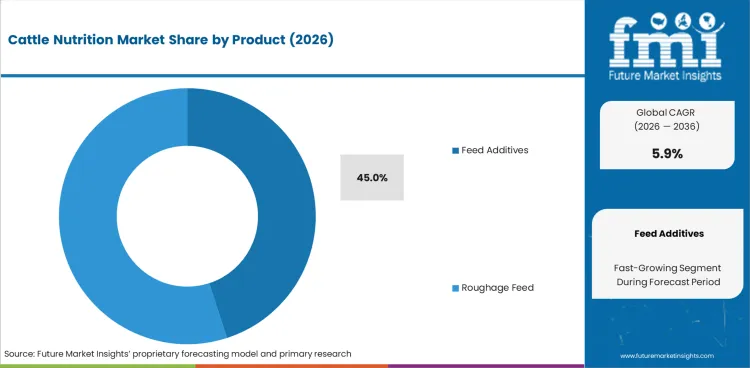
In 2026, feed additives are expected to have the biggest market share, with 45% of all products. This leadership shows that the company has a wide range of products, including ionophores, rumen modifiers, probiotics, enzymes, and special formulations that reduce methane. It also has a strong presence in dairy and beef production.
Ionophores and rumen modifiers are the most well-known sub-segment of feed additives. They include Elanco Rumensin (monensin), Zoetis specialty products, and generic ionophore alternatives. Specialty methane-reducing feed additives like DSM's Bovaer are the fastest-growing premium sub-segment because of regulations that promote sustainability.
As the demand for more efficient dairy and beef production and regulations that support sustainability continue to drive innovation in the category, feed additives are expected to keep the majority of the market share until 2036. Premixes, mineral supplements, and vitamin supplements are well-known subcategories that are consistently bought by large cattle farms.
Insights into the Milk Production Applications Segment
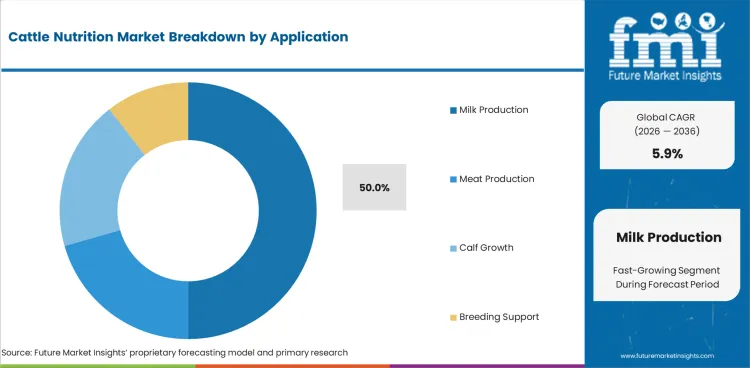
By 2026, milk production applications are expected to make up half of the application segment. The three biggest sub-applications are dairy cow nutrition for optimizing milk yield, improving milk components, and increasing reproductive efficiency.
The second-largest application category is beef production efficiency. This is driven by the need for sub-applications that help with feed conversion, average daily gain optimization, and carcass quality. Specialty cattle health applications, such as hoof health, immunity, and stress management, help premium sub-category positioning.
Cattle Nutrition Market Drivers, Restraints, and Opportunities?
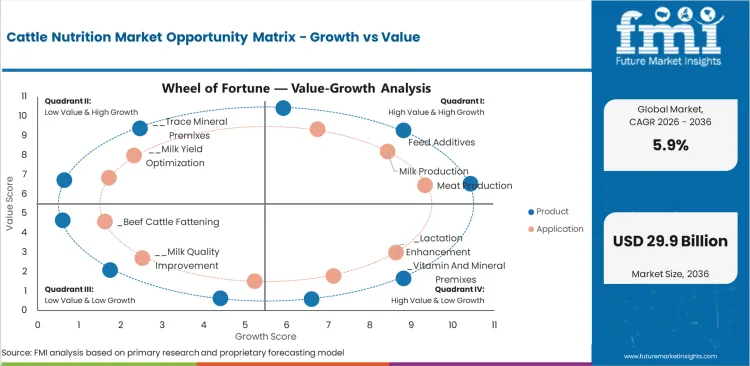
- The need for more efficient dairy production drives the purchase of scale premix, mineral, and specialty feed additives.
- Optimizing feed conversion for beef production helps meet the needs of ionophores and rumen modifiers at large-scale feedlot operations.
- Sustainability positioning and rules for cutting methane emissions are what drive innovation in specialty feed additives and premium positioning.
The cattle nutrition market is influenced by the need for more efficient dairy and beef production, the need for more sustainable practices, and changes in regulations. Some of the limits are the changing prices of dairy products, which affect how much money farms can spend, the changing dynamics of the beef cycle, which affect how feedlots buy food, and the changing rules about antibiotic alternatives and feed additive approvals.
Dairy Production Efficiency Demand
Demand is shaped by the need for dairy production efficiency, which drives the purchase of premix, mineral, and specialty feed additives on a large scale. Cargill, ADM, Kemin Industries, BASF, and Novus International use their relationships with dairy farms in North America, Europe, and Latin America to shape the category. The growth of dairy production in India and Brazil adds to the demand for the category on a large scale in emerging markets.
Beef Production Feed Conversion Optimization
Growth shows how efficient beef production is and how much demand there is for better feed conversion. Monensin (Elanco Rumensin), lasalocid, and specialty ionophores are examples of beef production feed additives that help keep the category where it is. JBS, Tyson Foods, and regional beef feedlot operators buy in bulk from markets in North America and Latin Americac.
Sustainability Positioning and Methane Reduction
Sustainability positioning and methane reduction regulation are driving innovation in feed additives, which is making adoption more common. DSM's Bovaer (3-NOP), specialty seaweed-derived methane-reducing formulations, and biochar feed additives help cattle farming that is good for the environment. The EU Common Agricultural Policy, California's dairy methane rules, and global ESG-aligned sourcing all help the specialty feed additive category be seen as high-end.
Commodity Cycle Volatility and Regulatory Evolution
Growth is being shaped by the ups and downs in the dairy and beef commodity cycles, which are affecting how much cattle operators can spend on feed additives. In North America and Europe, the price of milk goes up and down, and in global markets, the price of beef goes up and down. This causes cattle operators to have 15% to 30% more flexible spending each year. Changes in the rules about antibiotic alternatives, growth promoter limits, and feed additive approvals are still changing how products are positioned in the market and how companies plan their product lines.
Analysis of Cattle Nutrition Market By Key Countries
.webp "Top Country Growth Comparison Cattle Nutrition Market Cagr (2026 2036)")
| Country | CAGR |
|---|---|
| India | 6.50% |
| China | 6.10% |
| Brazil | 5.60% |
| Germany | 4.70% |
| United States | 4.30% |
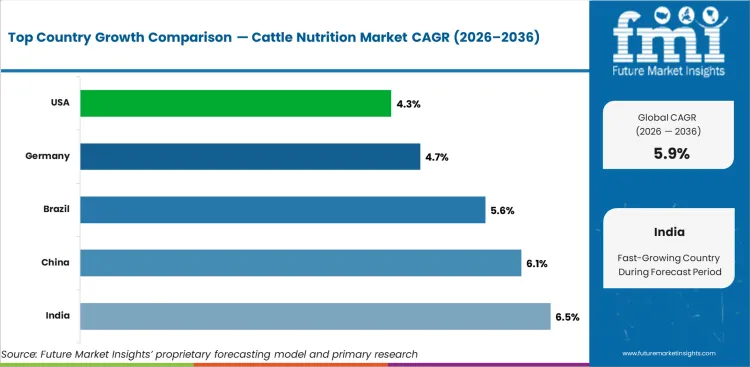
- North America and Western Europe lead absolute category spending through dairy production efficiency and beef feedlot scale, while Asia Pacific and Latin American emerging markets deliver strong CAGR.
- India leads growth at 6.5% CAGR, propelled by dairy production expansion and rising cattle operation modernization.
- China grows at 6.1% CAGR, supported by dairy category expansion and premium beef production development.
- Mature markets including the USA and Germany grow at 4.3% to 4.7% CAGR through sustained dairy and beef production efficiency demand.
The cattle nutrition market is projected to grow globally at a CAGR of 5.9% from 2026 to 2036. he analysis spans over 30 countries, with the leading markets detailed below.
Demand Outlook for Cattle Nutrition Market in the United States
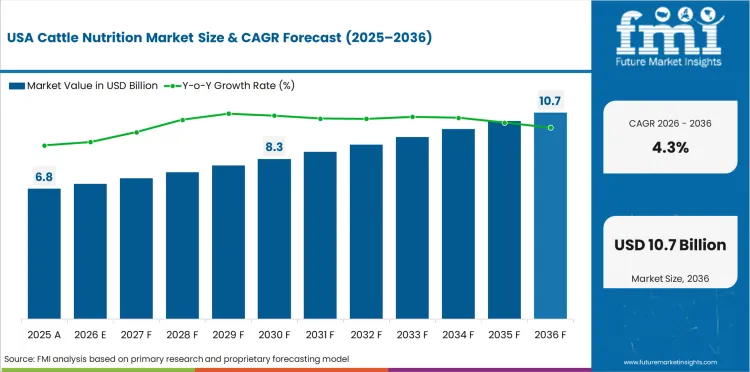
The United States is projected to grow at 4.3% CAGR through 2036, shaped by Cargill, ADM, Kemin Industries, BASF Animal Nutrition, and Novus International branded positioning, dairy farm procurement, beef feedlot operator procurement at JBS, Tyson Foods, and regional operators, and USDA organic certification supporting specialty feed additive positioning. California dairy methane regulations accelerate specialty feed additive category adoption.
- Cargill, ADM, Kemin, BASF, and Novus International lead domestic supply capacity.
- JBS, Tyson Foods, and regional feedlot operators drive beef production procurement.
- California dairy methane regulations accelerate specialty feed additive category adoption.
Future Outlook for Cattle Nutrition Market in the United Kingdom
The United Kingdom demonstrates steady growth through 2036, supported by Cargill UK, ADM UK, and specialty cattle nutrition suppliers, UK dairy farm and beef operator procurement, and post-Brexit trade dynamics affecting EU ingredient imports. UK sustainability positioning supports specialty methane-reducing feed additive category adoption.
- Cargill UK, ADM UK, and specialty suppliers drive domestic supply capacity.
- UK dairy farm and beef operator procurement supports category demand.
- Post-Brexit trade dynamics and sustainability positioning shape category development.
Opportunity Analysis of Cattle Nutrition Market in Germany
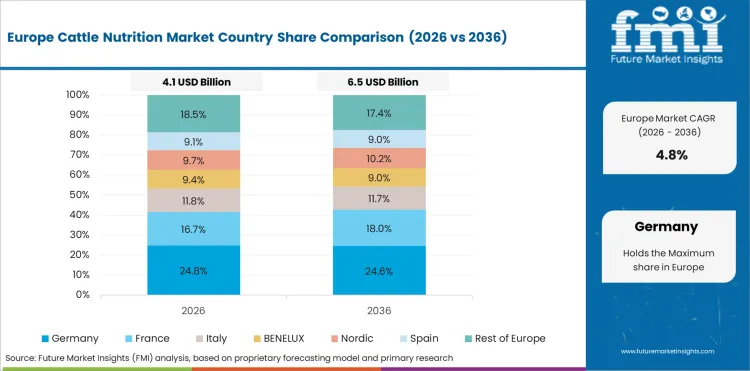
Germany is projected to grow at 4.7% CAGR through 2036, propelled by BASF Animal Nutrition domestic supply leadership, Cargill Germany, ADM Germany, and Kemin Germany branded positioning, and dairy farm and beef operator procurement. EU Regulation EC 1831/2003 feed additive approval framework and Common Agricultural Policy sustainability positioning support category development.
- BASF Animal Nutrition leads domestic supply capacity.
- Cargill Germany, ADM Germany, and Kemin Germany drive branded competition.
- EU Regulation EC 1831/2003 and CAP sustainability positioning shape category development.
In-depth Analysis of Cattle Nutrition Market in Japan
Japan demonstrates steady growth through 2036, reflecting specialty Wagyu beef production demand, dairy production efficiency demand at Hokkaido and regional dairy operations, and Mitsubishi Corporation and Marubeni domestic supply capacity. Imported premium suppliers including Cargill, ADM, and Kemin drive premium category positioning. MAFF sustainability positioning shapes category evolution.
- Mitsubishi Corporation and Marubeni lead domestic supply capacity.
- Specialty Wagyu beef production demand drives premium category positioning.
- Cargill, ADM, and Kemin imports drive premium category positioning.
Sales Analysis of Cattle Nutrition Market in China
China is projected to grow at 6.1% CAGR through 2036, propelled by dairy category expansion at Yili and Mengniu supply chains, premium beef production development, and e-commerce premium specialty feed additive access. Cargill China, ADM China, Kemin China, and BASF China lead imported branded positioning. Domestic suppliers including Dadhi and New Hope support scale category supply.
- Yili and Mengniu dairy supply chains drive dairy category procurement.
- Cargill China, ADM China, Kemin China, and BASF China lead imported category.
- Domestic suppliers including Dadhi and New Hope support scale supply.
In-depth Analysis of Cattle Nutrition Market in India
India leads growth at 6.5% CAGR through 2036, supported by dairy production expansion at Amul, Mother Dairy, and Nandini supply chains, rising cattle operation modernization, and growing middle-class dairy consumption. Cargill India, ADM India, Kemin India, and BASF India lead imported branded positioning. Domestic suppliers including Zuari Indcorp and Godrej Agrovet support domestic supply capacity.
- Amul, Mother Dairy, and Nandini dairy supply chains drive category procurement.
- Cargill India, ADM India, Kemin India, and BASF India lead imported category.
- Zuari Indcorp and Godrej Agrovet support domestic supply capacity.
Competitive Landscape and Strategic Positioning
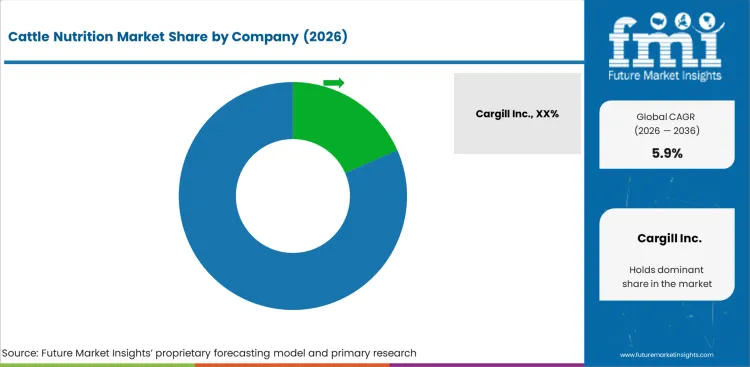
- Cargill, ADM, and Kemin Industries together control more than 45% of the world's cattle nutrition supply share. They have this share because they can produce a lot of products, have good relationships with cattle operators, and have a wide range of feed additives and premixes.
- BASF (Germany), Novus International (USA), and Alltech (USA/Ireland) are examples of regional experts who have strong brand positions in their own areas.
- DSM-Firmenich and other new specialty companies that sell methane-reducing feed additives together hold about 10% of the market share in this category, with different approaches to sustainability.
Global agriculture companies and specialty feed additive suppliers are important players in the cattle nutrition market. Cargill has the most market share in the world because it has a lot of production capacity, good relationships with cattle operators, and a wide range of feed additives, premixes, and mineral supplements.
ADM has a significant share of the category thanks to its Wisium-adjacent positioning and large supply of animal nutrition. Kemin Industries is the top supplier of specialty feed additives, and its proprietary ingredient platforms back up claims that they make dairy and beef production more efficient.
BASF Animal Nutrition runs a large European supply chain that includes vitamins and specialty feed additives. Novus International has a significant share of specialty ingredient platforms. Alltech has a large share of the market thanks to its mineral speciation technology (Bioplex, Sel-Plex) and its unique positioning.
Key Players in the Cattle Nutrition Market
Key global companies leading the cattle nutrition market include:
- Cargill Inc. (USA), ADM (USA), Kemin Industries, Inc. (USA), and BASF (Germany) were identified as some of the star players in the cattle nutrition market, given their scale production capacity, cattle operator relationships, and product portfolios spanning feed additives, premixes, mineral supplements, vitamin supplements, and specialty methane-reducing formulations.
- Novus International (USA), Alltech (USA/Ireland), and DSM-Firmenich (Netherlands/Switzerland) have established strong regional positions by specializing in feed additive platforms, mineral speciation technology, and specialty sustainability-positioned formulations including DSM's Bovaer methane-reducing feed additive supporting global cattle production operators.
- Elanco Animal Health (USA), Zoetis (USA), and Phibro Animal Health (USA), among others, have distinguished themselves by leveraging animal health expertise, established cattle operator relationships, and specialty ionophore and feed additive positioning supporting beef production and dairy production efficiency applications.
Competitive Benchmarking: Cattle Nutrition Market
| Company | Scale Production | Feed Additive Portfolio | Sustainability Positioning | Geographic Footprint |
|---|---|---|---|---|
| Cargill Inc. | High | High | Medium | Global |
| ADM | High | High | Medium | Global |
| Kemin Industries, Inc. | Medium | High | High | Global |
| BASF | High | Medium | High | Global |
| Novus International | Medium | High | High | Global |
| Alltech | Medium | High | High | Global |
| DSM-Firmenich | Medium | High | High | Global |
| Elanco Animal Health | Medium | Medium | Low | Global |
| Zoetis | Medium | Medium | Low | Global |
| Phibro Animal Health | Medium | Medium | Low | Global |
Source: Future Market Insights competitive analysis, 2026.
Key Developments in Cattle Nutrition Market
- In 2025, Cargill continued advancing feed solutions aimed at improving livestock sustainability, including efforts focused on reducing methane emissions in dairy cattle across regulated markets such as Europe and California.
- In 2025, Kemin Industries maintained its focus on rumen health and feed efficiency solutions for beef production, supporting performance optimization across feedlot operations in North and Latin America.
Key Players in the Cattle Nutrition Market
Major Global Players
- Cargill Inc.
- ADM
- Kemin Industries, Inc.
- BASF
- Novus International
- Alltech
- DSM-Firmenich
Emerging Players/Startups
- Elanco Animal Health
- Zoetis
- Phibro Animal Health
Report Scope and Coverage
| Metric | Value |
|---|---|
| Quantitative Units | USD 16.84 billion to USD 29.87 billion, at a CAGR of 5.9% |
| Market Definition | The cattle nutrition market encompasses feed additives, premixes, mineral supplements, vitamin supplements, and specialty nutrition products formulated for dairy cattle and beef cattle production. Product scope covers conventional and organic feed formulations, methane-reduction feed additives, ionophores, rumen modifiers, and specialty nutritional products sold to dairy farms, beef feedlots, and cattle production operations. |
| Regions Covered | North America, Latin America, Europe, East Asia, South Asia and Pacific, Middle East and Africa |
| Countries Covered | India, China, USA, UK, Germany, Japan, South Korea, Brazil, 30 plus countries |
| Key Companies Profiled | Cargill Inc., ADM, Kemin Industries, Inc., BASF, Novus International, Alltech, DSM-Firmenich, Elanco Animal Health, Zoetis, Phibro Animal Health |
| Forecast Period | 2026 to 2036 |
| Approach | Hybrid bottom-up and top-down methodology starting with verified cattle nutrition transaction data, projecting adoption velocity across segments and regions. |
Market Segmentation Analysis
Cattle Nutrition Market Market Segmented by Product:
- Feed Additives
- Vitamin And Mineral Premixes
- Trace Mineral Premixes
- Vitamin Fortified Blends
- Amino Acid Supplements
- Methionine Supplements
- Lysine Supplements
- Enzyme Based Additives
- Digestive Enzymes
- Fiber Breakdown Enzymes
- Vitamin And Mineral Premixes
- Roughage Feed
- Hay And Forage
- Alfalfa Based Feed
- Grass Silage
- Crop Residue Feed
- Corn Stover
- Straw Based Feed
- Hay And Forage
- Compound Feed
- Calf Starter Feed
- Growth Promoting Feed
- High Protein Starter Feed
- Dairy Cow Feed
- Lactation Feed
- Milk Yield Enhancing Feed
- Calf Starter Feed
- Protein Feed
- Soybean Meal
- Defatted Soy Meal
- High Protein Soy Feed
- Oilseed Meals
- Canola Meal
- Cottonseed Meal
- Soybean Meal
Cattle Nutrition Market Market Segmented by Application:
- Milk Production
- Lactation Enhancement
- Milk Yield Optimization
- Milk Quality Improvement
- Lactation Enhancement
- Meat Production
- Beef Cattle Fattening
- Growth Acceleration
- Carcass Quality Improvement
- Beef Cattle Fattening
- Calf Growth
- Early Stage Nutrition
- Weaning Support
- Immune Development
- Early Stage Nutrition
- Breeding Support
- Reproductive Health
- Fertility Improvement
- Hormonal Balance Support
- Reproductive Health
Cattle Nutrition Market Market Segmented by End Use:
- Dairy Farms
- Commercial Dairy Farms
- Large Scale Operations
- Integrated Dairy Systems
- Small Holder Farms
- Rural Dairy Units
- Cooperative Farming Systems
- Commercial Dairy Farms
- Beef Farms
- Feedlot Operations
- Intensive Feeding Systems
- Industrial Beef Production
- Pasture Based Farms
- Grass Fed Systems
- Organic Beef Production
- Feedlot Operations
Cattle Nutrition Market Market Segmented by Distribution Channel:
- Direct Sales
- Manufacturer To Farm
- Bulk Supply Contracts
- Long Term Supply Agreements
- Agri Cooperatives
- Farmer Cooperatives
- Regional Supply Networks
- Manufacturer To Farm
- Retail Distribution
- Agri Input Stores
- Feed Stores
- Veterinary Supply Stores
- Online Agri Platforms
- Digital Marketplace
- Subscription Supply Models
- Agri Input Stores
Cattle Nutrition Market Market Segmented by Formulation:
- Conventional Feed Formulations
- Mixed Feed Rations
- Total Mixed Ration Systems
- Balanced Diet Formulations
- Grain Based Feed
- Corn Based Feed
- Barley Based Feed
- Mixed Feed Rations
- Supplemented Feed Formulations
- Fortified Feed
- Vitamin Enriched Feed
- Mineral Enriched Feed
- Functional Feed Additives
- Probiotic Enriched Feed
- Enzyme Fortified Feed
- Fortified Feed
Cattle Nutrition Market Market Segmented by Pricing Tier:
- Mid Range
- Commercial Feed Products
- Standard Farm Grade Feed
- Commercial Feed Products
- Economy
- Low Cost Feed Solutions
- Basic Nutritional Feed
- Low Cost Feed Solutions
- Premium
- Specialty Nutrition Feed
- High Performance Feed
- Organic Certified Feed
- Specialty Nutrition Feed
Cattle Nutrition Market Market by Region:
- North America
- USA
- Canada
- Mexico
- Latin America
- Brazil
- Chile
- Rest of Latin America
- Western Europe
- Germany
- UK
- Italy
- Spain
- France
- Nordic
- BENELUX
- Rest of Western Europe
- Eastern Europe
- Russia
- Poland
- Hungary
- Balkan & Baltic
- Rest of Eastern Europe
- East Asia
- China
- Japan
- South Korea
- South Asia and Pacific
- India
- ASEAN
- Australia & New Zealand
- Rest of South Asia and Pacific
- Middle East & Africa
- Kingdom of Saudi Arabia
- Other GCC Countries
- Turkiye
- South Africa
- Other African Union
- Rest of Middle East & Africa
Research Sources and Bibliography
- 1. European Commission. (2024). EU Regulation EC 1831/2003 on Feed Additives. European Commission.
- 2. USA Food and Drug Administration. (2024). FDA Center for Veterinary Medicine Feed Regulatory Guidance. FDA CVM.
- 3. Association of American Feed Control Officials. (2025). AAFCO Official Publication. AAFCO.
- 4. Food and Agriculture Organization. (2025). FAO Global Livestock Feed Additive Analysis. FAO.
- 5. International Dairy Federation. (2024). IDF World Dairy Situation and Feed Analysis. IDF.
This bibliography is provided for reader reference.
This Report Answers
- Market sizing and revenue forecasting for cattle nutrition products from 2026 to 2036.
- Segmentation analysis across all product, application, end-use, and distribution-channel axes covered in Section 4.
- Regional and country-level insights covering over 30 markets with comparative growth analysis.
- Regulatory analysis covering the key frameworks shaping product specifications and procurement priorities in major markets.
- Competitive landscape assessment covering market structure, vendor positioning, and recent developments.
- Investment opportunity mapping across supplier, brand-owner, and channel verticals.
- Supply chain tracking from raw material sourcing to finished product distribution.
- Data delivery in PDF and Excel formats with quarterly refresh access.
Frequently Asked Questions
How large is the demand for Cattle Nutrition Market in the global market in 2026?
Demand for cattle nutrition market in the global market is estimated to be valued at USD 16.84 billion in 2026.
What will be the market size of Cattle Nutrition Market by 2036?
Market size for cattle nutrition market is projected to reach USD 29.87 billion by 2036.
What is the expected demand growth for Cattle Nutrition Market between 2026 and 2036?
Demand for cattle nutrition market is expected to grow at a CAGR of 5.9% between 2026 and 2036.
Which Product is poised to lead global sales by 2026?
Feed Additives accounts for 45.0% in 2026, reflecting established manufacturing infrastructure and proven performance advantages.
How is Direct Sales driving Cattle Nutrition Market adoption?
Direct Sales represents 60.0% of distribution channel demand as dominant operators and procurement organizations drive volume.
What is driving demand in the top-growth country?
India registers a 6.50% CAGR through 2036, propelled by policy mandates, category adoption, and procurement-scale investment.
What does Cattle Nutrition Market definition mean in this report?
The cattle nutrition market tle nutrition market encompasses feed additives, premixes, mineral supplements, vitamin supplements, and specialty nutrition products formulated for dairy cattle and beef cattle production. Product scope covers conventional and organic feed formulations, methane-reduction feed additives, ionophores, rumen modifiers, and specialty nutritional products sold to dairy farms, beef feedlots, and cattle production operations.
How does FMI build and validate the Cattle Nutrition Market forecast?
Forecasting models apply a hybrid bottom-up methodology starting with verified transaction data, cross-validated against industry sales statistics and manufacturer financial disclosures.
Preview the report firsthand - request a free sample
Get SampleGet the brochure for pricing and purchase details.
Get PDFTable of Content
- Executive Summary
- Global Market Outlook
- Demand-side Trends
- Supply-side Trends
- Technology Roadmap Analysis
- Analysis and Recommendations
- Market Overview
- Market Coverage / Taxonomy
- Market Definition / Scope / Limitations
- Research Methodology
- Chapter Orientation
- Analytical Lens and Working Hypotheses
- Market Structure, Signals, and Trend Drivers
- Benchmarking and Cross-market Comparability
- Market Sizing, Forecasting, and Opportunity Mapping
- Research Design and Evidence Framework
- Desk Research Programme (Secondary Evidence)
- Company Annual and Sustainability Reports
- Peer-reviewed Journals and Academic Literature
- Corporate Websites, Product Literature, and Technical Notes
- Earnings Decks and Investor Briefings
- Statutory Filings and Regulatory Disclosures
- Technical White Papers and Standards Notes
- Trade Journals, Industry Magazines, and Analyst Briefs
- Conference Proceedings, Webinars, and Seminar Materials
- Government Statistics Portals and Public Data Releases
- Press Releases and Reputable Media Coverage
- Specialist Newsletters and Curated Briefings
- Sector Databases and Reference Repositories
- FMI Internal Proprietary Databases and Historical Market Datasets
- Subscription Datasets and Paid Sources
- Social Channels, Communities, and Digital Listening Inputs
- Additional Desk Sources
- Expert Input and Fieldwork (Primary Evidence)
- Primary Modes
- Qualitative Interviews and Expert Elicitation
- Quantitative Surveys and Structured Data Capture
- Blended Approach
- Why Primary Evidence is Used
- Field Techniques
- Interviews
- Surveys
- Focus Groups
- Observational and In-context Research
- Social and Community Interactions
- Stakeholder Universe Engaged
- C-suite Leaders
- Board Members
- Presidents and Vice Presidents
- R&D and Innovation Heads
- Technical Specialists
- Domain Subject-matter Experts
- Scientists
- Physicians and Other Healthcare Professionals
- Governance, Ethics, and Data Stewardship
- Research Ethics
- Data Integrity and Handling
- Primary Modes
- Tooling, Models, and Reference Databases
- Desk Research Programme (Secondary Evidence)
- Data Engineering and Model Build
- Data Acquisition and Ingestion
- Cleaning, Normalisation, and Verification
- Synthesis, Triangulation, and Analysis
- Quality Assurance and Audit Trail
- Market Background
- Market Dynamics
- Drivers
- Restraints
- Opportunity
- Trends
- Scenario Forecast
- Demand in Optimistic Scenario
- Demand in Likely Scenario
- Demand in Conservative Scenario
- Opportunity Map Analysis
- Product Life Cycle Analysis
- Supply Chain Analysis
- Investment Feasibility Matrix
- Value Chain Analysis
- PESTLE and Porter’s Analysis
- Regulatory Landscape
- Regional Parent Market Outlook
- Production and Consumption Statistics
- Import and Export Statistics
- Market Dynamics
- Global Market Analysis 2021 to 2025 and Forecast, 2026 to 2036
- Historical Market Size Value (USD Million) Analysis, 2021 to 2025
- Current and Future Market Size Value (USD Million) Projections, 2026 to 2036
- Y-o-Y Growth Trend Analysis
- Absolute $ Opportunity Analysis
- Global Market Pricing Analysis 2021 to 2025 and Forecast 2026 to 2036
- Global Market Analysis 2021 to 2025 and Forecast 2026 to 2036, By Product
- Introduction / Key Findings
- Historical Market Size Value (USD Million) Analysis By Product , 2021 to 2025
- Current and Future Market Size Value (USD Million) Analysis and Forecast By Product , 2026 to 2036
- Feed Additives
- Vitamin And Mineral Premixes
- Trace Mineral Premixes
- Vitamin Fortified Blends
- Amino Acid Supplements
- Methionine Supplements
- Lysine Supplements
- Enzyme Based Additives
- Digestive Enzymes
- Fiber Breakdown Enzymes
- Roughage Feed
- Hay And Forage
- Alfalfa Based Feed
- Grass Silage
- Crop Residue Feed
- Corn Stover
- Compound Feed
- Calf Starter Feed
- Growth Promoting Feed
- High Protein Starter Feed
- Dairy Cow Feed
- Lactation Feed
- Protein Feed
- Soybean Meal
- Defatted Soy Meal
- High Protein Soy Feed
- Oilseed Meals
- Canola Meal
- Feed Additives
- Y-o-Y Growth Trend Analysis By Product , 2021 to 2025
- Absolute $ Opportunity Analysis By Product , 2026 to 2036
- Global Market Analysis 2021 to 2025 and Forecast 2026 to 2036, By Application
- Introduction / Key Findings
- Historical Market Size Value (USD Million) Analysis By Application, 2021 to 2025
- Current and Future Market Size Value (USD Million) Analysis and Forecast By Application, 2026 to 2036
- Milk Production
- Lactation Enhancement
- Milk Yield Optimization
- Milk Quality Improvement
- Meat Production
- Beef Cattle Fattening
- Growth Acceleration
- Carcass Quality Improvement
- Calf Growth
- Early Stage Nutrition
- Weaning Support
- Immune Development
- Breeding Support
- Reproductive Health
- Fertility Improvement
- Hormonal Balance Support
- Milk Production
- Y-o-Y Growth Trend Analysis By Application, 2021 to 2025
- Absolute $ Opportunity Analysis By Application, 2026 to 2036
- Global Market Analysis 2021 to 2025 and Forecast 2026 to 2036, By End Use
- Introduction / Key Findings
- Historical Market Size Value (USD Million) Analysis By End Use, 2021 to 2025
- Current and Future Market Size Value (USD Million) Analysis and Forecast By End Use, 2026 to 2036
- Dairy Farms
- Commercial Dairy Farms
- Large Scale Operations
- Integrated Dairy Systems
- Small Holder Farms
- Rural Dairy Value (USD Million)s
- Cooperative Farming Systems
- Beef Farms
- Feedlot Operations
- Intensive Feeding Systems
- Industrial Beef Production
- Pasture Based Farms
- Grass Fed Systems
- Dairy Farms
- Y-o-Y Growth Trend Analysis By End Use, 2021 to 2025
- Absolute $ Opportunity Analysis By End Use, 2026 to 2036
- Global Market Analysis 2021 to 2025 and Forecast 2026 to 2036, By Distribution Channel
- Introduction / Key Findings
- Historical Market Size Value (USD Million) Analysis By Distribution Channel, 2021 to 2025
- Current and Future Market Size Value (USD Million) Analysis and Forecast By Distribution Channel, 2026 to 2036
- Direct Sales
- Manufacturer To Farm
- Bulk Supply Contracts
- Long Term Supply Agreements
- Agri Cooperatives
- Farmer Cooperatives
- Regional Supply Networks
- Retail Distribution
- Agri Input Stores
- Feed Stores
- Veterinary Supply Stores
- Online Agri Platforms
- Digital Marketplace
- Direct Sales
- Y-o-Y Growth Trend Analysis By Distribution Channel, 2021 to 2025
- Absolute $ Opportunity Analysis By Distribution Channel, 2026 to 2036
- Global Market Analysis 2021 to 2025 and Forecast 2026 to 2036, By Formulation
- Introduction / Key Findings
- Historical Market Size Value (USD Million) Analysis By Formulation, 2021 to 2025
- Current and Future Market Size Value (USD Million) Analysis and Forecast By Formulation, 2026 to 2036
- Conventional Feed Formulations
- Mixed Feed Rations
- Total Mixed Ration Systems
- Balanced Diet Formulations
- Grain Based Feed
- Corn Based Feed
- Barley Based Feed
- Supplemented Feed Formulations
- Fortified Feed
- Vitamin Enriched Feed
- Mineral Enriched Feed
- Functional Feed Additives
- Probiotic Enriched Feed
- Conventional Feed Formulations
- Y-o-Y Growth Trend Analysis By Formulation, 2021 to 2025
- Absolute $ Opportunity Analysis By Formulation, 2026 to 2036
- Global Market Analysis 2021 to 2025 and Forecast 2026 to 2036, By Pricing Tier
- Introduction / Key Findings
- Historical Market Size Value (USD Million) Analysis By Pricing Tier, 2021 to 2025
- Current and Future Market Size Value (USD Million) Analysis and Forecast By Pricing Tier, 2026 to 2036
- Mid Range
- Commercial Feed Products
- Standard Farm Grade Feed
- Economy
- Low Cost Feed Solutions
- Basic Nutritional Feed
- Premium
- Specialty Nutrition Feed
- High Performance Feed
- Organic Certified Feed
- Mid Range
- Y-o-Y Growth Trend Analysis By Pricing Tier, 2021 to 2025
- Absolute $ Opportunity Analysis By Pricing Tier, 2026 to 2036
- Global Market Analysis 2021 to 2025 and Forecast 2026 to 2036, By Region
- Introduction
- Historical Market Size Value (USD Million) Analysis By Region, 2021 to 2025
- Current Market Size Value (USD Million) Analysis and Forecast By Region, 2026 to 2036
- North America
- Latin America
- Western Europe
- Eastern Europe
- East Asia
- South Asia and Pacific
- Middle East & Africa
- Market Attractiveness Analysis By Region
- North America Market Analysis 2021 to 2025 and Forecast 2026 to 2036, By Country
- Historical Market Size Value (USD Million) Trend Analysis By Market Taxonomy, 2021 to 2025
- Market Size Value (USD Million) Forecast By Market Taxonomy, 2026 to 2036
- By Country
- USA
- Canada
- Mexico
- By Product
- By Application
- By End Use
- By Distribution Channel
- By Formulation
- By Pricing Tier
- By Country
- Market Attractiveness Analysis
- By Country
- By Product
- By Application
- By End Use
- By Distribution Channel
- By Formulation
- By Pricing Tier
- Key Takeaways
- Latin America Market Analysis 2021 to 2025 and Forecast 2026 to 2036, By Country
- Historical Market Size Value (USD Million) Trend Analysis By Market Taxonomy, 2021 to 2025
- Market Size Value (USD Million) Forecast By Market Taxonomy, 2026 to 2036
- By Country
- Brazil
- Chile
- Rest of Latin America
- By Product
- By Application
- By End Use
- By Distribution Channel
- By Formulation
- By Pricing Tier
- By Country
- Market Attractiveness Analysis
- By Country
- By Product
- By Application
- By End Use
- By Distribution Channel
- By Formulation
- By Pricing Tier
- Key Takeaways
- Western Europe Market Analysis 2021 to 2025 and Forecast 2026 to 2036, By Country
- Historical Market Size Value (USD Million) Trend Analysis By Market Taxonomy, 2021 to 2025
- Market Size Value (USD Million) Forecast By Market Taxonomy, 2026 to 2036
- By Country
- Germany
- UK
- Italy
- Spain
- France
- Nordic
- BENELUX
- Rest of Western Europe
- By Product
- By Application
- By End Use
- By Distribution Channel
- By Formulation
- By Pricing Tier
- By Country
- Market Attractiveness Analysis
- By Country
- By Product
- By Application
- By End Use
- By Distribution Channel
- By Formulation
- By Pricing Tier
- Key Takeaways
- Eastern Europe Market Analysis 2021 to 2025 and Forecast 2026 to 2036, By Country
- Historical Market Size Value (USD Million) Trend Analysis By Market Taxonomy, 2021 to 2025
- Market Size Value (USD Million) Forecast By Market Taxonomy, 2026 to 2036
- By Country
- Russia
- Poland
- Hungary
- Balkan & Baltic
- Rest of Eastern Europe
- By Product
- By Application
- By End Use
- By Distribution Channel
- By Formulation
- By Pricing Tier
- By Country
- Market Attractiveness Analysis
- By Country
- By Product
- By Application
- By End Use
- By Distribution Channel
- By Formulation
- By Pricing Tier
- Key Takeaways
- East Asia Market Analysis 2021 to 2025 and Forecast 2026 to 2036, By Country
- Historical Market Size Value (USD Million) Trend Analysis By Market Taxonomy, 2021 to 2025
- Market Size Value (USD Million) Forecast By Market Taxonomy, 2026 to 2036
- By Country
- China
- Japan
- South Korea
- By Product
- By Application
- By End Use
- By Distribution Channel
- By Formulation
- By Pricing Tier
- By Country
- Market Attractiveness Analysis
- By Country
- By Product
- By Application
- By End Use
- By Distribution Channel
- By Formulation
- By Pricing Tier
- Key Takeaways
- South Asia and Pacific Market Analysis 2021 to 2025 and Forecast 2026 to 2036, By Country
- Historical Market Size Value (USD Million) Trend Analysis By Market Taxonomy, 2021 to 2025
- Market Size Value (USD Million) Forecast By Market Taxonomy, 2026 to 2036
- By Country
- India
- ASEAN
- Australia & New Zealand
- Rest of South Asia and Pacific
- By Product
- By Application
- By End Use
- By Distribution Channel
- By Formulation
- By Pricing Tier
- By Country
- Market Attractiveness Analysis
- By Country
- By Product
- By Application
- By End Use
- By Distribution Channel
- By Formulation
- By Pricing Tier
- Key Takeaways
- Middle East & Africa Market Analysis 2021 to 2025 and Forecast 2026 to 2036, By Country
- Historical Market Size Value (USD Million) Trend Analysis By Market Taxonomy, 2021 to 2025
- Market Size Value (USD Million) Forecast By Market Taxonomy, 2026 to 2036
- By Country
- Kingdom of Saudi Arabia
- Other GCC Countries
- Turkiye
- South Africa
- Other African Union
- Rest of Middle East & Africa
- By Product
- By Application
- By End Use
- By Distribution Channel
- By Formulation
- By Pricing Tier
- By Country
- Market Attractiveness Analysis
- By Country
- By Product
- By Application
- By End Use
- By Distribution Channel
- By Formulation
- By Pricing Tier
- Key Takeaways
- Key Countries Market Analysis
- USA
- Pricing Analysis
- Market Share Analysis, 2025
- By Product
- By Application
- By End Use
- By Distribution Channel
- By Formulation
- By Pricing Tier
- Canada
- Pricing Analysis
- Market Share Analysis, 2025
- By Product
- By Application
- By End Use
- By Distribution Channel
- By Formulation
- By Pricing Tier
- Mexico
- Pricing Analysis
- Market Share Analysis, 2025
- By Product
- By Application
- By End Use
- By Distribution Channel
- By Formulation
- By Pricing Tier
- Brazil
- Pricing Analysis
- Market Share Analysis, 2025
- By Product
- By Application
- By End Use
- By Distribution Channel
- By Formulation
- By Pricing Tier
- Chile
- Pricing Analysis
- Market Share Analysis, 2025
- By Product
- By Application
- By End Use
- By Distribution Channel
- By Formulation
- By Pricing Tier
- Germany
- Pricing Analysis
- Market Share Analysis, 2025
- By Product
- By Application
- By End Use
- By Distribution Channel
- By Formulation
- By Pricing Tier
- UK
- Pricing Analysis
- Market Share Analysis, 2025
- By Product
- By Application
- By End Use
- By Distribution Channel
- By Formulation
- By Pricing Tier
- Italy
- Pricing Analysis
- Market Share Analysis, 2025
- By Product
- By Application
- By End Use
- By Distribution Channel
- By Formulation
- By Pricing Tier
- Spain
- Pricing Analysis
- Market Share Analysis, 2025
- By Product
- By Application
- By End Use
- By Distribution Channel
- By Formulation
- By Pricing Tier
- France
- Pricing Analysis
- Market Share Analysis, 2025
- By Product
- By Application
- By End Use
- By Distribution Channel
- By Formulation
- By Pricing Tier
- India
- Pricing Analysis
- Market Share Analysis, 2025
- By Product
- By Application
- By End Use
- By Distribution Channel
- By Formulation
- By Pricing Tier
- ASEAN
- Pricing Analysis
- Market Share Analysis, 2025
- By Product
- By Application
- By End Use
- By Distribution Channel
- By Formulation
- By Pricing Tier
- Australia & New Zealand
- Pricing Analysis
- Market Share Analysis, 2025
- By Product
- By Application
- By End Use
- By Distribution Channel
- By Formulation
- By Pricing Tier
- China
- Pricing Analysis
- Market Share Analysis, 2025
- By Product
- By Application
- By End Use
- By Distribution Channel
- By Formulation
- By Pricing Tier
- Japan
- Pricing Analysis
- Market Share Analysis, 2025
- By Product
- By Application
- By End Use
- By Distribution Channel
- By Formulation
- By Pricing Tier
- South Korea
- Pricing Analysis
- Market Share Analysis, 2025
- By Product
- By Application
- By End Use
- By Distribution Channel
- By Formulation
- By Pricing Tier
- Russia
- Pricing Analysis
- Market Share Analysis, 2025
- By Product
- By Application
- By End Use
- By Distribution Channel
- By Formulation
- By Pricing Tier
- Poland
- Pricing Analysis
- Market Share Analysis, 2025
- By Product
- By Application
- By End Use
- By Distribution Channel
- By Formulation
- By Pricing Tier
- Hungary
- Pricing Analysis
- Market Share Analysis, 2025
- By Product
- By Application
- By End Use
- By Distribution Channel
- By Formulation
- By Pricing Tier
- Kingdom of Saudi Arabia
- Pricing Analysis
- Market Share Analysis, 2025
- By Product
- By Application
- By End Use
- By Distribution Channel
- By Formulation
- By Pricing Tier
- Turkiye
- Pricing Analysis
- Market Share Analysis, 2025
- By Product
- By Application
- By End Use
- By Distribution Channel
- By Formulation
- By Pricing Tier
- South Africa
- Pricing Analysis
- Market Share Analysis, 2025
- By Product
- By Application
- By End Use
- By Distribution Channel
- By Formulation
- By Pricing Tier
- USA
- Market Structure Analysis
- Competition Dashboard
- Competition Benchmarking
- Market Share Analysis of Top Players
- By Regional
- By Product
- By Application
- By End Use
- By Distribution Channel
- By Formulation
- By Pricing Tier
- Competition Analysis
- Competition Deep Dive
- Cargill Inc.
- Overview
- Product Portfolio
- Profitability by Market Segments (Product/Age /Sales Channel/Region)
- Sales Footprint
- Strategy Overview
- Marketing Strategy
- Product Strategy
- Channel Strategy
- ADM
- Kemin Industries, Inc.
- BASF
- Novus International
- De Heus Animal Nutrition
- Elanco
- DuPont
- Tata Chemicals
- Balchem Corporation
- Others
- Cargill Inc.
- Competition Deep Dive
- Assumptions & Acronyms Used


