
- Market Size (2026)
- USD 980.7 Mn
- Forecast (2036)
- USD 1691.1 Mn
- CAGR (2026 to 2036)
- 5.6%
How big is Cement Loading Spouts Market in 2026?
USD 980.7 million in 2026 and USD 1,691.1 million by 2036 at a 5.6% CAGR.
Demand for cement loading spouts is projected to expand at a 5.6% CAGR between 2026 and 2036, increasing valuation from USD 980.7 million in 2026 to USD 1691.1 million by 2036. Plant engineers replace loading hardware as dust containment failures or vehicle misalignment reduce dispatch reliability across established loading lanes. The American Cement Association reported in June 2026 that USA consumption in 2025 included about 65 million metric tons of blended cement and 35 million tons of traditional cement. Recurring cement throughput leaves these interfaces in daily service, so dependable dust collection systems remain part of replacement decisions.
Replacement demand varies across countries according to terminal density, distribution networks, and bulk-material handling requirements. Indonesia is forecast to expand at a 5.7% CAGR through 2036 compared with 4.1% for Japan. Indonesia's archipelagic geography requires extensive road, port and coastal transfer infrastructure, creating a broader installed base of loading equipment across dispersed cement distribution points. Japan's Ministry of Land, Infrastructure, Transport and Tourism forecast cement demand of 33 million tonnes for fiscal 2025 in October 2025. A mature terminal network and stable demand environment favor phased equipment replacement, whereas Indonesian operators continue to invest in service coverage and handling capacity across a wider logistics footprint.
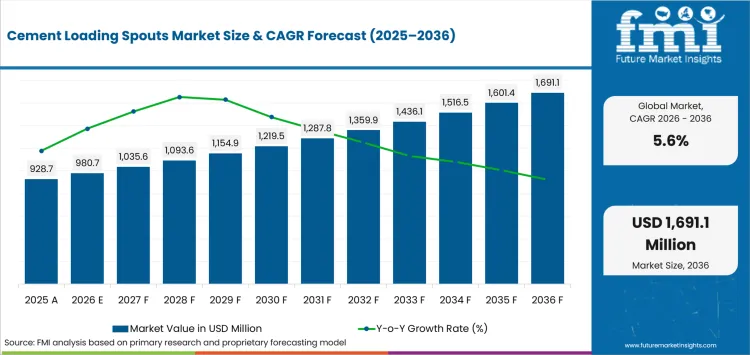
Key Takeaways of Cement Loading Spouts Market
- Dust containment and dependable dispatch increase replacement demand when cement terminals cannot accept product loss or prolonged vehicle loading delays.
- By spout type, open loading spouts are estimated to hold 22.0% in 2026 owing to flexible service across open receivers.
- In 2026, truck loading is expected to lead loading mode with 38.0% share because road dispatch suits regional bulk distribution.
- The control category is forecast to be led by manual control at 18.0% share in 2026 due to lower automation payback at lower-duty lanes.
- Retrofit geometry can delay adoption when silo clearances and dust ducts require extensive structural changes during loading-spout installation.
- WAMGROUP, Vortex Global, DCL, Midwest International, PEBCO, BEUMER Group, Rieco Industries and Polimak compete across specialist loading and broader bulk-handling roles.
Analyst Perspective
“Cement terminals should judge a loading spout across the complete loadout cycle, including hatch alignment and dust capture. Equipment earns a stronger case when it connects to existing controls and fits the planned shutdown window without reducing loading speed.”
- Nikhil Kaitwade, Principal Consultant, Future Market Insights
How is the Cement Loading Spouts Market segmented?
The cement loading spouts market is segmented by spout type, loading mode, control, material handled, sales channel and region.
The cement loading spouts market is segmented by spout type, loading mode, control, material handled and sales channel. Spout type covers open, closed, telescopic and dust-free designs, and loading mode includes truck, railcar, ship or barge and big-bag loading. Control covers manual, semi-automatic and fully automatic systems, and material handled covers cement, fly ash, clinker dust and lime or minerals. Sales channel distinguishes plant OEM or EPC, direct end user and aftermarket replacement.
What makes open loading spouts central to the spout type category?
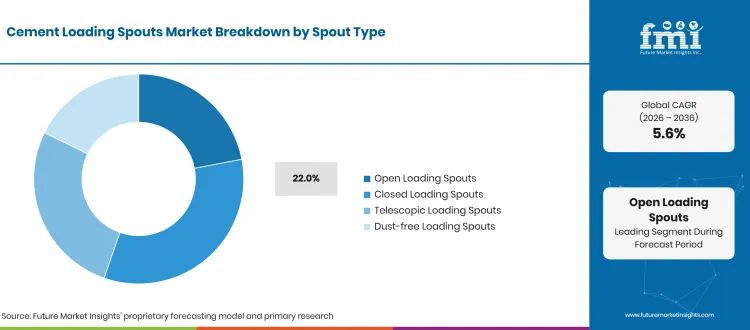
Open loading spouts serve receivers without a fixed sealed connection, so the outlet must follow changing material height. Their adjustable path suits varied truck bodies or open stockpiles, yet retrofit geometry also depends on the available drop below cement silos.
- Open loading spouts are set to lead the spout type category with 22.0% share in 2026 due to adaptable receiver coverage.
- Site measurements remain important because open-receiver dimensions can change the required travel and outlet position. Vortex Global shifted Oklahoma and Northern Texas loading-solutions representation to Shamrock Systems in October 2025, expanding regional technical support for equipment selection.
Why does truck loading lead the loading mode category?
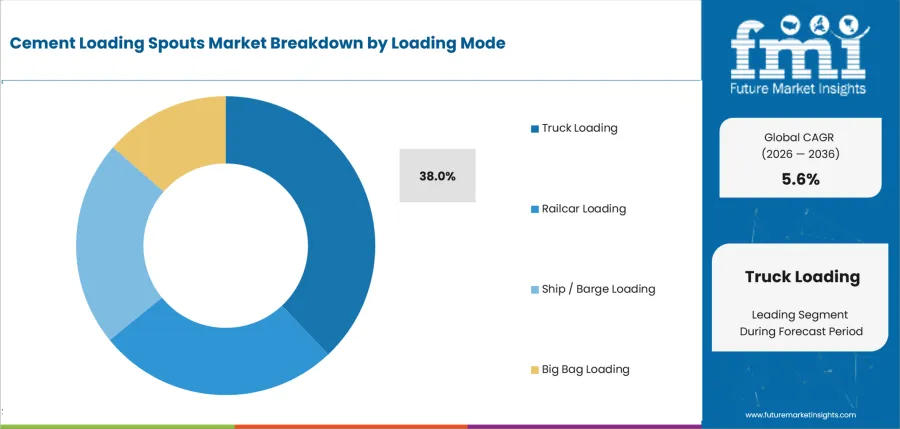
Truck loading gives cement terminals a flexible road-dispatch route without dedicated rail or marine infrastructure at each destination. The American Cement Association stated in March 2025 that imports represent about 20% of annual USA cement consumption. At coastal terminals, truck lanes must align hatch position and scales with upstream conveying equipment before inbound bulk cement moves into regional distribution.
- Truck loading is projected to hold 38.0% share in 2026 owing to flexible regional distribution from bulk terminals.
- Repeat dispatch depends on reliable hatch alignment and scale sequencing so trucks clear the lane without re-spotting or longer loading cycles.
How does manual control influence selection within the control category?
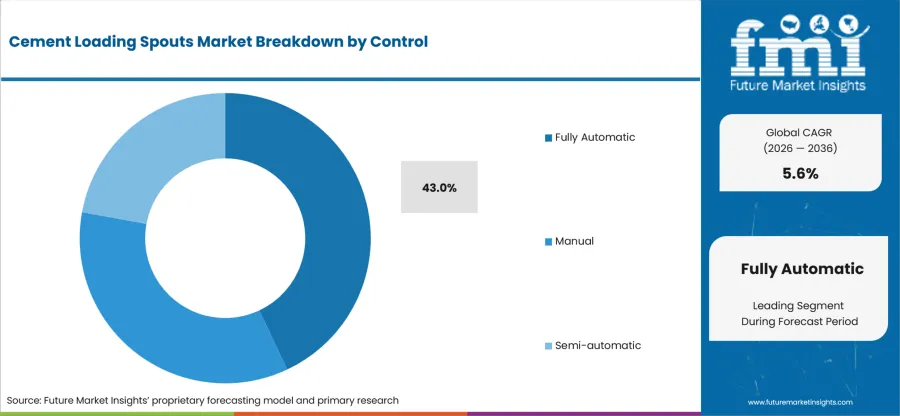
Manual control remains practical at lower-duty lanes that need dependable extension and retraction without a larger positioning package. Plant engineers compare maintenance access and control compatibility across adjacent material handling equipment before paying for automated alignment.
- Based on control, manual control is projected to account for 18.0% in 2026 due to simpler operation at lower-cycle lanes.
- The American Cement Association named Vortex Global its 2025 Manufacturers’ Performance Award winner in October 2025 for measurable improvements in cement manufacturing performance. At higher-cycle lanes, automated alignment becomes easier to justify because repeatable dispatch gains can offset the added controls and service requirements.
What supports cement within the material handled category?
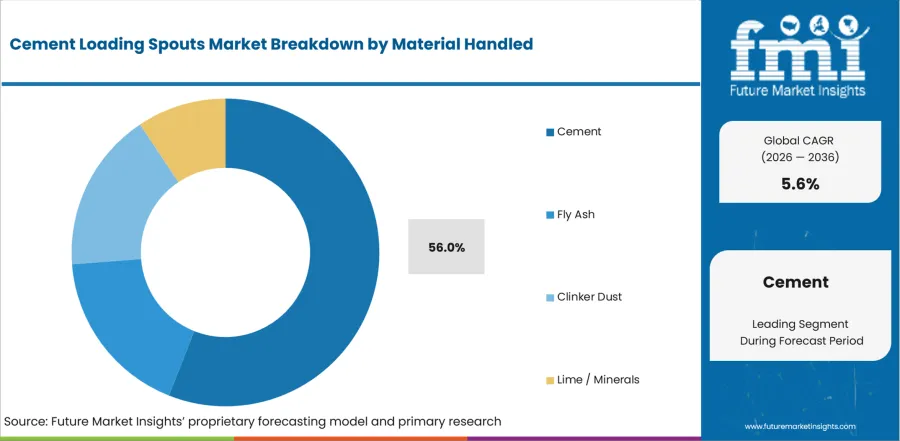
The American Cement Association reported in May 2025 that lower-emission cement exceeded 60% of USA consumption. Broader blend use changes the powder mix moving through shared bulk lanes and raises the need for stable flow and extraction performance. Cement loading equipment must contain fine powder during high-frequency dispatch and keep bulk movements separate from cement sacks.
- By material handled, cement is forecast to represent 56.0% in 2026 driven by recurring bulk dispatch and fine-powder containment needs.
- Recurring use increases liner and extraction maintenance, so plants favor spout designs that remain serviceable as powder properties change across repeated dispatch cycles.
What are the drivers, restraints and opportunities in the Cement Loading Spouts Market?
Dust containment and dependable dispatch raise replacement demand, retrofit fit can delay installation and service-led automation offers a practical expansion route.
- Driver: Worn loading interfaces raise replacement demand as dust escape and slow truck turnaround disrupt routine cement dispatch.
- Restraint: Existing steelwork and legacy controls increase engineering work when a replacement spout does not match the original installation envelope.
- Opportunity: Regional application teams can shorten specification and commissioning for terminals adding selective loading automation.
Dispatch Reliability Keeps Replacement Active
Installed loadout lanes still wear and lose dispatch efficiency even in a soft cement year, so replacement demand does not depend on rising consumption alone. The American Cement Association forecast in May 2025 that USA cement consumption would decline 1.6% that year, limiting the case for broad terminal expansion. A softer volume outlook favors targeted spout repairs alongside dust suppressant systems at sites that can recover clean dispatch without rebuilding the terminal.
Retrofit Fit Extends Installation Decisions
Old steelwork and dust ducts can turn a loading-spout replacement into a wider retrofit if adjacent pneumatic conveying diverters restrict access. Vortex Global documented a January 2025 Drax order for eight custom spouts designed around tight clearances and legacy controls. The extra interface work increases engineering risk and pushes some terminals toward maintenance windows that can absorb control and duct changes.
Regional Support Shortens Technical Conversion
Regional application support matters most when terminals need field measurements for loading controls and adjacent packaging equipment before approving a replacement. Vortex Global expanded its New Zealand representation with Pneuvay Engineering in May 2025, giving local customers direct access to its dry-bulk portfolio. Local engineering can resolve interface questions earlier and shorten the path from technical review to an approved loading project.
Which country CAGRs are profiled in the Cement Loading Spouts Market?
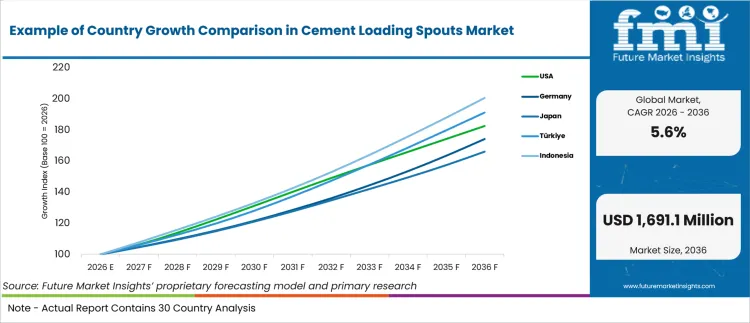
| Country | CAGR |
|---|---|
| Indonesia | 5.7% |
| Türkiye | 5.4% |
| USA | 4.8% |
| Germany | 4.4% |
| Japan | 4.1% |
How do country-level CAGRs compare in the Cement Loading Spouts Market?
The country CAGRs span 1.6 percentage points, forming a concentrated pattern instead of sharply separated country tiers. Indonesia and Türkiye form the upper pair as distribution expansion adds loadout requirements. USA, Germany and Japan form a replacement-led group where service access and retrofit fit matter more than new capacity.
- Indonesia’s island distribution requires flexible road and marine loading across dispersed coastal terminals.
- Türkiye’s export flows require adaptable inland and coastal configurations across busy cement terminals.
- USA terminals prioritize rapid truck alignment across established regional lanes and legacy scales.
- Germany favors compact retrofits fitting planned maintenance windows across mature cement plants.
- Japan’s concentrated asset base favors staged replacement with dependable parts support at terminals.
CAGR alone therefore does not rank current revenue or project accessibility. The full report provides country-level CAGR analysis across North America, Latin America, Europe, East Asia, South Asia, Oceania and the Middle East and Africa.
Country-wise Analysis
- Indonesian cement terminals serve an island network where marine transfers feed regional road distribution across widely separated consumption centers, requiring loading equipment that tolerates frequent vessel changes and long parts-delivery routes across regional terminals. ASPERSSI reported in February 2026 that 2025 cement exports rose 32.2% and clinker exports increased 12.8%, adding handling activity at coastal dispatch points that link domestic plants with export and inter-island routes. Cement loading-spout demand in Indonesia is forecast to rise at 5.7% CAGR over the forecast period, supported by recurring ship and truck duties as remote service calls can extend equipment downtime across dispersed islands.
- Türkiye combines large domestic cement production with export terminals serving recurring truck and marine dispatch across inland plants and coastal sites, requiring loading equipment that accommodates mixed vessel sizes and established regional trade routes. By 2036, Türkiye is projected to grow at 5.4% CAGR, owing to sustained loading activity as TÜRKÇİMENTO reported a 9.4% year over year production increase during January-November 2025 across the national cement industry. Port schedules and mixed plant ages complicate project timing, so loading-spout orders depend on field service that fits equipment around existing structures and restores dispatch within planned maintenance periods without extending production interruptions.
- United States cement terminals combine domestic output with imported supply moving across coastal and border gateways into regional truck distribution, placing repeated vehicle positioning and scale integration at the center of loadout work. The American Cement Association estimated in June 2025 that planned AI infrastructure could require about 1 million metric tons of cement by 2028, adding a project corridor for bulk dispatch into major construction clusters. Cement loading-spout sales in the United States are forecast to expand at 4.8% CAGR by 2036, supported by recurring terminal traffic as retrofit teams fit automation around legacy controls without disrupting daily truck schedules.
- German cement plants operate within a mature asset base, and planned shutdowns govern how loading-spout replacements fit around existing silos and controls at retained production and distribution sites with limited room for structural changes. Heidelberg Materials announced in March 2026 that it would close its Paderborn cement plant amid weak construction demand, reinforcing selective equipment spending at retained sites instead of broad rebuilding across the plant network. Germany is estimated to post 4.4% CAGR over the forecast period, shaped by compact retrofit work as plants delay orders until dust control or dispatch gains justify site installation during planned maintenance periods.
- Japanese cement producers operate a concentrated plant network with long equipment lives, so maintenance teams favor staged replacement and dependable spare-parts support across established production sites and regional bulk terminals with predictable service cycles. The Japan Cement Association reported in July 2025 that 15 companies operated 26 plants with about 47 million tonnes of clinker capacity, defining a clear installed base for service planning and replacement scheduling. Adoption of cement loading spouts in Japan is estimated to expand at 4.1% CAGR through 2036, supported by replacement around existing bulk assets as exact retrofit fit and inspection access determine equipment purchase timing.
Who are the notable companies in the Cement Loading Spouts Market?
WAMGROUP, Vortex Global, DCL, Midwest International, PEBCO, BEUMER Group, Rieco Industries and Polimak are the notable companies serving this market.
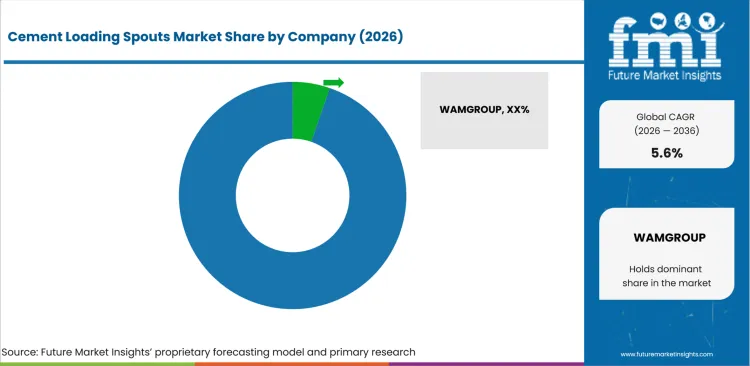
Competition is distributed across specialist loadout manufacturers and dry-bulk integrators serving established cement terminals. Plant engineers compare vessel coverage and dust-control fit alongside positioning depth and local commissioning support. Entry barriers rise as loading spouts must fit existing silos or adjacent bagging machines within scheduled shutdowns.
- Vortex Global, DCL, Midwest International and PEBCO focus on specialist loading hardware and vehicle positioning systems for terminal projects.
- WAMGROUP and BEUMER Group combine loading equipment with broader bulk-handling packages for coordinated cement plant projects.
- Rieco Industries and Polimak combine telescopic loading equipment with wider dry-bulk handling scope for project-based applications.
Competitive Benchmarking: Cement Loading Spouts Market
| Company | Mode & Vessel Coverage | Dust-Control Integration | Automation & Positioning | Geographic Reach |
|---|---|---|---|---|
| WAMGROUP | Medium | High | Medium | International |
| Vortex Global | High | High | High | International network |
| DCL | High | High | High | North America and international projects |
| Midwest International | High | High | Medium | United States |
| PEBCO | High | High | Medium | North America and international sales |
| BEUMER Group | High | High | Medium | Global |
| Rieco Industries | High | High | High | India and international projects |
| Polimak | High | High | Medium | Türkiye and international projects |
Key Developments in the Cement Loading Spouts Market
- In January 2026, Vortex Global appointed Optimum Industrial Technologies across five Middle Eastern markets and expanded regional engineering access for dry-bulk loading projects.
- In December 2025, BEUMER Group inaugurated its Jhajjar manufacturing facility in India and added local production of cement packing and loading machinery.
- In September 2025, BEUMER Group introduced Guardian for condition monitoring across conveying and end-of-line packaging systems serving cement dispatch operations.
Key Players in the Cement Loading Spouts Market
Loading and Positioning Specialists
- Vortex Global
- DCL
- Midwest International
- PEBCO
Integrated Bulk-Handling Suppliers
- WAMGROUP
- BEUMER Group
Telescopic Loading System Suppliers
- Rieco Industries
- Polimak
Cement Loading Spouts Market - Report Scope
| Coverage field | Report scope |
|---|---|
| Market breakdown | By spout type, loading mode, control, material handled, sales channel and region. |
| Quantitative Units | Revenue in USD million and CAGR in %. |
| Market Definition | Commercial revenue from cement loading-spout units and factory-configured loading-spout assemblies used to transfer cement and related dry bulk powders into vehicles or vessels. |
| Regions Covered | North America, Latin America, Europe, East Asia, South Asia and Pacific, and Middle East and Africa. |
| Countries Covered | Indonesia, Türkiye, USA, Germany, Japan, and 20+ countries included in the full report. |
| Key Companies Profiled | WAMGROUP, Vortex Global, DCL, Midwest International, PEBCO, BEUMER Group, Rieco Industries, Polimak. |
| Forecast Period | 2026 to 2036. |
| Approach | Primary and secondary research with market triangulation. |
Cement Loading Spouts Market - Research Methodology
| Method | Approach |
|---|---|
| Primary Research | FMI analysts gathered input from manufacturers, service providers, technology developers, distributors, end users, procurement teams, and subject-matter experts. Interviews examined purchasing decisions, product or service evaluation, adoption barriers, approval requirements, pricing considerations, and expectations for technical or commercial support. Respondents were also asked what evidence is required before a trial, pilot, or initial order develops into regular purchasing. |
| Desk Research | Desk research covered government statistics, regulatory publications, trade data, industry associations, technical literature, standards, company filings, product information, and official corporate announcements. Sources were reviewed for relevance, publication date, geographic coverage, and consistency with the defined market scope. Claims relating to performance, applications, approvals, capacity, investment, and commercial activity were retained only when supported by credible public evidence. |
| Market Sizing and Forecasting | The market model combined the baseline value with historical performance, segment structure, pricing and volume indicators, adoption levels, company participation, and country-level demand conditions. Forecast assumptions considered economic activity, investment trends, regulatory developments, technology adoption, purchasing cycles, supply availability, and barriers to wider market use. Segment and regional estimates were reconciled before the final market total was calculated. |
| Data Validation | Estimates were checked against multiple independent indicators, including public data, company activity, trade patterns, industry developments, and findings from primary interviews. Validation also tested whether products, services, applications, and company revenues fell within the defined market boundaries. Adjacent categories, unsupported claims, overlapping revenues, and activities without direct market relevance were excluded to reduce double counting and maintain consistency across segments and countries. |
Cement Loading Spouts Market by Segments
Cement Loading Spouts Market segmented by Spout Type:
- Open Loading Spouts
- Closed Loading Spouts
- Telescopic Loading Spouts
- Dust-free Loading Spouts
Cement Loading Spouts Market segmented by Loading Mode:
- Truck Loading
- Railcar Loading
- Ship / Barge Loading
- Big Bag Loading
Cement Loading Spouts Market segmented by Control:
- Manual
- Semi-automatic
- Fully Automatic
Cement Loading Spouts Market segmented by Material Handled:
- Cement
- Fly Ash
- Clinker Dust
- Lime / Minerals
Cement Loading Spouts Market segmented by Sales Channel:
- Plant OEM / EPC
- Direct End User
- Aftermarket Replacement
Cement Loading Spouts Market by Region:
- North America
- United States
- Canada
- Latin America
- Brazil
- Mexico
- Chile
- Rest of Latin America
- Western Europe
- Germany
- United Kingdom
- Italy
- Spain
- France
- Nordics
- Benelux
- Rest of Western Europe
- Eastern Europe
- Russia
- Poland
- Hungary
- Balkan and Baltic States
- Rest of Eastern Europe
- East Asia
- China
- Japan
- South Korea
- South Asia and Pacific
- India
- ASEAN
- Australia and New Zealand
- Rest of South Asia and Pacific
- Middle East and Africa
- Kingdom of Saudi Arabia
- Other GCC Countries
- Türkiye
- South Africa
- Other African Union Countries
- Rest of Middle East and Africa
Research Sources and Bibliography
- American Cement Association. (2026, June 18). ACA Launches First-Ever Blended Cement Awards
- Ministry of Land, Infrastructure, Transport and Tourism. (2025, October 31).
- Vortex Global. (2025, October 9). Vortex Global Announces Transition of Oklahoma & Northern Texas Loading Solutions Representation to Shamrock Systems Inc.
- American Cement Association. (2025, March 5). USA Cement Industry Statement on Trump Administration’s Implementation of Tariffs
- American Cement Association. (2025, October 29). ACA Announces 2025 Winners of the Industry’s Awards
- American Cement Association. (2025, May 7). Association Representing USA Cement Manufacturing Industry Takes a New Name
- American Cement Association. (2025, May 19). USA Cement Consumption Expected to Dip; Recession Not a Foregone Conclusion in Cement Industry Association’s Spring Economic Forecast
- Vortex Global. (n.d.). Optimising Pulverized Fuel Ash Handling at the UK’s Largest Power Station. Retrieved August 11, 2026.
- Vortex Global. (2025, May 22). Vortex Global Expands Partnership with Pneuvay Engineering to Serve New Zealand Market
- Association of Indonesian Cement Companies. (2026, February 1). Asperssi Reveals Cement Production & Sales Volume in 2025 and Projections for 2026
- TÜRKÇİMENTO. (2026, March 2). Cement and Clinker Statistical Data
- American Cement Association. (2025, June 19). New industry report predicts USA will need 1million tons of cement for AI infrastructure by 2028
- Heidelberg Materials. (2026, March 6). Heidelberg Materials to close Paderborn cement plant in Germany
- Japan Cement Association. (2025, July). Statistics
- DCL, Inc. (n.d.). DCL, inc. in the news. Retrieved August 11, 2026.
- Vortex Global. (2026, January 29). Vortex Global Appoints Optimum Industrial Technologies as New Representative for parts of the Middle East
- BEUMER Group. (2025, December 19). BEUMER Group inaugurates new state-of-the-art manufacturing facility in India
- BEUMER Group. (2025, September 22). Fachpack/Powtech: BEUMER Group presents BEUMER Guardian for process optimisation and increased plant availability
- BEUMER Group. (2026, January 8). BEUMER Group inaugurates new state-of-the-art manufacturing facility in Taicang, China
- Vortex Global. (2025, October 16). Vortex Global Announces Transition of North & South Carolina Territory Representation to Adams Brothers Inc.
- Rieco Industries Limited. (2025, June 24). Rieco Industries Limited inaugurates New Head Office in Pune
- BEUMER Group. (n.d.). Certifications. Retrieved August 11, 2026.
- BEUMER Group. (n.d.). Loading & Unloading Systems for Bags and Bulk Materials. Retrieved August 11, 2026.
- Rieco Industries Limited. (n.d.). Awards & Recognitions. Retrieved August 11, 2026.
- Rieco Industries Limited. (n.d.). Retractable Discharge Chute. Retrieved August 11, 2026.
- DCL, Inc. (n.d.). Loadout Systems for Railcars, Trucks, Ships, and Barges. Retrieved August 11, 2026.
- Midwest International. (n.d.). Products - Spouts, Positioners, Filter Modules. Retrieved August 11, 2026.
- PEBCO. (n.d.). Dustless Loading Spouts, Positioners & Chutes. Retrieved August 11, 2026.
- WAMGROUP. (n.d.). Bulk Solids Discharging and Loading. Retrieved August 11, 2026.
- Polimak. (n.d.). Loading Bellows. Retrieved August 11, 2026.
This bibliography is provided for reader reference and is not exhaustive. The full report contains the complete reference list and detailed citations
This Report Answers
- What is the size of the cement loading spouts market in 2026 and 2036?
- Which operating conditions support replacement demand for cement loading spouts?
- Why do open loading spouts account for 22.0% of spout type demand in 2026?
- How does truck loading shape equipment selection across bulk cement distribution?
- Why does manual control remain relevant at lower-duty cement loading points?
- How do country growth rates differ across Indonesia, Türkiye, USA, Germany and Japan?
- Which companies compete as loading specialists or integrated bulk-handling suppliers?
- What retrofit conditions can delay installation of a replacement cement loading spout?
- Which service capabilities improve recurring value after commissioning?
Table of Content
- Key Takeaways
- Market Size and CAGR
- Top Growth Driver
- Fastest Growing Segment
- Leading Region
- Key Companies
- Emerging Opportunities
- Executive Summary
- Global Market Outlook
- Demand-side Trends
- Supply-side Trends
- Technology Roadmap Analysis
- Analysis and Recommendations
- Analyst Perspective (What is happening? Why now? What should investors know?)
- Key Questions Answered
- How large is the market?
- What is the CAGR?
- What are key trends?
- Which region dominates?
- Who are the leaders?
Read More...
- Market Overview
- Market Coverage / Taxonomy
- Market Definition / Scope / Limitations
- Research Methodology
- Chapter Orientation
- Analytical Lens and Working Hypotheses
- Market Structure, Signals, and Trend Drivers
- Benchmarking and Cross-market Comparability
- Market Sizing, Forecasting, and Opportunity Mapping
- Research Design and Evidence Framework
- Desk Research Programme (Secondary Evidence)
- Expert Input and Fieldwork (Primary Evidence)
- Tooling, Models, and Reference Databases
- Data Engineering and Model Build
- Quality Assurance and Audit Trail
- Market Background
- Market Dynamics (Drivers, Restraints, Opportunity, Trends)
- Scenario Forecast (Optimistic, Likely, Conservative)
- Impact Analysis
- AI Impact
- Sustainability Impact
- Regulatory Impact
- Technology Impact
- Consumer / Buyer Analysis
- Purchase Drivers
- Adoption Barriers
- Buyer Journey
- Opportunity Map Analysis
- Product Life Cycle Analysis
- Supply Chain Analysis
- Investment Feasibility Matrix
- Value Chain Analysis
- PESTLE and Porter's Analysis
- Regulatory Landscape
- Regional Parent Market Outlook
- Production and Consumption Statistics
- Import and Export Statistics
- Global Market Analysis and Forecast, 2021 to 2036
- Historical Market Size Value (USD Million) Analysis, 2021 to 2025
- Current and Future Market Size Value (USD Million) Projections, 2026 to 2036
- Y-o-Y Growth Trend Analysis
- Absolute $ Opportunity Analysis
- Global Market Pricing Analysis, 2021 to 2036
- Global Market Analysis and Forecast, By Spout Type, 2021 to 2036
- Introduction / Key Findings
- Historical Market Size Value (USD Million) Analysis By Spout Type, 2021 to 2025
- Current and Future Market Size Value (USD Million) Analysis and Forecast By Spout Type, 2026 to 2036
- Closed Loading Spouts
- Open Loading Spouts
- Telescopic Loading Spouts
- Dust-free Loading Spouts
- Closed Loading Spouts
- Y-o-Y Growth Trend Analysis By Spout Type, 2021 to 2025
- Absolute $ Opportunity Analysis By Spout Type, 2026 to 2036
- Global Market Analysis and Forecast, By Loading Mode, 2021 to 2036
- Introduction / Key Findings
- Historical Market Size Value (USD Million) Analysis By Loading Mode, 2021 to 2025
- Current and Future Market Size Value (USD Million) Analysis and Forecast By Loading Mode, 2026 to 2036
- Truck Loading
- Railcar Loading
- Ship / Barge Loading
- Big Bag Loading
- Truck Loading
- Y-o-Y Growth Trend Analysis By Loading Mode, 2021 to 2025
- Absolute $ Opportunity Analysis By Loading Mode, 2026 to 2036
- Global Market Analysis and Forecast, By Control, 2021 to 2036
- Introduction / Key Findings
- Historical Market Size Value (USD Million) Analysis By Control, 2021 to 2025
- Current and Future Market Size Value (USD Million) Analysis and Forecast By Control, 2026 to 2036
- Fully Automatic
- Manual
- Semi-automatic
- Fully Automatic
- Y-o-Y Growth Trend Analysis By Control, 2021 to 2025
- Absolute $ Opportunity Analysis By Control, 2026 to 2036
- Global Market Analysis and Forecast, By Material Handled, 2021 to 2036
- Introduction / Key Findings
- Historical Market Size Value (USD Million) Analysis By Material Handled, 2021 to 2025
- Current and Future Market Size Value (USD Million) Analysis and Forecast By Material Handled, 2026 to 2036
- Cement
- Fly Ash
- Clinker Dust
- Lime / Minerals
- Cement
- Y-o-Y Growth Trend Analysis By Material Handled, 2021 to 2025
- Absolute $ Opportunity Analysis By Material Handled, 2026 to 2036
- Global Market Analysis and Forecast, By Sales Channel, 2021 to 2036
- Introduction / Key Findings
- Historical Market Size Value (USD Million) Analysis By Sales Channel, 2021 to 2025
- Current and Future Market Size Value (USD Million) Analysis and Forecast By Sales Channel, 2026 to 2036
- Plant OEM / EPC
- Direct End User
- Aftermarket Replacement
- Plant OEM / EPC
- Y-o-Y Growth Trend Analysis By Sales Channel, 2021 to 2025
- Absolute $ Opportunity Analysis By Sales Channel, 2026 to 2036
- Global Market Analysis and Forecast, By Region, 2021 to 2036
- Introduction
- Historical Market Size Value (USD Million) Analysis By Region, 2021 to 2025
- Current Market Size Value (USD Million) Analysis and Forecast By Region, 2026 to 2036
- North America
- Latin America
- Western Europe
- Eastern Europe
- East Asia
- South Asia and Pacific
- Middle East & Africa
- Market Attractiveness Analysis By Region
- North America Market Analysis and Forecast, By Country, 2021 to 2036
- Historical Market Size Value (USD Million) Trend Analysis By Market Taxonomy, 2021 to 2025
- Market Size Value (USD Million) Forecast By Market Taxonomy, 2026 to 2036
- By Country
- USA
- Canada
- By Spout Type
- By Loading Mode
- By Control
- By Material Handled
- By Sales Channel
- By Country
- Market Attractiveness Analysis
- By Country
- By Spout Type
- By Loading Mode
- By Control
- By Material Handled
- By Sales Channel
- Key Takeaways
- Latin America Market Analysis and Forecast, By Country
- Historical Market Size Value (USD Million) Trend Analysis By Market Taxonomy, 2021 to 2025
- Market Size Value (USD Million) Forecast By Market Taxonomy, 2026 to 2036
- By Country
- Brazil
- Mexico
- Chile
- Rest of Latin America
- By Spout Type
- By Loading Mode
- By Control
- By Material Handled
- By Sales Channel
- By Country
- Market Attractiveness Analysis
- By Country
- By Spout Type
- By Loading Mode
- By Control
- By Material Handled
- By Sales Channel
- Key Takeaways
- Western Europe Market Analysis and Forecast, By Country
- Historical Market Size Value (USD Million) Trend Analysis By Market Taxonomy, 2021 to 2025
- Market Size Value (USD Million) Forecast By Market Taxonomy, 2026 to 2036
- By Country
- Germany
- UK
- Italy
- Spain
- France
- Nordic
- BENELUX
- Rest of Western Europe
- By Spout Type
- By Loading Mode
- By Control
- By Material Handled
- By Sales Channel
- By Country
- Market Attractiveness Analysis
- By Country
- By Spout Type
- By Loading Mode
- By Control
- By Material Handled
- By Sales Channel
- Key Takeaways
- Eastern Europe Market Analysis and Forecast, By Country
- Historical Market Size Value (USD Million) Trend Analysis By Market Taxonomy, 2021 to 2025
- Market Size Value (USD Million) Forecast By Market Taxonomy, 2026 to 2036
- By Country
- Russia
- Poland
- Hungary
- Balkan & Baltic
- Rest of Eastern Europe
- By Spout Type
- By Loading Mode
- By Control
- By Material Handled
- By Sales Channel
- By Country
- Market Attractiveness Analysis
- By Country
- By Spout Type
- By Loading Mode
- By Control
- By Material Handled
- By Sales Channel
- Key Takeaways
- East Asia Market Analysis and Forecast, By Country
- Historical Market Size Value (USD Million) Trend Analysis By Market Taxonomy, 2021 to 2025
- Market Size Value (USD Million) Forecast By Market Taxonomy, 2026 to 2036
- By Country
- China
- Japan
- South Korea
- By Spout Type
- By Loading Mode
- By Control
- By Material Handled
- By Sales Channel
- By Country
- Market Attractiveness Analysis
- By Country
- By Spout Type
- By Loading Mode
- By Control
- By Material Handled
- By Sales Channel
- Key Takeaways
- South Asia and Pacific Market Analysis and Forecast, By Country
- Historical Market Size Value (USD Million) Trend Analysis By Market Taxonomy, 2021 to 2025
- Market Size Value (USD Million) Forecast By Market Taxonomy, 2026 to 2036
- By Country
- India
- ASEAN
- Australia & New Zealand
- Rest of South Asia and Pacific
- By Spout Type
- By Loading Mode
- By Control
- By Material Handled
- By Sales Channel
- By Country
- Market Attractiveness Analysis
- By Country
- By Spout Type
- By Loading Mode
- By Control
- By Material Handled
- By Sales Channel
- Key Takeaways
- Middle East & Africa Market Analysis and Forecast, By Country
- Historical Market Size Value (USD Million) Trend Analysis By Market Taxonomy, 2021 to 2025
- Market Size Value (USD Million) Forecast By Market Taxonomy, 2026 to 2036
- By Country
- Kingdom of Saudi Arabia
- Other GCC Countries
- Türkiye
- South Africa
- Other African Union
- Rest of Middle East & Africa
- By Spout Type
- By Loading Mode
- By Control
- By Material Handled
- By Sales Channel
- By Country
- Market Attractiveness Analysis
- By Country
- By Spout Type
- By Loading Mode
- By Control
- By Material Handled
- By Sales Channel
- Key Takeaways
- Key Countries Market Analysis
- USA
- Pricing Analysis
- Market Share Analysis, 2025
- By Spout Type
- By Loading Mode
- By Control
- By Material Handled
- By Sales Channel
- Canada
- Pricing Analysis
- Market Share Analysis, 2025
- By Spout Type
- By Loading Mode
- By Control
- By Material Handled
- By Sales Channel
- Mexico
- Pricing Analysis
- Market Share Analysis, 2025
- By Spout Type
- By Loading Mode
- By Control
- By Material Handled
- By Sales Channel
- Brazil
- Pricing Analysis
- Market Share Analysis, 2025
- By Spout Type
- By Loading Mode
- By Control
- By Material Handled
- By Sales Channel
- Chile
- Pricing Analysis
- Market Share Analysis, 2025
- By Spout Type
- By Loading Mode
- By Control
- By Material Handled
- By Sales Channel
- Germany
- Pricing Analysis
- Market Share Analysis, 2025
- By Spout Type
- By Loading Mode
- By Control
- By Material Handled
- By Sales Channel
- UK
- Pricing Analysis
- Market Share Analysis, 2025
- By Spout Type
- By Loading Mode
- By Control
- By Material Handled
- By Sales Channel
- Italy
- Pricing Analysis
- Market Share Analysis, 2025
- By Spout Type
- By Loading Mode
- By Control
- By Material Handled
- By Sales Channel
- Spain
- Pricing Analysis
- Market Share Analysis, 2025
- By Spout Type
- By Loading Mode
- By Control
- By Material Handled
- By Sales Channel
- France
- Pricing Analysis
- Market Share Analysis, 2025
- By Spout Type
- By Loading Mode
- By Control
- By Material Handled
- By Sales Channel
- India
- Pricing Analysis
- Market Share Analysis, 2025
- By Spout Type
- By Loading Mode
- By Control
- By Material Handled
- By Sales Channel
- ASEAN
- Pricing Analysis
- Market Share Analysis, 2025
- By Spout Type
- By Loading Mode
- By Control
- By Material Handled
- By Sales Channel
- Australia & New Zealand
- Pricing Analysis
- Market Share Analysis, 2025
- By Spout Type
- By Loading Mode
- By Control
- By Material Handled
- By Sales Channel
- China
- Pricing Analysis
- Market Share Analysis, 2025
- By Spout Type
- By Loading Mode
- By Control
- By Material Handled
- By Sales Channel
- Japan
- Pricing Analysis
- Market Share Analysis, 2025
- By Spout Type
- By Loading Mode
- By Control
- By Material Handled
- By Sales Channel
- South Korea
- Pricing Analysis
- Market Share Analysis, 2025
- By Spout Type
- By Loading Mode
- By Control
- By Material Handled
- By Sales Channel
- Russia
- Pricing Analysis
- Market Share Analysis, 2025
- By Spout Type
- By Loading Mode
- By Control
- By Material Handled
- By Sales Channel
- Poland
- Pricing Analysis
- Market Share Analysis, 2025
- By Spout Type
- By Loading Mode
- By Control
- By Material Handled
- By Sales Channel
- Hungary
- Pricing Analysis
- Market Share Analysis, 2025
- By Spout Type
- By Loading Mode
- By Control
- By Material Handled
- By Sales Channel
- Kingdom of Saudi Arabia
- Pricing Analysis
- Market Share Analysis, 2025
- By Spout Type
- By Loading Mode
- By Control
- By Material Handled
- By Sales Channel
- Türkiye
- Pricing Analysis
- Market Share Analysis, 2025
- By Spout Type
- By Loading Mode
- By Control
- By Material Handled
- By Sales Channel
- South Africa
- Pricing Analysis
- Market Share Analysis, 2025
- By Spout Type
- By Loading Mode
- By Control
- By Material Handled
- By Sales Channel
- USA
- Market Structure Analysis
- Competition Dashboard
- Competition Benchmarking
- Market Share Analysis of Top Players
- By Regional
- By Spout Type
- By Loading Mode
- By Control
- By Material Handled
- By Sales Channel
- Emerging Startups
- Innovation Benchmarking
- Competition Analysis
- Competition Deep Dive
- WAMGROUP
- Overview
- Product Portfolio
- Profitability by Market Segments
- Sales Footprint
- Strategy Overview
- Marketing Strategy
- Product Strategy
- Channel Strategy
- Vortex Global
- DCL
- Midwest International
- PEBCO
- Schenck Process
- Beumer Group
- Coperion
- Rieco Industries
- Polimak
- WAMGROUP
- Case Studies
- Success Stories
- Recent Developments
- Competition Deep Dive
- Assumptions & Acronyms Used
List of Tables
- Table 1: Global Market Value (USD Million) Forecast by Region, 2021 to 2036
- Table 2: Global Market Value (USD Million) Forecast by Spout Type, 2021 to 2036
- Table 3: Global Market Value (USD Million) Forecast by Loading Mode, 2021 to 2036
- Table 4: Global Market Value (USD Million) Forecast by Control, 2021 to 2036
- Table 5: Global Market Value (USD Million) Forecast by Material Handled, 2021 to 2036
- Table 6: Global Market Value (USD Million) Forecast by Sales Channel, 2021 to 2036
- Table 7: North America Market Value (USD Million) Forecast by Country, 2021 to 2036
- Table 8: North America Market Value (USD Million) Forecast by Spout Type, 2021 to 2036
- Table 9: North America Market Value (USD Million) Forecast by Loading Mode, 2021 to 2036
- Table 10: North America Market Value (USD Million) Forecast by Control, 2021 to 2036
- Table 11: North America Market Value (USD Million) Forecast by Material Handled, 2021 to 2036
- Table 12: North America Market Value (USD Million) Forecast by Sales Channel, 2021 to 2036
- Table 13: Latin America Market Value (USD Million) Forecast by Country, 2021 to 2036
- Table 14: Latin America Market Value (USD Million) Forecast by Spout Type, 2021 to 2036
- Table 15: Latin America Market Value (USD Million) Forecast by Loading Mode, 2021 to 2036
- Table 16: Latin America Market Value (USD Million) Forecast by Control, 2021 to 2036
- Table 17: Latin America Market Value (USD Million) Forecast by Material Handled, 2021 to 2036
- Table 18: Latin America Market Value (USD Million) Forecast by Sales Channel, 2021 to 2036
- Table 19: Western Europe Market Value (USD Million) Forecast by Country, 2021 to 2036
- Table 20: Western Europe Market Value (USD Million) Forecast by Spout Type, 2021 to 2036
- Table 21: Western Europe Market Value (USD Million) Forecast by Loading Mode, 2021 to 2036
- Table 22: Western Europe Market Value (USD Million) Forecast by Control, 2021 to 2036
- Table 23: Western Europe Market Value (USD Million) Forecast by Material Handled, 2021 to 2036
- Table 24: Western Europe Market Value (USD Million) Forecast by Sales Channel, 2021 to 2036
- Table 25: Eastern Europe Market Value (USD Million) Forecast by Country, 2021 to 2036
- Table 26: Eastern Europe Market Value (USD Million) Forecast by Spout Type, 2021 to 2036
- Table 27: Eastern Europe Market Value (USD Million) Forecast by Loading Mode, 2021 to 2036
- Table 28: Eastern Europe Market Value (USD Million) Forecast by Control, 2021 to 2036
- Table 29: Eastern Europe Market Value (USD Million) Forecast by Material Handled, 2021 to 2036
- Table 30: Eastern Europe Market Value (USD Million) Forecast by Sales Channel, 2021 to 2036
- Table 31: East Asia Market Value (USD Million) Forecast by Country, 2021 to 2036
- Table 32: East Asia Market Value (USD Million) Forecast by Spout Type, 2021 to 2036
- Table 33: East Asia Market Value (USD Million) Forecast by Loading Mode, 2021 to 2036
- Table 34: East Asia Market Value (USD Million) Forecast by Control, 2021 to 2036
- Table 35: East Asia Market Value (USD Million) Forecast by Material Handled, 2021 to 2036
- Table 36: East Asia Market Value (USD Million) Forecast by Sales Channel, 2021 to 2036
- Table 37: South Asia and Pacific Market Value (USD Million) Forecast by Country, 2021 to 2036
- Table 38: South Asia and Pacific Market Value (USD Million) Forecast by Spout Type, 2021 to 2036
- Table 39: South Asia and Pacific Market Value (USD Million) Forecast by Loading Mode, 2021 to 2036
- Table 40: South Asia and Pacific Market Value (USD Million) Forecast by Control, 2021 to 2036
- Table 41: South Asia and Pacific Market Value (USD Million) Forecast by Material Handled, 2021 to 2036
- Table 42: South Asia and Pacific Market Value (USD Million) Forecast by Sales Channel, 2021 to 2036
- Table 43: Middle East & Africa Market Value (USD Million) Forecast by Country, 2021 to 2036
- Table 44: Middle East & Africa Market Value (USD Million) Forecast by Spout Type, 2021 to 2036
- Table 45: Middle East & Africa Market Value (USD Million) Forecast by Loading Mode, 2021 to 2036
- Table 46: Middle East & Africa Market Value (USD Million) Forecast by Control, 2021 to 2036
- Table 47: Middle East & Africa Market Value (USD Million) Forecast by Material Handled, 2021 to 2036
- Table 48: Middle East & Africa Market Value (USD Million) Forecast by Sales Channel, 2021 to 2036
List of Figures
- Figure 1: Global Market Pricing Analysis
- Figure 2: Global Market Value (USD Million) Forecast 2021-2036
- Figure 3: Global Market Value Share and BPS Analysis by Spout Type, 2026 and 2036
- Figure 4: Global Market Y-o-Y Growth Comparison by Spout Type, 2026-2036
- Figure 5: Global Market Attractiveness Analysis by Spout Type
- Figure 6: Global Market Value Share and BPS Analysis by Loading Mode, 2026 and 2036
- Figure 7: Global Market Y-o-Y Growth Comparison by Loading Mode, 2026-2036
- Figure 8: Global Market Attractiveness Analysis by Loading Mode
- Figure 9: Global Market Value Share and BPS Analysis by Control, 2026 and 2036
- Figure 10: Global Market Y-o-Y Growth Comparison by Control, 2026-2036
- Figure 11: Global Market Attractiveness Analysis by Control
- Figure 12: Global Market Value Share and BPS Analysis by Material Handled, 2026 and 2036
- Figure 13: Global Market Y-o-Y Growth Comparison by Material Handled, 2026-2036
- Figure 14: Global Market Attractiveness Analysis by Material Handled
- Figure 15: Global Market Value Share and BPS Analysis by Sales Channel, 2026 and 2036
- Figure 16: Global Market Y-o-Y Growth Comparison by Sales Channel, 2026-2036
- Figure 17: Global Market Attractiveness Analysis by Sales Channel
- Figure 18: Global Market Value (USD Million) Share and BPS Analysis by Region, 2026 and 2036
- Figure 19: Global Market Y-o-Y Growth Comparison by Region, 2026-2036
- Figure 20: Global Market Attractiveness Analysis by Region
- Figure 21: North America Market Incremental Dollar Opportunity, 2026-2036
- Figure 22: Latin America Market Incremental Dollar Opportunity, 2026-2036
- Figure 23: Western Europe Market Incremental Dollar Opportunity, 2026-2036
- Figure 24: Eastern Europe Market Incremental Dollar Opportunity, 2026-2036
- Figure 25: East Asia Market Incremental Dollar Opportunity, 2026-2036
- Figure 26: South Asia and Pacific Market Incremental Dollar Opportunity, 2026-2036
- Figure 27: Middle East & Africa Market Incremental Dollar Opportunity, 2026-2036
- Figure 28: North America Market Value Share and BPS Analysis by Country, 2026 and 2036
- Figure 29: North America Market Value Share and BPS Analysis by Spout Type, 2026 and 2036
- Figure 30: North America Market Y-o-Y Growth Comparison by Spout Type, 2026-2036
- Figure 31: North America Market Attractiveness Analysis by Spout Type
- Figure 32: North America Market Value Share and BPS Analysis by Loading Mode, 2026 and 2036
- Figure 33: North America Market Y-o-Y Growth Comparison by Loading Mode, 2026-2036
- Figure 34: North America Market Attractiveness Analysis by Loading Mode
- Figure 35: North America Market Value Share and BPS Analysis by Control, 2026 and 2036
- Figure 36: North America Market Y-o-Y Growth Comparison by Control, 2026-2036
- Figure 37: North America Market Attractiveness Analysis by Control
- Figure 38: North America Market Value Share and BPS Analysis by Material Handled, 2026 and 2036
- Figure 39: North America Market Y-o-Y Growth Comparison by Material Handled, 2026-2036
- Figure 40: North America Market Attractiveness Analysis by Material Handled
- Figure 41: North America Market Value Share and BPS Analysis by Sales Channel, 2026 and 2036
- Figure 42: North America Market Y-o-Y Growth Comparison by Sales Channel, 2026-2036
- Figure 43: North America Market Attractiveness Analysis by Sales Channel
- Figure 44: Latin America Market Value Share and BPS Analysis by Country, 2026 and 2036
- Figure 45: Latin America Market Value Share and BPS Analysis by Spout Type, 2026 and 2036
- Figure 46: Latin America Market Y-o-Y Growth Comparison by Spout Type, 2026-2036
- Figure 47: Latin America Market Attractiveness Analysis by Spout Type
- Figure 48: Latin America Market Value Share and BPS Analysis by Loading Mode, 2026 and 2036
- Figure 49: Latin America Market Y-o-Y Growth Comparison by Loading Mode, 2026-2036
- Figure 50: Latin America Market Attractiveness Analysis by Loading Mode
- Figure 51: Latin America Market Value Share and BPS Analysis by Control, 2026 and 2036
- Figure 52: Latin America Market Y-o-Y Growth Comparison by Control, 2026-2036
- Figure 53: Latin America Market Attractiveness Analysis by Control
- Figure 54: Latin America Market Value Share and BPS Analysis by Material Handled, 2026 and 2036
- Figure 55: Latin America Market Y-o-Y Growth Comparison by Material Handled, 2026-2036
- Figure 56: Latin America Market Attractiveness Analysis by Material Handled
- Figure 57: Latin America Market Value Share and BPS Analysis by Sales Channel, 2026 and 2036
- Figure 58: Latin America Market Y-o-Y Growth Comparison by Sales Channel, 2026-2036
- Figure 59: Latin America Market Attractiveness Analysis by Sales Channel
- Figure 60: Western Europe Market Value Share and BPS Analysis by Country, 2026 and 2036
- Figure 61: Western Europe Market Value Share and BPS Analysis by Spout Type, 2026 and 2036
- Figure 62: Western Europe Market Y-o-Y Growth Comparison by Spout Type, 2026-2036
- Figure 63: Western Europe Market Attractiveness Analysis by Spout Type
- Figure 64: Western Europe Market Value Share and BPS Analysis by Loading Mode, 2026 and 2036
- Figure 65: Western Europe Market Y-o-Y Growth Comparison by Loading Mode, 2026-2036
- Figure 66: Western Europe Market Attractiveness Analysis by Loading Mode
- Figure 67: Western Europe Market Value Share and BPS Analysis by Control, 2026 and 2036
- Figure 68: Western Europe Market Y-o-Y Growth Comparison by Control, 2026-2036
- Figure 69: Western Europe Market Attractiveness Analysis by Control
- Figure 70: Western Europe Market Value Share and BPS Analysis by Material Handled, 2026 and 2036
- Figure 71: Western Europe Market Y-o-Y Growth Comparison by Material Handled, 2026-2036
- Figure 72: Western Europe Market Attractiveness Analysis by Material Handled
- Figure 73: Western Europe Market Value Share and BPS Analysis by Sales Channel, 2026 and 2036
- Figure 74: Western Europe Market Y-o-Y Growth Comparison by Sales Channel, 2026-2036
- Figure 75: Western Europe Market Attractiveness Analysis by Sales Channel
- Figure 76: Eastern Europe Market Value Share and BPS Analysis by Country, 2026 and 2036
- Figure 77: Eastern Europe Market Value Share and BPS Analysis by Spout Type, 2026 and 2036
- Figure 78: Eastern Europe Market Y-o-Y Growth Comparison by Spout Type, 2026-2036
- Figure 79: Eastern Europe Market Attractiveness Analysis by Spout Type
- Figure 80: Eastern Europe Market Value Share and BPS Analysis by Loading Mode, 2026 and 2036
- Figure 81: Eastern Europe Market Y-o-Y Growth Comparison by Loading Mode, 2026-2036
- Figure 82: Eastern Europe Market Attractiveness Analysis by Loading Mode
- Figure 83: Eastern Europe Market Value Share and BPS Analysis by Control, 2026 and 2036
- Figure 84: Eastern Europe Market Y-o-Y Growth Comparison by Control, 2026-2036
- Figure 85: Eastern Europe Market Attractiveness Analysis by Control
- Figure 86: Eastern Europe Market Value Share and BPS Analysis by Material Handled, 2026 and 2036
- Figure 87: Eastern Europe Market Y-o-Y Growth Comparison by Material Handled, 2026-2036
- Figure 88: Eastern Europe Market Attractiveness Analysis by Material Handled
- Figure 89: Eastern Europe Market Value Share and BPS Analysis by Sales Channel, 2026 and 2036
- Figure 90: Eastern Europe Market Y-o-Y Growth Comparison by Sales Channel, 2026-2036
- Figure 91: Eastern Europe Market Attractiveness Analysis by Sales Channel
- Figure 92: East Asia Market Value Share and BPS Analysis by Country, 2026 and 2036
- Figure 93: East Asia Market Value Share and BPS Analysis by Spout Type, 2026 and 2036
- Figure 94: East Asia Market Y-o-Y Growth Comparison by Spout Type, 2026-2036
- Figure 95: East Asia Market Attractiveness Analysis by Spout Type
- Figure 96: East Asia Market Value Share and BPS Analysis by Loading Mode, 2026 and 2036
- Figure 97: East Asia Market Y-o-Y Growth Comparison by Loading Mode, 2026-2036
- Figure 98: East Asia Market Attractiveness Analysis by Loading Mode
- Figure 99: East Asia Market Value Share and BPS Analysis by Control, 2026 and 2036
- Figure 100: East Asia Market Y-o-Y Growth Comparison by Control, 2026-2036
- Figure 101: East Asia Market Attractiveness Analysis by Control
- Figure 102: East Asia Market Value Share and BPS Analysis by Material Handled, 2026 and 2036
- Figure 103: East Asia Market Y-o-Y Growth Comparison by Material Handled, 2026-2036
- Figure 104: East Asia Market Attractiveness Analysis by Material Handled
- Figure 105: East Asia Market Value Share and BPS Analysis by Sales Channel, 2026 and 2036
- Figure 106: East Asia Market Y-o-Y Growth Comparison by Sales Channel, 2026-2036
- Figure 107: East Asia Market Attractiveness Analysis by Sales Channel
- Figure 108: South Asia and Pacific Market Value Share and BPS Analysis by Country, 2026 and 2036
- Figure 109: South Asia and Pacific Market Value Share and BPS Analysis by Spout Type, 2026 and 2036
- Figure 110: South Asia and Pacific Market Y-o-Y Growth Comparison by Spout Type, 2026-2036
- Figure 111: South Asia and Pacific Market Attractiveness Analysis by Spout Type
- Figure 112: South Asia and Pacific Market Value Share and BPS Analysis by Loading Mode, 2026 and 2036
- Figure 113: South Asia and Pacific Market Y-o-Y Growth Comparison by Loading Mode, 2026-2036
- Figure 114: South Asia and Pacific Market Attractiveness Analysis by Loading Mode
- Figure 115: South Asia and Pacific Market Value Share and BPS Analysis by Control, 2026 and 2036
- Figure 116: South Asia and Pacific Market Y-o-Y Growth Comparison by Control, 2026-2036
- Figure 117: South Asia and Pacific Market Attractiveness Analysis by Control
- Figure 118: South Asia and Pacific Market Value Share and BPS Analysis by Material Handled, 2026 and 2036
- Figure 119: South Asia and Pacific Market Y-o-Y Growth Comparison by Material Handled, 2026-2036
- Figure 120: South Asia and Pacific Market Attractiveness Analysis by Material Handled
- Figure 121: South Asia and Pacific Market Value Share and BPS Analysis by Sales Channel, 2026 and 2036
- Figure 122: South Asia and Pacific Market Y-o-Y Growth Comparison by Sales Channel, 2026-2036
- Figure 123: South Asia and Pacific Market Attractiveness Analysis by Sales Channel
- Figure 124: Middle East & Africa Market Value Share and BPS Analysis by Country, 2026 and 2036
- Figure 125: Middle East & Africa Market Value Share and BPS Analysis by Spout Type, 2026 and 2036
- Figure 126: Middle East & Africa Market Y-o-Y Growth Comparison by Spout Type, 2026-2036
- Figure 127: Middle East & Africa Market Attractiveness Analysis by Spout Type
- Figure 128: Middle East & Africa Market Value Share and BPS Analysis by Loading Mode, 2026 and 2036
- Figure 129: Middle East & Africa Market Y-o-Y Growth Comparison by Loading Mode, 2026-2036
- Figure 130: Middle East & Africa Market Attractiveness Analysis by Loading Mode
- Figure 131: Middle East & Africa Market Value Share and BPS Analysis by Control, 2026 and 2036
- Figure 132: Middle East & Africa Market Y-o-Y Growth Comparison by Control, 2026-2036
- Figure 133: Middle East & Africa Market Attractiveness Analysis by Control
- Figure 134: Middle East & Africa Market Value Share and BPS Analysis by Material Handled, 2026 and 2036
- Figure 135: Middle East & Africa Market Y-o-Y Growth Comparison by Material Handled, 2026-2036
- Figure 136: Middle East & Africa Market Attractiveness Analysis by Material Handled
- Figure 137: Middle East & Africa Market Value Share and BPS Analysis by Sales Channel, 2026 and 2036
- Figure 138: Middle East & Africa Market Y-o-Y Growth Comparison by Sales Channel, 2026-2036
- Figure 139: Middle East & Africa Market Attractiveness Analysis by Sales Channel
- Figure 140: Global Market - Tier Structure Analysis
- Figure 141: Global Market - Company Share Analysis
Frequently Asked Questions
How big is the Cement Loading Spouts Market in 2026?
The cement loading spouts market is expected to be valued at USD 980.7 million in 2026 and reach USD 1,691.1 million by 2036. Dust containment and dependable dispatch keep replacement spending active at cement plants and terminals.
What is the CAGR of the Cement Loading Spouts Market from 2026 to 2036?
The cement loading spouts market is projected to expand at a 5.6% CAGR between 2026 and 2036. Worn loadout interfaces and selective automation sustain replacement orders at terminals seeking faster vehicle turnaround.
Which spout type is projected to dominate the Cement Loading Spouts Market?
Open loading spouts are projected to account for 22.0% of the cement loading spouts market by spout type in 2026. Their position reflects adaptable service across open trucks and stockpile points with varied receiver geometry
Which different exhaustive segment is projected to grow fastest through 2036?
Fully automatic control is expected to gain adoption within the cement loading spouts market through 2036. High-cycle terminals value automated alignment and driver-initiated loading as fewer manual positioning steps can improve repeatability and reduce operator exposure.
Which companies are active in the Cement Loading Spouts Market?
The cement loading spouts market includes WAMGROUP, Vortex Global, DCL, Midwest International, PEBCO, BEUMER Group, Rieco Industries and Polimak. The group spans specialist loadout hardware and broader bulk-handling integration roles across plant and terminal projects.
Preview the report firsthand - request a free sample
Get SampleGet the brochure for pricing and purchase details.
Get PDF
