

- Market Size (2026)
- USD 2.5 Bn
- Forecast (2036)
- USD 8.2 Bn
- CAGR (2026 to 2036)
- 12.6%
How big is the cGAS-STING Pathway Market in 2026?
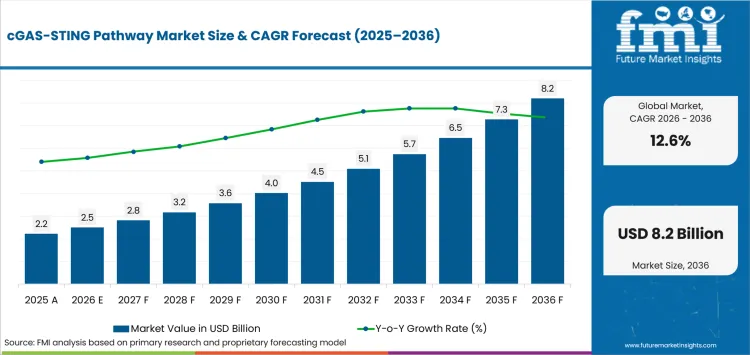
USD 2.5 billion in 2026 and USD 8.2 billion by 2036 at a 12.6% CAGR.
The cGAS-STING pathway demand is expected to push valuation from USD 2.5 billion in 2026 and USD 8.2 billion by 2036 at 12.6% CAGR during the forecast period. Demand reflects investment in next-generation immunotherapies that require measurable pathway control instead of broad immune activation.
Clinical progress depends on clinical trial programs that separate dose tolerance from useful pathway activity across defined tumor settings. GSK updated its 97-participant GSK3745417 study, terminated ahead of schedule, in July 2026, giving sponsors monotherapy and dostarlimab cohorts for combination-tolerability comparisons before the program's early stop.
Key Takeaways of cGAS-STING Pathway Market
- Demand expands as sponsors test controlled pathway activation in oncology and selective suppression across interferon-driven inflammatory diseases.
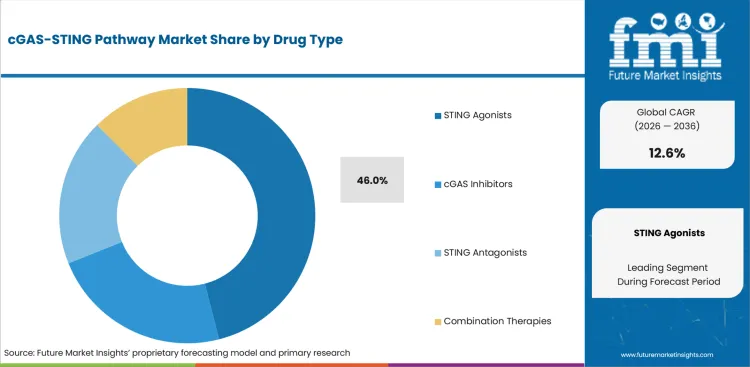
- STING agonists are projected to represent 46.0% by drug type in 2026 owing to their established human-development record.
- Oncology is estimated to account for 48.0% of application demand in 2026 due to measurable tumor-response and biopsy endpoints.
- Monotherapy is forecast to capture 42.0% share in 2026 supported by clear dose and target-engagement assessment.
- Systemic inflammation and uneven response durability restrict wider adoption without tissue control and biomarker-defined patient selection.
- Ventus Therapeutics, ImmuneSensor Therapeutics, Takeda Pharmaceutical Company Limited, Curadev Pharma, Inc., Astellas Pharma Inc., Boehringer Ingelheim International GmbH, Merck & Co., Inc. and GSK plc pursue distinct pathway-development routes.
Analyst Perspective
“cGAS-STING programs gain commercial credibility when tissue exposure and pathway markers align with observed clinical response. Developers that separate local immune activation from systemic inflammation make stronger dose decisions and avoid costly expansion around weak biological signals.”
- Anurag Sharma, Principal Consultant, Future Market Insights
How is the cGAS-STING Pathway Market segmented?
The cGAS-STING pathway industry is segmented by drug type, application, end user, distribution channel, therapy modality and region.
The cGAS-STING pathway market is segmented by drug type, application, end user, distribution channel, therapy modality and region. Drug type covers STING agonists, cGAS inhibitors, STING antagonists and combination therapies, while applications span oncology, autoimmune disease, infectious disease and rare genetic disorders. End-user and channel categories identify sponsors and routes, while therapy modality separates monotherapy, combination immunotherapy and targeted approaches.
Why do STING Agonists lead the Drug Type category?
STING agonists activate innate signaling inside oncology programs that seek immune recruitment within resistant tumors. Local and systemic routes require pharmacodynamic evidence that distinguishes intended tumor activity from inflammatory exposure elsewhere during multicenter clinical dose-escalation studies.
- By drug type, STING agonists are estimated to hold 46.0% share in 2026 owing to the broadest verified human-development record across several administration routes.
- Cyclic dinucleotide programs favor controlled local exposure, whereas non-nucleotide molecules support systemic formulation and repeated dosing. Both routes need tissue-linked biomarkers that show useful pathway activity without confusing treatment effects from immune checkpoint inhibitors.
Why does Oncology lead the Application category?
Oncology provides tumor biopsies and response endpoints that let sponsors test pathway activation against resistant solid tumors. Developers combine local pathway activation with antibody therapy to recruit adaptive immunity without broad systemic exposure.
- Based on application, oncology is projected to account for 48.0% share in 2026 due to measurable serial tumor-response endpoints and established immunotherapy combination routes.
- Combination design requires human evidence that separates pathway activity from checkpoint-partner effects across dose-expansion cohorts. A July 2025 registry update recorded 140 participants in Merck’s MK-2118 study, expanding human evidence for immuno-oncology assays that distinguish local signaling from systemic immune effects.
Why do Pharmaceutical Companies lead the End User category?
Pharmaceutical companies connect toxicology and biomarker development with multinational clinical operations under one accountable sponsor. A December 2025 registry update listed 66 planned participants for BI 1703880 across four countries, a design requiring companion diagnostics to standardize biomarker testing and cohort selection.
- The pharmaceutical companies segment is likely to capture 38.0% share in 2026 attributable to integrated toxicology, biomarker and multinational trial capabilities.
- Biotechnology companies contribute selective inhibitors and targeted delivery platforms, while research institutes and contract organizations provide mechanistic studies and trial execution. Small developers depend on licensing funds as pathway programs require prolonged follow-up and repeated assay validation.
Why do Hospital Pharmacies lead the Distribution Channel category?
Hospital pharmacies coordinate investigational receipt and preparation beside oncology teams that monitor acute immune effects during dose escalation. Their records connect dose-specific accountability with clinical trial packaging across narrow treatment windows and complex combination schedules.
- In 2026, hospital pharmacies are expected to lead the distribution channel with 39.0% share because specialist sites control centralized investigational preparation and accountability.
- Direct manufacturer supply remains central for trial stock, whereas specialty pharmacies gain relevance as oral inhibitors enter repeat outpatient dosing. Hospital teams retain oversight for adverse-event escalation and sample timing across protocol-defined treatment schedules at specialist centers.
Why does Monotherapy lead the Therapy Modality category?
Monotherapy establishes whether pathway modulation reaches its intended target without confusing activity from a partner medicine. Ventus reported in May 2025 that its Phase 1 VENT-03 study included 72 healthy adults and supported once-daily dosing through pharmacokinetic and target-engagement results.
- Monotherapy is set to lead the therapy modality with 42.0% share in 2026 due to the need for initial standalone dose and pharmacodynamic evidence.
- Combination immunotherapy requires partner attribution across response and toxicity, while gene or cell integration adds cell therapy manufacturing controls. Partner attribution and cell-processing controls delay interpretation until standalone data establish credible dosing and scheduling.
What are the drivers, restraints and opportunities in the cGAS-STING Pathway Market?
Pathway breadth supports oncology and inflammatory disease development, yet delivery control and uneven human response limit commercial confidence.
- Driver: One signaling pathway supports immune activation in oncology and selective suppression across interferon-driven inflammatory disease.
- Restraint: Uncontrolled systemic exposure produces inflammatory toxicity without delivering durable benefit across broadly selected patient populations.
- Opportunity: Oral inhibitors and targeted agonists align pathway modulation with diseased tissue and practical treatment settings.
One signaling system supports opposite therapeutic strategies across tumor immunity and interferon-driven inflammatory disease settings worldwide. Shared pathway knowledge reduces assay duplication, although every indication needs a distinct pharmacodynamic objective and patient-selection plan.
Clinical translation weakens when pathway activity reaches healthy tissue or produces transient signaling without durable benefit. Sponsors need dose schedules and biomarkers that separate biological activity from a clinically meaningful response.
Oral cGAS inhibitors fit repeat outpatient dosing, while targeted STING agonists concentrate activity near diseased tissue. Sample handling and follow-up depend on clinical trial logistics that preserve chain of custody across distributed outpatient and specialist sites.
Which country CAGRs are profiled in the cGAS-STING Pathway Market?
| Country | CAGR |
|---|---|
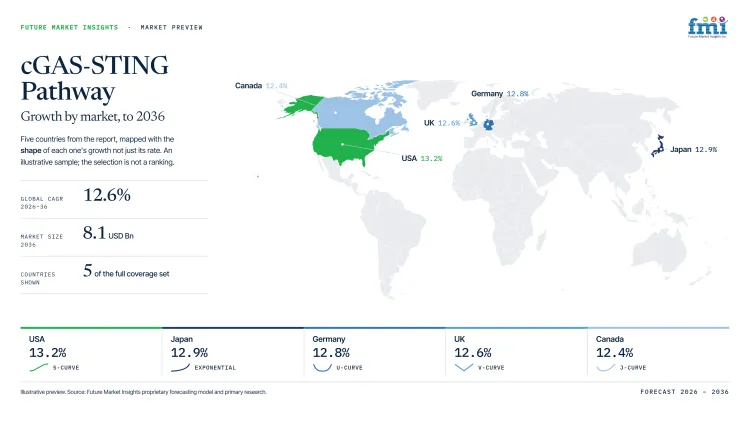
| USA | 13.2% |
| Japan | 12.9% |
| Germany | 12.8% |
| UK | 12.6% |
| Canada | 12.4% |
| Australia | 12.2% |
| France | 12.0% |
How do country-level CAGRs compare in the cGAS-STING Pathway Market?
The CAGR spread measures forecast pace and spans 1.2 percentage points across seven markets. Similar rates conceal trial costs and specialist capacity under distinct national review and delivery systems.
- United States programs benefit from oncology capacity but face costly dose selection across national networks.
- Japan combines structured regulator consultation with concentrated urban centers that limit access beyond research hubs.
- Germany links university hospitals with European submissions yet multicenter contracting delays coordinated multinational pathway studies.
- United Kingdom sponsors gain combined review while hospitals retain contracting duties across regional research networks.
- Canada offers experienced investigators across dispersed provinces that substantially increase patient travel and specimen-logistics requirements.
- Australia supports notification-based studies but long service distances complicate clinical supply and distributed site oversight.
- France combines major oncology networks with accelerated review options limited to qualifying mononational early-phase studies.
Comparable CAGRs produce distinct entry conditions across regulators and specialist treatment networks during clinical development. The full report covers country-level growth across every region retained within the complete geographic taxonomy.
Country-wise Analysis
- United States programs use major oncology centers and investigational pharmacies to coordinate biomarker sampling with dose-escalation schedules across sponsor networks that already manage complex immunotherapy trials and specialized specimen processing during early oncology development. cGAS-STING pathway sales in the United States are forecast to expand at 13.2% CAGR by 2036, supported by broad clinical capacity despite expensive dose selection and uneven access beyond established research hubs. ClinicalTrials.gov listed 81 planned participants across seven CRD3874-SI sites in June 2026, concentrating recruitment within a cancer network and increasing travel demands for patients outside the New York and New Jersey service area.
- Japanese programs combine metropolitan cancer centers with PMDA consultation routes that guide early protocol planning and locally suitable safety packages for pathway agents studied within small biomarker-defined patient groups with limited domestic enrollment. Japan’s cGAS-STING pathway outlook is anticipated to advance at 12.9% CAGR over the assessment period, reinforced by structured consultation despite limited specialist capacity beyond major metropolitan research centers and localized documentation requirements. PMDA published Points to Consider for Small Clinical Trials in March 2026, giving sponsors a current regulatory framework for designing interpretable studies when rare pathway populations cannot support conventional enrollment levels within domestic networks.
- Germany links university hospitals with European submissions and national scientific advice for pathway programs that require coordinated quality planning across laboratories, trial pharmacies and regional oncology investigators within multiple established research networks nationwide. The German cGAS-STING pathway sector is projected to record 12.8% CAGR during the assessment period, supported by specialist expertise despite demanding documentation and slower multicenter contracting across European submissions for national programs. Paul-Ehrlich-Institut updated its advice service in July 2025, offering product-specific consultation from discovery through authorization while requiring detailed briefing packages that increase preparation work for each planned formal development milestone and later authorization decisions.
- United Kingdom programs use specialist cancer hospitals and combined medicines and ethics review to connect biomarker sampling with investigational pharmacy controls across regional sites conducting multicenter early oncology studies within coordinated national research networks. cGAS-STING pathway demand in the United Kingdom is forecast to rise at 12.6% CAGR over the forecast period, aided by coordinated review despite hospital-level contracting and uneven research capacity outside major cities. MHRA and HRA reported in April 2026 that commercial trial setup fell from 169 days to 122 days, improving activation predictability while individual hospitals retain contracting and delivery responsibilities across regional research networks.
- Canadian programs connect experienced oncology centers with Health Canada review across dispersed provinces that depend on centralized clinical supply, temperature-controlled transport and reliable specimen transfers between distant research sites during complex early-phase studies. Adoption of cGAS-STING pathway therapeutics in Canada is estimated to expand at 12.4% CAGR through 2036, supported by experienced investigators despite participant travel and specimen-shipping constraints across provinces and sparse specialist coverage. Health Canada reported in May 2026 that Canada represented 4% of global clinical trial activity, giving pathway sponsors experienced infrastructure despite provincial contracting and specimen routes that complicate multicenter studies across dispersed specialist networks.
- Australian programs use specialist metropolitan hospitals and the Clinical Trial Notification pathway to administer investigational immune modulators under local governance across cities separated by long clinical supply routes and centralized laboratory services nationwide. In Australia, cGAS-STING pathway demand is predicted to advance at 12.2% CAGR through 2036, influenced by established notification procedures despite long service distances and limited specialist capacity outside major metropolitan centers nationwide. TGA stated in April 2025 that sponsors must submit notifications and obtain HREC and institutional approval, placing trial initiation under local governance and potentially producing uneven activation timelines across widely dispersed national research networks.
- French programs combine national cancer institutes with European submissions and coordinated scientific and ethics review for mononational early-phase studies that require centralized biomarker processing and specialist investigational pharmacies across nationally connected trial networks. By 2036, France is projected to grow at 12.0% CAGR, reinforced by accelerated review options despite demanding access evidence and limited eligibility for pathway programs using the national fast-track route during development. France opened a fast-track pilot in March 2026 with 48-hour eligibility responses and possible 14-day authorization, although participation remains limited to qualifying mononational Phase 1 studies at specialist cancer centers within the national pilot.
Who are the notable companies in the cGAS-STING Pathway Market?
Ventus Therapeutics, ImmuneSensor Therapeutics, Takeda Pharmaceutical Company Limited, Curadev Pharma, Inc., Astellas Pharma Inc., Boehringer Ingelheim International GmbH, Merck & Co., Inc. and GSK plc are the notable companies serving this market.
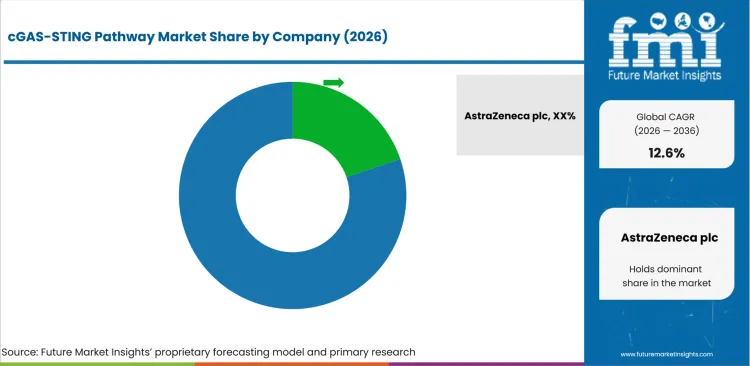
Competition remains fragmented because current cGAS and STING programs remain investigational and entry depends on controlled delivery with credible biomarker evidence for oncology and autoimmune disease therapeutics.
- Ventus Therapeutics and ImmuneSensor Therapeutics advance oral cGAS inhibitors through active programs serving lupus and interferon-driven genetic disease.
- Takeda and Curadev advance systemic agonists while Astellas and Boehringer Ingelheim pursue targeted or combination approaches across solid tumors.
- Merck and GSK provide completed human evidence that clarifies dose control and combination limits for later pathway programs.
Competitive Benchmarking: cGAS-STING Pathway Market
| Company | Clinical Maturity | Route Control | Combination Evidence | Geographic Reach |
|---|---|---|---|---|
| Ventus Therapeutics | High | High | Low | United States and Canada |
| ImmuneSensor Therapeutics | High | High | Low | Australia |
| Takeda Pharmaceutical Company Limited | Medium | Medium | High | Global |
| Curadev Pharma, Inc. | Medium | Medium | Low | United States |
| Astellas Pharma Inc. | High | High | Medium | United States and Japan |
| Boehringer Ingelheim International GmbH | Medium | High | High | Global |
| Merck & Co., Inc. | Low | Low | High | Global |
| GSK plc | Low | Medium | High | Global |
Key Developments in the cGAS-STING Pathway Market
- In February 2026, ImmuneSensor Therapeutics dosed the first patient in an Australian Phase 1b study of oral cGAS inhibitor IMSB301 for Aicardi-Goutières syndrome.
- In December 2025, Ventus Therapeutics dosed the first patient in a Phase 2 lupus trial evaluating oral cGAS inhibitor VENT-03.
- In June 2025, Curadev Pharma and Memorial Sloan Kettering expanded their collaboration to extend the Phase 1 CRD3874-SI study across additional cancers.
Key Players in the cGAS-STING Pathway Market
cGAS Inhibitor Developers
- Ventus Therapeutics
- ImmuneSensor Therapeutics
Systemic and Targeted STING Platforms
- Takeda Pharmaceutical Company Limited
- Curadev Pharma, Inc.
- Astellas Pharma Inc.
- Boehringer Ingelheim International GmbH
Completed Clinical Programs
- Merck & Co., Inc.
- GSK plc
cGAS-STING Pathway Market - Report Scope
| Coverage field | Report scope |
|---|---|
| Market breakdown | By drug type, application, end user, distribution channel, therapy modality and region. |
| Quantitative Units | Revenue in USD billion and CAGR in %. |
| Market Definition | Therapeutic programs and commercial activity involving cGAS inhibition, STING activation, STING antagonism and related combination approaches. |
| Regions Covered | North America, Latin America, Western Europe, Eastern Europe, East Asia, South Asia and Pacific, and Middle East and Africa. |
| Countries Covered | USA, Japan, Germany, UK, Canada, Australia, France, and 20+ countries included in the full report. |
| Key Companies Profiled | Ventus Therapeutics, ImmuneSensor Therapeutics, Takeda Pharmaceutical Company Limited, Curadev Pharma, Inc., Astellas Pharma Inc., Boehringer Ingelheim International GmbH, Merck & Co., Inc. and GSK plc. |
| Forecast Period | 2026 to 2036. |
| Approach | Primary and secondary research with market triangulation. |
cGAS-STING Pathway Market - Research Methodology
| Method | Approach |
|---|---|
| Primary Research | FMI analysts gathered input from manufacturers, service providers, technology developers, distributors, end users, procurement teams, and subject-matter experts. Interviews examined purchasing decisions, product or service evaluation, adoption barriers, approval requirements, pricing considerations, and expectations for technical or commercial support. Respondents were also asked what evidence is required before a trial, pilot, or initial order develops into regular purchasing. |
| Desk Research | Desk research covered government statistics, regulatory publications, trade data, industry associations, technical literature, standards, company filings, product information, and official corporate announcements. Sources were reviewed for relevance, publication date, geographic coverage, and consistency with the defined market scope. Claims relating to performance, applications, approvals, capacity, investment, and commercial activity were retained only when supported by credible public evidence. |
| Market Sizing and Forecasting | The market model combined the baseline value with historical performance, segment structure, pricing and volume indicators, adoption levels, company participation, and country-level demand conditions. Forecast assumptions considered economic activity, investment trends, regulatory developments, technology adoption, purchasing cycles, supply availability, and barriers to wider market use. Segment and regional estimates were reconciled before the final market total was calculated. |
| Data Validation | Estimates were checked against multiple independent indicators, including public data, company activity, trade patterns, industry developments, and findings from primary interviews. Validation also tested whether products, services, applications, and company revenues fell within the defined market boundaries. Adjacent categories, unsupported claims, overlapping revenues, and activities without direct market relevance were excluded to reduce double counting and maintain consistency across segments and countries. |
cGAS-STING Pathway Market by Segments
cGAS-STING Pathway Market segmented by Drug Type:
- STING Agonists
- Cyclic Dinucleotide (CDN) Agonists
- Non-Nucleotide STING Agonists
- cGAS Inhibitors
- Small Molecule cGAS Inhibitors
- Selective cGAS Inhibitors
- STING Antagonists
- Small Molecule STING Antagonists
- Targeted STING Modulators
- Combination Therapies
- STING - Immune Checkpoint Inhibitors
- STING - Chemotherapy
cGAS-STING Pathway Market segmented by Application:
- Oncology
- Solid Tumors
- Hematological Malignancies
- Autoimmune Diseases
- Systemic Lupus Erythematosus
- Aicardi-Goutieres Syndrome
- Infectious Diseases
- Viral Infections
- Bacterial Infections
- Rare Genetic Disorders
- Interferonopathies
- DNA Repair Disorders
cGAS-STING Pathway Market segmented by End User:
- Pharmaceutical Companies
- Oncology Drug Developers
- Immunology Drug Developers
- Biotechnology Companies
- Early-Stage Biotech Firms
- Precision Medicine Companies
- Academic & Research Institutes
- Universities
- Government Research Centers
- Contract Research Organizations (CROs)
- Preclinical CROs
- Clinical Research CROs
cGAS-STING Pathway Market segmented by Distribution Channel:
- Hospital Pharmacies
- Oncology Hospital Pharmacies
- Specialty Hospital Pharmacies
- Specialty Pharmacies
- Biologic Drug Pharmacies
- Oncology Specialty Pharmacies
- Direct Manufacturer Supply
- Clinical Trial Supply
- Specialty Distribution Networks
- Retail Pharmacies
- Chain Pharmacies
- Independent Pharmacies
cGAS-STING Pathway Market segmented by Therapy Modality:
- Monotherapy
- STING Agonist Monotherapy
- cGAS Inhibitor Monotherapy
- Combination Immunotherapy
- Immune Checkpoint Inhibitor Combinations
- Chemotherapy Combinations
- Targeted Therapy
- Precision Oncology Therapy
- Biomarker-Guided Therapy
- Gene & Cell Therapy Integration
- CAR-T Combination Therapy
- Gene Editing-Based Therapy
cGAS-STING Pathway Market by Region:
- North America
- United States
- Canada
- Latin America
- Brazil
- Mexico
- Chile
- Rest of Latin America
- Western Europe
- Germany
- United Kingdom
- Italy
- Spain
- France
- Nordics
- Benelux
- Rest of Western Europe
- Eastern Europe
- Russia
- Poland
- Hungary
- Balkan and Baltic States
- Rest of Eastern Europe
- East Asia
- China
- Japan
- South Korea
- South Asia and Pacific
- India
- ASEAN
- Australia and New Zealand
- Rest of South Asia and Pacific
- Middle East and Africa
- Kingdom of Saudi Arabia
- Other GCC Countries
- Türkiye
- South Africa
- Other African Union Countries
- Rest of Middle East and Africa
Research Sources and Bibliography
- ClinicalTrials.gov. (2026, April 8). A Study of Dazostinag as Single Agent and Dazostinag in Combination With Pembrolizumab in Adults With Advanced or Metastatic Solid Tumors (NCT04420884).
- GSK plc. (2026, July 7). A first time in human (FTIH) study of GSK3745417 administered to participants with advanced solid tumors (GSK study 208850).
- ClinicalTrials.gov. (2025, July 24). Study of MK-2118 Administered as Intratumoral Injection as Monotherapy and in Combination With Pembrolizumab (MK-3475) or by Subcutaneous Injection in Combination With Pembrolizumab in the Treatment of Adults With Advanced/Metastatic Solid Tumors or Lymphomas (MK-2118-001).
- ClinicalTrials.gov. (2025, December 17). A Study to Test How Different Doses of BI 1703880 in Combination With Ezabenlimab Are Tolerated in People With Different Types of Advanced Cancer (Solid Tumours) (NCT05471856).
- Ventus Therapeutics. (2025, May 22). Ventus Therapeutics to Present Phase 1 Results for VENT-03, a First-in-Class cGAS Inhibitor, at LUPUS 2025.
- ClinicalTrials.gov. (2026, June 5). A Study of CRD3874-SI in People With Solid Tumors (NCT06021626).
- Pharmaceuticals and Medical Devices Agency. (2026, March 19). Points to Consider for Small Clinical Trials (Early Consideration).
- Paul-Ehrlich-Institut. (2025, July 1). Advice.
- Medicines and Healthcare products Regulatory Agency & Health Research Authority. (2026, April 27). Launch of clinical trial reforms.
- Health Canada. (2026, May 20). Message from the Minister of Health - International Clinical Trials Day.
- Therapeutic Goods Administration. (2025, April 9). Clinical Trial Notification (CTN) scheme.
- Ministère de la Santé, de la Famille, de l’Autonomie et des Personnes handicapées. (2026, March 5). Dispositif d’évaluation accélérée des essais cliniques en France (fast-track) : les promoteurs pourront soumettre leurs demandes dès le 16 mars 2026.
- Astellas Pharma Inc. (2026, February). A Study of ASP2998 Given by Itself and Given with Standard Therapies in People with Solid Tumors, Trial ID 2998-CL-0101.
- ImmuneSensor Therapeutics. (2026, February 12). ImmuneSensor Therapeutics Doses First Patient with Aicardi Goutières Syndrome (AGS) in Phase 1b Clinical Study of cGAS inhibitor, IMSB301.
- Ventus Therapeutics. (2025, December 10). Ventus Therapeutics Announces First Patient Dosed in Phase 2 Clinical Trial of VENT-03, a Novel Small Molecule cGAS Inhibitor, in Patients with Lupus.
- Curadev Pharma. (2025, June). Memorial Sloan Kettering Cancer Center and Curadev are expanding their collaboration through the MSK Therapeutics Accelerator program to expand the Phase 1 clinical trial currently underway at MSK with CRD3874-SI, Curadev’s first-in-class allosteric STING agonist, to several types of cancers.
- ClinicalTrials.gov. (2026, June 11). A Study to Test How Well BI 3000202 is Tolerated by People With Type 1 Interferonopathies (NCT06878365).
This bibliography is provided for reader reference and is not exhaustive. The full report contains the complete reference list and detailed citations.
This Report Answers
- How large is the cGAS-STING pathway market through 2036?
- What operating conditions support cGAS-STING pathway therapeutic development?
- Which drug type holds the largest approved 2026 share?
- How do application and therapy modality shares shape development priorities?
- Which national conditions influence growth across the profiled countries?
- Which companies advance cGAS inhibitors and STING agonists?
- How do clinical maturity and delivery routes differ among competitors?
- What limits cGAS-STING pathway adoption across therapeutic development?
Frequently Asked Questions
How big is the cGAS-STING Pathway Market in 2026?
The cGAS-STING pathway market is valued at USD 2.5 billion in 2026 and is forecast to reach USD 8.2 billion by 2036. Growth reflects investment in next-generation immunotherapies that require measurable pathway control instead of broad immune activation across oncology and inflammatory disease programs.
What is the CAGR of the cGAS-STING Pathway Market from 2026 to 2036?
The cGAS-STING pathway market grows at a CAGR of 12.6% between 2026 and 2036, supported by sponsors testing controlled pathway activation in oncology and selective suppression across interferon-driven inflammatory diseases through defined clinical trial programs and biomarker-linked dosing strategies.
Which drug type leads the cGAS-STING Pathway Market?
STING agonists lead the cGAS-STING pathway market with a 46.0% share in 2026, because they carry the broadest verified human-development record across several administration routes, giving sponsors pharmacodynamic evidence that distinguishes intended tumor activity from inflammatory exposure elsewhere in the body.
How much will the cGAS-STING Pathway Market add between 2026 and 2036?
The cGAS-STING pathway market is set to add USD 5.7 billion between 2026 and 2036, growing from USD 2.5 billion to USD 8.2 billion as sponsors advance oncology and autoimmune disease programs through monotherapy, combination immunotherapy and targeted delivery approaches worldwide.
Who are the leading companies in the cGAS-STING Pathway Market?
The cGAS-STING pathway market is led by 8 companies, including Ventus Therapeutics, ImmuneSensor Therapeutics, Takeda, Curadev Pharma, Astellas Pharma, Boehringer Ingelheim, Merck and GSK, competing through clinical maturity, delivery-route control and combination evidence across oncology and autoimmune disease programs.
Preview the report firsthand - request a free sample
Get SampleGet the brochure for pricing and purchase details.
Get PDFTable of Content
- Key Takeaways
- Market Size and CAGR
- Top Growth Driver
- Fastest Growing Segment
- Leading Region
- Key Companies
- Emerging Opportunities
- Executive Summary
- Global Market Outlook
- Demand-side Trends
- Supply-side Trends
- Technology Roadmap Analysis
- Analysis and Recommendations
- Analyst Perspective (What is happening? Why now? What should investors know?)
- Key Questions Answered
- How large is the market?
- What is the CAGR?
- What are key trends?
- Which region dominates?
- Who are the leaders?
- Market Overview
- Market Coverage / Taxonomy
- Market Definition / Scope / Limitations
- Research Methodology
- Chapter Orientation
- Analytical Lens and Working Hypotheses
- Market Structure, Signals, and Trend Drivers
- Benchmarking and Cross-market Comparability
- Market Sizing, Forecasting, and Opportunity Mapping
- Research Design and Evidence Framework
- Desk Research Programme (Secondary Evidence)
- Expert Input and Fieldwork (Primary Evidence)
- Tooling, Models, and Reference Databases
- Data Engineering and Model Build
- Quality Assurance and Audit Trail
- Market Background
- Market Dynamics (Drivers, Restraints, Opportunity, Trends)
- Scenario Forecast (Optimistic, Likely, Conservative)
- Impact Analysis
- AI Impact
- Sustainability Impact
- Regulatory Impact
- Technology Impact
- Consumer / Buyer Analysis
- Purchase Drivers
- Adoption Barriers
- Buyer Journey
- Opportunity Map Analysis
- Product Life Cycle Analysis
- Supply Chain Analysis
- Investment Feasibility Matrix
- Value Chain Analysis
- PESTLE and Porter's Analysis
- Regulatory Landscape
- Regional Parent Market Outlook
- Production and Consumption Statistics
- Import and Export Statistics
- Global Market Analysis and Forecast, 2021 to 2036
- Historical Market Size Value (USD Billion) Analysis, 2021 to 2025
- Current and Future Market Size Value (USD Billion) Projections, 2026 to 2036
- Y-o-Y Growth Trend Analysis
- Absolute $ Opportunity Analysis
- Global Market Pricing Analysis, 2021 to 2036
- Global Market Analysis and Forecast, By Drug Type, 2021 to 2036
- Introduction / Key Findings
- Historical Market Size Value (USD Billion) Analysis By Drug Type, 2021 to 2025
- Current and Future Market Size Value (USD Billion) Analysis and Forecast By Drug Type, 2026 to 2036
- STING Agonists
- Cyclic Dinucleotide (CDN) Agonists
- Non-Nucleotide STING Agonists
- cGAS Inhibitors
- Small Molecule cGAS Inhibitors
- Selective cGAS Inhibitors
- STING Antagonists
- Small Molecule STING Antagonists
- Targeted STING Modulators
- Combination Therapies
- STING - Immune Checkpoint Inhibitors
- STING - Chemotherapy
- STING Agonists
- Y-o-Y Growth Trend Analysis By Drug Type, 2021 to 2025
- Absolute $ Opportunity Analysis By Drug Type, 2026 to 2036
- Global Market Analysis and Forecast, By Application, 2021 to 2036
- Introduction / Key Findings
- Historical Market Size Value (USD Billion) Analysis By Application, 2021 to 2025
- Current and Future Market Size Value (USD Billion) Analysis and Forecast By Application, 2026 to 2036
- Oncology
- Solid Tumors
- Hematological Malignancies
- Autoimmune Diseases
- Systemic Lupus Erythematosus
- Aicardi-Goutières Syndrome
- Infectious Diseases
- Viral Infections
- Bacterial Infections
- Rare Genetic Disorders
- Interferonopathies
- DNA Repair Disorders
- Oncology
- Y-o-Y Growth Trend Analysis By Application, 2021 to 2025
- Absolute $ Opportunity Analysis By Application, 2026 to 2036
- Global Market Analysis and Forecast, By End User, 2021 to 2036
- Introduction / Key Findings
- Historical Market Size Value (USD Billion) Analysis By End User, 2021 to 2025
- Current and Future Market Size Value (USD Billion) Analysis and Forecast By End User, 2026 to 2036
- Pharmaceutical Companies
- Oncology Drug Developers
- Immunology Drug Developers
- Biotechnology Companies
- Early-Stage Biotech Firms
- Precision Medicine Companies
- Academic & Research Institutes
- Universities
- Government Research Centers
- Contract Research Organizations (CROs)
- Preclinical CROs
- Clinical Research CROs
- Pharmaceutical Companies
- Y-o-Y Growth Trend Analysis By End User, 2021 to 2025
- Absolute $ Opportunity Analysis By End User, 2026 to 2036
- Global Market Analysis and Forecast, By Distribution Channel, 2021 to 2036
- Introduction / Key Findings
- Historical Market Size Value (USD Billion) Analysis By Distribution Channel, 2021 to 2025
- Current and Future Market Size Value (USD Billion) Analysis and Forecast By Distribution Channel, 2026 to 2036
- Hospital Pharmacies
- Oncology Hospital Pharmacies
- Specialty Hospital Pharmacies
- Specialty Pharmacies
- Biologic Drug Pharmacies
- Oncology Specialty Pharmacies
- Direct Manufacturer Supply
- Clinical Trial Supply
- Specialty Distribution Networks
- Retail Pharmacies
- Chain Pharmacies
- Independent Pharmacies
- Hospital Pharmacies
- Y-o-Y Growth Trend Analysis By Distribution Channel, 2021 to 2025
- Absolute $ Opportunity Analysis By Distribution Channel, 2026 to 2036
- Global Market Analysis and Forecast, By Therapy Modality, 2021 to 2036
- Introduction / Key Findings
- Historical Market Size Value (USD Billion) Analysis By Therapy Modality, 2021 to 2025
- Current and Future Market Size Value (USD Billion) Analysis and Forecast By Therapy Modality, 2026 to 2036
- Monotherapy
- STING Agonist Monotherapy
- cGAS Inhibitor Monotherapy
- Combination Immunotherapy
- Immune Checkpoint Inhibitor Combinations
- Chemotherapy Combinations
- Targeted Therapy
- Precision Oncology Therapy
- Biomarker-Guided Therapy
- Gene & Cell Therapy Integration
- CAR-T Combination Therapy
- Gene Editing-Based Therapy
- Monotherapy
- Y-o-Y Growth Trend Analysis By Therapy Modality, 2021 to 2025
- Absolute $ Opportunity Analysis By Therapy Modality, 2026 to 2036
- Global Market Analysis and Forecast, By Region, 2021 to 2036
- Introduction
- Historical Market Size Value (USD Billion) Analysis By Region, 2021 to 2025
- Current Market Size Value (USD Billion) Analysis and Forecast By Region, 2026 to 2036
- North America
- Latin America
- Western Europe
- Eastern Europe
- East Asia
- South Asia and Pacific
- Middle East & Africa
- Market Attractiveness Analysis By Region
- North America Market Analysis and Forecast, By Country, 2021 to 2036
- Historical Market Size Value (USD Billion) Trend Analysis By Market Taxonomy, 2021 to 2025
- Market Size Value (USD Billion) Forecast By Market Taxonomy, 2026 to 2036
- By Country
- USA
- Canada
- By Drug Type
- By Application
- By End User
- By Distribution Channel
- By Therapy Modality
- By Country
- Market Attractiveness Analysis
- By Country
- By Drug Type
- By Application
- By End User
- By Distribution Channel
- By Therapy Modality
- Key Takeaways
- Latin America Market Analysis and Forecast, By Country
- Historical Market Size Value (USD Billion) Trend Analysis By Market Taxonomy, 2021 to 2025
- Market Size Value (USD Billion) Forecast By Market Taxonomy, 2026 to 2036
- By Country
- Brazil
- Mexico
- Chile
- Rest of Latin America
- By Drug Type
- By Application
- By End User
- By Distribution Channel
- By Therapy Modality
- By Country
- Market Attractiveness Analysis
- By Country
- By Drug Type
- By Application
- By End User
- By Distribution Channel
- By Therapy Modality
- Key Takeaways
- Western Europe Market Analysis and Forecast, By Country
- Historical Market Size Value (USD Billion) Trend Analysis By Market Taxonomy, 2021 to 2025
- Market Size Value (USD Billion) Forecast By Market Taxonomy, 2026 to 2036
- By Country
- Germany
- UK
- Italy
- Spain
- France
- Nordic
- BENELUX
- Rest of Western Europe
- By Drug Type
- By Application
- By End User
- By Distribution Channel
- By Therapy Modality
- By Country
- Market Attractiveness Analysis
- By Country
- By Drug Type
- By Application
- By End User
- By Distribution Channel
- By Therapy Modality
- Key Takeaways
- Eastern Europe Market Analysis and Forecast, By Country
- Historical Market Size Value (USD Billion) Trend Analysis By Market Taxonomy, 2021 to 2025
- Market Size Value (USD Billion) Forecast By Market Taxonomy, 2026 to 2036
- By Country
- Russia
- Poland
- Hungary
- Balkan & Baltic
- Rest of Eastern Europe
- By Drug Type
- By Application
- By End User
- By Distribution Channel
- By Therapy Modality
- By Country
- Market Attractiveness Analysis
- By Country
- By Drug Type
- By Application
- By End User
- By Distribution Channel
- By Therapy Modality
- Key Takeaways
- East Asia Market Analysis and Forecast, By Country
- Historical Market Size Value (USD Billion) Trend Analysis By Market Taxonomy, 2021 to 2025
- Market Size Value (USD Billion) Forecast By Market Taxonomy, 2026 to 2036
- By Country
- China
- Japan
- South Korea
- By Drug Type
- By Application
- By End User
- By Distribution Channel
- By Therapy Modality
- By Country
- Market Attractiveness Analysis
- By Country
- By Drug Type
- By Application
- By End User
- By Distribution Channel
- By Therapy Modality
- Key Takeaways
- South Asia and Pacific Market Analysis and Forecast, By Country
- Historical Market Size Value (USD Billion) Trend Analysis By Market Taxonomy, 2021 to 2025
- Market Size Value (USD Billion) Forecast By Market Taxonomy, 2026 to 2036
- By Country
- India
- ASEAN
- Australia & New Zealand
- Rest of South Asia and Pacific
- By Drug Type
- By Application
- By End User
- By Distribution Channel
- By Therapy Modality
- By Country
- Market Attractiveness Analysis
- By Country
- By Drug Type
- By Application
- By End User
- By Distribution Channel
- By Therapy Modality
- Key Takeaways
- Middle East & Africa Market Analysis and Forecast, By Country
- Historical Market Size Value (USD Billion) Trend Analysis By Market Taxonomy, 2021 to 2025
- Market Size Value (USD Billion) Forecast By Market Taxonomy, 2026 to 2036
- By Country
- Kingdom of Saudi Arabia
- Other GCC Countries
- Türkiye
- South Africa
- Other African Union
- Rest of Middle East & Africa
- By Drug Type
- By Application
- By End User
- By Distribution Channel
- By Therapy Modality
- By Country
- Market Attractiveness Analysis
- By Country
- By Drug Type
- By Application
- By End User
- By Distribution Channel
- By Therapy Modality
- Key Takeaways
- Key Countries Market Analysis
- USA
- Pricing Analysis
- Market Share Analysis, 2025
- By Drug Type
- By Application
- By End User
- By Distribution Channel
- By Therapy Modality
- Canada
- Pricing Analysis
- Market Share Analysis, 2025
- By Drug Type
- By Application
- By End User
- By Distribution Channel
- By Therapy Modality
- Mexico
- Pricing Analysis
- Market Share Analysis, 2025
- By Drug Type
- By Application
- By End User
- By Distribution Channel
- By Therapy Modality
- Brazil
- Pricing Analysis
- Market Share Analysis, 2025
- By Drug Type
- By Application
- By End User
- By Distribution Channel
- By Therapy Modality
- Chile
- Pricing Analysis
- Market Share Analysis, 2025
- By Drug Type
- By Application
- By End User
- By Distribution Channel
- By Therapy Modality
- Germany
- Pricing Analysis
- Market Share Analysis, 2025
- By Drug Type
- By Application
- By End User
- By Distribution Channel
- By Therapy Modality
- UK
- Pricing Analysis
- Market Share Analysis, 2025
- By Drug Type
- By Application
- By End User
- By Distribution Channel
- By Therapy Modality
- Italy
- Pricing Analysis
- Market Share Analysis, 2025
- By Drug Type
- By Application
- By End User
- By Distribution Channel
- By Therapy Modality
- Spain
- Pricing Analysis
- Market Share Analysis, 2025
- By Drug Type
- By Application
- By End User
- By Distribution Channel
- By Therapy Modality
- France
- Pricing Analysis
- Market Share Analysis, 2025
- By Drug Type
- By Application
- By End User
- By Distribution Channel
- By Therapy Modality
- India
- Pricing Analysis
- Market Share Analysis, 2025
- By Drug Type
- By Application
- By End User
- By Distribution Channel
- By Therapy Modality
- ASEAN
- Pricing Analysis
- Market Share Analysis, 2025
- By Drug Type
- By Application
- By End User
- By Distribution Channel
- By Therapy Modality
- Australia & New Zealand
- Pricing Analysis
- Market Share Analysis, 2025
- By Drug Type
- By Application
- By End User
- By Distribution Channel
- By Therapy Modality
- China
- Pricing Analysis
- Market Share Analysis, 2025
- By Drug Type
- By Application
- By End User
- By Distribution Channel
- By Therapy Modality
- Japan
- Pricing Analysis
- Market Share Analysis, 2025
- By Drug Type
- By Application
- By End User
- By Distribution Channel
- By Therapy Modality
- South Korea
- Pricing Analysis
- Market Share Analysis, 2025
- By Drug Type
- By Application
- By End User
- By Distribution Channel
- By Therapy Modality
- Russia
- Pricing Analysis
- Market Share Analysis, 2025
- By Drug Type
- By Application
- By End User
- By Distribution Channel
- By Therapy Modality
- Poland
- Pricing Analysis
- Market Share Analysis, 2025
- By Drug Type
- By Application
- By End User
- By Distribution Channel
- By Therapy Modality
- Hungary
- Pricing Analysis
- Market Share Analysis, 2025
- By Drug Type
- By Application
- By End User
- By Distribution Channel
- By Therapy Modality
- Kingdom of Saudi Arabia
- Pricing Analysis
- Market Share Analysis, 2025
- By Drug Type
- By Application
- By End User
- By Distribution Channel
- By Therapy Modality
- Türkiye
- Pricing Analysis
- Market Share Analysis, 2025
- By Drug Type
- By Application
- By End User
- By Distribution Channel
- By Therapy Modality
- South Africa
- Pricing Analysis
- Market Share Analysis, 2025
- By Drug Type
- By Application
- By End User
- By Distribution Channel
- By Therapy Modality
- USA
- Market Structure Analysis
- Competition Dashboard
- Competition Benchmarking
- Market Share Analysis of Top Players
- By Regional
- By Drug Type
- By Application
- By End User
- By Distribution Channel
- By Therapy Modality
- Emerging Startups
- Innovation Benchmarking
- Competition Analysis
- Competition Deep Dive
- AstraZeneca plc
- Overview
- Product Portfolio
- Profitability by Market Segments
- Sales Footprint
- Strategy Overview
- Marketing Strategy
- Product Strategy
- Channel Strategy
- Bristol Myers Squibb
- GlaxoSmithKline plc
- Merck & Co., Inc.
- Novartis AG
- Roche Holding AG
- Pfizer Inc.
- Mersana Therapeutics, Inc.
- Aduro Biotech, Inc.
- Invivyd, Inc.
- AstraZeneca plc
- Case Studies
- Success Stories
- Recent Developments
- Competition Deep Dive
- Assumptions & Acronyms Used


