

- Market Size (2026)
- USD 185.9 Mn
- Forecast (2036)
- USD 314.5 Mn
- CAGR (2026 to 2036)
- 5.4%
How big is the Charcoal Bags Market in 2026?
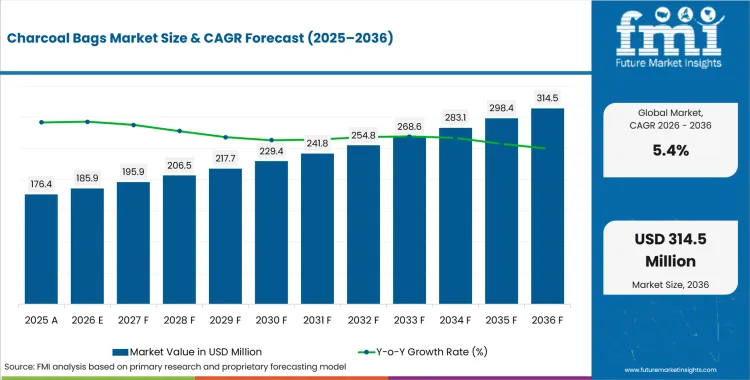
USD 185.9 million in 2026 and USD 314.5 million by 2036 at a 5.4% CAGR.
Demand for charcoal bags is projected to expand at 5.4% CAGR between 2026 and 2036, increasing valuation from USD 185.9 million in 2026 to USD 314.5 million by 2036. Prepared-food operators treat bag-format carriers as repeat supplies because each takeaway order needs dependable grease resistance plus closure performance and pack-station fit. The National Restaurant Association reported in May 2025 that 90% of off-premises customers would likely order a wider menu range if upgraded packaging preserved food quality. Related foodservice paper bags and carrier formats gain repeat volume after chains qualify fewer specifications and reorder them through fixed distributor schedules.
Material selection follows a different route because recovery systems determine whether a technically suitable carrier can stay on an approved list. Eurostat published in October 2025 that paper and cardboard represented 40.4% of EU packaging waste generated in 2023. That familiar recovery route makes paperboard practical to many foodservice accounts, but grease barriers and food residue still require qualification before a carrier can be treated as recyclable in practice. Repeat orders for takeaway containers and bag-format carriers follow after operators finish barrier and recovery checks for replacement materials.
Key Takeaways
- Foodservice operators generate repeat demand because takeaway carriers are consumed with every prepared order and must fit fixed packing routines.
- In 2026, standard formats are expected to lead format type with 43.0% share because common dimensions reduce training and inventory variation.
- By material, paperboard is estimated to hold 28.0% in 2026 owing to printability and familiar paper-recovery pathways.
- Standard meal formats are set to lead format size with 41.0% share in 2026 due to common bundled-meal order patterns.
- Barrier coatings and end-of-life claims can delay substitution because food-contact performance and local collection routes require separate verification.
- Some of the key players in this market include Berry Global, Genpak, Pactiv Evergreen, Dart Container, Huhtamaki, Detmold Group, Duni, Novolex, Graphic Packaging, and Sabert.
Analyst Perspective
"Charcoal bags earn repeat volume after restaurant groups prove that one carrier survives grease exposure plus delivery dwell time and local disposal rules. The stronger offer pairs a stable case specification with documented barrier chemistry and nearby stock, reducing requalification work after material rules change."
- Nandini Roy Choudhury, Principal Consultant, Future Market Insights
How is the charcoal bags market segmented?
The charcoal bags market is segmented by format type, material, format size, end use, sales channel, and region.
Format type covers standard, recyclable-optimized, premium and custom-engineered carriers. Material includes paperboard, molded fiber and bagasse, rPET and PP, compostable polymers and aluminium. Format size covers standard meal, single-serve, family and catering formats. End use includes QSR chains, delivery platforms, coffee and beverage operators, institutional catering and retail deli. Sales channels include broadline foodservice distributors, direct chain contracts, packaging distributors and online ordering.
How do standard meal formats hold the largest share within format size?
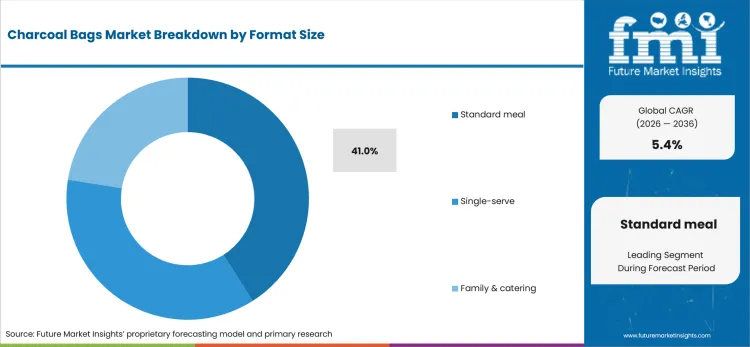
Standard meal carriers fit common takeaway bundles without forcing restaurants to hold many case sizes. Fewer dimensions reduce shelf congestion and make approved substitutions easier to control during peak service. The same storage logic applies to pre-made cups and other nested foodservice formats that compete for limited back-of-house space.
- Standard meal formats are set to lead format size with 41.0% share in 2026 due to repeatable bundled-order requirements.
- In December 2025, Duni Group launched Octaview in eleven sizes and formats designed for stacking and transport. The range illustrates how controlled size families can cover varied meal occasions without multiplying handling rules.
What keeps standard formats in front within the format type category?
Standard formats let restaurant groups qualify one base size and closure pattern before changing print or material. The same case-pack discipline lowers pick errors and simplifies outlet training at individual stores. Large paper bags programs also benefit from predictable case counts during distributor replenishment.
- In 2026, standard formats are expected to lead format type with 43.0% share because common specifications simplify chain replenishment and staff training.
- In April 2025, Novolex and Pactiv Evergreen completed their combination and reported more than 39,000 combined SKUs. The broader assortment reduces the number of packaging interfaces large foodservice accounts must manage.
Why does paperboard lead the material category?
Paperboard gives bag-format carriers enough stiffness for food handoff while preserving a printable surface for chain branding. Coatings determine grease resistance and recyclability, so paper packaging cannot be qualified from fiber content alone. Restaurant groups therefore test barrier chemistry against menu oils and condensation before approving a paperboard carrier.
- By material, paperboard is estimated to hold 28.0% in 2026 owing to print quality and familiar paper-recovery routes.
- In January 2025, the FDA ended 35 PFAS food-contact notifications covering grease-proofing uses on paper and paperboard. Replacement coatings now need food-contact and leak-performance evidence before restaurant chains approve new carrier specifications.
Why do QSR chains lead the end use category?
QSR chains centralize packaging specifications and repeat approved carriers through large outlet networks. Pack-station dimensions and handoff speed become part of the carrier specification because orders must move quickly without leaking or collapsing. Related paper cups programs face the same need for repeatable case supply and outlet-level handling.
- Based on end use, QSR chains are projected to account for 32.0% in 2026 due to centralized specifications and repeated outlet orders.
- In April 2025, National Restaurant Association data showed 40% of limited-service operators had altered restaurant space or parking for off-premises orders. Those operating changes increase the importance of carriers that fit fixed handoff routines.
Why do broadline foodservice distributors lead the sales channel category?
Broadline distributors replenish packaging with ingredients and operating supplies on fixed delivery routes, reducing separate deliveries for multi-unit restaurants. They also hold regional stock that can replace an unavailable carrier without forcing each outlet to source locally. This route is particularly useful for molded fiber packaging that needs documented substitutions by region.
- Broadline foodservice distributors are projected to hold 40.0% share in 2026 owing to consolidated delivery routes and regional stock management.
- In September 2025, UK recyclability guidance retained a three-level packaging rating scale from red through amber to green. The methodology gives distributors a clearer documentation check before a material substitution enters chain inventory.
What are the drivers, restraints and opportunities in the Charcoal Bags Market?
Off-premises ordering sustains repeat carrier purchases, qualification friction slows material switching, and modular paper or fiber ranges offer the clearest route to new accounts.
- Driver: Takeaway and delivery orders consume approved carriers with every transaction, keeping qualified charcoal bags on scheduled restaurant replenishment cycles.
- Restraint: Grease barriers and food-contact files can delay a switch if local collection systems cannot process the approved material.
- Opportunity: Manufacturers can win multi-unit programs by keeping familiar carrier dimensions while offering tested material alternatives through local distribution.
Off-premises order frequency keeps approved charcoal bags on restaurant purchase schedules because every completed order consumes a carrier. The National Restaurant Association reported in April 2025 that nearly 75% of restaurant traffic occurred off-premises. Qualified disposable food containers and bag-format carriers therefore replenish with transaction volume after heat resistance and closure performance pass menu testing.
Material substitution slows after a carrier passes food-contact review but lacks a workable local recovery route. Australia’s environment department reported in February 2026 that 41% of packaging placed on market in 2023-24 went to landfill. Restaurant groups evaluating compostable foodservice packaging therefore need collection evidence plus grease and moisture tests before replacing an approved carrier.
A practical expansion route is a carrier family that keeps familiar dimensions while offering approved material alternatives. Sabert’s June 2025 IDDBA announcement introduced foodservice formats spanning paperboard inserts and molded fiber plus recycled-content polymers for prepared-food applications. Restaurant groups can change substrates without rebuilding every packing routine, provided each option passes grease resistance and closure testing.
Which country CAGRs are profiled in the Charcoal Bags Market?
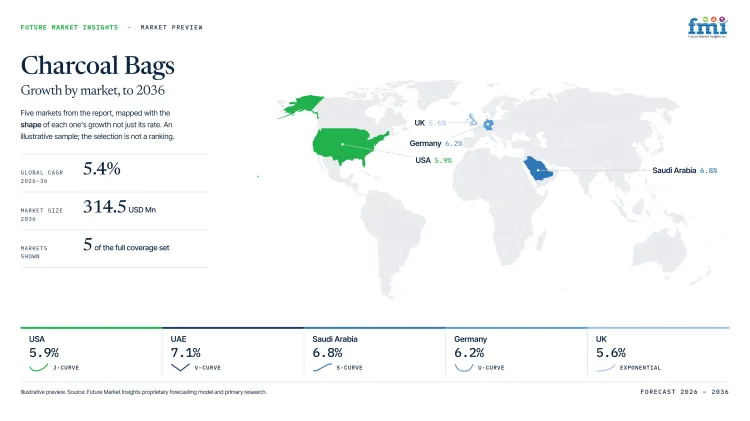
| Country | CAGR |
|---|---|
| UAE | 7.1% |
| Saudi Arabia | 6.8% |
| Australia | 6.5% |
| Germany | 6.2% |
| USA | 5.9% |
| UK | 5.6% |
How do country-level CAGRs compare in the Charcoal Bags Market?
The 1.5-point spread separates six countries into three bands rather than producing one dominant outlier. UAE and Saudi Arabia lead because restaurant networks absorb approved packaging substitutions quickly. Australia and Germany occupy the middle under different freight and recovery economics. USA and UK progress more steadily through mature foodservice distribution.
- UAE hospitality clusters shorten distributor routes and reduce stock between restaurant drops.
- Saudi Arabia centralizes chain specifications that several regional depots can replenish consistently.
- Australia’s intercity distances raise case-fill and safety-stock requirements for meal carriers.
- Germany’s reusable-offer rules constrain one-way takeaway expansion for many foodservice outlets.
- USA national contracts reward regional warehousing despite different state-level material specification requirements.
- UK urban storage constraints favor compact cases and frequent broadline replenishment schedules.
Service economics therefore vary despite similar growth rates. Coverage includes North America, Latin America, Western Europe, Eastern Europe, East Asia, South Asia and Pacific, Middle East and Africa.
Country-wise Analysis
- Dubai restaurant groups work in a dense hospitality market where packaging changes must reach many outlets without disrupting service. Charcoal bag demand in UAE is forecast to rise at 7.1% CAGR over the forecast period, propelled by quick turnover of approved paper and fiber formats in urban foodservice. Dubai Municipality documented about 2,336 new food establishments during the first half of 2025, expanding the local base that consumes takeaway carriers. Single-use restrictions raise substitution pressure during busy service periods. Grease performance under delivery conditions is the main friction, so companies with tested barriers and bilingual disposal guidance can shorten chain approval work.
- Saudi restaurant groups increasingly standardize packaging for dine-in service and takeaway programs under one municipal operating regime. The Ministry of Municipalities and Housing stated in August 2025 that its unified requirements cover five categories of food establishments, including restaurants and cloud kitchens. Saudi Arabia is estimated to post 6.8% CAGR over the forecast period, aided by organized chain purchasing and multi-city distributor coverage. Long service distances outside the largest urban clusters raise inventory costs and stockout risk. Companies that pair complete food-contact files with regional inventory can expand without forcing each restaurant group to repeat basic documentation work in regional tenders.
- Australian foodservice programs must balance nationally selected packaging with long intercity freight routes and collection systems that differ by state. APCO reported in December 2025 that 86% of packaging was reusable, recyclable or compostable in 2023-24. Paper familiarity supports trials, but uneven recovery outcomes force restaurant groups to verify disposal claims before national rollout. Adoption of charcoal bags in Australia is estimated to expand at 6.5% CAGR through 2036, reflecting organized takeaway demand and stronger recoverability requirements. Freight distance is a commercial constraint because carriers consume warehouse space, making flat or nested formats and state-aware labeling more valuable during rollout.
- German foodservice groups work with mature paper collection systems, but weak restaurant economics keep unit cost visible during packaging changes. Germany’s charcoal bags outlook is anticipated to advance at 6.2% CAGR over the assessment period, tied to structured distribution and familiar paper-recovery routes. Destatis reported in February 2026 that real gastronomy turnover fell 2.2% in 2025, increasing pressure on case efficiency during material qualification. Paperboard offers a practical collection route, yet coated formats need evidence that barriers will not block reprocessing. Companies that preserve case counts and storage efficiency have more room to defend margins during substitution programs on repeat orders.
- USA restaurant chains can standardize carrier dimensions nationally, but state packaging rules force different material choices under one operating program. CalRecycle approved permanent rules in May 2026 requiring producers to cut single-use plastic by 25%, changing California approval lists over time. The USA charcoal bags sector is projected to record 5.9% CAGR during the assessment period because national purchasing programs aggregate large orders. State recovery rules are the main friction since one substrate cannot fit every location. Regional material records and controlled alternative specifications let chains change substrates without altering pack-station instructions or case dimensions. That control protects national contract economics during state-level substitutions.
- UK restaurant groups source replacements through mature broadline channels and often require case sizes that fit compact urban storage. Defra’s July 2025 waste release recorded a 74.3% recycling rate for paper and cardboard packaging in 2024, giving fiber formats a familiar recovery route. Coatings and mixed-material components still require recyclability assessment before restaurant groups approve substitutions. In the UK, charcoal bag demand is predicted to advance at 5.6% CAGR through 2036, given steady takeaway orders and distributor coverage. The commercial opening is strongest for companies that pair lightweight paperboard with complete composition records, reducing repeated documentation work in competitive distributor tenders.
Who are the notable companies in the Charcoal Bags Market?
Berry Global, Genpak, Pactiv Evergreen, Dart Container, Huhtamaki, Detmold Group, Duni, Novolex, Graphic Packaging, and Sabert are the notable companies profiled in this market.
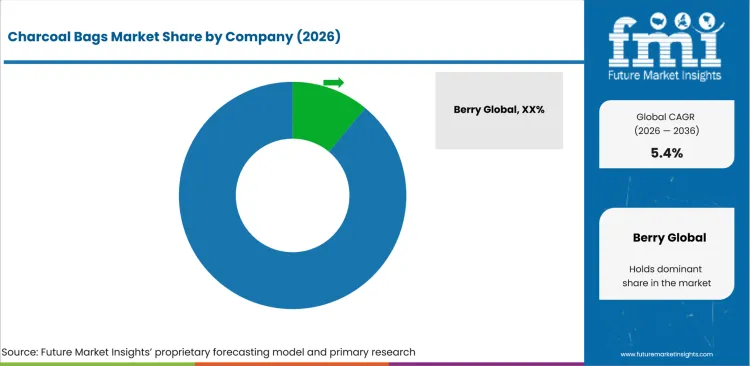
Competition separates by manufacturing breadth and material specialization among foodservice packaging groups serving prepared meals. Berry Global, Pactiv Evergreen, Dart Container, and Novolex bring wider foodservice portfolios or distribution scale. Huhtamaki, Detmold Group, and Graphic Packaging concentrate more heavily on fiber and paperboard engineering. Genpak, Duni, and Sabert compete through prepared-food formats and application support. Comparable molded fiber foodservice tableware programs show why qualification depth and regional stock can decide which companies fit large chain accounts.
- Berry Global, Pactiv Evergreen, Dart Container, and Novolex offer broad foodservice portfolios with chain-scale manufacturing or distribution coverage.
- Huhtamaki, Detmold Group, and Graphic Packaging provide stronger fiber and paperboard engineering for food-contact substitution programs.
- Genpak, Duni, and Sabert focus on prepared-food assortments and application support for restaurant or catering accounts.
Competitive Benchmarking: Charcoal Bags Market
| Company | Meal Packaging and Carrier Breadth | Fiber and Compostable Readiness | Chain-Scale Customization | Geographic Reach |
|---|---|---|---|---|
| Berry Global | High | Medium | High | Global through Amcor |
| Genpak | Medium | High | Medium | United States and Canada |
| Pactiv Evergreen | High | High | High | North America within Novolex network |
| Dart Container | High | High | High | North America and selected international markets |
| Huhtamaki | High | High | High | Europe, North America, Asia, Middle East, and Africa |
| Detmold Group | High | High | High | Australia, Asia, North America, Europe, and Middle East |
| Duni | Medium | High | Medium | More than 50 markets |
| Novolex | High | High | High | United States, Canada, Mexico, and Europe |
| Graphic Packaging | Medium | High | High | North America, Europe, and international markets |
| Sabert | High | High | High | North America and international foodservice markets |
Scoring basis: High meal-packaging breadth requires several documented prepared-food formats, while Medium identifies a narrower documented range. High fiber readiness requires broad paperboard or molded-fiber participation in verified foodservice programs, with Medium indicating narrower coverage. High chain-scale customization requires manufacturing reach plus documented engineering support, and Medium indicates selective or regional support. Low identifies a documented limitation and is never assigned because public evidence is missing.
Key Developments in the Charcoal Bags Market
- In July 2025, Huhtamaki launched certified paperboard ice-cream cups with a bio-based coating below 10%. Foodservice accounts gained another moisture-resistant fiber route, though local collection systems still determine whether the intended disposal claim is usable.
- In May 2025, Dart Container received TÜV Austria home-compostable certification for molded-fiber products and APR recognition for several clear polypropylene formats. The approvals strengthen qualification evidence, though restaurant groups must still test grease performance and local recovery fit.
- In April 2025, Berry Global became part of Amcor after the combination closed. Large foodservice accounts gained a wider multi-material corporate sourcing route, but exact bag-format availability still requires product-level confirmation.
Key Players in the Charcoal Bags Market
Chain-scale multi-material packaging platforms
- Berry Global
- Pactiv Evergreen
- Dart Container
- Novolex
Fiber-led foodservice packaging specialists
- Huhtamaki
- Detmold Group
- Graphic Packaging
Prepared-food and application-focused specialists
- Genpak
- Duni
- Sabert
Charcoal Bags Market - Report Scope
| Coverage field | Report scope |
|---|---|
| Market breakdown | By format type, material, format size, end use, sales channel, and region. |
| Quantitative Units | USD million. |
| Market Definition | Revenue includes first-sale value of disposable foodservice bags and bag-format meal carriers used for prepared meals and beverages. The scope excludes charcoal fuel sacks, reusable insulated delivery equipment, raw substrates, packaging machinery, downstream food and beverage sales, and adjacent containers sold outside bag-format systems. |
| Regions Covered | North America, Latin America, Western Europe, Eastern Europe, East Asia, South Asia and Pacific, and Middle East and Africa. |
| Countries Covered | USA, Germany, UK, Saudi Arabia, UAE, Australia, and 20+ countries included in the full report. |
| Key Companies Profiled | Berry Global, Genpak, Pactiv Evergreen, Dart Container, Huhtamaki, Detmold Group, Duni, Novolex, Graphic Packaging, and Sabert. |
| Forecast Period | 2026 to 2036. |
| Approach | Primary and secondary research with market triangulation. |
Charcoal Bags Market - Research Methodology
| Method | Approach |
|---|---|
| Primary Research | FMI analysts gathered input from manufacturers, service providers, technology developers, distributors, end users, procurement teams, and subject-matter experts. Interviews examined purchasing decisions, product or service evaluation, adoption barriers, approval requirements, pricing considerations, and expectations for technical or commercial support. Respondents were also asked what evidence is required before a trial, pilot, or initial order develops into regular purchasing. |
| Desk Research | Desk research covered government statistics, regulatory publications, trade data, industry associations, technical literature, standards, company filings, product information, and official corporate announcements. Sources were reviewed for relevance, publication date, geographic coverage, and consistency with the defined market scope. Claims relating to performance, applications, approvals, capacity, investment, and commercial activity were retained only when supported by credible public evidence. |
| Market Sizing and Forecasting | The market model combined the baseline value with historical performance, segment structure, pricing and volume indicators, adoption levels, company participation, and country-level demand conditions. Forecast assumptions considered economic activity, investment trends, regulatory developments, technology adoption, purchasing cycles, supply availability, and barriers to wider market use. Segment and regional estimates were reconciled before the final market total was calculated. |
| Data Validation | Estimates were checked against multiple independent indicators, including public data, company activity, trade patterns, industry developments, and findings from primary interviews. Validation also tested whether products, services, applications, and company revenues fell within the defined market boundaries. Adjacent categories, unsupported claims, overlapping revenues, and activities without direct market relevance were excluded to reduce double counting and maintain consistency across segments and countries. |
Charcoal Bags Market by Segments
Charcoal Bags Market segmented by format type:
- Standard formats
- Recyclable-optimized formats
- Premium & branded formats
- Custom-engineered formats
Charcoal Bags Market segmented by material:
- Paperboard
- Molded fiber & bagasse
- rPET & PP
- Compostable polymers
- Aluminium
Charcoal Bags Market segmented by format size:
- Standard meal
- Single-serve
- Family & catering
Charcoal Bags Market segmented by end use:
- QSR chains
- Delivery platforms
- Coffee & beverage
- Institutional catering
- Retail deli
Charcoal Bags Market segmented by sales channel:
- Broadline foodservice distributors
- Direct chain contracts
- Packaging distributors
- Online
Charcoal Bags Market by Region:
- North America
- United States
- Canada
- Latin America
- Brazil
- Mexico
- Argentina
- Chile
- Western Europe
- Germany
- France
- United Kingdom
- Italy
- Spain
- Benelux
- Nordics
- Eastern Europe
- Poland
- Czech Republic
- Romania
- Hungary
- East Asia
- China
- Japan
- South Korea
- South Asia and Pacific
- India
- ASEAN
- Australia and New Zealand
- Middle East and Africa
- GCC Countries
- South Africa
- Türkiye
- Israel
Research Sources and Bibliography
- National Restaurant Association. (2025, May 21). Increased sales come in the right packages.
- Eurostat. (2025, October 22). Plastic packaging waste in the EU: 35.3 kg per person.
- Novolex. (2025, April 1). Novolex and Pactiv Evergreen Inc. Complete Combination, Creating a Leading Manufacturer in Food, Beverage and Specialty Packaging.
- USA Food and Drug Administration. (2025, January 3). FDA Determines Authorization for 35 Food Contact Notifications Related to PFAS Are No Longer Effective.
- Duni Group. (2025, December 8). Duni Group Launches New Packaging Series with Enhanced Performance and Reduced Climate Impact.
- National Restaurant Association. (2025, April 17). Report: Takeout, drive-thru, delivery are more popular than ever.
- Department for Environment, Food & Rural Affairs, Environment Agency, and Natural Resources Wales. (2025, September 4). Recyclability assessment methodology: how to assess your packaging waste.
- National Restaurant Association. (2025, April 16). From Trend to Transformation: Off-Premises Dining Now Essential for Restaurant Consumers, Operators.
- Australian Government Department of Climate Change, Energy, the Environment and Water. (2026, February 3). A circular economy for packaging in Australia.
- Sabert Corporation. (2025, June 2). Sabert Invests in the Future of Food Packaging with Innovative, Domestically Produced Solutions Featured at the 2025 IDDBA Show.
- Dubai Municipality. (2025, July 30). Over 34,000 food inspections conducted in first half of 2025.
- Ministry of Municipalities and Housing, Kingdom of Saudi Arabia. (2025, August 10). MOMAH has set regulatory requirements.
- Australian Packaging Covenant Organisation. (2025, December 1). APCO Australian Packaging Consumption and Recovery Data 2023-24.
- Federal Statistical Office of Germany. (2026, February 19). Gastgewerbeumsatz 2025 real 2,1 % niedriger als im Vorjahr.
- CalRecycle. (2026, May 1). California approves new plastic and packaging rules that put consumers first.
- Department for Environment, Food & Rural Affairs. (2025, July 23). UK statistics on waste.
- Huhtamaki. (2025, July 16). Huhtamaki launches new compostable ice cream cups.
- Dart Container. (2025, May 12). Dart products earn sustainability recognition.
- Amcor. (2025, April 30). Amcor completes combination with Berry Global; Positioned to significantly enhance value for customers and shareholders.
- Graphic Packaging International. (2025, November 5). Graphic Packaging Launches Advanced Recycled Paperboard Facility in Waco, Texas.
- Detpak. (2026, July 20). Detpak Is Now Manufacturing in the United States.
- Sabert Corporation. (2026, August 18). Sabert Opens Fifth USA Distribution Facility in Georgia to Meet Growing Customer Demand.
- Graphic Packaging International. (2026, July 13). Graphic Packaging Enters Uncoated Recycled Paperboard Market with Launch of PaceSetter Ridgeline.
- Duni Group. (2026, May 5). Duni Group launches black paper-based packaging collection that facilitates sorting and contributes to lower climate impact.
- Huhtamaki. (2026, May 25). Huhtamaki collaborating with Hesburger on new fiber lids.
- Amcor. (2025, February 10). Smart & Intelligent: Berry's Reusable Cup Range Gains Renewed Attention.
- One Southern Indiana. (2025, January 14). Packaging Progress: Genpak Invests $6.69M in Southern Indiana.
- USA Securities and Exchange Commission. (2025, February 25). Pactiv Evergreen Inc. Form 10-K.
- Dart Container. (2025, June 5). Score! Dart reusables in play at pro soccer venue.
- Huhtamaki. (2025, February 14). Huhtamaki to separate Fiber Foodservice business segment into two distinct segments: Fiber Packaging and Foodservice Europe-Asia-Oceania.
- Detpak. (2026, August 18). Detpak is Expanding Manufacturing in India.
- Duni Group. (2025, May 15). Duni Group Becomes Official Event Partner and Supplier of Sustainable Packaging Solutions for Gothia Cup and Partille World Cup.
- Novolex. (2025, May 1). Eco-Products and DNO Produce Help Bring Environmental Sustainability to K-12 School Cafeterias.
- Graphic Packaging International. (2025, May 14). Graphic Packaging Launches New Portfolio of Paperboard Sushi Packaging To Support Regulatory Compliance of European Foodservice Operators.
- Sabert Corporation. (2026, May 19). Sabert to Showcase Multi-Substrate Sustainable Food Packaging Portfolio at IDDBA 2026.
- Duni Group. (2026). Documentation and certifications. Retrieved September 3, 2026.
This bibliography is provided for reader reference and is not exhaustive. The full report contains the complete reference list and detailed citations.
This Report Answers
- What is the charcoal bags market value in 2026 and what value is projected for 2036?
- Which operating conditions keep bag-format meal carriers on repeated foodservice purchasing schedules?
- Why do standard formats hold the leading share within the format type category?
- Why does paperboard lead material selection for bag-format foodservice carriers?
- How do standard meal formats reduce packaging complexity during prepared-food service?
- How do country CAGRs differ among UAE, Saudi Arabia, Australia, Germany, USA, and UK?
- Which companies provide chain-scale, fiber-led, or application-focused foodservice packaging capabilities?
- Which qualification and recovery constraints slow material substitution in charcoal bag programs?
- What should restaurant chains test before moving an approved carrier into repeated purchasing?
Frequently Asked Questions
How big is the charcoal bags market in 2026?
The charcoal bags market is valued at USD 185.9 million in 2026 and is projected to reach USD 314.5 million by 2036. Repeat takeaway purchasing keeps qualified carriers on regular restaurant replenishment schedules after foodservice groups approve their specifications.
What is the CAGR of the charcoal bags market from 2026 to 2036?
The charcoal bags market is projected to grow at a CAGR of 5.4% between 2026 and 2036. Expansion depends on off-premises order volume and approved material alternatives plus distributor stock that supports repeat outlet demand.
Which format type leads the charcoal bags market?
The standard formats segment is expected to hold 43.0% of the charcoal bags market in 2026, attributable to repeatable dimensions that simplify restaurant training and case replenishment. Common specifications also reduce material substitutions that restaurant chains must approve before rollout.
Which material leads the charcoal bags market?
The paperboard segment is expected to hold 28.0% of the charcoal bags market in 2026, supported by printability and familiar paper-recovery pathways. Coatings still require grease-resistance and recyclability checks before restaurant groups approve a replacement format.
Which countries are projected to record the highest growth in the charcoal bags market?
UAE is projected to grow at 7.1% CAGR, followed by Saudi Arabia at 6.8% and Australia at 6.5% through 2036. Faster growth is concentrated where organized foodservice networks can absorb approved packaging substitutions quickly.
Which companies are active in the charcoal bags market?
Key companies operating in the market include Berry Global, Genpak, Pactiv Evergreen, Dart Container, Huhtamaki, Detmold Group, Duni, Novolex, Graphic Packaging, and Sabert. Their positions differ by material breadth and manufacturing reach plus foodservice distribution depth.
Preview the report firsthand - request a free sample
Get SampleGet the brochure for pricing and purchase details.
Get PDFTable of Content
- Key Takeaways
- Market Size and CAGR
- Top Growth Driver
- Fastest Growing Segment
- Leading Region
- Key Companies
- Emerging Opportunities
- Executive Summary
- Global Market Outlook
- Demand-side Trends
- Supply-side Trends
- Technology Roadmap Analysis
- Analysis and Recommendations
- Analyst Perspective (What is happening? Why now? What should investors know?)
- Key Questions Answered
- How large is the market?
- What is the CAGR?
- What are key trends?
- Which region dominates?
- Who are the leaders?
- Market Overview
- Market Coverage / Taxonomy
- Market Definition / Scope / Limitations
- Research Methodology
- Chapter Orientation
- Analytical Lens and Working Hypotheses
- Market Structure, Signals, and Trend Drivers
- Benchmarking and Cross-market Comparability
- Market Sizing, Forecasting, and Opportunity Mapping
- Research Design and Evidence Framework
- Desk Research Programme (Secondary Evidence)
- Expert Input and Fieldwork (Primary Evidence)
- Tooling, Models, and Reference Databases
- Data Engineering and Model Build
- Quality Assurance and Audit Trail
- Market Background
- Market Dynamics (Drivers, Restraints, Opportunity, Trends)
- Scenario Forecast (Optimistic, Likely, Conservative)
- Impact Analysis
- AI Impact
- Sustainability Impact
- Regulatory Impact
- Technology Impact
- Consumer / Buyer Analysis
- Purchase Drivers
- Adoption Barriers
- Buyer Journey
- Opportunity Map Analysis
- Product Life Cycle Analysis
- Supply Chain Analysis
- Investment Feasibility Matrix
- Value Chain Analysis
- PESTLE and Porter's Analysis
- Regulatory Landscape
- Regional Parent Market Outlook
- Production and Consumption Statistics
- Import and Export Statistics
- Global Market Analysis and Forecast, 2021 to 2036
- Historical Market Size Value (USD Million) Analysis, 2021 to 2025
- Current and Future Market Size Value (USD Million) Projections, 2026 to 2036
- Y-o-Y Growth Trend Analysis
- Absolute $ Opportunity Analysis
- Global Market Pricing Analysis, 2021 to 2036
- Global Market Analysis and Forecast, By Format Type, 2021 to 2036
- Introduction / Key Findings
- Historical Market Size Value (USD Million) Analysis By Format Type, 2021 to 2025
- Current and Future Market Size Value (USD Million) Analysis and Forecast By Format Type, 2026 to 2036
- Standard formats
- Recyclable-optimized formats
- Premium & branded formats
- Custom-engineered formats
- Standard formats
- Y-o-Y Growth Trend Analysis By Format Type, 2021 to 2025
- Absolute $ Opportunity Analysis By Format Type, 2026 to 2036
- Global Market Analysis and Forecast, By Material, 2021 to 2036
- Introduction / Key Findings
- Historical Market Size Value (USD Million) Analysis By Material, 2021 to 2025
- Current and Future Market Size Value (USD Million) Analysis and Forecast By Material, 2026 to 2036
- Paperboard
- Molded fiber & bagasse
- rPET & PP
- Compostable polymers
- Aluminium
- Paperboard
- Y-o-Y Growth Trend Analysis By Material, 2021 to 2025
- Absolute $ Opportunity Analysis By Material, 2026 to 2036
- Global Market Analysis and Forecast, By Format Size, 2021 to 2036
- Introduction / Key Findings
- Historical Market Size Value (USD Million) Analysis By Format Size, 2021 to 2025
- Current and Future Market Size Value (USD Million) Analysis and Forecast By Format Size, 2026 to 2036
- Standard meal
- Single-serve
- Family & catering
- Standard meal
- Y-o-Y Growth Trend Analysis By Format Size, 2021 to 2025
- Absolute $ Opportunity Analysis By Format Size, 2026 to 2036
- Global Market Analysis and Forecast, By End Use, 2021 to 2036
- Introduction / Key Findings
- Historical Market Size Value (USD Million) Analysis By End Use, 2021 to 2025
- Current and Future Market Size Value (USD Million) Analysis and Forecast By End Use, 2026 to 2036
- QSR chains
- Delivery platforms
- Coffee & beverage
- Institutional catering
- Retail deli
- QSR chains
- Y-o-Y Growth Trend Analysis By End Use, 2021 to 2025
- Absolute $ Opportunity Analysis By End Use, 2026 to 2036
- Global Market Analysis and Forecast, By Sales Channel, 2021 to 2036
- Introduction / Key Findings
- Historical Market Size Value (USD Million) Analysis By Sales Channel, 2021 to 2025
- Current and Future Market Size Value (USD Million) Analysis and Forecast By Sales Channel, 2026 to 2036
- Broadline foodservice distributors
- Direct chain contracts
- Packaging distributors
- Online
- Broadline foodservice distributors
- Y-o-Y Growth Trend Analysis By Sales Channel, 2021 to 2025
- Absolute $ Opportunity Analysis By Sales Channel, 2026 to 2036
- Global Market Analysis and Forecast, By Region, 2021 to 2036
- Introduction
- Historical Market Size Value (USD Million) Analysis By Region, 2021 to 2025
- Current Market Size Value (USD Million) Analysis and Forecast By Region, 2026 to 2036
- North America
- Latin America
- Western Europe
- Eastern Europe
- East Asia
- South Asia and Pacific
- Middle East & Africa
- Market Attractiveness Analysis By Region
- North America Market Analysis and Forecast, By Country, 2021 to 2036
- Historical Market Size Value (USD Million) Trend Analysis By Market Taxonomy, 2021 to 2025
- Market Size Value (USD Million) Forecast By Market Taxonomy, 2026 to 2036
- By Country
- USA
- Canada
- By Format Type
- By Material
- By Format Size
- By End Use
- By Sales Channel
- By Country
- Market Attractiveness Analysis
- By Country
- By Format Type
- By Material
- By Format Size
- By End Use
- By Sales Channel
- Key Takeaways
- Latin America Market Analysis and Forecast, By Country
- Historical Market Size Value (USD Million) Trend Analysis By Market Taxonomy, 2021 to 2025
- Market Size Value (USD Million) Forecast By Market Taxonomy, 2026 to 2036
- By Country
- Brazil
- Mexico
- Chile
- Rest of Latin America
- By Format Type
- By Material
- By Format Size
- By End Use
- By Sales Channel
- By Country
- Market Attractiveness Analysis
- By Country
- By Format Type
- By Material
- By Format Size
- By End Use
- By Sales Channel
- Key Takeaways
- Western Europe Market Analysis and Forecast, By Country
- Historical Market Size Value (USD Million) Trend Analysis By Market Taxonomy, 2021 to 2025
- Market Size Value (USD Million) Forecast By Market Taxonomy, 2026 to 2036
- By Country
- Germany
- UK
- Italy
- Spain
- France
- Nordic
- BENELUX
- Rest of Western Europe
- By Format Type
- By Material
- By Format Size
- By End Use
- By Sales Channel
- By Country
- Market Attractiveness Analysis
- By Country
- By Format Type
- By Material
- By Format Size
- By End Use
- By Sales Channel
- Key Takeaways
- Eastern Europe Market Analysis and Forecast, By Country
- Historical Market Size Value (USD Million) Trend Analysis By Market Taxonomy, 2021 to 2025
- Market Size Value (USD Million) Forecast By Market Taxonomy, 2026 to 2036
- By Country
- Russia
- Poland
- Hungary
- Balkan & Baltic
- Rest of Eastern Europe
- By Format Type
- By Material
- By Format Size
- By End Use
- By Sales Channel
- By Country
- Market Attractiveness Analysis
- By Country
- By Format Type
- By Material
- By Format Size
- By End Use
- By Sales Channel
- Key Takeaways
- East Asia Market Analysis and Forecast, By Country
- Historical Market Size Value (USD Million) Trend Analysis By Market Taxonomy, 2021 to 2025
- Market Size Value (USD Million) Forecast By Market Taxonomy, 2026 to 2036
- By Country
- China
- Japan
- South Korea
- By Format Type
- By Material
- By Format Size
- By End Use
- By Sales Channel
- By Country
- Market Attractiveness Analysis
- By Country
- By Format Type
- By Material
- By Format Size
- By End Use
- By Sales Channel
- Key Takeaways
- South Asia and Pacific Market Analysis and Forecast, By Country
- Historical Market Size Value (USD Million) Trend Analysis By Market Taxonomy, 2021 to 2025
- Market Size Value (USD Million) Forecast By Market Taxonomy, 2026 to 2036
- By Country
- India
- ASEAN
- Australia & New Zealand
- Rest of South Asia and Pacific
- By Format Type
- By Material
- By Format Size
- By End Use
- By Sales Channel
- By Country
- Market Attractiveness Analysis
- By Country
- By Format Type
- By Material
- By Format Size
- By End Use
- By Sales Channel
- Key Takeaways
- Middle East & Africa Market Analysis and Forecast, By Country
- Historical Market Size Value (USD Million) Trend Analysis By Market Taxonomy, 2021 to 2025
- Market Size Value (USD Million) Forecast By Market Taxonomy, 2026 to 2036
- By Country
- Kingdom of Saudi Arabia
- Other GCC Countries
- Türkiye
- South Africa
- Other African Union
- Rest of Middle East & Africa
- By Format Type
- By Material
- By Format Size
- By End Use
- By Sales Channel
- By Country
- Market Attractiveness Analysis
- By Country
- By Format Type
- By Material
- By Format Size
- By End Use
- By Sales Channel
- Key Takeaways
- Key Countries Market Analysis
- USA
- Pricing Analysis
- Market Share Analysis, 2025
- By Format Type
- By Material
- By Format Size
- By End Use
- By Sales Channel
- Canada
- Pricing Analysis
- Market Share Analysis, 2025
- By Format Type
- By Material
- By Format Size
- By End Use
- By Sales Channel
- Mexico
- Pricing Analysis
- Market Share Analysis, 2025
- By Format Type
- By Material
- By Format Size
- By End Use
- By Sales Channel
- Brazil
- Pricing Analysis
- Market Share Analysis, 2025
- By Format Type
- By Material
- By Format Size
- By End Use
- By Sales Channel
- Chile
- Pricing Analysis
- Market Share Analysis, 2025
- By Format Type
- By Material
- By Format Size
- By End Use
- By Sales Channel
- Germany
- Pricing Analysis
- Market Share Analysis, 2025
- By Format Type
- By Material
- By Format Size
- By End Use
- By Sales Channel
- UK
- Pricing Analysis
- Market Share Analysis, 2025
- By Format Type
- By Material
- By Format Size
- By End Use
- By Sales Channel
- Italy
- Pricing Analysis
- Market Share Analysis, 2025
- By Format Type
- By Material
- By Format Size
- By End Use
- By Sales Channel
- Spain
- Pricing Analysis
- Market Share Analysis, 2025
- By Format Type
- By Material
- By Format Size
- By End Use
- By Sales Channel
- France
- Pricing Analysis
- Market Share Analysis, 2025
- By Format Type
- By Material
- By Format Size
- By End Use
- By Sales Channel
- India
- Pricing Analysis
- Market Share Analysis, 2025
- By Format Type
- By Material
- By Format Size
- By End Use
- By Sales Channel
- ASEAN
- Pricing Analysis
- Market Share Analysis, 2025
- By Format Type
- By Material
- By Format Size
- By End Use
- By Sales Channel
- Australia & New Zealand
- Pricing Analysis
- Market Share Analysis, 2025
- By Format Type
- By Material
- By Format Size
- By End Use
- By Sales Channel
- China
- Pricing Analysis
- Market Share Analysis, 2025
- By Format Type
- By Material
- By Format Size
- By End Use
- By Sales Channel
- Japan
- Pricing Analysis
- Market Share Analysis, 2025
- By Format Type
- By Material
- By Format Size
- By End Use
- By Sales Channel
- South Korea
- Pricing Analysis
- Market Share Analysis, 2025
- By Format Type
- By Material
- By Format Size
- By End Use
- By Sales Channel
- Russia
- Pricing Analysis
- Market Share Analysis, 2025
- By Format Type
- By Material
- By Format Size
- By End Use
- By Sales Channel
- Poland
- Pricing Analysis
- Market Share Analysis, 2025
- By Format Type
- By Material
- By Format Size
- By End Use
- By Sales Channel
- Hungary
- Pricing Analysis
- Market Share Analysis, 2025
- By Format Type
- By Material
- By Format Size
- By End Use
- By Sales Channel
- Kingdom of Saudi Arabia
- Pricing Analysis
- Market Share Analysis, 2025
- By Format Type
- By Material
- By Format Size
- By End Use
- By Sales Channel
- Türkiye
- Pricing Analysis
- Market Share Analysis, 2025
- By Format Type
- By Material
- By Format Size
- By End Use
- By Sales Channel
- South Africa
- Pricing Analysis
- Market Share Analysis, 2025
- By Format Type
- By Material
- By Format Size
- By End Use
- By Sales Channel
- USA
- Market Structure Analysis
- Competition Dashboard
- Competition Benchmarking
- Market Share Analysis of Top Players
- By Regional
- By Format Type
- By Material
- By Format Size
- By End Use
- By Sales Channel
- Emerging Startups
- Innovation Benchmarking
- Competition Analysis
- Competition Deep Dive
- Berry Global
- Overview
- Product Portfolio
- Profitability by Market Segments
- Sales Footprint
- Strategy Overview
- Marketing Strategy
- Product Strategy
- Channel Strategy
- Genpak
- Pactiv Evergreen
- Dart Container
- Huhtamaki
- Detmold Group
- Duni
- Novolex
- Graphic Packaging
- Sabert
- Berry Global
- Case Studies
- Success Stories
- Recent Developments
- Competition Deep Dive
- Assumptions & Acronyms Used


