

- Market Size (2026)
- USD 24.2 Bn
- Forecast (2036)
- USD 63.9 Bn
- CAGR (2026 to 2036)
- 10.2%
How big is Molded Fiber Foodservice Tableware & Cutlery Market in 2026?
USD 24.2 billion in 2026 and USD 63.9 billion by 2036 at a 10.2% CAGR.
Sales are projected to increase at 10.2% CAGR from 2026 to 2036, supported by substitution across standardized foodservice formats. Market value is expected to rise from USD 24.2 billion in 2026 to USD 63.9 billion by 2036. Expansion in the molded fibre packaging market supports forming capacity that can serve related trays and bowls. Eurostat reported in October 2025 that paper and cardboard formed 40.4% of European Union packaging waste during 2023. The reported share makes fiber packaging visible within collection statistics without proving recovery for coated foodservice items.
European foodservice programs face harmonized packaging requirements and national collection differences across the same restaurant network. United States programs combine federal food-contact oversight with state rules for barrier chemistry and disposal claims. The European Commission confirmed in February 2025 that the Packaging and Packaging Waste Regulation had entered into force. The regulation strengthens recyclability and consumer-information requirements across packaging formats sold throughout European Union markets. Demand for compostable foodservice packaging therefore depends on a verified local route rather than a material label alone. Commercial paper cutlery programs also require menu testing that measures bending strength and surface softening during realistic service periods. Commercial conversion improves as manufacturers document use limits and disposal instructions for each operating location.
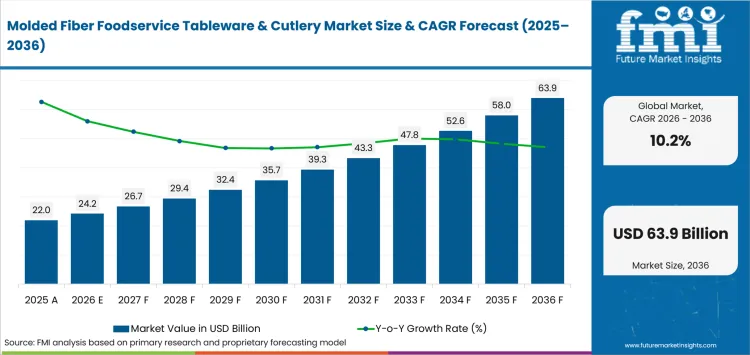
Key Takeaways of Molded Fiber Foodservice Tableware & Cutlery Market
- Foodservice chains increase fiber-tableware use as plastic-reduction rules converge with repeatable performance across standardized meal formats.
- Paper cutlery is projected to account for 40.8% of product in 2026, supported by compact storage and broad meal coverage.
- Molded fiber is estimated to hold 41.6% of material in 2026, owing to forming flexibility across bowls and trays.
- QSR is forecast to represent 45.1% of end use in 2026, driven by centralized specifications and recurring outlet demand.
- Barrier chemistry and uneven recovery access constrain wider use; visible fiber content does not establish a suitable disposal route for every customer location.
- Competition includes Sabert Corporation; Huhtamäki Oyj; Novolex Holdings, LLC; Duni AB; Dart Container Corporation; PulPac AB; Pakka Limited; and Footprint across different product and manufacturing routes.
Analyst Perspective
“Commercial growth depends on whether paper cutlery resists bending and molded fiber containers retain barriers across hot and oily menu conditions. QSR adoption can scale through centralized specifications, but local recovery routes determine whether compostability claims remain credible across every outlet. Manufacturers that connect forming control with menu testing and regional disposal guidance are better positioned for repeat foodservice orders.”
- Nandini Roy Choudhury, Principal Analyst, Future Market Insights
How is the Molded Fiber Foodservice Tableware & Cutlery Market segmented?
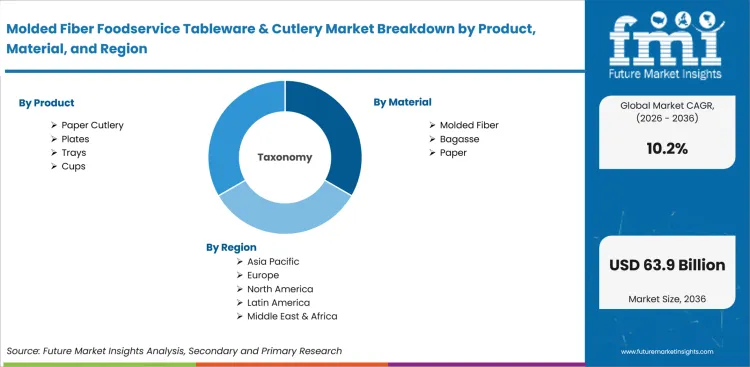
The molded fiber foodservice tableware & cutlery industry is segmented by product, material, end use, and region.
Product separates paper cutlery from plates and trays through the handling task required during meal service, and cups form a separate group through vessel shape and holding needs. Material distinguishes molded fiber from bagasse and paper through feedstock preparation, forming behavior, barrier treatment, and production control. End use compares QSR with catering and retail through service speed, menu range, order frequency, and presentation requirements. Region records food-contact rules, recovery infrastructure, manufacturing access, and distributor coverage across profiled national markets.
How does paper cutlery shape the product category?
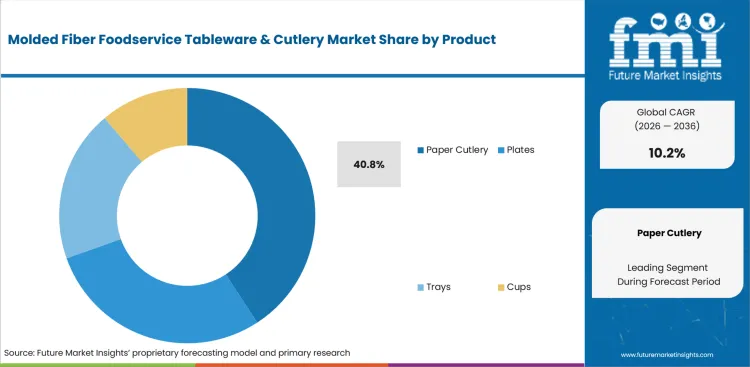
Paper cutlery needs repeatable stiffness across meals that combine elevated temperatures with sauces and surface oils. The European Investment Bank announced in July 2025 that financing would support PulPac research and commercialization through 2029. The program names plates and cutlery among potential dry molded fibre applications targeted through commercialization work. Faster forming can improve utensil economics through shorter cycle times and precise edge geometry across high-volume production programs. Different utensil forces make commercial qualification product-specific across actual menus and realistic foodservice handling conditions.
- By product, paper cutlery is estimated to hold 40.8% in 2026 owing to compact storage and broad meal coverage across recurring foodservice orders. Restaurant groups can pack utensils beside fiber containers and apply centralized specifications across outlets that use comparable menus without adding another rigid plastic substrate.
- QSR chains and caterers adopt paper cutlery for meals that require moderate cutting strength during normal holding periods. Menu conditions rather than material identity determine performance, so manufacturers need clear use limits and stable surface treatments. Distributor training also reduces substitution errors among utensil formats designed for different meal loads and holding periods.
What supports molded fiber within the material category?
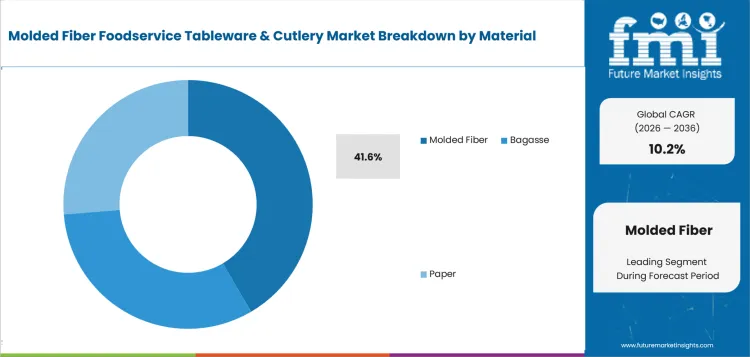
Molded fiber supports reinforcing ribs and deeper shapes across bowls and trays without separate assembly operations. PulPac reported in October 2025 that HZ Green Pulp began full-scale commercial production of dry molded fiber coffee lids in Malaysia. Commercial production demonstrates that fiber forming can support repeat output beyond controlled pilot equipment and limited validation runs. Manufacturers must control thickness and barrier treatment across every tableware shape and production run at scale.
- Based on material, molded fiber is projected to account for 41.6% in 2026 due to shared pulp preparation and forming flexibility across related tableware shapes. Manufacturers can distribute tooling and process-control costs across bowls and trays that use similar forming windows. Shared quality systems support consistent release decisions across several tableware dimensions and production lines at scale.
- Foodservice packaging engineers adopt molded fiber through phased menu trials that measure leakage and heat deformation across representative meal conditions. Repeat purchasing depends on consistent thickness and surface treatment; lot variation raises failure costs and requires tighter pressure control across scheduled production changes.
What drives QSR's position in the end use category?
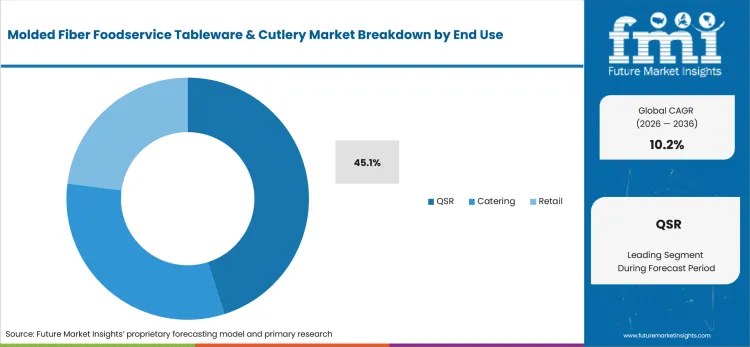
QSR operations need tableware that supports rapid packing and predictable holding performance across repeated menu combinations. Outlet specifications must align barrier strength with filling temperatures and delivery times across recurring restaurant workflows. Comparable disposable food containers show how sorting instructions affect takeaway programs across several collection systems. Duni Group launched Tray Contrast and Ronda Contrast in May 2026 with a functional barrier for cold foods. Restaurant chains retain local qualification for lid fit and collection guidance across delivery routes serving different municipal systems.
- QSR is projected to hold 45.1% share in 2026 owing to centralized specifications across recurring outlet orders. Central approval extends qualified designs across comparable menus and holding periods and improves volume planning for manufacturers serving coordinated restaurant networks.
- Restaurant chains introduce fiber tableware through menu trials that measure filling temperature and transport movement. Dependable regional inventory supports promotions and reduces conversion risk from distant replacement stock or technical support. Operators also need reliable lid compatibility across delivery and takeaway configurations used during recurring campaigns.
What are the drivers, restraints, and opportunities in the Molded Fiber Foodservice Tableware & Cutlery Market?
Plastic-reduction rules support substitution, barrier validation limits adoption, and new fiber processes widen the commercially usable product range.
- Driver: Product standards give manufacturers a shared testing basis for repeat purchasing across organized foodservice programs.
- Restraint: Uneven barrier performance across hot and oily meals can delay approval for commercial tableware programs.
- Opportunity: Commercial fiber-forming advances can widen usable shapes across plates and cutlery without conventional plastic substrates.
China issued GB/T 27591-2025 for paper tableware in May 2025 and implemented the standard during December, giving manufacturers a shared commercial testing reference. The specification creates a clearer basis for discussing strength and food-contact performance across production sites. Restaurant groups can compare test records across paper cutlery and formed tableware without creating separate acceptance criteria for each producer. Repeat orders become easier to support as factories demonstrate consistent performance across several tableware formats.
Oil and heat exposure is one of the notable challenges due to uneven barrier performance across menus and holding times. The United States Food and Drug Administration stated in January 2025 that authorization for 35 PFAS-related food-contact notifications was no longer effective. The affected substances had supported grease-proofing treatments for paper and paperboard used in commercial food-contact packaging. Manufacturers must qualify alternative barriers across the intended temperature and service duration for each tableware format. Restaurant conversions slow as migration records or performance tests fail to cover the exact formulation.
Sealable fiber systems create a commercial opening for ready meals that need formed bowls and reliable closure performance. Duni Group launched Sealable Ronda in April 2026 for hot and cold dishes within its Duniform system. The paper bowl works with compatible films and machines that support secure handling throughout filling and distribution across biodegradable food packaging programs. Tableware manufacturers can capture the opening by validating line speed and seal integrity beside bowl performance, which links lower food loss with clear operating responsibility.
Which country CAGRs are profiled in the Molded Fiber Foodservice Tableware & Cutlery Market?
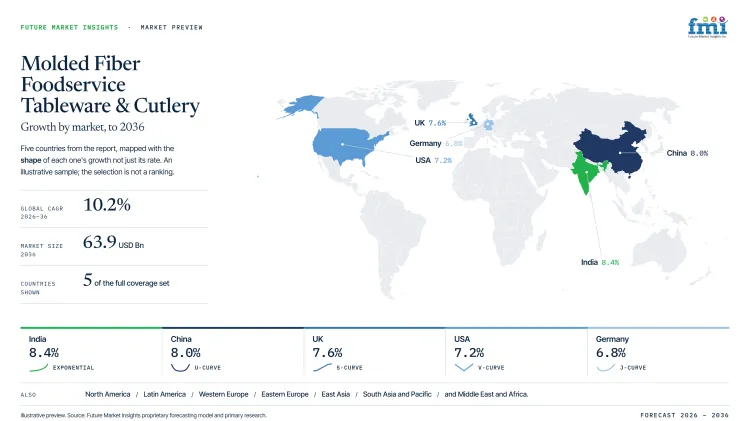
| Country | CAGR |
|---|---|
| USA | 7.2% |
| China | 8.0% |
| Germany | 6.8% |
| UK | 7.6% |
| India | 8.4% |
How do country-level CAGRs compare in the Molded Fiber Foodservice Tableware & Cutlery Market?
In the country outlook, India and China form the upper range through local fiber development and expanding organized foodservice channels. The UK and USA occupy a narrower middle range under different packaging and food-contact controls. Germany remains separated from the upper pair despite mature collection infrastructure and formal producer obligations.
- India combines agricultural-residue research with regional manufacturing potential, although fragmented collection systems complicate consistent end-of-life instructions across cities.
- China benefits from national paper-tableware standards and bamboo-fiber development that support evaluation across large manufacturing networks and diverse foodservice channels.
- The UK links packaging fees with material reporting, which increases scrutiny of fiber composites across centralized restaurant purchasing decisions.
- The USA places greater emphasis on food-contact evidence and state disposal rules across multi-location restaurant and catering programs.
- Germany combines established collection systems with producer reporting obligations that add administrative cost for smaller importers and specialized manufacturers.
Comparable growth rates produce different entry economics through differences in qualification costs and recovery routes. Restaurant groups should assess local barrier rules and distribution support rather than treating similar forecasts as equivalent openings. The full report provides country-level CAGR analysis across North America and Latin America together with the complete European coverage. It also covers East Asia and South Asia alongside Oceania and the Middle East and Africa.
Country-wise Analysis
- United States restaurant networks require food-contact documentation and local guidance for compostable tableware claims across qualified fiber formats. Sales of molded fiber foodservice tableware and cutlery in the USA are forecast to expand at 7.2% CAGR by 2036, supported by standardized national specifications. Dart reported in May 2025 that TÜV Austria certified all Dart-designed molded fiber products including dinnerware and trays alongside bowls, portion containers and hot cup lids. Domestic manufacturing and distribution help national chains coordinate product trials across restaurant outlets and catering locations throughout service programs. Local composting access remains uneven and certification cannot guarantee processing within every customer municipality served by national chains.
- China combines extensive converting capacity with a paper-tableware standard and active bamboo-fiber commercial engineering programs. Adoption of molded fiber foodservice tableware and cutlery in China is estimated to expand at 8.0% CAGR through 2036, reinforced by large manufacturing networks. Local equipment makers can connect bamboo preparation with formed products across commercial service temperatures and menu formats. Quality differences among production sites can weaken consistency across provincial restaurant accounts and replacement orders. The National Forestry and Grassland Administration reported in November 2025 that experts reviewed whole-bamboo-fiber tableware technology. The reviewed products included cups and bowls alongside plates designed for hot or cold commercial foodservice applications. .
- German foodservice programs operate within established collection systems and formal reporting duties under the single-use plastic fund. Germany's molded fiber foodservice tableware and cutlery outlook is anticipated to advance at 6.8% CAGR over the assessment period, underpinned by disciplined material reporting. Smaller importers face documentation costs from product classification and annual quantity reporting for relevant food containers. The German Environment Agency confirmed in May 2025 that quantity reporting remained mandatory through the DIVID platform. Formal records improve traceability across national restaurant accounts and clarify responsibility for reported product volumes. Accurate classification therefore shapes entry across lower-volume imported formats and specialized commercial foodservice programs with limited compliance resources.
- United Kingdom restaurant groups assess fiber formats through food-contact controls and packaging fees applied across national sales. The UK molded fiber foodservice tableware and cutlery sector is projected to record 7.6% CAGR during the assessment period, aided by coordinated purchasing across larger chains. Defra published final 2025 base fees in June 2025 with separate rates for paper and fibre-based composite packaging. The fee difference gives restaurant groups a direct cost signal for material classification and design decisions. National distribution supports coordinated format changes but uneven composting access requires local disposal instructions across participating restaurant locations. Misclassification can weaken environmental claims across restaurant groups using one specification throughout several collection systems.
- Indian tableware development uses agricultural residues and engineering partnerships connecting fiber preparation with commercial forming equipment. Regional manufacturers can use wheat straw and other residues to build products around local feedstock supply. Demand for molded fiber foodservice tableware and cutlery in India is forecast to rise at 8.4% CAGR over the forecast period, supported by local residues. Regional commercialization depends on equipment that can convert variable agricultural residues into repeatable food-contact products. The Press Information Bureau reported in October 2025 that IIT Roorkee and Parason Machinery developed wheat-straw tableware. The collaboration links food-safe molded products with machinery support for regional agricultural residue supply chains. Fragmented collection and distributor coverage constrain foodservice programs serving several cities and regional restaurant networks.
Who are the notable companies in the Molded Fiber Foodservice Tableware & Cutlery Market?
Sabert Corporation, Huhtamäki Oyj, Novolex Holdings, LLC, Duni AB, Dart Container Corporation, PulPac AB, Pakka Limited, and Footprint are the notable companies shaping this market.
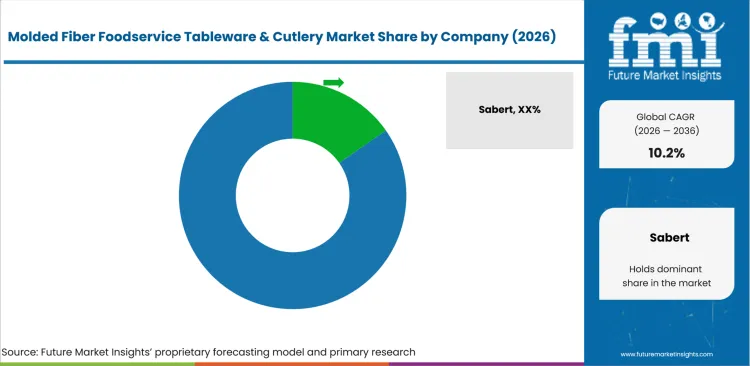
Competition includes foodservice packaging groups with fiber-technology developers and regional manufacturers that serve qualification routes. Sabert and Dart provide molded fiber plates and containers for commercial restaurant and catering applications. Huhtamäki and Duni AB contribute multi-region operations with broader material-development resources and coordinated customer support capabilities. An April 2025 SEC filing confirmed Novolex completed the Pactiv Evergreen acquisition and expanded its operating base. Novolex combines Eco-Products and Pactiv Evergreen capabilities within one integrated commercial foodservice packaging operating group. PulPac licenses dry-forming technology through commercial partners supporting regional production development and licensed manufacturing scale. Pakka and Footprint add agricultural-fiber or plant-based platforms across selected customer formats and operating regions. Competition therefore depends on verified barrier performance and dependable supply across each served operating region.
- Sabert Corporation and Dart Container Corporation focus on broad molded fiber dinnerware portfolios and documented manufacturing capacity. Footprint adds PE-free cups and related beverage components through a plant-based platform that emphasizes barrier engineering across selected formats. Selection depends on validated menu coverage and local manufacturing support across the intended service region.
- Huhtamäki Oyj and Duni AB combine multi-region distribution with foodservice packaging development across varied substrates and commercial regions. Novolex supports molded fiber foodservice programs through Eco-Products and its acquired Pactiv Evergreen operating base. Account selection depends on product breadth and coordinated distribution across each restaurant network and its regional service locations.
- PulPac AB develops a licensed dry-forming route that supports partners building new fiber capacity across regional manufacturing networks. Pakka Limited combines bagasse feedstock with direct tableware manufacturing across plates and bowls for Indian foodservice programs. Commercial execution depends on partner capacity and consistent quality across regional production runs and changing customer order volumes.
Competitive Benchmarking: Molded Fiber Foodservice Tableware & Cutlery Market
| Company | Molded Fiber Tableware Portfolio | Food-Contact and Barrier Support | Manufacturing and Scale Support | Geographic Reach |
|---|---|---|---|---|
| Sabert Corporation | High | High | Medium | North America, Europe, and Asia |
| Huhtamäki Oyj | Medium | Medium | Medium | Global |
| Novolex Holdings, LLC | Medium | Medium | Medium | North America |
| Duni AB | Medium | Medium | Medium | More than 50 markets |
| Dart Container Corporation | High | Medium | High | North America and international production |
| PulPac AB | Medium | Medium | Medium | Global licensee network |
| Pakka Limited | High | Medium | Medium | India |
| Footprint | Medium | Medium | Medium | Europe; North America planned |
Key Developments in the Molded Fiber Foodservice Tableware & Cutlery Market
- In April 2025, Novolex's Eco-Products brand and DNO Produce unveiled a four-ounce molded fiber cup with plant-based lidding film for school nutrition programs. DNO already served school nutrition programs across 17 states and needed pre-portioned produce formats that reduced preparation work. The launch gives molded fiber cups a direct institutional foodservice route with documented compostability and established regional distribution.
- In July 2025, Huhtamäki Oyj launched new ice cream cups that are home compostable and industrially compostable alongside being recyclable. The cups use certified paperboard with a bio-based coating and less than ten percent plastic content. The launch expands commercial foodservice cup availability for customers needing documented barrier performance with several end-of-life routes across ice cream and dessert service programs.
- In June 2026, PulPac reported that HZ Green Pulp and Hotpack Global formed a joint venture linking dry molded fiber production with a broad foodservice packaging network. The partnership gives HZ Green Pulp's commercial coffee lid a distribution route beside complementary paper cups. The arrangement can support additional foodservice applications as the company expands its dry molded fiber offering.
- In July 2026, Footprint expanded into PE-free hot and cold cups through a platform acquired from Transcend Packaging. The company stated that production would begin at its Poland facility with interim manufacturing support from Wales. The launch adds a recyclable and home-compostable cup route across Europe with planned North American availability for beverage and takeaway programs.
Key Players in the Molded Fiber Foodservice Tableware & Cutlery Market
Molded Fiber Foodservice Specialists
- Sabert Corporation
- Dart Container Corporation
- Footprint
Global Packaging Groups
- Huhtamäki Oyj
- Novolex Holdings, LLC
- Duni AB
Fiber Technology and Regional Manufacturers
- PulPac AB
- Pakka Limited
Molded Fiber Foodservice Tableware & Cutlery Market - Report Scope
| Coverage field | Report scope |
|---|---|
| Market breakdown | Product, material, end use, and region. |
| Quantitative Units | Revenue in USD Billion, CAGR in %. |
| Market Definition | Single-use foodservice plates, bowls, trays, cups, and cutlery produced from molded fiber, bagasse, paper, or related plant-fiber routes. |
| Regions Covered | North America, Latin America, Western Europe, Eastern Europe, East Asia, South Asia and Pacific, and Middle East and Africa. |
| Countries Covered | USA, China, Germany, UK, and India, with additional country coverage across the defined regions. |
| Key Companies Profiled | Sabert Corporation, Huhtamäki Oyj, Novolex Holdings, LLC, Duni AB, Dart Container Corporation, PulPac AB, Pakka Limited, and Footprint. |
| Forecast Period | 2026 to 2036. |
| Approach | Hybrid bottom-up and top-down market sizing supported by primary interviews and official desk research. |
Molded Fiber Foodservice Tableware & Cutlery Market - Research Methodology
| Method | Approach |
|---|---|
| Primary Research | FMI analysts gathered input from manufacturers, service providers, technology developers, distributors, end users, sourcing teams, and subject-matter experts. Interviews examined purchasing decisions, product or service evaluation, adoption barriers, approval requirements, pricing considerations, and expectations for technical or commercial support. Respondents were also asked what evidence is required before a trial, pilot, or initial order develops into regular purchasing. |
| Desk Research | Desk research covered government statistics, regulatory publications, trade data, industry associations, technical literature, standards, company filings, product information, and official corporate announcements. Sources were reviewed for relevance, publication date, geographic coverage, and consistency with the defined market scope. Claims relating to performance, applications, approvals, capacity, investment, and commercial activity were retained only when supported by credible public evidence. |
| Market Sizing and Forecasting | The market model combined the baseline value with historical performance, segment structure, pricing and volume indicators, adoption levels, company participation, and country-level demand conditions. Forecast assumptions considered economic activity, investment trends, regulatory developments, technology adoption, purchasing cycles, supply availability, and barriers to wider market use. Segment and regional estimates were reconciled before the final market total was calculated. |
| Data Validation | Estimates were checked against multiple independent indicators, including public data, company activity, trade patterns, industry developments, and findings from primary interviews. Validation also tested whether products, services, applications, and company revenues fell within the defined market boundaries. Adjacent categories, unsupported claims, overlapping revenues, and activities without direct market relevance were excluded to reduce double counting and maintain consistency across segments and countries. |
Molded Fiber Foodservice Tableware & Cutlery Market by Segments
Molded Fiber Foodservice Tableware & Cutlery Market segmented by Product:
- Paper Cutlery
- Plates
- Trays
- Cups
Molded Fiber Foodservice Tableware & Cutlery Market segmented by Material:
- Molded Fiber
- Bagasse
- Paper
Molded Fiber Foodservice Tableware & Cutlery Market segmented by End Use:
- QSR
- Catering
- Retail
Molded Fiber Foodservice Tableware & Cutlery Market by Region:
- North America
- United States
- Canada
- Latin America
- Brazil
- Mexico
- Argentina
- Chile
- Western Europe
- Germany
- France
- United Kingdom
- Italy
- Spain
- Benelux
- Nordics
- Eastern Europe
- Poland
- Czech Republic
- Romania
- Hungary
- East Asia
- China
- Japan
- South Korea
- South Asia and Pacific
- India
- ASEAN
- Australia and New Zealand
- Middle East and Africa
- GCC Countries
- South Africa
- Türkiye
- Israel
Research Sources and Bibliography
- Eurostat. (2025, October 22). Plastic packaging waste in the EU: 35.3 kg per person.
- European Commission, Directorate-General for Environment. (2025, February 11). New rules enter into force for a more sustainable and competitive packaging economy.
- European Investment Bank. (2025, July 3). Sweden: Europe’s fight against plastic pollution gets boost as EIB backs Swedish innovation packaging company PulPac.
- PulPac. (2025, October 28). HZ Green Pulp enters full-scale production.
- Duni Group. (2026, May 5). Duni Group launches black paper-based packaging collection that facilitates sorting and contributes to lower climate impact.
- State Administration for Market Regulation and Standardization Administration of China. (2025, May 30). GB/T 27591-2025:[Paper tableware].
- USA Food and Drug Administration. (2025, January 3). FDA Determines Authorization for 35 Food Contact Notifications Related to PFAS Are No Longer Effective.
- Duni Group. (2026, April 28). Duni Group launches a sealable paper bowl to reduce food waste in ready meals.
- Dart Container Corporation. (2025, May 12). Dart products earn sustainability recognition.
- National Forestry and Grassland Administration. (2025, November 12). [China’s whole-bamboo-fiber food-container and tableware technology reaches an internationally advanced level].
- German Environment Agency. (2025, May 2). Single-Use Plastic Fund: UBA waives requirement to verify quanties in 2025.
- Department for Environment, Food & Rural Affairs. (2025, June 30). Extended producer responsibility for packaging: 2025 base fees.
- Press Information Bureau. (2025, October 4). Mitti se Mitti Tak : IIT Roorkee’s Innovation in Eco-Friendly Tableware from Wheat Straw.
- Pactiv Evergreen Inc. (2025, April 1). Current Report (Form 8-K).
- Sabert Corporation. (2025, November 19). Sabert Corporation’s Pulp Ultra® Wins 2025 U.S. Plastics Pact Packaging Innovation Award for Compostability.
- Huhtamäki Oyj. (2025, July 16). Huhtamaki launches new compostable ice cream cups.
- PulPac. (2026, June 24). HZ strengthens Dry Molded Fiber offering through Hotpack partnership.
- Footprint. (2026, July 21). Footprint Expands Into PE-Free Cups with Proven Alternative to Plastic-Lined Paper Cups.
- Pakka Limited. (2025, February 15). Molded Fibre Serviceware for Food Businesses: Material Properties, Cost Analysis, and Procurement Decisions.
- Duni AB. (2026, April 23). Duni Group’s 2025 annual and sustainability report is now available online.
- Huhtamäki Oyj. (2026, March 3). Huhtamaki’s 2025 annual report published.
- Novolex. (2025, May 1). Eco-Products and DNO Produce Help Bring Environmental Sustainability to K-12 School Cafeterias.
The bibliography provides selected reader references for retained public evidence across the article’s analytical sections. The full report contains the complete reference list and detailed source citations supporting the wider market assessment.
This Report Answers
- How large is the molded fiber foodservice tableware & cutlery market in 2026 and 2036?
- Which material and product mechanisms support repeat purchasing across foodservice tableware applications?
- Why does paper cutlery account for the largest product share during 2026?
- How does molded fiber support formed tableware across varied menu and holding requirements?
- Why does QSR represent the largest end use share during 2026?
- How do country growth rates differ across the USA and China alongside Germany, the UK and India?
- Which companies provide fiber tableware or enabling manufacturing technology across regional markets?
- What barrier and recovery constraints delay commercial substitution from conventional plastic tableware?
- Which recent company developments influence competition through July 2026?
Frequently Asked Questions
How big is the Molded Fiber Foodservice Tableware & Cutlery Market in 2026?
The molded fiber foodservice tableware & cutlery market is valued at USD 24.2 billion in 2026 and is forecast to reach USD 63.9 billion by 2036.
What is the CAGR of the Molded Fiber Foodservice Tableware & Cutlery Market from 2026 to 2036?
The molded fiber foodservice tableware & cutlery market is projected to grow at a CAGR of 10.2% between 2026 and 2036, supported by plastic-reduction regulations driving substitution across standardized foodservice formats and expanding fiber-forming manufacturing capacity.
Which product segment leads the Molded Fiber Foodservice Tableware & Cutlery Market?
Paper cutlery accounts for 40.8% of the molded fiber foodservice tableware & cutlery market by product in 2026, driven by compact storage and broad meal coverage across recurring foodservice orders from QSR chains and catering operators.
Which country is growing fastest in the Molded Fiber Foodservice Tableware & Cutlery Market?
India is the fastest-growing country in the molded fiber foodservice tableware & cutlery market, expanding at an 8.4% CAGR through 2036, ahead of the market average of 10.2%, supported by local agricultural residue feedstocks and regional manufacturing development through engineering partnerships.
Who are the leading companies in the Molded Fiber Foodservice Tableware & Cutlery Market?
Leading companies in the molded fiber foodservice tableware & cutlery market include Sabert Corporation, Huhtamäki Oyj, Novolex Holdings, Duni AB, Dart Container Corporation, PulPac AB, Pakka Limited, and Footprint, spanning molded fiber tableware portfolios, dry-forming technology licensing, and regional manufacturing across global foodservice markets.
Preview the report firsthand - request a free sample
Get SampleGet the brochure for pricing and purchase details.
Get PDFTable of Content
- Key Takeaways
- Market Size and CAGR
- Top Growth Driver
- Fastest Growing Segment
- Leading Region
- Key Companies
- Emerging Opportunities
- Executive Summary
- Global Market Outlook
- Demand-side Trends
- Supply-side Trends
- Technology Roadmap Analysis
- Analysis and Recommendations
- Analyst Perspective (What is happening? Why now? What should investors know?)
- Key Questions Answered
- How large is the market?
- What is the CAGR?
- What are key trends?
- Which region dominates?
- Who are the leaders?
- Market Overview
- Market Coverage / Taxonomy
- Market Definition / Scope / Limitations
- Research Methodology
- Chapter Orientation
- Analytical Lens and Working Hypotheses
- Market Structure, Signals, and Trend Drivers
- Benchmarking and Cross-market Comparability
- Market Sizing, Forecasting, and Opportunity Mapping
- Research Design and Evidence Framework
- Desk Research Programme (Secondary Evidence)
- Expert Input and Fieldwork (Primary Evidence)
- Tooling, Models, and Reference Databases
- Data Engineering and Model Build
- Quality Assurance and Audit Trail
- Market Background
- Market Dynamics (Drivers, Restraints, Opportunity, Trends)
- Scenario Forecast (Optimistic, Likely, Conservative)
- Impact Analysis
- AI Impact
- Sustainability Impact
- Regulatory Impact
- Technology Impact
- Consumer / Buyer Analysis
- Purchase Drivers
- Adoption Barriers
- Buyer Journey
- Opportunity Map Analysis
- Product Life Cycle Analysis
- Supply Chain Analysis
- Investment Feasibility Matrix
- Value Chain Analysis
- PESTLE and Porter's Analysis
- Regulatory Landscape
- Regional Parent Market Outlook
- Production and Consumption Statistics
- Import and Export Statistics
- Global Market Analysis and Forecast, 2021 to 2036
- Historical Market Size Value (USD Billion) Analysis, 2021 to 2025
- Current and Future Market Size Value (USD Billion) Projections, 2026 to 2036
- Y-o-Y Growth Trend Analysis
- Absolute $ Opportunity Analysis
- Global Market Pricing Analysis, 2021 to 2036
- Global Market Analysis and Forecast, By Product, 2021 to 2036
- Introduction / Key Findings
- Historical Market Size Value (USD Billion) Analysis By Product, 2021 to 2025
- Current and Future Market Size Value (USD Billion) Analysis and Forecast By Product, 2026 to 2036
- Paper Cutlery
- Plates
- Trays
- Cups
- Paper Cutlery
- Y-o-Y Growth Trend Analysis By Product, 2021 to 2025
- Absolute $ Opportunity Analysis By Product, 2026 to 2036
- Global Market Analysis and Forecast, By Material, 2021 to 2036
- Introduction / Key Findings
- Historical Market Size Value (USD Billion) Analysis By Material, 2021 to 2025
- Current and Future Market Size Value (USD Billion) Analysis and Forecast By Material, 2026 to 2036
- Molded Fiber
- Bagasse
- Paper
- Molded Fiber
- Y-o-Y Growth Trend Analysis By Material, 2021 to 2025
- Absolute $ Opportunity Analysis By Material, 2026 to 2036
- Global Market Analysis and Forecast, By End Use, 2021 to 2036
- Introduction / Key Findings
- Historical Market Size Value (USD Billion) Analysis By End Use, 2021 to 2025
- Current and Future Market Size Value (USD Billion) Analysis and Forecast By End Use, 2026 to 2036
- QSR
- Catering
- Retail
- QSR
- Y-o-Y Growth Trend Analysis By End Use, 2021 to 2025
- Absolute $ Opportunity Analysis By End Use, 2026 to 2036
- Global Market Analysis and Forecast, By Region, 2021 to 2036
- Introduction
- Historical Market Size Value (USD Billion) Analysis By Region, 2021 to 2025
- Current Market Size Value (USD Billion) Analysis and Forecast By Region, 2026 to 2036
- North America
- Latin America
- Western Europe
- Eastern Europe
- East Asia
- South Asia and Pacific
- Middle East & Africa
- Market Attractiveness Analysis By Region
- North America Market Analysis and Forecast, By Country, 2021 to 2036
- Historical Market Size Value (USD Billion) Trend Analysis By Market Taxonomy, 2021 to 2025
- Market Size Value (USD Billion) Forecast By Market Taxonomy, 2026 to 2036
- By Country
- USA
- Canada
- By Product
- By Material
- By End Use
- By Country
- Market Attractiveness Analysis
- By Country
- By Product
- By Material
- By End Use
- Key Takeaways
- Latin America Market Analysis and Forecast, By Country
- Historical Market Size Value (USD Billion) Trend Analysis By Market Taxonomy, 2021 to 2025
- Market Size Value (USD Billion) Forecast By Market Taxonomy, 2026 to 2036
- By Country
- Brazil
- Mexico
- Chile
- Rest of Latin America
- By Product
- By Material
- By End Use
- By Country
- Market Attractiveness Analysis
- By Country
- By Product
- By Material
- By End Use
- Key Takeaways
- Western Europe Market Analysis and Forecast, By Country
- Historical Market Size Value (USD Billion) Trend Analysis By Market Taxonomy, 2021 to 2025
- Market Size Value (USD Billion) Forecast By Market Taxonomy, 2026 to 2036
- By Country
- Germany
- UK
- Italy
- Spain
- France
- Nordic
- BENELUX
- Rest of Western Europe
- By Product
- By Material
- By End Use
- By Country
- Market Attractiveness Analysis
- By Country
- By Product
- By Material
- By End Use
- Key Takeaways
- Eastern Europe Market Analysis and Forecast, By Country
- Historical Market Size Value (USD Billion) Trend Analysis By Market Taxonomy, 2021 to 2025
- Market Size Value (USD Billion) Forecast By Market Taxonomy, 2026 to 2036
- By Country
- Russia
- Poland
- Hungary
- Balkan & Baltic
- Rest of Eastern Europe
- By Product
- By Material
- By End Use
- By Country
- Market Attractiveness Analysis
- By Country
- By Product
- By Material
- By End Use
- Key Takeaways
- East Asia Market Analysis and Forecast, By Country
- Historical Market Size Value (USD Billion) Trend Analysis By Market Taxonomy, 2021 to 2025
- Market Size Value (USD Billion) Forecast By Market Taxonomy, 2026 to 2036
- By Country
- China
- Japan
- South Korea
- By Product
- By Material
- By End Use
- By Country
- Market Attractiveness Analysis
- By Country
- By Product
- By Material
- By End Use
- Key Takeaways
- South Asia and Pacific Market Analysis and Forecast, By Country
- Historical Market Size Value (USD Billion) Trend Analysis By Market Taxonomy, 2021 to 2025
- Market Size Value (USD Billion) Forecast By Market Taxonomy, 2026 to 2036
- By Country
- India
- ASEAN
- Australia & New Zealand
- Rest of South Asia and Pacific
- By Product
- By Material
- By End Use
- By Country
- Market Attractiveness Analysis
- By Country
- By Product
- By Material
- By End Use
- Key Takeaways
- Middle East & Africa Market Analysis and Forecast, By Country
- Historical Market Size Value (USD Billion) Trend Analysis By Market Taxonomy, 2021 to 2025
- Market Size Value (USD Billion) Forecast By Market Taxonomy, 2026 to 2036
- By Country
- Kingdom of Saudi Arabia
- Other GCC Countries
- Türkiye
- South Africa
- Other African Union
- Rest of Middle East & Africa
- By Product
- By Material
- By End Use
- By Country
- Market Attractiveness Analysis
- By Country
- By Product
- By Material
- By End Use
- Key Takeaways
- Key Countries Market Analysis
- USA
- Pricing Analysis
- Market Share Analysis, 2025
- By Product
- By Material
- By End Use
- Canada
- Pricing Analysis
- Market Share Analysis, 2025
- By Product
- By Material
- By End Use
- Mexico
- Pricing Analysis
- Market Share Analysis, 2025
- By Product
- By Material
- By End Use
- Brazil
- Pricing Analysis
- Market Share Analysis, 2025
- By Product
- By Material
- By End Use
- Chile
- Pricing Analysis
- Market Share Analysis, 2025
- By Product
- By Material
- By End Use
- Germany
- Pricing Analysis
- Market Share Analysis, 2025
- By Product
- By Material
- By End Use
- UK
- Pricing Analysis
- Market Share Analysis, 2025
- By Product
- By Material
- By End Use
- Italy
- Pricing Analysis
- Market Share Analysis, 2025
- By Product
- By Material
- By End Use
- Spain
- Pricing Analysis
- Market Share Analysis, 2025
- By Product
- By Material
- By End Use
- France
- Pricing Analysis
- Market Share Analysis, 2025
- By Product
- By Material
- By End Use
- India
- Pricing Analysis
- Market Share Analysis, 2025
- By Product
- By Material
- By End Use
- ASEAN
- Pricing Analysis
- Market Share Analysis, 2025
- By Product
- By Material
- By End Use
- Australia & New Zealand
- Pricing Analysis
- Market Share Analysis, 2025
- By Product
- By Material
- By End Use
- China
- Pricing Analysis
- Market Share Analysis, 2025
- By Product
- By Material
- By End Use
- Japan
- Pricing Analysis
- Market Share Analysis, 2025
- By Product
- By Material
- By End Use
- South Korea
- Pricing Analysis
- Market Share Analysis, 2025
- By Product
- By Material
- By End Use
- Russia
- Pricing Analysis
- Market Share Analysis, 2025
- By Product
- By Material
- By End Use
- Poland
- Pricing Analysis
- Market Share Analysis, 2025
- By Product
- By Material
- By End Use
- Hungary
- Pricing Analysis
- Market Share Analysis, 2025
- By Product
- By Material
- By End Use
- Kingdom of Saudi Arabia
- Pricing Analysis
- Market Share Analysis, 2025
- By Product
- By Material
- By End Use
- Türkiye
- Pricing Analysis
- Market Share Analysis, 2025
- By Product
- By Material
- By End Use
- South Africa
- Pricing Analysis
- Market Share Analysis, 2025
- By Product
- By Material
- By End Use
- USA
- Market Structure Analysis
- Competition Dashboard
- Competition Benchmarking
- Market Share Analysis of Top Players
- By Regional
- By Product
- By Material
- By End Use
- Emerging Startups
- Innovation Benchmarking
- Competition Analysis
- Competition Deep Dive
- Sabert
- Overview
- Product Portfolio
- Profitability by Market Segments
- Sales Footprint
- Strategy Overview
- Marketing Strategy
- Product Strategy
- Channel Strategy
- Huhtamaki
- Vegware
- Pactiv Evergreen
- BioPak
- Duni
- Sabert
- Case Studies
- Success Stories
- Recent Developments
- Competition Deep Dive
- Assumptions & Acronyms Used


