

- Industry Size (2026)
- USD 111.2 Bn
- Forecast (2036)
- USD 188.1 Bn
- CAGR (2026 to 2036)
- 5.4%
Cheese Market Size, Market Forecast and Outlook By FMI
In 2025, the cheese market was valued at USD 105.5 billion. Based on Future Market Insights’ analysis, demand is estimated to grow to USD 111.2 billion in 2026 and USD 188.1 billion by 2036. FMI projects a CAGR of 5.4% during the forecast period.
Pricing volatility and input cost dynamics are reshaping procurement strategies, compelling buyers to hedge against fluctuations in the global milk pool. In February 2026, the CME cash cheese close for barrels hovered at $1.4400 per lb, signalling a tightening supply-demand balance that forces manufacturers to optimize yield and prioritize high-margin formats [1]. This cost pressure is accelerating the shift toward scale and efficiency, evidenced by the US producing 1.23 billion lbs of cheese in March 2025 alone to meet domestic and export obligations [1]. Consequently, buyers are increasingly locking in long-term contracts for staple varieties like cheddar while retaining spot market exposure for specialty artisanal grades.
According to FMI's estimates, consolidation is becoming a primary lever for sustaining margins in this high-volume environment. "DMK Group is the largest dairy cooperative in Germany and a very attractive partner that shares our core values," states Peder Tuborgh, CEO of Arla Foods [5]. FMI analysts opine that such mega-mergers are designed to create buffer zones against raw material volatility and secure capital for decarbonization investments, ultimately creating a more resilient supply chain for global retailers.
Summary of Cheese
- Cheese Market Definition
- Covers the global production and trade of dairy and plant-based cheese formats for retail, foodservice, and industrial use.
- Demand Drivers in the Market
- Rising protein consumption in emerging Asian economies.
- Expansion of cold-chain logistics enabling broader distribution.
- Innovation in convenient snacking and functional formats.
- Key Segments Analyzed in the FMI Report
- Nature: Conventional cheese commands 64.2% of the market share.
- Source: Dairy-based varieties hold a dominant 68.1% share.
- Product Type: Mozzarella leads with 27.8% share due to the pizza industry.
- Analyst Opinion at FMI
- Nandini Roy Choudhury, Principal Consultant for Food & Beverage, opines, "The industry is pivoting from pure volume competition to a value-added model, where functional attributes and sustainability claims are the new currency for securing shelf space in Western retail markets."
- Strategic Implications/Executive Takeaways
- Prioritize supply chain consolidation to manage input cost spikes.
- Invest in plant-based hybrids to capture the flexitarian consumer.
- Target high-growth export corridors in Southeast Asia and the Middle East.
- Methodology
- Validated through first-hand corporate production and capacity data.
- Zero reliance on speculative third-party market research reports.
- Based on verifiable industrial benchmarks and verified sources.
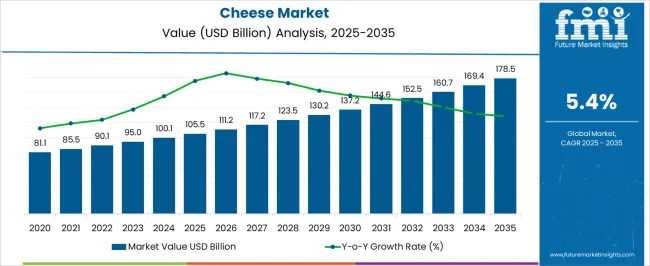
Growth is dispersed across distinct economic zones, with China (7.3% CAGR) and India (6.8% CAGR) leading the volume expansion charge driven by urbanization and QSR proliferation. Mature markets like Germany (6.2% CAGR) and the UK (5.1% CAGR) are revitalized by demand for premium and convenient formats. The USA (4.6% CAGR) maintains steady progress, anchored by its massive production base and growing export footprint.
Cheese Market Definition
The market refers to the commercial exchange of curdled milk products derived from the milk of cows, goats, sheep, buffalo, or plant-based alternatives. It encompasses the entire value chain from milk processing and curdling to ripening, packaging, and distribution of natural and processed varieties. The scope includes standard blocks, barrels, wheels, shredded, sliced, and spreadable formats used in retail, foodservice, and industrial food processing.
Cheese Market Inclusions
The report includes a comprehensive analysis of all major cheese varieties, including hard, semi-hard, soft, and fresh cheeses. It covers both conventional cheese produced from standard milk pools and certified organic variants. The analysis also incorporates the trade of value-added formats such as processed cheese, cream cheese, and cheese powders used in snack manufacturing, alongside the emerging segment of plant-based cheese alternatives.
Cheese Market Exclusions
The scope excludes raw liquid milk trade and non-food industrial casein applications unless they are directly integrated into the cheese production workflow. It also omits small-scale unregulated artisanal production sold in informal local markets that does not enter the organized commercial supply chain. Downstream finished goods where cheese is a minor ingredient, such as pre-made frozen pizzas or cheese-flavored snacks, are excluded from the market sizing, focusing strictly on the cheese ingredient itself.
Cheese Market Research Methodology
- Primary Research: Interviews with dairy cooperative leaders, plant managers, procurement heads, and trade association representatives across key export hubs.
- Desk Research: Analysis of USDA Agricultural Marketing Service price reports, FAO production dashboards, and national dairy board statistics.
- Market-Sizing and Forecasting: A bottom-up approach aggregating plant-level output and retail sales data, validated against global trade flow volumes.
- Data Validation and Update Cycle: Cross-verification of export values with customs data and reconciling production figures with milk intake reports.
Segmental Analysis
Cheese Market Analysis by Source
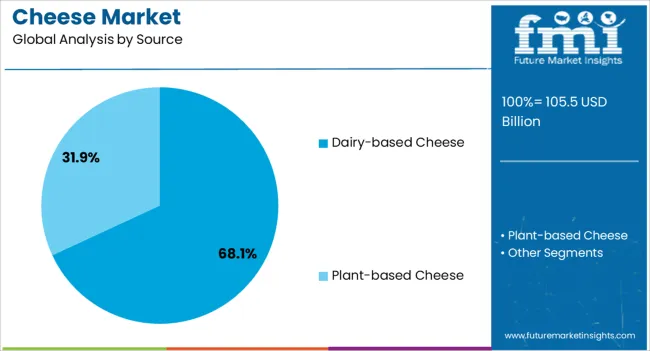
Dairy-based cheese commands 68.1 percent of the market in 2026, serving as the foundational protein source for global food processing and retail consumption. This segment's dominance is underpinned by established consumer preferences for the sensory profile of animal-derived casein, which remains difficult to replicate perfectly in alternatives. However, the segment is evolving as producers integrate probiotic cheese cultures to align with gut-health trends.
- Production trigger: Demand is reinforced by the massive installed base of dairy infrastructure, with the EU alone contributing 48 percent of global cheese production in the 2024/2025 period [9].
- Supply-side move: Cooperatives are optimizing networks to sustain this volume, exemplified by FrieslandCampina's strategic network optimization in November 2024 to streamline operations [7].
- Buyer priority: Procurement shifts toward verified sustainable dairy sources, driven by the need to secure consistent volumes as India's milk production reached 247.87 million tonnes in 2024-25 to feed domestic processing [2].
Cheese Market Analysis by Nature
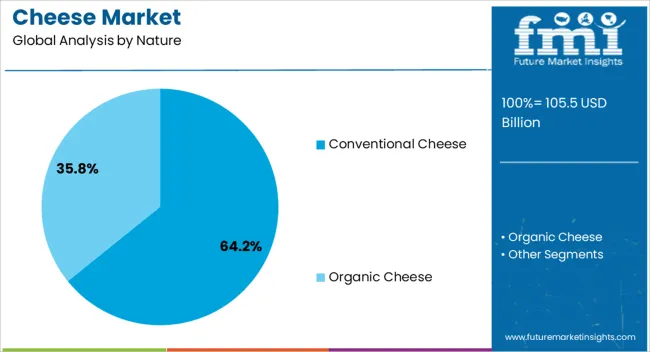
Conventional cheese accounts for 64.2 percent of trade volumes in 2026, driven by its affordability and widespread availability in mass-market retail and foodservice channels. While organic and specialty variants are growing, the conventional segment remains the engine of the industry, particularly for frozen cheese applications like pizza topping where price sensitivity is paramount. FMI analysts opine that standard conventional blocks are the primary currency in international trade.
- Cost driver: Consumption is anchored in conventional varieties due to price competitiveness, with cheddar blocks trading at an average of $1.40 per lb in early February 2026, making it accessible for bulk industrial use [1].
- Capacity scale: Manufacturers prioritize conventional lines to maximize throughput, with Wisconsin cheese plants alone producing over 25 percent of the nation's total cheese output in 2024 [1].
- Trade flow: Export markets rely heavily on conventional grades, with the US forecasting cheese exports to exceed 620,000 tons in 2026 to satisfy global demand [9].
Cheese Market Analysis by Product Type
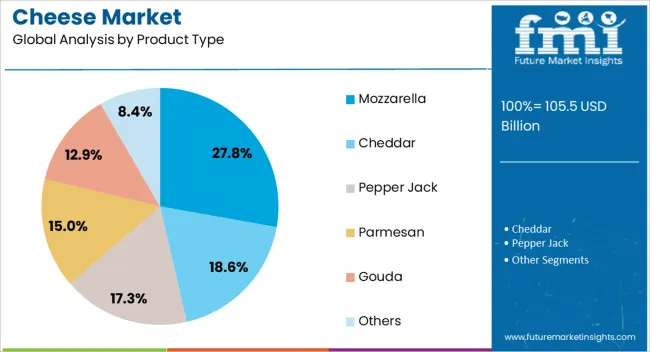
Mozzarella holds a leading 27.8 percent share in 2026, propelled by the relentless expansion of the global pizza service sector and the popularity of convenient string cheese snacks. The functionality of mozzarella, particularly its stretch and melt characteristics, makes it indispensable for the QSR industry. The segment is witnessing diversification into reduced fat cheese variants to cater to health-conscious consumers without compromising performance.
- Consumption driver: Growth is catalyzed by the convenient integration of cheese into daily diets, with US adults consuming a mean of 39 grams of cheese at dinner daily as of May 2024 [1].
- Innovation push: Brands are expanding the utility of mozzarella-adjacent categories, as seen with Kraft Heinz launching an "Everything Bagel" Mac & Cheese flavor in November 2024 to drive frequency [8].
- Export demand: Global demand for pizza cheese drives export volumes, with US cheese exports to the Dominican Republic reaching a record $71 million in 2024 [9].
Cheese Market Drivers, Restraints, and Opportunities
Drivers
A primary demand driver is the structural increase in dairy consumption across emerging economies, supported by rising incomes and the expansion of modern retail infrastructure. In India, per-capita milk availability climbed to 485 grams per day in 2024–25, fueling a domestic boom in processed dairy products [2]. This dietary shift is converting traditional milk usage into higher-value cheese consumption, creating a robust engine for volume growth. Consequently, global trade is accelerating, with US dairy export values hitting $8.25 billion in 2024, confirming that international appetite for dairy protein is a sustained secular trend rather than a temporary spike [9].
Restraints
The market is restrained by significant volatility in input costs and global commodity prices, which squeezes processor margins and affects affordability. The FAO Food Price Index averaged 127.1 points in February 2025, indicating sustained inflationary pressure on the basic food basket [4]. This volatility forces manufacturers to constantly adjust pricing mechanisms, which can dampen volume growth in price-sensitive developing markets. To mitigate this, companies are exploring cheese ingredient substitutions or cheese analogue formulations to maintain price points, but this creates a trade-off between quality perception and cost.
Opportunities
- Plant-Based Hybridization: Opportunities exist in the vegan cheese sector, where companies like Bel are launching 100% plant-based Babybel recipes to capture the flexitarian demographic [6].
- Mergers and Acquisitions: Consolidation offers a pathway to efficiency, as demonstrated by Arla Foods and DMK Group announcing their intention to merge in April 2025 to create a unified dairy powerhouse [5].
- Functional Snacking: There is significant headroom for growth in cheese powder and snack formats, leveraging the trend that US adults consume mean 27 grams of cheese at breakfast [1].
Regional Analysis
Based on the regional analysis, the Cheese market is segmented into North America, Latin America, Europe, East Asia, South Asia, Oceania and Middle East & Africa across 40+ countries. The full report also offers market attractiveness analysis based on regional trends.
<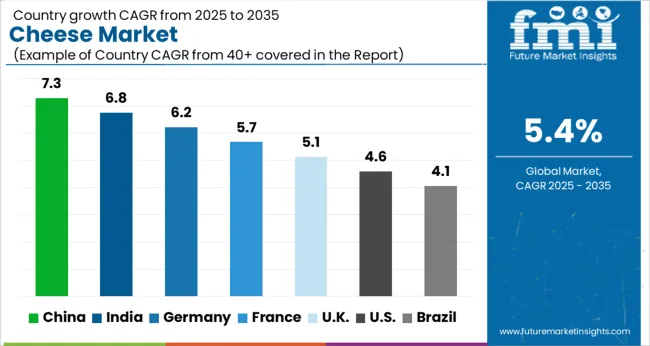
| Country | CAGR (2026 to 2036) |
|---|---|
| China | 7.3% |
| India | 6.8% |
| Germany | 6.2% |
| UK | 5.1% |
| USA | 4.6% |
Source: Future Market Insights (FMI) analysis, based on proprietary forecasting model and primary research
Asia Pacific Cheese Market Analysis
Asia Pacific is emerging as the high-growth engine for the global cheese trade, characterized by rapid "mass premiumisation" where consumers graduate from basic dairy to processed and specialty cheese formats. As per FMI's projection, the region's demand is outpacing local supply capabilities, necessitating significant imports and joint venture investments. The market is defined by the adaptation of western cheese types into local culinary habits, such as cheese-topped tea and spicy paneer fusion dishes.
- China: Demand for cheese in China is set to grow at 7.3% CAGR through 2036, supported by the expansion of modern retail chains and cold chain logistics before procurement cycles translate into higher deployment volumes [3]. This trajectory is supported by a forecasted increase in North American per-capita cheese consumption of 11% by 2033, which often serves as a leading indicator for global dietary westernization trends that China follows [3].
- India: India's cheese sector is poised to expand at 6.8% CAGR during 2026 to 2036 because rising milk production, which hit 239.30 million tonnes in 2023–24, provides the raw material base for domestic processing expansion [2]. This demand shift is reflected in the steady rise of per-capita milk availability, creating a fertile ground for converting liquid milk into value-added cheese products [2].
FMI’s report includes a comprehensive evaluation of the Asia Pacific landscape, detailing country-specific regulatory nuances. The analysis also covers Japan and South Korea as critical opportunistic markets where an aging population is driving demand for low fat cheese nutrition and functional protein-rich snacks. Buyers in these markets should watch for regulatory shifts regarding geographical indications for European cheeses.
Europe Cheese Market Analysis
Europe remains the heartland of cheese production and innovation, driven by a deep tradition of specialty and artisanal craftsmanship. However, the market is undergoing structural changes with consolidation among major cooperatives to enhance competitiveness. As per FMI's projection, the region is balancing its heritage of emmental cheese and gouda with new demands for sustainability and plant-based alternatives. The EU export forecast of 425,000 tons for 2026 underscores its role as a key supplier to the global market [9].
- Germany: The outlook for cheese in Germany indicates a 6.2% CAGR from 2026 to 2036 as value growth outpaces volume through a shift toward premium and functional segments [5]. This expansion is linked to strategic consolidation, such as the intent for Arla Foods and DMK Group to merge, which aims to create a robust entity capable of navigating volatile input costs [5].
- UK: The UK cheese landscape is forecast to expand at 5.1% CAGR through 2036, as retailers innovate with convenient cheese flavor profiles and private label offerings gain traction [5]. Growth is anchored in the launch of new formats, such as Arla's cottage cheese range introduction in late 2025, targeting health-conscious breakfast occasions [5].
FMI’s report includes a detailed growth analysis for the European region, focusing on regulatory barriers and niche opportunities. It identifies France and Italy as additional relevant markets, where cheese color and authenticity standards are paramount. Suppliers should monitor the growing market for cheese alternative products in these traditionally dairy-centric nations.
North America Cheese Market Analysis
North America is a mature but evolving market, characterized by high consumption rates and a strong export focus. The region is seeing a shift toward convenience and bold flavors in the spray cheese and snacking categories. FMI analysts opine that the US is leveraging its massive production capacity to capture share in international markets while satisfying a domestic appetite for diverse cheese varieties.
- USA: The USA is likely to see cheese revenues increase at 4.6% CAGR during 2026 to 2036, given the robust production base that churned out 1.23 billion pounds of cheese in March 2025 alone [1]. This growth is fueled by continuous capacity investments, such as Saputo's new cheese shred lines at their Tulare facility, which optimize operational efficiency for the foodservice channel [10].
FMI’s report includes a focused assessment of the North American market, highlighting the impact of federal safety rulings. Canada and Mexico are noted as secondary markets where trade agreements facilitate strong cross-border flows of cheese concentrate and finished goods. Stakeholders in these countries should prioritize supply chain integration to leverage the regional dairy ecosystem.
Competitive Aligners for Market Players
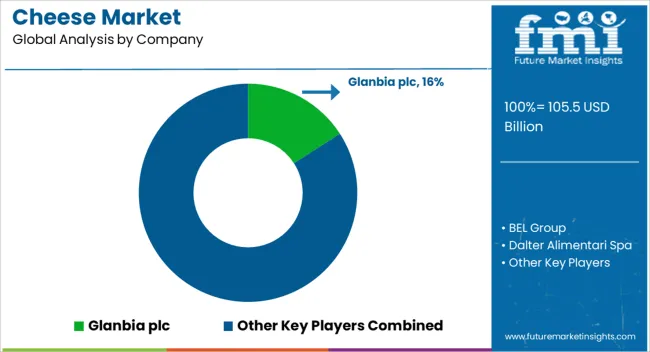
The competitive landscape is defined by aggressive consolidation and portfolio diversification. Major players are moving beyond simple volume competition to acquire capabilities in high-growth niches. For instance, Saputo's agreement to divest a majority stake in its Argentina operations in February 2026 highlights a strategy of capital recycling to focus on core profitable geographies and categories [10]. This allows firms to reallocate resources toward automation and sustainability initiatives that drive long-term value.
Differentiation strategies are increasingly centered on hybrid product portfolios. Companies are no longer strictly "dairy" or "non-dairy" but are blurring the lines to cater to all consumer needs. Bel's launch of 100% plant-based Babybel recipes in January 2026 exemplifies this approach, leveraging iconic branding to enter the vegan cheese sauce and snack space [6]. This agility allows legacy brands to remain relevant to younger, eco-conscious demographics while maintaining their core dairy customer base.
Operational optimization is critical for price survivability. With the FrieslandCampina and Milcobel merger gaining European Commission approval in October 2025, the industry is witnessing the creation of mega-cooperatives designed to achieve economies of scale [7]. These entities are better positioned to absorb the shocks of fluctuating milk prices and invest in large-scale capex projects, such as Arla's €59.4 million investment to expand cheese packaging and cream cheese capacities in Denmark [5].
Recent Developments
The report includes full coverage of key trends from competitive benchmarking. Some of the recent developments covered in the reports:
- In January 2026, Bel announced the launch of two 100% plant-based Babybel recipes in France to capture the growing flexitarian snacking market [6].
- In June 2025, Arla Foods announced a €59.4 million investment to expand cream cheese production capacities at its Holstebro site in Denmark to meet rising international demand [5].
Key Players in Cheese
- Arla Foods
- Lactalis
- Kraft Heinz
- Saputo
- Bel Group
- FrieslandCampina
- Fonterra
- DMK Group
Scope of the Report
| Metric | Value |
|---|---|
| Quantitative Units | USD 111.2 billion (2026) to USD 188.1 billion (2036), at a CAGR of 5.4% |
| Market Definition | The global production and trade of dairy and plant-based cheese formats for retail, foodservice, and industrial applications. |
| Nature Segmentation | Conventional, Organic |
| Source Segmentation | Dairy-based, Plant-based |
| Product Type Segmentation | Mozzarella, Cheddar, Parmesan, Feta, Others |
| Application Coverage | Retail, Foodservice, Industrial Food Processing |
| Regions Covered | North America, Latin America, Europe, East Asia, South Asia, Oceania, Middle East & Africa |
| Countries Covered | China, India, Germany, UK, USA and 40 plus countries |
| Key Companies Profiled | Arla Foods, Lactalis, Kraft Heinz, Saputo, Bel Group, FrieslandCampina, Fonterra, DMK Group |
| Forecast Period | 2026 to 2036 |
| Approach | Validated through primary interviews with dairy cooperatives and exporters, supported by official USDA/FAO production data and customs trade records |
Cheese Market Analysis by Segments
Nature
- Conventional
- Organic
Source
- Dairy-based
- Plant-based
Product Type
- Mozzarella
- Cheddar
- Parmesan
- Feta
- Others
Region
- Asia Pacific
- India
- China
- Japan
- South Korea
- Indonesia
- Australia & New Zealand
- ASEAN
- Rest of Asia Pacific
- Europe
- Germany
- Italy
- France
- United Kingdom
- Spain
- Benelux
- Nordics
- Central & Eastern Europe
- Rest of Europe
- North America
- United States
- Canada
- Mexico
- Latin America
- Brazil
- Argentina
- Chile
- Rest of Latin America
- Middle East & Africa
- Kingdom of Saudi Arabia
- United Arab Emirates
- South Africa
- Turkey
- Rest of Middle East & Africa
Bibliography
- [1] USDA Agricultural Marketing Service / NASS. (2025-2026). Dairy Market News, Production Statistics, and Consumption Data.
- [2] Department of Animal Husbandry and Dairying (DAHD), India. (2024-2025). Basic Animal Husbandry Statistics and Milk Production Estimates.
- [3] OECD-FAO. (2024). Agricultural Outlook 2024–2033: Dairy and Cheese Consumption Projections.
- [4] FAO. (2025). Food Price Index and Commodity Market Commentary.
- [5] Arla Foods. (2025). Press Releases on Mergers, Investments, and Product Launches.
- [6] Bel Group. (2026). Corporate News regarding Plant-based Innovation and Strategy.
- [7] FrieslandCampina. (2024-2025). Merger Announcements and Network Optimization Plans.
- [8] Kraft Heinz Company. (2024-2025). Product Launch Announcements for Mac & Cheese and Frosting.
- [9] USDA Foreign Agricultural Service (FAS). (2025). Dairy: World Markets and Trade Reports and Production Dashboards.
- [10] Saputo Inc. (2024-2026). Financial Results and Divestment Announcements.
This Report Addresses
- Market intelligence to enable structured strategic decision making across mature and emerging resin economies
- Market size estimation and 10 year revenue forecasts from 2026 to 2036, supported by validated capacity and trade benchmarks
- Growth opportunity mapping across powder, liquid, and solid forms with emphasis on ULEF and NAF grade transitions
- Segment and regional revenue forecasts covering building and construction, furniture and joinery, agriculture, automotive, and electrical applications
- Competition strategy assessment including integration models, cost survivability positioning, and compliance capability benchmarking
- Product reformulation and emission compliance tracking including E0, E1, CARB Phase 2, and EPA TSCA Title VI aligned grades
- Regulatory impact analysis covering formaldehyde emission mandates, indoor air quality thresholds, and export driven specification upgrades
- Market report delivery in PDF, Excel, PPT, and interactive dashboard formats for executive and operational use
Frequently Asked Questions
How large is the demand for Cheese in the global market in 2026?
Demand for Cheese in the global market is estimated to be valued at USD 111.2 billion in 2026.
What will be the market size of Cheese in the global market by 2036?
Market size for Cheese is projected to reach USD 188.1 billion by 2036.
What is the expected demand growth for Cheese in the global market between 2026 and 2036?
Demand for Cheese in the global market is expected to grow at a CAGR of 5.4% between 2026 and 2036.
Which Nature segment is poised to lead global sales by 2026?
Conventional cheese is expected to hold a dominant 64.2% share in 2026, driven by its affordability and widespread availability in retail.
How significant is the role of Mozzarella in driving Cheese adoption in 2026?
Mozzarella represents a critical segment, projected to hold a substantial 27.8% share of the total market in 2026 due to the global expansion of the pizza industry.
What is driving demand in China?
China's growth is driven by the expansion of modern retail and cold chain logistics which facilitate the distribution of dairy products [3].
What compliance standards or regulations are referenced for China?
Import policy shifts and domestic milk supply constraints are referenced as key regulatory factors [9].
What is the China growth outlook in this report?
China is projected to grow at a CAGR of 7.3% during 2026 to 2036.
Why is Europe described as a priority region in this report?
Europe is highlighted as a hub for specialty cheese production and major cooperative consolidation efforts.
What type of demand dominates in Europe?
Demand is characterized by a shift toward premium, sustainable, and convenient cheese formats.
What is the Germany growth outlook in this report?
Germany is projected to expand at a CAGR of 6.2% during 2026 to 2036.
Does the report cover India in its regional analysis?
Yes, India is included within the Asia Pacific regional scope.
What are the sources referred to for analyzing India?
Official milk production statistics from the Department of Animal Husbandry and Dairying are cited.
What is the main demand theme linked to India in its region coverage?
India is associated with a "mass premiumisation" trend where rising milk availability fuels processed cheese consumption [2].
Does the report cover the UK in its regional analysis?
Yes, the UK is included within the Europe regional analysis.
What is the main UK related demand theme in its region coverage?
Demand is influenced by a shift from commodity cheddar to convenient snacking and better-for-you formats [5].
Which product formats or configurations are strategically important for North America supply chains?
Shredded and sliced formats are prioritized to serve the high-volume foodservice and industrial sectors.
What is Cheese and what is it mainly used for?
Cheese is a dairy product derived from milk curd, primarily used as a nutritional food source, flavor enhancer, and ingredient in cooking.
What does Cheese Market mean in this report?
The market refers to the global production, trade, and consumption of natural and processed cheese varieties.
What is included in the scope of this Cheese report?
Scope covers conventional and organic cheese, dairy and plant-based sources, and various product types like mozzarella and cheddar.
What is excluded from the scope of this report?
Raw liquid milk, industrial casein for non-food use, and artisanal informal sales are excluded.
What does market forecast mean on this page?
Market forecast represents a model-based projection built on bottom-up production data and trade assumptions.
How does FMI build and validate the Cheese forecast?
Forecasts are developed by aggregating plant-level output and validating against customs export-import data.
What does zero reliance on speculative third party market research mean here?
It means the analysis uses primary USDA price reports and official government production stats rather than unverified syndicated reports.
Preview the report firsthand - request a free sample
Get SampleGet the brochure for pricing and purchase details.
Get PDFTable of Content
- Executive Summary
- Global Market Outlook
- Demand-side Trends
- Supply-side Trends
- Technology Roadmap Analysis
- Analysis and Recommendations
- Market Overview
- Market Coverage / Taxonomy
- Market Definition / Scope / Limitations
- Research Methodology
- Chapter Orientation
- Analytical Lens and Working Hypotheses
- Market Structure, Signals, and Trend Drivers
- Benchmarking and Cross-market Comparability
- Market Sizing, Forecasting, and Opportunity Mapping
- Research Design and Evidence Framework
- Desk Research Programme (Secondary Evidence)
- Company Annual and Sustainability Reports
- Peer-reviewed Journals and Academic Literature
- Corporate Websites, Product Literature, and Technical Notes
- Earnings Decks and Investor Briefings
- Statutory Filings and Regulatory Disclosures
- Technical White Papers and Standards Notes
- Trade Journals, Industry Magazines, and Analyst Briefs
- Conference Proceedings, Webinars, and Seminar Materials
- Government Statistics Portals and Public Data Releases
- Press Releases and Reputable Media Coverage
- Specialist Newsletters and Curated Briefings
- Sector Databases and Reference Repositories
- FMI Internal Proprietary Databases and Historical Market Datasets
- Subscription Datasets and Paid Sources
- Social Channels, Communities, and Digital Listening Inputs
- Additional Desk Sources
- Expert Input and Fieldwork (Primary Evidence)
- Primary Modes
- Qualitative Interviews and Expert Elicitation
- Quantitative Surveys and Structured Data Capture
- Blended Approach
- Why Primary Evidence is Used
- Field Techniques
- Interviews
- Surveys
- Focus Groups
- Observational and In-context Research
- Social and Community Interactions
- Stakeholder Universe Engaged
- C-suite Leaders
- Board Members
- Presidents and Vice Presidents
- R&D and Innovation Heads
- Technical Specialists
- Domain Subject-matter Experts
- Scientists
- Physicians and Other Healthcare Professionals
- Governance, Ethics, and Data Stewardship
- Research Ethics
- Data Integrity and Handling
- Primary Modes
- Tooling, Models, and Reference Databases
- Desk Research Programme (Secondary Evidence)
- Data Engineering and Model Build
- Data Acquisition and Ingestion
- Cleaning, Normalisation, and Verification
- Synthesis, Triangulation, and Analysis
- Quality Assurance and Audit Trail
- Market Background
- Market Dynamics
- Drivers
- Restraints
- Opportunity
- Trends
- Scenario Forecast
- Demand in Optimistic Scenario
- Demand in Likely Scenario
- Demand in Conservative Scenario
- Opportunity Map Analysis
- Product Life Cycle Analysis
- Supply Chain Analysis
- Investment Feasibility Matrix
- Value Chain Analysis
- PESTLE and Porter’s Analysis
- Regulatory Landscape
- Regional Parent Market Outlook
- Production and Consumption Statistics
- Import and Export Statistics
- Market Dynamics
- Global Market Analysis 2021 to 2025 and Forecast, 2026 to 2036
- Historical Market Size Value (USD billion) Analysis, 2021 to 2025
- Current and Future Market Size Value (USD billion) Projections, 2026 to 2036
- Y-o-Y Growth Trend Analysis
- Absolute $ Opportunity Analysis
- Global Market Pricing Analysis 2021 to 2025 and Forecast 2026 to 2036
- Global Market Analysis 2021 to 2025 and Forecast 2026 to 2036, By Source
- Introduction / Key Findings
- Historical Market Size Value (USD billion) Analysis By Source , 2021 to 2025
- Current and Future Market Size Value (USD billion) Analysis and Forecast By Source , 2026 to 2036
- Dairy-Based
- Plant-based
- Dairy-Based
- Y-o-Y Growth Trend Analysis By Source , 2021 to 2025
- Absolute $ Opportunity Analysis By Source , 2026 to 2036
- Global Market Analysis 2021 to 2025 and Forecast 2026 to 2036, By Nature
- Introduction / Key Findings
- Historical Market Size Value (USD billion) Analysis By Nature, 2021 to 2025
- Current and Future Market Size Value (USD billion) Analysis and Forecast By Nature, 2026 to 2036
- Conventional
- Organic
- Conventional
- Y-o-Y Growth Trend Analysis By Nature, 2021 to 2025
- Absolute $ Opportunity Analysis By Nature, 2026 to 2036
- Global Market Analysis 2021 to 2025 and Forecast 2026 to 2036, By Product Type
- Introduction / Key Findings
- Historical Market Size Value (USD billion) Analysis By Product Type, 2021 to 2025
- Current and Future Market Size Value (USD billion) Analysis and Forecast By Product Type, 2026 to 2036
- Mozzarella
- Cheddar
- Parmesan
- Feta
- Mozzarella
- Y-o-Y Growth Trend Analysis By Product Type, 2021 to 2025
- Absolute $ Opportunity Analysis By Product Type, 2026 to 2036
- Global Market Analysis 2021 to 2025 and Forecast 2026 to 2036, By Region
- Introduction
- Historical Market Size Value (USD billion) Analysis By Region, 2021 to 2025
- Current Market Size Value (USD billion) Analysis and Forecast By Region, 2026 to 2036
- North America
- Latin America
- Western Europe
- Eastern Europe
- East Asia
- South Asia and Pacific
- Middle East & Africa
- Market Attractiveness Analysis By Region
- North America Market Analysis 2021 to 2025 and Forecast 2026 to 2036, By Country
- Historical Market Size Value (USD billion) Trend Analysis By Market Taxonomy, 2021 to 2025
- Market Size Value (USD billion) Forecast By Market Taxonomy, 2026 to 2036
- By Country
- USA
- Canada
- Mexico
- By Source
- By Nature
- By Product Type
- By Country
- Market Attractiveness Analysis
- By Country
- By Source
- By Nature
- By Product Type
- Key Takeaways
- Latin America Market Analysis 2021 to 2025 and Forecast 2026 to 2036, By Country
- Historical Market Size Value (USD billion) Trend Analysis By Market Taxonomy, 2021 to 2025
- Market Size Value (USD billion) Forecast By Market Taxonomy, 2026 to 2036
- By Country
- Brazil
- Chile
- Rest of Latin America
- By Source
- By Nature
- By Product Type
- By Country
- Market Attractiveness Analysis
- By Country
- By Source
- By Nature
- By Product Type
- Key Takeaways
- Western Europe Market Analysis 2021 to 2025 and Forecast 2026 to 2036, By Country
- Historical Market Size Value (USD billion) Trend Analysis By Market Taxonomy, 2021 to 2025
- Market Size Value (USD billion) Forecast By Market Taxonomy, 2026 to 2036
- By Country
- Germany
- UK
- Italy
- Spain
- France
- Nordic
- BENELUX
- Rest of Western Europe
- By Source
- By Nature
- By Product Type
- By Country
- Market Attractiveness Analysis
- By Country
- By Source
- By Nature
- By Product Type
- Key Takeaways
- Eastern Europe Market Analysis 2021 to 2025 and Forecast 2026 to 2036, By Country
- Historical Market Size Value (USD billion) Trend Analysis By Market Taxonomy, 2021 to 2025
- Market Size Value (USD billion) Forecast By Market Taxonomy, 2026 to 2036
- By Country
- Russia
- Poland
- Hungary
- Balkan & Baltic
- Rest of Eastern Europe
- By Source
- By Nature
- By Product Type
- By Country
- Market Attractiveness Analysis
- By Country
- By Source
- By Nature
- By Product Type
- Key Takeaways
- East Asia Market Analysis 2021 to 2025 and Forecast 2026 to 2036, By Country
- Historical Market Size Value (USD billion) Trend Analysis By Market Taxonomy, 2021 to 2025
- Market Size Value (USD billion) Forecast By Market Taxonomy, 2026 to 2036
- By Country
- China
- Japan
- South Korea
- By Source
- By Nature
- By Product Type
- By Country
- Market Attractiveness Analysis
- By Country
- By Source
- By Nature
- By Product Type
- Key Takeaways
- South Asia and Pacific Market Analysis 2021 to 2025 and Forecast 2026 to 2036, By Country
- Historical Market Size Value (USD billion) Trend Analysis By Market Taxonomy, 2021 to 2025
- Market Size Value (USD billion) Forecast By Market Taxonomy, 2026 to 2036
- By Country
- India
- ASEAN
- Australia & New Zealand
- Rest of South Asia and Pacific
- By Source
- By Nature
- By Product Type
- By Country
- Market Attractiveness Analysis
- By Country
- By Source
- By Nature
- By Product Type
- Key Takeaways
- Middle East & Africa Market Analysis 2021 to 2025 and Forecast 2026 to 2036, By Country
- Historical Market Size Value (USD billion) Trend Analysis By Market Taxonomy, 2021 to 2025
- Market Size Value (USD billion) Forecast By Market Taxonomy, 2026 to 2036
- By Country
- Kingdom of Saudi Arabia
- Other GCC Countries
- Turkiye
- South Africa
- Other African Union
- Rest of Middle East & Africa
- By Source
- By Nature
- By Product Type
- By Country
- Market Attractiveness Analysis
- By Country
- By Source
- By Nature
- By Product Type
- Key Takeaways
- Key Countries Market Analysis
- USA
- Pricing Analysis
- Market Share Analysis, 2025
- By Source
- By Nature
- By Product Type
- Canada
- Pricing Analysis
- Market Share Analysis, 2025
- By Source
- By Nature
- By Product Type
- Mexico
- Pricing Analysis
- Market Share Analysis, 2025
- By Source
- By Nature
- By Product Type
- Brazil
- Pricing Analysis
- Market Share Analysis, 2025
- By Source
- By Nature
- By Product Type
- Chile
- Pricing Analysis
- Market Share Analysis, 2025
- By Source
- By Nature
- By Product Type
- Germany
- Pricing Analysis
- Market Share Analysis, 2025
- By Source
- By Nature
- By Product Type
- UK
- Pricing Analysis
- Market Share Analysis, 2025
- By Source
- By Nature
- By Product Type
- Italy
- Pricing Analysis
- Market Share Analysis, 2025
- By Source
- By Nature
- By Product Type
- Spain
- Pricing Analysis
- Market Share Analysis, 2025
- By Source
- By Nature
- By Product Type
- France
- Pricing Analysis
- Market Share Analysis, 2025
- By Source
- By Nature
- By Product Type
- India
- Pricing Analysis
- Market Share Analysis, 2025
- By Source
- By Nature
- By Product Type
- ASEAN
- Pricing Analysis
- Market Share Analysis, 2025
- By Source
- By Nature
- By Product Type
- Australia & New Zealand
- Pricing Analysis
- Market Share Analysis, 2025
- By Source
- By Nature
- By Product Type
- China
- Pricing Analysis
- Market Share Analysis, 2025
- By Source
- By Nature
- By Product Type
- Japan
- Pricing Analysis
- Market Share Analysis, 2025
- By Source
- By Nature
- By Product Type
- South Korea
- Pricing Analysis
- Market Share Analysis, 2025
- By Source
- By Nature
- By Product Type
- Russia
- Pricing Analysis
- Market Share Analysis, 2025
- By Source
- By Nature
- By Product Type
- Poland
- Pricing Analysis
- Market Share Analysis, 2025
- By Source
- By Nature
- By Product Type
- Hungary
- Pricing Analysis
- Market Share Analysis, 2025
- By Source
- By Nature
- By Product Type
- Kingdom of Saudi Arabia
- Pricing Analysis
- Market Share Analysis, 2025
- By Source
- By Nature
- By Product Type
- Turkiye
- Pricing Analysis
- Market Share Analysis, 2025
- By Source
- By Nature
- By Product Type
- South Africa
- Pricing Analysis
- Market Share Analysis, 2025
- By Source
- By Nature
- By Product Type
- USA
- Market Structure Analysis
- Competition Dashboard
- Competition Benchmarking
- Market Share Analysis of Top Players
- By Regional
- By Source
- By Nature
- By Product Type
- Competition Analysis
- Competition Deep Dive
- Arla Foods
- Overview
- Product Portfolio
- Profitability by Market Segments (Product/Age /Sales Channel/Region)
- Sales Footprint
- Strategy Overview
- Marketing Strategy
- Product Strategy
- Channel Strategy
- Lactalis
- Kraft Heinz
- Saputo
- Bel Group
- FrieslandCampina
- Arla Foods
- Competition Deep Dive
- Assumptions & Acronyms Used


