

- Industry Size (2026)
- USD 62.9 Bn
- Forecast (2036)
- USD 126.1 Bn
- CAGR (2026 to 2036)
- 7.2%
Cigar & Cigarillos Market Forecast and Outlook By FMI
In 2025, the cigar & cigarillos market was valued at USD 58.7 billion. Based on Future Market Insights’ analysis, demand for cigars and cigarillos is estimated to grow to USD 62.9 billion in 2026 and USD 126.1 billion by 2036. FMI projects a CAGR of 7.2% during the forecast period.
Absolute dollar growth of USD 63.2 billion over the decade points to steady expansion driven by premiumisation, wider retail availability, and price mix, while excise pressure and tightening pack rules keep growth disciplined in several mature markets.
Summary of Cigar & Cigarillos Market
- Market definition
- Cigars and cigarillos are finished tobacco products, spanning machine-made cigarillos and handmade cigars, sold through regulated retail and specialist channels.
- Demand drivers
- Premiumisation lifts value growth as adult consumers trade up for gifting, lounge use, and origin-labelled products.
- Specialist retail, duty-free, and online discovery expand access and widen brand portfolios in urban centres.
- Price mix rises as excise and compliance costs push manufacturers to optimise pack formats and SKUs.
- Key segments analysed
- Product outlook: Mass products lead with ~78% share in 2025 due to affordability and high retail penetration.
- Flavour outlook: Flavoured variants lead with ~52% share in 2025, supported by sensory-led buying in cigarillos.
- Geography: China and India are the fastest growth markets by CAGR, while North America and Western Europe remain the largest value pools.
- Analyst opinion at FMI
- Ronak Shah, Senior Consultant at Future Market Insights, opines, “The winners through 2036 will be those who treat packaging and excise as portfolio design inputs, not as after-the-fact compliance costs.”
- Strategic implications / executive takeaways
- Build SKU discipline around pack-size, wrapper format, and warning-space requirements to lower redesign churn.
- Ringfence premium supply chains (wrapper leaf, ageing, limited editions) to protect margin under tax shocks.
- Use channel-specific playbooks: tobacconists and lounges for premium storytelling, convenience and duty-free for mass velocity.
- Methodology
- Forecasts are built from country-level price and volume drivers rather than simple global extrapolation.
- Policy and tax changes are treated as explicit model variables for demand elasticity.
- Outputs are cross-checked against official statistics and issuer disclosures where available.
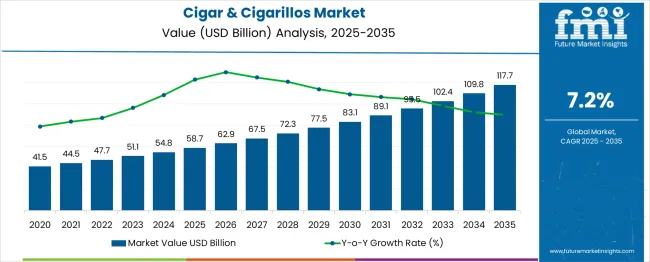
As Niels Frederiksen, CEO of Scandinavian Tobacco Group, noted regarding operating through volatility, “2024 was another challenging year with a volatile business environment, but for the first time, we reported net sales exceeding DKK 9 billion”. [1]
China (9.7% CAGR) and India (9.0% CAGR) lead growth on luxury gifting culture and the spread of specialist retail, while Germany (8.3%) and France (7.6%) gain from premiumisation within regulated channels. The United Kingdom (6.8%) and the United States (6.1%) generate replacement and trading-up demand, constrained by tax rises, packaging moves, and regulatory uncertainty around premium cigars. Brazil (5.4%) grows at a slower pace as enforcement intensity and price sensitivity shape category mix.
Market Definition
The cigar and cigarillos market covers the global production, trade, and retail sales of tobacco products rolled in tobacco leaf or tobacco-based wrappers, ranging from machine-made cigarillos to handmade premium cigars. Demand is tied to adult consumer use in social settings, leisure, gifting, and specialist lounge consumption. The market spans mass and premium positioning, flavoured and unflavoured variants, and offline and online retail routes, within country-specific rules on packaging, health warnings, taxation, and product presentation.
Market inclusions
This report covers global and regional market sizing for 2026 to 2036, with a 2025 base year reference, and forecast revenue estimates by product outlook, flavour outlook, distribution channel outlook, and region. The analysis includes country-wise growth rates for leading markets, category mix commentary (mass vs premium), and regulatory and tax factors that shape pricing and availability across retail formats.
Market exclusions
The scope excludes cigarettes, heated tobacco sticks, e-cigarettes, nicotine pouches, and cannabis-derived smoking products. It also omits tobacco farming and primary leaf processing economics, focusing on finished cigars and cigarillos sold through consumer channels. Illicit trade volumes are not sized as a standalone market; the analysis treats enforcement and illicit displacement as a demand risk factor where relevant.
Cigar & Cigarillos Market Research methodology
- Primary Research: FMI conducts interviews with distributors, tobacconists, duty-free operators, brand owners, and compliance professionals focused on excise, packaging, and channel rules.
- Desk Research: The model uses official tax, customs, and health agency publications, court and consultation documents, and company filings and press releases.
- Market-sizing and forecasting: FMI applies a hybrid approach combining category revenue baselines with country-level growth assumptions linked to price mix, channel reach, and regulatory impacts.
- Data validation and update cycle: Forecast outputs are triangulated against multi-source checks (policy updates, company disclosures, and official statistics) and refreshed when major excise or packaging actions shift pricing or availability.
Segmental Analysis
Cigar & Cigarillos Market Analysis by product outlook
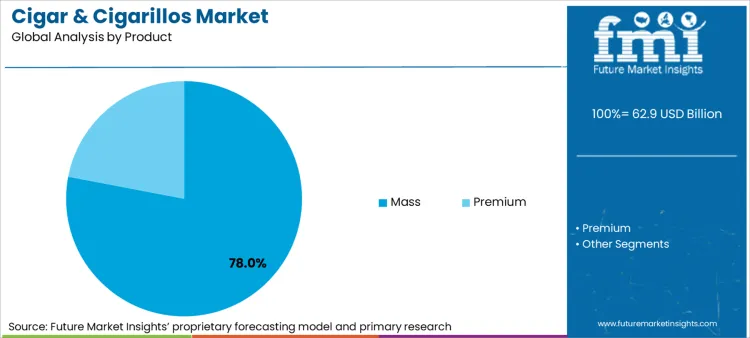
Based on FMI’s cigar & cigarillos market report, consumption of Mass products is estimated to hold 78% share in 2025. Mass cigarillos dominate because they sit at accessible price points, fit convenience-led shopping missions, and benefit from established distributor coverage across high-frequency outlets.
- Scale and footprint: Swisher describes its Jacksonville operation as a large-scale cigar manufacturing base, supporting consistent supply for mass-market cigarillos and national distribution programmes. [5]
- Portfolio repositioning: Scandinavian Tobacco Group’s public reporting points to active investment and turnaround focus in its machine-rolled cigar business, signalling ongoing attention to mass cigar segments. [1]
- Retail compliance pull-through: UK work on standardised packaging increases the compliance burden for branded pack formats, which tends to favour scaled players that can spread redesign and printing costs. [2]
Cigar & Cigarillos Market Analysis by flavor outlook
Based on FMI’s cigar & cigarillos market report, consumption of Flavored variants is estimated to hold 52% share in 2025. Flavoured cigarillos lead because they widen trial, support repeat purchase through taste variety, and work well in small-pack formats that suit convenience and impulse buying.
- Local and state restriction risk (USA): Public policy tracking on flavoured tobacco sales restrictions keeps flavoured cigars in scope for future sales limits, shaping SKU strategy and channel selection. [6]
- Packaging and warning evolution (UK): The UK call for evidence links standardised packaging to public health goals and references current warning treatment for cigar formats, which can affect flavoured lines that rely on branding cues. [2]
- Price-setting and listed products (France): French official price documentation includes cigar and cigarillo listings and supports the reality of regulated retail pricing environments where flavour-led SKUs compete on value and availability. [7]
Cigar & Cigarillos Market Drivers, Restraints, Opportunities
Future Market Insights analysis links the category’s growth pattern to premiumisation and channel expansion that lift value even when unit growth is uneven. In mature markets, excise and display rules steer buying toward fewer, higher-priced packs, while duty-free and specialist lounges support premium cigars as a gifting and occasion-led purchase.
Pricing and compliance are the main tensions shaping the next decade. Moves toward standardised packaging and stronger warning placement for cigar formats increase redesign cadence and raise unit costs, while regulatory uncertainty around premium cigar treatment in the United States creates planning friction for importers and brand owners. UK policy work on standardised packaging explicitly cites gaps for large cigars and individually wrapped cigars. [2]
- Standardised packaging pressure: Consultation work in the UK targets standardised packs across tobacco products and highlights weaker warning requirements for some cigar formats, which can change pack economics and merchandising. [2]
- Premium cigar rule uncertainty (USA): FDA materials and related court actions have kept the definition and treatment of “premium cigars” in focus, shaping compliance planning and reporting obligations. [3]
- Excise-led price mix (EU): Tax and duty structures, reinforced through national price-setting actions, keep retail prices moving and favour portfolio strategies that protect margin per stick. [4]
Regional Analysis
The market is assessed across North America, Europe, Asia Pacific, Latin America, and the Middle East & Africa, with country-level attractiveness analysis used to map where premiumisation, tax policy, and packaging rules are most likely to shift value pools over the forecast horizon.
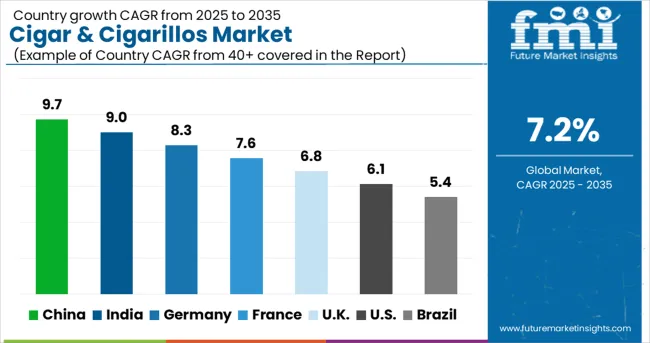
| Countries | CAGR (2026 to 2036) |
|---|---|
| China | 9.7% |
| India | 9.0% |
| Germany | 8.3% |
| France | 7.6% |
| United Kingdom | 6.8% |
| United States | 6.1% |
| Brazil | 5.4% |
Source: Future Market Insights (FMI) analysis, based on proprietary forecasting model and primary research
North America market analysis
North America is a high-value market shaped by specialist retail networks, premium imports, and a regulatory environment that influences product definitions and reporting. The competitive set includes Philip Morris International’s Swedish Match portfolio, Swisher International, and multinational tobacco groups with cigarillo ranges, with price mix and compliance planning driving portfolio decisions.
- United States: Demand for cigars and cigarillos in the United States is projected to rise at 6.1% CAGR through 2036. A central market driver is the breadth of retail access across tobacconists, convenience, and online discovery, while the primary constraint is policy uncertainty for premium cigars. FDA’s premium cigar materials reference litigation outcomes and confirm that the “premium cigar” question has been a live compliance topic, shaping how manufacturers plan reporting, user-fee classifications, and product documentation. [3] At the same time, state and local flavour-restriction momentum keeps flavoured cigarillos under scrutiny, which pushes brand owners to plan region-specific assortments and pack formats. [6]
FMI’s analysis of cigar and cigarillos market in North America consists of country-wise assessment that includes the United States and Canada. Readers can find channel-wise demand shifts, price-mix effects under excise, and the regulatory variables that influence premium cigars and flavoured cigarillos.
Europe market analysis
Europe functions as a compliance-intensive value pool where excise, pack rules, and regulated retail pricing shape brand strategy. Major players active in the region include Imperial Brands-linked Habanos distribution interests, Scandinavian Tobacco Group, and Oettinger Davidoff, with premium cigars supported by tobacconists and duty-free, and cigarillos supported by convenience-led channels.
- Germany: Demand for cigars and cigarillos in Germany is projected to rise at 8.3% CAGR through 2036. While Germany is a mature tobacco market, value growth can persist through premiumisation and price mix inside regulated channels. Official statistics show that taxed sales of cigars and cigarillos declined by 6.6% to 2.1 billion units in 2025, a signal that pricing, substitution, and consumption moderation influence unit trends even when premium categories hold interest. [8] This environment tends to push manufacturers toward fewer, higher-margin SKUs and stronger origin and authenticity cues in premium cigars sold via specialist outlets.
- France: Demand for cigars and cigarillos in France is projected to rise at 7.6% CAGR through 2036. France’s market mechanics are strongly influenced by price-setting and tax policy, with tobacco pricing actions communicated through public channels and supported by official notices on tobacco price rises. [9] Legifrance provides product-group price references, including a category line for “cigares et cigarillos”, reinforcing the reality of structured pricing context for the segment. [4] For suppliers, this environment rewards portfolio discipline and strong distribution through licensed channels, while premium cigars benefit from gifting culture and specialist tobacconists in major cities.
United Kingdom: Demand for cigars and cigarillos in the United Kingdom is projected to rise at 6.8% CAGR through 2036. The UK’s growth profile is shaped by premium cigar retail in major urban centres alongside tightening policy expectations on packaging and product presentation. The Department of Health and Social Care’s call for evidence on standardised packaging explicitly covers all tobacco products and notes the current warning treatment gap for some cigar formats, which can change pack design and merchandising rules over time. [2] For brand owners and retailers, this shifts focus toward compliance-ready packaging, slower-moving premium lines with stronger unit economics, and curated assortments that match evolving display conditions.
FMI’s analysis of cigar and cigarillos market in Europe consists of country-wise assessment that includes Germany, France, the United Kingdom, Italy, Spain, and BENELUX. Readers can find excise-driven price scenarios, pack-compliance tracking, and premium channel demand mapping across leading economies.
Asia Pacific market analysis
Asia Pacific is the fastest growth region, driven by luxury gifting demand, premium imports, and the spread of specialist retail in major cities. Global and regional players compete through distributor networks, duty-free placement, and premium brand storytelling, while local policy and customs treatment shape availability and pricing.
- China: Demand for cigars and cigarillos in China is projected to rise at 9.7% CAGR through 2036. Growth is supported by premium gifting occasions, the rise of cigar lounges in top-tier cities, and a broader set of imported and domestic premium offerings. Corporate disclosures from China Tobacco International, including transaction and supply arrangements reported through HKEX, point to active management of the tobacco supply chain and imported product flows that support premium category development. [10] Retail access is also influenced by policy and customs conditions that shape how imported cigars reach duty-free and specialist channels, making distributor capability a decisive factor.
- India: Demand for cigars and cigarillos in India is projected to rise at 9.0% CAGR through 2036. Growth is concentrated in metropolitan markets where luxury retail, gifting culture, and premium hospitality settings support cigar consumption. The compliance environment remains strict: India’s tobacco packaging and labelling framework is reinforced through government communications tied to large health warnings, shaping pack design, import compliance, and retail presentation for tobacco products sold legally. [11]
FMI’s analysis of cigar and cigarillos market in Asia Pacific consists of country-wise assessment that includes China, India, Japan, South Korea, and ASEAN. Readers can find duty-free and specialist retail demand signals, premium import dynamics, and policy-linked constraints that shape product availability.
Latin America market analysis
Latin America combines premium cigar heritage with uneven purchasing power and strict advertising constraints. Brazil anchors regional volumes and value, with premium cigars supported by specialist stores and gifting, while mass cigarillos compete on price and access in regulated retail settings.
- Brazil: Demand for cigars and cigarillos in Brazil is projected to rise at 5.4% CAGR through 2036. Growth is moderated by price sensitivity and tobacco control intensity, which shape marketing freedom and retail visibility. Brazil’s tobacco control framework includes packaging and product regulation oversight, and ANVISA’s tobacco-focused regulatory materials signal ongoing attention to product compliance requirements in the legal market. [12] WHO FCTC country information also frames Brazil’s policy posture on tobacco control, which influences how brands plan distribution, packaging, and consumer communication within legal limits. [13]
FMI’s analysis of cigar and cigarillos market in Latin America consists of country-wise assessment that includes Brazil, Chile, and the Rest of Latin America. Readers can find channel development signals, compliance constraints, and premium cigar demand mapping tied to urban consumption patterns.
Competitive Aligners for Market Players
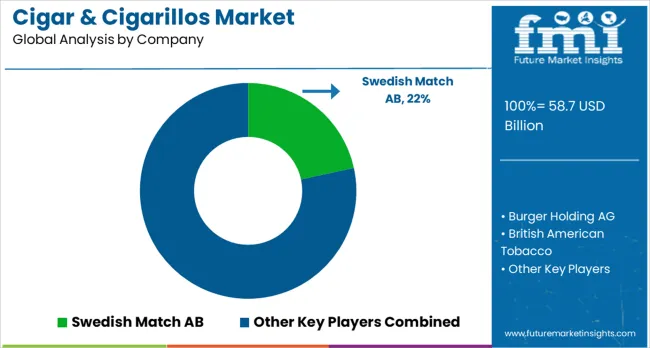
The cigar and cigarillos market remains competitive with a mix of large tobacco groups and specialist cigar houses. Concentration is higher in mass cigarillos because scale manufacturing and distributor control matter, while premium cigars are more fragmented due to brand heritage, origin, and limited-edition strategies. Competitive advantage is shaped by access to wrapper leaf supply, manufacturing footprint, and retailer relationships in regulated channels.
Scaled players hold structural advantages in packaging change management and excise-driven price resets. Standardised pack discussions and stronger warning placement raise redesign cadence, which favours companies that can execute label changes quickly and manage printing and inventory write-offs. Specialist premium players compete through authenticity, ageing, and controlled allocations that protect unit margins.
Buyer leverage differs by channel. Convenience and wholesale buyers push for reliable fill rates and price support, with promotions constrained by tobacco rules. Specialist tobacconists and lounges exert influence through shelf placement, education, and curated selections, making trade terms and exclusives a lever for premium brands. Where online channels are permitted, age-gating and compliant fulfilment become part of the competitive bar.
Recent developments:
- July 2024: Scandinavian Tobacco Group completed the acquisition of Mac Baren Tobacco Company, expanding its presence in smoking tobacco and related categories that sit adjacent to machine-rolled cigarillo portfolios. [14]
- June 2024: Swisher marked its Jacksonville centennial, reinforcing its scale footprint behind machine-rolled cigar and cigarillo supply in the United States. [5]
- September 2024: British American Tobacco set out its delivery plan under its corporate ambition to build a “Smokeless World”, signalling continued portfolio steering across combustible and non-combustible categories under tightening regulation. [15]
Key Players in Cigar & Cigarillos Market
- Swedish Match AB (Philip Morris International Inc.)
- Burger Söhne Holding AG
- British American Tobacco p.l.c.
- Gurkha Cigars
- JT International S.A. (Japan Tobacco Inc.)
- Imperial Brands PLC
- Habanos, S.A.
- Oettinger Davidoff AG
- Scandinavian Tobacco Group A/S
- Philip Morris International Inc.
- Swisher International, Inc.
Scope of the Report
| Metric | Value |
|---|---|
| Quantitative units | USD 62.9 billion (2026) to USD 126.1 billion (2036), at a CAGR of 7.2% |
| Market definition | The cigar & cigarillos market covers global production, trade, and retail sales of cigars and cigarillos, including mass and premium variants sold through offline and online channels, with category value shaped by excise, packaging, health-warning compliance, and product presentation rules across countries. |
| Product outlook | Mass; Premium |
| Flavor outlook | Flavored; Unflavored |
| Distribution channel outlook | Offline; Online |
| Regions covered | North America; Europe; Asia Pacific; Latin America; Middle East & Africa |
| Countries covered | United States; Canada; Mexico; Germany; United Kingdom; France; Italy; Spain; Nordic; BENELUX; Rest of Europe; China; Japan; South Korea; India; ASEAN; Australia & New Zealand; Rest of Asia Pacific; Brazil; Chile; Rest of Latin America; Kingdom of Saudi Arabia; Other GCC Countries; Turkiye; South Africa; Other African Union; Rest of Middle East & Africa; and 40 plus countries |
| Key companies profiled | Swedish Match AB (Philip Morris International Inc.); Burger Söhne Holding AG; British American Tobacco p.l.c.; Gurkha Cigars; JT International S.A. (Japan Tobacco Inc.); Imperial Brands PLC; Habanos, S.A.; Oettinger Davidoff AG; Scandinavian Tobacco Group A/S; Philip Morris International Inc.; Swisher International, Inc. |
| Additional attributes | Dollar sales and forecast by product outlook, flavour outlook, and distribution channel; regional demand and pricing environment tracking; excise and packaging impact assessment; consumer trading-up and premiumisation mapping; duty-free and specialist retail influence; competitive landscape and company positioning assessment; country attractiveness benchmarking. |
| Forecast period | 2026 to 2036 |
| Approach | Hybrid market sizing using top-down category baselines and bottom-up triangulation by country/channel mix, with explicit treatment of excise, packaging, and compliance variables; validated through primary interviews and public policy and statistical sources. |
Cigar & Cigarillos Market Analysis by Segments
Product outlook:
- Mass
- Premium
Flavor outlook:
- Flavored
- Unflavored
Distribution channel outlook:
- Offline
- Online
Region:
- North America:
- United States
- Canada
- Mexico
- Europe:
- Germany
- United Kingdom
- France
- Italy
- Spain
- Nordic
- BENELUX
- Rest of Europe
- Asia Pacific:
- China
- Japan
- South Korea
- India
- ASEAN
- Australia & New Zealand
- Rest of Asia Pacific
- Latin America:
- Brazil
- Chile
- Rest of Latin America
- Middle East & Africa:
- Kingdom of Saudi Arabia
- Other GCC Countries
- Turkiye
- South Africa
- Other African Union
- Rest of Middle East & Africa
Bibliography
- [1] Scandinavian Tobacco Group A/S. (2025, March). CEO statement in company announcement (Q4/FY 2024).
- [2] UK Department of Health and Social Care. (2024, November). Standardised packaging for all tobacco products (call for evidence).
- [3] USA Food & Drug Administration. (2025). Premium cigars (compliance/enforcement policy).
- [4] Légifrance. (2025, February). Arrêté du 23 janvier 2025 constatant les prix moyens pondérés (incluant cigares et cigarillos).
- [5] Swisher International, Inc. (2024, June). Swisher celebrates Jacksonville centennial [Press release].
- [6] Truth Initiative. (2025). Flavored tobacco sales restrictions [Policy tracker report].
- [7] Direction générale des douanes et droits indirects. (2025, May). Arrêté du 9 mai 2025: Prix homologués (cigares et cigarillos listings).
- [8] German Federal Statistical Office (Destatis). (2026, January). Sales of tobacco products in 2025: Cigarette tax revenue up 0.2% on a year earlier.
- [9] Service-Public.fr. (2024, December). Tobacco prices set to rise in 2025 (decree of 10 December 2024).
- [10] Hong Kong Exchanges and Clearing Limited. (2024, October). China Tobacco International (HK): Company disclosure (connected transactions/supply arrangements).
- [11] National Tobacco Control Programme (India). (2024, December). Packaging and labelling compliance guidance / health warning communication [Government notice].
- [12] Agência Nacional de Vigilância Sanitária (ANVISA). (2026, February). Tabaco [Regulatory information portal].
- [13] World Health Organization. (2026, February). WHO FCTC implementation database: Brazil country information.
- [14] Scandinavian Tobacco Group A/S. (2024, July). Completion of acquisition of Mac Baren Tobacco Company [Company announcement].
- [15] British American Tobacco p.l.c. (2024, September). BAT sets out its delivery plan to build a Smokeless World [Press release].
This bibliography is provided for reader reference and is not exhaustive. The full report contains the complete reference list and detailed citations.
This Report Addresses
- Market size and forecast for 2026 to 2036 with 2025 baseline anchoring and CAGR reconciliation
- Segment-wise forecasts by product outlook, flavour outlook, and distribution channel outlook
- Country attractiveness assessment with growth rate comparison across leading demand centres
- Competitive structure analysis with positioning levers across mass cigarillos and premium cigars
- Policy and compliance tracking for packaging, warnings, and category definitions affecting cigars
- Pricing and excise impact assessment on pack formats, portfolio mix, and retailer economics
- Channel analysis across specialist retail, duty-free, convenience, and compliant online routes
Frequently Asked Questions
How large is the cigar & cigarillos market in 2025?
The global cigar & cigarillos market is estimated at USD 58.7 billion in 2025.
What is the cigar & cigarillos market size in 2026?
Based on FMI’s outlook, the market is estimated to reach USD 62.9 billion in 2026.
What will be the size of the cigar & cigarillos market in 2036?
The market is projected to reach USD 126.1 billion by 2036.
What is the expected CAGR for 2026 to 2036?
FMI projects a 7.2% CAGR over the 2026 to 2036 forecast period.
How much absolute growth is expected from 2026 to 2036?
The market is expected to expand by USD 63.2 billion from 2026 to 2036.
Which product outlook segment leads the market?
Mass products lead, estimated at 78% share in 2025.
Which flavour segment holds the larger share?
Flavored variants lead, estimated at ~52% share in 2025.
Which distribution channel accounts for the larger sales share?
Offline channels lead due to specialist tobacconists, licensed retail, and duty-free dominance in many markets.
Which country is projected to grow fastest?
China leads with 9.7% CAGR through 2036.
What is the growth outlook for India?
India is projected to expand at 9.0% CAGR through 2036.
What is the growth outlook for Germany?
Germany is projected to expand at 8.3% CAGR through 2036.
What is the growth outlook for France?
France is projected to expand at 7.6% CAGR through 2036.
What is the growth outlook for the United Kingdom?
The United Kingdom is projected to expand at 6.8% CAGR through 2036.
What is the growth outlook for the United States?
The United States is projected to expand at 6.1% CAGR through 2036.
What is the growth outlook for Brazil?
Brazil is projected to expand at 5.4% CAGR through 2036.
What is the leading growth region?
Asia Pacific leads growth, anchored by China and India’s premiumisation and specialist retail expansion.
Why does the mass segment retain dominance despite premiumisation?
Mass cigarillos sustain dominance through price accessibility, high-frequency retail placement, and reliable supply economics.
What is the main restraint in mature markets?
The main restraint is the combined effect of excise pressure and packaging or warning changes that raise compliance costs and reshape retail presentation.
What will most influence portfolio strategy through 2036?
Pack-format compliance, excise-driven price resets, and flavour-related restrictions will most influence SKU rationalisation and channel strategy.
Which segment is most exposed to policy risk?
Flavoured cigarillos carry higher policy exposure because flavour-led product differentiation is a common target for sales restrictions and tighter retail rules.
Preview the report firsthand - request a free sample
Get SampleGet the brochure for pricing and purchase details.
Get PDFTable of Content
- Executive Summary
- Global Market Outlook
- Demand-side Trends
- Supply-side Trends
- Technology Roadmap Analysis
- Analysis and Recommendations
- Market Overview
- Market Coverage / Taxonomy
- Market Definition / Scope / Limitations
- Research Methodology
- Chapter Orientation
- Analytical Lens and Working Hypotheses
- Market Structure, Signals, and Trend Drivers
- Benchmarking and Cross-market Comparability
- Market Sizing, Forecasting, and Opportunity Mapping
- Research Design and Evidence Framework
- Desk Research Programme (Secondary Evidence)
- Company Annual and Sustainability Reports
- Peer-reviewed Journals and Academic Literature
- Corporate Websites, Product Literature, and Technical Notes
- Earnings Decks and Investor Briefings
- Statutory Filings and Regulatory Disclosures
- Technical White Papers and Standards Notes
- Trade Journals, Industry Magazines, and Analyst Briefs
- Conference Proceedings, Webinars, and Seminar Materials
- Government Statistics Portals and Public Data Releases
- Press Releases and Reputable Media Coverage
- Specialist Newsletters and Curated Briefings
- Sector Databases and Reference Repositories
- FMI Internal Proprietary Databases and Historical Market Datasets
- Subscription Datasets and Paid Sources
- Social Channels, Communities, and Digital Listening Inputs
- Additional Desk Sources
- Expert Input and Fieldwork (Primary Evidence)
- Primary Modes
- Qualitative Interviews and Expert Elicitation
- Quantitative Surveys and Structured Data Capture
- Blended Approach
- Why Primary Evidence is Used
- Field Techniques
- Interviews
- Surveys
- Focus Groups
- Observational and In-context Research
- Social and Community Interactions
- Stakeholder Universe Engaged
- C-suite Leaders
- Board Members
- Presidents and Vice Presidents
- R&D and Innovation Heads
- Technical Specialists
- Domain Subject-matter Experts
- Scientists
- Physicians and Other Healthcare Professionals
- Governance, Ethics, and Data Stewardship
- Research Ethics
- Data Integrity and Handling
- Primary Modes
- Tooling, Models, and Reference Databases
- Desk Research Programme (Secondary Evidence)
- Data Engineering and Model Build
- Data Acquisition and Ingestion
- Cleaning, Normalisation, and Verification
- Synthesis, Triangulation, and Analysis
- Quality Assurance and Audit Trail
- Market Background
- Market Dynamics
- Drivers
- Restraints
- Opportunity
- Trends
- Scenario Forecast
- Demand in Optimistic Scenario
- Demand in Likely Scenario
- Demand in Conservative Scenario
- Opportunity Map Analysis
- Product Life Cycle Analysis
- Supply Chain Analysis
- Investment Feasibility Matrix
- Value Chain Analysis
- PESTLE and Porter’s Analysis
- Regulatory Landscape
- Regional Parent Market Outlook
- Production and Consumption Statistics
- Import and Export Statistics
- Market Dynamics
- Global Market Analysis 2021 to 2025 and Forecast, 2026 to 2036
- Historical Market Size Value (USD Million) Analysis, 2021 to 2025
- Current and Future Market Size Value (USD Million) Projections, 2026 to 2036
- Y-o-Y Growth Trend Analysis
- Absolute $ Opportunity Analysis
- Global Market Pricing Analysis 2021 to 2025 and Forecast 2026 to 2036
- Global Market Analysis 2021 to 2025 and Forecast 2026 to 2036, By Product
- Introduction / Key Findings
- Historical Market Size Value (USD Million) Analysis By Product , 2021 to 2025
- Current and Future Market Size Value (USD Million) Analysis and Forecast By Product , 2026 to 2036
- Mass
- Premium
- Mass
- Y-o-Y Growth Trend Analysis By Product , 2021 to 2025
- Absolute $ Opportunity Analysis By Product , 2026 to 2036
- Global Market Analysis 2021 to 2025 and Forecast 2026 to 2036, By Flavour
- Introduction / Key Findings
- Historical Market Size Value (USD Million) Analysis By Flavour, 2021 to 2025
- Current and Future Market Size Value (USD Million) Analysis and Forecast By Flavour, 2026 to 2036
- Flavoured
- Unflavored
- Flavoured
- Y-o-Y Growth Trend Analysis By Flavour, 2021 to 2025
- Absolute $ Opportunity Analysis By Flavour, 2026 to 2036
- Global Market Analysis 2021 to 2025 and Forecast 2026 to 2036, By Region
- Introduction
- Historical Market Size Value (USD Million) Analysis By Region, 2021 to 2025
- Current Market Size Value (USD Million) Analysis and Forecast By Region, 2026 to 2036
- North America
- Latin America
- Western Europe
- Eastern Europe
- East Asia
- South Asia and Pacific
- Middle East & Africa
- Market Attractiveness Analysis By Region
- North America Market Analysis 2021 to 2025 and Forecast 2026 to 2036, By Country
- Historical Market Size Value (USD Million) Trend Analysis By Market Taxonomy, 2021 to 2025
- Market Size Value (USD Million) Forecast By Market Taxonomy, 2026 to 2036
- By Country
- USA
- Canada
- Mexico
- By Product
- By Flavour
- By Country
- Market Attractiveness Analysis
- By Country
- By Product
- By Flavour
- Key Takeaways
- Latin America Market Analysis 2021 to 2025 and Forecast 2026 to 2036, By Country
- Historical Market Size Value (USD Million) Trend Analysis By Market Taxonomy, 2021 to 2025
- Market Size Value (USD Million) Forecast By Market Taxonomy, 2026 to 2036
- By Country
- Brazil
- Chile
- Rest of Latin America
- By Product
- By Flavour
- By Country
- Market Attractiveness Analysis
- By Country
- By Product
- By Flavour
- Key Takeaways
- Western Europe Market Analysis 2021 to 2025 and Forecast 2026 to 2036, By Country
- Historical Market Size Value (USD Million) Trend Analysis By Market Taxonomy, 2021 to 2025
- Market Size Value (USD Million) Forecast By Market Taxonomy, 2026 to 2036
- By Country
- Germany
- UK
- Italy
- Spain
- France
- Nordic
- BENELUX
- Rest of Western Europe
- By Product
- By Flavour
- By Country
- Market Attractiveness Analysis
- By Country
- By Product
- By Flavour
- Key Takeaways
- Eastern Europe Market Analysis 2021 to 2025 and Forecast 2026 to 2036, By Country
- Historical Market Size Value (USD Million) Trend Analysis By Market Taxonomy, 2021 to 2025
- Market Size Value (USD Million) Forecast By Market Taxonomy, 2026 to 2036
- By Country
- Russia
- Poland
- Hungary
- Balkan & Baltic
- Rest of Eastern Europe
- By Product
- By Flavour
- By Country
- Market Attractiveness Analysis
- By Country
- By Product
- By Flavour
- Key Takeaways
- East Asia Market Analysis 2021 to 2025 and Forecast 2026 to 2036, By Country
- Historical Market Size Value (USD Million) Trend Analysis By Market Taxonomy, 2021 to 2025
- Market Size Value (USD Million) Forecast By Market Taxonomy, 2026 to 2036
- By Country
- China
- Japan
- South Korea
- By Product
- By Flavour
- By Country
- Market Attractiveness Analysis
- By Country
- By Product
- By Flavour
- Key Takeaways
- South Asia and Pacific Market Analysis 2021 to 2025 and Forecast 2026 to 2036, By Country
- Historical Market Size Value (USD Million) Trend Analysis By Market Taxonomy, 2021 to 2025
- Market Size Value (USD Million) Forecast By Market Taxonomy, 2026 to 2036
- By Country
- India
- ASEAN
- Australia & New Zealand
- Rest of South Asia and Pacific
- By Product
- By Flavour
- By Country
- Market Attractiveness Analysis
- By Country
- By Product
- By Flavour
- Key Takeaways
- Middle East & Africa Market Analysis 2021 to 2025 and Forecast 2026 to 2036, By Country
- Historical Market Size Value (USD Million) Trend Analysis By Market Taxonomy, 2021 to 2025
- Market Size Value (USD Million) Forecast By Market Taxonomy, 2026 to 2036
- By Country
- Kingdom of Saudi Arabia
- Other GCC Countries
- Turkiye
- South Africa
- Other African Union
- Rest of Middle East & Africa
- By Product
- By Flavour
- By Country
- Market Attractiveness Analysis
- By Country
- By Product
- By Flavour
- Key Takeaways
- Key Countries Market Analysis
- USA
- Pricing Analysis
- Market Share Analysis, 2025
- By Product
- By Flavour
- Canada
- Pricing Analysis
- Market Share Analysis, 2025
- By Product
- By Flavour
- Mexico
- Pricing Analysis
- Market Share Analysis, 2025
- By Product
- By Flavour
- Brazil
- Pricing Analysis
- Market Share Analysis, 2025
- By Product
- By Flavour
- Chile
- Pricing Analysis
- Market Share Analysis, 2025
- By Product
- By Flavour
- Germany
- Pricing Analysis
- Market Share Analysis, 2025
- By Product
- By Flavour
- UK
- Pricing Analysis
- Market Share Analysis, 2025
- By Product
- By Flavour
- Italy
- Pricing Analysis
- Market Share Analysis, 2025
- By Product
- By Flavour
- Spain
- Pricing Analysis
- Market Share Analysis, 2025
- By Product
- By Flavour
- France
- Pricing Analysis
- Market Share Analysis, 2025
- By Product
- By Flavour
- India
- Pricing Analysis
- Market Share Analysis, 2025
- By Product
- By Flavour
- ASEAN
- Pricing Analysis
- Market Share Analysis, 2025
- By Product
- By Flavour
- Australia & New Zealand
- Pricing Analysis
- Market Share Analysis, 2025
- By Product
- By Flavour
- China
- Pricing Analysis
- Market Share Analysis, 2025
- By Product
- By Flavour
- Japan
- Pricing Analysis
- Market Share Analysis, 2025
- By Product
- By Flavour
- South Korea
- Pricing Analysis
- Market Share Analysis, 2025
- By Product
- By Flavour
- Russia
- Pricing Analysis
- Market Share Analysis, 2025
- By Product
- By Flavour
- Poland
- Pricing Analysis
- Market Share Analysis, 2025
- By Product
- By Flavour
- Hungary
- Pricing Analysis
- Market Share Analysis, 2025
- By Product
- By Flavour
- Kingdom of Saudi Arabia
- Pricing Analysis
- Market Share Analysis, 2025
- By Product
- By Flavour
- Turkiye
- Pricing Analysis
- Market Share Analysis, 2025
- By Product
- By Flavour
- South Africa
- Pricing Analysis
- Market Share Analysis, 2025
- By Product
- By Flavour
- USA
- Market Structure Analysis
- Competition Dashboard
- Competition Benchmarking
- Market Share Analysis of Top Players
- By Regional
- By Product
- By Flavour
- Competition Analysis
- Competition Deep Dive
- Swedish Match AB
- Overview
- Product Portfolio
- Profitability by Market Segments (Product/Age /Sales Channel/Region)
- Sales Footprint
- Strategy Overview
- Marketing Strategy
- Product Strategy
- Channel Strategy
- Burger Söhne Holding AG
- British American Tobacco p.l.c.
- Gurkha Cigars
- JT International S.A. (Japan Tobacco Inc.)
- Imperial Brands PLC
- Habanos, S.A.
- Swedish Match AB
- Competition Deep Dive
- Assumptions & Acronyms Used


