

- Market Size (2026)
- USD 980.6 Mn
- Forecast (2036)
- USD 1691.0 Mn
- CAGR (2026 to 2036)
- 5.6%
How big is Clinker Cooler Plates Market in 2026?
USD 980.6 million in 2026 and USD 1,691.0 million by 2036 at a 5.6% CAGR.
Sales of clinker cooler plates are projected to rise at 5.6% CAGR through 2036. Market valuation is expected to increase from USD 980.6 million in 2026 to USD 1,691.0 million by 2036. Cement plants replace worn plates to preserve airflow and clinker transport during continuous kiln operation. Fuller separates material transport from air distribution within its Cross-Bar cooler design throughout continuous production. The arrangement connects waste heat generation with stable secondary-air recovery and predictable maintenance during production. Plant managers therefore assess plate condition beside fuel use and shutdown risk across integrated cement production lines at operating sites.
Plate geometry controls clinker transport and cooling-air passage across the hot bed during continuous kiln production. Poor dimensional fit can increase material fall-through and expose neighboring castings to uneven thermal stress during extended campaigns. Plant engineers compare gap tolerance and alloy selection beside heat recovery systems across cement plant operations during specification reviews. A stable arrangement supports predictable bed depth and better control over air entering secondary combustion zones. Maintenance teams must confirm mounting details and retained pattern records ahead of planned kiln stops. Drawing control reduces field modification and protects restart schedules across connected cooler rows during planned outages.
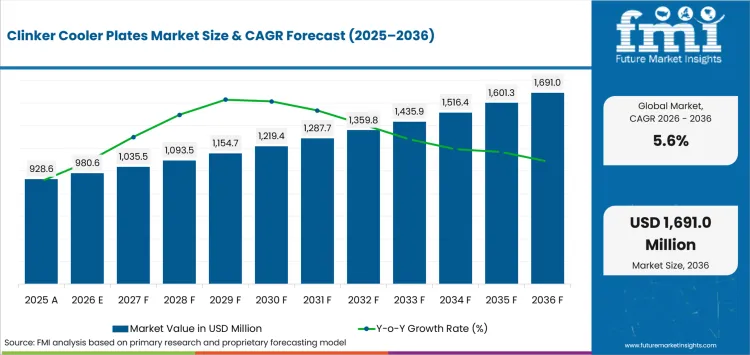
Key Takeaways of Clinker Cooler Plates Market
- Recurring plate replacement protects aeration control and stable heat transfer across continuously operating production lines.
- Grate plates are projected to account for 34.0% in 2026 due to use across cooler rows.
- Heat-resistant cast steel is estimated to represent 39.0% in 2026 owing to repeated thermal cycling.
- Grate coolers are forecast to capture 44.0% in 2026 driven by familiar modular maintenance routes.
- Custom patterns and alloy lead times delay shutdown work without early drawing approval and inventory confirmation.
- Fuller Technologies; IKN; KHD Humboldt Wedag; thyssenkrupp Polysius; Claudius Peters; Magotteaux; Unicast and Columbia Steel serve distinct system and casting requirements.
Analyst Perspective
"Plant operators should treat cooler plates as heat recovery components rather than interchangeable wear castings. A low bid creates little value if uncertain geometry extends the outage or weakens airflow during restart. Strong purchasing combines verified dimensions with suitable alloy selection and accountable installation support across the expected service interval."
- Nikhil Kaitwade, Principal Analyst, Future Market Insights
How is the Clinker Cooler Plates Market segmented?
The clinker cooler plates industry is segmented by plate type, material, cooler type, demand type, end use and region.
The clinker cooler plates market is organized by plate type and material to distinguish component geometry from metallurgical performance requirements. Cooler type distinguishes grate systems and alternative architectures through their respective material transport and air distribution arrangements across production lines. Demand type separates recurring replacement purchases from new fitment and retrofit projects across established or expanding cement production lines. End use identifies integrated cement plants alongside grinding units and mineral facilities with different exposure to cooler plate consumption. Regional analysis compares service access and operating conditions across global supply routes and preserves consistent category boundaries throughout the article for reporting.
Why do grate plates lead demand within the plate type category?
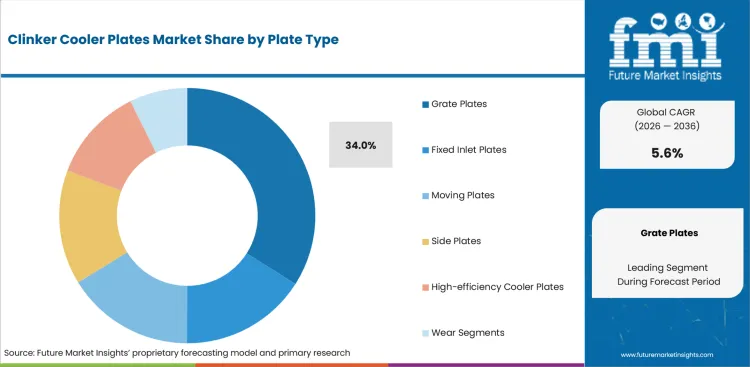
Grate plates carry hot clinker while calibrated openings distribute cooling air through the moving bed during continuous kiln production. IKN describes precision-machined Coanda Wing plates that direct air across the grate surface and promote heat transfer inside the clinker layer. The configuration connects abrasive wear control with stable secondary-air recovery and controlled material transport across the complete cooler support structure.
- By plate type, grate plates are estimated to hold 34.0% share in 2026 owing to installation across cooler rows. Their operating position carries clinker weight and repeated thermal loading throughout campaigns at integrated plants. Matched grate sets therefore remain central to planned replacement budgets across established cement production sites.
- Maintenance teams purchase matched plate sets after measuring gaps and inspecting support frames during planned kiln shutdowns. Accurate drawings preserve airflow balance across neighboring rows and reduce field modification during installation work. Plants retaining approved patterns can order repeat castings faster and limit emergency engineering during later maintenance campaigns globally.
Why does heat-resistant cast steel lead demand within the material category?
Repeated heating and cooling can distort plates lacking suitable high-temperature strength during prolonged cement production campaigns. Heat-resistant cast steel balances thermal stability with foundry cost across mainstream cooler zones and extended maintenance intervals at integrated plants. High-chrome and ceramic-coated alternatives remain concentrated in locations exposed to exceptional abrasion or temperature gradients throughout variable kiln output and demanding production conditions worldwide.
- By material, heat-resistant cast steel is forecast to represent 39.0% share in 2026 driven by thermal stability and cost. The alloy suits mainstream cooler zones that require repeatable dimensions under sustained hot clinker exposure. Premium coated alternatives remain concentrated in narrower high-abrasion applications with specialized installation and inspection requirements.
- Foundries use controlled chemistry and heat treatment practices to stabilize castings before machining mounting surfaces. Unicast lists ASTM A297 HH steel for cooler grates and Columbia Steel identifies heat-resistant alloys for parts. Plants should request material certificates and dimensional records since alloy labels cannot prove installed fit or service life.
Why do grate coolers lead demand within the cooler type category?
Grate coolers transport clinker across modular rows and distribute cooling air through controlled zones beneath the bed. The cooler forms part of the complete industrial furnace operation and requires balanced loading across every production campaign. KHD documents Pyrofloor² systems covering two thousand to fourteen thousand tons daily for retrofit and greenfield projects spanning varied cement production scales across active commercial installations worldwide.
- Grate coolers are set to lead cooler type with 44.0% share in 2026 due to modular maintenance routes. Row-based construction lets plant teams replace worn sections without rebuilding the complete cooler shell during outages. Alternative architectures retain specialized roles but grate systems anchor spare-parts planning across integrated kiln lines.
- Operators favor plate upgrades that fit beams and preserve fan arrangements during limited kiln outages. Magotteaux supplies grate designs for existing supports and provides alignment supervision throughout planned installation work. Plants can modernize wear surfaces without accepting the major capital exposure or commissioning schedule associated with complete cooler replacement programs.
Why do replacement and wear parts lead demand within the demand type category?
Cooler plates lose section thickness and dimensional accuracy during repeated exposure to hot abrasive clinker throughout continuous production campaigns. Fuller describes preventive maintenance and planned spare-part readiness as necessary for reliable cooler availability across every affected zone. Replacement work remains central to airflow control and protects surrounding beams plus sealing components from progressive wear during prolonged campaigns at active plants.
- In 2026, replacement and wear parts are expected to lead demand type with 61.0% share because wear recurs. Deferred plate changes can damage beams and sealing components across adjoining rows during continuous production campaigns. New cooler fitment follows capacity projects but established kiln lines require repeat replacement budgets annually.
- Plant stores reserve critical hot-zone plates and order matched sets around scheduled annual kiln stops. Regional stock and accurate drawing control reduce emergency freight costs but custom patterns extend manufacturing lead times. Producers retain approved pattern numbers so repeat orders require less engineering review and arrive before later planned outages.
Why do integrated cement plants lead demand within the end use category?
Integrated cement plants own kiln and cooler assets that create direct plate consumption inside complete clinker production sites. Claudius Peters supplies new coolers beside modification sets and components for several existing cooler types. The offer gives plant engineers a route to compare replacement work with broader process upgrades across varied production capacities and active operating layouts at cement sites worldwide.
- The integrated cement plants segment is likely to capture 74.0% share in 2026 attributable to direct cooler ownership. Engineering teams monitor outlet temperature and pressure loss beside kiln output across every operating shift. Grinding units without kilns have limited exposure to plate replacement during kiln-line shutdowns and maintenance campaigns.
- Larger integrated plants compare alloy life across production lines and negotiate planned replacement packages using retained technical records. Smaller lime or mineral plants need precise guidance because their coolers use narrower application-specific geometries. Central maintenance teams create repeat purchasing routes that support pattern retention and standardized inspections across several sites.
What are the drivers, restraints and opportunities in the Clinker Cooler Plates Market?
Driver: Heat recovery pressure raises the value of accurate aeration. Restraint: Custom castings require verified drawings and alloy lead time. Opportunity: Retrofit packages can combine plates with inspection and installation support.
- Driver: Cement plants protect fuel efficiency by maintaining airflow and clinker-bed control throughout production campaigns.
- Restraint: Equipment-specific patterns and specialty alloys can extend engineering schedules beyond planned kiln shutdown windows.
- Opportunity: Service-led retrofit packages reduce fit risk and shorten installation work during scheduled kiln outages.
Heat recovery pressure raises cooler plate replacement because damaged openings weaken air distribution across the clinker bed. Plants first assess whether degraded rows are reducing recuperation and secondary-air temperature during production at operating sites. IKN explains that replacing older cooler designs with grate coolers improves heat recovery and plant availability. The operating gain makes cooler inspection relevant to waste heat boiler performance and stable kiln firing across planned production campaigns.
Equipment-specific patterns materially slow cooler plate orders because each machine requires exact hole positions and mounting dimensions. Plant engineers must establish drawing ownership and revision control at operating sites before foundries prepare custom castings. Unicast lists replacement parts for several named cooler platforms and confirms the need for machine-specific fit. Machine-specific fit extends engineering review before pricing and broader steel supply conditions can push approved orders beyond scheduled kiln shutdown windows.
Service-led retrofit packages support revenue by combining cooler inspection with plate supply and installation responsibility. Cement plants need one accountable technical route for measurements and fit decisions during time-limited shutdown work. Claudius Peters states that cooler modifications can include capacity upgrades and waste heat recovery interface evaluation. Retained measurements and approved patterns reduce uncertainty during later campaigns and allow phased work without requiring complete cooler replacement across established production lines.
Which country CAGRs are profiled in the Clinker Cooler Plates Market?
|
Country |
CAGR |
|
United States |
6.2% |
|
Germany |
5.7% |
|
Japan |
5.2% |
|
Vietnam |
7.2% |
|
Brazil |
6.7% |
How do country-level CAGRs compare in the Clinker Cooler Plates Market?
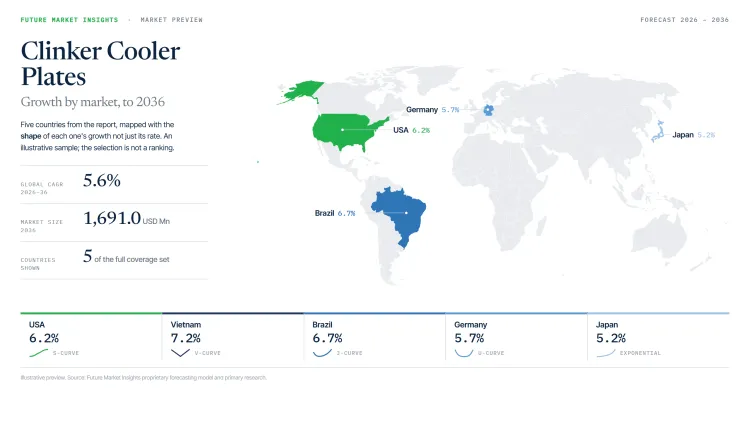
The five-country outlook forms a gradual progression rather than investment tiers across the assessment period. Vietnam and Brazil combine production recovery with maintenance requirements across dispersed cement assets nationally today. The United States follows through retrofit economics that directly connect energy recovery with shutdown planning. Germany and Japan remain replacement-led as mature plants prioritize engineering compatibility and longer approval cycles. The 2.0-percentage-point spread reflects routes to cooler plate purchases instead of uniform demand expansion. Service coverage and pattern ownership therefore produce commercial outcomes among countries reporting similar forecast momentum.
- Vietnam remains above Brazil as rising clinker output accompanies formal equipment reviews and structured maintenance deployment.
- Brazil trails Vietnam while cement sales recover but financing costs constrain comprehensive cooler modernization programs.
- The United States follows Brazil through established kiln assets and measurable waste heat recovery economics.
- Germany remains below the United States amid site-specific engineering requirements and coordinated modernization approval cycles.
- Japan trails Germany as clinker substitution tempers new loading but precision maintenance sustains replacement activity.
Comparable rates create different entry conditions since service distance and shutdown authority determine usable supply routes. The full report provides country-level CAGR analysis across North America, Latin America, Europe, East Asia, South Asia, Oceania and the Middle East and Africa.
Country-wise Analysis
- United States cement plants operate large kiln lines that value measurable heat recovery and nearby shutdown support. Clinker cooler plate demand is forecast to rise at 6.2% CAGR over the forecast period supported by retrofit economics. Plant managers need quantified energy benefits before assigning capital to replacement work across established kiln lines. In August 2025 the Department of Energy reported 2.0 net kilowatt-hours per ton from an Amrize thermoelectric validation and projected USD 241,000 annually. Measured savings strengthen capital review and established service networks enable field support, although long foundry distances restrict urgent orders at remote integrated plants.
- Germany applies plant-specific engineering to carbon capture and kiln modernization across its established cement production base. VDZ reported in March 2025 that capture technology selection depends on site conditions across multi-line facilities. Site-specific capture choices require detailed cooler surveys and compatible refractory systems ahead of formal equipment approvals. Germany’s clinker cooler plate outlook is anticipated to advance at 5.7% CAGR over the assessment period underpinned by precision retrofit work across established multi-line production sites. Premium engineering capacity enables accurate replacement but lengthy approvals and coordinated shutdown planning can delay component delivery across older production sites during extended modernization cycles nationwide.
- Japan expands low-carbon concrete use through public works while integrated plants maintain quality and reliability standards. Clinker substitution moderates new cooler loading but domestic engineering supports precise maintenance across existing plants during maintenance planning. Adoption of clinker cooler plates in Japan is estimated to expand at 5.2% CAGR through 2036 shaped by replacement activity. Japan’s infrastructure ministry stated in March 2025 that designated low-carbon concrete replaces 55% of Portland cement and reduces manufacturing emissions by about half. The substitution threshold moderates new cooler loading, although separate alloy validation can extend qualification periods for unfamiliar materials and nonstandard mounting arrangements during planned shutdowns.
- Vietnam operates a cement system combining high clinker output with uneven plant utilization and intense price competition. The operating mix requires formal equipment reviews at operating plants before companies commit to broader maintenance programs. The Ministry of Construction reported in July 2025 that VICEM produced 7.957 million tons of clinker during the first half and increased output by 6.5%. Vietnam is estimated to post 7.2% CAGR over the forecast period aided by smart maintenance deployment. Local engineering programs support structured replacement but overcapacity and constrained margins can favor lower-cost castings with weaker service accountability across regional plants.
- Brazil distributes cement production across broad regions which raises service and inventory requirements for replacement work. Clinker cooler plate sales in Brazil are forecast to expand at 6.7% CAGR by 2036 reinforced by production recovery. Infrastructure spending and masonry cement demand support kiln utilization across established integrated plants during active production campaigns. SNIC reported in December 2025 that national cement sales reached 67 million tons and increased by 3.7% during the year. Regional production enables recurring maintenance but high financing costs and long inland transport routes constrain comprehensive cooler retrofits outside major industrial centers during tight investment cycles.
Who are the notable companies in the Clinker Cooler Plates Market?
Fuller Technologies, IKN, KHD Humboldt Wedag, thyssenkrupp Polysius, Claudius Peters, Magotteaux, Unicast and Columbia Steel are the notable companies shaping this market.
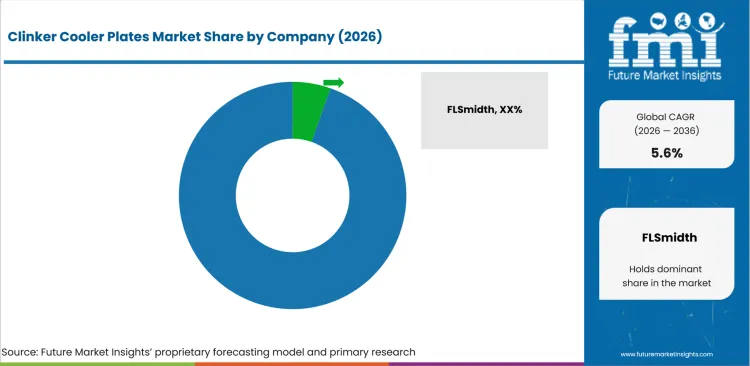
Competition is concentrated among a small group of integrated cooler builders at the system-engineering tier. The replacement-casting tier is more fragmented because metal casting capabilities let foundries enter installed-base platforms without supplying cooler controls. Entry scope depends on access to verified drawings and suitable high-temperature metallurgy across named machines. Integrated firms compete through performance accountability while specialists compete through response time and alloy life. Cement producers balance system accountability against regional availability throughout planned and emergency kiln shutdown programs worldwide.
- Fuller Technologies; IKN; KHD Humboldt Wedag; thyssenkrupp Polysius and Claudius Peters provide complete coolers or major retrofit systems. Their engineering connects proprietary plates with airflow control and service responsibility across operating machines and planned modernization projects during scheduled kiln outages.
- Magotteaux and Unicast focus on engineered grate plates plus compatible wear parts for existing cooler designs. Their casting routes address zone-specific abrasion while drawing accuracy and installation support determine shutdown performance across several cooler rows during scheduled kiln maintenance campaigns.
- Columbia Steel supports cement cooler parts through alloy selection and wear-part engineering from North American operations. Its narrower scope suits plants seeking casting expertise while retaining machine-level responsibility for installation and later process adjustment throughout North American kiln shutdown programs.
Competitive Benchmarking: Clinker Cooler Plates Market
|
Company |
Plate and Grate Engineering |
Complete Cooler Integration |
Lifecycle Service |
Geographic Reach |
|
Fuller Technologies |
High |
High |
High |
Global |
|
IKN |
High |
High |
High |
Europe, Americas and Asia |
|
KHD Humboldt Wedag |
High |
High |
High |
Global |
|
thyssenkrupp Polysius |
High |
High |
High |
Global |
|
Claudius Peters |
High |
High |
High |
Europe, Americas and Asia |
|
Magotteaux |
High |
Low |
Medium |
Global |
|
Unicast |
High |
Low |
Medium |
Global foundry network |
|
Columbia Steel |
Medium |
Low |
Medium |
North America |
Scoring basis: Plate and grate engineering rates high for dedicated platforms, medium for narrower engineering and low for one verified format. Complete cooler integration rates high for full systems, medium for retrofit modules and low for documented component-focused scope. Lifecycle service rates high for installation plus spares, medium for support and low for parts-focused service; geographic reach records verified regions.
Key Developments in the Clinker Cooler Plates Market
- In October 2025, Fuller reported that its Cross-Bar cooler at Shree Cement’s Nawalgarh plant regularly exceeded 13.5 thousand tons of clinker daily. The installation recovered around eight megawatts through waste heat recovery and operated above performance guarantees during production. Shree Cement’s order for two additional identical lines gives project teams a current reference for airflow stability and service planning at very high throughput.
- In November 2025, Pacific Avenue completed its acquisition of FLSmidth Cement and renamed the operating business Fuller Technologies. The completed transaction transferred intellectual property and manufacturing facilities alongside employees and global sales and service organizations into the independent company. Cement producers should use the Fuller identity for new cooler contracts while retaining FLSmidth Cement records for installed equipment and historical specifications.
- In November 2025, KHD Humboldt Wedag received a South Valley Cement modernization order covering a Pyrofloor² cooler and related pyroprocess equipment. KHD stated that the walking-floor design reduces pressure loss and supports energy-efficient cooling at the Egyptian plant. Replacement casting specialists must prove compatibility with proprietary floor modules and aeration components during subsequent scheduled maintenance campaigns at that operating facility in Egypt.
- In July 2026, thyssenkrupp Polysius helped inaugurate the Catch4Climate Pure Oxyfuel demonstration plant with capacity near 450 tons of clinker daily. The process feeds pure oxygen into the foremost cooler zone and routes heated gas toward the kiln burner. Cooler plate and sealing specifications therefore become part of oxyfuel engineering during commercial scale-up and later maintenance planning across future cement projects.
Clinker Cooler Plates Market - Report Scope
|
Coverage field |
Report scope |
|
Market breakdown |
By plate type, material, cooler type, demand type, end use and region. |
|
Quantitative Units |
USD million. |
|
Market Definition |
The market covers plate and grate components used inside clinker cooling systems for transport, aeration, heat recovery and wear replacement. |
|
Regions Covered |
North America, Latin America, Europe, East Asia, South Asia and Pacific and Middle East and Africa. |
|
Countries Covered |
United States, Germany, Japan, Vietnam and Brazil. |
|
Key Companies Profiled |
Fuller Technologies, IKN, KHD Humboldt Wedag, thyssenkrupp Polysius, Claudius Peters, Magotteaux, Unicast and Columbia Steel. |
|
Forecast Period |
2026-2036. |
|
Approach |
Primary and secondary research with market triangulation. |
Clinker Cooler Plates Market - Research Methodology
|
Method |
Approach |
|
Primary Research |
FMI analysts gathered input from manufacturers, service providers, technology developers, distributors, end users, procurement teams, and subject-matter experts. Interviews examined purchasing decisions, product or service evaluation, adoption barriers, approval requirements, pricing considerations, and expectations for technical or commercial support. Respondents were also asked what evidence is required before a trial, pilot, or initial order develops into regular purchasing. |
|
Desk Research |
Desk research covered government statistics, regulatory publications, trade data, industry associations, technical literature, standards, company filings, product information, and official corporate announcements. Sources were reviewed for relevance, publication date, geographic coverage, and consistency with the defined market scope. Claims relating to performance, applications, approvals, capacity, investment, and commercial activity were retained only when supported by credible public evidence. |
|
Market Sizing and Forecasting |
The market model combined the baseline value with historical performance, segment structure, pricing and volume indicators, adoption levels, company participation, and country-level demand conditions. Forecast assumptions considered economic activity, investment trends, regulatory developments, technology adoption, purchasing cycles, supply availability, and barriers to wider market use. Segment and regional estimates were reconciled before the final market total was calculated. |
|
Data Validation |
Estimates were checked against multiple independent indicators, including public data, company activity, trade patterns, industry developments, and findings from primary interviews. Validation also tested whether products, services, applications, and company revenues fell within the defined market boundaries. Adjacent categories, unsupported claims, overlapping revenues, and activities without direct market relevance were excluded to reduce double counting and maintain consistency across segments and countries. |
Clinker Cooler Plates Market by Segments
Clinker Cooler Plates Market segmented by Plate Type:
- Grate Plates
- Fixed Inlet Plates
- Moving Plates
- Side Plates
- High-efficiency Cooler Plates
- Wear Segments
Clinker Cooler Plates Market segmented by Material:
- Heat-resistant Cast Steel
- High Chrome Alloy
- Stainless Alloy
- Composite / Ceramic Coated
Clinker Cooler Plates Market segmented by Cooler Type:
- Grate Coolers
- Reciprocating Coolers
- Cross-bar Coolers
- Rotary Coolers
Clinker Cooler Plates Market segmented by Demand Type:
- Replacement / Wear Parts
- New Cooler Fitment
- Upgrade / Retrofit
Clinker Cooler Plates Market segmented by End Use:
- Integrated Cement Plants
- Grinding Units with Clinker Handling
- Lime / Mineral Plants
Clinker Cooler Plates Market by Region:
- North America
- United States
- Canada
- Latin America
- Brazil
- Chile
- Mexico
- Rest of Latin America
- Western Europe
- Germany
- United Kingdom
- Italy
- Spain
- France
- Nordics
- Benelux
- Rest of Western Europe
- Eastern Europe
- Russia
- Poland
- Hungary
- Balkan and Baltic States
- Rest of Eastern Europe
- East Asia
- China
- Japan
- South Korea
- South Asia and Pacific
- India
- ASEAN
- Australia and New Zealand
- Rest of South Asia and Pacific
- Middle East and Africa
- Kingdom of Saudi Arabia
- Other GCC Countries
- Türkiye
- South Africa
- Other African Union Countries
- Rest of Middle East and Africa
Research Sources and Bibliography
- United States Department of Energy. (2025, August 5). Amrize validation program.
- Verein Deutscher Zementwerke. (2025, March 24). Synergies in the integration of CO₂ capture systems on several production lines.
- Ministry of Land, Infrastructure, Transport and Tourism. (2025, March 14).
- Ministry of Construction of Vietnam. (2025, July 4). Tổng công ty Xi măng Việt Nam đẩy mạnh triển khai các mục tiêu, nhiệm vụ Quý III/2025.
- Sindicato Nacional da Indústria do Cimento. (2025, December). Preliminary results for December 2025.
- Fuller Technologies. (2025, October 1). Cooler than ever: How Shree Cement’s mega cooler is redefining efficiency and energy recovery.
- Fuller Technologies. (2025, November 3). Pacific Avenue’s acquisition of FLSmidth Cement closes; new company name and brand announced.
- KHD Humboldt Wedag. (2025, November 12). Humboldt Wedag GmbH has been awarded a modernization project for South Valley Cement.
- thyssenkrupp AG. (2026, July 9). Catch4Climate Pure Oxyfuel plant in Mergelstetten officially inaugurated - a milestone for low-carbon cement.
This bibliography is provided for reader reference and is not exhaustive. The full report contains the complete reference list and detailed citations
This Report Answers
- How large is the clinker cooler plates market in 2026 and 2036?
- Which operating conditions support clinker cooler plate replacement demand?
- Which plate and material segments hold the significant shares in 2026?
- How do cooler architecture and plate geometry shape commercial demand?
- Which operating condition creates the greatest adoption restraint?
- How do country growth rates differ for clinker cooler plates?
- Which companies serve the clinker cooler plates market?
- What should plants compare before approving a cooler plate order?
- How do service routes influence emergency and planned replacement work?
Frequently Asked Questions
How big is the Clinker Cooler Plates Market in 2026?
The clinker cooler plates market is valued at USD 980.6 million in 2026 and is forecast to reach USD 1691.0 million by 2036. Growth is supported by cement plants replacing worn plates to preserve airflow and clinker transport during continuous kiln operation.
What is the CAGR of the Clinker Cooler Plates Market from 2026 to 2036?
The clinker cooler plates market grows at a CAGR of 5.6% between 2026 and 2036, supported by integrated cement plants sustaining recurring replacement budgets once verified drawings and suitable alloy selection convert planned kiln shutdowns into repeat casting orders.
Which end use leads the Clinker Cooler Plates Market?
Integrated cement plants account for 74.0% of the clinker cooler plates market by end use in 2026, driven by direct kiln and cooler ownership that lets engineering teams monitor outlet temperature and pressure loss across every operating production shift.
How much will the Clinker Cooler Plates Market add between 2026 and 2036?
The clinker cooler plates market is set to add USD 710.4 million between 2026 and 2036, growing from USD 980.6 million to USD 1,691.0 million as cement plants sustain recurring plate replacement to protect heat recovery and airflow control worldwide.
Who are the leading companies in the Clinker Cooler Plates Market?
Eight companies lead the clinker cooler plates market, including Fuller Technologies, IKN, KHD Humboldt Wedag, thyssenkrupp Polysius, and Claudius Peters, competing through complete cooler systems, engineered grate plates, and alloy-specific casting support across integrated cement plant maintenance and modernization programs worldwide.
Preview the report firsthand - request a free sample
Get SampleGet the brochure for pricing and purchase details.
Get PDFTable of Content
- Key Takeaways
- Market Size and CAGR
- Top Growth Driver
- Fastest Growing Segment
- Leading Region
- Key Companies
- Emerging Opportunities
- Executive Summary
- Global Market Outlook
- Demand-side Trends
- Supply-side Trends
- Technology Roadmap Analysis
- Analysis and Recommendations
- Analyst Perspective (What is happening? Why now? What should investors know?)
- Key Questions Answered
- How large is the market?
- What is the CAGR?
- What are key trends?
- Which region dominates?
- Who are the leaders?
- Market Overview
- Market Coverage / Taxonomy
- Market Definition / Scope / Limitations
- Research Methodology
- Chapter Orientation
- Analytical Lens and Working Hypotheses
- Market Structure, Signals, and Trend Drivers
- Benchmarking and Cross-market Comparability
- Market Sizing, Forecasting, and Opportunity Mapping
- Research Design and Evidence Framework
- Desk Research Programme (Secondary Evidence)
- Expert Input and Fieldwork (Primary Evidence)
- Tooling, Models, and Reference Databases
- Data Engineering and Model Build
- Quality Assurance and Audit Trail
- Market Background
- Market Dynamics (Drivers, Restraints, Opportunity, Trends)
- Scenario Forecast (Optimistic, Likely, Conservative)
- Impact Analysis
- AI Impact
- Sustainability Impact
- Regulatory Impact
- Technology Impact
- Consumer / Buyer Analysis
- Purchase Drivers
- Adoption Barriers
- Buyer Journey
- Opportunity Map Analysis
- Product Life Cycle Analysis
- Supply Chain Analysis
- Investment Feasibility Matrix
- Value Chain Analysis
- PESTLE and Porter's Analysis
- Regulatory Landscape
- Regional Parent Market Outlook
- Production and Consumption Statistics
- Import and Export Statistics
- Global Market Analysis and Forecast, 2021 to 2036
- Historical Market Size Value (USD Million) Analysis, 2021 to 2025
- Current and Future Market Size Value (USD Million) Projections, 2026 to 2036
- Y-o-Y Growth Trend Analysis
- Absolute $ Opportunity Analysis
- Global Market Pricing Analysis, 2021 to 2036
- Global Market Analysis and Forecast, By Plate Type, 2021 to 2036
- Introduction / Key Findings
- Historical Market Size Value (USD Million) Analysis By Plate Type, 2021 to 2025
- Current and Future Market Size Value (USD Million) Analysis and Forecast By Plate Type, 2026 to 2036
- Grate Plates
- Fixed Inlet Plates
- Moving Plates
- Side Plates
- High-efficiency Cooler Plates
- Wear Segments
- Grate Plates
- Y-o-Y Growth Trend Analysis By Plate Type, 2021 to 2025
- Absolute $ Opportunity Analysis By Plate Type, 2026 to 2036
- Global Market Analysis and Forecast, By Material, 2021 to 2036
- Introduction / Key Findings
- Historical Market Size Value (USD Million) Analysis By Material, 2021 to 2025
- Current and Future Market Size Value (USD Million) Analysis and Forecast By Material, 2026 to 2036
- Heat-resistant Cast Steel
- High Chrome Alloy
- Stainless Alloy
- Composite / Ceramic Coated
- Heat-resistant Cast Steel
- Y-o-Y Growth Trend Analysis By Material, 2021 to 2025
- Absolute $ Opportunity Analysis By Material, 2026 to 2036
- Global Market Analysis and Forecast, By Cooler Type, 2021 to 2036
- Introduction / Key Findings
- Historical Market Size Value (USD Million) Analysis By Cooler Type, 2021 to 2025
- Current and Future Market Size Value (USD Million) Analysis and Forecast By Cooler Type, 2026 to 2036
- Grate Coolers
- Reciprocating Coolers
- Cross-bar Coolers
- Rotary Coolers
- Grate Coolers
- Y-o-Y Growth Trend Analysis By Cooler Type, 2021 to 2025
- Absolute $ Opportunity Analysis By Cooler Type, 2026 to 2036
- Global Market Analysis and Forecast, By Demand Type, 2021 to 2036
- Introduction / Key Findings
- Historical Market Size Value (USD Million) Analysis By Demand Type, 2021 to 2025
- Current and Future Market Size Value (USD Million) Analysis and Forecast By Demand Type, 2026 to 2036
- Replacement / Wear Parts
- New Cooler Fitment
- Upgrade / Retrofit
- Replacement / Wear Parts
- Y-o-Y Growth Trend Analysis By Demand Type, 2021 to 2025
- Absolute $ Opportunity Analysis By Demand Type, 2026 to 2036
- Global Market Analysis and Forecast, By End Use, 2021 to 2036
- Introduction / Key Findings
- Historical Market Size Value (USD Million) Analysis By End Use, 2021 to 2025
- Current and Future Market Size Value (USD Million) Analysis and Forecast By End Use, 2026 to 2036
- Integrated Cement Plants
- Grinding Units with Clinker Handling
- Lime / Mineral Plants
- Integrated Cement Plants
- Y-o-Y Growth Trend Analysis By End Use, 2021 to 2025
- Absolute $ Opportunity Analysis By End Use, 2026 to 2036
- Global Market Analysis and Forecast, By Region, 2021 to 2036
- Introduction
- Historical Market Size Value (USD Million) Analysis By Region, 2021 to 2025
- Current Market Size Value (USD Million) Analysis and Forecast By Region, 2026 to 2036
- North America
- Latin America
- Western Europe
- Eastern Europe
- East Asia
- South Asia and Pacific
- Middle East & Africa
- Market Attractiveness Analysis By Region
- North America Market Analysis and Forecast, By Country, 2021 to 2036
- Historical Market Size Value (USD Million) Trend Analysis By Market Taxonomy, 2021 to 2025
- Market Size Value (USD Million) Forecast By Market Taxonomy, 2026 to 2036
- By Country
- USA
- Canada
- By Plate Type
- By Material
- By Cooler Type
- By Demand Type
- By End Use
- By Country
- Market Attractiveness Analysis
- By Country
- By Plate Type
- By Material
- By Cooler Type
- By Demand Type
- By End Use
- Key Takeaways
- Latin America Market Analysis and Forecast, By Country
- Historical Market Size Value (USD Million) Trend Analysis By Market Taxonomy, 2021 to 2025
- Market Size Value (USD Million) Forecast By Market Taxonomy, 2026 to 2036
- By Country
- Brazil
- Mexico
- Chile
- Rest of Latin America
- By Plate Type
- By Material
- By Cooler Type
- By Demand Type
- By End Use
- By Country
- Market Attractiveness Analysis
- By Country
- By Plate Type
- By Material
- By Cooler Type
- By Demand Type
- By End Use
- Key Takeaways
- Western Europe Market Analysis and Forecast, By Country
- Historical Market Size Value (USD Million) Trend Analysis By Market Taxonomy, 2021 to 2025
- Market Size Value (USD Million) Forecast By Market Taxonomy, 2026 to 2036
- By Country
- Germany
- UK
- Italy
- Spain
- France
- Nordic
- BENELUX
- Rest of Western Europe
- By Plate Type
- By Material
- By Cooler Type
- By Demand Type
- By End Use
- By Country
- Market Attractiveness Analysis
- By Country
- By Plate Type
- By Material
- By Cooler Type
- By Demand Type
- By End Use
- Key Takeaways
- Eastern Europe Market Analysis and Forecast, By Country
- Historical Market Size Value (USD Million) Trend Analysis By Market Taxonomy, 2021 to 2025
- Market Size Value (USD Million) Forecast By Market Taxonomy, 2026 to 2036
- By Country
- Russia
- Poland
- Hungary
- Balkan & Baltic
- Rest of Eastern Europe
- By Plate Type
- By Material
- By Cooler Type
- By Demand Type
- By End Use
- By Country
- Market Attractiveness Analysis
- By Country
- By Plate Type
- By Material
- By Cooler Type
- By Demand Type
- By End Use
- Key Takeaways
- East Asia Market Analysis and Forecast, By Country
- Historical Market Size Value (USD Million) Trend Analysis By Market Taxonomy, 2021 to 2025
- Market Size Value (USD Million) Forecast By Market Taxonomy, 2026 to 2036
- By Country
- China
- Japan
- South Korea
- By Plate Type
- By Material
- By Cooler Type
- By Demand Type
- By End Use
- By Country
- Market Attractiveness Analysis
- By Country
- By Plate Type
- By Material
- By Cooler Type
- By Demand Type
- By End Use
- Key Takeaways
- South Asia and Pacific Market Analysis and Forecast, By Country
- Historical Market Size Value (USD Million) Trend Analysis By Market Taxonomy, 2021 to 2025
- Market Size Value (USD Million) Forecast By Market Taxonomy, 2026 to 2036
- By Country
- India
- ASEAN
- Australia & New Zealand
- Rest of South Asia and Pacific
- By Plate Type
- By Material
- By Cooler Type
- By Demand Type
- By End Use
- By Country
- Market Attractiveness Analysis
- By Country
- By Plate Type
- By Material
- By Cooler Type
- By Demand Type
- By End Use
- Key Takeaways
- Middle East & Africa Market Analysis and Forecast, By Country
- Historical Market Size Value (USD Million) Trend Analysis By Market Taxonomy, 2021 to 2025
- Market Size Value (USD Million) Forecast By Market Taxonomy, 2026 to 2036
- By Country
- Kingdom of Saudi Arabia
- Other GCC Countries
- Türkiye
- South Africa
- Other African Union
- Rest of Middle East & Africa
- By Plate Type
- By Material
- By Cooler Type
- By Demand Type
- By End Use
- By Country
- Market Attractiveness Analysis
- By Country
- By Plate Type
- By Material
- By Cooler Type
- By Demand Type
- By End Use
- Key Takeaways
- Key Countries Market Analysis
- USA
- Pricing Analysis
- Market Share Analysis, 2025
- By Plate Type
- By Material
- By Cooler Type
- By Demand Type
- By End Use
- Canada
- Pricing Analysis
- Market Share Analysis, 2025
- By Plate Type
- By Material
- By Cooler Type
- By Demand Type
- By End Use
- Mexico
- Pricing Analysis
- Market Share Analysis, 2025
- By Plate Type
- By Material
- By Cooler Type
- By Demand Type
- By End Use
- Brazil
- Pricing Analysis
- Market Share Analysis, 2025
- By Plate Type
- By Material
- By Cooler Type
- By Demand Type
- By End Use
- Chile
- Pricing Analysis
- Market Share Analysis, 2025
- By Plate Type
- By Material
- By Cooler Type
- By Demand Type
- By End Use
- Germany
- Pricing Analysis
- Market Share Analysis, 2025
- By Plate Type
- By Material
- By Cooler Type
- By Demand Type
- By End Use
- UK
- Pricing Analysis
- Market Share Analysis, 2025
- By Plate Type
- By Material
- By Cooler Type
- By Demand Type
- By End Use
- Italy
- Pricing Analysis
- Market Share Analysis, 2025
- By Plate Type
- By Material
- By Cooler Type
- By Demand Type
- By End Use
- Spain
- Pricing Analysis
- Market Share Analysis, 2025
- By Plate Type
- By Material
- By Cooler Type
- By Demand Type
- By End Use
- France
- Pricing Analysis
- Market Share Analysis, 2025
- By Plate Type
- By Material
- By Cooler Type
- By Demand Type
- By End Use
- India
- Pricing Analysis
- Market Share Analysis, 2025
- By Plate Type
- By Material
- By Cooler Type
- By Demand Type
- By End Use
- ASEAN
- Pricing Analysis
- Market Share Analysis, 2025
- By Plate Type
- By Material
- By Cooler Type
- By Demand Type
- By End Use
- Australia & New Zealand
- Pricing Analysis
- Market Share Analysis, 2025
- By Plate Type
- By Material
- By Cooler Type
- By Demand Type
- By End Use
- China
- Pricing Analysis
- Market Share Analysis, 2025
- By Plate Type
- By Material
- By Cooler Type
- By Demand Type
- By End Use
- Japan
- Pricing Analysis
- Market Share Analysis, 2025
- By Plate Type
- By Material
- By Cooler Type
- By Demand Type
- By End Use
- South Korea
- Pricing Analysis
- Market Share Analysis, 2025
- By Plate Type
- By Material
- By Cooler Type
- By Demand Type
- By End Use
- Russia
- Pricing Analysis
- Market Share Analysis, 2025
- By Plate Type
- By Material
- By Cooler Type
- By Demand Type
- By End Use
- Poland
- Pricing Analysis
- Market Share Analysis, 2025
- By Plate Type
- By Material
- By Cooler Type
- By Demand Type
- By End Use
- Hungary
- Pricing Analysis
- Market Share Analysis, 2025
- By Plate Type
- By Material
- By Cooler Type
- By Demand Type
- By End Use
- Kingdom of Saudi Arabia
- Pricing Analysis
- Market Share Analysis, 2025
- By Plate Type
- By Material
- By Cooler Type
- By Demand Type
- By End Use
- Türkiye
- Pricing Analysis
- Market Share Analysis, 2025
- By Plate Type
- By Material
- By Cooler Type
- By Demand Type
- By End Use
- South Africa
- Pricing Analysis
- Market Share Analysis, 2025
- By Plate Type
- By Material
- By Cooler Type
- By Demand Type
- By End Use
- USA
- Market Structure Analysis
- Competition Dashboard
- Competition Benchmarking
- Market Share Analysis of Top Players
- By Regional
- By Plate Type
- By Material
- By Cooler Type
- By Demand Type
- By End Use
- Emerging Startups
- Innovation Benchmarking
- Competition Analysis
- Competition Deep Dive
- FLSmidth
- Overview
- Product Portfolio
- Profitability by Market Segments
- Sales Footprint
- Strategy Overview
- Marketing Strategy
- Product Strategy
- Channel Strategy
- IKN
- Claudius Peters
- KHD Humboldt Wedag
- thyssenkrupp Polysius
- Magotteaux
- AIA Engineering
- Columbia Steel
- Unicast
- Hunan Hyster Material
- FLSmidth
- Case Studies
- Success Stories
- Recent Developments
- Competition Deep Dive
- Assumptions & Acronyms Used


